
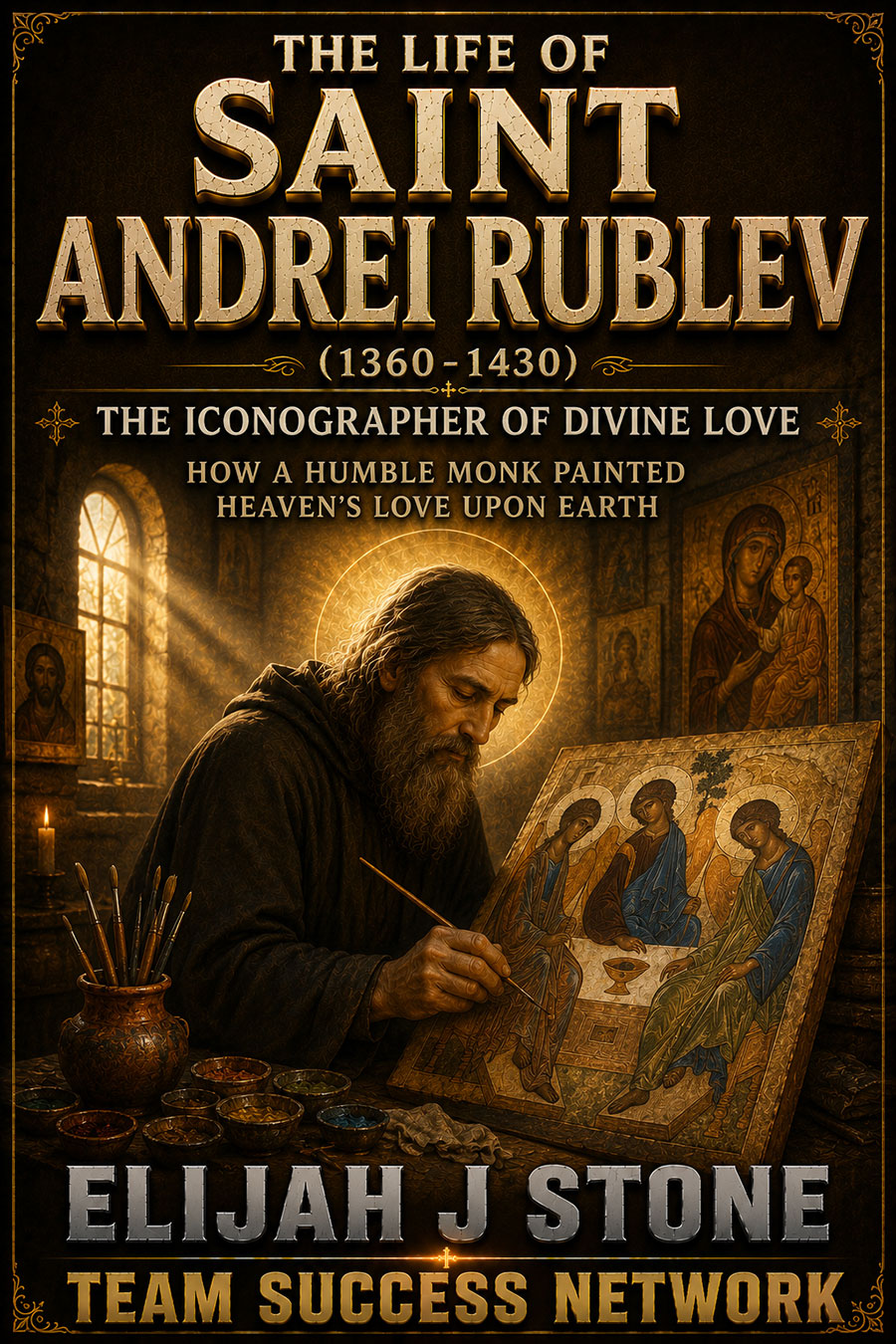
Book 103: Saint Andrei Rublev (c. 1360 - c. 1430) The Iconographer of Divine Love

The Life of Saint Andrei Rublev
How a Humble Monk Painted Heaven’s Love Upon Earth
By Mr. Elijah J Stone
and the Team Success Network
Table
of Contents
Part 1 – The Hidden
Preparation
Chapter 1 – The Child Who
Loved the Light
Chapter 2 – Silence Before
the Brush
Chapter 3 – The World That
Needed Peace
Chapter 4 – The Calling of
a Young Monk
Chapter 5 – Under the
Mantle of Saint Sergius
Part 2 – The Formation
of a Holy Artist
Chapter 6 – Learning from
Theophanes the Greek
Chapter 7 – The Art of
Prayerful Painting
Chapter 8 – Fasting,
Faith, and the Iconographer’s Discipline
Chapter 9 – The Colors of
Heaven
Chapter 10 – When Humility
Meets Divine Inspiration
Part 3 – The First
Icons and Early Masterpieces
Chapter 11 – The
Annunciation Cathedral Commission
Chapter 12 – The Light of
Vladimir
Chapter 13 – Painting the
Faces of the Saints
Chapter 14 – The Silence
Within the Studio
Chapter 15 – Icons That
Preached Without Words
Part 4 – The Trinity
and the Vision of Divine Love
Chapter 16 – The Passing
of Saint Sergius of Radonezh
Chapter 17 – The
Invitation to Paint Heaven
Chapter 18 – The Symbolism
of The Trinity Icon
Chapter 19 – The Circle of
Eternal Communion
Chapter 20 – The Icon That
Changed the World
Part 5 – The Later
Years of Prayer and Peace
Chapter 21 – The Life of
Stillness at Andronikov Monastery
Chapter 22 – The Savior
Cathedral Frescoes
Chapter 24 – The Last
Icons of Light
Chapter 25 – The Peaceful
Departure of the Saint
Part 6 – The Legacy of
Love Eternal
Chapter 26 – Canonization
and Eternal Memory
Chapter 27 – The Theology
of Beauty
Chapter 28 – The Spirit
That Paints Through the Pure
Chapter 29 – The Enduring
Power of Holy Art
Chapter 30 – Becoming
Icons of Divine Love Today
Part 1 – The Hidden Preparation
Before he
ever held a brush, Andrei Rublev’s soul was already being shaped for holiness.
Born in a world torn by war and uncertainty, he found peace in the quiet beauty
of candlelight and sacred worship. The church became his first classroom, and
silence his first teacher.
His heart
was drawn to stillness and prayer, long before he knew what divine art could
be. In quiet observation, he learned that beauty reveals truth, and that
reverence opens the eyes of the soul. These early impressions built the
foundation for a life that would reveal Heaven’s peace through color and form.
As he
entered monastic life, Rublev exchanged ambition for devotion. The monastery’s
rhythm of fasting, prayer, and humility molded him into a vessel of grace.
Every discipline prepared him for divine service.
Guided by
Saint Sergius of Radonezh, he absorbed the mystery of divine love and unity.
His preparation was not academic—it was spiritual. The hidden years became his
apprenticeship under Heaven itself, shaping a heart that would one day reflect
eternity through paint and prayer.

Chapter 1
– The Child Who Loved the Light
The Early Years of Wonder and Quiet Reverence
Discover how a young boy’s awe for light and
beauty became the foundation of divine artistry.
Introduction
– The Saint of Heavenly Peace
Among all
the saints of Russia, Saint Andrei Rublev (c. 1360–c. 1430) stands as
the most luminous painter of divine love. His life was quiet, his art serene,
and his soul transparent before God. He never sought fame or recognition, yet
his icons have become eternal prayers in color. Through stillness and humility,
he revealed Heaven’s gentleness to the world.
He is
remembered most for his masterpiece The Trinity, which radiates peace
and unity. But his sanctity began long before the brush ever touched gold. His
entire life expressed his most famous reflection:
“Where
there is love, there is the image of God.”
That
conviction was not a theory—it was his heartbeat from childhood. Before he
learned to paint, he learned to see.
The Dawn
Of A Gentle Soul
In the
quiet countryside near Moscow, Andrei Rublev’s early years unfolded in
simplicity. He was drawn to the sacred stillness of the village church, where
candles flickered beneath painted icons. The boy would stand motionless for
long moments, captivated by the tender faces of saints. Their eyes seemed to
look not at him, but into him.
He was not
fascinated by technique or detail, but by presence. Something within him
recognized holiness. The dance of light upon gold and color awakened a
reverence that words could not describe. From those earliest moments, the seed
of sacred art was planted in his heart.
Rublev’s
world was humble—fields, wooden homes, and a church that became the center of
life. In that setting, God trained his soul to notice beauty not as luxury, but
as revelation. He began to sense that all things, when pure, reflected divine
harmony. His heart became soft to wonder, ready for the Spirit’s touch.
“He who
keeps his heart pure will see the light of God even in a single ray of sun.”
These
early impressions of peace and purity prepared him for his lifelong calling: to
let the invisible shine through the visible.
The Hidden
Classroom Of Worship
While
others his age played in the fields, Andrei preferred the sanctuary. The toll
of bells and the fragrance of incense formed his education. The church became
his first studio, and prayer his first instructor. In the chant of monks, he
felt rhythm; in the flicker of flame, he saw motion; in the icons, he found
truth.
He was
being taught by the Spirit through beauty. The silence of worship shaped him
more deeply than any lecture could. Rublev’s art would one day radiate that
same silence—a peace that spoke louder than words.
Even
before he knew the principles of iconography, he understood its essence: that
holy art is not created but revealed through a pure heart. This early
reverence turned his soul into a vessel for divine reflection.
“The
painter must first cleanse the mirror of his heart before he paints the
saints.”
God was
training him through awe. Every candle, every prayer, every echo of sacred
chant etched eternal lines of peace upon his spirit.
Beauty As
The Voice Of God
For young
Andrei, beauty was never separate from holiness. He saw light as a living
voice—the language of God calling through creation. His love for icons was not
about their style, but their truth. He perceived that within each holy image
was a meeting point between Heaven and earth.
That
awareness made him deeply contemplative. Even in youth, he practiced the art of
stillness, letting beauty draw him inward toward the divine. Where others saw
art, he saw worship. The simplicity of his gaze was his greatest gift: he
didn’t analyze—he adored.
Through
that adoration, God filled him with understanding. The harmony he saw in color
and light became a reflection of divine order. This quiet revelation formed the
spiritual DNA of all his later works—the union of theology and beauty in
perfect peace.
“Beauty is
born where the soul bows low before God.”
Long
before he painted a single panel, Rublev’s heart became the prototype of his
icons—pure, luminous, and full of peace.
Formed In
Simplicity, Prepared For Glory
Andrei’s
upbringing was simple but rich in faith. His family, like most villagers, lived
close to the land. They rose with the sun, worked with their hands, and rested
in prayer. The rhythms of sowing, reaping, and worship taught him patience.
Creation became his silent teacher.
He learned
that beauty takes time—that divine order unfolds slowly, like dawn. This
patience would later define his art: calm, balanced, and eternal in tone. Each
brushstroke he would one day make was foreshadowed in the quiet years of
waiting and watching.
“The one
who sees God in every small thing will reveal Him in great things.”
Those who
knew him as a child described him as gentle and thoughtful, often lost in
contemplation. He spoke little, smiled easily, and seemed to live already in
the rhythm of prayer. The humility of his early years was not weakness—it was
preparation for divine intimacy.
The
Foundation Of Holy Vision
Everything
about Rublev’s childhood pointed toward one truth: seeing was his calling. But
it was not the seeing of the eyes—it was the vision of the heart. He had
learned to behold rather than observe, to contemplate rather than consume. That
posture would make him not merely a craftsman, but a vessel of revelation.
When he
later entered the monastery and began his formal training, his heart was
already sanctified by wonder. The grace that filled his icons had first filled
his soul. God had painted within him before He ever painted through him.
The light
that once drew him to the icons of others would now shine from his own hands.
And yet, he would never boast, for he understood that true beauty comes only
through surrender. In his humility, Heaven found its artist.
“Let your
soul become the icon, and your life the prayer through which others see God.”
This was
the secret of his greatness—not ambition, not brilliance, but purity.
Summary
From his
earliest breath, Saint Andrei Rublev was chosen to reveal divine love through
beauty. His childhood was Heaven’s workshop, forming within him a peace that no
teacher could give. Every candle he watched, every icon he admired, was a
lesson in light.
He learned
that wonder opens the soul, that stillness becomes revelation, and that
simplicity is the highest art. The child who loved the glow of sacred light
would one day become its steward, allowing eternity to shine through earthly
color.
Key Truth: God prepares His vessels in silence. The
light that transforms the world first begins in the heart that loves Him
quietly.

Chapter 2
– Silence Before the Brush
The Holy Quiet That Births True Art
How inner peace became the secret chamber
where Heaven and color met.
The Early
Discovery Of Sacred Quiet
As a boy
growing up in a world filled with conflict and noise, Andrei Rublev
found himself drawn not to the sound of war drums, but to silence. Russia
trembled under invasions and political unrest, yet within his tender heart
there was a hidden stillness that nothing could disturb. When others shouted,
he listened. When the world hurried, he waited.
He began
to sense that silence was not emptiness—it was presence. In that gentle quiet,
he could feel the nearness of God. What others called emptiness was, to him,
expectancy. The world outside was loud with fear, but within that silence, he
learned that peace could speak.
Silence
became the first teacher of his soul. It trained his eyes to see what cannot be
seen and his heart to sense what cannot be heard. Through silence, he found
communion with the One who paints the heavens.
“Only the
silent heart can hear the music of eternity.”
That quiet
discipline would later define his art, transforming his brush into an
instrument of divine calm.
The
Stillness That Teaches The Spirit
Silence
for Rublev was not passive—it was formative. In the stillness of prayer, his
mind was refined, and his emotions were softened. He discovered that peace has
rhythm, and that within quietness lies revelation. When others filled their
lives with distraction, he emptied his heart of noise.
He learned
that stillness opens the soul to divine vision. Every future painting
would emerge from that posture. Silence was not the absence of sound but the
space where God’s Word could echo clearly. The habit of pausing before acting
became his way of living.
In the
monastery years later, he often sat long hours before beginning an icon. The
brothers sometimes wondered if he had fallen asleep, but Rublev was praying. He
was letting peace settle over his soul until inspiration was no longer effort,
but overflow.
“Wait upon
God until peace fills you; then create, for His breath will move your hand.”
Such
stillness was not laziness—it was obedience. He waited not for ideas, but for
presence.
Learning
To Hear The Whisper Of God
The
Scriptures tell us that God did not appear to Elijah in the earthquake or the
fire, but in a still small voice. Rublev lived that truth. He discovered that
divine inspiration rarely shouts—it whispers. And only the heart trained in
silence can hear it.
When
Rublev painted, he did not chase visions; he received them. He would sit in
prayer until the theme, colors, and harmony formed naturally in his heart. His
genius came not from effort, but from listening. He painted what Heaven
whispered.
This way
of working demanded purity of motive. Pride and noise are twins—they both make
it hard to hear. Rublev learned that humility and quietness are the inner
doors to revelation. When those doors are opened, the Spirit enters freely.
“Noise
confuses the soul, but silence reveals the face of God.”
In that
gentle quiet, his brush became an instrument of Heaven’s peace. Each line he
drew carried the rhythm of prayer, and every stroke felt like worship.
The
Discipline Of Waiting
In a
culture that valued power and speed, Rublev practiced patience. He waited
before he worked, prayed before he painted, and paused before he spoke. His art
was never rushed because his soul was never hurried. He knew that what is
eternal cannot be birthed in haste.
Waiting
became his act of faith. The silence between brushstrokes was as holy as the
colors themselves. Each moment of restraint allowed Heaven to breathe through
him. The stillness that shaped his life shaped his art—the peace within him
became visible on every icon he painted.
Those who
watched him at work said his presence calmed the room. Even the novices felt
compelled to speak softly around him, as though they had stepped into sacred
ground. His serenity was contagious, teaching others that silence is not
weakness—it is authority under control.
“He who
learns to be silent before God will speak peace to the world.”
In that
patience, Rublev found strength that no storm could steal.
Silence As
The Mirror Of Humility
True
silence is born of humility. It does not seek to be noticed; it simply abides.
Rublev understood that only a humble soul can remain still before God. The
proud are noisy because they must prove; the humble are quiet because they
trust. His silence was not shyness—it was surrender.
When
others sought fame, he withdrew. When others debated, he prayed. His restraint
was not fear but faith. He knew that divine inspiration cannot live where pride
shouts. The Holy Spirit delights in resting upon hearts that rest in Him.
Rublev’s
humility was visible even in his art. He never signed his icons. He said they
belonged not to the painter but to God. His silence and humility were two sides
of the same coin—both reflected a life emptied of self so Heaven could fill it.
“The
artist who forgets himself allows God to be remembered.”
In every
way, his quietness became his greatness.
The
Eternal Echo Of His Peace
Years
later, those who stood before his icons would describe a strange stillness
overtaking them. They felt what he felt when he painted—peace beyond
understanding. His silence had traveled through time and entered their hearts.
The calm he carried was contagious because it was real.
Every
saint carries a fragrance; Rublev’s was tranquility. His icons were not loud
with emotion, but soft with serenity. They invited prayer without demanding
attention. The peace within him had become visible light, radiating through
wood, pigment, and gold.
The
silence he cultivated in youth became his lifelong sermon. Without words, he
preached that God is found not in clamor but in calm, not in striving but in
surrender. His quiet soul became a resting place for the Spirit, and through
him, millions have since found peace.
“Peace is
the highest form of strength—it conquers without fighting.”
This was
the legacy of his silence: not escape from the world, but victory over its
noise.
Summary
Saint
Andrei Rublev discovered early that silence is not absence—it is divine
presence. In a noisy, fearful world, he built his life around stillness.
That quiet made him receptive to Heaven’s whispers, turning his art into living
prayer. Through patience, humility, and peace, he learned to listen before he
painted and to wait before he spoke.
His
silence was not retreat—it was power. It became the bridge between Heaven and
earth, between inspiration and expression. Every brushstroke flowed from that
sanctuary of calm within.
Key Truth: Silence prepares the soul for revelation.
When the heart is still, God’s voice becomes the melody that guides every work
of love.

Chapter 3
– The World That Needed Peace
How a Nation in Turmoil Became the Canvas for
Divine Calm
Discover how one man’s faith brought Heaven’s
stillness into an age of chaos and fear.
A Land
Torn By Turmoil
The
fourteenth century was a time of deep unrest in Russia. The Mongol invasions
had shattered cities, and the constant struggle for power among princes divided
the land. Famine stalked the villages, and the shadow of despair hung over the
people. The sound of swords and the cries of the hungry filled the air far more
often than the sound of prayer.
Amid that
darkness, Andrei Rublev was born—a quiet soul in a world that shouted. He saw
the weariness of his people, their longing for peace, and their fear that God
had turned His face away. From childhood, he breathed in a world heavy with
suffering, and yet he carried a serenity that seemed untouched by it.
That calm
was not naivety—it was grace. While others despaired, he prayed. While many
sought power to survive, Rublev sought purity to endure. His peace was a
protest against chaos, a declaration that God was still near even when the
world felt abandoned.
“When the
world trembles, keep your heart steady, for Christ stands upon the storm.”
It was in
this climate of pain that his mission was born: to show that divine love had
not left humanity, even when humanity had forgotten love.
The Cry
For Meaning
The people
of Rublev’s generation did not need more rulers or soldiers—they needed
reassurance that life was still sacred. Everywhere they turned, corruption and
violence distorted their faith. The Church remained strong in doctrine, but the
heart of devotion had grown faint. In that vacuum, God was preparing a quiet
artist to preach through beauty what sermons could no longer convey.
Rublev’s
eyes saw what most overlooked: the spiritual exhaustion of a nation. His
compassion was not sentimental but redemptive. The suffering around him became
the soil of tenderness within him. Where others hardened, he softened. Every
wound he witnessed became a reason to paint healing.
He began
to sense that his calling would not be to escape the pain of the world, but to
redeem it through holiness. His brush would become a vessel for mercy, turning
grief into light.
“The soul
that suffers with the world will heal it through love.”
Before he
ever touched paint, Rublev was already preparing his heart for intercession.
His art would not be decoration—it would be prayer for a broken people.
The Birth
Of Compassionate Vision
Compassion
was Rublev’s first true inspiration. He felt the anguish of others so deeply
that it shaped his imagination. When he saw hunger, he thought of the Bread of
Life; when he saw war, he envisioned the Prince of Peace. His heart became the
meeting place of Heaven’s answers and earth’s cries.
Through
compassion, he learned the language of Heaven. His icons would not shout or
condemn—they would whisper comfort. The saints he would later paint looked not
down in judgment but outward in invitation. Their eyes, calm and kind, spoke
the peace he had discovered in prayer.
He
understood that the artist’s duty was not to escape reality but to reveal
redemption within it. Each image he would one day create was born from the
tension between pain and hope.
“True art
does not flee from sorrow—it baptizes it in light.”
This
vision, born of empathy, became the heart of his life’s work. He painted not
from distance but from shared suffering transformed into divine serenity.
Peace As
Prophecy
When
Rublev painted serenity, it was not because he ignored turmoil—it was because
he had conquered it within himself. His art became prophetic, declaring peace
where there was no peace, much like Scripture’s promise of light shining in
darkness.
Each icon
he would later craft was a silent prophecy: God is still among us. While
soldiers destroyed kingdoms, Rublev built a spiritual empire—one made of
prayer, color, and holiness. His paintings were windows to eternity, opening
the hearts of those who looked upon them to the reality of Heaven’s calm.
He
believed that peace is not found by avoiding conflict but by abiding in God’s
presence amidst it. To create beauty in an age of fear was his act of defiance
against despair. His brush became his sword, his color his armor, and his
silence his victory song.
“Peace is
not escape from the storm—it is Christ walking upon it.”
This
prophetic peace made his art eternal. Empires fell, but his icons endured
because they carried something that no force could destroy—the fragrance of
divine love.
When
Heaven Speaks Through Color
Rublev’s
icons began to answer questions his generation could not voice. In their glow,
peasants saw comfort, and rulers glimpsed humility. The light that filled his
paintings was not mere artistry—it was revelation. Every shade of gold seemed
to whisper that God’s glory still covered the earth.
He painted
with restraint, never indulging in extravagance. His simplicity was deliberate;
he wanted nothing to distract from the divine message. The tranquility of his
figures, the symmetry of his compositions—all proclaimed the order and peace
that only Heaven could restore.
Where
words had failed, beauty began to speak. The fearful saw hope; the angry found
calm. Through color and form, Rublev’s icons reconciled human anguish with
divine mercy. They stood as living prayers, softening hearts more powerfully
than decrees or doctrines ever could.
“Where
beauty reveals love, God has already spoken.”
Thus,
Rublev became not merely an artist, but a herald of peace to a nation desperate
for God’s voice.
The
Eternal Contrast
Rublev
lived in contrast to his age. While others sought fame through power, he sought
immortality through holiness. The world celebrated warriors and princes, but
Heaven celebrated the monk who painted mercy. His quietness became his
strength, and his humility became his crown.
Even when
turmoil surrounded him, he never turned bitter. He refused to mirror the chaos
of the world in his art. Instead, he chose to reflect the unchanging beauty of
Heaven. Each icon he created was a doorway through which despair was
transformed into devotion.
His peace
was revolutionary because it was spiritual. In every age, the world needs such
contrast—men and women who choose stillness over noise, prayer over pride, and
beauty over power. Rublev was one of them.
“He who
keeps peace within will restore peace without.”
Through
his life, God proved that the calm of one soul can outlast the storms of a
century.
The
Triumph Of Divine Tenderness
History
remembers empires by their monuments, but Heaven remembers them by their
saints. Rublev’s art outlived every army that marched through his homeland. His
icons still breathe peace into hearts that gaze upon them. The tenderness he
learned in a broken world became the mark of eternal victory.
He showed
that love is stronger than fear and that beauty rooted in holiness cannot die.
His icons remain, whispering across time the same quiet truth they whispered to
his generation: “Be still; God is near.”
That
stillness continues to call souls into peace. His colors have faded in places,
yet their message remains bright—the world is redeemed not by might, but by
mercy. Rublev proved that to paint peace is to preach eternity.
“Love is
the brush with which God repaints the world.”
And
through that brush, wielded by one humble saint, Heaven’s tenderness still
touches the earth.
Summary
Saint
Andrei Rublev lived in an age of chaos, yet his heart became a sanctuary of
peace. He did not flee the suffering of his world—he transfigured it. His art
answered violence with gentleness and despair with hope. Through color and
prayer, he brought Heaven’s calm into human pain.
The world
needed peace, and God sent it through a humble artist. Rublev’s icons still
remind us that even in the darkest times, divine light cannot be extinguished.
His serenity proved stronger than the sword, and his compassion became the
brushstroke of redemption.
Key Truth: Peace is not born in the absence of pain,
but in the heart that turns pain into prayer.

Chapter 4
– The Calling of a Young Monk
When a Quiet Soul Chose the Path of
Consecration
How surrender, obedience, and holiness shaped
the artist who would one day paint Heaven’s light.
The Pull
Toward Something Eternal
As Andrei
Rublev grew, his fascination with beauty deepened into something sacred. The
same light that had once drawn him toward icons now pulled him toward God
Himself. What began as artistic curiosity matured into a spiritual calling. He
no longer desired to paint for admiration—he longed to live for adoration.
He felt a
stirring that the world could not satisfy. The noise of daily life, the
struggle for survival, and the pursuit of recognition all felt empty to him.
The peace he sought could only be found in the presence of God. The more he
prayed, the more he understood that his hands were not his own—they were meant
for service.
It was not
an easy decision. To enter monastic life meant leaving behind comfort, family,
and the freedom of self-expression. Yet his heart recognized the call: a
summons not to confinement, but to communion. The monastery was not a retreat
from the world—it was a gateway to Heaven’s rhythm.
“The one
who gives himself entirely to God loses nothing but gains everything eternal.”
That
surrender marked the beginning of a transformation that would prepare him for
the divine purpose awaiting his brush.
The
Furnace Of Formation
When
Rublev entered the monastery, he did not find peace immediately—he found
purification. The life of a monk was demanding, full of fasting, manual labor,
and long hours of prayer. It stripped away the self so that only the spirit
could remain. This was not punishment; it was preparation. God was shaping him
through the discipline of holy living.
The
monastery’s rhythm became his new heartbeat. The day began with the sound of
bells, continued through chants and Scripture reading, and ended with the warm
glow of candlelight. Between these sacred hours lay silence, service, and
contemplation. Every action—from grinding pigment to tending the garden—became
worship.
This
environment refined his character. Obedience replaced ambition, and humility
replaced pride. He learned that to follow God is to trust His timing, even when
unseen. The fire of discipline melted away impurities, leaving only devotion.
“The soul
becomes radiant only when it passes through the furnace of obedience.”
By
embracing the monastic rule, Rublev found freedom not in expression, but in
surrender. His art would one day reflect this purity of soul.
Discovering
Theology In Color
Within
those quiet walls, Rublev discovered that art and worship were inseparable. He
realized that to paint Christ was not merely to depict Him, but to become like
Him. Each icon required prayer as deep as paint, faith as steady as line, and
holiness as radiant as gold.
The
brothers taught him that iconography is theology made visible—a sacred
act that reveals the divine mysteries through form and color. Every stroke had
to carry truth; every detail reflected doctrine. The painter was a priest of
vision, serving at the altar of beauty.
Rublev
approached this revelation with awe. He understood that the image of a saint
could only be drawn by one who pursued sanctity himself. The iconographer was
not an inventor but a translator of heavenly truth. To paint the holy, one had
to dwell with the Holy.
“He who
paints Christ must first have Christ dwelling within.”
Through
prayer, fasting, and silence, Rublev’s soul was slowly tuned to Heaven’s
harmony. His future masterpieces were being formed not by talent alone, but by
transformation.
The
Humility That Unlocks Glory
The
monastery taught Rublev one of life’s greatest lessons: humility is the
gateway to divine glory. Every task, no matter how small, was sacred.
Whether sweeping the floor or illuminating manuscripts, he served with the same
care and reverence. His life became a living liturgy.
He learned
to rejoice in anonymity. The world outside might forget his name, but Heaven
remembered his faithfulness. The abbot often said, “In the Kingdom of God, the
lowest obedience is higher than the greatest achievement.” Rublev lived by that
truth. His hands, once restless for artistic creation, now moved only as guided
by God.
Humility
became his shield against pride. He began to understand that divine inspiration
is not earned—it is entrusted. And God entrusts His glory only to those who
will not steal it.
“The
humble heart reflects God’s light more clearly than gold reflects the sun.”
This
humility would later allow Rublev’s icons to radiate with a peace that human
pride could never produce.
When Work
Becomes Worship
In the
monastery, Rublev learned that every act could become holy when done in love.
Painting, prayer, and labor were no longer separate—they were one seamless
offering to God. His art would never again be “his” art; it would always be
God’s.
He saw
that the same Spirit who inspired prophets could also guide the brush of a
faithful hand. The act of creation, when done in surrender, was participation
in divine creativity. The brush became a pen of praise; the panel, an altar.
Even the
process of preparing materials carried sacred meaning. Grinding pigments
reminded him that beauty is born from breaking. Mixing colors with egg and
water symbolized the union of spirit and flesh in Christ. Every detail
whispered theology.
Through
this understanding, Rublev’s entire approach to art changed forever. His future
icons would not be painted from imagination, but from worship.
“Let your
labor become prayer, and your prayer will become eternal work.”
Work had
become worship, and art had become adoration.
The Sacred
Responsibility Of Representation
Rublev
came to recognize that painting holy images carried immense responsibility. To
depict Christ or His saints was to hold sacred trust—to ensure the invisible
truth was not distorted by human ego. The iconographer was not free to invent;
he was called to reveal faithfully.
He saw
himself as a servant of light, not its source. This awareness filled him with
reverence every time he faced a blank panel. Before touching it, he prayed:
“Lord, cleanse my eyes that they may see as You see.” His greatest fear was not
failure of skill, but failure of purity.
Each image
became a spiritual mirror. The more he painted, the more he realized that what
appeared on the wood reflected the state of his own heart. Holiness in life and
holiness in art could never be separated.
“The icon
is not the work of hands, but of a heart illuminated by grace.”
With that
conviction, Rublev entered into his sacred duty—not as an artist seeking
praise, but as a servant revealing truth.
Emerging
From The Hidden Season
Years in
the monastery transformed Rublev completely. The restless young artist who once
sought beauty became a man of stillness who carried beauty within. He emerged
not only skilled in technique but sanctified in soul. The silence of monastic
life had refined him into a vessel fit for Heaven’s purpose.
When his
mentors finally sent him to paint his first major icons, they did so with
confidence that his heart was ready. The world would soon see the fruit of his
hidden years—colors born of contemplation, lines drawn in prayer, faces radiant
with peace.
His
calling had cost him everything, but in that loss he had gained eternity. The
monastery had not limited his freedom—it had purified it. From this moment on,
every stroke of his brush would bear the mark of the sacred fire that formed
him.
“He who
loses himself in God becomes the instrument through which God reveals Himself.”
Andrei
Rublev had not just found his vocation—he had become it.
Summary
Saint
Andrei Rublev’s calling was not merely to create art, but to consecrate it. His
monastic journey transformed his ambition into obedience, his gift into grace.
Within those humble walls, he learned that painting for God requires living for
God. Every act of surrender prepared him to reveal Heaven’s peace through
earthly materials.
His story
proves that the greatest artists are not those who master technique, but those
who master the heart. In the monastery’s silence, Rublev was reborn—not as an
artist of fame, but as a vessel of divine revelation.
Key Truth: When a soul is fully given to God, its
work becomes holy ground—every act, a prayer; every creation, a glimpse of
eternity.

Chapter 5
– Under the Mantle of Saint Sergius
When a Holy Mentor Formed a Saint of Beauty
and Peace
How divine love, learned through spiritual
fatherhood, became the heartbeat of Andrei Rublev’s art.
The
Meeting Of Disciple And Master
When Andrei
Rublev entered the Monastery of the Holy Trinity in Radonezh, he did
not simply find a place to serve—he found a spiritual father. Saint Sergius
of Radonezh, already known across Russia for his holiness, prayer, and
miracles, became the guiding star of his formation. Sergius’s monastery was not
a place of prestige, but of profound humility and unity. Its very atmosphere
breathed peace.
Sergius
lived with simplicity that concealed divine power. He dressed plainly, worked
with his hands, and spoke with gentleness. Yet through him, countless lives
were changed. His influence was not through command but through compassion.
When Rublev met him, he felt that he had stepped into the living presence of
the Trinity itself—a man whose very being reflected love in motion.
The young
monk quickly realized that his calling as an artist was inseparable from this
man’s vision of holiness. Under Sergius’s mantle, Rublev’s gift began to find
its true purpose. He learned that art was not just expression—it was ministry.
It could heal, unite, and awaken souls.
“The one
who lives in love paints Heaven wherever he walks.”
This was
the beginning of his apprenticeship not only in art, but in divine
relationship.
The
Theology Of Holy Unity
Saint
Sergius taught that the Holy Trinity was not an abstract mystery for
scholars to ponder—it was the very model of human love. Father, Son, and Holy
Spirit lived in perfect harmony, a circle of mutual giving and receiving. To
live rightly before God was to reflect that unity with others.
Rublev
absorbed this truth deeply. He began to see that every act of creation should
echo the balance of divine communion—no competition, no chaos, only harmony.
Even his brushstrokes would later mirror this theology: every line supporting
the other, every color flowing in relationship.
This
revelation changed how he viewed holiness itself. It was not isolation but
connection—not escape from the world, but reconciliation within it. Holiness
was relational. Love was theological. Every human relationship was meant to
mirror the Trinity’s peace.
“Where
there is true love, there is the image of God.”
Those
words, repeated often by Sergius, became the anchor of Rublev’s soul. They
would later resound through his masterpiece, The Trinity, which became a
visual hymn to divine unity.
The Gentle
Power Of Saint Sergius
Rublev’s
admiration for Sergius grew daily. The saint was not loud in his leadership,
nor severe in correction. His authority came from love. When quarrels arose
among princes or monks, Sergius would not lecture—he would pray. Peace seemed
to descend wherever he went. Even wild animals were said to approach him
without fear.
Rublev
watched how humility governed power. He saw that gentleness could accomplish
what force never could. Sergius’s life became a living parable of divine
meekness—the kind that disarms pride and reconciles enemies.
Through
this witness, Rublev’s understanding of beauty deepened. He began to believe
that art, too, could reconcile what was broken. If prayer could heal conflict,
perhaps color could heal hearts. Beauty, when born of humility, could draw
people back into harmony with God and one another.
“Peace is
the fragrance of humility; it fills the world where love abides.”
Sergius
taught without speeches. His example became Rublev’s silent guide—a reminder
that holiness is most powerful when it is most humble.
Learning
To Paint From The Spirit
Under
Sergius’s mentorship, Rublev learned that the source of divine creativity is love,
not ambition. The saint often told his monks, “Do everything with love, and
God will bless your labor.” Rublev took those words literally. Before painting,
he would pray that his heart be purified of pride or distraction. He understood
now that art was not technique—it was communion.
He began
to approach his craft as participation in God’s own creativity. The act of
painting became prayer; the icon became a mirror of the painter’s soul.
Sergius’s teaching infused his work with reverence. Even the preparation of
pigment or panel became holy ritual.
He learned
to discern the Spirit’s quiet direction—to know when to pause, when to listen,
and when to create. The colors he mixed began to reflect divine virtues: gold
for glory, blue for wisdom, green for life. The process itself became worship.
“The hands
that paint must first be washed in prayer.”
Through
such discipline, Rublev began to embody the spirit of his mentor—peaceful,
focused, and filled with gentle fire.
The Vision
Of Reconciliation
One of the
greatest gifts Saint Sergius imparted to Rublev was his vision of
reconciliation. Russia at that time was fractured by political strife and
spiritual apathy. Sergius worked tirelessly to unite princes and rebuild faith
among the people. His influence brought not just reform but renewal—a spiritual
awakening rooted in peace.
Rublev
watched him bridge divisions with patience and prayer. He learned that love,
not argument, restores unity. The saint’s approach impressed him deeply: he
never shamed or demanded; he simply radiated peace until conflict dissolved.
Rublev saw that beauty could work the same miracle.
He began
to dream of using his art as a ministry of peace—to paint images so full of
grace that they would draw hearts together again. The idea of reconciliation
became the essence of his vision. His future icons would not glorify power, but
humility. They would not display judgment, but mercy.
“The brush
dipped in love can heal more wounds than the sword drawn in pride.”
That
revelation would guide him for the rest of his life, culminating years later in
the creation of The Trinity, the supreme icon of divine unity.
The
Formation Of Spiritual Vision
Living
under Saint Sergius transformed Rublev’s perception of reality. He began to see
the world not as divided between sacred and ordinary, but as one seamless
garment woven by divine presence. For him, every person became an icon of
God, and every act of love, a brushstroke in the great masterpiece of
creation.
Sergius
often reminded his monks that the world itself was God’s icon—a reflection of
His order and beauty. Rublev took this teaching into his heart. It reshaped the
way he observed color, form, and human expression. Everything visible became a
window to the invisible.
His eyes
became instruments of contemplation. When he looked upon the faces of men and
women, he saw potential sanctity; when he gazed upon nature, he saw divine
design. This perception was not imagination—it was revelation born of purity.
“The pure
heart sees the world as God painted it—in light.”
This
vision would define Rublev’s art forever. His icons would not imitate the
world’s beauty—they would reveal its holiness.
A Legacy
Rooted In Love
As the
years passed, Rublev grew in both skill and spirit. Saint Sergius continued to
nurture him until the day came when Heaven called the holy abbot home. His
death was mourned by all Russia, but for Rublev, it felt like losing a father.
Yet even in loss, his mentor’s presence remained. Sergius’s teachings had been
etched into his heart.
The love
that once radiated from his mentor now flowed through his art. Rublev had
become what Sergius had taught—a living image of the Trinity’s love, creating
unity through beauty. The saint’s mantle of peace had settled upon him
completely.
Every
future masterpiece, especially The Trinity, would be a tribute to his
mentor’s vision. The circular harmony of that icon would capture perfectly what
Sergius had embodied: love in motion, equality in humility, and peace that
conquers through grace.
“Love is
the circle in which God Himself dwells; enter it, and you will never be alone.”
Through
Rublev, the legacy of Saint Sergius continued—a torch of divine harmony burning
across generations.
Summary
Saint
Andrei Rublev’s life was forever shaped by the holy mentorship of Saint Sergius
of Radonezh. Under that mantle of wisdom and love, he learned that art and
holiness are inseparable—that every act of creation must echo the harmony of
the Trinity. From Sergius, he received not just instruction, but impartation: a
spirit of peace that would define both his life and his work.
Their bond
became a living image of divine relationship—teacher and disciple united by
love and humility. The saint’s teachings bore fruit in Rublev’s art, which
reconciled a broken world through beauty.
Key Truth: True holiness is relational. When love
becomes the foundation of creation, art turns into worship, and life becomes a
reflection of Heaven’s peace.
Part 2 –
The Formation of a Holy Artist
In his
early years as an iconographer, Rublev learned the sacred craft under the
guidance of Theophanes the Greek. From him, he inherited discipline, reverence,
and technical mastery. Yet his gentle temperament softened Theophanes’s fire,
blending strength with serenity. Through this balance, Rublev discovered his
own divine voice.
He came to
see that an icon must first be prayed before it is painted. Fasting and
confession became as essential as pigments and brushes. In his hands, art was
not expression—it was communion with the Holy Spirit. Every brushstroke
whispered prayer; every image glowed with devotion.
His
palette reflected Heaven itself—soft blues of eternity, radiant golds of divine
light, and greens of everlasting life. His art no longer sought to dazzle, but
to comfort and heal. It spoke peace into the hearts of those who saw it.
As his
humility deepened, divine inspiration increased. Rublev became a living conduit
of grace, allowing Heaven to paint through him. In purity of heart, he found
his power.

Chapter 6
– Learning from Theophanes the Greek
When Fire Met Peace in the Workshop of Divine
Art
How discipline, power, and mercy came together
to form a vessel of heavenly harmony.
The
Meeting Of Two Worlds
When Andrei
Rublev entered his apprenticeship under Theophanes the Greek, he
stepped into the orbit of one of the most renowned Byzantine masters of the
14th century. Theophanes was already a legend—known across Russia and
Constantinople for his dramatic, majestic icons that seemed to thunder with
divine energy. His brush commanded authority, his figures radiated awe, and his
colors struck the soul like lightning from Heaven.
For the
young Rublev, this was an honor beyond measure. To study under such a master
meant not only artistic training but spiritual challenge. Theophanes’s work
carried grandeur that reflected the glory of God’s transcendence—Heaven
unapproachable and infinite. Yet, as Rublev watched his teacher, he began to
sense a tension within himself. His spirit longed not only for majesty but for
mercy.
He revered
Theophanes’s brilliance but quietly sought a gentler tone—a vision of God not
only enthroned in power but present in tenderness. It was not rebellion; it was
revelation.
“Majesty
commands the heart, but mercy conquers it.”
Rublev’s
path would not replace his mentor’s power—it would complete it. The meeting of
their souls became a sacred fusion of fire and peace.
The
Discipline Of Sacred Order
From
Theophanes, Rublev learned discipline, the backbone of divine artistry.
The master insisted that every icon, no matter how inspired, must submit to the
laws of proportion and sacred geometry. Art was not chaos—it was cosmos. The
iconographer’s task was to reflect Heaven’s perfect order on earth.
Each
morning began with structure: careful sketches, precise measurements, and the
repetition of form until it became prayer in motion. Theophanes often reminded
his students that creativity without obedience is pride disguised as freedom.
Rublev absorbed every lesson. He saw how even the most spiritual art required
craftsmanship worthy of God’s glory.
Through
this discipline, Rublev’s skill sharpened. He learned to see beauty not in
complexity, but in balance. The structure of an icon was not a limitation; it
was a frame for revelation. Within its boundaries, infinity could unfold.
“Perfection
in form reflects purity in soul.”
That
lesson stayed with him forever. Order became his foundation—peace, his crown.
The Fire
Of Heavenly Grandeur
Theophanes
painted with an intensity that left observers in awe. His icons pulsed with
energy, their faces illuminated by fierce light. His brush seemed to move like
wind through flame—alive, decisive, unhesitating. To witness him work was to
feel the nearness of divine majesty.
Rublev
stood in silence, watching. He admired how his mentor’s art captured the
transcendence of God—the King of Heaven robed in unapproachable glory.
Theophanes’s saints looked like pillars of fire, their eyes aflame with wisdom.
It was as though he had brought the celestial courts down to earth.
Yet even
in that brilliance, Rublev sensed something his heart longed to soften.
Theophanes painted holiness as distant light; Rublev desired to paint holiness
as dwelling light—warm, near, intimate. He knew that the same God who reigns
also embraces, that the thunder of majesty is completed by the whisper of love.
“Power
reveals God’s glory; love reveals His heart.”
From this
contrast, Rublev’s calling began to take shape—a mission to unite the fire of
awe with the calm of compassion.
The Birth
Of A New Harmony
The
relationship between master and student became more than instruction—it became
dialogue. Theophanes embodied divine transcendence; Rublev embodied divine
immanence. Together, they revealed two sides of the same mystery.
Their work
on cathedral frescoes became an exchange between Heaven’s grandeur and Heaven’s
gentleness. Rublev would often temper Theophanes’s bold lines with softer
transitions, subtle colors, and peaceful expressions. The result was
breathtaking balance. Those who beheld their joint works said they saw both
lightning and dawn on the same wall.
Rublev was
learning that true beauty unites, not divides. He realized that strength
and softness, when purified by love, cease to oppose one another. Just as the
Father and Son are distinct yet one, so too must truth and tenderness dwell
together in the image of God.
“The fire
that destroys is wrath; the fire that warms is love.”
Rublev’s
art would later radiate that warmth—the serenity of strength governed by mercy.
Lessons In
Humility And Reverence
Working
beside Theophanes was no easy task. The older master’s brilliance could be
overwhelming, his standards exacting. There were moments when Rublev felt small
and unseen, his gentler instincts overshadowed by the grandeur of his mentor’s
fame. But those trials became his training in humility.
He learned
that greatness is not self-assertion—it is service to the divine message. Each
correction, each rebuke, became a refining fire for his soul. Theophanes’s
demand for precision purified Rublev’s motives. His heart began to echo the
humility of Christ Himself: silent, faithful, obedient.
Over time,
Rublev realized that the humility required of the student was the same humility
that reveals God through art. To portray Christ’s gentleness, one must first
become gentle. To show the purity of saints, one must live purely.
“The heart
that bows low before God becomes a window for His light.”
Theophanes
taught him how to craft; God taught him how to bow. The union of those lessons
would make Rublev’s future icons timeless.
The Union
Of Technique And Spirit
As Rublev
matured, he began to understand that the truest mastery is not in technique
alone but in the marriage of skill and spirit. Theophanes had given him
structure, proportion, and reverence for form—but now he felt the breath of God
teaching him to fill those forms with living peace.
He
realized that the hand may paint, but only the heart can reveal.
Theophanes had trained his outer craft; silence and prayer were training his
inner life. When the two joined, art became worship.
In
Theophanes’s dynamic energy, Rublev saw divine majesty. In his own
contemplative spirit, he saw divine compassion. He learned to balance the
two—to let every line express strength, yet every face radiate tenderness. This
balance became his signature: power sanctified by peace.
“The brush
that moves in love never paints in vain.”
Through
that revelation, Rublev stepped out of apprenticeship and into spiritual
maturity.
From Pupil
To Contemplative
Years
under Theophanes shaped Rublev into more than an artist—they formed him into a
contemplative. His teacher had shown him how to portray the glory of Heaven;
now Rublev sought to express its peace. He no longer painted to impress but to
invite. His icons would not command attention—they would calm the soul.
When he
eventually stood alone before a blank panel, the lessons of his mentor
whispered through his mind: precision, reverence, proportion. Yet something new
filled his heart—mercy. His art had grown from imitation to revelation. What
Theophanes began in mastery, God completed in meekness.
The
partnership of their spirits became a parable of divine cooperation. One
revealed God’s fire; the other revealed His tenderness. Together, they
proclaimed a full Gospel in color—truth with grace, holiness with love, Heaven
with heart.
“When
power and peace embrace, beauty is born.”
This union
would define Rublev’s life and echo through every masterpiece that followed.
Summary
Saint
Andrei Rublev’s apprenticeship under Theophanes the Greek was a sacred
meeting of contrasts—fire and peace, authority and humility, structure and
spirit. From Theophanes, he inherited discipline, reverence, and technical
perfection. From God, he received mercy, quietness, and grace.
The
harmony of these influences became the essence of his art. He learned that
beauty is not power displayed but love revealed, not domination but balance.
What began as training became transformation—the making of an artist who would
portray God not only as King of Heaven but as Father of peace.
Key Truth: True mastery is born when discipline meets
devotion—when the fire of skill is tempered by the peace of love.

Chapter 7
– The Art of Prayerful Painting
When Every Brushstroke Became Worship
How prayer, fasting, and humility turned the
painter’s craft into communion with God.
The Studio
As A Sanctuary
For Andrei
Rublev, the studio was not a workplace—it was a chapel. Every time he
approached a blank panel, he treated it as holy ground. The tools laid before
him were not instruments of art but vessels of devotion. To him, painting an
icon was no different than standing before the altar.
He began
his work in silence. The morning light entered softly through the narrow
monastery window, and he would pause, cross himself, and whisper a prayer: “Lord,
make me worthy to depict Your glory.” Before grinding pigments or mixing
gold, he prepared his heart through confession and fasting. Only when his soul
was calm did his hand begin to move.
That
stillness became his sanctuary. His brushes rested like prayer beads between
his fingers, and every stroke became intercession. He did not create to
impress; he painted to adore. Each movement of the brush was a hymn, each layer
of color a liturgy.
“He who
paints in prayer sees the face of God in light.”
In that
sacred quiet, Heaven descended upon wood and pigment.
The
Preparation Of The Heart
Rublev
believed that the power of an icon was not in the paint but in the purity of
the painter. If the heart was impure, no amount of skill could reveal divine
beauty. Pride blurred clarity, and distraction dulled perception. Thus, before
painting, he would always enter deep prayer and repentance.
He often
said that the iconographer must first become the icon—that the artist’s
life must reflect the holiness he sought to portray. To reveal God through art,
he had to let God first reveal Himself through the soul. His fasting, prayer,
and silence were not rituals; they were cleansing fires that burned away self
until only grace remained.
His
brothers in the monastery often found him still before his easel, unmoving for
hours, lost in contemplation. He was not thinking of composition or color—he
was seeking communion. Only when the inner peace settled like light upon his
heart did he dare to begin.
“The brush
cannot move rightly if the heart is restless.”
This
discipline turned each painting session into an act of worship—his spirit
leading, his hands following.
Painting
As Prayer
To Rublev,
art was prayer in visible form. He did not separate the two; they were one
continuous movement of love toward God. As others prayed with words or song, he
prayed with color and line. His icons were silent psalms, expressing what
language could not.
Before
each stroke, he prayed the Jesus Prayer: “Lord Jesus Christ, Son of God,
have mercy on me.” Each repetition tuned his soul to Heaven’s rhythm. He
felt that if the artist prayed with sincerity, the Spirit would guide even the
smallest detail. When fatigue came, he did not stop to rest—he stopped to pray.
His fellow
monks noticed that when Rublev painted, the atmosphere around him seemed to
change. The air grew still, and a peace filled the room. Those who entered
quietly found themselves drawn into the same sacred calm. Painting had become
not performance but presence—the space where eternity touched time.
“When
prayer and work unite, the ordinary becomes holy.”
In this
union, Rublev’s art ceased to be human effort—it became divine participation.
The Holy
Discipline Of Silence
Silence
was Rublev’s teacher, the unseen companion at his side. He believed that God’s
voice is clearest when the world’s noise is gone. So while others filled
their studios with conversation or music, Rublev worked in quiet reverence.
Only the faint brushing of hair against wood could be heard.
The
silence was not emptiness but fullness. In it, he felt the nearness of Heaven.
Each pause between strokes carried as much meaning as the painting itself. He
often said that the spaces in his icons were as sacred as the figures—that the
stillness around the holy image allowed God to breathe through it.
Silence
also protected him from vanity. It reminded him that creation belongs to God
alone. His humility kept him from claiming ownership of what he painted. He was
not the maker, only the messenger.
“The
artist who learns silence allows God to speak through his work.”
Through
that disciplined quiet, Rublev’s icons became radiant not just with color but
with peace itself—the peace of a man who had learned to listen more than speak.
The Face
Of Christ In Light
Of all the
subjects Rublev painted, none was dearer to him than the face of Christ.
He approached it trembling, for he felt that to depict the Savior was to look
upon uncreated light. He would fast for days, praying that his heart might be
pure enough to bear such holiness.
When his
brush finally touched the panel, he sought not to copy features but to convey
presence. The eyes of Christ in his icons do not simply look—they see. They
reflect both compassion and majesty, sorrow and triumph. Rublev said that if
one paints Christ rightly, His gaze will follow the viewer not in judgment but
in love.
Every
highlight of gold upon the face symbolized divine illumination. Every shadow
spoke of humility. The colors were chosen not for contrast but for worship—gold
for glory, blue for eternity, red for sacrifice. The icon became a theological
sermon painted in silence.
“To paint
Christ is to pray until your soul becomes His mirror.”
Those who
stood before his icons did not see art—they felt encounter.
The
Theology Of The Brush
Rublev’s
method transformed art into theology. For him, the icon was not
imagination; it was revelation. The painter did not invent beauty—he received
it. Like Moses on the mountain, Rublev believed the iconographer must ascend
through prayer and descend bearing light.
He saw the
act of painting as sacramental: the materials of earth—wood, pigment, and
gold—were transfigured by grace into carriers of divine presence. His theology
was simple yet profound: what is offered to God in purity becomes holy. Even
the mundane could become miraculous in the hands of surrender.
Through
this understanding, his art achieved what few have accomplished—it made the
invisible visible without reducing its mystery. His icons were not windows into
Heaven; they were Heaven’s light shining through the world.
“Grace
does not descend upon talent—it descends upon surrender.”
Thus, his
legacy became more than artistic—it became spiritual architecture for the soul.
The Glow
Of Uncreated Light
Centuries
later, those who stand before Rublev’s icons still sense the peace he carried.
The glow that radiates from his paintings is not illusion—it is intercession.
The same prayer that filled his studio still flows through the lines of his
art. Time has dimmed their colors, but not their light.
His icons
invite the viewer into the same silence that once surrounded their creation.
They do not demand attention; they draw it gently. Their calm becomes
contagious, their stillness transforming. The hands that once fasted, prayed,
and painted left behind not art, but evidence of God’s presence among men.
Every
detail, every hue, every softened face continues to whisper the same eternal
message: God is near. The peace Rublev cultivated in secret became the peace
his art now gives freely to the world.
“When the
heart paints in love, the image will never fade.”
His icons
remain alive because their source was alive—the Spirit of God working through a
man who prayed more than he painted.
Summary
For Saint
Andrei Rublev, painting was not an act of creativity but an act of communion.
His art was the fruit of fasting, prayer, and silence—a partnership between
Heaven and earth. He proved that beauty born from devotion endures beyond
centuries. Each brushstroke became worship; each icon became a window of divine
peace.
The world
calls him an artist, but Heaven calls him a worshiper. Through him, wood and
color became instruments of grace. His life teaches that sacred art is not made
by the gifted, but by the surrendered.
Key Truth: When prayer leads the hand and purity
fills the heart, art becomes revelation, and beauty becomes worship.

Chapter 8
– Fasting, Faith, and the Iconographer’s Discipline
How Spiritual Purity Became the Canvas for
Divine Illumination
Discover how self-denial, devotion, and faith
turned art into holy service before God.
The Sacred
Practice Of Emptying
For Andrei
Rublev, holiness was not a decoration—it was the very foundation of
creation. He understood that before he could paint light, he had to become
light within. This conviction shaped every part of his life, especially his
discipline of fasting. Before beginning a sacred icon, he would fast for days,
eating only bread and water, withdrawing from unnecessary conversation, and
living as one waiting for Heaven to speak.
He
believed that fasting purified the soul’s vision. The less the body
demanded, the more the spirit could perceive. In the hunger of his flesh, he
felt a deeper hunger for God. The emptier he became, the more Heaven filled
him. This was not asceticism for pride’s sake—it was preparation for presence.
Fasting
taught him dependence. It reminded him that divine inspiration could not
coexist with self-indulgence. Just as pigments must be ground to reveal their
color, so the soul must be humbled to reveal its brilliance.
“When the
body is quieted, the spirit begins to hear God.”
Through
this rhythm of fasting and prayer, Rublev’s brush became an instrument not of
fleshly ambition but of heavenly purity.
Faith As
The Foundation Of Every Stroke
Rublev’s
faith was not separate from his art—it was his art. Each icon he painted
was an act of belief. He knew that to depict Christ or the saints was to carry
a sacred trust. A careless line could distort the divine truth; a distracted
heart could misrepresent Heaven’s peace. Thus, his faith guarded his creativity
like a sacred vow.
Before
beginning an icon, he prayed that his hand would not betray his heart. He
believed that the Spirit Himself guided every motion when humility led the way.
His brush did not move until faith was stirred within him.
Rublev
treated each project as a covenant, not a commission. He saw painting as
liturgy—holy participation in the mystery of incarnation, where the invisible
became visible through faith. It was never mere depiction; it was revelation.
“Faith is
the hand that paints what the eyes cannot see.”
This
conviction gave weight to his work. Every color became confession, every
gesture a proclamation of belief. Without faith, paint remained paint. With
faith, it became prayer.
The Purity
That Protects The Vision
The
clarity of Rublev’s icons came not only from skill, but from sanctity. He
believed that the heart of the painter is the lens through which Heaven
shines. If the lens is clouded, the image is distorted. Therefore, he
labored not only to refine his technique but to cleanse his soul.
He lived
with careful watchfulness over his thoughts. If pride arose, he repented
immediately. If impatience stirred, he fasted again. He knew that spiritual
impurity would dull divine sensitivity. The same peace that filled his icons
had to first dwell within his heart.
To Rublev,
holiness was more precious than gold leaf. Pigments could fade, but purity
would preserve the light. His icons remain radiant centuries later because they
were born from a heart polished by repentance and devotion.
“A pure
heart paints what angels see.”
This inner
purity did not make his life easier—it made it meaningful. His restraint was
not repression; it was reverence.
The
Discipline Beyond Food
Fasting
for Rublev went beyond the table. He fasted with his words, his comforts,
and even his sleep. He practiced restraint in every part of life,
believing that an artist who cannot master himself cannot reveal God. His
silence was as deliberate as his brushstrokes.
He often
avoided unnecessary talk, preferring to keep his mind fixed on prayer. He
denied himself excessive rest, waking before dawn to meditate on Scripture. His
cell was simple—no luxuries, no distractions. He once said that too much
comfort dulls the edge of the soul.
Through
this restraint, he learned focus. His discipline became the soil where
inspiration grew. Every sacrifice cleared space for grace. The less he
possessed, the freer he became.
“He who
restrains his body enlarges his spirit.”
This
discipline was not legalism; it was love. He was not trying to earn grace—he
was creating room for it.
The
Balance Between Labor And Grace
Rublev
understood the delicate tension between effort and inspiration. He labored
faithfully but never believed his effort was enough. Fasting taught him that human
strength must yield to divine help. The iconographer worked diligently, but
it was God who breathed life into his colors.
Each
brushstroke was his offering, but the glory belonged to Heaven. When fatigue or
doubt came, he would pause to pray, often whispering, “Lord, without You, my
work is dust.” He found strength in surrender, not in striving.
This
humility created a unique light in his work—an inner glow untouched by pride.
People who stood before his icons often described a sense of peace that
transcended explanation. That peace was the mark of grace working through
submission.
“Effort
prepares the altar; grace lights the flame.”
Rublev’s
balance of labor and faith remains a timeless lesson: excellence is born when
diligence bows to devotion.
Holiness
As The True Material Of Art
To Rublev,
the truest material of sacred art was not pigment, wood, or gold—it was
holiness. He saw virtue as the real medium of beauty. The technical elements
were only vessels; the spirit within gave them life.
When
others spoke of mastery, he spoke of purity. When they sought new methods, he
sought deeper humility. His icons radiated not because of innovation but
because they carried the presence of a sanctified soul.
He often
reminded younger monks that even the finest technique cannot disguise a proud
heart. Only holiness can make art eternal. His discipline was thus not
aesthetic but spiritual. Every color, line, and form became the overflow of an
inward sanctification.
“Holiness
is the brush with which God paints eternity into time.”
In this
way, Rublev transformed his entire vocation into worship. His art was not
merely seen; it was felt—because it was pure.
Fasting As
Freedom
To the
world, fasting seems restrictive. To Rublev, it was liberation. In denying
himself, he found expansion. His hunger became a hymn, his emptiness a vessel
for divine fullness. Through simplicity, he gained sight.
The
practice freed him from the tyranny of fleshly desire. He no longer painted for
praise or reward, but for the joy of revealing God. Every act of restraint
became a door to greater peace. Fasting stripped away all that was temporary,
allowing him to touch the eternal.
In that
purity, he discovered creative freedom. The Holy Spirit, unhindered by
cluttered passions, flowed through him effortlessly. His art breathed serenity
because his soul breathed surrender.
“The free
soul is the one mastered by God alone.”
Through
fasting, Rublev entered the paradox of divine creativity—emptiness producing
fullness, weakness revealing power, stillness birthing beauty.
The Legacy
Of Holy Discipline
Rublev’s
discipline sanctified his gift and preserved his legacy. His life became a
living testimony that true art is born not in indulgence but in consecration.
The peace that flows from his icons is the fruit of a disciplined life steeped
in prayer, fasting, and humility.
He reminds
every generation that creative excellence without holiness is hollow. The
sacred must be received, not fabricated. When the artist bows before the
Creator, creation becomes worship. Rublev’s devotion made his work immortal,
because it carried something timeless—the fragrance of sanctity.
“The hands
that fasted painted eternity.”
His life
was proof that beauty does not come from abundance but from surrender. Through
fasting and faith, he became not just an artist of icons, but a vessel of
divine light.
Summary
Saint
Andrei Rublev’s discipline revealed that spiritual purity is the foundation
of sacred creativity. Fasting was not deprivation but preparation—an
invitation for Heaven to dwell in human hands. His faith guided every line, and
his restraint gave clarity to every vision. Through consecration, he discovered
freedom.
His
example teaches that holiness is the artist’s greatest tool, and surrender the
highest skill. The same light that once filled his soul still glows through his
icons, because it was born of obedience, not ambition.
Key Truth: When the soul is emptied through fasting
and filled with faith, its work no longer depicts light—it radiates it.
Chapter 9
– The Colors of Heaven
When Pigments Became the Language of Divine
Truth
How Saint Andrei Rublev turned light and color
into a hymn of grace that still glows across the centuries.
The
Language Of Divine Light
For Andrei
Rublev, color was never mere decoration—it was revelation. He believed that
light itself was one of God’s first creations and that color was its language.
Through it, Heaven spoke in tones of mercy and peace. Each hue carried a
meaning far deeper than the eye could see. His brush translated theology into
beauty, turning pigment into prayer.
Rublev saw
every color as sacred. Blue, for him, represented the vastness of divine
wisdom and eternity—the color of the heavens where God’s mysteries dwell. Gold
symbolized the uncreated light, the glory that shines from God Himself. Green
spoke of renewal, resurrection, and the freshness of grace that continually
gives life to creation.
He mixed
his pigments with prayer, blending minerals and oils as though preparing
incense for worship. Each layer of paint was a confession of faith. To him,
color was not added to the image—it was breathed into it.
“Light is
God’s voice made visible.”
His icons
did not just portray light; they seemed to emit it, as if Heaven’s
radiance had been gently trapped within the painted surface.
The
Theology Of Hues
Rublev’s
theology of color reflected his profound understanding of divine truth. He saw
creation not as fallen chaos but as redeemed harmony. His palette became a
sermon—each shade declaring that God’s presence sanctifies the material world.
Blue, used generously in his icons, symbolized
divine mystery and spiritual contemplation. It invited the viewer to lift their
thoughts heavenward, to rest their soul in eternal peace. Gold, always
surrounding holy figures, revealed the majesty of God’s kingdom—an otherworldly
light that illuminated without blinding. Green, often woven through
robes or landscapes, expressed life, hope, and resurrection. It whispered that
grace always renews what sin once darkened.
Rublev
never painted with black despair. Even shadows in his work carried softness,
touched by mercy. Where others used darkness to define form, Rublev used light
to define redemption.
“In the
light of Christ, even the shadow becomes gentle.”
His
theology of color transformed icons into windows of faith. They were not meant
to impress—they were meant to heal.
The Tender
Balance Of Peace
Unlike
many Byzantine masters of his era, Rublev avoided sharp contrasts or harsh
intensity. He preferred tones that calmed rather than startled, harmonies that
soothed rather than dominated. His colors blended like whispered
prayers—gentle, luminous, and balanced.
He
believed that divine beauty should lead the soul to stillness. To him, art that
overwhelms the senses distracts from worship. Beauty should never compete with
holiness; it should bow before it. In his icons, no single color shouts. All
coexist in serenity, like the voices of a choir singing in perfect unity.
Those who
stood before his works felt peace flow from them. The colors seemed alive—not
in movement, but in quiet radiance. His icons did not demand attention; they
drew it. They did not dazzle—they invited. Standing before them felt like
standing beneath sunlight after rain—gentle warmth bathing the heart.
“True
beauty does not shout—it sings softly of peace.”
This
harmony of hues became his signature—the visual reflection of the divine calm
within his soul.
The
Mystery Of Gold And Light
Gold was
central to Rublev’s spiritual symbolism. To him, it was not a mere
embellishment but a metaphor for God’s eternal presence. When sunlight touched
gold, it reflected light in every direction, never absorbing it. This, he
believed, mirrored divine nature—giving endlessly without losing brightness.
Before
applying gold leaf, Rublev would pray. The act was holy, almost sacramental. He
handled each sheet with reverence, whispering psalms as he laid them upon the
prepared surface. The glow that followed was not ornamental—it was theological.
The gold represented the uncreated light of God, the illumination that
filled Mount Tabor during Christ’s transfiguration.
Where
other artists might have used gold to show wealth, Rublev used it to show
worship. It was Heaven’s atmosphere captured in earthly form. In the gleam of
those icons, people glimpsed eternity.
“Gold is
the light that has no evening.”
The
radiance of his icons became their living breath—the visible echo of invisible
glory.
Blue: The
Color Of Eternity
If gold
revealed divine glory, blue revealed divine peace. Rublev used it
lavishly in his depictions of Christ, the Virgin, and the angels. It spoke of
the boundless heavens, of wisdom that cannot be measured, of faith that
transcends fear.
Blue, in
his hands, became the color of contemplation. It drew the soul upward into
mystery and inward into prayer. Its depth reminded believers that God’s wisdom
is infinite yet approachable. Unlike the blues of imperial courts or noble
garments, Rublev’s blue was soft, luminous, eternal—like the dawn rather than
the storm.
When the
faithful prayed before his icons, their eyes rested upon that tranquil hue. It
quieted anxiety, stilled the mind, and stirred devotion. The color itself
seemed to breathe the presence of God.
“Blue is
the sky of the soul where peace dwells.”
Through
this gentle shade, Rublev reminded the Church that Heaven was not distant; it
hovered close, wrapping creation in serenity.
Green: The
Promise Of Renewal
Rublev
often wove green into his icons with quiet purpose. To him, it
symbolized the Holy Spirit’s work of renewal—the living grace that turns barren
hearts into gardens. Whether in the robes of saints or the hills of sacred
landscapes, green proclaimed the victory of life over decay.
In an age
scarred by wars and plague, Rublev’s green carried hope. It told weary souls
that God’s love still makes all things new. His subtle greens—never harsh,
always tender—invited contemplation of resurrection. They reflected a world no
longer cursed, but consecrated.
He saw
every leaf, every hue of nature, as evidence of divine creativity still
unfolding. His art became an unspoken homily: creation itself was a cathedral,
and every color sang praise.
“Where the
Spirit moves, life returns.”
Through
the gentle greens of his icons, Rublev painted not the earth as it was, but the
earth as Heaven intended it to be—redeemed, restored, and radiant with grace.
Harmony As
The Reflection Of Heaven
Rublev’s
entire palette reflected one great truth: unity is divine beauty. His
colors never competed but complemented, just as the persons of the Trinity live
in perfect communion. This harmony was not just artistic—it was theological. In
every brushstroke, he revealed that peace among colors was a mirror of peace
within God.
He
understood that chaos cannot communicate holiness. For him, beauty and order
were inseparable. The calm transitions between gold and blue, between red and
green, symbolized divine harmony made visible.
When
viewers beheld his icons, they experienced a sense of healing—not only of the
mind but of the spirit. His colors reconciled the senses, just as Christ
reconciles creation.
“When
color lives in harmony, the heart remembers Heaven.”
Through
balance and unity, Rublev taught that the divine is not distant perfection but
intimate peace.
The
Eternal Glow
Centuries
later, Rublev’s colors still shine. Though pigments have faded, their spiritual
light endures. No museum can contain their peace; no analysis can explain their
life. They glow because they were born from prayer, humility, and revelation.
Modern
artists still study his palette, not merely to imitate his technique but to
grasp his vision. They see that color, when sanctified by faith, becomes more
than art—it becomes intercession. His icons continue to whisper the same gentle
truth that guided his brush: that God’s beauty is not violent but healing, not
distant but near.
Rublev
painted not the wrath of Heaven but its warmth. His colors teach that holiness
is not grim—it is radiant.
“The light
that shines from love never fades.”
Through
his sacred hues, he left the world not only paintings, but windows of
peace—each one opening into the calm, golden dawn of eternity.
Summary
Saint
Andrei Rublev’s use of color was more than artistry—it was theology in light.
Every hue carried meaning, every shade spoke grace. Blue revealed Heaven’s
wisdom, gold shone with divine glory, green breathed renewal and life. His
tender harmony of tones reflected the unity of the Trinity itself.
He taught
the world that beauty should heal, not dazzle; that true art brings rest, not
noise. Through his palette, creation itself was redeemed in color.
Key Truth: When love guides the artist’s palette,
every color becomes prayer, and the world begins to glow with the light of
Heaven.

Chapter 10
– When Humility Meets Divine Inspiration
How Surrender Opened the Door for Heaven’s
Brush to Move Through Man
Discover how Andrei Rublev’s humility became
the sacred vessel for divine creativity and timeless beauty.
The Quiet
Heart That Heaven Could Trust
Among all
virtues that marked Andrei Rublev, none shone brighter than humility. It
was the soil in which every other grace took root. He never sought recognition,
wealth, or fame; his only ambition was to remain pure enough for God to work
through him. To Rublev, art was not a performance—it was participation in
divine grace.
He
understood that God resists the proud but gives grace to the humble
(James 4:6). And he lived as if that truth governed every breath. While other
artists signed their works, Rublev left his masterpieces anonymous, believing
that beauty belongs to the One who created beauty itself. Each stroke of his
brush was an act of surrender, a prayer in motion.
“The soul
that empties itself makes room for Heaven.”
This
posture made him a vessel Heaven could trust. The quieter he became, the louder
the divine presence spoke through him. He was not a man striving to create
something new—he was a man yielding to what already existed in eternity.
The Power
Of Self-Surrender
Rublev’s
humility was not weakness—it was strength under control. He understood that
pride blinds the soul, while surrender clears the eyes. He didn’t paint to
express himself; he painted to reveal Christ. Every color, every line, every
form was shaped by the conviction that inspiration is received, not
manufactured.
He lived
out the truth that obedience opens the door to revelation. The more he
yielded his will, the more freely the Spirit moved through him. He never relied
on technique alone; he relied on prayer, fasting, and dependence on God’s
breath. His art was born not from striving but from stillness.
To Rublev,
creativity was divine partnership. He often said that a true iconographer is
not the maker but the messenger—one who transmits what Heaven discloses. The
secret of his inspiration was not talent, but trust.
“Inspiration
visits the humble because they no longer block its path.”
His
surrender became his genius, and his meekness became the key to eternal impact.
Living The
Art He Painted
Rublev’s
life was a mirror of his art. The peace and gentleness that filled his icons
flowed directly from his character. He did not simply depict holiness; he
practiced it. Those who knew him said his presence brought calm wherever he
went. His eyes reflected kindness, his speech was measured, and his silence
carried depth.
He
believed that one cannot paint peace without first becoming peaceful.
Just as light cannot shine through stained glass unless it is clean, the Spirit
could not illuminate through the artist unless his heart was pure. This is why
Rublev’s humility mattered—it allowed the divine light to pass through
unfiltered.
His fellow
monks often witnessed something extraordinary when he worked. The room seemed
to grow lighter, the air calmer, as if invisible prayer surrounded him.
Painting was not an activity—it was worship. In his stillness, the Spirit
moved; in his humility, Heaven found expression.
“The meek
heart becomes the lamp of God.”
Rublev
lived in such quiet grace that even his silence preached.
The
Atmosphere Of Heaven
When
Rublev painted, those nearby often described the space as sacred. It wasn’t
noise or music that filled the room—it was presence. Monks who entered his
studio sometimes paused, whispering that they could “feel God near.” This was
not imagination. It was the natural fruit of humility joined with inspiration.
His
calmness created an environment where the Spirit could rest. Just as the dove
descended upon Jesus in gentleness, the Spirit descended upon Rublev’s
simplicity. Pride repels grace; humility invites it. His quiet surrender became
the throne upon which divine beauty sat.
This was
why his icons carried such peace. They were painted in prayerful stillness. The
same atmosphere that surrounded him when he worked now surrounds the faithful
who gaze upon his art centuries later. The serenity one feels before a Rublev
icon is the lingering fragrance of Heaven’s presence that once filled his
studio.
“Where
humility abides, the Spirit remains.”
Through
his surrender, Rublev became the channel through which Heaven flowed freely
into human form.
The
Refusal Of Earthly Glory
Despite
his growing reputation, Rublev never accepted praise. He often turned
conversation away from himself and back toward God. When admirers spoke of his
mastery, he would simply smile and say, “It is His hand, not mine.” Such words
were not false modesty—they were truth.
He
believed that claiming credit for divine inspiration was like stealing light
from the sun. The painter could hold the brush, but only God could bring life
to color. By refusing recognition, Rublev remained untainted by vanity. This
humility protected his gift.
His
refusal to sign his works became symbolic of his theology: all glory returns
to the Source. Every masterpiece that bore no name still proclaimed the
Name above all names. The anonymity of the artist magnified the presence of the
Divine.
“When the
artist disappears, God becomes visible.”
Thus,
Rublev’s humility not only preserved his purity—it ensured that his art would
remain timeless, untouched by ego and filled with eternity.
The
Harmony Between Heaven And Earth
Rublev
lived in the intersection between human frailty and divine inspiration. He was
fully aware of his limitations, yet he trusted fully in God’s sufficiency. This
balance became the hallmark of his genius. He knew that his task was not to
conquer the mystery of Heaven but to cooperate with it.
He once
wrote that an iconographer must “listen more than imagine, pray more than
paint.” His goal was not to represent divine things perfectly but to let divine
presence shine through imperfection. In this harmony of surrender, his art
transcended technique—it became theology in motion.
Every
brushstroke testified to the beauty of weakness surrendered to strength. In
Rublev’s hands, art became incarnation—Heaven clothed in color, Spirit resting
upon material form.
“When the
humble touch creation, Heaven kisses the earth.”
This union
of grace and obedience made his icons not just beautiful, but living—breathing
peace into every heart that beheld them.
The
Mystery Of Divine Flow
The
mystery of Rublev’s inspiration cannot be explained by skill alone. Many
studied his method, but few captured his spirit. His secret lay in the
invisible—his relationship with God. He painted as one listening to the
Spirit’s whisper, moving only when prompted, stopping when peace said “enough.”
His
humility kept his ego silent so he could hear the divine rhythm. The result was
effortless beauty—lines that seemed inevitable, colors that seemed alive, light
that seemed to come from within.
Inspiration
flowed through him because there was no resistance. Like a clear stream
reflecting sunlight, his surrendered soul reflected Heaven perfectly.
“The
humble heart becomes the pathway of divine movement.”
It was
this invisible harmony—between man and God—that made his art eternal.
Legacy Of
The Surrendered Brush
Rublev’s
legacy is not merely artistic—it is spiritual. His humility outlived his
lifetime, continuing to teach the Church that true greatness is found in quiet
obedience. His icons endure because they were not built upon ambition but upon
surrender.
Generations
of believers still gaze upon his Trinity and feel the peace that once
flowed through his humble heart. The colors still sing, the light still
breathes, the harmony still speaks. Why? Because they were born not from a man
seeking to impress, but from a soul seeking to worship.
He proved
that when humility meets inspiration, Heaven touches earth. The
masterpieces that carry God’s presence are not painted by gifted hands
alone—they are born through surrendered hearts.
“The work
of God begins where self ends.”
Through
humility, Rublev became not just an artist, but a vessel of divine communion.
Summary
Saint
Andrei Rublev’s humility was the open door through which divine inspiration
entered the world. He signed no works, sought no fame, and took no credit. In
his surrender, God found a channel for beauty that still heals souls today.
Every icon he painted bore not his name, but Heaven’s peace.
He reminds
us that inspiration is not earned but entrusted—that God entrusts His glory to
those who refuse to claim it. Through humility, Rublev’s art became eternal.
Key Truth: When humility meets divine inspiration,
art becomes prayer, the heart becomes a canvas, and Heaven paints through human
hands.
Part 3 –
The First Icons and Early Masterpieces
Rublev’s
early commissions revealed the quiet brilliance forming within him. Working on
the Annunciation Cathedral, he learned how to sanctify collaboration—letting
humility govern every creative decision. His touch added gentleness where
others brought grandeur, and his portions shimmered with tranquility that drew
the heart toward God.
In the
great cathedrals of Vladimir, his frescoes radiated peace amid national
turmoil. His saints were not distant or fierce, but compassionate—faces of
divine tenderness inviting worshipers to trust God’s love. Even Christ’s
majesty appeared as mercy, not wrath.
He often
painted in sacred silence, treating his studio as a chapel. The stillness
became his language, allowing divine presence to rest upon every board. Each
icon carried the calm he himself lived daily.
Through
these works, he became the preacher of beauty without words. His art taught
theology to the unlearned and offered comfort to the weary. Every color became
a sermon, every image a living prayer.

Chapter 11
– The Annunciation Cathedral Commission
When Obedience Became the Pathway to Sacred
Glory
How Andrei Rublev’s humble service in the
Kremlin revealed the quiet birth of his divine calling through art.
A Moment
Of Destiny
When Andrei
Rublev was called to work on the Cathedral of the Annunciation
inside the Kremlin of Moscow, it was not simply an artistic commission—it was a
divine appointment. Still a young monk, quiet and largely unknown, he found
himself among the greatest masters of his age: Theophanes the Greek, his
fiery mentor, and Prokhor of Gorodets, a skilled and seasoned craftsman.
Together, they were entrusted with the holy task of adorning the cathedral that
would serve as the spiritual heart of Russia’s rulers.
For
Rublev, this was both an honor and a test. The golden halls of the Kremlin were
filled with expectation, yet he entered them without pride. He knew that every
wall he touched would bear witness to his soul. To him, the commission was not
an opportunity for recognition but an invitation for worship.
“To paint
for kings is nothing—to paint for God is everything.”
As
scaffolds rose and colors were prepared, Rublev began to sense that this was
more than labor; it was revelation. Heaven was calling him to express divine
peace amidst earthly splendor.
Working
Beside Giants
The
workshop of the Annunciation Cathedral was alive with activity—brushes
clattering, pigments grinding, scaffolds echoing with prayer and song. Rublev
worked quietly beside Theophanes the Greek, whose powerful strokes
thundered with divine majesty, and Prokhor of Gorodets, whose steady
hand reflected experience and structure.
Among
them, Rublev seemed almost invisible. He rarely spoke, preferring to listen and
observe. Yet those who watched him noticed something different: a stillness
that carried weight, a serenity that filled the space around him. His brush
moved slowly, deliberately, as though he feared to disturb the holiness
dwelling in each image.
Where
Theophanes painted with energy, Rublev painted with tenderness. Where Prokhor
emphasized order, Rublev breathed grace. Though young, his contribution already
bore the gentle balance that would later define his entire life’s work—the
fusion of power and peace, discipline and devotion.
“The hand
may be guided by skill, but the spirit must be guided by prayer.”
This was
the secret that set his art apart.
The
Cathedral As Sanctuary
The Cathedral
of the Annunciation was not merely an architectural wonder—it was a vessel
for worship. Every surface, from domed ceilings to curved arches, was designed
to tell Heaven’s story through color and form. The atmosphere was both grand
and intimate: gold leaf reflecting candlelight, frescoes depicting angelic
hosts, and incense filling the air with the fragrance of prayer.
Rublev
understood that he was not decorating a building; he was preparing a dwelling
place for God’s presence. His work became devotion incarnate. Each stroke of
pigment felt like a psalm, each face painted like a silent prayer rising toward
Heaven.
He would
often whisper Scripture as he worked, his lips moving in rhythm with his brush:
“Let the beauty of the Lord our God be upon us.” (Psalm 90:17). Those
who labored alongside him said that his section of the wall seemed to radiate
light before it was even finished.
“When the
artist prays, the wall becomes an altar.”
In that
sacred space, Rublev’s soul and his art became one.
Heaven’s
Presence In Every Stroke
Rublev’s
approach to painting within the cathedral was unlike that of others. While many
rushed to complete their assignments within the royal deadlines, he worked
slowly—almost reverently. Each color was mixed as though it carried eternal
meaning. Each line was drawn with the awareness that angels might be watching.
Observers
noticed that his figures looked different. The faces were gentler, the
expressions serene, the movements graceful. His saints did not command
attention—they invited reflection. His angels seemed to breathe, their eyes
full of compassion rather than power. The difference was unmistakable: Rublev
painted not to impress men but to please God.
Through
him, divine tenderness found form. In a world often marked by political
turmoil and human pride, his art whispered a new truth—that holiness was not
harsh, and that the glory of God could shine through humility.
“The light
of Heaven is soft upon the humble.”
By the
time his sections were complete, the distinction between art and prayer had
vanished entirely.
Learning
Through Sacred Pressure
Working in
the Kremlin tested not only Rublev’s artistry but his inner character. The
demands of the court were strict, and the eyes of powerful patrons watched
constantly. Mistakes were costly, both materially and politically. Yet through
this pressure, his patience deepened.
He never
protested deadlines or compared himself with others. Instead, he surrendered
every frustration to God in quiet prayer. While other painters grew weary or
anxious, Rublev’s calm presence steadied the team. His humility disarmed pride
and fostered unity among the craftsmen. The more difficult the task became, the
more serene he appeared.
He later
said that true art requires endurance as much as inspiration—that beauty
is born through both discipline and devotion. His time in the cathedral was not
only a triumph of skill; it was a purification of soul.
“Gold is
refined by fire; the artist by obedience.”
By
embracing hardship without complaint, Rublev’s faith was strengthened and his
calling confirmed.
The Birth
Of His Distinct Vision
Within
those luminous walls, God began shaping something new in Rublev’s spirit. The
influence of his mentors merged into a unique harmony—the boldness of
Theophanes softened by mercy, the order of Prokhor infused with grace. From
their example, he learned form and strength; from the Spirit, he learned peace
and love.
As he
stood before the vast expanse of wall, brush in hand, Rublev saw not stone but
canvas for eternity. His work began to reflect Heaven’s gentleness, a
vision of divine majesty expressed through quiet compassion. He had found his
voice—not loud or dramatic, but profoundly holy.
In those
sacred days, Rublev’s art moved beyond imitation. It became incarnation. Every
hue glowed with purpose, every figure radiated peace. The world would later
call this the beginning of his genius, but he called it something simpler:
obedience.
“The
obedient heart paints with Heaven’s hand.”
Through
submission, his individuality was not lost—it was sanctified.
The
Cathedral Unveiled
When the Cathedral
of the Annunciation was finally unveiled, the city gathered in awe.
Candlelight shimmered across the gilded domes and painted saints, illuminating
every brushstroke with living warmth. Worshipers entered and fell silent. The
very air seemed changed.
Among the
grand frescoes, Rublev’s sections drew particular attention. There was
something different—an atmosphere of peace that lingered. The walls seemed to
breathe serenity. The saints he painted appeared alive with divine compassion,
their eyes filled with the quiet joy of Heaven. Even hardened officials found
their hearts softened in that glow.
His art
did not shout of glory; it whispered of grace. The people felt it
without understanding it fully—God’s love, reflected in color and form.
Rublev’s humility had translated divine inspiration into visible peace.
“What was
prayed in silence was now seen in light.”
That
moment marked the beginning of his ministry through art.
The Dawn
Of A Calling
The
completion of the Annunciation Cathedral was more than an artistic success—it
was a spiritual awakening for Rublev. Through this project, he discovered that
God had not merely gifted him with skill, but had called him to reveal
Heaven to earth through beauty. The peace in his heart had become a light
for others.
His work
at the cathedral prepared him for the masterpieces that would follow—the icons
that would shape centuries of devotion. Yet he never claimed credit. He saw
himself only as a servant in God’s grand design, a brush in the Master’s hand.
The
humility that guided him in the Kremlin would continue to define every work
that followed. Through surrender, he had found his true strength.
“The
servant who paints for God never fades from memory.”
From that
day forward, Andrei Rublev was no longer just an apprentice—he was an
instrument of divine revelation.
Summary
Saint
Andrei Rublev’s service in the Annunciation Cathedral marked the
beginning of his sacred mission. Working beside great masters, he revealed a
gentler glory—a peace that could be seen and felt. His humility, patience, and
prayer turned a royal commission into an encounter with Heaven.
The
cathedral became his proving ground, where obedience birthed revelation and
service became worship. The calm light that filled those walls still glows in
his legacy, reminding all that true greatness begins in quiet faithfulness.
Key Truth: When humility serves faithfully, God turns
labor into liturgy, and art into the language of Heaven.
Chapter 12
– The Light of Vladimir
When Divine Compassion Shone Through Color and
Grace
How Andrei Rublev’s masterpiece in Vladimir
revealed a vision of holiness transformed by mercy.
A New
Season Of Grace
Years
after his sacred service in the Kremlin, Andrei Rublev was called
again—this time to the Dormition Cathedral in Vladimir, one of the
holiest churches in Russia. The commission was monumental, but his heart was
quiet. He was no longer the young apprentice painting under great masters. He
had become the vessel of his own divine peace—the artist through whom Heaven’s
tenderness now freely flowed.
The city
of Vladimir was a place of both glory and sorrow. Once a seat of power, it had
endured invasions and loss. The cathedral itself stood like a survivor, scarred
yet sacred, awaiting renewal. Into that wounded beauty stepped Rublev, carrying
no ambition, only obedience.
“When the
world grows dark, God sends those who paint with light.”
This was
more than another assignment—it was a calling fulfilled. In Vladimir, Rublev
would reveal the heart of God not in thunder, but in warmth; not in dominance,
but in compassion.
The
Maturing Of A Vision
Rublev
entered this new project as a man transformed. The discipline learned from Theophanes
the Greek, the peace received from Saint Sergius, and the prayerful
devotion forged in years of fasting—all converged into harmony within him. His
brush no longer searched for meaning; it carried it. He had discovered what
true iconography meant: not to impress the eye, but to awaken the soul.
Every
stroke of color was now shaped by contemplation. He painted not as a laborer,
but as one in communion with God. Gone was the anxiety of proving himself; in
its place was serenity—a peace that came from knowing he painted only for
Heaven’s pleasure.
As he
prepared to begin the frescoes, Rublev spent days in prayer and silence, asking
God to make his heart pure enough to bear divine beauty. He believed that every
image must begin in humility, for the humble heart reflects Heaven clearly.
“The hands
that serve with peace become the hands through which Heaven works.”
His art
was now not merely skilled—it was sanctified.
The
Cathedral As A Canvas Of Mercy
The Dormition
Cathedral had long stood as a symbol of endurance and hope. Its thick stone
walls carried the echoes of centuries of worship. But under Rublev’s brush,
those stones seemed to breathe again. He turned the vast interior into a living
sanctuary of light.
The
frescoes he painted told stories not of wrath, but of redemption. The saints
were not stern figures of judgment—they were radiant intercessors, filled with
compassion for humanity. Their faces glowed with the gentleness of those who
had seen God and carried His mercy. Even Christ in Majesty, enthroned
above all, radiated tenderness rather than fear.
The colors
flowed like hymns—soft blues, deep golds, warm greens. Each tone was
deliberate, each harmony intentional. His lines curved gracefully, evoking the
rhythm of eternity.
“Holiness,
when true, is never harsh—it is radiant with love.”
Through
his art, Rublev revealed a God who did not demand trembling, but offered
embrace.
Transforming
Fear Into Beauty
In an age
marked by famine, war, and uncertainty, the people of Vladimir were weary.
Their faith was often mingled with fear. Many came to the cathedral expecting
to see the divine majesty that terrified, but what they found instead was a
God who comforted.
Before
Rublev’s frescoes, pilgrims wept—not from guilt, but from peace. The walls no
longer felt heavy with power but alive with compassion. The saints seemed to
lean toward them, listening, praying, understanding. Even those who had lost
everything felt that Heaven had drawn near.
Rublev had
achieved something rare: he transformed divine glory into accessible grace.
He bridged the chasm between awe and intimacy. For the first time, many
believers looked upon sacred images and felt not distant reverence but personal
connection.
“When love
paints holiness, fear becomes awe, and awe becomes peace.”
His icons
did not condemn—they consoled. They did not command—they invited.
Painting
Heaven’s Tenderness
Rublev’s
work in Vladimir became the fullest expression of his theology in color. To
him, beauty was the garment of truth. He did not aim to depict perfection but
to reveal redemption. The saints he painted were not untouchable—they
bore traces of humanity transfigured by grace. Their peace came not from pride
but from surrender.
He once
said that the iconographer must “paint Heaven’s joy into earth’s sorrow.” In
Vladimir, he did exactly that. The faces glowed as if lit from within, the gold
shimmered like eternal dawn, and every curve of the halo seemed to breathe
prayer.
His Christ
Pantocrator, enthroned yet gentle, became the visual gospel of mercy. The
eyes of Christ looked not through men but into them—seeing sin without
condemnation, weakness without rejection. This was theology in pigment, a
silent sermon of divine tenderness.
“The mercy
of God is brighter than gold and softer than morning light.”
Rublev’s
art did not speak—it sang.
The Peace
That Entered The People
When the
frescoes were completed, the city gathered for the cathedral’s reopening. As
the candles were lit and chants filled the air, people fell silent. They sensed
something holy—something alive. The entire space seemed washed in divine calm.
Those who
entered burdened with grief left with tears of peace. Soldiers who had seen too
much war stood still, unable to speak. Mothers brought their children forward,
whispering prayers of thanksgiving. Even the clergy, accustomed to grandeur,
felt the tenderness that emanated from the walls.
Rublev’s
art had become a refuge of peace. It provided sanctuary not through
architecture, but through presence. Heaven seemed to dwell there—not above, but
among. The frescoes carried not only beauty but blessing.
“Where
prayer has painted, peace will remain.”
In a time
when kingdoms fought for dominance, Rublev’s colors conquered hearts with
gentleness.
The Artist
Who Remained Hidden
Though the
Dormition Cathedral secured Rublev’s place as the greatest iconographer
of his age, he refused every form of recognition. There were no signatures, no
boasts, no declarations of authorship. When people praised his talent, he
deflected the glory back to God.
He
believed that to claim ownership of divine work was to cloud its light. Art, to
him, was not a monument to self but a mirror of Heaven. In that mirror, he
desired no reflection of himself—only of Christ.
His
humility amplified his influence. The less he sought attention, the brighter
his art shone. Generations that followed revered his name, even though he never
sought to preserve it.
“The
humble leave no mark upon stone, but they write eternity upon hearts.”
Rublev’s
refusal of fame was not self-denial; it was spiritual integrity. He wanted his
art to direct every gaze upward, never inward.
The
Lasting Light Of Vladimir
Centuries
have passed since the frescoes of Vladimir first glowed under candlelight, yet
their peace endures. Time has dimmed the pigments, but not their spirit. The
faces still radiate calm, the colors still breathe grace. Pilgrims continue to
come—not to see art, but to meet Presence.
What
Rublev achieved there was more than decoration—it was revelation. He showed
that holiness is not distant perfection but intimate love. His icons became a
window into the heart of God, and through them, countless souls have
rediscovered hope.
Even now,
scholars and believers alike sense that something eternal rests in those walls.
Rublev’s humility allowed God to paint through him—and because of that, his
light has never faded.
“He who
paints with love leaves behind light that time cannot extinguish.”
The Light
of Vladimir remains not only in the cathedral but in every heart that longs
to see Heaven through gentleness.
Summary
Saint
Andrei Rublev’s frescoes in the Dormition Cathedral of Vladimir revealed
a new vision of holiness—one filled with compassion rather than judgment, peace
rather than power. His gentle saints, luminous colors, and Christ of mercy
transformed fear into faith and worship into rest.
In a world
torn by conflict, his art became sanctuary. His humility turned skill into
service, and his obedience turned beauty into revelation. Centuries later, his
light still shines—a witness that divine glory is most radiant when expressed
through love.
Key Truth: When humility wields the brush and love
guides the vision, art becomes light—and that light becomes eternal.

Chapter 13
– Painting the Faces of the Saints
When Holiness Became the Reflection of Love
How Andrei Rublev revealed the saints not as
distant icons of perfection, but as living companions of grace and mercy.
The Faces
That Spoke Peace
When Andrei
Rublev painted the saints, he did not portray them as remote figures locked
in golden stillness. He painted them as living souls—gentle, approachable,
radiant with divine peace. Their eyes did not merely look at the viewer;
they looked into them, reading the heart with compassion rather than
scrutiny. In his hands, the holy ones of Heaven were not untouchable heroes,
but family—brothers and sisters who walked the same road of repentance and
grace.
Rublev
believed that the saints were not above humanity but among it. Each had been
transformed by love, and through their transfiguration, they revealed what
every believer could become. To him, sanctity was not reserved for the few but
offered to all who surrendered to God.
“The saint
is not distant from man—he is man filled with God.”
Through
his brush, the heavenly family became visible, reminding the faithful that
holiness was not isolation but communion.
Holiness
As Warmth, Not Distance
In an era
when religious art often depicted saints as stern and forbidding, Rublev
introduced tenderness. He replaced severity with serenity, distance with
warmth. His saints did not command reverence through fear—they inspired it
through love. Their faces glowed with quiet kindness, their postures open,
their gestures welcoming.
Each
expression whispered of divine gentleness. The saints’ eyes carried sorrow for
the world’s pain, yet also hope that all could be redeemed. Rublev’s vision was
revolutionary: holiness, he believed, was not grim perfection but joyful
participation in God’s grace.
The
austere models of earlier iconography gave way to luminous compassion. He did
not seek to terrify sinners into repentance, but to draw them home through
love’s invitation.
“True
holiness warms—it does not wound.”
Through
his art, he showed that sainthood was not about escaping the human condition,
but about being transfigured within it.
The Family
Of Heaven
Rublev’s
understanding of the saints was deeply relational. He saw them not as
individual figures frozen in spiritual triumph, but as members of the same
household of God—united across time and eternity. To him, every saint reflected
one facet of divine love, and together they formed a radiant mosaic of Heaven’s
unity.
When he
painted them, he imagined them gathered in silent fellowship—each one humble,
joyful, and filled with light. Their peace was not solitary; it was shared.
Just as the Holy Trinity exists in perfect communion, so too the saints
dwell in mutual love.
This
vision transformed how believers viewed Heaven. It was no longer a distant
realm for the perfect few, but a family home where love reigns.
“The
saints are Heaven’s mirror, showing us what we are called to become.”
In the
faces Rublev painted, worshipers saw not unreachable perfection, but the
reflection of divine grace offered to every soul.
The Eyes
That Knew Mercy
Rublev’s
saints were defined most powerfully by their eyes. He understood that
the eyes are the language of the soul, and through them, he communicated God’s
heart. His saints looked with tenderness, never judgment. Their gaze followed
the viewer softly—inviting, forgiving, healing.
Each pair
of eyes told a silent story of redemption. They carried both the memory of
repentance and the joy of restoration. In them, believers found
understanding—an assurance that Heaven saw their struggles yet loved them
still.
People
would often stand before his icons for hours, unable to turn away. They said it
felt as though the saints were listening. That was Rublev’s intention. He
wanted the faithful to sense that holiness was compassionate awareness, not
distant superiority.
“The eyes
that forgive reveal the face of God.”
Through
these sacred gazes, he taught that God’s mercy was not abstract—it was
personal, present, and full of affection.
A Turning
Point In Sacred Art
Before
Rublev, much of religious art emphasized power—Christ as Judge, the saints as
conquerors, and Heaven as a court of glory. Majesty was magnified, but mercy
often hidden. Rublev changed everything. His icons shifted focus from
domination to relationship, from fear to fellowship.
He dared
to paint divinity as love. In doing so, he transformed theology into
tenderness. No longer did sacred images remind believers of their distance from
God—they reminded them of His nearness. His saints did not stand above humanity
but stood beside it, their calm expressions saying, “You, too, can be filled
with this same light.”
This
gentle revolution marked the beginning of a new era in spiritual art. He
replaced the language of judgment with the language of invitation.
“Heaven’s
throne is love, not distance.”
His icons
became sermons in silence—wordless gospels that preached mercy more powerfully
than any spoken word.
Sainthood
As Reflection, Not Achievement
Rublev
understood that sainthood was not a human accomplishment but a divine
reflection. The saints shone because they reflected the light of Christ, not
their own glory. Their holiness was not self-made—it was received. He often
said that the saint’s role was like that of an icon: transparent enough for
God’s radiance to shine through.
That
belief shaped the way he painted. His saints never drew attention to
themselves. Their beauty was quiet, their glow soft, their forms humble. They
seemed to exist only to reveal another’s presence—the presence of the Divine
within them.
This
vision invited every believer to the same calling: to become a living icon. To
be holy was not to achieve greatness, but to yield to grace.
“The saint
is the soul that lets God be seen.”
Rublev’s
icons reminded the faithful that holiness was not beyond reach—it was already
within, waiting to be awakened by love.
The
Awakening Of The Heart
Those who
stood before Rublev’s icons often described an experience deeper than
admiration. Something awakened in them—a yearning, a gentle conviction that
holiness was not foreign but familiar. His saints stirred not guilt, but
longing. People did not feel condemned; they felt called.
Men and
women who came burdened left comforted. The faces before them spoke silently of
a divine love that understood weakness and yet invited transformation. His
icons became spiritual mirrors—revealing not who people were, but who they
could become through grace.
It was
said that even the hardest hearts softened before his paintings. They saw that
to follow Christ was not to climb a ladder of perfection, but to enter a
relationship of love. Rublev’s saints showed that Heaven is not a reward for
the flawless—it is the home of the forgiven.
“When the
heart sees love, it remembers its origin.”
Through
those holy faces, he led countless souls toward the gentle fire of divine
intimacy.
A Theology
Of Tenderness
Rublev’s
theology of tenderness continues to echo through time. He redefined beauty as
compassion, strength as humility, and holiness as love. In his art, truth was
never divorced from mercy, and glory never separated from grace. His saints
were not symbols of distance but bridges of belonging.
He showed
that divine authority is not cold power but radiant kindness. His icons became
living reminders that God’s kingdom is built not on fear, but on love.
And through the saints he painted, that love became visible, tangible, and
near.
“The heart
that sees love sees God.”
In a world
where religion often frightened, Rublev’s art healed. His saints did not guard
Heaven—they opened its doors.
Summary
Saint
Andrei Rublev transformed the way the world saw holiness. Through his
compassionate depictions of the saints, he replaced fear with love and distance
with nearness. His icons revealed sanctity as the reflection of divine
tenderness—a gift, not an achievement.
He showed
that the saints are not distant figures, but family in God’s household—inviting
all to share in their light. Through them, the weary found peace, the guilty
found grace, and the humble found hope.
Key Truth: When love paints holiness, sainthood
becomes not unreachable perfection, but redeemed humanity glowing with the
mercy of God.
Chapter 14
– The Silence Within the Studio
When Stillness Became the Gateway to Divine
Creation
How Andrei Rublev’s holy quiet turned his
studio into a sanctuary where Heaven touched his hands.
The Holy
Quiet Of Creation
The studio
of Andrei Rublev was no ordinary workshop. There was no chatter, no
rush, no sound of worldly commotion—only stillness, reverent and alive. Those
who entered said it felt less like a place of labor and more like a chapel. The
air carried the faint fragrance of wax, resin, and incense. A single lamp
flickered before an icon of Christ, its light trembling like a heartbeat of
devotion.
Rublev
believed that sacred art could not emerge from noise. To paint what is holy, he
said, one must first become quiet within. Silence was not absence to him—it was
presence. It was the sacred space where the soul could hear Heaven whisper.
He moved
slowly, deliberately, as if every sound or gesture might disturb something
invisible. His brushes rested like prayer instruments, his pigments arranged as
offerings. For him, art was not produced—it was received.
“In
silence, the Spirit breathes; in noise, the soul forgets.”
This was
the secret of his genius: he painted from stillness, not from striving.
Prayer As
Preparation
Every
session began the same way. Before touching wood or pigment, Rublev would stand
before the icon of Christ and bow deeply. He would cross himself three times,
whispering prayers to the Holy Spirit: for purity of mind, for
steadiness of hand, for grace in every movement. Only when his heart felt
aligned with peace would he begin to work.
To him,
painting an icon was not a craft—it was communion. He prayed over the gesso as
he applied it, prayed while mixing colors, prayed before every first line. He
understood that the holiness of the finished work depended on the holiness of
its beginning.
No task
was mechanical; every detail became liturgy. Even the smallest gesture—dipping
the brush, touching the panel—was done with reverence. Those who observed him
said he worked as though angels stood nearby.
“To create
for God, one must first stand before Him.”
This
prayerful beginning consecrated the entire process. The studio became a
sanctuary, the brush an instrument of worship.
The
Atmosphere Of Sacred Stillness
Inside
Rublev’s studio, time seemed to move differently. There was no sense of
urgency, no measure of hours. The only rhythm was the slow breathing of prayer
and the soft rustle of his brush on wood.
He refused
to allow idle talk or casual visitors while he worked. If another monk entered,
he would greet them with a gentle nod, inviting them into silence. No one dared
break it. The quiet was not emptiness—it was holy presence. It carried the
weight of eternity.
Every
corner of the room reflected order and calm. A small table held his
pigments—crushed minerals of blue, green, and gold. A beeswax candle flickered
steadily beside a wooden crucifix. The simplicity of the space mirrored the
purity of his art.
“Heaven
enters where words cease.”
That
silence was not just around him; it was within him. It centered his
soul, sharpened his perception, and filled his brush with grace.
The Rhythm
Of Sacred Work
Rublev
painted in silence, but not in isolation. He worked in companionship with the
Holy Spirit. His breathing slowed until it matched the natural rhythm of
prayer. The act of painting became like chanting without words—a steady,
contemplative flow of motion.
He often
paused between strokes, not out of indecision but out of reverence. Each
movement had purpose. Each color carried meaning. He once told a fellow monk, “The
brush must move only when the heart moves first.”
Through
this sacred rhythm, his work became seamless—an unbroken prayer from dawn until
dusk. The stillness around him was not passive; it was alive with divine
energy. Heaven’s light seemed to rest on his hands, guiding every touch.
“When the
soul is still, God paints through it.”
It was in
that atmosphere that his icons were born—not through ambition, but through
adoration.
The
Communion Of Silence
In that
stillness, Rublev experienced something beyond inspiration—a communion of souls
between Creator and creation. Silence became his greatest teacher, revealing
truths no sound could express.
Each layer
of paint felt like a deeper step into prayer. The pigments were not mere
colors; they were sacraments of contemplation. As he painted, his mind quieted,
and his heart opened. He felt as though Heaven itself was breathing through his
brush, transforming matter into mystery.
There were
moments when he would stop completely, lost in awe. He sensed that he was not
alone—that the saints, whose faces he painted, were present with him. In that
silent fellowship, he learned the rhythm of divine attentiveness.
“Silence
is the meeting place between man’s hand and God’s breath.”
His
stillness was not escape from the world—it was participation in the eternal.
A
Sanctuary Of Creation
To step
into Rublev’s studio was to step into peace. Visitors often remarked that they
felt something change as soon as they crossed the threshold. The noise of the
world seemed to fall away; the heart slowed; the mind cleared. It was as if the
air itself carried the fragrance of prayer.
He had
cultivated an atmosphere where work became worship. Every object in the room
had meaning—the candle, the cross, the pigments, the silence. Even the dust on
the floor seemed sanctified. Those who entered instinctively lowered their
voices.
Rublev
rarely spoke. When he did, his words were gentle and few. He did not discuss
technique or theory; he spoke only of prayer. He believed that art, like faith,
was learned by stillness more than by speech.
“The
silence of the studio is the echo of Heaven’s peace.”
His studio
was not a place to produce—it was a place to receive.
The Peace
That Passed Into His Work
The same
silence that filled Rublev’s studio flowed into his icons. They carried the
peace of their creation within them. When believers later stood before his
works, they felt the calm that had surrounded him as he painted. The stillness
he had lived became visible.
His art
did not merely depict serenity—it transmitted it. Each saint’s face seemed to
radiate the quiet he had cultivated. Viewers found themselves breathing slower,
thinking softer, feeling closer to God. It was as though the silence of his
studio had been captured and preserved in color and line.
“What is
born of peace gives peace.”
His
paintings were not just images—they were extensions of his prayer life. The
tranquility of his spirit became the stillness of the viewer’s soul.
The Studio
As A Mirror Of Heaven
Rublev’s
studio reflected the same order and harmony he saw in the divine world. He
believed that beauty and holiness were inseparable, and that chaos could not
produce sacred art. Everything in his space pointed upward—from the light that
fell across the icons to the calm air that carried the faint sound of birds
outside.
It was
said that when Rublev worked, the veil between Heaven and earth grew thin. The
same peace that filled the saints he painted filled the air around him. His
studio became a place where creation was renewed, where the ordinary was
transfigured into the holy.
“The soul
that is still becomes a window for Heaven’s light.”
Through
silence, Rublev found clarity; through peace, he found power. His art was proof
that divine creation begins not in noise, but in worshipful quiet.
Summary
Saint
Andrei Rublev’s studio was not a workshop—it was a sanctuary of silence. Every
brushstroke was prayer, every color a hymn. He painted in stillness because he
knew that only a quiet heart can reflect Heaven clearly. In that silence, he
communed with God, and Heaven painted through his hands.
The peace
of his studio became the peace of his art. The same sacred quiet that birthed
his icons now radiates from them, calling all who look upon them to rest in
God’s presence.
Key Truth: When silence becomes worship, creation
becomes prayer, and the artist becomes a vessel through which Heaven’s peace
enters the world.

Chapter 15
– Icons That Preached Without Words
When Beauty Became the Language of the Gospel
How Andrei Rublev’s silent masterpieces taught
the truth of God to hearts that could not read but could see.
The Gospel
In Color
In the
days of Andrei Rublev, most people could not read the Scriptures. Words
were for scholars and priests, but images were for everyone. Icons became the
people’s Bible—their sacred text written in light, line, and color. Rublev
understood this deeply. He knew that a single holy image could reveal Christ
more clearly than a thousand sermons.
To him,
art was not about decoration—it was proclamation. Each icon preached, not with
voice or sound, but with divine radiance. Every color, every gesture, every
beam of gold carried meaning. His icons spoke the Word of God to eyes and
hearts alike.
He often
said that the Spirit does not need language to teach. Truth, when
embodied in beauty, reaches where words cannot. His brush became the instrument
of that revelation, translating Heaven’s message into a visual gospel.
“He who
cannot hear the Word may yet see it in light.”
Through
his art, Rublev gave Scripture to the illiterate, hope to the weary, and faith
to generations yet unborn.
The
Language Of Form And Light
Rublev’s
genius lay in his ability to make theology visible. Every composition he
painted was deliberate—an arrangement of meaning in sacred harmony. The figures
were never random; each position, gesture, and color told a part of the divine
story.
He painted
Christ’s compassion in the soft tilt of His head, Mary’s tenderness
in the curve of her hands, the saints’ endurance in the quiet strength
of their posture. The flow of their robes, the angle of their gaze, the golden
backgrounds—all worked together to reveal truths of eternity.
He
understood that art could guide contemplation. The eyes led the mind, and the
mind led the heart. As worshipers gazed upon his icons, their thoughts began to
move heavenward. The arrangement of light and color became a silent homily,
teaching the soul to adore.
“The hand
paints form, but God paints meaning.”
Through
these images, even those who knew no doctrine felt the reality of divine love.
Icons As
Silent Teachers
In an age
of war, famine, and confusion, Rublev’s icons became teachers of peace.
They required no words, no interpretation. The beauty itself carried authority.
Those who stood before them instinctively understood.
Children,
peasants, nobles, and monks alike would gather before his paintings and simply
look. Some wept quietly; others fell to their knees. It was not emotion but
recognition—they saw in the art something they had always longed for but could
never name. The saints looked back at them not with judgment, but with love.
Rublev’s
icons were sermons of silence. They preached mercy, humility, and eternal hope.
In the stillness of the church, they spoke directly to the spirit. The
unlettered found wisdom there, and the educated found wonder.
“When
words fail, beauty becomes the voice of God.”
Through
these silent preachers, Heaven itself proclaimed good news.
A Church
That Breathed With Light
Rublev’s
icons transformed the very atmosphere of worship. The churches where he painted
were no longer dim stone halls—they became radiant sanctuaries. Light from
candles shimmered upon gold leaf, causing the saints to flicker with life. The
faithful felt surrounded by witnesses, embraced by the love of Heaven.
In those
illuminated spaces, theology came alive. The faithful did not simply learn
about God; they encountered Him. Rublev believed that an icon was not
merely an image—it was a window into divine reality. When believers stood
before it in faith, they were not just looking at holy things, but through
them.
The icons
turned worship into experience. People left not only informed but inwardly
changed. The peace that radiated from the faces of the saints seemed to settle
upon them like soft light.
“The light
that shines through beauty is the presence of God Himself.”
Through
this luminous theology, the Word became visible, dwelling among the people once
more.
The Power
Of Holy Storytelling
Every one
of Rublev’s icons told a story. Whether it was the tenderness of the Virgin
and Child, the humility of Christ washing His disciples’ feet, or the
fellowship of the Holy Trinity, each image carried the rhythm of Scripture.
But these
stories were not static scenes—they were living revelations. Rublev arranged
his compositions so that they drew the viewer into participation. The open
space at the front of many of his icons symbolized invitation; the worshiper
became part of the story.
Even those
who could not read the Gospels could see them. They could perceive God’s
compassion through gesture, His peace through color, His eternity through
light. His icons were sermons for the senses, sanctified imagination captured
on wood and gold.
“The icon
does not speak—it listens until your soul begins to hear.”
Through
visual storytelling, Rublev turned sacred history into living encounter.
Faith
Formed Through Beauty
Rublev’s
icons were not only for devotion—they were for formation. They shaped
how people believed and how they prayed. The more the faithful looked upon
them, the more their hearts conformed to what they saw. Beauty became the
bridge between sight and faith.
He
understood that the human heart is moved more deeply by wonder than by
instruction. Words inform; beauty transforms. His icons taught the mind through
the eyes, and the soul through silence.
When
believers gazed upon Christ’s gentleness or Mary’s purity, they desired to
become gentle and pure. The image awakened imitation. In this way, Rublev’s
icons did what sermons often could not—they inspired transformation from
within.
“The eye
that loves beauty will soon love God.”
He proved
that the Spirit speaks not only through Scripture and sound, but through the
glory of sanctified art.
Evangelism
Through Awe
For the
weary, Rublev’s icons offered rest. For the doubting, they revealed truth. For
the brokenhearted, they whispered comfort. His art did not argue—it invited. It
did not demand belief; it unveiled beauty until the soul could not resist.
Many who
entered the church as skeptics left as believers. They could not explain what
they had seen; they only knew they had met peace. His icons were sermons of awe—a
silent evangelism that worked not through persuasion but through presence.
In that
still beauty, the Spirit spoke directly to the heart. Rublev himself said that
“the icon is the voice of prayer made visible.” And indeed, his works
preached across boundaries of language, age, and understanding.
“Faith is
born not only from hearing, but from beholding.”
Through
color and compassion, he proclaimed the Gospel to the simplest soul.
A Legacy
That Still Speaks
Centuries
later, Rublev’s icons continue to preach. Scholars study them, pilgrims
venerate them, and artists imitate them—but most importantly, hearts are still
moved by them. Their light has outlasted kingdoms, their silence has outspoken
empires.
Even now,
when words grow cheap and noise fills the world, his icons remain beacons of
calm truth. They remind humanity that the Gospel is not confined to speech—it
lives wherever beauty reveals love.
His art
stands as testimony that the Holy Spirit has never been limited by sound.
Through form, color, and light, the message of Christ continues to reach across
time and culture, whispering peace into the modern soul.
“What God
once spoke in Scripture, He now shows in beauty.”
The brush
of Rublev still preaches—not with noise, but with light that never fades.
Summary
Saint
Andrei Rublev’s icons became the voice of the Gospel in a world without
words. Through his art, the illiterate saw what Scripture proclaimed—the love
of Christ, the compassion of Mary, and the fellowship of the saints. His
paintings taught faith through beauty and brought theology to life through
peace.
He proved
that God’s truth does not depend on speech but shines through form, light, and
silence. His icons still speak today, preaching salvation through wonder.
Key Truth: When beauty becomes love’s language, art
becomes sermon, and the light of God preaches without a single word.
Part 4 –
The Trinity and the Vision of Divine Love
When Saint
Sergius passed away, Rublev longed to honor the message of his mentor—unity
through divine love. That longing gave birth to the icon that would change the
world: The Trinity. In it, he portrayed the mystery of God as eternal
communion—a circle of perfect relationship.
The image
radiated harmony beyond human language. Three angelic figures, seated in quiet
symmetry, revealed the beauty of mutual humility and eternal peace. It was not
only art; it was revelation in color.
Through
this icon, Rublev preached that God is love itself. No longer would divinity be
seen as distant or dreadful, but near, radiant, and tender. His work invited
every believer to sit at the same table of communion.
The icon
became a silent hymn of eternal relationship—a theology written not in words
but in light. It remains one of history’s purest depictions of divine love.

Chapter 16
– The Passing of Saint Sergius of Radonezh
When Grief Became the Gateway to Divine
Revelation
How Andrei Rublev transformed sorrow into
sacred beauty through the memory and message of his beloved spiritual father.
The Death
Of A Saint
The news
spread like a soft wind across Russia: Saint Sergius of Radonezh had
entered eternity. The land mourned, the monasteries fell silent, and hearts
that had long drawn strength from his prayers trembled in grief. To many,
Sergius had been the heartbeat of holiness in their time—a light of peace in a
darkened age. But for Andrei Rublev, his disciple and spiritual son, the
loss was immeasurable.
Sergius
was not only his mentor but the guiding compass of his entire life. Through
him, Rublev had learned what divine love looked like in human form. The saint’s
humility had been his theology, his gentleness his instruction, his unity his
message. When that light went out on earth, Rublev felt as if the soul of his
homeland had dimmed.
He wept,
but quietly. He did not lament like one without hope. For he knew that saints
do not truly die—they change their dwelling place. Yet the silence that
followed Sergius’s departure was heavy. The one who had taught him how to see
Heaven now saw it face to face.
“The
righteous leave the earth, but their peace remains.”
It was in
that peace that Rublev would find his next calling.
Grief As
Holy Ground
Rublev’s
grief was not despair—it was devotion purified by loss. He spent long hours in
prayer, not asking for comfort, but for understanding. Why had God taken his
teacher, his father, his friend? And as he prayed, the answer did not come in
words but in light.
He began
to sense that his mourning was not an end but a beginning. The vision that
Sergius had carried—of divine harmony reflected in human love—was now entrusted
to him. The saint’s passing was a seed planted in Rublev’s heart, destined to
bloom into revelation.
Instead of
turning from his pain, he entered it like a cloister. Silence became his
companion, and through that silence, Heaven whispered. The ache of loss turned
into the birth of inspiration.
“Grief
sanctified by love becomes revelation.”
Rublev
realized that the best way to honor his mentor was not through memorial words,
but through holy creation.
The Desire
To Remember Rightly
Rublev did
not wish to immortalize Saint Sergius through portraiture. To him, the saint’s
holiness could not be captured in flesh and form—it was something deeper.
Sergius had lived not for himself, but for the vision of the Trinity:
perfect love, perfect unity, perfect peace.
That was
the truth Rublev wanted to convey. He longed to show the invisible harmony that
Sergius had lived and preached. His teacher’s life had been an icon of divine
relationship—Father, Son, and Spirit in mutual love—and Rublev’s brush would
now give that theology form.
He saw in
Sergius’s death not the end of influence, but the fulfillment of it. The
saint’s peace had become his inheritance, and through that inheritance,
Rublev’s art would speak for generations.
“The holy
do not pass away—they pass their vision to those who remain.”
So Rublev
took up his brush again, not to paint sorrow, but to reveal serenity.
Prayer
Turning Into Paint
When
Rublev returned to his studio, the world around him felt different. The silence
was deeper, the air thicker with reverence. He set before him a blank wooden
panel and prayed: “Lord, make this work a dwelling for Your peace.”
He fasted
before he began, cleansing his heart of grief until it became pure longing for
God. As the days passed, he worked slowly, not with haste or emotion, but with
a contemplative calm. Each line, each hue, became a conversation between his
soul and Heaven.
He did not
paint Saint Sergius directly, but everything in his work carried the saint’s
spirit. The serenity of the faces, the circular flow of the composition, the
tenderness between figures—all were born from what Sergius had taught him about
divine love.
“The heart
that mourns in faith will one day paint in glory.”
Through
the rhythm of prayer and brushstroke, Rublev’s grief was transfigured into
grace.
The Birth
Of The Trinity
From that
season of sorrow came one of the greatest masterpieces in the history of sacred
art: The Trinity. It was not merely an icon—it was a revelation in color
and form. Rublev’s composition depicted three angelic figures seated around a
table, representing the Father, the Son, and the Holy Spirit in perfect unity.
Yet it was
more than symbolic. The icon breathed peace. The figures inclined toward one
another in mutual humility, their gestures gentle, their gazes filled with
affection. Their circular arrangement created a sense of infinite communion—an
unbroken harmony of divine love.
At the
center sat a chalice, a symbol of both sacrifice and fellowship. The colors
shimmered with meaning: gold for glory, blue for divinity, green for life. And
though the scene was quiet, it spoke louder than any sermon.
“Here,
Heaven sits with itself in peace, inviting the world to join.”
It was a
theology painted not with words, but with worship.
The Legacy
Of A Vision Fulfilled
When the
icon was unveiled, those who beheld it felt a peace they could not explain. It
seemed as though the very air around it had changed. Monks stood in silence,
overcome by reverence. They said the image did not just depict the Trinity—it
made one feel the Trinity’s presence.
Rublev had
not only honored Saint Sergius’s vision; he had fulfilled it. The saint had
dreamed of a Russia united by divine love, and in this icon, that unity became
visible. It was as if the brush had turned doctrine into atmosphere, theology
into tenderness.
This
painting became Rublev’s offering of gratitude—his sermon in color, his hymn to
divine harmony. Through it, he preached the same message Sergius had lived:
that love is the likeness of God, and peace the proof of His presence.
“The work
born of love never dies; it carries eternity within its beauty.”
Rublev’s
masterpiece became his teacher’s final testimony.
The
Comfort Of Holy Art
For
Rublev, the creation of The Trinity was healing. As he painted, his
grief softened into serenity. He realized that his mentor was not gone—he was
now everywhere, reflected in the love that united Heaven and earth. The icon
became both memorial and miracle.
When he
prayed before it, he felt close again to Sergius—not as a man lost, but as a
saint glorified. The peace that radiated from those painted angels mirrored the
peace he had once found in his teacher’s presence.
Pilgrims
who came to see it felt the same. Many wept without knowing why. They said it
was as if Heaven had drawn near to comfort the world. Through color and
silence, Rublev had given them a glimpse of eternal communion—the very essence
of God.
“Grief
becomes grace when love finds its form.”
His sorrow
had become sacrament.
The
Eternal Connection
Years
after Sergius’s death, Rublev continued to feel his influence. Whenever he
worked, he remembered the saint’s words: “Live in peace, and the Spirit of
God will dwell in you.” That peace had now become Rublev’s own spirit,
woven into every brushstroke he made.
Through The
Trinity, he passed that peace to generations yet unborn. His grief, once
private, became universal consolation. The saint’s passing had birthed an icon
that would outlive time itself.
And in
that holy image, teacher and disciple remain forever united—one in vision, one
in worship, one in divine love.
“The love
that begins in one soul can illuminate a thousand ages.”
In the
light of his loss, Rublev revealed the love that conquers death.
Summary
The death
of Saint Sergius of Radonezh was a turning point in Andrei Rublev’s
life. His sorrow became the soil from which divine beauty grew. Through grief,
he discovered revelation; through loss, he painted eternity. Out of mourning
came the masterpiece The Trinity—an icon that embodied the peace, love,
and unity his mentor had lived for.
In this
work, Rublev gave form to what Sergius had taught: that God is communion, and
love is His image upon the earth.
Key Truth: When grief surrenders to grace, sorrow
becomes creation, and loss becomes light that comforts generations to come.
Chapter 17
– The Invitation to Paint Heaven
When Art Became the Doorway to Divine
Communion
How Andrei Rublev’s holy commission to depict
Abraham’s three angelic visitors became a revelation of Heaven’s eternal
harmony.
A Holy
Invitation
When Saint
Nikon of Radonezh, the devoted disciple of Saint Sergius, summoned Andrei
Rublev to paint for the Trinity Monastery, it was no ordinary request. It
was not merely the assignment of an artist, but the calling of a prophet
with a brush. The chosen subject was the Old Testament story of Abraham’s
hospitality—the visit of three angelic guests beneath the oak of Mamre. But
to Rublev, this was more than history; it was mystery.
He saw
within that narrative something infinitely greater: the eternal communion of
the Father, Son, and Holy Spirit reflected in earthly form. What others
might paint as angels, Rublev understood as symbols of divine relationship.
The
invitation was, in truth, an invitation to paint Heaven. It was as though God
Himself had asked him to reveal the invisible through beauty. Rublev trembled
before the task, sensing its sacred weight.
“When
Heaven entrusts you with light, you must paint with prayer, not pride.”
Thus began
one of the most profound spiritual labors in the history of art—a work that
would turn vision into theology, and color into worship.
Preparing
The Soul Before The Brush
Rublev did
not begin with sketches; he began with repentance. He withdrew into fasting and
confession, cleansing his heart of distraction. He believed that no one could
portray divine love unless that same love ruled within them. The hand could not
move rightly unless the soul was first at peace.
His
preparation became a liturgy. Every sunrise found him at prayer; every evening
ended in silence. He asked the Holy Spirit to guide his thoughts and
sanctify his imagination. In the stillness, he waited—not for ideas, but for
inspiration born of intimacy.
He knew
that to paint Heaven required holiness, not merely talent. His fasting was not
asceticism for its own sake, but a form of humility. It was his way of saying,
“Lord, not my art, but Yours.”
“The hand
that holds the brush must first be washed in tears of repentance.”
Only when
he felt Heaven’s peace within did he dare to touch pigment to panel.
The
Mystery Beneath The Oak
As Rublev
began to meditate on the story of Abraham and the three visitors, Scripture
unfolded before him like living fire. He saw in those three angelic figures the
divine communion that Saint Sergius had loved and preached: unity without
confusion, distinction without division, love without end.
He
imagined the scene not as earthly hospitality, but as heavenly fellowship. The
table became an altar. The cup in its center symbolized sacrifice. The gestures
of the angels formed a silent conversation—a circle of love that drew the
viewer in.
In their
stillness, he perceived movement; in their equality, hierarchy dissolved. Each
honored the other; none dominated. It was the eternal dance of divine humility,
mirrored in color and form.
“In
Abraham’s tent, Heaven revealed its own heart.”
For
Rublev, this was no longer a painting. It was a participation in the mystery of
the Trinity itself.
The
Fasting Of Imagination
The
creative process for Rublev was itself a form of fasting. He restrained his
imagination as one restrains the body, refusing to add anything proud,
excessive, or theatrical. He feared to impose his own will upon the divine
image.
Every idea
was tested in prayer. If a design stirred pride, he erased it. If it stirred
peace, he kept it. He once said to a fellow monk, “The artist must disappear
until only the Spirit remains.” This became his rule.
He
believed that the iconographer’s duty was not to invent but to reveal—to
uncover the divine light already hidden in matter. The panel, pigments, and
gold were not his tools; they were vessels awaiting sanctification.
“To paint
Heaven, one must first unlearn earth.”
Thus, his
creativity became consecration. What others called imagination, Rublev called
obedience.
Heaven
Drawing Near
As the
days passed, the work began to transform the space around him. The more he
painted, the more he felt that the veil between Heaven and earth had grown
thin. The silence of his studio became luminous; the air felt charged with the
same peace that filled his icons.
He sensed
the presence of the Trinity itself—subtle, unseen, yet profoundly real. Every
time his brush touched the panel, his heart beat in reverence. The colors
glowed softly as if lit from within, and the faces of the angels began to
radiate calm joy.
It was
said that at times Rublev would stop painting and simply bow his head, overcome
by awe. He felt as though Heaven was guiding his hand—not through visions of
power, but through whispers of peace.
“The
painter who feels awe will never lose truth.”
Through
that holy stillness, Rublev’s art became more than craftsmanship; it became
prayer made visible.
The Burden
Of Holy Responsibility
Rublev
knew that this icon was more than a masterpiece—it was a theological
confession. To paint the Trinity wrongly would mean to misrepresent God
Himself. Such awareness made every line feel weighty, every choice a form of
worship.
He once
remarked, “The higher the subject, the lower the heart must bow.” That
humility guided him. He would not allow haste or ambition to enter the process.
Each color, each figure, was approached with trembling reverence.
He
understood that beauty could become idolatry if it drew attention to the artist
instead of to the divine. So he kept himself invisible. His goal was to let the
viewer see through the image, not at it—to glimpse the communion that had no
beginning and no end.
“True art
is the absence of self where only God remains.”
In bearing
this burden faithfully, Rublev transformed the act of painting into a sacrament
of obedience.
A Vision
Becoming Reality
At last,
the composition began to take its eternal form. The three angels sat in gentle
harmony, encircling the table of fellowship. Their wings touched lightly,
forming a triangle of peace. Their eyes turned toward one another in silent
communion. Between them stood the chalice, filled with mystery—the
foreshadowing of the Eucharist, the outpouring of divine love into creation.
Every
color carried meaning. Gold shimmered with eternity. Blue spoke
of divinity and calm. Green symbolized renewal and the Spirit of life.
Even the empty space before the table invited the viewer in, as if Heaven were
extending its hand.
Rublev had
not painted angels; he had painted love itself. The mystery of the Trinity had
taken form through humility, prayer, and purity.
“When love
becomes visible, Heaven has spoken.”
The
invitation had been fulfilled—not only by his brush, but by his entire life
poured out in adoration.
The Reward
Of Faithful Obedience
When
Rublev finished, the monks gathered to see the completed icon. They stood in
silence, overcome by awe. The image seemed alive—not with motion, but with
stillness that moved the soul. Saint Nikon wept softly, saying, “This is not
paint; this is peace.”
Those who
looked upon it felt as though the very Trinity was present among them. The
light that shone from the figures did not come from candles—it came from
within. The painting seemed to breathe the serenity of Heaven.
For
Rublev, that was enough. He asked for no praise, no recognition. His joy was in
obedience, his glory in surrender. He had not painted for men’s admiration but
for God’s pleasure.
“When
Heaven is pleased, earth is renewed.”
The
invitation to paint Heaven had become the offering of his life.
Summary
When Saint
Nikon invited Andrei Rublev to paint for the Trinity Monastery,
Heaven was extending an invitation of its own. Through prayer, fasting, and
humility, Rublev accepted not an artistic challenge, but a divine commission—to
reveal the mystery of eternal love. His icon of The Trinity became a
window through which generations could see Heaven’s peace.
He proved
that true art is not invention but revelation, born of purity and reverence.
The brush became prayer, the image became theology, and the man became a vessel
of light.
Key Truth: When Heaven invites, humility obeys—and
through obedience, the invisible becomes visible, and God’s love takes form on
earth.
Chapter 18
– The Symbolism of The Trinity Icon
When Divine Mystery Took Form in Color and
Light
How Andrei Rublev’s masterpiece became a
visual revelation of God’s love, unity, and peace—inviting humanity into the
eternal communion of Heaven.
A Vision
Unlike Any Other
When Andrei
Rublev completed The Trinity, the world had never seen anything like
it. The icon radiated such stillness and harmony that even seasoned monks wept
in silence. Three angelic figures sat around a simple table, their postures
gentle, their gestures perfectly balanced, their gazes filled with eternal
tenderness. Yet these were no ordinary angels—they were symbols of divine
communion, the visible echo of the invisible God.
Nothing in
the composition felt accidental. Every line, every hue, every fold of cloth
seemed to breathe theology. The painting glowed as though it had been touched
by Heaven’s own light. It did not shout majesty; it whispered mercy. In its
calm, the viewer sensed motion. In its silence, they heard the music of divine
love.
“Behold,
God is love—not thunder nor power, but peace shared in perfection.”
Rublev’s Trinity
was not a portrayal of divine distance; it was an invitation to divine
nearness.
The Table
Of Communion
At the
heart of the icon lies a simple table, around which the three figures
sit in a circle of unity. Upon the table rests a single chalice,
symbolizing the sacrifice of Christ. It is the center of their
attention—the meeting point of divine purpose and redemptive love.
The table
is more than furniture—it is an altar. Its shape invites the viewer forward, as
though a space were left open for humanity to join in the fellowship. The
circle is not closed; it welcomes. The chalice stands not as a reminder of
sorrow, but as the fountain of shared joy.
Through
this sacred geometry, Rublev captured the essence of eternal relationship: God
as communion, not isolation. The Father, Son, and Spirit dwell together in
perfect harmony, and from that unity, creation finds its meaning.
“The love
shared in Heaven forever calls man to sit at the same table.”
Thus, the
table becomes both mystery and mercy—the place where Heaven feeds the earth.
The House,
The Tree, And The Mountain
Behind the
three figures stand three symbols—each one a sermon in color and form.
To the left,
behind the first figure, rises a house. It represents the dwelling place
of the Father—the eternal home from which all life flows and to which
all returns. It is the “many mansions” of John’s Gospel, the promise of divine
belonging.
In the center,
behind the second figure, stands a tree—a clear allusion to both the oak
of Mamre and the Cross of Christ. Its branches stretch heavenward,
uniting earth and eternity. It reminds the viewer that divine love is not
sentimental but sacrificial.
To the right,
behind the third figure, rises a mountain—symbolizing the ascent of the Holy
Spirit, who lifts creation toward communion with God. It is the Spirit’s
invitation to rise, to be transformed, to enter the rhythm of divine life.
Together,
house, tree, and mountain form a trinity of symbols: dwelling, redemption,
and ascent. They declare that love both descends to save and rises to
glorify.
“Every
symbol in Heaven points back to love.”
Through
these elements, Rublev built not a landscape of the earth but a theology of
eternity.
The Circle
Of Divine Love
The most
striking feature of the icon is its circular composition. The three
figures are arranged so that their gestures and gazes form an unbroken circle—a
visual embodiment of divine unity. There is no hierarchy, no dominance,
no rivalry. Each figure honors the others; each gives and receives in perfect
reciprocity.
The Father
looks to the Son, the Son inclines to the Spirit, and the Spirit gestures back
toward the Father. It is a movement of humility that never ends—a dance of
eternal giving and receiving. In this silent conversation, love has no
beginning and no conclusion.
The empty
space before the table extends the circle outward, symbolizing the invitation
of humanity. The viewer is not excluded but gently drawn in. The Trinity’s
gaze seems to rest upon all who look upon it, saying without words, “Come,
share our peace.”
“Divine
love is not a triangle of power—it is a circle of humility.”
Through
this symmetry, Rublev painted the mystery of God’s nature as perfect
relationship.
The Colors
Of Heaven
Rublev’s
palette was theology in pigment. Each color carried sacred meaning, chosen not
for contrast but for harmony. His use of blue, green, and gold
formed the very language of Heaven.
- Blue, the color of divine mystery, robes all
three figures—showing that each Person of the Trinity shares the same
divine essence.
- Gold symbolizes glory and eternity—the
uncreated light that fills all things.
- Green, the color of life and renewal, speaks
of the Holy Spirit, the breath of creation and rebirth.
Even the
variations between the robes tell a story. The Father’s garments shimmer in
light hues of blue and gold—revealing transcendence and majesty. The Son’s
tunic blends blue and deep red, symbolizing both divinity and sacrifice. The
Spirit’s clothing glows with green and blue, showing life that flows from
divine unity into the world.
“Color
became Rublev’s Scripture, light his language of truth.”
Together,
these hues form not contrast but communion—a visual echo of divine peace.
The
Stillness That Moves
Though The
Trinity is silent, it vibrates with motion—not earthly motion, but
spiritual rhythm. The flow of gestures, the tilt of heads, and the curvature of
the wings create a gentle movement of grace. One can almost sense the air of
Heaven circulating between them.
Rublev
achieved this paradox: stillness that feels alive. The absence of tension
becomes energy; the calm becomes pulse. It is as if time itself pauses, yet
eternity breathes through the composition.
This was
no artistic trick—it was spiritual insight. For in the life of the Trinity,
movement and rest are one. Love is always active, yet never anxious. It flows
endlessly, returning to itself in peace.
“He
painted eternity not as endless time, but as unbroken peace.”
Through
balance and rhythm, Rublev gave sight to what words cannot express—the serenity
of divine relationship.
The
Theology Of Tenderness
Perhaps
the most astonishing aspect of The Trinity is what it reveals about God’s
heart. Rublev chose not to depict majesty, power, or judgment, but
tenderness. His Trinity is not a throne of dominance, but a fellowship of
gentleness.
There is
no wrath, no fear, no distance. Only peace. Only love. It is the Gospel made
visible—the truth that God’s nature is relationship, not solitude; compassion,
not cold perfection.
In that
revelation lies humanity’s hope. The icon does not intimidate—it welcomes. It
does not speak condemnation—it speaks communion. It says to every soul, “You
are made for this love.”
“He who
gazes upon divine peace becomes what he beholds.”
Through
brush and prayer, Rublev preached a wordless homily that continues to echo
through centuries: God is love.
The Icon
As Invitation
Those who
stood before The Trinity in the monastery of Saint Sergius often
described a strange sensation. They felt drawn forward—not by curiosity, but by
longing. The icon seemed alive, whispering, “Come and see.”
Worshipers
found themselves praying without words. Many testified that their hearts grew
calm, their fears lifted. They had not merely looked at a painting; they had
encountered a presence. For the icon was not art to admire—it was a window to
Heaven’s hospitality.
Through
this sacred image, Rublev extended the hand of God to the world. He offered not
doctrine alone, but participation. The Trinity’s love was no longer a distant
mystery—it was an open invitation.
“The
circle of divine love always has room for one more.”
The icon
became a meeting place between the visible and the invisible, the temporal and
the eternal, man and God.
Summary
The
Trinity stands as
Andrei Rublev’s greatest revelation—a masterpiece where beauty became
theology and light became language. Every symbol, every color, every
gesture speaks of God’s eternal communion. The table invites, the circle
embraces, and the stillness sings of unending love.
In this
sacred image, Rublev showed the world that the essence of God is not isolation
but relationship, not wrath but peace, not power but love. Through his brush,
Heaven opened a door, and the Spirit whispered to humanity: “Enter into our
joy.”
Key Truth: When love is perfectly shared, it becomes
visible—and in that vision, the heart finds its home in God.
Chapter 19
– The Circle of Eternal Communion
When Divine Relationship Became the Shape of
Forever
How Andrei Rublev revealed the mystery of
God’s infinite love through the perfect circle of unity that welcomes every
soul into its peace.
The
Geometry Of Heaven
When Andrei
Rublev painted The Trinity, he did more than arrange figures; he
unveiled revelation. The three angelic forms—symbolizing the Father, Son,
and Holy Spirit—were not placed in rigid hierarchy or fixed symmetry.
Instead, their gestures and gazes curved in a gentle, unbroken circle, flowing
in eternal communion. There was no beginning, no end, no boundary. Only love
that forever moves and forever rests.
This was
not a matter of aesthetic preference—it was theology in shape. The
circle became a sacred symbol of what words could never contain. It spoke of
God’s being as endless relationship—an eternity of giving, receiving, and
belonging. The Father loves the Son, the Son loves the Spirit, and the
Spirit returns all in perfect harmony.
Rublev’s
geometry preached silently but powerfully. In that divine circle, humanity
could glimpse what Heaven truly is: not isolation, but union; not authority,
but fellowship; not power, but peace.
“In the
circle of divine love, there is no first, no last—only oneness.”
What
mathematics could describe, Rublev made visible—the infinite life of God
captured in the gentlest of forms.
The
Eternal Conversation
Every
gesture in The Trinity participates in dialogue. The Father inclines
toward the Son; the Son bows to the Father; the Spirit leans between them,
completing the motion of communion. Their hands gesture in unspoken
conversation, and their eyes hold the tenderness of infinite recognition.
Nothing
stands still, yet nothing is rushed. The figures seem to breathe together,
their stillness alive with mutual love. This is not a static image of deity—it
is love in motion, a ceaseless exchange of divine affection.
Rublev
understood that this mutuality is the very heart of existence. God is not
alone; God is relationship. The life of the Trinity is an eternal act of
self-giving and receiving. Each Person glorifies the other; each delights to
honor, never to dominate.
“The
highest form of power is perfect humility shared in love.”
This is
the circle’s meaning: divine equality expressed through eternal communion. The
icon teaches that love is not something God does—it is what God is.
The Circle
That Invites Humanity
The most
remarkable feature of Rublev’s design is the open side of the circle,
facing the viewer. It is not a closed perfection, but a welcoming one. The
empty space before the table feels almost intentional—as though Heaven itself
had reserved a seat.
That space
is for us. It is the silent invitation extended to every soul: “Come
and share our love.” Rublev painted not merely divine fellowship, but
divine hospitality. He made room for humanity at the table of God.
When one
stands before the icon, the gaze of the three figures gently draws the heart
inward. The circle does not exclude—it enfolds. It gathers the viewer into the
rhythm of eternal peace. What theologians call “deification,” Rublev expressed
in art: humanity’s invitation to participate in divine life.
“The
circle opens where love wishes to include.”
Thus, The
Trinity is not simply a picture of Heaven—it is Heaven extending its hand
toward the earth.
Unity
Without Hierarchy
In an age
when earthly power was defined by kings and thrones, Rublev dared to depict
divine authority as mutual humility. There is no ruler in his Trinity,
no one figure exalted above the rest. The Father, Son, and Spirit share equal
glory, equal gentleness, equal rest.
Their
posture teaches the opposite of domination—it teaches harmony. The heads
incline in deference, not superiority. The authority of God, Rublev reminds us,
is not control but communion. The perfection of Heaven lies in love’s
symmetry.
This was a
radical vision for his time. In an era marked by political division and
spiritual fear, Rublev painted divine peace as unity without coercion, strength
without strife. The geometry of Heaven rebuked the chaos of earth.
“The
kingdom of God is the fellowship of hearts that bow to one another in love.”
Through
his art, Rublev proclaimed that true order flows not from rule, but from
relationship.
The
Silence That Speaks
Unlike the
grand mosaics of power that filled imperial cathedrals, The Trinity is a
quiet revelation. Its stillness is its sermon. There are no gestures of
command, no halos of thunder—only silence suffused with presence.
That
silence speaks more profoundly than sound. It tells of peace that surpasses
understanding, of joy that does not demand attention. It is the calm of
eternity captured in pigment and line.
When
worshipers stood before it, they often found themselves drawn into
contemplation. Their breathing slowed; their hearts quieted. The painting
became not an object to observe but a presence to encounter. The circle’s calm
rhythm pulled the soul into prayer.
“Where God
dwells, all noise must bow.”
In this
silence, Rublev revealed the language of Heaven: communion without words, unity
without explanation, love without condition.
The
Harmony Of Divine Colors
Color
became Rublev’s sacred alphabet. He spoke through hue what theologians could
not through speech. In The Trinity, color participates in the circle as
much as form does.
The Father
is robed in shimmering gold and pale blue—signifying transcendence and glory
beyond sight. The Son, seated at the center, wears both divine blue and
sacrificial red, the eternal and the incarnate meeting in one. The Spirit,
on the right, glows with green, the color of creation and renewal, the breath
that gives life to all.
Each hue
flows gently into the other, forming no sharp boundaries—just as in the
Trinity, distinction never becomes division. Light seems to pass between them,
weaving them into one radiant harmony.
“In divine
love, difference becomes music, not conflict.”
Through
these colors, Rublev painted not static figures but living peace—God’s light
moving as color moves through stained glass, illuminating all who behold it.
The
Theology Of Relationship
What
Rublev expressed through paint is what Scripture reveals in spirit: that God’s
essence is love shared eternally. The circle of the Trinity is not abstract
design—it is the pattern of all creation. Everything that exists finds its
meaning within this relational rhythm.
The stars,
the seas, the human heart—all echo the divine circle. To live apart from love
is to break the rhythm; to live in love is to return to it. Rublev’s icon
teaches that salvation is not escape from the world but restoration into
harmony—a reunion with the eternal communion that has always existed in
God.
This truth
reshaped theology itself. No longer was God distant or fearsome; He was near,
humble, and relational. The circle said what no sermon could: “God is love,
and love is home.”
“The
circle of Heaven is drawn with hands that never close.”
To behold The
Trinity was to remember the reason for one’s own existence—to love and be
loved in return.
Heaven’s
Invitation To The Soul
Those who
looked upon Rublev’s Trinity often said they felt time pause. Something
in the balance of its shapes, the softness of its colors, the serenity of its
silence, reached beyond the senses. It was as though eternity leaned close,
whispering: “Enter our joy.”
The icon
was not painted merely to be seen; it was painted to be entered. The open
circle welcomed every soul who longed for peace, every pilgrim weary of the
world’s divisions. Its message was simple yet infinite: You belong in this
love.
“Heaven’s
circle is wide enough for every heart that seeks God.”
Through
this masterpiece, Rublev turned art into invitation and vision into embrace.
Summary
In The
Trinity, Saint Andrei Rublev captured the unspoken language of Heaven. The
circle formed by the Father, Son, and Spirit was not an ornament—it was
revelation. It declared that God’s life is endless communion, eternal humility,
and infinite love. The open side of the circle welcomes all creation into
fellowship with its peace.
Rublev’s
painting does not simply describe the divine—it extends the divine hand.
Through geometry and grace, he made the eternal accessible. The circle became
the doorway through which time touches eternity.
Key Truth: The love of God has no corners, no end,
and no walls—only the everlasting circle of communion, forever open to every
soul that longs for peace.

Chapter 20
– The Icon That Changed the World
When a Painting Became a Window into Eternity
How Andrei Rublev’s masterpiece transformed
faith, art, and the very way humanity understands divine love.
The
Unveiling Of Glory
When Andrei
Rublev unveiled The Trinity, the air itself seemed to pause. The
monks who had prayed beside him for months gathered in silent awe. Nobles and
peasants came, drawn by word of a painting that was unlike any other. No one
spoke. The room filled with the soft crackle of candlelight reflected on gold,
and a presence too deep for words settled over them.
Some wept.
Others bowed. Many simply stood, feeling an inexplicable peace—an awareness
that Heaven had entered their midst. They were not looking at mere art; they
were standing before revelation. Rublev’s Trinity was not decoration—it
was visitation.
It was
said that one elderly monk whispered through tears, “Eternity is here.”
That was the effect the icon had—it made eternity visible and love tangible.
For the first time, ordinary people beheld God not in terror, but in
tenderness.
“When
Heaven speaks through beauty, the soul remembers home.”
From that
moment, the world of sacred art—and the hearts of believers—would never be the
same.
A Doorway
Into Divine Presence
Those who
entered the church where The Trinity hung soon realized it was more than
an image—it was an encounter. The icon drew them inward, beyond the
visible, into the eternal circle of divine love it depicted. Prayer came easily
there; words seemed unnecessary. The colors themselves felt like prayer—calm,
radiant, holy.
Even those
unfamiliar with theology sensed something sacred. The harmony of the figures,
the softness of their eyes, and the balance of their gestures all seemed to
breathe peace. Rublev had succeeded in creating what no brush had achieved
before: a painting that invited Heaven to dwell among men.
It became
known as the icon of peace, a refuge for weary souls. People entered
troubled and left tranquil. The icon didn’t only illustrate God’s nature—it shared
it.
“Where
divine love is pictured, divine love is present.”
Through The
Trinity, worshipers didn’t merely learn about God; they met Him.
The
Standard Of Sacred Beauty
Word of
the icon spread quickly throughout Russia. Artists traveled miles just to study
it. Monks copied its composition, nobles commissioned replicas, and churches
across the land sought to emulate its peace. Yet none could capture its
essence.
The
mystery was not in its proportions or pigments—it was in its purity of heart.
Rublev’s art was sanctified by prayer, fasting, and humility. Others could
imitate his form, but not his spirit. What made The Trinity divine was
not technique, but anointing.
Soon, the
Church declared it the measure of all iconography. It became the ideal
not because of artistic perfection, but because of its theological truth. Its
power lay in what it revealed about God—that love is His very being, and
communion His eternal act.
“Holiness
cannot be painted—it must be lived before it is seen.”
Every
future icon bore traces of its light, but none matched its living presence.
The Church
That Breathed With Love
As The
Trinity’s fame grew, its influence went beyond art—it reshaped worship
itself. Churches that displayed it found their congregations praying
differently. Fear softened into awe. Reverence turned into relationship. The
harshness that once characterized devotion began to melt into tenderness.
Priests
preached about the God of love rather than the God of distance. Monks
meditated on unity instead of judgment. The theology of power gave way to the
theology of communion.
The icon
had become a silent teacher. It redefined divinity in the collective
imagination of a nation. For centuries, believers had trembled before visions
of wrath; now they gazed upon faces of mercy.
“Through
its stillness, the icon taught the movement of grace.”
Rublev had
done more than paint theology—he had humanized Heaven.
A
Revelation In Color
The Church
recognized The Trinity not merely as a masterpiece, but as a
revelation in color. The icon was called a visual hymn to the triune God.
Each hue, gesture, and beam of light became part of an eternal symphony.
Blue for
divinity, gold for glory, green for renewal—all harmonized in perfect balance.
The figures leaned toward one another in a rhythm of humility, their serenity
revealing the heart of Heaven. No single form dominated, and no single tone
clashed. Every element bowed to another, forming a theology of tenderness.
Theologians
began to quote the icon as they would Scripture. It expressed truths beyond
words—the divine circle, the invitation of love, the unity of God’s heart. It
became not only the summit of sacred art, but the visual creed of the Christian
soul.
“What
words teach the mind, beauty teaches the heart.”
Through The
Trinity, doctrine became devotion and color became communion.
The Peace
That Conquered Fear
In the
centuries that followed, Russia endured invasions, famine, and civil strife.
Yet amid all turmoil, Rublev’s Trinity remained a beacon of calm.
Wherever it hung, the weary found solace. It reminded them that beyond
history’s storms, divine love never changes.
People
began to pray differently before it. They no longer cried out in fear but
rested in peace. The icon taught them that God’s holiness is not hostility, and
His power is not distance. It turned trembling into trust.
Many who
saw it spoke of a transformation within—a peace that surpassed understanding, a
joy that did not fade. The icon did not simply survive history; it interpreted
it. It told every generation the same message: Love endures when all
else fails.
“Eternal
love is stronger than every empire that falls.”
Through
war and winter, through kings and revolutions, the icon remained—untouched,
unbroken, unforgotten.
The
Immortality Of A Vision
As
centuries passed, The Trinity crossed borders and languages. Scholars
called it the most perfect expression of Christian art. Pilgrims traveled great
distances to behold it. Even unbelievers felt reverence in its presence.
Something universal spoke through its silence—the longing of every heart for
communion.
No museum
could contain its spirit, no analysis could explain its effect. Its peace did
not age; its message did not fade. It had become more than an icon—it was a
living witness that holiness and beauty are inseparable.
Artists of
every generation studied it and left changed. They realized that the highest
form of art was not innovation, but illumination—to let the divine shine
through the human. Rublev had done exactly that.
“Time
cannot erase what eternity has touched.”
His brush
had written on wood what no empire could erase: the eternal truth that God
is love.
The Legacy
Of Light
Even now,
six centuries later, The Trinity continues to draw hearts to stillness.
In monasteries, it is prayed before; in galleries, it is studied; in hearts, it
is remembered. Its light still calls humanity to the circle of communion it
portrays.
The icon
remains timeless not because of preservation, but because it carries a
Presence. Those who look upon it are changed, even if they cannot explain why.
It reaches beyond intellect to the soul, teaching without words that peace is
possible, that unity is real, that love is eternal.
Rublev’s
masterpiece has become the silent sermon of all ages—a testimony that when a
human heart unites with God, even paint and wood can preach eternity.
“Heaven’s
love still shines through the brush of the humble.”
Through
his obedience, Rublev painted not just an image but a prophecy: the day when
all creation would be restored to divine harmony.
Summary
When The
Trinity was unveiled, Heaven touched the earth. The icon transformed art
into worship, theology into tenderness, and fear into peace. It became the standard
of sacred beauty, the mirror of divine relationship, and the doorway
through which humanity glimpsed eternal love.
Through
his masterpiece, Saint Andrei Rublev proved that holiness speaks through
beauty, and beauty leads the heart back to God. The world saw not just paint—it
saw the peace of Heaven made visible.
Key Truth: When love creates, eternity listens—and
through one man’s humble brush, Heaven changed how humanity sees God forever.
Part 5 –
The Later Years of Prayer and Peace
After
years of sacred labor, Rublev withdrew to the quiet refuge of Andronikov
Monastery. There, he sought peace more than recognition. The world saw less of
his hand but more of his heart, as prayer replaced ambition and contemplation
deepened into holiness.
Within the
monastery’s walls, he painted his final frescoes—Christ as gentle Redeemer,
saints as living peace. His colors softened; his lines grew simpler, mirroring
the calm of a soul nearing eternity. His work became less about mastery and
more about surrender.
He shared
deep friendship with fellow monk Daniel Chorny, their companionship reflecting
the same unity Rublev once painted. They encouraged one another toward purity,
prayer, and joy.
When his
final days came, Rublev departed as he lived—peacefully, humbly, and filled
with light. His death was a benediction, and his life a prayer completed.
Chapter 21
– The Life of Stillness at Andronikov Monastery
When the Artist Became the Prayer He Once
Painted
How Andrei Rublev’s final years were shaped by
holy silence, inward peace, and the quiet joy of living already half in Heaven.
Retreat
Into Holy Silence
After the
unveiling of The Trinity, Andrei Rublev withdrew from public
acclaim and entered the Andronikov Monastery in Moscow—a place known not
for grandeur, but for peace. The world saw his masterpiece and called him a
genius; Rublev saw it and trembled. He felt that art could never belong to the
artist, only to the God who breathes through it.
So he
turned away from the applause of princes and the admiration of scholars. The
courts of Moscow had their noise, their politics, and their pride—but Rublev
longed for stillness. The monastery, with its humble cells and candlelit
corridors, became his sanctuary.
There,
walls were his cathedral, and silence his choir. The rhythm of bells and prayer
replaced the pace of commissions and praise. Rublev had painted Heaven with his
hands; now he sought to live it with his soul.
“The one
who has seen Heaven in color must learn to dwell in its silence.”
It was not
retreat, but return—to simplicity, to truth, to God.
The Joy Of
Hiddenness
Within the
quiet of Andronikov, Rublev discovered a joy far deeper than any earthly
success. His days began before dawn with the chanting of psalms, continued with
humble labor, and ended in prayer by the flickering light of oil lamps. His
meals were plain—bread, broth, and water—but his peace was full.
He painted
only when asked, and even then, reluctantly. To him, every brushstroke had to
emerge from worship. He said little to others, yet his silence spoke volumes.
Fellow monks testified that merely sitting beside him brought calm; his
presence radiated the same serenity as his icons.
Rublev had
no need to display holiness—it simply was. Like light through stained
glass, his soul shone quietly through his actions. His humility was not
weakness; it was strength mastered through surrender. He no longer sought to be
remembered; he sought only to reflect.
“The
saint’s reward is not to be known by men, but to be known by Heaven.”
Through
hiddenness, Rublev found freedom.
The
Monastery As His Cathedral
The
Andronikov Monastery became more than Rublev’s dwelling—it became his final
teacher. Its simple stone walls, its slow rhythm of worship, its sacred
stillness—all spoke to him of eternal truth. Every hallway echoed with prayer.
Every sound of sweeping, every flicker of candlelight, became part of a greater
liturgy.
He would
often walk its cloisters alone, whispering prayers beneath his breath, letting
the wind through the trees become his choir. To others, he seemed solitary; to
him, he was never alone. Heaven felt close—woven into the rhythm of every day.
His fellow
monks said that Rublev painted as he lived: gently, patiently, reverently. He
treated each icon not as a task but as a sacrament. Before painting, he would
fast. Before beginning, he would bow. When finished, he would weep.
“He who
paints for God must first let God paint upon his heart.”
The
monastery walls were not adorned with his art alone—they were filled with his
spirit.
Stillness
As Communion
Rublev’s
stillness was not escape—it was communion. He did not withdraw from
life; he entered it more deeply. In silence, he heard the whisper of eternity.
In solitude, he found fellowship with the Trinity he had once painted.
To him,
peace was not the absence of sound but the presence of God. The quiet of
his monastery cell became a reflection of the divine circle—Father, Son, and
Spirit united in unbroken love. He believed that to paint Heaven truthfully,
one must live as though already part of it.
Each day
became a prayer painted in slow motion. The act of breathing became worship;
the act of resting became reverence. His stillness was not lifeless—it was
alive with attention to the eternal.
“The soul
that learns stillness learns to see as Heaven sees.”
Through
this holy quiet, Rublev’s life itself became a living icon—an image of divine
peace carved not in pigment, but in being.
The Art Of
Becoming Beauty
In his
later years, Rublev no longer sought to produce beauty—he sought to become
it. The discipline of peace that had guided his brush now guided his soul.
The gentleness of his art became the gentleness of his speech. The balance of
his colors became the balance of his heart.
He began
to see beauty not as something external but as a quality of holiness. The same
radiance that once filled his icons now filled his presence. He was becoming
what he painted—a reflection of divine light.
Visitors
to the monastery described meeting him as meeting calm itself. His smile was
soft, his words few, his eyes bright with inner joy. When asked how he achieved
such serenity, he would simply say, “By remembering love.”
“The
artist who forgets himself remembers God.”
In this
way, Rublev’s life became his greatest masterpiece.
The Quiet
Influence
Though
hidden from fame, Rublev’s influence continued to spread. Pilgrims who visited
Andronikov often spoke of the “peace that lived in its walls.” They said that
even when he did not speak, one could feel the stillness of his spirit guiding
them toward prayer.
Young
iconographers sought his blessing, and he would gently remind them: “Paint with
your soul before your hand.” To him, technique without purity was noise; skill
without faith was blindness. The only true art, he said, is born from humility
before God.
As
Russia’s capital grew busier, Rublev’s monastery became an oasis of calm in the
midst of chaos. People came not only to see his icons but to feel his peace. He
had become what his art once revealed—the embodiment of divine gentleness.
“One holy
man can fill a whole monastery with peace.”
His legacy
was no longer painted—it was lived.
Living
Half In Heaven
As the
years passed, the boundary between Heaven and earth seemed to fade for Rublev.
His body remained in the world, but his spirit had already begun to dwell in
eternity. The more he prayed, the less he spoke. The more he listened, the
clearer Heaven’s voice became.
Monks
often found him alone before an icon, lost in stillness for hours. When they
asked what he saw, he replied, “Only light.” That light was not of this
world—it was the same radiance that filled his Trinity, the same peace
that now filled his heart.
He no
longer desired to create; he desired only to contemplate. His art had served
its purpose—it had led him to God. In that holy silence, he prepared not
another masterpiece, but his own soul for glory.
“He who
lives in peace dies in union.”
In those
final years, Rublev’s life became a prayer too deep for words, a steady gaze
into the light that never fades.
Heaven’s
Final Preparation
The monks
of Andronikov said that Rublev’s presence made the air lighter. His peace
lingered like incense long after he passed by. When illness finally came, he
faced it as he had faced everything—with stillness and trust.
He asked
for no honors, no visitors, no farewells. Only prayer. As his strength waned,
he whispered psalms and blessed his brethren. His final words were said to echo
the same truth his art had always proclaimed: “Peace be among you, for God
is love.”
When he
closed his eyes for the last time, the monastery bells rang softly in the
distance. The artist who painted Heaven had finally entered it.
“The
silence he painted now became his dwelling place.”
And in
that moment, the world gained not only an artist, but a saint.
Summary
In his
final years at Andronikov Monastery, Saint Andrei Rublev exchanged fame
for peace, noise for silence, and recognition for relationship with God. His
stillness became prayer, his humility became beauty, and his life itself became
an icon of divine love.
Through
hidden devotion, he fulfilled what he had always painted: the serenity of
Heaven shared with the earth. In the quiet halls of the monastery, he became
what his art had prophesied—a living reflection of eternal peace.
Key Truth: When a soul learns to rest in God, it
ceases to create for Him and begins to live in Him—the final masterpiece of
divine love made human.

Chapter 22
– The Savior Cathedral Frescoes
When Divine Power Took the Form of Compassion
How Andrei Rublev’s final frescoes transformed
the vision of Christ—from Judge to Redeemer, from majesty to mercy, from
distant divinity to living love.
A Final
Work Of Worship
Within the
quiet grounds of the Andronikov Monastery, there stood a sacred
jewel—the Cathedral of the Savior, a house of prayer and pilgrimage. Its
white stone walls echoed with centuries of worship, but it awaited one final
adornment: the touch of Andrei Rublev’s hand.
By this
time, Rublev was an old man, his hair turned silver, his spirit refined by
decades of prayer. The world revered him as a master iconographer, yet he
carried himself as a monk who painted only to serve. The Church had called upon
him once more—to cover the walls of the Savior Cathedral with images that would
speak the Gospel not through words, but through light.
Rublev
accepted, not as an artist seeking another triumph, but as a servant completing
his life’s devotion. He knew this work would likely be his last. Every
brushstroke became a prayer; every color, an offering.
“To paint
the Savior is to paint mercy—it must come from a heart forgiven.”
Thus began
his final labor of love—the frescoes of the Savior Cathedral, a
testimony not of his genius, but of his sanctity.
The Christ
Of Compassion
The
central figure of his frescoes was Christ the Redeemer, yet Rublev
refused to portray Him as a ruler of thunder or judgment. Instead, the Savior’s
face radiated kindness. His eyes were deep pools of peace, filled with
understanding, not accusation. His expression invited the sinner, comforted the
weary, and assured the fearful that love was still stronger than death.
He
softened every line, every contour, until even divine majesty seemed gentle.
Christ’s raised hand in blessing carried no trace of command—only welcome. His
garments shimmered in hues of soft gold and luminous blue, mingling Heaven’s
glory with earth’s tenderness.
Those who
entered the Cathedral felt something shift within. It was said that when
sunlight streamed through the windows, the painted Christ seemed
alive—breathing calm into every corner.
“Power
without love wounds; love without power redeems.”
Rublev’s
Redeemer was no distant deity. He was God with us—approachable,
compassionate, and near.
The Colors
Of Grace
In these
frescoes, Rublev’s palette reached its most profound harmony. The gold
symbolized divine light, not as blinding brilliance but as a warm, embracing
glow. The blue carried depth—the color of Heaven brought to earth.
Together they whispered of glory and grace intertwined.
Unlike the
bold contrasts of earlier iconographers, Rublev’s tones melted into one
another, creating the effect of living serenity. The walls did not dazzle; they
soothed. The art did not shout; it sang softly.
Observers
said the colors seemed to breathe—a visual echo of the peace Rublev had found
in his final years. They reflected not only the light of candles, but the light
of a heart long purified.
“When the
artist’s soul is still, the colors remember Heaven.”
Even the
background shimmered with life, reminding every pilgrim that divine beauty is
not distant—it dwells among us.
The
Redeemer Who Invites
In
Rublev’s Savior Cathedral, Christ’s gaze did not command worship—it
welcomed relationship. His arms extended slightly outward, as though ready to
embrace the entire congregation. His throne appeared simple, His posture
humble.
This was a
deliberate theological choice. Rublev wanted worshipers to approach God not as
servants trembling before a king, but as children returning to their Father.
Every line of Christ’s figure communicated invitation.
When
pilgrims entered the Cathedral, many reported feeling the same peace that had
filled the room when The Trinity was first unveiled. The frescoes were
not mere decoration—they were a continuation of that same divine circle, now
centered in Christ Himself.
“Heaven
bends down when love lifts its eyes.”
In the
Savior’s gaze, every heart found recognition. Rublev had painted not an image
of command, but a face of understanding.
The
Maturity Of Love
By the
time Rublev painted these frescoes, his theology had ripened into radiant
simplicity. He no longer sought to impress minds—he sought to heal hearts. The
world had shown him both its glory and its grief, but he distilled them into
peace.
His Christ
bore no wounds of anger, only the scars of compassion. His saints no longer
glowed with unapproachable holiness, but with the soft light of shared
redemption. His angels leaned closer, as if listening to the prayers of the
people below.
These
frescoes revealed a soul completely surrendered. The artist had become the art.
Rublev no longer painted from inspiration; he painted from union. His
hands moved, but Heaven guided.
“When love
becomes mature, it no longer strives to shine—it simply glows.”
This was
not the brilliance of youth; it was the serenity of eternity breaking through
time.
The
Pilgrims Who Prayed
Pilgrims
from distant towns began to visit the Cathedral of the Savior. They came weary
from travel, burdened by sin or sorrow, and found rest in the gaze of Rublev’s
Christ. The frescoes did not speak in language—they spoke in presence.
Many wept
without knowing why. Some felt forgiveness without confession. Others said that
as they prayed, the walls themselves seemed to breathe peace. Even the air felt
holy, as if painted with light.
The monks
of Andronikov often guided visitors to the Cathedral and stood silently beside
them. They had learned not to speak in that space. Rublev’s work required no
commentary; it preached with the same quiet authority as the Gospels
themselves.
“The art
that leads to prayer fulfills its divine purpose.”
Through
those walls, Rublev’s faith still preached—mercy is mightier than fear,
and love remains God’s truest image.
A Sermon
In Color And Light
Every inch
of the Cathedral testified to a truth deeper than theology: that holiness is
tenderness. Rublev transformed stone into serenity, pigment into praise.
The frescoes seemed alive, as though Heaven had found residence in plaster and
gold.
Even
centuries later, visitors describe a sacred hush that settles upon entering.
The rhythm of Rublev’s composition leads the eye from earth to Heaven, from
sorrow to peace, from awe to affection. It is theology made visible—a silent
homily of divine compassion.
Wherever
one looked, the same message echoed: Christ does not condemn—He redeems. The
Savior’s eyes did not pierce; they embraced.
“The
highest beauty is mercy made visible.”
In that
Cathedral, people no longer prayed for God to draw near—they realized He
already had.
The Final
Masterpiece Of Peace
The
frescoes of the Savior Cathedral marked the culmination of Rublev’s
spiritual journey. He had begun his life painting saints in solemn reverence
and ended it painting divinity in intimate love. What had once been doctrine
had become experience.
These
walls were his farewell to the world—a hymn to the God who had guided his brush
from youth to old age. Unlike his earlier works, these images carried no
striving, no tension—only rest.
It was as
though Rublev had finally learned what Heaven had been teaching him all along:
that God’s glory is not found in thunder, but in gentleness.
“The brush
that has painted mercy will rest in peace.”
When he
completed the last figure, the monks said he stood in silence for a long time,
his eyes shining with tears. He bowed before the fresco of Christ and
whispered, “It is finished.”
Summary
In the Savior
Cathedral of Andronikov Monastery, Saint Andrei Rublev painted his final
sermon—not with ink or speech, but with light and tenderness. His frescoes
revealed the face of Christ not as Judge, but as Redeemer; not in distance, but
in closeness; not in power, but in compassion.
The warm
golds and deep blues of his final work glowed with the wisdom of a life
sanctified by prayer. To those who prayed beneath them, it felt as if Heaven
had drawn near.
Through
these frescoes, Rublev proclaimed his last message: that mercy is mightier
than fear, and love is the truest image of God.
Key Truth: When the artist’s heart becomes one with
the heart of Christ, his final masterpiece is not painted on walls but written
upon the souls it brings to peace.
Chapter 23
– Companionship and Holy Friendship
When
Fellowship Became a Reflection of the Trinity
How Andrei
Rublev and Daniel Chorny’s sacred friendship revealed that holiness grows not
in isolation but in communion—two souls learning together the art of love.
A Brother
In The Journey
Though he
lived simply and quietly within the walls of the Andronikov Monastery, Andrei
Rublev was not a solitary figure. Among the monks, he shared a profound
companionship with another devout iconographer and spiritual brother—Daniel
Chorny. Their friendship was not born of artistic ambition, but of shared
devotion. Together they prayed, painted, and pursued the same radiant goal: to
reflect Heaven through humility.
Their bond
ran deeper than work. It was a partnership of souls—a fellowship grounded in
repentance, reverence, and joy. Where others saw colleagues, Heaven saw
communion. Rublev and Daniel spoke the same spiritual language, one of silence
more than speech, of prayer more than opinion.
“True
friendship does not pull us from God—it draws us nearer to Him.”
Their
companionship became an echo of the divine harmony Rublev so often painted:
distinct persons united in one spirit of love.
Friendship
As A Mirror Of Heaven
Rublev
often said that to understand the Trinity, one must learn the language
of holy friendship. In Daniel, he found that living parable. Their relationship
mirrored the same selfless rhythm he had painted in The Trinity—each
honoring, serving, and uplifting the other without rivalry or pride.
They did
not compete for skill or recognition. They completed one another’s peace. When
one grew weary, the other prayed; when one painted, the other blessed. It was a
sacred exchange, a circle of love within the monastery’s walls—a human
reflection of divine fellowship.
Their
friendship was quiet but strong. Others noticed that their bond brought harmony
wherever they worked. Quarrels ceased in their presence, and even the
atmosphere of the workshop felt gentler.
“Where two
hearts love purely, Heaven joins their hands.”
Together,
they demonstrated that sanctity is not achieved alone—it blossoms in unity.
Conversations
Of The Heart
Their
conversations were unlike those of ordinary men. They spoke not of technique or
praise, but of the soul’s pilgrimage—the struggle for purity, the
nearness of grace, the joy of surrender.
They
discussed the mystery of repentance, not as punishment but as cleansing. They
meditated on Christ’s humility, on love’s quiet victories, on the transforming
power of prayer. When words failed, they simply prayed together, letting
silence say what speech could not.
In Daniel,
Rublev found a mirror of his own heart—a friend who sought not recognition, but
holiness. They often rose before dawn to pray side by side, their chants
blending in a rhythm as gentle as their souls. When they worked on icons, it
was as if one spirit guided two hands.
“A friend
who helps you see God has already become His gift to you.”
Their
companionship became a daily sermon on the beauty of humility and the strength
of shared devotion.
Work
Sanctified By Love
Much of
Rublev and Daniel’s time together was spent painting—not as laborers, but as
worshipers. They saw art not as expression but as intercession. Every pigment,
every line, was laid down in prayer.
Their
collaboration on several church commissions became an offering of unity. Daniel
often prepared the surfaces; Rublev refined the faces. When one began a piece,
the other finished it. They did not sign their work, for to them, ownership
belonged only to God.
It was
said that when they painted together, even the air seemed sanctified. The
workshop grew quiet; brushes moved like gentle hymns. Their harmony produced
not just icons, but a testimony of peace.
“Work
becomes holy when done in love and done together.”
Through
their art, they revealed that friendship itself can become a prayer—each
encouraging the other toward faithfulness and grace.
The Virtue
Of Mutual Encouragement
Rublev and
Daniel practiced a rare kind of encouragement—gentle, honest, and humble.
They corrected each other softly, never with pride, but always with compassion.
If one grew discouraged, the other reminded him of Heaven’s patience. If one
faltered in fasting or prayer, the other quietly strengthened him with
kindness.
There was
no rivalry in their studio, only reverence. They believed that true brotherhood
meant rejoicing in another’s holiness as one’s own.
This kind
of fellowship was rare in any century, but within the cloistered life of the
monastery, it became a treasure. Their unity gave witness that holiness is not
a solitary achievement but a shared ascent.
“Iron
sharpens iron, but love softens both.”
In each
other, they saw not competition but confirmation—that God delights when His
children walk together in humility.
The Bond
That Outlived Death
When
illness eventually came for Daniel Chorny, Rublev remained faithfully by
his side. The monks recalled that Rublev never left his friend’s cell except to
pray in the chapel for his peace. He ministered to him quietly, reading psalms,
anointing his hands, and singing soft hymns of hope.
When
Daniel finally passed from this world, Rublev wept, but his tears were not of
despair. He understood that friendship rooted in Christ cannot end with death.
He told one of the brothers, “Our communion has not ended—it has only
deepened.”
From that
day on, Rublev often painted alone, yet never truly alone. He felt Daniel’s
peace beside him—the same calm presence that had once worked and prayed with
him. The memory of their friendship became his final teacher, reminding him
that all relationships in Christ are eternal.
“The bonds
woven in Heaven’s love are never broken by earth’s death.”
His grief
was transformed into gratitude. Their fellowship had become a foretaste of
eternity.
The
Fellowship Of The Saints
Rublev’s
friendship with Daniel illustrated a truth that transcends time: holiness
flourishes in community. Just as the Holy Trinity is perfect communion, so
too the life of the faithful is meant to be shared.
Their
companionship was not sentimental—it was sacramental. Through patience,
gentleness, and mutual reverence, they modeled divine fellowship in human form.
Each sharpened the other’s virtue, not by argument, but by example.
The monks
who lived with them often said that their friendship sanctified the whole
monastery. Where others might debate or divide, Rublev and Daniel united. They
revealed that brotherhood is not merely coexistence—it is co-sainthood,
a shared ascent into God’s light.
“Two who
love in truth make visible the invisible Trinity.”
In their
harmony, others glimpsed what Heaven must be: love without envy, peace without
pride, joy without end.
A
Friendship That Preached
Long after
Daniel’s passing, Rublev’s life continued to preach the same message their
friendship embodied. He became gentler, quieter, even more radiant with peace.
When asked how he kept such serenity, he would reply simply, “Love
remembers.”
For him,
memory was not nostalgia—it was communion. He felt Daniel’s prayers living on,
woven into his own. The fellowship they shared became a symbol of divine
friendship, an unending dialogue between souls who both sought God’s face.
Even his
final works carried that tenderness—the reflection of a heart shaped by shared
holiness. The peace between them had become his palette, and love had become
his brush.
“The soul
that has loved purely carries Heaven wherever it goes.”
Through
that friendship, Rublev learned that no one truly walks to Heaven alone.
Summary
Within the
sacred walls of the Andronikov Monastery, Saint Andrei Rublev and Daniel
Chorny lived out one of the purest friendships in Christian history—a
companionship built not on ambition, but on humility, prayer, and mutual love.
Together, they painted, prayed, and purified their hearts, reflecting in their
fellowship the very communion of the Trinity.
When
Daniel passed away, Rublev continued their journey in spirit, strengthened by
the peace they had cultivated. Their bond became a living testimony that holy
friendship is both earthly grace and eternal gift.
Key Truth: When friendship is rooted in Christ, it
becomes more than companionship—it becomes a reflection of Heaven itself, a
union of souls that not even death can divide.
Chapter 24
– The Last Icons of Light
When Earth’s Colors Faded Into Heaven’s Glow
How Andrei Rublev’s final works became gentle
windows to eternity—painted not with ambition, but with worship, humility, and
love’s last light.
The Fading
Of Strength, The Brightening Of Spirit
In his
final years, Andrei Rublev grew frail in body, yet radiant in spirit.
The same hands that once painted the grand Trinity now trembled with
age, but his heart remained steady in peace. The strength of his flesh
declined, but the light of Heaven began to rise through him like dawn breaking
through mist.
He no
longer sought great commissions or recognition. Those days had long passed. His
name was already whispered with reverence throughout Russia, yet he lived as
though unknown. To him, fame was an echo—only love was real.
Now every
brushstroke became a prayer, every icon a confession of gratitude. He painted
slowly, as though aware that each movement might be his last, and every image
was infused with farewell. The monastery’s halls glowed with quiet reverence as
he worked—not hurried, not proud, only full of holy calm.
“When the
body weakens, the soul learns how to shine.”
The outer
man was fading, but the inner man was being renewed day by day.
The
Simplicity Of Heaven
Rublev’s
last icons were remarkably simple. Gone were the elaborate compositions and
complex architectural details of his earlier years. In their place came stillness,
light, and purity. His lines grew fewer, his colors softer, his
forms more transparent. It was as though he had ceased painting matter and
begun painting spirit.
He no
longer tried to capture the appearance of Heaven—he let Heaven flow through
him. The halos of his saints gleamed faintly, not with brightness but with
quiet radiance. Faces appeared lighter, nearly ethereal, and their eyes—those
calm, eternal eyes—seemed to gaze far beyond the viewer into eternity.
Visitors
who beheld these final icons often said they felt as though the veil between
worlds had thinned. The figures were neither of earth nor entirely of
Heaven—they were between, shimmering with the nearness of both realms.
“The
closer one draws to Heaven, the fewer colors are needed.”
Through
that simplicity, Rublev taught that holiness is not complexity refined, but self
refined—until nothing remains but light.
A Farewell
In Every Stroke
Each of
Rublev’s final works carried the feeling of a benediction. They were not the
labor of ambition, but the expression of love returning to its Source. He no
longer painted to instruct others, but to commune with God. Every brushstroke
whispered gratitude for grace received, every image became a prayer of
surrender.
His last
icons featured Christ with a tender smile, the Virgin with maternal compassion,
angels leaning close as if in eternal comfort. The colors—pale golds, soft
blues, muted greens—seemed to dissolve into one another, as if Heaven’s own
light were gently overtaking earthly pigment.
He often
paused while painting, his eyes closed in prayer, his lips silently forming the
Jesus Prayer. Those who assisted him said he sometimes wept as he worked,
though not from pain, but from the sweetness of nearing home.
“The
artist who has given his gift back to God dies fulfilled.”
Each line
became less effort and more worship. His art had become a sacrament of love
poured out completely.
The
Tenderness Of The Eternal
There was
something unmistakably childlike in Rublev’s final icons. Not childish—but
pure, trusting, serene. It was as though the old master had rediscovered the
innocence of his earliest days, when he first stood before candlelit icons as a
boy, full of wonder.
Those who
saw his last works described them as alive with gentleness. There was no
trace of sorrow or fear—only peace, deep and luminous. The saints appeared
almost weightless, as if ready to step across the threshold into glory.
When
questioned about this new quality in his work, Rublev smiled softly and said, “When
you paint from love, the hand disappears, and only light remains.”
“He who
paints Heaven long enough begins to live there.”
His art no
longer sought to depict holiness—it had become holiness in form and color.
Through those final icons, he invited others not just to look upon Heaven, but
to feel its peace.
Simplicity
As Glory
The wisdom
of Rublev’s old age was simple: the holiest beauty is the quietest. He
had learned that the path to divine truth does not climb upward through
mastery, but descends inward through humility. The closer he drew to God, the
less he needed to prove.
He began
to see all of life as an icon—the faces of his brothers, the flicker of
candles, the silence of prayer. Art and existence merged into one act of
adoration. His brush no longer separated creation from the Creator; it revealed
the unity between them.
Where once
he sought to depict mystery, now he simply rested in it. His art became
stillness. His colors, like prayer, grew softer until they nearly vanished into
light.
“The
highest beauty does not declare itself—it rests.”
In that
restful simplicity, Rublev had reached the summit of his journey: not artistic
perfection, but divine peace.
The Peace
That Taught Without Words
Those who
encountered Rublev in his final years said that his very presence felt like an
icon come to life. He spoke rarely, smiled often, and radiated tranquility. The
monks would sometimes find him in the chapel at dawn, kneeling before one of
his own paintings, whispering prayers of repentance and praise.
He treated
his last icons not as creations, but as companions—windows through which he and
God met in silence. When visitors came to see them, he did not explain their
meaning; he simply urged them to pray.
It was in
this way that his final works preached more powerfully than words. They carried
the fragrance of a life emptied of self and filled with God. Even centuries
later, that peace remains in his icons—peace that asks nothing, demands
nothing, and yet transforms all who behold it.
“The art
that teaches peace was painted by a peaceful soul.”
In those
final strokes, Heaven had already begun to speak through him more clearly than
ever before.
The Artist
Becomes The Icon
By the
end, Rublev himself had become what he had always depicted—a vessel of divine
serenity. His face was often described as “luminous,” his eyes clear and kind.
He seemed to live half in the visible world and half in the eternal one.
The
brothers in the monastery said that when he entered the chapel, even the
candles burned steadier. His life had turned into prayer, his breath into
praise. He no longer needed to paint holiness—he was holiness revealed
in gentleness.
In his
final days, he painted a small image of Christ the Savior, so tender and
soft that it appeared almost transparent. When asked why it seemed so faint, he
replied, “Because light needs no outline.”
“He who
becomes love no longer paints—it is God who paints through him.”
That would
be his final masterpiece—a quiet, luminous farewell to the world.
From
Effort To Eternity
When his
last brushstroke was made, Rublev set down his tools and sat in silence for a
long time. The brothers who watched said his eyes were filled not with
exhaustion, but with joy. He looked upon his final work and whispered, “It
is light.”
He knew
his time was short. The art was finished; the soul’s journey was not. Soon
after, he took to his bed, surrounded by the soft glow of candles and the faint
fragrance of incense.
There were
no grand farewells, no speeches—only peace. The same stillness that had guided
his brush now carried him toward eternity. The artist who had spent his life
painting Heaven was ready at last to enter it.
“The soul
that has painted love is ready to behold it.”
And so,
with his hands folded and his heart at rest, Andrei Rublev left behind
his icons of light and stepped into the everlasting radiance they had always
foretold.
Summary
In his
final years, Saint Andrei Rublev painted not for recognition, but for worship.
His last icons—simple, luminous, and filled with tenderness—revealed a soul
already standing at the threshold of Heaven. Through simplicity, he reached the
highest beauty; through surrender, he touched eternity.
Those who
beheld his final works found themselves surrounded by peace that transcended
words. His legacy was not only painted on wood—it was written on hearts.
Key Truth: The holiest art is born when effort ends
and surrender begins—for the soul that rests in God becomes light itself.

Chapter 25
– The Peaceful Departure of the Saint
When the Painter of Light Stepped Into His Own
Creation
How Andrei Rublev’s final moments became a
living reflection of his art—gentle, luminous, and filled with the serenity of
Heaven.
The
Evening Of His Life
The end of
Andrei Rublev’s earthly journey came as quietly as the setting of the
sun. There was no fear, no struggle, no sense of finality—only rest. After
decades of devotion, fasting, prayer, and painting the radiance of divine love,
he was now ready to step into the very light he had spent his life revealing.
Within the
peaceful walls of the Andronikov Monastery, Rublev’s strength waned, but
his spirit remained strong and serene. The brethren who cared for him said he
smiled often, speaking little, spending his final days in prayer and
thanksgiving. He had long ceased painting, for the true canvas now awaited him
beyond sight.
Each
morning, the monks gathered quietly outside his chamber, listening to the soft
cadence of his prayers. He would whisper the words of the Psalms, his frail
voice carrying the same reverence that once guided his brush. To them, he
seemed already half in Heaven—his body present, but his heart elsewhere.
“He who
has painted the light does not fear to walk into it.”
It was the
evening of his earthly pilgrimage, but the dawn of his eternal reward.
The Final
Hours Of Peace
On the day
of his passing, Rublev requested that a candle be lit beside his bed and an
icon of Christ the Redeemer placed before him. The brothers gathered,
chanting the prayers for the departing soul. His hands, once steady with the
brush, were folded gently upon his chest. His eyes rested on the Savior’s
face—soft, tender, radiant with the same mercy he had spent a lifetime
portraying.
Those who
were there described the atmosphere as otherworldly. The air itself
seemed to shimmer with peace. A subtle fragrance filled the room, like flowers
blooming though none were present. Some said the candle’s flame brightened for
a moment, illuminating his serene expression. Others testified that time seemed
to slow, as though Heaven itself had bent close.
He did not
suffer; he simply breathed more gently, his gaze fixed on the icon before him.
Then, with a quiet sigh that sounded more like a prayer, he whispered, “Glory
to Thee, O Light eternal.”
“The saint
dies not in darkness but in dawn.”
And with
that, he entered the radiance he had spent his life painting.
Heaven’s
Welcome
Those
present in his cell said that when Rublev passed, a stillness fell unlike
any they had ever known. It was not the silence of sorrow, but of awe. The
monks stood motionless, afraid even to breathe. Something holy had just
occurred—something gentle and infinite.
A few
moments later, one of the brothers began to sing softly, “Memory eternal.”
His voice trembled with tears of joy. They covered Rublev’s body with his
monastic cloak and placed his worn brush and prayer rope beside him. The candle
still flickered, steady and golden, as if unwilling to go out.
The
witnesses later said that for hours afterward, a faint light seemed to linger
in his cell—neither from the candle nor from the sun. It was the same soft
radiance that had shone in his icons, now resting upon the artist himself. They
believed Heaven had received its painter back, not with thunder, but with
tenderness.
“He
painted peace upon walls; now peace had painted him.”
The one
who revealed divine love through art had now entered it completely.
No
Monument But Memory
True to
his humility, no grand monument was built for Rublev. He had never
desired fame, nor would he have wanted earthly honors. His grave was marked
only by a simple cross and a small lamp that the monks kept burning. Yet though
his resting place was unadorned, his legacy could not be buried.
His name
spread not through worldly acclaim but through the quiet persistence of
beauty. Pilgrims began to visit Andronikov, not to see where he died, but
to feel the peace that still lingered there. They prayed beside his humble
grave, sensing the presence of a man who had never sought greatness but had
achieved holiness.
“The
artist who sought no glory received the glory that never fades.”
His true
monument was not stone—it was light. It lived in every icon he had
painted, every soul touched by his work, every prayer whispered before the
faces of saints he brought to life. His art became his eternal testimony.
The Legacy
Of Holy Peace
After his
death, Rublev’s icons began to spread across Russia like morning light.
Churches, monasteries, and hermit chapels all sought his works, not as
decoration, but as sacred teachers. His images of Christ, Mary, and the saints
carried an unmistakable calm that softened hearts and healed divisions.
Generations
later, his art would come to define the very soul of Orthodox
spirituality—where beauty and holiness are one, and divine truth is revealed
through serenity. He had taught through pigment what Scripture taught through
words: that love is the shape of Heaven.
Monks
often said, “Rublev painted peace because he lived peace.” And indeed, his
icons glowed with the quiet strength of one who had conquered pride, ambition,
and fear. His was the art of the meek—the beauty of a heart surrendered to God.
“Peace is
the greatest masterpiece of all.”
Even
centuries after his death, that peace continues to radiate from his work, as
though his spirit still prays through every brushstroke.
The
Artist’s True Reward
In life,
Rublev had never painted for applause. His art was prayer. His success was
surrender. He believed that to create something holy, the soul must first
become holy. And so, at the end of his life, his reward was not fame but
union—the quiet joining of his spirit with the light he had always served.
His final
journey was not an end but a fulfillment. Every act of obedience, every fast,
every icon had prepared him for this moment—to behold the face of Christ not in
color, but in glory.
When the
Church later canonized him as Saint Andrei Rublev, it did not exalt a
celebrity, but recognized a servant. His sainthood was the natural flowering of
a life hidden in God. The man who painted the Trinity now lived within that
eternal communion.
“To see
God’s light is blessed; to become it is salvation.”
The artist
of divine love had finally been embraced by Love Himself.
The
Eternal Morning
Though his
earthly body rested in the quiet soil of Andronikov, his spirit entered the
dawn of everlasting life. His soul joined the eternal liturgy of Heaven,
where colors never fade and hymns never end. Perhaps even now, in that radiant
realm, he continues his holy craft—adorning eternity with beauty beyond
imagination.
The peace
that marked his death mirrored the peace that had shaped his life. No fear, no
struggle—only the surrender of a heart long prepared for Heaven. His brothers
said it was as if he had not died at all, but merely stepped into another room,
where the light was brighter and the song unending.
“The light
he revealed has never gone out.”
And so,
Rublev’s story does not end with death—it continues wherever hearts encounter
his icons and feel Heaven’s peace awaken within them. The saint who painted
divine love now lives forever in its embrace.
Summary
Saint
Andrei Rublev’s passing was as gentle and luminous as his art. Surrounded by
his brothers in the Andronikov Monastery, he departed this world without
fear, his eyes fixed on the Redeemer he had so faithfully portrayed. Heaven
received him not with noise but with stillness—the stillness of perfect peace.
No
monument was needed, for his icons became his memorial, and his life became his
sermon. His spirit remains alive in every brushstroke that reveals love,
humility, and divine harmony.
Key Truth: The one who paints peace in life will rest
in peace forever—for every act of love is a brushstroke on eternity’s canvas.
Part 6 –
The Legacy of Love Eternal
Long after
his passing, Rublev’s peace continued to spread through his icons. The Church
eventually recognized him as a saint, affirming that holiness can be painted as
surely as it can be preached. His feast day celebrates the union of art and
worship—a testimony that beauty itself can glorify God.
He taught
the world that true beauty is sacred when born from humility. His theology of
light revealed that holiness and loveliness are inseparable, both rooted in
love. Through art, he turned belief into experience, and theology into
tenderness.
The Holy
Spirit that once guided his hand still moves through the hearts of those who
create, pray, and serve in purity. Every believer who lives in love becomes a
brushstroke of Heaven’s story.
Today, his
icons still whisper peace. His legacy reminds us that our lives, too, can
become radiant with God’s presence—living icons of divine love shining quietly
in a world that longs for light.
Chapter 26
– Canonization and Eternal Memory
When Heaven Confirmed What Hearts Had Always
Known
How the Church’s recognition of Saint Andrei
Rublev affirmed a truth long written in eternity—that holiness can speak
through color, silence, and humble devotion.
The Glory
That Needed No Crown
Centuries
rolled by after Andrei Rublev’s peaceful passing, yet his presence never
faded. His icons continued to glow in monasteries and cathedrals, their
serenity untouched by time or turmoil. While rulers rose and fell, wars came
and went, his gentle faces of Christ and the saints still preached the same
eternal peace.
For
generations, the faithful spoke of him not merely as a painter, but as a holy
man. Pilgrims whispered prayers before his works, feeling something alive
within the colors—an unseen grace that reached through the ages. Even when his
name was forgotten, his art remained a living testimony to the divine.
The world
changed; empires collapsed; yet Rublev’s icons endured, untouched by decay or
fashion. They carried a quiet authority that no decree could grant or revoke.
Long before any council declared it, Heaven had already canonized him.
“A saint’s
light does not wait for recognition—it simply keeps shining.”
The glory
he never sought began to surround him, not as fame, but as fragrance—a
sweetness of holiness that time could not erase.
The
Church’s Awakening
By the
twentieth century, the Orthodox Church looked back over its thousand
years of faith and found Rublev’s light still burning. His name had become
synonymous with sacred beauty. His masterpiece, The Trinity, had crossed
borders and centuries, touching hearts in ways no human argument ever could.
In 1988,
as Russia celebrated the millennium of Christianity, the Church finally
spoke aloud what believers had long felt within: Andrei Rublev is a saint.
It was not
a discovery, but a declaration—a public confirmation of what Heaven had known
from the beginning. The humble monk of Andronikov was lifted to the altar, not
by the acclaim of the world, but by the quiet witness of his works.
“The
Church does not make saints—it recognizes those whom Heaven has already
crowned.”
When his
canonization was announced, bells rang across monasteries and cathedrals. It
was as though the sound itself carried his peace into the air. The nation
rejoiced—not for the honor given to Rublev, but for the holiness his life had
already given to them.
The
Humility That Outlasted Empires
The beauty
of Rublev’s canonization lies in its irony: he who never sought to be
remembered was remembered forever. He who painted without signing his name
became one of the most beloved saints of the Christian world.
Throughout
Russia’s turbulent history, his icons had survived revolutions, invasions, and
centuries of political change. Palaces and thrones had crumbled, but his
art—born in prayer and humility—remained. His peace endured where power
perished.
His Trinity
had become more than a painting—it was a symbol of hope, reconciliation, and
unity. Even those far from faith felt its silent pull. Artists, theologians,
and simple worshipers alike were drawn to the serenity that had outlasted
centuries of noise.
“The
humble are never forgotten, for God Himself remembers them.”
Through
his humility, Rublev triumphed—not by force, but by love. His life proved that
holiness needs no monuments; its endurance is its crown.
The
Miracle Of Quiet Holiness
Rublev’s
canonization reminded the world that sanctity does not always thunder with
miracles or visions. Sometimes, it paints in silence. Sometimes, it fasts
instead of preaches. Sometimes, it expresses theology not in words, but in
color.
He was not
a warrior-saint, nor a preacher to the masses. He worked with brushes, not
swords; he battled sin, not flesh. His cell was his cathedral; his art, his
offering. The sanctity of his life was woven into simplicity, patience, and
devotion.
The
Church’s recognition affirmed that holiness can dwell in the studio as
surely as in the pulpit. The brush in Rublev’s hand became a relic of
grace, his pigments a liturgy of light. His very craft had become prayer—an
extension of worship, a conversation with the eternal.
“Not all
saints raise their hands in power; some lift their brushes in praise.”
Through
him, artists everywhere learned that beauty itself can be a sacrament when born
from a pure heart.
The
Liturgy Of Beauty
The
celebration of Rublev’s canonization was more than a historical moment—it was a
spiritual revelation. The Church was not simply honoring a painter, but
proclaiming a truth about God Himself: that beauty is one of His languages, and
love is its grammar.
Rublev’s
feast day, now observed each July, became a festival of divine harmony.
Churches displayed his icons, choirs sang hymns of peace, and prayers rose in
thanksgiving for the saint who had shown the world the face of Christ through
gentleness.
In
cathedrals and chapels across the Orthodox world, believers stood before his Trinity
and wept—not out of sorrow, but awe. They understood that this canonization was
not about artistic achievement but about union with God.
“Every
color he laid upon the wood was a prayer that never ceased.”
Through
his sanctification, art and worship were reunited. The Church declared that to
create with love is to pray, and that beauty offered humbly becomes holiness
revealed.
Eternal
Memory
To this
day, Saint Andrei Rublev stands as a bridge between earth and Heaven.
His icons continue to convert hearts, not through doctrine, but through beauty.
His images of Christ, Mary, and the saints speak the universal language of
peace—a language that needs no translation.
His name,
once hidden in monastic obscurity, now resounds across centuries. Yet his
legacy remains as humble as ever. He did not build cathedrals or lead armies;
he simply showed the world what divine love looks like when expressed through
color.
His Trinity
remains a timeless invitation—a silent call into communion, into stillness,
into joy. When believers look upon it today, they see not only God but also the
reflection of the man who painted Him faithfully.
“Eternal
memory belongs not to those who shout, but to those who shine.”
Through
his canonization, Rublev’s gentle voice continues to whisper across history: Be
still, and know that God is love.
A Saint
For The Ages
The story
of Rublev’s canonization carries a lesson for every generation: that holiness
is not confined to the spectacular. True sainthood begins in the heart that
loves quietly, forgives easily, and creates faithfully. His life was not about
perfection, but about purity—a soul transparent enough for Heaven to pass
through.
As time
moves forward, Rublev’s icons continue to radiate the same peace they did
centuries ago. They are not relics of a past age but living windows into
eternity. His life, though hidden, has become a beacon for artists, monks, and
seekers of every kind—a reminder that all creation is meant to glorify its
Creator.
“Holiness
is the art of becoming what God paints when He looks at you.”
Saint
Andrei Rublev remains not just a saint of art, but a saint of peace, beauty,
and humble communion. His canonization was Heaven’s gentle way of saying: Well
done, good and faithful servant.
Summary
In 1988,
during the thousandth anniversary of Christianity in Russia, the Orthodox
Church officially canonized Saint Andrei Rublev, confirming what
centuries of believers already knew—that his life and art were touched by
divine grace. His recognition was not the rise of fame but the unveiling of
eternal truth: that sanctity can dwell in silence, in simplicity, and in beauty
offered to God.
Now his
name stands among the saints he once painted, his feast day shining as a union
of art and worship.
Key Truth: Heaven had crowned him long before earth
did—for true holiness leaves behind no monument but the light that never fades.
Chapter 27
– The Theology of Beauty
When Divine Truth Took the Form of Radiance
How Andrei Rublev’s vision of beauty
transformed the Church’s understanding of art—not as decoration, but as
revelation of God Himself.
Beauty As
The Language Of God
Andrei
Rublev changed
forever how the world understood beauty. In his gentle hands, art ceased to be
mere adornment—it became theology in color, worship in form, truth made
visible. He believed that beauty was not luxury, but language—the way
Heaven speaks to human hearts that have forgotten how to listen.
For
Rublev, every shade of gold, every gentle curve of a saint’s face, every gleam
of light upon a halo was part of this divine conversation. He saw beauty as the
visible breath of God, reaching through matter to awaken the soul. To
gaze upon beauty rightly was to pray.
“The eyes
must learn to see as the heart believes.”
This
conviction would define his life and reshape the Christian imagination for
centuries. In a time when art could glorify pride or power, Rublev returned it
to its true purpose: to glorify God alone.
His icons
whispered that beauty, when sanctified by humility, becomes one of the most
powerful forms of prayer.
Truth Made
Visible
Rublev
taught that beauty was not about pleasing the senses—it was about revealing truth.
In his icons, beauty was the body of theology, the visible form of invisible
grace. Every detail—light, proportion, color—was chosen to reflect divine
harmony.
He once
said, “The icon does not invent truth; it reveals it.” And indeed,
through his art, the eternal truths of faith took on a face. The saints no
longer appeared distant; they seemed alive with compassion. Christ did not
stand as Judge but as Redeemer, radiant with mercy.
His colors
were not meant to dazzle, but to draw the soul upward. Gold represented
the light of eternity; blue, the wisdom of Heaven; green, the new life of the
Spirit. Through these hues, truth took on substance, and the unseen world
became touchable.
“Beauty is
not what pleases us—it is what transforms us.”
Rublev’s
icons were not mirrors of the earth, but windows into eternity.
Holiness
And Beauty United
Before
Rublev, many saw holiness and beauty as separate things—piety belonged to the
soul, art to the senses. But Rublev wove them together until they were
inseparable. His theology of beauty declared that whatever is truly holy
must also be beautiful, for God Himself is both Truth and Splendor.
He looked
upon the Genesis account and saw a Creator who made all things good—and
therefore lovely. The universe itself was a divine masterpiece, a cathedral of
light and proportion. For Rublev, to portray that beauty was not vanity—it was obedience.
He
believed ugliness was not simplicity of form, but distortion of spirit. The
true offense to Heaven was not lack of decoration, but lack of love. Thus, his
icons radiated peace, humility, and balance—the outer reflection of inner
grace.
“To make
something beautiful is to agree with God.”
In this,
Rublev restored to Christianity a lost truth: that beauty is not a distraction
from holiness—it is one of its purest expressions.
Beauty As
Evangelism
Rublev’s
theology of beauty was not confined to artists—it was for the world. His icons
became sermons for the eyes, preaching peace to those who could not yet read
Scripture. The poor and illiterate, kneeling before his images, found
themselves in the presence of love.
Through
beauty, Rublev evangelized. His icons healed despair where words could not
reach. They offered weary hearts a glimpse of Heaven’s tenderness—a reason to
hope again. He painted Christ not as a distant ruler, but as a friend; not as a
warrior, but as light.
In doing
so, he reintroduced the world to the gentleness of God. He showed that truth
does not always roar; sometimes, it shines.
“Beauty
converts where argument cannot.”
Even
centuries later, his Trinity continues to draw hearts to prayer,
reminding all who see it that love is not an idea, but an eternal relationship
of peace.
The
Healing Power Of Beauty
Rublev’s
art carried a strange power—the power to heal. Those who stood before
his icons felt burdens lift and fears ease. His colors did not stir excitement
but restored calm. It was said that his images could quiet the tormented and
comfort the grieving.
Why?
Because Rublev painted not just faces, but presence. The peace he lived flowed
into his work. His brush was dipped not merely in pigment, but in prayer. The
holiness of his life sanctified his art, and the grace he carried passed
through his hands into the icons that still glow with it today.
“The soul
recognizes its home in beauty.”
He showed
that beauty, when born from purity, becomes medicine for the world—a balm for
the heart and a doorway for the weary.
His art
did not distract from God; it led to Him.
A Beauty
That Humbled
Unlike
worldly art that glorifies the artist, Rublev’s beauty humbled both painter and
viewer. His images asked for reverence, not applause. To stand before them was
to be invited—not to admire—but to adore.
He saw
beauty as sacred only when it humbled the soul. If it drew attention to
itself, it lost its holiness. But if it drew the heart toward worship, it
fulfilled its divine purpose. That was the difference between vanity and
vision.
Rublev
never signed his works; he left them anonymous, so that only God would receive
glory. His art was never about self-expression—it was about self-erasure. In
that humility, Heaven shone most clearly.
“The more
the self disappears, the clearer the light becomes.”
True
beauty, he taught, does not flatter the senses—it sanctifies them.
The Face
Of Christ As Theology
In all his
work, Rublev’s central revelation remained this: the face of Christ is the
theology of beauty. To behold the radiant gentleness of Jesus was to see
all truth fulfilled—justice in mercy, majesty in meekness, power in love.
For him,
Christ’s countenance revealed the harmony of Heaven itself. Every expression,
every gaze, every touch of color testified that beauty and holiness are one
reality. In that face, the despair of the world found its answer.
His icons
preached silently that sin disfigures, but grace restores; that darkness
blinds, but light redeems. The beauty of Christ was not sentimental—it was
salvific.
“The light
of His face heals all who behold it.”
Rublev
understood that art, when consecrated, can become a mirror in which humanity
sees what it was always meant to be: beautiful because beloved.
The Legacy
Of Divine Radiance
The
theology of beauty that Rublev embodied still shapes Christian thought today.
His vision calls believers to see creation, worship, and even suffering through
the eyes of divine splendor. For him, nothing truly good could ever be
ugly—because all goodness flows from the same radiant Source.
Modern
artists, theologians, and mystics alike continue to draw from his insight: that
beauty is not an ornament of truth—it is truth, shining through matter.
His icons stand as proof that the world was not meant for despair, but for
glory.
When souls
grow weary, his art whispers the same message it has carried for six hundred
years: Look up. The light has not gone out.
“Beauty is
the handwriting of God upon creation.”
Through
Saint Andrei Rublev, the Church rediscovered the holiness of loveliness and the
loveliness of holiness—each reflecting the other like flame and light.
Summary
Saint
Andrei Rublev revealed a theology where beauty and holiness are one,
where art becomes worship and color becomes prayer. For him, beauty was not
indulgence—it was truth clothed in splendor. Through his icons, he taught that
divine beauty heals, converts, and humbles, leading the soul to its Creator.
In his
gentle mastery, the world saw that God’s glory is not harsh but harmonious, not
distant but near.
Key Truth: True beauty is not meant to be admired—it
is meant to be adored, for in every pure radiance, the face of God is
reflected.

Chapter 28
– The Spirit That Paints Through the Pure
When Heaven Finds a Brush in Human Hands
How Andrei Rublev’s life revealed that divine
creativity flows not from talent but from purity—that the Holy Spirit still
paints, sings, and creates through surrendered hearts.
Inspiration
As Indwelling
Saint Andrei
Rublev left behind more than icons—he left a revelation: the Spirit of
God still creates through the pure. For him, inspiration was not invention;
it was indwelling. He never claimed originality or genius. What flowed through
his brush was not self-expression but divine expression.
He
believed that creativity was not a human trait, but a participation in God’s
nature. Just as the Spirit hovered over the waters at creation, so too the
Spirit hovers over every soul that yields in humility. When the heart is still
and clean, Heaven begins to speak—and when Heaven speaks, beauty is born.
Rublev’s
icons proved that miracles do not always appear as thunder and flame. Sometimes
they appear as color and calm—as the quiet overflow of a sanctified
life.
“Inspiration
is not something you find; it is Someone who finds you.”
Through
his surrender, Rublev became the meeting point between divine inspiration and
human obedience—the place where the Spirit touched earth and left light behind.
The Holy
Spirit, The True Artist
Rublev
understood what many forget: the true Artist is the Holy Spirit. The
brush, the voice, the pen—these are instruments. The Spirit is the source.
Every great act of creativity, when born in humility, is simply God expressing
Himself through a willing vessel.
He used to
say that holiness and artistry are not two callings but one. Both are born from
the same root: love. To create beautifully is to love truth deeply. To paint
icons, to write hymns, to build churches—all are acts of divine partnership.
The Spirit does not replace the artist; He inhabits them.
In
Rublev’s time, some artists sought fame or favor with princes. Rublev sought
only to become transparent enough for the Spirit to shine through him. The more
he emptied himself, the more Heaven filled him.
“When the
vessel is clean, the oil flows without resistance.”
And that
is why his art endures—not as decoration, but as living participation in God’s
ongoing act of creation.
Purity As
The Medium
To Rublev,
the true medium of divine art was not gold leaf or tempera paint—it was purity
of heart. Skill could shape form, but only holiness could breathe life. He
believed that no technique, no matter how refined, could substitute for
spiritual surrender.
Before
painting, he prayed. Before mixing pigments, he fasted. Before touching the
brush, he confessed. His art was born out of inner cleansing, not outer
striving. And that is why his icons glow with more than color—they radiate
presence.
Purity was
not moral perfection to him; it was alignment—a soul free of pride,
envy, and self-assertion, allowing God’s light to pass through without
distortion. Like a window washed clean, his heart reflected Heaven’s light
without altering it.
“Skill
refines the work; purity sanctifies it.”
This truth
remains his greatest legacy: that the Spirit cannot flow freely through a proud
heart, but through the humble, He creates worlds.
The Heart
As The Brush
Rublev’s
theology of creation was simple: every believer is a brush in God’s hand.
The Spirit does not only move through painters or musicians; He moves through
all who live yielded lives. A word spoken in love, a meal prepared in kindness,
a forgiveness offered in silence—all become strokes of divine artistry.
He showed
that creativity is not the privilege of the gifted but the calling of the
faithful. The Spirit desires to paint through every willing life, to turn
ordinary acts into reflections of eternal beauty.
To Rublev,
life itself was a canvas. Prayer was the color; humility, the frame; obedience,
the texture. And when a heart was fully surrendered, God Himself became the
artist.
“When the
soul says yes, Heaven begins to paint.”
This
vision freed generations of believers from seeing art as something separate
from holiness. For Rublev, the creative act was worship—the Spirit
breathing through flesh, transforming work into wonder.
A Living
Legacy Of Divine Cooperation
Though
centuries have passed, Rublev’s influence endures in every corner of sacred
creativity. His example calls artists, writers, singers, and craftsmen to
remember that their gifts are not possessions—they are partnerships.
Many who
have stood before his icons have felt that same living current: a sense that
something—or Someone—is still creating through them. That is the mark of the
Holy Spirit, whose work never ends, only continues through new hearts.
In
monasteries and studios alike, believers recall Rublev’s life as a model of
divine cooperation. He did not create for God; he created with
God. The Spirit who once hovered over his wooden panels now hovers over every
heart willing to be made His instrument.
“God does
not need perfect hands, only surrendered ones.”
Rublev’s
story reminds us that sanctity is not static—it is participatory. The Creator
still creates, but only through those who listen and yield.
The Power
Of Surrendered Creativity
Rublev’s
artistry was not fueled by ambition, but by surrender. He knew that to become
God’s instrument, the soul must first let go of its need for control. True
creativity is not invention—it is revelation. It is seeing what Heaven
sees and allowing it to flow through unresisting hands.
His
process was never hurried. He worked in stillness, waited on inspiration
through prayer, and trusted that what came would not be his own. He believed
the Spirit moved most clearly through the quiet heart, just as wind moves most
freely over still waters.
In that
quiet yieldedness, he found power. The same Spirit that inspired prophets and
apostles moved through his gentle obedience. His art became a continuation of
Pentecost—the Word taking visible form through color and light.
“The
greatest art is born when man stops trying and starts listening.”
Rublev’s
genius was not in his technique but in his transparency. He allowed the eternal
to flow through the temporal, until Heaven’s peace was painted upon earthly
wood.
Heaven’s
Creativity Through Humanity
Rublev’s
vision revealed something profound about God’s nature: the Creator delights in co-creating
with His children. From the beginning, God invited humanity into His
work—naming animals, shaping culture, building beauty from earth’s dust. Rublev
embodied this divine invitation.
His icons
were not attempts to impress Heaven—they were Heaven’s way of expressing itself
through him. Every believer, he taught, can live the same miracle. When the
Spirit finds a heart unguarded by pride, He begins to create through it—writing
mercy, composing peace, and painting love across the world.
Rublev’s
life became a living parable of divine partnership. What he did with pigment
and wood, others can do with words, deeds, and relationships. Every act of
obedience becomes another brushstroke in God’s masterpiece of redemption.
“Creation
did not end in Genesis; it continues in every soul that says yes.”
Through
Rublev, the Church learned that art is not the privilege of the talented but
the vocation of the transformed.
The Spirit
Still Paints
Today,
Rublev’s icons continue to shine, but his truest masterpiece is not what hangs
in galleries—it is what happens wherever the Spirit finds purity. His life
testifies that divine creativity never ceases; it only seeks new vessels.
In a world
crowded with noise and self-expression, his example calls us back to quiet
indwelling—to the art of surrender. The same Spirit who once filled his studio
still waits to fill hearts with the same light. The brush may change, the era
may shift, but the Artist remains eternal.
“When the
soul is still, God begins to move.”
And so,
the Spirit who painted through Rublev continues His work—painting compassion
through the merciful, wisdom through the humble, and glory through the meek.
The masterpiece is ongoing, and every pure heart is part of its unfolding.
Summary
Saint
Andrei Rublev revealed that divine inspiration is not human invention but the
Holy Spirit’s indwelling. His life showed that purity, not talent, is the
true channel of God’s creative power. Every believer can become a brush in
Heaven’s hand, painting truth through love and beauty through humility.
Through
his surrender, Rublev taught the Church that the Creator still creates through
His children. The Spirit who once guided his brush now moves through all who
yield their hearts.
Key Truth: When the heart is pure, God paints
again—for the Spirit always finds expression through the surrendered soul.
Chapter 29
– The Enduring Power of Holy Art
When Time Bows Before Eternity’s Light
How Andrei Rublev’s sacred art continues to
outlast empires, ideologies, and centuries—radiating the same divine peace that
first flowed through his humble brush.
Art That
Time Cannot Touch
Centuries
have risen and fallen since Andrei Rublev first painted his luminous
icons, yet their radiance remains undimmed. His works have survived wars,
revolutions, persecution, and neglect, but the peace within them endures. The
world around them has changed—languages have shifted, kingdoms have crumbled—but
Rublev’s faces of holiness still gaze with the same serene compassion.
Those who
stand before his icons today sense it immediately: something timeless
lives within them. The soft colors, though aged by centuries, seem freshly
painted; the golden light that glows behind every saint appears to come not
from pigment, but from eternity itself.
This is
because Rublev’s art was never of this world to begin with. He painted from
another realm—one untouched by decay, driven not by human vision but by divine
revelation. His art remains unaging because the Spirit who inspired it is
unaging.
“What is
born of time fades; what is born of Heaven endures.”
Rublev’s
icons are not echoes of the past; they are windows into the everlasting present
of God.
The
Immortality Of Holy Beauty
The
endurance of Rublev’s art is not a mystery of preservation—it is a miracle of presence.
Holy art, when created through purity and prayer, carries within it something
more than skill. It becomes inhabited. The Spirit who inspired the work remains
within it, continually communicating grace to all who behold it.
Rublev
never intended his icons to be admired as artifacts. They were made for prayer,
not exhibition. Yet even when displayed behind glass, they breathe with the
same stillness that once filled the monasteries where he prayed. His paintings
retain the echo of their original purpose: to draw hearts upward into worship.
Their
endurance is not material but spiritual. The paint may crack, the wood may
weather, but the divine peace they carry cannot fade. Like Scripture written in
color, they continue to speak the unchanging Word of God—truth that no time or
empire can silence.
“Holy art
endures because holiness endures.”
This is
the secret of Rublev’s immortality: he painted not for applause, but for
eternity.
Silent
Missionaries Of Light
Across
continents and centuries, Rublev’s icons have preached the same message without
a single word. They are silent missionaries, carrying divine truth
across generations, cultures, and languages. They convert not through argument
but through awe.
In the
stillness of a museum, a cathedral, or a humble chapel, these icons continue
their mission. People who know nothing of theology find themselves moved to
tears. A sense of nearness, of peace, of holiness—fills the air. The gaze of
Christ in Rublev’s work does not condemn; it calls. His Trinity still
invites: Come, and share Our love.
These
icons do what sermons cannot—they speak directly to the soul. Where the world
grows weary of noise, Rublev’s silence becomes its own form of preaching. His
art bridges centuries, proving that truth needs no translation when it shines
through beauty.
“Where
words fail, light still speaks.”
Rublev’s
icons continue to evangelize—not to doctrine, but to divine presence.
The Breath
Of Prayer
Those who
have prayed before Rublev’s icons often testify to a strange sensation: the
paintings seem alive. It is as though they breathe with prayer—the
invisible residue of centuries of devotion. Each stroke of his brush was
accompanied by fasting, worship, and tears. The Spirit sanctified not only the
image but the process itself.
This is
why, even now, standing before one of his icons feels different from viewing
ordinary art. There is something sacramental about it—something that transcends
observation and draws the viewer into communion. One does not merely look at
his icons; one enters into them.
His saints
do not appear distant or idealized. Their faces are tender, their eyes
compassionate, their posture humble. They reflect the same peace that once
filled Rublev’s own heart as he painted.
“The icon
carries within it the prayer that created it.”
In every
generation, those prayers continue to breathe. The paint may fade, but the
Spirit remains alive, whispering the same invitation: Be still, and know
that I am God.
Truth That
Outlasts Culture
Artistic
styles come and go. Empires rise, philosophies shift, and human standards of
beauty evolve. Yet Rublev’s icons stand immune to fashion because they do not
represent culture—they reveal truth. His art reflects not the taste of
his era, but the reality of eternity.
In every
age, human hearts hunger for the same things: peace, belonging, and love that
does not fail. Rublev’s icons meet that hunger by showing the eternal face of
divine compassion. The Christ he painted is not bound to the fourteenth
century. He is the same Christ who reigns today, whose gaze still meets every
searching soul with mercy.
No
revolution, ideology, or modernism can erase the longing for beauty born of
holiness. Rublev’s icons remain relevant because they speak to what is most
human—and therefore most divine—within us.
“The
beauty that comes from truth never grows old.”
While the
world pursues novelty, Rublev’s art remains new precisely because it is
eternal.
The Peace
That Cannot Die
What
Rublev gave the world was not merely art—it was peace incarnate in image.
His icons radiate the same tranquility that once filled his soul in prayer.
That peace has weathered centuries of conflict. It has survived being hidden,
stolen, damaged, and restored. Yet it always returns, serene as dawn after
storm.
In the
face of wars and upheavals, Rublev’s work remains unshaken. It whispers a
defiance to destruction: You cannot destroy what Heaven has consecrated.
For the peace he painted was not his own—it was Christ’s, and that peace is
indestructible.
Every
brushstroke, every gentle contour, was Rublev’s act of faith against chaos. And
now, centuries later, that faith still speaks. His icons tell us that no
darkness is deep enough to extinguish divine light, and no passage of time is
long enough to erode divine love.
“Peace
born of prayer is stronger than the fires of war.”
Rublev’s
serenity has become the Church’s inheritance—the calm that no storm can drown.
The
Invitation Of Eternal Beauty
To this
day, believers and unbelievers alike find themselves drawn toward Rublev’s
icons. There is something irresistible in their stillness—a quiet summons from
another world. Their simplicity disarms pride; their beauty softens cynicism.
In a noisy, fractured world, they continue to whisper, Come and see the
peace of God.
Every time
a heart is stilled before one of his paintings, the miracle continues. The same
Spirit that inspired Rublev still moves, calling souls into the same communion
of love he once depicted. His icons are not relics—they are living prayers,
timeless doorways into the eternal.
“Holy
beauty is an open door between earth and Heaven.”
Through
his art, Rublev left behind more than images—he left a way of seeing. To look
upon his work is to remember that beauty is not fragile, holiness is not
obsolete, and God’s peace still waits to be found.
Summary
Saint
Andrei Rublev’s icons remain radiant through the centuries because they were
born not from ambition but from eternity. They endure wars, time, and
cultural shifts because they reveal what never changes—love, unity, and divine
light. His art does not merely depict holiness; it carries its presence.
Even now,
Rublev’s icons continue their mission as silent preachers of peace,
inviting every generation to encounter the living God.
Key Truth: When beauty is born of holiness, time
cannot diminish it—for what is painted in light will shine forever.

Chapter 30
– Becoming Icons of Divine Love Today
When Holiness Becomes Visible Through the
Human Heart
How Andrei Rublev’s life still calls every
believer to reflect divine love—not with paint and brush, but through daily
acts of kindness, humility, and peace.
Love: The
True Beginning And End
The story
of Saint Andrei Rublev ends where all holiness begins—in love.
His brushes have long been laid to rest, yet his message continues to speak
through centuries: every soul can become a living icon of divine love. He
painted what he lived and lived what he painted—gentleness, purity, and peace.
Rublev’s
legacy does not rest in museums or monasteries alone. It continues wherever
hearts choose compassion over anger, forgiveness over pride, and humility over
self. We may not hold brushes dipped in gold and pigment, but each of us paints
upon the canvas of the world through our choices.
Every
moment of patience, every word of mercy, every act of grace is a stroke of
color in God’s ongoing masterpiece. We are not spectators of holiness—we are
participants in it.
“To love
is to paint God upon the world.”
Rublev’s
life reminds us that sanctity is not an achievement; it is a surrender. It
begins not in the studio, but in the heart.
The Living
Icon
To become
a living icon is to let divine love shine through ordinary life. It is
to make one’s heart transparent enough for the light of God to pass through,
illuminating others. Just as Rublev’s icons were windows into Heaven, so too
every believer can become a window through which the world glimpses the beauty
of Christ.
This
transformation begins not in skill but in surrender. The colors of this icon
are spiritual: compassion, forgiveness, humility, and joy. The frame is
obedience, the background peace, the light pure faith.
When we
forgive, Heaven paints mercy through us. When we comfort the sorrowful, the
Holy Spirit adds warmth to the picture. When we pray sincerely, God breathes
radiance into the portrait. In this way, every believer becomes a small
reflection of eternity—a living image of love made visible.
“Every act
of love adds another hue to Heaven’s canvas.”
Through
us, the unseen can become seen—the invisible compassion of God revealed through
tangible grace.
The
Brushstrokes Of Daily Life
Rublev’s
art teaches us that holiness is built slowly, stroke by stroke. The same
is true for our lives. Sanctity is not a moment—it is a lifelong painting
composed of small, faithful acts.
Each day
gives us new opportunities to add color to our spiritual canvas:
- Patience is the steady hand that keeps us from
smudging God’s peace.
- Humility is the underpainting that gives depth to
every other virtue.
- Forgiveness is the gold leaf that catches Heaven’s
light.
- Kindness is the gentle brush that softens the
roughness of others.
Rublev’s
icons were created through repetition, prayer, and silence. Likewise, the icon
of a holy life is formed through consistent love, prayerful stillness, and
self-denial.
“Every
breath of grace becomes a brushstroke of eternity.”
The
masterpiece God wishes to paint through us is not grand or ostentatious—it is
quiet beauty, formed in the details of daily surrender.
Holiness
In The Ordinary
Rublev’s
sanctity did not come from greatness of talent, but from greatness of heart. He
lived quietly, worked humbly, and prayed constantly. His life teaches us that
holiness is not confined to monasteries, but can bloom wherever a soul is
surrendered to God.
In the
marketplace, in the classroom, in the home, the Spirit can still move as freely
as in Rublev’s studio. The same grace that hovered over his wooden panels
hovers over modern lives willing to yield. When we work honestly, speak gently,
and serve joyfully, we become icons painted by God’s own hand.
“The pure
heart turns the ordinary into sacred space.”
To live in
divine love is to make the invisible visible—to allow God’s kindness, patience,
and peace to be seen in flesh and blood. The world may not understand theology,
but it recognizes love when it sees it.
The Return
To Silence And Humility
Rublev’s
art was born of silence. In stillness, he heard the Spirit; in humility, he
made room for grace. In our age of noise, ambition, and distraction, his
example calls us back to these forgotten virtues.
Silence
allows the heart to listen to Heaven. Humility allows it to be filled. When we
quiet the inner noise of pride and hurry, we rediscover God’s gentle voice
guiding our every action. Like Rublev, we must learn to work from rest and to
create from communion.
The modern
world measures success by achievement, but Heaven measures it by surrender.
Rublev never sought fame; he sought purity—and found immortality. His icons
shine because his soul was still enough for God’s light to dwell within.
“Silence
is the space where God paints the soul.”
To live
humbly is to become transparent—to disappear, that divine love may appear.
Love As
The True Art
All of
Rublev’s masterpieces point to one conclusion: love is the highest art.
Without it, even the most beautiful works fade. With it, even the simplest
gesture becomes holy.
When
Christ dwells in the heart, every word, look, and deed becomes luminous. We
become what Rublev once painted: faces of peace, eyes of mercy, and hands of
blessing. The Spirit no longer paints upon wood and pigment but upon living
souls.
Rublev’s
art revealed that holiness is not hard—it is beautiful. It does not scorn the
world; it transfigures it. His icons taught the Church that the most sacred
thing a human can do is to love well.
“The
masterpiece God desires most is a loving heart.”
To live
this art is to bring Heaven into homes, workplaces, and relationships—to make
every encounter a revelation of grace.
The Light
That Still Shines
More than
five centuries after his death, Rublev’s icons continue to shine, but their
truest radiance is found in the lives of those who follow his example. Every
believer who chooses peace over bitterness, compassion over criticism, and
humility over pride becomes part of his unending gallery of light.
His life
was a sermon in silence—a testimony that love, when pure, never dies. The same
Spirit that once painted through him now paints through every surrendered soul.
Each generation becomes a new canvas, each heart a new icon through which God
continues to reveal His beauty to the world.
“The light
he painted now shines through those who love.”
To become
an icon of divine love is not to escape the world but to sanctify it—to let
Heaven find reflection on the surface of human hearts.
Living The
Legacy
Rublev’s
legacy is not merely artistic—it is transformational. He showed that
creativity, peace, and holiness are all born from the same Source: divine love.
His paintings endure, but his truest masterpiece is the vision of humanity
transformed by grace.
Every
person who surrenders becomes what he once portrayed—a radiant witness of
compassion, serenity, and truth. To live this way is to continue his work,
turning the world itself into a sanctuary of light.
“The saint
does not escape creation—he completes it.”
The
invitation remains the same today as it was in Rublev’s time: let God’s love
flow through you. Become a living icon that reflects eternity in the present
moment.
Summary
The life
and art of Saint Andrei Rublev end not in history but in calling. He
invites every believer to become a living icon—an image of divine love shining
through daily life. Through silence, humility, and compassion, we too can
reveal Heaven’s beauty on earth.
His
brushes may rest, but the Spirit still paints through hearts that surrender.
Key Truth: Every soul that loves purely becomes what
Rublev once painted—an icon of divine love glowing quietly in a world that
longs for peace.