
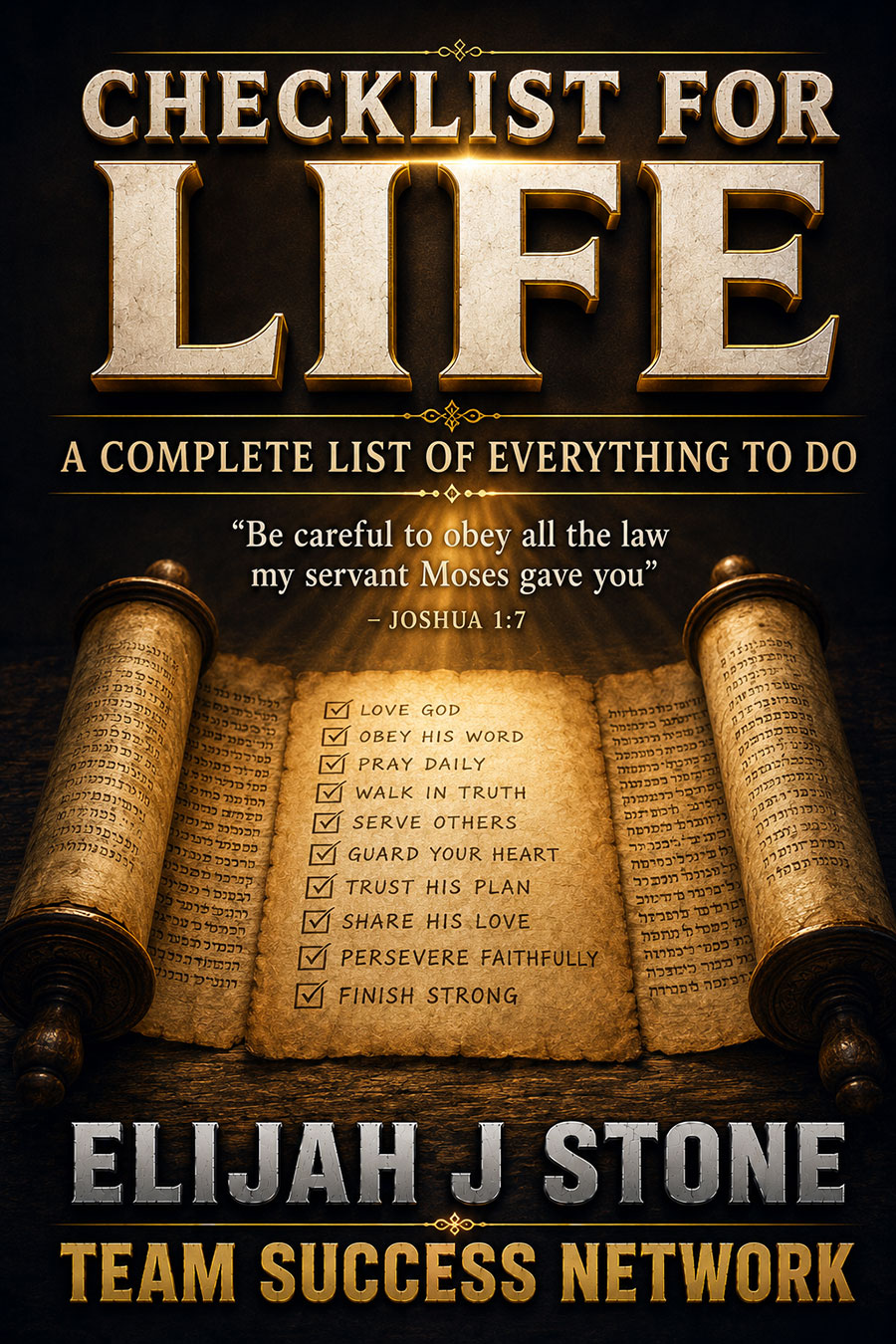
Book 104: Checklist for Life

Checklist for Life
A Complete List Of Everything To Do – “Be careful to
obey all the law my servant Moses gave you”
By Mr. Elijah J Stone
and the Team Success Network
Table
of Contents
Part 1 – Understanding
the Complete Law of God
Chapter 1 – The Complete
Law of God
Chapter 2 – The Ten
Commandments
Chapter 5 – The
Deuteronomic Code
Chapter 6 – The Blessings
and Curses
Chapter 7 – Overview of
the Ten Commandments
Chapter 8 – No Other Gods
Before Me
Chapter 9 – No Idols or
Images
Chapter 11 – Keep the
Sabbath Day Holy
Chapter 12 – Honor Father
and Mother
Chapter 13 – You Shall Not
Murder
Chapter 14 – You Shall Not
Commit Adultery
Chapter 15 – You Shall Not
Steal
Chapter 16 – You Shall Not
Bear False Witness
Chapter 17 – You Shall Not
Covet
Chapter 18 – Overview of
the Covenant Code
Chapter 19 – Laws on
Servants and Justice
Chapter 20 – Laws on
Property and Responsibility
Chapter 21 – Laws on
Integrity, Compassion, and Worship
Chapter 22 – God’s Promise
of His Angel and Protection
Chapter 23 – Overview of
the Holiness Code
Chapter 24 – Sacred Life
and Blood
Chapter 25 – Sexual Purity
and Boundaries
Chapter 26 – Justice,
Mercy, and Holiness in Community
Chapter 27 – Consequences
for Sin and Atonement
Chapter 28 – Appointed
Feasts and the Holy Times
Chapter 29 – The Sabbath
Year and Jubilee Freedom
Chapter 30 – Rewards and
Discipline from God
Part 5 – The
Deuteronomic Code
Chapter 31 – Overview of
the Deuteronomic Code
Chapter 32 – Centralizing
Worship and Obedience
Chapter 33 – Leadership,
Justice, and Prophecy
Chapter 34 – Family,
Purity, and Social Order
Chapter 35 – Generosity,
Justice, and Covenant Renewal
Part 6 – The Blessings
and Curses
Chapter 36 – Overview of
Blessings and Curses
Chapter 37 – The Blessings
of Obedience
Chapter 38 – The Warnings
of Disobedience
Chapter 39 – God’s Mercy
and the Call to Return
Chapter 40 – The Covenant
of Life Renewed
Part 1 – Understanding the Complete Law of God
The first
section introduces God’s Law as the divine framework for living in harmony with
Him and with others. It explores how Exodus, Leviticus, and Deuteronomy reveal
God’s wisdom for every area of life—spiritual, moral, and social. The Law is
not a burden, but a blessing designed to guide humanity into truth, justice,
and peace.
Readers
discover that the commandments, codes, and covenants were expressions of God’s
heart. They taught Israel how to live distinct from surrounding nations,
showing holiness in conduct and compassion in community. Every rule was rooted
in love and relationship.
This
section explains that obedience is a form of worship. God wanted His people to
reflect His purity and kindness through daily living, not just religious
ceremony. The Law was His way of revealing Himself to a world that had
forgotten Him.
Understanding
these foundations helps believers see that holiness is not about perfection,
but about direction. God’s instructions are pathways, not prison walls. They
lead to freedom, not fear. His Law shows us what pleases Him—and in pleasing
Him, we find life, order, and blessing.

Chapter 1
– The Complete Law of God
Exodus, Leviticus & Deuteronomy
Revealing God’s Heart Through His Law
The Law
Was Born From Love
The Law of
God given through Moses was not a cold list of commands—it was the heartbeat of
Heaven written into human life. Every word God spoke on Mount Sinai came from
His deep desire to dwell among His people. The Law was His covenant of love,
meant to guide, protect, and reveal who He truly is.
When God
said, “I am the Lord your God, who brought you out of Egypt, out of the land
of slavery” (Exodus 20:2), He began not with control but with compassion.
The Law begins with deliverance, not demand. God rescued His people first, then
taught them how to live free. His Law was never meant to enslave them again—it
was meant to preserve their freedom by teaching them how to walk in His
holiness.
Through
the Law, God revealed the boundaries of blessing. Obedience wasn’t about
earning His favor—it was about enjoying His presence. The moment Israel agreed
to His covenant, Heaven and earth were linked through promise.
The Law
Reveals God’s Character
The Law is
God’s autobiography in action. It tells us what He loves, what He hates, and
what He desires for His children. Exodus, Leviticus, and Deuteronomy form a
complete picture of who He is—holy, just, merciful, and near.
• Exodus
shows God as Deliverer, setting His people free and establishing His covenant.
• Leviticus reveals Him as Sanctifier, calling His people into purity
and teaching them how to worship rightly.
• Deuteronomy presents Him as Father and Teacher, restating His commands
with love, urging His people to live from the heart.
Each
section of the Law draws us closer to God’s nature. “The law of the Lord is
perfect, refreshing the soul” (Psalm 19:7). It restores what sin distorts.
Every command flows from His character, shaping a people who reflect His ways.
When we obey, we become living testimonies of His wisdom to the world.
The Law
Established A Holy Nation
God’s Law
turned a group of former slaves into a holy nation. The Israelites were called
to be set apart—a living demonstration of what it means to belong to God. Their
laws on worship, community, purity, and justice were unlike any other on earth.
Through them, God displayed His justice, mercy, and order.
The Law
gave structure to freedom. It defined relationships, protected the weak, and
restored what was broken. God’s purpose was to create a people so distinct that
the nations around them would see His glory through their conduct. “Observe
them carefully, for this will show your wisdom and understanding to the
nations” (Deuteronomy 4:6).
The Law
was not about superiority—it was about stewardship. Israel’s obedience was
meant to shine like light in the darkness. The world was supposed to look at
their compassion, honesty, and purity and say, “Surely their God is near to
them.” Holiness became evangelism—living differently for God’s glory.
The Law
Points To Relationship, Not Regulation
God never
gave laws to replace love. He gave laws to protect it. Every command was an
invitation to draw closer to Him in purity and truth. The Law was the framework
for friendship with God—a way for a holy God to dwell among imperfect people.
When
Israel sinned, the sacrificial system provided a way for mercy to triumph over
judgment. God didn’t destroy His people when they failed; He gave them
atonement. Each sacrifice pointed toward the coming of Jesus Christ, who would
fulfill the Law perfectly and become the ultimate Lamb of God.
Jesus
later said, “Do not think that I have come to abolish the Law or the
Prophets; I have not come to abolish them but to fulfill them” (Matthew
5:17). Every command, every ceremony, every offering was a shadow of what He
would accomplish on the cross. The Law revealed humanity’s need for grace, and
grace revealed the heart of the Law.
The Law
Shapes The Heart, Not Just Behavior
God’s goal
was never outward compliance—it was inward transformation. The Law was meant to
renew the heart. “These commandments that I give you today are to be on your
hearts. Impress them on your children” (Deuteronomy 6:6–7). Obedience was
always about love first, action second.
The
Israelites were called to meditate on His commands day and night. By speaking
them, teaching them, and living them, they would develop hearts that naturally
delighted in doing what pleased Him. The Law was God’s way of writing holiness
on human hearts long before the New Covenant came.
True
obedience is not about fear—it’s about fellowship. When we understand that
God’s boundaries are gifts, our obedience becomes worship. His commands keep us
from harm and lead us into abundance. Sin may promise freedom, but it only
enslaves. God’s Word alone sets the heart free.
The Law
Prepared The Way For Grace
The Law
was never the final destination—it was a guidepost pointing forward. It
revealed the standard of holiness that no human could meet, showing the need
for a Savior. The Law’s perfection exposed humanity’s imperfection. But within
its demands lay a hidden promise—God Himself would one day fulfill what man
could not.
Through
Jesus, the Law reached its fullness. He lived every command flawlessly and bore
the curse of our disobedience. “Christ is the culmination of the law so that
there may be righteousness for everyone who believes” (Romans 10:4). In
Him, the righteousness once written on tablets of stone is now written on
hearts of flesh.
Grace
doesn’t cancel the Law—it completes it. Where the Law said “do,” grace says
“done.” Yet the purpose remains: to shape lives that reflect God’s holiness.
The Holy Spirit now empowers believers to walk in the same obedience Israel was
called to, but with joy instead of fear.
Key Truth
The Law of
God is not about restriction—it’s about revelation. It reveals His nature, His
justice, and His mercy. Exodus shows His power, Leviticus His holiness, and
Deuteronomy His love. Together, they form a portrait of a God who desires
closeness with His people.
Every
command is a doorway to deeper fellowship. Obedience brings alignment with
Heaven’s order, and alignment brings peace. To know the Law is to know the
heart of the Lawgiver.
Summary
The
Complete Law of God—revealed through Exodus, Leviticus, and Deuteronomy—is a
divine covenant of love, designed to guide humanity into holiness and
relationship. It is not a ladder to climb toward God but a light that shows His
path of life.
Through
the Law, God teaches justice, compassion, purity, and faithfulness. It reminds
us that obedience brings blessing, rebellion brings distance, and grace brings
restoration. Every law, sacrifice, and command points to Jesus, the fulfillment
of all righteousness.
To live
under God’s Law is to walk in His presence daily—to let His Word become the
rhythm of our hearts. The Law of God still speaks, still guides, and still
calls us higher. It is not the end of freedom—it is the foundation of it.
“The
statutes of the Lord are trustworthy, making wise the simple.” (Psalm 19:7)

Chapter 2
– The Ten Commandments
Exodus 20; Deuteronomy 5
God’s Eternal Blueprint For Love And Life
The Voice
That Spoke From Fire
The Ten
Commandments were not whispered—they were thundered from Heaven. On Mount
Sinai, the ground shook, the mountain smoked, and the voice of God filled the
air. No prophet delivered these words; God Himself spoke them. The people
trembled, but His purpose was love, not fear. He was establishing the moral
foundation of His covenant—a covenant built on relationship and reverence.
When God
declared, “You shall have no other gods before Me,” (Exodus 20:3) He was
not introducing religion—He was inviting loyalty. The Law began with
relationship. God had freed His people from slavery, and now He wanted to teach
them how to stay free. These commandments were Heaven’s constitution for earth,
designed to keep hearts clean and communities strong.
Each
commandment was born from God’s nature. They were not arbitrary rules but
reflections of His character. They reveal what God values most—truth, honor,
faithfulness, and love. By living them, His people would become living
representations of His holiness in a fallen world.
The Ten
Commandments are the world’s moral compass. They define right and wrong not by
culture, but by Creator. Their power has not faded with time because truth
cannot expire.
The
Commandments Reveal God’s Nature
The Ten
Commandments show what God is like. Every “You shall” and “You shall not” is a
glimpse into His heart. They reveal His priorities and His passion for purity,
peace, and love. “The law of the Lord is perfect, refreshing the soul.”
(Psalm 19:7)
• The
first four commands center on our relationship with God.
• The last six center on our relationship with others.
• Together, they form the cross—love for God vertically and love for people
horizontally.
This
divine structure teaches that all of life flows from worship. When we honor
God, we learn to honor people. When we love Him first, we love others rightly.
The commandments are not two sets of duties—they are one expression of love.
Every
command points to balance. God knew that if His people loved Him fully and
treated others justly, they would live in peace. His laws were meant to heal
chaos, not create it. The Ten Commandments remain the world’s clearest portrait
of moral order rooted in divine love.
The First
Commandments: Loving God Fully
The first
commandment declares, “You shall have no other gods before Me.” God
begins with loyalty because everything begins with worship. The human heart was
made to adore, and whatever it adores, it becomes like. This command guards the
soul from false devotion and broken identity.
The second
commandment warns, “You shall not make for yourself an image.” Idolatry
is not only about statues—it’s about substitutes. Anything that replaces God in
your trust or affection becomes an idol. This command protects the purity of
worship and keeps the heart free from deception.
The third
commandment says, “You shall not misuse the name of the Lord your God.”
God’s name represents His presence, power, and promise. Speaking it carelessly
dishonors His holiness. To carry His name rightly means to live as His
representative—truthfully, humbly, and gratefully.
The fourth
commandment invites rest: “Remember the Sabbath day by keeping it holy.”
This is God’s rhythm for renewal. It’s not laziness—it’s worshipful trust.
Sabbath reminds humanity that work does not sustain life—God does. By resting,
we declare that He is enough.
Together,
these first four commandments teach reverence. They restore order in the soul
by putting God first in affection, speech, worship, and time. When God is
honored rightly, everything else aligns.
The
Remaining Commandments: Loving People Rightly
The fifth
commandment builds the bridge between Heaven and earth: “Honor your father
and your mother.” Family is the foundation of society, and respect is the
foundation of love. This command teaches gratitude, humility, and order.
Honoring authority honors God Himself.
The sixth
commandment—“You shall not murder”—protects the sacredness of life.
Every person bears the image of God. To harm another is to strike at the
reflection of the Creator. This law guards not only against violence but
against hatred and bitterness in the heart.
The
seventh commandment—“You shall not commit adultery”—protects covenant
love. Faithfulness in marriage mirrors God’s faithfulness to His people. Purity
is not repression; it’s sacred devotion. When the marriage bed is honored,
families thrive and society flourishes.
The eighth
commandment—“You shall not steal”—honors ownership and contentment. It
teaches integrity in both big and small things. Stealing is not just
taking—it’s mistrusting God’s provision. Generosity is the cure that restores
peace.
The ninth
commandment—“You shall not give false testimony”—protects truth and
justice. Lying is the language of the enemy; truth is the language of Heaven.
Speaking truth keeps hearts pure and communities stable.
Finally,
the tenth commandment—“You shall not covet”—reaches into the hidden
motives of the heart. It addresses desire before it becomes action. Coveting
feeds comparison and destroys gratitude. The cure is contentment in God alone.
These six
commands teach us how to live in community, protect relationships, and embody
compassion. Together, they turn human behavior into holy character.
The Law
Protects, It Doesn’t Restrict
Many
people see the Ten Commandments as chains, but they are actually safeguards.
They don’t confine—they protect. God didn’t give them to limit joy but to
preserve it. They are the fence around freedom, ensuring we stay safe within
God’s blessing.
When
Israel obeyed, peace filled the land. Families were strong, justice prevailed,
and worship flourished. The commandments were never designed to crush people
under rules but to lift them into righteousness. Sin enslaves; obedience
liberates. “To the faithful You show Yourself faithful.” (Psalm 18:25)
Even
today, those who live by these principles find stability in a chaotic world.
Society works when people tell the truth, value life, and respect boundaries.
The wisdom of God’s commands is eternal—they work in every culture, every
century, every heart.
The Ten
Commandments are proof that moral law doesn’t expire. They are not relics—they
are reminders. Each one points to how love behaves when God reigns at the
center.
The
Commandments Lead To Grace
The Ten
Commandments expose our need for grace. No one can keep them perfectly.
Humanity fails, not because the Law is harsh, but because the heart is weak.
Yet that weakness doesn’t cancel God’s plan—it fulfills it through Christ.
Jesus came
to fulfill the Law, not abolish it. He summarized the commandments in two
statements: “Love the Lord your God with all your heart and with all your
soul and with all your mind,” and “Love your neighbor as yourself.”
(Matthew 22:37–39) In Him, the Law became life.
Where the
old covenant carved the Law on stone, the new covenant writes it on hearts.
Through the Holy Spirit, obedience becomes desire, not duty. The same God who
spoke from fire now speaks from within, empowering His people to live holy
lives from love, not fear.
The
commandments still stand—not as conditions for salvation but as evidence of
transformation. When the heart is renewed, the Law becomes delight. What once
felt impossible becomes natural because the Lawgiver Himself now lives within.
Key Truth
The Ten
Commandments are not ancient rules—they are eternal relationships. They reveal
God’s holiness, humanity’s need, and Christ’s fulfillment. Each commandment
safeguards love—love for God, love for others, and love for life itself.
God’s Word
was written in stone so it could never be erased, and written in hearts so it
could never be forgotten. The same voice that thundered on Sinai now whispers
through grace, calling us to live free by walking faithfully.
Summary
The Ten
Commandments remain the moral foundation for all humanity—ten eternal truths
that define how to love God and live well with others. The first four commands
build vertical love; the last six, horizontal harmony. Together, they form the
framework of freedom.
They were
not given to burden humanity but to bless it. They preserve purity, peace, and
purpose in every generation. Every command points to the God who is both holy
and merciful.
Obedience
brings life, but grace makes obedience possible. Through Christ, the Law is no
longer carved in stone—it’s alive in us. And as we walk in it, we live out the
very love that gave it.
“Love is
the fulfillment of the law.” (Romans
13:10)

Chapter 3
– The Covenant Code
Exodus 21–23
Bringing God’s Justice Into Everyday Life
God’s Law
Reaches Into Daily Living
The
Covenant Code is where the Law of God becomes practical. It takes the moral
foundation of the Ten Commandments and applies it to everyday life—how people
work, trade, settle disputes, and treat one another. God wasn’t content with
His people being holy in worship but careless in conduct. He wanted holiness to
shape everything they touched.
When God
gave these laws through Moses, He was building a society that reflected His
justice and mercy. The Covenant Code guided how to handle property, resolve
injury, care for servants, and treat strangers. It was designed to create order
in a world prone to chaos. “What does the Lord require of you? To act justly
and to love mercy and to walk humbly with your God.” (Micah 6:8)
This was
not a political system—it was divine morality in motion. God was teaching His
people how to reflect His character through their relationships and
responsibilities. Every detail, from restitution to compassion, carried the
fragrance of His righteousness. The Covenant Code made faith visible and
measurable in daily actions.
True
holiness, God showed, begins where ordinary life happens—in our words, our
work, and our treatment of others.
Justice
That Reflects God’s Fairness
God’s
justice is never partial or cruel—it’s perfectly balanced with mercy. The
Covenant Code revealed that fairness is sacred because it mirrors His nature. “Do
not show favoritism to a poor person in a lawsuit,” God said, “and do
not deny justice to your poor people in their lawsuits.” (Exodus 23:3, 6)
He was teaching that integrity means treating all people with equal value.
Many of
these laws addressed how to handle wrongdoing and harm. If someone injured
another person or damaged property, restitution was required. Justice meant
making things right, not simply punishing wrongs. The guilty restored what was
lost, and the innocent were protected from exploitation.
This
principle of restitution is still one of the most beautiful demonstrations of
divine logic. God values restoration over revenge. The goal was always healing,
not harm. Forgiveness and accountability walked hand in hand.
In a world
filled with injustice and favoritism, God created a new model. His justice
defended the weak, restrained the powerful, and reminded everyone that they
were accountable to Him. Obedience to these laws built a culture where truth
and fairness could flourish.
Compassion
That Honors The Weak
The
Covenant Code revealed a God who sees every person. He cares deeply for
servants, widows, orphans, and foreigners—those who had no voice in society. “Do
not mistreat or oppress a foreigner, for you were foreigners in Egypt.”
(Exodus 22:21) God reminded His people of their own story so they would never
forget compassion.
Servants
were to be treated humanely, not abused. The poor were to receive kindness, not
exploitation. When debts were owed, God commanded mercy—if someone’s only cloak
was taken as collateral, it had to be returned by sunset so they could sleep
warm. Every detail revealed the tenderness of God’s heart.
This
compassion extended beyond people to animals and land. Even the fields were to
rest every seventh year so the poor and wild creatures could eat freely.
(Exodus 23:10–11) In God’s economy, rest was built into creation for everyone
and everything.
These
commands teach that holiness and compassion are inseparable. You cannot love
God and disregard His image in others. True spirituality expresses itself in
justice for the vulnerable and mercy toward the broken. The Covenant Code was a
divine blueprint for human kindness.
Integrity
That Builds Trust
God’s laws
didn’t stop at behavior—they reached into motives. The Covenant Code called His
people to honesty in every matter. “Do not spread false reports. Do not help
a guilty person by being a malicious witness.” (Exodus 23:1) God hates lies
because they destroy trust, and trust is the foundation of community.
Integrity
means truth in business, fairness in judgment, and transparency in all
dealings. When people live deceitfully, corruption spreads like disease. But
when honesty rules, peace reigns. God’s Law taught Israel that truthfulness is
not just a virtue—it’s a form of worship.
He also
commanded His people not to take bribes or show favoritism. Bribery blinds
justice, twisting right and wrong for personal gain. God’s standard was clear:
righteousness must never be for sale. To walk with Him meant walking in light,
not manipulation.
Obedience
to these laws created trust within the nation. The people could live without
fear because truth governed them. In every transaction, every decision, every
judgment, God’s name was honored when integrity ruled the heart.
Rest That
Honors God’s Rhythm
Even in a
code filled with rules of justice and responsibility, God wove in rest. He
reminded His people to work diligently but rest faithfully. “Six days do
your work, but on the seventh day do not work, so that your ox and your donkey
may rest, and so that the slave born in your household and the foreigner living
among you may be refreshed.” (Exodus 23:12)
This law
revealed something extraordinary—God’s concern extended beyond human beings to
all creation. He gave His people permission to pause, to trust, and to remember
that He was their Provider. Rest became a sacred act of faith.
The
Sabbath principle applied to the land as well. Every seventh year, it was to
lie fallow so that the poor and even the animals could enjoy its produce. Rest
was God’s way of maintaining balance—teaching that creation thrives when
humanity trusts His rhythm.
Rest is
not inactivity—it’s holy alignment. When people rest in God, they acknowledge
His sovereignty. The Covenant Code reminds us that life becomes chaotic when
rest is ignored, but peaceful when His order is respected.
Worship
That Anchors Justice
Justice
and worship were never meant to be separate. God commanded His people to
celebrate specific feasts as memorials of His faithfulness—Passover, the Feast
of Harvest, and the Feast of Ingathering. These were not only religious events
but reminders that justice flows from gratitude.
Worship
kept the people humble and dependent on God’s goodness. It reminded them that
their wealth came from His hand, their protection from His presence, and their
laws from His wisdom. When worship waned, corruption followed; when worship
thrived, righteousness returned.
God also
warned Israel not to mix worship with idolatry. False gods would corrupt their
hearts and compromise their morals. “Do not invoke the names of other gods;
do not let them be heard on your lips.” (Exodus 23:13) A nation’s purity in
worship determined its purity in justice.
The
Covenant Code concludes with God’s promise: if His people obeyed, His angel
would go before them, protecting and prospering them. Worship and obedience
together would bring victory. God’s presence was their assurance of blessing.
Key Truth
God’s Law
was never just for altars—it was for life. The Covenant Code proves that faith
must shape conduct, not just creed. Through these commands, God showed that
justice, mercy, and holiness belong together.
When
people live by His Word, society becomes a reflection of Heaven’s order. The
Covenant Code reminds us that God is just in judgment and kind in mercy—and He
expects the same from His people.
Summary
The
Covenant Code transforms faith from belief into behavior. It shows that
obedience to God’s Law is not confined to temples or rituals but must govern
every interaction. God’s justice is fair, His compassion wide, and His wisdom
practical.
Through
these laws, He built a society of trust, mercy, and holiness. Every command
protected life, restored fairness, and preserved dignity. It revealed a God who
is deeply involved in both personal and public life.
For
today’s believer, the Covenant Code remains a reminder that righteousness is
relational. How we treat others reflects how much we revere God. When justice
flows like a river and mercy fills our hearts, the world sees His righteousness
through us.
“The Lord
loves righteousness and justice; the earth is full of His unfailing love.” (Psalm 33:5)

Chapter 4
– The Holiness Code
Leviticus 17–26
Living Set Apart In A World That’s Forgotten
God
The Call
To Reflect God’s Nature
The
Holiness Code is not a list of impossible demands—it’s an invitation to reflect
the character of God. The message at its heart is clear and timeless: “Be
holy because I, the Lord your God, am holy.” (Leviticus 19:2) Holiness is
not human effort trying to reach Heaven; it’s Heaven shaping the heart of
humanity.
God’s call
to holiness is a call to likeness. He wanted His people to be distinct, not
distant—set apart from sin, yet close to His presence. These chapters in
Leviticus revealed what holiness looks like in action: purity in worship,
justice in relationships, and compassion in community. Holiness touches
everything.
Holiness
is not about perfection—it’s about direction. It means choosing daily to align
your life with God’s ways. The closer His people walked with Him, the more they
began to resemble Him. Holiness wasn’t something to perform—it was something to
become.
The
Holiness Code reveals that righteousness is not just for priests or
prophets—it’s the birthright of every believer who belongs to God. Holiness is
what happens when love grows mature and obedience becomes joy.
Holiness
Protects The Sacredness Of Life
Leviticus
begins this section by teaching that life itself is sacred because it belongs
to God. Blood, representing life, was never to be misused or consumed. God
said, “For the life of a creature is in the blood, and I have given it to
you to make atonement for yourselves on the altar.” (Leviticus 17:11) Every
drop of blood pointed toward the preciousness of life and the promise of
redemption.
By
commanding Israel to respect blood, God was teaching them to value life. He was
drawing a line between the holy and the profane, the sacred and the careless.
This law reminded them that sin always costs something—and that forgiveness
flows through sacrifice.
Every
animal offered, every ritual performed, carried prophetic meaning. It pointed
forward to the perfect sacrifice of Jesus Christ, whose blood would one day
fulfill every requirement of holiness. What was temporary under Moses became
eternal under Christ.
Holiness
begins with valuing what God values. Life is not casual—it is covenantal. When
we honor life as God’s gift, we honor the Giver Himself.
Holiness
Builds Boundaries Of Purity
God’s
holiness touches even the private areas of life. Leviticus 18 outlines
boundaries for sexuality, relationships, and family life. These commands
weren’t meant to suppress joy but to protect it. The nations around Israel
practiced every form of immorality and perversion imaginable. God’s people were
to be different—pure in body and faithful in covenant.
Sexual
purity is not about restriction—it’s about reflection. It reflects God’s
faithfulness. Just as He never breaks covenant with His people, marriage was
designed to reflect that same steadfast love. The holiness of the body mirrors
the holiness of the heart.
God’s
commands about moral purity reveal His care for families, children, and
society. When the heart is pure, homes are peaceful, and generations are
blessed. “Do not defile yourselves in any of these ways, because this is how
the nations that I am going to drive out before you became defiled.”
(Leviticus 18:24)
Holiness
creates safety. It keeps people from self-destruction and communities from
collapse. God’s laws about purity were not punishments—they were protection.
Every “no” in Scripture hides a greater “yes” in God’s heart.
Holiness
Flows Through Justice And Mercy
Leviticus
19 brings holiness into the marketplace, the home, and the courtroom. It
connects worship to daily behavior. “Do not steal. Do not lie. Do not
deceive one another.” (Leviticus 19:11) These are not just moral
suggestions—they are expressions of God’s nature. Holiness shows itself in how
we treat others.
This
chapter is full of compassion: don’t harvest your entire field, leave some for
the poor; don’t take advantage of the blind or the deaf; pay your workers
fairly; love your neighbor as yourself. (Leviticus 19:9–18) These laws show
that holiness is inseparable from kindness.
God was
creating a nation that didn’t just worship well but lived well. Holiness means
honesty in business, humility in leadership, and generosity in community. It’s
not about isolation from sinners—it’s about demonstration of righteousness.
Holiness
that doesn’t touch others isn’t holiness at all. God’s kind of holiness heals,
uplifts, and restores. It turns ordinary life into a living sermon of grace and
truth.
Holiness
Respects The Order Of Creation
Leviticus
20–22 reveals the seriousness of sin but also the mercy of atonement. God’s
commands dealt with justice for wrongdoing and the qualifications of priests
who served before Him. Every rule underscored one central truth—God is holy,
and His people must approach Him with reverence.
The
priests were not exempt from obedience; they were examples of it. Their purity
was a visible picture of the purity God desired for all His people. The
offerings they presented had to be without blemish because they represented a
perfect God.
God even
extended holiness into the rhythm of time. The Sabbath, the feasts, and the
sacred celebrations were built to remind the people of His faithfulness. Each
one pointed to aspects of His character—His provision, His deliverance, His
rest.
These
instructions might seem ceremonial, but they carry deep meaning. God was
teaching that every part of life—work, worship, and rest—should flow in harmony
with His design. Holiness means living according to the rhythm of Heaven, not
the chaos of the world.
Holiness
Produces Freedom And Renewal
The
Holiness Code also introduced one of the most revolutionary concepts in all of
Scripture—the Sabbath Year and the Year of Jubilee. Every seventh year, the
land rested. Every fiftieth year, debts were forgiven, slaves were freed, and
families regained their inheritance. God built mercy into the structure of
society.
This
system protected the poor from permanent poverty and prevented greed from
destroying the community. It reminded everyone that the land belonged to God,
not man. “The land must not be sold permanently, because the land is Mine
and you reside in My land as foreigners and strangers.” (Leviticus 25:23)
Holiness,
therefore, is not cold rule-keeping—it’s the overflow of mercy. God’s holiness
restores what sin breaks. It is not static; it’s redemptive. When His people
lived by these rhythms, the entire nation flourished—economically,
relationally, and spiritually.
Even the
closing chapter, Leviticus 26, emphasizes this truth: obedience brings
blessing, disobedience brings loss. But even in warning, mercy remains. God
promises that if His people repent, He will remember His covenant and restore
them. Holiness always leads home.
Key Truth
Holiness
is not perfection—it’s reflection. It’s the visible evidence that God lives
within His people. The Holiness Code shows that God cares about every detail of
life—work, relationships, worship, and rest.
True
holiness balances purity with compassion, order with mercy, and truth with
love. It is not about separation from people but dedication to God. To be holy
is to love what He loves and reject what harms His heart.
Summary
The
Holiness Code transforms holiness from a concept into a lifestyle. It teaches
that purity, justice, mercy, and faithfulness all spring from the same
source—God’s own character. Every law, from sacrifices to social ethics, was
designed to make His people a reflection of His glory.
For
believers today, holiness is not a list to perform but a life to embody. It
means aligning with God’s heart in every decision, living with integrity, and
extending compassion wherever we go. When holiness rules the heart, peace rules
the home.
God’s call
remains unchanged: “Be holy, because I am holy.” Holiness is not
confinement—it’s communion. It’s the freedom of living fully in the presence of
the One who made us to shine with His light.
“The
highway will be called the Way of Holiness; it will be for those who walk on
that Way.” (Isaiah
35:8)

Chapter 5
– The Deuteronomic Code
Deuteronomy 12–26
Obedience From The Heart, Not From Fear
A Covenant
Renewed For A New Generation
The
Deuteronomic Code stands as Moses’ final message to a new generation standing
on the edge of promise. Their parents had perished in the wilderness because of
unbelief, but now their children were ready to inherit the land. Before they
entered, God—through Moses—renewed His covenant, reminding them that the future
depended on obedience from the heart.
The
message was clear: “Love the Lord your God and keep His requirements, His
decrees, His laws and His commands always.” (Deuteronomy 11:1) The Law was
not meant to intimidate but to inspire. God was reminding His people that
faithfulness was the doorway to blessing.
This
section of Scripture is full of warmth and tenderness. Moses does not simply
repeat rules; he pleads for relationship. He wants Israel to remember what God
had done—the plagues in Egypt, the parting of the Red Sea, the manna from
Heaven. Gratitude was to be the soil from which obedience grew.
The
Deuteronomic Code transforms law into love. It calls believers to remember that
obedience is not about perfection, but direction—choosing daily to walk with
God, step by step, because of love, not fear.
Worship
That Centers The Heart
The first
instruction in this code focuses on worship. God commands His people to destroy
idols, tear down pagan altars, and worship only in the place He chooses. “You
must not worship the Lord your God in their way.” (Deuteronomy 12:4) The
emphasis is purity—exclusive devotion to the one true God.
Worship
was never to be driven by convenience or culture, but by covenant. God wanted
His people to gather where His name dwelled, bringing offerings with gratitude
and joy. Worship was not about location—it was about loyalty. When God was at
the center, life stayed aligned with His blessing.
This law
also introduced celebration as part of holiness. Feasts like Passover, the
Feast of Weeks, and the Feast of Tabernacles reminded Israel to rejoice before
the Lord. Joy was not optional—it was holy. True worship balances reverence
with rejoicing, gratitude with giving.
In today’s
world, this same call remains: keep God first, destroy every modern idol, and
build your life around His presence. Worship is not a Sunday habit—it’s a daily
heartbeat. When He is first, everything else falls into place.
Leadership
That Reflects God’s Wisdom
God cares
deeply about leadership because leaders shape nations. In Deuteronomy 17–20, He
establishes principles for kings, priests, and prophets. No leader was to use
power for self-gain or personal pride. The standard was holiness, humility, and
honesty.
The king
was commanded to write his own copy of the Law and read it daily so that he
would learn to fear the Lord and lead with wisdom. “He is to read it all the
days of his life so that he may learn to revere the Lord his God.”
(Deuteronomy 17:19) Leadership, in God’s eyes, begins with submission.
Prophets
were to speak only what God revealed, not what people wanted to hear. False
prophets—those who twisted truth for popularity—were condemned. God values
integrity over influence. Every word spoken in His name was to carry the weight
of His truth.
This
divine framework teaches that leadership is stewardship. Whether in church,
family, or nation, leaders are called to serve, not rule. When authority bows
before God, blessing flows to everyone under its care.
Justice
That Reflects God’s Compassion
The
Deuteronomic Code also weaves compassion into the structure of justice. God’s
people were to live in a society where fairness and mercy walked hand in hand.
Justice was not just a legal matter—it was a moral calling.
Judges
were to reject bribery, honor truth, and protect the innocent. “Follow
justice and justice alone, so that you may live and possess the land the Lord
your God is giving you.” (Deuteronomy 16:20) God hates corruption because
it distorts His image. His kind of justice restores rather than destroys.
The code
included detailed laws for caring for the poor, widows, orphans, and
foreigners. Farmers were instructed to leave leftover grain in the fields so
that those in need could gather. Loans were to be forgiven every seventh year,
ensuring that no one was permanently trapped in poverty.
God’s
justice was rooted in compassion. It reminded Israel that they were once slaves
in Egypt, dependent on divine mercy. Remembering their past would keep their
hearts soft. Justice without mercy becomes cruelty, but mercy without justice
becomes chaos. God’s way always blends both perfectly.
Family,
Faith, And The Rhythm Of Life
The
Deuteronomic Code reaches deep into family life, calling parents to pass on
faith to their children. “These commandments that I give you today are to be
on your hearts. Impress them on your children.” (Deuteronomy 6:6–7) Faith
was not meant to live in temples—it was meant to live in homes.
Obedience
was to be generational. Each family was a living classroom where stories of
God’s faithfulness were told and remembered. Meals, work, and celebrations all
became opportunities to talk about the Lord. The Law was not only for the
elders—it was the heritage of every child born under covenant.
This
section also establishes rhythms of worship and rest through festivals and
Sabbath observance. These holy days were reminders of God’s faithfulness and
generosity. Time itself was to honor Him. Rest, remembrance, and rejoicing were
all acts of worship woven into the calendar of life.
When
families build their lives around God’s truth, holiness becomes culture. The
Word of God becomes not just a book—but a way of life.
Generosity
That Reflects Gratitude
In
Deuteronomy 25–26, God commands His people to give their first fruits and
tithes with joy. Giving was never meant to be a tax—it was worship. Each time
they brought their offerings, they were to declare their gratitude for what God
had done: “My father was a wandering Aramean… and the Lord brought us out of
Egypt with a mighty hand.” (Deuteronomy 26:5, 8)
Generosity
was the tangible proof of remembrance. By giving back, they acknowledged that
everything came from Him. God’s economy thrives on gratitude. A thankful heart
always gives freely, knowing that generosity keeps the blessings flowing.
The
Deuteronomic Code also condemns greed and dishonesty. “Do not have two
differing weights in your bag—one heavy, one light.” (Deuteronomy 25:13)
God demanded honesty in trade and business, teaching that fairness honors Him
more than profit.
Generosity
and integrity are the twin pillars of blessing. When a nation gives with open
hands and lives with honest hearts, God’s favor rests upon it. Worship through
giving transforms greed into gratitude and self-interest into service.
Key Truth
The
Deuteronomic Code is the language of love translated into law. It shows that
obedience is never about control—it’s about communion. God doesn’t ask for
compliance; He desires connection. Every command flows from His covenant love.
True
obedience is gratitude expressed through action. When we remember what God has
done, faithfulness becomes natural. Forgetfulness leads to rebellion, but
remembrance leads to revival. The one who remembers always obeys with joy.
Summary
The
Deuteronomic Code is God’s invitation to live with integrity, gratitude, and
love. It takes the Law beyond duty and transforms it into devotion. Every
command calls believers to remember God’s faithfulness and respond with
wholehearted obedience.
Through
this code, God shows that holiness is practical. Worship affects justice,
leadership affects compassion, and generosity affects blessing. Obedience
becomes worship when it’s rooted in love.
Moses’
final message still speaks today: obedience brings life. The laws of God are
not cold—they’re alive with covenant love. When we walk in them, we don’t lose
freedom—we discover it.
“Now
choose life, so that you and your children may live and that you may love the
Lord your God, listen to His voice, and hold fast to Him.” (Deuteronomy 30:19–20)

Chapter 6
– The Blessings and Curses
Leviticus 26; Deuteronomy 28
The Power Of Choice: Life Or Death, Blessing
Or Curse
God Offers
A Covenant Of Consequence
The
blessings and curses stand as one of Scripture’s clearest revelations of God’s
justice and mercy. They form the closing words of His covenant—where Heaven and
earth witness a choice: life or death, obedience or rebellion. God was not
threatening His people; He was teaching them how sacred their choices were.
Every decision carried spiritual weight, shaping the future of a nation and the
condition of a heart.
“See, I
set before you today life and prosperity, death and destruction.” (Deuteronomy 30:15) With these words, God
made the covenant deeply personal. He didn’t force devotion; He invited it. He
gave freedom, but with it came responsibility. The law of cause and
effect—blessing for obedience, consequence for rebellion—was woven into
creation itself.
The
blessings and curses reveal a God who is relational, not robotic. He rewards
faithfulness because love delights to bless, and He disciplines rebellion
because love refuses to abandon truth. The goal was never punishment—it was
protection. God’s heart was always to lead His people toward life.
Obedience
was the doorway to joy; rebellion was the path to sorrow. The choice still
stands for every generation.
The
Blessings Of Obedience
When God’s
people walked in His ways, blessing overflowed from every corner of life. The
land flourished, families thrived, and peace guarded the nation. “The Lord
will open the heavens, the storehouse of His bounty, to send rain on your land
in season and to bless all the work of your hands.” (Deuteronomy 28:12) God
promised abundance—not as a reward for perfection, but as the natural fruit of
walking with Him.
The
blessings touched every dimension:
• Provision – Rain, harvest, and overflowing abundance.
• Protection – Safety from enemies and strength in battle.
• Peace – Harmony within families and stability within the land.
• Promotion – Honor among the nations, being “the head and not the
tail.”
These were
not just material gifts—they were signs of God’s presence. Obedience kept His
people under the canopy of His favor. When God is obeyed, blessing follows like
sunrise after night.
The most
powerful blessing, however, was relational. God promised, “I will walk among
you and be your God, and you will be My people.” (Leviticus 26:12) His
presence was the greatest reward. Obedience wasn’t about earning; it was about
aligning with the Source of life. To obey was to live in rhythm with Heaven.
The
Warnings Of Disobedience
Just as
obedience brought blessing, disobedience brought inevitable consequences. When
the people turned from God, they removed themselves from His protection. The
result was not random wrath—it was the collapse that comes when order is
abandoned. “If you will not listen to Me and carry out all these commands, I
will bring upon you sudden terror, wasting diseases, and fever.” (Leviticus
26:14–16)
The curses
warned of loss, confusion, and defeat. God described drought in the land,
enemies gaining power, and hearts filled with fear. He was painting a picture
of what life looks like when His covering is ignored. It was not vengeance—it
was the natural outcome of rebellion.
The
further the people strayed, the heavier the consequences grew. “You will
plant much but harvest little.” (Deuteronomy 28:38) Effort without
blessing. Work without joy. Success without peace. It was a tragic
exchange—abundance traded for anxiety.
Even in
judgment, however, God’s voice remained tender. Every warning carried a
redemptive echo: “Come back to Me.” The purpose of the curse was not
destruction—it was restoration. Love disciplines to protect, not to harm.
The
Purpose Behind The Warnings
God’s
warnings were acts of mercy. They were the spiritual equivalent of flashing
lights on a cliffside road. He didn’t hide the danger—He exposed it, so His
people would turn back before falling. The curses were not evidence of an angry
God but of a loving Father refusing to let sin ruin His children.
Sin, left
unchecked, always leads to pain. It destroys relationships, peace, and
identity. God’s boundaries were blessings in disguise—walls built to keep His
people safe within His presence. The pain of disobedience was not God’s
cruelty; it was the absence of His covering.
“Because
you did not serve the Lord your God joyfully and gladly in the time of
prosperity, therefore in hunger and thirst… you will serve the enemies the Lord
sends against you.”
(Deuteronomy 28:47–48) Even in discipline, God’s goal was redemption. He wanted
His people to remember the sweetness of obedience so they would return to it.
God’s
justice never cancels His mercy. Even in the darkest warnings, He leaves a door
open for repentance. The covenant of consequence was always accompanied by the
promise of compassion.
The Mercy
Of Restoration
Though the
blessings and curses describe opposite outcomes, both end with hope. God never
closes the story with despair. In Leviticus 26:40–42, He promises restoration
to any who humble themselves and confess: “If they will confess their sins…
then I will remember My covenant.” His mercy never runs out—it only waits
for repentance.
When
Israel fell into sin, God’s discipline was severe but purposeful. Captivity,
famine, and loss all served to awaken their hearts. And when they turned back,
He restored them. History proves His faithfulness—He always keeps His word,
both in correction and in compassion.
This
pattern reveals the unchanging rhythm of grace:
- Warning – God reveals truth before judgment.
- Consequence – Rebellion brings loss and distance.
- Repentance – The heart softens under conviction.
- Restoration – God renews covenant and blessing.
Every step
of the journey reveals His love. No matter how far His people drift, God’s
mercy pursues. Holiness and grace are never opposites—they work together to
bring hearts home.
The
Eternal Principle Of Choice
The
message of the blessings and curses transcends time: every person must choose
whom they will serve. God’s love gives freedom, but His justice holds truth in
place. To obey is to walk with Him; to rebel is to walk alone.
Moses
declared, “This day I call the heavens and the earth as witnesses against
you that I have set before you life and death, blessings and curses. Now choose
life.” (Deuteronomy 30:19) The invitation is timeless—God still calls
humanity to the same decision.
Life with
God is not without challenge, but it is rich with peace and purpose.
Disobedience may promise freedom, but it leads only to emptiness. God’s
commandments are not chains—they are safeguards for joy. The blessings and
curses prove that love demands choice, and real freedom carries responsibility.
To choose
obedience is to choose intimacy with God. To walk in His ways is to dwell in
His protection. Every choice, large or small, still echoes through eternity.
Key Truth
The
blessings and curses reveal a loving God who honors choice. His commandments
are not threats—they are lifelines. Obedience brings alignment with His
blessing; rebellion breaks that alignment and invites loss. Yet even in
failure, His mercy endures.
God does
not delight in punishment—He delights in repentance. His desire has always been
restoration. Every promise of judgment is paired with the hope of return. The
covenant stands as both warning and welcome: “If you obey, you will live.”
Summary
The
blessings and curses form the final heartbeat of God’s covenant with His
people—a reminder that every decision carries eternal significance. Obedience
opens the gates of favor; rebellion closes them. Yet mercy always keeps the
door of grace unlocked.
Through
these chapters, God reveals that His love is firm, His justice fair, and His
patience endless. Blessing and curse are not opposites—they are the two sides
of covenant love. Both lead the heart back to Him.
For every
believer, the message remains the same: God longs to bless, not to break. His
boundaries are protection, His correction is kindness, and His heart is always
to restore.
“If you
fully obey the Lord your God and carefully follow all His commands… all these
blessings will come on you and accompany you if you obey the Lord your God.” (Deuteronomy 28:1–2)
Part 2 –
The Ten Commandments
The second
section centers on the Ten Commandments, God’s moral anchor for all
generations. These timeless truths define how to love God first and how to love
others rightly. They form the foundation for all ethical living and reveal what
true holiness looks like in action.
Each
command flows from relationship, not regulation. God speaks directly to the
heart, inviting His people to live in loyalty, purity, honesty, and compassion.
The commandments protect what God treasures—family, truth, life, and worship.
They ensure that love governs every human interaction.
This
section shows that obedience brings peace and order. The Ten Commandments are
not ancient restrictions but eternal realities that still govern healthy
societies today. They teach respect for authority, the value of rest, and the
power of integrity.
When
believers understand these laws as expressions of love, obedience becomes joy
instead of duty. Each command becomes an opportunity to know God’s heart more
deeply. The goal is not rule-keeping, but relationship—living a life that
honors the Creator through everyday choices.

Chapter 7
– Overview of the Ten Commandments
Exodus 20; Deuteronomy 5
God’s Eternal Blueprint For Harmony And
Freedom
The Ten
Commandments
- You shall have no other gods before Me.
- You shall not make for yourself an image
or bow down to any idol.
- You shall not misuse the name of the Lord
your God.
- Remember the Sabbath day by keeping it
holy.
- Honor your father and your mother.
- You shall not murder.
- You shall not commit adultery.
- You shall not steal.
- You shall not give false testimony
against your neighbor.
- You shall not covet anything that belongs
to your neighbor.
God’s
Blueprint For Life And Love
The Ten
Commandments are God’s divine design for how humanity should live—simple,
powerful, and everlasting. They were not written by man’s imagination but by
the very hand of God. “The tablets were the work of God; the writing was the
writing of God, engraved on the tablets.” (Exodus 32:16) These commands
reveal Heaven’s moral structure, the unchanging standards that govern how we
walk with God and one another.
They were
given in fire and thunder, yet they speak of love and peace. Each commandment
is a line of communication from the Creator’s heart—a message of how to live
rightly in a broken world. God wasn’t trying to restrict His people; He was
freeing them from the chaos of sin. Obedience to these commands doesn’t trap
us—it transforms us.
These ten
truths summarize all of life’s duties and desires. The first four teach us to
love God with reverence; the last six teach us to love people with respect.
They are not suggestions—they are spiritual laws written into creation itself.
To follow
the Ten Commandments is to walk in divine order, where peace, purpose, and
blessing flow naturally. They are not old words from an ancient mountain; they
are living truth for every generation.
The Voice
That Spoke On The Mountain
When God
gave the Ten Commandments, He didn’t send an angel—He came Himself. The
mountain shook, lightning flashed, and His voice filled the air. “When you
heard the voice out of the darkness while the mountain was ablaze with fire,
all the leaders of your tribes and your elders came to Me.” (Deuteronomy
5:23) The Law began with encounter, not mere instruction.
God’s
purpose was to reveal His holiness and His closeness. He wanted His people to
understand who He was—the only true God worthy of worship. Every commandment
begins with relationship. Before any rule was given, He said, “I am the Lord
your God, who brought you out of Egypt, out of the land of slavery.”
(Exodus 20:2)
Freedom
came first, then guidance. Redemption came before regulation. The Ten
Commandments were not chains on a rescued people—they were guardrails to keep
them free. God wasn’t demanding perfection; He was defining the path of peace.
When God
speaks, He doesn’t just give information—He imparts identity. The Law revealed
not only what to do, but who His people were: chosen, redeemed, and set apart
for holiness.
The
Commands That Reveal God’s Heart
Each
commandment shines a light on a different part of God’s nature. Together they
form a portrait of His love, His purity, and His justice.
• You
shall have no other gods before Me — reveals His loyalty and desire for
relationship.
• You shall not make idols — reveals His truth; He cannot be reduced to
an image.
• You shall not misuse His name — reveals His holiness; His presence is
sacred.
• Remember the Sabbath — reveals His rest and rhythm; He values balance
and renewal.
• Honor your father and mother — reveals His order; family reflects His
authority and care.
• You shall not murder — reveals His value of life; every person bears
His image.
• You shall not commit adultery — reveals His faithfulness; covenant is
sacred.
• You shall not steal — reveals His generosity; what He provides must be
respected.
• You shall not bear false witness — reveals His truthfulness; He cannot
lie.
• You shall not covet — reveals His sufficiency; contentment is found in
Him alone.
Every
commandment mirrors an attribute of the Creator. They are not rules detached
from His nature—they are reflections of it. When we obey them, we begin to
resemble Him.
The Ten
Commandments teach not only what God requires but what God is like. He is
faithful, pure, just, and compassionate—and He calls His people to walk in the
same spirit.
Love
Fulfills The Law
The Ten
Commandments are summed up perfectly in two phrases spoken by Jesus: “Love
the Lord your God with all your heart and with all your soul and with all your
mind,” and “Love your neighbor as yourself.” (Matthew 22:37–39) Love
is not separate from the Law—it is the foundation of it.
When you
love God, you naturally keep the first four commandments. When you love people,
you naturally keep the last six. The Law was never about robotic obedience—it
was always about relational love. God’s rules are expressions of His heart,
showing how love behaves.
The
mistake of religion is to pursue rules without relationship. But when love
governs obedience, the Law becomes joy. “His commands are not burdensome.”
(1 John 5:3) Instead of crushing, they lift; instead of limiting, they
liberate.
The Law is
fulfilled not through effort but through intimacy. When God’s Spirit writes His
Word on our hearts, obedience becomes delight. Grace doesn’t cancel the
commandments—it empowers us to live them.
The
Covenant That Still Speaks
The Ten
Commandments were written on stone to endure, but God promised a time when they
would be written on hearts. Through the New Covenant, that promise is
fulfilled: “I will put My laws in their minds and write them on their
hearts. I will be their God, and they will be My people.” (Hebrews 8:10)
What began
on tablets of stone now lives in every believer by the Holy Spirit. The
commandments still stand—not as old inscriptions, but as living truth guiding
God’s children from within. They were never replaced; they were internalized.
God’s
standard of holiness has not changed. What He desired in Exodus, He still
desires today—loyalty, honesty, purity, and love. The difference now is that
His power enables what His law commands. The Spirit writes what the hand of man
could not.
The Ten
Commandments still serve as the moral compass of every nation and the spiritual
foundation of every believer. They remind us that God’s way is always the way
of blessing.
Key Truth
The Ten
Commandments are not ancient restrictions but eternal relationships. They
reveal who God is and how we are called to live with Him and one another. They
are the divine blueprint for love, loyalty, and life.
When we
honor them, we honor Him. Every command draws us closer to the heart of the One
who wrote them—not to control us, but to commune with us. Obedience to His
commands is the truest form of worship.
Summary
The Ten
Commandments are the moral heartbeat of Scripture—the unchanging voice of God
calling His people into alignment with His character. They teach that freedom
is found in faithfulness, and love is proven in obedience.
These
commandments are not just laws; they are lifelines. They protect what is
sacred, preserve what is good, and promote what brings peace. They are Heaven’s
way of saying, “This is how love works.”
When we
see them not as burdens but as blessings, we begin to live the way we were
designed to. The commandments remain God’s covenant of love written for all
generations—a guide for every heart that longs to walk in His ways.
“The law
of the Lord is perfect, refreshing the soul. The statutes of the Lord are
trustworthy, making wise the simple.” (Psalm 19:7)

Chapter 8
– No Other Gods Before Me
Exodus 20:3
The First Commandment: The Foundation Of All
Worship
God Must
Come First
The first
commandment is the cornerstone of the entire Law: “You shall have no other
gods before Me.” (Exodus 20:3) Every other commandment flows from this one,
because everything begins with what—or whom—you worship. This was not a
suggestion; it was the heartbeat of Heaven expressed in words. God was
declaring that He alone is worthy of first place.
When He
gave this command, Israel had just been freed from Egypt—a land filled with
idols. They had seen false gods made of gold, stone, and wood, but none could
deliver or speak. Only the living God parted the sea, guided them by fire, and
fed them from Heaven. He wanted His people to know that their freedom was not
just from slavery but from false worship.
Putting
God first is not about religion—it’s about relationship. He doesn’t demand
worship to feed His ego; He invites worship to free our hearts. The first
commandment is a call to reorder life under divine authority. It says, “Let
everything else take its rightful place beneath the throne of God.”
When God
is first, everything else aligns. When He is not, everything fractures.
The Nature
Of False Gods
Idolatry
is not limited to ancient statues—it lives in modern hearts. Anything we trust,
love, or depend on more than God becomes a “god” to us. Success, relationships,
possessions, status, comfort, or even ministry can take His place. The first
commandment exposes these rivals and calls us back to loyalty.
False gods
promise fulfillment but deliver emptiness. They take and never give back. They
demand attention, energy, and devotion but cannot bless or save. God, on the
other hand, gives life, love, and peace. Every idol is a thief of joy; every
surrender to God restores it.
“Those who
cling to worthless idols forfeit the grace that could be theirs.” (Jonah 2:8) That verse reveals the tragedy of
misplaced worship. When our hearts are divided, we lose the flow of grace that
comes from singular devotion. God does not want part of our heart—He wants all
of it.
The first
commandment is not restrictive; it’s restorative. It removes counterfeit
sources of meaning so that only the true source—God Himself—remains. When the
throne of the heart is cleansed of competition, peace returns.
The Call
To Exclusive Devotion
God
doesn’t tolerate rivals because He knows divided devotion leads to destruction.
The first commandment demands exclusivity not out of insecurity but out of
love. He knows that whatever takes His place will eventually enslave us again.
When God
says, “You shall have no other gods before Me,” He’s not just forbidding
idol worship—He’s inviting intimacy. He wants His people to know Him
personally, to trust Him fully, and to depend on Him completely. Love for God
thrives only when loyalty is undivided.
“Hear, O
Israel: The Lord our God, the Lord is one. Love the Lord your God with all your
heart and with all your soul and with all your strength.” (Deuteronomy 6:4–5) This foundational truth,
known as the Shema, echoes the same heart as the first commandment—God must be
central. When He is one in our hearts, everything else finds its rightful
order.
God’s love
is total, and He asks for a total response. This commandment doesn’t compete
with love for others—it perfects it. When God is first, love for people becomes
pure, not possessive; generous, not self-centered.
The Danger
Of Divided Hearts
A divided
heart cannot sustain peace. When two masters claim the same soul, conflict
begins within. Jesus said, “No one can serve two masters… You cannot serve
both God and money.” (Matthew 6:24) This truth extends to anything that
competes for our loyalty—career, comfort, control, or even fear.
Divided
loyalty drains spiritual strength. One part of the heart worships while the
other worries. One hand raises to Heaven while the other clings to control. The
first commandment calls us to tear down every inner altar that does not belong
to God. Only then can worship flow freely again.
God’s
desire is not partial affection but wholehearted trust. He doesn’t share His
throne with fear, pride, or ambition. When He reigns alone, chaos loses its
voice, and the heart becomes still. “Be still, and know that I am God.”
(Psalm 46:10) Stillness is the fruit of surrender.
When the
soul finally bows fully to God, confusion gives way to clarity. Peace reigns
because order is restored—the Creator sits again at the center of His creation.
The
Freedom Of Full Surrender
Many fear
surrender, imagining it means losing control. In truth, surrender to God is the
gateway to freedom. The first commandment liberates the heart from false
masters and teaches the joy of trust. God’s rule is not tyranny—it’s
tenderness. His authority doesn’t crush; it carries.
When God
is first, everything else finds its place. Priorities align, stress lifts, and
identity stabilizes. You no longer live chasing approval or fearing loss
because your value is anchored in the One who never changes. The same fire that
burned on Sinai burns in every heart that says, “God, You are first.”
Worship is
not limited to songs or temples—it’s lived through choices. Each decision
reveals who truly reigns in the heart. Every time we say no to pride, greed, or
fear, we reaffirm the first commandment: there is no other god but Him.
“Trust in
the Lord with all your heart and lean not on your own understanding; in all
your ways submit to Him, and He will make your paths straight.” (Proverbs 3:5–6) Surrender is not
weakness—it’s wisdom. It releases control into capable hands.
When God
takes first place, fear loses its place. His peace fills the spaces where
anxiety once ruled, and His presence transforms worry into worship.
The Reward
Of Putting God First
God
promises blessing to those who honor Him above all else. His favor rests on
single-hearted devotion. “Seek first His kingdom and His righteousness, and
all these things will be given to you as well.” (Matthew 6:33) When we seek
God first, everything we truly need finds us.
Putting
God first doesn’t mean ignoring earthly responsibilities—it means inviting His
order into them. Family, work, finances, and relationships flourish when
aligned with His will. The first commandment creates divine order in human
life.
Obedience
here opens the door for every other blessing. Once God sits on the throne of
the heart, sin loses its grip. Temptation weakens because loyalty strengthens.
A person anchored in God cannot be easily shaken.
This is
why the first commandment is the foundation for all others. Without it,
morality becomes mere behavior; with it, holiness becomes a relationship. God
first—always and forever—is the principle that sustains peace, prosperity, and
purpose.
Key Truth
The first
commandment is not a restriction—it is liberation. It frees us from the tyranny
of idols and aligns us with the heart of our Creator. To have no other gods is
to live in the freedom of divine order, where worship becomes the natural
expression of love.
God must
always be first, not out of demand, but out of design. He alone satisfies what
the human heart was created to desire. When He is first, everything else falls
into place.
Summary
The first
commandment establishes the foundation for all spiritual life: God alone
deserves worship. Every other commandment flows from this truth. It is the
anchor of all morality, the essence of faith, and the source of peace.
When we
obey it, we experience freedom, alignment, and purpose. When we ignore it,
confusion and bondage follow. God’s command is not to limit us but to lead us
into lasting joy.
To say, “You
shall have no other gods before Me,” is to declare that nothing compares to
Him. It is the anthem of loyalty, the vow of love, and the secret to true
peace. The one who puts God first never comes last.
“My soul
finds rest in God alone; my salvation comes from Him.” (Psalm 62:1)
Chapter 9
– No Idols or Images
Exodus 20:4–6
The Second Commandment: Protecting The Purity
Of Worship
The
Warning Against Idols
The second
commandment is God’s divine safeguard against the distortion of His glory: “You
shall not make for yourself an image in the form of anything in heaven above or
on the earth beneath or in the waters below. You shall not bow down to them or
worship them.” (Exodus 20:4–5)
God was
not merely forbidding statues—He was protecting the integrity of His presence.
The Israelites had just come out of Egypt, where every animal, star, and symbol
was worshiped as divine. God wanted them to understand that He is not like
creation—He is the Creator. He cannot be confined to any shape, symbol, or
human imagination.
This
commandment separates truth from deception. The human heart loves to make God
visible, to create something it can control or carry. But the moment we try to
contain the Infinite, we lose sight of His majesty. God is spirit, limitless
and eternal. He invites us to worship in spirit and in truth, not through the
work of our hands but through the surrender of our hearts.
The second
commandment exists to keep worship pure—so that love remains personal, not
mechanical; spiritual, not superficial.
Why God
Forbids Images
The human
instinct to create idols comes from a desire for control. People crave
something visible, something tangible to focus their devotion on. But idols are
not just wrong because they misrepresent God—they’re dangerous because they
replace Him.
“They
exchanged the glory of the immortal God for images made to look like mortal man
and birds and animals and reptiles.” (Romans 1:23) Every idol is an exchange—trading the eternal for
the temporary, the unseen truth for a visible lie.
God
forbids idols because He wants His people to know Him directly, not through
man-made symbols. He doesn’t want intermediaries of stone or gold; He wants
communion of spirit and truth. No image can reveal His fullness. No form can
contain His presence.
This
commandment also protects against spiritual deception. The moment humanity
begins to define God through images, those images begin to define humanity.
What we worship, we become. Idolatry reshapes the soul into the image of its
obsession—empty, powerless, and blind.
By
forbidding idols, God protects our identity. He reminds us that we are made in
His image—not the other way around.
Modern
Idolatry In A Digital World
For those
new to faith, idolatry may sound ancient, but it’s as alive today as ever.
Modern idols may not sit on altars—they sit in hearts, on screens, and in
desires. Anything that consumes more affection, attention, or trust than God
becomes an idol.
Idolatry
today wears many disguises:
• Money – trusted more than God’s provision.
• Fame – pursued more than God’s approval.
• Relationships – loved more than God Himself.
• Self – exalted through pride and independence.
In modern
culture, even good things—work, ministry, or family—can become idols when they
replace God as the center. Idols are subtle. They rarely begin with rebellion;
they begin with misplaced affection.
Jesus
said, “Where your treasure is, there your heart will be also.” (Matthew
6:21) The modern idol is anything that captures the heart’s treasure before God
does. The second commandment is God’s way of saying, “Keep your heart
uncluttered, so My presence can fill it completely.”
To destroy
idols today is not to break statues—it’s to realign priorities. It’s choosing
to love God more than what He gives, and to worship the Giver more than the
gifts.
The
Jealousy Of God’s Love
In this
commandment, God reveals a part of His heart many misunderstand: “For I, the
Lord your God, am a jealous God.” (Exodus 20:5) His jealousy is not petty
or selfish—it is protective and passionate. He knows that idols destroy the
soul, so He refuses to share His people with false gods.
Divine
jealousy is the love of a faithful husband for an unfaithful bride. It is the
pain of a father watching his child wander into danger. God’s jealousy is love
on fire—unyielding in its pursuit of what is rightfully His. He knows that when
His people chase idols, they are drinking poison and calling it pleasure.
Idolatry
is not just sin—it’s betrayal. It replaces the Creator with creation. It treats
the gift as greater than the Giver. Yet even when His people fall into this
trap, God’s jealousy leads to mercy. He disciplines not to destroy but to
restore.
His
jealousy is proof of His commitment. A God who did not care would not correct.
But the God of Israel cares deeply, and His holy jealousy still protects His
children today from everything that steals life.
The
Blessing Of Generational Faithfulness
God’s
warning in this commandment stretches across generations: “Punishing the
children for the sin of the parents to the third and fourth generation of those
who hate Me, but showing love to a thousand generations of those who love Me
and keep My commandments.” (Exodus 20:5–6)
This is
not a curse—it’s a pattern. Idolatry infects generations, but faithfulness
multiplies blessing. Children often inherit not only the habits but the
spiritual atmosphere of their parents. When a family chooses false gods—wealth,
comfort, or pride—those patterns echo for years. But when a family chooses God,
the blessing flows endlessly.
God’s
heart is not to punish but to purify. The contrast between judgment to the
“fourth generation” and mercy to “a thousand generations” reveals the scale of
His love. His mercy outweighs His judgment a thousand to one.
This truth
calls every believer to choose generational faithfulness. When we refuse idols
and worship God alone, we’re not just securing our own peace—we’re building
spiritual inheritance for our children. A single heart fully surrendered can
rewrite the story of an entire family line.
The
Presence Of The Invisible God
The second
commandment ultimately reminds us that God does not dwell in images—He dwells
in hearts. He cannot be carved, but He can be known. He cannot be contained,
but He can be close. Jesus fulfilled this truth when He said, “Anyone who
has seen Me has seen the Father.” (John 14:9)
Through
Christ, God gave the only visible image of Himself we are ever meant to see—the
image of love incarnate. The invisible God became visible in Jesus, not through
stone, but through flesh and compassion. Every other representation is an
imitation.
Now,
through the Holy Spirit, God’s presence lives not in temples made by hands but
in living temples—His people. Worship is no longer about approaching an image
but becoming one. Our lives become reflections of His character, our hearts
mirrors of His glory.
When the
heart is pure from idols, it becomes a sanctuary for the living God. The
absence of false images makes room for the fullness of His presence.
Key Truth
The second
commandment is not just about what we should avoid—it’s about who we should
adore. God’s prohibition against idols is an invitation to intimacy. He wants
hearts, not objects; relationship, not representation.
When we
remove idols, we make space for God to reveal Himself. His jealousy is love in
action, His correction is mercy in disguise, and His goal is always our
freedom. Idols imprison, but worship frees.
Summary
The
command to avoid idols is a call to spiritual purity and personal freedom. It
teaches that God cannot be reduced to what the human hand creates or the human
mind imagines. He is beyond form, beyond image, and beyond imitation.
This law
still speaks with power today: do not let anything replace God in your heart.
He is jealous for your affection because He knows that only His presence can
satisfy your soul.
To obey
this command is to live unshackled from the tyranny of false gods. It’s to walk
in a love that is pure, undivided, and alive. The invisible God fills the
visible world through those who worship Him in truth.
“Dear
children, keep yourselves from idols.” (1 John 5:21)

Chapter 10
– Honor God’s Name
Exodus 20:7
The Third Commandment: Reverence For The Name
Above All Names
The
Command To Reverence
“You shall
not misuse the name of the Lord your God, for the Lord will not hold anyone
guiltless who misuses His name.” (Exodus 20:7)
This
commandment calls every believer to deep reverence for the holy name of God.
His name is not just a label—it is the revelation of His nature. When God
revealed Himself to Moses, He said, “I AM WHO I AM.” (Exodus 3:14) That
declaration was not a mere title—it was the unveiling of His eternal being.
To misuse
God’s name is to treat His presence lightly. The Hebrew idea of “taking His
name in vain” literally means to carry it emptily—to wear His name but live
without His likeness. This commandment teaches that reverence is more than
speech; it’s the posture of the soul.
God’s name
carries weight. It represents His authority, His faithfulness, and His
holiness. When we speak His name with honor, we recognize His sovereignty. When
we misuse it, we detach ourselves from the reality of His power.
This
commandment is not just about words—it’s about worship. It’s about carrying His
name with integrity wherever we go.
The
Meaning Of God’s Name
In
Scripture, a name represents identity, essence, and reputation. God’s name
embodies His character and His covenant. He is not one among many—He is the One
and Only. “Lord, our Lord, how majestic is Your name in all the earth!”
(Psalm 8:1)
The
ancient Hebrews so revered the name of God that they refused to pronounce it
aloud. The four Hebrew letters—YHWH (Yahweh)—were considered too sacred for
casual use. This wasn’t superstition; it was adoration. They understood that
His name was a manifestation of His holiness.
Every name
of God reveals a different dimension of His nature:
• Yahweh-Jireh – The Lord Who Provides.
• Yahweh-Rapha – The Lord Who Heals.
• Yahweh-Shalom – The Lord Our Peace.
• Yahweh-Nissi – The Lord Our Banner.
• Yahweh-Tsidkenu – The Lord Our Righteousness.
To
dishonor His name is to disregard these realities. Every time we speak His
name, we are invoking His presence and acknowledging His power. This is why
careless or casual use of His name carries spiritual consequence—it disconnects
the word from the wonder.
God’s name
is holy because God Himself is holy. When we speak His name with love and awe,
Heaven draws near.
Misusing
God’s Name
Many
assume this commandment simply forbids profanity—and while that’s part of it,
the truth goes much deeper. Misusing God’s name includes every instance where
His name is spoken without sincerity, reverence, or truth.
We misuse
His name when we speak about Him casually, when we use His name to justify
selfish motives, or when we claim His authority without walking in His
character. Saying “God told me” when He did not, invoking His name for
manipulation, or swearing falsely by His name—all of these break this
commandment.
“Do not
swear falsely by My name and so profane the name of your God. I am the Lord.” (Leviticus 19:12)
The
commandment also warns against hypocrisy—professing faith outwardly while
living contrary to His will. When our actions contradict the name we claim, we
take His name in vain. To bear His name is to represent Him. Every believer
carries the name of Christ—Christian means “little Christ.” Our conduct either
honors or misrepresents Him to the world.
The misuse
of God’s name is not just about speech; it’s about stewardship. To carry His
name means to live as His representative on earth.
The Power
Of His Name
The name
of God is not just sacred—it’s powerful. It carries authority in Heaven, on
earth, and under the earth. “At the name of Jesus every knee should bow, in
heaven and on earth and under the earth.” (Philippians 2:10)
When
spoken in faith, His name releases divine power. Demons tremble, sickness bows,
and fear flees. The early church healed the sick, cast out spirits, and
preached salvation—all in His name. The apostles declared, “Salvation is
found in no one else, for there is no other name under heaven given to mankind
by which we must be saved.” (Acts 4:12)
To speak
His name in truth is to wield spiritual authority. But to speak it in vanity is
to empty it of meaning in our lives. God’s name is not a charm or formula—it’s
a covenant of relationship. Its power flows through purity, not performance.
When we
honor His name, we open our lives to His strength. The name of the Lord is not
merely something to say—it’s a place to dwell. “The name of the Lord is a
fortified tower; the righteous run to it and are safe.” (Proverbs 18:10)
To live
under that name is to live under divine covering.
Honoring
His Name In Speech And Life
To honor
God’s name is to make every word and action reflect His glory. It means
speaking truth, showing grace, and living in integrity. Our conversations,
prayers, and even casual remarks should reveal respect for who He is.
Reverence
doesn’t silence joy—it purifies it. It turns ordinary speech into sacred
language. When we say “God,” we are addressing the Maker of heaven and earth,
not a concept or tradition. Every word connected to His name should carry
weight and gratitude.
But
honoring His name goes beyond speech—it reaches into behavior. We honor His
name when we forgive as He forgives, love as He loves, and serve as He serves.
The believer’s life is meant to be a living testimony of His character. When
others see us, they should catch a glimpse of the One whose name we carry.
Jesus
taught us to pray, “Our Father in heaven, hallowed be Your name.”
(Matthew 6:9) To hallow His name is to set it apart as sacred in our hearts. It
is to live every moment conscious of His presence and worthy of His reputation.
The Reward
Of Reverence
God
promises to draw near to those who honor His name. “Because he loves Me,”
says the Lord, “I will rescue him; I will protect him, for he acknowledges My
name.” (Psalm 91:14) Reverence invites intimacy. When we lift His name with
purity and love, His presence responds.
Honoring
His name also brings peace. The soul that reveres God walks in calm assurance,
knowing that every situation rests under His authority. Speaking His name in
worship releases strength in weakness and light in darkness.
To revere
God’s name is to live with constant awareness of His greatness. Every sunrise,
every answered prayer, every breath becomes an act of worship. His name becomes
the song of our life—the anthem of our identity.
When we
honor His name, we make our hearts a sanctuary for His presence. And where His
presence dwells, fear dissolves, and faith grows strong.
Key Truth
The name
of God is not to be used lightly—it is to be loved deeply. It represents His
essence, His authority, and His glory. To honor His name is to honor His
presence; to misuse it is to distance ourselves from His power.
Our words
reveal the condition of our hearts. When the heart reveres God, the mouth
reflects it. True reverence begins with awe and ends with alignment—living and
speaking as those who bear His name with joy and truth.
Summary
The third
commandment teaches that the name of God is sacred, powerful, and holy. It
calls every believer to live and speak with reverence, reflecting His nature in
both word and deed. His name is not to be used carelessly but to be cherished
constantly.
To misuse
His name is to misrepresent His heart; to honor it is to reveal His glory. This
commandment is not about restriction—it’s about revelation. It reminds us that
God’s name is not just something we say; it’s the identity we carry.
When we
honor His name, Heaven draws near. His presence fills our lives, His peace
guards our minds, and His strength empowers our steps. The believer who reveres
God’s name walks under divine protection and lives as a vessel of His presence.
“Let them
praise the name of the Lord, for His name alone is exalted; His splendor is
above the earth and the heavens.” (Psalm 148:13)

Chapter 11
– Keep the Sabbath Day Holy
Exodus 20:8–11
The Fourth Commandment: God’s Gift Of Rest And
Renewal
The
Command To Remember And Rest
“Remember
the Sabbath day by keeping it holy. Six days you shall labor and do all your
work, but the seventh day is a Sabbath to the Lord your God.” (Exodus 20:8–10)
The
Sabbath commandment stands out as both practical and profound. It is a rhythm
woven into the fabric of creation—a divine pause reminding us that life was
never meant to be endless motion. God Himself modeled it: “For in six days
the Lord made the heavens and the earth… but He rested on the seventh day.
Therefore the Lord blessed the Sabbath day and made it holy.” (Exodus
20:11)
This
commandment is not about restriction—it’s about restoration. The God who never
tires invites His people to rest, not because He needs it, but because we do.
The Sabbath is His gracious reminder that our worth is not found in our work,
but in His presence.
When we
pause from striving, we declare our trust in the God who provides. Sabbath rest
is not idleness—it’s worship through surrender. It’s saying, “God, I trust You
enough to stop.”
The Rhythm
Built Into Creation
The
Sabbath was not an afterthought—it was part of the design from the beginning.
In Genesis 2:2–3, before sin ever entered the world, God established rest as
holy. He finished His work and then sanctified the seventh day. Humanity was
created to live by that same rhythm—working diligently and then resting in
gratitude.
The world
teaches constant striving, but God teaches sacred pacing. Work is good, but
rest is divine. Six days of labor reflect purpose, but the seventh day reflects
dependence. The Sabbath realigns creation with its Creator, reminding us that
time itself belongs to Him.
Without
rest, work loses meaning. Without rhythm, life becomes restless. God built rest
into time as a form of protection for the soul. The Sabbath restores what the
week drains—it refreshes the body, renews the mind, and rekindles the spirit.
“The
Sabbath was made for man, not man for the Sabbath.” (Mark 2:27) Jesus confirmed that this command
was never meant to burden us but to bless us. Rest is God’s idea of balance—a
sacred pause in a noisy world.
Trusting
God Through Rest
At its
heart, the Sabbath is a declaration of trust. When we rest, we are proclaiming
that God—not our effort—is the source of provision and success. Israel learned
this lesson through manna in the wilderness. God commanded them to gather food
for six days, but on the seventh, none would appear. The message was clear:
God’s supply does not depend on human striving.
In
resting, we remember that the world doesn’t collapse when we stop. It continues
because He sustains it. The Sabbath reminds us that we are not the source of
our strength—He is.
For the
modern believer, this command still speaks with power. Rest is not
laziness—it’s faith in motion. To pause is to proclaim that God is faithful to
provide. When we refuse to rest, we reveal a heart that trusts self more than
Savior.
Sabbath
rest transforms anxiety into assurance. It whispers, “God is enough.” Each time
we rest in Him, our soul learns again that His hands hold everything
together—ours don’t need to.
The
Spiritual Meaning Of Sabbath
Beyond
physical rest, the Sabbath points to a deeper reality—spiritual rest in Christ.
Under the Old Covenant, the Sabbath was a day; under the New, it becomes a
lifestyle. Jesus fulfilled the Law by becoming our rest. “Come to Me, all
you who are weary and burdened, and I will give you rest.” (Matthew 11:28)
The
Sabbath teaches that true peace is not found in a schedule, but in a Savior. It
foreshadowed the finished work of Christ—when He cried, “It is finished,”
He completed the eternal Sabbath of redemption.
To keep
the Sabbath holy is to live from rest, not just for it. It’s to approach every
day from a place of peace with God. We no longer strive to earn His love—we
rest in what Christ has done.
Still, the
principle remains: a day set apart renews the spirit and honors the Creator.
The Sabbath is both symbol and substance—reminding us that all of life belongs
to God and that every breath is a gift from His rest.
The
Blessing Of Sacred Rhythm
God
designed rest as a blessing, not a burden. The Sabbath brings life into order.
Families reconnect. Hearts slow down. The noise of work fades, and the voice of
God grows clear again. In keeping it holy, we rediscover joy, gratitude, and
perspective.
This
rhythm trains our hearts to see the difference between urgent and eternal. When
we pause for Sabbath, we stop letting the world define our pace and start
letting God define our peace. It becomes a weekly realignment of the soul—a
return to center.
The
Sabbath also teaches humility. It reminds us that we are not indispensable,
that creation continues without our constant control. It breaks pride and
builds dependence. Every time we rest, we remember: God is God, and we are not.
“In
repentance and rest is your salvation, in quietness and trust is your
strength.” (Isaiah
30:15) Rest is a weapon against burnout, a shield against fear, and a path back
to intimacy. When we guard the Sabbath, the Sabbath guards us.
Keeping
The Sabbath Holy Today
Keeping
the Sabbath holy doesn’t mean following rigid rules—it means embracing sacred
rhythm. Holiness, in this context, means “set apart.” To keep the Sabbath holy
is to set it apart from ordinary time. It’s not just a break from work—it’s a
return to worship.
For some,
it may be a specific day of the week. For others, it’s a consistent rhythm of
rest that reconnects them with God. What matters is not the calendar but the
consecration. It’s the intentional pause that turns time into an altar.
Sabbath is
more than stopping; it’s refocusing. It’s about doing things that renew rather
than drain—reading Scripture, worshiping, spending time in nature, gathering
with loved ones, and letting gratitude rise. It’s a day to remember who God is
and who we are because of Him.
When we
make rest holy, we make space for God to fill it. And when He fills our rest,
that rest becomes restoration.
Key Truth
The
Sabbath is not a demand—it’s a design. It’s the rhythm of divine balance
written into creation itself. God gives rest as a gift to restore joy, rebuild
faith, and remind us of His sovereignty.
To rest is
not to stop caring; it’s to start trusting. When we honor the Sabbath, we
declare that God’s work is complete and His care is continual. The Sabbath is
not about doing less—it’s about receiving more of Him.
Summary
The fourth
commandment teaches that rest is holy, not optional. God blessed the Sabbath to
bless humanity. It’s a time for renewal, reflection, and relationship with the
One who never ceases to love or provide.
By keeping
the Sabbath, we align with the Creator’s rhythm—six days of purpose, one day of
peace. It’s an act of worship that says, “God, I trust You more than my to-do
list.”
In
honoring the Sabbath, we honor the One who rested after creation and who now
invites us into eternal rest through Christ. The Sabbath is more than a
pause—it’s a promise: when we stop for God, He starts restoring us.
“The Lord
replied, ‘My Presence will go with you, and I will give you rest.’” (Exodus 33:14)

Chapter 12
– Honor Father and Mother
Exodus 20:12
The Fifth Commandment: Building A Foundation
Of Honor
The
Command That Connects Heaven And Home
“Honor
your father and your mother, so that you may live long in the land the Lord
your God is giving you.” (Exodus
20:12)
This
commandment stands at the crossroads between loving God and loving people. It
bridges the first four commandments—focused on relationship with God—and the
last five—focused on relationship with others. By placing it in the middle, God
reveals something profound: our ability to honor Him is reflected in how we
honor those closest to us.
Honor
begins at home. Before we ever learn to worship in a temple, we are trained to
respect in a family. The family is God’s first institution, His first classroom
for love, authority, and humility. When that foundation stands, society stands.
When it crumbles, everything else begins to fall apart.
To “honor”
means more than obedience—it means to value, respect, and hold in esteem. It’s
an attitude of the heart that recognizes God’s order. Honoring parents is not
about perfection; it’s about position. God placed them in our lives for
formation. To honor them is to honor His wisdom.
This
command carries the first explicit promise in the Law: “That you may live
long.” Honor extends life because it aligns us with God’s flow of blessing.
The
Meaning Of Honor
The word
“honor” in Hebrew—kabed—means “to give weight.” To honor someone is to
treat their presence and words as weighty, not disposable. It is the opposite
of contempt, which treats others as light or unimportant.
In the
family, this means showing gratitude for the role parents play, regardless of
their flaws. Parents may not always be right, but their God-given role deserves
respect. God calls us to see beyond human weakness to divine order.
Honor
begins in attitude and expresses itself in action. It speaks respectfully,
listens carefully, and remembers gratefully. Even disagreement can be wrapped
in dignity. When we honor our parents, we acknowledge the truth that life came
through them—and that alone carries sacred weight.
This
commandment also shapes our relationship with God. How we respond to earthly
authority often mirrors how we respond to heavenly authority. Rebellion at home
often reveals a heart unyielded to God. But a spirit trained in honor becomes a
vessel of peace, humility, and blessing.
Honor
doesn’t mean blind obedience or enabling wrongdoing—it means choosing respect
even when boundaries are needed. It is the grace to respond with love, not
bitterness.
God’s
Design For Family
Family was
God’s first masterpiece—a picture of His own nature. The Father, Son, and Holy
Spirit dwell in perfect unity and love. Humanity was created to mirror that
divine fellowship. When God gave this commandment, He was protecting the
reflection of His image on earth.
In
Deuteronomy 6:6–7, He instructed parents, “These commandments that I give
you today are to be on your hearts. Impress them on your children.” Family
was meant to be the first place where God’s truth was taught and His love was
lived. When parents guide with integrity and children respond with honor,
Heaven’s order touches the home.
Even in
broken families, God’s design remains good. Honoring parents doesn’t mean
pretending everything is perfect—it means choosing to bless where we can and
forgive where we must. The act of honor releases healing, both in the home and
in the heart.
When a
family practices honor, generations are strengthened. Wisdom flows downward;
gratitude flows upward; blessing flows both ways. Families built on honor
become unshakable in times of trial.
The
Promise Of Blessing And Longevity
This
commandment carries a unique promise: “That you may live long in the land
the Lord your God is giving you.” (Exodus 20:12) God links honor with life
and longevity because honor creates peace, and peace preserves health and
stability.
A society
that forgets honor loses its future. Disrespect corrodes unity, while honor
strengthens the bonds that sustain life. When children learn to value
authority, they grow into adults who value community.
Ephesians
6:2–3 reaffirms this promise for believers today: “Honor your father and
mother—which is the first commandment with a promise—so that it may go well
with you and that you may enjoy long life on the earth.” The principle is
eternal: honor leads to blessing.
This
blessing is not merely about physical years—it’s about quality of life. A
person who lives in honor experiences peace with God, favor with people, and
stability of soul. Dishonor, by contrast, shortens joy, relationships, and
opportunity.
Honor
invites divine favor. It turns households into havens and communities into
families. It reminds us that God rewards those who uphold His order.
Honor
Beyond The Home
While this
commandment begins with parents, it expands to every sphere of authority God
establishes—teachers, leaders, employers, and governments. “Give to everyone
what you owe them… if respect, then respect; if honor, then honor.” (Romans
13:7)
The spirit
of honor transforms workplaces, churches, and nations. It doesn’t mean agreeing
with everything; it means disagreeing with dignity. Honor refuses to curse what
God has appointed. It keeps hearts clean even in unjust situations.
Daniel
honored pagan kings but never compromised his faith. David refused to harm King
Saul, saying, “I will not lift my hand against the Lord’s anointed.” (1
Samuel 26:11) Their examples show that honor protects the heart, even when
others fail.
Dishonor
breeds rebellion; honor breeds revival. When people choose respect over
resentment, they become channels of peace. God blesses environments where honor
flows freely.
In every
relationship, honor acts as spiritual oil—reducing friction and keeping
connection alive. Whether upward to authority, outward to peers, or downward in
leadership, honor sustains harmony.
The
Healing Power Of Honor
For many,
this commandment can be painful because of difficult family histories. Yet
God’s word still brings redemption. Honor does not erase pain, but it
transforms it. By choosing forgiveness, we honor God’s grace above human
failure.
Jesus
Himself modeled perfect obedience to this commandment. Though He was the Son of
God, He submitted to earthly parents. “He went down to Nazareth with them
and was obedient to them.” (Luke 2:51) Even from the cross, He honored His
mother, ensuring her care before He died. Honor was woven into His every act.
When we
honor despite pain, we align with Christ’s heart. God uses that obedience to
break cycles of bitterness and start new legacies of blessing. What once was a
source of hurt can become a testimony of healing.
The Holy
Spirit gives strength to honor when it feels impossible. His presence brings
freedom from resentment and restores compassion. The more we honor, the more
our hearts reflect the nature of our Father—patient, kind, and merciful.
Key Truth
Honor is
Heaven’s language of love. It acknowledges God’s order, celebrates His wisdom,
and releases His blessing. To honor parents is to honor the God who gave them.
It’s not about agreeing with everything—they are not perfect—but about aligning
with His perfect design.
Honor
transforms relationships, protects communities, and lengthens life. It is the
soil where peace and prosperity grow. When honor thrives, division dies.
Summary
The fifth
commandment reveals that honor is not optional—it’s essential. It begins at
home but extends to every relationship touched by God’s authority. By honoring
parents, we participate in a divine pattern that brings peace, stability, and
blessing.
For those
who obey it, God promises life that is long, fruitful, and full of favor. Honor
restores what dishonor destroys. It heals generations and rebuilds broken
trust.
When we
live with hearts of honor, we reflect the humility of Christ, the wisdom of the
Father, and the love of the Spirit. The home becomes holy ground, and every
relationship becomes a reflection of God’s kingdom.
“Be
devoted to one another in love. Honor one another above yourselves.” (Romans 12:10)

Chapter 13
– You Shall Not Murder
Exodus 20:13
The Sixth Commandment: Protecting The Sacred
Gift Of Life
Life
Belongs To God
“You shall
not murder.” (Exodus
20:13)
These four
words hold immense power. They reveal that life is not ours to take—it belongs
to the One who gave it. From the moment God breathed His Spirit into Adam,
humanity became sacred. Life is holy because it carries the image of God
Himself.
The sixth
commandment is not just a prohibition; it’s a proclamation of divine ownership.
Only the Creator has authority over life and death. When we destroy what He
created in His image, we rebel against His authority and violate His love.
This law
safeguards human dignity. It reminds us that every person—regardless of age,
race, status, or belief—is a living reflection of God’s design. To harm another
is to strike at His masterpiece. That’s why this commandment stands as one of
the moral pillars of civilization.
God’s
command is clear: human life is sacred, and protecting it honors Him.
The
Sanctity Of Life In God’s Image
Genesis
9:6 declares, “Whoever sheds human blood, by humans shall their blood be
shed; for in the image of God has God made mankind.” This verse gives the
reason behind the command—humanity bears God’s likeness. The value of life is
not based on performance, beauty, or usefulness but on divine imprint.
Every
heartbeat, every breath is evidence of God’s ongoing presence. That’s why
taking life unjustly is not merely a crime—it’s blasphemy. It dishonors the
Creator who formed that life with purpose.
The
sanctity of life extends beyond physical murder. It includes how we view, speak
to, and treat others. To belittle someone made in God’s image is to cheapen His
creation. To nurture hatred in the heart is to plant the seed of death in the
soul.
When we
begin to see others through God’s eyes, we learn to cherish life as He does.
The weak, the poor, the unborn, the elderly—all are sacred. God’s people are
called to defend life wherever it is threatened and to nurture it wherever it
is fragile.
Murder
Begins In The Heart
Jesus
revealed the deeper dimension of this commandment when He said, “You have
heard that it was said to the people long ago, ‘You shall not murder,’ and
anyone who murders will be subject to judgment. But I tell you that anyone who
is angry with a brother or sister will be subject to judgment.” (Matthew
5:21–22)
Murder
begins long before a weapon is drawn. It starts in the heart—with anger,
bitterness, resentment, or unforgiveness. These inner poisons corrode the soul
and eventually manifest as destruction. Jesus was teaching that the commandment
isn’t just about what we do with our hands, but what we harbor in our hearts.
Harboring
hatred is spiritual violence. It kills peace, relationships, and intimacy with
God. The same heart that holds grudges cannot hold grace. The sixth
commandment, therefore, calls for inner transformation, not just outward
restraint.
The Spirit
of Christ leads believers to a higher standard—not merely the absence of harm,
but the presence of love. To obey this command is not simply to avoid murder
but to actively cultivate mercy, kindness, and forgiveness.
Love: The
True Antidote To Murder
If murder
is rooted in hate, its cure is love. “Anyone who hates a brother or sister
is a murderer, and you know that no murderer has eternal life residing in him.”
(1 John 3:15) God’s kingdom operates by a higher law—the law of love. When love
rules the heart, violence loses its power.
Love
transforms how we see people. It softens judgment, diffuses anger, and restores
dignity. It chooses compassion over criticism and forgiveness over fury. This
love is not weak—it is divine strength under control.
Jesus
modeled this perfectly. Even while nailed to the cross, He prayed, “Father,
forgive them, for they do not know what they are doing.” (Luke 23:34) In
that moment, He defeated the spirit of murder with the power of mercy. His
blood didn’t cry for vengeance—it cried for redemption.
Every time
we choose forgiveness over bitterness, we echo the heart of Christ. We silence
hatred’s voice and release the fragrance of Heaven. Love doesn’t merely obey
the sixth commandment—it fulfills it.
The
Responsibility To Protect And Preserve Life
The sixth
commandment also carries a positive call: to value and protect life. It’s not
just about avoiding harm—it’s about actively doing good. God calls His people
to be agents of healing, advocates of justice, and voices for the voiceless.
Proverbs
31:8–9 says, “Speak up for those who cannot speak for themselves, for the
rights of all who are destitute.” Protecting life includes defending the
unborn, feeding the hungry, comforting the suffering, and standing for those
oppressed.
When we
protect life, we imitate our Creator, who sustains it. Every act of kindness,
generosity, and compassion honors this commandment. Even small gestures—a word
of encouragement, a prayer for someone hurting—carry the power of life.
God
entrusts His people with this responsibility. We are not called to judge who
deserves life but to preserve it because He alone gives it. The believer’s
calling is not destruction but restoration—to repair what sin has broken and
heal what hate has wounded.
To live
the spirit of this commandment is to live as a life-giver in a culture of
death.
The Spirit
Of Forgiveness And Reconciliation
The
command against murder invites us to become peacemakers. Jesus said, “Blessed
are the peacemakers, for they will be called children of God.” (Matthew
5:9) Peacemakers are those who build bridges where others burn them, who bring
calm where there is conflict.
Forgiveness
is the soil where peace grows. It doesn’t excuse wrongdoing—it releases the
wrongdoer into God’s hands. Unforgiveness imprisons the soul, but mercy sets it
free. When we forgive, we remove the weapon of bitterness from the enemy’s hand
and replace it with the healing power of grace.
Reconciliation
reflects God’s heart. He did not wait for humanity to come to Him—He came to us
through Christ, making peace by the cross. In the same way, we are called to
pursue peace, even when others resist it.
Every time
we forgive, we preserve life—both ours and others’. Murder takes life, but
forgiveness gives it back.
The
Eternal Value Of Life
The sixth
commandment points to eternity. Human life is precious not only because it
begins with God but because it is destined for Him. Every soul carries eternal
value. That’s why God commands us to protect life now—it’s training for
eternity, where love reigns forever.
Life is
sacred from conception to final breath, from the cradle to the cross, from
earth to eternity. God’s commandment reminds us that we are caretakers, not
owners, of life. Each day we’re given is a trust—a chance to love, to serve, to
forgive, and to bring Heaven’s compassion into the world.
When
believers value life, they reflect the nature of the Savior who gave His life
for all. The cross is the ultimate declaration that life matters to God.
Key Truth
The sixth
commandment is more than a warning—it’s a witness. It proclaims that God is the
giver of life, and we are stewards of it. Murder, in any form, contradicts the
heart of the Creator. But love, forgiveness, and mercy reveal His image within
us.
Every time
we choose peace over anger, compassion over contempt, we honor this command.
Protecting life is not just obedience—it’s worship. It declares to the world
that life is holy, because God Himself dwells within it.
Summary
“You shall
not murder” is one of
the simplest and most sacred laws ever spoken, yet its meaning runs deep. It
teaches that every life is precious, every soul sacred, and every act of love
divine. Murder destroys, but mercy restores.
This
commandment calls believers to be life-givers—to heal wounds, forgive offenses,
and defend the vulnerable. It urges hearts to turn from hatred and walk in the
compassion of Christ.
To obey
this command is to mirror God’s heart in a violent world. When we honor life,
we honor Him. When we protect others, we preserve His image.
“The thief
comes only to steal and kill and destroy; I have come that they may have life,
and have it to the full.” (John
10:10)
Chapter 14
– You Shall Not Commit Adultery
Exodus 20:14
The Seventh Commandment: Faithfulness As A
Reflection Of God’s Covenant Love
The
Sacredness Of Covenant Love
“You shall
not commit adultery.” (Exodus
20:14)
This
commandment goes beyond the surface act—it protects the deepest human bond on
earth: the covenant of marriage. Marriage is not merely a contract between two
people; it is a covenant before God, a living reflection of His faithful love
toward His people. When a husband and wife honor their vows, they mirror the
unbreakable faithfulness of God Himself.
Adultery,
by contrast, shatters that sacred mirror. It tears at the fabric of trust,
desecrates intimacy, and wounds generations. God forbids adultery not to limit
joy but to preserve it. He created love, desire, and union as gifts, not as
chains. When those gifts remain within His boundaries, they produce security,
peace, and blessing.
The
seventh commandment is a call to purity rooted in faithfulness. It declares
that love is not fleeting emotion but enduring covenant. It’s a reminder that
true intimacy grows from devotion, not desire; from promise, not passion alone.
God’s
covenant love defines purity—not as restriction, but as holiness in
relationship.
God’s
Design For Marriage
In the
beginning, God established marriage as part of His perfect creation. “That
is why a man leaves his father and mother and is united to his wife, and they
become one flesh.” (Genesis 2:24) This divine union was more than
physical—it was spiritual, emotional, and eternal in intention. Two lives, two
destinies, becoming one before God.
Marriage
was designed to reflect divine unity: faithfulness, mutual love, and shared
purpose. The husband’s love was to represent Christ’s love for His
church—sacrificial, steadfast, and selfless. The wife’s devotion was to reflect
the church’s loving submission and honor toward Christ. Together, they were to
display the beauty of Heaven’s covenant on earth.
Adultery
attacks this reflection. It doesn’t merely break a rule—it breaks
representation. It mocks the image of God’s faithfulness and replaces love with
betrayal. No wonder the Lord said, “For I hate divorce… and the one who
covers his garment with violence.” (Malachi 2:16) Unfaithfulness wounds not
only people but the very picture of divine love.
The purity
of marriage is holy ground. To guard it is to guard the image of God’s own
covenant heart.
The Heart
Of The Command
Jesus
deepened the meaning of this commandment when He said, “You have heard that
it was said, ‘You shall not commit adultery.’ But I tell you that anyone who
looks at a woman lustfully has already committed adultery with her in his
heart.” (Matthew 5:27–28)
Sin
doesn’t begin in the body—it begins in the heart. Adultery is the fruit; lust
is the seed. Long before betrayal occurs outwardly, compromise begins
inwardly—with unchecked desire, fantasy, or dissatisfaction. Jesus didn’t
intensify the law to condemn, but to cleanse. He was revealing that purity is
not external performance—it’s internal devotion.
The battle
for holiness is fought in secret thoughts and unseen motives. The Holy Spirit
guards hearts before hands, affections before actions. The goal is not merely
to avoid sin but to love rightly—to see others as sacred, not as objects of
pleasure or possession.
Purity,
therefore, is not repression—it’s redirection. It channels desire toward
covenant love and worships God through faithfulness.
Sexuality:
A Sacred Gift
For those
new to Scripture, this commandment reveals a freeing truth: sexuality is not
sinful—it is sacred. God created it as a gift of joy, unity, and fruitfulness
within marriage. “The man and his wife were both naked, and they felt no
shame.” (Genesis 2:25) Before sin entered the world, there was complete
innocence in love and transparency in intimacy.
Adultery
corrupts this purity by separating pleasure from purpose. God’s design for
sexuality is covenant—it thrives only in commitment. When sex is removed from
covenant, it loses its holiness and becomes idolatry: pleasure without purpose,
passion without permanence.
The world
treats desire as entertainment, but God treats it as sacred fire—powerful,
beautiful, and dangerous when misused. The commandment, then, is not to
extinguish passion but to contain it in holiness. Like fire in a hearth, it
warms a home; outside that hearth, it burns it down.
The gift
of intimacy is God’s way of saying, “I trust you to carry a piece of My
creative love.” That’s why purity matters—it’s stewardship of something divine.
Faithfulness:
The Language Of Heaven
The
commandment against adultery is not just about avoiding betrayal—it’s about
embodying faithfulness. God Himself is faithful. “Your faithfulness
continues through all generations.” (Psalm 119:90) When His people walk in
loyalty, they reflect His nature to the world.
Faithfulness
builds safety. It says, “I am with you even when it’s hard.” It turns emotion
into endurance, attraction into affection, and romance into reliability. It
transforms love from feeling to foundation.
In
marriage, faithfulness is love proven through time. It is the daily choice to
stay, serve, forgive, and grow. It is the quiet miracle of two hearts becoming
one story of grace. Adultery destroys that story, but faithfulness continues
it.
When
believers keep covenant in their marriages, they preach a living sermon to the
world: that God’s love never fails, never betrays, and never abandons. Every
loyal husband and every faithful wife becomes an image of Christ’s commitment
to His bride, the Church.
Faithfulness
is not limitation—it’s liberation. It frees love from fear and anchors passion
in trust.
Guarding
The Heart And The Eyes
Obedience
to this commandment begins with vigilance over the heart and the eyes. The eyes
are windows to the soul, and what they dwell on shapes desire. “I made a
covenant with my eyes not to look lustfully at a young woman.” (Job 31:1)
In a world
saturated with temptation, guarding purity requires intentional boundaries.
What we consume through media, entertainment, or imagination influences what we
crave. The heart follows the eyes, and the actions follow the heart.
The key to
overcoming temptation is not just avoidance—it’s affection. When our love for
God grows stronger, sin loses its appeal. The Holy Spirit doesn’t just restrain
us—He renews us. He fills the heart so full of divine love that lesser loves
lose their grip.
Faithfulness
is not the absence of attraction—it’s the presence of devotion. It’s the
decision to redirect desire toward covenant love, knowing that God blesses
purity with peace.
Healing
And Restoration
Adultery
leaves deep wounds, but God’s mercy reaches deeper still. The same command that
reveals sin also points to grace. When David fell into adultery, his repentance
became a model for restoration. “Create in me a pure heart, O God, and renew
a steadfast spirit within me.” (Psalm 51:10)
No failure
is beyond God’s forgiveness. He restores purity where shame once ruled. His
grace rebuilds what sin destroyed. In Christ, hearts can be healed, marriages
renewed, and trust restored.
Forgiveness
doesn’t erase the past, but it writes a new future. The cross proves that God’s
faithfulness triumphs even when ours fails. He turns broken covenants into
testimonies of mercy.
Purity is
not perfection—it’s direction. Every step back toward faithfulness is a step
toward God’s heart.
Key Truth
The
seventh commandment is not a barrier to pleasure—it’s a boundary for blessing.
It preserves the holiness of love, the purity of covenant, and the trust that
sustains families. Faithfulness in marriage mirrors God’s faithfulness to His
people.
Purity
begins long before actions—it begins in devotion. When God is the center,
hearts stay whole, and love remains true. Adultery is prevented not by fear of
punishment but by fullness of love.
Summary
“You shall
not commit adultery” is God’s
call to covenant loyalty. It teaches that love is sacred, sex is holy, and
faithfulness is divine. This commandment protects relationships from decay and
society from collapse.
When we
live by it, our homes become sanctuaries of peace, our marriages reflect
Heaven’s fidelity, and our hearts mirror God’s love. The faithful soul becomes
a testimony of divine integrity—a living witness that true love never betrays.
Adultery
destroys, but grace rebuilds. Lust consumes, but love endures. Faithfulness,
anchored in God’s presence, transforms marriage into worship.
“Marriage
should be honored by all, and the marriage bed kept pure, for God will judge
the adulterer and all the sexually immoral.” (Hebrews 13:4)
Chapter 15
– You Shall Not Steal
Exodus 20:15
The Eighth Commandment: Living In Integrity
And Trust
The Heart
Behind The Command
“You shall
not steal.” (Exodus
20:15)
This
simple command carries deep spiritual weight. It is not only about
possessions—it is about the heart’s relationship with trust, contentment, and
dependence on God. Stealing dishonors His provision and denies His sufficiency.
It reflects a heart that says, “God has not given me enough,” instead of “God
has been faithful.”
From the
beginning, this commandment was designed to protect community life. Trust
cannot thrive where theft exists. Every act of stealing—whether material or
moral—tears at the fabric of relationships, replacing unity with suspicion. God
desires His people to live in honesty and gratitude, not deception and greed.
The
commandment reveals a divine principle: everything we have ultimately belongs
to God. We are not owners; we are stewards. To take what He has entrusted to
another is to rebel against His authority. The one who trusts God for provision
never needs to steal, because contentment becomes their security.
This law
is not about deprivation—it’s about devotion. It guards purity of heart and
teaches that abundance flows from integrity, not manipulation.
Stealing
In All Its Forms
Most
people associate theft with taking physical items, but Scripture shows that
stealing wears many disguises. It includes anything unjustly taken—money, time,
honor, opportunity, or truth. The commandment reaches far beyond wallets; it
reaches into motives.
A person
can steal through:
• Deception – cheating in business, lying for gain, or withholding fair
wages.
• Neglect – failing to give God His portion in tithes or using time
meant for others selfishly.
• Credit – taking recognition that belongs to someone else.
• Injustice – exploiting the weak or withholding compassion when it’s
within our power to help.
God’s Word
says, “Do not defraud or rob your neighbor. Do not hold back the wages of a
hired worker overnight.” (Leviticus 19:13) Stealing, in any form, reflects
disregard for others and distrust in God.
Even
spiritual theft is possible—taking glory that belongs only to Him. Every time
we exalt ourselves for what He has done, we rob the Giver of the honor due His
name.
The root
of all theft is greed—the craving to possess rather than to trust. The cure is
contentment—a heart at peace with God’s provision.
Stealing
Dishonors God’s Provision
When
someone steals, they are not just taking from people—they are accusing God of
failing to provide. Theft is unbelief in disguise. It whispers, “God won’t take
care of me, so I must take care of myself.” But God promises the opposite: “My
God will meet all your needs according to the riches of His glory in Christ
Jesus.” (Philippians 4:19)
To steal
is to act outside of divine timing. It’s reaching for something not yet given
or not meant to be ours. Adam and Eve fell for this very deception. The serpent
promised knowledge God hadn’t yet entrusted to them, and they grasped for
it—stealing from the boundaries of His wisdom. Every theft, large or small,
repeats that same pattern: impatience with God’s provision.
Trust,
however, breaks that cycle. When we rely on God, we rest. We stop grasping and
start receiving. Faith says, “If God hasn’t given it, I don’t need it yet.”
This posture turns temptation into testimony and scarcity into satisfaction.
The eighth
commandment, therefore, isn’t just about avoiding theft—it’s about learning
trust.
The
Blessing Of Stewardship
Scripture
teaches that everything belongs to God: “The earth is the Lord’s, and
everything in it.” (Psalm 24:1) This means that possessions are temporary
trusts, not permanent rights. We are caretakers of what He places in our hands,
responsible to use it for His glory.
Stewardship
transforms ownership. It replaces greed with gratitude and turns possessions
into platforms for blessing. When we recognize God as Owner, we stop competing
and start cooperating. We stop comparing and start contributing.
This
commandment calls believers to live as faithful managers. It means paying debts
honestly, giving generously, and treating others’ property with respect. It’s
the integrity that says, “What is yours is yours, and what is mine is God’s to
use.”
A
steward’s heart sees every blessing as borrowed. When we live that way, our
grip loosens, our peace deepens, and our generosity grows. God never entrusts
more to hands that are closed in greed, but He overflows the hands that are
open in gratitude.
The Thief
In The Heart
Jesus
revealed that stealing originates in the heart. “For it is from within, out
of a person’s heart, that evil thoughts come… theft, murder, adultery.”
(Mark 7:21–22) Theft is not first an act—it’s an attitude. It begins when
desire replaces discipline, when envy replaces gratitude.
Covetousness
fuels theft. The desire to have what others possess slowly transforms into
justification for taking it. That’s why the tenth commandment (“You shall not
covet”) completes the moral circle—it guards the heart from theft before the
hands ever move.
The enemy
himself is called “a thief who comes only to steal and kill and destroy.”
(John 10:10) When we participate in deception or greed, we echo his nature
instead of God’s. Every act of stealing—no matter how small—aligns the heart
with darkness instead of light.
But Jesus
came to reverse that curse. He said, “I have come that they may have life,
and have it to the full.” The heart once ruled by taking can now live by
giving. The grace that forgives the thief also transforms him into a giver.
Restoring
What Was Taken
Repentance
doesn’t end with apology—it includes restitution. When Zacchaeus met Jesus, he
declared, “If I have cheated anybody out of anything, I will pay back four
times the amount.” (Luke 19:8) His heart was changed, and his integrity
demanded action. Restoration became the fruit of repentance.
God’s
grace not only forgives theft—it redeems it. He turns takers into contributors,
liars into truth-tellers, and thieves into testimonies of transformation. Those
who once drained others become channels of blessing.
Restitution
may not always be possible in form, but it is always possible in spirit. We can
make amends through generosity, service, and humility. Every act of giving
reclaims territory once surrendered to greed.
The gospel
reverses theft by teaching that we already have everything we need in Christ.
When the heart finds its treasure in Him, nothing else needs to be stolen.
The
Freedom Of Generosity
Generosity
is the opposite spirit of theft. It declares, “God is my Provider, and I have
more than enough to share.” The generous person lives unshackled from fear and
comparison. Their joy comes not from possessing but from pouring out.
Paul
wrote, “Anyone who has been stealing must steal no longer, but must work,
doing something useful with their own hands, that they may have something to
share with those in need.” (Ephesians 4:28) Notice that redemption doesn’t
stop at honesty—it continues to generosity. The thief doesn’t just stop taking;
he starts giving.
Generosity
is not measured by wealth but by willingness. It flows from a heart that trusts
God’s abundance. When we give, we partner with His nature—because God Himself
is the greatest Giver of all.
To live
generously is to live free. Free from greed, from scarcity, and from fear of
lack. The spirit of theft dies wherever gratitude and generosity reign.
Key Truth
The eighth
commandment calls believers to live as faithful stewards of God’s gifts.
Stealing breaks trust, but honesty builds it. Theft reveals fear; generosity
reveals faith. Everything we have is borrowed from the One who owns it all.
When we
trust His provision, we no longer need to grasp. When we give freely, we defeat
the enemy’s lie of lack. The hands that honor God’s ownership never come up
empty.
Summary
“You shall
not steal” is God’s
call to live in contentment, integrity, and generosity. It teaches that life
thrives where trust abides and dies where greed takes root.
This
commandment transforms hearts from takers into givers, from hoarders into
helpers, from consumers into caretakers. It teaches that honesty is not just
morality—it’s worship.
When we
honor God’s ownership, we reflect His faithfulness. When we live in gratitude,
we silence the fear of lack. The thief becomes a steward, the taker becomes a
giver, and peace replaces envy.
“The
blessing of the Lord brings wealth, without painful toil for it.” (Proverbs 10:22)

Chapter 16
– You Shall Not Bear False Witness
Exodus 20:16
The Ninth Commandment: Living In Truth That
Reflects God’s Nature
Truth Is
Sacred
“You shall
not give false testimony against your neighbor.” (Exodus 20:16)
Truth is
sacred because it flows directly from the character of God. He is not simply
truthful—He is Truth. Every lie, deception, or distortion opposes His
very nature. This commandment therefore protects more than reputation—it
protects the reflection of God’s image within human relationships.
Falsehood
destroys trust, fractures community, and corrupts justice. But truth heals,
builds, and restores. God gave this command so His people would become living
witnesses of His integrity. Just as He is faithful and true, His children are
called to walk in that same spirit.
The
commandment reminds us that words are never empty. Every sentence has the power
to shape reality—either toward righteousness or toward ruin. When our speech
aligns with truth, we partner with God in preserving peace and order. When it
doesn’t, we echo the voice of the deceiver.
The ninth
commandment, then, is not only about avoiding lies; it’s about embodying truth.
It’s a call to mirror the honesty of Heaven.
The Weight
Of Our Words
In ancient
Israel, bearing false witness referred primarily to giving dishonest testimony
in court. To lie about another person under oath could destroy their life,
property, or reputation. God took this seriously because justice depends on
truth. “Do not spread false reports. Do not help a guilty person by being a
malicious witness.” (Exodus 23:1)
But the
principle extends far beyond the courtroom. Every conversation, every promise,
every word spoken in daily life becomes a form of testimony. Each one declares
either integrity or deception. Our words reveal our hearts—and God hears them
all.
Scripture
says, “The Lord detests lying lips, but He delights in people who are
trustworthy.” (Proverbs 12:22) Dishonesty grieves His Spirit because it
pollutes the beauty of truth He planted in humanity. Lies may seem small, but
they erode the foundation of trust. Once truth is compromised, every
relationship begins to crumble.
Every
believer must remember: truth-telling isn’t optional—it’s essential. Our words
either uphold or betray the Kingdom we represent.
The Source
Of All Lies
Jesus said
of the devil, “When he lies, he speaks his native language, for he is a liar
and the father of lies.” (John 8:44) Deception was Satan’s first weapon in
Eden. He twisted truth to sow doubt, leading humanity away from trust in God.
Every lie since that moment echoes his voice.
Lying,
therefore, is never neutral—it aligns us with darkness. It replaces God’s
wisdom with human manipulation. The deceiver thrives where truth is silenced.
But wherever truth is spoken, the enemy loses ground.
That is
why Jesus declared, “You will know the truth, and the truth will set you
free.” (John 8:32) Freedom is impossible without honesty. Lies enslave;
truth liberates. When we speak the truth—even when it costs us—we participate
in the victory of Christ over deception.
God’s
people must reject every form of falsehood, not because of moral pride, but
because they serve a God who cannot lie. To bear true witness is to bear His
image in a world that no longer knows what truth sounds like.
False
Witness In Everyday Life
Bearing
false witness is not limited to formal testimony—it shows up in daily life in
subtle but serious ways. We bear false witness when we:
• Exaggerate stories to impress others.
• Gossip about people without knowing the full truth.
• Flatter to gain favor or hide motives.
• Hide truth to avoid responsibility or discomfort.
• Misrepresent facts to protect ourselves or damage others.
Each of
these behaviors replaces honesty with self-preservation. They seem harmless at
first but breed corruption within the soul. Lies build walls between people and
distance us from God.
James
warns, “The tongue is a small part of the body, but it makes great boasts…
it is a fire, a world of evil among the parts of the body.” (James 3:5–6)
Our speech can ignite entire worlds of harm. But surrendered to God, that same
tongue can spread light and life.
A truthful
person carries peace wherever they go. People trust their words because their
integrity is consistent. They don’t manipulate; they minister.
Truth As
Worship
Speaking
truth is not just moral discipline—it’s spiritual worship. Each time we choose
honesty, we align with the God of truth and glorify His name. “Lord, who may
dwell in Your sacred tent?… The one whose walk is blameless, who does what is
righteous, who speaks the truth from their heart.” (Psalm 15:1–2)
Truth
honors God because it reflects His heart. He desires truth not just on our lips
but within our hearts. Real honesty is not about rehearsed morality; it’s about
purity of motive.
To live
truthfully means we no longer hide behind appearances. We become transparent
vessels through which God’s light can shine. This kind of truth-telling humbles
us—it strips away hypocrisy and invites authenticity.
Honesty is
not always comfortable, but it is always cleansing. Every time we confess truth
instead of concealing sin, we move from darkness into light. “If we walk in
the light, as He is in the light, we have fellowship with one another.” (1
John 1:7)
Truth
unites; lies divide. Speaking truth builds bridges of trust and restores what
deceit has broken.
Integrity:
The Foundation Of Trust
Integrity
means wholeness—a heart that matches its words. It’s the opposite of duplicity.
The world is full of polished words and hidden motives, but God seeks those who
live with consistent character in public and private alike.
When we
live truthfully, others can depend on us. Our “yes” means yes, and our “no”
means no. Jesus said, “All you need to say is simply ‘Yes’ or ‘No’; anything
beyond this comes from the evil one.” (Matthew 5:37)
Integrity
creates peace of mind because there’s nothing left to hide. The truthful heart
sleeps soundly. It doesn’t need to remember lies or maintain illusions. It
walks in freedom.
Integrity
also attracts divine favor. God blesses those who live in honesty because He
can trust them with greater influence. Leaders, families, and nations crumble
without it. But with it, everything flourishes.
Healing
Through Truth
Falsehood
destroys, but truth heals. Confession—honest acknowledgment of wrong—is the
first step toward restoration. God’s mercy always meets those who stop
pretending. When David hid his sin, he said, “My bones wasted away through
my groaning all day long.” But when he confessed, he found release: “Then
I acknowledged my sin to You… and You forgave the guilt of my sin.” (Psalm
32:3–5)
Truth has
power to heal because it invites grace. Lies isolate; truth restores
relationship. Speaking the truth, even when difficult, opens the door for
reconciliation.
The Church
thrives when truth is its language. It loses power when deception creeps in.
The Holy Spirit, called the Spirit of Truth, moves freely where honesty abides.
Wherever people tell the truth in love, healing begins.
Truth is
not harsh—it’s holy. It’s not meant to wound but to cleanse. When spoken with
grace, truth becomes medicine for the soul.
Key Truth
The ninth
commandment reminds us that truth is not a concept—it’s a Person. To lie is to
step away from God; to speak truth is to walk with Him. Every honest word is a
seed of righteousness that grows into peace.
Truth-telling
is love in action. It honors others, protects justice, and glorifies the
Creator. Our words are sacred—they carry the power to bless or break. God calls
His people to use them as instruments of light.
Summary
“You shall
not bear false witness” is more
than a moral warning—it’s a divine invitation to walk in truth. Lies enslave,
but truth liberates. Deception divides, but honesty unites.
This
commandment calls believers to represent God’s integrity in every area of life.
Our speech becomes testimony; our honesty becomes worship. The world learns who
God is by the truth His people live and speak.
When we
commit to truth, we become trustworthy. When we speak life, we silence the
enemy. The God of truth delights in those whose words echo His own.
“Therefore
each of you must put off falsehood and speak truthfully to your neighbor, for
we are all members of one body.” (Ephesians 4:25)
Chapter 17
– You Shall Not Covet
Exodus 20:17
The Tenth Commandment: Guarding The Heart
Against Envy And Discontent
The Silent
Sin Of The Heart
“You shall
not covet your neighbor’s house. You shall not covet your neighbor’s wife, or
his male or female servant, his ox or donkey, or anything that belongs to your
neighbor.” (Exodus
20:17)
The final
commandment penetrates deeper than all the rest. While the others deal with
outward actions—murder, theft, adultery—this one exposes the hidden desires of
the heart. Coveting is the silent sin: unseen, subtle, yet deadly. It is not
about taking, but about wanting what isn’t ours to have.
God ends
His commandments here for a reason. He knows that every outward sin begins with
inward craving. Coveting is the seed that grows into theft, adultery, and
deceit. It is the restless whisper that says, “What I have is not enough; I
need more.”
This
commandment reveals that holiness is not just about behavior but about motives.
God’s standard reaches beyond conduct to intention. He desires purity of heart,
not just conformity of habit. The person who conquers covetousness conquers
countless other sins before they ever begin.
Coveting
may hide behind smiles and politeness, but it robs peace and poisons joy. God
gave this law to free His people from the slavery of comparison.
The Nature
Of Coveting
To covet
means to crave, to desire greedily what belongs to another. It’s more than
admiration—it’s longing that corrodes contentment. The covetous heart looks at
another’s blessings and feels resentment instead of rejoicing.
Scripture
warns, “A heart at peace gives life to the body, but envy rots the bones.”
(Proverbs 14:30) Coveting rots from within—it weakens gratitude, fuels
jealousy, and distorts perspective. It convinces the soul that happiness is
always somewhere else, in something or someone we don’t possess.
The sin of
coveting is not limited to material things. People covet success,
relationships, attention, and status. It’s the desire to have someone else’s
portion instead of cherishing our own. Behind it lies unbelief—the suspicion
that God’s plan for us isn’t as good as His plan for them.
Coveting
blinds the heart to grace. It causes us to overlook what we already have and to
chase what we were never meant to hold. It whispers that God has withheld
something good, when in truth, He’s already given us everything necessary for
life and godliness.
When we
recognize this lie for what it is, the soul begins to heal.
The Root
Of Discontent
Covetousness
reveals a deeper problem—discontent with God’s provision. When Israel grumbled
in the wilderness, they weren’t just craving food; they were questioning God’s
goodness. “If only we had died in Egypt!” they cried. Their hearts were
enslaved by desire even after their bodies were freed.
Discontentment
grows wherever gratitude fades. It magnifies what we lack and minimizes what
we’ve received. It looks at blessings and calls them burdens. That’s why the
Apostle Paul wrote, “I have learned to be content whatever the
circumstances.” (Philippians 4:11)
True
contentment is not denial of need—it’s dependence on God. It’s saying, “What I
have is enough because You are enough.” That kind of peace doesn’t come from
possessions; it comes from perspective. The heart that trusts God’s timing and
provision becomes immune to jealousy.
Coveting
thrives in comparison. But comparison fades where gratitude grows. Gratitude
shifts our focus from what we lack to what we’ve been given—and that shift
changes everything.
The cure
for coveting is not having more; it’s wanting less and worshiping more.
The
Connection Between Desire And Sin
James
describes the inner process that leads from coveting to corruption: “Each
person is tempted when they are dragged away by their own evil desire and
enticed. Then, after desire has conceived, it gives birth to sin; and sin, when
it is full-grown, gives birth to death.” (James 1:14–15)
Every
sinful act begins as a misplaced desire. Coveting is conception—it plants seeds
that, if nurtured, grow into destruction. That’s why God addresses it at the
heart level. He doesn’t merely prune the branches of behavior; He pulls up the
root of desire.
Satan
understands this process well. He tempted Eve not with an act but with a
thought: “You will be like God.” (Genesis 3:5) Coveting began in her heart
before her hand reached for the fruit. The same pattern repeats today. Coveting
always begins with the thought that God is holding out on us.
The good
news is that the Spirit gives power to reverse this cycle. He plants holy
desire where sin once ruled. He replaces envy with gratitude and greed with
generosity. The renewed heart doesn’t crave what others have—it delights in
what God gives.
Holiness,
then, is not suppression of desire but transformation of it.
The
Freedom Of Contentment
Contentment
is one of life’s greatest treasures. It brings rest to the restless heart and
peace to the anxious soul. “Godliness with contentment is great gain.”
(1 Timothy 6:6) This is not passive acceptance—it’s active trust. It’s
believing that God knows what’s best and provides in perfect measure.
A content
person lives free from the tyranny of comparison. They can rejoice when others
are blessed, knowing that another’s abundance doesn’t diminish their own. Joy
shared is joy multiplied.
Contentment
also restores perspective. It helps us see that everything we own is temporary
and that true wealth is eternal. Jesus said, “Life does not consist in an
abundance of possessions.” (Luke 12:15) To the covetous heart, enough never
feels like enough. But to the grateful heart, even little becomes abundance.
The secret
of contentment lies in the presence of God. When He is near, lack loses power.
The more we desire Him, the less we crave the world.
Celebrating
Others’ Blessings
One of the
most beautiful ways to defeat covetousness is to celebrate others sincerely.
Rejoicing with others turns envy into empathy and comparison into compassion.
Scripture commands, “Rejoice with those who rejoice; mourn with those who
mourn.” (Romans 12:15)
It’s
impossible to covet someone you’re blessing. Gratitude toward God for another’s
success transforms jealousy into joy. Instead of asking, “Why not me?” the
content heart says, “Thank You, Lord, for what You’re doing in them.”
This
attitude creates unity in relationships and peace within the heart. It frees us
from the bitterness that envy brings. The more we bless others, the more
blessed we become.
God calls
His people to be joyful witnesses of His goodness—not competitors in His
provision.
Trusting
God’s Provision
Coveting
questions God’s wisdom. Contentment trusts it. The one who covets says, “God
forgot me.” The one who trusts says, “God’s timing is perfect.” Faith replaces
comparison with confidence.
Jesus
addressed this directly: “Do not worry, saying, ‘What shall we eat?’ or
‘What shall we wear?’… Your heavenly Father knows that you need them. But seek
first His kingdom and His righteousness, and all these things will be given to
you as well.” (Matthew 6:31–33)
Trusting
God’s provision breaks the power of envy. When we believe He truly knows and
cares, we stop grasping and start giving. The same hand that releases envy can
now lift in praise.
God is
enough. His blessings arrive at the right time, in the right way, for the right
purpose.
Key Truth
The tenth
commandment is not a fence—it’s a door to freedom. It releases us from the
endless cycle of wanting more. Coveting enslaves, but contentment satisfies.
Gratitude turns lack into abundance and envy into worship.
To obey
this command is to say, “God, You are enough for me.” When that confession
becomes our daily posture, peace fills our soul, and joy overflows to others.
The heart that rests in God’s goodness can never be stolen by greed.
Summary
“You shall
not covet” is the
command that reaches deepest and heals most completely. It uproots jealousy,
envy, and discontent—the hidden roots behind many sins. God gave it not to
restrict desire but to redeem it.
This
commandment teaches that peace is not found in possession but in trust. The
grateful heart becomes the free heart. Coveting ends where worship begins.
When we
learn to celebrate others, cherish what we have, and trust God’s plan, we find
the richest joy of all—contentment in His presence.
“The Lord
is my shepherd; I lack nothing.” (Psalm 23:1)
Part 3 –
The Covenant Code
The third
section brings God’s Law into everyday life. The Covenant Code shows how faith
shapes business, community, and relationships. It proves that holiness isn’t
limited to worship—it extends to how we treat others, handle money, and pursue
justice.
God gave
Israel practical guidance for honesty, fairness, and compassion. These laws
protected the weak and upheld the dignity of all people. They revealed that
true righteousness touches every corner of life, not just moments of prayer.
This
section demonstrates that obedience is love in action. God’s concern for
servants, strangers, and the poor reveals His heart for equality and mercy. His
covenant people were meant to live as a reflection of His goodness before the
nations.
Modern
readers learn that faith must express itself in conduct. God’s principles of
restitution, generosity, and compassion are still timeless. The Covenant Code
turns spirituality into service, reminding us that justice and kindness are
inseparable in God’s design.
Chapter 18
– Overview of the Covenant Code
Exodus 21–23
The Laws Of Justice, Mercy, And Daily Holiness
God’s Law
For Everyday Life
The
Covenant Code is one of the most practical and profound portions of Scripture.
Found in Exodus 21–23, it serves as an expansion of the Ten
Commandments—applying divine principles to daily living. These laws cover
justice, fairness, worship, and compassion, revealing that holiness isn’t
reserved for religious ceremonies; it’s woven into ordinary decisions.
While the
Ten Commandments provide the foundation, the Covenant Code builds the
framework. It answers the question: What does love for God and others look
like in action? God’s laws were not abstract—they touched real situations,
from business dealings to family disputes, from property rights to community
responsibility.
In these
chapters, we see the heart of God shaping a nation’s moral character. His
concern was not only that His people would worship Him correctly but that they
would represent Him accurately in how they treated others. Holiness, therefore,
became visible in compassion, honesty, and integrity.
To obey
these laws was to show the world what God’s kingdom looks like—orderly, just,
and merciful. The Covenant Code transformed faith from belief alone into
behavior that blessed everyone it touched.
Justice
With Compassion
The first
part of the Covenant Code focuses on justice—laws about servants, property,
injury, and restitution. Yet these weren’t cold or cruel regulations. They
balanced accountability with mercy, protecting both the offended and the
offender.
For
example, “If someone steals an ox or a sheep and slaughters or sells it,
they must pay back five head of cattle for the ox and four sheep for the
sheep.” (Exodus 22:1) This principle established restitution, not
revenge. Justice was restorative, aiming to repair what was broken rather
than escalate punishment.
Even
servants were treated with dignity: “If you buy a Hebrew servant, he is to
serve you for six years. But in the seventh year, he shall go free, without
paying anything.” (Exodus 21:2) God’s system was built on fairness and
compassion, ensuring that no one remained enslaved indefinitely.
This was
revolutionary for its time. In surrounding nations, the poor and powerless had
little protection. But in Israel, God declared that every person mattered. His
people were to reflect His nature—a God who is both just and kind.
Justice in
the Covenant Code was not vengeance—it was stewardship of righteousness. It
reminded Israel that judgment must always flow from compassion, not cruelty.
Protecting
The Vulnerable
Throughout
the Covenant Code, God expresses a fierce concern for the weak and oppressed. “Do
not mistreat or oppress a foreigner, for you were foreigners in Egypt. Do not
take advantage of the widow or the fatherless.” (Exodus 22:21–22)
In those
days, widows, orphans, and foreigners had no social safety nets. Yet God
commanded His people to care for them personally. Israel’s memory of slavery
was to make them merciful. They were to become the kind of community that
remembered suffering and therefore chose compassion.
This
remains one of the most timeless aspects of God’s law. His heart hasn’t
changed. Holiness is not only about purity before Him—it’s about tenderness
toward others. Every act of care for the vulnerable still carries the fragrance
of Heaven.
God’s
commands to protect the weak were not suggestions—they were sacred
responsibilities. “If you lend money to one of my people among you who is
needy, do not treat it like a business deal; charge no interest.” (Exodus
22:25) The goal was community built on generosity, not greed.
Through
these laws, God redefined greatness—not as power, but as mercy.
Integrity
In Relationships
Another
central theme of the Covenant Code is integrity. It forbids bribery, false
testimony, and dishonest dealings. “Do not accept a bribe, for a bribe
blinds those who see and twists the words of the innocent.” (Exodus 23:8)
God knew
that society stands or falls on the integrity of its people. A dishonest
witness can destroy a life. A corrupt leader can destroy a nation. That’s why
He called His people to radical honesty—to be a light in a dark world.
Integrity
is not merely about keeping rules—it’s about reflecting the truth of God’s
nature. He cannot lie, so His people must not deceive. The Covenant Code
established that truthfulness is the backbone of justice.
This
principle extended to compassion for enemies as well: “If you come across
your enemy’s ox or donkey wandering off, be sure to return it.” (Exodus
23:4) True righteousness goes beyond fairness—it includes kindness. It turns
enemies into neighbors through humble acts of goodness.
God was
teaching His people that holiness is not harsh; it’s helpful. Real
righteousness is relational.
Worship
And Holiness
Amid the
civil and social laws, the Covenant Code also includes commands about worship. “Do
not invoke the names of other gods; do not let them be heard on your lips.”
(Exodus 23:13) Worship was not meant to be compartmentalized—it was to saturate
life. Every choice, transaction, and conversation was a form of worship to the
one true God.
God also
established appointed feasts: “Celebrate the Festival of Unleavened Bread…
the Festival of Harvest… and the Festival of Ingathering.” (Exodus
23:15–16) These sacred gatherings reminded Israel of His provision,
deliverance, and ongoing faithfulness. The rhythm of worship was built into the
rhythm of daily life.
Holiness,
then, was not about perfection—it was about participation. It meant bringing
God into every sphere of living: work, rest, justice, and joy. The Covenant
Code taught that worship didn’t end at the altar—it continued in the
marketplace, the field, and the home.
When
worship and integrity unite, communities flourish under the favor of God.
The
Balance Of Justice And Grace
One of the
most beautiful aspects of the Covenant Code is how it holds justice and grace
in perfect tension. God established clear boundaries and consequences, yet
within those boundaries, He built pathways for mercy.
For
example, if someone caused harm, they were required to make things right. But
if that harm was accidental, leniency applied. The purpose was not punishment
for its own sake—it was restoration of peace.
This
reveals a God who is both righteous and relational. He doesn’t enforce law
mechanically; He applies it compassionately. His justice flows from His love,
and His love fulfills His justice.
Every
principle in Exodus 21–23 foreshadows the character of Christ, who later
embodied both justice and mercy perfectly. Jesus upheld every moral truth of
the law, yet offered forgiveness to those who broke it. The Covenant Code was a
shadow of that greater grace.
Faith In
Action
The
Covenant Code transforms faith into action. It teaches that love must take
shape in justice, generosity, and truth. Religion without righteousness was
meaningless to God.
James
echoes this truth centuries later: “Religion that God our Father accepts as
pure and faultless is this: to look after orphans and widows in their distress
and to keep oneself from being polluted by the world.” (James 1:27) The
principle never changed—faith that does not love is not faith at all.
Obeying
God’s commands creates peace not only within the soul but within society. When
honesty, mercy, and fairness govern people’s hearts, injustice loses power. The
result is a community that reflects Heaven’s order on earth.
The
Covenant Code was not designed to enslave but to bless. It taught Israel—and
still teaches believers today—that holiness is lived, not just spoken. Every
choice becomes an offering to God when it is made in truth and love.
Key Truth
The
Covenant Code is a divine blueprint for living faith in practical ways. It
shows that God cares as much about how we treat others as how we worship Him.
Justice, compassion, and honesty are not human inventions—they are reflections
of His nature.
When we
live by these principles, we reveal God’s heart to the world. Obedience becomes
worship, and justice becomes love in action.
Summary
Exodus
21–23 proves that holiness is not confined to temples—it belongs in daily life.
The Covenant Code transformed belief into behavior and faith into fairness. It
taught that every relationship, transaction, and decision carries spiritual
meaning.
Through
these laws, God revealed His perfect balance of justice and mercy. He protected
the vulnerable, commanded integrity, and built a culture of compassion. The
same principles still apply today: where God’s people walk in truth, peace and
blessing follow.
When faith
governs actions and love shapes laws, communities reflect the Kingdom of
Heaven. The Covenant Code remains a timeless reminder that God’s holiness is
practical—and His justice is love made visible.
Chapter 19
– Laws on Servants and Justice
Exodus 21:1–36
The Heart Of God’s Justice In Human
Relationships
God’s
Justice Among His People
“These are
the laws you are to set before them.” (Exodus 21:1)
When God
gave His people the Covenant Code, He began with laws concerning servants and
justice. This may seem unusual, but it reveals His priorities. Before He
addressed property, festivals, or social order, He established how people were
to treat one another—especially those in positions of vulnerability.
In the
ancient world, slavery was brutal, degrading, and absolute. Masters had
unchecked power, and servants were often treated as disposable property. Yet
God stepped into that culture and rewrote the standard. His laws did not
endorse oppression—they restrained it. He brought moral order into a corrupt
system and planted seeds of human dignity that would one day overthrow slavery
altogether.
The laws
in Exodus 21 show that God’s justice always leans toward mercy. He saw the
abused and said, “Not under My rule.” Servants were to be treated as people
made in His image, not possessions to be exploited. His heart was—and still
is—for compassion, fairness, and restoration.
These laws
are not relics of an ancient world; they are revelations of a timeless God who
cares about how power is used.
Servanthood
Redefined
God’s law
redefined servanthood entirely. It transformed it from endless bondage into a
temporary arrangement of responsibility and protection. “If you buy a Hebrew
servant, he is to serve you for six years. But in the seventh year, he shall go
free, without paying anything.” (Exodus 21:2)
This one
command shattered the system of perpetual slavery that existed in surrounding
nations. God introduced a principle of freedom. Servanthood was never meant to
define identity—it was meant to provide stability during hardship. The seventh
year symbolized redemption, reminding Israel that they themselves had been
delivered from slavery in Egypt.
Even when
servitude continued voluntarily, it was built on love, not compulsion. “But
if the servant declares, ‘I love my master and my wife and children and do not
want to go free,’ then his master must take him before the judges… and pierce
his ear with an awl. Then he will be his servant for life.” (Exodus 21:5–6)
This gesture was a sign of covenant loyalty, not of ownership. The servant
chose to stay because love ruled, not fear.
God turned
what was a symbol of oppression in Egypt into a symbol of faithfulness in
Israel. Every act of compassion toward a servant reminded His people of their
own freedom story.
Human
Dignity And Protection
The laws
of Exodus 21 reflect divine concern for human dignity. They protected servants
from violence, neglect, and exploitation. “Anyone who beats their male or
female slave with a rod must be punished if the slave dies as a direct result.”
(Exodus 21:20) This command introduced accountability—something unheard of in
ancient law. In surrounding nations, masters could kill servants without
consequence. But God demanded justice, declaring that all life bears His image.
Even
injury required restitution: “If the owner hits a male or female slave in
the eye and destroys it, they must let the slave go free to compensate for the
eye.” (Exodus 21:26) Every wound carried a moral weight. Freedom was the
compensation for cruelty. The message was clear—no one could abuse authority
without facing God’s justice.
For a
modern reader, these laws can feel foreign, but their purpose was radical
compassion in their time. They elevated the lowly and restrained the powerful.
They proved that holiness includes how we treat those under our care or
authority.
God’s
justice does not overlook the vulnerable—it prioritizes them.
Balancing
Responsibility And Restitution
Exodus 21
also deals with laws about personal injury and property damage. These might
seem technical, but they reveal how seriously God values fairness. Justice, in
His kingdom, was never one-sided. It balanced responsibility with restoration.
“Anyone
who strikes a person with a fatal blow is to be put to death. However, if it
was not done intentionally… they are to flee to a place I will designate.” (Exodus 21:12–13) Here, God introduced the
concept of intent. He distinguished between murder and accident, between malice
and mistake. This distinction would later form the basis of judicial fairness
in many nations.
Likewise,
if an animal caused harm, the owner was accountable. “If a bull gores a man
or woman to death, the bull is to be stoned to death… but if the bull has had
the habit of goring and the owner has been warned but does not keep it penned
up… the owner also must be put to death.” (Exodus 21:28–29) God demanded
that negligence carry consequences. Justice meant responsibility, not revenge.
These
principles show that God’s laws were not arbitrary—they were protective. They
created a culture of accountability, where actions mattered and every life was
valued.
Justice,
in God’s design, restores balance. It doesn’t destroy—it repairs.
Mercy
Within The Law
Even as
God established rules for justice, mercy was always woven through them. He
never gave law without providing grace. Servants were given rest, freedom, and
dignity. Victims were given restitution. The community was called to
compassion.
Mercy was
not weakness—it was holiness expressed through empathy. God knew that a society
without mercy would eventually collapse under cruelty. His laws prevented that
decay by demanding compassion alongside discipline.
The same
pattern appears throughout Scripture. Jesus later echoed this heart when He
said, “The Sabbath was made for man, not man for the Sabbath.” (Mark
2:27) In other words, the law exists to serve life, not to suffocate it. God’s
commands were never meant to crush people—they were meant to protect them.
When
believers today read the laws of Exodus 21, they can see a God who values both
justice and grace. His standards were far ahead of their time because they
reflected His eternal character.
Leadership
And Stewardship
The laws
on servants teach something vital about leadership: authority is stewardship,
not domination. God entrusted power to serve others, not to exploit them.
Masters were to reflect the compassion of the ultimate Master—God Himself.
The same
principle applies today in workplaces, governments, families, and ministries.
Leadership that imitates God’s heart lifts others up; leadership that imitates
Pharaoh’s heart tears others down.
Jesus
embodied perfect leadership when He said, “Whoever wants to become great
among you must be your servant.” (Matthew 20:26) In that statement, He
revealed the spirit behind the laws of Exodus 21. True greatness is measured
not by how many people serve you, but by how faithfully you serve them.
The mark
of divine leadership is fairness, humility, and love. When those who hold
authority act with God’s heart, peace and trust flourish.
A Just And
Compassionate Society
The laws
of Exodus 21:1–36 were more than civil instructions—they were a divine
framework for social stability. God was shaping a nation that would reflect His
nature to the world. Justice was not about punishment alone—it was about
preservation.
When
fairness governed business, families, and communities, everyone thrived. When
mercy guided justice, peace prevailed. These laws ensured that holiness was
visible not just in worship but in work, relationships, and rulings.
God’s
justice is never partial. It defends the powerless and disciplines the proud.
It holds everyone—rich or poor, master or servant—to the same moral standard.
That equality under God’s law is one of the greatest moral revolutions in
history.
Understanding
these laws helps modern believers see the depth of God’s wisdom. His justice is
timeless, His compassion endless, and His order perfect.
Key Truth
The laws
about servants and justice reveal the heart of a God who values people over
power. He gave structure not to control but to protect. His commandments
transformed ancient culture by introducing compassion, responsibility, and
fairness.
God’s
justice is never cruel—it is corrective. It restores dignity where sin has
brought oppression. The same God who freed Israel from Egypt now called them to
live as liberators in spirit.
When
authority mirrors His mercy, leadership becomes love in action.
Summary
“These are
the laws you are to set before them.” (Exodus 21:1) This statement introduced one of the most humane
legal systems in ancient history. The laws of servants and justice taught
Israel how to lead with fairness and live with compassion.
They
reveal that God’s heart is tender even in governance. He protects the weak,
disciplines the unjust, and reminds His people that freedom carries
responsibility.
For
believers today, these principles remain alive: treat others with dignity, lead
with humility, and let mercy guide judgment. When God’s justice rules a
community, His peace fills it.
The
ultimate fulfillment of this justice is seen in Jesus Christ—the
Servant-King—who came not to be served but to serve, and to set all people
free.
“He has
shown you, O mortal, what is good. And what does the Lord require of you? To
act justly and to love mercy and to walk humbly with your God.” (Micah 6:8)

Chapter 20
– Laws on Property and Responsibility
Exodus 22:1–31
The Stewardship Of God’s Creation Through
Justice And Integrity
Ownership
Under God’s Authority
“Whoever
steals an ox or a sheep and slaughters it or sells it must pay back five head
of cattle for the ox and four sheep for the sheep.” (Exodus 22:1)
The laws
concerning property may seem ordinary at first glance, but they reveal
something profound about God’s nature. He is a God of order, accountability,
and fairness. Every field, every animal, every piece of land, and every tool
was not simply personal property—it was divine trust. Humanity was placed as
steward, not sovereign.
These laws
were not written for greed or control; they were written to preserve harmony
among people and respect for God’s creation. By establishing clear boundaries,
God prevented chaos, greed, and resentment from taking root in society. He
taught His people that justice is not merely about punishment—it’s about
restoration.
Property,
in God’s view, was a reflection of stewardship. What we possess is a sacred
trust. How we handle it reveals whether we honor or dishonor the One who gave
it. Every loss, damage, or misuse carried spiritual weight because it violated
the principle of divine responsibility.
To live
under these laws was to live in awareness that everything belongs to God.
Restitution,
Not Revenge
One of the
most striking features of Exodus 22 is that it emphasizes restitution over
retribution. The goal was not punishment—it was restoration. If someone
stole or damaged another person’s property, they were required to repay more
than what was lost. This principle upheld accountability while teaching respect
for others’ labor.
“Anyone
who steals must certainly make restitution, but if they have nothing, they must
be sold to pay for their theft.” (Exodus 22:3) God’s system restored balance rather than creating
endless cycles of vengeance. The thief’s debt became an opportunity to learn
responsibility and rebuild integrity.
This
stands in contrast to the harsh punishments of surrounding nations. In Egypt or
Babylon, theft could result in execution. But God’s law focused on correction
and reconciliation. His justice always aimed to heal relationships, not destroy
people.
Restitution
taught three vital truths:
• Actions have consequences.
• Wrongdoing can be repaired through humility and honesty.
• Mercy and accountability can coexist.
Every
repayment was a reminder that peace and justice go hand in hand.
Boundaries,
Respect, And Responsibility
Property
laws protected not only possessions but relationships. They established mutual
respect and trust among neighbors. Each person had to take responsibility for
what was under their care—whether land, livestock, or borrowed items.
“If anyone
grazes their livestock in a field or vineyard and lets them stray and they
graze in someone else’s field, the offender must make restitution from the best
of their own field or vineyard.” (Exodus 22:5)
This
command may seem simple, yet it carries deep meaning. God expected His people
to respect one another’s work. Carelessness that harmed another’s livelihood
required restoration. Negligence was treated as seriously as theft because both
violated the principle of love for one’s neighbor.
In modern
terms, this law teaches integrity in all dealings—returning borrowed things,
paying debts promptly, maintaining honesty in business, and taking
responsibility for mistakes. God’s kingdom operates on trust, not exploitation.
When we honor others’ rights, we strengthen community unity.
These laws
made selfishness costly and integrity rewarding. They were God’s way of shaping
hearts toward fairness.
Stewardship
Of What Belongs To Others
God’s
property laws also addressed situations where people were entrusted with
another’s goods. “If anyone gives a neighbor silver or goods for safekeeping
and they are stolen from the neighbor’s house… the one the judges determine to
be guilty must pay back double.” (Exodus 22:7–9)
This shows
that God holds people accountable even for what doesn’t belong to them. Trust
was sacred. If someone cared for another’s property, they were expected to
treat it with the same diligence as their own. Faithfulness in small things
revealed character in larger things.
This
principle still holds true: stewardship extends beyond ownership. We are
caretakers of everything God entrusts to us—finances, relationships, influence,
time, and talents. When we handle them faithfully, we prove our devotion to
Him.
Jesus
later echoed this truth: “Whoever can be trusted with very little can also
be trusted with much.” (Luke 16:10) The seed of that teaching began here in
Exodus. God’s justice was forming not just a nation but a people of integrity.
When we
honor what belongs to others, we honor God’s trust in us.
Protection
Of Creation And Compassion For The Poor
The
property laws also included compassion for the poor and respect for the earth.
God’s economy was moral, not mechanical. He built mercy into the framework of
justice.
“If you
lend money to one of My people among you who is needy, do not treat it like a
business deal; charge no interest.” (Exodus 22:25) God commanded His people to help, not exploit.
Lending was to lift others, not profit from their pain. Even in ownership,
compassion remained central.
Creation
itself was also protected under these laws. Animals, land, and produce were
part of God’s design for balance and blessing. People were forbidden to destroy
carelessly or hoard selfishly. Every field had to rest during the Sabbath year
so that the poor and the wild animals could eat from it (Exodus 23:10–11).
These laws
reveal that stewardship includes compassion. Ownership is not domination—it is
partnership with God in caring for what He made.
The
believer’s call today is the same: to handle resources in ways that honor God,
bless people, and protect His creation.
Honesty In
Transactions
God’s
concern for integrity extended to every area of life. “Do not blaspheme God
or curse the ruler of your people. Do not hold back offerings from your
granaries or your vats.” (Exodus 22:28–29) These commands remind us that
honesty and worship are inseparable. How we handle resources is an act of
faith.
Withholding
what rightfully belongs to God or others was considered robbery. Fairness in
business, generosity in giving, and integrity in trade were forms of worship.
In the same way, deception or greed was a form of idolatry—trusting wealth more
than God.
Every
transaction became spiritual. Every act of honesty became an offering. God
wanted His people to see that worship wasn’t confined to the altar; it extended
to how they managed their possessions and treated their neighbors.
When
honesty governs finances, peace fills communities. When deceit takes over,
trust dies. God’s laws kept His people aligned with Heaven’s economy—built on
faithfulness, not greed.
Responsibility
Reflects Relationship
The deeper
message of these laws is this: how we handle what we have reflects how we view
the One who gave it. Responsibility is an expression of relationship. Neglect
and carelessness reveal distance from God; faithfulness and generosity reveal
closeness to Him.
“You are
to be My holy people. So do not eat the meat of an animal torn by wild beasts;
throw it to the dogs.” (Exodus
22:31) Even in small details, God was teaching His people to value purity,
order, and discipline. Nothing in life was too trivial for holiness.
By tying
stewardship to holiness, God connected the sacred and the ordinary. Plowing a
field, returning a neighbor’s lost animal, or managing a loan—all became
spiritual acts when done in reverence to Him.
Responsibility,
then, is not just ethical—it’s devotional. It’s how believers demonstrate that
their hearts belong to God.
Key Truth
The laws
on property and responsibility reveal that ownership is never absolute—it’s
always stewardship. God entrusts resources to His people not for exploitation
but for care. Every possession, opportunity, and relationship is a test of
faithfulness.
Restitution,
fairness, and compassion are not optional virtues; they are reflections of
divine order. When we take responsibility seriously, we honor the Creator who
provides.
True
blessing flows from trustworthy stewardship.
Summary
Exodus 22 transforms everyday life into a lesson in
holiness. Property laws were never about possessions alone—they were about
people, integrity, and relationship with God. Every rule about fields, animals,
or money carried spiritual meaning: love your neighbor, respect creation, and
honor the Giver of all things.
Through
restitution and responsibility, God built communities of peace. His justice
prevented greed, His mercy protected the poor, and His order preserved harmony.
For
believers today, the message is timeless: what we own, we manage for Him.
Whether wealth or work, time or influence, it all belongs to God. Faithful
stewardship invites His favor and establishes lasting peace.
“The earth
is the Lord’s, and everything in it, the world, and all who live in it.” (Psalm 24:1)

Chapter 21
– Laws on Integrity, Compassion, and Worship
Exodus 23:1–19
Holiness That Flows From Justice, Mercy, And
Celebration
Integrity:
The Foundation Of Holiness
“Do not
spread false reports. Do not help a guilty person by being a malicious
witness.” (Exodus
23:1)
In these
verses, God weaves together two inseparable truths: righteousness in life and
purity in worship. He shows that holiness is not only expressed through prayer
or sacrifice—it is revealed through integrity, honesty, and compassion in daily
dealings. A holy life begins not in the temple but in the heart that refuses
deceit.
God begins
this section by warning His people against falsehood. Lies corrupt justice and
destroy community. Every false report, every twisted word, tears at the moral
fabric of society. Truth, on the other hand, reflects God’s very character.
When His people walk in integrity, they bear His image on earth.
Integrity
means living the same in private as in public—being truthful when no one is
watching. God’s command is not just to avoid lying but to love truth. This love
for truth transforms how we speak, how we judge, and how we treat others.
Integrity
is the root of worship, for without truth, there can be no true praise.
Justice
That Reflects God’s Heart
God’s laws
in Exodus 23 demand fairness in judgment and compassion in action. “Do not
follow the crowd in doing wrong. When you give testimony in a lawsuit, do not
pervert justice by siding with the crowd.” (Exodus 23:2)
This
command strikes directly against human nature. People often follow the majority
even when it’s wrong. But God calls His people to be courageous enough to stand
for righteousness, even if they stand alone. Justice, in God’s kingdom, is not
determined by popularity—it’s defined by truth.
He
continues, “Do not deny justice to your poor people in their lawsuits.”
(Exodus 23:6) Justice was not to be a privilege for the rich or powerful. The
poor, the outcast, and the marginalized were equally valuable in His eyes. God
established an impartial system where dignity and fairness prevailed.
These
commands reveal His compassion for the oppressed. The God who freed slaves from
Egypt will never tolerate oppression from His own people. True worshippers
cannot claim to love God while ignoring injustice. The test of holiness is not
the loudness of praise but the fairness of practice.
When
believers act justly, they display God’s righteousness to the world.
Compassion
Toward Enemies
One of the
most radical commands in Exodus 23 is this: “If you come across your enemy’s
ox or donkey wandering off, be sure to return it. If you see the donkey of
someone who hates you fallen down under its load, do not leave it there; be
sure you help them with it.” (Exodus 23:4–5)
This law
reveals the supernatural nature of divine love. In a world that demanded
revenge, God called His people to mercy. Helping an enemy’s animal was not just
about kindness—it was about character. It showed that compassion is stronger
than conflict.
God wasn’t
merely teaching social etiquette; He was shaping hearts to love as He loves. He
was preparing a people who would later hear Jesus say, “Love your enemies
and pray for those who persecute you.” (Matthew 5:44)
Compassion
toward enemies reflects the heart of the Gospel. It breaks the cycle of hate
and replaces vengeance with peace. It teaches that holiness is not about
superiority—it’s about humility that serves even those who oppose us.
When we
bless those who curse us, we imitate the mercy of the God who forgave us.
Mercy
Toward Strangers And The Oppressed
God’s laws
consistently reminded Israel of their past. “Do not oppress a foreigner; you
yourselves know how it feels to be foreigners, because you were foreigners in
Egypt.” (Exodus 23:9)
This
command came with a memory and a moral lesson. God wanted His people to
remember their pain so they could prevent it in others. Compassion grows in the
soil of remembrance. When we recall how God delivered us, we find grace to show
patience and mercy toward others.
In the
ancient world, foreigners had no rights. But God declared, “Not so among My
people.” Israel was to build a culture of inclusion, generosity, and
hospitality. This wasn’t charity—it was justice rooted in gratitude.
Mercy is
not weakness; it is strength restrained by love. God’s people were to model His
tenderness in every encounter. Even in matters of justice, mercy was to temper
judgment.
A nation
that remembers mercy remains close to its Maker.
Sabbath
And Sacred Rest
After
commanding justice and compassion, God turned to the rhythm of rest. “For
six years you are to sow your fields and harvest the crops, but during the
seventh year let the land lie unplowed and unused.” (Exodus 23:10–11)
This
Sabbath principle wasn’t only for humans—it extended to the land, the animals,
and even the poor. God’s rest was inclusive, reminding everyone that He alone
sustains creation. Allowing the land to rest demonstrated faith that God would
provide without constant striving.
Likewise, “Six
days do your work, but on the seventh day do not work, so that your ox and your
donkey may rest, and so that the slave born in your household and the foreigner
living among you may be refreshed.” (Exodus 23:12)
The
Sabbath was an equalizer. In God’s design, everyone—master and servant, rich
and poor, human and beast—deserved rest. It proclaimed that all life matters to
Him. The seventh day became a declaration that work is not ultimate—worship is.
Keeping
Sabbath still means trusting God enough to stop striving. It’s not
idleness—it’s dependence.
Festivals
Of Worship And Joy
Worship in
Israel was not somber—it was celebratory. God commanded three annual feasts:
the Festival of Unleavened Bread, the Festival of Harvest, and the Festival of
Ingathering (Exodus 23:14–17). These were not optional—they were sacred rhythms
of gratitude and remembrance.
Each feast
told a story:
• The Festival of Unleavened Bread celebrated deliverance from Egypt—the
God who redeems.
• The Festival of Harvest (Pentecost) honored provision—the God who
sustains.
• The Festival of Ingathering (Tabernacles) rejoiced in abundance—the
God who completes.
Together,
these feasts formed the heartbeat of worship. They united the nation in
thanksgiving and kept their hearts anchored to His goodness.
Worship
was never meant to be detached from life—it was woven into its seasons. Every
harvest, every meal, every song became a testimony of God’s faithfulness. These
festivals taught that joy and justice belong together. A worshipping people
should also be a just people.
When
gratitude rules, greed fades; when celebration reigns, jealousy dies.
Integrity
In Worship
God also
warned His people against mixing truth with falsehood in worship. “Do not
invoke the names of other gods; do not let them be heard on your lips.”
(Exodus 23:13) Holiness demanded exclusivity. They could not honor Him on one
altar and idols on another.
Worship
that tolerates compromise loses power. True worship flows from a pure heart—one
that honors God in speech, thought, and conduct. Integrity in worship means
aligning actions with adoration.
That’s why
God tied moral behavior to spiritual devotion. He refused to separate ethics
from praise. How His people lived among one another was the measure of how they
truly revered Him. To sing songs on Sabbath while cheating neighbors on Monday
was hypocrisy, not holiness.
When
integrity governs both life and worship, Heaven’s presence fills the earth.
The
Harmony Of Justice And Joy
Exodus 23
concludes by uniting justice and joy, responsibility and rest, morality and
worship. God showed His people that holiness is whole—it touches everything. He
did not want religious people with corrupt hearts but righteous people whose
worship overflowed in love.
When we
live truthfully, act compassionately, and celebrate gratefully, we fulfill
God’s vision for humanity. Integrity keeps worship sincere; worship keeps
integrity strong. Together they form the melody of a holy life.
To obey
these laws is to live in rhythm with Heaven—to bring divine order into human
experience. God’s justice establishes peace; His worship restores joy.
Key Truth
Holiness
is not divided between worship and life. Integrity, mercy, and justice are
sacred acts of devotion. God desires people who tell the truth, show
compassion, and celebrate His goodness with pure hearts.
Integrity
without worship becomes pride; worship without integrity becomes hypocrisy. But
when both unite, life becomes a song of praise.
Summary
Exodus
23:1–19 paints a
picture of a world where honesty, mercy, and joy intertwine. God calls His
people to walk in integrity, to defend the weak, to rest in faith, and to
celebrate with gratitude.
These laws
reveal a God who values every detail of human conduct. He links truth in the
marketplace with praise in the temple, justice in the courtroom with joy in the
festival.
When His
people live this way, society flourishes and His name is honored. The outcome
is a community that reflects Heaven’s beauty on earth—a people of truth,
compassion, and worship.
“Let
justice roll on like a river, righteousness like a never-failing stream.” (Amos 5:24)
Chapter 22
– God’s Promise of His Angel and Protection
Exodus 23:20–33
The God Who Commands, Companions, And Covers
His People
The
Promise Of Divine Guidance
“See, I am
sending an angel ahead of you to guard you along the way and to bring you to
the place I have prepared.” (Exodus
23:20)
After
giving His people the Covenant Code, God did not simply hand them laws and walk
away. He gave them Himself—His presence, His protection, and His promise. The
commandments provided moral direction, but His angel provided daily guidance.
Together they formed the balance of truth and grace, command and companionship.
This angel
was not just a messenger but a manifestation of God’s own presence—His
representative among His people. God’s heart was clear: He did not want Israel
to journey alone. The path before them was filled with danger, but His presence
would go before them as a shield.
Every
command of God comes with the presence of God. He never calls His people to
obedience without also giving them the power to walk it out. The same Lord who
said, “You shall have no other gods before Me,” now said, “I will go
before you.” Obedience was never meant to be solitary—it was relational.
God’s
angel still goes before those who trust Him today, leading, protecting, and
preparing the way.
The Angel
Of The Lord
This
passage introduces one of Scripture’s most mysterious and powerful figures—the
Angel of the Lord. God said, “My Name is in him.” (Exodus 23:21) That
statement means this was no ordinary angel. He carried divine authority, divine
presence, and divine power.
In the Old
Testament, “the Angel of the Lord” often appeared as the visible representation
of God Himself—a pre-incarnate appearance of Christ, the eternal Word. This
angel spoke as God, acted as God, and received worship due only to God. He was
the bridge between Heaven’s glory and earth’s need.
The angel
was more than a guide—He was a guardian. His presence assured Israel that the
same God who led them out of Egypt would lead them into promise. He was the
commander of Heaven’s armies, the One who would drive out their enemies and
secure their inheritance.
To follow
the angel was to follow God’s will. To resist His voice was to resist God
Himself. “Pay attention to him and listen to what he says. Do not rebel
against him; he will not forgive your rebellion, since my Name is in him.”
(Exodus 23:21) Obedience was not optional—it was the condition for victory.
The angel
represented the truth that God’s guidance always carries both authority and
intimacy. He commands—but He also comforts.
Obedience
That Invites Partnership
God’s
promise in Exodus 23:22 is both simple and staggering: “If you listen
carefully to what he says and do all that I say, I will be an enemy to your
enemies and will oppose those who oppose you.”
Obedience,
in God’s covenant, always opens the door to partnership. When His people align
their steps with His will, He fights on their behalf. Their battles become His
battles; their cause becomes His cause. The condition is clear—listen and
follow.
This isn’t
mechanical obedience; it’s relational trust. To “listen carefully” means to
lean in, to treat God’s voice as sacred, and to respond quickly to His
direction. His promises are not for those who merely hear but for those who
heed.
God’s
covenant was never one-sided. He promised to bless, protect, and provide—but He
also required loyalty. Faithfulness to His voice was the key to sustaining His
presence. The same principle applies today: when we walk in obedience, we walk
under divine favor.
Disobedience,
on the other hand, disconnects us from that covering. The angel’s guidance can
only be followed, not ignored. Obedience isn’t bondage—it’s safety under God’s
wings.
Protection
Through Presence
God’s
promise to Israel was deeply personal. He didn’t just offer abstract
protection; He guaranteed a tangible presence that would surround them wherever
they went. “My angel will go ahead of you and bring you into the land of the
Amorites, Hittites, Perizzites, Canaanites, Hivites, and Jebusites, and I will
wipe them out.” (Exodus 23:23)
The
journey ahead was filled with opposition. The Promised Land was inhabited by
nations stronger and more numerous than Israel. Yet God declared victory before
a single step was taken. His angel would go before them to prepare the way.
This was
more than physical protection—it was spiritual partnership. The angel
symbolized God’s constant involvement in their destiny. Every battle, every
challenge, every threat would be met with divine intervention.
The same
truth remains for believers today. When God calls us to new territory—whether
in faith, family, or purpose—He also goes before us. He does not send us into
uncertainty without assurance. His Spirit leads us, surrounds us, and covers
us.
The safest
place in the world is not behind walls of comfort but within the will of God.
Purity As
The Pathway To Blessing
God tied
His promise of protection to a command for purity. “Do not bow down before
their gods or worship them or follow their practices. You must demolish them
and break their sacred stones to pieces.” (Exodus 23:24)
Before
Israel could inherit the land, they had to reject idolatry completely. God
would not share His glory with false gods. His people were to remain
distinct—holy in worship, honest in character, and faithful in covenant. The
angel’s guidance could not coexist with rebellion.
Purity was
the condition for continued blessing. Idolatry would invite defeat, but
obedience would bring abundance. God’s people were called to tear down every
symbol of compromise. They could not conquer enemies outside while entertaining
idols within.
Today,
idolatry looks different but still exists—anything that replaces God in our
trust or affection becomes an idol. Success, comfort, approval, or possessions
can quietly take His place. The same command stands: demolish anything that
divides devotion.
The
promise of divine protection is preserved by undivided worship.
The
Blessing Of Obedient Living
God’s
covenant promise extended beyond safety—it included supernatural blessing. “Worship
the Lord your God, and His blessing will be on your food and water. I will take
away sickness from among you, and none will miscarry or be barren in your land.
I will give you a full life span.” (Exodus 23:25–26)
These
words reveal that obedience produces wholeness. God doesn’t just protect—He
prospers. His care touches every part of life: provision, health, fertility,
and longevity. Obedience unlocks a flow of divine favor that nothing on earth
can duplicate.
This
wasn’t a prosperity promise detached from responsibility; it was a covenant of
partnership. God would bless His people as they lived in alignment with His
ways. Their obedience became the pipeline for His goodness to flow.
Even
today, blessing still follows obedience. It may not always look like material
wealth, but it always brings spiritual abundance—peace, stability, and divine
favor.
To obey is
to live under an open Heaven.
Victory
Over Every Enemy
God’s
angel wasn’t only a guide—He was a warrior. “I will send My terror ahead of
you and throw into confusion every nation you encounter. I will make all your
enemies turn their backs and run.” (Exodus 23:27)
God
promised to conquer opposition supernaturally. Israel’s strength alone could
not secure the land, but His presence would ensure triumph. Their role was
obedience; His role was victory. Together, they would fulfill destiny.
He also
revealed His method: “I will not drive them out in a single year… little by
little I will drive them out before you, until you have increased enough to
take possession of the land.” (Exodus 23:29–30) God’s victories often come
progressively, not instantly. He expands our capacity before enlarging our
territory.
This truth
teaches patience. God removes enemies and obstacles in stages to prepare us for
sustainable success. Quick victories can be shallow; gradual growth builds
strength. The angel’s work was not only to conquer but to cultivate—a lasting
inheritance rooted in maturity.
Every
victory God gives is both promise and process.
The
Boundaries Of Blessing
God
concluded His promise with assurance and warning. “I will establish your
borders from the Red Sea to the Mediterranean Sea… I will hand over to you the
people who live in the land, and you will drive them out before you.”
(Exodus 23:31)
He defined
their inheritance and set its boundaries. Their dominion would be vast, but
their purity must remain intact. “Do not make a covenant with them or with
their gods. They must not live in your land, or they will cause you to sin
against Me.” (Exodus 23:32–33)
Blessing
without boundaries leads to downfall. God’s protection is preserved by
separation from compromise. To remain under His covering, His people had to
remain distinct.
Even
today, the boundaries God sets in our lives are not limitations—they are
safeguards. They protect purpose, preserve peace, and maintain presence. The
borders of obedience are where His power rests.
Key Truth
God never
gives commands without companionship. His angel went before Israel as guide,
guard, and guarantee of victory. The same God who calls us to obedience also
walks with us through every challenge.
Obedience
is not a burden—it’s an invitation to divine partnership. When we follow His
voice, we live under His protection, favor, and blessing.
Summary
In Exodus
23:20–33, God sealed His covenant with a promise of presence. He would send His
angel to lead, protect, and fight for His people. Obedience would unlock
victory; rebellion would forfeit protection.
Through
these verses, we see God’s heart revealed—He commands, but He also accompanies.
He gives laws, but He also provides love.
For
believers today, the lesson is timeless: wherever God sends you, His presence
goes before you. When you follow His ways, His angel still leads your steps,
His Spirit still guards your life, and His covenant still surrounds you.
“The Lord
will go before you, the God of Israel will be your rear guard.” (Isaiah 52:12)
Part 4 –
The Holiness Code
The fourth
section reveals what it means to live set apart for God. The Holiness Code
calls believers to purity, integrity, and compassion in every area of life. It
covers worship, relationships, morality, and community conduct, showing that
holiness transforms both heart and habit.
God’s
standard of holiness is not meant to isolate, but to illuminate. He calls His
people to reflect His character so that the world sees His goodness through
them. Every detail of life—speech, work, and love—becomes sacred when done in
His presence.
This part
teaches that holiness is practical and relational. It protects families, honors
life, values justice, and celebrates worship. Even the rituals and feasts point
toward a deeper truth: God’s presence belongs not just in the temple, but in
everyday living.
Ultimately,
this section shows that holiness is the visible expression of love. It’s not
legalism—it’s alignment with God’s heart. When people live according to His
ways, their lives radiate peace, joy, and divine purpose.
Chapter 23
– Overview of the Holiness Code
Leviticus 17–26
Holiness As A Lifestyle Of Love, Justice, And
Reverence
The Call
To Be Set Apart
“Speak to
the entire assembly of Israel and say to them: ‘Be holy because I, the Lord
your God, am holy.’”
(Leviticus 19:2)
The
Holiness Code stands as one of the most profound sections in all of Scripture.
In these chapters, God reveals that holiness is not limited to priests,
rituals, or ceremonies—it is the calling of every believer. Holiness means
being set apart for God’s purpose, living differently from the world, and
reflecting His nature in every decision.
These
laws, given to Israel through Moses, reach deep into every corner of
life—family, work, community, worship, and morality. They show that holiness is
practical, not mystical. God’s presence was meant to shape daily behavior, not
just moments of worship. Every act of honesty, purity, compassion, and justice
became an act of devotion.
God’s
holiness is not distant perfection—it’s relational purity. He calls His people
to live as living reflections of His own character, so that the nations would
see His glory through their conduct.
Holiness
is not about separation for pride—it’s separation for purpose.
Holiness
In Worship And Relationship With God
The
Holiness Code begins by establishing right relationship with God through
worship. “They must no longer offer any of their sacrifices to the goat
idols to whom they prostitute themselves.” (Leviticus 17:7) God’s first
concern was exclusive devotion. His people were not to mix His worship with
pagan practices or compromise His purity with imitation rituals.
Worship
was sacred because it represented the heart’s alignment with Heaven. Every
sacrifice, feast, and offering had purpose—it was meant to teach reverence,
gratitude, and dependence on God. Holiness in worship meant approaching Him
according to His ways, not human imagination.
God set
boundaries around blood and sacrifice to emphasize the sacredness of life. “For
the life of a creature is in the blood, and I have given it to you to make
atonement for yourselves on the altar.” (Leviticus 17:11) In these
instructions, we glimpse the foreshadowing of Christ—the ultimate atonement who
would later fulfill all sacrifices through His own blood.
To be holy
in worship meant to approach God with awe, to honor His presence, and to
worship in truth. True holiness begins in the heart that reveres Him above all
else.
Holiness
In Purity And Morality
Holiness
is not abstract—it reaches into moral choices and personal conduct. Leviticus
18 lays out standards for sexual purity, showing that intimacy is sacred, not
casual. In a world filled with corruption and confusion, God’s laws protected
family integrity and human dignity.
These laws
were not meant to restrict joy—they were meant to preserve it. Sexual
boundaries safeguarded the holiness of marriage, the protection of children,
and the sanctity of human life. By obeying these commands, Israel became
distinct from the nations around them.
“Do not
defile yourselves in any of these ways, because this is how the nations that I
am going to drive out before you became defiled.” (Leviticus 18:24) God desired His people to
live in purity because purity preserves blessing. The world’s ways always lead
to bondage; God’s ways lead to freedom.
Holiness
in morality still matters today. It means rejecting what pollutes the heart,
guarding the eyes and mind, and walking in integrity. Every moral decision
reveals whom we serve—ourselves or God. Holiness begins where compromise ends.
Holiness
In Community Life
One of the
most beautiful aspects of the Holiness Code is that it links love for God with
love for people. In Leviticus 19, God commands His people to live out justice,
kindness, and compassion in community. These are not mere social ethics—they
are divine expectations.
“Do not
steal. Do not lie. Do not deceive one another.” (Leviticus 19:11)
“Do not defraud or rob your neighbor.” (Leviticus 19:13)
“Do not seek revenge or bear a grudge against anyone among your people, but
love your neighbor as yourself.” (Leviticus 19:18)
These
verses reveal that holiness is measured not just by prayer or ritual, but by
how we treat others. God’s people were to care for the poor, leave portions of
their harvest for the hungry, and deal honestly in business. Holiness was seen
in the marketplace as much as in the sanctuary.
This
section demonstrates that holiness is love in action. It’s not cold or distant;
it’s compassionate and practical. Every just act, every kind word, every honest
transaction was a reflection of divine righteousness.
When
communities live with holy integrity, society flourishes. Holiness is the
culture of Heaven manifesting on earth.
Holiness
In Justice And Equality
Leviticus
19 and 24 also emphasize justice as a form of worship. “Do not pervert
justice; do not show partiality to the poor or favoritism to the great, but
judge your neighbor fairly.” (Leviticus 19:15)
God’s
holiness is impartial. It honors both truth and compassion, balancing judgment
with mercy. The Holiness Code required judges, priests, and citizens alike to
uphold fairness. There could be no double standards—every person stood equal
before God’s law.
This
equality extended even to foreigners. “The foreigner residing among you must
be treated as your native-born. Love them as yourself, for you were foreigners
in Egypt.” (Leviticus 19:34) God reminded His people that holiness without
empathy is hypocrisy. True holiness reflects His heart for justice, humility,
and kindness.
In a
modern world often divided by pride and prejudice, the Holiness Code still
speaks clearly: righteousness and compassion are inseparable. God’s people must
reflect His fairness in every relationship.
Justice is
holiness in action.
Holiness
In Rest And Celebration
God also
built holiness into time itself. Leviticus 23 describes sacred feasts and
Sabbaths—divine rhythms of worship, rest, and remembrance. Every festival
marked God’s faithfulness: Passover celebrated redemption, Pentecost marked
provision, and the Feast of Tabernacles rejoiced in His presence.
These
appointed times reminded Israel that holiness includes joy. Resting and
celebrating were as holy as laboring and serving. Worship was not meant to be
dull—it was meant to overflow with thanksgiving and delight.
Leviticus
25 introduced the Year of Jubilee, when debts were forgiven, land
restored, and slaves freed. It was a breathtaking symbol of grace and renewal.
The Jubilee proclaimed that holiness restores what sin breaks. It showed that
God’s justice is redemptive, not destructive.
Holiness
is not a burden—it’s a rhythm of peace. When God’s people live in His timing,
they experience His abundance. Rest and celebration are signs of trust in His
sovereignty.
Holiness
In Daily Conduct
Leviticus
20–22 adds practical detail to the holy life. It calls for honesty in business,
respect for authority, purity in body, and reverence for God’s name. Even the
priests were held to high standards, for they represented the holiness of God
before the people.
This
section teaches that holiness is not situational—it’s consistent. It applies in
private as much as in public. The marketplace, the family table, and the temple
were all places of worship when lived with integrity.
God’s
holiness touches everything—speech, labor, relationships, and rest. It calls
His people to live fully awake to His presence, realizing that no part of life
is “secular” when it belongs to Him.
The
Holiness Code transforms the ordinary into the sacred.
Holiness
And Covenant Blessing
The
closing chapters of Leviticus (25–26) show that holiness brings reward. God
promised peace, abundance, and His abiding presence to those who obeyed. “I
will walk among you and be your God, and you will be My people.” (Leviticus
26:12)
But He
also warned that rebellion would bring desolation and loss. Holiness was not
optional—it was the key to covenant blessing. When Israel obeyed, Heaven’s
favor overflowed. When they strayed, discipline followed—not to destroy them,
but to bring them back.
God’s goal
was always restoration. Even His warnings were acts of mercy, calling His
people back to the path of life. The Holiness Code shows that obedience leads
to intimacy. To live holy is to walk with God.
Key Truth
Holiness
is not about perfection—it’s about reflection. It’s the daily decision to
mirror God’s purity, compassion, and justice in every part of life. The
Holiness Code reveals that true holiness touches everything—how we worship, how
we work, and how we treat others.
When our
lives align with God’s character, holiness becomes visible love.
Summary
Leviticus
17–26 reveals the heart of holiness—a life fully devoted to God and
compassionate toward others. Through these commands, God showed that every
action, every relationship, and every moment can reflect His glory.
Holiness
is not a set of restrictions—it’s an invitation to live in God’s presence
continually. It’s justice with joy, purity with compassion, obedience with
grace.
The
Holiness Code reminds believers today that to walk with God is to walk in love,
truth, and integrity. Holiness is not about separating from life—it’s about
sanctifying it with God’s presence.
“Be holy
in all you do; for it is written: ‘Be holy, because I am holy.’” (1 Peter 1:15–16)
Chapter 24
– Sacred Life and Blood
Leviticus 17
The Holy Mystery Of Life That Belongs To God
Alone
Life Flows
From The Hand Of God
“For the
life of a creature is in the blood, and I have given it to you to make
atonement for yourselves on the altar; it is the blood that makes atonement for
one’s life.”
(Leviticus 17:11)
The
seventeenth chapter of Leviticus opens with one of the most profound
revelations in all of Scripture: life itself belongs to God. Every heartbeat,
every breath, and every drop of blood is sacred because it carries the spark of
divine creation. The Lord commanded Israel to honor blood as holy—not as
superstition, but as truth.
Blood
represents life, and life is God’s possession. When He forbade His people from
consuming blood, it wasn’t a mere dietary rule—it was a declaration that life
is not to be taken or treated lightly. In a world that often cheapened
existence through violence, idolatry, and human sacrifice, God set His people
apart with reverence for the living.
This
chapter was a safeguard against two evils: the misuse of sacrifice and the
misuse of life. Every offering had to be brought to the sanctuary, every act of
worship had to recognize God as the source and owner of life. Nothing about
blood was casual—it was sacred, set apart for holy purpose.
When we
understand this truth, we see that to honor life is to honor God Himself.
The
Sanctity Of Blood
God’s
instruction about blood was detailed and deliberate. “Any Israelite or any
foreigner residing among them who eats any blood, I will set my face against
that person who eats blood and will cut them off from the people.”
(Leviticus 17:10)
This might
seem extreme, but it reveals how seriously God treats the sanctity of life. To
consume blood was to disregard the divine symbolism of life and atonement.
Blood was not for food—it was for forgiveness. It represented the meeting place
between God’s justice and His mercy.
Each time
blood was shed on the altar, it was a reminder that sin costs life. Every
sacrifice pointed to the gravity of rebellion and the depth of God’s grace.
When blood was sprinkled, it symbolized cleansing and restoration—a visible act
of invisible mercy.
By
reserving blood for the altar, God taught His people that atonement could never
come from human effort, only divine provision. The blood belonged to Him
because forgiveness belonged to Him. No human could manipulate or possess what
only God could sanctify.
This
reverence for blood also protected Israel from idolatrous rituals common in
surrounding nations, where people drank blood in attempts to gain power or
favor from false gods. God’s law drew a clear line—life is not to be consumed;
it is to be consecrated.
Blood And
The Sacrificial System
The
sacrificial system was more than ritual—it was revelation. When an animal was
offered, its life was taken in substitution for the sinner. The blood
symbolized that one life was given so another could live. It was God’s way of
teaching His people that sin always requires payment, but that He Himself would
one day provide the ultimate offering.
“For
without the shedding of blood there is no forgiveness.” (Hebrews 9:22)
This
principle runs through the entire Bible. In Eden, God covered Adam and Eve with
garments of skin—the first recorded shedding of blood for sin. In Exodus, the
Passover lamb’s blood marked Israel’s homes for protection. In Leviticus,
sacrifices were offered continually as temporary atonement.
All of
this pointed toward Calvary. Jesus Christ became the perfect fulfillment of
Leviticus 17 when His blood was poured out on the cross. He was not only the
Lamb offered—He was the High Priest presenting His own life before God.
When He
declared, “This is My blood of the covenant, which is poured out for many
for the forgiveness of sins,” (Matthew 26:28) the symbolism of Leviticus
found its eternal completion. What was once ritual became reality.
The blood
of animals could only cover sin temporarily; the blood of Jesus removes it
forever.
Respecting
Life As Worship
In
Leviticus 17, God’s instructions about sacrifice were deeply practical. He
commanded that no one offer animals outside the tabernacle, and no one eat
blood under any circumstance. These rules weren’t about control—they were about
consecration. God wanted His people to live constantly aware of the sacredness
of life.
When
Israel obeyed, they declared that every life and every breath ultimately
belonged to Him. The shedding of blood became a solemn moment of humility, not
a casual event. It was the visual reminder that sin destroys, but mercy
restores.
Even in
everyday life, God’s people were called to reflect this truth. The prohibition
against eating blood taught them to value every living creature as a creation
of God. It reminded them that food, breath, and survival were gifts sustained
by His will.
In modern
terms, this law still speaks powerfully. It calls believers to treat all
life—with humans, animals, and creation itself—with care and gratitude. Life is
not disposable. Violence, cruelty, and indifference toward life grieve the
heart of God.
Every act
of kindness toward the living honors the God of life.
The
Connection Between Blood And Holiness
God’s
purpose was to make His people a holy nation. The Holiness Code connected
spiritual truth with physical practice so that obedience would shape both heart
and habit. By treating blood as sacred, Israel learned that holiness is not
abstract—it touches the tangible.
Holiness
requires boundaries. By regulating how sacrifices were offered and how life was
treated, God was training His people to see that nothing in creation exists
outside His lordship. He alone defines what is holy.
Blood also
connected the sacred to the human. In the tabernacle, the priest stood as
mediator between God and the people, applying blood to the altar to cleanse
sin. This act was both symbolic and spiritual—it restored fellowship between
Heaven and earth.
That same
truth continues through Christ, our High Priest. His blood reconciles humanity
to God, purifies the conscience, and seals the covenant of grace. The holiness
once maintained through ritual is now maintained through relationship.
The
believer’s life, purified by the blood of Christ, becomes a living altar of
worship.
The Value
Of Life Today
In a
culture where life is often disregarded or devalued, the message of Leviticus
17 is more relevant than ever. God’s command to treat blood as sacred calls us
to rediscover the sanctity of existence. Every person—regardless of age,
status, or background—is made in God’s image and carries divine worth.
When we
honor life, we echo Heaven’s perspective. Protecting the innocent, caring for
the weak, defending the voiceless—these are all acts of holiness. Life is not a
commodity to be used or taken at will; it is a sacred gift entrusted by God.
This
reverence extends beyond humanity. Stewardship of creation—animals, land, and
environment—flows from the same truth: all life belongs to God. To respect life
is to worship the Creator.
Jesus’
blood redeemed not only individuals but all creation. Through Him, every living
thing finds restoration and purpose. The holiness of life is not an ancient
idea—it’s the foundation of Christian ethics.
The Blood
That Speaks Better Things
The writer
of Hebrews captures the eternal fulfillment of Leviticus 17: “You have come…
to Jesus the mediator of a new covenant, and to the sprinkled blood that speaks
a better word than the blood of Abel.” (Hebrews 12:24)
The blood
of Abel cried out for justice; the blood of Christ cries out for mercy. What
was once forbidden to consume has now become the symbol of divine communion.
When Jesus said, “Whoever eats My flesh and drinks My blood has eternal
life,” (John 6:54) He was not breaking the law—He was fulfilling it
spiritually. He invited humanity to receive His life, not through ritual
consumption but through faith in His sacrifice.
The
sacredness of blood was always leading to the sacredness of redemption. Through
His blood, life is not just preserved—it is eternalized.
Key Truth
Blood is
holy because life is holy. God’s command in Leviticus 17 was never about
restriction—it was about revelation. Every drop of blood represented the breath
of God’s creation and the cost of sin. The same truth culminates in the cross,
where Christ’s blood became the ultimate sign of divine love.
To honor
life is to honor God. To revere blood is to remember grace.
Summary
Leviticus
17 reveals the sacred connection between life, blood, and holiness. God taught
Israel that blood belongs to Him alone because it carries life—the most
precious gift of all. By prohibiting its misuse, He trained His people to value
what He values: the sanctity of existence.
Every
sacrifice foreshadowed the cross, where Jesus’ blood would provide eternal
atonement. His sacrifice fulfilled every symbol and sealed a new covenant of
life and grace.
This
chapter calls every believer to live with reverence—for God, for creation, and
for life itself. To walk in holiness is to walk in respect for the breath that
God has given to all.
“You were
bought at a price. Therefore honor God with your bodies.” (1 Corinthians 6:20)
Chapter 25
– Sexual Purity and Boundaries
Leviticus 18
Honoring God’s Design For Love, Intimacy, And
Covenant
The
Purpose Of Holy Boundaries
“You must
not do as they do in Egypt, where you used to live, and you must not do as they
do in the land of Canaan, where I am bringing you. Do not follow their
practices.”
(Leviticus 18:3)
Leviticus
18 is one of the most defining passages on moral integrity in Scripture. It
lays out God’s vision for sexuality, family, and human relationships—not to
restrict life, but to protect it. In a world drowning in impurity, God called
His people to rise above cultural corruption and live by divine design.
These laws
were not born from shame; they were born from love. Every boundary God gave had
purpose—to preserve purity, honor covenant, and protect the human heart from
destruction. The surrounding nations viewed sexuality as entertainment,
worshiped fertility gods, and distorted love into idolatry. God’s people were
called to something entirely different—to holiness.
Sexual
purity is not a denial of pleasure; it’s a redirection toward purpose. It
preserves dignity, strengthens families, and mirrors God’s faithfulness.
Holiness in intimacy reflects holiness in relationship with Him.
When God
said, “Be holy, for I am holy,” He included the realm of desire, proving that
love and purity were never meant to be separated.
The
Sanctity Of Family And Covenant
Leviticus
18 begins by defining moral order in the home. God forbids sexual relations
between close relatives, protecting family structure from confusion and harm. “No
one is to approach any close relative to have sexual relations. I am the Lord.”
(Leviticus 18:6)
These
boundaries preserved identity, protected children, and ensured that love
remained honorable within families. God’s intention was always to build homes
on trust, respect, and clarity—not secrecy or manipulation. Family was meant to
be a place of nurture, not misuse.
The
ancient world often disregarded such distinctions. Incest, adultery, and
exploitation were common among the Canaanites and Egyptians. But God drew a
sharp line—His people would not imitate them. The family unit was sacred
because it reflected the order of Heaven. Each relationship carried divine
meaning, and to cross those lines was to dishonor both people and God.
Purity in
the home preserves peace in the nation. When families remain faithful to God’s
structure, societies flourish. When they don’t, chaos follows. God’s command
was both moral and merciful—a shield against the breakdown of love.
Holiness
begins in how we honor relationships closest to us.
The
Protection Of Intimacy
God
designed intimacy to be the highest physical expression of spiritual unity. It
is a sacred gift given within marriage—a reflection of the covenant between God
and His people. That’s why this chapter condemns adultery, sexual violence, and
perversion. These acts destroy trust, defile the body, and distort the meaning
of love.
“Do not
have sexual relations with your neighbor’s wife and defile yourself with her.” (Leviticus 18:20)
Every
command in this chapter defends the purity of covenant. Marriage was—and still
is—a divine reflection of God’s faithfulness. When that bond is violated, it
wounds not just two people but the very image of God expressed through their
union.
God’s
commands against sexual sin are not cold prohibitions—they are tender
protection. He knows the pain that impurity brings: betrayal, broken families,
disease, and spiritual emptiness. What He forbids is what harms. What He
commands is what heals.
The
purpose of sexual purity is restoration. When intimacy is protected, love grows
deeper. When boundaries are honored, trust becomes unshakable. God’s laws
preserve the beauty of His gift so that it can flourish in safety, not shame.
The
Warning Against Defilement
Leviticus
18 not only outlines what to avoid but warns about the consequences of
disobedience. God says, “Do not defile yourselves in any of these ways,
because this is how the nations that I am going to drive out before you became
defiled.” (Leviticus 18:24)
The word
“defile” means to pollute or make unclean. Sexual sin defiles because it
desecrates something holy—our bodies, our consciences, and our relationships.
The nations around Israel lost their moral foundation because they treated
holiness as irrelevant. They turned what was sacred into spectacle, and their
cultures decayed.
God’s
message was urgent: purity is the foundation of His presence. He will not dwell
where defilement is cherished. Yet even in warning, His goal was redemption.
His commands always lead to blessing, not bondage.
When the
human heart chooses impurity, it becomes enslaved to desire. But when it
chooses holiness, it finds freedom in peace. Every “no” from God carries a
greater “yes”—a yes to wholeness, security, and true love.
The same
principle holds today. In a world where lust is celebrated and covenant is
mocked, God still calls His people to stand apart. Purity is not outdated—it’s
timeless truth.
Purity As
Worship
In God’s
eyes, purity is an act of worship. It’s not just physical abstinence—it’s
spiritual alignment. Sexual holiness begins long before the body acts; it
begins in the mind and heart. Jesus later reaffirmed this when He said, “Anyone
who looks at a woman lustfully has already committed adultery with her in his
heart.” (Matthew 5:28)
This
teaching deepens the Holiness Code. God doesn’t only address behavior—He
transforms desire. He calls His people to purity not through repression, but
through renewal. The Holy Spirit empowers believers to walk in self-control,
guarding their hearts from temptation and their minds from compromise.
To live
pure is to live free. It means refusing to be mastered by passion or pride. It
means surrendering desires to God so they can be purified, not suppressed. When
intimacy flows from love and not lust, it becomes worship—an offering that
glorifies the Creator who designed it.
Purity is
not the absence of love; it is love refined by truth.
God’s
Vision For Wholeness
The
Holiness Code was not given to isolate Israel from pleasure, but to elevate
them into wholeness. God’s vision for sexuality is not fear—it’s fulfillment
through faithfulness. Every command in Leviticus 18 protects a greater
blessing: peace within the soul and harmony within the community.
God’s laws
build fences around sacred gardens. Inside those boundaries, joy flourishes.
Outside them, destruction waits. The Creator designed love to be powerful
enough to create life, therefore it must be treated with reverence.
Modern
culture often inverts this truth, celebrating freedom without responsibility.
But freedom without holiness leads to harm. God’s way is the only path that
joins passion with purity and love with loyalty.
Sexual
holiness heals what the world breaks. It restores dignity where shame has lived
and gives stability where chaos has ruled. It is not a denial of desire—it is
the sanctification of it.
When love
is expressed God’s way, it becomes eternal.
Redemption
Through Christ’s Purity
Every
command in Leviticus 18 ultimately points to Jesus Christ, who lived the
perfect example of holiness in body and spirit. He honored God in every
thought, word, and deed. Through His purity, He became the spotless sacrifice
that cleanses us from impurity.
His blood
not only forgives but restores. For those who have fallen into sin, Christ
offers redemption—not condemnation. The cross redefines purity as grace made
visible. It tells us that no matter how deep the stain, God can make the heart
new.
“Though
your sins are like scarlet, they shall be as white as snow.” (Isaiah 1:18)
In Him,
holiness is not achieved by effort but received by faith. Through repentance
and renewal, every believer can walk in restored purity. Christ’s love cleanses
the past and empowers the present.
Sexual
purity is not about perfection—it’s about direction. It’s a daily choice to
live for the One who made love sacred again.
Key Truth
God’s
boundaries are not barriers—they are blessings. Sexual purity preserves what
sin destroys: trust, joy, and covenant love. When we guard the sacred gift of
intimacy, we reflect the faithfulness of the God who loves without compromise.
Purity is
not fear of sin—it is freedom to love rightly.
Summary
Leviticus
18 reveals God’s design for love, purity, and holiness. His laws established
moral boundaries that protected families, preserved dignity, and reflected His
faithfulness. These commands still speak today, calling believers to live in
covenant integrity.
Purity is
not repression—it’s restoration. It guards hearts, preserves relationships, and
honors the image of God within every person. Holiness in intimacy points back
to the Creator, who made love to be sacred, not selfish.
The world
may distort love, but God defines it. To walk in sexual purity is to walk in
His presence—whole, free, and faithful.
“Blessed
are the pure in heart, for they will see God.” (Matthew 5:8)

Chapter 26
– Justice, Mercy, and Holiness in Community
Leviticus 19
Holiness That Transforms How We Live With
Others
Holiness
In Everyday Life
“Speak to
the entire assembly of Israel and say to them: ‘Be holy because I, the Lord
your God, am holy.’”
(Leviticus 19:2)
Leviticus
19 stands as one of the most beautiful and practical chapters in all of
Scripture. It takes holiness out of the temple and brings it into the streets,
homes, and workplaces. Here, God teaches that holiness is not confined to
rituals or ceremonies—it is expressed through how we live, speak, and treat
others every single day.
This
chapter is often called the “Heart of the Law,” because it reveals God’s moral
nature in action. It commands fairness in trade, compassion toward the poor,
respect for authority, and love for one’s neighbor. The message is clear: true
holiness is not about isolation from people—it’s about transformation among
them.
God wants
His people to be living examples of His justice and mercy. Their lives were to
show that His presence makes every corner of life sacred. Holiness is not a
private matter; it’s a public testimony of God’s goodness.
When
holiness becomes visible through kindness, honesty, and humility, communities
become reflections of Heaven.
Respect
For God And Family
The
chapter begins by uniting reverence for God with respect for others. “Each
of you must respect your mother and father, and you must observe My Sabbaths. I
am the Lord your God.” (Leviticus 19:3)
In one
sentence, God ties family and worship together. Honoring parents reflects
submission to divine authority, and keeping the Sabbath shows dependence on
God’s provision. The home and the heart were both places of holiness.
For
Israel, this was revolutionary. In ancient cultures, power often led to
oppression within families. But God’s design was rooted in mutual honor and
order. Parents were to be respected not out of fear, but out of gratitude for
the role they played in His plan.
Respecting
parents trains the heart to honor God. It teaches submission, patience, and
humility—qualities essential for holiness. Likewise, observing the Sabbath was
more than rest; it was realignment. Every seventh day reminded Israel that time
itself belongs to God.
The rhythm
of reverence—toward both God and family—formed the foundation of community
holiness.
Compassion
Toward The Poor And Vulnerable
One of the
most striking commands in Leviticus 19 concerns generosity. “When you reap
the harvest of your land, do not reap to the very edges of your field or gather
the gleanings of your harvest. Do not go over your vineyard a second time or
pick up the grapes that have fallen. Leave them for the poor and the
foreigner.” (Leviticus 19:9–10)
In God’s
economy, compassion was built into the structure of daily life. Farmers were to
leave portions of their crops for the needy and the outsider. This wasn’t
optional charity—it was commanded justice. God didn’t want His people to give
out of guilt but out of grace.
This law
revealed the heart of divine fairness. The poor were not to be humiliated by
begging; they were to be honored through participation in God’s provision. The
same field that fed the wealthy was meant to sustain the humble.
Holiness,
then, meant more than purity—it meant generosity. To withhold from the needy
was to dishonor the God who provides. To share freely was to imitate His
compassion.
When we
care for the poor, we demonstrate that God’s love is not theoretical—it is
practical.
Honesty,
Fairness, And Integrity
Holiness
also demanded integrity in every transaction. “Do not steal. Do not lie. Do
not deceive one another.” (Leviticus 19:11)
These
simple commands went far beyond moral slogans. They built a society where truth
replaced corruption and trust replaced fear. Every dishonest word or unjust act
was a violation not only of human trust but of divine holiness.
God’s law
even reached into business: “Do not defraud or rob your neighbor. Do not
hold back the wages of a hired worker overnight.” (Leviticus 19:13) In
other words, justice had to be timely, not delayed. Fairness in pay, honesty in
trade, and sincerity in speech were acts of worship.
The people
of Israel were to be known for integrity. Their word was to be reliable, their
scales accurate, and their promises kept. Every deal made in honesty was a
declaration of God’s character.
In today’s
world, integrity is still one of the clearest reflections of faith. A holy
person is an honest person.
Love And
Justice For All People
Leviticus
19 goes beyond fairness—it commands love. “Do not seek revenge or bear a
grudge against anyone among your people, but love your neighbor as yourself. I
am the Lord.” (Leviticus 19:18)
This
verse, later echoed by Jesus, summarizes the essence of holiness. Love is not
sentimental—it is sacrificial. It means forgiving instead of retaliating,
blessing instead of resenting, and valuing others as we value ourselves.
God also
commanded fairness toward outsiders: “When a foreigner resides among you in
your land, do not mistreat them. The foreigner residing among you must be
treated as your native-born. Love them as yourself, for you were foreigners in
Egypt.” (Leviticus 19:33–34)
This
command was revolutionary. In a time when foreigners were often exploited, God
demanded compassion and equality. Israel’s own history of deliverance was to
fuel their mercy. The redeemed must become redeemers.
Holiness
that excludes compassion is hypocrisy. But holiness expressed through justice
and mercy reveals the heart of God.
Holiness
In Speech And Attitude
God’s
holiness extends even to words and thoughts. “Do not go about spreading
slander among your people. Do not do anything that endangers your neighbor’s
life. I am the Lord.” (Leviticus 19:16)
Gossip,
manipulation, and deceit destroy community. God’s command protected reputations
as much as it protected relationships. Holiness meant speaking life, not death.
Words have
power. They can heal or harm, build or break. When God’s people speak truth
with love, they create an atmosphere where peace can thrive. But when they
misuse speech, holiness disappears from the conversation.
The same
applies to attitude. “Do not hate a fellow Israelite in your heart. Rebuke
your neighbor frankly so you will not share in their guilt.” (Leviticus
19:17) God cares as much about hidden motives as visible actions. Holiness
begins in the heart long before it reaches the tongue.
A
community of holy people guards both their words and their hearts.
Reverence
For Authority And The Sacred
God also
commanded respect for elders and leaders as a sign of humility. “Stand up in
the presence of the aged, show respect for the elderly and revere your God.”
(Leviticus 19:32)
Reverence
for the aged reflected reverence for God. In honoring wisdom, the people
honored the One who gives life and years. Society thrives when respect is shown
across generations—when youth honor age, and age mentors youth.
Leviticus
19 also reinforced purity in worship. God warned against idols, mediums, and
false practices that polluted the soul. True holiness required single-hearted
devotion. Nothing—not wealth, power, or pleasure—was to take God’s place.
To revere
Him meant to live aware of His presence in every setting, not just within
sacred walls.
The
Harmony Of Justice And Mercy
Every
command in Leviticus 19 shows the harmony between justice and mercy. God’s
holiness is not cold law—it’s warm righteousness. It defends the weak, corrects
the proud, and lifts the fallen. His justice protects community; His mercy
restores it.
When His
people practiced these laws, they became a visible portrait of Heaven’s
kingdom. They cared for the poor, honored the aged, forgave offenses, and
worshiped with sincerity. In doing so, they demonstrated that holiness was not
about distance from the world but about revealing God’s heart within it.
The
chapter closes with a reminder: “Keep all My decrees and all My laws and
follow them. I am the Lord.” (Leviticus 19:37) Obedience was not
legalism—it was love in action.
When
holiness governs both heart and hand, society becomes sacred ground.
Key Truth
Holiness
is not isolation—it’s integration. It joins worship with justice, and prayer
with compassion. God’s people are called to live as reflections of His
character in every interaction.
To love
your neighbor is to reveal your God.
Summary
Leviticus
19 turns holiness into a way of life. It teaches that faith without justice is
incomplete, and worship without mercy is empty. God calls His people to honor
Him through respect, honesty, generosity, and love.
True
holiness is relational—it touches family, community, and strangers alike. It is
seen in how we work, how we speak, and how we forgive. Every act of compassion
becomes an act of worship.
When
justice and mercy walk together, holiness becomes visible. This is how
communities shine with God’s glory—when His people love as He loves.
“He has
shown you, O mortal, what is good. And what does the Lord require of you? To
act justly and to love mercy and to walk humbly with your God.” (Micah 6:8)
Chapter 27
– Consequences for Sin and Atonement
Leviticus 20–22
The Seriousness of Sin and the Mercy That
Restores
The Weight
of Sin Before a Holy God
“Consecrate
yourselves and be holy, because I am the Lord your God. Keep My decrees and
follow them. I am the Lord, who makes you holy.” (Leviticus 20:7–8)
Leviticus
20–22 reveals the sobering truth that sin is not a small matter. Every act of
rebellion, impurity, or disobedience carried consequences because it violated
the very nature of God’s holiness. These chapters were written to remind Israel
that the presence of God is sacred and that sin cannot dwell where He resides.
Yet even
in His justice, God’s mercy shines. The laws of consequence were not
expressions of cruelty but of divine protection. God was teaching His people to
hate what harms and to love what heals. Sin leads to separation, pain, and
death—but obedience brings life and peace.
When God
spoke of punishment, it was not for destruction but for correction. His desire
was always restoration, not rejection. He disciplined His people to keep them
close.
The
holiness of God demands purity, but His heart provides a path to grace. That
path is atonement.
The
Consequences of Rebellion
Leviticus
20 is clear about the cost of unrepentant sin. God listed specific offenses
that defiled the land and the people—idolatry, witchcraft, sexual immorality,
and child sacrifice among them. “Any Israelite or any foreigner residing in
Israel who sacrifices any of his children to Molek is to be put to death.
Because by doing this he has defiled My sanctuary and profaned My holy name.”
(Leviticus 20:2–3)
These were
not merely cultural regulations; they were moral absolutes. The surrounding
nations normalized perversion and violence, but God called His people to stand
apart. Every command was an act of protection, preserving them from the
self-destruction that sin brings.
To defile
oneself was to break fellowship with God. To defile others was to spread
spiritual decay. The severity of the punishments underscored one truth: sin
kills. It kills relationships, purity, trust, and peace. That is why God took
it seriously—because He treasures life.
The deeper
message here is that holiness cannot coexist with compromise. God’s people were
to represent His character to the world. When they disobeyed, it wasn’t just a
personal failure—it was a misrepresentation of His glory.
Justice
was never about vengeance; it was about preserving holiness.
The Mercy
Within the Judgment
Even as
God outlined the penalties for sin, His compassion remained central. The fact
that He warned His people before judging them shows His mercy. He desired
repentance, not ruin. “Keep all My decrees and laws and follow them, so that
the land where I am bringing you to live may not vomit you out.” (Leviticus
20:22)
The
imagery is vivid: sin defiles the land until it can no longer sustain the
people who dwell there. But obedience preserves both creation and community.
The laws of consequence were boundaries of blessing. They kept Israel distinct,
pure, and ready for His presence.
God’s
justice is always redemptive. Every warning was a doorway to return. Every act
of discipline pointed toward restoration. His mercy was woven into the very
fabric of His law.
When
judgment came, it revealed what His people valued most—sin’s fleeting pleasure
or God’s eternal presence. Holiness was not an impossible demand; it was an
invitation into life with Him.
The Need
for Atonement
The
concept of atonement lies at the heart of these chapters. Sin separated
humanity from God, but atonement—literally “at-one-ment”—restored the
relationship. Through sacrifice, blood symbolized the price of forgiveness. It
was both a reminder of sin’s cost and a revelation of God’s compassion.
Leviticus
21–22 shifts focus to the priests, those called to stand between God and the
people. Their purity symbolized the perfection required for mediation. Every
priest had to remain clean, undefiled, and faithful. “They must be holy to
their God and must not profane the name of their God. Because they present the
food offerings to the Lord, the food of their God, they are to be holy.”
(Leviticus 21:6)
Even
physical blemishes disqualified a priest from certain duties—not as punishment,
but as symbolism. God was teaching that sin, imperfection, and impurity cannot
represent His holiness. The sacrificial system reflected His perfection and
pointed toward a future when the perfect Priest would come.
Every
offering, every ritual, and every drop of blood foreshadowed Jesus Christ, the
sinless One who would become the ultimate atonement.
Holiness
Required of the Priests
The
priests had a sacred responsibility. They were mediators between a holy God and
a sinful people. Their conduct, purity, and devotion mattered deeply. They
could not approach God carelessly, for they stood in the presence of holiness.
“They must
be holy because they offer up the food of your God. Regard them as holy,
because I the Lord am holy—I who make you holy.” (Leviticus 21:8)
God’s
expectations were not burdens—they were blessings. Holiness protected the
priests from destruction and allowed them to dwell in the radiance of His
presence. They were to be examples of purity, not perfection born of pride, but
devotion born of love.
Leviticus
22 continues this focus by addressing the offerings themselves. The animals
brought to God had to be without defect. The priests could not accept lame,
blind, or blemished sacrifices. Why? Because offerings were not to be
convenient—they were to be costly.
Every
perfect sacrifice pointed to the perfect Savior. God was teaching His people
that worship requires honor, and honor requires purity. When we offer Him our
best, we recognize His worth.
The
priesthood and its rituals served as living parables of spiritual truth: God is
holy, and those who serve Him must come with reverence and integrity.
Sin,
Substitution, And Salvation
The
sacrificial system was God’s way of bridging the chasm between sin and grace.
When an Israelite sinned, an innocent animal died in their place. Its blood was
shed to symbolize atonement—life given for life. This constant repetition kept
the reality of sin and mercy before the people’s eyes.
Yet these
sacrifices were temporary. They could cover sin but not remove it. The altar
cried out for a greater answer—a perfect offering that would once and for all
reconcile humanity to God. That fulfillment came through Jesus Christ.
He became
both High Priest and sacrifice in one act of divine love. “He has appeared
once for all at the culmination of the ages to do away with sin by the
sacrifice of Himself.” (Hebrews 9:26)
The blood
of bulls and goats could not cleanse the conscience, but the blood of Christ
can. His death satisfied divine justice while demonstrating perfect mercy. The
holiness demanded in Leviticus found its completion at Calvary.
Through
Him, we are no longer cut off for sin but brought near by grace.
The
Pattern Of Repentance And Restoration
Leviticus
20–22 not only confronts sin—it reveals the process of restoration. Sin
isolates, but repentance reunites. Atonement rebuilds the bridge broken by
disobedience. God always provides a way back.
He told
His people, “You must keep My commands and follow them. I am the Lord. Do
not profane My holy name, for I must be acknowledged as holy by the Israelites.
I am the Lord, who made you holy.” (Leviticus 22:31–32)
The
repetition of “I am the Lord” echoes throughout these chapters, emphasizing
both authority and affection. God’s commands were not arbitrary rules; they
were relational anchors. To obey was to remain close. To rebel was to wander
into separation.
But every
law carried within it a whisper of grace—the assurance that forgiveness was
possible through sacrifice. And ultimately, that forgiveness would find eternal
expression in Christ.
The
Fulfillment In Christ
Everything
Leviticus taught about sin, sacrifice, and holiness finds its fulfillment in
Jesus. He is the perfect Priest who never fails, the perfect Lamb without
blemish, and the perfect Mediator who restores us fully to God.
The cross
transformed temporary atonement into eternal reconciliation. “For Christ
also suffered once for sins, the righteous for the unrighteous, to bring you to
God.” (1 Peter 3:18)
What was
symbolized through ritual has now been realized through relationship. No longer
do we need to bring sacrifices of animals; instead, we bring the sacrifice of
praise, gratitude, and obedience.
Through
Christ, holiness is not a burden we bear—it’s a nature we receive. His Spirit
sanctifies us daily, cleansing us from sin and empowering us to live in purity.
The
consequence of sin has been met by the triumph of grace.
Key Truth
Sin
separates, but atonement restores. God’s justice reveals His holiness; His
mercy reveals His heart. In Christ, both meet perfectly. The cross stands as
proof that holiness and love are not opposites—they are one.
Obedience
keeps us near to the One who makes us holy.
Summary
Leviticus
20–22 reveals the seriousness of sin and the mercy of atonement. God’s justice
is not harsh—it is healing. Every law, punishment, and sacrifice pointed to a
greater truth: holiness demands payment, and grace provides it.
The
priesthood, the offerings, and the purity laws all foreshadowed Jesus
Christ—the eternal High Priest who made one perfect sacrifice for all. Through
Him, we are cleansed, restored, and made holy.
God
disciplines to protect, not destroy. He forgives to restore, not excuse. The
same God who demanded purity also provided it through His Son.
“The blood
of Jesus, His Son, purifies us from all sin.” (1 John 1:7)

Chapter 28
– Appointed Feasts and the Holy Times
Leviticus 23–24
The Rhythm Of Worship And The Joy Of
Remembering God’s Faithfulness
Time Made
Holy
“The Lord
said to Moses, ‘Speak to the Israelites and say to them: These are My appointed
festivals, the appointed festivals of the Lord, which you are to proclaim as
sacred assemblies.’”
(Leviticus 23:1–2)
In
Leviticus 23–24, God reveals something beautiful—time itself can be holy. He
ordered Israel’s calendar not around business or battle, but around worship and
rest. Every season, every harvest, and every year were to be punctuated by
celebration, remembrance, and renewal.
These
appointed feasts were not manmade traditions; they were divine appointments.
God carved sacred pauses into the rhythm of life to remind His people that all
provision, all progress, and all peace flow from Him. Each feast marked a
chapter in His story of redemption—past, present, and future.
The
festivals of Israel were God’s way of saying, “Do not forget.” In times of
abundance, remember the Giver; in times of trial, remember the Deliverer.
Holiness was not just about moral purity—it was about mindful gratitude.
When life
revolves around worship, time becomes sacred.
The
Sabbath: The Foundation Of Rest
Before
listing the feasts, God began with the Sabbath, the weekly rhythm of rest. “There
are six days when you may work, but the seventh day is a day of Sabbath rest, a
day of sacred assembly.” (Leviticus 23:3)
The
Sabbath was the cornerstone of all holy times. Every feast flowed from this
weekly reminder that humanity is not sustained by labor, but by trust. On this
day, Israel ceased striving and simply delighted in God’s presence.
The
Sabbath was more than rest—it was relationship. It declared that God’s people
are not slaves to work or worry, because their Provider never fails. It
sanctified time by teaching dependence.
In a world
obsessed with constant movement, the Sabbath is God’s invitation to stillness.
It’s a reminder that peace doesn’t come from production, but from presence.
Holiness begins when we stop long enough to remember who God is and who we are
in Him.
Every
feast that followed built upon this principle: to rest in God’s goodness and
rejoice in His faithfulness.
The
Passover And The Feast Of Unleavened Bread
The first
great festival was Passover, commemorating the night God delivered Israel from
slavery in Egypt. “The Lord’s Passover begins at twilight on the fourteenth
day of the first month.” (Leviticus 23:5)
Passover
was a remembrance of redemption. Each family sacrificed a lamb and remembered
the blood that spared them from judgment. It was a sacred story retold every
year—a story of deliverance through sacrifice.
Immediately
after Passover came the Feast of Unleavened Bread, lasting seven days. During
this time, the people removed all yeast from their homes, symbolizing the
removal of sin and corruption. Yeast represented decay, but unleavened bread
represented purity.
Together,
these feasts taught that salvation is both an event and a lifestyle. God
redeems, and then He purifies. He delivers from bondage and calls to holiness.
For
believers today, Passover points directly to Jesus Christ—the Lamb of God whose
blood saves from sin. The Feast of Unleavened Bread reminds us to walk in
sincerity and truth, free from the corruption of the old life.
Redemption
leads to renewal, and both begin with remembering.
The Feast
Of Firstfruits
Next came
the Feast of Firstfruits, a celebration of gratitude for the first harvest of
the year. “Bring to the priest a sheaf of the first grain you harvest, and
he is to wave the sheaf before the Lord so it will be accepted on your behalf.”
(Leviticus 23:10–11)
This feast
was a declaration of faith. Before the people enjoyed the full harvest, they
offered the first portion to God, trusting Him to bless the rest. It taught
dependence and thanksgiving in advance.
The Feast
of Firstfruits carried prophetic power—it foreshadowed the resurrection of
Christ. Just as the first sheaf was a promise of greater harvest to come, Jesus
became “the firstfruits of those who have fallen asleep” (1 Corinthians 15:20).
His resurrection guarantees ours.
God
designed this festival to train hearts in gratitude. It was not just about
agriculture—it was about acknowledgment. Everything begins and ends with Him.
When we
give Him our first and best, we declare that He is the source of every
blessing. Gratitude sanctifies every gift.
The Feast
Of Weeks (Pentecost)
Fifty days
after Firstfruits came the Feast of Weeks, later known as Pentecost. It
celebrated the completion of the grain harvest and symbolized abundance and
provision. “Count off fifty days up to the day after the seventh Sabbath,
and then present an offering of new grain to the Lord.” (Leviticus
23:15–16)
This feast
was one of joy and generosity. The people brought freewill offerings to express
gratitude for all God had provided. They were also commanded to remember the
poor and the foreigner during this time.
The
spiritual meaning of Pentecost reached its fulfillment in the New Testament. On
that same day, the Holy Spirit descended on the disciples (Acts 2), marking the
birth of the Church. The Law written on stone in Sinai became the Law written
on hearts through the Spirit.
Pentecost
represents empowerment—God giving not just provision, but presence. The Holy
Spirit became the new harvest of souls, filling believers with divine life and
purpose.
What began
as a feast of grain became a feast of grace.
The Feast
Of Trumpets
As the
seventh month began, God appointed the Feast of Trumpets—a holy day of rest and
remembrance. “On the first day of the seventh month you are to have a day of
sabbath rest, a sacred assembly commemorated with trumpet blasts.”
(Leviticus 23:24)
Trumpets
signaled preparation. They announced that something significant was coming—the
Day of Atonement and the Feast of Tabernacles. It was a call to awaken the
heart, to turn back to God before the final harvest of the year.
Spiritually,
the Feast of Trumpets represents repentance and readiness. It reminds believers
to stay alert for God’s voice and to prepare for His coming. In prophetic
symbolism, it points to the return of Christ, when the final trumpet will sound
and redemption will be complete.
The
trumpet call of God still echoes today—calling His people to renewal,
repentance, and readiness for His glory.
The Day Of
Atonement
Perhaps
the most solemn day in Israel’s calendar was the Day of Atonement, or Yom
Kippur. “On the tenth day of the seventh month is the Day of Atonement.
Hold a sacred assembly and deny yourselves, and present a food offering to the
Lord.” (Leviticus 23:27)
This was
the day when the high priest entered the Holy of Holies to offer sacrifice for
the sins of the entire nation. It was a moment of confession, cleansing, and
covering. The people fasted, humbled themselves, and awaited forgiveness.
The Day of
Atonement pointed forward to the cross. Jesus, our Great High Priest, entered
not an earthly sanctuary but the heavenly one, offering His own blood for
eternal redemption (Hebrews 9:11–12). What the priest did once a year, Christ
did once for all.
This feast
reminds us that repentance and renewal are central to holiness. God’s mercy is
not seasonal—it’s eternal.
The Feast
Of Tabernacles
The final
festival of the year was the Feast of Tabernacles, a joyful celebration of
God’s provision in the wilderness. “Live in temporary shelters for seven
days so your descendants will know that I had the Israelites live in temporary
shelters when I brought them out of Egypt.” (Leviticus 23:42–43)
Families
built booths and lived in them to remember how God sustained them through every
trial. It was a week of thanksgiving, joy, and fellowship. The people rejoiced
over the harvest and over God’s faithfulness.
Prophetically,
this feast points to the future—when God will dwell permanently among His
people in the new creation. Revelation 21:3 echoes its fulfillment: “Now the
dwelling of God is with men, and He will live with them.”
The Feast
of Tabernacles celebrates God’s ultimate desire—to live with His people
forever. Every festival before it leads to this final joy: communion with the
Creator.
Holy Oil
And Bread: Constant Worship
Leviticus
24 closes with a description of the continual burning of lamps and the
presentation of the bread of the Presence in the tabernacle. These daily acts
symbolized unending devotion. The lamps represented God’s light that never goes
out; the bread symbolized fellowship that never ends.
These
practices taught Israel that worship is not just seasonal—it’s continual. God’s
presence is constant, and so must be His people’s devotion.
Even when
the festivals ended, the flame of faith was never to fade.
Key Truth
God built
holy rhythms into time itself. The feasts of Israel were more than rituals—they
were revelations of His grace, reminders of His promises, and rehearsals of
redemption.
Time
becomes sacred when it centers on God’s faithfulness.
Summary
Leviticus
23–24 shows that God values celebration, remembrance, and rest. Every feast was
a moment of worship—Passover pointing to salvation, Pentecost to empowerment,
and Tabernacles to eternal fellowship.
God
designed His people to live in rhythms of gratitude and grace. When they paused
to honor Him, their faith was renewed, their joy restored, and their hope
revived.
For
believers today, the feasts remind us to live with hearts anchored in His
presence and time ordered by His purpose. Worship is not confined to days—it is
the rhythm of life itself.
“Teach us
to number our days, that we may gain a heart of wisdom.” (Psalm 90:12)

Chapter 29
– The Sabbath Year and Jubilee Freedom
Leviticus 25
God’s Blueprint For Rest, Renewal, And
Redemption
The Law Of
Rest And Release
“The Lord
said to Moses on Mount Sinai, ‘Speak to the Israelites and say to them: When
you enter the land I am going to give you, the land itself must observe a
Sabbath to the Lord.’”
(Leviticus 25:1–2)
Leviticus
25 unveils one of the most compassionate and visionary laws in all of
Scripture—the command for rest, restoration, and release. God designed the
Sabbath Year and the Year of Jubilee to protect both people and the land from
exploitation. Every seventh year, the fields were to rest, and every fiftieth
year, liberty was proclaimed throughout the land.
The
Sabbath Year reminded Israel that the earth belonged to God. They were not
owners but stewards. By allowing the land to rest, they acknowledged His
sovereignty and trusted His provision. The Jubilee extended that same principle
into social life, breaking cycles of poverty, debt, and slavery.
This
divine system ensured that no person or family would be forever trapped by
misfortune. God built mercy into time itself—a periodic reset that restored
freedom and dignity.
It was
Heaven’s way of teaching that His kingdom operates not by greed, but by grace.
The
Sabbath Year: Rest For The Land
Every
seventh year, Israel was commanded to cease planting and harvesting their
fields. “For six years sow your fields, and for six years prune your
vineyards and gather their crops. But in the seventh year the land is to have a
year of sabbath rest.” (Leviticus 25:3–4)
This was a
radical command in an agricultural society. It required faith. The people had
to trust that God would provide enough in the sixth year to sustain them
through the seventh. But the Lord promised abundance: “I will send you such
a blessing in the sixth year that the land will yield enough for three years.”
(Leviticus 25:21)
The land
itself was treated as holy. By resting it, Israel learned that productivity
without pause leads to depletion. God’s wisdom preserved both the soil and the
soul.
Spiritually,
the Sabbath Year symbolizes surrender. It teaches believers to rest in God’s
provision rather than striving in human effort. Just as the earth needed rest
to remain fruitful, so do hearts that trust in God’s timing.
Rest is
not wasted time—it is worship in motion.
The Year
Of Jubilee: Freedom And Restoration
After
seven cycles of seven years—forty-nine in total—came the fiftieth year, the
Year of Jubilee. “Consecrate the fiftieth year and proclaim liberty
throughout the land to all its inhabitants.” (Leviticus 25:10)
The word
“Jubilee” comes from the Hebrew yobel, meaning “ram’s horn.” When the
trumpet sounded on the Day of Atonement, it signaled release—freedom for
slaves, forgiveness of debts, and restoration of ancestral lands.
This was
divine mercy institutionalized. Families who had lost property due to hardship
regained it. Those forced into servitude were released. Every inequality was
reset under God’s justice. The nation began again with a clean slate.
The
Jubilee was more than social reform—it was spiritual revival. It reminded the
people that God alone is the true Redeemer. He owns the land, the people, and
time itself. “The land must not be sold permanently, because the land is
Mine and you reside in My land as foreigners and strangers.” (Leviticus
25:23)
Through
this law, God was declaring, “No one owns forever what belongs to Me.” It was a
built-in guard against pride and oppression.
The sound
of the Jubilee trumpet echoed freedom—freedom from debt, bondage, and despair.
It was the sound of grace breaking the chains of injustice.
Mercy
Built Into The Economy
For
someone new to Scripture, these laws reveal that God’s economic design was not
capitalist or socialist—it was compassionate. His system valued people more
than profit and community more than competition.
In the
Sabbath Year, the land rested; in the Jubilee Year, people were restored. This
rhythm kept society from collapsing under greed. It reminded everyone—from the
richest landowner to the poorest servant—that all are equal before God.
“If any of
your fellow Israelites become poor and are unable to support themselves among
you, help them as you would a foreigner and stranger, so they can continue to
live among you.”
(Leviticus 25:35)
The Lord
commanded generosity, not exploitation. Loans were to be given without
interest, and slaves were to be treated as hired workers, not property. God was
shaping a people who reflected His heart—a community marked by compassion,
fairness, and freedom.
When mercy
governs economics, justice flourishes.
This
divine model still speaks today: wealth without generosity is poverty of the
soul.
Freedom
For The Captive
The
Jubilee law especially protected those who had fallen into servitude. Poverty
often forced individuals to sell themselves as laborers, but God ensured they
would never remain slaves forever.
“If any of
your fellow Israelites become poor and sell themselves to you, do not make them
work as slaves. They are to be treated as hired workers and must be released in
the Year of Jubilee.”
(Leviticus 25:39–41)
Every
fifty years, freedom was restored, and families were reunited. The nation would
hear the trumpet sound and watch as captives walked free, debts vanished, and
lost lands returned to their rightful heirs.
The
Jubilee proclaimed the heart of God: He does not allow His children to remain
in bondage indefinitely. His justice has an expiration date for oppression.
This law
pointed prophetically to Jesus Christ, who declared, “The Spirit of the Lord
is on Me, because He has anointed Me to proclaim good news to the poor... to
proclaim freedom for the prisoners and recovery of sight for the blind, to set
the oppressed free, to proclaim the year of the Lord’s favor.” (Luke
4:18–19)
Christ is
the eternal Jubilee. In Him, every spiritual debt is forgiven and every captive
soul is released.
God’s
Ownership And Human Stewardship
At the
core of Leviticus 25 lies a profound truth: everything belongs to God. The
people were not owners—they were caretakers. “The land is Mine,” He
said, “and you are but aliens and tenants.” (Leviticus 25:23)
This
perspective changes everything. Possession becomes stewardship, and power
becomes service. The Sabbath and Jubilee laws reminded Israel that control is
an illusion—God alone sustains all things.
Even
business dealings were to reflect this divine ownership. Property values were
determined by the number of years remaining until Jubilee. There was no room
for greed, only fairness. God built equity into His economy long before the
word existed.
Spiritually,
this truth still holds power. We own nothing—our time, talents, and treasures
are all on loan from God. To live with open hands is to live in alignment with
His heart.
When we
remember that He is the source, generosity becomes natural, and contentment
becomes possible.
Faith That
Trusts In God’s Provision
Obeying
these laws required extraordinary faith. To rest an entire year, forgive debts,
and release property took courage and trust. But God promised that obedience
would bring abundance, not lack.
“Follow My
decrees and be careful to obey My laws, and you will live safely in the land.
Then the land will yield its fruit, and you will eat your fill and live there
in safety.”
(Leviticus 25:18–19)
The
Sabbath Year and Jubilee tested whether Israel truly believed God was enough.
Would they trust His promise of provision, or cling to self-reliance?
Faith
always finds reward in obedience. When they rested, God worked. When they
released, God restored. When they forgave, God multiplied.
In every
generation, the principle remains: trust opens the door to blessing.
Spiritual
Jubilee In Christ
While
Israel’s Jubilee was national and periodic, the spiritual Jubilee in Christ is
eternal and personal. Through His death and resurrection, Jesus fulfilled every
symbol of Leviticus 25.
He is the
Redeemer who cancels sin’s debt, the Liberator who frees captives, and the
Restorer who returns what was lost. In Him, every soul finds release and
renewal.
“If the
Son sets you free, you will be free indeed.” (John 8:36)
The call
of Jubilee still echoes today—not through trumpets, but through grace. Every
time forgiveness is extended, every time mercy triumphs over judgment, and
every time generosity restores hope, the spirit of Jubilee lives on.
God’s
people are now His instruments of restoration in the world. As we practice
forgiveness, rest, and compassion, we reveal His kingdom on earth.
The
ultimate Sabbath is resting in Christ. The ultimate Jubilee is living free
through Him.
Key Truth
God’s
economy runs on mercy, not money. The Sabbath and Jubilee reveal His heart for
rest, equality, and redemption. He owns everything—and His desire is that His
people live free, generous, and grateful.
Freedom is
not earned; it’s given. And Christ is the sound of the everlasting Jubilee.
Summary
Leviticus
25 unveils God’s perfect balance between justice and mercy. Through the Sabbath
Year and Jubilee, He taught His people to rest, to release, and to restore.
These laws preserved dignity, prevented oppression, and declared that the
land—and life itself—belong to Him.
Every
seventh year brought rest for the soil; every fiftieth brought freedom for the
soul. This divine rhythm ensured that grace remained woven into daily life.
Today,
that same grace is fulfilled in Jesus Christ. He is the eternal Redeemer who
proclaims liberty to all who believe. Through Him, debts are canceled, hearts
are healed, and freedom becomes permanent.
“Proclaim
liberty throughout the land to all its inhabitants.” (Leviticus 25:10)

Chapter 30
– Rewards and Discipline from God
Leviticus 26
The Covenant of Blessing and the Call to
Faithful Obedience
The
Covenant of Promise and Warning
“If you
follow My decrees and are careful to obey My commands, I will send you rain in
its season, and the ground will yield its crops and the trees their fruit.” (Leviticus 26:3–4)
Leviticus
26 closes the Holiness Code with a powerful balance of grace and truth. God, as
a loving Father, lays before His people a choice between blessing and
discipline—between walking in harmony with Him or walking away into hardship.
This chapter is not merely about reward and punishment; it is about
relationship. It reveals that obedience draws us closer to God’s presence,
while rebellion separates us from His peace.
The
blessings promised are breathtaking: abundance in the land, safety from
enemies, and intimate fellowship with the Creator. But the warnings are
sobering—drought, disease, defeat, and exile if the people hardened their
hearts. Still, even the discipline of God is filled with mercy, for He always
leaves the door of repentance open.
God’s
covenant was never a cold contract—it was a bond of love. He desired His people
to thrive, not just survive. Leviticus 26 teaches that divine blessing flows
through faithfulness, and divine correction flows from love that refuses to
abandon its children.
The
Blessings of Obedience
The
chapter begins with promise. God declares that if Israel obeys His commands,
they will live in peace and prosperity. “I will grant peace in the land, and
you will lie down and no one will make you afraid.” (Leviticus 26:6)
The first
blessing is provision. God promised rain in its proper season and fertile
ground that would yield more than enough. Obedience brought not only survival
but abundance. Harvests would overflow, and joy would fill their homes.
The second
blessing is protection. Their enemies would fall before them, and fear would
have no place among them. “Five of you will chase a hundred, and a hundred
of you will chase ten thousand.” (Leviticus 26:8) God’s favor would make
them strong beyond measure, securing their peace.
The third
blessing is presence. “I will put My dwelling place among you, and I will
not abhor you. I will walk among you and be your God, and you will be My
people.” (Leviticus 26:11–12) This is the greatest reward—God Himself
dwelling in the midst of His people. His presence was their true prosperity.
Every
blessing in this chapter flows from one principle: obedience births communion.
When God’s ways are honored, His goodness is experienced in every area of
life—spiritual, physical, and social.
The
blessings were not only promises for Israel; they were previews of what
obedience always brings—peace, fruitfulness, and intimacy with God.
The
Warnings Against Disobedience
After
describing the blessings, God turns to the warnings. “But if you will not
listen to Me and carry out all these commands, I will bring on you sudden
terror, wasting diseases and fever that will destroy your sight and sap your
strength.” (Leviticus 26:14–16)
The
discipline of God was progressive. He didn’t unleash full judgment all at
once—He warned, then waited, then corrected with increasing intensity. His
purpose was not destruction but restoration. Each stage of discipline was a
call to return.
If the
people persisted in rebellion, the land itself would mourn. Crops would fail,
enemies would conquer, and cities would crumble. The same land that once
overflowed with milk and honey would become barren and desolate.
The heart
of the warning was this: sin brings disorder to everything. When humanity
resists God, the world itself feels the fracture. The blessings of obedience
are not arbitrary, and neither are the consequences of rebellion—they are the
natural outflow of spiritual reality.
God’s
discipline was covenantal love expressed in justice. He would rather wound
temporarily than lose His people eternally.
Even in
His anger, His compassion remained.
The Stages
of Correction
God’s
words in Leviticus 26 outline five escalating stages of correction—each one
designed to awaken repentance.
- Warning through frustration and
fear. When
the people disobeyed, God would allow unrest and loss to remind them of
their dependence on Him.
- Failure of prosperity. He would withhold rain and fruitfulness
to show that human strength cannot replace divine favor.
- Defeat and despair. Enemies would triumph, revealing the
fragility of life apart from God’s protection.
- Desolation and exile. The land would enjoy its Sabbaths while
the people were removed from it—a sobering reminder that everything
belongs to Him.
- Desperate humility and eventual
repentance.
Finally, when all pride was broken, the people would remember their
covenant and cry out for mercy.
This
pattern reveals that God’s discipline increases only when His people resist His
grace. He warns before He wounds, and He restores before He rejects. His
justice always has redemptive purpose.
Even the
exile—the greatest consequence of Israel’s rebellion—became the stage for their
return.
Mercy
Remembered
The beauty
of Leviticus 26 shines brightest in its final verses. After all the warnings,
God speaks mercy: “But if they will confess their sins and the sins of their
ancestors—their unfaithfulness and their hostility toward Me—then I will
remember My covenant with Jacob, My covenant with Isaac, and My covenant with
Abraham.” (Leviticus 26:40–42)
Here lies
the heartbeat of God’s discipline—it is not final. He remembers His covenant
even when His people forget it. His love endures beyond failure.
This
passage shows that repentance restores relationship. The moment the people turn
back, God’s compassion moves swiftly to heal and rebuild. He promised to
remember the land, the covenant, and the people. The same God who allowed
hardship also promised hope.
The cross
of Christ reflects this same truth. Judgment and mercy meet perfectly in Jesus.
He bore the curse of disobedience so that we might inherit the blessing of
obedience. “Christ redeemed us from the curse of the law by becoming a curse
for us.” (Galatians 3:13)
In Him,
every broken covenant finds repair, and every exiled heart finds home.
The
Blessing of God’s Presence
The
central promise of Leviticus 26 is not material—it is relational. “I will
walk among you and be your God.” (Leviticus 26:12) God’s greatest blessing
has always been His presence. Prosperity without Him is empty; hardship with
Him is bearable.
Obedience
cultivates that presence. It is not about legalism but love. God’s commands are
pathways into communion. The more we walk in His ways, the more His peace
surrounds us.
Even
discipline, when received with humility, becomes a doorway back to His
presence. When we repent, He runs to restore. When we obey, He delights to
dwell.
Holiness
is not about earning His favor—it is about enjoying His nearness.
The
Purpose of Divine Discipline
For
someone new to Scripture, it’s vital to understand that divine discipline is
not punishment for punishment’s sake—it’s correction born of love. Just as a
father disciplines a child to teach wisdom, God disciplines His people to
preserve their souls.
“The Lord
disciplines those He loves, as a father the son he delights in.” (Proverbs 3:12)
When God
allowed hardship, it was because He desired holiness. His goal was always
transformation, never condemnation. Each trial was an opportunity to return to
trust.
The cycle
of blessing, rebellion, correction, and restoration is not just Israel’s
story—it’s humanity’s story. And through Christ, that story ends in redemption.
Living the
Lesson Today
Leviticus
26 still speaks today. God continues to bless obedience and correct
disobedience—not through ritual law, but through the principles of His Spirit.
When believers walk in faith and humility, they experience His favor, peace,
and strength. When they stray, His loving correction draws them back.
The choice
remains the same: life or loss, obedience or pride, blessing or barrenness. God
never forces allegiance—He invites it. His Word still calls: “Choose life,
that you and your children may live.” (Deuteronomy 30:19)
The modern
believer experiences this truth spiritually rather than nationally. Blessing
comes through alignment with God’s ways; discipline comes when pride leads us
astray. But in both, His love endures.
Every
trial, every triumph, and every turning point is a chance to remember that His
purpose is always restoration.
Key Truth
God’s
blessing rewards obedience, and His discipline restores through repentance.
Both flow from covenant love. The same God who corrects is the One who
comforts, and His goal is always fellowship, never rejection.
Holiness
brings His favor; humility brings His forgiveness.
Summary
Leviticus
26 concludes God’s Holiness Code with divine clarity: obedience brings
blessing, rebellion brings correction, but repentance always brings
restoration. God’s people were invited to live in continual fellowship,
surrounded by His peace and provision.
The
blessings of faithfulness were abundant—fruitful land, victorious living, and
God’s dwelling among them. The consequences of disobedience were severe, yet
even then, His mercy endured.
For
today’s believer, the message remains timeless. God blesses the obedient heart
and disciplines the wandering one. Both acts reveal His unchanging love.
“I will
walk among you and be your God, and you will be My people.” (Leviticus 26:12)
Part 5 –
The Deuteronomic Code
The fifth
section renews the Law for a new generation. As Israel prepared to enter the
Promised Land, Moses reminded them that obedience brings blessing and that love
must motivate every command. The Law becomes personal, a covenant of the heart,
not just of duty.
This
section emphasizes remembering God’s faithfulness. Forgetting leads to pride;
remembering produces gratitude. Through worship, leadership, family care, and
generosity, God teaches His people to reflect His justice and compassion in
society.
It also
introduces rhythms of worship and generosity that keep hearts humble and
grateful. The giving of first fruits and the observance of festivals were
tangible ways of keeping God at the center of life.
The
Deuteronomic Code ends with covenant renewal—a fresh invitation to love and
obey God wholeheartedly. It reminds readers that obedience is not about law
enforcement but life enrichment. When God’s people walk in His Word, they live
in peace, prosperity, and purpose.

Chapter 31
– Overview of the Deuteronomic Code
Deuteronomy 12–26
The Law of Love, Memory, and Heartfelt
Obedience
A Renewed
Covenant For A New Generation
“And now,
Israel, what does the Lord your God ask of you but to fear the Lord your God,
to walk in obedience to Him, to love Him, to serve the Lord your God with all
your heart and with all your soul.” (Deuteronomy 10:12)
The
Deuteronomic Code stands as Moses’ final sermon—a passionate restatement of
God’s Law spoken to a new generation on the edge of the Promised Land. The
first generation had perished in the wilderness because of unbelief, but their
children now stood ready to inherit what God had promised. Before they crossed
the Jordan, Moses reminded them of the covenant made at Sinai.
This
wasn’t just a repetition—it was renewal. The laws in Deuteronomy 12–26 are
given with deeper warmth, greater clarity, and stronger emphasis on love. The
people were to obey not out of fear, but out of affection for the God who had
delivered them. Every command was an invitation to relationship.
The
Deuteronomic Code transformed law into love in action. It took the same truths
given through Moses in Exodus and Leviticus but infused them with heart and
gratitude. This section of Scripture teaches that obedience without
relationship is religion, but obedience born of love is worship.
Moses was
preparing the people to live not just in a land of promise—but in a life of
purpose.
The
Central Theme: Remember and Do Not Forget
The
heartbeat of the Deuteronomic Code can be summed up in one word: remember.
Over and
over, Moses pleaded, “Remember the Lord your God.” Forgetfulness was the
greatest danger, not enemies or famine. When the heart forgets who God is and
what He has done, idolatry follows close behind.
“Be
careful that you do not forget the Lord your God, failing to observe His
commands… Otherwise, when you eat and are satisfied, when you build fine houses
and settle down, then your heart will become proud.” (Deuteronomy 8:11–14)
Memory was
Israel’s safeguard. Remembering God’s faithfulness built faith for the future.
The Law reminded them daily of who He was—the One who redeemed them from
slavery and made them His own.
The
Deuteronomic Code teaches that spiritual strength comes from remembrance. Every
feast, tithe, and command was designed to keep the story of redemption alive in
the hearts of God’s people.
When
believers forget God’s past goodness, they lose sight of His present presence.
But when they remember, their obedience becomes joyful, not burdensome.
Worship In
The Land Of Promise
The
Deuteronomic Code begins by focusing on worship. The people were instructed to
destroy every pagan altar and high place in the land. “You must not worship
the Lord your God in their way.” (Deuteronomy 12:4)
God was
calling His people to pure worship—a central, unified place where His name
would dwell. The Tabernacle (and later the Temple) was to be the heart of their
devotion. Worship was not to be scattered or self-centered but sacred and
corporate.
True
worship, according to Moses, begins with exclusivity: only one God, one altar,
one devotion. The people were to bring their offerings and sacrifices not out
of obligation but as expressions of thanksgiving. Worship was not merely an
event—it was a way of life.
This
principle remains vital today. God still desires undivided worship. Anything
that competes for our affection becomes a false god. The Deuteronomic Code
teaches that holiness starts with loyalty—honoring God above all else and
celebrating His presence with joy.
When
worship is pure, the rest of life comes into divine order.
Justice,
Leadership, And Community
The
Deuteronomic Code also establishes structure for righteous leadership. Moses
outlined instructions for judges, kings, priests, and prophets—showing that
every position of authority must operate under God’s rule.
“Appoint
judges and officials for each of your tribes in every town the Lord your God is
giving you, and they shall judge the people fairly.” (Deuteronomy 16:18)
Leaders
were called to humility and integrity. Kings were commanded to read the Law
daily so they would not become proud or corrupt. Prophets were to speak only
what God revealed, and false prophecy was strictly forbidden. Justice had to
reflect divine fairness: “Do not pervert justice or show partiality. Follow
justice and justice alone.” (Deuteronomy 16:19–20)
The
Deuteronomic Code shows that righteousness cannot thrive without righteous
leadership. When those in authority live by God’s standards, the entire nation
benefits. When they deviate, corruption spreads.
Even
ordinary citizens were given responsibilities—showing kindness to the poor,
protecting the stranger, and honoring the elderly. The Law wove mercy into the
very fabric of community life.
This
reveals God’s heart for balance: power tempered by compassion, authority
grounded in humility, and justice driven by love.
Generosity,
Giving, And Compassion
Deuteronomy
also highlights the importance of generosity. Every command concerning tithes,
offerings, and charity served one purpose—to remind Israel that everything they
had came from God.
“Give
generously to them and do so without a grudging heart; then because of this the
Lord your God will bless you in all your work.” (Deuteronomy 15:10)
The poor
were not to be ignored or shamed. Landowners were to leave gleanings in their
fields for widows, orphans, and foreigners. Every third year, a special tithe
was set aside for community care. The Year of Release ensured that debts did
not enslave generations.
This
system reflected God’s mercy. His economy valued people above possessions and
compassion above control.
The
Deuteronomic Code reminds believers that generosity is not optional—it’s
worship in action. Giving was God’s way of keeping the heart free from greed
and the community free from inequality. The open hand became a sign of open
faith.
Holiness
In Daily Life
Deuteronomy’s
laws also covered daily living—marriage, family, property, work, and justice in
social relationships. God cared about every detail, from honest weights in the
marketplace to kindness toward animals.
Holiness
was practical. The Law touched everything from the home to the harvest. It was
not confined to ceremonies but applied to the rhythm of ordinary life.
“Do not
muzzle an ox while it is treading out the grain.” (Deuteronomy 25:4)
This
simple rule showed that God values fairness, even toward creatures. Every law,
no matter how small, reflected His justice and care for creation.
The
Deuteronomic Code shows that righteousness is not abstract—it’s lived out in
how we treat others daily. Every decision is an act of worship or rebellion.
When we
live with integrity, compassion, and humility, the holiness of God becomes
visible in the world around us.
Love As
The Foundation Of Obedience
Perhaps
the most powerful truth in Deuteronomy is that love—not fear—is the foundation
of obedience.
“Hear, O
Israel: The Lord our God, the Lord is one. Love the Lord your God with all your
heart and with all your soul and with all your strength.” (Deuteronomy 6:4–5)
This is
known as the Shema—the heartbeat of Israel’s faith. Every command, every
ritual, and every law flows from this declaration of love. God never wanted
mechanical compliance; He wanted relationship.
Obedience
was simply the outward expression of inward affection. When love fills the
heart, obedience follows naturally. When gratitude drives devotion, holiness
becomes joyful.
This truth
transforms how believers see God’s Law. It is not a burden to carry but a
blessing to cherish. The commandments were never meant to restrict life—they
were meant to protect it.
To love
God is to delight in His ways. To obey Him is to trust His wisdom.
The
Promise Of Blessing
Throughout
the Deuteronomic Code, God repeats His promise: obedience brings blessing. “The
Lord will open the heavens, the storehouse of His bounty, to send rain on your
land in season and to bless all the work of your hands.” (Deuteronomy
28:12)
Blessing
was not random—it was relational. It flowed from covenant partnership. The
people were to live as reflections of God’s character so that the nations would
see His glory.
Even when
failure came, grace remained. Moses reminded them that repentance would always
restore favor. “When you and your children return to the Lord your God and
obey Him with all your heart and with all your soul, then the Lord your God
will restore your fortunes and have compassion on you.” (Deuteronomy
30:2–3)
The
Deuteronomic Code shows that God’s covenant love never quits. His discipline
corrects, His mercy restores, and His faithfulness endures.
Key Truth
The
Deuteronomic Code reveals that obedience is not legalism—it’s love in motion.
God’s Law is the language of relationship, not regulation. Remembering His
goodness leads to grateful living, and grateful living leads to blessing.
Forgetfulness
breeds pride, but remembrance sustains faith.
Summary
Deuteronomy
12–26 is Moses’ passionate reminder that obedience to God is rooted in love,
gratitude, and memory. The Law was never meant to bind—it was meant to bless.
It called Israel to live with compassion, integrity, and wholehearted devotion
in every part of life.
The
Deuteronomic Code transforms law into relationship and obedience into worship.
It teaches that holiness is practical, love is powerful, and remembrance is
essential.
God still
calls His people to live by these same principles—to love Him fully, remember
Him daily, and obey Him joyfully.
“Choose
life so that you and your children may live and that you may love the Lord your
God, listen to His voice, and hold fast to Him.” (Deuteronomy 30:19–20)
Chapter 32
– Centralizing Worship and Obedience
Deuteronomy 12–16
The Call To Pure Worship And Focused Devotion
Worship
Where God Chooses
“You must
not worship the Lord your God in their way. But you are to seek the place the
Lord your God will choose from among all your tribes to put His Name there for
His dwelling. To that place you must go.” (Deuteronomy 12:4–5)
When
Israel prepared to enter the Promised Land, God gave a clear and powerful
instruction: their worship must be centralized. They were not to build altars
or shrines wherever they pleased, nor mix their devotion with pagan customs.
Instead, He would choose one place—His sanctuary—where His presence would dwell
and His name would be honored.
This act
of centralization wasn’t about restriction—it was about protection. It
preserved purity and unity, ensuring that Israel’s worship remained distinct
from the nations around them. Pagan altars filled the land, each claiming
power, but God called His people to one altar, one God, and one truth.
The
principle remains vital today: true worship is not defined by convenience or
preference but by obedience and focus. God’s presence is sacred. He chooses
where and how He is to be approached, and that order brings freedom, not
limitation.
Worship is
never casual—it is covenantal. It’s an act of alignment, placing our hearts
where His name dwells.
Destroying
False Worship
Before
establishing true worship, God commanded the destruction of false worship. “Destroy
completely all the places on the high mountains, on the hills and under every
spreading tree, where the nations you are dispossessing worship their gods.”
(Deuteronomy 12:2)
Israel
could not serve God while keeping remnants of idolatry. The land had to be
cleansed of every counterfeit altar, image, and shrine. God’s holiness could
not coexist with compromise.
This was
not about violence but about purity of heart. Each idol represented a rival
love—a distraction from the covenant relationship between God and His people.
To tear down idols was to make room for His glory.
For the
modern believer, the message is the same. Before true worship can flourish,
false worship must fall. Anything that absorbs more affection, time, or trust
than God becomes a “high place” that must be torn down.
Worship
begins with surrender. Purity precedes power.
God still
calls His people to clear away the clutter of divided devotion so that His
presence can fill the center again.
The Place
of His Name
God’s
command to centralize worship carried deep meaning. He told Israel that He
would choose “the place where His name would dwell.” This referred first to the
Tabernacle, later to the Temple in Jerusalem. The “place of His Name”
symbolized His covenant presence—where Heaven met earth and God’s people met
their Redeemer.
Bringing
offerings, tithes, and sacrifices to that one location created unity. Every
tribe, family, and household gathered together before the Lord in one heart and
purpose. Worship was communal, not isolated. The sanctuary became a visible
reminder that God’s people were one nation under one God.
“There in
the presence of the Lord your God, you and your families shall eat and rejoice
in everything you have put your hand to, because the Lord your God has blessed
you.”
(Deuteronomy 12:7)
Worship
was not meant to be somber duty but joyful celebration. God’s people were
invited to feast in His presence, rejoicing in His goodness. The Lord of heaven
delighted in dwelling among His people—not as a distant deity, but as a Father
who wanted fellowship.
Today,
this principle finds fulfillment in Christ. He is now the “place” where God’s
name dwells—the living temple of divine presence. Through Him, worship is no
longer confined to a building but centered in a Person.
“God is
spirit, and His worshipers must worship in the Spirit and in truth.” (John 4:24)
The true
center of worship is now the heart that is surrendered to Jesus.
Worship
With Reverence And Joy
The
Deuteronomic Code taught that worship must be both reverent and rejoicing. The
people were not to approach God carelessly or without preparation. He was holy,
yet He desired joy-filled communion.
Moses
reminded them to come before God with offerings that expressed gratitude: the
tithe of their harvest, the firstborn of their flocks, and the vows they had
made. Each act of giving was a tangible acknowledgment that everything they had
came from Him.
“Be
careful not to neglect the Levites as long as you live in your land.” (Deuteronomy 12:19)
God also
commanded generosity toward the priests and the poor. Worship wasn’t only
vertical—it was horizontal. To love God meant to care for people. True devotion
always overflows into compassion.
This
balance between reverence and joy shaped Israel’s spiritual identity. Worship
was not ritualistic austerity but relational celebration. They were to sing,
feast, and rejoice before God because His presence made their land fruitful and
their lives meaningful.
When
worship is centered on gratitude, it transforms both giver and gift.
The
Festivals of Remembrance
Chapters
16 of Deuteronomy describe three major annual festivals—Passover, the Feast of
Weeks, and the Feast of Tabernacles. Each celebration taught Israel to remember
God’s faithfulness through time.
Passover recalled deliverance from Egypt. The people
were to eat unleavened bread and remember that freedom came by God’s power, not
their own. “Do not forget the day you came out of Egypt, the land of
slavery.” (Deuteronomy 16:3)
The Feast
of Weeks (Pentecost)
celebrated the first fruits of the harvest. It was a joyful acknowledgment that
God provides all things. Offerings were to be given willingly and cheerfully,
reflecting hearts full of gratitude.
The Feast
of Tabernacles reminded
the people of their wilderness journey. For seven days they lived in temporary
shelters to recall how God had sustained them in every trial. It was a feast of
joy—God’s people celebrating His faithfulness together.
Each
festival was a sermon in motion—a living memory that kept faith alive. Through
repetition and rhythm, worship became the heartbeat of national identity.
God used
time itself to train His people in gratitude.
The Rhythm
Of Obedience
Centralized
worship was not only about location—it was about rhythm. Every feast, tithe,
and sacrifice reminded the people to live in step with God’s divine order.
The Law
was not just a list of rules but a pattern of life shaped by remembrance and
renewal. Obedience became a way of participating in God’s story.
“Three
times a year all your men must appear before the Lord your God at the place He
will choose.”
(Deuteronomy 16:16)
This
pattern of gathering ensured unity. No one lived spiritually isolated; everyone
was part of a larger covenant family.
The
repetition of festivals and offerings created a steady rhythm of repentance,
rejoicing, and renewal. God built this cadence into the life of His people so
that worship would never fade into forgetfulness.
In the
same way, modern believers are called to live by spiritual rhythm—daily prayer,
weekly fellowship, and ongoing gratitude. These practices keep the heart
centered and the soul strong.
Obedience,
like worship, is sustained by rhythm.
The
Dangers Of Distraction
God warned
Israel not to imitate the nations around them. “Be careful not to be
ensnared by inquiring about their gods, saying, ‘How do these nations serve
their gods? We will do the same.’” (Deuteronomy 12:30)
Curiosity
toward compromise was a trap. The human heart easily drifts toward what is
visible, convenient, or popular. But God called His people to purity and
focus—to worship Him His way, not theirs.
Distraction
still threatens worship today. The modern heart is tempted to divide devotion
among career, comfort, and culture. But when God ceases to be central,
everything else loses alignment.
The cure
for distraction is consecration—returning to the one true center of worship,
Christ Himself. When the heart is wholly fixed on Him, everything else finds
proper order.
Focus is
love expressed through loyalty.
The Joy Of
Unified Worship
When
Israel obeyed these commands, worship became their greatest strength. Families
gathered together, communities rejoiced, and the nation was united by shared
devotion.
The
centralized sanctuary was not a limitation—it was liberation. It gave them a
holy anchor in the midst of a changing world. The same principle remains: when
God’s people gather with one focus, His presence fills the place.
“For where
two or three gather in My name, there am I with them.” (Matthew 18:20)
Unity in
worship invites the fullness of God’s presence. Divided hearts create
confusion, but unified hearts create revival.
God’s
command for central worship wasn’t just for Israel’s structure—it was for their
survival.
Key Truth
God calls
His people to focused, unified, and pure worship. Centralized devotion keeps
the heart undivided and the soul anchored in truth. When worship is centered
where His name dwells, His presence fills every part of life.
Focus
brings freedom. Purity brings power.
Summary
Deuteronomy
12–16 reveals God’s design for worship that is pure, joyful, and unified. He
commanded one central place for His presence to dwell, teaching that holiness
requires focus and intentionality. Every festival and command built a rhythm of
remembrance, gratitude, and obedience.
These
principles still apply today. Worship must remain centered on Christ, untainted
by distraction or divided affection. When hearts are aligned, blessings flow.
God
blesses those who worship Him wholly. His presence remains where His name is
honored.
“You are
to rejoice before the Lord your God in everything you put your hand to.” (Deuteronomy 12:7)

Chapter 33
– Leadership, Justice, and Prophecy
Deuteronomy 17–20
God’s Blueprint For Righteous Leadership And
Holy Justice
Authority
Under God
“Be sure
to appoint over you a king the Lord your God chooses. He must be from among
your fellow Israelites. He must not consider himself better than his fellow
Israelites and must not turn from the law to the right or to the left.” (Deuteronomy 17:15, 20)
In these
chapters of Deuteronomy, God reveals how leadership, justice, and prophecy were
to function among His people. The nation of Israel was entering the Promised
Land—a place that would require structure, wisdom, and accountability. God’s
design ensured that authority existed not for control, but for service under
His direction.
Leadership
in God’s kingdom was sacred stewardship. Every position of influence—king,
judge, priest, or prophet—was meant to reflect His righteousness and mercy. The
Law made it clear that no one stood above divine authority. Each leader was a
servant first, accountable to the same standard of holiness as everyone else.
This model
separated Israel from the nations around them. While other kings ruled through
power and pride, Israel’s leaders were to rule through humility and obedience.
God Himself was their true King, and all human leadership operated under His
law.
Leadership
was not self-promotion—it was self-sacrifice. Those entrusted with power were
called to fear God more than man.
Judges And
Justice
Deuteronomy
16:18 through 17:13 outlines the structure of justice in Israel. “Appoint
judges and officials for each of your tribes in every town the Lord your God is
giving you, and they shall judge the people fairly.” (Deuteronomy 16:18)
Justice
was the backbone of Israel’s moral life. God commanded impartiality—no bribes,
no favoritism, no bending truth for personal gain. “Do not pervert justice
or show partiality. Follow justice and justice alone.” (Deuteronomy
16:19–20)
Judges
were to rule with the fear of God, not fear of man. Their verdicts had to
reflect His standards, not public opinion. When difficult cases arose, they
were to be brought to the priests or the place of worship, ensuring that every
judgment aligned with divine wisdom.
God’s
justice system was revolutionary for its time. It protected the poor, defended
the weak, and restrained the powerful. Equality before the Law was not a modern
invention—it was God’s idea from the beginning.
For modern
readers, these verses show that true justice begins with submission to God’s
truth. Laws detached from His Word become unstable; but when righteousness
governs decisions, nations find peace.
Justice
that ignores God will always fail. Justice that honors Him will always stand.
The King
Under the Law
As Israel
prepared to enter a settled land, God anticipated their desire for a king. Yet
His instructions for monarchy were radically different from the world’s model
of power.
“When you
enter the land the Lord your God is giving you and you say, ‘Let us set a king
over us like all the nations around us,’ be sure to appoint over you a king the
Lord your God chooses.”
(Deuteronomy 17:14–15)
The king
was not to seek wealth, military might, or many wives. These were symbols of
pride and corruption. Instead, he was commanded to write for himself a copy of
the Law and read it daily.
“It is to
be with him, and he is to read it all the days of his life so that he may learn
to revere the Lord his God and follow carefully all the words of this law.” (Deuteronomy 17:19)
This was
divine accountability. A king who ruled apart from the Word would lead his
people into destruction, but one who ruled by the Word would lead them into
peace. God’s design demanded that leaders remain students before
Him—continually learning, humbling, and aligning their hearts with His.
Leadership
without Scripture becomes tyranny. But when power bows before truth, nations
prosper under righteousness.
The true
mark of a godly leader is not authority but submission—to God’s Word above all
else.
The
Priests And The Levites
Deuteronomy
18 shifts focus to the priests and Levites, the spiritual leaders who mediated
between God and His people. They were to live by faith, not fortune. “They
shall have no inheritance among their fellow Israelites; the Lord is their
inheritance.” (Deuteronomy 18:2)
Their
lives were a living testimony that dependence on God is greater than possession
of wealth. The priests represented holiness in the midst of the nation,
teaching the Law, interceding for the people, and maintaining the sanctuary.
They
received portions from the offerings, not as payment, but as provision from the
Lord’s own hand. Their calling was sacred and their lifestyle was meant to
mirror purity, gratitude, and trust.
God
ensured that His spiritual leaders were sustained but never corrupted by greed.
Their role was not political—it was prophetic. They reminded the nation that
worship and obedience must remain at the center of national life.
For
believers today, this principle still stands: spiritual leadership is not a
career—it is a calling. God’s servants must rely on Him, not manipulation or
material gain. Ministry that begins in dependence will always end in
fruitfulness.
The
Prophet Like Moses
Among the
most profound promises in these chapters is God’s declaration of a coming
prophet. “I will raise up for them a prophet like you from among their
fellow Israelites, and I will put My words in his mouth. He will tell them
everything I command him.” (Deuteronomy 18:18)
This was
both a warning and a prophecy. Israel was not to follow diviners, sorcerers, or
false prophets. Those who spoke lies in God’s name faced judgment. Only those
who faithfully declared His Word were to be trusted.
Yet this
verse pointed beyond Israel’s history—to the coming of Jesus Christ, the
ultimate Prophet like Moses. He would not only speak God’s Word but embody it.
He would lead His people not to an earthly land, but into eternal life.
Every
prophet before Him foreshadowed His ministry; every false prophet contrasted
His truth.
This
passage teaches that true prophecy never contradicts Scripture and never
glorifies self. It directs hearts to God, not to human fame.
When
leaders today speak truth from God’s heart, they continue that same prophetic
ministry—declaring His Word with purity and power.
Warnings
Against False Prophets
God’s
justice demanded discernment. Not everyone who claimed to speak for Him truly
did. “If a prophet presumes to speak in My name anything I have not
commanded, or a prophet who speaks in the name of other gods, that prophet is
to be put to death.” (Deuteronomy 18:20)
The
standard was clear: if the prophecy failed, it was false. If it contradicted
God’s revealed Word, it was rebellion. This kept the nation from spiritual
deception.
False
prophets always promised comfort without conviction, prosperity without
repentance, and blessing without obedience. But God’s true messengers called
people to holiness, truth, and reverence.
This
principle still applies. Spiritual deception thrives where people neglect the
Word. But when believers anchor themselves in Scripture, they can discern truth
from error.
God’s
people must test every voice by the written Word of God. Truth stands the test
of time; deception always collapses under its own weight.
War And
Responsibility
Deuteronomy
19–20 outlines laws for justice in warfare and daily life. Even in conflict,
God demanded righteousness. “When you go to war against your enemies and see
horses and chariots and an army greater than yours, do not be afraid, because
the Lord your God will be with you.” (Deuteronomy 20:1)
War was
never to be waged for conquest or greed but for defense and justice. Before
every battle, priests were to remind the people of God’s presence and promises.
Victory was always attributed to His power, not military strength.
God even
provided laws of mercy during warfare—protecting trees, offering peace before
attack, and sparing those who surrendered. His justice extended even to
conflict, showing that holiness governs every arena of life.
For
newcomers to Scripture, this is revolutionary: God’s law reached beyond worship
into ethics, leadership, and governance. Every decision, whether on a throne or
in battle, was to reflect His holiness.
Righteousness
was not reserved for religion—it was the foundation for society.
The Heart
Of Godly Leadership
At the
core of Deuteronomy 17–20 lies this truth: God values humble, righteous
leadership. Whether king or judge, priest or prophet, all must walk under His
authority. The greatest leaders are those who recognize they are servants
first.
The king
reads the Word daily.
The judge refuses bribes.
The priest lives by faith.
The prophet speaks only truth.
Together,
they create a society rooted in divine order and moral clarity.
When
leadership strays from God, chaos follows. But when leaders fear the Lord,
peace reigns.
“When the
righteous thrive, the people rejoice; when the wicked rule, the people groan.” (Proverbs 29:2)
Key Truth
Leadership
in God’s kingdom is stewardship, not status. True authority serves, listens,
and obeys. Justice and humility are the hallmarks of those who govern in the
fear of the Lord.
Every
leader who bows before God stands strong before men.
Summary
Deuteronomy
17–20 reveals God’s order for leadership and justice. The king, the priest, and
the prophet all operated under His Law, ensuring that authority served rather
than dominated. Every decision was to reflect His righteousness and compassion.
God’s
system protected against corruption and exalted humility. Leaders were called
to read the Word, speak truth, and live with integrity. The people, in turn,
were to honor justice and trust God’s direction.
This
remains a timeless truth: power without humility destroys, but leadership under
God restores.
“He has
shown you, O mortal, what is good. And what does the Lord require of you? To
act justly, to love mercy, and to walk humbly with your God.” (Micah 6:8)

Chapter 34
– Family, Purity, and Social Order
Deuteronomy 21–24
God’s Wisdom For Daily Life, Relationships,
And Compassionate Community
The Law
For Everyday Living
“You must
purge the evil from among you and do what is right in the eyes of the Lord your
God.”
(Deuteronomy 21:21)
Deuteronomy
21–24 reveals that God’s concern for His people extended far beyond worship in
the sanctuary. His law reached into the home, the field, the workplace, and the
heart. Every relationship, from marriage to business, was to reflect His
holiness and compassion.
These
chapters are a portrait of divine wisdom applied to daily life. God showed
Israel how to live with order, purity, and justice so that their society would
shine with righteousness. His commandments shaped how they treated family
members, strangers, servants, and even animals. Nothing was too small to matter
to Him.
For
newcomers to Scripture, this section demonstrates that the Law was not cold
legislation—it was relational instruction. It taught the people how to honor
God by honoring one another. Every rule reflected His character: faithful in
love, fair in judgment, and merciful in compassion.
When a
nation builds its moral foundation on God’s wisdom, peace flourishes, and life
becomes sacred again.
Family
Order And Honor
The family
stood at the heart of God’s design for community. These chapters begin by
addressing issues of inheritance, marriage, and parental authority. Family life
was to be governed by justice and respect, not selfishness or manipulation.
“If a man
has two wives and loves one but not the other, and both bear him sons, the
firstborn—the son of the unloved wife—is to have the right of the firstborn.” (Deuteronomy 21:15–17)
God’s law
protected fairness within the home. Even when human emotions caused imbalance,
His justice restored equity. The rights of the firstborn could not be stolen
through favoritism—a principle that preserved peace between siblings and upheld
truth in households.
Family
discipline was also addressed. Children were to honor their parents, not merely
by words but through obedience and respect. This reflected a larger truth: how
people treat authority in the home shapes how they treat God’s authority in
heaven.
Marriage
laws further demonstrated God’s wisdom. Unions were to be pure, faithful, and
covenantal—not casual or exploitative. The home was sacred ground where love,
loyalty, and truth were to reign. God’s law preserved family stability and
modeled the divine order He intended from the beginning.
The Value
Of Purity
Throughout
Deuteronomy 22–23, God addresses matters of moral and ceremonial purity. Every
command—whether about sexuality, property, or cleanliness—served to separate
His people from pagan corruption and remind them of their identity as His holy
nation.
“You are
to be holy to the Lord your God. He has chosen you out of all the peoples on
the face of the earth to be His people, His treasured possession.” (Deuteronomy 14:2)
Sexual
boundaries were established not to restrict joy but to protect dignity.
Immorality degraded both individuals and families, but purity preserved honor.
Adultery, exploitation, and violence were condemned because they distorted
God’s image in human relationships.
God’s
commands also covered small details of daily life—returning lost property,
caring for animals, and even building safety railings on rooftops (Deuteronomy
22:8). These seemingly ordinary laws reflected extraordinary care for human
life.
Holiness
wasn’t limited to temple worship—it was woven into everyday actions. Every
deed, however small, was an opportunity to love one’s neighbor and glorify God.
Moral
purity, honesty, and kindness were not optional virtues—they were covenant
requirements. To walk in holiness was to mirror the God who had redeemed them.
Justice
For The Vulnerable
One of the
most striking aspects of these chapters is God’s deep compassion for the weak
and marginalized. His laws protected widows, orphans, foreigners, and the
poor—those often ignored or exploited in ancient cultures.
“Do not
deprive the foreigner or the fatherless of justice, or take the cloak of the
widow as a pledge. Remember that you were slaves in Egypt and the Lord your God
redeemed you from there.”
(Deuteronomy 24:17–18)
God
reminded Israel that compassion was not charity—it was justice. Because they
had once been oppressed, they were to ensure no one else suffered the same.
Employers
were commanded to pay workers daily, not delay their wages. Lenders were told
to show mercy and never exploit the poor through harsh debt collection. Even
collateral, such as a cloak, had to be returned before nightfall so the
borrower would not suffer cold.
The
agricultural laws were equally compassionate. Farmers were to leave the edges
of their fields unharvested and not pick up fallen sheaves. These leftovers
were for the poor, the widow, and the foreigner to gather freely.
“When you
reap your harvest in your field and forget a sheaf, do not go back to get it.
Leave it for the foreigner, the fatherless, and the widow.” (Deuteronomy 24:19)
Through
these commands, God built generosity into the nation’s economy. Kindness wasn’t
occasional—it was institutional.
Society
flourishes when compassion becomes a way of life.
Marriage,
Divorce, And Integrity
God’s Law
also addressed delicate matters of marriage and divorce, ensuring that covenant
relationships were treated with seriousness. “If a man marries a woman who
becomes displeasing to him and he writes her a certificate of divorce…”
(Deuteronomy 24:1)
While this
law recognized divorce as a social reality, it was meant to protect women from
injustice, not encourage separation. The certificate provided legal recognition
and prevented exploitation. It also upheld personal accountability, making
remarriage to a previously divorced partner unlawful to prevent trivializing
marriage vows.
Through
this regulation, God was teaching that love and commitment are sacred. Marriage
was not a convenience but a covenant before Him.
Honesty
and purity in relationships were crucial for maintaining social order. False
accusations, deceitful promises, and manipulative actions tore at the fabric of
community life. God’s laws called His people to integrity—to speak truth, honor
commitments, and treat one another with respect.
When
relationships are rooted in truth, society thrives in trust.
Compassion
As A Command
These
chapters reveal that compassion was not merely encouraged—it was commanded. God
required His people to reflect His heart in how they treated others.
When
justice is coupled with mercy, communities experience balance and peace. God’s
system ensured that the strong did not oppress the weak and that the poor were
never forgotten.
His
compassion extended to foreigners and servants alike. Israel was reminded
constantly, “Remember that you were slaves in Egypt.” (Deuteronomy
24:22) This memory was meant to keep their hearts soft and humble.
Every act
of kindness—feeding the hungry, defending the defenseless, forgiving debts—was
an act of worship. Compassion was not simply moral behavior; it was covenant
faithfulness.
Today,
this truth still stands. God measures greatness not by power but by mercy. The
most godly societies are those that protect the vulnerable and uplift the
weary.
Social
Order Rooted In God’s Character
The
detailed laws in Deuteronomy 21–24 might seem distant from modern life, yet
their principles remain timeless. They teach that order, purity, and justice
are not human inventions but divine reflections.
God cares
about how we build homes, run businesses, and treat neighbors. He values
fairness in trade, truth in speech, and respect in relationships. Every command
was meant to produce harmony between heaven’s holiness and earth’s daily
routines.
Society
decays when greed replaces generosity and truth gives way to deceit. But when
people live by God’s wisdom, communities flourish in security and peace.
Obedience
is not about restriction—it’s about restoration. God’s laws bring balance where
chaos reigns and beauty where brokenness abounds.
When
families honor one another, when employers act with integrity, when compassion
governs commerce, God’s presence dwells among the people.
Key Truth
God’s Law
is relational—it sanctifies ordinary life. Family, work, and community all fall
under His care. Purity protects dignity, and compassion preserves peace.
Justice and kindness together reflect the heart of the King.
Holiness
is not just in worship—it’s in how we live, love, and treat one another.
Summary
Deuteronomy
21–24 reveals that God’s wisdom governs every corner of human life. His laws
for family, purity, and social order were not mere regulations but expressions
of His character. They protected the vulnerable, promoted honesty, and
preserved peace.
From
marriage vows to business dealings, from harvest fields to the treatment of
foreigners, God showed that every act of righteousness matters. His people were
called to build communities of truth, mercy, and generosity.
These same
principles still shape godly societies today. Families grounded in love,
leaders guided by justice, and neighbors moved by compassion create spaces
where God’s presence is welcome.
“The Lord
your God commands you this day to follow these decrees and laws; carefully
observe them with all your heart and with all your soul.” (Deuteronomy 26:16)

Chapter 35
– Generosity, Justice, and Covenant Renewal
Deuteronomy 25–26
The Joy Of Giving, The Weight Of Justice, And
The Heart Of Renewal
Giving As
Worship
“When you
have entered the land the Lord your God is giving you as an inheritance and
have taken possession of it and settled in it, take some of the first of all
the fruit of the soil which you harvest and put it in a basket.” (Deuteronomy 26:1–2)
As the
Deuteronomic Code comes to a close, God’s Word turns from law to love—from
command to covenant. These final chapters invite His people to respond to His
faithfulness with gratitude, generosity, and renewed devotion. The call is
simple yet profound: remember what God has done, honor Him with what you have,
and walk humbly in His justice.
The first
principle He emphasizes is generosity. God instructed Israel to bring the first
fruits of their harvest to the altar as an act of worship. This offering was
not a tax or ritual obligation—it was a declaration of trust and thanksgiving.
The people acknowledged that everything they owned came from His blessing.
Giving was
an act of remembrance. As they presented their baskets before the Lord, they
were to recite the story of their redemption: “My father was a wandering
Aramean…” (Deuteronomy 26:5). This confession reminded them that their
prosperity was born from God’s mercy, not human effort. Gratitude was the soil
in which generosity grew.
For
newcomers to faith, this reveals that giving is not about money—it’s about the
heart. God desires worshipers who remember His faithfulness and respond with
joy. When we give freely, we declare that He is the true source of all good
things.
The Tithe
Of Compassion
God’s
design for giving was both spiritual and social. Every third year, the tithe
was to be gathered and distributed locally—to the Levites, foreigners, orphans,
and widows—so that no one in the community would suffer lack. “Then you
shall say before the Lord your God: I have removed from my house the sacred
portion and have given it to the Levite, the foreigner, the fatherless, and the
widow.” (Deuteronomy 26:13)
This was
God’s divine welfare system, but rooted in relationship, not bureaucracy.
Giving was an act of covenant loyalty. It reminded Israel that they were once
slaves in Egypt and that compassion was their moral duty.
No one was
exempt from generosity. The farmer, the merchant, the shepherd—all were called
to share what they had. God was teaching His people that abundance is meant to
flow, not accumulate. When blessing is hoarded, it rots; when it’s shared, it
multiplies.
The tithe
taught balance—between worship and justice, between faith and action. True
holiness, God declared, was not just lifting hands in prayer but extending
hands in service.
Generosity
is the proof of remembrance. It says, “I have not forgotten where my blessings
came from.”
Justice In
Commerce And Community
Alongside
the call to generosity, Deuteronomy 25 focuses on justice—fairness in trade,
business, and daily dealings. God commanded, “Do not have two differing
weights in your bag—one heavy, one light. Do not have two differing measures.”
(Deuteronomy 25:13–14)
These laws
may sound practical, but they carried deep moral weight. Dishonesty in trade
was not merely cheating people—it was dishonoring God. The scales and measures
symbolized integrity itself. To manipulate them was to reject truth.
For
beginners, this reveals that God’s justice is not limited to the courtroom—it
extends to the marketplace. Every transaction is sacred because every person
involved bears God’s image.
Honesty
was a form of worship. The merchant who used honest scales was as pleasing to
God as the priest offering incense. The farmer who sold fair produce honored
the same holiness as the Levite serving in the temple.
Through
these commands, God built an ethical foundation for society. Fairness in
business reflected fairness in the heart. Exploitation of the weak was
forbidden because it contradicted His nature of mercy.
“For the
Lord your God detests anyone who deals dishonestly.” (Deuteronomy 25:16)
God’s
justice is moral, not mechanical—it flows from His character of truth and
compassion. A society that practices integrity invites His blessing; a society
that deceives invites decay.
Mercy And
Memory
God’s laws
of justice were balanced by His call to mercy. In these same chapters, He
commanded His people to remember what Amalek had done—attacking the weak and
weary during Israel’s journey (Deuteronomy 25:17–19). This command served as
both a warning and a lesson.
The
message was clear: God defends the defenseless and remembers every injustice
done to His people. His mercy never forgets the oppressed, and His justice
never overlooks the oppressor.
For
Israel, remembering Amalek wasn’t about vengeance—it was about vigilance. They
were to remain compassionate and righteous, never becoming like the nations
that once harmed them. Memory was moral training—it kept their hearts humble
and their hands clean.
To
remember is to stay awake to God’s grace and the dangers of forgetting.
Forgetfulness leads to pride; remembrance leads to righteousness.
The Joy Of
Covenant Renewal
After
laying out these principles of generosity and justice, God led His people into
covenant renewal. Deuteronomy 26 climaxes with one of the most beautiful
declarations in all Scripture—a public reaffirmation of relationship between
God and His people.
“You have
declared this day that the Lord is your God and that you will walk in obedience
to Him… And the Lord has declared this day that you are His people, His
treasured possession.”
(Deuteronomy 26:17–18)
This was
not a ceremony of fear, but of love. The people brought their offerings and
recited their story, and in doing so, they renewed their bond with the One who
had redeemed them. The covenant was not just law—it was love expressed through
loyalty.
For
newcomers to the Bible, this moment reveals God’s heart for relationship. He
does not demand obedience as a tyrant but as a Father who delights in His
children. Covenant renewal was a celebration of belonging—a reminder that
identity flows from intimacy with Him.
Every
generation of believers is called to do the same: to remember, to give thanks,
and to renew devotion. Gratitude keeps faith alive.
Generosity
And Justice As Covenant Signs
When the
people obeyed these commands, generosity and justice became visible signs of
covenant faithfulness. Every gift, every fair deal, every merciful act
testified that God’s Spirit was among them. Their society became a living
sermon—a testimony to surrounding nations that righteousness exalts a people.
God’s
vision for His nation was never mere survival—it was reflection. They were to
mirror His nature so that the world could see His goodness through them.
When a
nation gives generously, judges fairly, and remembers its God, it becomes
unshakable. But when greed replaces gratitude and deceit replaces truth, decay
begins from within.
Deuteronomy
25–26 therefore closes the Deuteronomic Code with both warning and invitation:
choose the path of life, the path of justice, the path of renewal.
The Power
Of Remembrance
The
repeated theme through all these laws is memory. God constantly reminded
His people: “Remember that you were slaves in Egypt.” This was more than
history—it was the heartbeat of humility.
To
remember past deliverance keeps the present heart soft. Forgetting leads to
arrogance and injustice; remembering produces compassion and obedience.
Every act
of worship, every tithe, every feast was designed to renew this memory—to keep
the story of redemption alive in every household.
Today,
believers renew that same covenant through gratitude and giving. Each time we
thank God, each time we bless others, we declare: “We remember what You have
done.”
Memory
fuels generosity, and generosity fuels joy.
Key Truth
Generosity,
justice, and remembrance are the pillars of a covenant heart. Giving is not
about loss—it is worship. Justice is not about rules—it is love in action.
Renewal is not about duty—it is relationship reborn.
Obedience
flows from gratitude, and gratitude keeps faith alive.
Summary
Deuteronomy
25–26 unites God’s moral and spiritual vision for His people. He commands
honest dealings, generous giving, and faithful remembrance. Every law is rooted
in love—love for Him and love for neighbor.
God’s
system ensured fairness, provision, and continual renewal of the covenant
relationship. The people were to give joyfully, live honestly, and walk humbly
before their Redeemer.
This
remains the heart of true faith: worship expressed through justice, compassion,
and gratitude. When God’s people live generously and walk righteously, they
renew their covenant with Him daily.
“You are
His treasured possession, as He promised.” (Deuteronomy 26:18)
Part 6 –
The Blessings and Curses
The final
section reveals the consequences of obedience and disobedience. God sets before
His people the choice between life and death, blessing and curse. Obedience
leads to abundance, while rebellion leads to loss. Every choice carries
spiritual weight.
God’s
blessings were tangible expressions of His favor—fruitful land, safety, and
success. His warnings, however, were acts of mercy meant to lead His people
back when they strayed. Even in judgment, His heart remained redemptive.
This
section reveals the consistency of God’s nature—He is just, yet merciful; firm,
yet forgiving. He never stops calling His people to return. Repentance always
opens the door to restoration and renewed blessing.
The final
message is timeless: obedience is the path to life. God still invites every
believer to “choose life” by following His voice. His covenant of love endures
forever, promising peace to all who walk in His ways.
Chapter 36
– Overview of Blessings and Curses
Leviticus 26; Deuteronomy 28
The Divine Equation Of Obedience, Consequence,
And Covenant Love
The
Covenant of Cause and Effect
“See, I
set before you today life and prosperity, death and destruction.” (Deuteronomy 30:15)
At the
heart of God’s covenant with Israel lies a profound truth: every choice carries
consequence. Leviticus 26 and Deuteronomy 28 present the blessings and curses
of the Law—God’s declaration that obedience would bring life, and rebellion
would bring loss. These were not arbitrary rules, but relational realities. The
way His people responded to His Word would determine the quality of their
lives, their land, and their legacy.
For those
new to Scripture, these chapters are both sobering and hopeful. They show that
God is not passive toward human behavior—He responds with fatherly care and
divine justice. His commands were meant to bring protection and prosperity, not
pain. Every promise of blessing carried the heartbeat of love; every warning of
curse carried the call of mercy.
God wanted
His people to understand the spiritual laws that govern creation: righteousness
brings stability; sin brings destruction. Just as gravity is unchanging, so are
the moral consequences of obedience and disobedience. Blessing was not
earned—it was aligned. The people didn’t need to force God’s favor; they only
needed to remain in His will.
The
covenant was never about control. It was about communion.
The
Overflow Of Obedience
When God
described the blessings of obedience, He painted a vision of peace, plenty, and
presence. His favor was not confined to the temple—it would flow into fields,
families, and futures.
“If you
fully obey the Lord your God and carefully follow all His commands, the Lord
your God will set you high above all the nations on earth.” (Deuteronomy 28:1)
The
blessings were comprehensive:
• Fruitfulness: The land would yield abundance, and families would
multiply in joy.
• Protection: Enemies who rose against them would fall before them.
• Provision: Rain would come in its season, crops would flourish, and
storehouses would overflow.
• Peace: Fear would vanish, replaced by the assurance of God’s nearness.
Leviticus
26 echoes this same promise: “I will look on you with favor and make you
fruitful and increase your numbers, and I will keep My covenant with you.”
(Leviticus 26:9)
The most
precious blessing of all was not material—it was relational. “I will walk
among you and be your God, and you will be My people.” (Leviticus 26:12)
God Himself would dwell among them. His presence would be their prosperity.
Obedience
opened the door to intimacy, not just prosperity. The goal of blessing was not
comfort but communion—living every day under His smile.
When God
is at the center, everything else finds order. That is the secret of true
blessing.
The
Consequence Of Rebellion
Yet just
as obedience brings peace, rebellion invites destruction. God did not hide this
truth from His people. He made it clear that disobedience would unleash chaos,
not because He wished it—but because sin always carries its own curse.
“If you
will not listen to Me and carry out all these commands, I will bring upon you
sudden terror, wasting diseases, and fever that will destroy your sight and sap
your strength.”
(Leviticus 26:14–16)
The curses
described in these chapters follow a descending pattern—each layer more severe
than the last, each meant to awaken repentance.
• Loss
of peace: Fear and confusion would replace confidence.
• Loss of provision: Crops would fail, and labor would bring
frustration.
• Loss of protection: Enemies would overpower them, and they would live
in defeat.
• Loss of presence: The greatest tragedy—God would turn His face away
until they turned back in humility.
Deuteronomy
28 expands these warnings in vivid detail, showing how rebellion would corrupt
every sphere of life—family, economy, health, and land. The same land that once
flourished under obedience would wither under disobedience.
To a
modern reader, this can sound harsh, but it reveals a deeper spiritual reality:
when people walk away from God, they step out from under His covering. The
result is not divine cruelty—it is divine consequence.
God does
not curse arbitrarily; He allows sin to bear its own bitter fruit so that
hearts might awaken and return to Him.
Mercy In
The Midst Of Judgment
Even in
the midst of warning, God’s mercy shines through. His discipline is never
final—it is redemptive.
“But if
they will confess their sins and the sins of their ancestors… then I will
remember My covenant with Jacob.” (Leviticus 26:40, 42)
The same
God who pronounced judgment also promised restoration. When the people humbled
themselves, He would forgive, heal, and bring them home. His heart was never to
destroy but to restore. The curses were a means of correction, not
condemnation.
God’s love
is like the sun—it never stops shining. Sin may cast shadows, but repentance
always brings light again.
This is
one of Scripture’s most comforting truths: no matter how far a person or nation
falls, repentance opens the door of mercy. Deuteronomy 30 later confirms this
hope: “When you and your children return to the Lord your God and obey Him
with all your heart and with all your soul, then the Lord your God will restore
your fortunes and have compassion on you.” (Deuteronomy 30:2–3)
The
purpose of both blessing and curse was the same—to bring hearts back to God.
The Moral
Law Of Choice
These
chapters teach that God’s universe operates on moral order. Choices create
chains—either of blessing or bondage. Every decision of obedience strengthens
life; every act of rebellion weakens it.
“This day
I call the heavens and the earth as witnesses against you that I have set
before you life and death, blessings and curses. Now choose life.” (Deuteronomy 30:19)
The
message is timeless: God gives humanity the dignity of choice, but not the
freedom from consequence. To obey is to remain under divine covering; to rebel
is to step outside of it. Yet His mercy forever calls the wanderer home.
For the
believer, this law of cause and effect still applies—not as condemnation, but
as spiritual principle. When we walk in righteousness, peace follows. When we
act in rebellion, turmoil comes. God’s laws are not weights—they are wings.
They lift us into alignment with His heart.
Obedience
is not about legalism—it’s about love. When we follow His commands, we remain
close to His presence.
Blessing
And Curse In Modern Light
Though
these passages were written to ancient Israel, their spiritual message is
universal. God still blesses obedience and disciplines rebellion, not through
plagues or famine, but through the spiritual fruit of our choices.
• A heart
of gratitude produces joy and contentment.
• A spirit of pride produces emptiness and strife.
• Integrity brings favor; deceit brings isolation.
• Mercy brings peace; bitterness brings torment.
The same
divine order continues today. Every seed we plant—whether in thought, word, or
action—grows into a harvest. The Law of sowing and reaping is woven into
creation itself.
God is not
waiting to strike the disobedient; He is waiting to restore them. His arms
remain open, His mercy unending. Every warning is an invitation back to love.
The
blessings and curses remind us that we are never victims of fate—we are
stewards of choice.
The Heart
Behind The Law
When we
read the blessings and curses together, a clear picture emerges: God’s motive
is love. His discipline is protective; His blessing is purposeful. Every
promise and warning flows from the same desire—to keep His people near His
heart.
The
blessings reveal His generosity. The curses reveal His holiness. Together, they
reveal His covenant love.
For those
new to the Bible, this is vital to grasp: God’s justice and mercy are not
opposites—they are partners. His justice keeps us accountable; His mercy keeps
us close. The tension between them is not harsh—it is healing.
The entire
covenant was God’s invitation to live under His covering. He did not want mere
compliance but communion—a people who loved Him from the heart and walked in
His ways from gratitude, not fear.
When
obedience flows from love, blessing flows naturally.
Key Truth
Blessing
and curse are not random acts—they are relational responses. God’s heart is
always for life. Obedience aligns us with His favor; rebellion separates us
from His peace. Yet His mercy stands ready to restore all who return.
The Law
ends where it began—with love calling people home.
Summary
Leviticus
26 and Deuteronomy 28 conclude God’s covenant by revealing the moral order of
His kingdom. Obedience brings life, abundance, and peace; rebellion brings
hardship, fear, and exile. But even in judgment, His mercy never fades—He
always leaves a path back through repentance.
The
blessings and curses are not threats but truths. They teach that every act of
obedience strengthens connection with God, and every act of rebellion weakens
it. His goal was never punishment—it was preservation.
The heart
of the Law is love: a Father guiding His children into life, calling them to
choose blessing, and promising restoration whenever they return.
“The Lord
will open the heavens, the storehouse of His bounty… if you obey the commands
of the Lord your God and walk in His ways.” (Deuteronomy 28:12)

Chapter 37
– The Blessings of Obedience
Deuteronomy 28:1–14
Heaven’s Favor Released Through Faithful
Obedience
The Key
That Unlocks God’s Favor
“If you
fully obey the Lord your God and carefully follow all His commands I give you
today, the Lord your God will set you high above all the nations on earth.” (Deuteronomy 28:1)
Obedience
has always been the doorway to divine blessing. In Deuteronomy 28:1–14, God
reveals the abundant rewards that flow from a heart surrendered to His will.
These verses are not abstract promises—they describe the real, tangible ways
Heaven touches earth when people walk in harmony with the Word of God.
For
Israel, obedience was not just about ritual—it was about relationship. God
desired a nation that reflected His righteousness so clearly that the whole
world would see His glory. Blessing was never random; it was the natural result
of alignment with divine truth. When hearts followed His commands, everything
else came into order.
For
someone new to the Bible, this passage shows that God’s favor is comprehensive.
He doesn’t only bless the spirit—He blesses life in its entirety: family,
health, work, and community. His covenant promises were designed to make His
people flourish in every sphere. The blessings of obedience were not rewards
for performance; they were fruits of partnership with a faithful God.
Obedience
is the soil where blessing grows.
Blessing
in Every Place
The first
promise of obedience was location—God would bless His people wherever
they went.
“You will
be blessed in the city and blessed in the country.” (Deuteronomy 28:3)
No
environment could limit His provision. Whether in the bustling city or the
quiet field, God’s favor would rest upon them. His presence, not their
geography, determined their prosperity.
This truth
remains timeless: when God’s blessing is upon a life, success is not confined
to circumstances. A person walking in obedience can thrive in any environment
because God Himself is their source. The world says success depends on where
you are; God says it depends on who you follow.
When His
people honored Him, every place they set their feet became fruitful ground.
Their homes became sanctuaries of peace, their workplaces became altars of
purpose, and their communities became centers of hope.
Obedience
doesn’t just change outcomes—it transforms environments. God’s presence makes
ordinary places extraordinary.
Fruitfulness
And Provision
The next
wave of blessing touched the land, the harvest, and the household.
“The fruit
of your womb will be blessed, and the crops of your land and the young of your
livestock—the calves of your herds and the lambs of your flocks.” (Deuteronomy 28:4)
God
promised abundance in family and work. Fruitfulness symbolized divine favor—the
ability to multiply, increase, and sustain life. Families would grow strong,
harvests would be plentiful, and resources would overflow.
To ancient
Israel, these were not abstract ideas; they were the heartbeat of daily life.
Agriculture, family, and livestock represented survival and security. God’s
blessing covered all of it. He was declaring: “I will bless the work of your
hands because your heart is mine.”
This truth
still applies. When we live in obedience, the “fields” of our lives—our
efforts, businesses, and relationships—become fertile under God’s care.
Blessing is not luck; it’s the outcome of divine partnership.
God’s
provision always matches His purpose. He supplies so that His people can give,
serve, and glorify Him through their abundance. The more obedient the heart,
the freer His blessing flows.
Protection
And Victory
God’s
blessing also promised divine protection.
“The Lord
will grant that the enemies who rise up against you will be defeated before
you. They will come at you from one direction but flee from you in seven.” (Deuteronomy 28:7)
Obedience
didn’t mean absence of conflict—it meant guaranteed victory. The same God who
blessed their fields also defended their battles. When Israel walked in
righteousness, no enemy could prevail. God Himself became their shield,
confusing and scattering those who opposed them.
This
principle remains powerful today. Obedience establishes spiritual authority. A
believer walking in truth stands under divine covering that no weapon can
penetrate. The enemy may attack, but he cannot conquer where God reigns.
Victory
flows from submission. The more we yield to God, the more He fights for us. The
greatest warriors in Scripture were not those with strength or numbers—but
those with obedience.
Peace,
protection, and victory always follow those who trust and obey.
Blessing
Of Increase
The
blessings of obedience continued with increase and abundance beyond measure.
“The Lord
will open the heavens, the storehouse of His bounty, to send rain on your land
in season and to bless all the work of your hands.” (Deuteronomy 28:12)
God
promised open heavens—a symbol of divine supply without limitation. Rain
represented both literal and spiritual provision. It meant that everything
depending on God’s timing would flourish exactly when needed.
To the
obedient heart, delay is never denial. God’s “rain” comes in its appointed
season, watering the seeds of faith and hard work. He blesses not only what we
possess but what we do—the work of our hands.
When the
heavens open, scarcity closes. The blessing of increase transforms lack into
overflow, debt into provision, and struggle into strength.
But note
the purpose: God’s abundance was not meant to create pride but generosity. “You
will lend to many nations but will borrow from none.” (Deuteronomy 28:12)
The blessed become a blessing. Divine favor always overflows outward—it is
never self-contained.
Obedience
opens the floodgates, but humility keeps them flowing.
Head And
Not The Tail
Among the
most famous promises in this passage is the declaration of leadership and
influence.
“The Lord
will make you the head, not the tail. If you pay attention to the commands of
the Lord your God… you will always be at the top, never at the bottom.” (Deuteronomy 28:13)
This image
of “head and not tail” symbolizes spiritual authority, moral influence, and
divine promotion. God intended His people to lead, not follow—to shape the
culture, not copy it. Their obedience would elevate them above fear,
corruption, and oppression.
In the
same way, believers today are called to walk in excellence and leadership under
God’s wisdom. When hearts are aligned with His Word, divine favor establishes
credibility and honor. The “head” represents vision and direction—the ability
to guide others with integrity and wisdom.
However,
this promise carries a condition: “If you pay attention to the commands of
the Lord your God.” Success in God’s kingdom flows from submission, not
ambition. Leadership is not a status to claim but a result of faithfulness.
When we
obey God, He positions us where our light can shine brightest. Influence
becomes an instrument of glory, not self-promotion.
The
Purpose Of Blessing
Every
blessing in Deuteronomy 28 had one ultimate purpose—to reveal God’s nature to
the world. Israel’s prosperity was not about luxury; it was about testimony.
“Then all
the peoples on earth will see that you are called by the name of the Lord, and
they will fear you.”
(Deuteronomy 28:10)
When God’s
people thrived, it was meant to display His faithfulness. Every harvest,
victory, and act of favor shouted to surrounding nations: “This is what
happens when the Lord is your God.”
The same
is true today. God still blesses obedience so that the world may see His
goodness. Our peace in trial, our integrity in business, our generosity in
success—all reveal His character. Blessing is evangelism through living
testimony.
When our
lives reflect His order, others are drawn to His glory.
Obedience
As Relationship
These
blessings reveal a deeper truth: obedience is not about rule-keeping—it’s about
relationship. God’s promises were never meant to be mechanical; they were
relational. He longed for a people whose hearts would delight in His will.
“If you
love Me, keep My commands.” (John
14:15)
Obedience
is love expressed through action. It says, “God, I trust You more than I trust
myself.” Every act of obedience is an act of intimacy. When we align with His
ways, we walk in the rhythm of His heart—and blessing naturally follows.
The
blessings of obedience are not transactional—they’re transformational. They
change not only circumstances but character, drawing us deeper into the
presence of God.
Key Truth
Obedience
invites blessing because it aligns the heart with Heaven. God’s favor flows
wherever His will is honored. Blessing is not luck—it’s divine order. When we
live in submission to His Word, everything we touch reflects His goodness.
Obedience
is the highest form of worship—and the pathway to overflowing life.
Summary
Deuteronomy
28:1–14 presents a breathtaking picture of God’s generosity toward the
obedient. His blessings cover every area—spiritual, relational, and material.
Cities, families, work, and nations flourish under His hand when hearts walk in
His ways.
But these
blessings were never meant for selfish gain. They were a testimony of covenant
love—a visible sign that God’s ways lead to life. Even today, the principle
remains: obedience unlocks divine abundance, not through striving, but through
surrender.
Wherever
God’s presence dwells, life multiplies.
“The Lord
will open the heavens, the storehouse of His bounty… to bless all the work of
your hands.”
(Deuteronomy 28:12)
Chapter 38
– The Warnings of Disobedience
Deuteronomy 28:15–68
The Heavy Cost Of Rebellion And The Mercy
Hidden Within Judgment
The Pain
Of Separation
“However,
if you do not obey the Lord your God and do not carefully follow all His
commands and decrees I am giving you today, all these curses will come on you
and overtake you.”
(Deuteronomy 28:15)
After
describing the overflowing blessings of obedience, God turns to the solemn
reality of disobedience. These verses stretch longer than the promises of
blessing, not because God delights in warning, but because He longs to spare
His people from pain. The language is vivid and the tone urgent. Heaven itself
bends low to plead: Do not turn away from Me.
For
beginners in Scripture, these warnings may seem harsh. Yet they reveal the
depth of God’s fatherly heart. He is not threatening from anger—He is grieving
from love. Disobedience doesn’t provoke Him to cruelty; it breaks His heart.
Sin naturally carries destruction within it, and God, in mercy, wanted His
people to see where rebellion leads before they ever took a step down that
path.
When
humanity walks away from the source of life, the result is always decay. Every
curse listed in this passage is not divine revenge—it’s divine reality. Apart
from God, blessings fade, peace shatters, and joy evaporates. The pain of
separation is not imposed by God—it is invited by disobedience.
The
Descent Of Disorder
The first
sign of disobedience’s consequences was confusion—spiritual and mental unrest
that replaced peace.
“The Lord
will send on you curses, confusion and rebuke in everything you put your hand
to, until you are destroyed and come to sudden ruin because of the evil you
have done in forsaking Him.”
(Deuteronomy 28:20)
Rebellion
breaks harmony. The order that once governed Israel’s homes, crops, and
communities collapses. Confusion takes the place of clarity; frustration
replaces fruitfulness. When hearts drift from God’s wisdom, human understanding
becomes chaotic.
Then the
natural world turns against them. Drought, disease, and famine strike the land
that once overflowed with abundance. The very soil groans under the weight of
their disobedience. “The sky over your head will be bronze, the ground
beneath you iron.” (Deuteronomy 28:23) Without the blessing of rain, the
earth hardens—a symbol of the human heart when it resists correction.
Loss
begins to multiply. Crops fail, livestock perish, and families suffer.
Prosperity built without obedience crumbles into dust. God allows His people to
feel the emptiness of self-reliance so that they might remember their
dependence on Him.
The
message is timeless: when humanity chooses pride over partnership, creation
itself testifies to its Creator’s absence.
Defeat And
Fear
The
progression of curses moves from the fields to the battlefield.
“The Lord
will cause you to be defeated before your enemies. You will come at them from
one direction but flee from them in seven.” (Deuteronomy 28:25)
Disobedience
reverses the blessing of victory. The same people who once triumphed by God’s
strength now crumble under fear. Instead of being “the head and not the tail,”
they find themselves chased, scattered, and humiliated.
But the
defeat is deeper than war—it is spiritual. Fear becomes their constant
companion. They wake with dread and sleep with anxiety. “You will live in
constant suspense, filled with dread both night and day, never sure of your
life.” (Deuteronomy 28:66)
This
description mirrors what happens when sin reigns in the human heart. The peace
that once guarded the soul is replaced by insecurity. Disobedience builds
prisons of the mind long before it produces external ruin.
Even
nations that once respected Israel would mock their downfall. The people who
were called to reveal God’s greatness would become an example of the emptiness
of rebellion. Yet even this humiliation was mercy—it was meant to awaken
repentance through sorrow.
The Loss
Of Joy And Security
The next
stage of warning reaches the most personal areas—family, community, and joy.
“You will
have sons and daughters but you will not keep them, because they will go into
captivity.”
(Deuteronomy 28:41)
Disobedience
erodes the most precious gifts. Families fracture, relationships strain, and
generations suffer. When idolatry replaces intimacy with God, everything sacred
begins to fade. The protection that once guarded their homes weakens as hearts
grow distant from divine truth.
This
section also reveals the emotional cost of rebellion. The joy of harvest
becomes replaced with toil. The laughter of community becomes drowned in
mourning. Without God’s blessing, life loses color and rhythm. What was once
sacred turns ordinary, and what was once joyful turns heavy.
The weight
of sin is never light. It crushes slowly through disappointment and despair.
But even here, the heart of God grieves more than it condemns. His discipline
is the cry of a Father trying to save His children before destruction overtakes
them.
When joy
is lost, the path home is through repentance.
Captivity
And Exile
As the
passage progresses, the warnings reach their peak: exile from the land itself.
“The Lord
will bring a nation against you from far away, from the ends of the earth, like
an eagle swooping down.”
(Deuteronomy 28:49)
Disobedience
would ultimately lead to captivity. The people who were once free under God’s
covenant would become servants under foreign rulers. The land of promise would
be lost—not because God was unfaithful, but because His people forgot Him.
This final
stage of judgment represents the end of self-reliance. When humanity refuses
God’s covering, it becomes enslaved to its own sin. The image of exile is both
physical and spiritual—it represents what happens when the human heart lives
far from its Creator.
Yet even
here, hope lingers between the lines. History would prove that exile was not
the end—it was the beginning of restoration. God would use captivity to purify
His people, remove their idols, and awaken longing for His presence again.
Discipline was always the doorway back to grace.
The
Purpose Of The Warnings
It is
crucial to understand that these curses were not threats of an angry God—they
were revelations of spiritual reality. Every command carries consequence. When
light is rejected, darkness fills the space.
God warned
Israel in detail so that no one could say they were surprised. His love was
transparent. He spoke plainly so that His people would understand the stakes:
obedience leads to life; rebellion leads to ruin.
Even the
intensity of these warnings reveals His mercy. He would rather overwhelm them
with words than watch them perish in silence. His goal was always repentance,
never destruction.
“The Lord
will again delight in you and make you prosperous, just as He delighted in your
ancestors—if you obey the Lord your God and keep His commands.” (Deuteronomy 30:9–10)
The same
God who warns also waits. The moment His people turn, He runs to restore. Every
consequence was designed to awaken the cry, “We have sinned—please take us
back.”
The Mirror
For Today
Though
these verses were spoken to ancient Israel, their principle echoes through all
generations. Sin still brings sorrow, not because God’s heart has changed, but
because His holiness never diminishes.
Today, the
“curses” of disobedience may not come through famine or captivity but through
the emptiness that follows self-centered living—broken families, restless
hearts, and moral confusion. When society abandons God’s truth, the same
pattern unfolds: confusion replaces clarity, greed replaces generosity, and
despair replaces peace.
Yet the
remedy remains the same. Repentance restores what rebellion destroys. God still
says, “Return to Me, and I will return to you.” His grace is greater
than judgment, and His mercy runs deeper than sin.
Every
warning in Scripture is an invitation to renewal.
The
Redeeming Heart Of God
Even in
Deuteronomy 28’s most difficult verses, we glimpse a God who refuses to give up
on His people. His warnings were the cries of a Father watching His children
wander toward danger.
Disobedience
always hurts Him more than it hurts us. But love disciplines to restore, not to
reject. God’s goal was never punishment—it was purification. He wanted His
people to see the futility of life without Him so that they would return home
transformed.
Jesus
later fulfilled what the Law foreshadowed. He bore the curse of disobedience on
the cross so that all who trust in Him might live under blessing once again. “Christ
redeemed us from the curse of the law by becoming a curse for us.”
(Galatians 3:13) Through Him, every warning becomes a doorway to mercy.
The story
ends not with wrath but with restoration.
Key Truth
Disobedience
removes God’s covering, allowing chaos to reign. But even in judgment, His
mercy calls us home. The warnings of God are not rejection—they are redemption
in disguise.
Sin
destroys, but repentance restores.
Summary
Deuteronomy
28:15–68 stands as one of the most sobering passages in Scripture. It describes
the natural and spiritual consequences of turning from God’s truth. Yet within
its severity lies deep compassion. God warns because He loves, disciplines
because He protects, and restores because He cannot abandon His covenant.
Every
curse traces back to separation from Him; every blessing flows from returning
to Him. The message remains timeless: obedience brings life, disobedience
brings loss—but mercy stands ready at every moment of repentance.
“Return to
the Lord your God, for He is gracious and compassionate, slow to anger and
abounding in love.” (Joel
2:13)

Chapter 39
– God’s Mercy and the Call to Return
Leviticus 26:40–45
Grace That Restores, Love That Never Forgets
Mercy
After Judgment
“But if
they will confess their sins and the sins of their ancestors—their
unfaithfulness and their hostility toward Me… then I will remember My covenant
with Jacob, My covenant with Isaac, and My covenant with Abraham, and I will
remember the land.”
(Leviticus 26:40, 42)
After
pages of warning and consequence, the light of mercy breaks through the clouds
of judgment. In this portion of Leviticus, God reveals the heart behind all His
correction—restoration. Even after disobedience, exile, and loss, His love
refuses to end the story in despair. His mercy outlasts His people’s rebellion.
For
beginners in Scripture, this passage is one of the most encouraging in the Old
Testament. It proves that God’s discipline is never the end—it is the beginning
of a return. The same voice that pronounced judgment now whispers invitation.
God’s justice exposes sin, but His mercy heals it.
Leviticus
26:40–45 is a divine pivot—from wrath to reconciliation, from distance to
embrace. It reminds us that no matter how far people fall, the moment they
turn, God runs to meet them. His love is not based on perfection; it is based
on covenant. His heart always points toward redemption.
Mercy is
not God’s reaction—it is His nature.
The Power
Of Confession
God begins
this section with an invitation to confession: “But if they will confess
their sins…” (Leviticus 26:40). Confession is the first step on the road
back to restoration. It is not simply admitting failure—it is agreeing with God
about what is true.
Confession
acknowledges that sin is not just a mistake; it is rebellion against a holy and
loving God. But it also acknowledges something greater—that His mercy is
stronger than our sin. True confession is not shame-driven—it is love-driven.
It looks at God and says, “You were right all along, and I want to be close to
You again.”
For
Israel, confession meant remembering how they had broken covenant, how pride
had blinded them, and how idolatry had hardened their hearts. For believers
today, confession still carries that same healing power. When we stop defending
ourselves and start surrendering, grace flows freely.
God never
demands perfection before He restores—He simply asks for honesty. The humble
heart that confesses finds instant mercy.
“If we
confess our sins, He is faithful and just and will forgive us our sins and
purify us from all unrighteousness.” (1 John 1:9)
Confession
is not weakness; it is wisdom. It is how sinners become saints and how
wanderers find home again.
The
Covenant Remembered
The beauty
of Leviticus 26:42 is the word “remember.” God promises, “I will
remember My covenant with Jacob… with Isaac… and with Abraham.” This is not
because He ever forgot—it is because He chooses to act once again on the basis
of love, not wrath.
God’s
memory is covenantal, not conditional. When His people repent, He does not
recall their sin—He recalls His promise. The same God who made a covenant with
Abraham to bless all nations now remembers that covenant through grace.
This
moment reveals something profound about God’s character: He ties His mercy to
His memory of relationship. Even when His people forget Him, He refuses to
forget them. The covenant of old was built on faithfulness, not performance.
And that faithfulness has never wavered.
For
Israel, God’s remembrance meant restoration to the land, renewal of worship,
and revival of blessing. For believers today, it means something even greater:
eternal reconciliation through Jesus Christ. He is the fulfillment of every
covenant—God’s memory made flesh, His mercy made visible.
When God
remembers, redemption begins.
The
Restoration Of Relationship
God’s
words in Leviticus 26:44 are among the most tender in Scripture:
“Yet in spite of this, when they are in the land of their enemies, I will
not reject them or abhor them so as to destroy them completely, breaking My
covenant with them. I am the Lord their God.”
Even in
exile, even in failure, even surrounded by foreign nations—God’s identity
remained unchanged: “I am the Lord their God.” He would not abandon the
relationship. His covenant love endured through distance.
This is
the essence of grace. God does not wait for perfection to restore
relationship—He initiates restoration because of His compassion. The people
deserved judgment, but what they received was mercy. The Lord’s discipline
might scatter them, but His mercy would gather them again.
For modern
believers, this truth still resounds. God’s presence does not vanish in
failure; it waits in faithfulness. His grace remains active even in our lowest
moments. When we think we’ve fallen too far, He whispers, “I will not reject
you.”
The heart
of God is not to destroy but to dwell. Restoration is His joy. He disciplines
only to draw His people closer, never to drive them away. Every act of mercy is
a declaration: the covenant still stands.
Repentance
That Leads To Renewal
Repentance
is the bridge between brokenness and blessing. In Leviticus 26, repentance
begins with confession but ends with transformation. God’s people were not only
to admit their sin but to turn from it—to realign their hearts with His
holiness.
Repentance
is not an emotion—it is a decision. It means walking away from rebellion and
walking back into obedience. God promises that when His people do this, He will
restore what was lost. The exile will end, the land will yield fruit again, and
peace will return to the soul.
“Then I
will remember the covenant with Jacob… and I will remember the land.” (Leviticus 26:42)
The
restoration of the land symbolizes the restoration of life itself. When God
heals the soil, He heals the people. His renewal touches everything—body, mind,
spirit, and community.
This is
what grace looks like in motion. Repentance does not just change circumstances;
it changes hearts. The past loses its power, and the future becomes filled with
promise.
Every
return to God begins with humility and ends in joy.
God’s
Relentless Love
At the
center of this passage stands one timeless truth: God never gives up on His
people. His mercy outlasts their rebellion. His faithfulness endures through
generations.
“For the
Lord will not reject His people; He will never forsake His inheritance.” (Psalm 94:14)
Even when
Israel broke their covenant, God remained faithful to His. His love was not
dependent on their behavior—it was anchored in His unchanging character. He
could discipline them severely but never destroy them completely. Love always
had the final word.
This
relentless love points forward to Jesus Christ, who became the ultimate
expression of God’s mercy. At the cross, justice and grace met perfectly. The
curse of sin was broken so that restoration could be permanent. What Leviticus
26 foreshadowed, the Gospel fulfilled—mercy stronger than judgment, grace
greater than sin.
The story
of God’s people is a story of divine patience. Over and over, He calls them
home. Over and over, He restores. The covenant of mercy cannot be erased, for
it is written not on stone but on the heart of God.
The
Invitation For Every Generation
Though
these words were first spoken to ancient Israel, they still speak powerfully to
every generation. The call to return is timeless. God still waits for
confession, still offers restoration, still remembers His promises.
When a
nation, a family, or a single soul humbles itself before Him, the same mercy
unfolds. The covenant of grace has no expiration date. His forgiveness reaches
across centuries, cultures, and conditions.
For those
who feel far from God, this passage is an open door. The same Lord who forgave
Israel’s idolatry forgives today’s rebellion. The same God who restored their
land can restore your heart. His mercy is not limited by history—it is
limitless by nature.
God never
stops calling. Repentance is always met with welcome.
Key Truth
God’s
mercy is greater than human failure. Confession opens the door to restoration,
and repentance leads to renewal. He remembers His covenant even when we forget
ours.
His love
never quits. His faithfulness never fades.
Summary
Leviticus
26:40–45 reveals the heartbeat of God’s covenant mercy. After warnings of
judgment, He opens a door of grace, promising restoration for those who confess
and return. His remembrance of the covenant proves His faithfulness.
Confession
brings cleansing, repentance brings renewal, and love brings lasting
reconciliation. God’s mercy is not fragile—it is eternal. He disciplines to
correct, not to condemn. The story always ends in hope for those who return.
“Yet I
will not reject them or abhor them so as to destroy them completely… I am the
Lord their God.”
(Leviticus 26:44)
Chapter 40
– The Covenant of Life Renewed
Deuteronomy 30
The Final Call: Choose Life and Walk With God
The Choice
Between Life and Death
“See, I
set before you today life and prosperity, death and destruction.” (Deuteronomy 30:15)
The Law
concludes not with a list of rules but with a call from the heart of God—a call
to choose life. Deuteronomy 30 stands as one of the most tender and powerful
invitations in all Scripture. After all the commands, the blessings, and the
warnings, God reaches the summit of His covenant: relationship. He offers His
people freedom, not compulsion; love, not fear.
Moses
gathers Israel and lays before them two paths: obedience and blessing,
disobedience and loss. Yet the tone is not legal—it is deeply personal. God is
not demanding allegiance as a tyrant but offering communion as a Father. The
covenant is renewed, not through rituals or sacrifices, but through choice.
For those
new to Scripture, this moment reveals the essence of God’s heart. The Law was
never meant to crush humanity but to guide it toward life. The Creator who
spoke the universe into existence now speaks to the soul, saying, “Choose
life.”
The choice
is not theoretical—it is daily. Every act of obedience, every moment of
surrender, every decision to love instead of resist is a choice for life.
The
Nearness of God’s Word
One of the
most beautiful truths in this chapter is God’s assurance that His Word is not
unreachable.
“Now what
I am commanding you today is not too difficult for you or beyond your reach…
The Word is very near you; it is in your mouth and in your heart so you may
obey it.”
(Deuteronomy 30:11, 14)
In ancient
times, other nations worshiped distant gods—deities who demanded sacrifices but
offered no relationship. But the God of Israel was near, speaking directly to
His people, dwelling among them, and writing His truth upon their hearts.
This
passage reveals that obedience is not an impossible burden; it is a
partnership. God does not ask His people to climb the heavens or cross the seas
to find Him. His presence is already with them. His Word is within reach,
waiting to be believed and lived out.
For the
believer today, this is a powerful reminder: God’s will is not hidden in
mystery—it is revealed through His Spirit and His Word. The same closeness that
Israel was offered is now fulfilled in Christ. “The Word became flesh and
made His dwelling among us.” (John 1:14)
The
nearness of the Word means we are never too far gone to return. The same God
who commanded obedience gives the grace to walk in it.
Repentance
and Restoration
Before
calling His people to choose life, God offers a message of hope for those who
have fallen.
“When you
and your children return to the Lord your God and obey Him with all your heart
and with all your soul… then the Lord your God will restore your fortunes and
have compassion on you.”
(Deuteronomy 30:2–3)
Even after
failure, mercy remains. God’s covenant was not written in stone alone—it was
written in compassion. The people of Israel would wander, disobey, and suffer
exile, but His invitation to return would always stand open. The promise was
simple: repentance leads to restoration.
This
passage reveals that repentance is not a punishment—it’s a privilege. It is
God’s gift of a second chance, an open door back to intimacy. His forgiveness
does not depend on perfection but on sincerity.
When
Israel turned from idols and back to truth, God promised to regather them from
distant lands, heal their wounds, and prosper their lives once again. His love
refused to end with their rebellion.
That same
promise extends to every soul today. No matter how far one has strayed, the
moment the heart turns, God runs to restore. His mercy doesn’t just repair
what’s broken—it rebuilds stronger than before.
The Heart
of the Covenant
The core
of Deuteronomy 30 is love.
“Love the
Lord your God, listen to His voice, and hold fast to Him. For the Lord is your
life.”
(Deuteronomy 30:20)
Obedience
in God’s covenant is not mechanical; it flows from love. The Law was never
meant to be a list of restrictions—it was a roadmap for relationship. Every
command was designed to draw the people closer to the One who gave it.
To “choose
life” meant to love God wholeheartedly—to trust His character, obey His Word,
and stay close to His presence. Life was not found in possessions or
performance; it was found in fellowship with Him.
This
transforms the way we understand holiness. Obedience is not about earning
favor—it’s about expressing love. When hearts delight in God, obedience becomes
joy, not duty.
Moses made
it clear: the covenant was not a cold contract, but a living bond between
Creator and creation. It was renewed not through ceremonies, but through
choice.
“The Lord
your God will circumcise your hearts and the hearts of your descendants, so
that you may love Him with all your heart and with all your soul, and live.” (Deuteronomy 30:6)
Here, God
reveals that the real issue is not external compliance—it’s internal
transformation. The covenant of life is a matter of the heart.
The Grace
to Obey
One of the
greatest truths hidden in this chapter is that God never calls His people to
something He does not empower them to do.
“The Lord
your God will make you most prosperous in all the work of your hands… if you
obey the Lord your God and keep His commands and decrees.” (Deuteronomy 30:9–10)
The same
God who commanded obedience also promised enablement. He did not simply tell
His people what to do; He pledged to walk with them as they did it. Grace was
already woven into the covenant long before Christ revealed it in fullness.
For modern
believers, this grace is even clearer. Through Jesus and the Holy Spirit, God
not only commands holiness—He creates it within us. His Word becomes alive in
the heart, transforming willpower into worship and obedience into delight.
This is
the miracle of covenant renewal: we are not left to our strength but invited
into His. The life He offers is sustained by His presence, not our perfection.
The
Eternal Choice
At the
climax of this chapter, Moses declares the greatest decision any human will
ever make.
“This day
I call the heavens and the earth as witnesses against you that I have set
before you life and death, blessings and curses. Now choose life, so that you
and your children may live.”
(Deuteronomy 30:19)
The
language is final and eternal. Heaven and earth stand as witnesses because this
choice transcends time. Every person must decide whether to live under God’s
lordship or apart from it. The stakes are not temporary—they are eternal.
Yet the
invitation is filled with hope. God’s will is not hidden. His heart is clear: “Choose
life.” It is the same invitation that echoes through the Gospel: “I have
come that they may have life, and have it to the full.” (John 10:10)
To choose
life is to choose Jesus—the living Word, the fulfillment of the Law, the
eternal covenant made flesh. Through Him, the covenant of Deuteronomy becomes
the covenant of grace. Through Him, life is no longer a command but a gift.
A Covenant
Renewed for All Generations
The
covenant Moses renewed that day did not end with Israel—it flows through every
generation of faith. Each time a heart turns to God, the covenant is renewed
again. Each time someone says, “Yes, Lord,” the promise of life continues.
From Mount
Sinai to Calvary, from ancient Israel to the modern church, the call has
remained the same. The covenant is not about ceremony but surrender. The Law
pointed to grace; grace fulfills the Law.
God still
sets before every person a divine choice. It is not about religion—it is about
relationship. It is not about perfection—it is about love. The life He offers
is abundant, eternal, and deeply personal.
When we
choose life, we are not just choosing blessings; we are choosing Him—the source
of all blessing.
Key Truth
God’s
covenant is always renewed through love and choice. Life and blessing flow
wherever His Word is obeyed and His presence is welcomed.
To choose
life is to choose intimacy with the Living God.
Summary
Deuteronomy
30 closes the Law with grace and invitation. God offers His people a choice
between life and death, calling them to love Him and walk in His ways. His Word
is not distant—it is near, in the heart and on the lips of all who believe.
The
covenant of life is renewed not through ritual, but through relationship.
Repentance restores, obedience blesses, and love sustains. The same God who
spoke to Israel still calls today: “Choose life.”
Every
generation stands before the same choice—and every heart that says yes enters
the everlasting covenant of life with God.
“For the
Lord is your life, and He will give you many years in the land.” (Deuteronomy 30:20)