
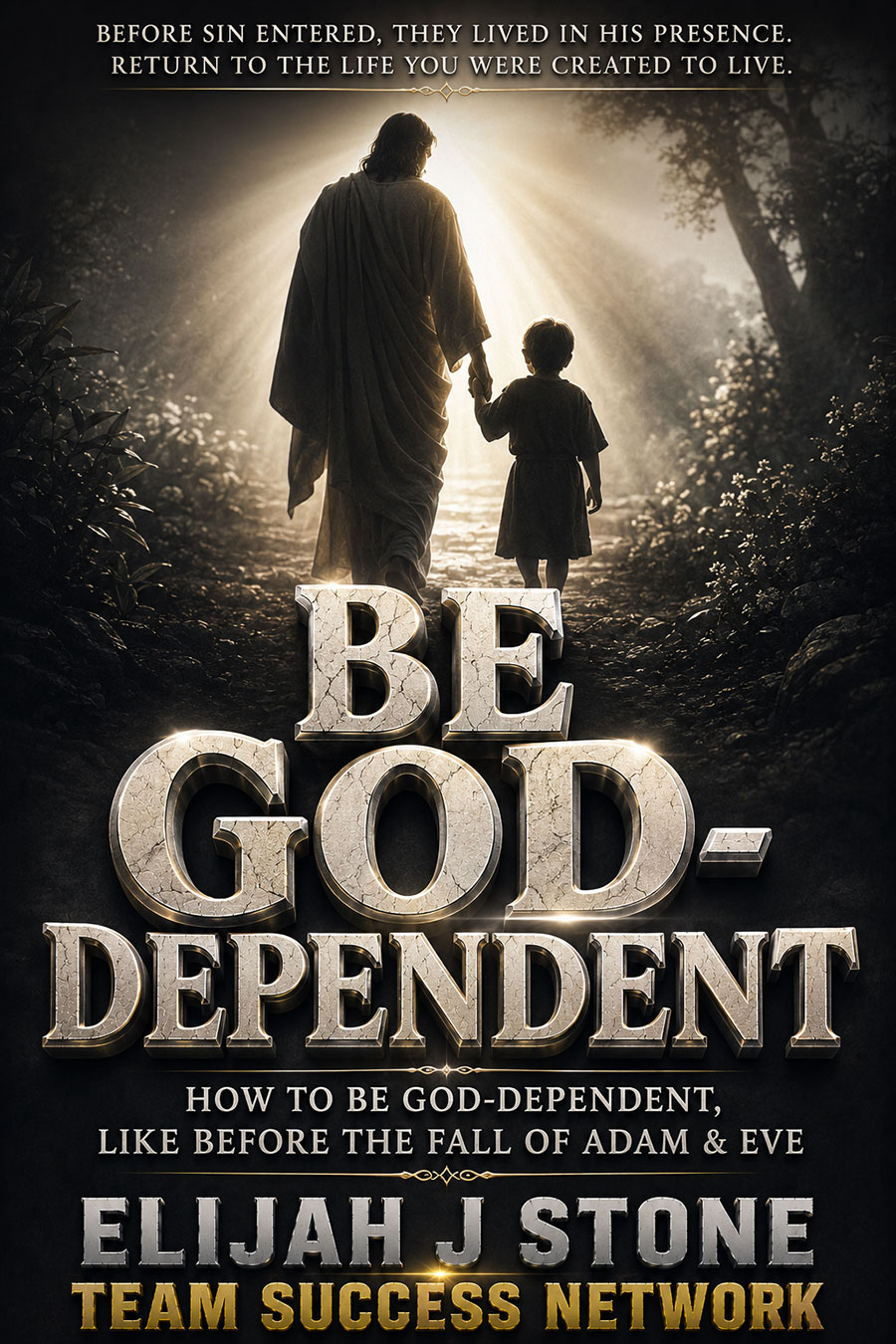
Book 112: Be God-Dependent

Be God-Dependent – For Christians
How To Be God-Dependent, Like Before The Fall of
Adam & Eve
By Mr. Elijah J Stone
and the Team Success Network
Table
of Contents
Part 1 – Understanding
Dependence: Returning to Eden’s Design
Chapter 1 – The Original
Design: How Adam and Eve Lived in Perfect Dependence
Chapter 2 – The Fall: When
Independence Replaced Intimacy
Chapter 3 – The Lie of
Self-Reliance: How the Serpent Still Deceives Today
Chapter 4 – The Nature of
True Dependence: Trust That Breathes Peace
Chapter 5 – Jesus, the
Model of Perfect Dependence on the Father
Chapter 6 – The Holy
Spirit Within: Restoring the Lost Connection
Chapter 7 – Hearing God
Daily: Returning to the Voice That Sustains
Part 2 – Practicing
Dependence: Living by the Spirit, Not the Flesh
Chapter 8 – The Power of
Daily Surrender: Letting Go to Let God
Chapter 9 – Depending on
God for Provision: Faith That Feeds the Soul
Chapter 10 – Depending on
God for Guidance: Walking by Revelation, Not Reason
Chapter 11 – Depending on
God in Weakness: Strength Made Perfect in Surrender
Chapter 12 – Depending on
God in Relationships: Love That Flows, Not Forces
Chapter 13 – Depending on
God in Decision-Making: Trusting Beyond Understanding
Chapter 14 – Depending on
God in Waiting: Finding Purpose in Stillness
Part 3 – Sustaining
Dependence: Living as Heaven’s Partner on Earth
Chapter 15 – The
Discipline of Dependence: Making Intimacy With God a Lifestyle
Chapter 16 – Battling
Pride and Control: The Enemies of God-Dependence
Chapter 17 – Living in
Constant Awareness: The Presence That Never Leaves
Chapter 18 – Dependence in
Ministry: Letting God Work Through You
Chapter 19 – Dependence in
Trials: Faith That Refuses to Break
Chapter 20 – Walking with
God Again: The Restoration of Eden in Your Heart
Part 1 – Understanding Dependence: Returning to Eden’s Design
Before sin
entered the world, humanity lived in perfect dependence on God. Adam and Eve
knew no fear, worry, or self-reliance because their every need was met through
divine presence. Their joy was in walking with God daily, drawing wisdom and
identity directly from Him. Dependence wasn’t weakness—it was the natural state
of life in harmony with the Creator.
When the
fall introduced independence, separation began. Humanity’s desire to live apart
from God’s leadership birthed confusion, striving, and pride. The human heart
was never designed to function apart from divine connection. Every attempt at
control only deepened the distance between humanity and Heaven.
Through
Jesus Christ, that original design is being restored. Believers are called to
return to the same trust-filled relationship Adam once enjoyed. Dependence is
not a step backward—it’s the highest maturity of faith, where the soul learns
to rest and receive again.
Understanding
dependence helps believers rediscover who they are and how they were made to
live. It replaces fear with faith, striving with surrender, and loneliness with
intimacy. Life becomes whole again when God is restored to His rightful place
as the Source of everything.

Chapter 1
– The Original Design: How Adam and Eve Lived in Perfect Dependence
Living in Union With God Before the Fall
How God’s Presence Sustained Every Breath and
Decision
The
Beginning Of Divine Dependence
Before sin
entered the world, humanity lived in the rhythm of divine relationship. Adam
and Eve were not merely created to exist — they were created to abide.
Their lives flowed from the constant awareness that God was their Source for
everything: life, breath, provision, and identity.
They
didn’t strive for survival or chase purpose. Their purpose was God
Himself. “The Lord God took the man and put him in the Garden of Eden to work
it and take care of it” (Genesis 2:15). Even work in Eden wasn’t toil; it was
partnership. Every task began and ended with His presence.
Dependence
was not weakness—it was design. Humanity’s greatest strength came from harmony
with Heaven. Before the first temptation, there was only trust, and that trust
produced peace.
The Peace
Of Total Trust
Adam and
Eve had no concept of fear, scarcity, or anxiety. They awoke every morning
surrounded by provision and love. The presence of God defined their reality.
Nothing was missing, and nothing was out of place.
Their
dependence was not forced; it was joyful. They didn’t wake up wondering if God
would show up — they walked with Him. “Then the man and his wife heard
the sound of the Lord God as he was walking in the garden in the cool of the
day” (Genesis 3:8). Fellowship wasn’t an event; it was existence.
For
believers today, this picture of dependence is what the Spirit of God longs to
restore. Peace returns wherever dependence is restored. Trust isn’t something
you try to maintain — it’s the natural result of knowing Who sustains you.
The Flow
Of Provision
Everything
Adam and Eve needed came from the hand of God. The rivers, trees, and fruit
weren’t just resources — they were evidence of divine faithfulness. They didn’t
earn provision; they received it. God established this truth at creation:
provision follows presence.
“The Lord
God made all kinds of trees grow out of the ground — trees that were pleasing
to the eye and good for food” (Genesis 2:9). The Garden was already abundant
before Adam began to work. That is the heart of dependence — knowing that God
has already prepared what you need before you begin.
For
Christians, the same principle holds true. Jesus echoed this Edenic truth when
He said, “Seek first His kingdom and His righteousness, and all these things
will be given to you as well” (Matthew 6:33). Dependence doesn’t reduce you —
it multiplies grace around you.
The
Simplicity Of Obedience
Obedience
was effortless in Eden. Adam and Eve didn’t view God’s commands as restrictions
but as protection. The Creator’s guidance wasn’t questioned because His love
wasn’t doubted. Dependence made obedience natural.
God gave
one simple boundary: “You must not eat from the tree of the knowledge of good
and evil” (Genesis 2:17). This wasn’t limitation; it was invitation — a
reminder that life only thrives when it flows from Him. Obedience was how
dependence expressed itself.
In the
life of a believer, obedience still functions as the fruit of trust. When God
is the center, surrender stops being difficult. You follow easily when you know
His will is perfect and His ways are peace.
The
Relationship Of Presence
The
greatest gift of Eden wasn’t beauty or abundance — it was presence.
God’s companionship defined humanity’s identity. Adam didn’t discover who he
was by self-reflection but by divine reflection.
Dependence
begins where self-sufficiency ends. When we stop trying to manufacture identity
and start receiving it, peace floods the heart again. “It is in Him we live and
move and have our being” (Acts 17:28). You don’t discover purpose apart from
presence; you discover it through Him.
Today,
through the Holy Spirit, that same intimacy is available. Dependence restores
the Eden experience — not geographically, but spiritually. Every time you lean
into His presence instead of your own power, you live as humanity was first
meant to live.
The Fall
That Broke The Flow
When
independence entered, intimacy was broken. The serpent didn’t tempt Eve with
rebellion but with autonomy. “You will be like God,” he said (Genesis 3:5).
That one thought shattered the design of dependence.
Humanity’s
first sin was not murder or greed — it was independence. It was the belief that
wisdom could be found apart from the Source of all wisdom. The moment they
acted alone, fear entered, and hiding began.
Even
today, self-reliance is still the enemy of intimacy. The more we depend on our
intellect, strength, or plans, the more distant we feel from peace.
God-dependence heals what self-dependence broke.
The Return
To Design
Jesus came
not only to save humanity from sin but to restore the design of dependence. He
lived as the perfect example of trust, declaring, “The Son can do nothing by
Himself; He can do only what He sees His Father doing” (John 5:19). In Him, the
Eden model of reliance was reborn.
Dependence
is not regression; it’s redemption. The believer who learns to rest again in
God’s presence rediscovers original purpose. Life begins to flow, not from
effort, but from intimacy.
The Spirit
whispers the same truth that once filled the Garden: You are not alone. You
are not your own source. Every breath, every gift, every step of faith is
meant to remind you that you were created to be connected.
Key Truth
Dependence
is not a weakness — it’s divine design. Independence was humanity’s first sin;
dependence is its full restoration. Every time you trust God more deeply, you
return to Eden’s original harmony. The Christian life isn’t about mastering
faith but about surrendering fully to the One who holds all things together.
Summary
Before the
fall, dependence was humanity’s default condition. Adam and Eve lived in
perfect harmony with their Creator, drawing purpose and peace from His
presence. Their world was sustained by divine relationship, not human strength.
When
independence replaced intimacy, fear entered the story. But through Jesus
Christ, believers are invited to return — to live as children again, completely
dependent on their Father’s care.
To be
God-dependent is to walk again in Eden’s peace. It is to trust completely, rest
securely, and live constantly in communion with the One who provides, guides,
and loves without limit. Humanity’s beginning reveals its purpose: we were
never made to live without Him.

Chapter 2
– The Fall: When Independence Replaced Intimacy
How Humanity Lost Its Trust in God
When Self-Reliance Broke the Connection of
Divine Dependence
The Moment
Of Separation
When Adam
and Eve reached for the forbidden fruit, they weren’t just disobeying a
command—they were declaring independence. That bite was humanity’s first act of
self-reliance, a statement that said, “We no longer need God to define what is
good and evil.” With that single choice, intimacy gave way to isolation.
“The woman
saw that the fruit of the tree was good for food and pleasing to the eye, and
also desirable for gaining wisdom, she took some and ate it” (Genesis 3:6). The
deception was not about the fruit itself but the idea behind it—autonomy. The
serpent’s lie promised enlightenment but delivered emptiness.
The Fall
was not only moral rebellion; it was relational rebellion. Humanity turned
inward, looking to self for what only God could provide. The result was
immediate disconnection, and the sound of God walking in the garden became a
sound to hide from instead of a sound to run toward.
The Cost
Of Independence
Independence
promised freedom but delivered fear. Adam and Eve’s eyes were opened—but not to
wisdom, to vulnerability. “Then the eyes of both of them were opened, and they
realized they were naked” (Genesis 3:7). For the first time, shame entered
creation.
Without
God’s covering, they tried to cover themselves. The fig leaves symbolized
humanity’s endless effort to fix what sin broke—to manage life apart from
divine grace. Religion without relationship began in that moment: outward
attempts to hide inward emptiness.
Independence
still carries the same cost today. It offers the illusion of control but
results in anxiety and isolation. Every time we choose self-sufficiency over
surrender, we repeat the pattern of Eden’s fall.
The Birth
Of Fear And Hiding
The moment
intimacy was replaced by independence, fear became the human instinct. “But the
Lord God called to the man, ‘Where are you?’ He answered, ‘I heard you in the
garden, and I was afraid because I was naked; so I hid’ ” (Genesis 3:9-10). The
same presence that once brought joy now caused dread.
Sin
changed humanity’s perception, not God’s posture. The Father still came
walking, still seeking, still calling. But the fallen heart could no longer
receive love without suspicion. Dependence had been replaced with distance.
This is
the tragedy of sin—it convinces the heart that God must be avoided instead of
trusted. Independence breeds insecurity. Every mask we wear, every fear of
exposure, every hiding place of pride traces back to that first moment of
distrust.
The
Deception Of Control
The
serpent’s strategy has never changed: to make people believe they can control
what only God sustains. The lie that we can “be like God” (Genesis 3:5) still
whispers through modern culture—in self-help, success obsession, and the idol
of self-sufficiency.
Control
feels safe but secretly enslaves. It burdens the soul with pressures it was
never designed to carry. When we take control, we take responsibility for
outcomes that only God can handle. Independence leads not to empowerment but
exhaustion.
Dependence,
on the other hand, restores peace. It places the weight back where it
belongs—on divine shoulders. Jesus said, “Come to me, all you who are weary and
burdened, and I will give you rest” (Matthew 11:28). Dependence is the rest
humanity has been searching for since Eden closed its gates.
The
Consequences Of The Fall
The moment
humanity chose independence, creation itself felt the fracture. The ground was
cursed, pain entered labor, and death entered time. “For dust you are and to
dust you will return” (Genesis 3:19). Life outside of dependence became
survival instead of communion.
Adam’s
work turned from partnership to toil. Eve’s joy became shadowed by pain. The
world began to reflect the broken relationship between God and man—still
beautiful, but bruised. Sin distorted the design but couldn’t destroy it
entirely. Deep inside, every heart still remembers Eden.
That
longing for connection is proof of the divine image within us. The ache to be
loved, guided, and covered isn’t weakness—it’s memory. Dependence is not
something new to learn; it’s something ancient to recover.
The
Invitation Of Redemption
Even as
judgment fell, grace appeared. God covered Adam and Eve with garments of skin
(Genesis 3:21), symbolizing that innocence must be restored through sacrifice.
The first shedding of blood pointed forward to the Cross—the ultimate
restoration of intimacy.
Through
Jesus, the curse began to reverse. He didn’t just forgive sin; He reopened the
door to dependence. “For through him we both have access to the Father by one
Spirit” (Ephesians 2:18). The same relationship that once existed in Eden can
now live again in every believer’s heart.
Redemption
restores relationship. Dependence is not weakness—it’s worship. Every time a
Christian chooses trust over control, Heaven celebrates the undoing of the
Fall.
The Fight
Between Flesh And Spirit
Since
Eden, every believer battles the same war: flesh wants independence; spirit
longs for intimacy. Paul described it clearly, saying, “For the flesh desires
what is contrary to the Spirit, and the Spirit what is contrary to the flesh”
(Galatians 5:17). The human will still wrestles to rule itself, even after
salvation.
Dependence
must be practiced daily. It’s not a one-time surrender but a continual
choosing. Each decision becomes a declaration of who rules the heart—self or
Spirit.
When
believers walk in dependence, the Spirit produces fruit—love, joy, peace, and
self-control. When they walk in independence, anxiety and frustration return.
The key to victory is simple: yield. Dependence turns conflict into communion.
The
Restoration Of Intimacy
God’s goal
has always been restoration, not rejection. From Genesis to Revelation, His
story is the pursuit of lost dependence. The Cross is the bridge between
isolation and intimacy.
When a
believer says, “Father, I need You,” something holy happens—the curse begins to
reverse in their own heart. Connection replaces control, humility replaces
pride, and peace replaces fear.
Dependence
brings believers back to Eden’s atmosphere: walking with God in love and trust.
It’s not about religion; it’s about relationship restored. Jesus didn’t die to
make us independent saints but dependent sons and daughters.
Key Truth
The first
sin was independence. Every act of rebellion since then has been an echo of
Eden’s choice to live apart from God. But through Jesus, the curse is broken
and dependence restored. The Christian life is not about achieving freedom from
God—it’s about rediscovering freedom in Him.
Summary
The Fall
was humanity’s first step away from intimacy and its first attempt at
self-rule. Independence brought fear, shame, and toil into a world once defined
by peace. Every form of control, pride, and anxiety traces back to that ancient
lie that we could live without God.
Yet God’s
plan of redemption has always been about restoration. Through Christ, the
broken relationship is healed, and believers can once again walk in daily
communion with the Father.
To be
God-dependent is to reverse the Fall in your own life—choosing connection over
control, surrender over striving, and trust over fear. Dependence isn’t a
return to weakness—it’s the restoration of what we were created for: intimacy
with God that never ends.

Chapter 3
– The Lie of Self-Reliance: How the Serpent Still Deceives Today
When Strength Becomes Subtle Pride
How the Desire for Independence Still
Separates Us From God
The
Whisper That Started It All
The
serpent’s whisper in Eden—“You will be like God”—was not just a temptation; it
was the birth of self-reliance. The enemy didn’t tempt Adam and Eve with evil;
he tempted them with independence. The lie wasn’t about fruit—it was
about freedom from dependence. Humanity was deceived into believing it could
function apart from its Creator.
That same
lie still echoes in modern hearts. Our culture celebrates autonomy, ambition,
and self-made success, all while quietly exalting the same spirit that brought
the fall. “There is a way that appears to be right, but in the end it leads to
death” (Proverbs 14:12). What looks wise to the world often leads away from the
heart of God.
The
serpent’s deception wasn’t just about disobedience—it was about distraction. If
the enemy can make you believe you can sustain yourself, he doesn’t have to
make you rebel; he’s already made you forget your dependence.
The
Culture Of Self-Made Strength
We live in
a generation that glorifies control. Society teaches that strength means
standing alone, building your empire, and “believing in yourself.” While
confidence has value, self-reliance crosses a sacred line—it replaces faith in
God with faith in self.
The modern
world rewards independence but the Kingdom rewards trust. Jesus said, “Apart
from Me you can do nothing” (John 15:5). Every attempt to succeed without His
help eventually leads to frustration or burnout. What the world calls
achievement, Heaven often calls idolatry.
Many
believers fall into the same pattern without noticing. We pray, but we plan
more than we listen. We work, but we forget who gave the strength. We celebrate
human effort while overlooking divine enablement. In the end, self-reliance
becomes the quiet killer of intimacy.
The Trap
Inside Good Intentions
Self-reliance
doesn’t always appear sinful. It often hides beneath noble goals and good
motives. People say, “I’m just being responsible” or “I don’t want to bother
God with this.” But the truth is, dependence is never a burden to Him—it’s what
He designed us for.
Even in
ministry, self-reliance can sneak in disguised as diligence. We may start
projects for God but quickly shift into working without Him. The moment
we stop seeking His presence and start relying on performance, we step outside
divine partnership.
“Trust in
the Lord with all your heart and lean not on your own understanding” (Proverbs
3:5). God isn’t asking us to abandon wisdom—He’s asking us to anchor it. Real
wisdom comes from Heaven, not from human logic or experience.
The Burden
Of Self-Sufficiency
Self-reliance
promises control but produces pressure. When you make yourself the source, you
become responsible for every outcome. That’s why anxiety often accompanies
independence—it’s the soul trying to carry what only God can sustain.
Many
Christians feel burned out not because they’ve failed, but because they’ve
succeeded in their own strength. They’ve built impressive structures without
divine support. Jesus warned of this kind of success when He said, “What good
will it be for someone to gain the whole world, yet forfeit their soul?”
(Matthew 16:26).
Dependence
doesn’t mean inactivity—it means alignment. It means refusing to take a single
step without divine direction. When you let God carry the weight, peace returns
and striving ends.
The
Humility Of Dependence
Dependence
requires humility—the kind that admits, “I cannot do this without You.” It’s
not self-pity; it’s spiritual realism. Everything we have, from breath to
strength, comes from the Lord.
Scripture
says, “He gives strength to the weary and increases the power of the weak”
(Isaiah 40:29). God doesn’t despise our weakness—He fills it. Dependence
positions us to receive what pride resists. When we stop trying to impress God
and start relying on Him, the flow of grace begins again.
True
humility isn’t thinking less of yourself—it’s thinking of yourself less. It’s
living aware that every success, insight, and blessing is a reflection of
divine generosity, not personal greatness.
The
Illusion Of Control
Self-reliance
feels empowering at first because it gives a false sense of control. But
control is the enemy of peace. The more we cling to it, the more anxious we
become. The heart wasn’t designed to rule—it was designed to rest under the
rule of God.
The
serpent still whispers today: “You can handle this. You don’t need to wait. You
don’t need help.” But every time we listen, we take one step further from
intimacy. The devil doesn’t need to destroy your faith; he only needs to
convince you to depend on yourself.
Dependence
breaks the illusion. When believers say, “Lord, I can’t, but You can,” they
dismantle hell’s oldest deception. Power flows where surrender lives.
The
Freedom Of Letting Go
When
dependence replaces self-reliance, the soul breathes again. Letting go of
control doesn’t mean chaos—it means confidence in divine order. God knows the
outcome before the beginning. His sovereignty doesn’t eliminate our effort; it
empowers it.
Paul
declared, “I worked harder than all of them—yet not I, but the grace of God
that was with me” (1 Corinthians 15:10). That is the balance of dependence:
full effort, zero pride. You give your best, knowing the results belong to God.
Dependence
frees believers from both fear of failure and obsession with success. The
pressure lifts, and peace returns. It’s no longer about proving worth—it’s
about walking in grace.
The Power
Of A Surrendered Heart
God
doesn’t want strong performers; He wants surrendered hearts. He delights in
those who trust Him completely, not those who showcase their strength. The
Kingdom is built not by human might but by divine Spirit.
“‘Not by
might nor by power, but by My Spirit,’ says the Lord Almighty” (Zechariah 4:6).
Every victory in Scripture came through dependence, not domination. David
defeated Goliath by faith, not force. Moses parted the sea by obedience, not
strategy.
The
surrendered heart is God’s most powerful weapon on earth. When you depend
fully, you become unshakeable—not because you’re strong, but because your
foundation is.
Key Truth
The
serpent’s oldest lie is still humanity’s greatest struggle: the belief that we
can handle life without God. Self-reliance may look admirable, but it separates
the heart from grace. Dependence is not laziness—it’s divine alignment. The
truly strong are those who lean.
Summary
From Eden
to the modern world, the serpent’s deception remains the same: convincing
humanity that it can be its own god. What began as a whisper in the garden has
become the anthem of modern culture—self-sufficiency over surrender.
But the
Gospel reverses the lie. Jesus calls believers back to dependence—the posture
of trust that births peace, power, and intimacy. Every time you rely on Him
instead of yourself, you break the serpent’s spell.
To be
God-dependent is to reclaim your true strength. Success without His presence is
still failure, but weakness with His presence is victory. Dependence isn’t
regression—it’s restoration to how we were created to live: fully connected
to God, completely sustained by grace.

Chapter 4
– The Nature of True Dependence: Trust That Breathes Peace
Dependence That Produces Calm Confidence
How Trust Becomes the Pathway to Peace
Dependence
Is Strength, Not Weakness
True
dependence is one of the most misunderstood virtues in the Christian life. Many
mistake it for passivity or spiritual laziness, when in reality it’s the
highest form of strength. To depend on God is to trust so deeply that fear no
longer controls the heart.
Dependence
means leaning fully into His power, not your own. It is the quiet assurance
that the God who created the universe is also managing the details of your
life. “The Lord is my strength and my shield; my heart trusts in Him, and He
helps me” (Psalm 28:7). When trust becomes your foundation, peace becomes your
atmosphere.
Dependence
doesn’t remove responsibility—it redefines it. Your job becomes faith; His job
becomes outcome. The soul that truly depends on God learns to walk in boldness,
not because it knows what’s next, but because it knows Who leads.
Trust That
Defeats Fear
Fear is
born from misplaced trust. When you depend on your own understanding, you will
eventually meet uncertainty and panic. But when trust is anchored in God, even
the unknown becomes sacred ground.
“The Lord
is with me; I will not be afraid. What can mere mortals do to me?” (Psalm
118:6). This confidence doesn’t come from courage—it comes from companionship.
The presence of God drives out fear because perfect love leaves no room for it.
Dependence
quiets the anxious heart. It teaches the believer to breathe again—to rest in
the assurance that God is working in every situation. What looks like delay is
often divine design, and what feels like loss is sometimes hidden preparation.
To depend
on God is to choose peace before you see results. It is saying, “I may not know
the way, but I know the Guide.” Fear loses power where faith becomes focus.
Resting
While Obeying
Dependence
is not sitting still; it’s moving under instruction. God-dependent believers
don’t run ahead or lag behind—they walk in step with His timing. Jesus lived
this perfectly: “I only do what I see the Father doing” (John 5:19). That
statement defines the rhythm of divine dependence.
To rest
while obeying means to act without anxiety. You move when He says “go” and wait
when He says “stay.” You work with diligence but sleep with peace. The world’s
rhythm is frantic, but the Kingdom’s rhythm is restful.
Rest
doesn’t mean inactivity—it means inner stillness. You can work in peace because
your confidence isn’t in effort but in alignment. God-dependent obedience
brings fruit without fatigue because grace does the heavy lifting.
Dependence
transforms striving into surrender. The believer stops chasing outcomes and
starts following presence. You no longer carry life; life carries you.
Surrender
That Unlocks Peace
The key to
peace is surrender. The moment you stop trying to control everything, anxiety
loses its power. Dependence invites you to lay down your need to understand, to
manage, or to predict. The Spirit whispers, “Let go,” and peace floods in.
“You will
keep in perfect peace those whose minds are steadfast, because they trust in
You” (Isaiah 26:3). This is not ordinary calm—it’s supernatural serenity that
transcends circumstance. Peace is not the absence of problems; it’s the
presence of God in the midst of them.
Surrender
doesn’t mean indifference—it means confidence. When you hand situations to God,
you’re not giving up; you’re giving over. It’s a holy transaction: your worry
for His wisdom, your fear for His faithfulness.
Dependence
breathes peace because it removes the weight of self-reliance. The believer who
surrenders daily discovers that peace isn’t something to pursue—it’s something
to receive.
Walking
Through Storms Without Panic
Dependence
doesn’t exempt you from storms—it steadies you through them. Jesus never
promised an absence of trouble; He promised His presence within it. When your
trust is in Him, external chaos cannot shake internal calm.
“Peace I
leave with you; My peace I give you. I do not give to you as the world gives.
Do not let your hearts be troubled and do not be afraid” (John 14:27). The
peace of Christ isn’t fragile—it’s anchored. It stands even when waves rise.
When the
disciples panicked in the storm, Jesus slept. Not because He didn’t care, but
because He knew His Father’s power over wind and wave. Dependence gives you
that same rest—an inner stability that circumstances cannot steal.
Storms
reveal the foundation of faith. The dependent heart doesn’t panic because it
knows Who commands the sea. Trust transforms fear into worship, and peace
becomes the believer’s default state.
The Wisdom
Of Dependence
In a world
that glorifies control, dependence looks foolish. Yet in Heaven’s eyes, it’s
wisdom. “For the foolishness of God is wiser than human wisdom, and the
weakness of God is stronger than human strength” (1 Corinthians 1:25).
Dependence
is wisdom because it connects you to infinite understanding. God sees what you
cannot, knows what you don’t, and plans what you can’t imagine. When you trust
Him, you gain access to a higher perspective.
True
wisdom isn’t knowing everything—it’s knowing the One who does. Dependence
positions you under divine guidance where every step becomes ordered, every
detour purposeful, and every delay meaningful.
What the
world calls weakness, Heaven calls worship. To depend on God is to declare that
His wisdom is enough, His will is perfect, and His presence is sufficient.
The Rhythm
Of Grace
Dependence
aligns the believer with Heaven’s rhythm. Life becomes less about striving and
more about flowing. Grace becomes the atmosphere where peace grows naturally.
You stop forcing outcomes and start receiving direction.
“Be still,
and know that I am God” (Psalm 46:10). Stillness isn’t inactivity—it’s
awareness. It’s the recognition that He is God and you are not. Dependence
restores divine order: God leading, you following, and peace flowing.
This
rhythm produces lasting joy. You move through life confident, not because you
have control, but because you have connection. The one who trusts God deeply
carries calm everywhere they go.
Dependence
is the heartbeat of relationship. It keeps your soul in sync with Heaven. The
more you lean, the lighter you live. The more you trust, the more peace
breathes through you.
Key Truth
Dependence
is not passive—it’s powerful. It is the highest expression of trust, the
posture that allows peace to reign. To depend on God is to hand Him every
burden and receive His rest. The heart that trusts fully breathes freely.
Summary
True
dependence is the rhythm of peace restored. It is the strength that comes from
surrender, the calm that grows from confidence in God’s character. The believer
who depends learns to rest while obeying, to work without worry, and to wait
without fear.
The Spirit
of God teaches that dependence is not weakness—it’s wisdom. It is the return to
Eden’s harmony, where trust flows naturally and peace fills every corner of the
heart.
To be
God-dependent is to live with quiet confidence, knowing that the same God who
rules the universe also governs your steps. It is life as it was meant to be—restful,
peaceful, and fully secure in His hands.

Chapter 5
– Jesus, the Model of Perfect Dependence on the Father
How the Son’s Surrender Became Our Example
Learning From the Life of Jesus: The Power of
Complete Reliance
The Son
Who Chose Dependence
Jesus
didn’t just talk about dependence—He embodied it. Every moment of His earthly
life reflected total trust in the Father. Though He was fully divine, He chose
to live fully dependent as a man led by the Spirit. “Very truly I tell you, the
Son can do nothing by Himself; He can do only what He sees His Father doing”
(John 5:19). Those words reveal not limitation, but divine alignment.
Jesus’
greatness was rooted in surrender. His miracles flowed from obedience, not
ambition. His wisdom came from communion, not intellect. His entire ministry
revealed that true power begins where pride ends. Dependence wasn’t an option
for Him—it was the foundation of His identity and the key to His authority.
Through
Christ, believers see what perfect dependence looks like in human form. He
modeled the life that Adam was meant to live: walking in constant fellowship,
hearing God clearly, and acting only in response to divine direction.
Prayer As
The Lifeline Of Power
For Jesus,
prayer wasn’t religious formality—it was relational necessity. He withdrew
often to quiet places, not because He was weary of people, but because He
longed for the Father’s presence. “But Jesus often withdrew to lonely places
and prayed” (Luke 5:16). Prayer was His oxygen—the unbroken connection that
kept Him aligned with Heaven.
The Son of
God could have relied on His own power, yet He continually looked upward before
acting outward. Dependence drove Him to listen before leading and to commune
before commanding. Every miracle began in prayer and ended in praise.
This
example teaches us that prayer is not preparation for dependence—it is
dependence. It’s the daily act of humility that acknowledges our need for
divine wisdom. Jesus didn’t move from prayer to power; He moved through
prayer in power.
When
believers learn to treat prayer not as duty but as lifeline, they begin to
operate in the same rhythm of grace.
Submission
That Brought Authority
The
authority of Jesus flowed from His submission. Every word He spoke carried
weight because it carried Heaven’s backing. He didn’t speak from personal
confidence but divine commissioning. “For I did not speak on My own, but the
Father who sent Me commanded Me to say all that I have spoken” (John 12:49).
His
authority came not from position, but from posture. Dependence kept Him
grounded while power flowed freely through Him. The miracles weren’t proof of
divinity alone—they were proof of intimacy. He acted as a Son under complete
trust.
In the
Kingdom, submission always precedes authority. Those who depend deeply on God
carry true spiritual influence because Heaven trusts them with its resources.
Dependence isn’t loss—it’s divine stewardship. It’s the humility that turns
obedience into miracles.
Jesus’
life demonstrates that real strength comes from yielded hearts. When we bow
low, God raises us high.
The Rhythm
Of Listening And Acting
Jesus
lived in a sacred rhythm—listening, then acting. He never moved impulsively.
Every teaching, healing, and word of knowledge flowed from revelation, not
reaction. Dependence kept His pace perfectly in sync with the Father’s will.
“I do
nothing on My own but speak just what the Father has taught Me” (John 8:28).
This verse reveals the secret to His peace: He didn’t need to figure life out.
His task was not control but cooperation.
The
believer who follows this pattern will find rest in motion. Dependence doesn’t
paralyze action—it purifies it. It turns busyness into purpose and replaces
pressure with peace. When we act from listening, we produce fruit that lasts
instead of work that fades.
Dependence
is not inactivity—it’s intentional alignment. When we learn to wait for God’s
voice before we act, we begin to move with Heaven’s rhythm.
The
Humility Of The Son
The
humility of Jesus was not weakness—it was wisdom. Though equal with the Father,
He chose servanthood over status. “He humbled Himself by becoming obedient to
death—even death on a cross” (Philippians 2:8). That humility is the core of
divine dependence.
Humility
says, “I trust You more than I trust myself.” It’s the daily decision to bow
before wisdom greater than our own. Jesus’ humility made Him untouchable by
pride and unshakable in purpose. He didn’t need to prove Himself—He only needed
to please the Father.
For
Christians, humility is the doorway back into dependence. Pride isolates, but
humility reconnects. The lower we bow, the freer we become. Dependence thrives
in hearts that stay surrendered.
The same
Spirit that empowered Jesus now empowers every believer who walks in humility.
The greater the dependence, the greater the display of divine strength.
The Model
For Every Believer
Jesus’
dependence wasn’t just for observation—it was for imitation. He came not only
to redeem humanity but to reveal how humanity was designed to live. His
relationship with the Father was the blueprint for ours.
He prayed,
listened, obeyed, and trusted—and the results were divine partnership. The
miracles He performed weren’t unreachable; they were demonstrations of what
dependence produces. He said, “Whoever believes in Me will do the works I have
been doing, and they will do even greater things than these” (John 14:12).
Dependence
is the secret to those “greater works.” It’s not about replicating power—it’s
about replicating trust. When believers align their hearts like Jesus did, the
supernatural becomes natural.
To be
God-dependent is to live as Christ lived—walking daily in intimacy, relying
fully on the Father’s direction, and letting love lead every decision.
The
Partnership Of Heaven And Earth
Jesus
demonstrated what perfect partnership between Heaven and earth looks like. His
dependence created a seamless connection—divine will expressed through human
obedience. Every miracle on earth began with agreement in Heaven.
Dependence
bridges the gap between divine intention and earthly manifestation. It is the
invisible current through which God flows His purposes. Jesus modeled this
partnership by showing that surrender, not striving, brings results.
When
believers yield to the Spirit, they continue this same partnership. God still
desires to work through His people, not merely around them.
Dependence transforms ordinary lives into instruments of eternal impact.
Heaven
still moves through surrendered hearts. Dependence is the open doorway through
which the Kingdom touches the earth.
Key Truth
The Son’s
dependence on the Father was not a sign of limitation—it was a revelation of
divine perfection. Jesus lived fully surrendered, proving that true power flows
through humility. Every miracle, word, and act of love was born from trust.
Dependence is not weakness—it is Heaven’s greatest strength revealed through
man.
Summary
Jesus
showed the world that dependence is not optional—it’s essential. He modeled the
life every believer is invited into: a life led by prayer, guided by
revelation, and sustained by surrender.
His
words—“The Son can do nothing by Himself”—remain the cornerstone of Christian
living. They remind us that intimacy produces power, and submission releases
authority. The more we rely on God, the more His Spirit flows through us.
To be
God-dependent is to live like Jesus—listening before acting, trusting before
understanding, and yielding before achieving. Dependence is the doorway to
divine partnership, where human weakness becomes the stage for God’s strength.
It is not limitation—it’s liberation into the same rhythm of life that made
Jesus unstoppable. Dependence is the secret of divine power.
You said:
Write
chapter 6 in the SAME EXACT WAY Write it in 1000 words in 2 pages, in one go
——— —Additional Notes: Chapter 6 – The Holy Spirit Within: Restoring the Lost
Connection When Adam and Eve fell, humanity lost more than paradise—they lost
the indwelling presence of God. Fellowship became distant, and divine guidance
turned faint. But through Jesus, that lost connection has been restored. The
Holy Spirit now lives within every believer, making dependence possible once
again. The Spirit isn’t just a force; He’s a Person who teaches, comforts, and
directs. Being God-dependent means learning to listen to Him in daily
life—whether in small choices or major decisions. His presence is Heaven’s
voice inside the human heart, guiding believers back to the intimacy Adam once
had. Dependence on God today is dependence on the Spirit within. It’s walking
by His leading instead of reacting to circumstance. As believers yield to His
whisper, they experience peace that surpasses understanding and strength beyond
human capacity. This restored connection changes everything. The believer no
longer searches for God externally but communes with Him internally. To be
God-dependent is to live aware that He dwells inside, ready to guide every
step, every prayer, every breath.

Chapter 6
– The Holy Spirit Within: Restoring the Lost Connection
How God Returned to Dwell in the Hearts of His
People
The Spirit’s Presence: The Power That Makes
Dependence Possible Again
The
Presence Humanity Lost
When Adam
and Eve fell, they lost more than a garden—they lost divine indwelling. The
presence of God that once walked with them became distant. The voice that once
spoke face-to-face now echoed faintly through prophets and priests. Humanity
had exchanged intimacy for independence.
Sin didn’t
just break rules; it broke relationship. Fellowship became rare, guidance
became unclear, and peace became temporary. The image of God in man remained,
but the breath of communion was gone. “Your iniquities have separated you from
your God; your sins have hidden His face from you” (Isaiah 59:2).
From that
moment, the cry of Heaven’s heart was restoration. God longed to dwell with His
creation again—not above them, not beside them, but within them.
Dependence could only be restored when presence was restored.
The
Promise Of The Spirit
God’s plan
was never to leave humanity abandoned. Through the prophets, He began revealing
His redemptive design—a day when His Spirit would once again fill human hearts.
“I will put my Spirit within you and move you to follow my decrees and be
careful to keep my laws” (Ezekiel 36:27).
This was
more than prophecy; it was a promise of reconciliation. The law could command
righteousness, but only the Spirit could empower it. Humanity didn’t need more
instruction—they needed inhabitation.
Jesus came
to fulfill that promise. Before returning to the Father, He told His disciples,
“And I will ask the Father, and He will give you another Advocate to help you
and be with you forever—the Spirit of truth” (John 14:16–17). Through His death
and resurrection, the dwelling place of God moved from temples made of stone to
hearts made of flesh.
Dependence
on God became internal again. What Adam lost in Eden, the believer regains
through the Spirit of Christ.
The Person
Of The Holy Spirit
The Holy
Spirit is not an impersonal force or abstract power—He is the living presence
of God Himself. He speaks, teaches, comforts, corrects, and communes. “But the
Advocate, the Holy Spirit, whom the Father will send in My name, will teach you
all things and will remind you of everything I have said to you” (John 14:26).
Dependence
on God today means learning to recognize and respond to this indwelling
presence. The Spirit is Heaven’s voice within—our inner teacher and divine
counselor. Through Him, the believer receives guidance, conviction, and comfort
in ways no external system could ever provide.
The Spirit
is not a guest to entertain; He is a resident to cooperate with. He doesn’t
just visit during worship—He abides continually. To be God-dependent is to live
in daily fellowship with the One who now lives inside.
The Return
Of Daily Communion
Before the
Fall, Adam walked with God in constant fellowship. Through the Holy Spirit,
that same communion is now restored in every believer. What was once external
has become internal. The garden has moved into the heart.
The Spirit
brings believers back to divine intimacy—not as distant observers but as living
temples. “Do you not know that your bodies are temples of the Holy Spirit, who
is in you, whom you have received from God?” (1 Corinthians 6:19). God no
longer visits—He inhabits.
Dependence
is now practiced through awareness. Every whisper of peace, every inner
prompting toward love, every conviction toward truth is the Spirit’s voice
restoring the lost rhythm of Eden. Dependence becomes a lifestyle of listening.
The
believer no longer searches for God in external signs or systems. The
indwelling Spirit is the connection that was lost but now eternally restored.
Walking By
The Spirit
To depend
on God is to depend on His Spirit’s leading. Scripture says, “Since we live by
the Spirit, let us keep in step with the Spirit” (Galatians 5:25). This verse
describes more than behavior—it describes relationship. Walking by the Spirit
means allowing His direction to override our impulses.
Dependence
requires sensitivity. The Spirit doesn’t shout; He whispers. The more we yield,
the clearer His guidance becomes. The flesh reacts, but the Spirit responds.
When believers follow His gentle nudges instead of their emotions, they begin
to experience supernatural peace and clarity.
Walking by
the Spirit transforms chaos into calm. It means responding to life’s challenges
with divine timing, not human panic. Dependence keeps you steady when
everything else shakes.
The Spirit
doesn’t control; He collaborates. His leadership is gentle but sure. The one
who depends on Him will never walk in confusion for long because divine
direction always leads to peace.
Dependence
That Brings Power
When the
Spirit was poured out at Pentecost, humanity’s dependence was fully restored.
“You will receive power when the Holy Spirit comes on you” (Acts 1:8). The same
Spirit that hovered over creation now filled fragile human vessels, turning
weakness into strength.
This power
isn’t limited to miracles—it’s power to live holy, power to forgive, power to
persevere. Dependence activates divine ability. When we yield, God moves. When
we surrender, Heaven responds.
Jesus
performed miracles not as God apart from man but as man filled with God. That
same pattern continues through the Spirit-filled believer today. Dependence
invites empowerment. The more we depend, the more He displays.
Power in
the Kingdom never comes through striving—it comes through surrender. The Spirit
doesn’t empower independence; He empowers reliance.
The Peace
Of His Presence
Dependence
on the Holy Spirit brings a peace that nothing else can duplicate. His
indwelling presence becomes the calm center of a chaotic world. “And the peace
of God, which transcends all understanding, will guard your hearts and your
minds in Christ Jesus” (Philippians 4:7).
This peace
is not circumstantial—it’s relational. It flows from knowing that God is not
only with you but within you. You don’t have to beg for His
nearness; you simply acknowledge His presence.
When fear
rises, dependence turns your gaze inward—toward the One who already reigns
inside. Peace doesn’t come from fixing problems; it comes from resting in His
control. The Holy Spirit makes peace possible because He never leaves.
Dependence
is the doorway to tranquility. The soul that trusts the Spirit learns to live
unhurried, unshaken, and unafraid.
The
Restoration Of Relationship
The
arrival of the Holy Spirit marks the completion of God’s rescue plan. The
relationship lost in Genesis has been fully restored through Christ and His
Spirit. What was once broken is now bonded forever.
This
restoration is not abstract—it’s personal. Every believer now carries the very
presence Adam forfeited. God once again walks with His creation—not beside them
but within them. Dependence is now the natural expression of that restored
relationship.
To depend
on the Spirit is to participate in God’s original design. It is to live in
unbroken fellowship, guided by divine wisdom, strengthened by divine power, and
comforted by divine love.
Key Truth
The Holy
Spirit within every believer is the restoration of what was lost in Eden.
Dependence is no longer distant—it lives inside you. The Spirit is Heaven’s
voice, power, and peace dwelling in human hearts. To be God-dependent is to
live fully aware that the Creator of all now resides within.
Summary
When Adam
fell, humanity lost the presence of God, but through Christ, the Spirit has
returned to dwell within us. This is the miracle of restored dependence—He no
longer walks beside; He lives inside.
The Spirit
is not an occasional visitor but an eternal companion. He teaches, comforts,
and directs, making dependence not a burden but a blessing. As believers yield
to His leading, peace and power replace fear and striving.
To live
God-dependent is to live Spirit-led. The garden of fellowship has been
replanted in the human heart. The same voice that once spoke in Eden now
whispers within. Dependence is restored, and God is home again.

Chapter 7
– Hearing God Daily: Returning to the Voice That Sustains
How to Walk in Daily Conversation With the
Father
Hearing God’s Voice as the Foundation of True
Dependence
The Voice
That Once Filled the Garden
In Eden,
communication with God was effortless. His voice was the rhythm of life, the
melody that guided every thought and action. Adam and Eve didn’t strive to hear
Him—they lived in a world tuned to His frequency. Each day began and ended with
the sound of divine fellowship.
Sin didn’t
just break obedience; it broke communication. Humanity lost its clear hearing
when it chose independence. The heart that once resonated with Heaven became
filled with static from the world. But through Christ, that voice was restored
to every believer willing to listen again.
Dependence
begins with listening. The God-dependent life isn’t built on good ideas but on
divine direction. When you hear God clearly, you live confidently because His
Word becomes your compass.
The God
Who Still Speaks
Contrary
to what many believe, God has not stopped speaking. He never fell silent;
humanity simply forgot how to listen. The same God who spoke creation into
being now speaks through His Word, His Spirit, and His peace. “My sheep listen
to My voice; I know them, and they follow Me” (John 10:27).
God’s
voice is not reserved for prophets or pastors—it’s the inheritance of every
child who belongs to Him. His Word is alive, His Spirit is active, and His
peace is directional. To live God-dependent is to live aware of that ongoing
communication.
He speaks
through Scripture, revealing His unchanging truth. He speaks through the still,
small voice of the Spirit, whispering guidance to the heart. He speaks through
the atmosphere of peace that confirms His will. Dependence means tuning your
spiritual ears to catch every frequency of His voice.
Learning
To Listen Again
The
problem isn’t that God has stopped talking—it’s that we’ve filled our lives
with too much noise to hear Him. Distraction has become the modern thief of
intimacy. We listen to everything but the One who sustains everything.
Stillness
has become rare, yet it is in stillness that the voice of God is clearest. “Be
still, and know that I am God” (Psalm 46:10). The Spirit doesn’t shout over
chaos; He whispers into quiet hearts. Dependence requires space—time to pause,
to breathe, and to listen intentionally.
Many
believers miss divine direction because they only seek it in crisis. But
hearing God daily builds trust that prepares you for every season. Dependence
isn’t event-based; it’s relational. The one who listens continually never loses
their way.
Recognizing
His Voice
God’s
voice is distinct, though gentle. It aligns with Scripture, produces peace, and
draws you closer to love. It never condemns—it convicts with compassion. “When
He, the Spirit of truth, comes, He will guide you into all the truth” (John
16:13).
The voice
of the Holy Spirit will never contradict the Word of God. If what you hear
leads to fear, confusion, or pride, it isn’t Him. His tone carries authority
yet tenderness. Dependence teaches discernment—learning to separate His whisper
from your own thoughts or the enemy’s noise.
You’ll
know it’s God when His words bear fruit: peace replaces panic, clarity replaces
confusion, and humility replaces self-will. The heart trained to listen becomes
sensitive to even the smallest promptings.
Dependence
sharpens that sensitivity. The more time you spend with Him, the more familiar
His voice becomes. Just as Adam once recognized the sound of the Lord walking
in the garden, you will recognize the sound of His Spirit walking through your
day.
The
Discipline Of Daily Conversation
Hearing
God daily is not a mystical experience; it’s a disciplined habit of
relationship. It begins with consistent time in His presence. Reading Scripture
with expectation opens the gateway to His voice. Prayer becomes dialogue, not
monologue.
Dependence
transforms prayer from performance into communion. You speak, then you wait.
You ask, then you listen. You worship, then you hear. It’s a two-way exchange
that deepens intimacy with every moment.
Jesus
modeled this perfectly. “Very early in the morning, while it was still dark,
Jesus got up, left the house, and went off to a solitary place, where He
prayed” (Mark 1:35). If the Son of God needed daily conversation with the
Father, how much more do we?
Dependence
isn’t just about asking God what to do; it’s about staying close enough to hear
what He says next.
The Voice
That Guides And Guards
God’s
voice not only directs—it protects. Many believers walk into unnecessary
trouble because they act before they listen. Dependence slows us down long
enough to hear the warning before the fall.
“The Lord
will guide you always; He will satisfy your needs in a sun-scorched land”
(Isaiah 58:11). His voice isn’t just for spiritual insight—it’s for everyday
living. He’ll guide your steps at work, in relationships, in finances, and in
ministry. There is no area too small for His direction.
Dependence
means trusting His timing as much as His words. Sometimes His silence is
guidance too—it means “wait.” The one who depends doesn’t panic when Heaven
pauses; they stay in peace until instruction comes.
The voice
that once sustained creation now sustains your heart. Listening becomes the
safeguard against confusion, deception, and unnecessary striving.
The
Rewards Of Obedience
Every time
you listen and obey, dependence deepens. God reveals more to those who respond
faithfully to what they’ve already heard. Hearing without obedience leads to
spiritual dullness, but obedience sharpens perception.
“Whoever
has My commands and keeps them is the one who loves Me. The one who loves Me
will be loved by My Father, and I too will love them and show Myself to them”
(John 14:21). Hearing God is an invitation to revelation—each act of obedience
unveils more of His presence.
Dependence
transforms hearing into doing. You don’t just recognize His voice; you reflect
it. The Word becomes flesh again through your actions. Every step of obedience
says, “Lord, I trust You more than myself.”
The more
you obey, the more you’ll hear. Relationship grows stronger with every “yes.”
The
Restoration Of Relationship
Hearing
God daily restores the intimacy Adam once knew. Dependence revives fellowship,
not as theory but as reality. His voice is no longer a distant echo—it becomes
a constant presence.
Dependence
turns prayer into partnership. It’s no longer about begging for direction but
walking in ongoing conversation. The believer who listens lives in continual
awareness of divine companionship. God isn’t silent; He’s simply waiting for
quiet hearts to listen.
To hear
God is to return to the life humanity was created for—constant communion, daily
guidance, and unbroken peace. It’s what makes the Christian life supernatural
instead of stressful.
Dependence
is not about control; it’s about connection. The voice that once spoke worlds
into being now whispers your name in love. When you live by that voice, life
regains its holy rhythm again.
Key Truth
Hearing
God daily is the foundation of true dependence. Trust requires relationship,
and relationship requires conversation. His voice still speaks—through
Scripture, Spirit, and peace. The believer who listens daily walks in divine
rhythm, guided by love and guarded by truth.
Summary
In Eden,
the voice of God was humanity’s heartbeat. Sin silenced that rhythm, but
through Jesus, it has been restored. God still speaks clearly, but we must
choose to listen.
Hearing
God is not rare—it’s relational. His Word, His Spirit, and His peace remain the
three channels through which dependence grows. Every time you stop to listen
and obey, you return to the intimacy Adam once knew.
To be
God-dependent is to live in conversation with Heaven. His voice becomes not an
interruption but a lifeline—the sustaining sound of love guiding every step. Dependence
begins and matures in the heart that hears.
Part 2 –
Practicing Dependence: Living by the Spirit, Not the Flesh
Dependence
is not merely a truth to understand—it’s a lifestyle to practice. Walking with
God daily means learning to rely on His Spirit in real situations: in weakness,
in decisions, in relationships, and even in waiting. It’s not passive, but
deeply participatory—moving in rhythm with Heaven’s leading.
Each area
of life becomes a training ground for trust. When we depend on God for
provision, He teaches us that faith feeds more than the body—it nourishes the
soul. When we depend on Him for guidance, He proves that revelation is far
superior to reason.
Through
daily surrender, believers experience the freedom of letting go. Life no longer
revolves around human effort but divine grace. Dependence releases us from the
exhausting weight of control and invites peace that surpasses understanding.
Practicing
dependence is learning to live as children again—safe, cared for, and confident
in a Father who never fails. Every moment becomes an opportunity to exchange
self-reliance for supernatural partnership. That is where true transformation
begins.
Chapter 8
– The Power of Daily Surrender: Letting Go to Let God
How Surrender Restores Dependence and Peace
The Strength That Comes From Yielding
Completely to God
The Choice
To Let Go
Dependence
always begins with surrender. Every morning, the believer faces a choice—to
control or to trust. Surrender is not a one-time event; it is a lifestyle of
continual yielding. “Then He said to them all: ‘Whoever wants to be My disciple
must deny themselves and take up their cross daily and follow Me’” (Luke 9:23).
Dependence grows each time we let go of our will and embrace His.
Many
believers love God sincerely but still cling to their own agendas. They ask for
guidance yet secretly hope God agrees with their plan. But divine partnership
only begins where self-rule ends. The Spirit cannot fill a life still occupied
by control.
Letting go
doesn’t mean giving up—it means giving over. The hands that release
control find themselves free to receive peace, clarity, and divine direction.
The surrendering heart is the soil where dependence grows strong roots.
Surrender
As Alignment
Surrender
is not weakness—it’s alignment. To surrender daily is to position your life
under Heaven’s order. When Jesus prayed, “Not My will, but Yours be done” (Luke
22:42), He wasn’t defeated—He was perfectly aligned. That moment of surrender
unlocked the world’s redemption.
Dependence
is not about losing power but rediscovering its true Source. When we align with
God’s will, His wisdom replaces our worry. What once felt impossible becomes
effortless because Heaven begins to orchestrate what human hands could never
accomplish.
Many
Christians pray for peace without realizing peace only comes through surrender.
The mind that releases control enters divine rest. “You will keep in perfect
peace those whose minds are steadfast, because they trust in You” (Isaiah
26:3). Dependence and peace are inseparable because both are born from yielded
hearts.
Letting
Heaven Govern The Details
Surrender
invites Heaven into the details of life. God doesn’t just guide the big
decisions—He desires to direct every step. The surrendered believer doesn’t
separate the sacred from the simple. Every conversation, opportunity, and
challenge becomes an act of obedience.
“Trust in
the Lord with all your heart and lean not on your own understanding; in all
your ways submit to Him, and He will make your paths straight” (Proverbs
3:5–6). Surrender transforms confusion into clarity and chaos into calm. It’s
not about figuring life out but about letting God lead it out.
Dependence
keeps us from the exhaustion of micromanaging life. When God governs the
details, you stop reacting and start resting. Surrender doesn’t remove
responsibility—it removes anxiety. You still act, but you act from peace, not
pressure.
When God’s
Wisdom Replaces Worry
The moment
surrender becomes daily, worry loses its throne. Dependence exchanges panic for
perspective. You no longer have to know the outcome because you know the
Overseer. Worry thrives in control, but it dies in trust.
Jesus
taught this truth when He said, “Do not worry about your life, what you will
eat or drink… your heavenly Father knows that you need them” (Matthew 6:25–32).
Dependence rests in that knowing. You can release tomorrow because God is
already there.
As
believers yield to the Spirit’s direction, He leads with precision that logic
can’t match. Dependence produces fruit that striving never could. Human effort
may build temporary success, but only divine guidance builds eternal impact.
The more
we surrender, the more clearly we hear. Worry fades because trust speaks
louder.
Surrender
Produces Supernatural Strength
The world
measures strength by control, but Heaven measures it by surrender. Dependence
turns weakness into an open door for God’s power. “My grace is sufficient for
you, for My power is made perfect in weakness” (2 Corinthians 12:9). The
yielded believer becomes the strongest vessel because they draw from divine
supply.
Surrender
doesn’t strip you of ability—it supercharges it with grace. God’s strength
begins where your striving ends. When you stop fighting to prove yourself, you
make space for Him to prove His faithfulness.
The
surrendered life walks in quiet confidence. You no longer fear outcomes because
you trust the One writing the outcome. This supernatural calm doesn’t come from
ignoring reality—it comes from remembering Who rules reality. Dependence
transforms pressure into power by placing all responsibility back in God’s
hands.
Freedom
Through Yielding
To live
surrendered is to live free. Control creates captivity because it ties peace to
performance. The more you grasp for control, the more anxious you become. But
surrender unties those knots of fear and replaces them with rest.
Freedom in
Christ doesn’t come from having everything figured out—it comes from trusting
the One who does. Dependence allows you to breathe again, to stop pretending
you’re in charge, and to rediscover the joy of childlike faith.
Surrendered
believers are the freest people on earth. They live without fear of failure
because God turns even mistakes into miracles. They live without fear of the
future because the Father already stands there waiting. Freedom is not found in
self-confidence but in God-confidence.
Dependence
is liberation disguised as humility. The one who bows low before God stands
tall before the world.
The Daily
Practice Of Letting Go
Daily
surrender is practical, not abstract. It begins each morning with simple words:
“Father, I give this day to You.” That prayer opens the door for divine
partnership. Dependence is nurtured in moments of quiet surrender, not dramatic
declarations.
Each day
will test your trust. You’ll face choices where fear says, “Take control,” and
faith says, “Let go.” The surrendered heart chooses the second voice every
time. Dependence grows through repetition—moment by moment, surrender by
surrender.
Journaling
prayers, meditating on Scripture, and listening before acting all cultivate
this daily rhythm. The goal is not perfection but consistency. God doesn’t
expect flawless surrender; He expects willing hearts. Each day offers a new
opportunity to yield.
Dependence
matures through practice. The more you surrender, the easier it becomes to
recognize His hand in every area of life.
What
Happens When You Don’t Surrender
When
surrender stops, striving starts. The moment you take control again, peace
begins to unravel. Dependence cannot coexist with pride or fear. One says, “I
can handle it”; the other says, “I need Him.”
A lack of
surrender closes the flow of grace. You may still love God, but your life feels
heavy because you’re carrying what He never asked you to. Anxiety, confusion,
and burnout are signs that control has crept back in.
The cure
is simple—repentance. Not out of guilt, but out of recognition. Return to the
posture of open hands. God never condemns the one who returns; He restores.
Dependence begins anew every time you let go again.
Key Truth
Surrender
is the foundation of daily dependence. It’s not the end of strength but the
beginning of supernatural peace. Every act of yielding invites divine power
into human weakness. The believer who lets go finds freedom, wisdom, and calm
that striving can never produce.
Summary
Dependence
begins with surrender. It’s the daily act of releasing control and inviting God
to lead. When we live with open hands, Heaven governs the details of our lives.
Confusion turns to clarity, and fear turns to rest.
Jesus
modeled this posture perfectly, showing that surrender isn’t defeat—it’s divine
alignment. As believers surrender daily, God’s wisdom replaces worry and His
strength replaces striving.
To live
surrendered is to live free—free from fear, failure, and self-dependence. It’s
the quiet strength that says, “Lord, not my will, but Yours be done.” Dependence
grows in the soil of surrender, and peace blooms wherever trust takes root.

Chapter 9
– Depending on God for Provision: Faith That Feeds the Soul
Trusting God as the Source of Every Need
How Dependence Transforms Worry Into Worship
The
Provider Before the Fall
Before sin
ever entered the world, God had already revealed Himself as Provider. Adam
didn’t have to ask for food, shelter, or purpose—everything he needed was
already waiting in Eden. The rivers flowed, the trees bore fruit, and peace
filled the air. God provided first, then placed Adam within the provision.
“The Lord
God made all kinds of trees grow out of the ground—trees that were pleasing to
the eye and good for food” (Genesis 2:9). Adam woke up into abundance. He
didn’t labor to earn blessing; he simply received it through relationship.
That same
divine heart beats for every believer today. God hasn’t changed—His character
is still generous, faithful, and abundant. Dependence means trusting that His
provision still surrounds you, even before you see it. The same God who
sustained Adam sustains His children now.
Provision
was never humanity’s job—it was always God’s joy.
The Nature
Of True Provision
Provision
in God’s Kingdom is not transactional; it’s relational. He doesn’t provide
because we earn it, but because He loves us. Jesus said, “Look at the birds of
the air; they do not sow or reap or store away in barns, and yet your heavenly
Father feeds them. Are you not much more valuable than they?” (Matthew 6:26).
The world
teaches that security comes from accumulation. But dependence teaches that
security comes from relationship. When you truly trust God as your Provider,
fear about the future loses its grip.
Provision
isn’t limited to money—it includes peace, wisdom, opportunities, and strength.
Every need—spiritual, emotional, and physical—is met through dependence. The
believer who looks to God daily experiences a kind of provision that cannot be
shaken by circumstance.
Faith that
feeds the soul begins where striving ends.
The Faith
That Frees From Anxiety
Anxiety
thrives wherever trust is absent. When your confidence is in your paycheck,
your plans, or your own strength, peace becomes fragile. But when your
confidence shifts to God’s faithfulness, peace becomes permanent.
Jesus told
His followers, “Do not worry about tomorrow, for tomorrow will worry about
itself” (Matthew 6:34). Worry is the language of self-reliance; peace is the
language of dependence. God-dependence turns fear into rest because it roots
security in His unchanging care.
When you
depend on God for provision, you begin to see life differently. Needs become
opportunities for faith. Lack becomes the stage for divine supply. You stop
calculating what you can afford and start trusting what He can provide.
Dependence
replaces panic with prayer, turning every uncertainty into a conversation with
your Father.
The
Freedom Of Trusting His Timing
God’s
provision is perfect not just in measure but in timing. He never arrives late,
though He often arrives differently than expected. Dependence means
surrendering not only what you need, but when you need it.
The
Israelites learned this lesson in the wilderness. God fed them with manna from
Heaven—just enough for each day. “The one who gathered much did not have too
much, and the one who gathered little did not have too little” (Exodus 16:18).
Daily provision taught them daily dependence.
In the
same way, God often withholds abundance until the heart can handle it. He
doesn’t delay out of cruelty but out of wisdom. His goal isn’t just to supply
your need—it’s to strengthen your trust.
When
believers rest in His timing, they stop striving for control. Dependence says,
“God, You know best when to send what I need.” That trust transforms waiting
from frustration into formation.
Provision
Through Partnership
Dependence
doesn’t mean passivity—it means partnership. God provides through your
obedience. Adam worked the garden not to create blessing but to steward what
God already gave. The believer’s role remains the same: to cooperate with
grace, not compete with it.
“Seek
first His kingdom and His righteousness, and all these things will be given to
you as well” (Matthew 6:33). When the Kingdom becomes your priority, provision
becomes God’s responsibility. Dependence aligns your actions with Heaven’s
flow, ensuring you never lack what obedience requires.
Provision
and purpose walk hand in hand. The same God who calls you will always resource
you. Dependence turns your work into worship, where every effort becomes a
response to His faithfulness.
You no
longer live chasing provision—you live from it.
When
Provision Feeds The Soul
God’s
greatest gifts are not material but spiritual. Food feeds the body, but faith
feeds the soul. Dependence teaches believers that God Himself is the ultimate
supply.
David
understood this deeply: “The Lord is my shepherd, I lack nothing” (Psalm 23:1).
That statement wasn’t about possessions—it was about presence. David knew that
if he had God, he had everything.
When you
learn to find satisfaction in God, earthly needs lose their power to control
you. Dependence reorders priorities, making peace more precious than
possessions. True provision is not about what fills your hands—it’s about what
fills your heart.
God
provides resources, yes—but the greatest provision He gives is Himself. Every
other blessing flows from that relationship.
Breaking
The Illusion Of Scarcity
The
enemy’s favorite lie is scarcity—the belief that there isn’t enough for you.
It’s the same deception he used in Eden, convincing Adam and Eve they needed
more than what God had already given. Dependence destroys that lie by revealing
God’s abundance.
When you
trust the Provider, lack loses its voice. You stop competing, comparing, and
coveting because you know your Father’s supply is limitless. “And my God will
meet all your needs according to the riches of His glory in Christ Jesus”
(Philippians 4:19).
Dependence
is not about what you don’t have—it’s about who you have. God’s abundance
doesn’t always mean excess, but it always means enough. The believer who trusts
in divine sufficiency lives in gratitude rather than greed.
Gratitude
multiplies what fear diminishes. The thankful heart never runs dry.
Resting In
The Provider’s Faithfulness
Dependence
leads to rest because it shifts the weight of provision from you to God. The
same God who formed you takes responsibility for sustaining you. Faith says,
“If He created me, He will also care for me.”
The world
demands constant striving, but the Spirit invites continual rest. Provision is
not something to chase; it’s something to receive. Every morning brings new
mercies, not new measurements of your worth.
Dependence
teaches believers to stop worrying about the next door and start worshiping at
the one already open. God’s provision is never random—it’s relational. He
provides because you are His.
The
Father’s track record is flawless. Every sunrise testifies that His provision
never fails.
Key Truth
God’s
provision flows through relationship, not performance. Dependence frees you
from anxiety by anchoring your faith in His faithfulness. The Provider hasn’t
changed—He still delights in meeting needs. The believer who trusts His heart
never lacks His hand.
Summary
God was
Adam’s Provider before sin and remains ours today. Every need in Eden was met
through relationship, not effort. That same pattern continues for believers who
depend on Him.
Dependence
turns fear into faith and scarcity into sufficiency. When you trust God’s
timing and character, you discover that provision is not earned—it’s received.
He provides not only for the body but for the soul.
To be
God-dependent is to rest in abundance that flows from His heart. It’s no longer
striving to accumulate but learning to abide in the One who owns it all. Dependence
transforms provision from something you chase into Someone you trust.

Chapter 10
– Depending on God for Guidance: Walking by Revelation, Not Reason
How to Follow the Voice That Leads You Right
Every Time
Letting Divine Wisdom Direct Every Step of
Life
The
Crossroads Of Human Reason
Life
presents endless crossroads—moments where reason feels sufficient, but
revelation is essential. Human logic can analyze facts, but only divine wisdom
knows the future. Dependence on God for guidance means refusing to make
decisions based on sight alone.
“Trust in
the Lord with all your heart and lean not on your own understanding; in all
your ways submit to Him, and He will make your paths straight” (Proverbs
3:5–6). That verse defines spiritual guidance: not independence, but intimacy.
God’s direction is not found through cleverness, but through closeness.
Every
major turning point in life—career, relationships, ministry—requires more than
intellect. The believer who walks by revelation sees what others can’t.
Dependence allows Heaven to set the course while peace confirms the way.
Reason
observes; revelation obeys.
The
Superiority Of Revelation Over Logic
Logic
serves a purpose, but revelation carries authority. The mind can plan well, yet
only the Spirit can plan perfectly. Human understanding is limited by time;
divine guidance flows from eternity.
“The steps
of a good man are ordered by the Lord, and He delights in his way” (Psalm
37:23). Dependence means letting God do the ordering, even when His path seems
unconventional. Logic says, “This makes sense.” Revelation says, “This makes
faith.”
God’s
guidance is not always comfortable, but it’s always correct. When Noah built
the ark, it had never rained. When Abraham left his homeland, he didn’t know
the destination. When Peter stepped onto the water, it defied reason. Each of
them walked by revelation, not reason—and the result was divine partnership.
Dependence
transforms uncertainty into adventure. The believer learns that it’s better to
walk blindly with God than to walk confidently alone.
The
Channels Of God’s Guidance
God guides
His children through three primary channels: His Word, His Spirit, and His
peace. These never contradict each other—they work together to confirm His
direction.
His Word provides principle. Scripture is the
foundation for every decision. “Your word is a lamp for my feet, a light on my
path” (Psalm 119:105). The written Word establishes boundaries for the
believer’s journey. No revelation will ever oppose what God has already spoken.
His Spirit provides prompting. The Holy Spirit whispers
instructions specific to time and context. “Whether you turn to the right or to
the left, your ears will hear a voice behind you, saying, ‘This is the way;
walk in it’” (Isaiah 30:21). Dependence means tuning your heart to that inner
leading instead of external pressure.
His peace provides confirmation. Even when logic
argues, peace will testify. “Let the peace of Christ rule in your hearts”
(Colossians 3:15). When peace reigns, confusion retreats. Dependence recognizes
peace as the final green light of Heaven.
The
Humility That Listens Before Acting
Dependence
requires humility—the willingness to pause and listen before moving. Pride
says, “I already know.” Humility says, “Lord, show me.” God’s guidance flows
through surrendered hearts, not stubborn minds.
Many
believers rush ahead of revelation because they mistake busyness for faith. But
divine direction often begins with stillness. Jesus Himself withdrew to quiet
places before making major decisions. “He went out to a mountainside to pray,
and spent the night praying to God” (Luke 6:12).
Dependence
learns the discipline of delay—not procrastination, but patience. Waiting is
not wasted time when you’re listening for God. Obedience often comes before
understanding; clarity follows submission.
When you
pause long enough to listen, you begin to discern. Guidance is not discovered
in chaos but in communion.
Trusting
When The Path Is Unclear
Dependence
is tested most when the path looks uncertain. God often leads through faith,
not full visibility. He reveals one step at a time because dependence thrives
in daily trust. “Your word is a lamp for my feet”—not a floodlight for the
future (Psalm 119:105).
Abraham
understood this principle. God said, “Go to the land I will show you” (Genesis
12:1). Not “the land I’ve explained,” but “the land I will show.” Faith
followed revelation, and direction unfolded along the way.
Dependence
means walking forward even when explanations are absent. Each step of obedience
invites the next revelation. When the path feels uncertain, the believer must
remember—God’s clarity often comes after movement, not before it.
Faith
doesn’t eliminate mystery; it sanctifies it.
The
Partnership Of Obedience
Divine
guidance is not just information—it’s invitation. God reveals direction to
those willing to obey it. The Spirit leads where hearts are pliable. “If you
are willing and obedient, you will eat the good things of the land” (Isaiah
1:19).
Dependence
transforms decision-making into worship. Every “yes” becomes an act of
partnership with Heaven. The more you obey, the clearer His voice becomes.
Obedience sharpens sensitivity.
Many
believers seek revelation without readiness. They want divine direction but
resist divine correction. Dependence removes that resistance. It says,
“Whatever You say, I’ll do.” That posture invites continuous guidance.
Each
choice made in surrender deepens the relationship. The believer’s life becomes
a living map of divine encounters, guided moment by moment by the Spirit’s
wisdom.
The Peace
That Confirms The Path
God’s
peace is the compass of dependence. When you’re walking in divine direction,
peace becomes your confirmation. The absence of peace is often the Spirit’s
warning. Dependence learns to recognize that tension as a divine stop sign.
Philippians
4:7 promises, “The peace of God, which transcends all understanding, will guard
your hearts and your minds in Christ Jesus.” That peace doesn’t just comfort—it
guards. It keeps you from walking into paths that reason might justify
but revelation forbids.
Dependence
values peace more than approval. You stop asking, “Does this make sense?” and
start asking, “Do I feel His peace here?” Peace becomes the inner voice of
alignment—the assurance that you’re still walking in step with the Shepherd.
Following
peace will sometimes lead you away from crowds, trends, or opportunities—but it
will always lead you closer to Christ.
From
Confusion To Clarity
Dependence
turns confusion into clarity because it shifts the focus from self-guidance to
Spirit-guidance. You stop guessing and start listening. Life’s complexity
begins to simplify under divine leadership.
When
believers live this way, decisions no longer drain them—they direct them. Every
crossroad becomes an opportunity to experience God’s wisdom firsthand.
Dependence turns decision-making into dialogue. You no longer ask, “What should
I do?” but, “Father, what are You doing?”
Revelation
never competes with reason—it completes it. Dependence doesn’t eliminate
intelligence; it sanctifies it under divine authority.
Guided
believers become peaceful leaders. They walk confidently, not because they know
everything, but because they know the One who does.
Key Truth
Dependence
for guidance means walking by revelation, not reason. Human wisdom observes,
but divine wisdom leads. God’s voice, Word, and peace remain the believer’s
compass. The one who listens before acting will never lose their way.
Summary
Life
offers countless choices, but human reasoning alone cannot guarantee right
direction. Dependence means seeking revelation from the God who sees beyond
sight. His Word sets boundaries, His Spirit gives direction, and His peace
confirms the path.
Guidance
in the Kingdom requires humility and trust—listening before acting, and obeying
before understanding. Dependence transforms every decision into partnership
with Heaven.
When you
walk by revelation, confusion fades and clarity reigns. Every choice becomes
worship, every step a demonstration of trust. Dependence turns direction
into intimacy—because when God leads, you never walk alone.

Chapter 11
– Depending on God in Weakness: Strength Made Perfect in Surrender
How Divine Power Flows Through Human Frailty
The Secret of Finding Strength Where You Feel
Least Capable
The Gift
Hidden In Weakness
Human
weakness was never meant to be a source of shame—it was meant to reveal the
sufficiency of God. The moment you reach the end of your strength is the moment
you stand on holy ground. Dependence begins where self-sufficiency ends.
The
Apostle Paul understood this paradox better than anyone. After pleading for God
to remove his “thorn,” the Lord replied, “My grace is sufficient for you, for
My power is made perfect in weakness” (2 Corinthians 12:9). What looked like
limitation became a doorway for divine power.
Weakness
is not failure; it’s invitation. God doesn’t despise frailty—He fills it. The
areas you try hardest to hide are often the very places He desires to display
His glory. Dependence transforms the wounded heart into a vessel of strength,
because the power now flows from Him, not from you.
When
Strength Fails, Grace Begins
We live in
a culture that idolizes strength and hides struggle. But God’s Kingdom turns
that logic upside down. The world says, “Be strong enough.” Heaven says, “Be
dependent enough.” True strength is not the absence of weakness—it’s the
presence of grace.
Paul
discovered this when he wrote, “That is why, for Christ’s sake, I delight in
weaknesses, in insults, in hardships, in persecutions, in difficulties. For
when I am weak, then I am strong” (2 Corinthians 12:10). The secret wasn’t that
Paul loved pain—it was that he learned to meet God there.
Dependence
is the bridge between human limitation and divine empowerment. It’s the place
where failure turns into faith, where exhaustion becomes encounter. When we
finally stop striving to prove ourselves, grace starts proving God’s power
through us.
Weakness
is not an obstacle to the Christian life—it’s the stage where grace performs
its greatest miracles.
The
Exchange Of Strength
Dependence
means living in a continual exchange: your weakness for His strength, your
worry for His wisdom, your limitation for His limitless grace. God never asked
you to be flawless—He asked you to be faithful.
Isaiah
described this divine trade beautifully: “He gives strength to the weary and
increases the power of the weak” (Isaiah 40:29). God doesn’t bypass weakness;
He builds upon it. Dependence invites Him to take what’s insufficient and turn
it into something supernatural.
Every time
you come before Him empty, you make room to be filled. The believer who depends
daily learns that emptiness is not failure—it’s readiness. God cannot fill
what’s already full of pride, control, or self-sufficiency.
Dependence
allows you to live lighter, freer, and stronger—not because you’re capable, but
because He is constant. The more you rely on His ability, the less pressure you
place on your own.
The
Humility That Unlocks Power
Admitting
weakness is an act of worship. It’s humility in action—the kind that breaks
pride’s hold and opens the door to grace. “God opposes the proud but shows
favor to the humble” (James 4:6). Dependence always flows from humility, and
humility always attracts grace.
Pride
hides weakness; humility invites help. Dependence doesn’t deny reality—it
invites redemption. When you stop pretending to have it all together, God
begins to hold everything together.
The moment
you confess, “I can’t do this alone,” Heaven responds, “I never asked you to.”
That admission is not defeat—it’s deliverance. Grace rushes into honest hearts.
The same Spirit that raised Jesus from the dead empowers the believer who dares
to depend.
Humility
is not weakness—it’s the gateway to strength made perfect in surrender.
The Power
Of Restful Surrender
Dependence
transforms striving into stillness. Instead of exhausting yourself trying to
maintain control, you learn to rest in the power of God’s presence. Jesus
modeled this perfectly when He said, “Come to Me, all you who are weary and
burdened, and I will give you rest” (Matthew 11:28).
Rest is
not passivity—it’s faith in action. It’s the posture that says, “God, I trust
You to carry what I can’t.” Dependence replaces performance with peace. You no
longer feel pressured to be everything for everyone because you know Who
sustains everything for you.
Surrender
is not letting go of responsibility—it’s letting go of control. Dependence
releases the weight of perfection and embraces the grace of participation. You
show up, but God supplies the strength.
The
believer who learns to rest in God’s strength becomes unstoppable—not by human
effort, but by divine empowerment.
Turning
Pressure Into Peace
Dependence
is what turns life’s pressures into platforms for peace. Every trial becomes a
training ground for trust. God uses weakness not to expose your flaws but to
expand your faith.
When
pressure builds, grace multiplies. When your plans collapse, His presence
comforts. “The Lord is my strength and my defense; He has become my salvation”
(Psalm 118:14). The same hand that allows weakness also provides wisdom to
navigate it.
The key is
surrender. The moment you stop fighting the pressure and start yielding to
God’s process, peace begins to flow. Dependence doesn’t remove the storm—it
reveals who sustains you through it.
The heart
that depends learns to say, “Even in my weakness, I am secure. Even when I
fall, I am held.” Peace doesn’t come from understanding every reason—it comes
from trusting every promise.
Living In
Continual Exchange
Dependence
is not a single act but a daily rhythm. Every morning, you wake up needing
grace again. Every night, you lay down grateful that He carried you. The
exchange of strength happens continually as you stay connected to the Source.
Jesus
said, “I am the vine; you are the branches. If you remain in Me and I in you,
you will bear much fruit; apart from Me you can do nothing” (John 15:5).
Dependence is staying attached to that life flow. Weakness reminds you to stay
near.
You don’t
need to fear your limitations—they are reminders of your connection. The
believer who depends daily doesn’t rely on yesterday’s strength. Grace is fresh
every morning, designed to meet you where you are.
This daily
exchange transforms ordinary living into extraordinary reliance. You walk
lighter, love deeper, and serve stronger because His power rests upon you.
The
Strength That Triumphs Through Trust
Dependence
doesn’t just sustain you—it transforms you. What once felt like weakness
becomes your greatest witness. The strength that comes through surrender
carries an unmistakable peace—the kind that doesn’t boast but blesses.
Paul
didn’t just survive his thorn—he thrived through it. He discovered that power
wasn’t something to achieve but something to receive. “Therefore I will boast
all the more gladly about my weaknesses, so that Christ’s power may rest on me”
(2 Corinthians 12:9).
Dependence
doesn’t remove difficulty; it redefines it. Weakness becomes the meeting place
of grace and glory. You stop fearing what makes you fragile and start
celebrating the God who makes you strong.
This is
the believer’s secret weapon—strength made perfect in surrender.
Key Truth
Dependence
in weakness is not defeat—it’s divine design. God’s power doesn’t replace your
weakness; it perfects it. Every limitation becomes a location for His strength
to shine. The believer who surrenders daily walks not in self-confidence, but
in God-confidence.
Summary
Human
weakness is the doorway to divine strength. When believers reach the end of
themselves, they make room for God to move. Dependence turns frailty into
favor, teaching that power is perfected through surrender.
Grace
flows freely where pride steps aside. The humble heart invites Heaven’s
strength into earthly struggles. Rest replaces striving, and peace replaces
pressure.
To be
God-dependent is to live in continual exchange—your weakness for His strength,
your effort for His empowerment. This is the life of victory through
vulnerability, of power through peace. Dependence in weakness is not the end
of strength—it’s where true strength finally begins.

Chapter 12
– Depending on God in Relationships: Love That Flows, Not Forces
How Dependence Restores Harmony in Human
Connection
Letting God’s Love Flow Through You Instead of
Forcing It Yourself
The Source
Of All True Love
Every
human relationship reveals how dependent we truly are on God. Without Him, love
turns transactional, forgiveness becomes exhausting, and unity dissolves into
misunderstanding. The moment we disconnect from the Source, our love dries up.
Scripture
makes this clear: “We love because He first loved us” (1 John 4:19). Love
doesn’t begin in human emotion; it begins in divine revelation. Dependence
means acknowledging that apart from God’s love flowing through us, we are
incapable of sustaining relationships that reflect Heaven.
When
believers rely on God’s presence as the fuel for affection, compassion, and
patience, love regains its purity. It stops being performance and becomes
presence. In dependence, we no longer love for God—we love from
God.
Dependence
restores the Edenic flow of love—freely given, never forced.
Love That
Gives, Not Demands
God-dependent
love doesn’t demand; it gives. It doesn’t manipulate; it ministers. It doesn’t
seek to be understood first; it seeks to understand. This kind of love reflects
the heart of Christ, who gave Himself not because we were deserving but because
He was devoted.
Jesus
said, “A new command I give you: Love one another. As I have loved you, so you
must love one another” (John 13:34). His command was not about emotion but
about expression—letting divine love flow naturally through surrendered hearts.
Human love
asks, “What can I get?” Divine love asks, “What can I give?” Dependence allows
this shift because it moves us from self-centeredness to God-centeredness. When
we lean on God’s love, we become free to give without calculating what will
return.
The
believer who depends on God’s heart can forgive endlessly, serve joyfully, and
love courageously—because their supply is supernatural.
Forgiveness:
The Fruit Of Dependence
Forgiveness
is one of the greatest tests of dependence. Without God’s help, it feels
impossible. The wound seems too deep, the betrayal too heavy. But dependence
invites divine grace to do what the human heart cannot.
“Be kind
and compassionate to one another, forgiving each other, just as in Christ God
forgave you” (Ephesians 4:32). The only way to forgive as Christ forgave is to
depend on the same Spirit that empowered Him.
When you
forgive, you’re not excusing wrong—you’re releasing control. You’re saying,
“God, I trust You to handle justice while I choose freedom.” Dependence breaks
the cycle of bitterness by drawing from Heaven’s unlimited reservoir of mercy.
Unforgiveness
drains the soul, but dependence restores it. As you yield to God’s Spirit, your
heart becomes light again. Love starts flowing where resentment once stood
still.
Forgiveness
isn’t a moment—it’s a movement of grace through a dependent heart.
Relationships
Anchored In Peace
Dependence
doesn’t just heal relationships—it anchors them. When Christ is the center,
peace replaces pressure. You no longer expect people to meet needs only God can
fulfill. That shift removes strain and restores joy.
“Let the
peace of Christ rule in your hearts, since as members of one body you were
called to peace” (Colossians 3:15). Dependence allows peace to become the
referee of every interaction. When emotions flare, peace says, “Pause.” When
pride rises, peace whispers, “Yield.”
In
friendships, families, and marriages, peace flows wherever dependence lives.
When both hearts lean on God instead of each other, relationships flourish.
Dependence
doesn’t remove human difference—it redeems it. Each person becomes a mirror
reflecting another angle of God’s love. Conflicts don’t end all connection;
they become opportunities to depend more deeply on the Holy Spirit’s wisdom.
Abiding In
The Vine Of Love
Jesus
compared dependence to a vine and branches: “Remain in Me, as I also remain in
you. No branch can bear fruit by itself; it must remain in the vine” (John
15:4). Love that lasts can only grow from that connection.
The
believer who abides daily in God’s presence receives fresh grace to love others
consistently. You can’t pour from an empty vessel, and dependence keeps the
vessel filled. Prayer, worship, and the Word are not just personal
disciplines—they’re relationship fuel.
When you
abide, you stop forcing affection and start flowing in compassion. Patience
grows naturally because you’re connected to the One who is patient. Kindness
flows easily because you’re abiding in the One who is kind.
Dependence
replaces exhaustion with overflow. You stop trying to love people in your own
strength and start letting God love them through you.
The End Of
Control, The Beginning Of Compassion
Control is
the enemy of love. It turns relationships into transactions and affection into
obligation. But dependence breaks that cycle by restoring humility. When you
depend on God, you no longer need to manipulate outcomes—you trust Him to
handle hearts.
Love that
flows from dependence is unhurried and unforced. It gives people room to grow,
space to fail, and grace to return. It mirrors how God loves us—patiently,
consistently, and unconditionally.
1
Corinthians 13 reminds us that “Love is patient, love is kind… it is not
self-seeking.” That is the blueprint of divine love—one that can only exist
through dependence.
When you
let go of control, compassion begins. Dependence transforms relationships from
performance-based to presence-based. You begin to care not because you must,
but because His Spirit moves you to.
That shift
changes everything.
Learning
To Love Like Christ
Depending
on God in relationships means loving like Christ—sacrificially, selflessly, and
supernaturally. This love forgives quickly, listens deeply, and serves
joyfully. It doesn’t fade when feelings change because it’s rooted in the
eternal heart of God.
Christ’s
love was not reactionary; it was redemptive. He loved first, forgave first, and
reached out first. The believer who depends on that same Spirit learns to do
likewise. Dependence turns love from something you try to do into
something you become.
“Dear
friends, let us love one another, for love comes from God. Everyone who loves
has been born of God and knows God” (1 John 4:7). Dependence makes that verse
real—it’s the ongoing experience of God’s nature expressing itself through
human vessels.
The more
you depend, the more you resemble Him. Love stops being an effort and starts
being your essence.
Echoes Of
Eden
In Eden,
love flowed effortlessly—no fear, no competition, no pride. Dependence kept
humanity in harmony because love’s source was unbroken. Every act of kindness,
every word of affection, flowed from divine connection.
That same
flow can be restored today. When believers depend on God for love, they reenter
that Edenic rhythm—where grace replaces striving and unity replaces tension.
Each relationship becomes a living echo of the Garden, a place where divine
affection freely moves between hearts.
Dependence
doesn’t make relationships perfect, but it makes them peaceful. It teaches us
to love beyond offense and to forgive beyond reason.
Love that
flows from dependence is Heaven touching earth again.
Key Truth
Dependence
in relationships turns love from a struggle into a flow. God’s love cannot be
forced—it must be received and released. The believer who abides in God’s
presence becomes a vessel of divine compassion, forgiving freely and loving
deeply. True unity begins where dependence begins.
Summary
Every
relationship is a test of trust—trust in God as the true Source of love.
Without dependence, love turns conditional and peace collapses. But when
believers stay connected to God, affection flows naturally, forgiveness grows
easily, and grace becomes abundant.
Dependence
removes the pressure to perform and replaces it with the power to love. In
friendships, family, and marriage, peace thrives where Christ remains the
center.
To be
God-dependent in relationships is to stop forcing love and start flowing in it.
Every act of kindness becomes an overflow of divine life, every word of grace
an echo of Eden’s harmony. Dependence turns love from human effort into
Heaven’s expression.

Chapter 13
– Depending on God in Decision-Making: Trusting Beyond Understanding
How to Follow God’s Wisdom When the Path Isn’t
Clear
Turning Every Choice Into an Act of Faith and
Surrender
The Test
Of Dependence In Decisions
Decisions
are where dependence is most visibly tested. It’s easy to say, “I trust God,”
until the next choice requires surrender instead of certainty. The real measure
of faith is not in worship songs but in moments of decision—when logic shouts
one thing and the Spirit whispers another.
Proverbs
3:5–6 declares, “Trust in the Lord with all your heart and lean not on your own
understanding; in all your ways submit to Him, and He will make your paths
straight.” Dependence is the refusal to lean on limited perspective. It’s the
posture that says, “God, even if I don’t understand, I still choose to trust.”
Every
believer will face crossroads where reason collides with revelation. Dependence
doesn’t ignore logic—it submits it. You gather information, seek counsel, and
plan wisely, but in the end, you let God have the final word.
Decision-making
becomes worship when surrender becomes your strategy.
The Wisdom
That Transcends Intellect
The
believer who seeks God’s counsel first walks in wisdom that transcends
intellect. Scripture calls this the “peace that surpasses understanding”
(Philippians 4:7)—a peace that confirms direction even when logic can’t explain
it.
God’s
wisdom doesn’t contradict truth; it completes it. He sees what you can’t and
knows what you never will. His guidance weaves unseen factors into perfect
timing. That’s why dependence must always come before decision.
James 1:5
promises, “If any of you lacks wisdom, you should ask God, who gives generously
to all without finding fault.” Dependence begins in prayer, not planning.
Wisdom flows when the heart is still enough to hear.
God’s
guidance is not a riddle to solve but a relationship to trust. You don’t follow
a formula—you follow a Father.
Waiting
For Divine Clarity
Dependence
in decision-making often requires waiting, and waiting tests the soul. We live
in a world that idolizes urgency, but Heaven moves at the pace of purpose.
God’s timing may feel slow, but it’s never late.
Psalm 37:7
says, “Be still before the Lord and wait patiently for Him.” Stillness is not
inactivity—it’s inner calm that refuses to rush ahead of God. Dependence learns
to wait without panic, trusting that silence does not mean absence.
Many
believers make wrong turns because impatience replaces prayer. They act too
soon, then ask for peace later. But peace is not a postscript—it’s the
prerequisite. If the heart feels restless, it’s not time to move.
God’s
delays are not denials; they are divine designs to prepare the heart for
obedience. Dependence knows that the waiting room is often where wisdom is
born.
Obedience
Before Understanding
Dependence
often means obeying before understanding. Faith always precedes explanation.
Abraham didn’t receive the details before he left his homeland—he received a
direction: “Go to the land I will show you” (Genesis 12:1). Each step revealed
the next.
God rarely
gives full blueprints; He gives daily instructions. Dependence trusts that
obedience today opens revelation tomorrow. Every major figure in
Scripture—Noah, Moses, Mary, Peter—had to act on faith before they could see
results.
Obedience
is not about convenience; it’s about confidence in God’s character. When you
move at His command, even uncertain steps become secure. The believer learns
that clarity often comes in motion, not in meditation.
Dependence
doesn’t demand to understand—it simply believes the One who does.
Faith That
Defies Logic
Sometimes,
divine direction looks illogical. God’s plans often contradict human patterns
because His wisdom operates on an eternal scale. Faith sees what eyes can’t;
dependence walks where logic stops.
When
Israel stood before the Red Sea, reason said, “We’re trapped.” Revelation said,
“Lift your staff.” When Jesus told Peter to cast the net again after an
unproductive night, reason said, “It’s pointless.” Revelation said, “Obey.”
Both moments ended in miracles.
Isaiah
55:8–9 reminds us, “‘My thoughts are not your thoughts, neither are your ways
My ways,’ declares the Lord.” Dependence means embracing divine
unpredictability. What seems confusing often conceals greater clarity from
Heaven’s view.
Faith
doesn’t ignore facts—it interprets them through trust. When God leads you
against logic, it’s because He’s guiding you toward something supernatural.
Dependence is the courage to obey even when the math doesn’t make sense.
Turning
Decisions Into Worship
Dependence
transforms decision-making into worship. When you invite God into the process,
every choice becomes an altar of trust. Prayer isn’t just preparation—it’s
participation in divine wisdom.
Romans
12:2 explains it perfectly: “Do not conform to the pattern of this world, but
be transformed by the renewing of your mind. Then you will be able to test and
approve what God’s will is.” Dependence renews your mind until discernment
replaces doubt.
When
believers make decisions through prayer, Scripture, and peace, they stop
striving for perfect outcomes and start seeking perfect alignment. Dependence
says, “I don’t just want a good result—I want a God result.”
Decision-making
becomes less about destination and more about devotion. Every step of faith is
a statement: “Father, I trust Your leadership more than my logic.”
Peace: The
Divine Confirmation
Peace is
Heaven’s signal of alignment. When you are walking in God’s will, peace will
rule even if circumstances shake. When you step out of His will, that peace
will quietly withdraw.
Colossians
3:15 instructs, “Let the peace of Christ rule in your hearts.” The word rule
here means to act as an umpire. Peace calls the shots. Dependence learns
to recognize that inner peace as the voice of divine confirmation.
You may
not have every detail, but peace will whisper, “This is right.” Conversely,
when anxiety lingers and restlessness remains, it’s a sign to pause. Dependence
trusts peace more than pressure.
God’s
peace doesn’t mean the path will be easy—it means it will be established. You
can face uncertainty boldly because you know the decision was made in divine
partnership.
Peace
becomes your compass when vision feels cloudy.
Walking By
Revelation, Not Reaction
To be
God-dependent means walking by revelation, not reaction. The world reacts to
fear, opportunity, and urgency. The Spirit-led believer responds to revelation,
rhythm, and rest.
Dependence
slows you down long enough to hear the still, small voice that says, “This is
the way; walk in it” (Isaiah 30:21). You no longer react to circumstances—you
respond to the Shepherd’s call.
Every
decision becomes an expression of trust. Whether it’s a career move, a ministry
step, or a personal commitment, dependence keeps you anchored in peace while
others panic in pressure.
The mature
believer learns that revelation doesn’t always come with fireworks. Sometimes
it’s a whisper of peace in prayer, a verse illuminated at the right moment, or
a divine nudge that confirms direction.
Dependence
ensures that you never mistake activity for guidance.
When The
Shepherd Leads Perfectly
Dependence
in decision-making proves one truth above all others: the Shepherd still leads
His sheep perfectly. “He guides me along the right paths for His name’s sake”
(Psalm 23:3). You may not always understand the path, but you can always trust
the Guide.
Every
decision made in dependence deepens intimacy. You start recognizing His voice
more clearly with each step of faith. Even missteps become moments of mercy,
because God can reroute any heart that remains surrendered.
Dependence
doesn’t mean you’ll never make mistakes—it means you’ll never walk alone. The
Shepherd’s rod corrects, and His staff directs. You can rest knowing that
divine navigation always brings you home.
When
believers choose revelation over reaction, peace over pressure, and trust over
control, they begin to live guided lives—lives shaped not by fear of getting it
wrong, but by faith that God will make it right.
Key Truth
Dependence
in decision-making means trusting God beyond understanding. It’s the choice to
wait for revelation instead of rushing into reaction. When peace rules and
obedience leads, you’ll find that God’s timing, though mysterious, is always
miraculous.
Summary
Decisions
reveal the depth of your dependence. The world relies on logic, but faith
relies on revelation. Dependence means seeking divine counsel first, waiting
patiently, and obeying even when understanding is incomplete.
When you
walk by revelation, peace becomes your compass, and obedience becomes your
worship. Every step, whether clear or confusing, draws you closer to the
Shepherd who leads perfectly.
To be
God-dependent in decision-making is to live unshaken by uncertainty. It’s
choosing prayer over panic, peace over pressure, and faith over fear. Dependence
turns every decision into proof that God still guides His people one step at a
time.

Chapter 14
– Depending on God in Waiting: Finding Purpose in Stillness
How to Discover God’s Presence in Delays That
Feel Endless
Turning Seasons of Silence Into Sacred Ground
for Growth
The Test
Of Waiting
Waiting
tests the soul like few other things can. It’s in the space between promise and
fulfillment that faith is stretched and dependence is refined. Waiting exposes
what we truly trust—our timeline or God’s.
We often
see waiting as wasted time, but in Heaven’s perspective, waiting is working
time. “Those who hope in the Lord will renew their strength. They will soar on
wings like eagles” (Isaiah 40:31). That verse doesn’t describe passivity—it
describes transformation. Dependence in waiting produces renewal that striving
can’t achieve.
Every
believer will face a season where movement stops, clarity fades, and all that
remains is trust. In those moments, waiting becomes the crucible of maturity.
God doesn’t delay to punish—He delays to prepare.
Dependence
is proven not when doors open, but when they remain closed and you still
believe He’s good.
The
Refining Of Dependence
Waiting
refines dependence like fire purifies gold. It strips away pride,
self-reliance, and impatience, revealing whether faith is built on feelings or
on God’s faithfulness.
God uses
waiting to strengthen the heart that’s too easily hurried. He knows that what’s
rushed is rarely ready. David was anointed king as a teenager but didn’t rule
until years later. In those wilderness years, dependence was being forged in
solitude.
“Be still
before the Lord and wait patiently for Him” (Psalm 37:7). Stillness is not
weakness—it’s wisdom. It’s choosing trust over turbulence, surrender over
striving. Dependence teaches you that unseen growth is often the deepest
growth.
When the
surface looks silent, roots are growing stronger beneath. God is building
character that can carry the calling.
The Sacred
Work Of Stillness
Waiting
isn’t inactivity—it’s spiritual training. God uses stillness to teach what
motion never could. The believer learns to listen more carefully, rest more
deeply, and depend more completely.
Stillness
becomes the place where divine intimacy blooms. It’s where the noise of
ambition quiets and the whisper of God becomes clear again. “In repentance and
rest is your salvation, in quietness and trust is your strength” (Isaiah
30:15). The very things the world avoids—quiet, patience, surrender—are the
keys to supernatural strength.
In
stillness, God trains your heart to trust His unseen hand. Dependence means
believing that God is working behind the scenes even when nothing appears to
change. Faith is not proven by what you see moving—it’s proven by what you
believe while nothing moves at all.
The
silence of waiting is not absence; it’s invitation.
When Delay
Is Divine Preparation
What feels
like delay is often divine preparation. God’s timing is not measured by minutes
but by maturity. He prepares the promise before He delivers it—and He prepares
you to receive it.
Abraham
waited decades for Isaac, the son of promise. Joseph waited in a prison cell
before stepping into his palace assignment. Even Jesus waited thirty years
before His ministry began. In each case, the waiting wasn’t punishment—it was
positioning.
Ecclesiastes
3:11 reminds us, “He has made everything beautiful in its time.” Dependence is
trusting that the Author of time also manages timing. If He’s making you wait,
it’s because He’s weaving something greater than you can imagine.
Patience
in God’s process doesn’t delay destiny—it develops it. Waiting seasons build
spiritual stamina and teach the heart to trust beyond sight.
Dependence
says, “Even when I can’t see progress, I trust the process.”
The Peace
That Guards The Pause
When
believers resist the urge to rush and choose to rest, peace begins to fill the
pause. Waiting shifts from frustration to formation. The heart that depends no
longer demands; it delights in God’s timing.
Philippians
4:6–7 gives the posture: “Do not be anxious about anything, but in every
situation, by prayer and petition, with thanksgiving, present your requests to
God. And the peace of God… will guard your hearts and your minds in Christ
Jesus.”
Peace in
waiting is not denial—it’s dependence. It’s the supernatural calm that says,
“God is working even when I’m not.” The believer who depends doesn’t need to
control outcomes because they trust the One controlling everything.
This peace
is not passive—it’s protective. It guards the mind from fear and the heart from
discouragement. The waiting soul becomes untouchable because it’s anchored in
trust, not in timelines.
Dependence
turns delay into divine rest.
The Rhythm
Of Heaven
Being
God-dependent transforms waiting into worship. Heaven operates in rhythm, not
rush. When you wait with faith, you align yourself with Heaven’s tempo—a divine
pace that never hurries yet never fails.
“The Lord
is good to those whose hope is in Him, to the one who seeks Him; it is good to
wait quietly for the salvation of the Lord” (Lamentations 3:25–26). Every “not
yet” from God carries the promise of “soon enough.”
The
Christian who learns to wait learns to walk in rhythm with Heaven. Dependence
is the dance between faith and patience. It’s trusting that the same God who
spoke the promise will fulfill it in the perfect moment.
When
believers rush, they step out of rhythm; when they rest, they step into
alignment. The Spirit’s leading is never anxious, and His timing is always
exact. Dependence listens for that rhythm and moves only when grace says,
“Now.”
The
Examples That Encourage
Every
great move of God began with waiting. Abraham waited for his promised son.
Joseph waited for freedom after betrayal. Hannah waited for Samuel. Jesus
waited for the Father’s appointed hour. None were forgotten in their
waiting—all were prepared.
Their
patience wasn’t weakness—it was worship. Waiting became the place where faith
matured and trust deepened. God uses waiting to prove that His faithfulness is
stronger than human frustration.
If
Abraham’s delay birthed faith, Joseph’s imprisonment birthed wisdom, and Jesus’
silence birthed salvation, then your waiting is doing more than you realize.
Dependence
in waiting doesn’t just prepare you for the next season—it transforms who you
are in this one.
Learning
To Rest While You Wait
Waiting
doesn’t mean doing nothing; it means doing the right things with the right
heart. You can pray, serve, and grow while still trusting God’s timing. Rest is
not inactivity—it’s inner alignment.
Psalm 62:1
says, “Truly my soul finds rest in God; my salvation comes from Him.” Resting
doesn’t mean resignation—it means readiness. You remain faithful where you are,
trusting that God will move when the moment is right.
Dependence
allows you to wait without worry. Instead of counting days, you cultivate
faith. Instead of demanding answers, you develop intimacy. Waiting becomes the
classroom of spiritual depth, where God teaches you that who you’re becoming
matters more than what you’re receiving.
The
believer who rests while waiting never wastes the wait.
The Beauty
Of Trusting The Unseen
Dependence
in waiting reveals the beauty of trust. You begin to see that stillness isn’t
stagnation—it’s strategy. God does His deepest work in hidden seasons because
hidden roots support visible fruit.
When you
can trust God’s hand even when you can’t trace it, you’ve graduated from belief
to maturity. Waiting doesn’t weaken faith—it purifies it. The believer who
depends no longer prays for speed but for strength to stay faithful until
fulfillment comes.
Every
delay hides divine design. What feels like silence is often God speaking in
ways your heart will understand later.
Dependence
finds peace in this truth: God is never too late, never too early, and never
wrong.
Key Truth
Waiting is
not punishment—it’s preparation. Dependence turns silence into strength and
delay into development. Stillness is sacred when it’s surrendered to God. The
believer who waits in faith will never miss what God has promised in His
perfect time.
Summary
Waiting
seasons reveal the depth of trust. In the pause between promise and
fulfillment, God refines character and renews strength. What seems like delay
is divine preparation for greater purpose.
Dependence
in waiting transforms frustration into worship and fear into peace. The
believer learns to rest instead of rush, to listen instead of force, and to
grow instead of grumble.
Every
great move of God is born in stillness. When you wait with faith, you align
with Heaven’s rhythm—trusting that God’s timing is perfect and His plan
unstoppable. Dependence turns waiting from endurance into encounter, from
silence into sacred peace.
Part 3 –
Sustaining Dependence: Living as Heaven’s Partner on Earth
Dependence
must be sustained to become a way of life. It’s one thing to experience a
moment of surrender; it’s another to walk continually in it. This lasting
intimacy is cultivated through discipline, humility, and awareness of God’s
constant presence.
Believers
grow stronger when they learn to abide rather than strive. Dependence turns
everyday life into sacred communion—each thought and action anchored in God’s
guidance. Even ministry becomes less about performance and more about
partnership.
The
journey of dependence continues through trials and triumphs. Challenges become
opportunities to trust deeper, not excuses to withdraw. Every hardship refines
the believer’s faith until it reflects Christ’s character.
Sustained
dependence restores Eden within. When God is truly at the center, life regains
divine rhythm. The believer walks with Him again—not as a servant fearful of
failure, but as a child confident in love. Dependence becomes the heartbeat of
Heaven expressed on earth.
Chapter 15
– The Discipline of Dependence: Making Intimacy With God a Lifestyle
How Daily Habits Keep the Heart Connected to
Heaven
Turning Dependence Into a Rhythm That Deepens
Relationship
Dependence
As A Daily Choice
Dependence
isn’t a one-time revelation—it’s a daily discipline. It’s not something we feel
our way into; it’s something we practice until it becomes natural. Just
like breathing, dependence must become a constant rhythm of the heart.
Many
believers experience moments of closeness with God but struggle to sustain that
intimacy. The difference between a moment and a lifestyle is discipline.
“Remain in Me, as I also remain in you” (John 15:4). That word remain
implies persistence—a continual choice to stay connected.
Dependence
grows when we stop treating intimacy like an event and start treating it like
oxygen. Every day, we must decide again: I will trust, I will seek, I will
walk with God.
Discipline
is not drudgery when love is the motivation. Dependence thrives when desire
fuels devotion.
The
Practice Of Spiritual Rhythms
Like any
relationship, intimacy with God requires attention, consistency, and time.
Dependence is sustained through spiritual rhythms that anchor the soul. Prayer,
worship, fasting, and Scripture reflection are not religious chores—they’re
relational touchpoints.
“Draw near
to God and He will draw near to you” (James 4:8). Each practice becomes a way
to draw near—to realign the heart with Heaven. Prayer keeps conversation alive,
fasting resets priorities, worship centers affection, and the Word renews
perspective.
These
rhythms are not boxes to check but bridges to build. They keep the believer
rooted in grace and grounded in truth. When dependence is practiced through
daily habits, the noise of the world fades and the voice of God becomes clear.
Discipline
doesn’t create God’s presence—it cultivates awareness of it.
Prayer:
The Lifeline Of Dependence
Prayer is
the breath of dependence. It’s not simply talking to God but walking with
Him through every part of life. The believer who prays constantly lives in
continual connection.
Jesus
modeled this dependence beautifully. “Very early in the morning, while it was
still dark, Jesus got up… and prayed” (Mark 1:35). Even the Son of God sought
communion before activity. His miracles flowed from moments of intimacy.
Prayer
isn’t about length; it’s about life. It can happen in whispers between tasks or
in tears before the dawn. Dependence means prayer becomes the first reaction,
not the last resort.
When we
pray consistently, we stop carrying burdens that were never meant to be ours.
Each prayer releases control and strengthens connection. Dependence grows one
surrendered conversation at a time.
The Word:
Feeding The Root Of Faith
Dependence
cannot survive without the Word. Scripture is the fuel that keeps faith alive.
“Man shall not live on bread alone, but on every word that comes from the mouth
of God” (Matthew 4:4). The believer who neglects the Word starves spiritually,
no matter how busy they are.
The Bible
reveals God’s character, exposes self-reliance, and renews the mind. Dependence
means approaching Scripture not as information but as transformation. You don’t
just read the Word—you let it read you.
Regular
time in Scripture trains the heart to recognize God’s voice. When the world
grows loud, verses rise like anchors in the soul. Dependence deepens because
truth becomes the compass for every decision.
Every time
you open the Bible, you’re opening a conversation with God. Dependence grows as
His voice becomes familiar, comforting, and trusted.
Worship:
The Posture Of The Dependent Heart
Worship is
the sound of dependence. It’s the posture that says, “God, You are my source,
not me.” Worship turns the heart from self to Savior and resets perspective
from striving to surrender.
“God is
Spirit, and His worshipers must worship in the Spirit and in truth” (John
4:24). True worship flows from dependence—it’s not performance but presence.
When
believers worship through difficulty, they proclaim faith over feelings. When
they worship in gratitude, they acknowledge God’s provision. Worship is both
weapon and witness—it reminds the heart who truly reigns.
Dependence
grows stronger when worship becomes more than Sunday singing. It becomes a
lifestyle—gratitude at work, praise in pain, and peace in pressure. Worship
anchors the believer in the reality that God is good even when life isn’t.
Dependence
flourishes in the atmosphere of worship because praise always draws Presence.
Fasting:
Reclaiming The Place Of Hunger
Fasting is
the discipline that reorders desire. It reminds the soul that dependence on God
is more vital than dependence on comfort. By saying “no” to the flesh, you say
“yes” to faith.
Jesus
said, “When you fast…” (Matthew 6:16)—not if. Fasting is not about
earning favor but about clearing clutter. It silences distractions so
dependence can breathe.
When
believers fast, they discover what truly sustains them. It’s not food, success,
or approval—it’s fellowship with God. Fasting trains the heart to hunger for
Heaven more than for habit.
Dependence
becomes deeper when we disconnect from noise and reconnect with need—our need
for Him. Fasting doesn’t move God closer; it moves us nearer to His voice.
Consistency
Over Perfection
Dependence
grows when time with God becomes non-negotiable. The goal is not perfection but
consistency. Discipline keeps intimacy alive when emotions waver or motivation
fades.
Adam
walked with God daily in the Garden; that rhythm has never changed. Dependence
means cultivating a lifestyle where communion is continuous. The consistent
believer becomes the confident believer—not because of their strength, but
because of their steadiness.
Galatians
6:9 reminds us, “Let us not become weary in doing good, for at the proper time
we will reap a harvest if we do not give up.” Dependence produces fruit not
through perfection but persistence.
Even five
faithful minutes with God can realign an entire day. Discipline is simply love
practiced over time.
From
Effort To Environment
Being
God-dependent is not about effort—it’s about environment. You can’t force
dependence; you must foster it. The more time you spend in His presence, the
more natural trust becomes.
Psalm
16:11 says, “You make known to me the path of life; You will fill me with joy
in Your presence.” Dependence grows where presence dwells. When you build an
environment saturated with prayer, worship, and Scripture, God becomes your
atmosphere—not just your focus.
You don’t
have to strive to feel close to God; you just need to stay where He is.
Dependence happens automatically in the right environment—like plants naturally
growing toward the light.
The
believer who prioritizes presence lives in peace, no matter the circumstance.
Dependence becomes instinct, not effort.
When
Discipline Becomes Delight
At first,
dependence feels like discipline—effortful, intentional, structured. But over
time, discipline turns into delight. What began as scheduled devotion becomes
spontaneous love.
Psalm 37:4
declares, “Take delight in the Lord, and He will give you the desires of your
heart.” Delight means you no longer have to spend time with God—you want
to. The practices that once felt like habits become holy moments.
Dependence
matures when the relationship moves from duty to desire. The believer stops
checking boxes and starts cherishing encounters. God ceases to be an obligation
and becomes the obsession of the heart.
That’s
when dependence becomes lifestyle—unforced, unbroken, and unending.
Key Truth
Dependence
is not sustained by emotion but by discipline. Daily rhythms of prayer,
Scripture, worship, and fasting keep the heart connected to Heaven. Over time,
discipline transforms into delight, and intimacy becomes lifestyle. The
believer who remains consistent will never drift far from God’s presence.
Summary
Dependence
must be practiced to be preserved. Spiritual disciplines like prayer, worship,
fasting, and Scripture meditation are not religious routines—they’re relational
lifelines. They keep the believer aware, connected, and surrendered.
The more
time spent in God’s presence, the more natural dependence becomes. It stops
being effort and becomes environment. What begins as discipline matures into
intimacy—a lifestyle that mirrors Eden’s unbroken fellowship.
To live
God-dependent is to make communion your culture and intimacy your instinct. Dependence
thrives not through striving but through staying—where discipline becomes
delight, and presence becomes home.
Chapter 16
– Battling Pride and Control: The Enemies of God-Dependence
How Surrender Defeats the Silent War Within
Letting Go of Self-Reliance to Let God Reign
Fully
The Root
Of Separation
Pride was
the first sin in Heaven and the seed of every rebellion since. It was pride
that turned Lucifer from light-bearer to deceiver, and pride that convinced
Adam and Eve they could live independently of God. Pride whispers the same lie
still: “You don’t need Him.”
“The pride
of your heart has deceived you” (Obadiah 1:3). That deception is subtle—it
replaces dependence with self-confidence, humility with control, and worship
with self-will. Pride blinds us to need, convincing us that strength means
autonomy.
But
dependence dies where pride lives. The more we rely on self, the less room we
give to God. Pride may look like confidence on the surface, but beneath it lies
fear—the fear of not being in control.
Dependence
begins where pride ends.
The Silent
Rival Of Grace
Scripture
says clearly, “God opposes the proud but gives grace to the humble” (James
4:6). That single verse exposes pride’s true cost—it doesn’t just limit grace;
it invites God’s resistance. Grace and pride cannot coexist.
Pride
builds walls; humility opens windows. When pride says, “I can handle it,” grace
pauses. When humility says, “I can’t without You,” grace floods in.
The heart
that insists on independence unknowingly blocks Heaven’s flow. Pride is not
always loud or arrogant—it can wear the disguise of responsibility, ambition,
or control. But its fruit is the same: anxiety, exhaustion, and distance from
God.
Dependence
thrives when pride is crucified daily. Every time we bow our hearts in prayer,
confess weakness, or ask for help, pride loses ground. Grace rushes where
surrender reigns.
The
Illusion Of Control
Control is
pride in action. It’s the attempt to manage outcomes that only God can sustain.
It often feels noble—driven by care or diligence—but underneath it beats the
fear of losing power.
Jesus
addressed this spirit of control directly: “Who of you by worrying can add a
single hour to your life?” (Matthew 6:27). Control is worry dressed in
strategy. It tries to predict tomorrow instead of trusting the One who holds
tomorrow.
Dependence
invites us to let go—not because life is chaotic, but because God is capable.
The believer learns that peace begins the moment control ends. Letting go isn’t
irresponsibility; it’s worship. It’s admitting that our efforts cannot replace
His sovereignty.
Control
exhausts; surrender renews. Dependence means resting in the truth that God
can handle what we can’t.
The Power
Of Humility
God calls
believers to humility because humility keeps the heart open. Pride says, “I can
do it,” but humility says, “Without You, I can do nothing.” Jesus modeled this
posture perfectly: “The Son can do nothing by Himself; He can do only what He
sees His Father doing” (John 5:19).
If
Jesus—perfect and sinless—chose total dependence, how much more must we?
Humility doesn’t weaken you; it positions you for power. God fills what is
empty, lifts what is bowed down, and empowers what is surrendered.
Dependence
and humility are inseparable. You cannot be dependent without being humble, and
you cannot be humble without depending on God. Pride resists grace; humility
releases it.
The
believer who kneels before God can stand before anything.
When
Control Masquerades As Responsibility
Many
Christians confuse control with stewardship. They think managing every detail
means being faithful, but there’s a difference between stewardship and
self-sovereignty. Stewardship obeys; control dominates.
Dependence
is wise management under divine direction. Control is anxious manipulation born
from fear. It’s the difference between guiding the ship by God’s compass and
trying to steer the sea itself.
Proverbs
19:21 reminds us, “Many are the plans in a person’s heart, but it is the Lord’s
purpose that prevails.” Dependence respects that boundary. It plans responsibly
but submits completely.
The moment
you surrender your outcomes to God, your burden lifts. Dependence releases the
illusion of control and restores the reality of peace.
True
freedom is found not in mastering outcomes but in trusting the Master.
The
Warfare Of The Heart
To be
God-dependent means waging war against pride and control daily. This war is not
external but internal—a battle between surrender and self-will. The human heart
naturally leans toward self-rule, but the Spirit calls us to yield.
Paul
wrote, “We take captive every thought to make it obedient to Christ” (2
Corinthians 10:5). Dependence begins in the mind—choosing trust over worry,
surrender over stubbornness.
Pride and
control will always tempt the believer to take back what was placed in God’s
hands. The moment you start fixing, forcing, or fretting, you’ve stepped off
the altar of dependence. But humility restores alignment.
Dependence
is not a one-time event—it’s a continual surrender. Each day, you decide who
sits on the throne of your heart: self or Savior.
Releasing
The Need To Be In Charge
Learning
to release control is not weakness—it’s wisdom. Every time you hand over a
burden, decision, or fear, you’re declaring that God is trustworthy. Dependence
becomes a declaration of faith—a statement that says, “Your hands are safer
than mine.”
Jesus
lived this truth to perfection in Gethsemane: “Not my will, but Yours be done”
(Luke 22:42). That was not resignation—it was revelation. He showed that
surrender is strength because it aligns us with divine will.
The
believer who learns to release control experiences supernatural peace.
Philippians 4:7 promises that “the peace of God, which transcends all
understanding, will guard your hearts and your minds in Christ Jesus.”
Dependence
doesn’t eliminate responsibility—it removes the illusion of ultimate control.
You still work, but you trust while you work. You still plan, but you surrender
your plan’s outcome.
Peace
begins the moment you stop trying to be God in your own life.
Recognizing
The Subtle Signs Of Pride
Pride
doesn’t always announce itself—it often hides in spiritual disguise. It can
sound like independence, look like confidence, or even feel like leadership.
But the fruit reveals the root.
Here are a
few signs pride or control may be creeping in:
• A growing frustration when plans don’t go your way
• Anxiety that spikes when outcomes aren’t predictable
• Resistance to correction or feedback
• A constant need to prove capability
• Difficulty admitting weakness or asking for help
These are
warning lights on the dashboard of the soul. They don’t mean you’re
condemned—they mean you’re invited back into dependence.
The
solution is always the same: humility. Admit the need, invite His grace, and
let God re-center your heart.
Dependence
always begins with a simple confession: “Lord, I need You.”
The Reward
Of Surrender
When pride
dies, peace rises. When control releases, grace increases. Dependence restores
what pride destroyed—intimacy with God and the freedom of resting in His rule.
1 Peter
5:6–7 captures this exchange perfectly: “Humble yourselves, therefore, under
God’s mighty hand, that He may lift you up in due time. Cast all your anxiety
on Him because He cares for you.”
Humility
doesn’t leave you empty-handed—it places your life in stronger hands. The
believer who humbles themselves doesn’t lose control; they gain divine
covering. Dependence turns submission into safety, and surrender into strength.
Every act
of letting go is an act of worship. Dependence says, “I trust You with what I
can’t control and I’ll follow You where I can’t see.” That’s where Heaven’s
peace begins to fill every part of life.
Key Truth
Pride and
control are the twin enemies of dependence. They promise power but produce
pressure. Humility and surrender are the weapons that win this war. True power
begins where pride ends, and peace begins where control releases.
Summary
Pride
whispers independence; control demands authority. Both oppose the flow of grace
that fuels dependence. But humility opens the door to divine partnership, where
God leads and the believer rests.
Learning
to release control is not failure—it’s faith in action. Every surrendered
moment becomes proof that God’s hands are stronger than ours.
Dependence
is a daily battle against pride’s lie and control’s illusion. Yet the believer
who humbles themselves discovers unshakable peace, unstoppable grace, and
unhindered fellowship. When pride dies and surrender lives, dependence
becomes your greatest strength.
Chapter 17
– Living in Constant Awareness: The Presence That Never Leaves
How to Walk Daily with the God Who Never
Departed
Turning Ordinary Moments into Holy Encounters
Through Awareness
The
Nearness We Often Forget
Dependence
flourishes when we become aware of God’s constant presence. He is not a distant
deity watching from Heaven but an indwelling companion walking within us. Every
heartbeat, every breath, every step happens inside His sustaining grace.
Scripture
declares, “Do you not know that your bodies are temples of the Holy Spirit, who
is in you…?” (1 Corinthians 6:19). Awareness begins with revelation—the
understanding that God isn’t beside you; He’s within you.
Many
believers struggle because they imagine God as Someone to reach for instead of
Someone who already resides within. But dependence deepens when proximity
becomes reality. You stop searching for Presence and start living from it.
God
doesn’t visit—He abides.
Practicing
His Presence Daily
Being
God-dependent means practicing awareness. It’s not about chasing spiritual
moments; it’s about cultivating spiritual mindfulness. You learn to sense God’s
nearness in every situation—in work, rest, and even in ordinary routines.
Brother
Lawrence, a humble monk, called this “Practicing the Presence of God.” He
learned to experience God as intimately while washing dishes as while kneeling
in prayer. His secret? Awareness. He treated every task as worship and every
breath as conversation.
Psalm 16:8
captures this mindset: “I keep my eyes always on the Lord. With Him at my right
hand, I will not be shaken.” Awareness creates stability because it anchors the
heart to an unshakable presence.
Dependence
grows as you learn to turn your attention toward Him throughout the day—not out
of duty but desire. Awareness transforms the mundane into ministry and moments
into meeting places with God.
The
Presence That Brings Peace
When we
become aware of God’s presence, peace replaces pressure. The mind that
remembers “God is here” cannot stay anxious for long. Awareness doesn’t always
change circumstances, but it changes atmosphere.
Isaiah
26:3 promises, “You will keep in perfect peace those whose minds are steadfast,
because they trust in You.” The steadfast mind is simply the mindful heart—one
continually focused on the nearness of God.
When you
face chaos, whisper to your soul: “He is here.” When fear rises, remind
your mind: “He is near.” Awareness is not a feeling—it’s faith in
action. It is the quiet conviction that no moment is empty of God.
Dependence
becomes effortless when you stop striving to invite God in and start believing
He never left. His presence is the atmosphere of your life, not an event you
enter.
Peace
flows not from knowing what’s next, but from knowing Who’s near.
Abiding:
The Secret To Unbroken Fellowship
Jesus
revealed the secret of constant awareness in one word: abide. “Remain in
Me, as I also remain in you” (John 15:4). Abiding is more than visiting—it’s
living. It’s not about maintaining perfection but maintaining connection.
Dependence
thrives when abiding becomes your default posture. You begin each day not by
inviting God to join you but by joining Him in what He’s already doing. Prayer
shifts from event to environment; worship shifts from Sunday to lifestyle.
Abiding
means carrying conversation with God through the day—pausing to thank Him,
asking for wisdom mid-task, or silently acknowledging His love in small
moments. Every thought becomes a bridge, every breath a reminder: He’s here.
When
believers abide, dependence becomes instinctive. They no longer
compartmentalize life into “spiritual” and “secular.” Work becomes worship, and
rest becomes revelation.
Dependence
thrives when awareness becomes unbroken.
The Unity
of Life and Spirit
Many
Christians struggle because they separate spiritual life from daily life—as if
God is present in prayer but absent in traffic, present in church but distant
at work. But dependence reunites what religion divided.
“The earth
is the Lord’s, and everything in it” (Psalm 24:1). There is no moment outside
His ownership and no space beyond His presence. Awareness dissolves division;
it makes every place a sanctuary.
When you
carry awareness, your daily environment becomes sacred ground. Conversations
shift from casual to compassionate, decisions from rushed to prayerful. You
begin to walk with the same simplicity Adam had in Eden’s cool of the
day—unhurried, unafraid, and unbroken in fellowship.
Dependence
restores that Edenic awareness. Every sound becomes a hymn, every task an
offering, every breath an echo of grace.
Awareness
In Action
Practicing
awareness is not complicated—it’s cultivated. It begins with small
acknowledgments throughout the day. Here are a few simple ways to nurture it:
• Pause
and Acknowledge – Before every major task or conversation, take one moment
to whisper, “Lord, You are here.”
• Thank Continually – Gratitude keeps the heart sensitive. Give thanks
for small things—a sunrise, a smile, a solution.
• Listen Often – Dependence grows in stillness. Between thoughts or
prayers, listen for the Spirit’s whisper.
• Recenter Quickly – When distraction or frustration arises, don’t
condemn yourself; simply return. Say, “Here I am again, Lord.”
• End With Reflection – At night, look back and notice where you sensed
Him. Awareness increases through reflection.
The more
you acknowledge Him, the more real He becomes to your consciousness. Dependence
matures as awareness becomes automatic—like spiritual breathing that never
stops.
God’s
Nearness In Every Season
Awareness
keeps faith alive in every season—joyful or painful. Whether you’re celebrating
victory or walking through grief, dependence thrives through remembrance: He
is still here.
Psalm
139:7–10 captures this truth vividly: “Where can I go from Your Spirit? Where
can I flee from Your presence? …If I make my bed in the depths, You are there.”
God’s
presence is not conditional; it’s continual. Even in moments of failure, He
remains faithful. Awareness brings comfort in sorrow, courage in trials, and
humility in success.
The
believer who practices awareness no longer asks, “Where is God?” Instead, they
begin to ask, “Where am I aware of Him?” That question shifts everything.
Dependence
grows deepest when you realize presence doesn’t disappear—it’s only displaced
in your perception.
The Fruit
Of Continual Awareness
When
awareness becomes lifestyle, transformation follows. You speak gentler, walk
calmer, and love deeper. Fear fades because you no longer face life alone.
Moses
carried awareness so deeply that even his face reflected God’s glory. David’s
psalms overflowed with awareness—he sang of God in the fields, caves, and
courts. Jesus lived with perfect awareness, saying, “The Father who sent Me is
with Me; He has not left Me alone” (John 8:29).
Awareness
doesn’t make life easier; it makes life eternal in quality. Every act becomes
partnership with the Divine. Dependence ceases to be a discipline—it becomes
delight.
You stop trying
to stay connected and start realizing you already are. Awareness turns
presence into peace, communion into confidence, and daily life into divine
rhythm.
Living
Aligned Through Awareness
To live
aware is to live aligned. When you remember that God is always with you, fear
fades, decisions clarify, and rest returns. The soul no longer wrestles to find
God—it simply relaxes into His nearness.
Jesus
promised, “Surely I am with you always, to the very end of the age” (Matthew
28:20). Dependence matures when that promise becomes your perspective. You stop
begging for presence and start walking in it.
Awareness
doesn’t require noise or performance—it thrives in simplicity. A glance toward
Heaven, a whispered “thank You,” or a moment of quiet recognition brings you
back into alignment.
When your
inner life aligns with His presence, dependence becomes as natural as
breathing. You no longer visit God—you walk with Him.
Key Truth
Dependence
flourishes through awareness of God’s unbroken presence. He is not distant but
indwelling—not occasional but constant. The believer who practices His presence
learns that every breath is shared with Heaven. Awareness turns ordinary life
into holy ground.
Summary
Dependence
deepens through awareness. God is not far off but near—living within and
surrounding every part of life. The believer who practices His presence walks
in peace amid chaos, strength amid weakness, and direction amid confusion.
Awareness
restores Eden’s intimacy—constant communion with a God who never leaves. It
turns the mundane into meaningful and the ordinary into sacred.
To live
aware is to live aligned. The heart that remembers “God is here” walks free
from fear, full of faith, and steady in joy. Dependence becomes effortless
when you realize you were never alone—not for a single breath.

Chapter 18
– Dependence in Ministry: Letting God Work Through You
How to Serve from Overflow, Not Burnout
Turning Ministry into Partnership Instead of
Performance
Ministry
As Partnership, Not Performance
True
ministry is not an assignment—it’s a partnership. God never intended His
servants to accomplish great things for Him but with Him. The
most powerful ministries in history were not built by gifted people but by
surrendered ones.
Jesus
summarized this principle with one unshakable truth: “Apart from Me you can do
nothing” (John 15:5). Those words define the foundation of Christian service.
Every sermon preached, every song sung, every act of compassion given must flow
from connection with the Source.
Dependence
is what transforms ministry from striving to abiding, from pressure to peace.
It turns service into intimacy and labor into love. When we rely on God’s
strength rather than our own, we stop performing and start partnering.
True
ministry doesn’t begin with effort—it begins with Emmanuel.
The Danger
Of Self-Driven Ministry
One of the
greatest temptations in ministry is to start in the Spirit and continue in the
flesh. Many begin by trusting God but end up trusting methods, strategies, and
systems. The result? Burnout replaces breakthrough.
Paul
warned against this very trap: “After beginning by means of the Spirit, are you
now trying to finish by means of the flesh?” (Galatians 3:3). Ministry without
dependence may look busy but bears little fruit. It exhausts the servant and
glorifies the self.
When we
serve without the Spirit’s power, we produce noise instead of transformation.
People may applaud, but Heaven remains silent. God measures ministry not by
size, but by surrender.
Dependence
is not weakness—it’s wisdom. It’s knowing that spiritual work requires
spiritual strength. Every time we attempt to serve apart from dependence, we
risk building altars to our own ability instead of His anointing.
The most
dangerous substitute for faith is competence without communion.
The Flow
Of Divine Power
Dependence
invites divine flow. It opens the channel through which God’s power moves
freely. When the vessel is yielded, the Living Water can pour without
resistance.
Jesus
said, “Whoever believes in Me… rivers of living water will flow from within
them” (John 7:38). That’s what ministry is—God’s Spirit flowing through human
vessels to touch the world. The moment we stop depending, the river slows; when
we surrender again, it surges.
Dependence
doesn’t diminish your calling—it amplifies it. It multiplies fruit because the
power comes from Heaven, not from human energy. It turns ordinary words into
revelation and simple acts into miracles.
The
dependent minister doesn’t strive to produce outcomes; they simply stay
connected to the Source. God does the heavy lifting.
Ministry
done by human effort drains; ministry done through divine flow
sustains.
Jesus: The
Model Of Dependent Ministry
Even
Jesus, though fully God, modeled total dependence on the Father. He said, “The
Son can do nothing by Himself; He can do only what He sees His Father doing”
(John 5:19). Every miracle, message, and moment in His ministry flowed from
obedience to that awareness.
He
withdrew often to pray, to realign with the Father’s will before re-engaging
with people’s needs. His strength was not self-generated—it was Spirit-fueled.
“Very early in the morning… Jesus got up, left the house and went off to a
solitary place, where He prayed” (Mark 1:35).
If Jesus,
the perfect example of divine power in human form, needed dependence to fulfill
His ministry, how much more do we?
Dependence
was His rhythm—He spoke what He heard, did what He saw, and trusted the Father
with every result. The same Spirit that empowered Jesus now empowers His
followers. Ministry done His way will always lead back to dependence.
From
Burnout To Overflow
Dependence
turns ministry from burnout to overflow. When believers minister in their own
strength, fatigue sets in quickly. The joy of serving turns into the weight of
striving. But dependence shifts the posture from pressure to partnership.
Isaiah
40:31 declares, “Those who hope in the Lord will renew their strength.” That
renewal is supernatural—He replaces your exhaustion with endurance, your effort
with energy, your worry with worship.
Dependence
creates overflow because it taps into an endless source. You stop pouring from
your cup and start pouring from His river. The joy of the Lord becomes your
strength, not your schedule or results.
The
dependent servant doesn’t quit when drained—they refill through communion.
Their ministry becomes a cycle of receiving and releasing, inhaling grace and
exhaling love.
Dependence
doesn’t deplete—it multiplies.
The
Posture Of Surrendered Service
To be
God-dependent in ministry is to stay surrendered. It means praying before
acting, listening before leading, and loving before speaking.
Prayer
becomes the steering wheel, not the spare tire. Dependence means you never
start a task without first consulting the Father. Jesus demonstrated this
constantly—He prayed before choosing disciples, before healing the sick, before
facing the cross.
James 4:15
reminds us to say, “If it is the Lord’s will, we will live and do this or
that.” The dependent heart always asks before acts. It seeks alignment before
activity.
Surrendered
service requires humility—admitting that even the best intentions need divine
direction. It means showing up prepared but letting the Holy Spirit rewrite the
script mid-sermon, mid-song, or mid-conversation.
Dependence
doesn’t limit creativity—it sanctifies it. It allows God to guide the
expression while you steward the gift.
Grace As
The Power Source
The
dependent minister walks in both boldness and rest. They labor diligently but
rely fully on grace. Paul captured this paradox perfectly: “I worked harder
than all of them—yet not I, but the grace of God that was with me” (1
Corinthians 15:10).
Grace is
not a safety net—it’s the power grid. It supplies energy, wisdom, and endurance
to every act of service. The believer who ministers from grace never burns out
because the strength supply is endless.
Dependence
shifts ministry from “I must make this happen” to “God will work through me.”
You still labor, but the weight of outcome disappears. You realize that every
transformation, healing, and breakthrough is His work, not yours.
Grace-driven
ministry is both restful and fruitful. You move with authority because you move
under alignment.
Dependence
says, “I’m not responsible for results—only for obedience.”
Miracles
Through Yielded Vessels
Dependence
makes room for miracles because it gives God full control of the vessel. The
Spirit can only fill what’s empty, can only move through what’s yielded.
Acts 1:8
promises, “You will receive power when the Holy Spirit comes on you.” That word
receive implies surrender—you cannot manufacture this power; you can
only welcome it.
Every
revival in history began when people stopped performing and started depending.
The miracles of Scripture—whether through Moses, Elijah, or Peter—were not
results of human strength but divine partnership. The pattern is always the
same: surrender first, power second.
Dependence
allows God to demonstrate His glory through human weakness. The less control
you cling to, the more power He pours through.
The vessel
doesn’t need to be flawless—it needs to be available.
Fruit That
Remains
Ministry
done in dependence bears fruit that lasts because it’s rooted in relationship.
Temporary success can be achieved through charisma or talent, but eternal
impact requires communion.
Jesus
said, “I chose you and appointed you so that you might go and bear fruit—fruit
that will last” (John 15:16). Lasting fruit comes only from abiding.
Dependence
keeps you anchored to the Vine so that what you produce is not temporary
applause but eternal transformation. It ensures that what begins in the Spirit
will not die in the flesh.
The
outcome belongs to God, and the glory returns to Him. Dependence ensures both.
Key Truth
Dependence
in ministry is not optional—it’s essential. True service flows from connection,
not performance. The Spirit does the work through yielded hearts, producing
fruit that remains. Burnout ends where surrender begins.
Summary
Ministry
was never meant to be mastered; it was meant to be shared with God. Dependence
turns labor into love and performance into partnership. The Holy Spirit doesn’t
need capable people—He needs surrendered ones.
When
believers pray before acting, listen before leading, and serve from grace
instead of striving, ministry becomes effortless and effective. God’s power
flows through the humble, not the hurried.
To be
God-dependent in ministry is to stay available for divine use. When God
works through you instead of around you, ministry becomes peaceful, powerful,
and eternal in impact.
Chapter 19
– Dependence in Trials: Faith That Refuses to Break
How to Trust When Everything Is Shaking
Finding Peace in the Fire and Strength in
Surrender
When Faith
Meets Fire
Trials
reveal what comfort hides. When life is easy, dependence feels natural, but
when storms come, our trust is tested. In hardship, faith stops being theory
and becomes testimony.
“Consider
it pure joy, my brothers and sisters, whenever you face trials of many kinds,
because you know that the testing of your faith produces perseverance” (James
1:2–3). Dependence in trials is the decision to lean harder on God, not less—to
trust His heart when His hand feels distant.
Every
storm has purpose. God doesn’t send trouble to destroy you; He allows it to
develop you. Each trial becomes a classroom of trust, training you to believe
that even in pain, He is still good and still present.
Faith that
endures is faith that leans. Dependence becomes the anchor that holds when
everything else shakes.
The
Classroom Of Trust
Every
difficulty you face teaches something dependence can’t learn in calm. When the
road is smooth, you learn gratitude; when it’s rough, you learn grace. God uses
both seasons to form faith, but the deepest roots grow in the darkest soil.
Trials
refine dependence like fire purifies gold. “These have come so that the proven
genuineness of your faith… may result in praise, glory and honor when Jesus
Christ is revealed” (1 Peter 1:7). God is not testing you to find weakness—He’s
revealing strength that’s already there.
Dependence
doesn’t mean understanding every reason—it means trusting every moment. When
believers choose worship over worry and prayer over panic, they transform
suffering into strength.
In the
school of dependence, pain is not punishment—it’s preparation.
Worship
Over Worry
Worry
drains faith; worship refills it. The first response to trouble determines the
direction of the outcome. The world teaches panic, but dependence teaches
praise.
Paul and
Silas modeled this truth in prison. “About midnight, Paul and Silas were
praying and singing hymns to God… and suddenly there was such a violent
earthquake that the foundations of the prison were shaken” (Acts 16:25–26).
Their worship turned captivity into breakthrough.
Dependence
is not blind denial—it’s bold devotion. It looks at the storm and says, “I will
praise anyway.” Worry reacts to what’s seen; worship responds to Who is unseen.
When you
worship in hardship, you proclaim that God is greater than what hurts you. The
dependent believer learns that songs sung in pain echo loudest in Heaven.
Worship
shifts your focus from the storm around you to the Savior within you.
The
Strength Hidden In Surrender
Dependence
doesn’t deny pain—it surrenders it. Faith doesn’t always fix circumstances; it
transforms the soul within them. Surrender is not giving up—it’s giving over.
Jesus
modeled this perfectly in Gethsemane: “Father, if You are willing, take this
cup from Me; yet not My will, but Yours be done” (Luke 22:42). That was
dependence at its deepest—obedience through anguish, trust through tears.
Surrender
doesn’t weaken you; it steadies you. The believer who yields control finds
unexplainable strength. Dependence turns “I can’t handle this” into “God is
handling this.” It’s a holy exchange of burden for peace.
Philippians
4:6–7 describes this trade beautifully: “Do not be anxious about anything… and
the peace of God, which transcends all understanding, will guard your hearts
and your minds in Christ Jesus.”
Dependence
releases what pride tries to manage and allows peace to reign where pressure
once ruled.
The
Foundation That Doesn’t Move
Trials
expose foundations. Storms don’t just shake—they separate what’s built on self
from what’s built on surrender. Dependence ensures your foundation stands firm
no matter what hits.
Jesus
said, “Everyone who hears these words of Mine and puts them into practice is
like a wise man who built his house on the rock” (Matthew 7:24). The winds may
blow, but the foundation doesn’t break because it’s built on trust, not talent.
When you
depend on God, the same storm that destroys others only deepens your roots.
Each gust of wind becomes a reminder: “My strength is not in my structure—it’s
in my Source.”
Trials
don’t make or break you—they reveal what you’ve been depending on. The believer
who leans on God through pain proves that their faith rests on Someone
unshakable.
Dependence
doesn’t prevent storms; it preserves peace through them.
Refined
Like Gold
God uses
fire not to burn you but to beautify you. Dependence is refined through
difficulty—each flame burns away fear, doubt, and self-reliance. What remains
is pure faith.
Malachi
3:3 says, “He will sit as a refiner and purifier of silver.” The Refiner
doesn’t walk away from the furnace—He watches closely until His reflection
appears in the metal. Likewise, God remains present in every trial, molding you
until His image shines through.
Suffering
doesn’t mean abandonment—it means refinement. Dependence says, “Even here, I
trust You.”
When you
stop asking why and start asking who, faith begins to grow
stronger than the fire. Dependence transforms trials from torment into training
grounds for intimacy.
The
believer who endures doesn’t come out burnt—they come out brighter.
Peace In
The Presence
Dependence
in trials doesn’t remove pain, but it anchors peace. You may still cry, but you
no longer collapse. You may still grieve, but not as one without hope.
“The Lord
is close to the brokenhearted and saves those who are crushed in spirit” (Psalm
34:18). The God-dependent heart understands that peace is not found in the
absence of suffering but in the presence of the Savior.
Every tear
becomes a seed of intimacy when offered back to God. Dependence doesn’t escape
emotion—it sanctifies it. Grief turns into gratitude because every breath
becomes proof that He’s sustaining you through the storm.
Even when
you can’t trace His hand, you can trust His heart. The believer who learns this
truth becomes immovable.
Dependence
doesn’t promise painless days—it promises Presence-filled ones.
Faith That
Refuses To Break
Faith that
refuses to break is not fearless—it’s steadfast. It wobbles, it weeps, but it
never walks away. Dependence empowers you to stand when everything else falls.
Job,
stripped of everything, still declared, “Though He slay me, yet will I hope in
Him” (Job 13:15). That is the anthem of dependence—trust without terms. Job
didn’t understand the “why,” but he never doubted the “Who.”
Dependence
allows faith to breathe even under pressure. It whispers, “I don’t see the end,
but I know the Author.” Trials may bruise the heart, but they cannot break a
spirit anchored in God’s goodness.
When
believers endure with dependence, they show the world that God’s strength is
stronger than life’s suffering.
Faith that
depends doesn’t escape the fire—it walks through it and comes out refined,
radiant, and renewed.
The Gift
Hidden In Suffering
Trials can
become sacred when seen through dependence. They pull us closer to God, not
farther away. They remind us that His grace is not theoretical—it’s tangible.
Paul
discovered this secret when he said, “My grace is sufficient for you, for My
power is made perfect in weakness… for when I am weak, then I am strong” (2
Corinthians 12:9–10). Dependence transforms pain into partnership. God becomes
your strength, not your spectator.
When you
surrender the outcome, you receive the gift—the revelation that He is
enough. Even unanswered prayers become proof of His sustaining love.
Dependence
in suffering turns chaos into communion and pain into purpose.
Key Truth
Dependence
in trials is not the absence of pain but the presence of peace. Faith that
leans on God never breaks—it bends and blooms. Every hardship becomes an
invitation to trust deeper and love stronger. The believer who depends fully
discovers that God’s strength is steady, even when life isn’t.
Summary
Trials
test faith but also transform it. They strip away self-reliance and teach the
power of surrender. Dependence doesn’t deny hardship—it redeems it.
Every
storm becomes a lesson in trust, every tear a seed of intimacy. Worship
replaces worry, peace replaces panic, and faith refuses to break.
The
God-dependent believer stands firm not because the winds are calm but because
the Rock beneath them doesn’t move. Dependence turns trials into triumphs,
pain into purpose, and weakness into the doorway of divine strength.

Chapter 20
– Walking with God Again: The Restoration of Eden in Your Heart
How Dependence Restores the Fellowship
Humanity Lost
Living Daily in the Presence That Once Walked
in the Garden
The Return
To Eden
The story
that began in Eden ends with restoration. Through Jesus, humanity can walk with
God again—not in a garden of trees, but in the garden of the heart. The curse
of separation has been broken, and dependence is the bridge that leads us back
into communion with the Creator.
“Then the
man and his wife heard the sound of the Lord God as He was walking in the
garden in the cool of the day” (Genesis 3:8). That sound—the nearness of God—is
what our souls long for still. Redemption didn’t just forgive sin; it reopened
the pathway to intimacy.
Dependence
restores what sin destroyed: perfect fellowship, peace, and purpose in His
presence. The fall fractured trust; the cross repaired it. Through Jesus, God
is not merely above us or around us—He is within us.
Walking
with God again is not nostalgia for Eden’s beauty—it’s the reality of Eden’s
presence reborn inside the believer.
The Garden
Within
Eden was
never only a physical place—it was a spiritual condition. It represented
uninterrupted fellowship between God and humanity. That same fellowship can now
flourish in the heart of every believer through the Holy Spirit.
Ezekiel
prophesied this renewal when God said, “I will give you a new heart and put a
new spirit in you… and I will put My Spirit in you” (Ezekiel 36:26–27). The
garden has moved from geography to intimacy—from the outside world to the inner
life.
Dependence
transforms the heart into holy ground. The believer who depends on God doesn’t
need a sacred temple to encounter Him; the temple is already within. The Spirit
makes every prayer, every whisper, and every act of love an echo of Eden’s
fellowship.
Walking
with God again means carrying His presence through every moment, every
decision, and every breath.
Relationship
Over Ritual
Walking
with God daily is the goal of every believer—but not through ritual or
regulation. Dependence is relational, not religious. It’s not about checking
spiritual boxes but cultivating spiritual closeness.
Micah 6:8
simplifies the pursuit beautifully: “What does the Lord require of you? To act
justly, to love mercy, and to walk humbly with your God.” Dependence is that
humble walk—constant communion rather than occasional conversation.
Ritual
seeks control; relationship seeks connection. Dependence means you no longer
strive to earn God’s favor—you simply walk in it. You stop performing to reach
Him and start resting in the fact that He’s already near.
Every step
becomes worship, every breath becomes prayer, and every moment becomes holy.
Dependence
revives the simplicity Adam knew: walking, talking, and trusting without fear
or separation.
The Heart
As Heaven’s Altar
Dependence
makes the heart an altar where Heaven and earth meet. The presence of God is
not confined to churches or cathedrals—it lives in surrendered hearts.
Jesus
declared, “The Kingdom of God is within you” (Luke 17:21). That kingdom reality
turns ordinary life into divine space. When dependence governs your heart,
every room you enter becomes sacred ground.
In the Old
Testament, God’s glory dwelled in the temple’s Holy of Holies. Today, His glory
dwells in those who depend. The believer becomes a living sanctuary, and every
act of obedience burns like incense before Him.
Romans
12:1 invites us to “offer your bodies as a living sacrifice, holy and pleasing
to God—this is your true and proper worship.” Dependence is that offering. It’s
waking each morning saying, “Here I am, Lord—use me, lead me, dwell within me.”
When the
heart becomes an altar, heaven touches earth again.
The Sacred
In The Simple
Being
God-dependent means living aware that life is sacred again. The presence of God
sanctifies the ordinary. Every conversation becomes a ministry moment; every
task becomes worship when done in awareness of His nearness.
“Whether
you eat or drink or whatever you do, do it all for the glory of God” (1
Corinthians 10:31). Dependence turns this verse into a lifestyle. The mundane
becomes meaningful when shared with Him.
In Eden,
there was no divide between spiritual and physical life—everything was sacred
because everything was shared. Dependence restores that vision. You don’t need
a pulpit to serve God; you need awareness. You don’t need perfect surroundings;
you need a present Savior.
When
dependence saturates your perspective, nothing is “ordinary” again. The
classroom, the kitchen, the commute—all become places of communion.
Eden is
restored every time you remember: He’s here, and He’s enough.
The Rhythm
Of Walking Together
Walking
with God is not an occasional event—it’s a rhythm of grace. It’s learning to
move at His pace, listen to His voice, and align your steps with His will.
Amos 3:3
asks, “Can two walk together unless they are agreed?” Dependence means learning
to stay in agreement with God—not through perfection, but through constant
returning.
When you
fall, dependence says, “Get up and walk again.” When you drift, dependence
whispers, “Come back to Me.” Walking with God is not about speed; it’s about
steadfastness. You may stumble, but the Shepherd never leaves your side.
Psalm 23:3
affirms, “He guides me along the right paths for His name’s sake.” Dependence
keeps you walking even when sight is gone and feeling fades. It’s not the
strength of your stride that matters—it’s the closeness of your Companion.
You walk
not to reach God but because God walks with you.
Freedom
Through Dependence
Dependence
may sound restrictive, but it’s the deepest form of freedom. The world calls
independence strength, but Heaven calls it separation. Dependence restores
connection—freedom within relationship, not outside of it.
Jesus
said, “Take My yoke upon you and learn from Me… for My yoke is easy and My
burden is light” (Matthew 11:29–30). Dependence is that yoke—it binds you to
love, not labor. You find rest, not restriction.
When you
depend on God, fear loses its grip because control no longer belongs to you.
Sin loses its pull because satisfaction is found in Him. You stop running for
approval and start resting in identity.
Dependence
doesn’t imprison the soul—it releases it. The heart finally returns to its
natural habitat: walking freely with God in unbroken fellowship.
The
Restoration Of Image
The more
you depend, the more you reflect His image. Eden’s greatest loss was likeness,
and dependence restores it. When you walk closely with God, His nature begins
to rub off on you—His patience becomes yours, His peace becomes your posture,
His love becomes your language.
2
Corinthians 3:18 describes it perfectly: “And we all… are being transformed
into His image with ever-increasing glory.” Dependence is the process of
transformation—it’s how the divine nature becomes visible through human life.
You were
created to mirror God’s heart. Sin distorted that reflection; dependence
polishes it again. Every step of faith, every surrendered moment, every “yes”
to His Spirit restores more of what Eden lost.
To walk
with God again is to live as you were designed—fully human, fully dependent,
and fully alive.
Eden
Restored In You
The
Christian journey ends where it began—in total dependence. The circle closes:
from trust lost to trust regained, from separation to oneness. Through Christ,
God is once again our Guide, Provider, and Friend.
Revelation
21:3 completes the promise: “Now the dwelling of God is with men, and He will
live with them.” That is Eden restored—not just around us, but within us.
Dependence
is not bondage—it’s restoration. It’s returning to that first love where
walking with God was effortless and joy was unbroken. It’s remembering that we
were never created to survive without Him.
The more
you depend, the more you reflect. The more you reflect, the more the world sees
Eden alive in you.
Dependence
is not the end of freedom—it is the beginning of true fellowship. It is
the heart’s return home.
Key Truth
Dependence
restores Eden’s design within the heart. Through Christ, believers can walk
with God again—not occasionally, but continually. Every moment of surrender
reopens the gates of fellowship, where peace, purpose, and Presence dwell
together.
Summary
The story
that began with lost communion ends with restored intimacy. Through dependence,
the believer walks with God again—not in a distant paradise, but in the living
temple of the heart.
Every
breath shared with Him becomes sacred; every moment becomes holy. Dependence
transforms daily life into divine partnership and ordinary ground into Eden
restored.
To depend
on God is to return home—to the peace, purity, and presence humanity once knew.
Dependence is the restoration of Eden: the heart walking again with its
Creator, step by step, in perfect love.
