
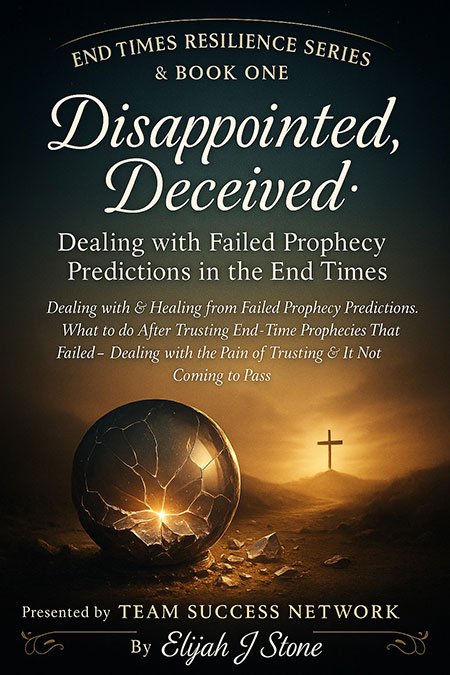
Book 30: Disappointed, Deceived - Failed Prophecy Predictions

Disappointed, Deceived: Dealing with Failed Prophecy Predictions in the End Times
Dealing
with & Healing from Failed Prophecy Predictions. What to do After Trusting
End-Time Prophecies That Failed – Dealing with the Pain of Trusting & It
Not Coming to Pass
By Mr. Elijah J Stone
and the Team Success Network
Table
of Contents
Part 1 – Dealing With Deception - Recognize & Deal With It When
Prophecy Fails 1
CHAPTER 1 - When Prophecies Fail...................................................... 1
CHAPTER 2 - Hope Deferred, Hearts Wounded..................................... 1
CHAPTER 3 - God’s Word vs. Man’s Word............................................. 1
CHAPTER 4 - Testing the Spirits............................................................ 1
CHAPTER 5 - The Ripple Effect of Sharing............................................. 1
CHAPTER 6 - Faith Beyond Failures...................................................... 1
CHAPTER 7 - Healing the Heart After Deception ................................... 1
CHAPTER 8 - The Good Shepherd’s Voice.............................................. 1
CHAPTER 9 - Living Watchful, Not Fearful............................................. 1
CHAPTER 10 - Restored and Rooted in God.......................................... 1
Part 2 – Affected By Deception: Healing & Prayers To Prevent
Deception 1
CHAPTER 11 – Healing Your Own Heart After Being Misled: Letting Go of CHAPTER
and Embarrassment From Past Deception.................................................. 1
Chapter 12 – Forgiving the Person or People Who the Deception Came From 1
CHAPTER 13 – Guarding Your Heart and Mind: Practical Steps to Stay Safe
From Deception Again................................................................................................. 1
CHAPTER 14 – Standing in Truth Daily: Foundational Habits That Keep You
Rooted in God’s Word & Prevent Deception................................................................. 1
CHAPTER 15 – Helping the Hurting: Helping Others Who Have Been Affected
by Failed Prophecies......................................................................................... 1
CHAPTER 16 – Thriving in Faith After Deception, Equipped to Prevent It in
the Future 1
CHAPTER 17 – Prayers for Discernment: Asking God for Eyes to See Clearly
and Avoid Future Deception.......................................................................................... 1
Part 1 – Dealing With Deception - Recognize & Deal With It When
Prophecy Fails
Failed prophecies are not just disappointing—they can shake the
core of someone’s faith. When dates pass, predictions collapse, or promises
prove false, many are left wondering what went wrong. Part 1 is about facing
this reality with honesty, and learning how to separate truth from deception
without losing sight of God.
This section will uncover why deception happens and how it affects
believers deeply. It will explore the difference between trusting God’s
unchanging Word versus relying on human voices or timelines that can fail. By
identifying patterns of deception, you will gain clarity on how to recognize
when a prophecy is unreliable.
Part 1 will also address the dangers of spreading untested words,
especially those tied to dates and events. While some chase urgency or
excitement, the result is often hurt and confusion. You’ll learn why depending
on God daily—not on a date—keeps your faith steady even when others are shaken.
Most importantly, this part will point you back to the Good
Shepherd, whose voice is always clear and trustworthy. His Word never fails,
and His promises never disappoint. By understanding deception, you will be
prepared not only to withstand it but also to grow stronger through it.

Chapter 1 – When
Prophecies Fail
Why Predictions Can
Break Hearts
Understanding the Pain of Failed Prophecies and Dates
The Attraction of Prophetic Dates
Prophecies that include dates have a strong pull on people.
There’s something about knowing when something might happen that creates
urgency and focus. A specific time can stir prayer, motivate preparation, and
unite communities. For a short while, it feels like heaven is pressing close.
But what happens when the date comes and goes? Instead of a move
of God, there’s silence. Instead of celebration, there’s confusion. People are
left with heavy hearts, wondering if they misunderstood God or if He somehow
failed them.
The Good and the Bad of Dates
It’s important to admit there can be short-term good in setting a
date. When believers hear about a predicted time for the rapture or a coming
judgment, many draw closer to God. They repent, they pray, and they begin to
live with more urgency. That’s not bad—it reveals the hunger for God’s
presence.
Yet, the danger outweighs the temporary benefits. If the prophecy
isn’t from God, the result is a wave of disappointment. Instead of
strengthening faith, it weakens it. Instead of drawing people to Jesus, it can
push them into doubt or fear.
Scripture on Testing What We Hear
The Bible is clear: not every word that sounds spiritual comes
from God. We are told to weigh, test, and discern. If we don’t, we risk being
swept up in false promises.
• “Do not despise prophecies, but test everything; hold fast
what is good.” (1 Thessalonians 5:20–21)
• “Beloved, do not believe every spirit, but test the spirits to see whether
they are from God.” (1 John 4:1)
• “For false christs and false prophets will arise and perform great signs
and wonders, so as to lead astray, if possible, even the elect.” (Matthew
24:24)
• “God is not man, that he should lie, or a son of man, that he should
change his mind.” (Numbers 23:19)
• “Heaven and earth will pass away, but my words will not pass away.”
(Matthew 24:35)
Notice the contrast—human words can fail, but God’s Word never
does.
Why Failed Prophecies Hurt So Much
Disappointment with prophecy is not just an intellectual issue;
it’s deeply emotional. When people expect something grand and it doesn’t
happen, their hearts ache. They feel betrayed, ashamed, or even foolish for
believing.
Some blame themselves: “Maybe I didn’t have enough faith.” Others
blame God: “Why would He let this happen?” Still others blame the prophet.
Whatever the direction, the wound is real. Hope deferred makes the heart sick
(Proverbs 13:12).
The Cycle of Excitement and Crash
Here’s how it often unfolds:
- The
Excitement – A date or prediction is announced, stirring urgency.
- The
Build-Up – People prepare spiritually, emotionally, even physically.
- The
Climax – The day arrives. Hopes are high.
- The
Silence – Nothing happens. Confusion spreads.
- The
Crash – Faith is shaken, and some walk away discouraged.
Does that sound familiar? Many believers have been caught in this
cycle more than once. It’s like riding a rollercoaster that always ends with a
painful drop.
The Human Side of Failed Prophecies
It’s not just spiritual; failed prophecies impact real life. Some
rearrange their jobs, sell possessions, or neglect responsibilities because
they believe a prophecy will come true. When it doesn’t, the practical fallout
is devastating.
That’s why the enemy loves to use false prophecies. He doesn’t
just want people disappointed; he wants them disillusioned, paralyzed, or even
ruined. But God can turn every disappointment into a lesson that draws us
closer to Him.
Learning the Difference Between God’s Word and Man’s Word
God’s promises are unshakable. Man’s words are not. Many times,
believers confuse the two. A passionate preacher, a moving dream, or a viral
message online can feel just as strong as a verse from the Bible.
But feelings don’t make something true. The standard is always
Scripture. That’s why Jesus said His words will never pass away (Matthew
24:35). When we build our lives on His Word, we won’t be swept away by the next
failed prediction.
Questions to Consider
- Have
you ever placed your hope in a prophecy that didn’t happen?
- Did
it bring you closer to God for a season, or leave you feeling betrayed?
- How
did it affect your trust in people, or even in God Himself?
The Ripple Effect of Failed Dates
When failed prophecies spread, the damage multiplies. It’s not
just the one who first believed who gets hurt—entire communities can be shaken.
Families argue, friendships fracture, and churches divide.
Think of how quickly a message spreads online. Thousands—or
millions—can hear a prophecy in hours. If it’s false, thousands are left to
clean up the pieces afterward. That’s why the responsibility of sharing
prophecy is so serious.
Why This Book Matters
This book isn’t about mocking people who have been misled. It’s
about healing. It’s about guiding believers back to the steady ground of God’s
truth. It’s about reminding you that God has not abandoned you, even if you’ve
been hurt by false promises.
Failed prophecies are real, but so is God’s faithfulness. And He
will never fail you.
Phrases to Remember:
“God’s Word never fails, even when people’s words do.
“Disappointment can be a doorway to deeper faith, if we let it push us back
to God.”
Call-to-Action Summary
When prophecies fail, don’t let your faith fail. Recognize the
pain, admit the disappointment, but then run back to God’s Word—the one
foundation that never changes. Learn to test, weigh, and discern, so you are
not tossed back and forth by every prediction.
Most of all, let failed prophecies remind you of one truth: God
is faithful, even when people are not.

Chapter 2 – Hope
Deferred, Hearts Wounded
Why
Disappointment Cuts So Deep
Understanding the Emotional Fallout of Failed Prophecies
The Reality of Broken Hope
When you put your trust in a prophecy, you expect it to bring
life. You prepare, you pray, and you hold on with anticipation. But when the
event never happens, it can feel like the bottom has dropped out of your heart.
Hope deferred makes the heart sick (Proverbs 13:12).
This is not just theory—it’s human experience. People walk away
from failed prophecies feeling betrayed, embarrassed, or even spiritually
crushed. Disappointment digs deep because it touches both your faith and your
emotions.
The Pain That Lingers
Disappointment is more than a fleeting feeling; it lingers. Some
carry wounds for years after trusting a prophecy that did not come true. These
wounds show up as distrust of leaders, skepticism of the prophetic, or even
bitterness toward God.
Have you seen this in yourself or others? People who once burned
with zeal for Jesus can become cautious, jaded, or even cold. When trust is
broken, healing does not happen overnight.
Why the Heart Feels Betrayed
The heart feels betrayed because it invested belief, energy, and
passion into something that did not happen. It’s like being promised a gift
that never arrives. Expectations build, only to collapse in disappointment.
• People blame themselves: “I must not have had enough faith.”
• People blame leaders: “They tricked me.”
• People blame God: “He let me down.”
The wound is real, and unless it’s healed, it can grow into
lasting distrust.
Scripture Speaks to Our Pain
God’s Word does not ignore disappointment. It acknowledges it and
provides comfort.
• “Hope deferred makes the heart sick, but a desire fulfilled
is a tree of life.” (Proverbs 13:12)
• “The Lord is near to the brokenhearted and saves the crushed in spirit.”
(Psalm 34:18)
• “Cast all your anxieties on him, because he cares for you.” (1 Peter
5:7)
• “Why are you cast down, O my soul, and why are you in turmoil within me?
Hope in God.” (Psalm 42:5)
• “Those who look to him are radiant, and their faces shall never be
ashamed.” (Psalm 34:5)
The Bible validates our pain but always points us back to God as
the source of healing.
The Silent Struggle of Shame
Many don’t just feel disappointed—they feel ashamed. “How could
I have believed that?” “Why did I share it with others?” Shame adds
another layer of hurt, making people withdraw.
This silence creates isolation. Instead of processing
disappointment in community, people carry it alone. The enemy uses shame to
convince them they are foolish, when in reality, they are simply human.
How Disappointment Changes Behavior
When the heart is wounded, people change. They may stop engaging
with the prophetic altogether. They may become critical of churches or leaders.
Some even walk away from God, confusing the failure of people with the
faithfulness of God.
But avoiding disappointment by closing our hearts isn’t the
solution. Instead, we must allow God to meet us in our pain, to restore hope in
His unchanging promises.
Recognizing the Enemy’s Strategy
Satan uses disappointment as a weapon. He wants you to believe
that God is untrustworthy, that His promises are fragile, and that His love is
uncertain. If the enemy can plant those lies in your heart, he can choke your
faith.
But here’s the truth: God never lied to you. His Word never
failed. The failure lies in human misinterpretation, not in the character of
God. Disappointment is real, but it should never be confused with God
abandoning you.
Practical Ways to Process Disappointment
When disappointment comes, you don’t have to stay stuck in it.
There are practical steps to walk toward healing:
- Acknowledge
the Pain – Don’t minimize it or pretend it didn’t hurt. God values
honesty.
- Bring
It to God – Cast your cares on Him, for He cares for you (1 Peter
5:7).
- Talk
With Safe Believers – Share with those who will listen with
compassion, not judgment.
- Separate
God From the Failure – Recognize the prophecy failed, but God
never did.
- Ask
God to Restore Hope – Invite Him to plant new desires and
dreams in your heart.
A God Who Heals Broken Hearts
The Lord doesn’t dismiss your disappointment—He heals it. Psalm
147:3 says, “He heals the brokenhearted and binds up their wounds.” He
understands the pain of unmet expectations and the ache of unfulfilled hope.
God never intended for failed prophecies to define your walk with
Him. His love is steady, His promises secure, and His presence constant. He
will meet you in the very place where your heart feels most wounded.
Phrases to Remember:
“Disappointment is not the end of faith—it can be the doorway to
deeper trust.”
“Hope deferred may wound the heart, but God’s presence restores it.”
Call-to-Action Summary
Don’t let disappointment harden your heart. Acknowledge the hurt,
bring it before God, and allow Him to heal you. Let failed prophecies remind
you of the difference between man’s words and God’s promises.
Remember this: God never fails. His love is steady, even when
your heart feels shaken.

Chapter 3 – God’s
Word vs. Man’s Word
Knowing What
Never Fails
Learning to Trust Scripture Over Human Predictions
The Difference Between God’s Voice and Ours
One of the greatest sources of confusion in the church is this:
many people treat human words with the same authority as God’s Word. A
preacher’s vision, a dream shared online, or a popular prophecy can sound
powerful. But even the most sincere words from people can fail. God’s Word
never does.
This difference is vital to understand. When we confuse man’s
voice with God’s voice, we set ourselves up for disappointment. But when we
anchor ourselves in Scripture, we find stability that no failed prophecy can
shake.
Why People Trust Human Words
Why do so many believers lean on human predictions? Often it’s
because they long for clarity. They want answers about the future. They want
direction in uncertain times. Hearing “God said this will happen” feels strong
and reassuring.
The problem is that reassurance doesn’t always come from God.
People can be sincere but wrong. Some can even be deceived. That’s why it’s
dangerous to let the voice of man carry the same weight as the Word of God.
The Eternal Reliability of God’s Word
The Bible is clear: God’s Word is unshakable. It doesn’t change
with time, culture, or trends. When everything else fails, Scripture stands.
• “Heaven and earth will pass away, but my words will not pass
away.” (Matthew 24:35)
• “Every word of God proves true; he is a shield to those who take refuge in
him.” (Proverbs 30:5)
• “Your word is a lamp to my feet and a light to my path.” (Psalm
119:105)
• “The grass withers, the flower fades, but the word of our God will stand
forever.” (Isaiah 40:8)
• “Sanctify them in the truth; your word is truth.” (John 17:17)
When you build your hope on Scripture, you are building on a
foundation that cannot be moved.
The Fragility of Human Predictions
Man’s words can sound spiritual, but they are fragile. They are
shaped by human perspective, limited knowledge, and sometimes even personal
desires. Even when spoken with passion, they cannot guarantee fulfillment.
That’s why many believers have been let down—not because God
failed, but because people’s words were mistaken. It is crucial to separate
fallible human predictions from the infallible Word of God.
How to Anchor Yourself in God’s Word
If you’ve ever been hurt by a failed prophecy, one of the most
healing steps is to anchor yourself in Scripture again. Ask yourself:
• Does this prophecy line up with the Bible?
• Does it glorify Christ or glorify a person?
• Does it bring peace, or does it stir fear and confusion?
The Word of God is the ultimate test. If it doesn’t align with
Scripture, it’s not worth building your life on.
The Power of Prioritizing Scripture
Imagine the strength that comes when believers place the Bible
above every other voice. Instead of being tossed back and forth by predictions,
they remain steady. Instead of fear, they walk in peace. Instead of confusion,
they walk in clarity.
This is the power of prioritizing Scripture. It protects us from
deception and steadies us in truth. When you learn to trust the Word of God
above everything else, you cannot be shaken by failed prophecies.
When Scripture Guides, You Can’t Be Moved
God never intended for His people to live in fear of missing out
on prophecies. He gave us His Word so we could live with confidence. When you
hear a prophecy, measure it against the Bible. If it doesn’t align, let it go.
The psalmist said, “Your word is firmly fixed in the heavens”
(Psalm 119:89). That means no human word can overrule it. Scripture is the
final authority.
Phrases to Remember:
“Man’s words can fail. God’s Word never will.”
“Anchor yourself in Scripture, and no prophecy can shake you.”
Call-to-Action Summary
The difference between God’s Word and man’s word is the difference
between stability and disappointment. Failed prophecies are guaranteed when
human words are treated as divine. But when we hold to Scripture, we stand
unshaken.
From this chapter forward, make a decision: God’s Word will
always come first in your life. Every prophecy, vision, or message must be
tested against it. That’s how you stay steady in the storms of deception.

Chapter 4 –
Testing the Spirits
Learning to
Discern God’s Voice
How to Avoid Deception and Walk in Truth
Why Testing Matters
Not every spiritual word, dream, or message comes from God. Some
are born from human imagination, and others can even be influenced by
deception. That’s why the Bible repeatedly warns us to test what we hear before
receiving it.
If you’ve ever been disappointed by a failed prophecy, you’ve
experienced firsthand why discernment matters. Testing isn’t about being
negative—it’s about being safe. It’s how you protect your heart and keep your
faith grounded in God’s truth.
The Biblical Command to Test
The Bible is clear: don’t accept every spirit at face value. God
wants His people to be wise and discerning, not gullible or easily misled.
• “Beloved, do not believe every spirit, but test the spirits
to see whether they are from God.” (1 John 4:1)
• “Do not despise prophecies, but test everything; hold fast what is good.”
(1 Thessalonians 5:20–21)
• “Beware of false prophets, who come to you in sheep’s clothing but
inwardly are ravenous wolves.” (Matthew 7:15)
• “Let two or three prophets speak, and let the others weigh what is said.”
(1 Corinthians 14:29)
• “Your word is truth.” (John 17:17)
God Himself tells us to test. That means it’s not a lack of
faith—it’s an act of obedience.
How to Test the Spirits
So, how do you actually test a word or prophecy? Scripture gives
us clear guidelines.
- Does
It Align With the Bible? God never contradicts His Word. If it
opposes Scripture, it is not from Him.
- Does
It Glorify Jesus? The Holy Spirit always points people to
Christ, not to fear, pride, or human agendas.
- Does
It Produce Peace or Confusion? God is not the author of
confusion (1 Corinthians 14:33).
- Does
It Bear Good Fruit? Look at the results—does it lead people
into holiness, love, and obedience?
- Is It
Confirmed by Mature Believers? Wise counsel and accountability
are safeguards against deception.
The Danger of Blind Acceptance
When believers fail to test what they hear, the door opens to
confusion. That’s why so many are tossed from one prophecy to the next, always
chasing the newest word. Blind acceptance leads to instability, and instability
leads to disappointment.
God never designed His people to live on shaky ground. Discernment
is part of spiritual maturity. When you test, you move from being easily swayed
to being rooted and steady.
Discernment Brings Freedom
Testing is not about fear—it’s about freedom. When you test a word
and know it aligns with God’s truth, you can embrace it with confidence. When
you test and realize it’s false, you can let it go without guilt or confusion.
That’s what it means to walk in discernment. Instead of being
tossed around, you learn to hear God’s voice clearly. Discernment doesn’t make
you suspicious—it makes you secure.
God’s Spirit Leads Us Into Truth
The Holy Spirit is the best teacher of discernment. Jesus said the
Spirit would guide us into all truth (John 16:13). That means you don’t test
alone—you test with the help of God’s Spirit living inside you.
When you rely on the Spirit and the Word together, you walk in
wisdom. You don’t have to fear deception. Instead, you can live with confidence
that God is guiding your steps.
Phrases to Remember:
“Testing is not doubting—it’s obeying.”
“Discernment protects your faith from deception.”
Call-to-Action Summary
God has called you to be discerning, not gullible. Every prophecy,
every word, every dream must be tested. Hold fast to what is good, and release
what is not.
Make a decision today: you will no longer accept spiritual words
blindly. You will test them by Scripture, by the Spirit, and by wise counsel.
That is how you stay steady in the truth and safe from deception.

Chapter 5 – The
Ripple Effect of Sharing
The Power of
Words That Spread
Why Untested Prophecies Can Build or Break Faith
The Seriousness of Sharing Prophecy
Every word we share carries weight, but words claimed to be from
God carry eternal weight. When someone shares a prophecy, others naturally lean
in because it feels sacred. Even if the original message was only a personal
impression, once spoken in God’s name, it takes on authority.
This is where danger lies. A word can spread quickly, touching
countless lives. If it’s from God, the impact is powerful and fruitful. But if
it’s not, the damage can be deep and widespread.
Why Prophecies Spread So Quickly
In our connected world, a single message can move faster than ever
before. Social media, livestreams, and online groups amplify words in seconds.
What once would have stayed within a small gathering can now circle the globe
overnight.
This speed means there is little time for weighing and testing.
Instead of careful discernment, many jump to share. The result? A prophecy—true
or false—ripples outward, shaping thoughts, decisions, and emotions.
The Double-Edged Sword of Influence
Sharing a prophecy can do incredible good—or incredible harm.
• For Good: A true word can encourage, strengthen, and
direct people toward God’s purposes.
• For Harm: A false word can stir fear, confusion, and disappointment
when it fails.
• For Neutrality: Sometimes, words simply distract, pulling believers’
attention away from Christ without causing visible harm.
Like ripples in water, you may never see how far the influence of
your words travels. That’s why the responsibility of sharing prophecy is so
serious.
Scripture Warns About Influence
The Bible recognizes the power of words and warns about careless
influence.
• “Death and life are in the power of the tongue.”
(Proverbs 18:21)
• “Not many of you should become teachers, my brothers, for you know that we
who teach will be judged with greater strictness.” (James 3:1)
• “By their fruit you will recognize them.” (Matthew 7:16)
• “Let no corrupting talk come out of your mouths, but only such as is good
for building up.” (Ephesians 4:29)
• “When words are many, transgression is not lacking, but whoever restrains
his lips is prudent.” (Proverbs 10:19)
God cares about how His name is used, and He holds us accountable
for what we attach to Him.
The Domino Effect of Failed Prophecies
When a shared prophecy fails, the fallout is rarely contained.
People who trusted it feel betrayed. Families argue over what went wrong.
Churches split in disagreement.
And often, unbelievers mock, saying, “See, those Christians
don’t know what they’re talking about.” The reputation of God’s people—and
sometimes even God’s name—suffers. One false word doesn’t just harm the one who
believed it; it damages the credibility of the church at large.
Practical Guardrails Before Sharing
To keep from spreading deception, every believer should ask:
- Have
I Tested This Word Against Scripture? If it doesn’t align, it should
not be shared.
- Have
I Waited in Prayer? Sometimes time reveals whether a word is
from God or not.
- Have
I Brought It to Accountability? Wise, mature believers can help
confirm or correct.
- Will
This Build Faith or Stir Fear? Prophecy should encourage, not
oppress.
- Am I
Sure This Honors Christ? If it glorifies anything else, it’s not
His voice.
If you can’t answer “yes” to these, it’s better to wait than to
wound.
The Power of Restraint
Restraint doesn’t mean unbelief—it means responsibility. Not every
impression needs to be shared. Sometimes God speaks to you personally, not to
the whole body. Knowing the difference requires humility.
Wise believers understand that silence can sometimes be the most
faithful act. Holding back can protect others from hurt, and it can preserve
the purity of God’s name.
The Positive Side of Careful Sharing
When you share a word that has been tested and confirmed, it
carries strength. People are encouraged, faith is built, and the body is
edified. That’s the way God designed prophecy to work—bringing life, not
confusion.
The ripple effect can be beautiful when handled with care. Just as
a stone creates waves in water, a true prophetic word can create waves of
encouragement, leading many closer to Jesus.
Phrases to Remember:
“What you share can either plant faith or spread confusion.”
“Every ripple matters—make sure yours is from God.”
Call-to-Action Summary
Your words matter. When you share in God’s name, the stakes are
eternal. Be slow to speak, quick to test, and humble in your approach.
The ripple effect of sharing can either wound or heal, confuse or
encourage. Choose wisely. Test everything, hold fast to what is good, and let
your words glorify Christ.
Chapter 6 – Faith
Beyond Failures
When Prophecies
Fall Short
How to Keep Trust in God When People Disappoint You
Faith That Outlasts Disappointment
When a prophecy fails, the first thing many people feel is loss.
Trust is broken. Hope collapses. Questions flood the heart: “Why did God
allow this? Can I ever trust again?”
But here’s the truth: God never failed you. His promises remain,
even when people’s words collapse. Faith was never meant to rest on fragile
predictions—it was meant to rest on the unshakable character of God.
The Source of True Faith
Faith that lasts doesn’t come from believing in leaders,
timelines, or visions. It comes from knowing God personally and trusting His
Word above all else. The Bible says, “Faith comes from hearing, and hearing
through the word of Christ.” (Romans 10:17).
If your faith is shaken because of failed prophecies, it means
your faith was leaning too much on people. But when you realign with God’s
Word, your faith becomes stronger, deeper, and unbreakable.
Scripture on God’s Faithfulness
The Bible repeatedly reminds us that God Himself cannot fail.
• “God is faithful, by whom you were called into the fellowship
of his Son.” (1 Corinthians 1:9)
• “If we are faithless, he remains faithful—for he cannot deny himself.”
(2 Timothy 2:13)
• “The steadfast love of the Lord never ceases; his mercies never come to an
end.” (Lamentations 3:22–23)
• “The Lord is my rock and my fortress and my deliverer.” (Psalm 18:2)
• “Jesus Christ is the same yesterday and today and forever.” (Hebrews
13:8)
Faith built on God’s unchanging nature will always outlast human
failure.
Why Prophecies Fail But God Remains
Prophecies can fail because people mishear, misinterpret, or even
add their own ideas to what they think God is saying. That doesn’t mean God was
wrong—it means humanity was.
God doesn’t ask us to put our faith in man’s words. He calls us to
put our faith in Him. When we understand that difference, our disappointment
turns into resilience.
How to Strengthen Faith After Failure
So how do you rebuild faith when you’ve been let down? Here are
some steps:
- Go
Back to the Word – Re-anchor yourself in promises that
never change.
- Refocus
on God’s Character – Remember His goodness, mercy, and
faithfulness.
- Release
the Hurt – Forgive those who misled you, and forgive yourself for
believing.
- Choose
to Trust Again – Faith is not a feeling; it’s a
decision to rely on God.
- Look
for God’s Hand in the Trial – Even in disappointment, He is
shaping and maturing your faith.
Faith as a Shield
The Bible calls faith a shield (Ephesians 6:16). Why? Because it
protects us from the fiery arrows of doubt, fear, and deception. When
disappointment hits, faith shields us by reminding us who God is and what He
has already promised.
Prophecies may fall, but the shield of faith still stands. It
doesn’t mean we ignore hurt—it means we don’t let hurt define us. Faith helps
us rise again when failure tries to keep us down.
The Witness of Enduring Faith
Your faith, when it endures through disappointment, becomes a
powerful testimony. Others watch how you respond when you’ve been hurt. Do you
give up on God, or do you cling to Him even tighter?
Enduring faith shines brighter in the darkness. It shows the world
that your God is bigger than your circumstances. This kind of faith inspires
others to keep trusting, no matter what.
Phrases to Remember:
“Faith anchored in God can never be shaken by man.”
“Failed prophecies are not the end—they can be the beginning of deeper
trust.”
Call-to-Action Summary
When prophecies fail, don’t let your faith die with them. Instead,
return to God’s Word, remember His character, and choose to trust Him again. He
is faithful, even when people fail.
Take the shield of faith back up. Stand firm. And let your trust
in God grow stronger than it has ever been before.

Chapter 7 –
Healing the Heart After Deception
Finding
Restoration After Betrayed Trust
How God Heals the Wounds of False or Failed Prophecies
The Wounds of Deception
Being deceived is more than just being wrong—it’s being wounded.
Failed prophecies don’t only create confusion; they can cut deep into the
heart. You may feel tricked, embarrassed, or abandoned. Sometimes the pain
lingers long after the prophecy is forgotten.
The enemy loves to take advantage of this moment. He whispers lies
like, “You can’t trust anyone again” or “God doesn’t care about you.”
But God doesn’t leave His children broken. He specializes in healing wounded
hearts.
Recognizing the Symptoms of a Wounded Heart
How do you know if deception has left a scar? It often shows up in
subtle ways:
• A deep distrust of church leaders or other believers.
• Cynicism whenever prophecy or spiritual gifts are mentioned.
• Withdrawal from community out of fear of being hurt again.
• Doubts about whether God Himself is trustworthy.
• Lingering shame for “falling for it” in the first place.
Do any of these sound familiar? Recognizing them is the first step
to healing.
Scripture for the Brokenhearted
God’s Word speaks directly to those carrying wounds of
disappointment and deception.
• “The Lord is near to the brokenhearted and saves the crushed
in spirit.” (Psalm 34:18)
• “He heals the brokenhearted and binds up their wounds.” (Psalm 147:3)
• “Cast your burden on the Lord, and he will sustain you.” (Psalm 55:22)
• “Come to me, all who labor and are heavy laden, and I will give you rest.”
(Matthew 11:28)
• “I will restore to you the years that the swarming locust has eaten.”
(Joel 2:25)
God doesn’t dismiss your pain. He promises to meet you in it and
restore what was lost.
Steps to Emotional and Spiritual Healing
Healing is possible, but it requires honesty and surrender. Here
are key steps to begin:
- Admit
the Hurt – Don’t minimize or hide it. God can only heal what you
bring to Him.
- Release
the Shame – Being deceived does not mean you are worthless. You are
loved and chosen.
- Forgive
Others – Forgiveness doesn’t mean approval; it means freedom for
your heart.
- Forgive
Yourself – Let go of self-condemnation. Everyone is vulnerable to
mistakes.
- Invite
God’s Healing – Ask the Holy Spirit to replace the
lies with truth.
Healing comes when you open your wounds to God and allow His love
to cover them.
The Role of Forgiveness
Forgiveness is often the hardest part, but it is also the most
powerful. Unforgiveness keeps the wound open, while forgiveness begins to close
it. Jesus forgave those who betrayed Him, and He calls us to do the same.
Forgiving does not mean pretending it didn’t hurt. It means you
refuse to let bitterness control your future. By forgiving, you free yourself
to receive God’s healing.
The Healing Presence of the Holy Spirit
The Holy Spirit is called the Comforter for a reason. He doesn’t
just comfort you in theory—He comes alongside you in your pain. He whispers
peace where confusion once lived. He pours out love where betrayal left scars.
Invite Him into your hurt. Healing is not only about moving past
deception—it’s about encountering God’s presence in a fresh, life-changing way.
Moving From Hurt to Wisdom
Healing also means learning. Once restored, you gain wisdom that
protects you in the future. Instead of being cynical, you become discerning.
Instead of fearing prophecy, you learn how to weigh it.
God uses what the enemy meant for harm to strengthen you. Your
healed heart becomes a testimony to others who are still hurting.
Phrases to Remember:
“Healing starts where honesty begins.”
“Forgiveness closes the wound; God’s love restores the heart.”
Call-to-Action Summary
You don’t have to carry the pain of deception forever. God sees
your wounds and longs to heal them. Admit the hurt, release the shame, forgive,
and invite the Holy Spirit to restore your heart.
What once felt like betrayal can become a place of breakthrough.
Let God transform your wound into wisdom and your pain into testimony.

Chapter 8 – The
Good Shepherd’s Voice
Hearing God
Clearly in a Confusing World
How to Recognize His Voice Above the Noise
The Promise of the Shepherd
Jesus gave His people a beautiful promise: “My sheep hear my
voice, and I know them, and they follow me” (John 10:27). That means you
don’t have to live confused about whether God is speaking. He is a Good
Shepherd, and He knows how to lead His sheep.
The challenge comes when many voices are speaking at
once—prophets, leaders, social media, friends, and even your own thoughts. In
the middle of all that noise, how do you know which voice is His? The key is
learning to recognize His tone, His truth, and His peace.
How God Speaks
God’s primary way of speaking is through His Word. Scripture is
the foundation—everything else must align with it. But He also speaks through
the inner witness of the Holy Spirit, through peace in your heart, and through
confirmation in community.
When you know the different ways He speaks, you won’t be easily
swayed by every prophecy you hear. Instead, you’ll be anchored in His Word and
guided by His Spirit.
Scripture on God’s Leading
The Bible repeatedly assures us that God speaks clearly to His
people:
• “My sheep hear my voice, and I know them, and they follow
me.” (John 10:27)
• “Your word is a lamp to my feet and a light to my path.” (Psalm
119:105)
• “For all who are led by the Spirit of God are sons of God.” (Romans
8:14)
• “Whether you turn to the right or to the left, your ears will hear a voice
behind you, saying, ‘This is the way; walk in it.’” (Isaiah 30:21)
• “The Lord is my shepherd; I shall not want.” (Psalm 23:1)
These verses remind us: God is not silent. He is speaking—our part
is to listen and discern.
The Contrast of Voices
How do you tell the difference between the Good Shepherd’s voice
and other voices?
• God’s Voice – Brings peace, clarity, conviction, and
alignment with Scripture.
• The Enemy’s Voice – Brings fear, condemnation, confusion, or pride.
• Your Own Voice – Often reflects desires, emotions, or personal
reasoning.
The Good Shepherd’s voice always leads you closer to Jesus. If a
word leads you into fear, division, or away from Him, it’s not His.
Practical Ways to Discern His Voice
Here are steps to grow in hearing God more clearly:
- Spend
Time in Scripture – The more familiar you are with His
Word, the easier it is to recognize His voice.
- Listen
for Peace – God’s voice often carries a calm assurance, even when He
corrects.
- Seek
Confirmation – He often confirms through multiple
ways: His Word, His Spirit, and His people.
- Pray
for Discernment – Ask the Holy Spirit to sharpen your
ability to hear.
- Practice
Obedience – The more you respond to His voice, the clearer it becomes.
The Role of Relationship
Hearing God’s voice isn’t about formulas—it’s about relationship.
The closer you walk with Him, the more naturally you recognize His voice. Just
as a child knows their parent’s voice in a crowd, you will know the Shepherd’s
voice as you spend time with Him.
This is why intimacy matters. Prophecies may fail, but the
relationship between you and Jesus is secure. The more you walk with Him daily,
the less likely you are to be shaken by deception.
Confidence in His Guidance
God doesn’t want you living in fear of missing His direction. He
promised to guide His people faithfully. When you trust Him as your Shepherd,
you can walk with confidence that He will lead you in the right path.
Even when you’ve been hurt by false words, His voice brings
healing. He restores your soul and reminds you that He is faithful.
Phrases to Remember:
“The Good Shepherd never confuses His sheep.”
“When you know His voice, you can’t be shaken by another.”
Call-to-Action Summary
Don’t settle for confusion. Learn to recognize the Shepherd’s
voice through His Word, His Spirit, and His peace. Test what you hear, reject
the counterfeit, and follow Him with confidence.
Your Shepherd is speaking. Listen closely, and you will find
clarity, guidance, and rest for your soul.
Chapter 9 –
Living Watchful, Not Fearful
Staying Ready
Without Losing Peace
How to Prepare for Christ’s Return Without Obsession or Anxiety
The Call to Watchfulness
Jesus repeatedly told His disciples to “watch” and “be ready.”
That means living with an awareness that He could return at any time. It’s not
about predicting the day or the hour—it’s about staying spiritually awake and
alert.
Watchfulness is a posture of the heart. It’s choosing to live each
day as if Jesus could return tonight. But watchfulness should not produce fear
or panic—it should produce joy, hope, and holiness.
The Trap of Fearful Living
Some believers confuse watchfulness with worry. They constantly
scan the news, chase every new prophecy, and live in dread of missing the
moment. But fear was never God’s plan.
Scripture says, “God gave us a spirit not of fear but of power
and love and self-control” (2 Timothy 1:7). If your watchfulness makes you
anxious, it’s no longer biblical readiness—it’s bondage. God’s watchfulness
produces peace, not panic.
Scripture on Readiness
The Bible balances urgency with peace when it speaks about
Christ’s return:
• “Therefore, stay awake, for you do not know on what day your
Lord is coming.” (Matthew 24:42)
• “You also must be ready, for the Son of Man is coming at an hour you do
not expect.” (Luke 12:40)
• “So then let us not sleep, as others do, but let us keep awake and be
sober.” (1 Thessalonians 5:6)
• “For God has not destined us for wrath, but to obtain salvation through
our Lord Jesus Christ.” (1 Thessalonians 5:9)
• “Blessed is the one who stays awake, keeping his garments on.”
(Revelation 16:15)
Readiness is about living faithfully, not anxiously.
What True Watchfulness Looks Like
Watchfulness is not paranoia. It’s not running after dates,
stocking up in fear, or obsessing over every global crisis. True watchfulness
looks like this:
• A heart tender before God in prayer.
• A lifestyle of holiness and obedience.
• A steady walk in the Spirit day by day.
• A readiness to share Christ with others at any moment.
• A peace-filled expectation of Jesus’ return.
That’s the kind of watchfulness that brings blessing, not burnout.
The Difference Between Fear and Faith
Fear says, “I must control everything or I’ll miss it.”
Faith says, “God is in control, and I trust Him.”
Fear is rooted in insecurity, but faith is rooted in God’s
promises. Living watchful means choosing faith over fear, trusting that Jesus
will not forget His own. The Shepherd will not abandon His sheep when the end
comes.
Practical Ways to Stay Watchful Without Fear
Here are some simple, practical habits to cultivate:
- Stay
in the Word – Scripture keeps your perspective
rooted in God’s truth, not shifting headlines.
- Pray
Daily – Prayer keeps your heart tender and connected to the
Shepherd.
- Live
in Community – Being with other believers helps
balance and protect you from extremes.
- Serve
Faithfully – Doing God’s work now is the best way to be ready for
what’s next.
- Rest
in His Love – Confidence in His return grows from
knowing you are secure in Him.
The Gift of Peace in Preparation
God does not want His people panicked about the end times. He
wants them prepared. That preparation produces peace, because it rests on His
strength, not ours.
When you know the One who holds the future, you don’t need to fear
the future. Watchfulness becomes a joy, not a burden. You can look forward with
hope instead of dread.
A Balanced End-Time Lifestyle
The healthiest believers are those who live prepared without being
consumed. They don’t deny that Christ could return soon, but they also don’t
neglect living faithfully today. Their eyes are on eternity, but their hands
are busy serving in the present.
This balance honors God. It keeps us awake without making us
anxious. It keeps us steady when others are shaken by every failed prophecy or
frightening headline.
Phrases to Remember:
“Watchfulness brings peace, not panic.”
“The best way to prepare for tomorrow is to walk faithfully with Jesus
today.”
Call-to-Action Summary
You are called to be watchful, but not fearful. Stay awake, stay
ready, and stay anchored in God’s Word. Let your watchfulness lead to prayer,
holiness, and peace—not to obsession or dread.
Christ is coming. You don’t need to know the day—you just need to
walk with Him daily. That’s what true readiness looks like.

Chapter 10 –
Restored and Rooted in God
Finding Stability
After Disappointment
How to Build a Faith That Cannot Be Shaken
The Invitation to Restoration
Failed prophecies and false hopes may have left you wounded, but
they don’t have to define your future. God invites you to a place of
restoration. He doesn’t just want to patch up your brokenness—He wants to make
you stronger than before.
When you are restored, you become rooted. A rooted believer is not
easily swayed by predictions, trends, or passing storms. They stand firm in
God’s love, nourished by His Word, and anchored in His presence.
Why Roots Matter
Without roots, even a strong-looking tree can fall in the wind.
The same is true for faith. If your faith rests only on experiences, emotions,
or human voices, it will topple when storms come.
But when your faith is rooted in God Himself, you can endure. The
winds may blow, but you will not fall. You’ll remain steady, drawing life and
strength from Him daily.
Scripture on Being Rooted
The Bible paints a clear picture of what rooted faith looks like:
• “Blessed is the man who trusts in the Lord… He is like a tree
planted by water, that sends out its roots by the stream.” (Jeremiah
17:7–8)
• “Rooted and built up in him and established in the faith, just as you were
taught.” (Colossians 2:7)
• “He is like a tree planted by streams of water that yields its fruit in
its season.” (Psalm 1:3)
• “So that Christ may dwell in your hearts through faith—that you, being
rooted and grounded in love.” (Ephesians 3:17)
• “The righteous will never be moved.” (Proverbs 10:30)
Roots in God’s Word and His love create unshakable stability.
How God Restores What Was Lost
Maybe you feel like you wasted time believing a prophecy that
never came true. Maybe you fear that your life has been ruined by
disappointment. But God promises restoration. “I will restore to you the
years that the swarming locust has eaten.” (Joel 2:25).
Restoration means God can take your pain and turn it into wisdom.
He can take your shame and turn it into testimony. Nothing is wasted when it is
placed in His hands.
Steps to Becoming Rooted in God
Here are practical ways to move from shaken to rooted:
- Return
to the Word Daily – Make Scripture your main source of
truth, not online voices.
- Stay
in Prayer – Rooted believers draw strength from daily communion with
God.
- Plant
in Community – A tree doesn’t stand alone. Surround
yourself with other believers.
- Practice
Obedience – Don’t just hear the Word—do it. Obedience deepens roots.
- Trust
God’s Timing – Rooted faith waits patiently on God
instead of chasing dates.
From Shaken to Steady
The enemy wants failed prophecies to shake you. But God wants them
to drive your roots deeper. Every disappointment is an opportunity to anchor
yourself in what never fails—His love, His Word, and His Spirit.
When you learn from failure instead of being destroyed by it, you
grow stronger. Your roots stretch deeper, and your faith becomes unshakable.
Living From a Restored Place
Restoration is not just about personal healing—it’s about living
with new strength. A restored believer can encourage others, warn them against
deception, and point them back to God. They carry peace, stability, and
maturity that blesses the whole body of Christ.
When you are restored and rooted, you stop being tossed by
storms—you become a shelter for others. That’s God’s desire for you: not just
to survive disappointment, but to thrive beyond it.
Phrases to Remember:
“Disappointment doesn’t have to define you—God’s restoration can
refine you.”
“Rooted faith cannot be shaken by failed prophecies.”
Call-to-Action Summary
God is calling you to restoration. He wants to heal every wound
and plant your feet firmly in His love and truth. Let His Word become your
foundation, His Spirit your guide, and His presence your anchor.
When you are rooted in Him, nothing can move you. Failed
prophecies lose their power, and faith becomes steady, fruitful, and strong.
Part 2 – Affected By Deception: Healing & Prayers To Prevent
Deception
Being deceived by failed prophecies is painful, not only because
of what was believed, but because of the hurt, shame, and confusion that
follows. Many people silently carry wounds, afraid to admit they trusted in
something that didn’t happen. This section is about more than recovery—it’s
about healing, forgiveness, and learning how to walk in discernment with
confidence.
Healing begins when you bring your pain to God and allow Him to
restore your heart. Whether you feel embarrassed, angry, or let down, God does
not condemn you. Instead, He invites you to release guilt, forgive those who
misled you, and find new strength in His Word.
But healing doesn’t stop with you. God also equips you to help
others who are hurting. By walking with compassion, offering prayer, and
pointing people back to Jesus, you can become a source of encouragement for
those affected by deception.
This section will also guide you in prayers for discernment,
practical guardrails, and foundational habits that protect your faith. With
God’s help, you won’t just survive deception—you’ll thrive beyond it, equipped
for the future with wisdom, peace, and unshakable trust in Him.

Chapter 11 –
Healing Your Own Heart After Being Misled: Letting Go of Guilt and
Embarrassment From Past Deception
Finding Freedom
From Shame
God’s Grace Is Greater Than Your Mistakes
The Heavy Weight of Being Misled
When someone realizes they were deceived, the first feelings that
often come are guilt and embarrassment. It’s natural to ask, “How could I
have believed that?” or “Why didn’t I see through it sooner?” These
questions become heavy, creating shame that lingers long after the prophecy or
teaching has faded.
The enemy uses these feelings to trap believers. He whispers lies
like, “You’re foolish. You’ll never hear God correctly again.” But God
doesn’t shame His children for being misled. Instead, He calls them to healing,
reminding them that His grace is bigger than any mistake.
Understanding Why Deception Happens
One of the first steps to healing is understanding that deception
happens to sincere people. Being misled doesn’t mean you’re weak—it means you
trusted, and your trust was misplaced. Even strong believers throughout
Scripture were sometimes confused or deceived.
• Eve listened to the serpent’s lies in the Garden (Genesis
3:1–6).
• The disciples often misunderstood Jesus’ words (Mark 9:32).
• Peter, who walked on water, was rebuked by Paul for being misled by fear of
others (Galatians 2:11–14).
If these faithful followers could be misled, then anyone can.
Healing begins when you stop condemning yourself and start receiving God’s
mercy.
Scripture That Brings Comfort
God’s Word offers encouragement to those who feel embarrassed or
guilty after being deceived:
• “The Lord is near to the brokenhearted and saves the crushed
in spirit.” (Psalm 34:18)
• “If we confess our sins, he is faithful and just to forgive us our sins
and to cleanse us from all unrighteousness.” (1 John 1:9)
• “For the righteous falls seven times and rises again.” (Proverbs
24:16)
• “My grace is sufficient for you, for my power is made perfect in
weakness.” (2 Corinthians 12:9)
• “There is therefore now no condemnation for those who are in Christ
Jesus.” (Romans 8:1)
These verses remind us that God doesn’t discard us when we
stumble. He restores us.
The Role of Guilt and Shame
Guilt and shame are different, and it’s important to see the
difference:
• Guilt says, “I did something wrong.” This can
sometimes be healthy if it leads us back to repentance.
• Shame says, “I am something wrong.” This is destructive because
it attacks your identity as a child of God.
Many believers stay stuck in shame after being misled. They replay
the situation in their minds, punishing themselves again and again. But shame
is never from God. His Spirit convicts to bring change, not condemnation.
Practical Steps for Healing Your Heart
Healing doesn’t happen by accident—it requires intentional steps.
Here are some ways to begin the journey:
- Acknowledge
What Happened – Be honest with yourself and with God.
Pretending it didn’t hurt only delays healing.
- Confess
and Release – Bring your pain, guilt, and confusion
to God. Tell Him everything, and ask for His cleansing.
- Receive
His Forgiveness – Don’t just confess—accept that God has
forgiven you fully.
- Renounce
Shame – Speak truth over yourself: “I am loved. I am not a
failure. I am a child of God.”
- Ask
for Healing – Invite the Holy Spirit to restore your
peace and strengthen your discernment.
These steps don’t just remove guilt—they restore your confidence
in God’s love.
Why Embarrassment Is Hard to Shake
Embarrassment often lingers even after forgiveness is received.
People worry about what others think. “Do they see me as gullible? Do they
think less of me now?” These questions create insecurity and silence.
But embarrassment loses its power when you realize everyone has
moments of weakness. You are not the only one. The church is full of people who
have been misled at some point. Healing grows when you stop focusing on
people’s opinions and focus instead on God’s restoration.
God’s View of You After Deception
How does God see you after you’ve been misled? Not as a failure,
but as His child. Not as someone He can’t trust, but as someone He wants to
teach and strengthen.
God doesn’t waste experiences—even painful ones. He uses them to
grow your wisdom, sharpen your discernment, and deepen your dependence on Him.
What feels like failure can actually become a foundation for greater maturity.
Testimony of Restoration
Many believers who were deceived later testify to how God healed
them and used their experiences for good. They learned to test words carefully,
to listen more closely to the Holy Spirit, and to walk with greater humility.
Instead of living in shame, they now live with wisdom.
Your story can be the same. What was once a source of
embarrassment can become a testimony that helps others avoid deception. God
restores, and then He redeems.
Learning to Trust Again
One of the hardest parts of healing is learning to trust again.
After being misled, it’s easy to close your heart completely. But healing
doesn’t mean shutting down—it means learning to trust God more deeply.
Trust isn’t about ignoring the possibility of deception. It’s
about knowing God is faithful to lead you into truth. You don’t need to live
suspicious of everyone—you need to live confident in the Shepherd who guides
you.
Phrases to Remember
“Being misled doesn’t make you worthless—it makes you human, and
God’s grace is enough.”
“Shame is not your story. Restoration is.”
Call-to-Action Summary
Healing your heart after being misled begins with letting go of
guilt and shame. Admit the pain, confess the struggle, and receive God’s
forgiveness. Don’t let embarrassment define your future—let God’s love restore
your confidence.
Take this step today: speak over yourself that you are not
condemned, you are not forgotten, and you are not a failure. You are loved,
chosen, and being healed. God is bigger than deception, and His restoration
will make you stronger than ever before.
Chapter 12 –
Forgiving The Person or People Who The Deception Came From
Choosing Freedom
Over Bitterness
How Forgiveness Heals and Protects the Heart After Betrayal
Why Forgiveness Matters
When deception comes, it rarely arrives alone—it often comes
through a person or a group of people. Maybe it was a leader, a friend, or
someone who claimed to speak for God. When their words proved false, the hurt
was more than disappointment—it felt like betrayal.
That’s why forgiveness is such a critical part of healing. If you
don’t forgive, bitterness begins to take root. Instead of freedom, your heart
remains chained to the very pain you want to escape. Forgiveness isn’t about
excusing what happened—it’s about choosing freedom over bondage.
The Struggle to Forgive
Forgiving someone who misled you isn’t easy. Questions swirl in
your mind: “Why would they do this? Did they know it wasn’t true? Did they
use me for their gain?” Whether they acted in ignorance or with intention,
the wound is real.
The natural response is to hold on to anger and demand justice.
But carrying that anger only poisons your heart. Forgiveness doesn’t mean
forgetting—it means refusing to let their actions control your future. It’s
choosing to release them into God’s hands and trusting Him to deal with what
you cannot.
Scripture on Forgiveness
The Bible is clear that forgiveness is not optional—it’s essential
for those who follow Christ.
• “For if you forgive others their trespasses, your heavenly
Father will also forgive you.” (Matthew 6:14)
• “Be kind to one another, tenderhearted, forgiving one another, as God in
Christ forgave you.” (Ephesians 4:32)
• “Bear with each other and forgive one another if any of you has a
grievance against someone.” (Colossians 3:13)
• “Do not repay evil for evil or reviling for reviling, but on the contrary,
bless.” (1 Peter 3:9)
• “Father, forgive them, for they know not what they do.” (Luke 23:34)
Forgiveness is not just about others—it’s about your relationship
with God.
What Forgiveness Is and Is Not
Many struggle to forgive because they misunderstand what it means.
Forgiveness is:
• Releasing someone from the debt they owe you.
• Choosing not to hold their wrong against them.
• Trusting God to be the judge and deal with their actions.
• A process that brings freedom to your heart.
Forgiveness is not:
• Pretending the wrong never happened.
• Excusing sin or deception.
• Automatically restoring trust in the person.
• Forgetting about wisdom and boundaries.
Understanding the difference makes forgiveness possible—even in
the most painful situations.
Steps to Forgiving Those Who Misled You
Forgiveness often feels overwhelming, but breaking it into steps
makes it practical:
- Acknowledge
the Hurt – Be honest about what happened and how it made you feel.
Don’t minimize it.
- Decide
to Forgive – Forgiveness is not a feeling; it’s a choice of obedience
to God.
- Release
the Person to God – Pray: “Lord, I place them in Your
hands. You are the judge, not me.”
- Pray
Blessing Over Them – This is difficult but powerful. It
breaks the hold of bitterness.
- Repeat
if Necessary – Sometimes forgiveness is a process.
Keep choosing it until freedom comes.
Forgiveness is not a one-time emotion—it’s a decision that may
need to be renewed daily.
The Power of Releasing Others
Unforgiveness chains you to the past, but forgiveness opens the
door to freedom. When you forgive, you remove the power the deceiver has over
you. They no longer control your emotions, your thoughts, or your future.
Jesus modeled this from the cross when He said, “Father,
forgive them.” If He could forgive His betrayers in the moment of greatest
pain, then with His Spirit, so can you. Forgiveness is not weakness—it is
strength.
Guarding Against Bitterness
Bitterness is what grows when wounds are left unhealed. Hebrews
12:15 warns, “See to it that no root of bitterness springs up and causes
trouble, and by it many become defiled.” Bitterness not only poisons your
heart—it spreads to others.
Forgiveness cuts bitterness off at the root. Instead of infecting
others with anger and mistrust, you become a source of healing and hope.
Choosing forgiveness protects your heart and your community.
Helping Others Forgive
Many people hurt by failed prophecies or deception don’t know how
to forgive. You can become a voice of encouragement for them. Remind them that
forgiveness is possible and show them the steps you’ve learned.
By sharing your story of forgiveness, you give others hope that
they too can be free. Forgiveness multiplies—when one person chooses it, others
are inspired to follow.
Phrases to Remember
“Forgiveness is not approval—it is freedom.”
“Unforgiveness chains you to the past; forgiveness opens the door to the
future.”
Call-to-Action Summary
Forgiving the person or people who deceived you may feel
impossible, but with God it is possible. Choose to release them into His hands,
remembering that forgiveness is a decision, not a feeling.
Take the first step today: name the person, acknowledge the hurt,
and pray a simple prayer of release. As you do, you will discover the freedom
and healing that only forgiveness can bring.
Chapter 13 –
Guarding Your Heart and Mind – Practical Steps to Stay Safe From Deception
Again
Building
Spiritual Boundaries That Protect
How to Walk in Wisdom Without Fear
The Need for Guardrails
Once someone has been misled, the fear of being deceived again is
very real. People often think, “If I fell for that before, what’s to stop me
from falling again?” That’s why Scripture repeatedly calls believers to
guard their hearts and minds. Guardrails don’t remove your freedom—they protect
it.
Guarding your heart is not about living in fear or suspicion. It’s
about walking wisely, rooted in God’s Word, and learning how to recognize truth
from error. With the right practices, you can live free from deception without
closing your heart to God’s leading.
Why Deception Finds an Open Door
Deception often enters where discernment is weak. People become
vulnerable when they crave easy answers, neglect Scripture, or depend too
heavily on voices other than God’s. The enemy knows how to exploit those
openings.
That’s why guarding your heart requires both wisdom and
discipline. You don’t have to live paranoid, but you do need to stay alert.
Like a soldier on guard, your role is to watch carefully over what enters your
heart and mind.
Scriptures on Guarding the Heart and Mind
The Bible makes it clear that guarding yourself spiritually is
essential:
• “Above all else, guard your heart, for everything you do
flows from it.” (Proverbs 4:23)
• “Do not be conformed to this world, but be transformed by the renewal of
your mind.” (Romans 12:2)
• “Put on the whole armor of God, that you may be able to stand against the
schemes of the devil.” (Ephesians 6:11)
• “Finally, brothers, whatever is true, whatever is honorable… think about
these things.” (Philippians 4:8)
• “Beloved, do not believe every spirit, but test the spirits to see whether
they are from God.” (1 John 4:1)
These verses remind us that guarding isn’t optional—it’s a command
from God.
Why Dates in Prophecy Are Dangerous
One of the most common traps believers fall into is clinging to
dates. A prophecy tied to a date feels exciting, urgent, and tangible. But it
also sets people up for disappointment if the date passes without fulfillment.
The truth is simple: any date set for a prophecy is prone to
issues. It can be verified as false once the date passes, and countless
believers have been wounded by hanging their faith on a calendar. Scripture
itself says, “But concerning that day and hour no one knows, not even the
angels of heaven, nor the Son, but the Father only.” (Matthew 24:36).
Never depend on a date for anything. Trust God, not a date. Live
each day for Him—not in anxious countdowns but in steady obedience.
Practical Steps to Guard Your Heart and Mind
Here are practical guardrails you can build into your daily life:
- Stay
Rooted in Scripture – The Bible is your anchor. Test every
word, vision, or teaching against God’s Word. If it contradicts Scripture,
it’s not from God.
- Pray
for Discernment – Ask the Holy Spirit to give you wisdom
and clarity before you receive anything as truth.
- Wait
for Confirmation – Don’t rush. God confirms His words
through peace, Scripture, and the witness of mature believers.
- Avoid
Obsession With Dates – Recognize that clinging to timelines
opens the door to deception. Live watchfully, not dependently on dates.
- Stay
in Healthy Community – Surround yourself with believers who
can help weigh and test things with you.
Guarding your heart isn’t complicated—but it requires consistency.
What Guarding Is Not
Guarding your heart does not mean shutting down completely. Some
people, after being deceived, refuse to listen to any prophecy or spiritual
word again. But that’s not what God wants. He still speaks today—He just calls
us to weigh carefully.
Guarding is not about suspicion. It’s about discernment. It’s
about creating space where truth can flourish while lies are quickly exposed.
Living Watchful Without Fear
There is a difference between living watchful and living fearful.
Watchfulness means staying awake, alert, and ready for Christ’s return.
Fearfulness means living in anxiety, always suspicious of being misled.
God calls us to be watchful without losing peace. That’s why
guarding your heart should bring confidence, not paranoia. You don’t have to be
afraid of being deceived—you just have to stay grounded in truth.
The Role of the Holy Spirit
The Holy Spirit is your greatest defense against deception. He is
the Spirit of truth who leads believers into all truth (John 16:13). If you
stay sensitive to His voice, you won’t need to panic about being misled.
His peace becomes your guide. When a word stirs confusion, fear,
or pressure, that’s a red flag. But when the Spirit confirms truth with
Scripture and peace, you can walk forward with confidence.
Helping Others Guard Their Hearts
Guarding isn’t just for you—it’s also something you can help
others do. When you see friends or family running after every new prophecy,
lovingly remind them to test and weigh. Share what you’ve learned from your own
experiences.
You don’t need to police others, but you can guide them toward
wisdom. By encouraging others to guard their hearts, you multiply protection in
the body of Christ.
Phrases to Remember
“Guardrails don’t limit you—they protect you.”
“Trust God, not a date.”
“Watchful living is peaceful living.”
Call-to-Action Summary
Guarding your heart and mind is not optional—it’s the way God
keeps His people safe. Build simple guardrails: Scripture, prayer,
confirmation, avoiding date obsession, and staying in community. These will
protect you from deception without stealing your freedom.
Remember: every prophecy tied to a date is fragile. Don’t stake
your faith on a calendar. Trust God, live for Him daily, and walk with
discernment. That’s how you guard your heart and remain steady in every season.

Chapter 14 –
Standing in Truth Daily – Foundational Habits That Keep You Rooted in God’s
Word & Prevent Deception
Living Steady in
a Shaking World
How Daily Disciplines Protect Your Faith and Build Lasting Confidence
Why Truth Must Become a Lifestyle
Deception thrives wherever truth is weak. Many who are misled by
false words or failed prophecies weren’t trying to rebel—they simply weren’t
anchored. They leaned too much on voices around them and not enough on the
voice of God.
Truth is not something you visit once in a while—it must become
your daily home. Standing in truth daily doesn’t happen by accident; it happens
through intentional habits that anchor your heart. These habits don’t just
protect you from deception—they draw you closer to God Himself.
The Foundation of God’s Word
The strongest defense against deception is the Word of God. Every
prophecy, vision, or impression must be weighed against Scripture. God will
never contradict His Word, and if something doesn’t align, you can confidently
reject it.
Jesus Himself modeled this in the wilderness. When Satan tried to
twist truth, Jesus responded with “It is written.” (Matthew 4:4,7,10).
If the Son of God relied on Scripture to stand against deception, how much more
must we?
Scriptures That Call Us to Daily Truth
The Bible makes daily immersion in truth non-negotiable:
• “Your word is a lamp to my feet and a light to my path.”
(Psalm 119:105)
• “Sanctify them in the truth; your word is truth.” (John 17:17)
• “But his delight is in the law of the Lord, and on his law he meditates
day and night.” (Psalm 1:2)
• “If you abide in my word, you are truly my disciples, and you will know
the truth, and the truth will set you free.” (John 8:31–32)
• “The grass withers, the flower fades, but the word of our God will stand
forever.” (Isaiah 40:8)
Truth isn’t seasonal—it’s eternal. The Word stands when everything
else shakes.
Why Relying on Prophecy Dates Is Dangerous
One of the clearest examples of failing to stand in truth is
relying on dates. A date attached to prophecy can feel powerful—it creates
urgency and excitement. But when the date passes and nothing happens, people
are left wounded, confused, or even bitter.
That’s why Scripture warns us not to put faith in timelines. “But
concerning that day and hour no one knows, not even the angels of heaven, nor
the Son, but the Father only.” (Matthew 24:36). When you cling to a date,
you put your faith in something God has not promised.
Rely on God and not dates of prophecy. Depend on God above any
prophecy. If the word is true, God Himself will confirm it in His time.
Daily Habits That Build a Foundation of Truth
Standing in truth requires daily choices. Here are key habits to
develop:
- Daily
Scripture Reading – Even a small portion each day
strengthens your foundation. The Word cleanses and renews your mind.
- Consistent
Prayer – Prayer keeps your heart soft and sensitive to the Holy
Spirit’s leading.
- Journaling
With God – Write what He teaches you through His Word and Spirit;
this keeps you anchored in His voice.
- Community
Accountability – Share life with other believers who
can encourage you and help you test what you hear.
- Worship
and Obedience – Living out the Word is just as
important as reading it. Obedience seals truth in your life.
Truth becomes stronger in you when it is practiced daily, not just
studied occasionally.
The Difference Between Rooted and Shaken Believers
Two people can face the same failed prophecy with completely
different outcomes. One becomes bitter, while the other remains steady. What’s
the difference? One was rooted in God’s Word, the other was not.
Being rooted doesn’t mean you never feel disappointment—it means
you don’t collapse when storms come. When you are rooted in God’s Word, you can
weather confusion, failed predictions, and spiritual attacks without losing
your faith.
What Daily Truth Produces in You
When you live in truth daily, several fruits grow in your life:
• Discernment – You recognize false voices more quickly.
• Peace – Your confidence rests in God, not in shaky promises.
• Stability – You stop being tossed by every wave of teaching.
• Joy – You find pleasure in God’s presence, not just in exciting
predictions.
• Strength – You endure trials with faith instead of panic.
These fruits become natural when your roots go deep into God’s
truth.
Living Truth in Community
Daily truth isn’t only a personal practice—it’s also a shared one.
When you gather with other believers to study, pray, and encourage each other,
you strengthen your guard against deception. Community becomes a safety net
that keeps you from straying.
Isolation often leads to vulnerability. But walking in truth
together multiplies strength. God designed the church to be a body—each part
helps protect the other.
Choosing God Over Dates
Every day you must decide where your faith rests. Will you trust
in predictions, dates, and voices that change? Or will you trust in God, who
never fails?
The healthiest way to live is to walk with God daily and be ready
for anything. If He returns today, you are ready. If He waits another lifetime,
you are still ready. That is what it means to stand in truth daily—faithful no
matter what.
Phrases to Remember
“Truth is a daily practice, not a one-time decision.”
“Stand on God’s Word, not on prophecy dates.”
“Depend on God above every promise spoken by man.”
Call-to-Action Summary
Standing in truth daily means choosing habits that root you in
God’s Word. Read Scripture, pray, obey, and stay in community. These are not
just disciplines—they are lifelines that keep you steady in a shaking world.
Never depend on prophecy dates, no matter how compelling they
sound. Rely on God Himself, not a timeline. Depend on His unchanging Word, not
shifting voices. Live each day fully for Him, and you will stand firm, safe,
and unshakable.
Chapter 15 –
Helping the Hurting – Helping Others Who Have Been Affected by Failed
Prophecies
Becoming a Source
of Healing, Not More Harm
How to Walk Alongside Others With Compassion and Wisdom
The Ripple Effect of Failed Prophecies
Failed prophecies rarely wound only the one who believed them—they
ripple outward into families, friendships, and whole church communities. When
the word doesn’t come to pass, people experience anger, confusion, and even
despair. Some walk away from church altogether, while others quietly carry
private disappointment.
Helping the hurting in these situations requires more than quick
answers. It requires compassion, patience, and the wisdom of God. Our role is
not to lecture or shame but to lovingly walk with them back into the arms of
the Good Shepherd.
Why People Hurt So Deeply
When someone believes a prophecy, they often tie their heart to
it. They invest hope, prayer, and sometimes even life decisions into what they
were told. When it fails, it feels like their entire faith crumbles.
The pain can show up in different ways:
• Anger toward the messenger who shared it.
• Shame for “falling for it.”
• Doubt about whether God cares or still speaks.
• Isolation from other believers out of embarrassment.
To help the hurting, we must understand their pain is real, even
if we don’t fully agree with how they got there.
Scripture That Calls Us to Restore the Hurting
The Bible gives us a framework for responding to those who stumble
or are wounded:
• “Brothers, if anyone is caught in any transgression, you who
are spiritual should restore him in a spirit of gentleness.” (Galatians
6:1)
• “Encourage the fainthearted, help the weak, be patient with them all.”
(1 Thessalonians 5:14)
• “Bear one another’s burdens, and so fulfill the law of Christ.”
(Galatians 6:2)
• “A bruised reed he will not break, and a faintly burning wick he will not
quench.” (Isaiah 42:3)
• “Rejoice with those who rejoice, weep with those who weep.” (Romans
12:15)
Restoration is always God’s goal, and it must become ours too.
Practical Ways to Help the Hurting
When walking with someone affected by failed prophecies, these
steps can bring life and hope:
- Listen
First – Don’t rush to correct or explain. Let them share their
story without interruption.
- Acknowledge
Their Pain – Validate that what they’re feeling is real, even if you
would have responded differently.
- Avoid
Condemnation – Remember, deception can happen to
anyone. Speak with humility.
- Point
Back to God, Not Dates – Gently remind them that our faith
rests on God Himself, not on timelines or predictions.
- Pray
With Them – Invite the Holy Spirit to heal, comfort, and restore their
confidence in His voice.
Practical compassion opens the door for spiritual restoration.
Avoiding Harmful Responses
Sometimes, in our desire to “help,” we actually add to the hurt.
Common mistakes include:
• Mocking or Dismissing – Saying things like, “You
should’ve known better.”
• Rushing to Fix – Offering shallow answers like, “Just move on.”
• Using Their Pain as a Lesson – Turning their story into a sermon
instead of offering comfort.
• Impatience – Expecting them to heal quickly.
These responses deepen wounds instead of healing them. What people
need most is presence, not pressure.
Modeling the Love of Christ
Jesus gave us the perfect example of how to handle the hurting. He
never mocked the broken. He never crushed the weak. Instead, He invited them to
come close, offering compassion, truth, and healing.
When you walk with the hurting, you are representing Christ to
them. Your gentleness and patience can show them that God has not abandoned
them, even if they feel like they’ve been let down.
Helping the Hurting Return to Truth
Healing isn’t only about comfort—it’s also about guiding people
back to truth. But timing is critical. A heart must be soothed before it can be
taught.
Once trust is rebuilt, you can gently remind them:
• God’s Word never fails.
• Prophecy must always be tested, not blindly accepted.
• Faith should never rest on dates or predictions, but on God Himself.
• God can redeem even this disappointment and use it for growth.
Truth spoken in love restores confidence without crushing the
wounded.
Carrying Each Other Through Prayer
Prayer is one of the greatest ways to help the hurting. Even when
you don’t have answers, you can intercede for healing, clarity, and renewed
faith. Prayer creates space for the Holy Spirit to do what you cannot.
When praying with or for others, focus on:
• Asking God to heal their wounded heart.
• Inviting the Spirit of truth to bring clarity.
• Blessing them with peace and confidence in God.
• Praying Scripture over them as a reminder of His promises.
Prayer turns your compassion into spiritual power.
Helping Communities Heal
Sometimes entire groups are shaken by failed prophecies. Churches
divide, friendships strain, and trust breaks down. Healing in these cases
requires patience, open communication, and humility from leaders.
If you are in a position to help, encourage communities to:
• Acknowledge what happened openly.
• Allow space for lament and honest questions.
• Rebuild trust through Scripture and prayer, not timelines.
• Refocus on Christ’s mission, not speculation.
Healing a community is slower than healing an individual, but it
is just as necessary.
Phrases to Remember
“Presence heals more than pressure.”
“We restore people by reflecting Christ’s gentleness.”
“Helping the hurting means walking with them, not rushing them.”
Call-to-Action Summary
Helping the hurting after failed prophecies means listening,
validating, and walking patiently with them. Avoid condemnation, point them
back to God, and cover them in prayer. Remember that your compassion may be the
bridge that keeps them connected to Christ.
You may not have all the answers—but you don’t need to. Be
present. Be gentle. Be faithful. In doing so, you’ll reflect the heart of
Jesus, who restores the brokenhearted and binds up their wounds.

Chapter 16 –
Thriving in Faith After Deception, Equipped to Prevent It in the Future
From Wounded to
Stronger
How to Grow Beyond Pain and Walk in Lasting Confidence
More Than Just Recovery
When you’ve been deceived, the first focus is often survival—just
getting through the shock, hurt, and confusion. Healing begins with God’s
comfort and restoration, but it doesn’t stop there. God’s plan isn’t for you to
only recover from deception—His plan is for you to thrive.
Thriving means moving beyond hurt into maturity. It means your
faith becomes stronger, steadier, and wiser than before. What once threatened
to destroy you becomes the very experience God uses to prepare you for a deeper
walk with Him.
Why Thriving Is Possible
Deception doesn’t have to define your life. Through the Holy
Spirit, God can turn your disappointment into wisdom and your wounds into
testimony. What the enemy meant for harm, God can use to shape you into someone
resilient and discerning.
Thriving is possible because your faith rests on God Himself, not
on failed voices or broken promises. When you shift your focus from people to
the unshakable character of God, you gain the confidence to live boldly again.
Scripture That Calls Us to Thrive
The Bible repeatedly shows that failure and hardship can become
the soil for growth:
• “The righteous falls seven times and rises again.”
(Proverbs 24:16)
• “My grace is sufficient for you, for my power is made perfect in
weakness.” (2 Corinthians 12:9)
• “You intended to harm me, but God intended it for good.” (Genesis
50:20)
• “We are hard pressed on every side, but not crushed… struck down, but not
destroyed.” (2 Corinthians 4:8–9)
• “Count it all joy, my brothers, when you meet trials of various kinds, for
you know that the testing of your faith produces steadfastness.” (James
1:2–3)
Every verse reminds us: deception is not the end—it can be the
beginning of growth.
From Hurt to Wisdom
Thriving in faith after deception means you don’t only look back
with regret. Instead, you look forward with wisdom. You ask questions like: “What
have I learned? How can I grow? How can I protect myself and others from this
in the future?”
That shift changes everything. Instead of being defined by
failure, you become equipped for victory. Instead of carrying bitterness, you
carry discernment. Instead of fearing deception, you become wise and ready to
recognize it.
Practical Steps to Thriving After Deception
To thrive, you must intentionally choose growth. Here are
practical steps:
- Refocus
on God’s Word – Make His promises your daily anchor.
- Practice
Discernment – Test everything carefully, weighing it
against Scripture.
- Stay
in Community – Surround yourself with healthy
believers who encourage truth.
- Forgive
Quickly – Don’t let bitterness take root; it will slow your growth.
- Turn
Pain Into Purpose – Share your story to help others avoid
deception.
Thriving doesn’t happen overnight—but steady steps forward create
lasting strength.
Equipped for the Future
One of the greatest gifts of thriving faith is being equipped to
prevent future deception. Once you’ve experienced deception, you develop a
sensitivity that others may not have. God can use that sensitivity to protect
you—and to warn and guide others.
Equipped believers know how to:
• Test prophecies with Scripture.
• Recognize when someone is manipulating emotions.
• See the warning signs of date-setting and sensational predictions.
• Gently encourage others to depend on God, not on timelines.
Instead of being deceived again, you become a guard and guide for
others.
Helping Others Thrive Too
Thriving is not only for you—it’s also for others. Many around you
may still be trapped in hurt or confusion. They need to see someone who has
walked through deception and come out stronger.
You can help by:
• Sharing your testimony with humility.
• Encouraging them to forgive and release bitterness.
• Teaching them the practical steps you’ve learned.
• Praying with them for discernment and healing.
Your story can become the spark of hope that helps others move
from hurt to thriving.
Living Dependent on God, Not Prophecies
Thriving faith is marked by dependence on God, not on people’s
predictions. You don’t need dates or dramatic words to stay steady—you have the
daily presence of the Holy Spirit and the eternal promises of Scripture.
This doesn’t mean you ignore prophecy altogether. It means you
keep it in its proper place. You weigh it, you test it, and you never let it
become the foundation of your faith. Only God deserves that place.
Signs You Are Thriving After Deception
How do you know you’re thriving, not just surviving? Look for
these fruits:
• Peace – You’re no longer anxious about being misled.
• Confidence – You walk boldly in God’s Word.
• Discernment – You quickly recognize red flags.
• Compassion – You help others without pride.
• Faithfulness – You live daily for God, not for predictions.
When these fruits begin to show, you’ll know you’ve moved from
wounded to thriving.
The Enemy’s Plan vs. God’s Plan
The enemy wants deception to destroy you. He hopes you’ll walk
away bitter, fearful, or ashamed. But God’s plan is the opposite. He wants to
take the very thing the enemy used against you and turn it into strength.
Joseph said it best: “You intended to harm me, but God intended
it for good.” (Genesis 50:20). Thriving means believing that God can redeem
every wound and bring purpose from every deception.
Phrases to Remember
Thriving faith grows where deception once wounded.
Your past deception can become someone else’s protection.
Depend on God, not predictions.
Call-to-Action Summary
Thriving in faith after deception is not just about healing—it’s
about growing stronger, wiser, and more confident in God. Take intentional
steps: focus on His Word, stay in healthy community, forgive quickly, and let
your pain become purpose.
Don’t settle for survival when God has called you to thrive.
Depend on Him above all else, and let your life become a testimony that
deception cannot destroy the faith of a child of God.
Chapter 17 –
Prayers for Discernment – Asking God for Eyes to See Clearly and Avoid Future
Deception
The Gift of
Spiritual Clarity
How Prayer Protects, Guides, and Keeps You in the Truth
Why We Need Discernment
Every believer needs discernment. Without it, we are easily swayed
by emotions, appearances, or voices that sound spiritual but are not from God.
Discernment is the ability to tell the difference between truth and deception,
between the Holy Spirit and counterfeit spirits.
But discernment doesn’t come from human wisdom—it comes from God.
That’s why prayer is so important. Asking God for discernment is asking Him to
open your spiritual eyes so you can walk in truth and avoid deception in the
future.
Discernment as a Promise From God
The Bible tells us that God gives wisdom to those who ask. We are
not left defenseless against deception. Through prayer and the Spirit of truth,
we can walk with clarity even in confusing times.
Discernment isn’t just for leaders or prophets—it’s for every
believer. When you pray for discernment, you are simply asking God to do what
He has already promised: to guide you into truth.
Scriptures on Discernment and Prayer
Here are key passages that remind us of God’s promise to give
wisdom:
• “If any of you lacks wisdom, let him ask of God, who gives
generously to all without reproach, and it will be given him.” (James 1:5)
• “But solid food is for the mature, for those who have their powers of
discernment trained by constant practice to distinguish good from evil.”
(Hebrews 5:14)
• “Beloved, do not believe every spirit, but test the spirits to see whether
they are from God.” (1 John 4:1)
• “The Spirit of truth… will guide you into all the truth.” (John 16:13)
• “Your word is a lamp to my feet and a light to my path.” (Psalm
119:105)
These verses show us that prayer, practice, and God’s Word work
together to build discernment.
How to Pray for Discernment
Prayer for discernment doesn’t need to be complicated. God hears
simple, sincere prayers. But there are certain ways to pray that keep your
focus clear:
- Pray
for Wisdom – Ask God to help you see situations clearly.
- Pray
for Protection – Ask Him to guard you from lies and
deception.
- Pray
for Sensitivity – Ask the Holy Spirit to sharpen your
awareness of His voice.
- Pray
for Humility – Pride blinds, but humility keeps your
heart open to God’s correction.
- Pray
for Testing – Ask God to reveal what is true and
expose what is false.
Each of these prayers draws you closer to God while protecting you
from deception.
Sample Prayers for Discernment
Here are practical prayers you can use:
- “Lord,
give me wisdom to recognize truth from lies. Let me see with Your eyes.”
- “Holy
Spirit, guide me into all truth. Protect me from deception and keep my
heart pure.”
- “Father,
I lay down my pride. If I am wrong, correct me. If I am deceived, expose
it.”
- “Lord,
let Your Word be the standard I measure everything by. Keep me rooted in
Scripture.”
- “God,
help me test the spirits. Show me what comes from You and what does not.”
Prayers like these keep your heart sensitive to the leading of
God.
The Role of the Holy Spirit
Discernment is not about becoming suspicious—it’s about becoming
Spirit-led. The Holy Spirit is the Spirit of truth, and He knows how to reveal
what is hidden. He can whisper warnings in your heart, highlight Scriptures
that apply, or give you peace when something is from God.
Without the Spirit’s help, even the wisest person can be deceived.
But with Him, even a young believer can walk with clarity. Prayer keeps you
connected to Him so you don’t have to depend on yourself.
Discernment for the Future
As we move forward in uncertain times, discernment will only
become more important. Prophecies will come, dates will be suggested, and many
voices will claim to speak for God. Without prayerful discernment, even strong
believers may be shaken.
That’s why it’s critical to depend on God above any prophecy.
He may use prophecy, but prophecy should never replace your daily walk with
Him. Discernment protects you from depending on dates, timelines, or
predictions that can fail.
Helping Others Pray for Discernment
Prayers for discernment aren’t just for you—they’re also for
others. Many around you may still be vulnerable to deception. You can stand in
the gap for them, asking God to protect their minds and open their eyes.
Pray for your family, friends, and church:
• That they would hunger for God’s Word.
• That they would test everything they hear.
• That they would not be swayed by dates or false promises.
• That the Holy Spirit would sharpen their discernment daily.
Praying for others creates a shield of intercession around them.
What Prayer Produces in You
When you make discernment a regular part of your prayers, you
begin to notice changes in yourself:
• You feel less anxious about being deceived.
• You recognize false teaching more quickly.
• You have more peace about decisions.
• You rely on Scripture as your guide.
• You grow in humility, knowing you need God’s wisdom daily.
These are the marks of someone who doesn’t just survive deception
but walks confidently in truth.
Phrases to Remember
“Discernment is not suspicion—it is Spirit-led clarity.”
“Pray first, test everything, trust God.”
“Eyes opened by prayer see what deception tries to hide.”
Call-to-Action Summary
Prayers for discernment are your greatest defense against
deception. God promises to give wisdom to those who ask, and He delights in
guiding His children into truth.
Start today. Pray simple, honest prayers for clarity, protection,
and sensitivity to the Holy Spirit. Depend on God above any prophecy, and He
will keep your steps steady.
Discernment is not just for the moment—it is for the future. Pray
daily, and you will walk with eyes wide open in a world full of deception.