
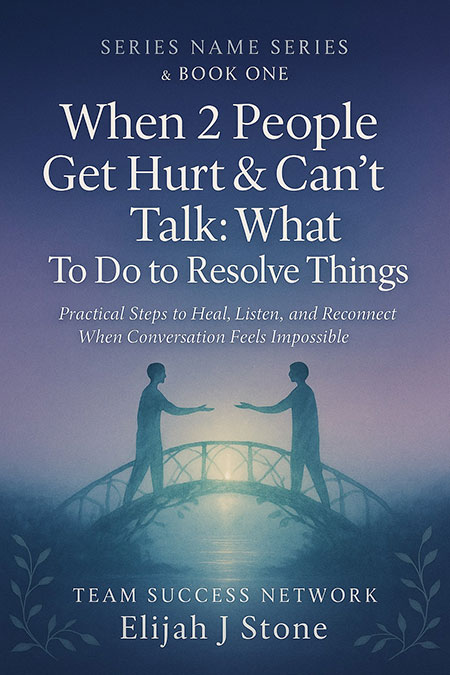
Book 32: When 2 People Get Hurt & Can’t Talk

When
2 People Get Hurt & Can’t Talk: What To Do To Resolve Things
Practical
Steps to Heal, Listen, and Reconnect When Conversation Feels Impossible
By Mr. Elijah J Stone
and the Team Success Network
Table
of Contents
CHAPTER 1 - When Pain Collides: Why Talking Feels Impossible............. 1
CHAPTER 2 - The Silent Wall: Understanding Shared Hurt...................... 1
CHAPTER 3 - Stop Before You Shatter: The Power of Pause.................... 1
CHAPTER 4 - Creating Safe Space for Two Wounded Hearts................... 1
CHAPTER 5 - Listening Without Words: Reading Hurt Beyond Speech.... 1
CHAPTER 6 - Breaking the Standoff: Gentle Ways to Reopen Conversation............ 1
CHAPTER 7 - From Blame to Understanding: Shifting the Focus............. 1
CHAPTER 8 - Small Steps Toward Resolution, One Word at a Time......... 1
CHAPTER 9 - Rebuilding Trust After Mutual Hurt................................... 1
CHAPTER 10 - Moving Forward: Turning Pain Into Deeper Connection... 1
Chapter 11 - Checklist for the First Meeting After Mutual Hurt.............. 1

Chapter 1 – When
Pain Collides: Why Talking Feels Impossible
Why Shared Hurt
Shuts Down Conversation
Understanding the Invisible Weight That Silences Two Voices at Once
The Collision of Two Hurts
When one person gets hurt, the path to healing may seem hard
enough. But when two people are hurt at the very same time, the difficulty
multiplies. Both are wounded, both are raw, and both feel misunderstood. The
collision of pain creates confusion, silence, and distance.
Instead of conversation leading to comfort, it suddenly feels
impossible to even speak. This is the challenge we are addressing in this book:
what do you do when both hearts are hurting at once, and words disappear?
Why Silence Takes Over
Silence is not random—it is a reaction. When two people are hurt,
silence often replaces speech because neither feels strong enough to carry the
weight of communication. Each expects the other to bridge the gap, yet neither
has the energy to start.
• Pain drains courage.
• Pain magnifies misunderstandings.
• Pain convinces us that talking will make things worse.
In moments like this, silence feels safer. But safety through
silence rarely lasts—it often deepens the wound.
The Bible’s Picture of Shared Sorrow
The Bible doesn’t ignore human pain. In fact, it gives us wisdom
for moments when sorrow overlaps. Consider these verses:
- “Two
are better than one… If either of them falls down, one can help the other
up.” (Ecclesiastes 4:9–10)
- “Rejoice
with those who rejoice; mourn with those who mourn.”
(Romans 12:15)
- “Carry
each other’s burdens, and in this way you will fulfill the law of Christ.”
(Galatians 6:2)
- “A
friend loves at all times, and a brother is born for a time of adversity.”
(Proverbs 17:17)
- “Blessed
are those who mourn, for they will be comforted.”
(Matthew 5:4)
The truth is clear: God designed us to share hurt, not retreat in
silence. But learning how to do this takes practice and intentionality.
The Natural Reactions That Block Communication
When two people are hurt, four common reactions often take place:
- Withdrawal –
Both retreat inward, afraid of making things worse.
- Explosion –
One or both lash out in anger, words becoming weapons.
- Deflection –
The conversation shifts away from the real issue, avoiding depth.
- Collapse –
Both shut down completely, leaving only silence.
Each reaction is understandable, but none lead to healing.
Recognizing these tendencies is the first step toward breaking the cycle.
Why Words Fail When Both Are Bleeding
It’s difficult to offer healing words when your own heart feels
raw. Imagine trying to bandage someone else’s wound while bleeding heavily
yourself—you may want to help, but your strength is limited.
• When I am in pain, my focus narrows.
• When I am hurt, empathy feels distant.
• When I am wounded, I see through cloudy eyes.
This is why conversations feel impossible when two hurts collide.
It is not unwillingness—it is exhaustion.
God’s Wisdom: Be Quick to Listen
James 1:19 reminds us: “Everyone should be quick to listen,
slow to speak and slow to become angry.” This principle becomes crucial
when two people are hurting.
Instead of racing to fix things or prove a point, the call is to
slow down. Listening, even when words are scarce, is often the most healing
gift. Sometimes the path to restored speech begins with silent presence, not
perfect sentences.
Questions to the Reader
• Have you ever been in a moment where both you and another person
were hurt at the same time?
• What did silence feel like in that situation—safe, scary, or both?
• How do you usually react when you’re in pain: withdraw, explode, deflect, or
collapse?
These questions are not for shame—they are for clarity. Awareness
prepares you to handle the next collision of hurt differently.
Tagline Truth
When two people are hurting, silence is normal. But silence
doesn’t have to be final.
A New Way to See the Struggle
The struggle of not being able to talk is not proof that the
relationship is weak—it is proof that both hearts are human. Instead of
condemning yourself or the other person for “failing,” you can see the silence
as a signal: both of us need healing space before words can return.
Reframing the silence changes everything. It turns confusion into
an opportunity for grace. It shows you that the breakdown is not the end—it is
simply the middle of the process.
The Three Truths About Shared Hurt
- It is
Temporary. Silence may feel overwhelming, but it doesn’t last forever
if handled with care.
- It is
Neutral. Silence by itself is not good or bad—it’s what you do with
it that matters.
- It is
Transformable. Shared pain can become shared growth if
you approach it intentionally.
Holding on to these truths will keep you from despair in moments
of collision.
Jesus’ Example of Silent Strength
In Matthew 26:63, when Jesus stood before His accusers, the Bible
says: “But Jesus remained silent.” His silence was not weakness—it was
wisdom. Sometimes silence holds space for truth to emerge later.
In our pain, silence can serve the same role. It gives space for
the storm to calm so healing words can be spoken with clarity instead of anger.
Practical Steps for When Conversation Feels Impossible
When words feel too heavy, here are steps you can take:
- Acknowledge
the Hurt. Say quietly, “I know we’re both hurting.” Recognition is the
first bridge.
- Allow
Space. Agree on a pause instead of forcing a talk. A pause shows
wisdom, not abandonment.
- Signal
Care. Even if words fail, a small gesture (hand on shoulder,
sitting nearby) can say, “I’m still here.”
- Invite
God In. Whisper a prayer: “Lord, guide our hearts in this silence.”
His presence changes the atmosphere.
These steps are small but powerful. They keep the silence from
becoming permanent.
When to Wait, When to Speak
Timing is everything. Ecclesiastes 3:7 tells us: “There is a
time to be silent and a time to speak.” Learning the difference saves
relationships.
Wait when:
• Emotions are boiling.
• Words would come out as weapons.
• The other person is visibly overwhelmed.
Speak when:
• The moment feels calmer.
• Words can be gentle instead of sharp.
• Both seem open to reconnecting.
Knowing when to wait and when to speak is wisdom in action.
Reflection Exercise
Pause and write down a memory of when you and another person were
both hurt at the same time. What emotions rose up? What silence felt like a
wall? What you wish you could have done differently?
This reflection prepares you to recognize the same patterns the
next time. Awareness is the seed of change.
The Comfort of God’s Presence
When both people are hurting and no words can be spoken, God’s
presence becomes the steady anchor. Psalm 34:18 says: “The Lord is close to
the brokenhearted and saves those who are crushed in spirit.”
You may not feel able to comfort each other in the moment, but the
Lord is present. His Spirit comforts, strengthens, and prepares both hearts for
reconnection.
Call to Action Summary
• Recognize that silence in shared hurt is normal, not failure.
• Reframe silence as a signal, not an ending.
• Remember: wait, listen, allow space, and invite God in.
• Trust that healing conversation will return when the time is right.
Closing Word
When two people are hurt at the same time, words will often fail.
But the absence of conversation is not the death of connection—it is the pause
before healing. If you let God guide your silence, He will prepare your words.
Silence can separate—but in Christ, silence can also protect until
healing is ready to emerge.

Chapter 2 – The
Silent Wall: Understanding Shared Hurt
Why Two Wounds
Create Barriers Instead of Bridges
Learning to Recognize and Break Through Emotional Distance
The Wall That Rises Between Two People
When both people are hurting, it feels like an invisible wall
rises between them. Suddenly, the one you love or trust feels distant,
unreachable, and guarded. The silence becomes heavy, and every attempt to speak
feels like hitting a brick wall.
This “silent wall” is not built on purpose—it’s built out of pain.
Understanding how and why it appears is the first step toward breaking it down.
What Is the Silent Wall?
The silent wall is the unspoken barrier that forms when two people
are simultaneously wounded. Neither has the strength to fully listen, and both
feel too raw to risk speaking. The result is distance—not because love is gone,
but because pain has taken center stage.
• The wall is made of unspoken emotions.
• The wall is fueled by fear of deeper hurt.
• The wall is maintained by silence that feels safer than speech.
This wall feels permanent, but it is not. With the right
perspective, it can be dismantled.
The Bible’s Wisdom About Walls
Scripture speaks often of walls—sometimes as protection, sometimes
as barriers. In Nehemiah, walls were rebuilt to protect God’s people. But in
other places, walls represented division.
- “He
Himself is our peace, who has made the two groups one and has destroyed
the barrier, the dividing wall of hostility.”
(Ephesians 2:14)
- “By
wisdom a house is built, and through understanding it is established.”
(Proverbs 24:3)
- “A
gentle answer turns away wrath, but a harsh word stirs up anger.”
(Proverbs 15:1)
- “Do
not let the sun go down while you are still angry, and do not give the
devil a foothold.” (Ephesians 4:26–27)
- “Peacemakers
who sow in peace reap a harvest of righteousness.”
(James 3:18)
God’s desire is never for walls to divide His children, but for
His peace to remove them.
How the Silent Wall Gets Built
The silent wall doesn’t appear instantly—it’s built layer by
layer. Here’s how it often happens:
- Painful
Event – Both people experience hurt at the same time.
- Retreat –
Each pulls inward, protecting themselves from more pain.
- Assumptions –
Without communication, each person guesses what the other is thinking.
- Mistrust –
Those guesses feel real, fueling suspicion or doubt.
- Distance –
The wall solidifies, making reconnection feel impossible.
The wall is not just silence—it is built from misunderstanding,
assumptions, and fear.
The Cost of the Silent Wall
Walls can feel protective, but they are costly. The silent wall
robs relationships of connection and prolongs pain.
• Conversations become avoided.
• Healing gets delayed.
• Loneliness grows even while sitting in the same room.
• Small issues begin to feel like permanent divisions.
The wall promises safety, but it delivers isolation.
Recognizing the Wall in Your Own Life
How do you know when the silent wall has formed? Look for these
signs:
• You feel distant even when you’re close.
• You avoid eye contact or conversation.
• You fear that speaking will make things worse.
• You replay the hurt in your mind but can’t share it.
• You sense tension in the air even in silence.
Have you ever felt this wall? Naming it is the first step toward
tearing it down.
Tagline Truth
The silent wall may block your voice, but it cannot block God’s
love.
Why God Allows the Wall to Be Seen
Sometimes God allows us to feel the weight of the wall so that we
recognize our need for Him. Left alone, we cannot always dismantle our
defenses. But with His Spirit, we gain wisdom, patience, and humility.
Ephesians 2:14 reminds us: “He Himself is our peace.” The
wall is not meant to remain; it is meant to be overcome by His peace.
Questions to the Reader
• Have you noticed moments where you felt an invisible wall rise
between you and another person?
• Did you assume the wall was permanent, or did you recognize it as temporary?
• How do you usually respond—do you retreat further, or do you try to force
conversation?
These reflections help you spot the wall before it becomes
thicker.
Practical Ways to Break Down the Wall
The silent wall doesn’t need to remain. Here are steps to begin
dismantling it:
- Recognize
It – Admit, “We both feel distant right now.” Naming the wall
weakens its power.
- Respect
It – Don’t force conversation in the heat of pain. Give space
for emotions to cool.
- Pray
Through It – Ask God for wisdom to soften your heart and theirs.
- Signal
Safety – Use small, gentle actions to show you’re still present.
- Re-enter
Slowly – Break the wall piece by piece, starting with short words
or kind gestures.
The key is gentleness—walls break easier with patience than with
pressure.
The Danger of Misinterpreting the Wall
Many people mistake the silent wall for rejection. They assume the
other person doesn’t care anymore. But the truth is usually the opposite: both
care so deeply that they are afraid of making things worse.
Don’t confuse silence with indifference. Don’t confuse distance
with abandonment. The wall is a symptom of pain, not proof of rejection.
God’s Promise of Reconnection
Isaiah 58:12 declares: “You will be called Repairer of Broken
Walls, Restorer of Streets with Dwellings.” God not only helps us recognize
walls—He calls us to repair them.
When you lean on His Spirit, the wall becomes less intimidating.
His grace empowers you to move carefully but confidently toward reconciliation.
Reflection Exercise
Think of a time when you felt a silent wall between you and
someone else. Write down what emotions you felt, what assumptions you made, and
how the situation eventually shifted. Then ask: how could I invite God into
that process sooner next time?
Reflection turns past pain into future wisdom.
The Hope Beyond the Wall
Every wall has a door. The silent wall may feel solid, but there
is always a way through. That way is built on humility, patience, and love.
Love is stronger than silence. Grace is stronger than fear. God’s
presence is stronger than any wall between hurting people.
Call to Action Summary
• Recognize the wall when it rises between two wounded hearts.
• Remember: silence is not rejection—it’s a symptom of pain.
• Break the wall gently with recognition, prayer, and patient re-entry.
• Trust God’s Spirit to bring peace that human words cannot.
Closing Word
The silent wall is real, but it is not final. It may divide you
for a moment, but it doesn’t have to define your relationship. With God’s peace
and gentle action, the wall can fall—and what once divided can become the
foundation for deeper trust.
The wall may rise in pain, but love and wisdom will always find a
way through.

Chapter 3 – Stop
Before You Shatter: The Power of Pause
Why Stopping
Protects the Relationship
Learning to Pause Before Pain Becomes Permanent
The Risk of Rushing Into Words
When both people are hurting, the instinct is to talk it out
immediately. But often, rushing into words only makes the damage worse. Raw
emotions turn sentences into sharp edges, and instead of resolving the issue,
the conversation spirals into deeper conflict.
The truth is simple but hard to practice: sometimes the most
loving thing you can do is stop. Pausing isn’t weakness—it’s wisdom. It’s a way
of protecting both people until hearts are ready to hear and be heard.
Why Pausing Feels Wrong (But Is Right)
Many of us were raised to believe problems must be solved
immediately. Walking away or pausing feels like failure. But God’s wisdom often
works the opposite of our instincts.
• Pausing prevents explosions.
• Pausing protects words from becoming weapons.
• Pausing gives time for clarity and calm to return.
Pausing doesn’t avoid the issue—it preserves the relationship so
that resolution can actually happen later.
God’s Timing in Conflict
The Bible repeatedly points to the wisdom of waiting, of knowing
the right moment to speak and the right moment to stay silent.
- “There
is a time for everything… a time to be silent and a time to speak.”
(Ecclesiastes 3:1,7)
- “The
one who has knowledge uses words with restraint, and whoever has
understanding is even-tempered.” (Proverbs 17:27)
- “Everyone
should be quick to listen, slow to speak and slow to become angry.”
(James 1:19)
- “Be
still, and know that I am God.” (Psalm 46:10)
- “The
prudent hold their tongue.” (Proverbs 10:19)
God’s Word makes it clear: waiting can be holy. Pausing creates
space for His Spirit to work.
The Difference Between Pausing and Avoiding
Pausing is not the same as avoiding. Avoidance is running from the
issue indefinitely. Pausing is intentionally stopping for a moment so that the
issue can be addressed later, with healthier hearts and calmer minds.
Avoidance says: “I don’t want to deal with this at
all.”
Pause says: “I want to deal with this, but I know now is not the right
time.”
That difference changes everything. Avoidance breaks trust.
Pausing builds safety.
How to Take a Healthy Pause
Here are steps for practicing the power of pause:
- Name
It. Say, “I need to pause so we don’t hurt each other more.”
This communicates intention.
- Set
Time. Agree to revisit the conversation after a break (minutes,
hours, or the next day).
- Seek
God. Use the pause for prayer, asking Him to guide your words.
- Reset
Heart. Focus on peace, not on replaying the hurt.
- Return. Come
back with humility and gentleness.
Pauses without return create fear. Pauses with clear return build
trust.
Why the Flesh Resists Pausing
Our flesh wants to win, prove a point, or defend ourselves
instantly. Pausing feels like surrender. But in Christ, surrender is strength.
Romans 8:6 says: “The mind governed by the flesh is death, but
the mind governed by the Spirit is life and peace.” When we resist the
flesh’s demand to fight immediately, we invite the Spirit’s gift of peace.
Tagline Truth
A pause is not a retreat—it is a shield against deeper wounds.
Common Fears About Pausing
People often resist pausing because of fear.
• Fear that the issue will never be resolved.
• Fear that the pause means rejection.
• Fear that silence equals abandonment.
But these fears can be disarmed when the pause is explained and
agreed upon. When you clearly say, “I want to pause so we can come back
stronger,” fear turns into reassurance.
Jesus and the Pause of Silence
When accused before Pilate, Jesus did not rush to defend Himself.
Matthew 27:14 records: “But Jesus made no reply, not even to a single
charge—to the great amazement of the governor.” His silence wasn’t
weakness—it was purposeful.
If Jesus modeled restraint in the face of hostility, surely we can
learn to pause when pain threatens to shatter connection. His silence shows us
that not every moment requires words—sometimes strength is found in waiting.
Questions to the Reader
• How do you usually react when conflict arises—rush in, shut
down, or pause?
• Have you ever regretted words you spoke in the heat of hurt?
• What would it look like to intentionally choose a pause in your next
conflict?
These questions help you begin practicing the pause instead of
fearing it.
The Fruit of a Well-Timed Pause
What happens when you choose to pause wisely?
• Emotions settle, lowering the intensity of the moment.
• Clarity rises—you can think more clearly after space.
• Words heal instead of harm when spoken later.
• Both people feel safer, knowing the issue is not ignored but respected.
A pause doesn’t just protect you—it blesses the relationship.
Reflection Exercise
Think back to a conflict where you rushed in and made things worse
with words. What would have happened if you had paused instead? Write down how
a pause could have changed the outcome.
This exercise isn’t about regret—it’s about learning for next
time.
When Pausing Is Difficult
Sometimes the hardest thing to do is stop talking when you want to
keep pressing. The temptation is to prove your point, demand understanding, or
insist on being heard.
But wisdom asks: will this bring healing, or will it break trust
further? If the answer is “break,” then pausing is the wiser choice.
Self-control in the heat of pain is one of the greatest signs of maturity.
God’s Presence in the Pause
Philippians 4:7 says: “And the peace of God, which transcends
all understanding, will guard your hearts and your minds in Christ Jesus.”
The pause is not empty—it can be filled with God’s peace.
Use the pause to pray. Use it to breathe. Use it to remember God’s
love for both you and the other person. In doing so, the pause becomes more
than silence—it becomes sacred space.
Call to Action Summary
• Recognize the difference between pausing and avoiding.
• Use pauses intentionally—name them, set a time, and return.
• Allow the Spirit of God to calm emotions during the pause.
• See pausing as protection, not weakness.
• Remember: Jesus Himself modeled the power of silence.
Closing Word
The power of pause can save relationships from shattering under
the weight of pain. Choosing to stop before speaking is not running away—it is
building a future where words bring life, not destruction.
A pause today creates peace tomorrow.

Chapter 4 –
Creating Safe Space for Two Wounded Hearts
How to Build an
Atmosphere Where Healing Can Begin
Practical Steps for Making Pain Bearable and Conversation Possible
Why Safety Matters in Shared Hurt
When two people are hurting, safety becomes more important than
solutions. Without a sense of safety, conversations will shut down and walls
will rise higher. You cannot force healing in a place that feels threatening.
Safety is the soil where trust can grow again. If both people feel
secure, the atmosphere shifts. Hearts soften, and the possibility of real
connection begins to open.
What Safety Looks Like in Relationships
Safety is not about the absence of conflict—it’s about the
presence of respect and care, even in conflict. Safe spaces have a few key
qualities:
• You feel heard without being interrupted.
• You feel respected even if you disagree.
• You feel valued, not dismissed.
• You sense patience, not pressure.
These qualities create an atmosphere where both wounds can be
acknowledged without fear of further injury.
God as Our Safe Refuge
The Bible often describes God as a place of refuge, safety, and
shelter. That same principle applies to our relationships—we can mirror His
heart by becoming a place of safety for each other.
- “God
is our refuge and strength, an ever-present help in trouble.”
(Psalm 46:1)
- “The
name of the Lord is a fortified tower; the righteous run to it and are
safe.” (Proverbs 18:10)
- “You
are my hiding place; you will protect me from trouble and surround me with
songs of deliverance.” (Psalm 32:7)
- “My
presence will go with you, and I will give you rest.”
(Exodus 33:14)
- “In
peace I will lie down and sleep, for you alone, Lord, make me dwell in
safety.” (Psalm 4:8)
God’s character shows us: real safety is not about perfect
circumstances, but about creating a shelter where peace and trust can live.
The Enemies of Safety
If you want to create safe space, you need to know what destroys
it. Here are some of the main “safety killers”:
- Harsh
Tone – Even if the words are right, the delivery can wound.
- Interruptions –
Cutting off the other person signals that their voice doesn’t matter.
- Blame –
Assigning fault before listening builds walls instead of bridges.
- Pressure –
Forcing quick answers creates fear rather than openness.
- Withdrawal
Without Notice – Leaving emotionally or physically
without explaining builds suspicion.
Safety cannot exist in the presence of these behaviors.
Recognizing them helps you guard against repeating them.
How to Build a Safe Atmosphere Step by Step
Creating safety is intentional. Here are practical steps you can
take:
- Set
the Tone. Begin softly, with calm words, not accusations.
- Honor
Space. Sit down together in a comfortable environment.
- Invite
Openness. Say, “I want to hear you. Your voice matters.”
- Commit
to Patience. Allow silence and pauses without
rushing.
- Protect
the Boundaries. Don’t let the conversation drift into
attack or shame.
Safety is less about a script and more about consistent attitudes.
When safety is honored, healing can begin.
Tagline Truth
Safety doesn’t remove pain, but it makes pain bearable.
Examples of Safe Space in Action
Imagine a couple who both feel hurt after a disagreement. Instead
of arguing in the kitchen where children overhear, they decide to step outside,
sit on the porch, and breathe together before speaking.
Or imagine two friends who’ve misunderstood each other. One says,
“I care about you too much to rush this. Let’s sit down tomorrow after we’ve
both had time to think.” That decision creates safety before words are even
exchanged.
Questions to the Reader
• Where do you feel most “safe” when hard conversations happen?
• What behaviors from others help you open up, even when you’re hurting?
• What could you do differently to create safety for someone else in conflict?
Reflecting on these helps you see the atmosphere you’ve been
creating—and what you could improve.
The Role of Body Language
Safety is communicated not just in words but in posture, tone, and
presence. A soft look, a relaxed voice, and a calm presence can speak louder
than an entire speech.
Ask yourself: is my body language building a safe space or
creating more tension? Often, it’s not what we say but how we sit, breathe, and
look that shapes the atmosphere of the moment.
The Example of Jesus
Jesus created safe space everywhere He went. Even the most broken
people felt welcome in His presence. The woman caught in adultery (John 8:1–11)
expected condemnation, but Jesus gave compassion and dignity. His response
created safety for repentance and transformation.
In the same way, we can mirror His example. Our goal is not to
excuse wrong but to create an atmosphere where healing becomes possible.
The Benefits of Safety
When both people feel safe, amazing things happen:
• Defensiveness lowers.
• Honest words rise.
• Misunderstandings can be clarified.
• Trust begins to rebuild.
• Healing becomes not only possible but natural.
Safety doesn’t solve everything instantly, but it lays the
foundation for every other step forward.
Reflection Exercise
Think about the last conflict where you felt unsafe. What happened
that made you close down? Write it down honestly. Then imagine how the moment
would have been different if safety had been created.
This reflection trains your mind to recognize the difference
between unsafe and safe spaces.
Mistakes to Avoid When Trying to Create Safety
Sometimes people try to create safety but accidentally sabotage
it. Here are common mistakes:
• Over-explaining – Too many words overwhelm instead of
comfort.
• Pretending Everything Is Fine – Denial blocks real healing.
• Rushing Forgiveness – Safety isn’t built by skipping the process.
• Making Promises You Can’t Keep – Broken promises destroy safety faster
than silence.
True safety is not about perfection—it’s about honesty, patience,
and humility.
God’s Promise of Shelter
Isaiah 41:10 says: “So do not fear, for I am with you; do not
be dismayed, for I am your God. I will strengthen you and help you; I will
uphold you with my righteous right hand.”
God Himself is our shelter. When we let His Spirit guide us, we
naturally become a safe place for others. His presence teaches us what safety
feels like—and equips us to extend it to those we love.
Key Truth:
Safety is not the absence of conflict—it is the presence of love
in the middle of conflict.
Call to Action Summary
• Identify the enemies of safety: harsh tone, blame, pressure, and
withdrawal.
• Build safety intentionally by honoring space, setting the tone, and inviting
openness.
• Remember: safety is shown not only in words but in presence and posture.
• Follow Jesus’ example of compassion as the foundation of safe space.
• Choose to be a shelter where hearts can heal.
Closing Word
Creating safe space is one of the most powerful gifts you can give
to a wounded relationship. Without it, pain multiplies and distance grows. With
it, walls come down, trust begins to form, and healing becomes possible.
You can’t control the wound, but you can control the atmosphere.
And in the right atmosphere, even the deepest wounds can heal.

Chapter 5 –
Listening Without Words: Reading Hurt Beyond Speech
How to Hear What
Pain Is Saying Without Sound
Learning the Silent Language of Wounded Hearts
The Challenge of Silence in Pain
When both people are hurting, words often disappear. Sometimes the
wound feels too deep to explain. Other times, fear of saying the wrong thing
keeps lips sealed. Yet silence does not mean nothing is being communicated.
In fact, silence often speaks louder than words. The challenge is
learning to listen to what is being said without speech—to hear with your
heart, your eyes, and your spirit.
Why Words Fall Short in Hurt
Words can be fragile in moments of pain. They break down because:
• The person doesn’t know how to explain the hurt.
• Emotions feel overwhelming and untranslatable.
• Fear of rejection or escalation keeps them silent.
• Both assume the other “should already know.”
In these moments, true listening is about reading beyond language.
The Bible’s View of Listening
God values listening even above speaking. Scripture consistently
emphasizes the power of hearing with more than just ears.
- “Be
quick to listen, slow to speak and slow to become angry.”
(James 1:19)
- “Let
the wise listen and add to their learning.”
(Proverbs 1:5)
- “Call
to me and I will answer you and tell you great and unsearchable things you
do not know.” (Jeremiah 33:3)
- “Speak,
Lord, for your servant is listening.” (1 Samuel 3:10)
- “He
who has ears to hear, let him hear.” (Matthew 11:15)
Listening is more than sound—it is posture, attention, and
humility.
The Silent Signals of Hurt
When words are missing, pain often shows up in silent signals.
These are the unspoken cries for understanding:
• Body Language – Crossed arms, turned away shoulders, or
slumped posture.
• Facial Expression – Tears, tightened jaw, or avoiding eye contact.
• Tone of Silence – Is it cold distance or heavy sadness?
• Physical Distance – Moving away, sitting apart, avoiding touch.
• Energy Shift – The room feels heavier even without words.
Each of these signals communicates a message waiting to be heard.
Tagline Truth
Silence is never empty—it is always saying something.
How to Listen Beyond Words
To hear what silence says, you need to practice deeper forms of
listening:
- Observe
Carefully. Notice posture, gestures, and small details.
- Feel
the Atmosphere. What emotions are filling the room?
- Stay
Present. Don’t rush away from the silence—sit with it.
- Ask
Gentle Questions. Instead of pushing, say, “I sense you’re
carrying something—am I right?”
- Pray
for Discernment. Ask the Holy Spirit to help you hear the
deeper need.
Listening without words requires patience and humility, but it
communicates powerful love.
Why Listening Heals
Listening validates the other person’s pain. It says, “I see you,
even if you can’t explain everything.” Often, the moment someone feels truly
seen, healing begins.
Jesus often listened before He spoke. With the blind beggar (Luke
18:40–41), He asked, “What do you want me to do for you?” Though He
already knew, He listened. That question gave dignity and space for expression.
Questions to the Reader
• When have you felt someone “heard” you without words?
• How do you usually respond to silence—do you push, withdraw, or observe?
• What would it look like for you to listen with your heart in your next
conflict?
Reflecting on these questions helps you reframe silence as an
opportunity instead of a threat.
The Dangers of Misinterpreting Silence
Not all silence means the same thing. If we assume wrongly, we can
make the wound worse.
• Silence could mean fear, not rejection.
• Silence could mean exhaustion, not anger.
• Silence could mean confusion, not betrayal.
That’s why patient listening matters—you cannot assume the meaning
of silence without sensitivity.
Key Truth:
Assumption builds walls. Attention builds bridges.
Practical Tools for Listening Without Words
Here are tools you can use immediately:
- Mirror
Posture. Gently reflect body language to show presence.
- Soften
Eyes. Your gaze communicates care without words.
- Stay
Still. Fidgeting communicates impatience. Stillness communicates
openness.
- Offer
Gentle Touch. A hand on the shoulder or arm can speak
volumes.
- Invite
Without Force. Say, “I’m here whenever you’re ready.”
These simple practices let the other person know: “You are safe
with me.”
The Example of Job’s Friends (Done Right and Wrong)
When Job lost everything, his friends sat with him in silence for
seven days (Job 2:13). That initial silence was powerful—they shared his pain
without speaking. But when they began talking, their words wounded instead of
healed.
This shows us a key truth: silence with presence can heal, but
silence broken with careless words can harm. Listening must be guided by
compassion, not judgment.
Reflection Exercise
Think of someone in your life who has been silent in their pain.
Write down the nonverbal signals you noticed. What could you have done
differently to listen more deeply without demanding words?
This exercise helps you build awareness of how silence
communicates.
The Spiritual Side of Listening Without Words
Sometimes listening without words is not just about the other
person—it’s about tuning into God. The Holy Spirit often reveals the hidden
cries of the heart when we slow down and pay attention.
Romans 8:26 says: “The Spirit himself intercedes for us through
wordless groans.” Even our prayers sometimes go beyond words. If God
listens to our wordless groans, we can learn to do the same for others.
The Fruit of Silent Listening
When you learn to listen without words:
• The other person feels seen, not pressured.
• Tension decreases as safety grows.
• Healing begins without force.
• Trust deepens because care has been proven.
• Words eventually flow more freely when ready.
Silent listening is not passive—it is one of the most active forms
of love.
Call to Action Summary
• Remember: silence always communicates something—don’t ignore it.
• Learn to notice body language, energy, and atmosphere.
• Don’t assume—observe, invite, and discern with prayer.
• Follow Jesus’ example of asking gentle, open-hearted questions.
• Practice presence: sometimes listening is about being there, not speaking.
Closing Word
Words may fail, but listening never does. When silence takes over,
you can still hear what pain is saying—if you slow down, observe, and listen
with your spirit.
Listening without words is love in its purest form.

Chapter 6 –
Breaking the Standoff: Gentle Ways to Reopen Conversation
How to Take the
First Step Without Forcing It
Turning Silence Into an Invitation for Healing
The Standoff That Keeps You Stuck
When two people are hurt, it often feels like a standoff. Both
want resolution, but neither wants to make the first move. Fear whispers: “If
I speak first, I’ll look weak. If I stay silent, maybe they’ll come to me.”
The longer the standoff lasts, the thicker the wall becomes. The
good news? You don’t need to break the standoff with force. Gentle steps are
enough to open the door.
Why Nobody Wants to Go First
Going first feels risky. It demands vulnerability in a moment when
both hearts already feel fragile. Common thoughts at this stage include:
• “What if they reject my attempt?”
• “What if I say it wrong and make things worse?”
• “Why should I go first when I’m hurt too?”
These fears are normal. But unless someone breaks the silence,
healing can’t begin.
God’s Call to Take the First Step
Scripture shows that love often moves first. God Himself modeled
this when He initiated reconciliation with us.
- “We
love because he first loved us.” (1 John 4:19)
- “While
we were still sinners, Christ died for us.”
(Romans 5:8)
- “If
your brother or sister sins against you, go and point out their fault,
just between the two of you.” (Matthew 18:15)
- “Make
every effort to live in peace with everyone.”
(Hebrews 12:14)
- “Blessed
are the peacemakers, for they will be called children of God.”
(Matthew 5:9)
God doesn’t ask us to always be “right.” He asks us to be
willing—to go first in grace, just as He did.
Tagline Truth
The first step is not weakness—it’s leadership in love.
Gentle Ways to Break the Silence
You don’t need to launch into a long speech. Often, small gestures
are enough to soften the air. Try:
• A kind smile that says, “I’m still here.”
• A gentle word like, “Can we start again?”
• A touch on the arm or shoulder.
• Sitting nearby instead of staying distant.
• Writing a short note if words feel stuck.
Gentleness disarms fear. Even the smallest gesture can start to
melt the ice.
The Power of a Question
Questions often reopen doors better than statements. Instead of, “You
hurt me,” try:
- “Can
I ask how you’re feeling right now?”
- “Would
you be open to talking when you’re ready?”
- “Can
we take this one step at a time?”
Questions invite conversation instead of demanding it. They signal
humility and a willingness to listen.
Reflection Questions for You
• How do you usually respond in a standoff—do you wait, withdraw,
or lash out?
• Which gentle gesture feels most natural for you to try first?
• What would it look like for you to break silence with humility instead of
fear?
These reflections prepare you for the moment when the standoff
comes again.
The Danger of Forcing a Breakthrough
Some try to break the silence with pressure—raising voices,
demanding answers, or forcing quick reconciliation. But force backfires. It
creates more resistance instead of more openness.
Remember: the goal is not speed but safety. Breaking the standoff
requires gentleness, not control.
Biblical Example: Joseph and His Brothers
In Genesis 45, Joseph finally revealed himself to his brothers
after years of pain. He broke the standoff with tears and kindness, not
accusations. Instead of saying, “You ruined my life,” he said, “God sent me
ahead of you to preserve life.”
His gentleness reopened the door to family restoration. This story
reminds us: healing comes when love leads, not when blame dominates.
Practical Step-by-Step Method
Here’s a framework you can use:
- Pray
First. Ask God to soften your heart and give you words.
- Start
Small. Use a gentle gesture before diving into deep talk.
- Name
the Moment. Say, “I know we’ve both been hurting.”
Recognition brings relief.
- Offer
Openness. Add, “I want to listen when you’re ready.”
- Be
Patient. Let the other person come at their pace.
Breaking the standoff is more about posture than persuasion.
Key Truth:
Gentleness breaks standoffs faster than arguments ever will.
The Role of the Holy Spirit
We cannot always see the right words or gestures on our own. But
the Spirit knows exactly how to nudge our hearts. Jesus promised: “But the
Advocate, the Holy Spirit… will teach you all things and will remind you of
everything I have said to you.” (John 14:26)
When you invite the Spirit into the silence, He gives wisdom
beyond your understanding. Sometimes He’ll whisper, “Wait.” Other times
He’ll prompt, “Speak now.” Trust His timing.
The Fruit of Going First
When someone gently breaks the standoff:
• Fear begins to fade.
• Trust begins to rebuild.
• Hope returns to the atmosphere.
• Words start to flow again.
• Healing becomes possible.
One gentle move can shift the entire dynamic.
Reflection Exercise
Think of a time you were in a standoff with someone you loved.
Write down how the silence ended—who broke it, how they did it, and what
changed afterward. Then consider: how could you have offered a gentler step
yourself?
This prepares you to be the one who courageously and kindly goes
first next time.
Jesus the Peacemaker
Jesus continually stepped into standoffs with love. Whether with
His disciples after betrayal or with enemies who opposed Him, He often disarmed
tension with gentleness. His words in John 20:19 to His frightened disciples
were simple: “Peace be with you!”
Sometimes the gentlest words—peace, love, forgiveness—are the
strongest. Following His example, we can break standoffs by choosing peace over
pride.
Call to Action Summary
• Don’t wait for the other person—be willing to go first.
• Use gentle gestures or questions instead of pressure.
• Pray for the Spirit’s wisdom before acting.
• Remember Joseph’s example: kindness restores more than blame.
• Trust that one small step can reopen the door to healing.
Closing Word
The standoff doesn’t need to last forever. Breaking it doesn’t
require force, long speeches, or perfect words. All it takes is a willing
heart, a gentle gesture, and God’s peace guiding you.
Healing begins the moment someone chooses to go first. Let that
someone be you.

Chapter 7 – From
Blame to Understanding: Shifting the Focus
Why Accusation
Deepens Hurt
How Compassion Turns Conflict Into Connection
The Trap of Blame
When both people are hurting, it feels natural to blame the other.
“If you hadn’t said that…” or “If you cared more, this wouldn’t have
happened.” These words rise quickly, and they sting deeply.
Blame feels powerful in the moment, but it poisons the atmosphere.
Instead of drawing hearts closer, it pushes them farther apart. The path
forward requires shifting the focus—from accusation to understanding.
Why Blame Feels So Natural
Blame is a defense mechanism. It allows us to unload pain by
pointing the finger. But in reality, blame creates distance instead of relief.
• Blame protects pride but destroys peace.
• Blame creates winners and losers instead of partners.
• Blame fuels resentment instead of resolution.
Blame may feel like justice, but it rarely brings healing.
God’s Call to Understanding
Scripture shows us another way—the way of compassion and
understanding.
- “Do
not judge, and you will not be judged. Do not condemn, and you will not be
condemned. Forgive, and you will be forgiven.”
(Luke 6:37)
- “Be
completely humble and gentle; be patient, bearing with one another in
love.” (Ephesians 4:2)
- “Above
all, love each other deeply, because love covers over a multitude of
sins.” (1 Peter 4:8)
- “Do
nothing out of selfish ambition or vain conceit. Rather, in humility value
others above yourselves.” (Philippians 2:3)
- “A
person’s wisdom yields patience; it is to one’s glory to overlook an
offense.” (Proverbs 19:11)
God does not tell us to ignore wrong, but He calls us to approach
it with gentleness, humility, and love.
Tagline Truth
Blame makes enemies. Understanding makes allies.
The Cost of Staying in Blame
Blame doesn’t just delay healing—it actively damages the
relationship.
- It
builds resentment in the one being blamed.
- It
reinforces self-righteousness in the one doing the blaming.
- It
keeps the focus on the past instead of the future.
- It
creates a cycle where each person blames the other back.
This cycle of accusation guarantees that nobody wins.
Why Understanding Heals
Understanding shifts the atmosphere completely. It doesn’t mean
excusing harmful behavior—it means seeking to grasp the heart behind the
actions.
• Understanding asks, “What pain might they be carrying?”
• Understanding seeks connection, not condemnation.
• Understanding creates space for empathy and compassion.
When someone feels understood, even if not agreed with, their
heart often begins to soften.
Reflection Questions for You
• Do you tend to defend yourself with blame when you feel hurt?
• How do you feel when others blame you instead of trying to understand you?
• What would it look like to replace one blaming statement with one
understanding question?
Reflection reveals how often blame creeps into your habits—and how
you can shift toward empathy.
Practical Ways to Shift the Focus
Here’s how you can move from blame to understanding in practice:
- Pause
Before Speaking. Ask yourself, “Am I trying to punish or
to heal?”
- Reframe
Words. Replace “You always…” with “I felt hurt when…”
- Ask
Questions. Instead of accusing, ask: “Can you help me understand what
you meant?”
- Listen
Fully. Allow them to explain without interrupting.
- Seek
Common Ground. Find one point you can agree on before
discussing differences.
Understanding doesn’t erase conflict, but it creates a safe path
forward.
The Example of Jesus
Jesus constantly chose understanding over blame. With Peter, who
denied Him three times, Jesus could have said: “You failed me.” Instead,
He asked: “Do you love me?” (John 21:15–17). That question restored
Peter instead of condemning him.
His example teaches us: understanding is redemptive. It sees
beyond failure to the heart, offering a chance to heal and grow.
Key Truth:
Blame looks at the offense. Understanding looks at the person.
The Emotional Shift of Empathy
Empathy is the bridge that carries us from blame to understanding.
It doesn’t excuse wrong—it acknowledges humanity.
When you empathize, you begin to feel what the other might be
feeling. That shift lowers anger and raises compassion. In empathy, your words
become softer, your tone becomes calmer, and the standoff begins to break.
Reflection Exercise
Think of a recent moment when you blamed someone. Write down the
exact words you used. Now rewrite those same words as if you were seeking
understanding. Compare the difference.
This exercise helps train your communication toward compassion.
The Role of Humility
Understanding requires humility. Pride demands to be right.
Humility seeks to build peace. Philippians 2:3 reminds us: “Value others
above yourselves.”
Humility doesn’t mean agreeing with everything. It means
recognizing that the relationship matters more than the argument.
The Fruit of Choosing Understanding
When both people shift from blame to understanding, transformation
happens:
• Arguments lose their sharpness.
• Hearts open to reconciliation.
• Forgiveness feels possible.
• Trust begins to rebuild.
• The relationship becomes stronger than before.
Understanding is not weakness—it is one of the strongest forces
for healing.
Call to Action Summary
• Recognize that blame deepens wounds instead of healing them.
• Choose humility over pride—seek to understand, not just to win.
• Use empathy to see the heart behind the hurt.
• Follow Jesus’ example: ask questions instead of casting accusations.
• Practice rephrasing blame statements into understanding statements.
Closing Word
Blame is easy, but it always costs more than it gives.
Understanding is harder at first, but it opens the door to healing. When you
stop pointing fingers and start opening your heart, conflict turns into
connection.
Blame divides. Understanding unites. Choose unity.

Chapter 8 – Small
Steps Toward Resolution, One Word at a Time
Why Healing Comes
in Inches, Not Miles
Learning to Celebrate Progress Instead of Demanding Perfection
The Myth of Instant Resolution
When conflict has created hurt, we want resolution immediately. We
imagine one conversation will fix everything. But healing doesn’t work that
way. Real resolution usually happens slowly—one step, one phrase, one act of
kindness at a time.
Believing in the myth of instant resolution sets us up for
frustration. When it doesn’t happen quickly, we assume nothing will ever
change. But God teaches us to value the process.
Why Small Steps Matter
Small steps are powerful because:
• They prove movement is possible.
• They build trust without overwhelming.
• They create momentum toward bigger breakthroughs.
• They allow both people to heal at a safe pace.
When wounds are deep, large leaps often feel unsafe. Small steps
keep the journey steady.
God’s Way of Gradual Healing
Scripture reminds us that God’s work is often progressive.
- “The
path of the righteous is like the morning sun, shining ever brighter till
the full light of day.” (Proverbs 4:18)
- “Do
not despise these small beginnings, for the Lord rejoices to see the work
begin.” (Zechariah 4:10)
- “Let
perseverance finish its work so that you may be mature and complete, not
lacking anything.” (James 1:4)
- “Though
it linger, wait for it; it will certainly come and will not delay.”
(Habakkuk 2:3)
- “The
kingdom of God is like a mustard seed… the smallest of all seeds, yet when
it grows, it is the largest.” (Matthew 13:31–32)
God delights in steady, faithful progress. We should too.
Tagline Truth
Resolution is built, not discovered. One step at a time.
What Small Steps Look Like
Small steps toward resolution may include:
- A
single kind word.
- A
willingness to sit in the same room.
- A
small apology, even if incomplete.
- A
text message that says, “I’m thinking of you.”
- A
calm tone replacing an angry one.
Each of these seems small, but together, they rebuild connection
brick by brick.
The Danger of Expecting Too Much
One of the biggest obstacles to resolution is expecting everything
at once. When we expect a dramatic breakthrough, we often miss the beauty of
gradual change.
• Expectation says: “Everything should be fixed now.”
• Patience says: “Every step forward is progress.”
Celebrating small steps keeps hope alive even when full resolution
isn’t immediate.
Practical Framework for Taking Small Steps
Here’s a simple process:
- Identify
the First Step. What small action feels safe right now?
- Take
It Gently. Speak or act without pressure.
- Celebrate
It. Thank God for progress, even if tiny.
- Build
Consistency. Repeat small steps regularly.
- Allow
Growth. Trust that many small steps will create big change.
Resolution doesn’t come from one giant leap—it comes from
consistent small moves.
Example: Jacob and Esau
In Genesis 33, Jacob and Esau reunited after years of conflict.
Jacob didn’t rush in with bold demands. He approached humbly, step by
step—bowing, offering gifts, and speaking gently. Esau responded with embrace,
and resolution came.
Their story shows us that humility and small gestures open the
door to reconciliation.
Questions to the Reader
• Have you ever missed small progress because you were expecting
big results?
• What’s one small step you could take today toward resolution with someone?
• How would your perspective change if you saw resolution as a journey, not an
event?
Your answers prepare you to notice and value steady growth.
The Role of Patience
Patience is the fuel for small steps. Without patience, you’ll
feel like nothing is happening. But patience reminds you: every seed takes time
to sprout.
Galatians 6:9 encourages us: “Let us not become weary in doing
good, for at the proper time we will reap a harvest if we do not give up.”
Each small step is a seed—don’t stop planting.
The Fruit of Small Steps
When you value small progress, several things happen:
• Pressure decreases—both people can breathe easier.
• Trust grows steadily instead of being forced.
• Resolution feels genuine, not rushed.
• The relationship becomes stronger than before.
Small steps are not signs of weakness—they are signs of wisdom.
Reflection Exercise
Think of a relationship where you long for resolution. Write down
three small steps you could take this week to move closer. Then pray over those
steps, asking God to guide your timing and words.
This exercise gives you a roadmap for gentle progress.
The Example of Jesus With His Disciples
Jesus often restored His disciples gradually. After Peter’s
denial, Jesus didn’t confront him harshly. Instead, He asked three gentle
questions: “Do you love me?” (John 21:15–17). Each question was a small
step toward restoring Peter’s confidence and calling.
Resolution came through repetition and gentleness, not one
dramatic moment.
Key Truth:
Small steps done consistently lead to big restoration.
The Danger of Neglecting Small Steps
Neglecting small steps can leave wounds unhealed. Waiting for the
“perfect moment” can cause years of silence. Choosing to move slowly is better
than not moving at all.
Don’t despise progress because it feels minor. God celebrates
every act of humility, every gentle word, every seed of reconciliation.
Call to Action Summary
• Stop expecting instant resolution—embrace the process.
• Value small steps: kind words, gentle gestures, humble apologies.
• Follow biblical examples like Jacob, Esau, and Peter’s restoration.
• Cultivate patience—trust God’s timing in the process.
• Celebrate progress instead of demanding perfection.
Closing Word
Resolution rarely comes in a single conversation. It grows slowly,
step by step, word by word. The key is not speed but consistency.
Take one step today. Then another tomorrow. Before long, the road
to resolution will be clear.
Chapter 9 –
Rebuilding Trust After Mutual Hurt
Why Trust Feels
Fragile After Shared Pain
Practical Steps to Restore What Was Broken
The Fragility of Trust
When two people are hurt at the same time, trust can feel
shattered. Even if neither person intended harm, the wounds create questions: “Can
I trust you again?” or “Will this happen the same way next time?”
Trust is fragile—easy to break, slow to rebuild. Yet without it,
no relationship can thrive. The good news? Trust can be restored with patience,
humility, and consistent care.
Why Trust Breaks So Easily
Trust breaks quickly in moments of pain because:
• Expectations collapse under disappointment.
• Words spoken in anger leave lasting scars.
• Silence creates fear of abandonment.
• Misunderstandings distort intentions.
When both are hurt, it feels like the foundation has cracked. But
even cracked foundations can be repaired.
God’s Heart for Trust
The Bible speaks often about faithfulness, reliability, and
trustworthiness. These qualities reflect God’s character and set the standard
for our relationships.
- “The
Lord is faithful to all his promises and loving toward all he has made.”
(Psalm 145:13)
- “Great
is his faithfulness; his mercies begin afresh each morning.”
(Lamentations 3:23)
- “Let
your ‘Yes’ be yes, and your ‘No,’ no.” (Matthew 5:37)
- “A
faithful person will be richly blessed.” (Proverbs 28:20)
- “Trust
in the Lord with all your heart and lean not on your own understanding.”
(Proverbs 3:5)
God models faithfulness so we can reflect it in our relationships.
Tagline Truth
Trust is broken in moments, but rebuilt in patterns.
The Cost of Broken Trust
Without trust, relationships become fragile shells:
- Every
word is doubted.
- Every
silence feels suspicious.
- Every
promise sounds hollow.
- Every
effort feels too little, too late.
Broken trust creates an atmosphere of fear instead of safety. The
cost is too high to leave it unattended.
What Rebuilding Trust Requires
Trust is not rebuilt by words alone—it requires actions,
consistency, and time. Three essentials must be present:
- Honesty.
Speak the truth, even when it’s uncomfortable.
- Consistency. Do
what you say, repeatedly, over time.
- Humility.
Admit faults without defensiveness.
Without these, trust will not return. With them, trust slowly
grows stronger than before.
Reflection Questions for You
• When have you experienced broken trust?
• What actions helped you begin to trust again?
• Do you find it easier to rebuild trust with words or with actions?
These reflections reveal how you personally experience the process
of trust.
Practical Steps to Rebuild Trust
Here’s a clear roadmap for restoring trust after mutual hurt:
- Acknowledge
the Damage. Pretending nothing happened only deepens
suspicion.
- Apologize
Honestly. Own your part without minimizing or excusing.
- Set
Clear Boundaries. Agree on healthy ways to move forward.
- Keep
Small Promises. Build confidence through consistency.
- Give
Time. Don’t expect instant results—patience is required.
These steps create the scaffolding where trust can be rebuilt.
Biblical Example: Peter’s Restoration
Peter denied Jesus three times, a massive betrayal of trust. Yet
Jesus restored him not with harshness, but with love. Three times, Jesus asked:
“Do you love me?” (John 21:15–17). Each question was an invitation to
rebuild trust.
This shows us: even after betrayal, restoration is possible. Jesus
trusted Peter again with leadership. Trust broken does not mean trust gone
forever.
Key Truth:
Trust is not rebuilt in speeches but in daily choices.
The Role of Patience in Rebuilding Trust
Patience is the glue of rebuilding trust. Without it, frustration
rises and both give up too soon. With patience, small consistent actions
accumulate into strong reliability.
Galatians 5:22 reminds us that patience is a fruit of the Spirit.
If God is patient with us, we can be patient with others in the process of
rebuilding.
Signs That Trust Is Being Restored
How do you know when trust is beginning to return? Look for these
signs:
• Conversations feel less tense.
• Promises are followed by consistent actions.
• Defensiveness begins to fade.
• Small laughter or lightness returns.
• Both begin to feel safe again.
These signs signal that the rebuilding process is working.
Reflection Exercise
Write down one relationship in your life where trust feels broken.
Then list three consistent actions you could take this week to begin
rebuilding. Ask God for strength to carry them out faithfully.
This turns vague desire into practical steps.
The Danger of Demanding Instant Trust
One of the greatest mistakes is expecting trust to be restored
instantly. Forgiveness can happen in a moment, but trust takes time. Pressuring
someone to trust before they’re ready only adds new wounds.
Respect the pace of the other person. Trust rebuilt slowly is
trust that lasts.
God’s Faithfulness as Our Anchor
When human trust feels fragile, God’s faithfulness remains
unshakable. 2 Timothy 2:13 declares: “If we are faithless, he remains
faithful, for he cannot disown himself.”
This truth anchors us. Even when trust with others feels broken,
we can lean on God’s unchanging reliability as we patiently rebuild.
Key Truth:
Forgiveness wipes the slate clean. Trust redraws the lines over
time.
Call to Action Summary
• Admit when trust is broken—don’t minimize it.
• Rebuild with honesty, consistency, and humility.
• Follow Jesus’ example of restoring Peter.
• Be patient—trust grows slowly but surely.
• Celebrate small signs of progress along the way.
Closing Word
Trust is the foundation of every relationship, and when it cracks,
everything feels unstable. But cracks can be repaired. With honesty, humility,
consistency, and patience, trust can not only be restored—it can be made
stronger than before.
Trust takes time. But every faithful step is a stone in the
rebuilding of a bridge.

Chapter 10 –
Moving Forward: Turning Pain Into Deeper Connection
Why Conflict
Doesn’t Have to End in Distance
How Shared Hurt Can Become the Foundation for Stronger Love
The Gift Hidden in Pain
Nobody enjoys being hurt. When two people wound each other at the
same time, the pain can feel unbearable. Yet hidden inside that pain is a
surprising gift: the opportunity for deeper connection.
If we choose to move forward with humility and grace, shared pain
can transform into shared strength. What felt like the end can actually become
a new beginning.
Why Pain Often Feels Like the End
Pain convinces us that connection is lost forever. We believe:
• “If this happened once, it will happen again.”
• “We can never go back to how it was.”
• “This wound has ruined everything.”
But pain doesn’t have to be permanent. The key is how we respond
to it. Pain can end relationships, but it can also deepen them.
God’s Plan for Redemptive Pain
Scripture shows that God specializes in bringing beauty from
brokenness.
- “And
we know that in all things God works for the good of those who love him.”
(Romans 8:28)
- “Though
he brings grief, he will show compassion, so great is his unfailing love.”
(Lamentations 3:32)
- “The
Lord is close to the brokenhearted and saves those who are crushed in
spirit.” (Psalm 34:18)
- “Consider
it pure joy… whenever you face trials of many kinds, because you know that
the testing of your faith produces perseverance.”
(James 1:2–3)
- “He
heals the brokenhearted and binds up their wounds.”
(Psalm 147:3)
God does not waste pain. If surrendered to Him, it becomes a tool
for transformation.
Tagline Truth
Pain is not the end—it is the soil where deeper love can grow.
How to Move Forward Together
Moving forward doesn’t mean ignoring the hurt. It means walking
through it intentionally. Here are the steps:
- Acknowledge
the Wound. Denial keeps you stuck. Honesty sets you free.
- Forgive
Freely. Forgiveness is the bridge to new connection.
- Rebuild
Trust. Take consistent steps toward reliability.
- Create
New Memories. Replace the pain with fresh joy.
- Commit
to Growth. See conflict as a teacher, not just a trial.
These steps turn pain into a process of restoration.
The Example of Joseph
Joseph’s brothers betrayed him, yet years later, he told them: “You
intended to harm me, but God intended it for good.” (Genesis 50:20).
Instead of ending connection, Joseph’s pain became the foundation for
reconciliation and blessing.
Likewise, our pain doesn’t have to destroy relationships—it can
transform them into testimonies of God’s grace.
Reflection Questions for You
• Do you see pain as an ending or as an opportunity?
• What wound in your life might God be calling you to use as a bridge to deeper
love?
• How could forgiveness and humility turn your pain into connection?
Your reflections create new perspective.
The Danger of Staying Stuck
Some people choose to remain in the past, replaying the pain over
and over. This only hardens the heart and blocks intimacy.
• Staying stuck keeps wounds open.
• Staying stuck feeds bitterness.
• Staying stuck blinds you to new possibilities.
If you want deeper connection, you must move forward.
The Fruit of Moving Forward
When pain is transformed into growth, beautiful fruit appears:
- Trust
becomes stronger because it survived testing.
- Love
becomes deeper because it endured struggle.
- Understanding
becomes richer because empathy was learned.
- Commitment
becomes firmer because it was proven through trial.
Pain can either weaken or strengthen—moving forward decides which.
Key Truth:
The wound you survive together becomes the bond that holds you
together.
The Role of Grace
Grace is the fuel for transformation. Without it, pain only scars.
With it, pain becomes sacred. Grace says:
• “I forgive even when it hurts.”
• “I choose to believe the best.”
• “I will love again, even when afraid.”
Grace transforms pain into testimony.
Reflection Exercise
Think of one relationship where you have shared pain. Write down
three ways that pain could actually strengthen your bond if handled with grace.
Pray over each one, asking God to give you courage to move forward.
This reflection shifts your focus from past wounds to future
growth.
The Example of the Early Church
The early church faced persecution, betrayal, and internal
conflict. Yet Acts 4:32 says: “All the believers were one in heart and
mind.” Their shared pain did not divide them—it united them.
Your relationships can reflect the same truth. Shared hurt can
create unity instead of division when Christ is at the center.
The Role of New Memories
Moving forward requires more than healing old wounds—it requires
planting new joy. Create moments that remind you the relationship is more than
the pain.
- Share
laughter.
- Plan
new experiences.
- Celebrate
small victories.
- Speak
words of life daily.
New memories cover old scars with fresh hope.
Call to Action Summary
• Choose to see pain as soil for deeper connection.
• Follow biblical examples of redemptive hurt.
• Take practical steps: acknowledge, forgive, rebuild, create, commit.
• Don’t stay stuck in bitterness—move forward in grace.
• Build new memories that remind you of God’s power to restore.
Closing Word
Pain doesn’t have to end the story. With God’s grace, it can
become the turning point. If you choose humility, forgiveness, and
perseverance, your greatest wound can become your greatest bond.
Pain is not the enemy. Wasted pain is. Move forward—and let it
draw you closer than ever before.

Chapter 11 - Checklist
for the First Meeting After Mutual Hurt
🔹 Intro:
Before You Begin
Before starting, both people agree on these truths:
- We
are both hurt. This is not one-sided. Each wound
matters.
- This
meeting is not for winning. It’s for recognition, listening,
and safety.
- We
may not solve everything today. The goal is to take a safe first
step.
- We
can reconvene. If either person feels overwhelmed, we
pause and agree to meet again later.
➡ This creates the safe frame:
honesty + humility + patience.
🔹 The
Checklist for the Meeting
1. Open With Acknowledgment
Both say, in their own words: “I know we are both hurting right
now.” This recognizes the shared pain immediately.
2. Agree on the Purpose
Out loud: “We’re here to hear each other, not to fight or fix
everything.” This reduces pressure.
3. Set Boundaries for Tone
Decide together: no yelling, no blame phrases (“You always”),
no interruptions.
4. Take Turns Sharing Briefly
One speaks for 2–3 minutes. The other just listens. Then switch.
No rebuttals — just listening.
5. Reflect What You Heard
Each person repeats back, “What I hear you saying is…” This
ensures recognition.
6. Express Care Without Defending
Even if hurt, each person says one simple line of care: “I hear
your pain, and I don’t want to add more to it.”
7. Allow for Silence
Agree that pauses are okay. Silence doesn’t mean rejection — it’s
space to process.
8. Check Emotional Safety Midway
Ask: “Are you still okay to continue, or do we need a break?”
This prevents hidden overwhelm.
9. End With Small Steps Only
Do not push for full resolution. End with something simple: “I’m
glad we listened to each other” or “Let’s pray for strength.”
10. Agree on Reconvening if Needed
Make this priority clear: if at any point the hurt feels too
strong, you pause and agree to meet again. Example: “We’ll stop now, but
we’ll talk again tomorrow at 6 PM.”
➡ This protects the relationship by
making sure stopping doesn’t feel like abandonment.
🔹
Conclusion: After the Meeting
- Thank
each other. Even showing up was an act of courage.
- Do
not demand resolution yet. Healing takes multiple steps.
- Leave
space for rest. Avoid rehashing the conversation
privately.
- Plan
to reconvene. Whether tomorrow or next week, set a
concrete time to meet again.
➡ Ending well is just as important
as beginning well.
Summary:
The goal of this checklist is not to fix everything in one conversation. It’s
to recognize both people’s pain, speak and listen safely, and build a
foundation for ongoing healing. The most important agreement is this: If it
gets too painful, we stop and reconvene. That boundary protects both hearts
while keeping the relationship moving forward.