
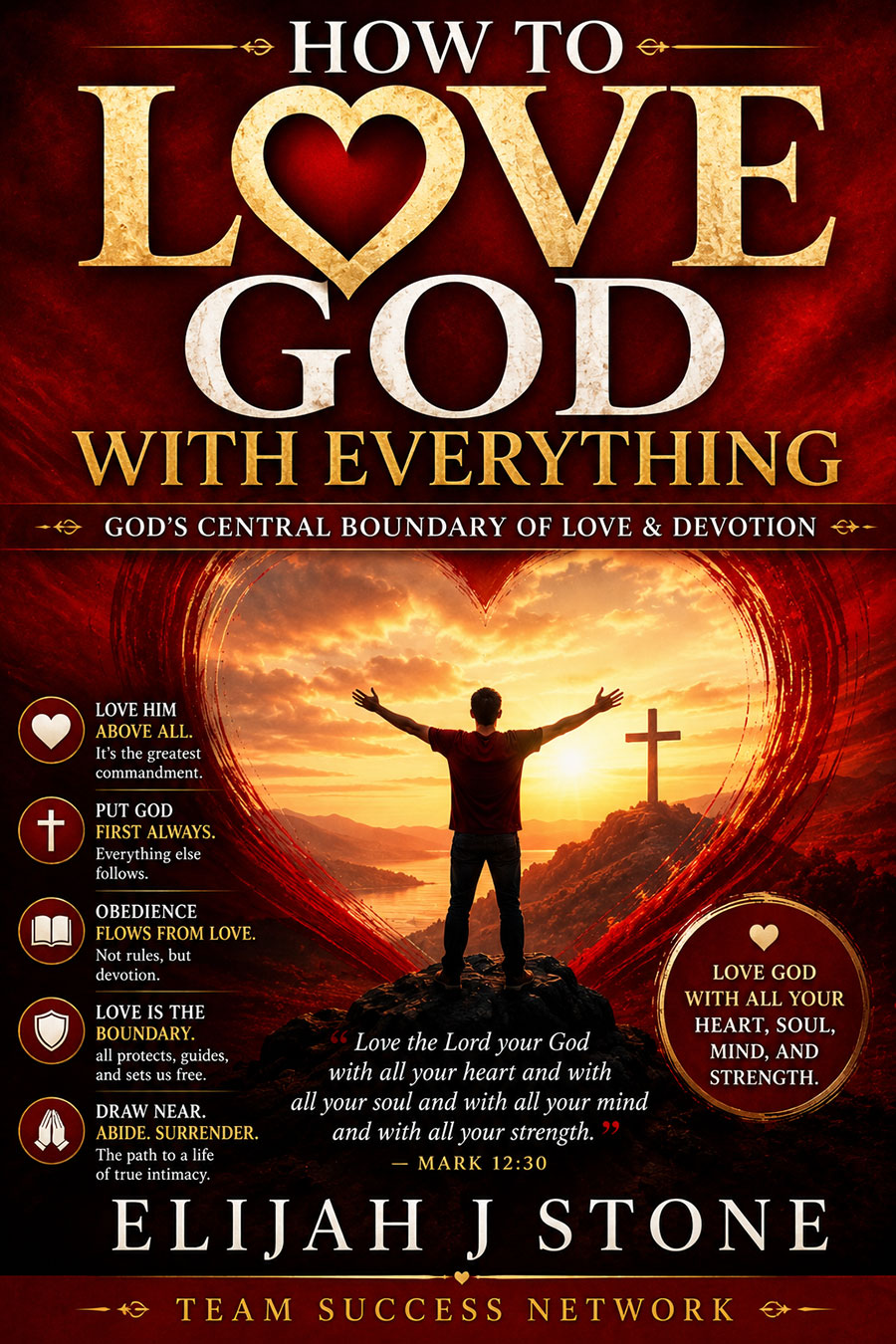
Book 41: How To Love God With Everything

Book
11 - in the “God’s
Truth” Series
How
To Love God With Everything
God’s
Central Boundary of Love & Devotion
By Mr. Elijah J Stone
and the Team Success Network
Table
of Contents
PART 1 – How to Love God With Everything
(making it solid)............... 1
CHAPTER 1 – The Boundary
of Total Devotion...................................... 1
CHAPTER 2 – Heart, Soul, Mind, and Strength...................................... 1
CHAPTER 3 – The First Commandment Above All.................................. 1
CHAPTER 4 – Love as the Root of Obedience........................................ 1
CHAPTER 5 – How To Make Sure We Keep Loving God Steadily.............. 1
PART 2 – How To Love God
With Everything, How To Do It All Of The Time (Making It A Constant Reality)............................................................................... 1
CHAPTER 6 – Walking in
Love Daily...................................................... 1
CHAPTER 7 – Setting Affections on Things Above.................................. 1
CHAPTER 8 – Love That Overcomes Distractions................................... 1
CHAPTER 9 – Abiding in the Vine of Christ............................................ 1
CHAPTER 10 – Choosing God Again and Again...................................... 1
PART 3 – How To Love God
With Everything, How To Really Do It Every Day (Making It A Stronger Reality)................................................................................ 1
CHAPTER 11 – Loving God
in Trials and Testing..................................... 1
CHAPTER 12 – Keeping the First Love Alive........................................... 1
CHAPTER 13 – Worship as a Lifestyle of Love........................................ 1
CHAPTER 14 – The Overflow of Loving God: Serving Others................... 1
CHAPTER 15 – Finishing Strong in Love to the End................................ 1
Part
1 – How to Love God With Everything (Making It Solid)
The
starting point of faith is understanding that love for God is the central
boundary of life. It isn’t just a suggestion—it’s the foundation of true
devotion. To love God fully means giving Him first place in every thought,
choice, and action. This boundary isn’t meant to restrict us, but to guide us
into the freedom of living as we were designed.
Loving God
requires all of who we are—our hearts, souls, minds, and strength. Every part
of life is included in this calling. Our emotions, our decisions, our thoughts,
and even our energy are invited into worship. Nothing is left untouched when
devotion becomes complete.
When we
begin here, we realize that every other act of faith flows naturally out of
love. Obedience is no longer a burden because it springs from affection.
Serving, giving, forgiving—all of these actions become easier when they are
rooted in devotion. Love makes faith real, not just a set of rules.
The
challenge is to guard that first spark of love so it grows into a steady flame.
Distractions, temptations, and busyness can weaken affection for God if left
unchecked. That is why this foundation must be solid, cared for, and protected
daily.

Chapter 1 – The Boundary of Total Devotion
Loving God Without Limits
Why the First Step of Obedience Is Learning to Give Him Everything
The
Foundation of Loving God
To love
God completely is the very heart of faith. It is not something partial, nor
something optional. The Bible places this boundary at the center: “Love the
Lord your God with all your heart and with all your soul and with all your
strength” (Deuteronomy 6:5). This is not a suggestion, but a clear line drawn
by God Himself.
A boundary
in Scripture is not meant to restrict us—it is meant to define what is safe and
true. The boundary of loving God is the ultimate line of life. It says: here is
where obedience begins, here is where devotion is made real, here is where
everything else flows.
Key Truth: The boundary of true love for God is not
how much we say we love Him, but how much of ourselves we actually give Him.
What It
Means to Love God With Everything
When God
commands love with “all,” He leaves nothing outside the line. Heart, soul,
mind, and strength are not just poetry—they are the complete description of the
whole human life. To love God with everything means no compartment is left
untouched.
The heart
refers to the center of emotions and desires. The soul points to the eternal
part of who we are—our identity and being. The mind represents our thoughts,
focus, and imagination. Strength speaks of action, physical effort, and
resources. To love God is to bring all of these under the same holy boundary of
devotion.
How to
Place God at the Center
To begin
loving God completely, the first “how-to” is establishing Him as the center. A
life of devotion cannot orbit around self. It must orbit around the Creator.
This is
done by drawing an inner line and saying: God first. Not career first.
Not relationships first. Not money first. God first. This is a decision and a
boundary we draw each day. Matthew 22:37 affirms this when Jesus restates the
command: “Love the Lord your God with all your heart and with all your soul and
with all your mind.”
Key Truth: Putting God at the center means everything
else in life finds its right place.
Building
Boundaries of the Heart
The heart
is often distracted. Feelings shift, desires wander, and affections drift. To
love God with all the heart requires protecting it with boundaries. Proverbs
4:23 says, “Above all else, guard your heart, for everything you do flows from
it.”
How do you
guard your heart? By setting limits on what you allow inside. What you watch,
listen to, and dwell on either fuels love for God or drains it. A clear
“how-to” boundary is this: if something weakens affection for God, remove it.
If something strengthens affection for God, feed it. The heart must be kept
within holy boundaries so love remains pure.
Strengthening
the Soul in Devotion
The soul
is the deepest part of who we are. It is where identity and eternity connect.
To love God with the soul means giving Him ownership of the core of life. No
longer do we belong to ourselves—we belong to Him.
This is a
boundary of surrender. Psalm 62:1 says, “Truly my soul finds rest in God; my
salvation comes from him.” The soul finds rest only when within God’s boundary.
To live outside this line is to chase identity in the wrong places. To live
inside it is to find peace and purpose.
Key Truth: When the soul rests in God, love becomes
the very atmosphere of life.
Renewing
the Mind for Full Love
The mind
is where battles are fought. Thoughts shape desires, and desires shape actions.
To love God with the mind means filling thoughts with truth. Romans 12:2
teaches, “Do not conform to the pattern of this world, but be transformed by
the renewing of your mind.”
The
practical boundary is this: decide what your mind is allowed to dwell on. Guard
against lies, against patterns of the world, and against images that pull you
away from God. Replace them with Scripture, worship, and truth. Each time you
choose to renew your mind, you push love for God deeper into your life.
Using
Strength as Worship
Strength
represents what you do with your body, your time, and your resources. To love
God with strength means love moves beyond feelings and thoughts into visible
action. It is where love becomes measurable.
How do you
love God with strength? By serving, by giving, by acting in obedience.
Colossians 3:23 says, “Whatever you do, work at it with all your heart, as
working for the Lord.” Every action can be worship when it is done inside the
boundary of loving Him. This means your energy, your work, and even your rest
become expressions of devotion.
Key Truth: When love becomes action, boundaries are
no longer invisible—they are lived out for all to see.
Keeping
Love First Above All
Life
constantly tempts us to put other loves above God. Career, family, dreams, and
desires can all become idols if placed outside the boundary. That is why the
Bible calls this the first and greatest commandment. Everything else must come
second.
Joshua
24:15 gives a clear example: “Choose for yourselves this day whom you will
serve… But as for me and my household, we will serve the Lord.” Loving God
completely is not automatic—it is a choice that defines a boundary. Each day is
an opportunity to place Him first again.
How
Boundaries Protect Love
Boundaries
are not chains; they are walls of safety. A fence around a garden keeps it from
being trampled. In the same way, boundaries protect love for God from being
stolen by sin, fear, or distraction.
This is
why loving God must be seen as a boundary. Without it, devotion leaks away.
With it, affection remains pure and strong. The boundary says: this belongs to
God, and nothing else has permission to take it.
The Daily
Practice of Loving God Completely
So how do
you live this out in real life? Begin each day by setting your heart, soul,
mind, and strength in God’s boundary. Pray, read His Word, guard your thoughts,
and commit your actions to Him.
This daily
rhythm keeps love alive. It is not about perfection—it is about direction. The
more you practice, the stronger the boundary becomes. Soon, loving God
completely moves from being a challenge to being a way of life.
Key Truth: Loving God completely is not a one-time
act, but a daily boundary we choose to live within.

Chapter 2 – Heart, Soul, Mind, and Strength
Loving God With Every Part of Who You Are
Drawing Boundaries That Make Your Whole Life Belong to Him
The Call
to Complete Love
When Jesus
was asked what mattered most, He gave a boundary line that could not be
ignored. He said: “Love the Lord your God with all your heart and with all
your soul and with all your mind and with all your strength” (Mark 12:30).
This was not four suggestions, but one command that covered every part of a
person. It was the blueprint for how to love God completely.
To
understand this, you must see each part as an area with its own boundary. The
heart, soul, mind, and strength are four territories of life. Each has its own
battles, its own distractions, and its own ways to draw the line of love.
Loving God completely means bringing all four under His ownership.
Key Truth: True devotion is not partial; it is whole.
The boundary of love includes every part of who you are.
How to
Love God With Your Heart
The heart
is the center of affection, passion, and desire. It is where emotions live and
choices are born. To love God with all your heart means placing boundaries
around what you allow to stir your deepest affections.
Here is
how-to do this:
- Guard what enters your heart. Proverbs 4:23 says, “Above all else,
guard your heart, for everything you do flows from it.” If something
steals affection from God—cut it off. If it strengthens love for God—feed
it.
- Set your heart on God
intentionally. This
is done by prayer, worship, and turning your emotions toward Him daily.
Feelings may not always follow, but focus builds affection.
- Remove divided loves. Matthew 6:24 teaches, “No one can
serve two masters.” A boundary of love requires God to be first.
Anything else claiming that spot must move.
The heart
is not meant to chase everything it desires. It is meant to love within the
boundary of God’s worthiness. By setting up this guardrail, your love becomes
steady and unshakable.
How to
Love God With Your Soul
The soul
is the eternal part of you. It is your identity, your will, and the core of who
you are. To love God with all your soul means surrendering your very life to
His ownership.
Here is
how-to live this boundary:
- Give Him ownership of your life. Ezekiel 18:4 declares, “Every living
soul belongs to me.” To love God with your soul means you stop living
for yourself. Your identity, purpose, and future now belong to Him.
- Rest your soul in Him. Psalm 62:1 says, “Truly my soul finds
rest in God.” This boundary keeps you from chasing peace in wrong
places. You anchor your identity in God, not in the world.
- Surrender daily. Jesus said, “Whoever wants to be my
disciple must deny themselves and take up their cross daily and follow me”
(Luke 9:23). Loving God with your soul is choosing His will over yours
again and again.
The soul
must live inside God’s boundary. Outside it, you will constantly search for
meaning. Inside it, you will find rest and purpose.
Key Truth: The soul was created to belong to God. It
finds peace only when it rests inside His boundary.
How to
Love God With Your Mind
The mind
is the battlefield. It is where lies, doubts, and distractions compete for
attention. To love God with all your mind means renewing it daily and bringing
every thought under His truth.
Here is
how-to apply this boundary:
- Renew your thinking. Romans 12:2 says, “Do not conform to
the pattern of this world, but be transformed by the renewing of your
mind.” Each day, replace worldly patterns with God’s truth.
- Take thoughts captive. 2 Corinthians 10:5 commands us to “take
captive every thought to make it obedient to Christ.” The boundary
line is clear: only thoughts that honor Him are allowed to remain.
- Fill your mind with Scripture. Philippians 4:8 urges us to think on
things that are true, noble, right, pure, lovely, admirable, excellent,
and praiseworthy. This isn’t vague—it’s a practical filter for every
thought.
Loving God
with the mind is about discipline. It means saying no to thoughts that lead to
sin and yes to thoughts that lead to devotion. The boundary line of the mind is
sharp, but it brings freedom.
How to
Love God With Your Strength
Strength
represents action, energy, and physical life. It is how love moves from being
invisible to being seen. To love God with all your strength means turning
everyday effort into worship.
Here is
how-to walk in this boundary:
- Work as unto the Lord. Colossians 3:23 says, “Whatever you
do, work at it with all your heart, as working for the Lord.” Every
task can be holy when done in devotion.
- Serve others with energy. Galatians 5:13 tells us, “Serve one
another humbly in love.” Loving God with strength shows up in how you
help people.
- Offer your body to God. Romans 12:1 says, “Offer your bodies
as a living sacrifice, holy and pleasing to God—this is your true and
proper worship.” Every action is inside or outside the boundary of
love.
Strength
proves love by action. It shows that love for God is not just a feeling—it is a
choice that moves muscles, spends energy, and sacrifices for His glory.
Key Truth: Love for God becomes visible when it is
expressed in action.
Bringing
It All Together
When
heart, soul, mind, and strength are united, love becomes complete. No part is
left outside God’s boundary. This is how devotion becomes whole—by drawing one
line that covers every area of life.
The
practical how-to is this:
- Guard your heart.
- Surrender your soul.
- Renew your mind.
- Act with strength.
This is
not theory—it is the daily practice of living inside God’s boundary. When all
four align, love for God becomes unstoppable.
Conclusion:
Living Inside the Boundary of Love
The
command to love God with all your heart, soul, mind, and strength is not an
impossible weight. It is the pathway to freedom. It is a holy boundary that
protects, directs, and empowers your life.
To love
God completely is to bring every part of yourself inside His ownership. No
divided heart. No wandering soul. No distracted mind. No wasted strength. This
is what it means to love God with everything.

Chapter 3 – The First Commandment Above All
Making Love for God the Highest Priority
Drawing the Boundary Line That Guides Every Other Choice in Life
Why Love
for God Comes First
The Bible
makes it clear: the most important command is to love God with all we are.
Jesus Himself said in Matthew 22:37–38, “Love the Lord your God with all
your heart and with all your soul and with all your mind. This is the first and
greatest commandment.” This is not one command among many; it is the
boundary line that defines all the rest.
When love
for God is placed first, everything else in life begins to make sense.
Boundaries fall into place because the greatest one is already drawn. Without
this, obedience becomes scattered, and devotion loses direction. Putting God
first is the “how-to” starting point of complete love.
Key Truth: Every other act of obedience flows from
the boundary of the first commandment: love God above all.
How to
Make God Your First Priority
Making God
first begins with intention. You cannot drift into loving Him above everything
else—it requires deliberate choice. Joshua 24:15 models this: “Choose for
yourselves this day whom you will serve… But as for me and my household, we
will serve the Lord.”
Practical
steps include:
- Begin your day with Him. Before work, before screens, before
demands—start in His presence. Prayer and Scripture first set the boundary
line for the rest of the day.
- Schedule around Him. Instead of fitting God into leftover
time, build your schedule around worship, prayer, and fellowship.
Boundaries are drawn by calendars as much as by words.
- Measure priorities by love. When faced with choices, ask: does this
decision increase or decrease my love for God? That line becomes your
“yes” or “no.”
This is
how you practically set Him first—not by feelings alone, but by daily
boundaries that show where love begins.
How Love
Becomes the Root of Obedience
When love
is first, obedience follows naturally. Jesus said in John 14:15, “If you
love me, keep my commands.” Notice He didn’t reverse the order. He didn’t
say, “Keep my commands to prove love.” He said love comes first, and obedience
flows out of it.
Here is
the “how-to”:
- Focus on relationship, not rules. Instead of obsessing over every detail
of performance, deepen your love for God. When love is healthy, obedience
grows strong.
- Turn commands into responses. Instead of duty, see commands as
opportunities to show love. For example, forgiving someone becomes an act
of devotion, not just a command.
- Keep the boundary clear. If love weakens, obedience will falter.
Protect your love for God, and obedience will remain steady.
The first
commandment protects us from legalism. It draws a line around obedience,
reminding us that love, not fear, is the boundary of devotion.
Key Truth: Love makes obedience joyful, not heavy.
When the boundary is love, every command becomes an act of devotion.
How to
Guard Against Competing Loves
The
greatest threat to the first commandment is divided love. Jesus warned in
Matthew 6:24, “No one can serve two masters… You cannot serve both God and
money.” This truth applies to every competing affection. Anything placed
alongside God as equal love will steal devotion.
Practical
boundaries to keep God first include:
- Identify rivals. Ask what consumes your time, thoughts,
and energy. These reveal what tries to compete with God.
- Set limits. If entertainment, work, or relationships
weaken love for God, create boundaries. Cut back, refocus, or replace them
with practices that strengthen devotion.
- Declare loyalty. Regularly affirm in prayer and life that
God is first. Speaking it strengthens the line.
Guarding
against rivals means drawing clear boundaries. Love for God is not shared
space; it is a holy priority.
How to
Love God First in Everyday Life
Putting
the first commandment above all is not just for Sundays. It must reach into
work, family, and daily choices. Colossians 3:17 says, “Whatever you do,
whether in word or deed, do it all in the name of the Lord Jesus.” Every
part of life is included.
Practical
“how-to” examples include:
- At work: Treat every task as service to God,
working with integrity and excellence.
- In family: Love your spouse, children, and friends
in ways that reflect devotion to God first.
- In decisions: Let love for God weigh heavier than
convenience, comfort, or culture.
This is
the everyday reality of the first commandment. Love is not just spoken; it is
lived out in boundaries that shape how we act.
Key Truth: When love for God is first in daily life,
ordinary moments become worship.
How to
Strengthen First Love Daily
The danger
is not only rivals—it is neglect. Revelation 2:4 records Jesus’ words to the
church in Ephesus: “You have forsaken the love you had at first.” Love
must be renewed daily or it will fade.
Practical
boundaries to strengthen first love include:
- Return daily to His presence. Prayer and worship keep affection alive.
- Feed love with Scripture. The Word fuels devotion by revealing
God’s character.
- Cut off what numbs affection. Entertainment, busyness, or sin can dull
love. Remove them before they weaken the boundary.
Renewal is
about returning to the line again and again. Love fades when neglected, but it
grows when guarded and fed.
Living
Within the Boundary of the First Commandment
The first
commandment is not just about what comes first—it is about everything else
finding its right place. When God is first, family is loved better, work
becomes holy, and decisions gain clarity. The boundary of love becomes the
guide for all of life.
Living
within this boundary means:
- God is first in time.
- God is first in thought.
- God is first in action.
- God is first in devotion.
This is
how to love Him completely—by drawing a line that nothing crosses. The first
commandment above all is not a heavy burden but the clearest boundary of
freedom.
Key Truth: The first commandment is the line that
shapes every other part of life. Love God first, and everything else follows.

Chapter 4 – Love Is The Root of Following God
& Doing What He Says. God Is Our Good Father.
God Is Our Good Shepherd, & He is The Only
One Who Wants The Best For Us
Obedience That Flows From Love, Not Fear
Learning How to Follow the Father and the Shepherd With Confidence and Joy
God as Our
Good Father and Shepherd
Every
relationship with God begins with trust in His goodness. He is not a harsh
ruler or distant master; He is the Good Father and the Good Shepherd. Psalm
23:1 says, “The Lord is my shepherd, I lack nothing.” Jesus Himself
declared in John 10:11, “I am the good shepherd. The good shepherd lays down
his life for the sheep.”
When you
see God in this way, obedience stops being a heavy demand. It becomes a natural
response of love. Boundaries stop looking like prison walls and start looking
like fences of safety. To love God completely is to believe He alone knows what
is healthy, right, and best.
Key Truth: When you know God as Good Father and
Shepherd, love leads you into joyful obedience.
How Love
Produces Obedience
Obedience
without love quickly becomes cold religion. But when love is the root,
following God becomes natural and alive. Jesus connected the two when He said, “If
you love me, keep my commands” (John 14:15). Love comes first; obedience
grows out of it like fruit from a tree.
Here’s
how-to let love produce obedience:
- Start with devotion, not duty. Spend time with God in prayer and
worship, so obedience flows from affection.
- Let love fuel your choices. Each time you obey, remember it is a way
to say, “I love You.”
- Focus on relationship, not rules. Obedience is not about passing tests,
but about walking closely with the Shepherd.
When love
is the root, obedience becomes a joy. Commands stop being lifeless rules and
turn into healthy boundaries that keep us safe and whole.
How God’s
Commands Act as Boundaries of Health
God’s will
is not random. Every command He gives is for our good. Deuteronomy 10:13
reminds us His commands are given “for your own good.” That means every
boundary God draws is a shield protecting us from harm.
Here’s the
how-to:
- See commands as shields, not
cages. They
guard you from dangers you may not see.
- Recognize obedience as health. What God asks always leads to life, not
destruction.
- Reject the lie of self-direction. Proverbs 14:12 warns, “There is a way
that appears to be right, but in the end it leads to death.”
Obedience
is not God taking away joy—it is God keeping us whole. His will is the
healthiest, safest place to live.
Key Truth: Every command of God is a boundary
designed for life, protection, and health.
How to
Follow the Good Shepherd Daily
Sheep
cannot survive without a shepherd. They wander, get lost, and fall into danger.
That is why God describes us as sheep needing His guidance. Isaiah 53:6 says, “We
all, like sheep, have gone astray, each of us has turned to our own way.”
The Good Shepherd rescues and leads us into safe paths.
Here is
how-to follow Him:
- Stay close to His voice. Jesus said, “My sheep listen to my
voice; I know them, and they follow me” (John 10:27). Read Scripture
daily to learn His voice.
- Trust His lead even when unclear. Sheep don’t need the map, only the
Shepherd. Trust He knows the way better than you.
- Stay within His flock. Community with other believers keeps you
inside His boundaries and guards you from wandering alone.
Following
the Shepherd is not complicated. It is listening, trusting, and staying near.
That is how love turns into daily obedience.
How to
Surrender Your Own Ideas to God’s Ways
One of the
hardest boundaries to accept is surrendering your own wisdom. Human ideas feel
right, but often lead away from God’s best. Proverbs 3:5–6 says, “Trust in
the Lord with all your heart and lean not on your own understanding; in all
your ways submit to him, and he will make your paths straight.”
Here’s
how-to surrender practically:
- Pray before deciding. Ask God for direction before you act.
- Check every idea with Scripture. If your plan doesn’t align with His
Word, it’s outside His boundary.
- Be willing to change course. When God redirects, obedience means
adjusting quickly.
Surrender
is the act of staying inside the boundary of God’s wisdom. It protects you from
the danger of self-made paths and keeps you healthy under His guidance.
Key Truth: Your own ideas may feel right, but only
God’s will is truly safe, whole, and healthy.
How to
Make Obedience a Lifestyle
Loving God
completely means obedience is not occasional—it becomes a way of life. Psalm
119:105 says, “Your word is a lamp to my feet, a light on my path.” That
means every step is guided by His direction.
Here is
how-to make obedience constant:
- Practice small obediences. Follow Him in little things—kindness,
prayer, generosity—so larger obedience grows naturally.
- Build habits of devotion. Daily Scripture and prayer keep your
heart soft and ready.
- Celebrate obedience. Rejoice when you follow His will—it
strengthens love for Him.
A
lifestyle of obedience grows one choice at a time. Boundaries stay strong when
reinforced daily. Love makes this a joyful rhythm instead of a heavy burden.
Living in
the Freedom of Boundaries
Obedience
may sound like restriction, but in God it is freedom. John 8:32 says, “Then
you will know the truth, and the truth will set you free.” The Shepherd’s
commands are not chains—they are pathways of liberty.
The
“how-to” is to see boundaries as blessings. By obeying God, you stay free from
guilt, shame, regret, and destruction. Life inside His will is the only life
that truly works.
This is
why love is the root. We obey not because we are forced, but because we are
convinced: God is good, His will is best, and His boundaries are life.
Key Truth: Obedience is the truest freedom because
God’s boundaries keep us safe, whole, and alive.
Conclusion:
Following Love Into Obedience
God is our
Good Father and Good Shepherd. He is the only one who truly wants what is best
for us. Every command He gives is born out of His goodness. Every boundary He
sets is for our life and health.
The how-to
of loving God completely is simple: let love fuel obedience. Guard your heart
with devotion, follow His voice as the Shepherd, and surrender your ways to His
wisdom. Step inside His boundaries daily and see them as protective shields,
not prison walls. This is the path of life, the only way to live healthy,
whole, and free.

Chapter 5 – How To Make Sure We Keep Loving
God Steadily
Building Boundaries That Protect Devotion
How to Stay Consistent in Loving God Through Every Season of Life
The
Challenge of Steady Love
Anyone can
begin with passion. The challenge is to keep loving God with the same intensity
tomorrow, next month, and years down the road. The Bible warns us about losing
what once burned bright: “You have forsaken the love you had at first”
(Revelation 2:4).
The issue
is not whether we start loving God, but whether we keep loving Him steadily.
Steadiness comes from boundaries. It means setting up protections around
devotion so it cannot be stolen, weakened, or forgotten.
Key Truth: Love for God must not only be started—it
must be guarded, fed, and kept steady.
How to
Guard the Heart Daily
The heart
is easily swayed. It moves with emotions, distractions, and desires. That is
why Proverbs 4:23 commands, “Above all else, guard your heart, for
everything you do flows from it.” If the heart drifts, love for God
weakens.
Here’s
how-to guard love in the heart:
- Start each day by setting your
affection.
Pray, worship, or sing to God before anything else. This anchors love.
- Watch what enters your heart. Music, media, and conversations can
either feed devotion or choke it. Keep boundaries on input.
- Return quickly when distracted. Don’t wait weeks—turn back the moment
you notice love cooling.
The heart
must be protected like a flame. Left open, the winds of life will put it out.
Guarded by boundaries, it grows brighter.
How to
Feed Love for God
Love does
not stay alive by accident. It must be fed with truth, worship, and presence.
Jesus said in Matthew 4:4, “Man shall not live on bread alone, but on every
word that comes from the mouth of God.” Just as food sustains the body,
God’s Word sustains love.
Practical
steps include:
- Read Scripture daily. Even a small portion keeps the heart
anchored in truth.
- Worship often. Singing, thanking, or simply exalting
Him keeps affection fresh.
- Stay in fellowship. Hebrews 10:25 reminds us not to neglect
meeting together. Being with others keeps love alive.
This is a
boundary of feeding. Starved love grows weak, but nourished love grows strong
and steady.
Key Truth: Love grows when it is fed. Neglected love
will always fade.
How to
Resist the Drift of Distraction
Life pulls
constantly. Work, busyness, and pressures can distract us from devotion. Jesus
explained this in the parable of the sower: “the worries of this life, the
deceitfulness of wealth and the desires for other things come in and choke the
word, making it unfruitful” (Mark 4:19).
Here’s the
how-to for resisting drift:
- Simplify your focus. Don’t let too many pursuits take energy
from devotion.
- Name your distractions. Identify what most often steals your
attention and set limits.
- Redraw boundaries quickly. If something weakens your affection for
God, cut it back or remove it.
Drift is
subtle but deadly. The boundary must be firm: nothing is worth more than steady
love for God.
How to
Persevere in Trials
Trials
test whether love is steady or shallow. Jesus said in John 16:33, “In this
world you will have trouble. But take heart! I have overcome the world.”
Hardship can either crush devotion or deepen it.
Here is
the how-to for steady love in trials:
- Decide in advance. Set the boundary that no hardship will
cause you to quit loving God.
- See trials as refining, not
destroying.
James 1:2–3 tells us trials produce perseverance.
- Stay near in suffering. Pray more, not less, when pain comes.
Trials are
where love is proven. Boundaries drawn in advance keep devotion steady when
life gets hard.
Key Truth: Steady love does not avoid trials; it
grows stronger through them.
How to
Renew First Love Regularly
Even
steady love must be renewed. Affection can cool if left unattended. That is why
Jesus told the church in Revelation 2:5, “Consider how far you have fallen!
Repent and do the things you did at first.” Renewal keeps devotion fresh.
Practical
renewal looks like this:
- Go back to early practices. Remember how you prayed, worshiped, and
sought God when love was fresh. Do those things again.
- Return to gratitude. Thank God daily for salvation and His
goodness. Gratitude keeps affection alive.
- Invite the Spirit’s fire. Ask God to reignite passion. His Spirit
keeps love burning.
Renewal is
not optional. It is the practice that keeps steady love alive through the
years.
How to
Anchor Love With Action
Love for
God cannot remain only in words. It must show up in choices, service, and
action. 1 John 3:18 says, “Let us not love with words or speech but with
actions and in truth.” Action anchors love so it does not drift.
Here is
the how-to:
- Serve others out of devotion. Acts of kindness keep love practical.
- Give sacrificially. Finances, time, and effort all become
boundaries proving love is real.
- Live holy. Purity and obedience show where your
affection truly lies.
Action is
the anchor. Love expressed through living choices will always remain steady.
Key Truth: Love that is acted out becomes harder to
lose. Choices anchor affection.
How to
Finish Strong in Love
Steady
love is not about a good week or a good year. It is about finishing a lifetime
in devotion. Jesus said in Matthew 24:13, “The one who stands firm to the
end will be saved.”
Here’s
how-to aim for steady love until the end:
- Keep short accounts. Repent quickly when sin breaks devotion.
- Stay teachable. Let God correct and guide you even in
maturity.
- Look to eternity. Remember heaven and the reward of
finishing in love.
The
boundary of steady love is lifelong. It says: no matter what, I will still be
loving God at the finish line.
Conclusion:
Living Inside the Boundary of Steady Love
To keep
loving God steadily, you must live inside His boundaries. Guard your heart,
feed your love, resist distractions, persevere in trials, renew devotion, act
out love, and finish strong. These are the “how-to” practices of steady love.
Steadiness
does not come by accident. It comes by living within protective boundaries that
keep love alive. With God as your strength and guide, you can love Him not only
today but every day, all the way to the end.
Part 2 – How To Love God With Everything, How
To Do It All Of The Time (Making It A Constant Reality)
Once love
for God is established, the next step is learning to make it consistent. Loving
Him isn’t meant for special moments only, but for daily life. It becomes a
rhythm, a steady beat guiding every step we take. This consistency keeps faith
strong and prevents devotion from fading over time.
Keeping
love alive requires setting the heart on what truly matters. Earthly
distractions are constant, but love directs our focus toward things above. By
turning our attention toward Christ, we begin to experience a love that is
steady rather than shallow. This change of focus anchors our devotion.
Daily life
presents countless distractions, but devotion makes it possible to cut through
the noise. Choosing God again and again is what builds consistency. These small
choices, repeated over time, strengthen the reality of love until it becomes
second nature. Love grows firm through repetition.
This
constant love is not powered by human willpower alone—it flows from staying
connected to Jesus. Just as a branch cannot live apart from the vine, our love
for God cannot thrive apart from Him. Living in His presence allows devotion to
remain fresh, real, and unbroken.

Chapter 6 – Walking in Love Daily
Turning Devotion Into a Lifestyle
How to Keep Loving God One Day at a Time With Steady Boundaries
Why Love
Must Become Daily
Love for
God was never meant to be occasional. It is not just for Sunday worship or
emotional moments. It is designed to be the rhythm of life, the steady boundary
that shapes every day. Jesus said in Luke 9:23, “Whoever wants to be my
disciple must deny themselves and take up their cross daily and follow me.”
This word daily
is critical. It means devotion is not seasonal or temporary—it is consistent.
To love God completely, you must learn how to walk in love one day at a time.
Key Truth: Steady love is built in daily steps, not
in rare moments.
How to
Start Every Day in Love
The way
you begin your day sets the boundary for everything that follows. If God is
first, love flows into every other area. Psalm 5:3 says, “In the morning,
Lord, you hear my voice; in the morning I lay my requests before you and wait
expectantly.”
Here’s
how-to start your day in love:
- Wake with prayer. Before looking at your phone, speak to
God.
- Read His Word. Even a few verses anchor the heart.
- Dedicate your day. Tell God your work, relationships, and
choices belong to Him.
This
boundary is like drawing a line around the morning. It keeps distractions from
stealing devotion before the day even begins.
How to
Walk in Love at Work
Many think
love for God belongs only in church. But Colossians 3:23 says, “Whatever you
do, work at it with all your heart, as working for the Lord, not for human
masters.” That means work is also a place to walk in love.
Here’s
how-to keep love alive at work:
- Do every task as worship. Treat your job as service to God.
- Keep your speech holy. Use words that honor God, even under
pressure.
- Live with integrity. Boundaries of honesty protect love from
being compromised.
Workplaces
can drain affection for God if left unchecked. But when boundaries are drawn,
work becomes an altar of worship.
Key Truth: Love for God can be steady even in
ordinary tasks when work is done in devotion.
How to
Love God in Relationships
Every
relationship influences devotion. People can either pull you closer to God or
drag you away. That is why Paul writes in 1 Corinthians 15:33, “Do not be
misled: ‘Bad company corrupts good character.’”
Here’s the
how-to for boundaries in relationships:
- Surround yourself with believers. Fellowship keeps your heart sharp.
- Love unbelievers without
compromise. Be a
witness, but stay firm in God’s boundaries.
- Seek accountability. Close friends in faith help you stay
steady when love wavers.
Love for
God shows in how you love people. But boundaries must remain clear—God always
comes first.
How to
Keep Love Alive in Busy Seasons
Busyness
is one of the greatest threats to steady love. Jesus warned in Luke 10:41–42, “Martha,
Martha… you are worried and upset about many things, but few things are
needed—or indeed only one. Mary has chosen what is better.”
Here’s
how-to stay steady in busy times:
- Protect time with God. Even short pauses can keep love alive.
- Say no when needed. Boundaries mean not every demand
deserves a yes.
- Keep your focus. Remember that only one thing is
needed—loving Him first.
Busy
schedules can’t be avoided, but they can be managed. With boundaries, love
remains steady even in full seasons.
Key Truth: Busyness cannot steal love when boundaries
protect devotion first.
How to
Keep Love Burning Through Trials
Trials
will always test whether love is steady. Job 1:21 declares, “The Lord gave
and the Lord has taken away; may the name of the Lord be praised.” This is
the voice of steady devotion even in loss.
Here’s the
how-to in trials:
- Choose to worship. Sing or pray even when it hurts.
- Declare trust aloud. Speak God’s goodness to resist doubt.
- Hold the boundary of faith. Refuse to let pain redefine who God is.
Trials can
shake feelings, but steady boundaries keep love rooted. The Shepherd never
leaves, and love never has to fade.
How to End
Every Day in Love
Just as
the day begins, it must also end inside the boundary of devotion. Psalm 63:6
says, “On my bed I remember you; I think of you through the watches of the
night.” Finishing the day with God seals it in love.
Here’s
how-to end your day in love:
- Review your day with God. Thank Him for victories, confess
failures.
- Worship before sleep. A song, Scripture, or prayer softens the
heart.
- Rest in His care. Trust Him to guard you through the
night.
Beginning
and ending with God forms a daily circle of love. Boundaries at both ends keep
devotion steady.
Key Truth: Daily love starts in the morning and is
sealed at night.
How to
Build Habits That Last
Steadiness
is strengthened by habits. Small repeated choices build lifelong devotion.
Galatians 6:9 reminds us, “Let us not become weary in doing good, for at the
proper time we will reap a harvest if we do not give up.”
Practical
steps for steady habits:
- Set times for prayer and
Scripture.
Boundaries on the calendar prove devotion.
- Link habits to daily routines. Pray while driving, worship while
walking.
- Stay consistent over perfect. Missed days don’t end love—start again
immediately.
Habits
form fences that protect love from fading. When repeated, they create steady
devotion that lasts for life.
Conclusion:
Walking Steadily in Daily Love
To walk in
love daily, you must draw clear boundaries. Start and end with God, work as
worship, guard relationships, resist busyness, endure trials, and build lasting
habits. These are not vague ideas—they are how-to steps that keep love steady.
Walking in
daily love is not about feelings; it is about direction. The boundaries you set
protect affection, strengthen obedience, and make devotion a way of life. To
love God completely is to choose Him daily, every day, until the very end.
Chapter 7 – Setting Affections on Things Above
Loving God by Lifting Your Focus Higher
How to Guard Your Heart by Placing Desire Where Christ Reigns
Why
Affections Must Be Set Above
The heart
always follows its affection. Whatever you treasure most will define your
devotion. That’s why Colossians 3:1–2 commands, “Since, then, you have been
raised with Christ, set your hearts on things above, where Christ is, seated at
the right hand of God. Set your minds on things above, not on earthly things.”
This is
not a casual suggestion; it is a boundary line. Affections either remain rooted
in the world or they are lifted above. To love God completely, you must
deliberately set your desires, attention, and priorities on Him.
Key Truth: The direction of your affection determines
the depth of your love for God.
How to
Shift Your Focus Toward Heaven
Shifting
affections begins with awareness. Many people live as though earthly things are
all that matters. But Scripture reminds us in Philippians 3:20, “Our
citizenship is in heaven.”
Here’s
how-to shift:
- Pause and redirect. When your thoughts circle around earthly
worries, stop and refocus on God’s promises.
- Meditate on eternity. Spend time imagining life with Christ
forever—it reorders priorities.
- Speak it out. Confess with your words that your true
home and hope are above.
Each shift
is like drawing a boundary: this thought belongs in heaven, not in the dust of
earth.
How to
Guard the Heart From Earthly Distractions
The world
constantly pulls at affection. Money, status, entertainment, and comfort can
all distract from God. 1 John 2:15 warns, “Do not love the world or anything
in the world. If anyone loves the world, love for the Father is not in them.”
Here’s
how-to guard against distractions:
- Set limits on input. Reduce what competes for
affection—social media, endless news, or empty entertainment.
- Filter your desires. Ask whether this desire increases or
decreases love for God.
- Create holy habits. Replace distractions with worship,
prayer, or serving others.
Boundaries
protect affection. Without them, love leaks away into countless earthly loves.
Key Truth: Unprotected affection will always drift
downward. Guarding it keeps love set above.
How to
Fill the Mind With Things Above
The mind
shapes affection. Philippians 4:8 directs us: “Whatever is true, whatever is
noble, whatever is right, whatever is pure, whatever is lovely, whatever is
admirable—if anything is excellent or praiseworthy—think about such things.”
Here’s the
how-to:
- Choose your meditation. Repeat Scripture, not worries.
- Redirect quickly. When thoughts go low, bring them back
above.
- Anchor with worship. Play music that keeps your mind on
Christ.
The mind
must be fenced in. It cannot wander everywhere. The boundary is: if it doesn’t
point you to God, it doesn’t belong.
How to
Desire God More Than the World
Affection
is about desire. Psalm 73:25 says, “Whom have I in heaven but you? And earth
has nothing I desire besides you.” This is the heart of love set above.
Here’s
how-to deepen desire for God:
- Fast from lesser loves. Temporarily give up comforts to awaken
desire for God.
- Spend time in His presence. Desire grows where attention dwells.
- Pray for hunger. Ask God to give you greater love for
Him.
Desire is
shaped, not random. Boundaries help cut off lesser cravings so affection rises
to God.
Key Truth: The more you feed love for God, the less
room remains for empty desires.
How to
Live Out Affection Above in Daily Life
Setting
affection above doesn’t mean ignoring life. It means living daily life with
eternity in view. Jesus said in Matthew 6:33, “But seek first his kingdom
and his righteousness, and all these things will be given to you as well.”
Here’s the
how-to in daily life:
- Work with eternity in mind. See your job as serving God’s kingdom.
- Love people as eternal souls. Relationships become opportunities for
eternal impact.
- Use resources with heaven’s
value.
Spend and give in ways that build the kingdom.
This is
living within the boundary of affection above. Earthly things become tools, not
masters.
How to
Reset When Affection Slips
Even
steady love can drift. The good news is that God invites us to reset.
Revelation 2:5 says, “Repent and do the things you did at first.”
Here’s
how-to reset:
- Notice the drift. Be honest when love is growing cold.
- Return quickly. Pray, repent, and turn back immediately.
- Repeat first practices. Worship, Scripture, and fellowship
restore affection.
Resetting
keeps the boundary strong. Without it, affection grows dull. With it, love
remains steady and alive.
Conclusion:
Living With Affection Set Above
To love
God completely, affections must be set on things above. This is not
automatic—it is a daily choice and a daily boundary. Guard the heart, fill the
mind, shape desire, and live daily life with eternity in view.
When
affections remain above, love remains steady. Earthly things lose power,
distractions lose grip, and devotion becomes strong. This is how to love God
completely—by placing desire where Christ reigns, and keeping it there with
holy boundaries.

Chapter 8 – Love That Overcomes Distractions
How to Keep Loving God When the World Pulls
You Away
Drawing Boundaries That Protect Your Focus and Affection
The
Reality of Distractions
Every
believer faces distractions. Work, entertainment, relationships, money, and
worries of life all compete for attention. Jesus explained this clearly in the
parable of the sower: “the worries of this life, the deceitfulness of wealth
and the desires for other things come in and choke the word, making it
unfruitful” (Mark 4:19).
If love
for God is not guarded, it will be choked by lesser loves. That is why
boundaries are essential. To love God completely, you must learn how to keep
devotion alive in a world full of distractions.
Key Truth: Distractions don’t have to steal love when
boundaries protect devotion.
How to
Identify Your Greatest Distractions
You cannot
overcome what you will not name. Distractions often hide under the surface,
disguised as harmless habits. Hebrews 12:1 says, “Let us throw off
everything that hinders and the sin that so easily entangles.” Notice—it’s
not only sin, but anything that hinders.
Here’s
how-to identify distractions:
- Notice what consumes time. Where hours slip away reveals where
affection drifts.
- Notice what fills the mind. The thoughts that dominate reveal the
real loves.
- Notice what steals focus in
prayer. If
you cannot be still before God, something else is pulling.
Naming
distractions is like drawing a line around them. Once identified, they can be
confronted.
How to
Guard Your Time for God
Time is
one of the first areas distractions attack. If you do not protect it, devotion
will shrink. Psalm 90:12 says, “Teach us to number our days, that we may
gain a heart of wisdom.”
Here’s
how-to guard time:
- Schedule devotion. Put prayer and Scripture first in the
calendar.
- Set limits on other activities. Boundaries around screen time, hobbies,
or work protect time for God.
- Keep sacred moments
non-negotiable.
Protect mornings, evenings, or key pauses as holy ground.
Love grows
where time is given. No boundary around time means love will always lose to
distractions.
Key Truth: Love survives where time is protected.
Without boundaries, time slips away and so does devotion.
How to
Keep the Heart From Wandering
Distractions
don’t just take time—they take desire. The heart is easily pulled toward other
loves. That’s why Jesus said in Matthew 6:21, “For where your treasure is,
there your heart will be also.”
Here’s the
how-to:
- Invest in God. Give finances, energy, and attention to
His kingdom—your heart follows investment.
- Practice gratitude. Thanking God daily keeps desire anchored
in Him.
- Cut off divided loves. Remove idols or habits that steal
affection.
The heart
must be fenced in by devotion. Without this boundary, it will wander to
whatever looks appealing.
How to
Guard the Mind Against Noise
The mind
is a battlefield of distraction. Constant notifications, endless media, and the
noise of culture compete for focus. Romans 12:2 tells us, “Do not conform to
the pattern of this world, but be transformed by the renewing of your mind.”
Here’s
how-to renew focus:
- Limit input. Reduce mindless scrolling or unhealthy
media.
- Replace noise with truth. Fill the mind with Scripture and
worship.
- Use silence. Create quiet moments daily where nothing
competes with God.
Boundaries
for the mind are like walls that block out noise. Without them, distractions
always invade.
Key Truth: The mind cannot love God steadily if it is
flooded with noise. Renewal requires boundaries of silence and truth.
How to
Redirect When Distractions Come
Distractions
are not always avoidable. They will come. The key is learning how to redirect
quickly so they do not steal devotion. Isaiah 26:3 promises, “You will keep
in perfect peace those whose minds are steadfast, because they trust in you.”
Here’s the
how-to:
- Catch it early. Notice when attention is drifting.
- Redirect with prayer. Speak His name, sing a line of worship,
or pray a short prayer.
- Refocus on Scripture. Keep verses nearby to bring your heart
back.
This is
like herding affection back inside the fence. Distractions will wander in, but
love must always be redirected home.
How to
Simplify Life for Greater Devotion
Many
distractions are not evil—they are simply too many. Complexity weakens
devotion. Jesus told Martha in Luke 10:41–42, “You are worried and upset
about many things, but few things are needed—or indeed only one.”
Here’s
how-to simplify:
- Cut excess commitments. Say no to what drains more than it
gives.
- Prioritize the one thing. Keep devotion as the central pursuit.
- Live uncluttered. Less noise, less stuff, more focus.
Simplifying
is drawing a boundary around life so love does not drown in activity.
Key Truth: Too many pursuits scatter affection.
Simplifying keeps love steady and whole.
How to
Persevere When the World Competes
Culture
will always compete for love. Advertisements, ambitions, and trends all say,
“Look here.” But James 4:4 warns, “Friendship with the world means enmity
against God.”
Here’s
how-to persevere:
- Declare loyalty. Say aloud that God is your first love.
- Reject cultural idols. Stand firm when pressured to compromise.
- Stay near community. Other believers keep you accountable
when distractions rise.
The world
will never stop pulling. But with boundaries, love can stay steady.
Conclusion:
Loving God Beyond Distractions
Distractions
are real, but they are not undefeatable. Boundaries protect affection, guard
time, renew the mind, and keep the heart loyal. Love for God remains steady
when fences are drawn and kept.
To love
God completely, you must overcome distraction daily. Identify it, guard against
it, redirect quickly, simplify life, and stay loyal. This is not theory—it is
the daily practice of living inside the boundary of love.

Chapter 9 – Abiding in the Vine of Christ
Staying Connected to the Source of Love
How to Live Inside the Boundary of Constant Dependence on Jesus
The
Command to Abide
Jesus gave
one of the clearest instructions on how to love Him completely. He said in John
15:4–5, “Remain in me, as I also remain in you. No branch can bear fruit by
itself; it must remain in the vine. Neither can you bear fruit unless you
remain in me. I am the vine; you are the branches. If you remain in me and I in
you, you will bear much fruit; apart from me you can do nothing.”
This is
the language of boundaries. The branch has life only when it remains connected.
The boundary is simple: inside Christ is life, outside Christ is nothing. To
love God completely, you must remain inside the line of abiding.
Key Truth: Abiding is the boundary that keeps love
alive. Connection produces devotion; disconnection produces dryness.
How to
Stay Connected Daily
Abiding is
not a one-time event—it is a daily practice. Just as a branch cannot take a day
off from the vine, believers cannot take a day off from Jesus.
Here’s
how-to stay connected:
- Start the day in His presence. Prayer and Scripture are the morning
connection point.
- Keep conversation with Him alive. Short prayers throughout the day keep
the line unbroken.
- Close the day in gratitude. Thank Him at night to seal the day in
love.
This daily
rhythm is like staying within a boundary fence. If you leave it, life fades.
Stay inside, and devotion remains steady.
How to
Draw Boundaries Against Disconnection
Disconnection
does not happen all at once. It creeps in through neglect, sin, or distraction.
Hebrews 2:1 warns, “We must pay the most careful attention, therefore, to
what we have heard, so that we do not drift away.”
Here’s
how-to guard against drift:
- Recognize the warning signs. Coldness in prayer, lack of joy, or
hidden sin signal disconnection.
- Cut off sin quickly. Sin severs intimacy—repent and return
immediately.
- Stay accountable. Fellowship helps guard against
isolation.
Boundaries
prevent drift. They keep the branch tied firmly to the vine where life flows
freely.
Key Truth: Disconnection begins with small drifts.
Boundaries stop the drift before it becomes a break.
How to
Abide in His Word
Abiding is
not mystical—it is rooted in Scripture. Jesus said in John 15:7, “If you
remain in me and my words remain in you, ask whatever you wish, and it will be
done for you.” His Word is the sap that flows through the branch.
Here’s the
how-to:
- Read daily. Even small portions feed the soul.
- Meditate deeply. Don’t rush—let verses soak into thought.
- Apply immediately. Obedience seals Scripture into life.
The Bible
is a boundary for the mind and heart. It keeps affection and thought rooted in
God’s truth.
How to
Abide in His Love
Jesus tied
abiding directly to love. John 15:9–10 says, “As the Father has loved me, so
have I loved you. Now remain in my love. If you keep my commands, you will
remain in my love.” Abiding in love is staying inside the circle of
affection and obedience.
Here’s the
how-to:
- Receive His love daily. Remember, He loved you first (1 John
4:19).
- Respond with obedience. Each act of obedience keeps you inside
His love.
- Reject lies of condemnation. Stay inside grace, not shame.
Abiding in
love is about living inside a boundary of trust—believing God loves you and
choosing to remain there.
Key Truth: The boundary of abiding is both receiving
His love and responding with obedience.
How to
Abide in Prayer
Prayer is
the lifeline of abiding. 1 Thessalonians 5:17 commands, “Pray continually.”
This does not mean endless words, but constant awareness and connection.
Here’s the
how-to:
- Begin with set times. Morning, midday, and evening anchor the
habit.
- Add ongoing conversation. Whisper prayers in the middle of tasks.
- Pray Scripture. Use verses to keep focus when words
fail.
Prayer is
the branch drawing from the vine. Without it, love withers. With it, love flows
strong.
How to
Abide Through Obedience
Abiding is
not only about connection—it is about following through. Jesus said in John
15:10, “If you keep my commands, you will remain in my love.” Obedience
is the fence line of abiding.
Here’s
how-to:
- Treat every command as life. Nothing God asks is optional.
- Respond immediately. Delayed obedience weakens love.
- Let love fuel every choice. Obedience flows from devotion, not fear.
The fence
of obedience is not restrictive—it is protective. It keeps love inside the safe
space of devotion.
Key Truth: Obedience is not separate from abiding; it
is proof that you are still connected.
How to
Bear Fruit by Abiding
Abiding is
not passive. It produces visible results. Jesus said in John 15:8, “This is
to my Father’s glory, that you bear much fruit, showing yourselves to be my
disciples.”
Here’s
how-to bear fruit:
- Love others. Fruit begins in relationships (John
15:12).
- Serve faithfully. Good works flow naturally when abiding.
- Share the gospel. Reproduction is the fruit of a healthy
branch.
Fruit
proves connection. No fruit means disconnection. The boundary of abiding
guarantees visible devotion.
How to
Stay Abiding Through Trials
Trials
test whether connection is real. Jesus said in John 15:2, “He cuts off every
branch in me that bears no fruit, while every branch that does bear fruit he
prunes so that it will be even more fruitful.” Pruning hurts, but it proves
abiding.
Here’s
how-to abide in trials:
- See pruning as love. God removes what hinders fruit, not what
helps it.
- Trust His hand. Even in pain, stay connected.
- Look for growth after pruning. Trials often lead to deeper love.
Trials are
boundaries that press us closer to Christ. Staying inside them keeps love
steady.
Conclusion:
Staying Inside the Boundary of Abiding
Abiding in
Christ is the secret of loving God completely. It is the fence line that keeps
life inside His presence. Connection to the vine means daily prayer, steady
Word, constant obedience, and unbroken love.
The how-to
is simple: stay connected, guard against drift, live in His Word, remain in His
love, and bear fruit. This is not heavy—it is healthy. It is the only way love
remains steady.

Chapter 10 – Choosing God Again and Again
The Daily Boundary of Devotion
How to Keep Loving God by Making Him Your Choice Every Day
The Power
of Daily Choice
Loving God
is not only about what you decided once—it is about what you keep deciding.
Joshua 24:15 says, “Choose for yourselves this day whom you will serve… But
as for me and my household, we will serve the Lord.” Notice it says this
day. The boundary of love is redrawn with every new sunrise.
Feelings
change, pressures rise, distractions come. But love remains steady when you
choose God again and again. This is how love becomes complete: not in one-time
passion but in daily boundaries of loyalty.
Key Truth: Love for God is proven by daily choice,
not just past decisions.
How to
Begin Each Day With a Choice for God
Every day
begins with direction. If you don’t choose God first, other loves will take
over. Psalm 143:8 says, “Let the morning bring me word of your unfailing
love, for I have put my trust in you. Show me the way I should go.”
Here’s
how-to set the boundary in the morning:
- Pray before anything else. Begin the day speaking to Him, not to
your phone.
- Declare your choice aloud. Say, “Today, I choose You, Lord.”
- Dedicate your schedule. Offer your plans, work, and decisions
into His hands.
This is a
line in the sand. Each morning, you decide: God is my first love today.
How to
Keep Choosing God in Temptation
Temptation
is a test of loyalty. In those moments, love must draw the boundary again. 1
Corinthians 10:13 promises, “No temptation has overtaken you except what is
common to mankind. And God is faithful; he will not let you be tempted beyond
what you can bear.”
Here’s
how-to choose God in temptation:
- Pause before acting. Create space to choose, not react.
- Remember the boundary. Ask, “Will this strengthen or weaken my
love for God?”
- Use Scripture. Like Jesus in the wilderness, fight lies
with truth.
Temptation
draws a line. Each time you obey, you reinforce the boundary of love.
Key Truth: Temptation is not just about saying no to
sin—it is about saying yes to God again.
How to
Choose God in Your Decisions
Life is
full of decisions—small and large. Each one reveals where love is placed.
Proverbs 3:6 says, “In all your ways submit to him, and he will make your
paths straight.”
Here’s the
how-to:
- Pray before deciding. Even small choices deserve His
direction.
- Check Scripture. If the Word is clear, obey without
hesitation.
- Seek counsel. Wise believers help reinforce the
boundary of obedience.
Every
decision is a fork in the road. Choosing God again and again builds a lifetime
of steady love.
How to
Re-Choose God After Failure
Sometimes
love falters. Peter denied Jesus, yet Jesus restored him and said, “Do you
love me?” (John 21:15). The truth is this: failure does not end devotion if
you choose God again afterward.
Here’s
how-to return:
- Confess quickly. Don’t hide failure—bring it to Him.
- Receive forgiveness. 1 John 1:9 promises He will cleanse us.
- Recommit your love. Say again, “Lord, I love You.”
The
boundary can always be redrawn. Love grows stronger when failure becomes
another chance to choose Him.
Key Truth: Falling is not the end. Choosing God again
is how love recovers.
How to
Keep Choosing God in Relationships
People
will test your love for God. Some will support it, others will oppose it.
Matthew 10:37 reminds us, “Anyone who loves father or mother more than me is
not worthy of me.”
Here’s
how-to choose Him above all:
- Set priorities. God comes first, even before closest
family.
- Stay gentle but firm. Love people, but keep the boundary of
loyalty to Christ.
- Walk with the faithful. Choose community that strengthens, not
weakens, devotion.
Relationships
must fit inside God’s boundary. Choosing Him first protects every other love.
How to
Finish Each Day With a Choice for God
The day
ends the same way it began—with a decision. Psalm 63:6 says, “On my bed I
remember you; I think of you through the watches of the night.”
Here’s the
how-to:
- Review your day. Thank Him for victories, confess
failures.
- Close with gratitude. End the night remembering His goodness.
- Rest in His care. Choosing Him includes trusting Him with
tomorrow.
Even at
the end of the day, the boundary is redrawn. Each night you say: I still love
You, Lord.
Key Truth: Love is not just chosen in the morning—it
is confirmed at night.
Conclusion:
The Boundary of Repeated Choice
To love
God completely is to choose Him not once, but continually. Morning, temptation,
decision, failure, relationship, and night—all are chances to draw the line
again.
This is
the language of boundaries: love is steady when it is redrawn daily. The how-to
is not complicated—it is consistent. Choose Him again, and again, and again.
That is how love for God becomes complete.
Part 3 – How To Love God With Everything, How
To Really Do It Every Day (Making It A Stronger Reality)
Maturity
in faith means learning to love God not only in good times, but in trials as
well. Difficult seasons test devotion and reveal whether love runs deep or
shallow. When love remains strong in hardship, it becomes unshakable. This is
where faith matures into strength.
The danger
many face is losing their first love over time. Initial passion can fade if not
intentionally guarded. Staying fresh in relationship with God is about
continually renewing love, never letting it grow cold. This requires awareness
and care to keep the fire burning.
As love
deepens, it transforms ordinary life into worship. Singing is one form of
worship, but true worship flows through daily choices, service, and gratitude.
Life itself becomes an offering when everything is done out of devotion. Love
is what turns routine into holy expression.
Finally,
true devotion is not just inward—it overflows outward. Love for God naturally
produces love for people, and service becomes the evidence of genuine faith.
The ultimate goal is to finish life still burning with love for God, stronger
than when we began. This is love that endures to the very end.

Chapter 11 – Loving God in Trials and Testing
How to Stay Steady When Life Gets Hard
Living Inside the Boundary of Trust When Everything Is Shaken
Why Trials
Test Our Love
It is easy
to love God when life feels good. But when pain, loss, or pressure comes, love
is tested. James 1:2–3 says, “Consider it pure joy, my brothers and sisters,
whenever you face trials of many kinds, because you know that the testing of
your faith produces perseverance.”
Trials
draw a boundary line. Will you stay inside devotion, or will you wander into
doubt and bitterness? To love God completely, you must learn how to remain
steady when tested.
Key Truth: Trials don’t destroy love for God—they
reveal whether it is real.
How to See
God’s Goodness in Trials
The first
battle in hardship is perspective. Satan whispers that God has abandoned you.
But Psalm 34:8 declares, “Taste and see that the Lord is good; blessed is
the one who takes refuge in him.”
Here’s
how-to stay inside the boundary of trust:
- Confess His goodness daily. Even when life hurts, declare that God
is still good.
- Remember past faithfulness. Write down or recall how He has helped
before.
- Look for His hand in small ways. Gratitude opens eyes to His presence
even in pain.
Seeing God
as good is a boundary of faith. Without it, love collapses into doubt.
How to
Guard the Heart From Bitterness
Hardship
tempts the heart to turn bitter. Hebrews 12:15 warns, “See to it that no one
falls short of the grace of God and that no bitter root grows up to cause
trouble and defile many.”
Here’s
how-to guard love:
- Bring pain to God, not away from
Him. Pour
out complaints in prayer like David in the Psalms.
- Forgive quickly. Don’t let offense harden your spirit.
- Refuse self-pity. It feeds bitterness and blinds you to
God’s presence.
The heart
must be fenced in by grace. Without this boundary, bitterness poisons love.
Key Truth: Bitterness builds walls between you and
God. Forgiveness and honesty keep love steady.
How to
Keep Worship Alive in Hardship
Worship is
not only for joy—it is for sorrow. Job declared in Job 1:21, “The Lord gave
and the Lord has taken away; may the name of the Lord be praised.” Worship
in trials keeps love alive.
Here’s the
how-to:
- Sing even when weak. A whispered song still declares loyalty.
- Thank Him for eternal hope. Even if the present is painful, eternity
is secure.
- Worship with community. Let others lift your arms when you feel
too weak.
Worship is
a boundary. It says: even in pain, I will remain inside devotion to God.
How to
Obey God in Testing Seasons
Trials
tempt you to compromise. Pressure whispers that obedience is too costly. But
Daniel 3 shows Shadrach, Meshach, and Abednego refusing to bow, even under
threat of fire. Their obedience proved their love.
Here’s
how-to obey in trials:
- Decide before pressure comes. Draw the line early: I will not
compromise.
- Focus on eternal reward. Temporary pain is nothing compared to
eternal joy.
- Ask God for courage. Strength to obey in testing comes from
His Spirit.
Obedience
in trials is love proven by action. The boundary is drawn not by words but by
costly choices.
Key Truth: Trials test if obedience is convenience or
conviction. Real love obeys under pressure.
How to
Lean on God’s Strength
Trials
expose human weakness. Alone, you cannot endure. But Philippians 4:13 promises,
“I can do all this through him who gives me strength.”
Here’s
how-to lean on Him:
- Pray for strength each day. Admit weakness and receive His power.
- Rest when needed. Strength also comes through physical
renewal.
- Stay in Scripture. His Word strengthens faith when feelings
fail.
The
boundary is dependence. Stay inside it, and God’s strength carries you through.
Step outside it, and you collapse under pressure.
How to
Find Purpose in Trials
Trials are
not meaningless. Romans 8:28 declares, “And we know that in all things God
works for the good of those who love him.” Even pain is turned into purpose
by His hand.
Here’s the
how-to:
- Ask what God is forming. Trials often shape character or prepare
you for ministry.
- Look for growth. Perseverance, humility, and compassion
are fruits of hardship.
- Trust His bigger picture. Even unseen, God is weaving good.
Seeing
purpose transforms trials into training. The boundary of faith says: nothing is
wasted in God’s hands.
Key Truth: Trials are classrooms where love for God
matures into unshakable devotion.
How to
Finish Strong Through Testing
Some
endure trials for a moment but quit when they last too long. Jesus said in
Matthew 24:13, “The one who stands firm to the end will be saved.”
Endurance is love proven to the finish line.
Here’s
how-to stay steady:
- Take one day at a time. Don’t carry tomorrow’s burdens today.
- Lean on community. Let others help you endure when strength
runs low.
- Fix your eyes on Christ. He endured the cross for the joy set
before Him (Hebrews 12:2).
Finishing
strong is the final boundary. It proves love for God lasted not only through
blessings but through trials to the end.
Conclusion:
Loving God Inside the Boundary of Trials
Trials and
testing will come. But they do not have to destroy devotion. With boundaries of
trust, worship, obedience, dependence, and endurance, love can remain steady.
To love
God completely is to stay inside the boundary of faith, even when everything
shakes. Pain cannot steal it. Pressure cannot break it. Trials only prove that
love is real.
Chapter 12 – Keeping the First Love Alive
How to Guard Passion So It Never Fades
Drawing Boundaries That Protect the Fire of Devotion Over a Lifetime
The
Warning About First Love
Jesus gave
a serious warning to the church in Ephesus: “Yet I hold this against you:
You have forsaken the love you had at first” (Revelation 2:4). This shows
it is possible to begin with passion but lose it over time. First love is the
initial burning affection for God—the joy of salvation, the excitement of
prayer, the eagerness to obey.
The danger
is not only starting strong, but slowly cooling. That’s why boundaries are
needed. To love God completely, you must know how to keep that first love
alive, fresh, and burning.
Key Truth: Love for God does not stay strong by
accident—it must be guarded, fed, and protected within holy boundaries.
How to
Remember and Return to First Love
Jesus gave
the solution in Revelation 2:5: “Consider how far you have fallen! Repent
and do the things you did at first.” The first step is remembering and
returning.
Here’s
how-to do it:
- Remember your salvation story. Recall when God first forgave and
changed you.
- Repent of cooling affection. Admit where passion has faded.
- Repeat first practices. Return to prayer, worship, and devotion
that once stirred love.
This
boundary is a reset. It redraws the line around affection and restores the
fire.
How to
Feed Passion Daily
First love
fades when it isn’t fed. Just as fire dies without fuel, devotion dies without
nourishment. Matthew 4:4 says, “Man shall not live on bread alone, but on
every word that comes from the mouth of God.”
Here’s
how-to feed it:
- Stay in the Word daily. Scripture fuels affection.
- Worship often. Sing, thank, and exalt God in everyday
life.
- Pray continually. Keep conversation alive, not just formal
moments.
Feeding
love daily is a boundary of discipline. Without it, affection runs out.
Key Truth: Passion grows where it is fed. Neglect
always starves first love.
How to
Protect Love From Substitutes
Many
things try to replace passion for God. Ministry, success, entertainment, or
relationships can slowly take His place. 1 John 5:21 warns, “Dear children,
keep yourselves from idols.”
Here’s
how-to guard the boundary:
- Check for rivals. Ask if anything excites you more than
God.
- Remove unhealthy substitutes. Don’t let good things replace the best.
- Keep God first. Make Him priority over all loves.
The heart
needs a fence. Without boundaries, other affections creep in and steal first
love.
How to
Refresh Love in Dry Seasons
Everyone
faces seasons where God feels distant. David cried in Psalm 13:1, “How long,
Lord? Will you forget me forever?” Yet even then, devotion can be
refreshed.
Here’s
how-to revive passion:
- Cry out honestly. Tell God your dryness—He listens.
- Fast and seek. Step away from distractions to focus on
Him.
- Wait patiently. Love deepens when tested by silence.
Dryness is
not the end of love. It can be the season where love grows roots.
Key Truth: Seasons of dryness are not losses—they are
invitations to press deeper.
How to
Keep Love Alive Through Obedience
Love is
not just feeling—it is action. Jesus said in John 14:21, “Whoever has my
commands and keeps them is the one who loves me.” Obedience keeps love
alive.
Here’s the
how-to:
- Respond quickly. Delayed obedience cools passion.
- Treat every command as
opportunity. Each
act of obedience says, “I love You.”
- See obedience as protection. Boundaries of obedience guard affection
from sin.
Obedience
is the fence line of first love. It proves love is still burning.
How to
Surround Love With Community
First love
fades fastest in isolation. Hebrews 10:24–25 says, “Let us consider how we
may spur one another on toward love and good deeds, not giving up meeting
together… but encouraging one another.”
Here’s
how-to build community:
- Stay in fellowship. Join with believers who keep you sharp.
- Invite accountability. Let others point out when love grows
cold.
- Share passion. Talking about God fuels affection.
Community
is a boundary. It keeps love alive when personal fire burns low.
How to
Finish With First Love Intact
The
ultimate goal is not just beginning with love but ending with it. Matthew 24:12
warns, “Because of the increase of wickedness, the love of most will grow
cold.” But verse 13 promises, “the one who stands firm to the end will
be saved.”
Here’s
how-to finish strong:
- Guard against slow drift. Stay alert to cooling.
- Renew regularly. Recommit to love again and again.
- Fix eyes on eternity. Heaven fuels passion to the end.
The
boundary is lifelong. First love must be protected until the final day.
Conclusion:
Guarding the Boundary of First Love
Keeping
first love alive is not about emotion—it is about daily choices, boundaries,
and devotion. Remember, feed, protect, refresh, obey, and surround your love
with community.
To love
God completely is to never let passion fade. The fire of first love can stay
alive when you guard it within His boundaries. And when life ends, the
testimony will be: “I never stopped loving Him.”
Chapter 13 – Building Boundaries That Keep
Love Strong
How to Protect Devotion From Drift
Practical Steps to Guard Your Heart and Keep Loving God Completely
Why
Boundaries Are Needed
Love for
God is precious. But it is also vulnerable. Jesus warned in Matthew 24:12, “Because
of the increase of wickedness, the love of most will grow cold.” If love
can grow cold, then it must be guarded.
Boundaries
are God-given fences that protect devotion. They are not meant to restrict life
but to preserve it. To love God completely, you must build clear boundaries
around your heart, mind, and daily life.
Key Truth: Love for God thrives within boundaries.
Without them, it weakens and fades.
How to
Build Boundaries Around the Heart
The heart
is the core of devotion. Proverbs 4:23 commands, “Above all else, guard your
heart, for everything you do flows from it.” Building boundaries around the
heart keeps affection pointed toward God.
Here’s
how-to guard the heart:
- Limit harmful influences. Cut off music, shows, or conversations
that weaken love.
- Feed it with truth. Fill your heart with Scripture and
worship.
- Keep short accounts. Repent quickly when sin sneaks in.
This
boundary protects what matters most. If the heart is steady, love remains
strong.
How to
Build Boundaries Around the Mind
Thoughts
shape affection. Romans 12:2 teaches, “Do not conform to the pattern of this
world, but be transformed by the renewing of your mind.” Boundaries around
the mind protect focus.
Here’s the
how-to:
- Choose what you meditate on. Don’t let the mind dwell on worry or
lust.
- Redirect quickly. Catch thoughts early and bring them back
to God.
- Anchor with Scripture. Keep verses ready to renew focus.
The mind
is like a gate. Guard it, and love remains focused on things above.
Key Truth: Unprotected thoughts become open doors for
distraction. Boundaries keep the mind centered on God.
How to
Build Boundaries Around Time
Time
reveals what you love. Ephesians 5:15–16 says, “Be very careful, then, how
you live—not as unwise but as wise, making the most of every opportunity.”
Building time boundaries makes sure God is first.
Here’s
how-to:
- Give Him the first part. Start each day with prayer and
Scripture.
- Set sacred moments. Block time in your calendar for
devotion.
- Limit waste. Cut activities that steal hours without
feeding love.
Time
boundaries are like guardrails. They ensure love is not crowded out by lesser
things.
How to
Build Boundaries in Relationships
Relationships
shape devotion, for better or worse. 1 Corinthians 15:33 warns, “Do not be
misled: ‘Bad company corrupts good character.’” Boundaries here are
essential.
Here’s
how-to:
- Choose godly influences. Walk closely with people who also love
God.
- Keep God first. Don’t let human love replace love for
Him.
- Set limits on unhealthy ties. Distance yourself from relationships
that pull you from God.
Relationships
must remain inside God’s boundaries. If not, they weaken love.
Key Truth: People can either fuel devotion or drain
it. Boundaries decide which.
How to
Build Boundaries in Daily Habits
Habits
determine direction. Galatians 6:7–8 says, “A man reaps what he sows.”
Daily patterns either build love or tear it down.
Here’s the
how-to:
- Establish spiritual rhythms. Prayer, Scripture, and worship as daily
anchors.
- Link habits with love. Connect devotion to regular routines
like meals or commuting.
- Replace bad patterns. Remove habits that numb affection.
Boundaries
in habits make love automatic. They turn devotion into lifestyle.
How to
Build Boundaries in Trials
Hardship
tests whether boundaries are strong. Psalm 119:71 says, “It was good for me
to be afflicted so that I might learn your decrees.” Trials either break or
strengthen love.
Here’s
how-to in trials:
- Refuse bitterness. Don’t let pain harden the heart.
- Cling tighter to God. Stay close through prayer and worship.
- See trials as training. Boundaries interpret pain as growth, not
loss.
Strong
fences protect love in storms. Without them, trials wash it away.
Key Truth: Boundaries in hardship prove whether love
is anchored in God or in circumstances.
How to
Keep Boundaries Firm Over Time
Boundaries
are not built once—they must be kept. Nehemiah rebuilt Jerusalem’s walls, but
they had to be guarded daily. Love works the same way.
Here’s
how-to keep them firm:
- Review regularly. Ask, “What weakens my devotion?” Adjust
boundaries as needed.
- Stay accountable. Let trusted believers help you keep
lines strong.
- Renew commitment often. Rededicate love to God, sealing
boundaries again.
Without
maintenance, boundaries crumble. With care, they remain strong.
Conclusion:
Living Inside Strong Boundaries
To love
God completely, you must live within holy boundaries. Guard the heart, mind,
time, relationships, habits, and trials. Each fence protects affection and
keeps it strong.
Boundaries
are not burdens—they are blessings. They do not restrict love; they preserve
it. When you live inside them, devotion remains steady, and love for God lasts
a lifetime.

Chapter 14 – Walking in Holiness Out of Love
How to Live Purely as an Expression of
Devotion
Drawing Boundaries That Keep Love for God Uncompromised
Why
Holiness Is About Love
Holiness
is not cold rule-keeping—it is love expressed in action. Jesus said in John
14:15, “If you love me, keep my commands.” Holiness proves love. It
shows devotion is not just words but life choices.
The world
views holiness as restriction, but the Bible shows it as protection. Boundaries
of holiness guard intimacy with God. To love Him completely, you must walk in
holiness out of love, not duty.
Key Truth: Holiness is the fence line that keeps love
for God pure and strong.
How to Set
Boundaries for Personal Purity
Personal
holiness begins in the private life. What happens in secret matters. 2
Corinthians 7:1 says, “Let us purify ourselves from everything that
contaminates body and spirit, perfecting holiness out of reverence for God.”
Here’s
how-to walk in purity:
- Guard what you see. Set boundaries for media and
entertainment.
- Guard what you think. Reject lustful or corrupt thoughts
quickly.
- Guard what you do. Choose actions that honor God, even when
no one watches.
Purity is
love expressed in the hidden place. Without boundaries, compromise creeps in
silently.
How to Set
Boundaries in Speech
Words
reveal devotion. Matthew 12:34 says, “For the mouth speaks what the heart is
full of.” If love fills the heart, it must guide speech.
Here’s the
how-to:
- Cut out harmful talk. Gossip, slander, and cursing weaken
holiness.
- Speak life. Encourage, bless, and declare God’s
Word.
- Stay truthful. Lies erode trust and devotion.
Boundaries
for speech are fences for love. They protect purity in how we relate to others.
Key Truth: Holy love speaks differently. Boundaries
in speech prove where affection rests.
How to Set
Boundaries in Relationships
Relationships
influence holiness deeply. 2 Corinthians 6:14 warns, “Do not be yoked
together with unbelievers. For what do righteousness and wickedness have in
common?”
Here’s
how-to love God completely in relationships:
- Choose close friends wisely. Walk with those who push you toward God.
- Set clear lines. Refuse compromising partnerships or
intimacy outside God’s design.
- Prioritize God above people. Love others, but never above Him.
Holiness
is not isolation—it is protected affection. Boundaries in relationships guard
love from being pulled off course.
How to
Walk in Holiness at Work and in the World
Holiness
is not just private; it is public. 1 Peter 1:15–16 says, “Just as he who
called you is holy, so be holy in all you do; for it is written: ‘Be holy,
because I am holy.’”
Here’s the
how-to:
- Stay honest. Integrity at work shows devotion.
- Resist compromise. Don’t join in sinful practices to fit
in.
- Shine with kindness. Holiness is not only avoiding sin but
doing good.
Public
holiness draws a boundary around your witness. It shows love for God even under
pressure.
Key Truth: Holiness is not retreating from the
world—it is living differently within it.
How to
Return Quickly When You Fail
No one
walks in holiness perfectly. But love for God shows in how fast you return. 1
John 1:9 promises, “If we confess our sins, he is faithful and just and will
forgive us our sins and purify us from all unrighteousness.”
Here’s
how-to return:
- Confess immediately. Don’t hide sin.
- Repent deeply. Turn back, not just with words but
actions.
- Rebuild boundaries. Strengthen weak spots where failure
entered.
Holiness
is not flawless perfection. It is steady devotion that refuses to live outside
God’s fence.
How to See
Holiness as Protection, Not Restriction
Satan
wants you to believe holiness steals joy. But Psalm 16:11 declares, “You
make known to me the path of life; you will fill me with joy in your presence,
with eternal pleasures at your right hand.” Holiness is not theft—it is the
pathway to joy.
Here’s the
how-to shift perspective:
- See boundaries as blessings. God’s commands protect from pain.
- Remember the fruit. Holiness leads to peace, joy, and
intimacy.
- Trust the Father’s heart. Every boundary is given out of love.
Holiness
is freedom inside God’s fence. Love grows safe, uncorrupted, and strong there.
Key Truth: Holiness is not about what God keeps from
you—it’s about what He protects for you.
How to
Keep Holiness Burning Long-Term
Holiness
must endure, not just appear for a season. Hebrews 12:14 commands, “Make
every effort to live in peace with everyone and to be holy; without holiness no
one will see the Lord.”
Here’s the
how-to sustain it:
- Stay accountable. Let trusted friends keep you sharp.
- Refresh daily in His presence. Holiness fades if not renewed.
- Keep vision of eternity. Remember, holiness prepares you to see
God.
The final
boundary is endurance. Keep walking in holiness, and love for God remains whole
until the end.
Conclusion:
Loving God With Boundaries of Holiness
Holiness
is how love proves itself. It is not cold rule-keeping but warm devotion fenced
by obedience. Guard your heart, words, relationships, public life, and habits
with holy boundaries.
To love
God completely is to love Him in holiness. Every fence is a protection, every
command a gift. Stay inside them, and love will never grow cold.
Chapter 15 – Making Love for God a Lifestyle,
Not Just a Moment
How to Build Habits That Keep Devotion Alive
Drawing Boundaries That Turn Love Into a Daily Way of Life
Love Is
More Than a Moment
Anyone can
feel passion for God in a single moment. A conference, a worship song, or a
season of breakthrough can stir excitement. But love is not proven in
moments—it is proven in lifestyle. Deuteronomy 10:12 says, “What does the
Lord your God ask of you but to fear the Lord your God, to walk in obedience to
him, to love him, to serve the Lord your God with all your heart and with all
your soul.”
The word walk
implies ongoing action, not one-time passion. The boundary of true devotion is
daily lifestyle. To love God completely, you must turn love into your way of
living.
Key Truth: Love is proven not by one moment of
passion but by a lifestyle of steady devotion.
How to
Build Daily Rhythms of Love
A
lifestyle of love begins with rhythm. Just as the body thrives on sleep, meals,
and breathing, the soul thrives on daily devotion. Psalm 119:164 says, “Seven
times a day I praise you for your righteous laws.”
Here’s
how-to build rhythms:
- Morning: Begin with Scripture and prayer before
anything else.
- Midday: Pause briefly to reconnect with God.
- Evening: Review the day, give thanks, and realign
with His presence.
These
boundaries of rhythm protect against drift. They keep devotion woven into daily
life.
How to
Make Love Visible in Habits
Habits
reveal what you love most. Galatians 6:8 teaches, “Whoever sows to please
their flesh, from the flesh will reap destruction; whoever sows to please the
Spirit, from the Spirit will reap eternal life.”
Here’s the
how-to:
- Link devotion to habits. Pray while driving, worship while
cooking, thank God before meetings.
- Replace weak patterns. Swap gossip for encouragement,
complaints for gratitude.
- Choose consistent practices. Even small actions, repeated, form
boundaries that protect love.
Habits are
fences around the heart. They keep affection pointed toward God without
constant struggle.
Key Truth: Small, steady habits keep love alive more
than rare bursts of passion.
How to
Guard Love in Busy Seasons
Busyness
is one of the greatest enemies of lifestyle devotion. Jesus warned in Luke
10:41–42, “Martha, Martha… you are worried and upset about many things, but
few things are needed—or indeed only one.”
Here’s
how-to guard love:
- Simplify commitments. Remove what drains energy from devotion.
- Keep God central. Protect sacred time no matter the
schedule.
- Turn tasks into worship. Fold love into chores, work, and
service.
Busy
seasons require stronger boundaries. Without them, love is swallowed by hurry.
How to
Bring Love Into Every Sphere of Life
A
lifestyle of love cannot be limited to church. Colossians 3:17 says, “Whatever
you do, whether in word or deed, do it all in the name of the Lord Jesus.”
Every sphere—family, work, money, friendships—is a chance to love God.
Here’s the
how-to:
- In family: Lead with patience, forgiveness, and
prayer.
- In work: Serve with integrity, treating tasks as
worship.
- In finances: Use money to honor God, not replace Him.
The
boundary here is consistency. Love must show everywhere, not only in religious
settings.
Key Truth: Love for God is not compartmentalized. It
must saturate every part of life.
How to
Reset When Lifestyle Slips
Even with
boundaries, love sometimes cools. The good news is that God invites resets.
Revelation 2:5 says, “Repent and do the things you did at first.”
Here’s
how-to reset:
- Recognize drift early. Notice when love is replaced by routine.
- Repent quickly. Confess cooling affection and turn back.
- Rebuild old practices. Return to worship, gratitude, and
fellowship that once fueled fire.
Resets
keep devotion from dying. They restore lifestyle boundaries when cracks appear.
How to
Endure With Lifestyle Love
A
lifestyle is not measured in weeks but in years. Hebrews 12:1 urges, “Let us
run with perseverance the race marked out for us.” The race of love is
lifelong.
Here’s the
how-to endure:
- Keep vision of eternity. Remember heaven fuels perseverance.
- Lean on community. Walk with believers who strengthen
devotion.
- Draw from the Spirit. Dependence on God’s power sustains
long-term love.
Endurance
is the final boundary. It ensures love remains a lifestyle until the very end.
Conclusion:
The Lifestyle Boundary of Love
To love
God completely is to turn devotion into lifestyle. Build rhythms, form habits,
guard love in busyness, and bring affection into every sphere. Reset when
needed, and endure with eyes fixed on Christ.
This is
the boundary of complete love: it is not seasonal, emotional, or occasional. It
is steady, daily, lifelong. Love for God must not only be felt—it must be
lived.