
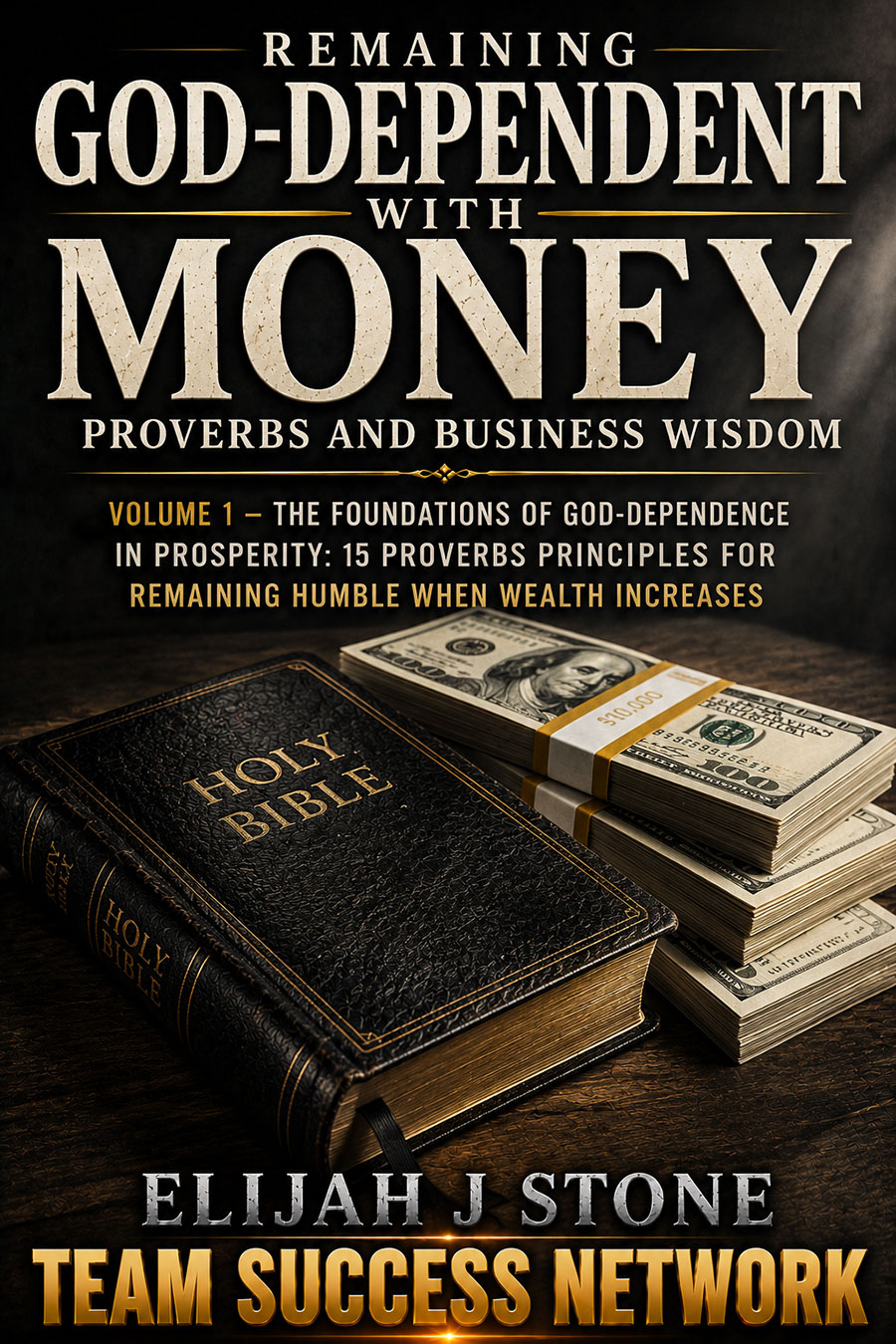
Book 57: Remaining God-Dependent With Money - Proverbs & Business Wisdom

Remaining
God-Dependent With Money - Proverbs and Business Wisdom
Volume
1 – The Foundations of God-Dependence in Prosperity: 15 Proverbs Principles for
Remaining Humble When Wealth Increases
By Mr.
Elijah J Stone
and the Team Success Network
Table
of Contents
Chapter 1 – Trust God, Not Your Understanding................................... 1
Chapter 2 – Refuse to Trust in Wealth1................................................ 1
Chapter 3 – Pray for Balance, Not Excess.............................................. 1
Chapter 4 – Stay Humble Before God................................................... 1
Chapter 5 – Commit Every Plan to the Lord.......................................... 1
Chapter 6 – Remain Generous and Open-Handed................................. 1
Chapter 7 – Be Patient with Growth..................................................... 1
Chapter 8 – Stay Honest in Every Deal.................................................. 1
Chapter 9 – Avoid Debt and Presumption............................................. 1
Chapter 10 – Keep Listening to Counsel............................................... 1
Chapter 11 – Remember God’s Ownership........................................... 1
Chapter 12 – Let Peace Rule Your Ambition.......................................... 1
Chapter 13 – Guard Against Greed....................................................... 1
Chapter 14 – Value Wisdom Over Gold................................................ 1
Chapter 15 – Fear the Lord More Than Loss......................................... 1

Chapter 1 – Trust
God, Not Your Understanding
How True Success
Begins with Surrender
Why Wealth
Without Dependence Always Fails
The Real Test Of Success
We live in a culture that praises independence. From childhood,
we’re taught to “make something of ourselves,” to “become self-made.” But
Proverbs 3:5–6 flips that idea on its head: “Trust in the Lord with all your
heart and lean not on your own understanding; in all your ways acknowledge Him,
and He will make your paths straight.”
When you begin to prosper, the temptation to trust yourself
becomes stronger than ever. Money creates options. Options make you feel in
control. But control is a dangerous illusion when God isn’t leading. True
success is not when you have enough to stop praying—it’s when you have more
reasons than ever to stay on your knees.
The moment you stop asking God for guidance in your prosperity,
your heart quietly begins to shift. It’s not greed that kills dependence—it’s
comfort. Comfort convinces you that you can handle tomorrow without Heaven’s
direction. The greatest danger of success is forgetting the One who gave it.
What Trusting God Actually Looks Like
Trusting God with all your heart is more than belief—it’s a
lifestyle of surrender. It means asking Him to interpret what success even means.
Money can change circumstances, but only God can define purpose. The wealthy
person who doesn’t ask, “Lord, what do You want me to do with this?” has
already misplaced trust.
To trust God is to invite Him into the boardroom, the budget, and
the business plan. It’s a conscious choice to believe that He knows more
than the market. While others rely on financial forecasts, the dependent
believer relies on divine direction. Wealth becomes safe only when it’s guided
by wisdom from above.
Trust doesn’t cancel planning—it sanctifies it. You still make
goals, but you hold them loosely. You still manage wealth, but you do it as a
steward, not an owner. Dependence doesn’t make you passive; it makes you
prayerful. Every new season of success should be met with fresh surrender.
Leaning On God, Not Logic
When Proverbs says, “lean not on your own understanding,” it
exposes one of the biggest temptations of prosperity: self-confidence. The more
you accomplish, the more natural it feels to depend on reason, strategy, or
skill. But no matter how wise you are, your understanding is still limited
compared to God’s.
Money can buy advisors, consultants, and data—but it cannot buy
divine direction. God sees beyond the numbers. He knows the timing, the hidden
motives, and the unseen consequences. That’s why dependence is wisdom’s highest
form. It’s saying, “Even if I can, I won’t—until You say so.”
To lean on understanding is to live by sight. To trust God is to
live by revelation. Human logic says, “This investment makes sense.” Divine
dependence says, “This feels right, but I’ll still pray.” The difference is
subtle yet eternal. The first path builds wealth; the second builds legacy.
Key Truth: If you can afford anything but prayer,
you’ve already drifted.
When Wealth Replaces Worship
Money’s quietest lie is that control equals safety. The more
successful you become, the easier it is to rely on numbers instead of God’s
nature. Wealth was never designed to be a substitute for His presence. When
finances become the foundation of peace, anxiety always follows.
Self-reliance seems efficient but leads to exhaustion. You may
achieve more but enjoy less. Every dollar earned without dependence adds
invisible weight to your soul. You’ll feel the pressure to sustain what you
built without God’s help. The moment you start carrying what He should be
carrying, joy disappears.
Worship is what frees you from that trap. When you stop to thank
God for every promotion, profit, and provision, you re-center your heart.
Wealth is safest in worshipping hands. You’ll never fear losing what you keep
surrendered. Dependence makes you a vessel; independence makes you a vault. One
flows; the other rusts.
Obedience Over Opportunity
God-dependence isn’t about missing opportunities—it’s about
missing traps. The devil knows how to bait ambition with attractive options.
Not every open door is divine; some are distractions in disguise. Trusting God
means waiting for His confirmation, even when it costs you time or reputation.
Your own understanding will always argue for action: “If you don’t
take this deal now, you’ll lose it.” But dependence says, “If it’s truly from
God, He’ll keep it for me.” Wealth tests patience because it tempts pride. But
obedience is always more profitable than impulse.
Every act of obedience is an investment in divine favor. When God
is your CEO, He manages both risk and reward. Even setbacks become setups in
His plan. You may not understand every delay, but trust guarantees that every
delay has purpose.
How To Stay Dependent When You’re Surrounded By Comfort
The wealthier you become, the easier it is to live without
reminders of need. You can solve problems with money that once required
miracles. But dependence means choosing prayer even when provision is
available. It’s not about needing money—it’s about needing God.
Here’s how you keep your heart aligned in seasons of prosperity:
• Pray before you plan. Let God filter every financial move through His
wisdom.
• Give before you spend. Generosity proves you trust the Giver, not the
gift.
• Thank before you act. Gratitude sanctifies decisions and keeps pride
away.
• Wait before you rush. Dependence develops patience that money cannot
buy.
The moment you pause long enough to invite God in, He transforms
ordinary decisions into eternal ones. Every choice becomes a statement of
trust. Wealth then becomes worship in motion—an offering of obedience wrapped
in stewardship.
The Freedom Of Dependence
Dependence doesn’t limit you—it liberates you. When God carries
the responsibility, you carry peace. You’re no longer crushed by outcomes or
addicted to success. You’re free to prosper without pride and to lose without
fear.
The self-dependent person must protect every gain; the
God-dependent person simply protects their connection. As long as your
relationship with Him stays intact, your supply will never run out. Prosperity
without presence is poverty in disguise.
Dependence also brings stability. When the economy shifts, your
faith doesn’t. When markets crash, your peace remains. Why? Because your
foundation isn’t wealth—it’s wisdom. You can hold riches without riches holding
you.
Key Truth: The goal of faith isn’t financial
control—it’s spiritual surrender.
Practical Signs You’re Leaning On Yourself
Sometimes self-reliance sneaks in quietly. You can diagnose it by
these subtle symptoms:
• Prayerlessness – Making big decisions without consulting God.
• Pride in success – Feeling you deserve more because of your effort.
• Fear of loss – Anxiety over losing what you believe you control.
• Neglect of worship – Less gratitude, more grind.
• Hurry in decision-making – Trusting time pressure more than God’s
timing.
If any of these describe your current mindset, pause. Invite God
back into the conversation. Dependence doesn’t need apology—it just needs
awareness. God never withdraws from a heart that still listens.
Why Dependence Is Wisdom’s Proof
Solomon didn’t just write Proverbs 3:5–6 as poetic advice; he
lived it as a warning. His wealth became his downfall when he trusted his
strategies more than his Source. The wisest man on earth lost dependence and
found emptiness. That’s how subtle the drift can be.
God-dependence is not for the weak—it’s for the wise. It takes
strength to say, “I can, but I won’t without Him.” Every time you choose prayer
over pride, you align with Heaven’s order. Dependence is your greatest
protection against deception.
Even when logic says, “You’ve got this,” the Spirit whispers, “Not
without Me.” True wisdom bows before the One who gave it. The beginning of
understanding is remembering who holds the outcome.
When Dependence Redefines Wealth
There comes a point where money stops being the reward and becomes
the responsibility. Dependence changes your definition of rich. You stop
asking, “How much do I have?” and start asking, “How much can God trust me
with?”
That’s the turning point of transformation. You realize that your
finances are part of a larger calling. They exist to serve God’s mission
through your life. Your job is not to accumulate—it’s to distribute under
divine direction.
Wealth held in dependence becomes a tool for Kingdom advancement.
It funds compassion, builds communities, and testifies of God’s goodness. When
you let Him guide every transaction, money becomes holy. You’re no longer an
owner—you’re an instrument.
Summary
Proverbs 3:5–6 calls every believer—especially the successful—to
surrender their understanding and lean fully on God. Wealth is not a sign of
independence; it’s a test of intimacy. The greater the resource, the deeper the
responsibility to remain humble and prayerful.
Trusting God with all your heart means acknowledging that no
amount of intelligence or experience replaces divine wisdom. It means living as
a steward of what He owns and a servant of what He directs. When you depend on
Him completely, your success becomes sacred—built not on pride but on
partnership.
Key Truth: Dependence is not weakness; it’s wisdom’s
proof that success never changed who your Provider is.

Chapter 2 –
Refuse to Trust in Wealth
How to Enjoy
Blessing Without Replacing the Blesser
Learning to Stay
Rooted in God When Success Feels Secure
The Illusion Of Financial Safety
“Those who trust in their riches will fall, but the righteous will
thrive like a green leaf.” — Proverbs 11:28
Money feels like protection. It seems to promise peace, control,
and freedom from worry. Yet the Bible exposes that security as an illusion.
Proverbs warns that trusting in wealth leads to a fall—not because money itself
is evil, but because misplaced trust always collapses.
Financial comfort can deceive the heart faster than hardship can.
When life feels stable and bills are paid, dependence on God easily fades. The
temptation isn’t in abundance—it’s in comfort. Wealth doesn’t whisper
rebellion; it whispers, “You don’t need to pray today.” That’s why the
wise learn early: if your peace depends on your balance, your roots are in
the wrong soil.
The righteous, by contrast, “thrive like a green leaf.” Their
stability doesn’t come from market conditions but from spiritual connection.
They stay fresh because their roots reach into the presence of God. When
everyone else panics, they remain calm—because their confidence isn’t in the
economy, it’s in eternity.
When Wealth Becomes A Substitute For Faith
Wealth makes life easier, but it can also make faith harder. When
you can buy solutions, prayer starts to feel unnecessary. When you can fund
your plans, surrender seems optional. Yet Proverbs shows that riches without
righteousness are like a beautiful tree with a hollow trunk—impressive, but
fragile.
Faith begins to erode the moment money becomes the comforter. You
might not say you trust in wealth, but you’ll know it when your peace rises and
falls with your profits. The problem isn’t possession—it’s dependence. God
wants to bless you, but He refuses to compete for your trust.
It’s not sinful to have savings; it’s sinful to let savings have
you. When comfort replaces communion, and calculations replace confidence, the
heart begins to dry out. True prosperity flows from the inside out—from a heart
anchored in the Provider, not the provision.
Key Truth: Money makes a poor god but a powerful
servant.
Enjoying Provision Without Replacing The Provider
God is not against your success. He delights in blessing His
children. But He designed provision to be a tool for gratitude, not a trade for
relationship. Every gift He gives is meant to lead you back to Him. When you
begin to love the gift more than the Giver, the blessing turns into bondage.
To stay dependent in prosperity, treat money like a resource to
steward, not a refuge to trust. Thank God daily for every opportunity and
increase. Each acknowledgment reminds your soul where it all came from.
Gratitude is the simplest—and most powerful—guardrail against pride.
The more you enjoy God, the less you’ll idolize gain. Let your
prosperity become a praise report, not a reason for pride. The safest hands for
wealth are thankful ones. That’s how you can enjoy abundance without losing
humility.
When riches increase, your worship should increase more. Every
dollar becomes holy when it returns to His glory. Dependence means you can
enjoy the blessing while staying fully anchored to the Blesser.
How To Keep Wealth From Owning You
You can tell whether money owns you by watching what happens when
it’s threatened. If losing it feels like losing peace, you’ve tied your
security to the wrong thing. God doesn’t want fear to guard your finances—He
wants faith to.
Here are ways to make sure wealth never becomes your master:
• Give regularly. Generosity breaks greed’s hold and keeps
your heart light.
• Pray before every big financial decision. Invite God into the
spreadsheet.
• Celebrate others’ success. Gratitude for others protects you from
comparison.
• Remember what truly matters. Peace, people, and purpose last longer
than profit.
When you practice these, wealth becomes your servant, not your
idol. You’ll handle increase with joy instead of anxiety. True dependence
doesn’t mean ignoring finances—it means mastering them under God’s authority.
The Fallacy Of Control
One of wealth’s most subtle lies is control. When things go well,
it feels like you earned it, managed it, or planned it perfectly. But Proverbs
says even the best-built fortune can collapse in a moment. God allows
uncertainty to remind us that control belongs only to Him.
You can’t secure tomorrow through calculation. You can only walk
into it through trust. That doesn’t mean carelessness—it means confidence in
the right source. The wise steward plans, but he plans while praying. The fool
plans, but forgets who allows plans to succeed.
Wealth-dependence leads to anxiety because it creates false
responsibility. You start believing you must hold everything together.
God-dependence leads to peace because it reminds you that He holds you
together. The goal of stewardship is diligence without delusion—working hard
while remembering that outcomes rest in God’s hands.
The Root Of Righteous Stability
Proverbs compares the righteous to a green leaf. That image isn’t
random. A leaf stays vibrant only when connected to a living branch. Cut it
off, and it dries out quickly—even if it looks healthy for a while. In the same
way, people can look prosperous while spiritually dying inside.
Connection, not cash flow, determines vitality. The righteous stay
nourished because they draw from God’s Spirit. When wealth shifts, their hearts
don’t. When markets fall, their peace doesn’t. They stay fruitful in every
season because dependence keeps the roots alive.
A dependent person never outgrows prayer. The more you have, the
more time you spend with the One who gave it. Dependency turns success into
fuel for worship. That’s why the righteous thrive—they don’t just survive the
seasons; they stay spiritually green all year.
Key Truth: Roots in God will outlast any drought of
circumstance.
Practical Habits For God-Dependence In Prosperity
You can keep dependence strong through intentional daily habits.
Spiritual disciplines aren’t just for the poor or desperate—they’re for anyone
who wants to remain close to God in abundance.
1. Begin each day in surrender. Before checking accounts or messages,
pray, “Lord, everything I have is Yours again today.” It resets authority and
realigns peace.
2. Practice gratitude. Thank Him not just for wealth but for
wisdom, health, and favor. Gratitude opens your heart wider than money ever
could.
3. Keep giving. Generosity is dependence in motion—it says,
“I trust You to refill what I release.”
4. Seek counsel. Surround yourself with people who challenge
you spiritually, not just financially.
5. Rest regularly. Rest is the act of refusing to earn
what God has already given.
Each of these habits cultivates humility in the soil of
prosperity. They remind your heart that success is a gift, not an identity.
What To Do When Wealth Feels Safer Than God
If you notice that your confidence leans more on your savings than
your Savior, don’t panic—repent. Repentance simply means to realign your heart
back to its Source. God doesn’t punish returning hearts; He restores them.
Start by confessing your misplaced trust. Say, “Lord, I’ve let
money feel safer than You.” Then re-surrender your resources. Dependence isn’t
about losing wealth—it’s about regaining perspective. When you give God back
ownership, fear loses its voice.
The safest place for your finances is under His leadership. You
can trust the same God who provided to also protect. Security built on savings
is temporary; security built on surrender is eternal.
If you truly want to stay free, let prayer become your first
transaction every day. Prayer keeps your soul wealth-proof.
The Blessing Of Trust Over Treasure
The promise of Proverbs 11:28 is not that the righteous will
always have more—it’s that they’ll always have life. The “green leaf”
represents vibrancy, growth, and resilience. When your trust is in God, you can
flourish in famine and thrive in downturns.
Trust turns ordinary wealth into extraordinary witness. People
will notice the peace you carry when others are panicking. That calm confidence
is the mark of God-dependence. The righteous don’t chase blessings; blessings
chase them because they’re rooted in the right place.
Wealth may fluctuate, but righteousness produces steady fruit. The
dependent believer becomes a testimony that true prosperity isn’t in
possessions—it’s in presence. That’s why Proverbs ties thriving to
righteousness, not revenue.
Key Truth: Trust is the currency of Heaven. When your
faith is stable, your fruit will be visible.
The Choice Between Riches And Roots
Every believer faces this question: Will I build deeper roots or
higher walls? Walls protect what you already have; roots prepare you for what’s
next. If your wealth isolates you from dependence, it’s not security—it’s
separation.
Choose roots. Stay connected to God in both success and setback.
Let your dependence grow stronger as your blessings grow larger. You’ll find
that abundance only multiplies peace when it remains surrendered.
When you refuse to trust in wealth, you make room for wisdom. You
let peace rule where panic once lived. You discover that being rich in God is
greater than being rich in gold. And when others fall with the market, you’ll
stand like a thriving tree—alive, fruitful, and rooted in divine dependence.
Summary
Proverbs 11:28 teaches that riches cannot secure the heart—only
righteousness can. Wealth isn’t evil, but trusting it is dangerous. The comfort
of prosperity can quietly pull the soul from prayer and replace faith with
formulas. God calls us to enjoy blessing without worshiping it, to steward
success without being enslaved by it.
Dependence means holding wealth lightly and God tightly. It means
celebrating increase while remembering its Source. The righteous thrive like a
green leaf because their roots are planted in the presence of God. When He
remains your foundation, no amount of money can shake your faith or steal your
peace.
Key Truth: When wealth grows, stay rooted. Let God
remain your stability, and you’ll flourish in every season.

Chapter 3 – Pray
for Balance, Not Excess
Why “Enough” Is
the Safest Blessing You Can Ask For
Learning the
Secret of Daily Bread Dependence
The Wisdom Of “Enough”
“Give me neither poverty nor riches, but give me only my daily
bread.” — Proverbs 30:8–9
Most people pray for more. More opportunity, more comfort, more
success, more security. But Proverbs offers a radical alternative: “Lord,
give me enough.” That prayer is rare—and deeply wise—because both poverty
and excess can destroy dependence. Lack tests your faith; abundance tests your
humility. The writer of Proverbs 30 knew that the safest place for the soul is
not at the extremes, but in the center—where gratitude still breathes.
Balance is not mediocrity; it’s maturity. The wise don’t chase
more—they cherish what sustains. When your heart learns to see enough as
perfect, you escape the endless race for “just a little more.” This is
not the prayer of fear; it’s the prayer of trust. It says, “God, You know my
limits better than I do. Give me what will keep me close.”
Key Truth: The middle ground of gratitude is where
dependence grows best.
The Danger Of Too Much
Wealth seems like a blessing until it dulls your desperation for
God. When every need is met, prayer feels optional. The urgency that once drove
your faith begins to fade. Comfort, though pleasant, is one of the most
deceptive dangers of success. It doesn’t scream rebellion—it simply whispers, “Relax.
You’re fine without praying today.”
Too much can quietly destroy intimacy. It replaces daily trust
with daily transactions. You begin to depend on systems, savings, and schedules
instead of the Spirit. And slowly, your dependence shifts from divine provision
to personal management. God is no longer your source—He becomes your
consultant.
That’s why the writer begged God not to give him riches that would
make him forget the Giver. He knew that abundance without awareness leads to
arrogance. When the hands are full but the heart is empty, the soul starves in
luxury. Dependence must be protected even when life seems stable.
The Fear Of Too Little
On the other hand, poverty can tempt you to doubt God’s care. When
resources run dry, anxiety tries to take over. The danger of lack is that fear
becomes louder than faith. But the wise know that even scarcity is a teacher—it
forces your eyes back to Heaven.
The prayer for balance is not a prayer against blessing but a
request for grace in both seasons. God sometimes limits your supply to
strengthen your surrender. He lets need teach trust. That’s why “daily bread”
dependence is divine mercy—it keeps your heart aligned with His.
When you learn to walk with peace in both abundance and need,
wealth no longer controls your worth. You become the same person in plenty and
in want, because your Provider never changes. That stability is what makes the
righteous thrive through every season.
Why Balance Protects Relationship
Praying for balance doesn’t mean refusing God’s blessing—it means
refusing to let blessing replace God. The goal isn’t poverty; it’s purity. The
danger of abundance isn’t comfort—it’s competition with the Comforter. God’s
greatest desire is not to fill your hands but to win your heart.
When you pray, “Lord, give me only what I can handle without
losing You,” you invite Heaven’s restraint. That restraint is love, not
limitation. God protects you from the kind of success that would destroy your
soul. Dependence isn’t punishment—it’s preservation.
If God ever delays increase, it’s because He’s more interested in
maturity than in money. When your heart can handle abundance without arrogance,
He releases it freely. Until then, He teaches contentment through balance. The
more you love His presence, the safer you are to hold His provision.
Daily Bread Dependence
“Daily bread” means daily trust. It’s the opposite of
self-sufficiency. It’s a heart posture that says, “God, I need You again
today.” Even when you have plenty in the bank, you still ask for fresh grace.
Yesterday’s provision doesn’t exempt you from today’s dependence.
Praying for daily bread is a declaration of humility. It
acknowledges that every breath, opportunity, and dollar still flows from God’s
hand. The proud pray only in crisis; the wise pray in comfort too. Prosperity
without prayer becomes poison, but prosperity with prayer becomes peace.
Dependence keeps abundance from turning into arrogance. Every
sunrise is another reminder: You are not the source—you are the steward.
As long as you keep receiving from Him, He can keep trusting you with more.
Practical Ways To Live In Balance
Here are some simple ways to guard your dependence in a season of
plenty:
• Budget prayerfully. Let prayer determine priorities, not
pressure.
• Celebrate small things. Gratitude for little keeps greed from growing.
• Tithe consistently. Giving reminds your soul that God still owns it
all.
• Slow down decisions. When in doubt, wait for peace before you act.
• Rest weekly. Sabbath is your declaration that God sustains you, not
effort.
Each of these disciplines trains your heart to live inside the
rhythm of grace. You learn to breathe with Heaven’s pace—steady, thankful,
unhurried. Balance becomes your spiritual safeguard against burnout, pride, or
fear.
Dependence isn’t an emotion; it’s a habit. When you choose to live
slowly, gratefully, and generously, your heart stays centered no matter what
your bank account says.
The Hidden Pride Of Excess
Excess doesn’t always appear as greed; sometimes it disguises
itself as “responsibility.” You tell yourself you’re saving for safety, but
deep down, you’re hoarding for control. The line between wisdom and worry is
thin. That’s why Proverbs teaches that both poverty and riches can ruin if not
ruled by humility.
Too much can breed self-importance. You begin to believe that
results come solely from effort, not grace. But God isn’t impressed by
totals—He’s drawn to trust. The prayer for balance keeps you grounded in the
truth that you can’t outgrow dependence.
The danger of success is that it feels spiritual to be in control.
But spiritual maturity isn’t control—it’s surrender. When you surrender, you
invite God into your strength as well as your struggle. That’s what makes
prosperity holy—it remains submitted.
Key Truth: If success makes you forget to pray, it
wasn’t success—it was a setup.
The Freedom Of Simplicity
There is a quiet freedom that comes from simplicity. When your
needs are met and your heart is content, anxiety loses its grip. Simplicity
doesn’t mean lack—it means clarity. It’s the ability to say, “This is enough.”
People who live in simplicity carry light hearts. They aren’t
chained to possessions or driven by comparison. They can give easily because
they don’t measure identity by inventory. This kind of life radiates peace in a
world addicted to more.
Simplicity is not the enemy of ambition—it’s the purity of it.
When your motives are clean, your pursuits become worship. You no longer chase
money to prove worth; you use money to serve purpose. That is the fruit of
balance—freedom without fear, prosperity without pride.
When God Uses Both Seasons To Teach Dependence
If you’ve ever had too little, you’ve seen God’s provision. If
you’ve ever had too much, you’ve seen your own heart. Both experiences are
classrooms of dependence. God uses lack to teach faith and abundance to test
faithfulness.
When you look back, you’ll notice that both seasons reveal the
same truth: God was always the source. You didn’t earn Him in prosperity, and
you didn’t lose Him in scarcity. His love remains steady across every economic
condition. That constancy is your real wealth.
Your heart grows mature when you stop labeling seasons as “good”
or “bad” and start calling them all “purposeful.” Whether He’s stretching or
steadying you, His goal is the same—to keep you close. Dependence isn’t about
the size of your wallet; it’s about the state of your worship.
The Eternal Value Of Contentment
Contentment is not complacency—it’s confidence in God’s goodness.
It says, “I don’t need everything because I already have Him.” Contentment
doesn’t mean you stop dreaming; it means you stop panicking. It’s an anchor
that holds when opportunity shifts or success feels slow.
Paul echoed this same truth in Philippians 4:11–12: “I have
learned to be content whatever the circumstances.” That word “learned”
shows contentment isn’t automatic—it’s practiced. Each time you choose
gratitude over comparison, you grow stronger in dependence.
A content heart is untouchable. It can celebrate others’ success
without envy and endure trials without despair. When you live satisfied in God,
the world loses its power to define you. That is balance in its purest
form—peace that no profit can buy.
Why “Enough” Is More Than A Number
“Enough” is not a figure—it’s a faith posture. It’s the point
where gratitude overtakes greed. You might earn millions and still live with an
“enough” heart, or earn little and still be generous. The number doesn’t
matter; the source does.
When you pray, “Lord, give me only what I can handle without
losing You,” you’re really saying, “Keep me close.” That prayer will always be
answered. God will tailor your provision to match your capacity for dependence.
If He withholds, it’s protection. If He releases, it’s purpose.
Wealth isn’t proof of favor; intimacy is. Abundance is not the
goal—it’s the overflow of relationship. That’s why balance matters—it keeps the
overflow clean.
Summary
Proverbs 30:8–9 calls every believer to seek wisdom in moderation.
The writer’s prayer wasn’t fear of wealth—it was love for God. He understood
that both lack and luxury could pull his heart away from dependence. True peace
comes from daily bread dependence—a steady rhythm of trust that stays humble in
abundance and hopeful in lack.
Balance protects relationship. It keeps your soul awake to the
presence of God, grateful for what is, and untempted by what isn’t. When you
stop chasing more and start cherishing enough, you’ll discover that
satisfaction doesn’t come from full barns but from a full heart.
Key Truth: When you learn to want nothing apart from
God, you can safely hold anything He gives.

Chapter 4 – Stay
Humble Before God
How to Prosper
Without Pride
Keeping God at
the Center When Success Elevates You
The Quiet Danger Of Success
“Humility is the fear of the Lord; its wages are riches and honor
and life.” — Proverbs 22:4
Wealth doesn’t always destroy people through greed — sometimes it
does so through pride. The most dangerous moment of success is not when you’re
struggling to rise, but when you’ve already arrived. Prosperity whispers
flattery: You earned this. You deserve this. You made this happen. If
unguarded, that voice becomes the silent assassin of dependence.
Proverbs shatters the illusion that hustle alone sustains
blessing. The wise understand that riches without reverence always end in ruin.
God’s system rewards humility, not arrogance. The fear of the Lord — that deep
respect, awe, and submission to His authority — is what keeps prosperity pure.
Humility isn’t weakness; it’s wisdom that remembers who the Source really is.
The truly blessed are not the ones who own the most; they’re the
ones who remember ownership belongs to God. Staying humble means never
outgrowing gratitude and never forgetting grace.
Key Truth: The higher success lifts you, the lower
your knees should go.
Pride: The Subtle Enemy Of Dependence
Pride rarely announces itself. It moves quietly, hiding behind
hard work, discipline, and “success principles.” It takes credit subtly,
stealing glory word by word — “My business,” “my team,” “my vision.” The
words sound normal, but the posture shifts. You start to lean on self instead
of the Spirit.
Pride is not just arrogance; it’s amnesia. It forgets where help
came from. It turns divine favor into personal achievement. That’s why pride
and dependence can’t coexist. The moment you believe you built it, you lose
sight of the One who blessed it.
Wealth magnifies pride’s potential. When you have power,
influence, or comfort, humility must be intentional. You can’t afford to let
applause drown out conviction. The higher you climb, the more you need to bend.
Pride says, “Look what I’ve done.” Humility says, “Look what God
has done through me.” That single difference determines whether your prosperity
glorifies God or glorifies you.
The True Power Of Humility
Humility doesn’t shrink your influence — it strengthens it. God
can trust a humble person with more because they won’t idolize what they have.
Scripture says humility brings “riches, honor, and life.” That’s not poetic
fluff — it’s divine order.
Riches flow through humble hearts because God knows they won’t
worship them. Honor follows humility because people trust those who aren’t
self-centered. Life thrives in humility because pride suffocates gratitude. The
humble walk freely, thankful for everything, entitled to nothing.
When you recognize that every opportunity, connection, and success
is grace, you handle prosperity lightly. You don’t cling to it in fear or
flaunt it in pride. You hold it open-handed, remembering that it’s not for your
ego but for God’s glory.
Humility is not thinking less of yourself — it’s thinking of
yourself less. It’s the steady awareness that every blessing carries His
fingerprints.
How Humility Protects Wealth
Pride invites destruction because it disconnects you from divine
protection. Proverbs 16:18 warns, “Pride goes before destruction, a haughty
spirit before a fall.” When pride takes the wheel, humility steps out of
the car — and so does God’s covering.
Humility, however, keeps the blessing secure. It acts like a
shield, deflecting greed, comparison, and self-praise. The humble stay focused
on purpose rather than prestige. They lead well because they know they’re
serving something greater than themselves.
Wealth is safest when held by the humble. They don’t use money to
prove worth; they use it to produce good. They don’t compete with others; they
complete others. Their success doesn’t create distance — it creates opportunity
for impact.
Dependence grows best on the soil of humility. It’s in kneeling
that strength multiplies.
Practical Habits That Keep You Humble
Humility must be practiced intentionally in a world obsessed with
image and influence. You can guard your heart by forming these habits:
• Kneel daily. Physical posture reminds the heart of
spiritual truth — that you are still under His authority.
• Speak gratitude out loud. Regularly thank God for opportunities,
income, and favor. Words shape humility.
• Serve someone quietly. Do good where no one sees it. Hidden obedience
protects your motives.
• Receive correction. Stay teachable even when you’re successful. The
proud resist feedback; the humble grow from it.
• Celebrate others. Rejoice in others’ success as if it were your own.
These rhythms keep the heart soft. The goal is not to think less
of yourself but to stay aware of your dependence. Every humble act declares, “God,
I still need You.”
Humility Transforms How You See Wealth
When you’re humble, money becomes ministry. You stop seeing it as
a measure of identity and start seeing it as a tool of generosity. Humility
transforms your relationship with wealth — from ownership to stewardship, from
pride to purpose.
A humble heart sees success as shared. Every dollar earned becomes
an opportunity to lift others, not elevate ego. Instead of asking, “How can
I gain more?” you begin asking, “How can this glorify God?” That
single shift in perspective turns business into Kingdom work.
The world defines wealth by accumulation; Heaven defines it by
assignment. The humble steward doesn’t aim to be impressive — only faithful.
Dependence means every profit becomes a prayer of praise, and every decision is
filtered through submission.
You are never more prosperous than when your wealth no longer owns
your worship.
How To Recognize When Pride Is Creeping In
Even the godliest leaders can slowly drift from humility. Pride
creeps in quietly through success, recognition, or unchecked independence. Here
are signs it’s time to reset:
• You pray less because you feel “in control.”
• You credit strategy more than surrender for outcomes.
• You measure others by achievement instead of character.
• You resist correction or advice from those “below” you.
• You struggle to celebrate others’ victories.
When these symptoms appear, take them seriously. Pride doesn’t
always look evil—it often looks efficient. The solution is not
self-condemnation but quick repentance. Say, “Lord, remind me that I am Yours,
not my own.” Humility doesn’t make you smaller; it makes God visible again.
The Strength Of Staying Small
Humility keeps you usable. God does His best work through those
who stay small in their own eyes. When Saul became king, Scripture says he
started humble but grew proud and lost the kingdom (1 Samuel 15). The shift was
subtle: he began taking credit for what God had done.
Every believer faces that same temptation. Success tries to
rewrite the story of grace as a story of self. The secret is staying small —
remembering that the same God who lifted you can also sustain you. Staying
small doesn’t mean denying growth; it means keeping perspective.
When you stay humble, you stay hungry. God can pour out more when
He knows you’ll pour it back into others. Dependence keeps expansion safe
because your spirit remains surrendered. The bigger your platform, the deeper
your prayer life must go.
Why Humility Attracts God’s Presence
God dwells where pride cannot breathe. Isaiah 57:15 declares, “I
live in a high and holy place, but also with the one who is contrite and lowly
in spirit.” That means God doesn’t just visit humility — He inhabits it.
Pride pushes Him away; humility invites Him near. If you want His
presence to stay, keep your posture low. Wealth cannot buy closeness; only
humility can. A proud life may look prosperous, but it’s spiritually bankrupt.
A humble heart, though unseen, becomes the richest place on earth.
Dependence thrives in the presence of God because humility creates
space for Him to move. When you choose humility, you choose intimacy. The
humble don’t need to beg for favor—they live in it.
The Reward Of Remaining Humble
Proverbs promises that humility’s “wages are riches and honor and
life.” Notice: these are not merely spiritual metaphors. God’s blessing flows
through humility in every area—financially, relationally, emotionally, and
spiritually.
• Riches – God entrusts more to those who won’t worship it.
• Honor – He elevates those who use their platform for His glory.
• Life – He fills their days with peace, joy, and purpose.
Humility isn’t the opposite of success—it’s the key to sustaining
it. Pride can build quickly but collapses easily; humility builds slowly but
stands forever. God resists the proud but gives grace to the humble (James
4:6). Grace is the fuel that keeps you fruitful when others burn out.
The humble don’t chase blessings—they attract them. When humility
rules, favor follows.
When Humility Meets Wealth
Imagine a person who manages millions yet kneels daily. Who makes
bold moves in business yet prays before every decision. Who treats employees
with honor, not hierarchy. That’s humility in action. It’s not shyness or
self-doubt—it’s strength under submission.
God can trust that kind of person with greater influence. Why?
Because they won’t mistake ownership for stewardship. They understand that
everything—every dollar, every opportunity, every open door—is a loan from
Heaven.
Humility and prosperity are not enemies; they are companions when
handled rightly. When humility leads, prosperity follows safely. You can live
abundantly without arrogance, confident without conceit, successful without
self-worship. That’s what it means to walk in the fear of the Lord.
Summary
Proverbs 22:4 reveals that the secret to true success is not
ambition but humility. The fear of the Lord produces a reverence that keeps
wealth from corrupting the heart. When pride whispers, “You earned this,”
humility answers, “No, God entrusted this.”
To stay humble before God is to stay safe in every season.
Gratitude replaces entitlement, stewardship replaces superiority, and
dependence replaces pride. The humble are the most trustworthy stewards of
prosperity because they never forget who it belongs to.
Key Truth: God isn’t against abundance — He’s against
arrogance. Stay small in your own eyes so He can stay big in your heart.

Chapter 5 –
Commit Every Plan to the Lord
How to Build Your
Future With God at the Center
Turning Ambition
Into Partnership Instead of Pressure
The Illusion Of Control
“Commit to the Lord whatever you do, and He will establish your
plans.” — Proverbs 16:3
Money gives a person the power to move fast. With enough
resources, you can start, build, and expand at will. The more you have, the
more you feel in control. But Proverbs reminds us that speed without surrender
can become your downfall. Wealth may make planning easy—but it can also make prayer
optional.
The temptation of success is to assume that your plan is
automatically blessed because it looks good or works on paper. But even the
smartest strategies fail if God isn’t leading them. You can’t build something
lasting with human wisdom alone. Dependence isn’t a lack of ambition; it’s the
discipline of alignment.
True prosperity comes when every idea, dream, and plan is handed
back to God before it ever leaves the notebook. You were never called to create
plans for Him—you were called to create plans with Him.
Key Truth: When you trust God with your plans, you
trade pressure for partnership.
Rolling Your Plans Onto God’s Shoulders
To “commit your plans” literally means to roll them onto God’s
shoulders—like transferring the full weight of a heavy load onto someone
stronger. It’s not about asking God to bless what you’ve already decided; it’s
about inviting Him to decide with you.
When you bring every plan before Him, you’re acknowledging His
ownership. You’re saying, “Lord, I don’t just want You to approve my
direction—I want You to define it.” That’s what dependence looks like in
motion. The proud plan first and pray later; the wise pray first and proceed
with peace.
God doesn’t just bless your steps—He also protects you from the
ones that lead nowhere. Sometimes His greatest mercy is not in giving you what
you planned but in blocking it. A closed door isn’t always a loss; it’s often a
rescue.
Dependence is trusting Him enough to be interrupted. It’s giving
Him the pen while you hold the paper.
Why Wealth Makes Dependence Difficult
The more resources you have, the easier it becomes to bypass
reliance on God. You can fund what you used to have to pray for. You can solve
what you used to surrender. Money tempts you to act without waiting, to move
without asking, and to build without blessing.
That’s why dependence must increase with success. Prosperity
multiplies decisions, and decisions require direction. Every level of wealth
demands a deeper level of submission. God doesn’t want you to stop planning—He
wants to be the Planner behind the plan.
The danger of wealth isn’t the abundance itself—it’s the illusion
of independence. When your ability replaces your awareness of Him, wisdom is
replaced by pride. The result may still look impressive, but it won’t last.
The higher your capacity grows, the lower your posture must stay.
God’s Role In Establishing Plans
Proverbs 16:3 carries a promise: when you commit your plans, He
will establish them. That word “establish” means to make stable, secure,
and enduring. Only God can take human vision and make it eternal.
Without His establishment, your efforts depend on circumstances;
with it, they rest on covenant. God doesn’t just make plans succeed—He
strengthens the person behind them. Every step that begins with prayer ends
with peace.
You might think success comes from effort, but divine
establishment comes from obedience. When you walk in step with Him, you don’t
have to manipulate outcomes. God Himself becomes the foundation.
Key Truth: You can build the walls, but only God can
lay the foundation.
How To Commit Plans Practically
Committing your plans is not a single act—it’s a rhythm. It means
you continually invite God into the process. Here are practical ways to keep
dependence alive in every decision:
• Pray before planning. Don’t wait until you have an
idea—start by seeking God’s will first.
• Ask questions, not permissions. Instead of “Will You bless this?” pray
“What are You building, and how can I join You?”
• Include Him in the details. God isn’t bored by budgets or business
models; He cares about integrity in execution.
• Pause before signing. Stillness invites discernment. Peace is your
confirmation.
• Review plans regularly. Keep surrendering them as conditions change.
Dependence isn’t a one-time event—it’s daily renewal.
These habits train your heart to build under His authority. When
you honor Him with the process, He takes responsibility for the outcome.
The Difference Between Striving And Stewardship
When you plan apart from God, you strive. When you plan with God,
you steward. Striving drains peace because you carry pressure that isn’t yours.
Stewardship brings joy because you’re managing what belongs to Him.
The world calls it “driving success.” Scripture calls it
“following direction.” Striving says, “I must make this happen.” Stewardship
says, “God, make this what You want it to be.” One depends on willpower; the
other depends on grace.
Many believers confuse independence with diligence. You can work
hard and still remain fully dependent. True diligence is obedience under
direction, not activity without prayer. The more you surrender, the more
strategic your success becomes.
If peace is missing, it’s usually because you’ve started striving.
When Plans Fail, But Purpose Stands
Even good plans can collapse when they’re built apart from God.
Financial independence may produce impressive results for a season, but without
divine purpose, the foundation remains fragile. Proverbs teaches that many
are the plans in a man’s heart, but the Lord’s purpose prevails.
Failure isn’t final when you’re dependent. When you commit your
plans to God, He uses even the failures to realign your direction. Dependence
means you no longer measure success by immediate outcomes but by obedience in
the process.
A failed plan doesn’t mean you missed God—it might mean He’s
redirecting you toward something better. Purpose outlives profit. Trust that
every closed door and delayed result is still under His sovereignty.
When you build with Him, even detours lead to destiny.
The Power Of Asking First
One of the clearest marks of dependence is the habit of asking
first. Before you act, before you invest, before you commit, you stop to ask,
“Lord, what do You want here?” This single question separates wise builders
from impulsive ones.
Asking first is not hesitation—it’s holiness. It honors God as the
ultimate decision-maker. When you move only after hearing His peace, you carry
authority that no contract or capital can replace.
The wealthy must learn this discipline most of all, because speed
becomes both their gift and their weakness. The faster you can move, the more
likely you’ll move without asking. The more capable you are, the easier it is
to forget to consult the Creator.
Dependence begins with a pause. It’s the willingness to let God
set the pace.
How God Speaks To Guide Your Plans
God doesn’t always write instructions in the sky, but He always
speaks through consistent channels:
- His
Word – Scripture gives principles that outlast trends. Every
major decision should align with His truth.
- His
Peace – If your spirit feels restless, wait. Peace is the
signature of God’s approval.
- His
People – Wise counsel protects you from blind spots. God often
speaks through community.
- His
Providence – Pay attention to patterns. Closed and open doors are part
of His communication.
- His
Presence – Stay in prayer long enough to sense His heart, not just
His hand.
These are the filters of dependence. When you plan within them,
you build on divine guidance instead of human guessing.
Letting God Interrupt You
One of the hardest parts of dependence is allowing God to
interrupt success. When everything is going well, it’s difficult to pause for
new direction. But sometimes God changes your plan not to punish you, but to
protect you.
He may shift your business model, redirect your generosity, or
close an opportunity that looks profitable but isn’t pure. When He interrupts,
it’s always redemptive. The humble say, “Yes, Lord, even if it costs me
comfort.” The proud say, “Not now, Lord—it’s working.”
Dependence is measured by your response to divine interruption.
The longer you walk with Him, the more you’ll learn that detours are part of
direction. God never changes plans without improving them.
Key Truth: Interruption from God is invitation to
deeper partnership.
Building With God, Not For God
Many believers try to build for God, as if He were a client
approving blueprints. But He doesn’t hire us—He partners with us. Building with
God means you’re working in real-time collaboration, not after-the-fact
presentation.
When you build for Him, you expect applause; when you build
with Him, you expect alignment. The difference is relationship. The
independent worker says, “Here’s what I’ve built for You, Lord.” The dependent
steward says, “Lord, show me how to build it Your way.”
The first produces exhaustion; the second produces endurance. When
you build with God, His wisdom becomes your strategy. His presence becomes your
protection. His power becomes your provision. That’s the beauty of divine
collaboration—it doesn’t just build projects; it builds character.
How To Know God Has Established It
When God establishes a plan, several signs appear:
• Peace replaces pressure. You stop forcing results and
start flowing in grace.
• Integrity stays intact. You don’t have to compromise your values to
advance.
• Provision meets purpose. Resources arrive at the right time, not
through manipulation.
• Fruit remains. What you build lasts and blesses others long after the
moment passes.
• Glory returns to God. People see His hand more than your name.
These marks confirm divine establishment. You’ll feel stability
where there used to be striving. You’ll sense alignment instead of anxiety.
That’s how dependence manifests—it produces peace in both the journey and the
outcome.
Summary
Proverbs 16:3 teaches that the wisest plans are the ones rolled
onto God’s shoulders. Wealth can fund your vision, but only God can secure your
purpose. Success becomes dangerous when prayer becomes optional. True wisdom is
not in how fast you build but in how faithfully you surrender.
Commitment is not passivity—it’s partnership. When you give God
ownership of the process, He gives you peace about the outcome. Dependence
means letting Him lead, interrupt, and direct as He pleases. Even good plans
are fragile without His foundation.
When you plan with God, pressure turns into peace, striving turns
into stewardship, and achievement turns into worship.
Key Truth: Money can fund your vision, but only God
can establish your destiny.

Chapter 6 –
Remain Generous and Open-Handed
Why Giving Keeps
the Heart Free
How Generosity
Protects Dependence in Seasons of Abundance
The Flow Of True Prosperity
“A generous person will prosper; whoever refreshes others will be
refreshed.” — Proverbs 11:25
Money is meant to move. When wealth flows through open hands, it
stays alive. But when it’s clutched tightly, it begins to decay. Proverbs shows
us a divine principle that contradicts human instinct: the generous prosper,
not the stingy. True prosperity is not measured by how much you keep, but by
how freely you give.
Wealth can close your hands if you forget who placed it there. The
more you gain, the stronger the temptation to protect, accumulate, and secure
comfort. But God’s economy works in reverse — those who release, receive.
Generosity keeps your heart tender, grateful, and connected to Heaven. The
moment you start hoarding, your soul begins to dry up.
The Bible never says “the rich will prosper,” but it clearly says
“the generous will.” Why? Because generosity is the evidence of trust. Every
time you give, you’re preaching to your own soul: “God is still my source.”
Key Truth: Wealth is not a reward for ownership—it’s
a test of stewardship.
Why Generosity Is Spiritual Warfare
Generosity isn’t just financial kindness—it’s spiritual warfare.
Every time you give, you strike at the root of greed, pride, and fear. Those
three forces constantly compete for control of the wealthy heart.
Greed whispers, “Keep more.” Pride says, “You earned
this.” Fear warns, “What if you run out?” But generosity silences
them all by declaring, “God gave this, and He’ll give again.”
When you give freely, you’re breaking agreement with the lie of
self-sufficiency. You’re reminding yourself that your job isn’t your
provider—God is. This is why the most prosperous people in Scripture, like
Abraham, Job, and David, were also the most generous. They didn’t just possess
wealth—they redirected it.
Generosity is dependence in motion. It’s how you prove to Heaven
and to your own heart that success hasn’t replaced surrender. The giver is
never the loser; the withholder is never secure.
The Danger Of Closed Hands
Wealth creates comfort, and comfort breeds caution. It’s easy to
become protective of what you’ve built. You start to fear loss more than you
love giving. Slowly, generosity feels risky instead of joyful. That’s how
dependence dies.
Closed hands stop the flow of blessing. God cannot pour into what
refuses to pour out. Like stagnant water, wealth that doesn’t move begins to
stink—it attracts anxiety, entitlement, and pride. You might still look
successful, but the freshness of grace is gone.
Greed is not always visible—it often looks like “being careful.”
But there’s a fine line between wisdom and withholding. If fear is the reason
you’re not giving, you’re already trusting money more than God.
Open-handed living doesn’t mean reckless spending; it means
obedient releasing. You hold what He gives loosely enough that He can take it
or multiply it whenever He wants.
Key Truth: You can’t be full of faith and full of
fear at the same time.
How Generosity Strengthens Dependence
Every act of giving is a declaration: “God is my provider.” It’s a
daily exercise that builds spiritual muscle. The more you practice it, the less
grip money has on your heart.
When you bless others, you realign your soul with Heaven’s rhythm.
God gives through you, not just to you. The more freely He can
move resources through your hands, the more He can trust you with. That’s why
some believers always seem to overflow—God knows they won’t hoard His blessing.
Dependence grows every time you let go. Giving reminds you that
success isn’t self-made; it’s God-sustained. The generous stay free because
their peace doesn’t depend on possessions—it depends on presence.
If you ever start to feel ownership tightening around your heart,
give something away quickly. The fastest way to break the illusion of control
is generosity in action.
Generosity As A Lifestyle, Not A Moment
Generosity is not an event—it’s an identity. It’s not just
something you do occasionally; it’s who you are consistently.
Proverbs 22:9 says, “The generous will themselves be blessed, for they share
their food with the poor.” That verse doesn’t describe an action—it
describes a nature.
The world gives to get, but the Kingdom gives to bless. The goal
isn’t to impress others with giving—it’s to express God through giving. Whether
it’s finances, time, encouragement, or hospitality, a generous spirit refreshes
the atmosphere everywhere it goes.
Living generously keeps your spirit awake to God’s heartbeat. It
shifts focus from what you own to whom you serve. The righteous don’t fear lack
because they live in overflow. And overflow isn’t about amount—it’s about
access. If Heaven can trust you as a channel, supply will never be your
problem.
Key Truth: Generosity is not losing—it’s
participating in God’s flow.
Breaking The Cycle Of Greed
Greed builds walls, but generosity builds channels. Greed says,
“It’s mine,” while grace whispers, “It’s His.” Greed clutches what should flow;
generosity releases what should multiply.
You don’t have to be rich to be greedy—just unwilling to share.
Greed is a heart posture, not a dollar amount. Even small acts of generosity
cut its roots.
Ask God to show you where greed hides. Sometimes it hides behind
excuses: “I’ll give when I have more.” But if you won’t give now, you won’t
give later. Generosity begins with obedience, not overflow.
Greed dies when you treat money as a means, not a master. You were
never called to store wealth; you were called to steward it. Hoarding
what belongs to God invites heaviness, but releasing it invites joy.
The antidote to greed isn’t guilt—it’s gratitude. The more
thankful you are, the less you need to keep.
How To Give From A Place Of Faith
Faithful giving requires spiritual discipline. You don’t give
because it’s convenient—you give because it’s commanded. It’s a response to
trust, not an emotional impulse.
Here are practical ways to build a generous rhythm:
• Tithe first. Give the first tenth of your income to God
as worship, not leftover obligation.
• Plan generosity. Set aside resources for blessing others; spontaneous
giving grows from prepared hearts.
• Give in secret. Hidden giving guards your motives and keeps the glory
on God.
• Be led by the Spirit. Sometimes God will tell you to give beyond
logic—follow His prompting with joy.
• Celebrate giving. Rejoice in opportunities to bless; each one
strengthens your dependence.
When you give by faith, you activate Heaven’s economy. God doesn’t
need your money—He wants your trust. Every time you release, He refills. The
only way to outgive God is to try—and even then, you’ll find He’s already
ahead.
Generosity Turns Money Into Ministry
Money itself isn’t spiritual—it’s neutral. But what you do
with it determines whether it becomes ministry or misery. When money becomes a
tool for serving God and others, it’s redeemed from selfish purpose.
Generosity turns your business, career, and investments into
Kingdom platforms. You’re not just earning—you’re equipping. Every paycheck
becomes potential for transformation. The question shifts from “How much can I
keep?” to “How much can I impact?”
The generous don’t live with fear of running out because they
understand the Source never does. They live aware that everything they have is
part of something bigger. Each transaction becomes an act of worship, and every
expense an opportunity for obedience.
When you live this way, giving stops being duty—it becomes
delight.
The Blessing Of Refreshing Others
Proverbs 11:25 promises that “whoever refreshes others will be
refreshed.” That’s not just poetic; it’s a spiritual law. God built a cycle of
renewal into generosity. When you pour into others, He pours back into you.
This doesn’t always mean financial return—it’s often peace, joy,
creativity, or divine favor. Your spirit stays alive when it’s flowing outward.
Those who give consistently never dry up; they live perpetually renewed.
Dependence flourishes in this cycle because you begin to expect
God’s supply. You don’t wonder if He’ll provide—you wonder how
He’ll do it this time. Every act of giving reinforces trust, every blessing
received reinforces purpose. The generous life is a rhythm of receiving and
releasing, trusting and thanking, sowing and reaping.
Key Truth: God refreshes those who refresh others
because He can trust their hearts to stay open.
How Generosity Keeps Wealth Safe
The most secure way to protect your wealth is to give it purpose.
Unused wealth becomes a burden; active generosity keeps it holy. When you give,
you consecrate your possessions to God’s Kingdom. You’re declaring, “This isn’t
mine—it’s Yours.”
The safest hands for money are open ones. God doesn’t want you to
feel guilty for being blessed—He wants you to feel responsible. Blessing always
comes with assignment. You’re a distribution center for Heaven’s goodness.
When you treat generosity as worship, you remove fear from
finance. You can’t lose what you’ve already given to God. What you release, He
redeems. What you hold, He can’t multiply.
The most prosperous believers are those whose wallets worship
alongside their words. They don’t wait to feel generous—they choose it, and God
ensures they never run dry.
The Eternal Impact Of Open Hands
When you live generously, you’re investing in eternity. Jesus
said, “Store up treasures in heaven, where moth and rust do not destroy.”
Every act of giving is a deposit into an account that never loses value.
Generosity may look costly now, but it compounds forever. Souls
touched, families helped, churches strengthened—all these ripple into eternity.
Money may fade, but impact doesn’t. That’s why the wise trade temporary luxury
for eternal legacy.
When you die, your possessions end—but your generosity keeps
working. The people you blessed become living proof of your stewardship. That’s
wealth the grave can’t steal.
Dependence keeps your giving eternal because it keeps it pure.
You’re not buying favor; you’re reflecting your Father. Heaven remembers every
open hand.
Summary
Proverbs 11:25 reveals that generosity isn’t optional for the
godly—it’s essential. Wealth becomes dangerous when it stops moving. Greed
closes hands, but generosity keeps them open to God’s flow. When you bless
others, you make room for God to bless you.
Dependence thrives in generosity because giving keeps your trust
in the Giver, not the gift. Every act of release strengthens relationship. The
secret of sustained blessing is circulation—when money becomes ministry, the
soul stays alive.
Key Truth: Give before fear has time to speak, and
your heart will stay aligned with the One who gave first.

Chapter 7 – Be
Patient With Growth
How to Prosper
Without Rushing God
Learning to Trust
His Pace in a World That Worships Speed
The Illusion Of Instant Success
“The plans of the diligent lead surely to abundance, but everyone
who is hasty comes only to poverty.” — Proverbs 21:5
Money creates a dangerous illusion—it makes you feel like you can
accelerate everything. When you have resources, you can buy tools, hire help,
and move fast. But Proverbs reminds us that haste, not poverty, is the true
threat to prosperity. Quick wins built without God collapse as fast as they
rise.
Wealth tempts you to skip process, but God never skips
preparation. He values maturity more than momentum. Dependence grows through
steady obedience, not speed. Every shortcut around His process becomes a detour
away from His presence.
Rushing is often disguised as ambition. You tell yourself, “I’m
just moving in faith.” But sometimes, what you call faith is really
impatience wearing spiritual language. True faith can wait without worry, work
without panic, and prosper without pride.
Key Truth: You can’t rush what God is growing without
ruining what He’s building.
Why Haste Leads To Poverty
Haste is not just physical speed—it’s spiritual independence. It’s
the mindset that says, “I can make this happen without waiting on God.”
Proverbs calls that poverty, not because it instantly empties your wallet, but
because it drains your wisdom.
When you act without listening, you trade blessing for burnout.
Hasty decisions may bring temporary gain, but they often carry long-term loss.
Rushing blinds you to red flags, blinds you to warning signs, and blinds you to
God’s still, small voice.
True abundance doesn’t come from constant motion—it comes from
consistent alignment. Diligence is not busyness; it’s faithfulness. It’s the
quiet, patient labor that stays steady through unseen seasons. The diligent
builder doesn’t sprint—he plants, waters, and waits.
Every impatient choice carries hidden cost. And every moment of
patience compounds peace.
The Discipline Of Trusting God’s Pace
Patience is not passive—it’s powerful. It’s the spiritual
discipline of trusting God’s timing more than your timeline. When you wait on
the Lord, you’re declaring that His pace is perfect even when it feels
painfully slow.
Money tempts you to skip waiting seasons. When you can afford to
solve problems instantly, prayer starts to feel unnecessary. But waiting is not
wasted time—it’s training time. God uses delay to develop dependence. Waiting
reveals who’s really in charge—your wallet or your Lord.
Dependence doesn’t mean doing nothing; it means doing the right
thing at the right time. The patient believer keeps building but refuses to
force. The heart that trusts God’s timing can move confidently without anxiety.
Every moment of waiting is proof that you value His will more than
your own convenience.
Key Truth: Waiting is not weakness—it’s worship.
Why God Allows Slow Growth
God could make you successful overnight, but He rarely does. Why?
Because fast success without strong character creates fragile faith. He allows
slow growth to protect you from yourself.
Patience develops roots. It anchors your heart deeper than
results. The longer it takes, the more you learn dependence, humility, and
perspective. You begin to see that the goal isn’t just blessing—it’s becoming
someone who can handle blessing without pride.
The world applauds speed, but Heaven rewards stability. God would
rather you grow deep before you grow wide. The delay is not denial; it’s
design. Every season of waiting shapes the person who will carry the promise.
When you understand this, you stop asking, “Why is this taking so
long?” and start thanking Him: “Thank You that You’re preparing me for more
than I imagined.”
The Dangers Of Buying Your Way Out Of Waiting
Wealth gives you options—and options can become temptations. When
something feels slow or stuck, the wealthy can throw money at the problem to
make it move. But not every delay is a mistake; sometimes it’s a message.
You can’t buy spiritual maturity with financial power. When you
use money to replace patience, you rob yourself of wisdom. Some lessons only
come through time—through struggle, prayer, and waiting on God’s direction.
God allows certain doors to stay closed until your heart is ready
to walk through them. If you force them open early, you’ll face pressures your
character can’t sustain. Money can get you in rooms that dependence alone can
keep you in.
Wealth without waiting produces weariness. Don’t confuse God’s
blessing with your ability to buy movement.
Diligence Versus Haste
Proverbs contrasts two paths: diligence and haste. Both are
active, but only one is wise.
Diligence is consistent, careful obedience over time.
It listens, learns, and adjusts under God’s direction.
Haste is impulsive, impatient action driven by fear or ego. It rushes
ahead, skipping wisdom for results.
The diligent worker builds slowly but surely. The hasty one builds
fast but fragile. One gains abundance through process; the other gains regret
through presumption.
Diligence is not flashy—it’s faithful. It trusts that long
obedience produces lasting fruit. Every slow, steady step in God’s direction is
richer than ten fast steps on your own.
If you want abundance that endures, choose diligence over drama.
Key Truth: Fast growth can fill your hands; slow
growth fills your heart.
How To Stay Patient While You’re Waiting
Patience is not natural—it must be practiced. Here’s how to stay
steady when progress feels slow:
• Keep praying even when it feels quiet. Silence doesn’t
mean absence; it means trust is being tested.
• Work faithfully in the small. God promotes those who steward the
little without complaining.
• Celebrate tiny progress. Gratitude keeps impatience from stealing joy.
• Refuse comparisons. Other people’s timelines are not your template.
• Guard your peace. Don’t trade your calm for someone else’s chaos.
Waiting with worship transforms delay into development. When you
anchor your peace in His pace, impatience loses power.
Patience is not about standing still—it’s about moving in rhythm
with God.
The Cost Of Cutting Corners
Every shortcut you take costs you something sacred. You might gain
time but lose testimony. You might reach the goal but miss the grace. God’s
blessings come without sorrow, but human shortcuts come with regret.
Compromise is the counterfeit of patience. It promises quick
progress but delivers empty results. Whenever you feel pressure to cut
corners—sign faster, spend sooner, speak prematurely—pause and pray. If peace
isn’t present, neither is God.
Integrity must never be sacrificed for speed. Dependence means
trusting that God’s timing will protect what haste would destroy. You can build
your way to success—but only God can build you for success.
Key Truth: What you rush to gain, you’ll often rush
to lose.
How Waiting Deepens Wisdom
Patience gives you the space to see clearly. In slow seasons, God
shows you what matters most. Waiting teaches discernment—the ability to tell
the difference between good ideas and God ideas.
Wisdom grows when you slow down enough to listen. You begin to
recognize patterns, principles, and promptings that you would’ve missed in
motion. Waiting lets revelation catch up to ambition.
The wise use waiting seasons to prepare, not panic. They sharpen
skills, deepen prayer, and strengthen character. While others chase quick wins,
they’re building quiet roots.
Dependence thrives in delay because you have no choice but to rely
on God’s timing. That’s where wisdom matures—in the soil of surrender.
When God’s Timing Feels Unfair
There will be moments when others seem to be moving faster. They
get promoted, noticed, or rewarded before you. It’s easy to wonder if patience
is worth it. But remember: every life has its own rhythm.
God’s timing is not slow—it’s specific. What looks like delay is
often divine sequencing. He’s aligning resources, relationships, and readiness
behind the scenes. When your time comes, no one can stop it.
The impatient seek platforms; the patient build foundations. One
fades with trends; the other stands through storms.
Never confuse delay with denial. God’s “not yet” always protects
something you can’t see.
Key Truth: If God made you wait, it’s because He’s
preparing something worth waiting for.
Fruit That Lasts Takes Time
Every farmer knows that fruit that ripens too quickly spoils
easily. The same is true in business, ministry, and personal growth. Fast
success may feel sweet at first, but it often lacks depth and durability.
God’s abundance is sustainable because it’s slow. He’s not in a
hurry—He’s building holiness. He won’t give you more until what you already
have is producing good fruit. The longer it takes, the longer it lasts.
Waiting seasons strengthen spiritual roots. When storms come, it’s
the deeply rooted trees that remain standing. Patience ensures that what God
builds in you can survive what life throws at you.
Dependence means trusting His seasons—sowing in faith, waiting in
peace, and reaping in joy.
Summary
Proverbs 21:5 teaches that prosperity grows through diligence, not
haste. Money can tempt you to accelerate everything, but God’s blessing flows
at His pace, not yours. Quick success without dependence collapses; steady
obedience builds abundance that lasts.
Patience is not passivity—it’s partnership with God’s process.
Waiting refines motives, deepens wisdom, and strengthens character. Every slow
season is a sacred invitation to trust Him more.
When you have money, don’t rush maturity. Let God lead your growth
step by step. His timing produces fruit that doesn’t spoil, peace that doesn’t
fade, and success that doesn’t steal your soul.
Key Truth: Stay steady. The richest form of success
isn’t instant—it’s eternal.

Chapter 8 – Stay
Honest in Every Deal
How Integrity
Protects True Prosperity
Building Wealth
That Heaven Can Bless
The Quiet Test Of Integrity
“The Lord detests dishonest scales, but accurate weights find
favor with Him.” — Proverbs 11:1
When you have financial power, integrity is tested more quietly.
No one may tempt you to steal outright—but you’ll face subtle chances to shade
truth, round numbers, or conceal weakness “for the sake of business.” Proverbs
leaves no room for compromise: God hates dishonesty. “Detests” is a strong
word—it means it makes Him sick.
In biblical times, merchants used scales to measure goods, and
dishonest ones would adjust the weights to cheat buyers. Today, the “scales”
may look like spreadsheets, contracts, or expense reports. The principle hasn’t
changed. The Lord delights in fairness because it reflects His nature.
Wealth without integrity is spiritual poverty. No matter how much
you gain, if your methods betray your faith, your profit is poisoned. God’s
blessing can’t rest on deceit. True prosperity is built on transparency, not
tricks.
Key Truth: God blesses what’s built in truth, not
what’s hidden in deceit.
Integrity Is Proven In Private
Integrity isn’t about reputation—it’s about reality. It’s what you
do when no one’s watching, when no one could find out, and when compromise
seems harmless. Money-dependence whispers, “No one will notice.”
God-dependence replies, “But He will.”
When finances grow, opportunities to bend truth multiply. A small
exaggeration in numbers. A deal signed without full disclosure. A convenient
“white lie” to save face. But each dishonest moment chips away at your
confidence in God as your provider.
Dishonesty says, “I need to protect myself.” Honesty says, “God
will protect me.”
Dishonesty says, “I must make this happen.” Honesty says, “If it’s
His will, it will happen without deceit.”
Integrity keeps dependence alive. Every time you choose honesty
over advantage, you declare that you trust His favor more than your
manipulation.
The truest test of faith is not in giving—it’s in truth-telling
when lying would be profitable.
Why God Hates Dishonest Scales
Dishonesty is not just unethical—it’s theological. It
misrepresents God’s character. The moment you deceive, you’re telling the world
that your trust is in yourself, not Him. That’s why God calls dishonesty an
abomination—it contradicts His truthfulness.
Every deal, transaction, and conversation represents your Father’s
reputation. He is truth itself, and when you distort truth for gain, you
distort His image before others. Proverbs 16:11 says, “Honest scales and
balances belong to the Lord; all the weights in the bag are of His making.”
That means every honest act in business is an act of worship. God
Himself designed fairness as part of His creation. When you operate truthfully,
you align your business with Heaven’s order.
The dishonest may rise quickly, but they build on sand. When the
storm comes, only honesty stands.
Key Truth: Every lie spoken for profit invites loss
in the soul.
The Subtle Corruption Of Success
Success can disguise corruption. When results look good, integrity
issues hide beneath performance. People begin to think that outcomes justify
means. But Proverbs warns: results without righteousness rot from within.
Money-dependence values results; God-dependence values
righteousness. The world measures you by what you earn; Heaven measures you by
how you earned it.
When you have wealth, the temptation shifts from “getting more” to
“keeping image.” You may fear losing credibility or control. That’s when
integrity costs something. The choice to stay honest might delay success or
lose a client—but it will keep God’s favor.
Favor without integrity fades fast. But the blessing that follows
honesty builds slowly and stands forever.
How Dishonesty Erodes Peace
Dishonesty might bring temporary success, but it always taxes your
peace. You’ll start watching your words, covering your tracks, and fearing
exposure. That anxiety is the sound of a fractured conscience.
The honest sleep peacefully because they have nothing to hide. The
dishonest succeed nervously, always wondering if someone will find out.
Proverbs 10:9 says, “Whoever walks in integrity walks securely, but whoever
takes crooked paths will be found out.”
Integrity is the insurance policy for peace. It keeps your heart
light, your mind clear, and your reputation intact.
If you ever have to choose between profit and peace, choose
peace—because peace means God is still your partner.
Key Truth: Success without peace is failure wearing
disguise.
When Honesty Costs You Temporarily
Honesty sometimes costs you—contracts, clients, opportunities—but
dishonesty costs you more: your confidence in God. God often allows integrity
to be tested by loss to reveal what you truly trust.
When a business deal requires compromise, walk away. When a gain
requires guilt, it’s not gain—it’s bondage. Each time you choose righteousness
over reward, you’re proving to Heaven that your heart is safe with abundance.
Daniel in Babylon faced this exact test. Surrounded by corrupt
officials, he chose integrity at every turn—and God promoted him above them
all. Integrity delayed his success but preserved his destiny.
Shortcuts may look efficient, but they steal divine endorsement.
God honors those who refuse to trade holiness for haste.
The loss you take for truth today becomes the seed of greater
favor tomorrow.
How To Keep Integrity In Wealth
Integrity must be guarded intentionally. Here are practical ways
to stay honest when you handle money and power:
• Keep transparent records. Nothing should require hiding.
If you’d be ashamed for someone to see it, don’t do it.
• Invite accountability. Have mentors or partners who can question your
decisions without fear.
• Pray before deals. Ask, “Lord, is this clean in Your eyes?” before
signing anything.
• Confess quickly. When you miss the mark, don’t justify it—repent
immediately.
• Celebrate honesty. Reward integrity in your workplace or team. What
you celebrate, you multiply.
These habits keep your business under Heaven’s covering. They
remind your heart that success isn’t about cleverness—it’s about character.
Integrity is like armor: you only realize how valuable it is when
the battle comes.
When Temptation Comes Quietly
Temptation in business rarely shouts; it whispers. It says, “Just
this once.” It hides behind logic: “Everyone does it.” It disguises
itself as strategy: “It’s not lying—it’s just good marketing.”
That’s why Proverbs begins with reverence for the Lord—it’s the
foundation of integrity. When you fear God, you lose fear of missing out. His
approval becomes enough.
When faced with moral gray areas, pause. Ask the Spirit to shine
light. If peace leaves your heart, truth has already been compromised. The Holy
Spirit is the guardian of integrity; follow His unease like a warning signal.
Every small dishonest act is a seed that grows into corruption.
Every honest choice is a seed that grows into favor. You are sowing something
every time you speak, write, or agree.
Key Truth: Small compromises today create big
consequences tomorrow.
Integrity Invites God’s Favor
Proverbs says accurate weights “find favor with the Lord.” Favor
means divine endorsement—God actively supporting and multiplying your work. The
moment you align your actions with His truth, Heaven aligns its resources with
your life.
God’s favor isn’t random—it rests where righteousness rules.
Honesty attracts it like a magnet. When your dealings are transparent, you make
room for supernatural stability. Clients trust you, opportunities find you, and
doors open that effort alone couldn’t force.
People can sense integrity—it’s spiritual fragrance. It builds
trust faster than marketing ever could. You can’t buy favor, but you can
cultivate it through honesty.
Favor that flows from integrity doesn’t fade with time—it
compounds through generations.
When Honesty Becomes Your Brand
For believers, integrity should not just be a moral choice—it
should be your identity. Your reputation should preach before your words do.
When people do business with you, they should sense Heaven’s fairness.
Make truth your brand. Let others know that dealing with you means
dealing with transparency. Over time, your consistency will create credibility
money can’t buy.
Proverbs 22:1 says, “A good name is more desirable than great
riches; to be esteemed is better than silver or gold.” God doesn’t just
want you rich—He wants you respected. And respect can’t be bought; it must be
earned through time-tested honesty.
Your name can either open doors or close them. Protect it with
truth.
The Reward Of Honesty
Honesty produces something money can’t: divine trust. When God
sees He can trust you with truth, He can trust you with treasure. Integrity
invites increase because it shows God that you won’t let prosperity pull you
away from purity.
The dishonest may rise fast but fall hard. The faithful grow slow
but stand forever. The difference is foundation. One builds with deceit; the
other builds with truth. When storms come, only integrity stands.
Honesty keeps your blessing pure. It ensures that every dollar
carries peace and every deal carries purpose. It protects your reputation and
multiplies your reach. The Lord Himself takes pleasure in those who walk
uprightly.
Key Truth: Integrity may cost in the short term, but
it always pays eternal dividends.
Building A House Of Glass
Build your wealth like a house of glass—transparent, accountable,
and filled with light. When your dealings are clear, God’s favor flows freely.
You don’t have to hide behind shadows or polish half-truths. What’s seen and
unseen tell the same story.
Transparency protects you. It silences accusation and attracts
trust. People will follow leaders who walk in light because light brings
safety.
Let every part of your business—books, contracts,
relationships—reflect Heaven’s clarity. The clearer your dealings, the closer
His presence stays.
Dependence is not just about trusting God for provision—it’s about
honoring Him with how you handle it.
Summary
Proverbs 11:1 reveals that God detests dishonesty but delights in
truth. Money tests integrity in subtle ways, tempting you to prioritize results
over righteousness. But true dependence on God means trusting His provision
more than manipulation.
Honesty keeps blessing pure. It guards peace, protects reputation,
and invites divine favor. The dishonest may seem successful for a season, but
their gain turns to grief. The righteous may grow slower, but they stand
stronger.
Build wealth like a house of glass—transparent, accountable, and
founded on truth. Every honest deal becomes an altar of worship, and every
truthful choice a testimony of trust.
Key Truth: The clearer your dealings, the closer His
favor flows.

Chapter 9 – Avoid
Debt and Presumption
How to Stay Free
in a World Built on Borrowing
Trusting God’s
Timing Over the Temptation of Credit
The Subtle Chains Of Borrowing
“The borrower is slave to the lender.” — Proverbs 22:7
Money can buy comfort, but debt can quietly sell your freedom.
What begins as convenience can end in captivity. Proverbs doesn’t exaggerate—it
calls debt slavery. When you owe more than you can repay, you’re no
longer in control; the lender is. The thing you thought you owned ends up
owning you.
God’s goal isn’t to shame those who struggle with debt—it’s to
restore peace through wisdom. He wants His people free, not bound to financial
systems that trade peace for pressure. Debt drains joy, limits generosity, and
replaces faith with fear.
Every loan comes with invisible strings—obligations that subtly
shift your priorities. You begin thinking about what you owe more than what
you’re called to do. That’s not abundance; that’s bondage.
Key Truth: Debt disguises itself as opportunity but
delivers slavery.
When Wealth Becomes A Trap
Debt isn’t only a problem for the poor—it’s often a snare for the
wealthy. When you have money, presumption becomes the bigger danger. You start
believing future success will cover today’s risk. You make bold decisions
assuming increase will continue.
But presumption is just pride in disguise. It says, “I’ll have
enough later,” without consulting the Lord now. Proverbs warns that
self-confidence apart from God’s counsel leads to loss. Even prosperous people
fall when they build on assumption instead of direction.
God-dependence doesn’t reject ambition—it refines it. It asks
before acting, waits before spending, and seeks peace before profit. It
remembers that just because you can doesn’t mean you should.
True freedom isn’t having enough to afford debt; it’s having
wisdom to avoid it.
Learning The Wisdom Of Restraint
Dependence on God teaches a beautiful, rare discipline: restraint.
The ability to say “not yet” when everything in you says “now.” Restraint is
not denial—it’s wisdom in action. It protects you from making permanent
decisions for temporary desires.
Credit cards, loans, and payment plans all preach the same gospel:
“You can have it today.” But that’s not faith—that’s impatience.
God-dependence says, “If I don’t have it now, He knows why.”
Saying “not yet” honors God’s pace. It declares that His provision
is better than human pressure. Sometimes, His “no” is protection from a future
regret. He delays not to punish, but to prepare.
When you live by restraint, you exchange anxiety for peace. You no
longer chase approval or urgency—you rest in trust.
Key Truth: If you can’t thank God for it now, you
shouldn’t borrow to get it.
Debt’s Hidden Cost: Peace
Debt doesn’t just drain accounts—it drains peace. It adds noise to
your mind and weight to your heart. Even when you’re not paying, you’re thinking
about paying. Proverbs 23:4 warns, “Do not wear yourself out to get rich; do
not trust your own cleverness.”
The anxious striving of debt feels spiritual because it looks
responsible—but it’s really restless. It replaces prayer with planning and
gratitude with grasping. You begin living to maintain instead of living to
serve.
Freedom isn’t the absence of bills—it’s the presence of peace. God
never intended His children to spend their lives stressed over what they owe.
His desire is that we owe nothing but love (Romans 13:8).
The enemy of dependence is the illusion of control. Debt promises
control—it gives you options, upgrades, and influence—but the fine print is
always servitude.
If peace is gone, it’s time to re-evaluate who’s leading—your
Provider or your payment plan.
The Spirit Of Presumption
Presumption is the cousin of debt—it assumes God will bless what
He never authorized. It’s moving forward without listening. It’s writing checks
of faith God never signed.
Proverbs 19:2 warns, “Desire without knowledge is not good—how
much more will hasty feet miss the way!” Presumption rushes ahead of
revelation. It believes that good intentions guarantee good outcomes. But God
doesn’t bless movement—He blesses obedience.
When you act on assumption, you replace prayer with pride. You
stop asking, “Lord, is this Your will?” and start assuming, “Of course it is.”
But dependence means you ask before you act, not after.
Presumption builds on sand. It may look stable, but one unexpected
storm can bring everything down.
Key Truth: Faith moves with God; presumption moves
ahead of Him.
The Freedom Of Living Within Grace
God-dependence teaches you to live within grace, not credit. Grace
is divine provision—it’s what He gives you for the season you’re in. Credit,
however, creates the illusion of more grace than you’ve been given.
When you live within grace, you stay thankful, content, and
peaceful. You don’t compare your pace to others’ prosperity. You measure your
progress by obedience, not outcome.
Credit tempts you to live beyond what God has released. It
stretches blessing into burden. When you borrow beyond grace, you carry what
only He was meant to sustain.
Living within grace is not small thinking—it’s wise thinking. It’s
understanding that timing matters. God’s “later” often saves you from regret
now. If He hasn’t supplied it yet, He might be protecting you from what you
can’t yet handle.
Trust His pace. The life built within grace never collapses under
its own weight.
Debt As A Spiritual Master
Proverbs doesn’t call debt an inconvenience—it calls it slavery.
Why? Because debt changes masters. You start serving a due date instead of
divine destiny. Your “yes” belongs to bills instead of God’s voice.
Jesus said, “You cannot serve both God and money.” (Matthew
6:24). Debt subtly enforces that reality. When you’re bound financially,
obedience feels expensive. You hesitate to give, serve, or step out because you
“can’t afford to.” That’s bondage, not blessing.
Freedom is not just financial—it’s spiritual. When you owe nothing
but love, you can follow God instantly. Debt delays obedience. Dependence
accelerates it.
If every decision in your life has to pass through the filter of
affordability, then money—not God—is leading. That’s not condemnation—it’s
revelation. And revelation brings opportunity for redemption.
Key Truth: Debt changes your master; dependence keeps
your freedom.
Breaking The Cycle Of Bondage
If debt already feels like chains, don’t despair—God is not a
condemner; He’s a redeemer. He specializes in breaking cycles and restoring
peace. Freedom begins with ownership—not of money, but of responsibility.
Start by bringing your finances into the light. Confession is the
first payment toward freedom. Admit where fear, pride, or pressure drove
decisions. Then invite God back into your stewardship.
Pray, “Lord, teach me to manage what I have, not borrow what I
don’t.” Ask for strategy, not shortcuts. Debt may be deep, but His wisdom is
deeper.
Then, act practically:
• Stop new borrowing. Don’t dig deeper; start climbing out.
• Create a plan. Tackle small debts first and celebrate progress.
• Increase generosity. Giving in faith breaks the spirit of fear.
• Renew your mind. Study what Scripture says about stewardship.
• Thank God daily. Gratitude invites grace to multiply what you have.
Freedom doesn’t happen overnight—it happens over obedience. Each
step in honesty invites God’s power to multiply.
The Pressure To Appear Successful
Many people stay in debt not because of need—but because of image.
They buy luxury to look blessed instead of living content to stay free.
Proverbs 13:7 says, “One person pretends to be rich, yet has nothing;
another pretends to be poor, yet has great wealth.”
Money-dependence lives for perception; God-dependence lives for
peace. The pressure to appear successful is one of the devil’s most profitable
lies. It drives you to prove instead of provide.
You don’t owe the world appearances—you owe God obedience. When
you stop performing for approval, you stop purchasing your peace.
There’s no shame in simplicity. There’s holiness in contentment.
Freedom always looks humble, but it feels powerful.
Key Truth: You can impress people or please God—but
rarely both.
How To Practice Financial Dependence
Living debt-free is not about hoarding—it’s about trusting.
God-dependence brings balance between generosity and wisdom. Here’s how to stay
aligned:
- Pray
before every purchase. If you can’t pray with peace, don’t pay
with pressure.
- Let
peace lead your spending. The Spirit’s voice is a better
budget than emotion.
- Invest
in purpose, not image. Spend on what fulfills God’s calling,
not people’s expectations.
- Wait
before committing. Time reveals whether desire is faith or
impulse.
- Honor
God first. Tithing keeps your finances under His authority.
Financial dependence doesn’t make you poor—it makes you powerful.
You become unshakable because your source isn’t salary; it’s sovereignty.
When God owns the budget, the burden disappears.
Freedom: God’s Goal For Your Finances
God’s dream for your life is freedom—freedom to give, go, and grow
without restraint. Debt restricts all three. That’s why He calls you to
stewardship, not servitude.
The goal isn’t to never borrow again—it’s to never let borrowing
become bondage. Debt can be a temporary tool, but it must never become a
permanent master.
God’s system of blessing always leads to liberty. The more
dependent you are on Him, the freer you become from financial fear. The more
you trust His timing, the lighter your burden becomes.
Dependence doesn’t destroy ambition—it redeems it. You still
build, plan, and expand, but now you do it with peace instead of panic.
Freedom isn’t the absence of challenges—it’s the presence of
trust.
Summary
Proverbs 22:7 teaches that debt is not neutral—it enslaves. It
binds hearts, limits generosity, and replaces faith with fear. God’s desire is
to lead His people into peace, not pressure.
Dependence on God teaches restraint—the ability to say “not yet”
when temptation says “now.” It protects from presumption, pride, and pressure
to perform. When you live within grace, not credit, you remain free and
fruitful.
Debt is a poor master, but God is a faithful one. Trust His
timing, His provision, and His wisdom. The truest form of prosperity isn’t
luxury—it’s liberty.
Key Truth: Freedom is worth more than luxury. Live
debt-free in heart, and your life will overflow with peace.

Chapter 10 – Keep
Listening to Counsel
How Humility
Keeps Wisdom Alive
Why the Wealthy
Need Guidance More Than Ever
The Hidden Danger Of Success
“Plans fail for lack of counsel, but with many advisers they
succeed.” — Proverbs 15:22
Success can isolate you. The more capable, resourced, and
experienced you become, the fewer people you feel you need. Independence feels
like maturity, but Proverbs warns that isolation is a silent destroyer of
wisdom. When your ears close, your heart begins to harden.
Wealth can trick you into believing your perspective is always
right. But no matter how much success you’ve achieved, God never designed you
to operate alone. His blessing always includes relationships—voices that
refine, challenge, and correct.
Counsel is not a sign of weakness; it’s a safeguard against pride.
God sends people into your life as mirrors, showing you what you can’t see
yourself. Refusing counsel isn’t strength—it’s blindness in disguise.
Key Truth: Success without counsel becomes success
without safety.
Why God Values Counsel
God built wisdom into community. From the very beginning, He said,
“It is not good for man to be alone.” That principle extends far beyond
marriage—it’s about decision-making, leadership, and accountability.
Proverbs 11:14 echoes this truth: “Where there is no guidance,
a people falls, but in an abundance of counselors there is safety.” God
uses counsel to protect you from deception—especially the deception of
self-confidence.
When you’re emotionally involved in your own vision, you can’t see
clearly. Counsel brings outside perspective that cuts through emotion and
reveals reality. It doesn’t remove faith; it refines it.
The wise seek correction before collapse. They know advice is not
an intrusion—it’s insurance. Every great decision in Scripture involved
counsel: Moses had Jethro, David had Nathan, Paul had Barnabas. Even Jesus
surrounded Himself with a circle.
The proud want control; the wise want clarity.
How Wealth Distorts Hearing
Wealth doesn’t just expand opportunity—it amplifies confidence.
When you can buy solutions, hire experts, and fund projects, dependence starts
to feel unnecessary. But money cannot purchase discernment.
Pride often hides behind phrases like, “I know what I’m doing,”
or “I’ve been successful before.” Yet success in one season doesn’t
guarantee wisdom for the next. When you stop listening, you start drifting.
Money gives the illusion of control, but counsel reminds you of
accountability. Even the richest hearts need correction.
The wealthier you become, the more deliberate your humility must
be. Having resources multiplies options, and too many options can cloud
discernment. Counsel acts like guardrails, keeping your path steady when
success speeds up.
Key Truth: The higher you rise, the more clearly you
must listen.
The Difference Between Opinions And Counsel
Not every voice is counsel. Some speak from experience, others
from emotion, and some simply to be heard. The difference between opinion and
counsel is authority and alignment.
Opinions come from preference; counsel comes from principle.
Opinions react to circumstances; counsel responds to God’s Word. Opinions
flatter; counsel corrects.
Godly counsel may not always sound encouraging—it often confronts
what’s uncomfortable. That’s why proud hearts reject it. But true wisdom
embraces correction because it values growth over ego.
Proverbs 12:15 says, “The way of fools seems right to them, but
the wise listen to advice.” The fool wants affirmation; the wise want
transformation.
If you only seek people who agree with you, you’re not seeking
counsel—you’re seeking validation.
Key Truth: Wise people don’t seek comfort—they seek
correction.
How Counsel Protects You From Blind Spots
Blind spots exist because success limits perspective. You can’t
see what’s behind you while driving forward. Counsel acts like rearview
mirrors, revealing dangers you’d never notice otherwise.
God places voices around you not to slow you down but to save you
from disaster. One wise word at the right moment can prevent years of regret.
When you humble yourself to listen, you’re choosing wisdom over pride.
The most dangerous phrase a successful person can say is, “I’ve
got this.” You may have talent, resources, and momentum, but without
counsel, all of that can crumble in one bad decision.
King Rehoboam learned this painfully. When he ignored the advice
of wise elders and listened only to peers who told him what he wanted to hear,
his kingdom split in two. (1 Kings 12). His downfall wasn’t lack of power—it
was lack of listening.
Counsel doesn’t slow destiny—it secures it.
Why Listening Is A Spiritual Discipline
Listening is not just a social skill—it’s a spiritual discipline.
James 1:19 says, “Everyone should be quick to listen, slow to speak, and
slow to become angry.” Listening requires humility, patience, and
self-control—the very traits that protect dependence.
When you stop listening, you stop learning. And when you stop
learning, pride takes over. God can’t teach a full heart; He teaches an open
one.
Prayer and counsel work together: prayer connects you vertically
with God, and counsel connects you horizontally with wisdom. Both are necessary
for spiritual balance.
The Spirit of God often speaks through the voices of godly people
around you. To reject counsel is to risk resisting the very guidance you prayed
for.
Key Truth: The Holy Spirit uses human voices to
deliver divine wisdom.
How To Choose The Right Counsel
Not every voice deserves authority in your life. Choosing your
counsel is as important as receiving it. Proverbs 13:20 says, “Walk with the
wise and become wise, for a companion of fools suffers harm.”
Here’s how to identify godly counsel:
• They love God more than your approval. They’ll tell you
truth even when it hurts.
• They live what they preach. Look for fruit, not just talk.
• They align with Scripture. True counsel never contradicts God’s Word.
• They pray before they advise. Spirit-led voices don’t rush answers.
• They protect confidentiality. Integrity in speech proves integrity in
heart.
Surround yourself with people who challenge you, not flatter you.
The right adviser sharpens your discernment; the wrong one softens your
convictions.
The goal isn’t to find people who think for you—but those who
think with you, under God’s direction.
The Temptation To Outgrow Counsel
As you grow in success, the temptation to “outgrow” guidance
becomes stronger. You start thinking, “I’ve learned enough. I know how to
handle this.” But the moment you stop needing advice, you start needing
correction.
Even Solomon—the wisest man in history—fell into idolatry later in
life because he stopped listening to his own wisdom. Knowledge without humility
leads to downfall.
No one graduates from dependence. The closer you walk with God,
the more you realize your need for voices that echo His heart. The truly mature
are not independent—they’re deeply connected.
Dependence is not about insecurity; it’s about awareness. You know
that success without submission is unsustainable.
Key Truth: You never outgrow your need for
guidance—you just change who gives it.
When Counsel Confirms Direction
One of the greatest benefits of counsel is confirmation. When God
gives you a vision, He often sends wise people to affirm it or refine it. They
help translate faith into strategy.
Counsel doesn’t replace God’s voice—it resonates with it. It
provides accountability so that emotion doesn’t masquerade as revelation.
When the apostles in Acts 15 faced disagreement about doctrine,
they didn’t separate—they sought counsel together. Through unity, they found
clarity. That same principle applies to every area of life.
If God truly spoke, the counsel of godly people will eventually
confirm it. If wise voices disagree, slow down and pray again. God is never in
a hurry when wisdom is at stake.
Counsel acts as your compass—it doesn’t move you off course; it
keeps you aligned.
When Advice Hurts But Heals
The best counsel often stings. Truth spoken in love exposes pride,
impatience, or misplaced priorities. But pain from correction is a gift—it
heals before it destroys.
Proverbs 27:6 says, “Wounds from a friend can be trusted, but
an enemy multiplies kisses.” A true adviser will risk offending you to keep
you from offending God.
Learn to thank those who tell you hard truths. Their words may
bruise your ego, but they’re saving your soul. Don’t dismiss the discomfort;
embrace it.
Growth always follows humility. God often hides your next
breakthrough inside a word you didn’t want to hear.
Key Truth: Correction may hurt your pride, but it
heals your path.
How To Stay Teachable In Prosperity
Teachable hearts attract continued blessing. Once you believe
you’ve “arrived,” your learning stops—and so does your growth. Here’s how to
stay teachable even when life feels successful:
- Ask
more questions than you answer. Curiosity keeps pride quiet.
- Invite
feedback regularly. Don’t wait for correction—pursue it.
- Remember
your mentors. Stay connected to those who trained and
shaped you.
- Honor
others’ wisdom. Even those “below” you can hold insights
from God.
- Pray
for humility daily. Ask God to keep your heart soft toward
truth.
Teachable people never plateau. God keeps pouring into vessels
that stay open. The moment you stop listening, you start leaking.
Humility isn’t natural—it’s nurtured. Keep your spirit low enough
for God to keep filling it.
The Reward Of Godly Counsel
Proverbs 15:22 ends with a promise: “With many advisers they
succeed.” That’s not just about business or leadership—it’s about spiritual
stability. Success sustained by counsel stands longer than success achieved in
isolation.
Godly counsel multiplies wisdom, clarifies direction, and protects
from downfall. It ensures that prosperity doesn’t become pride and that
blessing doesn’t become blindness.
The richest person in the room isn’t the one with the most
money—it’s the one who still listens. Dependence doesn’t shrink with success;
it deepens. The greater your influence, the greater your need for wisdom.
Every enduring success story is surrounded by the unseen gift of
good counsel.
Key Truth: Those who keep listening keep lasting.
Summary
Proverbs 15:22 teaches that plans fail without counsel but succeed
through wise advisers. Independence may look powerful, but it kills wisdom. God
designed counsel as protection—to keep hearts humble and success safe.
Wealth often tempts people to trust themselves, but dependence on
God requires remaining teachable. True wisdom seeks correction, not comfort.
Godly counsel acts as a compass, ensuring prosperity stays pure and purpose
stays aligned.
The most successful believers are the ones who keep listening.
They let correction refine them, guidance steady them, and humility preserve
them. The voice that listens longest to God and others will always lead best.
Key Truth: Dependence doesn’t shrink when wealth
grows—it just listens more carefully.

Chapter 11 –
Remember God’s Ownership
How to Prosper
Without Forgetting the Owner
Living as a
Steward, Not a Self-Made Success
The Illusion Of Ownership
“The earth is the Lord’s, and everything in it.” — Psalm 24:1
Supporting Proverbs:
- “Honor
the Lord with your wealth, with the firstfruits of all your crops.” — Proverbs
3:9
- “The
blessing of the Lord brings wealth, without painful toil for it.” — Proverbs
10:22
- “Humility
is the fear of the Lord; its wages are riches and honor and life.” — Proverbs
22:4
When you begin to prosper, it’s easy to forget who owns it all.
The temptation of money is the illusion of control — the belief that you are
the builder, manager, and protector of your success. The more you accumulate,
the easier it becomes to confuse stewardship with ownership.
But the Bible is clear: God owns everything. You are not
the owner—you are the steward, the caretaker, the manager of what belongs to
Him. Your business, income, possessions, and opportunities are all extensions
of His trust.
Proverbs continually points back to this truth: ownership is His;
obedience is yours. The moment you believe the lie of self-made success, you
remove the foundation of peace. You start carrying pressure that was never
yours to bear.
Key Truth: The illusion of ownership is the root of
anxiety; the revelation of stewardship is the beginning of peace.
Stewardship: The Real Definition Of Success
God measures success differently than the world does. The world
asks, “How much have you accumulated?” God asks, “How well did you manage what
I gave?”
In the Kingdom, success is not about possession but faithfulness.
It’s not about how much you control but how much you surrender. Jesus echoed
this in Luke 16:10: “Whoever can be trusted with very little can also be
trusted with much.” That principle runs throughout Proverbs—the faithful
steward receives more, not because of effort, but because of trustworthiness.
When you remember God’s ownership, humility becomes your security.
You no longer cling to outcomes or panic over provision. You simply do your
part and trust the Owner with results.
Every time you say, “This is Yours, Lord,” you shift the
burden from your shoulders to His. And He carries it better than you ever
could.
Key Truth: Success is not how much you own—it’s how
faithfully you manage what belongs to God.
The Heart Of The Manager
God is the true Owner, but He’s invited you into partnership as
His manager. A manager doesn’t act independently—they follow the Owner’s
instructions. They know what’s been entrusted is not theirs to misuse.
When you forget this role, you start treating blessings like
possessions instead of responsibilities. You begin hoarding instead of helping,
spending without seeking, building without blessing. That’s when money begins
to manage you.
Stewardship starts in the heart. It’s an attitude before it’s an
action. It says, “Lord, how would You like me to use what’s Yours today?” That
simple question keeps humility alive in seasons of plenty.
Dependence is daily—not occasional. The moment you stop consulting
the Owner, you risk mismanaging His property. The wisest thing you can do with
wealth is keep asking for direction from the One who gave it.
Key Truth: The more you consult the Owner, the more
He can trust you with His assets.
Why God Entrusts Wealth To The Humble
God doesn’t give wealth to everyone—but He entrusts resources to
those whose hearts stay teachable. Proverbs 22:4 connects humility directly to
riches, honor, and life. Why? Because humility remembers ownership. The humble
know that every blessing is borrowed.
Pride claims credit; humility gives thanks. Pride builds barns;
humility builds altars. Pride hoards for safety; humility gives for worship.
The humble are safe to bless because they don’t idolize what they receive.
God can pour more into a vessel that stays open. Closed hands
block blessing, but surrendered hearts create flow. Humility keeps you free
from the delusion that you earned everything. The moment you start saying, “My
power produced this wealth,” you step into danger. (See Deuteronomy
8:17–18).
Key Truth: The humble don’t lose wealth—they multiply
it, because they know it never belonged to them.
The Anxiety Of False Ownership
When you think something belongs to you, you feel responsible to
protect it. You worry about loss, theft, or failure. You check accounts more
than you pray. You plan more than you praise. The weight of ownership crushes
peace.
But when you remember it’s God’s, you can rest. You don’t stop
being diligent—you stop being desperate. You do your best, and He handles the
rest. You give generously, knowing the Owner refills what’s released.
False ownership leads to fear; real stewardship leads to faith.
You’ll know which one you’re living in by your level of peace. The true Owner
never runs out, so neither should your trust.
Letting go is not irresponsibility—it’s dependence. It’s saying, “God,
You can do more with what’s Yours than I can by clinging to it.”
Key Truth: Peace begins where ownership ends.
Returning What’s Already His
To stay God-dependent, practice returning what’s already His.
Tithing isn’t losing—it’s acknowledging. When you tithe, you’re not paying God
a bill; you’re recognizing His ownership. You’re declaring that everything you
have comes from Him and belongs to Him.
Proverbs 3:9–10 says, “Honor the Lord with your wealth, with
the firstfruits of all your crops; then your barns will be filled to
overflowing.” Notice the order—honor comes before overflow. When you give
God the first, He blesses the rest.
Give freely, not fearfully. Generosity doesn’t decrease you; it
increases your capacity for trust. You’re saying, “Lord, this is Your
harvest—I’m just returning a portion in gratitude.”
Tithing is not a religious tax; it’s a relational act. It’s how
stewards remind their hearts that God still owns the field.
Key Truth: The tithe isn’t about money—it’s about
mastery. Who owns your heart owns your harvest.
The Discipline Of Asking Daily
Dependence is built through daily consultation. Before spending,
giving, or investing, ask, “Lord, what would You like me to do with what’s
Yours?” That question turns every transaction into worship.
When you stop asking, pride begins deciding. You start doing good
things that weren’t God things. But the best decisions come from divine
direction.
Asking daily doesn’t slow success—it sanctifies it. It filters
greed out of generosity and replaces impulse with instruction. The Owner knows
what the market can’t predict and what spreadsheets can’t calculate.
The wisest financial planner in the world can’t compete with the
voice of the Holy Spirit. He knows exactly where your resources belong.
Dependence means you trust that His plan for His money is better than yours.
Key Truth: Prayer should be your first transaction,
not your last resort.
The Blessing Of Living Loosely
When you hold tightly to money, it grips back. When you hold
loosely, it flows freely. God never meant for blessing to be stored—it’s meant
to circulate. The more you clutch it, the less it grows; the more you release
it, the more it multiplies.
Living loosely doesn’t mean being careless—it means being content.
You can enjoy what you have without being enslaved by it. You can give without
fear because your identity isn’t tied to possessions.
Stewardship is about trust, not control. You’re a temporary
manager of eternal resources. Even your breath is borrowed. Every heartbeat is
a gift. When you live with that awareness, gratitude replaces greed, and peace
replaces pressure.
Generosity becomes natural when you realize nothing you own is
really yours anyway.
Key Truth: You can’t lose what you never owned.
When God Tests Ownership
Every steward will face moments when God tests ownership. He may
ask you to give away something you love or let go of something you’ve built.
Those moments reveal whether you’re holding things or they’re holding you.
Abraham faced this test with Isaac. God didn’t want Isaac’s
death—He wanted Abraham’s surrender. The moment Abraham proved that nothing
would come before God, the test ended and blessing began.
Sometimes God will ask, “Do you trust Me enough to release it?”
When you say yes, He always replaces what’s surrendered with something greater.
Stewardship requires open hands—ready to receive, ready to release.
The true mark of maturity is the ability to give without grieving.
That’s how the Owner knows He can trust you with more.
Key Truth: If you can’t release it, you’ve mistaken
stewardship for ownership.
Freedom In Ownership Transfer
True freedom begins when you stop saying, “This is mine,” and
start saying, “This is Yours, Lord.” Ownership transfer is the foundation of
peace. When everything belongs to Him, nothing can be stolen from you.
You can face loss without fear because nothing eternal is ever
gone. You can give boldly because you’re managing unlimited supply. You can
work hard without pressure because results belong to Him.
When ownership shifts, peace settles. You stop performing for
prosperity and start partnering with the Provider. You no longer need to prove
success because you know you’re just managing what’s already secure in His
hands.
Ownership transfer is not a one-time act—it’s a lifestyle. It’s
the continual confession that everything in your life belongs to God.
Key Truth: When God owns it all, worry has nothing
left to hold.
How To Stay Conscious Of God’s Ownership
Practical steps to remember the true Owner every day:
- Pray
over your possessions. Dedicate everything—from your home to
your bank account—to God’s glory.
- Tithe
consistently. Keep your finances under His authority
through faithful giving.
- Record
gratitude. Regularly write down what He’s entrusted to you—it keeps
humility alive.
- Hold
blessings loosely. Practice generosity before He has to
pry.
- Speak
ownership aloud. Say often, “This is Yours, Lord.” Words
reinforce reality.
These habits keep you centered. They prevent pride from
whispering, “Mine,” and keep dependence anchored in “Yours.”
The more you practice surrender, the lighter your soul becomes.
Summary
Psalm 24:1 declares, “The earth is the Lord’s, and everything in
it.” Proverbs echoes this truth again and again—“Honor the Lord with your
wealth” (3:9), “The blessing of the Lord brings wealth” (10:22), “Humility
brings riches and life” (22:4). Everything you own is borrowed; everything
you have is entrusted.
Dependence means remembering that you’re a steward, not an owner.
Ownership belongs to God; obedience belongs to you. The more you consult the
Owner, the greater your peace. The tighter you hold things, the heavier they
become. But when you release them, grace multiplies.
Real freedom begins when you stop saying, “This is mine,” and
start saying, “This is Yours, Lord.” Ownership transferred—peace restored.
Key Truth: Everything is His, and because it’s His,
you can finally rest.

Chapter 12 – Let
Peace Rule Your Ambition
When Desire Stays
Submitted to God’s Timing
How to Let Peace
Guide Every Pursuit and Profit
The Restless Nature Of Ambition
“Better a little with righteousness than much gain with
injustice.” — Proverbs 16:8
Ambition is a good servant but a cruel master. Wealth has a way of
turning desire into drive, and drive into restlessness. What begins as a
God-given dream can quickly become a self-driven chase. Proverbs reminds us
that having more isn’t always success—sometimes peace is the true
profit.
When ambition goes unchecked, peace disappears. The world
celebrates the hustler, the builder, the one who “makes it happen.” But God
celebrates the one who listens, waits, and obeys. He’s not impressed by your
pace—He’s moved by your peace.
Dependence on God keeps ambition under control. It keeps drive
from turning into domination. It reminds you that just because you can
doesn’t mean you should. When peace leaves, it’s often the first sign you’re
running ahead of grace.
Key Truth: Ambition without peace becomes anxiety in
disguise.
Peace As Heaven’s Compass
Letting peace rule your ambition means slowing down when your soul
starts speeding up. Peace is Heaven’s compass—it points you in the right
direction when opportunities start multiplying.
Ask yourself: Does this opportunity bring peace or only promise
gain? If it stirs fear, pride, or pressure, it’s not from God. True peace
doesn’t contradict purpose—it confirms it.
Proverbs 14:30 says, “A heart at peace gives life to the body,
but envy rots the bones.” The moment you start comparing, competing, or
proving, peace vanishes. Ambition detached from dependence turns into striving.
Peace is not laziness—it’s leadership of the Holy Spirit. It’s the
inner witness that tells you when to move, when to wait, and when to stop.
Every decision made without peace becomes an expensive lesson later.
Key Truth: Peace is not passive—it’s prophetic.
The Illusion Of More
The world teaches that more is always better—more money, more
success, more recognition. But Proverbs dismantles that illusion: “Better a
little with righteousness than much gain with injustice.” God isn’t against
abundance; He’s against the anxiety that often comes with it.
When ambition outruns peace, you start trading rest for results.
You work longer, think harder, and pray less. You push to make things happen
instead of waiting for God to open the door. The result? Profit without peace.
True prosperity never costs you intimacy with God. If it robs you
of rest, it’s not from Heaven. The Holy Spirit leads by peace, not pressure.
Dependence means choosing contentment even when the world calls it small.
Key Truth: If success costs you peace, it’s too
expensive.
The Spiritual Test Of Drive
Drive is not evil—it’s energy with purpose. But drive without
direction becomes destruction. God gives passion to build His Kingdom, not to
inflate your ego. When you start building for self rather than service,
ambition becomes idolatry.
Proverbs 19:21 says, “Many are the plans in a person’s heart,
but it is the Lord’s purpose that prevails.” That means not every goal is
God’s goal. Not every open door is His assignment.
Ambition becomes holy only when it’s submitted. Ask, “God, does
this plan serve You or just me?” If the answer exposes pride, slow down.
God’s purpose never contradicts His peace.
The Spirit’s timing is protective. He delays success not to punish
you but to preserve you. He’d rather give you peace without promotion than
promotion without peace.
Key Truth: The Spirit never rushes what He intends to
bless.
When Ambition Turns Into Anxiety
Ambition without dependence will always lead to anxiety. You start
worrying about performance, image, and control. You can’t rest because your
results define your worth.
God never asked you to carry that weight. His yoke is easy, and
His burden is light (Matthew 11:30). When the load feels heavy, you’ve added
something He didn’t assign.
Money makes anxiety look reasonable—after all, there’s always more
to earn, protect, or prove. But peace reminds you that your Provider is bigger
than your profit. When you follow His rhythm, even hard work feels light.
Dependence is letting go of outcomes. It’s trusting that God’s
timing is not late—it’s loving. You can rest because He runs your results.
Key Truth: If you can’t rest, you’re no longer being
led—you’re being driven.
Learning To Be Led By Peace
Peace is the leader of godly ambition. Colossians 3:15 says, “Let
the peace of Christ rule in your hearts.” The word “rule” means to act as
an umpire—making the final call in every decision.
Before signing, buying, or expanding, check your peace. Don’t
ignore that inner hesitation—it’s Heaven’s warning. God doesn’t use panic to
guide His people. When peace leaves, pause.
It’s better to wait in faith than to move in fear. Rushed ambition
builds regret. Peaceful progress builds legacy. Every time you let peace lead,
you prove that God—not greed—is in charge.
Ask yourself, “Can I move forward and still worship freely?”
If the answer is no, wait. Peace isn’t optional—it’s essential.
Key Truth: Peace is God’s “yes,” and restlessness is
His “no.”
The Danger Of Comparison
Nothing kills peace faster than comparison. When you look sideways
instead of upward, ambition becomes competition. You start measuring blessing
by others’ success instead of your obedience.
Proverbs 14:30 warns, “Envy rots the bones.” Comparison
makes you forget your lane and chase someone else’s. It shifts your focus from “What
is God doing in me?” to “Why is He doing that for them?”
Comparison births striving. Striving kills peace. Peace can only
live where gratitude grows.
When you see others prosper, bless them. Their success doesn’t
subtract from yours—it confirms that God is still generous. If He’s blessing
someone near you, it’s proof you’re in the neighborhood of favor.
Key Truth: Peace thrives where gratitude replaces
comparison.
When Less Is Actually More
Proverbs 16:8 teaches a radical principle: “Better a little
with righteousness than much gain with injustice.” In God’s economy, peace
outweighs profit.
Sometimes “less” keeps your soul alive. Sometimes “more”
suffocates it. The world calls “little” lack; God calls it safety. It’s better
to have enough with righteousness than abundance with compromise.
God-dependence means you’d rather have peace with God than praise
from men. It’s not poverty—it’s perspective. You realize that every dollar not
gained through peace is a dollar too costly.
The righteous thrive in simplicity because they don’t carry the
stress of deception or striving. They may have less money, but they have more
joy.
Key Truth: Righteous peace pays higher dividends than
unjust gain.
When God Slows You Down
One of the hardest lessons for driven believers is divine delay.
You pray, plan, and push—but God says, “Wait.” That pause isn’t
rejection—it’s refinement.
Delay tests whether you love the dream or the Deliverer. If peace
leaves when progress slows, it means your heart was attached to results, not
relationship.
God’s delays are invitations to dependence. He slows you down so
your spirit can catch up. He’s not punishing your ambition—He’s purifying it.
Patience doesn’t mean passivity; it means trust. Keep preparing
while waiting. Keep worshiping while planning. Let peace be the pace-setter.
Key Truth: When God delays, He’s protecting destiny.
How To Keep Peace While Pursuing Purpose
Practical ways to stay peaceful and dependent while being
ambitious:
- Start
your day in stillness. Don’t plan before you pray. Let peace
set your schedule.
- Define
“enough.” Ask God what “success” really looks like for your calling.
- Reject
hurry. Quick doesn’t mean blessed. Move at the speed of peace.
- Guard
your Sabbath. Rest is worship—it’s how you prove you
trust God’s provision.
- Let
peace decide. Never move forward until peace and
purpose agree.
These simple habits protect your soul from the tyranny of endless
progress. God wants you fruitful, not frantic.
Key Truth: Ambition submitted to peace produces
longevity.
Ambition Made Holy
When God’s peace rules, ambition becomes holy. You still work
hard—but without the anxiety of self-made striving. You still dream big—but
without the desperation of competition.
Peace doesn’t kill drive; it sanctifies it. It purifies motives
and replaces striving with strength. You stop chasing success and start
following purpose. You no longer measure value by achievement but by alignment
with God.
The most productive people in Scripture weren’t rushed—they were
rooted. Jesus fulfilled His mission without hurry. He changed the world and
still had time to rest, pray, and listen. That’s what peace looks like in
motion.
Key Truth: Peace-filled ambition works hard without
losing heart.
Summary
Proverbs 16:8 teaches that “Better a little with righteousness
than much gain with injustice.” Ambition without peace leads to striving,
anxiety, and spiritual drift. But when peace rules, ambition stays pure.
Letting peace lead means trusting God’s pace, choosing
contentment, and measuring success by obedience, not outcome. The Holy Spirit
uses peace as your internal compass—it’s His “green light” for direction and
His warning when you’ve gone too far.
Dependence is learning to pursue purpose without losing presence.
When peace governs ambition, work becomes worship, and goals become grace.
You’ll still succeed—but without the exhaustion of self-reliance.
Key Truth: Success birthed in peace will carry peace;
success built in restlessness will demand constant repair.
Chapter 13 –
Guard Against Greed
How to Keep a
Pure Heart in a Prosperous Life
Choosing
Gratitude Over Grasping
The Quiet Cancer Of Comfort
“Whoever loves money never has enough; whoever loves wealth is
never satisfied.” — Ecclesiastes 5:10
Supporting Proverbs:
- “The
greedy bring ruin to their households, but the one who hates bribes will
live.” — Proverbs 15:27
- “Such
are the paths of all who go after ill-gotten gain; it takes away the life
of those who get it.” — Proverbs 1:19
- “A
greedy man stirs up dissension, but he who trusts in the Lord will
prosper.” — Proverbs 28:25
Greed is the quiet cancer of comfort. It doesn’t arrive with
noise; it seeps in silently through satisfaction’s cracks. It whispers that
what you have isn’t enough and that what others have should be yours. Its
poison isn’t found in possessions but in the pursuit—that restless
hunger for more.
Proverbs reveals that greed destroys peace because it shifts focus
from gratitude to grasping. It’s not about how much you have—it’s about how
much it has you. Wealth itself isn’t sinful, but when the love of money
replaces love for God, it corrupts the soul.
Dependence on God protects you from this drift. Gratitude reminds
you that you’re a steward, not an owner. Every time you say, “This is
enough, Lord,” greed loses ground and peace gains strength.
Key Truth: Greed begins where gratitude ends.
How Greed Disguises Itself
The wealthier you become, the subtler greed becomes. It doesn’t
always look like obsession—it often looks like “good planning,” “ambition,” or
“wisdom.” But beneath those words can hide a quiet fear: What if I lose what
I have? What if I don’t have enough tomorrow?
Greed rarely shouts; it rationalizes. It convinces you to save
excessively, give sparingly, and justify self-protection as “responsibility.”
Yet the Bible calls it what it is—bondage to more.
Proverbs 28:25 warns, “A greedy man stirs up dissension, but he
who trusts in the Lord will prosper.” The difference between greed and
wisdom is trust. Wisdom plans with peace; greed plans with panic.
When you depend on God, you can plan for the future without
fearing it. You can save without idolizing security. You can prepare without
losing peace. The issue isn’t wealth—it’s worship.
Key Truth: Greed disguises itself as wisdom, but its
fruit is restlessness.
The Endless Appetite Of Greed
Ecclesiastes 5:10 captures greed’s trap perfectly: “Whoever
loves money never has enough.” No matter how much you gain, contentment
stays just out of reach. Greed promises satisfaction but delivers starvation.
Greed tells you, “Once you reach that number, you’ll finally
rest.” But once you reach it, the line moves again. You feel the same
emptiness, just with better furniture.
Proverbs 1:19 warns that “greedy gain takes away the life of
those who get it.” Greed doesn’t just steal your money—it drains your joy,
patience, and peace. It enslaves you to the pursuit of what will never fill
your soul.
Dependence on God reverses this curse. When your peace is rooted
in His presence, your contentment is unshakable. Money loses power when it’s no
longer your master.
Key Truth: Greed is not a financial problem—it’s a
worship problem.
The Deception Of “More”
Greed thrives on the deception that more equals better.
More money, more power, more possessions—these become the false metrics of
meaning. But Proverbs 15:27 reminds us that greed brings ruin, not reward.
The danger is not in having much—it’s in loving much. Love
of money blinds you to eternal values. You start treating temporary gain as
ultimate success. Before long, your peace depends on your portfolio, not your
Provider.
Dependence means you measure success by obedience, not
accumulation. You learn to ask, “God, is this Your ‘more’ or mine?”
because not all growth is grace. Sometimes “less” is His protection, not His
punishment.
When peace becomes the measure of wealth, greed loses its voice.
Key Truth: More is only a blessing when God approves
the increase.
Gratitude: The Cure For Greed
The antidote to greed is not guilt—it’s gratitude. Thankfulness
turns wealth into worship. It reminds your heart that everything you have is a
gift, not a guarantee.
When you start each day with thanks, you disarm greed’s whisper.
You tell your soul, “I already have enough.” Gratitude transforms the
focus from what’s missing to what’s present.
Proverbs 30:8–9 offers the perfect prayer for contentment: “Give
me neither poverty nor riches, but only my daily bread.” That’s the heart
of gratitude—wanting nothing apart from God’s will.
Dependence thrives in thanksgiving. A grateful person never lacks
peace because they see every provision as proof of God’s care.
Key Truth: Greed demands more; gratitude declares
enough.
The Greed Of Comparison
Comparison fuels greed. When you look sideways instead of upward,
gratitude fades and envy grows. You start measuring your blessings by someone
else’s abundance instead of God’s faithfulness.
Proverbs 14:30 says, “A heart at peace gives life to the body,
but envy rots the bones.” Envy rots because it eats joy from within. It
turns celebration into complaint and contentment into competition.
Dependence keeps your eyes on your own portion. God isn’t
measuring you by what others have—He’s measuring how you handle what you
have.
The moment you start thanking Him for another’s blessing, your
peace multiplies. Gratitude is contagious; envy is corrosive. Choose to
rejoice, and you’ll never run dry.
Key Truth: Gratitude and greed cannot coexist—they
expel each other.
When Stewardship Turns Into Selfishness
There’s a thin line between stewardship and selfishness. God wants
you to plan wisely, but not worship control. Stewardship honors God’s
ownership; selfishness forgets it.
Greed often hides behind responsible language: “I’m just
preparing,” “I’m just saving,” or “I’m just being wise.” But the motive reveals
the truth—are you preparing in peace or hoarding in fear?
Proverbs 11:24–25 says, “One person gives freely, yet gains
even more; another withholds unduly, but comes to poverty. A generous person
will prosper.” God’s economy operates on trust, not hoarding.
The more you release, the more room He has to refill. Dependence
means believing that generosity will never bankrupt you.
Key Truth: When saving replaces serving, stewardship
has turned selfish.
How To Recognize Greed Early
Greed rarely announces itself. It creeps in quietly. Here are
signs you might be drifting toward it:
- Joy
fluctuates with finances. When money dictates your mood,
greed has influence.
- Giving
feels like loss. If generosity hurts your sense of
safety, greed has your heart.
- You
fear losing control. Anxiety about the future reveals
misplaced trust.
- You
envy others’ gain. Comparison shifts your focus from
worship to worry.
- You
plan without prayer. Forgetting God in financial decisions is
independence disguised as diligence.
If these resonate, don’t feel condemned—feel invited. God’s
correction isn’t punishment; it’s protection. He’s calling you back to peace
through surrender.
Key Truth: Greed grows in silence but dies in
surrender.
The Freedom Of Enough
Contentment is freedom. It’s not about less—it’s about peace with
what you have. When you truly believe God is your source, “enough” becomes a
sacred word.
Proverbs 16:8 says, “Better a little with righteousness than
much gain with injustice.” Better to sleep well with less than lose peace
with more.
The content soul is rich in every season. It can celebrate during
plenty and stay calm during scarcity. It doesn’t panic when numbers dip or
boast when they rise.
Dependence creates stability. You’re no longer tossed by the tides
of profit or performance. You’re anchored in peace because your wealth sits in
God’s hands, not the market’s.
Key Truth: Peace is the truest form of prosperity.
Guarding Your Heart From Greed
Greed is not a financial issue—it’s a heart condition. Proverbs
4:23 says, “Above all else, guard your heart, for everything you do flows
from it.” If you guard your heart, your wallet will follow.
Guard it through prayer. Guard it through giving. Guard it through
gratitude. Each act of surrender is a shield against greed’s whisper.
When you feel the pull to chase more, pause and ask: “Would I
still be content if this never came?” That question reveals where your
treasure truly lies.
God’s favor flows toward the surrendered. He can trust open hands
more than clenched ones.
Key Truth: Guard your heart, not your bank account.
Gratitude That Grows Generosity
When gratitude fills your heart, generosity becomes natural.
Giving isn’t loss—it’s love in motion. The more you give, the more you reflect
God’s heart.
Proverbs 22:9 says, “The generous will themselves be blessed,
for they share their food with the poor.” Generosity keeps you aligned with
Heaven’s rhythm of abundance.
Gratitude says, “God, You’ve given me more than I deserve.”
Generosity adds, “Now I’ll use it to bless others.” Together they
silence greed and amplify grace.
Your giving is proof that greed no longer governs you. The more
you give, the more freedom you feel. Because true riches aren’t stored in
accounts—they’re stored in hearts.
Key Truth: Generosity is the language of gratitude.
Summary
Greed whispers that what you have isn’t enough. But Proverbs and
Ecclesiastes warn that those who love money never find satisfaction. Greed is
not a numbers issue—it’s a heart issue that replaces gratitude with grasping.
To resist greed, keep gratitude alive. Thank God daily for His
provision, give freely, and let peace—not profit—measure your success.
Dependence means trusting that God has given you exactly what you need for
today.
When joy is tied to God’s presence, not money’s movement, peace
remains unbroken. Real wealth isn’t found in possession—it’s found in
contentment.
Key Truth: Gratitude turns wealth into worship; greed
turns it into worry.
Chapter 14 –
Value Wisdom Over Gold
Why Wisdom Is the
True Currency of the Kingdom
Choosing Insight
Over Income
The Treasure That Outlasts Gold
“How much better to get wisdom than gold, to get insight rather
than silver!” — Proverbs 16:16
Money can open doors, but wisdom keeps them from closing on you.
Gold can buy you opportunities, but only wisdom can teach you how to walk
through them without losing your soul. Proverbs declares that wisdom is far
more valuable than riches because it guides how you handle wealth without being
handled by it.
Wealth without wisdom leads to pride; wisdom with wealth leads to
peace. The world chases riches, but the wise chase understanding. Money may
increase what you own, but wisdom increases who you become.
When your heart learns to prize wisdom above wealth, you’ll find
peace that money can’t provide. Gold fades, markets shift, and fortunes
vanish—but wisdom grows richer with every test and every year.
Key Truth: Gold fills your hands; wisdom fills your
life.
Why Wisdom Comes First
Before God ever gave Solomon riches, He gave him wisdom. When
Solomon asked for understanding instead of wealth, God responded with both. The
order matters—wisdom first, wealth second. When you put them in the right
sequence, blessing becomes safe.
Proverbs 3:13–14 says, “Blessed are those who find wisdom,
those who gain understanding, for she is more profitable than silver and yields
better returns than gold.” God’s Word doesn’t compare wisdom to
money; it declares it superior.
Why? Because wisdom is wealth that can’t be stolen. It guides,
guards, and grounds you when success threatens to change you. Wisdom keeps your
heart clean when blessings increase.
Money can buy you comfort, but only wisdom can buy you clarity.
Dependence means asking for insight before investment, understanding before
expansion, and discernment before decision.
Key Truth: Wisdom is the foundation that makes wealth
sustainable.
The Cost Of Neglecting Wisdom
Many people pray for increase but not for insight. They want more
money without more maturity. But without wisdom, increase becomes instability.
Proverbs 17:16 warns, “Of what use is money in the hand of a fool, since he
has no desire to get wisdom?”
When you gain wealth without wisdom, you build a palace without a
foundation. It may look strong, but one storm will reveal the cracks. The more
money you handle, the more essential wisdom becomes.
Money multiplies consequences. Every unwise decision costs more
when you have more to lose. That’s why Proverbs urges you to pursue wisdom like
treasure—because it prevents regret before it happens.
Dependence means saying, “Lord, teach me before You trust me.”
God will never give a level of blessing that your character cannot carry.
Wisdom enlarges capacity so blessing won’t break you.
Key Truth: The absence of wisdom turns gain into
grief.
Wisdom Keeps Wealth Holy
Money by itself is neutral—it reveals the heart of its holder.
Wisdom makes wealth holy because it aligns it with Heaven’s purpose. Without
wisdom, riches can become tools of pride, fear, or control. With wisdom, they
become instruments of love, faith, and impact.
Proverbs 8:10–11 says, “Choose my instruction instead of
silver, knowledge rather than choice gold, for wisdom is more precious than
rubies.” That means wisdom sanctifies success. It keeps prosperity pure.
When your finances grow, wisdom reminds you that you’re still a
steward, not a sovereign. It keeps you generous, humble, and guided. The moment
you stop seeking wisdom, money begins shaping you instead of serving you.
Wisdom isn’t just for crisis—it’s for direction. It prevents
arrogance when things go right and anchors you when things go wrong.
Key Truth: Wisdom doesn’t just protect wealth—it
purifies it.
Dependence Before Decision
God-dependence means asking for understanding before making
decisions, no matter how successful you feel. When your bank account grows,
it’s easy to believe you can afford mistakes—but you can’t afford disobedience.
Proverbs 19:20 says, “Listen to advice and accept discipline,
and at the end you will be counted among the wise.” Wisdom listens before
it acts. It doesn’t rush to invest, spend, or expand—it consults the Creator
first.
Every major decision—business, family, giving—becomes holy ground
when you invite God’s counsel. When you pray, “Lord, show me how You see
this,” you trade control for clarity. That posture transforms wealth from a
burden into a blessing.
You’ll never regret waiting for God’s insight. You might lose an
opportunity, but you’ll never lose peace. And peace is worth more than profit.
Key Truth: The richest decisions are those made after
prayer.
The Danger Of Self-Reliance
The more successful you become, the easier it is to trust your
experience instead of God’s wisdom. Proverbs 3:7 warns, “Do not be wise in
your own eyes; fear the Lord and shun evil.”
Self-reliance feels smart—but it’s spiritually blind. It convinces
you that past wins guarantee future wisdom. Yet even seasoned leaders fall when
they stop seeking God. Wealth amplifies both your reach and your risk.
Dependence requires humility to admit, “Lord, I don’t know
enough without You.” Wisdom is not about intellect—it’s about intimacy. It
flows from listening to the Spirit, not leaning on logic.
Self-reliance leads to burnout because it removes grace from the
process. When you depend on God, His wisdom sustains what your effort begins.
Key Truth: The moment you stop needing guidance, you
start needing correction.
When Money Grows Faster Than Maturity
One of the greatest tests of wealth is whether your character can
handle your increase. Many lose peace not because they lost money—but because
money grew faster than wisdom.
Proverbs 20:21 cautions, “An inheritance claimed too soon will
not be blessed at the end.” Growth without guidance breeds chaos. What God
gives gradually, greed demands immediately.
Wisdom builds capacity before blessing. It develops patience,
discipline, and humility. It ensures you know how to manage abundance without
misusing it. When wisdom grows first, you’ll never have to fear what success
might do to you.
Dependence says, “God, grow me before You grow what’s around
me.” That prayer keeps wealth from becoming a snare.
Key Truth: If your wisdom can’t handle your wealth,
your wealth will handle you.
The Blessing Of Asking
James 1:5 echoes Proverbs: “If any of you lacks wisdom, you
should ask God, who gives generously to all without finding fault.” God
never withholds wisdom—He only waits to be asked.
Every prayer for wisdom is a declaration of dependence. It says, “God,
You see what I can’t, and I trust Your view over mine.” That humility opens
Heaven’s storehouse of insight.
Wisdom gives what money cannot: discernment, patience, timing, and
divine strategy. It teaches you when to speak, when to sow, and when to stop.
When you ask for wisdom daily, God not only blesses your mind—He
anchors your heart. You stop chasing opportunities and start recognizing
God-ordained ones.
Key Truth: God gives wisdom freely, but only to those
humble enough to ask.
Choosing Wisdom Over Wealth
If you ever have to choose between more money and more wisdom,
always choose wisdom. Proverbs 4:7 declares, “The beginning of wisdom is
this: Get wisdom. Though it cost all you have, get understanding.”
Money may multiply your influence, but wisdom multiplies your
peace. Wealth can enhance your life, but wisdom protects it. The more you chase
wisdom, the more wealth will follow safely in its wake.
Wisdom gives balance—so when you prosper, you remain grounded. It
keeps your motives clean, your heart teachable, and your priorities aligned.
That’s why Proverbs calls wisdom “the principal thing.” It’s not optional—it’s
essential.
The wise are never empty-handed because they carry insight that
can’t be stolen.
Key Truth: Choose wisdom, and wealth will eventually
choose you.
How To Grow In Wisdom Daily
To value wisdom over gold, practice these habits:
- Seek
God before sunrise. Begin each day asking for clarity and
guidance.
- Read
Proverbs regularly. It’s Heaven’s financial and relational
manual.
- Invite
correction. Welcome feedback—it sharpens
discernment.
- Stay
teachable. Never let success make you unapproachable.
- Obey
quickly. Wisdom without obedience turns into pride.
Wisdom doesn’t arrive overnight—it’s cultivated daily. The more
you value it, the more God reveals it. The humble learner becomes the wise
leader.
Key Truth: Wisdom grows in those who listen, not
those who lecture.
The Eternal Value Of Wisdom
Gold’s worth ends at death, but wisdom’s reward lasts forever.
Proverbs 24:3–4 says, “By wisdom a house is built, and through understanding
it is established; through knowledge its rooms are filled with rare and
beautiful treasures.”
Every wise decision builds something eternal—peace in your family,
integrity in your business, and favor in your relationships. These are
treasures gold can’t purchase.
The more you walk in wisdom, the lighter wealth feels. You’ll stop
fearing loss because wisdom taught you that everything gained through God can
be regained through Him.
When you build your life on wisdom, you’re building on rock, not
sand. Gold glitters, but wisdom grounds.
Key Truth: Gold fades; wisdom endures.
Summary
Proverbs 16:16 declares, “How much better to get wisdom than gold,
to get insight rather than silver!” Money can open doors, but only wisdom keeps
them from closing on you. Wealth without wisdom leads to pride; wisdom with
wealth leads to peace.
God-dependence means asking for understanding before
acting—because even when you can afford mistakes, you can’t afford
disobedience. Every decision becomes sacred when guided by the Holy Spirit’s
insight.
If you ever must choose between gold and guidance, choose wisdom.
With God’s insight, wealth becomes a servant—never a substitute.
Key Truth: Wisdom is the only wealth that increases
with use and never loses its value.
Chapter 15 – Fear
the Lord More Than Loss
How Reverence
Protects Prosperity
Choosing Worship
Over Worry
The Reverent Heart That Keeps Wealth Pure
“Better a little with the fear of the Lord than great wealth with
turmoil.” — Proverbs 15:16
The greatest test of abundance is reverence. When life becomes
full, it’s easy to start loving the gift more than the Giver. Prosperity can
quietly turn your focus from who provided to what was provided.
Proverbs warns that wealth without worship brings inner chaos.
To “fear the Lord” doesn’t mean living in panic or dread—it means
living with deep awe, respect, and awareness of God’s authority. It’s
not fear of punishment; it’s fear of disconnection. It’s the daily awareness
that everything you are and have depends on Him.
When reverence rules, peace reigns. When reverence fades, turmoil
grows. God-dependence in abundance begins with remembering who holds your
breath, not just your bank account.
Key Truth: The fear of God doesn’t make you afraid of
Him—it makes you aware of Him.
What It Means To Fear God
In modern terms, “the fear of the Lord” means taking God
seriously. It’s the choice to honor His Word above your own opinion and to
value His presence more than profit.
To fear God is to say, “I’d rather disappoint people than
disobey Him.” It’s respect that changes behavior, humility that keeps you
teachable, and awe that keeps you grounded. It’s what happens when love matures
into loyalty.
Proverbs 9:10 says, “The fear of the Lord is the beginning of
wisdom.” That means every wise financial and life decision starts with
reverence. When you fear God rightly, you’ll handle wealth rightly.
People who fear losing money often compromise. People who fear
losing intimacy with God walk in peace—even in loss. That’s what makes the fear
of the Lord greater than any financial strategy.
Key Truth: The fear of God isn’t terror—it’s trust.
The Safety Of Reverence
Reverence keeps success safe. It anchors your prosperity in
humility. Proverbs 22:4 says, “Humility is the fear of the Lord; its wages
are riches and honor and life.” Notice the order: humility first, riches
later. The fear of God protects you from the pride that prosperity invites.
When you remember God owns it all, you stop worrying about losing
it. Fear of loss fades when fear of the Lord grows. The more reverence you
have, the less stress you carry.
Wealth without worship creates pressure to preserve what can’t be
controlled. Reverence releases that weight. It says, “God, I’ll manage what
You’ve given, but I’ll never mistake myself for the Owner.”
Dependence finds freedom here. You don’t have to protect blessings
you didn’t create—you just have to steward them faithfully.
Key Truth: Reverence removes the pressure of
self-preservation.
When Success Silences Awe
The danger of success is forgetfulness. The more comfortable you
become, the easier it is to drift into self-reliance. Comfort can quietly
replace prayer. Prosperity can drown out dependence.
Proverbs 30:8–9 warns, “Give me neither poverty nor riches, but
only my daily bread... otherwise, I may have too much and disown You.”
Abundance can become spiritual amnesia if you stop remembering who your Source
is.
The fear of the Lord keeps your memory sharp. It reminds you that
even your next breath is borrowed. When reverence fades, pride enters—and pride
is the fastest way to lose both peace and blessing.
Dependence keeps you grateful. Reverence keeps you humble.
Together they guard your soul from the arrogance that often hides behind
success.
Key Truth: Reverence keeps success from stealing your
soul.
Obedience Over Opportunity
Fearing God more than financial loss means choosing obedience over
opportunity. You’ll face decisions where doing the right thing costs more in
the short term—but saves your integrity for a lifetime.
Proverbs 19:23 says, “The fear of the Lord leads to life; then
one rests content, untouched by trouble.” Reverence doesn’t make you
timid—it makes you trustworthy. It reminds you that peace is better than
profit, and integrity is better than influence.
God can always replace money; He doesn’t easily replace character.
If you lose something while obeying Him, you haven’t lost—you’ve invested.
Dependence means saying, “Lord, I’d rather lose wealth than
lose Your voice.” That’s the kind of heart God can trust with more, because
He knows riches won’t replace relationship.
Key Truth: Every act of obedience is a declaration of
reverence.
When Money Becomes The Master
Money is a wonderful servant but a terrible master. It whispers
constantly: “Secure me. Protect me. Keep me.” And before long, you’re
serving what was supposed to serve you.
The fear of loss is what keeps many from generosity, rest, or
risk. They live in quiet bondage to what they’ve built. Proverbs 11:28 says, “Those
who trust in their riches will fall, but the righteous will thrive like a green
leaf.”
When you fear God more than loss, you stop living as money’s
prisoner. You realize wealth can’t keep promises only God can fulfill.
Reverence brings release—it dethrones fear and restores peace.
God doesn’t want you poor; He wants you free. And freedom begins
when you trust His security more than your savings.
Key Truth: Reverence frees you from money’s control.
Reverence Produces Rest
The fear of the Lord is restful because it replaces anxiety with
assurance. You stop striving to prove your worth and start trusting the One who
provides.
Proverbs 14:26 says, “Whoever fears the Lord has a secure
fortress, and for their children it will be a refuge.” Reverence not only
secures your heart—it blesses your household. Your peace becomes protection for
your family.
People who fear God walk lighter. They’re not afraid of losing
status, opportunity, or possessions because their treasure is already secure.
Reverence is the antidote to restlessness.
Dependence on God creates contentment that money can’t replicate.
The richest life is not full of things—it’s full of peace.
Key Truth: Reverence brings the kind of peace money
can’t buy.
How Reverence Transforms Wealth
When the fear of God rules, money bows. You stop asking, “How
much can I get?” and start asking, “How much can I give?” The focus
shifts from accumulation to adoration.
Proverbs 3:9–10 says, “Honor the Lord with your wealth, with
the firstfruits of all your crops; then your barns will be filled to
overflowing.” Reverence honors first; abundance follows.
When your heart worships more than it worries, generosity becomes
easy. You no longer see giving as loss—you see it as partnership with God.
Reverence keeps your motives pure and your blessings flowing.
Money may come and go, but a worshipful heart will always
overflow.
Key Truth: Reverence makes you a channel, not a
collector.
Recognizing False Fear
Not every fear is holy. Fear of failure, fear of lack, fear of
people—these counterfeit fears try to replace the fear of God. They drive you
toward control, not trust.
Proverbs 29:25 says, “Fear of man will prove to be a snare, but
whoever trusts in the Lord is kept safe.” False fear limits you; holy fear
liberates you. False fear panics; reverent fear prays.
Ask yourself, “Is this fear pushing me toward God or pulling me
away?” If it drives you into striving or hiding, it’s counterfeit. True
fear of the Lord brings humility, peace, and alignment.
Dependence replaces panic with presence. You stop fearing outcomes
and start trusting the Overseer.
Key Truth: The right fear removes all the wrong ones.
How To Grow In Reverence
Reverence is not automatic—it’s cultivated through awareness. Here
are simple ways to grow in the fear of the Lord daily:
- Acknowledge
God first. Begin and end each day saying, “You are my Source.”
- Pause
before decisions. Ask, “Will this honor You?” before
acting.
- Practice
worship in private. Reverence grows where no one’s watching.
- Stay
grateful. Gratitude keeps the heart humble and reminds you who
provides.
- Read
Scripture regularly. The more you know His ways, the deeper
your awe.
These small disciplines shape big dependence. Reverence isn’t
about perfection—it’s about perspective. It’s remembering who God is and
responding accordingly.
Key Truth: Reverence grows through recognition.
The Fear That Leads To Freedom
Many misunderstand the fear of God as intimidation, but it’s
actually intimacy. It’s the deep respect that draws you closer, not the kind of
fear that pushes you away.
When you fear God rightly, you live freely. You stop chasing
approval, fearing loss, or clinging to things. You rest in the awareness that
He’s in control—and that’s enough.
The fear of the Lord is not bondage—it’s balance. It puts
everything else in its right place. It tells your heart, “God is greater
than gain, higher than ambition, and stronger than loss.”
When reverence fills your heart, peace fills your life.
Key Truth: Fearing God most makes you fearless about
everything else.
Summary
Proverbs 15:16 declares, “Better a little with the fear of the
Lord than great wealth with turmoil.” The fear of God isn’t terror—it’s
reverent trust. It’s loving Him enough to obey and respecting Him enough to
surrender. Reverence keeps prosperity pure and peace intact.
To fear God more than loss means you’ll choose obedience over
opportunity, worship over worry, and holiness over haste. You’ll value His
presence more than your possessions.
The comfortable temptation of wealth is self-preservation, but
dependence says, “Lord, I’d rather lose riches than lose reverence.” When that
becomes your heart, God can trust you with more.
When the fear of God rules, money bows. You live lighter, give
freer, and sleep deeper. Wealth may fade, but worship never will.
Key Truth: Fearing God is not about being scared of
Him—it’s about staying close to Him.