
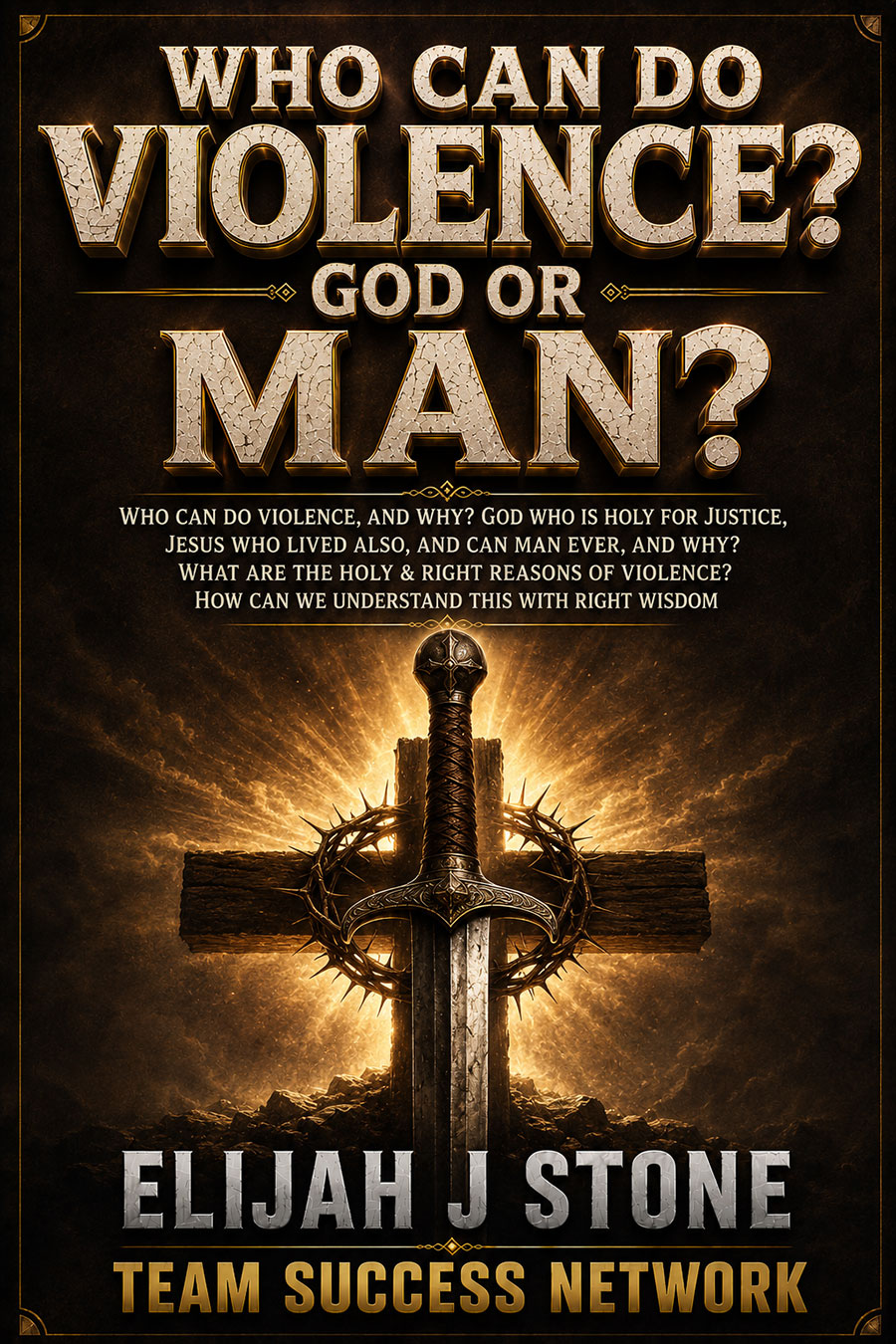
Book 80: Who Can Do Violence - God or Man?

Who
Can Do Violence? God or Man?
What Are The Holy & Right Reasons of Violence?
By Mr.
Elijah J Stone
and the Team Success Network
Table
of Contents
Preface – Here Is An Easy Way To Understand What The Book Is About.. 1
Chapter 1 – The God Who Acts with Justice......................................... 1
Chapter 2 – Understanding the Wrath of God....................................... 1
Chapter 3 – When Mercy and Judgment Meet..................................... 1
Chapter 4 – The Holy Pattern of Cleansing the Land.............................. 1
Chapter 5 – Jesus and the Temple Whip............................................... 1
Chapter 6 – The Cross: The Ultimate Act of Violence and Love............... 1
Chapter 7 – Violence in the Hands of the Holy...................................... 1
Chapter 8 – The Vengeance Belongs to God Alone................................ 1
Chapter 9 – When Angels Bring Destruction......................................... 1
Chapter 10 – The Judgment Day: Final Righteous Violence.................... 1
Chapter 11 – Man’s Desire for Power and Control................................. 1
Chapter 12 – Can a Man Be Just in Violence? ....................................... 1
Chapter 13 – The Warrior’s Burden: What Violence Does to the Soul..... 1
Chapter 14 – When Protection Becomes a Calling................................. 1
Chapter 15 – The Danger of Man’s Pride in Power................................ 1
Chapter 16 – The Sword and the Spirit: Two Forms of Strength............. 1
Chapter 17 – Lessons from the Old Testament Battles........................... 1
Chapter 18 – The Cost of Holy Judgment.............................................. 1
Chapter 19 – The Lamb and the Lion: Two Faces of Christ..................... 1
Chapter 20 – Redeeming Power: Turning Strength into Service.............. 1
Chapter 21 – Ever Since Jesus Died & Told Us To Turn The Other Cheek … As
Men, Should We Turn The Other Cheek? & Should We Do It Always?
......................................................................................................... 1
Chapter 22 – What To Do When Someone Breaks Into Your House & You Must
Protect Your Family? Can You Harm The Other If You Must, To Defend Your Family?
According to Jesus?......................................................................................................... 1
Chapter 23 – If You Must Defend, Choose Non-Lethal Ways to Disable the
Attacker, Right?......................................................................................................... 1
Chapter 24 – In Light of Defense, & Minimizing Damage to Others, What
Does God’s Word Say About Violence When in Danger?.................................................. 1
Chapter 25 – So Defend & Disarm & Be Good At It, & Also Don’t Hurt
The Attacker? And Prevent Harm To Those You Love? Is This Final Advice?......................... 1
Chapter 26 – What Is Jesus’ Vision For People In The Last Days – Regarding
Violence & How Jesus Wants Us All To Live With Each Other – Who Have Strong
Differences of Opinions?......................... 1
Chapter 27 – What Is Jesus’ Vision For People In The Last Days – Regarding
Violence – Using The Contrast Of The Days Of Noah – As An Example Of What We
Shouldn’t Do?.................................................. 1

Preface – Here Is An Easy Way To Understand
What The Book Is About
How Divine Power, Love, and Justice Intersect
in the Story of Humanity
Why Understanding God’s Heart Brings Peace to
a Violent World
The Simple
Picture: A Doctor, A Disease, And A Cure
Imagine a
world where every person carries an invisible sickness. The disease doesn’t
show up in their bodies—it lives inside their hearts. It causes anger, pride,
jealousy, and hate. It spreads through generations, passed down not through
blood, but through behavior. Everywhere you look, people are fighting, blaming,
and hurting each other.
Now
imagine a Doctor who loves every patient more than life itself. He has the
cure. But the cure requires more than medicine—it requires heart surgery. The
Doctor must cut away the infection, and sometimes that process looks painful.
Some reject Him, thinking the knife is meant to harm. Others submit, trusting
that His hands are steady and His purpose is healing.
That’s
what this book is about. God is that Doctor. Humanity carries the sickness of
sin. His justice is the surgery. His love is the anesthesia that keeps us safe
in the process. And His mercy is the recovery that restores life.
Every act
of divine judgment is not cruelty—it’s healing at the deepest level. Every
story of discipline is a glimpse of God’s determination to cleanse what would
otherwise destroy us.
When God
acts, even in violence, He’s not attacking life—He’s protecting it.
The Heart
Of The Message
To
understand God’s actions throughout history, we must first understand His
heart. The God of Scripture is not divided between love and wrath—He is love,
expressed through righteousness. His holiness demands justice because injustice
destroys what He loves.
“For the
Lord is righteous, He loves righteousness; His countenance beholds the
upright.” — Psalm 11:7
In the
pages that follow, you’ll see how divine power and moral order work together.
God’s “violence,” when it occurs, is never random—it is a holy reaction to
corruption. Like a surgeon removing a tumor, He cuts only to heal.
This is
not about a cruel deity venting anger. It’s about a holy Father defending His
creation. He cannot tolerate evil because evil poisons everything it touches.
His justice, then, becomes mercy in motion.
The whole
purpose of this message is simple: to show that God’s strength is love, and
His justice is compassion with a backbone.
The Key
Terms To Understand
Before you
journey through the rest of the chapters, here are the core terms that make
everything clear. These ideas repeat often, like the main notes in a song:
• Justice
– God setting things right. It’s not punishment for punishment’s sake; it’s
correction meant to restore balance.
• Wrath
– God’s passionate opposition to evil. It’s not hatred of people—it’s hatred of
what destroys people.
• Mercy
– God’s love reaching toward us even when we don’t deserve it. Mercy always
aims to restore.
• Holiness
– God’s pure nature. It’s why He can’t ignore sin, yet it’s also why His
forgiveness is perfect—He does everything without impurity or hidden motive.
• Violence
(Divine) – God’s decisive action to stop evil. Always moral. Always
controlled. Always redemptive.
• Peace
– The final goal of divine justice. Every act of judgment points toward this
outcome.
These
words are not contradictions; they are partners. Together they reveal a God who
is fierce in love and faithful in truth.
A Story Of
Fire That Purifies, Not Destroys
Think of
gold being refined in fire. The flame doesn’t come to harm the gold; it comes
to remove the impurities. If the gold could speak, it might cry out in pain,
thinking the fire was against it—but the truth is, the fire was for it all
along.
That’s how
God’s justice works. The fire isn’t meant to destroy humanity—it’s meant to
cleanse it. From the flood in Noah’s time to the final return of Christ, the
theme is consistent: God’s fire always purifies what He plans to preserve.
“He will
sit as a refiner and purifier of silver; He will purify the sons of Levi and
refine them like gold and silver.” — Malachi 3:3
In a world
filled with injustice, corruption, and pride, this truth changes everything. It
means that when God intervenes, even through judgment, He’s not giving up on
us—He’s bringing us back to Himself.
His
discipline is not rejection; it’s redemption in disguise.
What
Humanity Keeps Getting Wrong
People
often misunderstand divine power. Some see God’s strength and assume it means
cruelty. Others see His love and assume it means permissiveness. Both views
miss the truth. God is neither soft nor cruel—He is perfect.
He doesn’t
destroy out of frustration; He corrects out of purpose. The same hand that
parts the seas also wipes away tears. The same voice that commands storms also
whispers peace.
The
problem is not that God is inconsistent—it’s that humanity is impatient. We
want mercy for ourselves but justice for others. We celebrate God’s compassion
until He calls us to repent. In doing so, we fail to see that His justice is
love protecting the world from collapse.
Every act
of divine intervention in Scripture—whether cleansing the land, confronting the
proud, or correcting His people—was never random violence. It was love
enforcing righteousness.
“Whom the
Lord loves, He corrects, just as a father the son in whom he delights.” — Proverbs
3:12
The
Simplicity Of God’s Design
The
simplest way to understand everything is this: God is always restoring
order.
When chaos
enters, He calms it. When sin spreads, He cleanses it. When violence erupts, He
ends it. His actions, whether gentle or fierce, always point toward peace.
In the Old
Testament, He used floods, fire, and famine to confront evil. In the New
Testament, He used the cross. The method changed, but the mission didn’t—to
rescue creation from destruction.
The
crucifixion itself was both the greatest act of violence and the greatest act
of love. Jesus, the innocent Lamb, absorbed humanity’s wrath so that we could
receive God’s mercy. At Calvary, justice and grace shook hands.
That
moment defines the heart of this entire message: God’s power redeems; it
never ruins.
The
Invitation To Understand
For anyone
new to these ideas, here’s the most comforting truth: God does not want to
scare you—He wants to save you. He doesn’t want you to fear His might; He wants
you to trust His motive.
The same
God who commanded armies also washed feet. The same God who judged nations also
forgave sinners. His actions differ, but His heart never changes. Every story
of Scripture—from the flood to the cross to the final judgment—is one long
story of rescue.
When we
see violence through human eyes, it looks chaotic. But when we see it through
divine eyes, it looks like surgery—removing what’s killing us so that life can
flourish again.
God’s
heart, even in judgment, beats with compassion.
“The Lord
is merciful and gracious, slow to anger and abounding in mercy.” — Psalm
103:8
Key Truth
God’s
justice is not the opposite of His love—it is the proof of it. He intervenes
because He cares too much to stay silent while evil spreads. Every act of
divine correction is a declaration that holiness still matters, that goodness
still wins, and that mercy will have the final word.
When we
understand this, fear turns to trust. Judgment stops sounding like doom and
starts sounding like deliverance.
The same
fire that burns away evil warms the hearts of the faithful.
Summary
This
entire message is about seeing God as He truly is: a holy, loving, and
righteous King who acts not from rage, but from perfect wisdom. He cleanses to
protect. He disciplines to redeem. He commands not to control, but to guide
creation back into harmony.
If the
world’s violence reveals our sin, then God’s justice reveals His salvation. His
love is not fragile—it’s fierce enough to fight for us, even when we resist.
This book
is about that love—the kind that cuts to heal, disciplines to restore, and
ultimately triumphs through peace.
And once
you see that clearly, everything else about life, faith, and justice will
finally make sense.

Chapter 1 – The God Who Acts with Justice
Understanding Divine Justice as the Expression
of Perfect Love
Why God’s Power Is Always Redemptive, Never
Reckless
The Nature
Of God’s Justice
God’s
justice flows from His holiness—it is who He is, not just what He does. Every
action He takes carries perfect moral order and divine intention. When He
judges, He is not reacting in rage; He is restoring righteousness.
Unlike
human anger, divine justice is never impulsive. It is the full expression of
love confronting evil. When God acts decisively, it is always for the
preservation of what is good and pure. His justice protects the very
creation His love sustains.
“Righteousness
and justice are the foundation of Your throne; mercy and truth go before Your
face.” — Psalm 89:14
God’s
justice forms the moral backbone of the universe. Every star, law, and
heartbeat continues in harmony because He upholds it. When that harmony is
broken by sin, His justice steps in—not to destroy life, but to defend it.
Justice As
The Guardian Of Love
Many see
judgment as the opposite of love, but in truth, it is love’s defender. God’s
justice exists because His love refuses to allow evil to triumph. Every
judgment throughout history, from the flood to the cross, was an act of mercy
disguised as correction.
Love
without justice would tolerate wickedness, but justice without love would be
cruel. In God, both are perfectly united. He acts not to punish blindly, but to
protect the innocent and restore truth. Every divine act of violence is a
rescue mission in disguise.
“For the
Lord is righteous, He loves justice; the upright will see His face.” — Psalm
11:7
When He
sent the flood in Noah’s time, it was not an impulsive act of anger—it was
divine surgery. Evil had so infected humanity that only a reset could preserve
the promise of redemption. Justice became love in action.
The
Pattern Of Divine Cleansing
Throughout
Scripture, we see a pattern: when corruption spreads, God intervenes. His
intervention may appear violent, but it is always restorative. Like a surgeon
removing a deadly tumor, He uses holy precision to preserve life.
Sodom and
Gomorrah fell not because God hated people, but because wickedness had consumed
every moral foundation. His fire was not meant to annihilate, but to
cauterize—a cleansing judgment to prevent deeper ruin.
This
reveals the consistency of God’s character. He doesn’t change His standards
with emotion or convenience. Holiness demands purity, and purity demands
cleansing. Every act of divine judgment carries the same message: sin cannot
stay where life is meant to flourish.
“For the
Lord your God is a consuming fire, a jealous God.” — Deuteronomy 4:24
God’s
jealousy is not petty—it is protective. He is jealous for righteousness, for
truth, for His people’s hearts. His justice burns against everything that tries
to steal them away.
Holiness
And Judgment Are One
To
separate God’s holiness from His justice is to misunderstand His nature.
Holiness is what He is; justice is how that holiness responds to evil. He
cannot overlook sin because it violates His essence. Every act of judgment in
Scripture is the holiness of God confronting moral rebellion.
This is
why divine justice must sometimes take violent form. Evil will never leave
voluntarily—it must be driven out. Yet even in judgment, God’s motive is
restoration. He desires repentance, not ruin. Every strike of divine
correction echoes an invitation to return to Him.
“The Lord
is slow to anger and great in power, and will not at all acquit the wicked.” — Nahum
1:3
This verse
holds both comfort and caution. God’s slowness to anger reveals patience; His
refusal to acquit shows His integrity. Holiness never compromises truth, even
while offering grace.
Justice
And The Cross
The
greatest expression of God’s justice was the cross of Jesus Christ. At Calvary,
divine wrath and divine mercy met perfectly. Sin demanded judgment, but love
demanded redemption. The Son of God absorbed both.
What
humanity deserved, Christ endured. What holiness required, love fulfilled. The
violence of the cross was not an act of cruelty—it was the ultimate act of
justice. Sin was condemned, and sinners were offered mercy. At the cross,
God’s justice didn’t cancel love—it completed it.
“But God
demonstrates His own love toward us, in that while we were still sinners,
Christ died for us.” — Romans 5:8
To the
natural mind, the crucifixion looks like defeat. But in the spiritual realm, it
was victory—justice satisfied, mercy magnified, righteousness restored. Divine
justice became divine redemption.
Justice
That Heals, Not Hurts
God’s
justice is always corrective, never chaotic. It aims to bring balance to what
sin has disrupted. When He judges nations, individuals, or even the earth
itself, His purpose is renewal, not revenge.
Just as
discipline molds a child, divine judgment refines humanity. The fire of God is
not meant to destroy—it’s meant to purify. The difference between punishment
and purification lies in purpose. One seeks to harm; the other seeks to heal.
When
viewed through love’s lens, every act of divine force becomes an act of divine
care. The hand that strikes in judgment is the same hand that rebuilds in
mercy.
“He has
shown you, O man, what is good; and what does the Lord require of you but to do
justly, to love mercy, and to walk humbly with your God?” — Micah 6:8
This verse
sums up God’s entire justice system: mercy and humility balanced by truth and
righteousness.
Key Truth
God’s
justice is not His anger—it is His love protecting creation. Every act of
divine power is an act of moral repair. Holiness cannot remain silent while
evil destroys life. His judgments are not cruel—they are compassionate
corrections to preserve eternal order.
When God
acts, He acts to heal. His justice is the rhythm of heaven enforcing truth on
earth. Understanding this changes how we see His actions—He is not a God of
destruction, but a God of restoration.
Summary
God’s
justice is love in motion. It flows from His holiness, fueled by compassion,
guided by truth. The flood, the fire, and even the cross all reveal a God who
confronts evil not to annihilate humanity, but to rescue it.
For those
learning His ways, this is the foundation of trust. When God corrects, it is
for our good. When He judges, it is for redemption. When He uses power, it is
always with purpose.
His
justice keeps creation from collapse. His love keeps judgment from cruelty. And
together, they reveal the most beautiful truth of all: God’s justice is the
heartbeat of His holiness—and His holiness is the heartbeat of His love.

Chapter 2 – Understanding the Wrath of God
Seeing God’s Wrath as Holy Love in Action
Why God’s Anger Is Always Controlled,
Purposeful, and Redemptive
The
Misunderstanding Of Wrath
When most
people hear the word “wrath,” they imagine explosive rage—an uncontrolled
outburst of anger. But that is not who God is. Divine wrath is not human fury;
it is perfect holiness reacting to the cancer of sin. It is love that refuses
to remain silent while evil destroys what is precious.
God’s
wrath and His love are not opposites—they are two sides of the same coin. The
very reason He gets angry is because He cares so deeply. His wrath is the
fire of His love burning against everything that harms His creation. He
does not lose control; He exercises control to restore what sin has corrupted.
“For the
wrath of God is revealed from heaven against all ungodliness and
unrighteousness of men.” — Romans 1:18
God’s
anger is never random. It is moral, intelligent, and exact. His wrath is not
emotional instability—it is divine stability. It arises from His unwavering
commitment to justice and His refusal to allow evil to thrive unchecked.
The Wrath
That Comes From Love
Every
parent who loves their child knows what righteous anger feels like. When harm
threatens that child, love reacts with protective force. God’s wrath functions
the same way—it is His love in defense of what He cherishes most: truth,
purity, and people.
The Bible
consistently links God’s anger to His compassion. The greater His love, the
more fiercely He opposes what destroys it. Wrath is not a contradiction to
love; it is its strongest ally. Without divine wrath, love would be sentimental
and powerless.
“The Lord
is gracious and merciful, slow to anger and abounding in steadfast love.” — Psalm
145:8
Notice how
Scripture always pairs God’s anger with patience. He delays wrath to give space
for repentance, but when repentance is rejected, holiness must act. That’s not
cruelty—it’s consistency. His wrath ensures that justice does not fade with
time.
Wrath As
The Refiner’s Fire
God’s
wrath purifies. It’s not just punishment—it’s refinement. Like gold tested in
fire, His judgments burn away the impurities of rebellion to make room for
redemption. Every act of divine anger has always carried this hidden intention:
cleansing, not condemnation.
The flood
in Noah’s day washed away corruption so that life could begin anew. Israel’s
exile broke the chains of idolatry and birthed a renewed nation. Even when God
disciplines, He does it to heal. Wrath, in the hands of holiness, becomes an
instrument of renewal.
“For whom
the Lord loves He corrects, just as a father the son in whom he delights.” — Proverbs
3:12
God’s
correction proves His love. If He did not care, He would allow sin to run
unchecked. His wrath reveals His refusal to abandon His people to the
consequences of their own rebellion. It is the passionate pursuit of
restoration, not rejection.
Controlled,
Not Chaotic
Human
anger is easily corrupted by pride and emotion. But God’s anger is perfectly
measured, entirely self-controlled, and always morally justified. His wrath
never overreaches—it strikes precisely at what deserves judgment.
He does
not lash out in impatience. He calculates, waits, and gives opportunity after
opportunity for repentance. Yet when sin becomes defiant and destructive, His
holiness cannot remain silent. Divine patience eventually gives way to divine
precision.
“The Lord
is slow to anger, and great in power, and will not at all acquit the wicked.” —
Nahum 1:3
This verse
reveals God’s balance. He is slow to anger—that’s mercy. But He will not acquit
the guilty—that’s justice. His character never shifts depending on
circumstances; His anger and His love both serve the same eternal truth:
righteousness must reign.
For the
believer, this brings peace. It means the universe is not governed by mood
swings but by moral integrity. God’s emotions never rule Him—His holiness does.
The Cross:
Wrath And Love United
Nowhere do
we see God’s wrath and love meet more clearly than at the cross of Christ. On
that day, divine justice and divine mercy collided in perfect harmony. Sin
demanded punishment, but love provided the substitute. Jesus absorbed the wrath
of God so that sinners could receive the mercy of God.
This
wasn’t divine cruelty—it was divine compassion. The Son willingly bore judgment
so that mankind could go free. The wrath that should have fallen on us fell
upon Him. That is not violence born of hate—it is sacrifice born of grace.
“He
Himself bore our sins in His body on the tree, that we might die to sin and
live to righteousness.” — 1 Peter 2:24
The cross
reveals that wrath is not about destruction—it’s about deliverance. God’s
justice was satisfied so His mercy could flow freely. Wrath became redemption,
and punishment became peace.
For anyone
new to faith, this changes everything. God’s anger is not against you—it’s
against what’s hurting you. Jesus absorbed that wrath so you could be restored
to love.
When Wrath
Becomes Redemption
God’s
wrath is never the end of the story—it is always the beginning of restoration.
Every time He brings judgment, He leaves a door open for repentance. That door
is grace. Wrath clears the way for mercy to rebuild what sin has ruined.
Think of
how He judged Egypt but delivered Israel. Think of how He judged sin at the
cross but offered salvation to the world. Divine wrath never cancels God’s
plan—it fulfills it. Wrath is God’s declaration that evil will not win and
that holiness will always prevail.
This truth
brings hope, not fear. We can rest knowing that injustice will not last
forever. God’s wrath ensures that corruption has an expiration date.
“For His
anger is but for a moment, His favor is for life; weeping may endure for a
night, but joy comes in the morning.” — Psalm 30:5
Even His
wrath is temporary; His love is eternal. He strikes only long enough to heal.
Key Truth
God’s
wrath is not rage—it is righteous resistance to evil. His anger burns only
where His love is threatened. When He judges, He is not venting emotion; He is
defending creation. The wrath of God is His holiness demanding that evil cannot
coexist with love.
Wrath and
mercy are not rivals—they are partners in redemption. God’s anger clears the
way for healing, just as fire clears the forest for new growth. The more deeply
we understand His wrath, the more deeply we trust His love.
Summary
God’s
wrath reveals His unchanging moral perfection. It is controlled, pure, and
purposeful—never impulsive, never unjust. From Noah’s flood to Christ’s cross,
divine wrath has always carried the same message: evil will be defeated, and
love will prevail.
Every
judgment in Scripture points toward hope. The flood led to a new world. The
exile led to a new people. The cross led to a new covenant. Wrath always gives
way to renewal.
For
believers, this truth is freeing. God’s wrath is not the mark of an angry
deity—it is the proof of a loving one. His wrath is the fire of His love,
purifying the world until only righteousness remains.

Chapter 3 – When Mercy and Judgment Meet
How God Balances Justice with Compassion
Perfectly
Why Divine Correction Always Carries a Doorway
of Hope
The Unity
Of Mercy And Judgment
In the
heart of God, mercy and judgment are never at war. They flow from the same holy
source and serve the same redemptive purpose. What seems like contradiction to
the human mind is perfect harmony in the divine nature. Mercy and judgment
are partners—one heals, the other purifies.
When God
acts in judgment, He is not abandoning mercy. And when He extends mercy, He
never violates justice. He does both because He is both—holy and compassionate,
righteous and loving. His holiness demands truth; His heart provides grace.
“Mercy and
truth have met together; righteousness and peace have kissed.” — Psalm 85:10
This
single verse captures the entire balance of God’s character. He doesn’t choose
between mercy or justice—He fulfills both simultaneously. His correction and
compassion are never separate; they are perfectly timed responses that lead to
restoration.
Mercy
Inside Judgment
When God
judged Israel for their rebellion, His discipline was never about
destruction—it was always about drawing them back. The captivity in Babylon,
though painful, purified their hearts and freed them from idolatry. Divine
judgment became a refining fire that burned away rebellion and restored
intimacy.
Every time
God disciplined His people, He left a thread of mercy woven into the story. He
never destroyed without preserving a remnant. Even in wrath, He remembered
compassion. His hand that struck was the same hand that healed.
“For I
will not contend forever, nor will I always be angry; for the spirit would fail
before Me.” — Isaiah 57:16
God knows
human frailty. His judgments are never endless; they are precise, limited, and
restorative. Judgment without mercy would crush us. Mercy without judgment
would enable sin. But together, they produce redemption and holiness that last
forever.
The
Healing Process Of Divine Balance
When sin
infects the human heart, God responds like the Great Physician. Judgment
removes the infection; mercy heals the wound. Without both, the soul cannot
recover. His justice cuts away corruption, and His mercy fills the space with
grace.
In this
divine pattern, every act of discipline becomes a form of love. God corrects
because He desires restoration, not revenge. He confronts sin not to shame us
but to set us free from it. His justice makes us clean; His mercy makes us
whole.
“Whom the
Lord loves He chastens, and scourges every son whom He receives.” — Hebrews
12:6
Those who
understand this truth stop fearing God’s correction and start trusting it. His
discipline is proof that He values us too much to leave us broken. Mercy and
judgment together are not punishment—they are protection.
The Cross:
Where Justice And Mercy Met Eternally
The
clearest expression of this divine partnership is found at the cross of Christ.
There, judgment and mercy collided with full force—and both were satisfied.
Justice demanded that sin be punished. Mercy desired that sinners be forgiven.
The cross became the meeting place of both desires.
At
Calvary, the wrath of God fell on Jesus so that the mercy of God could fall on
us. Sin was condemned without the sinner being destroyed. The justice of
heaven and the compassion of the Father embraced perfectly on that wooden beam.
“Surely He
has borne our griefs and carried our sorrows... He was wounded for our
transgressions, He was bruised for our iniquities.” — Isaiah 53:4–5
This
moment defines all of history. Divine love satisfied divine law. The penalty of
sin was paid in full, and grace became available for all. What looked like
violence became salvation. What looked like defeat became victory.
Mercy That
Follows Judgment
After
judgment always comes grace. This pattern is seen repeatedly through Scripture.
After the flood, God placed a rainbow in the sky. After exile, He restored
Israel’s land. After the crucifixion, He brought resurrection. God never ends a
story in wrath—He always ends it in mercy.
His wrath
clears the ground so that mercy can plant new life. The storm makes way for
sunshine; the fire prepares the soil for growth. This is the rhythm of
redemption. Judgment is temporary, but mercy is eternal.
“For His
anger is but for a moment, His favor is for life.” — Psalm 30:5
To the
beginner, this reveals the beauty of God’s constancy. He never judges without
purpose, and He never corrects without compassion. His ultimate goal is always
restoration. The end of judgment is not destruction—it is renewal.
Why God’s
Balance Is Perfect
Human
beings struggle to balance justice and mercy. We either lean toward harshness
or excessive leniency. But God’s justice is untainted by emotion, and His mercy
is uncorrupted by compromise. He never shows mercy at the expense of truth, nor
justice at the expense of love.
In His
wisdom, every decision He makes aligns perfectly with His eternal nature. He
cannot be more merciful than He is just, nor more just than He is merciful.
Both qualities are equal, eternal, and inseparable.
“The Lord
is good; His mercy is everlasting, and His truth endures to all generations.” —
Psalm 100:5
For those
learning His ways, this truth builds trust. God will never act unfairly or
unjustly. His mercy softens His judgments, and His judgments give meaning to
His mercy. The same heart that corrects is the heart that forgives.
The
Outcome Of Divine Balance
When
believers understand this harmony, they find peace even in correction. No
longer do they fear God’s discipline as rejection. They see it as love’s
highest form of intervention. His justice keeps us from drifting, and His mercy
keeps us from despair.
This
balance transforms how we live. We begin to reflect it in how we treat
others—firm but compassionate, truthful yet gracious. Mercy without judgment
breeds weakness; judgment without mercy breeds cruelty. The image of God within
us matures only when both work together.
Divine
justice shapes our convictions; divine mercy softens our hearts. Together, they
produce the Christlike character that reveals God’s glory on earth.
Key Truth
God’s
justice and mercy are not enemies—they are eternal allies working toward
redemption. When He corrects, He loves. When He forgives, He still honors
truth. The two cannot be separated because they both flow from holiness.
At the
cross, mercy and judgment met forever. God’s wrath was satisfied; His grace was
released. That union remains the foundation of salvation. The same God who
disciplines you is the One who embraces you afterward. His goal is always
restoration.
Summary
Mercy and
judgment are not competing forces in heaven—they are the unified expression of
a perfect God. His discipline never aims to destroy; it aims to heal. His mercy
never denies justice; it fulfills it.
From the
Old Testament to the cross, God has shown that love corrects and grace
restores. He judges to purify, and He forgives to renew. Both are necessary for
holiness to dwell among humanity.
For every
believer, this truth offers profound comfort. When God confronts sin, it is
because He longs to bring freedom. When He shows mercy, it is because He
already bore the judgment. In His presence, mercy and justice walk hand in
hand—and together, they lead us home.

Chapter 4 – The Holy Pattern of Cleansing the
Land
How God Purifies What Has Been Defiled
Why Divine Cleansing Is Not Destruction But
Renewal
The
Purpose Of Divine Cleansing
Throughout
history, God has acted to cleanse what sin has corrupted. These moments often
appear violent, but they are never random—they are deliberate acts of
restoration. When wickedness infects a people, a nation, or even the earth
itself, holiness demands intervention. God’s cleansing is not punishment for
the sake of pain—it is purification for the sake of preservation.
The Bible
is filled with examples where God’s justice took the form of cleansing. He did
not strike because He hated; He struck because He loved too much to let decay
continue unchecked. What seems severe in human eyes is mercy in divine
perspective—a holy decision to stop what would destroy life itself.
“The Lord
saw that the wickedness of man was great in the earth… and the Lord said, ‘I
will blot out man whom I have created.’” — Genesis 6:5,7
God’s
justice is not reactionary—it is protective. His holiness cannot coexist with
corruption because holiness sustains life while sin breeds death. Cleansing,
therefore, becomes a necessary act of divine maintenance for creation.
The Flood
As Divine Renewal
The story
of Noah’s flood perfectly illustrates this principle. The world had become
filled with violence and moral chaos. Humanity was spiraling toward
self-destruction, and God, in His mercy, intervened through judgment. The flood
was not about annihilation—it was about new beginnings.
God spared
Noah, a righteous man, to preserve the possibility of redemption. He washed the
earth clean of pervasive wickedness and started anew with a family that feared
Him. The waters that destroyed also purified; the same waves that drowned evil
lifted the ark of salvation.
“But Noah
found grace in the eyes of the Lord.” — Genesis 6:8
This
pattern reveals God’s heart: judgment always travels alongside grace. His wrath
never moves without His mercy following close behind. Even when He cleanses the
earth, He preserves a remnant through which His promise continues.
The flood
teaches us that divine cleansing is not the end—it’s the preparation for a
better beginning.
The
Cleansing Of The Land Of Canaan
When
Israel entered the Promised Land, God commanded them to drive out the nations
steeped in idolatry and moral corruption. These wars were not for territorial
gain or power—they were acts of divine cleansing. The Canaanite culture had
become consumed by child sacrifice, ritual prostitution, and deep spiritual
perversion. God was restoring sacred order.
“You shall
destroy their altars, break their sacred pillars, and cut down their wooden
images.” — Exodus 34:13
From a
human view, such commands may seem harsh. But from heaven’s view, they were
acts of mercy for future generations. God was not teaching Israel violence—He
was teaching separation. Holiness cannot flourish in the soil of compromise.
Through
these cleansings, God was preserving the covenant people who would carry the
line of the Messiah. His command was not rooted in cruelty but in foresight. He
was removing what would one day destroy His people spiritually and morally.
The
Principle Of Separation
Divine
cleansing always involves separation. God divides the pure from the impure, the
holy from the corrupt. He does not blend righteousness with rebellion; He
distinguishes them to protect life. Separation is not rejection—it’s
preservation of holiness within a fallen world.
This
principle was seen from the beginning. God separated light from darkness,
waters from land, Israel from Egypt, and the righteous from the wicked. Each
act of division was not hostility—it was healing. Cleansing is the divine
act of drawing boundaries where sin has blurred the lines.
“Therefore
come out from among them and be separate, says the Lord. Do not touch what is
unclean, and I will receive you.” — 2 Corinthians 6:17
For the
believer, this means God sometimes cleanses by calling us to leave behind what
contaminates our hearts. He severs attachments, habits, and environments that
lead to decay. Though painful, it is divine love at work.
The
Cleansing Within The Heart
Just as
God cleansed the land, He also cleanses the hearts of His people. Spiritual
cleansing follows the same pattern as physical or national cleansing—something
must be removed for life to thrive. This removal often hurts, but it heals far
deeper than it wounds.
When God
begins to purify a person, He exposes hidden corruption, brings conviction, and
invites repentance. He uproots bitterness, pride, and sin that choke spiritual
growth. It feels uncomfortable, but it is the mercy of holiness doing surgery
on the soul.
“Create in
me a clean heart, O God, and renew a steadfast spirit within me.” — Psalm
51:10
David
prayed these words after his sin with Bathsheba, showing that cleansing is not
condemnation—it’s restoration. God’s cleansing work renews the mind,
strengthens the spirit, and restores intimacy with Him.
For new
believers, this process explains why repentance sometimes feels painful—it’s
because something unholy is being removed so that holiness can breathe again.
When
Cleansing Looks Like Loss
Cleansing
often comes disguised as loss. Relationships end. Opportunities fade. Comforts
vanish. Yet what feels like loss is often God removing what cannot stay in a
life destined for purity. The same God who floods the earth also builds an ark
of deliverance for those who trust Him.
Every
divine removal has redemptive purpose. God never takes away without intending
to replace it with something better—cleaner, holier, more aligned with His
will. Cleansing is the mercy that makes room for the next miracle.
“Every
branch that bears fruit He prunes, that it may bear more fruit.” — John 15:2
Pruning
hurts, but it multiplies life. It is not punishment—it is preparation. God’s
cleansing is pruning on a divine scale, cutting away what cannot survive in His
presence so that abundance can return.
Cleansing
As Protection For The Future
When God
cleanses, He’s not just dealing with the present—He’s protecting the future.
Every act of divine purification safeguards generations to come. His justice
acts as a shield for tomorrow’s righteousness.
The flood
protected future humanity from self-destruction. The conquest of Canaan
protected Israel’s spiritual inheritance. The cross protected eternity itself. God’s
cleansing always secures what sin would otherwise destroy.
This truth
shows His fatherly foresight. Just as a parent disinfects a wound to prevent
infection, God purges what could spread harm. His holiness is the immune system
of creation, defending life through moral precision.
Key Truth
Cleansing
is not cruelty—it is compassion in its purest form. When God removes, it is to
renew. When He purges, it is to protect. His acts of judgment are acts of mercy
aimed at preserving the world from complete collapse.
Whether
through the flood, the exile, or the personal pruning of your heart, God’s goal
is the same: to restore purity so that life can flourish. His cleansing
cuts deep, but it always heals. The holy pattern of divine cleansing proves
that His justice is love wearing armor.
Summary
Divine
cleansing is the rhythm of redemption—remove, restore, renew. From the
floodwaters of Noah to the cross of Christ, God has shown that judgment is
never random and cleansing is never cruel. His holiness demands separation from
sin because sin destroys life.
In your
own walk, cleansing may come through conviction, correction, or change. Don’t
resist it—embrace it. What God removes, He replaces with something far better. Cleansing
is not the end of your story; it is the beginning of your renewal.
God’s
holiness does not destroy life—it defends it. Every divine act of purification,
whether global or personal, points to this truth: the fire that burns away
sin is the same fire that lights the path to new creation.

Chapter 5 – Jesus and the Temple Whip
How Righteous Anger Reveals the Fierce Love of
God
Why True Holiness Is Willing to Confront
Corruption
The Moment
Holiness Took Action
When Jesus
entered the temple courts and saw money changers turning worship into business,
something holy rose within Him. The house of prayer had become a market of
greed. In that instant, love could no longer stay silent. The holiness of
God took form in the fury of the Son.
Jesus made
a whip of cords and drove out those who sold and cheated. He overturned tables,
scattered coins, and confronted a system that defiled His Father’s presence.
This was not rage—it was righteousness. His anger was not emotional chaos; it
was divine order being restored.
“Then
Jesus went into the temple of God and drove out all those who bought and sold
in the temple… and said to them, ‘My house shall be called a house of prayer,
but you have made it a den of thieves.’” — Matthew 21:12–13
In this
act, Jesus revealed that true holiness is not passive. It acts when injustice
desecrates what is sacred. Love, when pure, will always rise to defend the
presence of God.
Anger That
Flows From Love
The world
often confuses anger with sin. But in Jesus, anger was sanctified—it flowed
from purity, not pride. His wrath was not against people but against the
corruption that enslaved them. He didn’t strike flesh; He struck systems. His
confrontation was an act of love aimed at deliverance, not destruction.
Holy anger
is love in its most protective form. It refuses to allow evil to go
unchallenged. The temple was meant to be a place of worship, yet it had become
a place of exploitation. Righteous anger defends what love values most.
“Be angry,
and do not sin.” — Ephesians 4:26
This
scripture proves that anger is not the problem—it’s what you do with it that
determines righteousness. Jesus’ anger was not reactive; it was redemptive. He
didn’t lose control; He used control to restore divine respect.
When love
sees injustice, it must respond. Holy anger is not hatred—it is the refusal to
tolerate what harms the innocent and dishonors God.
The
Misunderstood Nature Of Meekness
To many
believers, Jesus’ actions may seem out of character—wasn’t He gentle, kind, and
meek? Yes, but meekness does not mean weakness. It means controlled strength
under submission to God. Meekness is power with restraint, authority with
humility, and courage under divine command.
In the
temple, Jesus demonstrated the full picture of meekness. He didn’t lose His
temper; He used His authority. Every move was intentional. His confrontation
was not for self-defense—it was for the defense of holiness.
“Take My
yoke upon you and learn from Me, for I am gentle and lowly in heart.” — Matthew
11:29
Even in
gentleness, Jesus was strong. The same Savior who healed the broken also
confronted the corrupt. The same voice that calmed storms also silenced
hypocrisy. Meekness does not avoid conflict—it engages it with wisdom and peace
in the heart.
True
meekness stands up for what is right, not out of pride but out of love for
truth.
The Whip
As A Symbol Of Cleansing
The whip
in Jesus’ hands symbolized divine authority. It was not a weapon of cruelty but
an instrument of correction. The temple had become polluted with greed, and the
only response to corruption that deep was decisive purification. Jesus’ actions
fulfilled prophetic Scripture and revealed His zeal for His Father’s glory.
“Zeal for
Your house has eaten Me up.” — John 2:17
This zeal
was not emotional fervor—it was the burning desire of holiness to reclaim
sacred ground. The whip cleared space for worship, not violence. It removed
barriers so that hearts could again approach God in sincerity.
Jesus’
cleansing of the temple mirrors God’s pattern throughout history: judgment to
restore, correction to cleanse, confrontation to heal. His righteous act made
the temple fit again for prayer. Holiness always confronts what hinders
intimacy with God.
Confronting
Corruption In Holy Spaces
This story
teaches that not all confrontation is unholy. There are moments when silence
becomes sin. When God’s truth is mocked or His presence disrespected,
righteousness must speak.
The temple
scene exposes how religious structures can become distorted when money, power,
or pride replaces purity. Jesus didn’t confront pagans—He confronted those who
claimed to serve God. That’s the most sobering truth: sometimes the cleansing
must begin within the house of worship itself.
“For the
time has come for judgment to begin at the house of God.” — 1 Peter 4:17
Jesus’
actions remind us that holiness demands integrity in every layer of faith.
Religion without purity becomes a performance. Faith without reverence becomes
empty. God’s anger toward hypocrisy is not cruelty—it’s love defending
authenticity.
When the
church, the believer, or the heart itself becomes polluted, Jesus still enters
with authority. He overturns what does not belong. He drives out what
desecrates. His whip still cleanses—but His hands still heal.
Righteous
Confrontation That Restores
Jesus’
cleansing of the temple was not the end of His ministry—it was a beginning.
After He drove out corruption, the blind and the lame came to Him, and He
healed them. Judgment created space for mercy. Once evil was expelled, grace
could flow freely.
“Then the
blind and the lame came to Him in the temple, and He healed them.” — Matthew
21:14
This
sequence is divine design: confrontation first, then restoration. Holiness
always clears the ground before planting healing. Jesus’ righteous anger opened
the way for compassion. His confrontation did not destroy worship—it revived
it.
For
believers, this truth is vital: when God removes something forcefully, it’s
because He intends to fill that space with His presence. The whip makes way
for healing.
Holy
confrontation is love in motion. It doesn’t avoid hard truth; it delivers it
with divine purpose. Every table overturned by God’s hand is an invitation to
rebuild on purity.
The
Courage To Defend The Sacred
This
moment in Jesus’ life shows that courage and compassion coexist perfectly in
Him. He was fearless because He was pure. Sin fears exposure, but holiness
fears nothing. When love fuels courage, truth becomes unstoppable.
Many today
avoid confrontation to keep peace, but peace without truth is just quiet
compromise. Jesus didn’t come to maintain false harmony—He came to
establish righteousness. His boldness teaches us that holiness sometimes looks
like disruption before it looks like peace.
Righteous
anger must always be rooted in God’s heart. It’s not about personal offense but
about spiritual defense. When guided by love, even confrontation becomes holy.
“Blessed
are those who hunger and thirst for righteousness, for they shall be filled.” —
Matthew 5:6
Those who
truly hunger for righteousness will sometimes find themselves flipping
tables—not to hurt, but to heal.
Key Truth
The temple
whip was not a weapon—it was a wake-up call. Jesus’ anger was sacred because it
was controlled by love. His confrontation revealed that holiness cannot remain
silent when sacred spaces are defiled.
Meekness
is not passivity—it’s purity with purpose. True love defends what is holy,
even when it means standing alone. The temple cleansing was not about
violence; it was about vision—restoring God’s house to the place of prayer it
was meant to be.
Summary
Jesus’
cleansing of the temple reveals the fierce, protective side of divine love. His
anger was not sinful; it was sacred. His whip was not cruel; it was corrective.
Through confrontation, He restored purity to worship and reminded all that
reverence is not optional—it’s holy ground.
Every
believer must learn this balance: love that comforts and love that confronts.
Holiness is never timid when truth is at stake. When guided by the Spirit, even
anger becomes redemptive.
Godly
anger restores; human anger retaliates. The difference lies in motive and
control. Jesus’ example teaches us that holiness is not silent when truth is
trampled—and that real love is brave enough to turn over tables for the glory
of God.

Chapter 6 – The Cross: The Ultimate Act of
Violence and Love
How God Turned Humanity’s Cruelty Into Eternal
Redemption
Why The Cross Reveals That Holiness and Love
Are One
The
Greatest Paradox In History
The
crucifixion of Jesus Christ stands as the most profound paradox ever witnessed:
a violent death that gave birth to eternal life. On that day, humanity’s hatred
collided with God’s holiness, and divine love triumphed over the darkest act of
cruelty. The cross was not a tragedy of defeat—it was the masterpiece of
redemption.
When nails
pierced His hands, and thorns pressed into His brow, the blood that flowed was
not a symbol of weakness—it was the ink of salvation. What the world saw as
destruction, heaven saw as deliverance. The violence meant to silence love
became the very act that shouted grace across eternity.
“But God
demonstrates His own love toward us, in that while we were still sinners,
Christ died for us.” — Romans 5:8
The cross
reveals that God did not avoid violence—He absorbed it. He took upon Himself
the full weight of human sin, wrath, and injustice, transforming judgment into
redemption.
When
Justice And Mercy Collided
At the
cross, divine justice and divine mercy met face to face. Justice demanded
payment for sin. Mercy desired restoration for the sinner. In one breathtaking
act, both were satisfied. Jesus became the bridge between holiness and
humanity.
Every lash
of the whip, every drop of blood, every breath He took on that cross fulfilled
both judgment and grace. It was God’s justice being executed upon Himself so
that mercy could be extended to us. The wrath that sin deserved was poured
out, and the grace that love promised was poured in.
“He
Himself bore our sins in His body on the tree, that we might die to sin and
live to righteousness.” — 1 Peter 2:24
For new
believers, this is the core of the gospel: God’s holiness did not compromise
His love—He fulfilled both through sacrifice. The cross was not God punishing
an innocent man; it was God Himself taking the punishment to set the guilty
free.
The
Violence That Redeemed The World
The
crucifixion was one of the most brutal deaths ever devised. Yet within that
brutality, heaven orchestrated the greatest act of love. What looked like chaos
to men was divine choreography from eternity past.
Each wound
carried prophetic meaning. The crown of thorns bore humanity’s curse from Eden.
The nails symbolized our bondage to sin. The spear that pierced His side
revealed a fountain of blood and water—redemption and cleansing, side by side. Violence
became the instrument of salvation, not destruction.
“And they
shall look on Him whom they pierced.” — Zechariah 12:10
The cross
shows us that God doesn’t run from the ugliness of sin—He enters it, conquers
it, and transforms it. It was through pain that He birthed peace, through death
that He brought life, and through suffering that He offered healing.
The
message of the cross is not “avoid suffering,” but “trust the One who redeems
it.”
The Lamb
That Took Our Place
From the
beginning of time, God prepared a sacrifice that would satisfy His justice once
and for all. The blood of lambs in the Old Testament was only a shadow of what
would come. Jesus became the perfect Lamb of God—sinless, pure, and willing.
He did not
resist the cross. He embraced it. His silence before His accusers revealed His
strength, not His weakness. The Lamb of God willingly became the substitute
for all humanity’s sin, bearing wrath so that mercy could reign.
“Behold!
The Lamb of God who takes away the sin of the world!” — John 1:29
Every
sacrifice before Him pointed forward; every act of mercy after Him points back.
The Lamb once slain became the eternal King who reigns. His death was not a
defeat—it was the coronation of love.
Through
His surrender, Jesus demonstrated the greatest truth: divine power is not
proven by domination, but by self-giving love.
The Cross
As God’s Justice Revealed
The cross
was God’s answer to the moral crisis of sin. His holiness could not overlook
rebellion, but His heart could not abandon the rebel. Only one solution
satisfied both His justice and His compassion—substitution. The innocent died
for the guilty, and the guilty were made righteous by grace.
This was
not divine cruelty—it was divine necessity. Without the cross, holiness would
have condemned us. Through the cross, holiness redeems us. Justice was not
ignored—it was completed.
“For He
made Him who knew no sin to be sin for us, that we might become the
righteousness of God in Him.” — 2 Corinthians 5:21
For every
person new to faith, this truth changes everything: you are not forgiven
because God overlooked your sin; you are forgiven because Jesus paid for it
completely. The cross stands as the eternal proof that justice and mercy are
perfectly balanced in the heart of God.
The Power
Of Redemptive Suffering
At the
cross, we see that suffering, when surrendered to God, becomes redemptive.
Jesus transformed pain into purpose. His wounds became the world’s healing. His
death became humanity’s life.
What
looked like violence was actually victory in disguise. Every blow of the hammer
echoed God’s plan to crush sin once and for all. Evil thought it had triumphed,
but love turned the very weapon of death into the doorway of life.
“By His
stripes we are healed.” — Isaiah 53:5
In our own
lives, God still redeems through suffering. The cross teaches that pain can
purify, loss can lead to transformation, and wounds can birth wisdom. When we
unite our trials with Christ’s, they no longer define us—they refine us.
For
believers, this is the heart of endurance: God wastes nothing. Every scar tells
the story of a Savior who turns agony into glory.
The
Triumph Of Love Over Violence
The cross
was meant to end Jesus’ mission, but instead it fulfilled it. The violence of
men was overpowered by the love of God. Death was swallowed by life. Darkness
met its match in the blinding light of grace.
When Jesus
declared, “It is finished,” He wasn’t announcing defeat—He was proclaiming
victory. The payment was complete. The curse was broken. The door to eternity
was open.
The
violence that began in the garden when sin entered the world found its end on a
hill called Calvary. Love conquered hate, forgiveness conquered judgment,
and life conquered death.
For those
new to faith, the cross answers the deepest question of all: How far will God
go to save us? The answer is simple—all the way to the cross.
Key Truth
The cross
reveals that God’s love is stronger than death and His mercy deeper than sin.
Divine justice demanded payment, and divine love paid it. Every drop of blood
shed was both wrath satisfied and grace released.
The
crucifixion was not an accident of history—it was the center of God’s plan. What
humanity meant for evil, God turned into the greatest act of redemption.
Violence became victory; pain became peace.
The cross
teaches us that holiness and love are not opposites—they are forever one in the
heart of God.
Summary
The cross
is the meeting point of heaven’s justice and earth’s rebellion. It is where
wrath met mercy, and mercy won. Through the violence of the crucifixion, God
displayed the depth of His compassion and the perfection of His righteousness.
For every
believer, this truth becomes the foundation of faith: we are loved beyond
measure because Jesus bore the weight of every sin. His death did not end the
story—it began the resurrection of humanity.
When we
look at the cross, we don’t see defeat; we see destiny fulfilled. It is the
ultimate reminder that divine love transforms even the greatest violence into
the greatest victory.

Chapter 7 – Violence in the Hands of the Holy
How God Uses Power to Heal, Not Destroy
Why Divine Force Restores What Human Anger
Ruins
The
Difference Between Holy And Human Power
Violence
by itself is neither righteous nor wicked—it is simply power in motion. What
makes it holy or corrupt is the heart behind it and the hand that wields it. In
the hands of men, power often becomes domination. In the hands of God, it
becomes deliverance. Divine strength never destroys for sport—it purifies
for purpose.
Throughout
Scripture, we see that God’s use of force always served a higher moral end.
Whether in the flood, the plagues of Egypt, or the defense of Israel, His
actions carried a motive that transcended anger. He does not strike from
irritation but from righteousness. Every act of divine power flows from perfect
wisdom and love.
“The Lord
is a warrior; the Lord is His name.” — Exodus 15:3
This verse
doesn’t describe a God of aggression but a God of protection. When He fights,
it is not to dominate creation but to defend it. His warfare is holy because
His motive is pure.
Force That
Flows From Holiness
When
violence flows from God’s holiness, it produces order, not chaos. His power
does not leave destruction in its wake—it restores what sin has corrupted. In
creation, He spoke with power and brought light out of darkness. In judgment,
He acted with power and brought justice out of rebellion. Every display of
divine strength aims to realign the universe with His moral perfection.
“For You
equipped me with strength for battle; You made those who rise against me sink
under me.” — Psalm 18:39
God’s
power equips, it does not corrupt. He strengthens His people not to destroy
others but to uphold truth. When His Spirit empowers a person, it comes with
purity of purpose—never pride. The same hand that splits seas also opens them
for deliverance.
For new
believers, this is a crucial distinction: violence in the hands of God heals
what it hurts, but violence in the hands of man usually hurts what it touches.
Divine force restores, while human force often retaliates.
Righteous
Violence Versus Vengeful Violence
Human
anger rarely aligns with righteousness. We are easily provoked, easily
deceived, and often blinded by emotion. When people justify violence, they
often do it under the banner of justice—but without purity of heart, justice
quickly turns to vengeance.
God’s
wrath, however, is never tainted by sin. It is consistent with His holiness and
motivated by love. His violence does not arise from insecurity or pride. It is
the precision of a surgeon removing a cancer, not the chaos of a mob seeking
revenge.
“Vengeance
is Mine, says the Lord; I will repay.” — Romans 12:19
This
scripture reminds us that God alone possesses the wisdom and moral clarity to
execute vengeance justly. When humans attempt to take His place, they almost
always distort justice into cruelty. The holiness of violence depends entirely
on the holiness of the one who wields it.
To reflect
divine justice, our hearts must first be purified by divine grace. Without
surrender, power becomes an idol; with surrender, it becomes a tool of
redemption.
The
Healing Power Of Divine Discipline
When God
disciplines through force, His goal is restoration, not humiliation. Divine
punishment always has a redemptive purpose. The plagues in Egypt weren’t just
judgments—they were revelations of God’s sovereignty meant to lead both Israel
and Egypt to truth. His power exposes sin, but it also calls nations to
repentance.
Even in
moments of wrath, God leaves room for mercy. His power never crushes without
rebuilding. When He cleansed the temple through Jesus, He overturned
corruption to restore purity. When He sent Israel into exile, He was preparing
their hearts for renewal.
“Those
whom I love, I rebuke and discipline. So be earnest and repent.” — Revelation
3:19
Divine
force is discipline expressed through love. It is the tough mercy of a Father
who will not allow His children to perish in rebellion. The purpose is not to
wound but to awaken. God’s hand may strike, but it strikes to save.
When Men
Try To Imitate God’s Wrath
Human
beings often misunderstand divine strength and attempt to imitate it in their
own way. But what is holy in God becomes sinful in us if driven by ego, pride,
or anger. When men take justice into their own hands, they risk becoming the
very evil they claim to fight.
History is
filled with examples of people justifying violence in God’s name, only to
spread hatred rather than healing. Without the Spirit of God guiding the
heart, power becomes poison. What was meant to defend truth turns into the
corruption of truth itself.
“The wrath
of man does not produce the righteousness of God.” — James 1:20
This verse
captures the essential warning: human anger, left unpurified, cannot accomplish
divine goals. It lacks the purity, patience, and perspective that holiness
requires.
For the
believer, this truth calls for deep humility. Before acting, one must ask not,
“Is this justified?” but “Is this sanctified?” Divine action must be born from
divine heart. Anything less becomes self-righteous rebellion disguised as zeal.
Surrendering
Power To God’s Authority
The only
way for human action to reflect divine justice is through complete surrender to
God’s authority. True strength begins in submission. It’s when power bows to
holiness that it becomes trustworthy.
When King
David faced enemies, he did not move until he sought the Lord’s counsel. He
refused to touch Saul, even when justified by circumstance, because he feared
defiling God’s order. David’s restraint was not weakness—it was reverence. He
understood that only God’s timing makes justice holy.
“Wait for
the Lord and keep His way, and He will exalt you to inherit the land.” — Psalm
37:34
When power
operates within God’s will, it becomes peace-producing. But when it acts
outside His will, it breeds chaos. The line between holiness and hubris is
drawn by obedience. Divine violence operates under divine instruction, never
personal impulse.
This is
why surrender is strength. To yield to God’s authority is to participate in His
justice without becoming corrupted by it.
The
Redemption Of Strength
When the
Spirit of God sanctifies power, violence turns into victory—not of flesh, but
of faith. God can take the destructive tendencies of humanity and redeem them
into courage, perseverance, and holy authority. The same zeal that once fueled
rage can become passion for righteousness.
This
transformation is what made men like Moses, Gideon, and Paul effective. They
learned that strength is not for self-defense alone but for divine service. In
their hands, sanctified by surrender, power became ministry. Redeemed
strength protects rather than harms; it restores rather than conquers.
“Not by
might nor by power, but by My Spirit,” says the Lord of hosts.” — Zechariah
4:6
The Spirit
converts human impulse into holy initiative. What once served vengeance now
serves virtue. The energy that once fueled destruction becomes fuel for
redemption.
Key Truth
Violence
becomes holy only in the hands of the Holy. God alone wields power without
corruption because His motives are pure and His purposes are eternal. In His
hands, force restores order; in ours, it often breeds chaos.
When power
flows from holiness, it becomes healing. When it flows from pride, it becomes
harm. The only safe place for strength is under God’s control. Surrendered
power becomes sanctified power.
Summary
Violence
is not evil by nature—it is the motive behind it that determines morality. In
God’s hands, power brings life, discipline, and protection. In human hands, it
too often brings pride, destruction, and sin.
The
difference lies in holiness. God’s violence is redemptive, precise, and loving.
Ours, without His Spirit, is reckless and self-centered. True strength is not
found in force—it’s found in obedience.
For every
believer, the lesson is clear: allow God to wield the power. When strength is
surrendered to Him, it heals what it once harmed. In the hands of the Holy,
even force becomes a tool of love, and justice becomes an act of restoration.

Chapter 8 – The Vengeance Belongs to God Alone
How God’s Perfect Justice Frees Us From the
Burden of Revenge
Why Only God Can Judge Purely, Wisely, and
Redemptively
The Weight
Of Vengeance
Vengeance
is far heavier than most people realize. It looks like strength from a
distance, but when carried, it crushes the heart beneath its weight. Human
anger was never built to handle divine justice. When we try to avenge
ourselves, we take on a burden meant for God alone—and it poisons our peace.
Every
desire for revenge comes from a place of pain, pride, or fear. It begins as the
cry for justice but quickly becomes the thirst for control. Vengeance in
human hands corrupts; in God’s hands, it corrects.
“Vengeance
is Mine, and recompense; their foot shall slip in due time.” — Deuteronomy
32:35
God’s
vengeance flows from holiness, not hostility. His anger is precise, His
judgment pure, and His justice redemptive. He never retaliates in emotion; He
restores righteousness in truth. His vengeance is measured, moral, and always
purposeful.
Why Only
God Is Qualified To Judge
The reason
vengeance belongs to God alone is simple: only He knows the whole story. He
sees motives, hidden wounds, unseen causes, and eternal consequences. Human
judgment, no matter how well-intentioned, will always be partial and
incomplete.
Our
hearts, even when righteous in desire, are clouded by pain. We judge from
fragments of truth, not from the full perspective of heaven. But God’s vision
is perfect. He sees both the sin and the sinner—the act and the ache—and
responds with justice that heals, not hatred that harms.
“The Lord
is a God of justice; blessed are all those who wait for Him.” — Isaiah 30:18
To wait on
God’s justice is not to ignore evil; it is to trust that He will address it
better than we ever could. His timing is flawless, and His response is final.
God never forgets wrongdoing, but He always judges through the lens of
redemption.
When we
let Him handle vengeance, we are choosing peace over pride, trust over tension,
and healing over hatred.
The
Corruption Of Human Revenge
When
humans try to avenge themselves, something dark happens inside. What begins as
righteous anger slowly morphs into bitterness, then pride, then blindness. The
very evil we fight begins to shape us into its image. We become what we hate.
Revenge
doesn’t end pain—it multiplies it. The cycle of retaliation keeps sin alive.
Families divide, nations war, and hearts grow cold. Human revenge always
escalates; it never redeems.
“The wrath
of man does not produce the righteousness of God.” — James 1:20
This verse
is not a suggestion—it’s a warning. Our wrath may feel justified, but it cannot
produce God’s righteousness because it lacks His holiness. Vengeance removes
peace and replaces it with poison. It takes away clarity and replaces it with
confusion.
For the
believer, revenge is not a weapon of faith—it’s a snare of pride. It lures us
to play God in situations we barely understand. Only humility can break that
trap.
The
Justice Of Divine Vengeance
When God
acts in vengeance, His purpose is always twofold: to punish evil and to protect
righteousness. His retribution is never reckless—it’s redemptive. He strikes
only when correction, mercy, and patience have run their course. Even His wrath
carries the fingerprints of love.
“He will
repay them according to their deeds, according to the work of their hands.” — Jeremiah
25:14
This is
the essence of divine justice—measured, fair, and morally precise. God’s
vengeance is not reactionary; it’s restorative. He dismantles systems of
oppression, exposes hypocrisy, and brings truth to light. What He removes, He
replaces with righteousness.
God’s
vengeance also breaks the generational curse of retaliation. Where humans would
perpetuate endless cycles of harm, God ends them. His judgment doesn’t continue
violence—it silences it forever. He alone has the authority to stop evil
without becoming evil.
Releasing
The Desire For Payback
To
surrender vengeance to God is one of the greatest acts of faith. It requires
trusting that He saw what happened, remembers what was done, and will make all
things right in His time. This doesn’t mean excusing injustice—it means
relinquishing control to the only One who judges rightly.
Forgiveness
is not forgetting; it is freeing. It’s choosing to trust God’s justice instead
of taking it into your own hands. Letting go of revenge is not weakness—it’s
worship. It is saying, “God, You are the Judge, and I trust You to do
what’s right.”
“Do not be
overcome by evil, but overcome evil with good.” — Romans 12:21
Goodness
is stronger than vengeance because it transforms rather than destroys. When we
repay kindness instead of cruelty, we reflect the heart of God. We mirror the
cross, where Jesus absorbed humanity’s vengeance and replaced it with grace.
For the
believer, this is not easy—but it is holy. The more you trust His justice, the
lighter your heart becomes.
How God’s
Vengeance Brings Restoration
Divine
vengeance doesn’t simply punish—it purifies. When God avenges, He doesn’t only
confront wrong; He reclaims what was lost. His justice restores moral order to
a broken world.
At the
cross, vengeance and mercy met perfectly. Sin demanded justice, but love
provided the sacrifice. God did not ignore the offense—He satisfied it through
Jesus. The greatest act of vengeance in history was the crucifixion—and it
ended with resurrection.
“For He
Himself is our peace, who has made both one, and has broken down the middle
wall of separation.” — Ephesians 2:14
The cross
shows that God’s vengeance doesn’t end with destruction—it ends with
reconciliation. He avenged sin not by destroying humanity, but by destroying
its power. His vengeance saved the very people who provoked it. That is divine
perfection: justice that redeems, not justice that retaliates.
When
believers grasp this, their hearts find freedom. You no longer need revenge
because you’ve already seen it fulfilled—in Christ.
The Peace
That Comes From Trust
When you
hand vengeance to God, peace begins to take root. You no longer live with the
weight of righting every wrong. You rest in the truth that every offense has
already been accounted for—either in the cross or in future judgment.
Peace is
not found in payback; it’s found in surrender. God’s timeline may seem slow,
but it’s sacred. He works with eternal precision, not emotional haste.
“He will
judge the world in righteousness; He will administer judgment for the peoples
in uprightness.” — Psalm 9:8
Knowing
this allows you to let go of resentment and rest in divine order. The God who
created justice will never forget to apply it. His courtroom is not bound by
time or silence.
The peace
of God replaces the poison of vengeance. The one who trusts His justice no
longer seeks control—only communion with the One who makes wrongs right.
Key Truth
Vengeance
in human hands destroys, but in God’s hands, it delivers. Divine vengeance is
not revenge—it is redemption in motion. God alone can confront evil without
being corrupted by it. His judgments are never fueled by emotion but guided by
love.
To release
vengeance is to honor His sovereignty. The justice you cannot see yet is
already in progress in heaven’s timeline. Your task is not to repay but to
remain faithful. The victory is already decided, and God Himself will settle
every account perfectly.
Summary
Vengeance
belongs only to God because only He can handle it without corruption. Human
revenge perpetuates cycles of pain; divine vengeance ends them. What we
surrender, He sanctifies. What we release, He redeems.
The cross
stands as proof that God’s justice is complete. Jesus bore wrath so we could
live in peace. Because of that, we no longer need to fight for revenge—we live
from victory.
When you
trust God’s justice, you are freed from bitterness, released from resentment,
and anchored in peace. Vengeance belongs to the Lord—not because He hoards
power, but because only His hands are holy enough to hold it.

Chapter 9 – When Angels Bring Destruction
How Heaven’s Warriors Carry Out God’s Perfect
Justice
Why Divine Judgment Sometimes Moves Through
the Hands of Angels
The
Heavenly Agents Of God’s Justice
When
people think of angels, they often picture radiant messengers, gentle
protectors, or beings singing in worship. And while that image is true, it is
not the whole story. Scripture reveals another side of angelic ministry—angels
who execute divine judgment at God’s command. They are not rebels of wrath;
they are instruments of righteousness.
Angels are
not independent forces; they are servants carrying out the precise will of the
Almighty. Their power is unimaginable, yet it is always perfectly restrained by
obedience. When God sends them to act, they do not hesitate, question, or
falter. Their purpose is singular—to enforce holiness and defend the moral
order of heaven and earth.
“Bless the
Lord, you His angels, who excel in strength, who do His word, heeding the voice
of His word.” — Psalm 103:20
When these
beings move, creation itself trembles. Their interventions remind us that God’s
justice is not symbolic—it is real, active, and unstoppable. The holiness of
heaven sometimes enters history through wings of fire.
The Angel
Of Death In Egypt
Perhaps
one of the most sobering displays of angelic power is found in the book of
Exodus. On the night of the Passover, an angel of death swept through Egypt,
striking down every firstborn who was not covered by the blood of the lamb. It
was swift, final, and holy.
This was
not random destruction. It was divine judgment executed after centuries of
oppression and defiance. Pharaoh had hardened his heart repeatedly; mercy had
been extended over and over. Yet when rebellion reached its peak, justice
descended in the form of an angel.
“For the
Lord will pass through to strike the Egyptians; and when He sees the blood on
the lintel… the Lord will pass over the door.” — Exodus 12:23
Even in
this act of judgment, grace was present. God provided a means of escape for all
who would obey. The angel’s sword was unstoppable, but mercy had already been
offered. This moment revealed the dual nature of divine justice—it punishes
rebellion while preserving the righteous.
For those
new to the Bible, this story teaches that God’s patience is immense, but His
justice is sure. The angel’s descent was not a gesture of cruelty; it was the
closing act of a long, merciful warning.
Angels On
The Battlefield
Throughout
Scripture, angels appear not only in moments of peace but in the heat of
battle. They are described as mighty warriors, clothed in light and armed with
power beyond human comprehension. Their role in war is not random violence—it
is divine intervention to defend truth and protect God’s people.
In 2 Kings
19, when the Assyrian army surrounded Jerusalem, boasting against the living
God, one angel was sent—and in a single night, 185,000 soldiers fell. Human
might could not stand against divine authority.
“And it
came to pass on a certain night that the angel of the Lord went out, and killed
in the camp of the Assyrians one hundred and eighty-five thousand.” — 2
Kings 19:35
The scale
of this event shocks modern readers, yet its meaning is clear: when evil rises
to crush God’s covenant, heaven intervenes. This was not revenge—it was
defense. The angel acted not from rage but from righteousness.
Divine
power is never excessive; it is exact. God’s angels never destroy without reason, and they never act
without restraint. Their warfare is surgical, purposeful, and completely free
from sin.
Heaven’s
Defense Of The Righteous
Another
striking example is found in the story of Elisha and his servant. When
surrounded by the Syrian army, fear gripped the servant’s heart. But God opened
his eyes, and he saw what was truly happening in the unseen realm—a mountain
full of horses and chariots of fire all around Elisha.
“So the
Lord opened the eyes of the young man, and behold, the mountain was full of
horses and chariots of fire all around Elisha.” — 2 Kings 6:17
These
weren’t ordinary soldiers; they were angelic forces of protection. The battle
between good and evil is not fought only on human terms—it is waged in the
spiritual realm, where angels stand guard over those who belong to God.
This
moment revealed that heaven’s power is not passive—it is protective. While some
angels bring judgment, others bring defense. Both are expressions of God’s
justice. The same hand that strikes the oppressor shields the faithful.
For new
believers, this truth brings assurance: you are never alone. Even when
evil surrounds you, heaven surrounds evil.
Angelic
Precision And Divine Obedience
Angels
never act from emotion. Their actions are not spontaneous or fueled by
frustration—they are perfectly aligned with divine timing. Every strike, every
defense, every movement reflects the flawless precision of heaven’s will.
When David
sinned by numbering Israel, an angel was sent to bring judgment. Seventy
thousand fell by plague—but as the angel stretched out his hand toward
Jerusalem, God said, “It is enough.” Instantly, the angel stopped. Even
judgment bows to mercy when God speaks.
“The Lord
relented from the destruction, and said to the angel… ‘It is enough; now
restrain your hand.’” — 2 Samuel 24:16
This
moment shows the balance of holiness in motion. Angels do not act beyond what
God commands. They are not vengeful—they are obedient. Their might is fully
yielded to the sovereignty of the One who sends them.
For
humanity, this example is profound. True power is not found in control—it is
found in surrender.
The
Misconception Of Angelic Gentleness
Modern
culture often paints angels as harmless, sentimental figures. Yet the Bible
portrays them as fierce defenders of holiness. They stand at the gates of Eden
with flaming swords. They deliver messages that shake nations. They execute the
decrees of God with supernatural authority.
This
should not provoke fear but awe. Angels are reflections of the Creator they
serve—merciful, mighty, and morally pure. Their power does not contradict God’s
love; it demonstrates it. Because God loves righteousness, He defends it.
Because He loves His people, He protects them—even if protection requires
destruction.
“He makes
His angels spirits, His ministers a flame of fire.” — Hebrews 1:7
When
heaven moves, it moves in fire—not to harm, but to purify. To understand angels
is to understand that holiness is never passive. It is active, alive, and
unwilling to let evil reign unchecked.
The
Reality Of Spiritual Warfare
Every act
of angelic judgment points to a greater truth: the spiritual world is not
distant or symbolic—it is real and deeply involved in human affairs. Angels are
not mythological; they are messengers and warriors who continue to serve God’s
purposes in unseen realms.
Their
presence reminds believers that battles are not merely political or
physical—they are spiritual. Behind every move of evil lies a greater conflict
between truth and deception, light and darkness. But God’s side never loses.
“For He
shall give His angels charge over you, to keep you in all your ways.” — Psalm
91:11
This
promise is not poetry—it is protection. Heaven is not idle while earth suffers.
The armies of the Lord still move at His command, bringing both comfort and
correction, depending on what righteousness requires.
Key Truth
Angels are
not sentimental symbols—they are servants of holy power. When they bring
destruction, it is not cruelty; it is cleansing. When they defend, it is not
favoritism; it is faithfulness. Their every action reveals the precision of
God’s justice and the passion of His protection.
Divine
destruction is never chaos—it is correction. The same angels who strike are the
ones who save. Both acts come from the same holy fire that refuses to let
darkness reign.
Summary
The angels
of God remind us that heaven is not passive about evil. When they bring
destruction, they are enforcing divine order, not inflicting random pain. Every
act of angelic power reflects God’s perfect blend of justice and mercy.
From Egypt
to Jerusalem, from Elisha’s chariots to Revelation’s trumpet blasts, angels
move at the command of the Almighty. They are living proof that God’s justice
is active, not abstract.
For
believers, this truth anchors our faith in the unseen. Heaven is closer than
we think, and its armies stand ready—not to destroy without purpose, but to
defend righteousness and fulfill the will of a holy God.

Chapter 10 – The Judgment Day: Final Righteous
Violence
How God’s Last Act of Justice Brings Eternal
Peace
Why the Return of Christ Is Both Terrifying
and Beautiful
The
Promise Of A Final Reckoning
From the
first pages of Scripture to the last, God declares that a day of ultimate
justice is coming. It will not be a metaphor or moral illustration—it will be a
real, global, supernatural event when Christ returns to judge the living and
the dead. Every injustice that ever scarred creation will face divine
accountability.
For those
who love truth, this day is not something to fear but to long for. It is the
moment when the chaos of history will finally bow to the perfect order of
heaven. Judgment Day is not cruelty—it is closure.
“For He
has appointed a day on which He will judge the world in righteousness by the
Man whom He has ordained.” — Acts 17:31
When Jesus
returns, He will not come as the suffering Lamb, but as the conquering King.
The meek Savior who once bore the wrath of men will now carry the sword of
heaven. His justice will not be partial—it will be perfect.
The King
Who Returns In Glory
The Bible
paints a vivid picture of Jesus’ return. The skies will split, trumpets will
sound, and every eye will see Him. The One who was crucified in weakness will
appear in blazing power, clothed in light and authority.
“Now I saw
heaven opened, and behold, a white horse. And He who sat on him was called
Faithful and True, and in righteousness He judges and makes war.” — Revelation
19:11
This is
not the Jesus of gentle stories and quiet fields—this is the Jesus of majesty,
justice, and righteous wrath. His robe will be dipped in blood, and His name
declared as The Word of God. The armies of heaven will follow Him, not
to conquer by cruelty, but to purge the earth of corruption once and for all.
To those
who have waited in faith, this moment will be breathtaking. To those who have
defied His truth, it will be unbearable. The same face that shines with love
will shine with judgment.
Christ’s
second coming will not be a negotiation—it will be the fulfillment of divine
justice.
The End Of
Evil Forever
Judgment
Day will mark the violent end of wickedness. It is not a random destruction but
a divine purification. Every lie, every cruelty, every rebellion will be
confronted by the holiness of God Himself. Evil will not be tolerated,
explained away, or debated—it will be ended.
“Then the
lawless one will be revealed, whom the Lord will consume with the breath of His
mouth and destroy with the brightness of His coming.” — 2 Thessalonians 2:8
This is
what righteous violence looks like—it destroys what destroys life. It tears
down what keeps creation in bondage. The same fire that judges the wicked also
refines the righteous. In God’s hands, even destruction becomes restoration.
This act
is not fueled by rage but by holiness. When love sees what threatens purity,
it must act. Judgment is not God losing control—it is God taking back
control.
For new
believers, this truth reframes fear into faith. The end of evil is not the end
of love; it is love fulfilling its duty to protect creation forever.
The
Vindication Of The Righteous
One of the
most beautiful aspects of Judgment Day is the vindication of the faithful.
Every hidden act of obedience, every tear shed in secret, every injustice
endured for righteousness’ sake will be revealed and rewarded. Heaven remembers
what earth forgets.
The
martyrs who died for their faith will rise in glory. The persecuted will stand
justified. The meek who were trampled will inherit the kingdom they were
promised. God’s justice doesn’t just punish evil—it honors endurance.
“He will
bring forth your righteousness as the light, and your justice as the noonday.”
— Psalm 37:6
On that
day, truth will no longer be ridiculed, holiness will no longer be mocked, and
those who clung to Christ will shine like stars in His kingdom. The moral order
of the universe will be restored, and everything wrong will finally be made
right.
For the
believer, this is the greatest hope: that faith is never wasted and suffering
is never forgotten. God’s memory is perfect, and His rewards are eternal.
The Fall
Of The Proud
While
Judgment Day brings comfort to the righteous, it brings terror to the proud.
Those who built empires of sin, who mocked truth and oppressed the innocent,
will face the reality they denied. Every throne of arrogance will crumble
before the throne of Christ.
“And the
kings of the earth, the great men, the rich men, the commanders, the mighty
men… hid themselves in the caves and in the rocks of the mountains.” — Revelation
6:15
No wealth
will buy mercy. No argument will excuse rebellion. On that day, every mouth
will be silenced, and every heart will be exposed. God’s judgment is not swayed
by reputation; it measures truth in light of eternity.
This is
divine fairness—each person judged according to what they have done, without
bias or mistake. For the wicked, this will be a day of terror; for the humble,
a day of relief.
The same
fire that burns away evil will also burn away all pretense. It will reveal what
was real and consume what was false.
The New
Creation That Follows
Judgment
Day is not the end—it is the beginning. Once evil is destroyed, the world will
be reborn in righteousness. The Book of Revelation describes a new heaven and a
new earth, where pain, death, and sin will never exist again.
“And God
will wipe away every tear from their eyes; there shall be no more death, nor
sorrow, nor crying.” — Revelation 21:4
The final
act of divine violence clears the way for perfect peace. The sword of judgment
makes room for the reign of love. The Lamb who once was slain will rule from a
throne that never fades. Every nation will worship, and every creature will
live in harmony with the holiness of God.
For those
new to faith, this truth is crucial: God’s endgame is not destruction—it is
restoration. Judgment is the cleansing before renewal, the storm before
eternal calm. The violence of holiness prepares the world for everlasting
peace.
Living In
Light Of Judgment
Understanding
Judgment Day changes how we live now. When you realize that every act, every
thought, and every word will one day stand before the King, life gains eternal
significance. Holiness stops being optional—it becomes essential.
This truth
keeps believers humble and hopeful. It prevents despair when evil seems to
prosper and pride when success feels easy. It reminds us that God’s justice
is not delayed—it is developing. The final chapter of history has already
been written, and righteousness will win.
“For we
must all appear before the judgment seat of Christ, that each one may receive
the things done in the body.” — 2 Corinthians 5:10
To live in
awareness of this truth is to live with purpose. It teaches us to forgive
freely, endure patiently, and walk righteously, knowing that God’s timeline is
eternal.
Key Truth
Judgment
Day is not a myth—it is the inevitable climax of God’s justice. The final act
of holy violence will purge the universe of evil and reveal the perfection of
divine love. The King who once wore a crown of thorns will return wearing a
crown of glory.
For the
faithful, that day is not doom—it is deliverance. For the unrepentant, it is
not surprise—it is consequence. Every knee will bow, and every tongue will
confess that Jesus Christ is Lord.
Holiness
will no longer be hidden; it will be the atmosphere of eternity.
Summary
The final
judgment is the day when righteousness will speak its last word and evil will
breathe its last breath. Jesus Christ, the righteous Judge, will return to
cleanse creation with holy fire and establish everlasting peace.
For
believers, this is the greatest hope. Evil will not win. Suffering will not
last. Every injustice will be undone.
Judgment
Day is not the end of the story—it is the beginning of forever. It is the
day when love finishes its fight, truth takes its throne, and the holy fire of
God renews the world in glory.

Chapter 11 – Man’s Desire for Power and
Control
How the Human Heart Twists Strength Into
Selfishness
Why Power Without Purity Always Leads to
Corruption
The Fallen
Desire To Dominate
From the
very beginning, humanity has wrestled with the temptation to control. The
desire to rule, to influence, to bend circumstances—or people—to one’s will is
deeply embedded in fallen human nature. Power itself is not evil, but the
craving to possess it for selfish ends reveals the corruption of the human
heart.
Unlike
God, who wields power with perfect holiness and self-restraint, mankind often
seeks it for pride, fear, or personal validation. Humanity’s greatest
weakness has always been its hunger for control. The story of the world is
the story of people trying to take from God the authority that only He can hold
safely.
“You will
be like God, knowing good and evil.” — Genesis 3:5
Those
words spoken by the serpent to Eve expose the original temptation—not the lust
for pleasure, but the lust for power. Sin began when humans sought independence
from God’s rule, believing they could define right and wrong for themselves.
Every empire, war, and system of oppression since then has been a reflection of
that first rebellion.
The Misuse
Of Power And The Rise Of Violence
When man
acts apart from divine guidance, power always becomes dangerous. It transforms
from a tool of justice into an instrument of domination. Violence, in human
hands, often stems not from righteousness but from pride. Instead of
restoring order, it creates chaos. Instead of protecting the innocent, it
destroys them.
History is
full of examples—kings who enslaved nations, governments that silenced truth,
armies that justified cruelty in the name of conquest. Even in modern times,
the thirst for control drives corruption, political manipulation, and moral
decay. Power without purity breeds tyranny, both in nations and in hearts.
“For where
envy and self-seeking exist, confusion and every evil thing are there.” — James
3:16
This
scripture perfectly describes the result of power unrestrained by holiness. The
human ego, when combined with authority, creates destruction. Without God,
strength becomes a sword turned inward, cutting both the oppressor and the
oppressed.
The
Illusion Of Control
At its
root, humanity’s obsession with control is an illusion. People strive for
dominance to mask insecurity. The leader wants respect to hide fear of
insignificance. The powerful seek submission to silence inner weakness. Yet no
amount of control can heal the human soul. You can conquer nations and still
lose yourself.
The need
to control others often arises from a heart that feels powerless. We grasp for
authority when we no longer trust God’s sovereignty. That grasping is the very
definition of pride—placing self on the throne that belongs to the Creator.
“Pride
goes before destruction, and a haughty spirit before a fall.” — Proverbs
16:18
Pride and
fear are twin roots of human violence. Pride seeks to elevate self; fear seeks
to protect self. Together, they produce domination, manipulation, and war. The
tragedy of fallen power is that it always turns against its wielder. Every
empire built on ego eventually collapses under its own corruption.
When Good
Intentions Become Corrupted
Even those
who start with noble motives are not immune to pride. A leader may begin by
wanting justice, but without humility, justice turns into control. A pastor may
desire to protect truth, but if he forgets compassion, truth becomes a weapon.
A soldier may fight for peace, but if hate enters his heart, the fight becomes
revenge.
Power
without purity is like fire without boundaries—it burns what it was meant to
warm.
“He who
trusts in his own heart is a fool, but whoever walks wisely will be delivered.”
— Proverbs 28:26
The danger
of unchecked authority lies not in strength itself, but in the heart that
wields it. Without constant surrender to God, even spiritual or moral authority
can become idolatrous. The moment a person stops depending on God for
direction, their power starts serving their pride instead of His purpose.
For
believers, the warning is clear: humility must guard every position of
influence. The higher the platform, the deeper the dependence on God must go.
The Pain
Behind Power
Many who
seek control do so because of hidden wounds. They were once powerless, and now
they vow never to feel weak again. This is how cycles of violence begin—not
just between nations, but within families, churches, and workplaces. The abused
becomes the abuser, the oppressed becomes the oppressor.
Without
inner healing, pain transforms into pride. Instead of seeking God’s comfort,
people build walls of control. They disguise insecurity as leadership,
dominance as confidence, and fear as strength. But these defenses eventually
crumble. True strength does not come from control—it comes from surrender.
“My grace
is sufficient for you, for My strength is made perfect in weakness.” — 2
Corinthians 12:9
God’s
power flows through humility, not through self-exaltation. When the human heart
yields control, divine strength enters. The paradox of true leadership is this:
you only gain authority when you give it back to God.
The
Destruction Of Self-Made Power
Power
disconnected from divine morality always collapses. Pharaohs drowned, empires
fell, dictators perished, and kingdoms built on blood turned to dust. History
testifies that no power sustained by pride can endure. Only what is surrendered
to God remains pure and permanent.
The
pursuit of control eventually enslaves the pursuer. You can master others but
lose mastery over your own soul. Jesus said, “What does it profit a man to gain
the whole world and lose his soul?” Every earthly empire is proof that human
ambition without holiness leads to ruin.
“Unless
the Lord builds the house, they labor in vain who build it.” — Psalm 127:1
The
antidote to destructive power is dependence. When God becomes the architect of
strength, power turns from oppression to service. A ruler led by the Spirit
becomes a protector, not a predator. A person guided by heaven becomes a vessel
of peace, not pride.
Redeeming
Human Strength
God does
not reject human power—He redeems it. When yielded to His authority, strength
becomes stewardship. The same hands that once sought to dominate can now serve.
The same voice that once silenced others can now speak truth with love. The
same drive that once pursued control can now advance the Kingdom of God.
Jesus
demonstrated this redemption perfectly. He possessed all power, yet He used it
to wash feet, heal the sick, and forgive enemies. His authority flowed not from
pride, but from purity. His leadership was defined by sacrifice, not
self-interest.
“The Son
of Man did not come to be served, but to serve, and to give His life a ransom
for many.” — Matthew 20:28
This is
divine power in action—strength expressed through love, leadership expressed
through humility. God calls every believer to follow that model: to exchange
domination for discipleship, control for compassion, pride for purpose.
Key Truth
Humanity’s
obsession with control is the echo of Eden’s sin. Power in itself is not
evil—it is the heart that wields it that determines its nature. In fallen
hands, strength corrupts; in surrendered hands, it redeems.
Every
position of authority is a test of character. Will we build kingdoms for
ourselves or steward power for God? The world glorifies dominance, but
heaven honors humility. Only those who yield control find true freedom.
True
leadership flows from submission to God’s will, not from the assertion of self.
The strongest people are those who no longer need to prove they are strong.
Summary
Man’s
desire for power and control reveals both his potential and his peril. The same
drive that can build nations can also destroy them. Without holiness, strength
becomes selfish; without humility, leadership becomes tyranny.
For every
believer, the lesson is clear: strength without surrender leads to sin, but
surrender without strength leads to stagnation. God calls us to hold power with
clean hands and pure hearts.
When
humanity’s need for control is crucified with Christ, power is transformed into
purpose. In God’s hands, strength becomes service, and authority becomes
love. Only then can power reflect the heart of the One who wields it perfectly.

Chapter 12 – Can a Man Be Just in Violence?
How God Measures the Heart Behind Every Act of
Force
Why True Justice Requires Submission, Not
Self-Glory
The
Ageless Question Of Righteous Violence
Is it ever
right for a human being to use violence? This question has echoed through
generations, shaping nations, ethics, and theology alike. From soldiers and
judges in the Old Testament to followers of Christ in the New, the tension
remains: can force ever be holy when it comes from human hands?
Scripture
gives us a complex answer—not a simple “yes” or “no.” There are moments where
God clearly directed warriors to fight, and others where He rebuked acts of
anger that disguised themselves as righteousness. The true issue is not the
weapon—it’s the heart that wields it.
“There is
a time to kill, and a time to heal; a time for war, and a time for peace.” — Ecclesiastes
3:3, 8
This verse
acknowledges that force can sometimes serve divine purposes, but only when
guided by divine command. Violence is not automatically sin, but it is never
safe when guided by self. The moment man acts without God’s direction, justice
becomes corruption.
The Line
Between Righteous And Unrighteous Violence
The Bible
records both kinds of violence—the kind birthed from obedience and the kind
born from rebellion. When God commanded Israel to drive out evil nations, it
was judgment, not conquest. When David struck Goliath, it was defense, not
domination. Yet when Cain killed Abel, or Saul hunted David, violence turned
from instrument to idol.
Righteous
violence flows from love; unrighteous violence flows from pride.
“The Lord
tests the righteous, but the wicked and the one who loves violence His soul
hates.” — Psalm 11:5
God does
not hate power; He hates when power is abused. The line is found in motive.
Violence becomes righteous only when it serves mercy, defends truth, and aligns
with the will of heaven. The moment it serves ego or vengeance, it loses its
holiness.
In
essence, human violence can only be just if it mirrors divine intention.
Anything less than full submission to God turns strength into sin.
The
Purpose Of Holy Defense
There are
times when God calls His people to stand firm against evil—not with cruelty,
but with conviction. Scripture honors defenders who protect the innocent.
Abraham rescued Lot from captivity. Moses confronted Pharaoh’s oppression.
Gideon led Israel’s defense against Midianite destruction.
In each
case, violence was not the goal—it was the means to preserve life and covenant.
The motivation was love, not hatred. God’s justice often demands resistance to
evil, but never participation in it.
“Rescue
those being led away to death; hold back those staggering toward slaughter.” — Proverbs
24:11
This verse
shows the moral responsibility to intervene when evil seeks to destroy. Yet
even in action, humility must lead. The defender must remember that justice
belongs to God alone. The moment pride takes the throne, righteousness leaves
the room.
True holy
defense carries tears, not triumphalism. The just warrior weeps even as he
fights, knowing that his hand is only an instrument of divine mercy—not an
outlet for personal vengeance.
The Danger
Of Self-Righteous Anger
Most human
violence does not stem from justice—it stems from offense. People lash out not
because God sent them, but because pride was wounded. Self-righteous anger
disguises itself as moral passion, but underneath lies ego. The flesh loves
to call revenge “justice” when it wears the mask of zeal.
Jesus
warned His followers about this very deception. When Peter struck the servant
in Gethsemane, cutting off his ear, Jesus rebuked him and healed the wound. His
words were firm:
“Put your
sword back into its place, for all who take the sword will perish by the
sword.” — Matthew 26:52
The issue
wasn’t the sword—it was the spirit. Peter’s action was impulsive, reactive, and
driven by fear, not faith. Christ’s correction revealed the heart of the
matter: violence without divine instruction always ends in destruction.
For
believers, this truth is sobering. Even when our cause seems just, our methods
must remain holy. God cares as much about how we fight as why we
fight.
When
Pacifism Misses The Point
On the
other hand, Scripture never teaches that complete passivity is always godly.
Jesus Himself used physical action when cleansing the temple, and the prophets
confronted wicked kings with boldness that risked their lives. Holiness is not
helplessness. The absence of confrontation is not always the presence of peace.
“To
everything there is a season… a time for war, and a time for peace.” — Ecclesiastes
3:8
Righteous
restraint and righteous action both require the same foundation—obedience to
God. A refusal to act when God commands can be as sinful as acting without His
command. The key is discernment. The Spirit leads the righteous to act, not
react.
True
holiness is not passive—it is responsive. It waits for heaven’s signal before
moving the hand. This is why prayer precedes every battle, and humility must
guard every victory.
The
Discipline Of Holy Restraint
The
greatest measure of a man’s righteousness is not how fiercely he fights, but
how faithfully he restrains himself. A man who can wield strength but chooses
not to without God’s permission reveals true power. The ability to fight is
human; the ability to wait is divine.
David
demonstrated this when he refused to kill King Saul, even though Saul sought
his life. By all worldly logic, David’s action would have been justified—he was
the anointed future king. Yet he said, “I will not stretch out my hand against
the Lord’s anointed.”
“Do not be
overcome by evil, but overcome evil with good.” — Romans 12:21
David’s
restraint showed reverence. He understood that justice delayed is not justice
denied when God is in control. Holy restraint is the fruit of trust. It says,
“God will avenge; I will obey.”
For modern
believers, this discipline is vital. We are called not to suppress truth, but
to surrender temperament. The Holy Spirit teaches us when to speak, when to
act, and when to stay silent.
Violence
Redeemed By Love
If
violence is ever to be just, it must be entirely governed by love. Love for
God’s holiness. Love for the innocent. Love even for those who oppose truth.
The paradox of righteous violence is that it defends without hatred and strikes
without malice.
This is
why Christ’s cross remains the ultimate model of holy sacrifice. It was the
most violent event in history—yet also the most loving. God did not kill His
enemies—He absorbed their violence and transformed it into salvation. Love
turned judgment into redemption.
“Greater
love has no one than this, than to lay down one’s life for his friends.” — John
15:13
This is
the foundation of all true justice: love that sacrifices self rather than
exalts self. When force is driven by compassion and controlled by obedience, it
reflects God’s nature. When it’s driven by anger or ambition, it mirrors the
devil’s.
Key Truth
The
question is not simply, “Can man use violence?” but “Can man remain holy while
doing so?” The answer lies in motive, submission, and love. Violence becomes
just only when commanded by God, guided by the Spirit, and executed with
humility.
Righteous
violence never celebrates itself—it trembles at its necessity. It seeks restoration, not revenge; peace, not
pride. The moment we act for our own glory, we abandon justice and embrace sin.
Summary
Man’s
capacity for violence must always bow before the holiness of God. The same
strength that can defend life can also destroy it; the difference lies in who
controls the hand. The just man never moves before heaven speaks.
Righteous
violence is rare because it requires pure motive, divine timing, and absolute
surrender. It is not born from emotion but from obedience. It never exalts the
warrior—it glorifies the One who commands.
For
believers, this truth keeps our hearts aligned with heaven’s justice. Before
we ever draw a sword, we must kneel. Before we ever speak of power, we must
learn submission. Only then can any act—even force—be truly just before a holy
God.

Chapter 13 – The Warrior’s Burden: What
Violence Does to the Soul
How Even Righteous Battles Leave Wounds That
Need Healing
Why God Offers Restoration to Those Who Have
Carried the Sword
The Weight
That Cannot Be Seen
Even when
violence is necessary, it always leaves a mark. Those who have lived through
conflict—soldiers, police officers, defenders, or even ordinary people forced
into crisis—often carry invisible scars. The world may call them heroes, but
heaven knows they are also wounded. The soul is not made to take life, even
in defense of what is right, without feeling the weight of it.
Scripture
never hides this truth. From David’s battles to Peter’s sword, the Bible
reveals that violence—no matter how justified—touches the deepest parts of the
human heart. It changes how one sees life, death, and justice. God understands
this, and He doesn’t condemn the warrior for the scars they bear. Instead, He
invites them into healing.
“The Lord
is near to the brokenhearted, and saves those who are crushed in spirit.” — Psalm
34:18
This is
the promise that anchors every burdened soul: even when your duty has demanded
violence, God draws near, not away. He knows that justice has a cost, and He
pays attention to every tear shed by those who had no choice but to fight.
David: The
Warrior Who Could Not Build
King David
was called a man after God’s own heart, yet God would not allow him to build
the temple. The reason? He had shed much blood in battle. This was not
punishment—it was recognition. God acknowledged both David’s obedience and the
spiritual toll that came with his wars.
“You have
shed much blood and have fought many wars. You are not to build a house for My
Name.” — 1 Chronicles 22:8
This verse
reveals something profound about the nature of holiness and violence. Even when
done in obedience, war affects the soul. God loved David deeply, but He also
recognized that the residue of battle was incompatible with the sacred peace
required for building His temple.
David’s
story teaches that violence, though sometimes commanded, is never casual. The
sword that defends can also scar. Every warrior must eventually lay down the
weapon—not in defeat, but in reverence. The God who called David to battle
also called him to rest.
The Hidden
Toll Of Righteous Battles
Modern
warriors carry the same burden David did. Many return from conflict zones or
dangerous service with wounds no one can see—memories, guilt, grief, and
confusion. They struggle to reconcile their duty with their humanity. The heart
that once had to act decisively now wrestles with reflection and regret.
Even when
a person acts rightly, their spirit may ache under the weight of what was
necessary. Scripture acknowledges this inner conflict. The soul cannot engage
in destruction, even for justice, without being shaped by it.
“A time to
love, and a time to hate; a time of war, and a time of peace.” — Ecclesiastes
3:8
The verse
doesn’t glorify war—it simply names its reality. God understands both the time
for fighting and the time for healing. The same hands that once held the sword
must one day open to receive grace.
For those
who have fought, both physically or spiritually, healing is not weakness—it is
worship. It’s the act of giving God back the part of your heart that was
hardened by battle.
When Duty
Meets Humanity
Many who
have faced violence live with the tension between obedience and emotion. They
did what they had to do, yet something inside feels wounded. This is the human
cost of justice. It’s not a sign of failure—it’s evidence of conscience.
Even
righteous acts can leave grief behind. The prophet Elijah, after witnessing
divine fire and victory over evil, collapsed under despair. His heart couldn’t
bear the intensity of what he’d seen. The human spirit was never designed to
carry violence indefinitely—it was designed to carry peace.
“He
restores my soul; He leads me in the paths of righteousness for His name’s
sake.” — Psalm 23:3
The
restoration of the soul is God’s promise to those who have walked through
battle. You cannot restore yourself; it is something only the Shepherd can do.
The same Lord who commands warriors also comforts them afterward. His presence
is the only antidote to the spiritual exhaustion that follows conflict.
The
Spiritual Residue Of War
Violence,
even when justified, leaves residue. It can desensitize compassion or awaken
shame. Some grow numb, while others are tormented by memories of what they’ve
seen or done. These are not signs of weakness—they are signs of humanity. The
spirit was not created for endless conflict.
David’s
psalms reveal his internal battles long after his physical wars were over. He
wrestled with guilt, fear, and sorrow. Yet he found peace not by denying his
pain, but by confessing it before God.
“Have
mercy on me, O God, according to Your unfailing love; blot out my
transgressions.” — Psalm 51:1
True
healing begins when the warrior brings their burden into the light. Suppression
breeds torment; surrender brings release. The only way to be cleansed from the
residue of battle is to stand again before the One who commands both armies and
angels.
God’s
mercy washes even the deepest stains of war—not to erase the past, but to
redeem it.
The
Journey Of Healing And Repentance
For every
soul that has engaged in violence, whether by command, duty, or circumstance,
the journey toward healing must include three things: repentance, reflection,
and renewal.
Repentance does not always mean guilt—it means
realignment. It is the act of saying, “God, I give You back what I had to do,
and I trust You to cleanse what I cannot.”
Reflection invites honesty. It allows the warrior to
process what happened through the lens of truth, not denial. It acknowledges
both the necessity of the act and the pain that came with it.
Renewal is the divine response. It’s when God takes
the ashes of battle and turns them into the oil of peace. It’s when the heart,
once hardened for survival, becomes tender again in the hands of grace.
“Come to
Me, all you who labor and are heavy laden, and I will give you rest.” — Matthew
11:28
This
invitation is not only for the weary—it’s for the warrior. It’s for every
person who’s seen too much, fought too long, and wonders if peace is still
possible. In Christ, peace is not only possible—it is promised.
God’s View
Of The Protector
God honors
those who stand for what is right. He understands the burden of the one who
defends others. Scripture calls them servants of justice, ministers of order,
and guardians of peace. But He also calls them to restoration.
He does
not shame the protector; He sanctifies them. Yet He never ignores the cost.
Every act of service that involves violence must eventually return to His altar
for cleansing. Not to erase worth—but to renew worship.
“Blessed
are the peacemakers, for they shall be called sons of God.” — Matthew 5:9
Peacemaking
does not mean avoiding conflict—it means creating harmony after it. The true
warrior’s journey doesn’t end when the battle stops; it ends when the heart
finds rest in the presence of God.
Key Truth
Even
righteous violence leaves a spiritual echo. God never condemns the faithful
defender, but He always invites them into healing. The sword may protect
life, but it also cuts the soul. Only grace can mend what duty has wounded.
The
warrior’s burden is not a curse—it’s a call to deeper communion. The one who
has faced darkness learns to value light more deeply. The one who has carried
the sword learns to lay it down at the feet of the Savior who carried the
cross.
Summary
The cost
of conflict reaches beyond the battlefield. Even when justified, violence
affects the soul that wields it. David’s story, and the stories of countless
modern warriors, remind us that strength and sorrow often walk hand in hand.
But God
does not abandon those who have fought for righteousness. He calls them to His
side, not for condemnation, but for restoration. Healing comes through
humility, repentance, and grace.
Peace
after battle is not earned—it is given. The same God who strengthens the
warrior for the fight also tenderly heals him afterward. In His hands, even the
scars of violence can become testimonies of redemption and love.
Chapter 14 – When Protection Becomes a Calling
How Defending Others Reflects the Heart of God
Why True Strength Is Rooted in Love, Not Pride
The Sacred
Duty Of The Protector
There are
moments in life when love must take a stand. To protect, to defend, to
shelter—these are not just instincts; they are divine callings. God Himself is
called a Defender, a Shield, and a Strong Tower. Those who step into roles of
protection—parents, pastors, leaders, soldiers, and shepherds—mirror a sacred
aspect of His heart.
Protection,
when done in love, is holy. It is not driven by anger but anchored in
compassion. It doesn’t exist to prove strength but to preserve life. Defense
is not ego in armor—it is love wearing courage.
“The Lord
is my rock, my fortress and my deliverer; my God is my rock, in whom I take
refuge.” — Psalm 18:2
Every
person who takes on the role of protector stands in the shadow of this verse.
They become living reflections of God’s care for His people. But such a calling
comes with deep responsibility—it requires purity of motive, humility of heart,
and constant reliance on the One whose strength is never corrupted.
The Heart
Of The Good Shepherd
Jesus
described Himself as the Good Shepherd, the one who lays down His life for the
sheep. This is not passive love—it is protective love. It does not retreat in
danger; it steps forward. Christ’s example redefines what protection truly
means.
“The good
shepherd lays down his life for the sheep.” — John 10:11
The heart
of a true protector is not rooted in violence, but in sacrifice. The Good
Shepherd does not use force to control—He uses strength to guard. He watches
over the flock not to dominate, but to defend from predators. His authority
flows from care, not coercion.
For those
called to protect, this becomes the model: courage guided by compassion,
power governed by purpose. The shepherd carries both rod and staff—one to
defend, one to guide. The two are never separated. Strength without tenderness
becomes tyranny; tenderness without strength becomes vulnerability.
The
Balance Of Strength And Humility
To protect
well, one must balance courage with humility. The protector’s greatest
temptation is to confuse dominance with duty. When pride enters, protection
becomes possession. When humility leads, protection becomes holy.
Those who
defend others must continually examine their motives. Am I doing this to look
strong—or to keep others safe? Am I standing in love—or lashing out from fear?
The protector who forgets to kneel before God soon becomes the one people need
protection from.
“He has
shown you, O man, what is good; and what does the Lord require of you but to do
justly, to love mercy, and to walk humbly with your God?” — Micah 6:8
True
protection operates under this divine equation: justice plus mercy plus
humility. The moment one of these elements disappears, righteousness fades.
For
parents, this may mean disciplining with gentleness. For leaders, it may mean
confronting evil without becoming harsh. For soldiers, it may mean obeying
orders while keeping conscience anchored in faith. The holy protector walks the
narrow path where strength and surrender meet.
The
Courage To Stand When Others Cannot
Protection
often demands action when others hesitate. It takes courage to step between
danger and the defenseless. Yet that courage is not bravado—it is selflessness.
It is love that refuses to stay silent when evil advances.
God honors
this kind of courage. He called Gideon to defend Israel, David to face Goliath,
and Esther to risk her life for her people. Each one acted not for glory, but
for God. Their bravery was born in obedience, not ambition.
“Be strong
and courageous. Do not be afraid or discouraged, for the Lord your God will be
with you wherever you go.” — Joshua 1:9
The
courage of a protector is not natural—it is spiritual. It flows from the
assurance that God stands with them. When love fuels courage, fear loses its
grip. The protector becomes a vessel through which heaven defends earth.
To protect
others, you must sometimes face discomfort, criticism, or danger. But every act
done in righteousness becomes worship. The hands that shield are as holy as the
hands that pray.
The Danger
Of Becoming What You Fight
Every
protector faces a hidden danger—the temptation to become the very force they
resist. When vigilance turns into suspicion, or justice turns into control, the
protector’s heart drifts from holiness. That’s why constant surrender to God is
essential.
King Saul
began as a defender of Israel but ended as a tyrant. His downfall was not lack
of strength but lack of surrender. Power, even for noble purposes, corrupts
when divorced from God’s guidance.
“Pride
goes before destruction, and a haughty spirit before a fall.” — Proverbs
16:18
Every
warrior must remember: protection without purity becomes perversion. A
protector’s first battle is not with external enemies, but with the inner pride
that whispers, “You’re the savior.” Only God saves. The human role is
stewardship, not sovereignty.
Humility
guards the heart of the defender. It reminds them that strength is borrowed,
not owned. It keeps the weapon clean and the conscience clear.
Protection
As An Act Of Love
At its
core, protection is an act of love—love strong enough to sacrifice, yet pure
enough to stay gentle. Love that builds walls not to exclude, but to shield.
Love that says, “I will stand in the gap so others don’t have to fall.”
“Greater
love has no one than this, than to lay down one’s life for his friends.” — John
15:13
This verse
is not just for martyrs—it’s for every protector who quietly sacrifices time,
comfort, or reputation for the sake of others. Every parent who works long
hours to provide, every pastor who stands against lies, every soldier who
stands watch at night—they all reflect the same divine principle: love that
guards.
When
protection flows from love, it carries the fragrance of heaven. It restores, it
uplifts, and it gives safety room to breathe. But when protection flows from
pride, it suffocates. That’s why protectors must keep their hearts anchored in
worship, not warfare.
The
Protector’s Reward
Those who
protect others may rarely be thanked, but God sees every act of unseen
faithfulness. Heaven records every moment of courage, every tear shed in
secret, every battle fought to keep someone else safe.
“The Lord
will repay everyone for whatever good they do.” — Ephesians 6:8
God’s
reward for the protector is peace—the same peace they fought to preserve for
others. It may not come immediately, but it will come eternally. The warrior’s
rest, the parent’s comfort, the leader’s relief—these are divine gifts given to
those who have carried the burden of defense with integrity.
In
eternity, the defenders will be honored not for how many enemies they stopped,
but for how faithfully they loved. Their legacy is not destruction—it is
preservation. Their battle scars will shine as symbols of redemption, not ruin.
Key Truth
Protection
is not a sign of aggression—it is an expression of divine care. God Himself is
a protector, and those who follow Him share that duty. When done in love and
humility, protection becomes worship.
The true
protector is not motivated by power, but by compassion. He does not seek
control, but peace. She does not act from fear, but from faith. In the heart of
the godly defender, courage kneels before holiness.
Summary
To protect
is to carry part of God’s nature—the side of Him that shields, rescues, and
preserves. But this calling demands purity. Without humility, strength turns to
pride; without love, defense turns to domination.
God calls
protectors to guard not only others, but also their own hearts. The hands that
hold the shield must also lift in prayer. The one who stands in the gap must
also bow in surrender.
Protection
becomes holy when it reflects the Good Shepherd—strong enough to fight, but
gentle enough to heal. Those who are called to defend must first learn to
kneel, for only in surrender does strength become sacred.

Chapter 15 – The Danger of Man’s Pride in
Power
How Pride Corrupts the Heart That Seeks
Control
Why True Strength Can Only Survive in Humility
The Subtle
Poison Of Pride
Pride is
the most deceptive of all sins because it often hides behind good intentions.
It can appear noble, courageous, or even righteous—but at its core, it elevates
self above God. When pride joins hands with power, corruption is inevitable. What
begins as confidence quickly becomes control; what begins as purpose ends in
domination.
“Pride
goes before destruction, and a haughty spirit before a fall.” — Proverbs
16:18
Humanity
has walked this path again and again. From the fall of Lucifer to the fall of
kings, pride has been the root of rebellion. It blinds the heart to its need
for divine guidance. It whispers, “You know better. You can handle this. You
deserve more.” That whisper has toppled kingdoms and hardened hearts that once
walked humbly with God.
The danger
of pride in power is not always loud—it’s quiet, confident, and self-assured.
It convinces leaders that their authority is their own. It convinces protectors
that they are saviors. It convinces the strong that they are untouchable. But
power disconnected from humility always self-destructs.
When
Confidence Becomes Corruption
Confidence
is not evil—it’s necessary. God gives His people courage and boldness to lead,
to protect, and to create change. But pride twists confidence into arrogance.
What starts as “I can do this with God” slowly becomes “I can do this without
Him.”
This
transformation often happens unnoticed. Pride doesn’t shout—it creeps. It
begins with small compromises: ignoring prayer because results are coming
quickly, justifying harshness because “it’s for the greater good,” or taking
credit for what only God empowered.
“When
pride comes, then comes shame; but with the humble is wisdom.” — Proverbs
11:2
The proud
lose perspective. They stop listening. They start justifying. They begin to
mistake their personal ambition for divine mission. Pride disguises selfishness
as passion and domination as leadership. This is why even moral causes can
become corrupted when led by men who no longer seek the heart of God.
Every
tyrant throughout history began with a “good reason.” Every oppressor began as
a “reformer.” Pride cloaks itself in noble words, but its true aim is
self-glorification.
The Fall
Of Great Men
Scripture
and history are filled with examples of men who began under God’s blessing but
fell because of pride. King Saul, chosen and anointed, lost his throne not
because of weakness, but because of self-importance. He disobeyed God’s command
yet justified it as zeal. Saul’s pride turned obedience into opinion, and his
downfall followed swiftly.
“Because
you have rejected the word of the Lord, He also has rejected you from being
king.” — 1 Samuel 15:23
King
Nebuchadnezzar of Babylon faced a similar fate. His empire flourished under
God’s allowance, but when he looked at his kingdom and said, “Is not this
great Babylon that I have built by my mighty power?” pride sealed his fate.
God stripped him of reason until he learned that power belongs to heaven, not
man.
Even
David, a man after God’s heart, faltered when pride led him to number his army
out of insecurity rather than trust. His act brought judgment upon Israel,
reminding every leader that authority without accountability brings harm, not
blessing.
Pride
doesn’t just break people—it breaks nations.
How Pride
Justifies Violence
The most
dangerous expression of pride is when it dresses itself as righteousness. When
man believes his cause is unquestionably holy, he stops checking his motives.
Violence that once seemed defensive becomes aggressive. Control that once
seemed protective becomes oppressive.
“They have
a zeal for God, but not according to knowledge.” — Romans 10:2
Many have
done evil believing they were doing good. Pride convinces the heart that its
own reasoning equals God’s will. The Pharisees persecuted Christ believing they
were defending truth. Religious crusaders have shed blood in the name of faith.
Political leaders have oppressed nations “for their own good.” The pattern
never changes: pride blinds people to the difference between divine justice
and personal agenda.
This is
why the Bible constantly commands humility—not as weakness, but as protection.
Humility keeps the conscience clear and the soul aligned with heaven. Without
it, even a righteous cause can become demonic in its execution.
The
Deception Of Authority
Authority
is not ownership—it is stewardship. God gives people positions of influence to
serve others, not to rule over them. But pride distorts this truth. It makes
people believe that power means possession, that leadership means superiority.
“For even
the Son of Man came not to be served but to serve, and to give His life as a
ransom for many.” — Mark 10:45
Jesus, who
had all authority in heaven and earth, demonstrated true leadership through
service. He washed the feet of His disciples, showing that greatness is
measured not by how many obey you, but by how many you uplift.
Pride
reverses this. It says, “I deserve to be followed,” rather than “I am called to
lead.” It craves recognition instead of results. It measures success by control
rather than compassion. The proud leader eventually becomes what he once
opposed—a ruler serving self-interest rather than divine justice.
The danger
of man’s pride is that it imitates God’s position without sharing His purity.
Authority without surrender is counterfeit holiness.
The Silent
Collapse Of The Proud
Pride’s
destruction rarely comes suddenly. It erodes the foundation slowly—through
small decisions that favor ego over obedience. The proud stop praying because
they no longer feel the need. They stop listening because they assume they
already know. And then, when collapse finally comes, they call it unfair.
“God
resists the proud, but gives grace to the humble.” — James 4:6
To be
resisted by God is the most terrifying position a human can occupy. Pride
doesn’t just separate us from people—it separates us from grace itself. It
closes the door to correction and blinds the heart to repentance.
But even
in judgment, God’s purpose is mercy. He humbles the proud not to humiliate
them, but to heal them. When man’s strength is broken, humility can finally
take root. Many of the greatest revivals, personal and national, began in the
ashes of pride.
The
collapse of pride is the beginning of wisdom.
The Power
Of Humility
If pride
corrupts power, humility redeems it. Humility does not mean timidity—it means
truthfulness about where strength comes from. The humble person can lead boldly
because they know the power isn’t theirs. They are vessels, not sources;
channels, not creators.
Moses was
called the meekest man on earth, yet he led a nation through miracles and
warfare. His strength was not in his staff but in his submission. He consulted
God before he acted and gave glory to God after every victory. That’s what
keeps power pure.
“Humble
yourselves before the Lord, and He will lift you up.” — James 4:10
When power
kneels, it becomes holy. When authority bows, it becomes trustworthy. When
strength serves, it becomes sacred. Humility does not weaken leadership—it
sanctifies it.
The proud
rule through fear; the humble lead through faith. The proud demand obedience;
the humble inspire it. Pride consumes. Humility restores.
Key Truth
Pride is
the root of all corruption. It takes God’s gifts and twists them into idols. Power
without humility is poison. Every person entrusted with influence must
choose daily—will I serve self or serve God?
The only
safe place for power is in the hands of the humble. The moment we think we are
indispensable, we are already falling. The moment we stop seeking God, we start
replacing Him.
The proud
crave to be seen as great. The humble desire only that God be seen as good.
Summary
The danger
of man’s pride in power is that it blinds the heart and hardens the soul. What
begins as strength ends as downfall when the spirit forgets its Source. Pride
destroys what humility could have built.
True
strength must always kneel before holiness. The leader who prays more than he
speaks, the protector who listens before he acts, and the believer who submits
before he serves—these are the ones God can trust with power.
Pride
seeks to rule, but holiness seeks to serve. The mightiest weapon against
corruption is not more power—it is more humility. For in the end, only the
surrendered heart can carry strength without losing its soul.
Chapter 16 – The Sword and the Spirit: Two
Forms of Strength
How True Power Is Found in Truth, Not Violence
Why God’s Warriors Fight with Words, Not
Weapons
Two
Swords, Two Kingdoms
Throughout
history, men have used swords to claim power, defend land, and control others.
The sword represents the ultimate symbol of strength in the physical
realm—sharp, decisive, and feared. Yet Scripture reveals another kind of sword,
one not forged of metal but of Spirit. The physical sword ends life, but the
Sword of the Spirit gives it.
“And take
the helmet of salvation, and the sword of the Spirit, which is the Word of
God.” — Ephesians 6:17
This verse
separates two worlds—the kingdom of men and the Kingdom of God. The first
conquers by taking; the second conquers by giving. The first fights with force;
the second fights with faith. God’s strength does not depend on the edge of
steel but on the power of His spoken Word.
Jesus
Himself carried no weapon, yet His words cut through lies, healed hearts, and
disarmed darkness. His life proved that divine victory is not achieved by
domination but by revelation. The truest sword is truth spoken in love.
The Power
Of The Word
The Word
of God is not passive—it is alive. It pierces deeper than any weapon known to
man, reaching into the heart where no blade can go.
“For the
word of God is living and active, sharper than any double-edged sword.” — Hebrews
4:12
When
believers speak truth, pray Scripture, or declare God’s promises, they wield
spiritual power. Every time faith is spoken in alignment with God’s will, the
atmosphere changes. Lies lose their strength. Fear loses its grip. Darkness
retreats.
This kind
of warfare does not destroy people—it destroys deception. The enemy’s strongest
weapon is falsehood, and God’s answer is truth. When Jesus was tempted in the
wilderness, He didn’t summon angels or draw a weapon. He used Scripture. Three
times He said, “It is written.” That phrase, backed by divine authority,
broke Satan’s attack without a single swing of a sword.
Words
fueled by faith can accomplish what weapons never could.
Why Jesus
Refused The Sword
When
soldiers came to arrest Jesus in Gethsemane, Peter drew his sword and struck
the servant’s ear. He meant well—his loyalty was real—but his method was wrong.
Jesus immediately rebuked him, healed the man’s ear, and said:
“Put your
sword back into its place, for all who take the sword will perish by the
sword.” — Matthew 26:52
Christ’s
command wasn’t only about that night—it was about His kingdom’s nature. The way
of the world is retaliation; the way of the Kingdom is redemption. Jesus did
not conquer by shedding blood—He conquered by shedding His own.
This
moment redefined strength forever. Power was no longer measured by control but
by surrender. Victory was no longer achieved by killing the enemy but by loving
them. The cross became the battlefield where mercy triumphed over might.
Christ
replaced the sword of steel with the sword of the Spirit. His followers were to fight evil not with
aggression, but with authority rooted in truth, humility, and love.
The New
Kind Of Warrior
The
followers of Christ are not called to be passive—they are called to be
powerful. But the nature of their power is different. Spiritual warriors don’t
conquer lands—they conquer lies. They don’t destroy enemies—they pray for them.
They don’t win arguments—they win souls.
“For
though we live in the world, we do not wage war as the world does.” — 2
Corinthians 10:3
This verse
redefines warfare. The Christian’s battle is invisible, fought in the heart,
mind, and spirit. The weapons are prayer, truth, and faith. When believers
stand firm in righteousness, they become immovable fortresses of peace in a
world addicted to chaos.
To the
beginner, this may sound paradoxical—how can peace be powerful? But in God’s
Kingdom, gentleness is strength under control. Humility is power submitted to
God. Every time a believer chooses forgiveness over retaliation, faith over
fear, or patience over pride, they strike a spiritual blow more devastating
than any weapon of war.
The
Discipline Behind Divine Power
The sword
of the Spirit cannot be wielded casually. Just as a soldier trains with
discipline, a believer must be trained in righteousness. Scripture becomes both
shield and sword when it is known, believed, and lived. Power without purity is
dangerous; authority without intimacy is hollow.
“Be strong
in the Lord and in the power of His might.” — Ephesians 6:10
Notice
that Scripture doesn’t say “be strong in yourself.” It says in the Lord.
The strength to fight spiritual battles comes not from physical endurance, but
from spiritual dependence. The more a person surrenders to God, the sharper
their spiritual weapon becomes.
Prayer
hones the blade. Worship fuels its fire. Obedience keeps it polished. A life
rooted in the Word becomes unshakable—able to cut through temptation, lies, and
fear with a single truth. The Spirit trains warriors not through violence
but through surrender.
The
Strength That Builds, Not Breaks
The
Spirit’s sword doesn’t just defend—it also restores. Words inspired by God heal
hearts, deliver captives, and set truth free in places of confusion. The
physical sword divides flesh; the spiritual sword divides darkness from light.
When
believers speak life where others curse, they wield the Spirit’s blade. When
they pray for enemies instead of hating them, they display power that the world
cannot explain. Real strength is not in striking back, but in standing firm
without compromise.
“Do not be
overcome by evil, but overcome evil with good.” — Romans 12:21
This verse
captures the heart of divine warfare. Evil expects retaliation. It feeds on
conflict. But goodness disarms it completely. When love responds where hate
expects war, darkness collapses under its own weight.
The
Spirit’s sword is not destructive—it is redemptive. It cuts away lies, heals
division, and liberates souls from bondage. Every time truth is spoken with
grace, heaven wins another battle.
Learning
To Fight The Right Way
Spiritual
strength must be guided by spiritual wisdom. Not every battle deserves your
sword. Some fights are distractions designed to drain your faith. True
discernment means knowing when to speak, when to pray, and when to stay still.
Jesus
stood silent before Pilate—not out of fear, but authority. Silence can
sometimes speak louder than any word. The mature believer knows that peace is
not weakness—it is mastery over emotion.
The devil
tempts believers to fight flesh with flesh, to respond to insult with insult,
to replace prayer with argument. But the Spirit calls believers higher—to fight
on their knees, to overcome through truth, and to stand unshaken in love.
The
greatest victories are invisible but eternal.
“Not by
might, nor by power, but by My Spirit,” says the Lord. — Zechariah 4:6
When we
fight by the Spirit, our victory is secure because it belongs to God, not to
us.
Key Truth
There are
two kinds of strength: the sword that takes life and the Spirit that gives it.
God calls His people to choose the latter—to fight darkness with light, not
with hate. The sharpest weapon in heaven’s arsenal is truth spoken in love.
The
physical sword wins territory; the spiritual sword wins eternity. One conquers
by bloodshed; the other conquers by grace. True warriors fight not to destroy
but to redeem. The hands that hold the Bible are stronger than the hands that
hold the blade.
Summary
The Sword
of the Spirit redefines what it means to be strong. Power in God’s Kingdom is
not about control—it’s about conviction. It’s not about force—it’s about faith.
The believer’s courage flows from intimacy with God, not aggression toward men.
The
Spirit’s sword pierces deception, not flesh. It silences lies, not lives. It
defeats darkness, not people. When truth is spoken under the anointing of the
Holy Spirit, it has the power to break chains, restore peace, and establish
God’s reign on earth.
The
greatest warriors are those who fight without hatred and win without bloodshed.
Their sword is truth, their shield is faith, and their strength is love. That
is divine power—the kind that conquers by peace and reigns through
righteousness.
Chapter 17 – Lessons from the Old Testament
Battles
How God’s Ancient Wars Reveal His Holiness and
Justice
Why Every Divine Battle Was About Redemption,
Not Conquest
The
Mystery Of Divine Warfare
For many
new believers, the wars of the Old Testament seem puzzling—how could a loving
God command violence? At first glance, these stories appear brutal and harsh.
Yet beneath the surface lies a divine logic, a redemptive purpose. God’s
battles were never about bloodlust—they were about holiness.
Every
conflict in Scripture carried a spiritual meaning. God was shaping a nation,
teaching them to obey, to trust, and to distinguish between good and evil.
Israel’s victories and failures alike served as moral lessons for future
generations.
“The Lord
is a warrior; the Lord is His name.” — Exodus 15:3
This verse
does not portray God as cruel but as just. His wars were never random—they were
precise, measured acts of judgment upon nations that had utterly corrupted
themselves. Every divine battle was both punishment and purification—a severe
mercy designed to protect what was still good.
The God
who fought for Israel was not defending land; He was defending covenant.
Why God
Commanded Israel To Fight
The
ancient wars of Israel were not human wars. They were divine instructions given
for specific times, against specific peoples, under divine supervision. These
nations—such as the Canaanites, Amalekites, and Midianites—were not innocent.
They had filled generations with idolatry, child sacrifice, and moral
corruption.
“For the
iniquity of the Amorites is not yet full.” — Genesis 15:16
This
phrase reveals God’s patience. He waited centuries before allowing Israel to
engage in battle, giving every nation time to repent. But when wickedness
reached its limit, divine justice required action. Israel became the instrument
of that justice—not to glorify war, but to preserve holiness.
Every
command to destroy was rooted in God’s knowledge of the future. He knew that
tolerating certain evils would destroy His people spiritually. God’s warfare
was never reckless—it was redemptive and preventive.
To modern
readers, this may seem harsh, but the principle is eternal: sin, if left
unchecked, spreads. Divine intervention, even through battle, was mercy in
disguise—an act to stop evil before it consumed the world.
The
Purpose Behind The Battles
Israel’s
wars were always about obedience. God’s concern was not military success but
moral alignment. When Israel obeyed, victory came easily. When they disobeyed,
even their strongest armies failed. The pattern was clear: the outcome of
battle was determined not by strength, but by submission.
“If you
carefully observe all these commands I am giving you… then the Lord will drive
out all these nations before you.” — Deuteronomy 11:22–23
This was
not a call to aggression—it was a test of trust. Israel had to learn that
holiness was their true weapon. Their strength lay not in numbers or weapons
but in righteousness. Every victory was a mirror reflecting God’s faithfulness;
every defeat, a reminder of the cost of rebellion.
For
newcomers to Scripture, this is the key: the wars of the Old Testament were not
blueprints for modern violence but lessons about obedience, faith, and moral
order. God was training a people to understand that His ways are perfect, even
when they seem hard.
When War
Became Disobedience
Not every
war in the Old Testament was righteous. When kings and commanders acted without
God’s instruction, disaster followed. Saul’s partial obedience in sparing King
Agag led to his downfall. David’s prideful census brought judgment upon Israel.
Jehoshaphat’s alliance with wicked Ahab nearly cost him his life.
“The Lord
does not save with sword and spear; for the battle is the Lord’s.” — 1
Samuel 17:47
This verse
reveals the divine principle: the moment man tries to control war, he loses.
Victory belongs to those who fight under God’s direction, not their own
ambition. Israel’s history is a testimony that violence without divine purpose
leads to ruin.
Even when
battles were commanded, God’s motives were pure—justice, not revenge. But when
men fought for pride or gain, those same battles brought shame. The difference
was always the heart behind the sword.
Obedience
sanctifies strength; pride corrupts it.
Moral
Lessons From Ancient Warfare
The Old
Testament battles are more than historical records—they are moral blueprints.
Each war teaches a facet of God’s character and humanity’s tendency toward
self-reliance.
- God’s justice is patient, not
impulsive.
He waited centuries before bringing judgment. This shows His mercy even toward the wicked. - Obedience determines outcome.
Israel’s victories were spiritual, not strategic. When they walked in holiness, they triumphed. - Sin spreads through tolerance.
When Israel spared what God said to destroy, corruption returned. Partial obedience leads to full defeat. - God values holiness above
comfort.
Some wars were unpleasant but necessary to preserve purity. God’s priority is eternal righteousness, not temporary peace. - Every battle points to a greater
redemption.
The wars foreshadowed Christ’s ultimate victory—not through bloodshed of others, but through His own.
These
principles remind believers that divine warfare is moral, not mechanical. It’s
not about territory but transformation.
From
Physical Battles To Spiritual Warfare
The Old
Testament was preparation for the New. The battles Israel fought in the flesh
foreshadow the spiritual battles believers now fight in faith. God once used
swords and armies to judge nations; now He uses truth and grace to conquer
hearts.
“For we
wrestle not against flesh and blood, but against principalities, against
powers, against the rulers of the darkness of this world.” — Ephesians 6:12
The
battlefield has changed, but the purpose remains. Just as Israel was called to
purify the land, believers today are called to purify their hearts. The enemies
now are pride, greed, lust, and unbelief—not nations, but spiritual forces.
The lesson
is timeless: obedience still brings victory, and compromise still leads to
defeat. God’s people win not by destroying others but by submitting fully to
Him.
What God
once accomplished through battle, He now fulfills through the cross.
Seeing
God’s Heart In Hard Stories
Understanding
divine warfare requires trust in God’s nature. Every act of judgment was also
an act of mercy toward the innocent and a warning to the rebellious. The same
God who ordered justice in the Old Testament sent His Son to offer mercy in the
New.
God’s
character never changed—only His method. He has always been holy, just, and
compassionate. What began as judgment through the sword was completed through
love at Calvary. The blood of Christ ended the need for physical wars of
purification by providing spiritual cleansing once and for all.
“For He
Himself is our peace, who has made both one, and has broken down the middle
wall of separation.” — Ephesians 2:14
The cross
transformed the battlefield forever. Through Jesus, God turned war into
reconciliation, wrath into grace, and destruction into restoration.
Key Truth
The wars
of the Old Testament were not contradictions of God’s love—they were
expressions of it. Divine violence was never about cruelty; it was about
cleansing. God fought not to destroy humanity but to preserve holiness so
that salvation could come.
Each
battle was a step toward redemption’s unfolding plan. From Jericho’s walls to
David’s victories, every triumph whispered of a greater one to come—the victory
of Christ over sin and death.
God’s
justice in the past points to His mercy in the present. The sword that once
brought judgment has been replaced by the cross that brings grace.
Summary
The Old
Testament battles reveal that God’s ways are deliberate, not impulsive. His
wars were instruments of justice and discipline, not domination. Through them,
He taught humanity the seriousness of sin and the beauty of obedience.
These
stories are not calls to physical violence but invitations to spiritual
understanding. They remind believers that holiness still matters and that every
conflict—ancient or modern—finds meaning only when aligned with God’s will.
The same
God who commanded Israel’s armies now commands our hearts. He calls us not
to destroy, but to redeem—not to fight for land, but to fight for love. For
every sword once lifted in judgment, there now stands a cross lifted in mercy.

Chapter 18 – The Cost of Holy Judgment
How God’s Justice Reveals His Grieving Love
Why Every Act of Divine Judgment Is Both
Painful and Pure
The Weight
Of Righteous Justice
Holy
judgment is never light. Even when God acts in perfect righteousness, His heart
feels the pain of what must be done. Divine justice is not cold or detached—it
is sorrowful, precise, and purposeful. Every time God judges, He does so
with tears, not triumph.
“For I
have no pleasure in the death of anyone who dies,” declares the Lord God.
“Therefore, repent and live!” — Ezekiel 18:32
This verse
exposes the heart behind divine wrath. God does not delight in punishment; He
longs for repentance. His judgments are the last resort of a heart that has
offered mercy again and again but has been refused. When evil refuses to
change, justice becomes the only loving option left.
For those
new to faith, this can feel like a contradiction—how can love bring judgment?
The answer lies in holiness. Love without truth becomes indulgence; truth
without love becomes cruelty. God’s nature holds both in perfect balance. He
judges to heal, not to harm.
The Sorrow
Within God’s Justice
The Bible
reveals a God who feels deeply about sin. Every act of judgment in Scripture
carries emotional weight. The flood was not a gleeful display of power—it was
an act of divine heartbreak.
“The Lord
was grieved that He had made man on the earth, and His heart was filled with
pain.” — Genesis 6:6
Those
words reveal the tone of God’s heart: grief, not gloating. The flood was
necessary because humanity had become consumed by corruption and violence. Yet
even as the waters rose, God’s mercy was at work, preserving Noah and his
family—a seed of renewal amid devastation.
This
pattern repeats throughout Scripture. When God judged Sodom, Abraham
interceded, and God listened. When Nineveh repented at Jonah’s warning, He
relented. Every judgment came with an open door for repentance. God’s wrath
is slow, but His mercy is fast. He delays punishment until delay becomes
injustice.
Divine
anger is not like human rage. It is controlled, righteous, and rooted in sorrow
for what sin destroys.
The
Compassion Hidden In Severity
To
understand holy judgment, one must see it through the lens of compassion. When
a surgeon removes a diseased organ, the act is violent but necessary. It is
mercy disguised as pain. God’s judgments operate the same way—they are
surgical, not senseless.
“Those
whom I love, I rebuke and discipline.” — Revelation 3:19
Judgment
is love in its most protective form. It is God refusing to let evil spread
unchecked. It is the fire that purifies, not the flame that consumes without
cause. His holiness demands that sin be dealt with, but His love ensures that
judgment is always redemptive in purpose.
From
Egypt’s plagues to Israel’s exiles, every divine act of discipline carried
restoration within it. God judged Pharaoh to free the oppressed. He exiled
Israel to bring them back to repentance. He never abandoned them; He refined
them.
Even the
fiercest expressions of divine power—like the destruction of nations—were never
random. They were precise, moral, and purposeful. God’s severity protects
His mercy from becoming meaningless.
The Grief
Behind Every Judgment
When God
enacts judgment, He does not celebrate. His justice is holy, but His heart
mourns. The prophets often capture this divine ache. Jeremiah, called “the
weeping prophet,” spoke not only of destruction but of God’s tears for His
people.
“Oh, that
my head were waters, and my eyes a fountain of tears, that I might weep day and
night for the slain of my people!” — Jeremiah 9:1
Jeremiah’s
sorrow was a reflection of God’s own. Every fallen city, every lost soul, every
broken covenant pierced His heart. This is why God sent prophets before
punishment—to warn, to plead, to give every opportunity for repentance.
Holy
judgment costs heaven dearly. It cost God His Son. When Christ hung on the
cross, bearing the wrath of sin, it was the ultimate display of holy sorrow.
The Father judged sin in the body of His own Son so that mercy could triumph
forever. The wrath that once fell on nations fell upon Jesus instead.
At
Calvary, justice and compassion met perfectly. The cross was the price of
both forgiveness and fairness.
The
Purpose Of Divine Pain
Many
people fear judgment because they misunderstand its purpose. They imagine an
angry deity eager to destroy. But Scripture reveals a different picture—one of
divine love acting with moral necessity. When God judges, He is not throwing
away creation; He is restoring it.
“For whom
the Lord loves He chastens, and scourges every son whom He receives.” — Hebrews
12:6
Judgment
refines what mercy redeems. The fire that burns away sin also prepares the soul
for holiness. Even painful discipline is proof of belonging. God does not judge
the world because He hates it—He judges it because He plans to renew it.
Each act
of divine judgment throughout history was like a note in a larger symphony—a
composition leading to the crescendo of redemption through Christ. The flood,
the exile, the fall of empires—all pointed to one truth: evil cannot win, and
holiness will have the final word.
This gives
believers great hope. God’s judgment may wound, but it always heals. His
justice is never wasteful; it’s always purposeful.
The Cost
On God’s Heart
When we
talk about the “cost” of holy judgment, we usually think about what humanity
loses. But Scripture shows that God feels that cost even more deeply. His
creation suffers, and He suffers with it. The same heart that creates cannot
remain indifferent when it must destroy.
When Jesus
wept over Jerusalem, He revealed the tenderness of God’s heart toward a
rebellious world.
“O
Jerusalem, Jerusalem… how often I wanted to gather your children together, as a
hen gathers her chicks under her wings, but you were not willing.” — Matthew
23:37
That cry
captures the agony of divine love rejected. Judgment was coming, but not
because God desired it—because humanity refused His mercy. Sin doesn’t just
break laws; it breaks God’s heart.
This is
the cost of holy judgment: God’s love must watch what His justice must do.
Every act of discipline echoes with compassion, every expression of wrath is
wrapped in mourning. The Judge is not detached from His verdict—He feels its
pain more than anyone.
Judgment
And Redemption Intertwined
The
greatest mystery of Scripture is that God’s justice and mercy are never in
conflict—they are intertwined. Without judgment, mercy has no meaning. Without
mercy, judgment has no hope. Every time God disciplines, He preserves the
possibility of restoration.
“Righteousness
and peace have kissed each other.” — Psalm 85:10
This verse
beautifully describes the cross. In Christ, righteousness and peace meet.
Judgment and love embrace. God’s holiness was satisfied, and humanity was
offered salvation. The ultimate cost of holy judgment was borne by Jesus—an
innocent Man carrying the penalty for every guilty heart.
That
moment redefined justice forever. God didn’t just pronounce judgment—He
absorbed it.
Key Truth
Holy
judgment is not the absence of love—it is love refined by holiness. God’s wrath
is the shadow cast by His compassion when mercy is rejected. Every act of
divine discipline flows from a heart unwilling to tolerate sin’s destruction
any longer.
God does
not destroy for sport; He purifies for life. The flood was mercy. The exile was mercy.
Even hell itself is the final boundary of mercy—God’s eternal protection of
righteousness from corruption.
The cost
of holy judgment is heavy, but it is holy. It reveals how fiercely God loves,
how deeply He feels, and how far He will go to restore what sin has ruined.
Summary
Holy
judgment is not a contradiction of God’s love—it is its purest expression. The
same heart that blesses must sometimes break to heal. Every flood, fire, and
exile in Scripture points to a God who grieves before He acts and who restores
after He disciplines.
For
believers, this truth brings reverence and peace. God’s justice may be severe,
but it is never heartless. His hand may strike, but His heart still weeps.
The cross
remains the ultimate proof of the cost of holy judgment. There, divine wrath
and divine love met, and the result was salvation. The God who judges is
also the God who bleeds—and in that truth, we find both fear and comfort,
justice and grace, holiness and hope.
Chapter 19 – The Lamb and the Lion: Two Faces
of Christ
How Jesus Unites Gentle Mercy and Fierce
Majesty
Why True Love Is Both Tender Enough to Die and
Strong Enough to Reign
The
Complete Portrait Of The Son Of God
Jesus
Christ cannot be understood in fragments. To see Him fully, we must behold both
His gentleness and His power. He is not only the Lamb who was slain but also
the Lion who reigns forever. These two images—the humble sacrifice and the
conquering King—reveal the full spectrum of divine character.
“Behold,
the Lion of the tribe of Judah, the Root of David, has prevailed.” — Revelation
5:5
“Worthy is the Lamb who was slain.” — Revelation 5:12
The same
chapter in Revelation presents both titles side by side. The Lamb who died is
the Lion who triumphs. The one who submitted to judgment now sits as Judge.
These are not two different Christs—they are two dimensions of the same eternal
Savior.
The Lamb
shows us God’s humility; the Lion shows us His holiness. Together, they display the perfect balance of
mercy and might, compassion and authority. Without both, we would see only half
of who Jesus is.
The Lamb
Who Chose To Suffer
When John
the Baptist first saw Jesus, he declared, “Behold! The Lamb of God who takes
away the sin of the world!” (John 1:29). In that moment, heaven’s plan was
revealed—the Messiah would conquer not by killing, but by dying.
The Lamb
represents the gentleness of divine love. Jesus did not resist arrest, argue
with His accusers, or call down angels to defend Himself. He was silent before
His shearers, like a lamb before the slaughter. His submission was not
weakness; it was divine control.
“He was
led as a lamb to the slaughter, and as a sheep before its shearers is silent,
so He opened not His mouth.” — Isaiah 53:7
At the
cross, the Lamb absorbed humanity’s violence, hatred, and sin. He took upon
Himself the wrath we deserved. The world mocked Him for appearing powerless,
yet in that very moment, He wielded the greatest power of all—the power of love
that redeems.
Every drop
of blood cried out forgiveness. Every wound declared mercy. The Lamb won by
losing, and through His humility, He became humanity’s only hope.
The Lion
Who Returns To Reign
The story
does not end at the cross. The same Jesus who wept over Jerusalem will one day
return to rule the nations. The Lamb who was slain will roar as the Lion of
Judah.
“Now I saw
heaven opened, and behold, a white horse. And He who sat on him was called
Faithful and True, and in righteousness He judges and makes war.” — Revelation
19:11
This image
reveals Christ’s other face—not the gentle teacher, but the conquering King.
His eyes are flames of fire, and His voice like rushing waters. The world that
once rejected Him will bow before Him. The meek Savior will stand as the mighty
Judge.
To the
repentant, His return will bring joy and reward. To the rebellious, it will
bring justice long delayed but never forgotten. The Lion defends the
innocent and destroys the oppressor. His roar is the sound of righteousness
setting all things right.
Jesus is
not returning to suffer again—He is returning to reign. The One who once
carried a cross will soon carry a crown.
Mercy And
Judgment In Perfect Harmony
Many
people struggle to reconcile these two sides of Christ. They love the Lamb but
fear the Lion. Yet Scripture teaches that the two are inseparable. His mercy
makes His judgment meaningful; His judgment makes His mercy trustworthy.
“Righteousness
and justice are the foundation of Your throne; mercy and truth go before Your
face.” — Psalm 89:14
This verse
shows the divine balance at the center of God’s nature. He is perfectly loving
and perfectly just, never compromising either for the sake of the other. The
Lamb shows that sin can be forgiven; the Lion shows that sin will still be
judged. The same heart that welcomes sinners also rejects evil.
If Christ
were only the Lamb, the world might mistake His kindness for weakness. If He
were only the Lion, we might cower without hope. But because He is both, we are
both comforted and corrected—safe in His mercy, yet awed by His majesty.
Jesus
embodies strength without cruelty and mercy without compromise.
The Lamb
Teaches Us To Love
The Lamb’s
example teaches believers what divine love looks like in action. He endured
injustice without bitterness, loved enemies without condition, and obeyed the
Father even unto death. The Lamb’s strength was not in striking back, but in
staying surrendered.
“Father,
forgive them, for they do not know what they do.” — Luke 23:34
These
words define the heart of the Lamb. He loved while being crucified. He gave
mercy to those who mocked Him. This is the foundation of Christian
character—love that costs something, love that endures pain to bring healing.
To walk in
the way of the Lamb means to carry grace into a hostile world. It means
choosing patience over pride, forgiveness over revenge, and humility over
dominance. It is a quiet strength that outlasts violence.
The Lamb
calls us to conquer hearts, not crush them.
The Lion
Teaches Us To Stand
While the
Lamb teaches us how to love, the Lion teaches us how to stand. There are
moments when silence is no longer holy and tolerance becomes compromise. The
Lion rises in the believer’s spirit when truth must be defended and darkness
confronted.
“The
righteous are bold as a lion.” — Proverbs 28:1
The Lion
within Christ represents His authority—the power to speak truth that cannot be
silenced. When He cleansed the temple, He showed righteous anger, driving out
corruption from holy ground. That was not cruelty; it was courage.
The Lion
teaches us that love sometimes requires confrontation. It is not love to let
evil thrive unchallenged. The same Jesus who said “turn the other cheek” also
told His disciples to stand firm in persecution and to proclaim truth without
fear.
The Lion
reminds us that spiritual strength is not passive—it is principled. Holiness
must roar against injustice. Faith must stand when others bow. The Lion’s roar
within the believer is the courage to live unashamed for God.
The
Harmony Of The Two Natures
Jesus is
not half Lamb and half Lion. He is fully both, all the time. His gentleness and
authority never compete—they complete each other. The Lamb reveals His heart;
the Lion reveals His honor. One expresses love through sacrifice; the other
expresses love through sovereignty.
In His
first coming, Jesus came as the Lamb to take away sin. In His second coming, He
will appear as the Lion to remove sin’s dominion. Both are acts of the same
love—one to redeem, the other to restore.
“He will
rule them with a rod of iron… and on His robe and on His thigh He has a name
written: KING OF KINGS AND LORD OF LORDS.” — Revelation 19:15–16
This is
the Christ we worship—merciful yet mighty, humble yet holy. The gentle Shepherd
is also the roaring King. To know Him is to experience both comfort and awe,
both tenderness and power.
His mercy
invites us close; His majesty keeps us reverent.
Key Truth
Jesus is
not divided between love and justice—He is the perfect union of both. The
Lamb and the Lion are not opposites; they are partners in redemption. The
Lamb reveals how far God will go to save; the Lion reveals how firmly He will
rule to protect what He has redeemed.
The same
Jesus who whispers peace to sinners will one day roar against sin itself. His
love is not fragile—it is fierce. His grace is not permissive—it is purifying.
To follow
Him means learning both gentleness and strength, compassion and conviction. The
believer who imitates Christ must carry both the tenderness of the Lamb and the
courage of the Lion.
Summary
The Lamb
and the Lion together form the most complete picture of Jesus Christ. The Lamb
reminds us of His sacrifice; the Lion reminds us of His sovereignty. He saves
with compassion and rules with authority.
For the
believer, this truth transforms faith. It teaches that love is not weakness and
justice is not cruelty. Christ’s power is pure because His heart is pure.
When we
worship the Lamb, we find peace. When we bow before the Lion, we find purpose. The
same Savior who died to redeem will return to reign—and in Him, perfect mercy
and perfect justice will finally embrace forever.

Chapter 20 – Redeeming Power: Turning Strength
into Service
How God Transforms Power From Control Into
Compassion
Why True Greatness Is Measured by How We
Serve, Not How We Rule
The
Redemption Of Strength
Power has
always been part of God’s design—but never for selfishness. In His kingdom,
strength is sacred when surrendered, not when seized. From the beginning,
humanity was entrusted with dominion, not domination—with the responsibility to
care for creation, not to corrupt it. True power was meant to serve, not to
enslave.
“Whoever
desires to become great among you, let him be your servant.” — Matthew 20:26
Jesus
completely redefined greatness. While the world equates strength with control,
God equates it with compassion. The most powerful people in His kingdom are not
those who command armies or influence crowds, but those who quietly serve with
humility and love.
When power
is redeemed, it no longer exists to elevate self—it exists to elevate others.
The hands that once clenched in anger now lift in prayer. The voice that once
demanded now encourages. Redemption changes not only what we do with
strength, but why we use it.
From
Domination To Service
In the
fallen world, power corrupts because pride directs it. From empires to
families, history shows that when power is used for control, it destroys both
the ruler and the ruled. But when power is surrendered to God, it becomes
holy—it becomes an extension of His heart.
“The Son
of Man did not come to be served, but to serve, and to give His life as a
ransom for many.” — Matthew 20:28
Jesus
demonstrated what redeemed power looks like. Though He had all authority in
heaven and on earth, He used it to wash feet, heal lepers, and feed the hungry.
He never used strength to elevate Himself, but always to lift others.
The
difference between worldly power and divine power is motive. Worldly power
says, “Look at what I can do.” Divine power says, “Look at who I can help.”
When power bows to love, it becomes healing instead of harmful, redemptive
instead of destructive.
The
greatest act of strength is not in subduing others—it is in subduing oneself
for the sake of love.
The
Strength That Restores
When a
person’s power is redeemed, it becomes a tool for restoration. It no longer
tears down; it rebuilds. It no longer wounds; it heals. It no longer
intimidates; it inspires.
“Do not be
overcome by evil, but overcome evil with good.” — Romans 12:21
Redeemed
power does not ignore evil—it confronts it righteously. But instead of
responding with vengeance, it responds with virtue. Instead of returning harm
for harm, it chooses holiness over hostility. This is not weakness; it is
divine mastery.
The Holy
Spirit transforms how we handle power. The same zeal that once sought revenge
can now seek justice. The same passion that once broke hearts can now bind
wounds. God redeems not only our souls but our strengths, repurposing every
ability for His kingdom’s good.
When power
becomes service, it mirrors the character of Christ. He never sought comfort
but gave Himself fully for others. True greatness is found not in how high
we stand, but in how low we’re willing to kneel.
Servant
Leadership: God’s Model For Authority
The
kingdom of God operates on a different standard than the world. In the world,
leaders rise by stepping on others. In the kingdom, they rise by lifting
others. Jesus’ life was the perfect example of servant leadership—a pattern
that all redeemed believers are called to follow.
“Let this
mind be in you which was also in Christ Jesus… who made Himself of no
reputation, taking the form of a servant.” — Philippians 2:5–7
True
leadership in God’s eyes begins with humility. It is power under
submission—strength under the control of love. Leaders who live this way are
not ruled by ego, but by empathy. They do not demand loyalty; they inspire it.
They do not command attention; they give it.
A servant
leader does not use authority to be seen but to see others. They defend the
weak, guide the lost, and nurture those under their care. Leadership is not
about status—it’s about stewardship.
When God
redeems power, He restores purpose. Every believer becomes a vessel of His
compassion, called to lead not by force, but by faith.
The
Transformation Of The Strong
Many
people fear their own strength because they’ve seen what it can do when
uncontrolled. But when given to God, strength becomes sanctified. The same
passion that once fueled conflict can become fuel for ministry. The same
determination that once sought revenge can build reconciliation.
“My grace
is sufficient for you, for My strength is made perfect in weakness.” — 2
Corinthians 12:9
This verse
reveals the mystery of redeemed power: God does not remove strength—He refines
it. He takes the raw force of human will and purifies it through surrender. In
His hands, strength becomes softness without losing its backbone.
The
redeemed soul no longer strives to prove worth or protect ego. It acts from
identity, not insecurity. It serves because it’s free, not because it needs
validation. Power ceases to be about control and becomes a channel for
compassion.
When love
governs strength, even confrontation becomes healing. The redeemed person can speak truth firmly
without cruelty, lead boldly without arrogance, and serve quietly without fear
of being overlooked.
Healing
The World Through Holy Power
Violence
and oppression have marked human history, but God’s plan has always been to
redeem power itself. He calls His people to model what strength looks like when
it is holy—strength that protects the innocent, upholds justice, and serves the
broken.
“Learn to
do good; seek justice, correct oppression; bring justice to the fatherless,
plead the widow’s cause.” — Isaiah 1:17
Redeemed
power is proactive. It steps into injustice to bring peace. It confronts evil
not out of hatred but out of hope. It fights not to dominate but to deliver.
This is the power that heals nations and restores communities—the power that
reflects God’s heart.
When the
church embodies this kind of power, the world takes notice. People recognize
that holiness is not weak—it is courageous. Love is not passive—it is fierce.
The gospel itself is a story of power redeemed: the cross transformed from a
symbol of death into a symbol of life.
The same
God who turned a Roman instrument of execution into the greatest sign of hope
can turn your strength into service that changes lives.
Strength
Ruled By Love
Power in
its purest form is not control—it is care. Love must always sit on the throne
of strength. The moment love leaves, power becomes pride, and pride leads to
ruin.
“Let all
that you do be done in love.” — 1 Corinthians 16:14
This
simple command guards the soul from corruption. Every action, every word, every
use of influence must pass through the filter of love. Only then can strength
remain pure.
To live
this way is to walk as Jesus did—powerful, yet peaceful; authoritative, yet
approachable; holy, yet humble. His life proves that true holiness is not
the absence of strength—it is strength ruled by love.
Key Truth
Power
itself is not evil—it is neutral until directed by motive. In fallen hands, it
destroys; in redeemed hands, it delivers. God does not call us to abandon
strength, but to submit it. When strength bows to love, it becomes sacred.
Redemption
transforms power into purpose. The one who once demanded control becomes a
servant. The one who once sought vengeance becomes a protector. The one who
once led for glory now leads for grace.
Greatness
in God’s kingdom is not about climbing higher—it’s about going lower in
humility and deeper in compassion.
Summary
Redeeming
power means allowing God to reshape our understanding of strength. It means
trading pride for purpose and control for compassion. In His hands, power
becomes healing, leadership becomes servanthood, and strength becomes love in
action.
The
strongest people in the Kingdom are those who serve without needing to be seen.
They fight injustice with gentleness and lead with humility.
Power in
redeemed hands no longer harms—it heals. It builds, it blesses, it restores. When
strength becomes service, heaven touches earth—and in that transformation, the
world finally sees what true power looks like: love wearing authority.
Chapter 21 – Ever Since Jesus Died & Told
Us To Turn The Other Cheek … As Men, Should We Turn The Other Cheek? &
Should We Do It Always?
Understanding Christ’s Command for Strength,
Not Submission
Why Turning the Other Cheek Is Not Weakness,
But a Weapon of Righteous Power
What Jesus
Really Meant
When Jesus
said, “If anyone slaps you on the right cheek, turn to him the other also”
(Matthew 5:39), He was not teaching men to be passive victims. He was revealing
a higher law—a kingdom response that disarms evil rather than fuels it. Turning
the other cheek was not about cowardice. It was about courage strong enough to
refuse the world’s cycle of retaliation.
“But I
tell you, do not resist an evil person. If anyone slaps you on the right cheek,
turn to them the other also.” — Matthew 5:39
This
command wasn’t meant to silence righteous strength; it was meant to redirect
it. Jesus showed that spiritual power is greater than physical dominance. He
wasn’t removing manhood—He was redefining it. True masculinity is not proven
by revenge, but by restraint.
When Jesus
taught this, He was addressing a culture obsessed with honor and retaliation.
Every insult demanded a response. Every offense required payback. But Christ
came to break that chain. He introduced a way to conquer evil without becoming
evil. Turning the other cheek is the decision to win through righteousness
instead of rage.
The
Misunderstood Strength of Meekness
The world
often misunderstands meekness as weakness, but Jesus called it blessed. “Blessed
are the meek, for they shall inherit the earth.” (Matthew 5:5). Meekness is
not powerlessness—it is power under perfect control. It is the
discipline of a heart so confident in God’s justice that it no longer needs to
defend its pride.
“Do not
repay evil for evil or insult for insult, but on the contrary, bless; for to
this you were called.” — 1 Peter 3:9
This verse
teaches that the strength of a man is measured not by his ability to strike
back, but by his ability to stand firm in peace. The man who is ruled by God’s
Spirit no longer fights to prove worth; he lives to reveal truth.
When Jesus
turned the other cheek, He wasn’t denying His strength—He was displaying it. On
the cross, He had the authority to call down legions of angels, yet He chose
silence. That was not surrender—it was divine strategy. His restraint defeated
sin more completely than force ever could.
Meekness
is strength purified by mercy. It’s a
sword that cuts pride without spilling blood.
When
Turning The Other Cheek Is Godly
There are
moments when turning the other cheek is exactly what God calls us to do. When
insulted, misunderstood, or betrayed, the natural instinct is defense. But
Christ’s way teaches us that humility often wins more battles than hostility.
“A gentle
answer turns away wrath, but a harsh word stirs up anger.” — Proverbs 15:1
When a man
chooses peace over provocation, he reflects the heart of his Savior. He
declares, “My dignity comes from God, not from man’s approval.” That kind of
strength is revolutionary in a culture that glorifies aggression.
Turning
the other cheek is right when:
- The situation would escalate evil if
retaliated against.
- The offense targets your ego, not your
safety.
- You sense the Holy Spirit prompting
patience rather than action.
In those
moments, silence becomes strength. Patience becomes power. God uses restraint
to reveal His glory through you. The world may call it weakness, but heaven
calls it wisdom.
To turn
the other cheek is to trust that God’s justice is better than your revenge.
When
Turning The Other Cheek Isn’t Required
Jesus
never said we should allow harm to persist unchecked. There’s a difference
between forgiving evil and enabling it. When someone’s safety,
dignity, or life is threatened, God calls men to protect and defend. Love does
not turn away from danger—it stands in front of it.
“Rescue
the weak and the needy; deliver them from the hand of the wicked.” — Psalm
82:4
This verse
reveals that righteous strength includes the responsibility to intervene. If a
man sees harm and refuses to act under the excuse of “turning the other cheek,”
he misunderstands the heart of Christ. Jesus laid down His life willingly—but
He never allowed injustice to thrive in His presence.
There is a
time for stillness, and there is a time for stance. When violence or oppression
threatens others, it is holy to resist evil—not with hatred, but with courage
guided by love.
Turning
the other cheek is not about surrendering truth—it’s about surrendering pride. When injustice demands a defender, love
compels action. The goal remains the same: protect the innocent, redeem the
guilty, and honor God through it all.
Strength
Through Holy Restraint
Jesus
modeled a level of control the world had never seen. His restraint under
torture, His silence before Pilate, and His forgiveness on the cross all
revealed supernatural power. Each act of self-control declared one thing: “My
kingdom is not of this world.”
“When they
hurled their insults at Him, He did not retaliate; when He suffered, He made no
threats. Instead, He entrusted Himself to Him who judges justly.” — 1 Peter
2:23
That is
what it means to turn the other cheek—to entrust judgment to God. It is a
declaration that justice is safest in His hands, not ours.
For men,
this requires humility deeper than instinct. It means learning that not every
attack deserves an answer, and not every battle is yours to fight. Sometimes,
walking away is harder than striking back. But when done in obedience, it
carries eternal power.
The man
who can turn the other cheek without bitterness is stronger than the man who
swings the sword in pride.
Redeeming
Masculinity Through Christ’s Example
Jesus was
not fragile. He was fierce in love and unwavering in purpose. His call to “turn
the other cheek” was not an invitation to lose courage—it was an invitation to
find it in God.
True
manhood is not about dominating others but mastering oneself. The redeemed man
no longer acts out of impulse; he acts out of wisdom. He knows when to speak
and when to be silent, when to fight and when to forgive.
“He who is
slow to anger is better than the mighty, and he who rules his spirit than he
who takes a city.” — Proverbs 16:32
That verse
defines divine masculinity. The greatest victories happen within. Every time a
man controls his spirit, he wins a battle unseen by others but celebrated in
heaven.
Turning
the other cheek does not erase manhood—it sanctifies it. It transforms raw
instinct into holy discipline. It channels passion into purpose, turning the
warrior’s heart into the protector’s heart.
God
doesn’t call men to be passive; He calls them to be pure in their power.
Living
Between Grace And Grit
Following
Christ means living in the tension between grace and grit. Grace forgives the
offender; grit stands against the offense. One without the other is incomplete.
Turning
the other cheek doesn’t mean never standing up—it means never striking back in
sin. It’s about choosing the method that glorifies God the most. Sometimes,
that means walking away; other times, it means standing firm with love and
courage.
To live
this balance, a man must stay close to God. The Holy Spirit provides
discernment to know when to yield and when to act. Without His guidance,
strength turns to pride or passivity. But with Him, every action becomes
holy—measured, wise, and redemptive.
“Be
strong, and let all that you do be done in love.” — 1 Corinthians 16:13–14
This is
the model for Christian strength: firm in conviction, soft in heart.
Key Truth
Turning
the other cheek is not about losing; it’s about leading through love. Jesus’
command is not an escape from courage—it is courage redefined. To turn the
other cheek is to rise above human instinct and walk in divine strength.
Men are
not called to be powerless; they are called to be purposeful. The goal is not
to avoid conflict but to redeem it—to respond in ways that reflect heaven, not
earth.
Godly
restraint is not cowardice—it’s kingdom leadership.
Summary
Turning
the other cheek is one of Christ’s most misunderstood commands. It was never
meant to make men weak—it was meant to make them wise. Jesus taught that
strength without self-control leads to sin, but restraint led by the Spirit
leads to righteousness.
When faced
with insult or injustice, believers must ask: Will my response reveal pride
or peace? Turning the other cheek does not mean silence in the face of
evil—it means trusting God to bring justice through His perfect wisdom.
The true
man of God is both warrior and peacemaker. He turns the other cheek not because he is
afraid to fight, but because he knows God fights for him. In that surrender
lies the greatest strength—the strength that wins battles without hatred and
changes the world through love.

Chapter 22 – What To Do When Someone Breaks
Into Your House & You Must Protect Your Family? Can You Harm The Other If
You Must, To Defend Your Family? According to Jesus?
How to Stand in Righteous Strength Without
Losing God’s Heart
Why Protection Is a Form of Love, and How to
Defend Without Sinning
When Love
Requires Strength
When
danger enters your home, the question becomes immediate and real: What would
Jesus have me do? It’s not a philosophical debate—it’s a moment of heart,
conscience, and conviction. Protecting your family is one of the most sacred
responsibilities God gives. Scripture affirms that a man who refuses to care
for his household “has denied the faith and is worse than an unbeliever” (1
Timothy 5:8).
But how
far can protection go before it becomes sin? Jesus taught peace, forgiveness,
and non-retaliation, yet He also affirmed justice, wisdom, and courage. The
challenge is not choosing one truth over the other—it’s walking in both.
“Greater
love has no one than this: to lay down one’s life for one’s friends.” — John
15:13
That verse
doesn’t only mean dying—it means standing up for those you love, even
when it costs you. The act of protecting your family is not an expression of
hate toward an intruder; it’s an expression of love toward those entrusted to
you.
The
question, then, is not whether you should protect—it’s how you protect
while remaining righteous before God.
God’s View
Of Defense And Protection
Throughout
Scripture, defense is seen as honorable when it springs from love rather than
pride. When Nehemiah rebuilt Jerusalem’s walls, he stationed families with
swords to guard against attack (Nehemiah 4:13). When David defended his
flock from lions and bears, he wasn’t driven by violence—he was fulfilling
responsibility.
“If a
thief is caught breaking in at night and is struck a fatal blow, the defender
is not guilty of bloodshed.” — Exodus 22:2
This
passage reveals a sobering truth: God understands self-defense. It recognizes
that when evil intrudes violently, protection becomes necessity, not malice.
However, God also requires that human hearts stay pure—that our actions, even
in crisis, reflect His character.
To harm in
self-defense is never an act to celebrate. It’s an act of last resort, meant
only to preserve life when no other choice remains. The motivation must always
be protection, never punishment.
God does
not glorify violence—but He does honor courage guided by compassion.
Jesus And
The Principle Of Protection
Many
people point to Jesus’ words—“turn the other cheek”—as meaning that we
should never resist evil. Yet that teaching, found in Matthew 5:39,
addressed personal insult, not life-threatening harm. Jesus was not commanding
passivity in the face of murder or assault. He was teaching freedom from pride
and vengeance, not surrender to evil.
When
soldiers came to arrest Jesus in the garden, Peter drew his sword and struck a
man’s ear. Jesus told him, “Put your sword back into its place; for all who
take the sword will perish by the sword.” (Matthew 26:52). Notice
Jesus didn’t say owning a sword was wrong—He said using it wrongly leads
to destruction.
“But now,
if you have a purse, take it, and also a bag; and if you don’t have a sword,
sell your cloak and buy one.” — Luke 22:36
These
words from Jesus reveal that preparedness is not ungodly—it’s wise. The sword
was not a symbol of aggression, but of readiness. Christ knew His followers
would face danger, and He wanted them alert, not afraid.
Jesus
Himself did not resist His crucifixion because His mission was to die for the
world’s salvation. But that does not mean every believer must submit to
violence in their home. His sacrifice was unique; His wisdom is universal.
The Sacred
Duty To Protect
Family is
one of God’s greatest gifts, and with it comes responsibility. The role of
protector—especially for fathers and leaders—is deeply biblical. Shepherds were
called to guard their flocks, not just feed them. To ignore danger is not
mercy; it’s negligence.
“The good
shepherd lays down his life for the sheep.” — John 10:11
Notice
that the good shepherd lays down his life, not the lives of his sheep.
This is the essence of godly protection—sacrifice, not aggression. When evil
threatens, love compels you to act, even if it means standing in harm’s way.
Protecting
your family is not about destroying an enemy—it’s about stopping harm. If
confrontation becomes unavoidable, the believer’s heart must remain anchored in
righteousness. The goal is preservation of life, not proof of power.
When
guided by prayer, restraint, and clarity, defense becomes holy. To protect
your family from evil is to reflect God’s nature—He, too, is a defender.
The Fine
Line Between Justice And Vengeance
The
heart’s motive determines whether action is righteous or sinful. God looks
beyond the act itself to the spirit behind it. If fear, hatred, or rage drive
your response, sin has already entered before the confrontation begins.
“Do not be
overcome by evil, but overcome evil with good.” — Romans 12:21
This
doesn’t mean allowing evil to triumph—it means that even in conflict, you must
act from love, not revenge. To protect your home righteously, the heart must be
governed by peace, even when the hands must act in strength.
There’s a
difference between defending life and seeking payback. One preserves what God
loves; the other exalts self over God. A redeemed man guards his heart first,
because the battle inside determines the victory outside.
The
Balance Of Faith And Action
Faith does
not deny danger—it transforms how you face it. While believers trust God for
protection, that trust includes acting with wisdom and courage when danger
arises. Prayer and prudence must coexist.
“The horse
is prepared for the day of battle, but victory belongs to the Lord.” — Proverbs
21:31
Preparation
is not a lack of faith—it’s faith expressed through obedience. Locking your
doors, securing your home, and training your family in safety are acts of
stewardship, not fear. God expects believers to be wise as serpents and
harmless as doves (Matthew 10:16).
If an
intruder comes and there’s no escape, defending your family may require force.
Yet even in that moment, remember—your actions are accountable before God. Pray
for peace before the crisis ever comes. That prayer will steady your spirit
when adrenaline rises.
Faith does
not replace readiness—it redeems it.
Restoring
The Heart After Conflict
Even if
violence occurs in defense, the soul must seek healing afterward. Taking life,
even justly, leaves an imprint. God’s Word shows this through David—a warrior
after God’s own heart who nonetheless bore the weight of bloodshed.
“You shall
not build a house for My Name, because you have shed much blood on the earth in
My sight.” — 1 Chronicles 22:8
God
forgave David, but He acknowledged the cost. Violence, even righteous, affects
the heart deeply. That’s why every defender must seek God’s cleansing
afterward. Prayer, repentance, and renewal are part of holy protection.
It is not
shameful to defend—it is human to grieve. God comforts those who act in faith
yet feel the sorrow of necessity. When your heart remains tender, your strength
remains holy.
The true
victory is not only in survival, but in keeping love alive within you.
Key Truth
God calls
men to protect, not provoke. The line between holy defense and sinful
aggression lies in the motive of the heart. To act from love is righteous; to
act from hate is rebellion.
When an
intruder threatens, your responsibility is clear: protect your family with
courage, act with restraint, and stay anchored in peace. Violence is never
God’s desire—but justice and protection are His nature.
The man
who guards his home righteously mirrors his Creator, who guards His people with
fierce love.
Defend
with compassion. Protect with purity. Respond with wisdom. That is the way of Jesus.
Summary
When
danger strikes, faith is not passivity—it is presence. Protecting your family
is not rebellion against Christ’s teaching; it is obedience to love’s highest
duty. Jesus never told us to surrender our families to evil—He told us to
surrender ourselves to God’s guidance in every decision.
To harm
another is never the goal. The goal is to protect life, preserve peace, and
reflect the heart of God. If force becomes unavoidable, it must remain
righteous—free from malice, anchored in mercy, and covered by prayer.
The
calling of a man is not to choose between strength and spirit, but to unite
them. True
defense is not about control—it’s about compassion. When love leads your
actions, even conflict can carry the fragrance of holiness.
The godly
defender does not fight to destroy; he fights to preserve. And when he stands
in that sacred place—strong in heart, pure in motive, guided by heaven—he
reflects the greatest truth of all: that love is powerful enough to protect,
and holy enough to never lose itself in doing so.

Chapter 23 – If You Must Defend, Choose
Non-Lethal Ways to Disable the Attacker, Right?
How to Protect Life First While Neutralizing
Threats Without Crossing God’s Heart
Why Choosing Non-Lethal Defense Honors Both
Justice and Mercy
The
Priority: Preserve Life
Preserve
life as the primary aim. When
danger arrives, the first rule is simple: protect people, not punish the
perpetrator. God’s heart is for life. Even when force becomes unavoidable, the
goal must be to stop harm, create escape, and safeguard those you love.
Non-lethal choices seek to incapacitate temporarily rather than to kill—because
killing closes the door to repentance and restoration in ways none of us can
afford emotionally or morally.
“Rescue
those who are being taken away to death; hold back those who are stumbling to
the slaughter.” — Proverbs 24:11
Use every
reasonable means—barriers, alarms, shouting for help, creating distance—before
moving toward physical confrontation. The aim is de-escalation first,
disruption second, and only as a last resort any form of physical restraint.
Wisdom
Before Weapons
Wisdom
guides what tools you accept. Not every
defensive option is wise or lawful in every place. Some non-lethal tools
exist—alarms, pepper spray, personal safety lights, whistles, commercially-made
non-lethal deterrents, and training in escape and control tactics—but none
substitute for discernment. Know your local laws, because legality matters
before God’s call to protect. The Bible commends prudence, not recklessness.
“Wisdom is
the principal thing; therefore get wisdom.” — Proverbs 4:7
Preparation
looks like layered defense: prevention (locks, lighting, safe room), detection
(alarms, cameras), communication (phones, neighbors, emergency numbers), and
options for temporary incapacitation that allow escape—not escalation. The wise
protector trains the mind and home environment first, then considers physical
tools second.
Proportionality
and the Heart
Proportionality
keeps your response just. The
rightful use of force is never about retaliation. It is about proportion: the
level of your response should mirror the level of the threat. If an intruder is
fleeing or unarmed, lethal force is neither necessary nor justified in most
ethical frameworks. God judges motives, not merely outcomes. A calm, controlled
protector acts out of love, not fury.
“He who is
slow to anger is better than the mighty, and he who rules his spirit than he
who takes a city.” — Proverbs 16:32
When you
choose non-lethal incapacitation, you declare that you stand for the image of
God in every human soul—even the attacker’s. That doesn’t mean naïveté; it
means courage shaped by mercy.
Practical,
Responsible Options (High Level)
Choose
tools and tactics that favor escape and aid, not permanent harm. Without giving tactical step-by-step
instructions, here are categories to consider responsibly and legally:
•
Environmental measures — reinforce doors/windows, create choke points,
designate safe rooms.
• Early detection — motion sensors, lighting, audible alarms, monitored systems
that bring help quickly.
• Communication — a plan to call authorities, prearranged signals with family
or neighbors, keeping phones charged and accessible.
• Non-lethal deterrents — commercial personal alarms, bright lights, loud
noise-makers, and lawful, regulated deterrents where permitted (know the law).
• Training and avoidance — practice escape routes, family drills, and
de-escalation practice with qualified instructors.
Each of
these reduces reliance on bodily force by creating time and options for safe
withdrawal and professional response.
“Behold,
how good and how pleasant it is for brethren to dwell together in unity!” — Psalm
133:1
Unity in
the household includes planning together for safety and what to do in a
crisis—so the choices made under stress reflect prior wisdom, not panic.
When
Physical Intervention Becomes Necessary
Act only
when there is imminent threat and no safe alternative. If a life is in immediate danger, temporary
disabling measures—aimed at allowing escape or restraining without fatal
injury—may be morally acceptable in a just conscience and where the law
permits. Always prefer actions that minimize lasting injury: block, distract,
create distance, call for help, and use restraints only as a last stop until
authorities arrive.
“A prudent
man foresees evil and hides himself; the simple pass on and are punished.” — Proverbs
22:3
After any
physical defense, report the incident to authorities and avoid taking on the
role of judge and jury. Let civil justice handle the offender. Your role was
protection, not punishment.
Training,
Accountability, and Humility
Train with
experts and keep accountability. If you choose to learn control or restraint techniques, seek
reputable, ethical training that emphasizes escape, de-escalation, and
minimizing harm. Never rely on internet tips or self-styled “how-to” guides.
Professionals teach legal, practical, and psychological aspects: how to
stabilize a situation and how to care for those affected afterwards.
“Iron
sharpens iron; so a man sharpens the countenance of his friend.” — Proverbs
27:17
Remain
accountable to your community—leaders, law enforcement, pastors, and family.
After a confrontation, allow counsel and the church’s pastoral care to help
process trauma and moral complexity. Humility after action protects your soul.
After the
Incident: Care and Restoration
Spiritual
and emotional restoration is essential. Even necessary defense can scar the
conscience. Seek God’s forgiveness and peace, not because you were wrong to
protect, but because violence—even for protection—leaves traces that need God’s
healing. Confess fear, anger, or any dehumanizing response. Pursue
reconciliation in lawful ways and allow the justice system to pursue
consequences.
“Come to
Me, all who labor and are heavy laden, and I will give you rest.” — Matthew
11:28
Provide
care for children and family members who witnessed the event. Trauma is real;
pastoral care, counseling, and prayer are not optional extras. The protector’s
responsibility continues long after the door is secured.
Key Truth
Protecting
life is holy; extinguishing life is final. When defense becomes necessary, choose
measures that preserve opportunity for repentance and restoration where
possible. God’s justice includes protection, but His mercy keeps open the path
to reconciliation. Non-lethal priorities honor both.
Your
highest aim: save life, evade harm, call help, and keep your heart tender.
Summary
When
forced to defend, Christians must blend courage with mercy, prudence with
prayer. Prioritize prevention, alarms, escape, and lawful, non-lethal means
that enable life to continue—even for the attacker. Know the laws where you
live, train wisely, and anchor every decision in love for your family and
respect for the image of God in every person.
Protecting
your family is not a license to rage—it is a call to sacrificial courage. In
choosing restraint over revenge, you reflect the Savior who guards His flock:
strong to act, gentle in spirit, and sovereign in mercy.
Chapter 24 – In Light of Defense, &
Minimizing Damage to Others, What Does God’s Word Say About Violence When in
Danger?
Understanding Jesus’ Command to Love Even in
the Face of Threat
Why Nonviolence Is Not Weakness, But the
Highest Expression of Trust in God
The Call
To A Higher Way
Violence
is one of humanity’s oldest instincts, but Jesus called His followers to a
higher law. When danger arises, our first impulse may be to strike back or
protect ourselves at any cost. Yet Christ’s teachings draw a clear line between
earthly instinct and heavenly wisdom. His words were not suggestions; they were
commands for those who desire to walk as He walked.
“But I
tell you, love your enemies and pray for those who persecute you.” — Matthew
5:44
This
radical love is not natural—it is supernatural. It flows from trust in God’s
sovereignty, not human self-preservation. Jesus did not merely tell His
disciples to avoid violence; He embodied peace under pressure. On the cross,
when surrounded by cruelty, He didn’t retaliate. He forgave. That moment
revealed heaven’s eternal law: love conquers evil more deeply than force
ever can.
For
believers, this means that when faced with danger, our ultimate goal is not to
win the confrontation—but to win the heart of God by acting in accordance with
His nature.
Violence
Through The Eyes Of Christ
Jesus
never glorified violence, nor did He bless those who used it to establish
power. He taught that the Kingdom of God advances through surrender, not
domination. Every act of aggression—whether defensive or offensive—must pass
through the filter of love before it can ever be considered righteous.
“Put your
sword back into its place, for all who take the sword will perish by the
sword.” — Matthew 26:52
When Jesus
said this to Peter, it was at the very moment His own arrest began. If there
was ever a time for legitimate defense, this was it. Yet He stopped Peter from
acting. Why? Because Jesus understood that earthly protection cannot compare to
divine preservation. His purpose was not to survive, but to fulfill God’s will.
This
doesn’t mean every act of defense is sin—it means every act of defense must be
surrendered to God’s authority first. Violence is never “holy” simply because
it is humanly justified. God looks beyond the action to the heart. The moment
fear or pride governs, holiness departs.
True
strength is not the ability to strike—it’s the courage to obey love even when
afraid.
When
Danger Confronts The Believer
For
Christians living in real-world danger—where persecution, robbery, or assault
may occur—Christ’s command still stands: respond in faith, not fury. Scripture
gives examples of saints who faced violence but chose peace over retaliation.
Stephen, the first martyr, was stoned while praying for his murderers (Acts
7:60). Paul and Silas sang hymns in prison rather than cursing their
captors (Acts 16:25).
These
weren’t men without courage. They were men whose confidence was so anchored in
God’s justice that they refused to fight for temporary survival at the cost of
eternal obedience.
“Do not
repay anyone evil for evil… If it is possible, as far as it depends on you,
live at peace with everyone.” — Romans 12:17–18
Notice
that phrase: “as far as it depends on you.” God knows we can’t always
control others, but we can always control ourselves. Peace begins within the
believer’s heart long before it manifests in their actions.
The goal
is not to prove strength, but to prove faith. To remain calm under threat is to
declare, “God is my defender, not my weapon.”
Martyrdom
And Mercy
There are
moments in history—and there will be more to come—when believers must face
violence not as defenders, but as witnesses. The early church knew this reality
well. Jesus warned that some would suffer for His name, not because they were
powerless, but because their restraint would testify to heaven’s power.
“If anyone
would come after Me, let him deny himself and take up his cross daily and
follow Me.” — Luke 9:23
This
doesn’t mean every Christian must seek martyrdom. It means every Christian must
be willing to surrender control when obedience requires it. Martyrdom is not
suicide; it’s surrender. It is the highest form of spiritual warfare, where
love refuses to yield to hate.
For those
who face danger yet are not called to die, the principle remains: avoid
violence unless the Spirit gives unmistakable peace and clarity to act. God
may call one to endure suffering, another to protect with restraint—but in
both, the motive must be mercy.
Minimizing
Harm As A Spiritual Duty
If
violence cannot be avoided, the believer’s responsibility is to minimize harm.
Every action must reflect the sanctity of life. This is where wisdom and
compassion unite. The objective is not to destroy the attacker, but to stop
evil with as little damage as possible.
“Blessed
are the merciful, for they shall obtain mercy.” — Matthew 5:7
Mercy in
conflict looks like restraint. It looks like pausing before acting, praying
before reacting, and seeking every possible path of peace. The follower of
Christ must be quick to protect others, but slow to punish. Even when force
becomes necessary, love must remain the motive and mercy the measure.
It is
better to suffer temporary harm than to cause eternal loss. The believer’s witness depends not on
self-defense, but on Spirit-led discernment.
Jesus’
Clear Teaching On Violence
Christ
left no ambiguity on this subject. His entire ministry embodied the principle
of overcoming evil with good. His Sermon on the Mount laid down the foundation
of non-retaliation and compassion even under oppression.
“You have
heard that it was said, ‘Eye for eye, and tooth for tooth.’ But I tell you, do
not resist an evil person. If anyone slaps you on the right cheek, turn to them
the other also.” — Matthew 5:38–39
To “turn
the other cheek” does not mean endorsing injustice—it means refusing to let
hatred rule the heart. Jesus was teaching spiritual freedom from the tyranny of
violence. When you choose peace, you step into His power.
He also
said, “Blessed are the peacemakers, for they shall be called sons of God.”
(Matthew 5:9). Peacemaking is not passive—it is active resistance to the
world’s pattern of retribution. To choose nonviolence at all times is not to
run from battle, but to fight in the Spirit.
The
weapons of a believer are not physical. They are prayer, forgiveness, and
faith. These disarm evil at its root—the heart.
The Power
Of Nonviolence
Nonviolence
is not surrender—it’s warfare on a higher plane. It takes greater strength to
restrain than to retaliate. The cross itself was the ultimate nonviolent
victory. Evil struck with all its might, but Christ’s response—love—broke its
power forever.
“Do not be
overcome by evil, but overcome evil with good.” — Romans 12:21
This is
the believer’s battle plan: overcome, not by force, but by faith. Every act of
mercy is a weapon against hell. Every refusal to hate is a declaration of
victory.
Those who
choose peace may appear weak, but in heaven’s eyes, they are warriors. It is
not cowardice to refuse violence—it is confidence that God’s justice will not
fail.
Key Truth
Jesus did
not leave room for divided loyalty. His followers must choose: trust in divine
justice or take vengeance into their own hands. Violence, even when justified,
always risks corrupting the soul. Nonviolence, when rooted in faith, magnifies
God’s power to save.
To
minimize harm, avoid retaliation, and pursue peace at every opportunity is not
only wise—it’s Christlike. When you choose peace, you stand on holy ground.
Summary
God’s Word
calls believers to a life of radical peace. In moments of danger, fear tempts
us to act in our own strength—but faith demands that we act in God’s character.
Jesus clearly commanded love, forgiveness, and restraint, not because evil is
harmless, but because love is stronger than death.
Martyrdom
is not for everyone, but the spirit of surrender is. The believer’s duty is to
protect life without destroying souls—to guard with courage and forgive with
grace.
Violence
may end a threat, but only love ends the cycle. Jesus’ way remains the only path that truly
wins: mercy in the face of fear, peace in the midst of danger, and faith that
trusts God’s justice above all.
Chapter 25 – So Defend & Disarm & Be
Good At It, & Also Don’t Hurt The Attacker? And Prevent Harm To Those You
Love? Is This Final Advice?
Understanding Christ’s Way of Defense Through
Mercy, Wisdom, and Peace
Why True Protection Flows From Love, Not From
Force
The
Balance Between Strength And Mercy
The
question of how to respond to violence has followed the people of God for
centuries. Should we defend, disarm, or simply endure? Jesus’ teachings bring
both challenge and clarity to this struggle. He does not call His followers to
be passive victims—but neither does He permit cruelty or vengeance. His way is
the way of divine balance: firm in truth, gentle in heart, and ruled by love
above all.
“Be wise
as serpents and harmless as doves.” — Matthew 10:16
This verse
captures the perfect tension of Christian defense. Wisdom—like the serpent—acts
strategically and decisively. Harmlessness—like the dove—guards purity and
peace. Together they form the framework of righteous strength. The believer is
not called to harm, but to protect; not to dominate, but to defend what is
sacred.
To “defend
and disarm” is therefore not contradiction—it is cooperation with God’s will.
The goal is not destruction of life but the preservation of peace. True
holiness lives in that tension: strong enough to protect, loving enough to
forgive.
Jesus’
Clear Command About Violence
When Jesus
spoke about violence, He always returned to the same truth: love must remain
supreme, even under threat. He never glorified retaliation or justified harm.
His commands were consistent, simple, and absolute—trust God’s justice, love
your enemies, and walk in peace.
“You have
heard that it was said, ‘Eye for eye, and tooth for tooth.’ But I tell you, do
not resist an evil person.” — Matthew 5:38–39
“Love your enemies, do good to those who hate you.” — Luke 6:27
These
words strip away our excuses. Jesus does not divide His followers into
“warrior” and “pacifist.” He calls all into love so powerful that it overwhelms
fear and silences vengeance. To love one’s enemy does not mean approving
evil—it means refusing to let evil determine your response.
Jesus’
example proves this. When struck, He did not strike back. When betrayed, He did
not retaliate. When crucified, He forgave. In doing so, He revealed the secret
of heaven: violence may wound the body, but only love transforms the soul.
Protection
Without Cruelty
God
created strength with purpose—to serve, not to destroy. Every believer has the
right to defend the innocent, but that right is governed by the law of love.
Defense becomes righteous only when it preserves life without crossing into
vengeance.
“Do not be
overcome by evil, but overcome evil with good.” — Romans 12:21
This means
that while it is acceptable to shield others from danger, it is never
acceptable to do so with hatred. The moment love leaves, righteousness leaves
with it.
Defending
your family, community, or nation must never be about harming—it must be about protecting
from harm. This subtle but vital difference keeps the heart aligned with
God’s will. The defender’s task is to disarm, not destroy; to restrain,
not retaliate; to uphold peace, not pursue control.
You can
train your hands to be ready, your mind to be steady, and your will to be
calm—but the motive must always remain pure. The goal of defense is not
domination; it’s preservation of life and reflection of God’s mercy.
Why
Nonviolence Is Power, Not Weakness
The world
calls peace “weakness,” but Jesus revealed it as the highest form of strength.
To restrain oneself when provoked requires more power than to strike in anger.
To forgive under threat takes more courage than to retaliate.
“Blessed
are the peacemakers, for they shall be called sons of God.” — Matthew 5:9
This
blessing is not for those who avoid conflict but for those who enter it with
clean hearts and calm spirits. A peacemaker is a warrior of another kind—a
fighter who battles chaos with compassion and fear with faith.
Jesus
Himself demonstrated this kind of power. His silence before His accusers wasn’t
passivity—it was mastery. His willingness to suffer wasn’t defeat—it was
victory disguised as surrender. The cross proved that love is stronger than
violence because it alone changes hearts, not just outcomes.
So when
the believer chooses restraint, he is not giving up ground—he is claiming
spiritual territory the enemy cannot touch. Nonviolence is not the absence
of courage; it is the presence of divine control.
The
Mission Of The Protector
Every
believer has a calling to protect what is good—family, truth, innocence, and
faith. But protection in Christ’s way is rooted in stewardship, not ownership.
We protect because life is sacred, not because it belongs to us.
“The good
shepherd lays down his life for the sheep.” — John 10:11
Notice the
order: the shepherd lays down his life, not the life of another. He
sacrifices himself before taking a life. This is the model of holy
protection—strength willing to suffer rather than sin.
To defend
and disarm effectively, you must cultivate both readiness and restraint.
Readiness equips your body; restraint governs your heart. You can study safety,
strategy, and discernment without losing compassion. The mature believer
understands that preparation and peace are not opposites—they are partners.
Preparedness
without prayer becomes pride. Prayer without preparation becomes presumption. Balance them both, and your defense will
honor God.
When
Violence Must Be Faced
Scripture
does not deny that evil sometimes brings unavoidable danger. When such moments
come, Jesus’ teaching still applies: respond with mercy first. If danger
threatens others, act to stop it—but always with the intent to minimize harm.
“Let all
that you do be done in love.” — 1 Corinthians 16:14
If harm
must occur to save a life, let it grieve you, not gratify you. Let it drive you
to prayer, not pride. God understands necessity but condemns cruelty. The line
between justice and vengeance is drawn not by the act itself but by the heart
behind it.
Even when
force becomes unavoidable, the believer’s goal remains the same—restore peace,
protect life, and point back to God’s love. Every response should carry
heaven’s fingerprints: compassion in the chaos, holiness in the heat of
conflict, and calmness under pressure.
The world
fights to destroy; the believer stands to defend. And when defense is over, the
believer heals.
Jesus’
Final Example
At the
cross, Jesus gave humanity the final demonstration of righteous power. He faced
unjust violence and overcame it without returning it. He absorbed hate and
released love.
“Father,
forgive them, for they know not what they do.” — Luke 23:34
That
prayer is the eternal example for every disciple. It shows the heart posture
God expects even in life’s darkest moments. The defender must protect without
losing compassion. The believer must confront evil without becoming it.
Jesus’
command remains: forgive, bless, and trust the Father to bring justice. The
path is narrow, but it is holy. The one who walks it may suffer, but he will
never fall out of God’s hands.
Our
defense must always look like His redemption.
Key Truth
Jesus’
words about violence were never partial or unclear. His will for His followers
is simple yet demanding: act in love at all times, even under threat. Defend
without hatred. Protect without cruelty. Resist evil without becoming evil.
Strength
under love is sacred. Power without love is sin. When you must defend, do so
with mercy and self-control, knowing that your restraint reveals your true
authority as a child of God.
To disarm
in peace is greater victory than to conquer through harm.
Summary
The final
advice of Christ concerning violence is the same now as it was two thousand
years ago: walk in love, no matter the cost. Defend the innocent,
yes—but never let the act of protection become an act of hatred. God calls His
people to stand firm without striking, to act decisively without destruction,
and to carry peace into the places where fear once ruled.
Jesus’ way
is not one of reckless passivity or unchecked aggression—it is disciplined
compassion, holy courage, and divine self-control.
If you
must defend, do so to preserve life, not to prove strength. If you must act, do
it with tears in your eyes and love in your heart. This is the mark of a true
disciple: one who protects others while reflecting the mercy of Christ Himself.
The final
word of heaven is not vengeance—it is love. And those who live by that love will always
win, for in choosing peace, they choose the power of God Himself.
Chapter 26 – What Is Jesus’ Vision For People
In The Last Days – Regarding Violence & How Jesus Wants Us All To Live With
Each Other – Who Have Strong Differences of Opinions?
How Christ Calls His People to Peace Amid
Division, Chaos, and Conflicting Convictions
Why Unity in Love Is the Only Weapon Strong
Enough to Withstand the Last Days
The Heart
Of Jesus’ Vision For The Last Days
As the
world moves closer to the end of the age, division grows sharper, tempers run
higher, and violence feels more common. Scripture foretold this: “Because
lawlessness will abound, the love of many will grow cold.” — Matthew
24:12. Jesus knew that humanity’s final generations would face
unprecedented tension—not only through wars and persecution but through
disagreement among believers themselves.
In this
era, His command has not changed. His vision for His people remains the same as
it was from the beginning: peace, humility, forgiveness, and love even
toward those who oppose us.
“By this
all will know that you are My disciples, if you have love for one another.” — John
13:35
Love is
not sentimental here—it’s supernatural endurance. It’s choosing unity when
opinions clash. It’s listening when others accuse. It’s remaining gentle when
provoked. The mark of Christ’s people in the last days will not be their
knowledge, boldness, or even power—it will be their love that refuses to die in
an age of hatred.
Jesus’
vision is clear: His Church must become a refuge of peace in a violent world.
A World On
Edge And Hearts Growing Cold
The end
times will magnify human weakness. Political division, social unrest, and
spiritual deception will tear nations apart. People will argue over truth,
faith, freedom, and justice. Even within the body of Christ, strong differences
of opinion will threaten to split what Jesus died to unite.
“Nation
will rise against nation, and kingdom against kingdom… and many will betray one
another, and will hate one another.” — Matthew 24:7,10
This
prophecy describes not just nations—it describes people. Families will
fracture, friendships will crumble, and communities will harden. In this
climate, violence will not always look like bloodshed; it will also appear as
cruelty, gossip, slander, and division among God’s people.
Jesus
foresaw this and warned that His followers must respond differently. The Church
cannot mirror the world’s aggression. The true believer must radiate calm in
the storm, forgiveness in offense, and gentleness in disagreement.
Our fight
in the last days is not against each other—it is for each other.
What Jesus
Desires Among His People
Christ’s
prayer for His followers before going to the cross remains His vision for us
today:
“Father,
that they may be one, just as You and I are one.” — John 17:21
This
prayer reveals His deepest longing: that His people live in unity. Not
uniformity—unity. He never asked that we all think alike, but that we all love
alike. Disagreement was expected; division was not.
In the
last days, when confusion and fear rise, God’s people must embody this prayer
by choosing relationship over rivalry, humility over pride, and reconciliation
over winning arguments.
Jesus
wants His followers to model heaven’s culture:
- Speak truth with love. (Ephesians 4:15)
- Forgive freely. (Matthew 6:14)
- Serve even those who
misunderstand you.
(John 13:14)
This is
how light shines in darkness—not through debates won, but through hearts
surrendered.
The proof
of spiritual maturity is not who’s right—it’s who loves best.
Violence
In The Last Days: The Spirit Of The Age
The Bible
warns that in the end times, violence will not just increase—it will define
society. As it was in the days of Noah, so it will be again. Humanity will
worship self, despise authority, and grow addicted to offense.
“But know
this, that in the last days perilous times will come: men will be lovers of
themselves, lovers of money, proud, blasphemers, disobedient… without
self-control, brutal, despisers of good.” — 2 Timothy 3:1–3
Notice the
word “brutal.” It describes a world hardened against compassion. Violence
becomes more than physical—it becomes emotional and spiritual. Words pierce
deeper than swords.
In this
environment, Jesus’ command stands in bold contrast:
“Blessed
are the peacemakers, for they shall be called sons of God.” — Matthew 5:9
To be a
peacemaker in the last days is not passive—it’s powerful. It means choosing
calm when others panic, choosing prayer over protest, choosing forgiveness over
fury.
Christ’s
followers will stand out not because they fight better, but because they love
stronger.
How Jesus
Calls Us To Live Amid Strong Differences
Differences
of opinion will be unavoidable—even among believers. The early disciples argued
over food laws, circumcision, and cultural customs, yet the gospel triumphed
through love. Today’s disagreements—political, theological, social—are no less
real, but the principle remains the same: truth without love divides, and
love without truth deceives.
Jesus
never told His people to silence disagreement; He told them to handle it with
humility.
“If your
brother sins against you, go and tell him his fault between you and him alone.”
— Matthew 18:15
Notice His
order: go privately, speak gently, restore quickly. The world shouts; the
kingdom listens. The world condemns; the kingdom forgives.
When
believers face differences, the question should not be, “Who wins?” but “Who
grows more Christlike through this?”
In every
discussion, Jesus expects His people to represent His heart—not their pride.
The more intense the disagreement, the greater the opportunity to show grace.
The Church
As A Refuge Of Peace
In the
chaos of the last days, the Church must become an ark—a place of refuge from
the flood of hatred. This is Christ’s vision: that His body shine as a
sanctuary of reconciliation while the world tears itself apart.
“See how
they love one another,” early observers once said of Christians in Rome. That
testimony must return. The Church’s credibility in the end times will not come
from miracles, wealth, or influence—it will come from love under pressure.
Believers
must refuse to engage in the world’s cycle of outrage. Instead, we are called
to pray for those who disagree, to honor those who oppose, and to bless those
who curse.
“Repay no
one evil for evil… If it is possible, as far as it depends on you, live at
peace with everyone.” — Romans 12:17–18
The
Church’s unity will be its survival. Division is Satan’s favorite weapon, but
forgiveness disarms him. When the people of God choose grace instead of
grievance, heaven’s culture manifests on earth.
The Final
Example: Jesus Before His Enemies
No one
faced stronger opposition than Jesus Himself. He stood before political
leaders, religious authorities, and crowds filled with conflicting opinions.
Yet He never attacked; He loved.
He washed
Judas’s feet knowing betrayal was coming. He remained silent before Pilate
knowing injustice awaited. He prayed for the soldiers who crucified Him. His
conduct under pressure defined His kingdom.
“Father,
forgive them, for they do not know what they are doing.” — Luke 23:34
That
single sentence is Jesus’ final instruction for the end times: forgive when
wronged, love when hated, and stay holy when surrounded by corruption.
The Church
that reflects that heart will endure any storm.
Key Truth
In the
last days, the greatest sign of Christ in His people will not be power—it will
be peace. Jesus’ vision is that His followers become living testimonies of love
that refuses to hate, patience that refuses to snap, and mercy that refuses to
end.
When
violence rises, respond with peace. When opinions clash, respond with grace.
When fear spreads, respond with faith.
That is
how the kingdom advances in the chaos.
Summary
Jesus’
vision for His people in the last days is clear: live as lights of peace in a
world consumed by conflict. He desires His followers to be slow to anger, quick
to forgive, and committed to unity above opinion. Violence, hatred, and pride
will destroy the earth—but humility, forgiveness, and love will reveal heaven.
God’s
final call is not for warriors with swords, but for servants with hearts aflame
with love. The Church’s strength will not come from its power to fight, but
from its capacity to forgive.
When the
world divides, Christ’s followers must unite. When others choose fear, we
choose faith. When many lose love, we keep it alive.
This is
Jesus’ vision for His people until the very end—a family that refuses to
hate, a Church that refuses to fight, and a kingdom that conquers through love.
Chapter 27 – What Is Jesus’ Vision For People
In The Last Days – Regarding Violence – Using The Contrast Of The Days Of Noah
– As An Example Of What We Shouldn’t Do?
How the Days of Noah Reveal the Dangers of
Violence, Pride, and Self-Reliance
Why Jesus Calls Us to Build Peace Instead of
Arks of Fear
Learning
From The Days Of Noah
When Jesus
spoke about the last days, He gave a sobering comparison: “As it was in the
days of Noah, so it will be at the coming of the Son of Man.” — Matthew
24:37. He wasn’t referring merely to weather patterns or floodwaters—He was
describing the moral and spiritual condition of humanity.
The world
in Noah’s day was full of noise, conflict, and corruption. Scripture describes
it plainly: “The earth was filled with violence.” — Genesis 6:11.
That single line explains everything. Humanity had abandoned love, justice, and
humility. Every thought, decision, and system was soaked in self-centeredness
and aggression.
Jesus used
that period as a mirror—showing us what we must not become in the end times.
Violence in Noah’s day wasn’t just physical. It was social, moral, and
spiritual. People were violent with their words, relationships, and priorities.
They lived for self, not for God. Their hearts were unrestrained, and their
consciences dull.
Christ’s
warning is crystal clear: when violence becomes normal, destruction is near.
The Spirit
Of The Age: Violence Without Repentance
In Noah’s
world, violence had become entertainment. Oppression was common, compassion
rare. Men justified cruelty in the name of survival. Life was cheap, and pride
was celebrated.
“Then the
Lord saw that the wickedness of man was great in the earth, and that every
intent of the thoughts of his heart was only evil continually.” — Genesis
6:5
This is
what Jesus was pointing to when He said, “As it was in the days of Noah.”
It wasn’t just about people marrying or eating—it was about people living as if
God didn’t exist. Their focus was pleasure, wealth, and power. They were numbed
by distraction and driven by desire.
In today’s
world, the same spirit lives on. Violence fills our screens, our headlines, and
sometimes even our hearts. The floodwaters of aggression rise again—anger in
homes, hatred in politics, division in the Church. Jesus wasn’t warning us
about rainfall; He was warning us about rage.
The flood
that drowned Noah’s generation began in their hearts before it filled the
earth.
Violence
Begins In The Heart
Jesus
taught that sin always starts internally. Murder begins with hatred, theft
begins with greed, and violence begins with pride. That’s why His teachings
always aim for the heart rather than the hands.
“For out
of the heart proceed evil thoughts, murders, adulteries, fornications, thefts,
false witness, blasphemies.” — Matthew 15:19
When Jesus
spoke of the last days, He described people who would become lovers of
themselves—boastful, arrogant, and unloving. The same conditions that led to
the flood will resurface before His return. Yet He also provided the antidote:
love your neighbor, forgive your enemies, and walk humbly before God.
The
solution to violence is not more control, but more compassion. It’s not
stronger weapons, but stronger hearts. Jesus came to transform what drives
us—to replace fear with faith and bitterness with mercy.
If the
days of Noah were defined by corruption, the days of Christ’s return should be
defined by conversion.
The
Contrast Between Noah And His Generation
While the
world drowned in wickedness, one man stood apart. Noah was not perfect, but he
was willing. Scripture says, “Noah found grace in the eyes of the Lord.”
— Genesis 6:8.
Noah’s
difference was obedience. He listened when others mocked. He built when others
destroyed. He feared God when others feared nothing. In a world consumed by
violence, Noah’s reverence became his refuge.
“By faith
Noah, when warned about things not yet seen, in holy fear built an ark to save
his family.” — Hebrews 11:7
This is
the contrast Jesus wanted us to see. In the last days, the faithful must
build—not with wood and pitch, but with prayer and purity. While others panic,
we prepare. While others rage, we rest in God. While others attack, we act in
love.
The ark we
are called to build is not physical—it’s spiritual. It’s made of forgiveness,
compassion, and obedience. Our protection is not in escape—it’s in alignment
with God’s heart.
The Modern
Echo Of Noah’s World
Today, the
earth again feels filled with violence—not just in war zones, but in attitudes.
Anger simmers beneath every social conversation. Words cut deeper than swords.
Human hearts are quick to cancel but slow to forgive.
Technology
magnifies offense. People rage behind screens, attack strangers, and justify
cruelty in the name of “truth.” Even believers can fall into this
trap—forgetting that truth without love becomes a weapon, not a witness.
Jesus
calls us out of that storm. His vision for His followers is to be peacemakers
in a violent age. To live differently—not joining the noise, but calming it. To
be builders, not breakers; healers, not hurters; forgivers, not fighters.
The
contrast between Noah’s day and ours isn’t just historical—it’s spiritual. The
same flood of wickedness rises again, but this time God’s people are the ark.
Our lives, united in Christ, become the vessels that carry others through the
chaos.
Jesus’
Vision: A People Of Peace Amid A World Of Rage
Jesus
never promised that violence would vanish before His return. In fact, He said
the opposite: “You will hear of wars and rumors of wars.” — Matthew
24:6. But He followed with the command, “See that you are not troubled.”
His vision
is not the absence of danger—it’s the presence of peace within it. The Church’s
role is not to outfight the world but to outlove it.
“Blessed
are the meek, for they shall inherit the earth.” — Matthew 5:5
Meekness
is not weakness; it’s strength submitted to God. The meek refuse to let fear
turn them violent. They trust that justice belongs to God, not to them. They
walk through a violent world without becoming part of it.
This is
the vision of Jesus in the last days: a people so anchored in His peace that
they cannot be provoked into hatred. A generation that looks different from
Noah’s, not because the world is calmer, but because their hearts are.
The world
will rage, but His followers will remain radiant.
The
Warning And The Way
Jesus’
reference to Noah carries both a warning and an invitation. The warning is
clear: violence destroys everything it touches. But the invitation is
beautiful: grace still saves those who listen.
When the
flood came, only those in the ark survived. In our time, Jesus Himself is the
Ark. The invitation is to enter His peace, obey His commands, and live by His
Spirit.
“Come to
Me, all you who labor and are heavy laden, and I will give you rest.” — Matthew
11:28
The people
of Noah’s day mocked him until the rain began. The people of today mock the
message of repentance—but when judgment comes, it will be too late to build.
Christ’s warning is merciful: don’t join the world in its violence; join the
kingdom in its peace.
Our task
is to stand as Noah did—countercultural, faithful, and kind. We can’t stop the
storm, but we can invite others into safety through love.
Key Truth
The days
of Noah reveal what happens when humanity forgets God and glorifies aggression.
Jesus’ vision for the last days is the opposite: a Church filled with humility,
compassion, and restraint. Violence once filled the earth—but love will fill
the hearts of His people.
The world
builds weapons; believers build bridges. The world floods in hatred; believers
float on grace.
When the
last days look like Noah’s days, live like Noah lived—listening, obeying, and
walking with God.
Summary
Jesus used
the days of Noah as a final warning, not a distant story. The flood was not
just water—it was a mirror of the human heart apart from God. In our age, the
flood has returned in the form of anger, division, and pride. Yet Christ’s call
remains: stand apart, live with peace, and walk in mercy.
Violence
is the world’s reflex, but love is heaven’s response. God does not need His
people to fight for His throne—He needs them to reflect His nature.
The
contrast is clear: Noah’s generation destroyed what it couldn’t control;
Christ’s generation must love what it cannot understand. When others shout, we pray. When others hate,
we heal. When others harm, we help.
This is Jesus’ vision for His people in the
last days—a people who live above the flood, walking with God in
righteousness, carrying peace like an ark of salvation for a violent world.