
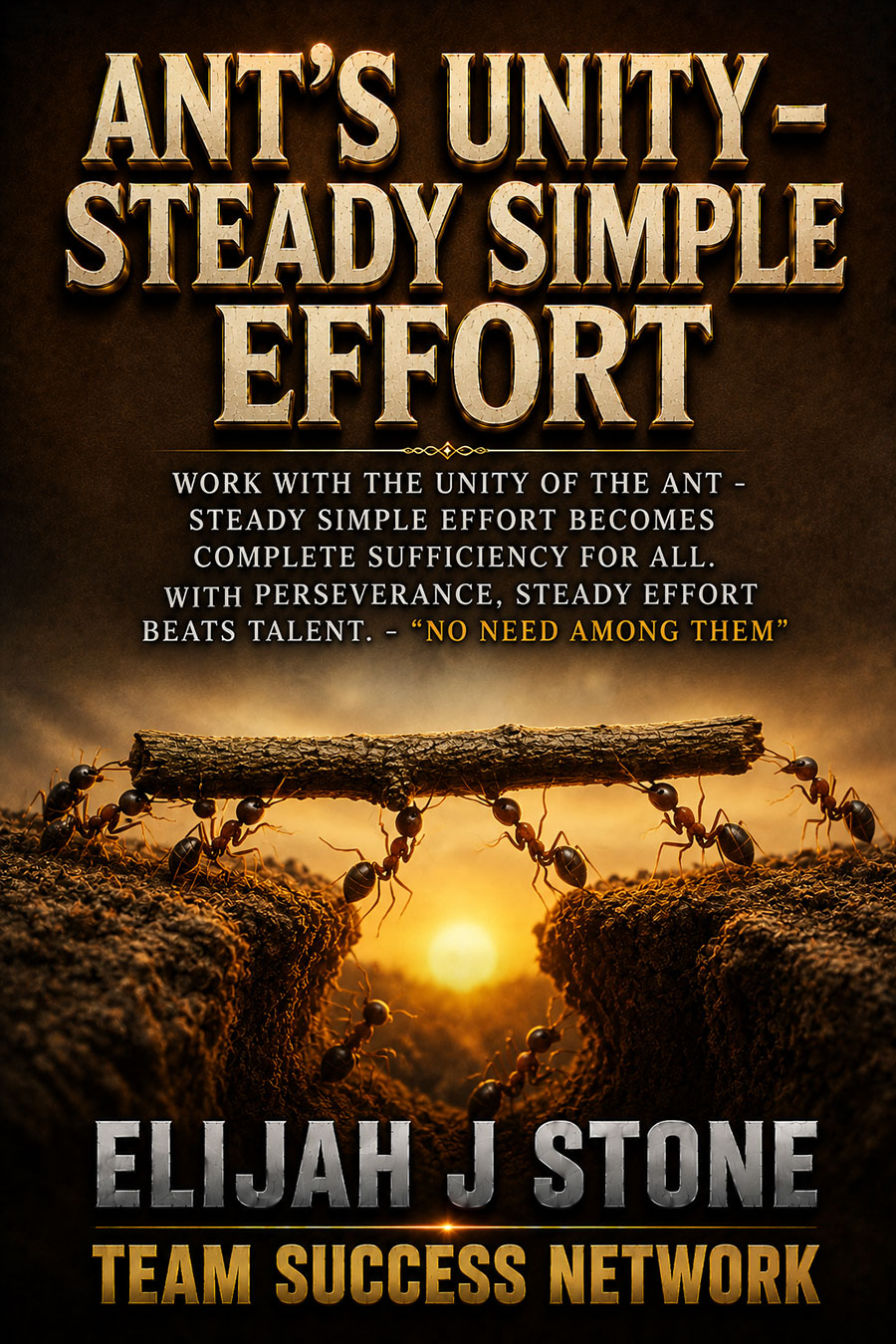
Book 86: Ant's Unity - Steady Simple Effort

Ant’s
Unity - Steady Simple Effort
Work With The Unity of the Ant - Steady Simple Effort Becomes Complete
Sufficiency For All. With Perseverance, Steady Effort Beats Talent. "No
Need Among Them"
By Mr.
Elijah J Stone
and the Team Success Network
Table
of Contents
Chapter 1 – The Power of Steady Effort................................................ 1
Chapter 2 – Why Simplicity Multiplies Results...................................... 1
Chapter 3 – The Ant’s Blueprint for Teamwork...................................... 1
Chapter 4 – Perseverance: The Force That Outlasts Talent..................... 1
Chapter 5 – Little by Little Becomes Plenty........................................... 1
Chapter 6 – Faithfulness Over Flash..................................................... 1
Chapter 7 – The Gift of Dependable People.......................................... 1
Chapter 8 – The Miracle of Mutual Help............................................... 1
Chapter 9 – How God Blesses Collective Rhythm.................................. 1
Chapter 10 – The Dangers of Comparison............................................ 1
Chapter 11 – Rest in Rhythm, Not Rush................................................ 1
Chapter 12 – God’s Reward for the Diligent.......................................... 1
Chapter 13 – How to Build a Culture of Consistency.............................. 1
Chapter 14 – The Law of Incremental Increase..................................... 1
Chapter 15 – Patience: The Partner of Perseverance............................. 1
Chapter 16 – Working as Unto the Lord............................................... 1
Chapter 17 – The Blessing of Shared Vision.......................................... 1
Chapter 18 – How to Sustain Motivation Over Time.............................. 1
Chapter 19 – Sufficiency Through Cooperation..................................... 1
Chapter 20 – Finishing Well: The Reward of Perseverance..................... 1

Chapter 1 – The Power of Steady Effort
Building Strength That Lasts
How God Rewards Those Who Keep Going When
Others Quit
The Secret
Strength Hidden In Simplicity
There is a
quiet kind of power that doesn’t demand attention or applause. It’s not loud,
not flashy, and not driven by emotion—it’s steady effort. The person who simply
keeps going, day after day, doing what is right, discovers a strength that
outlasts storms. In a world that celebrates fast success, God celebrates those
who choose to remain faithful in the small things.
Steady
effort is sacred because it imitates the nature of God Himself. He is constant,
dependable, and never in a rush. Everything He builds—mountains, seasons, and
souls—takes time. Scripture says, “Let us not become weary in doing good,
for at the proper time we will reap a harvest if we do not give up”
(Galatians 6:9). This is the divine principle of perseverance: in God’s timing,
the patient always prosper.
The power
of steady effort is invisible at first. Like a seed growing under the soil, its
progress cannot be measured by the eye. Yet, beneath the surface, roots are
spreading and strength is forming. What others call slow, Heaven calls secure.
Faithfulness
is never wasted. God uses the rhythm of consistency to shape your character
into something trustworthy. While talent may open a door, only perseverance
keeps it open. Every great work of God begins with steady effort that refuses
to stop when it feels unseen.
Why God
Honors The Slow Builders
God is not
impressed by speed; He is impressed by steadfastness. He measures success not
by how fast you move, but by how long you stay faithful. The world rewards
results, but God rewards faithfulness in the process. The slow builder, the
faithful worker, the unseen servant—they all mirror His divine patience.
Every
person who walks with God must learn His pace. He rarely rushes because He is
always building something that will last. “The plans of the diligent lead to
profit as surely as haste leads to poverty” (Proverbs 21:5). In this verse
lies the divine contrast between hurry and wisdom. Rushing makes you fragile.
Diligence makes you fruitful.
Think
about the way God created the world. He could have spoken everything into
existence at once, yet He took six days and rested on the seventh. Why? Because
process glorifies patience. Creation itself was a lesson in steady effort.
When you
align with God’s pace, you discover peace. You stop comparing your progress to
others, and you begin to enjoy the slow unfolding of grace. Steadiness becomes
your rhythm, and peace becomes your reward. The more consistent your obedience,
the more permanent your growth.
Faithfulness
Is Heaven’s Currency
Faithfulness
is the language of Heaven. It’s the evidence of maturity and the foundation of
trust. God doesn’t measure worth by what you start, but by what you sustain.
Even the angels who serve at His throne are steady—unceasing, unwavering, and
disciplined in devotion.
The
servant who shows up every day becomes God’s most trusted vessel. When the
Master sees consistency, He entrusts more responsibility. That is why Scripture
says, “Whoever can be trusted with very little can also be trusted with
much” (Luke 16:10). Faithfulness in small things qualifies you for greater
ones.
Many
people chase greatness while ignoring the power of faithfulness. But
faithfulness is what transforms the ordinary into the extraordinary. It’s the
bridge between prayer and promise, between calling and completion. God does not
anoint the impatient; He strengthens the consistent.
Your daily
obedience becomes a spiritual deposit. Every time you choose to keep going
instead of giving up, you add to the account of grace that will one day
overflow. Heaven always rewards those who refuse to quit.
How
Consistency Builds Spiritual Momentum
Consistency
is not boring—it’s the engine of breakthrough. Those who keep showing up in
prayer, in work, and in love begin to experience divine acceleration. At first,
effort feels slow, but with time, it gains supernatural momentum.
Every
moment of steady obedience compounds like interest in a bank. Each act of faith
builds on the last until suddenly, what was hard becomes natural. This is why
Jesus compared the Kingdom of God to a seed: small beginnings that grow into
mighty harvests. “The kingdom of heaven is like a mustard seed… though it is
the smallest of all seeds, yet when it grows, it is the largest of garden
plants” (Matthew 13:31–32).
Consistency
transforms weakness into strength because it invites the Holy Spirit into the
process. When you keep doing what’s right, even when it feels unproductive,
Heaven multiplies your endurance. Over time, steady habits become holy
reflexes.
The person
who walks steadily with God never stays stuck. What looks like waiting is
actually preparation. Each step, each day, each prayer builds momentum toward
the fulfillment of God’s promise.
Why Many
Start Strong But Don’t Finish
Starting
something new is exciting. The first few days of change feel easy because
energy is high and expectations are fresh. But the true test of growth comes
when the excitement fades. That’s when most people stop—and where the steady
person begins to shine.
The
parable of the sower illustrates this truth. Some seeds sprout quickly but
wither when the sun rises because they have no root. “But since they have no
root, they last only a short time” (Matthew 13:21). Quick growth without
depth always dies under pressure. Real transformation takes time and roots.
Those who
depend on motivation rarely last. Those who depend on discipline endure. Steady
effort is not about feeling inspired; it’s about being committed. When the
heart decides that obedience matters more than outcome, endurance is born.
The reward
is always at the end, never at the beginning. God tests the consistency of your
faith before He releases the fullness of your fruit. Perseverance is proof that
your faith is genuine, not emotional.
Learning
To Move At Heaven’s Pace
Heaven has
a rhythm—and it’s slower, deeper, and wiser than the world’s. The earth spins,
the seasons turn, and everything under God’s hand grows through stages. Nothing
He does is rushed, because nothing He does is shallow.
The life
of Jesus reflects this divine tempo. He waited thirty years before beginning
His public ministry, and even then, He often withdrew to pray. His miracles
came through obedience, not urgency. His power was steady, not sporadic.
If
Jesus—who was perfect—walked patiently, then so must we. “Be still before
the Lord and wait patiently for him; do not fret when people succeed in their
ways” (Psalm 37:7). This verse reminds us that God’s timing is not
delayed—it’s deliberate. Waiting seasons aren’t wasted; they are strengthening.
When you
match Heaven’s rhythm, peace replaces pressure. You begin to sense that each
day has divine purpose, no matter how ordinary it seems. The slow pace of
obedience is where deep trust is formed.
When
Effort Becomes Worship
Work
becomes worship when done for the right reason. Every act of diligence offered
to God is an altar of devotion. When your motive shifts from performance to
praise, even your smallest tasks become sacred.
Scripture
says, “Whatever you do, work at it with all your heart, as working for the
Lord” (Colossians 3:23). When you dedicate your steady effort to Him, you
stop needing recognition from people. The satisfaction of knowing you’ve
honored God becomes enough.
Steady
effort becomes worship because it aligns your heart with divine order. God is a
worker—He created, He sustains, and He provides. When you reflect that
consistency, you become His co-laborer. The steady worker is the one who brings
Heaven’s reliability into earth’s instability.
When your
work flows from worship, weariness loses its grip. You stop striving for
perfection and start resting in purpose. Every effort becomes a love offering,
pleasing to the One who sees it all.
The Key
Truth
Steady
effort outlasts talent, emotion, and circumstance. What you build slowly with
faith will stand firmly with grace. The world moves fast, but the Kingdom grows
deep. God uses those who keep going when others quit.
Heaven
does not accelerate the impatient—it strengthens the faithful. What begins as
small steps of obedience becomes a lifelong testimony of trust. The steady hand
always wins because it’s guided by divine rhythm.
True
strength is quiet. True greatness is consistent. The ones who endure in love
and labor will one day look back and see that every small act was part of
something eternal.
Summary
The power
of steady effort is more than human persistence—it’s divine participation.
God’s Spirit works through your discipline, turning simple consistency into
supernatural sufficiency. Every moment of obedience becomes a seed that Heaven
multiplies.
To live
this truth is to trust God’s timing. It means letting go of hurry, comparison,
and perfectionism, and embracing the peace of progress that unfolds day by day.
The person who walks steadily with God walks securely.
Faithfulness
is never forgotten. Each step you take in patience, each day you refuse to
quit, becomes a part of God’s story through your life. That is the secret
strength of steady effort—it doesn’t just build results; it builds you.

Chapter 2 – Why Simplicity Multiplies Results
The Freedom of Focused Purpose
How God Turns Clarity Into Strength
The Power
Of Doing One Thing Well
In a world
filled with noise, options, and endless distractions, simplicity has become a
rare treasure. Many people confuse activity with achievement—thinking that
doing more means becoming more. Yet the opposite is true. The most powerful
lives are the simplest ones: clear in direction, focused in purpose, and steady
in action.
Simplicity
is not about doing less; it’s about doing what matters most. God’s wisdom works
best in uncluttered hearts. He designed your life to bear fruit, not to juggle
chaos. Jesus said, “No one can serve two masters” (Matthew 6:24).
Divided attention divides your strength. But when you focus on one
direction—God’s will—your effort multiplies under His blessing.
The
greatest progress happens when you stop scattering your energy across a dozen
things and commit fully to one purpose. Like sunlight through a magnifying
glass, concentration creates power. The person who simplifies their focus
allows God’s power to concentrate through them.
God never
called you to complexity—He called you to clarity. When your goals align with
His guidance, confusion fades and confidence rises. Simplicity multiplies
results because it removes the waste of worry and the burden of divided effort.
Simplicity
Brings Spiritual Clarity
Clarity
begins when you let go of unnecessary weight. Many believers carry extra
burdens that God never asked them to carry—worries about outcomes, comparisons,
or performance. But Jesus said, “My yoke is easy and my burden is light”
(Matthew 11:30). His way is simple because it’s relational, not religious.
When your
relationship with God is your center, everything else finds its order. The
complicated falls away, and priorities become clear. You no longer live by
pressure but by peace. This is why simplicity is spiritual strength—it anchors
your soul in what lasts.
Complexity
drains because it divides. Every competing thought pulls energy in a new
direction. But simplicity gathers it back into one stream. A river moves
powerfully because its waters are contained; when scattered, it becomes a
puddle. Simplicity gives your life that same focused flow.
When you
learn to remove what distracts, you make space for divine direction. God speaks
most clearly to quiet hearts. Simplifying your priorities creates room for His
presence to guide every step.
Complexity
Is The Enemy Of Fruitfulness
Complexity
often disguises itself as progress. It makes you feel busy but leaves you
spiritually empty. Many chase multiple goals yet complete none because their
focus is fragmented. Complexity is not just external—it begins in the heart
when peace is replaced with striving.
The enemy
loves to complicate what God made simple. Salvation, obedience, and calling are
all simple truths. The confusion comes when pride, fear, or comparison twist
them into performance. Paul wrote, “But I am afraid that just as Eve was
deceived by the serpent’s cunning, your minds may somehow be led astray from
your sincere and pure devotion to Christ” (2 Corinthians 11:3). God’s
design is purity of focus—single-minded devotion.
Complexity
weakens confidence because it breeds double-mindedness. A divided heart cannot
decide, and a confused mind cannot act. But the moment you return to
simplicity—to loving God and serving faithfully—everything becomes clear again.
The path lights up because your motives align with Heaven’s order.
Simplicity
restores focus by cutting away what doesn’t belong. It’s not about doing less
for the sake of comfort—it’s about doing less so you can do the right things
well. When your attention is purified, your energy is multiplied.
The
Strength Of Focused Effort
Focus is
the multiplier of effectiveness. A thousand scattered efforts cannot equal one
steady direction empowered by faith. That’s why Jesus could change the world in
three short years—He lived with unwavering focus on the Father’s will. He said,
“My food is to do the will of Him who sent me and to finish His work”
(John 4:34). His strength came from simplicity.
Simplicity
focuses your life around a central purpose. When your “yes” is clear, your “no”
becomes easy. Every decision gains direction from your mission. The clutter of
uncertainty disappears because everything filters through a single question:
Does this align with what God told me to do?
This is
where steady effort meets divine efficiency. When you stop spreading your
strength thin, your results begin to multiply. Each act of obedience compounds
like interest in God’s economy. The clearer your focus, the greater your fruit.
Like a
sharpened blade, simplicity cuts through what distracts. It directs all your
energy toward what truly matters. The clearer your focus, the cleaner your
results—and the deeper your peace.
How
Simplicity Multiplies Peace
Peace is a
powerful byproduct of simplicity. The more complicated your goals, the more
anxious your heart becomes. But when you live with focus, peace protects your
pace. You no longer rush, compare, or compete—you simply remain consistent.
Simplicity
creates margin, and margin creates rest. You don’t have to carry every load,
fix every problem, or chase every opportunity. You just have to obey what God
placed before you today. “Do not worry about tomorrow, for tomorrow will
worry about itself. Each day has enough trouble of its own” (Matthew 6:34).
Simplicity is obedience to that truth.
Peace and
productivity are not opposites—they’re partners. When your heart is still, your
hands work better. When your mind is clear, your results improve. Simplicity
restores rhythm to your work because you’re no longer working from chaos but
from confidence.
Simplicity
multiplies peace by aligning your priorities with eternal truth. It lets you
breathe again, think clearly, and act purposefully. God’s peace flows where
clutter ends.
The
Difference Between Simple And Shallow
Many
mistake simplicity for shallowness. But true simplicity is not the absence of
depth—it’s the presence of clarity. Shallow living avoids complexity for
comfort; simple living removes complexity for focus. Jesus lived simply but
deeply—He was never rushed, but always purposeful.
Simple
things are strong because they’re built on truth. A building with fewer moving
parts is harder to break. Likewise, a life anchored in God’s simple
commands—love, faith, obedience—can withstand any storm. Complexity invites
confusion, but simplicity fortifies conviction.
You don’t
need to know everything to follow God. You just need to do the next right thing
faithfully. Steady obedience is stronger than sporadic brilliance. When your
faith becomes simple again, it becomes powerful again.
God
designed your life to be light enough to carry. When you return to simplicity,
you regain your strength. Every unnecessary burden that falls away makes room
for grace to lift you higher.
How
Simplicity Attracts God’s Blessing
God’s
blessing flows through order. Simplicity brings that order by removing
distraction and aligning priorities. When your life reflects His pattern, His
power can move freely. The Spirit does not fill chaos; He fills vessels that
are ready and clear.
Order is
Heaven’s language. From the creation of the world to the structure of the
Church, everything God builds is simple yet powerful. His systems—seedtime and
harvest, cause and effect, sowing and reaping—are all grounded in simplicity. “For
God is not a God of disorder but of peace” (1 Corinthians 14:33).
Simplicity creates the atmosphere where His peace abides.
The
clearer your life becomes, the easier it is for God to bless it.
Disorganization drains divine momentum, but simplicity invites it. Just as a
clean field receives rain without obstruction, a simplified life receives grace
without resistance.
When you
simplify your commitments, clarify your motives, and prioritize obedience,
Heaven begins to multiply your outcomes. God loves to bless what reflects His
own nature: simplicity, purity, and purpose.
Simplify
To Strengthen
If your
energy feels scattered, start subtracting. Simplifying your life is not a
loss—it’s a refinement. Every distraction removed becomes strength regained.
The art of simplicity is learning to say “no” to the good so you can say “yes”
to the best.
Look at
nature. The most enduring forces are simple—gravity, light, wind, and water.
They move in single directions yet carry immeasurable power. Your spiritual
life works the same way. When it becomes pure in direction, its impact becomes
unstoppable.
Simplifying
strengthens you because it restores unity between your heart, mind, and
mission. When all parts of your life agree, energy flows unhindered. You stop
fighting yourself and start flowing with grace.
God
designed simplicity as a form of strength. Complexity drains, but simplicity
sustains. The less divided your attention, the more concentrated your
authority.
Practical
Steps Toward Simplicity
Simplicity
is not achieved overnight—it’s cultivated through intentional choices. You
simplify through subtraction, not addition.
1. Clarify
your calling.
Write down what God has clearly assigned you to do. Everything outside that
mission is distraction.
2. Remove
competing priorities.
Busyness is not faithfulness. Evaluate where your time and attention are going,
and cut what doesn’t align with your purpose.
3. Guard
your peace.
Protect your mind from unnecessary information and conflict. Simplicity begins
when peace becomes your priority.
4. Focus
on daily obedience.
Don’t try to master everything at once. Win each day by doing the next faithful
thing.
5. Keep
your motives pure.
Simplicity dies when pride enters. Serve quietly, love consistently, and let
God multiply your results.
Every step
toward simplicity is a step toward sufficiency.
The Key
Truth
God’s
wisdom is simple, and His strength flows through focus. When you simplify your
life around His purpose, your results multiply because grace no longer competes
with distraction.
Simplicity
is not laziness—it’s alignment. It is the discipline of clarity, not the denial
of responsibility. What you surrender in quantity, you gain in quality.
A simple
life centered on God becomes a powerful life guided by peace. When you move in
clarity, you move in strength. The simpler your focus, the stronger your fruit.
Summary
Simplicity
multiplies results because it removes the noise that drains strength and
replaces it with focus that bears fruit. The world celebrates multitasking, but
God blesses single-minded obedience. Clarity creates momentum; complexity
creates confusion.
Living
simply before God means trusting His design, keeping your heart uncluttered,
and your direction pure. It’s about doing the right thing well, over and over,
until it grows into lasting impact.
Every
great work begins in simple obedience and continues through steady consistency.
When your life becomes focused, your results become fruitful. Simplicity isn’t
weakness—it’s wisdom. It’s how God multiplies the efforts of those who walk in
His peace.

Chapter 3 – The Ant’s Blueprint for Teamwork
The Strength of Working Together in Harmony
How Unity Turns Small Efforts Into Great
Achievements
The Quiet
Power Of The Smallest Workers
Ants are
among the smallest of God’s creations, yet they reveal one of Heaven’s greatest
secrets: unity. Without titles, applause, or competition, they move together
with flawless coordination. Their success doesn’t come from strength, size, or
talent—it comes from shared purpose. Each tiny ant knows what to do, trusts the
others to do the same, and together they accomplish the impossible.
The ant’s
lifestyle is a living sermon about teamwork. “Go to the ant, you sluggard;
consider its ways and be wise” (Proverbs 6:6). This verse is not just about
diligence—it’s about wisdom in unity. Ants don’t wait for instructions; they
cooperate by instinct. Each one’s steady effort contributes to something far
greater than itself.
In the
Kingdom of God, this principle shines brightly. God never intended for His
people to strive alone. He created community so that individual faith could
combine into collective strength. Just as no single ant can build an entire
colony, no believer can fulfill God’s full purpose in isolation. Unity
multiplies power.
When we
learn from the ant’s wisdom, we discover that humility and cooperation are
divine strengths. Small efforts, when combined with others, form foundations
that last for generations.
Unity Is
Heaven’s Design
Teamwork
is not a human invention—it’s a divine pattern. From the beginning, God worked
as a team within Himself: Father, Son, and Holy Spirit in perfect harmony.
Creation was the result of divine collaboration. That same unity is meant to
reflect through us.
The Bible
says, “Two are better than one, because they have a good return for their
labor” (Ecclesiastes 4:9). This truth isn’t just practical—it’s spiritual.
When people walk in unity, God’s blessing automatically follows. Where there is
agreement, there is acceleration.
Unity
doesn’t mean uniformity. The ants don’t all do the same task, yet they move
toward the same goal. One gathers food, another builds tunnels, another
protects the nest—but all contribute to the common mission. Likewise, God’s
people each have different gifts, but when those gifts unite under His
direction, the result is abundance.
Disunity
delays blessing. Unity invites divine multiplication. It’s not the size of the
effort that matters—it’s the agreement of hearts working in love. The power of
unity is that it allows ordinary people to build extraordinary things together.
The Beauty
Of Selfless Contribution
One of the
most remarkable traits of ants is their selflessness. They don’t work for
recognition or reward. They don’t boast about their strength or compare loads.
Each simply does its part for the sake of the whole. That quiet humility
carries divine wisdom.
In the
body of Christ, the same principle applies. Every believer is a part of
something much larger than themselves. “Just as each of us has one body with
many members, and these members do not all have the same function… so in Christ
we, though many, form one body” (Romans 12:4–5). Each part matters equally,
regardless of visibility.
Selfless
teamwork removes the pride that divides. When you realize that success belongs
to everyone who contributes, competition dies and cooperation thrives. The
person cleaning, praying, organizing, or encouraging is as vital as the one
leading from the front.
Ants prove
that greatness is not found in position but in participation. Every faithful
act—no matter how small—moves the whole colony forward. In God’s Kingdom, no
role is insignificant when done with love.
Why
Cooperation Creates Strength
When
individual strength combines with others in harmony, it becomes unstoppable.
The ant teaches us that cooperation transforms weakness into power. Alone, an
ant can carry little; together, they can move mountains of earth.
God
designed His people to function the same way. Jesus sent His disciples out in
pairs, not alone, because He understood the power of partnership. “If either
of them falls down, one can help the other up. But pity anyone who falls and
has no one to help them up” (Ecclesiastes 4:10). We are meant to strengthen
one another.
Cooperation
multiplies energy. When hearts align, effort feels lighter. What once seemed
impossible becomes easy because the weight is shared. True teamwork is not
about equal ability—it’s about equal willingness. When each person gives what
they can, God supplies what they cannot.
The
miracle of cooperation is that it transforms limited human effort into
limitless divine potential. Where unity exists, grace flows freely. Every joint
supplies strength to the next, and the whole body grows in power.
The Danger
Of Isolation
Isolation
weakens purpose. It blinds us to the bigger picture and makes burdens heavier
than they were meant to be. The ant never isolates itself—it knows survival
depends on community. Likewise, spiritual isolation breeds weakness, confusion,
and discouragement.
God never
designed you to do life alone. From Genesis to Revelation, His pattern is
partnership. “It is not good for the man to be alone” (Genesis 2:18).
This statement isn’t just about marriage—it’s about relationship, cooperation,
and connection.
The enemy
loves to divide because division destroys power. When you’re isolated, you’re
easier to attack, easier to deceive, and easier to exhaust. But when you remain
surrounded by others of faith, strength flows naturally. Fellowship fuels
endurance.
Just as an
ant cut off from the colony soon dies, a believer separated from fellowship
slowly loses fire. Community is not optional—it’s essential. God’s favor rests
on connection, not separation.
Humble
Coordination Builds Miracles
Ants are
not loud, but they are effective. Their quiet coordination produces results
that far exceed their size. They don’t argue about direction or delay with
pride—they simply move. This is humility in motion.
Humble
coordination is the foundation of every miracle that lasts. When people stop
seeking credit and start seeking purpose, God can move freely. He resists the
proud but gives grace to the humble. Grace is the divine glue that holds teams
together.
Humility
means being willing to work beneath others, beside others, and sometimes unseen
altogether. The ant doesn’t care who gets noticed—it only cares that the
mission succeeds. “Do nothing out of selfish ambition or vain conceit.
Rather, in humility value others above yourselves” (Philippians 2:3). This
verse describes the secret strength of every great team.
When
humility becomes the culture, unity becomes unstoppable. Cooperation turns from
obligation into joy. The humble work together easily because their hearts have
the same posture—service over self.
The Reward
Of Shared Purpose
Shared
purpose turns work into worship. It gives meaning to every small contribution
because each one plays a role in something eternal. When an ant carries a grain
of sand, it’s not just moving dirt—it’s expanding a kingdom.
The same
is true for believers. Your contribution may seem small, but it is part of
God’s vast design. When your hands and heart align with His plan, even the
smallest act matters. “Whatever you do, work at it with all your heart, as
working for the Lord” (Colossians 3:23). Every effort becomes sacred when
done in love.
Shared
purpose also brings shared joy. When success comes, no one boasts because
everyone belongs. The reward of unity is fulfillment that lasts. People feel
valued, seen, and empowered—not by position, but by participation.
The
greatest teams are not those with the most talent, but those with the most
trust. Shared purpose builds that trust because everyone knows their “why.” It
transforms separate workers into one living organism guided by God’s Spirit.
When
Everyone Does Their Part
When
everyone plays their role faithfully, nothing is left undone. The ant colony
thrives because every ant contributes something unique. The Kingdom of God
functions the same way—completeness comes when each person fulfills their
calling.
A body
cannot move if one part refuses to function. Likewise, God’s work slows when
individuals hold back their gifts. But when each person steps forward, the
result is beautiful coordination. The hands, eyes, and feet all serve one
purpose under one Head—Christ.
This kind
of harmony turns effort into sufficiency. No one burns out because the work is
shared. No one feels left out because every part matters. No one is overwhelmed
because grace flows through collective obedience.
Teamwork
under God’s direction removes pressure and replaces it with partnership. You
don’t have to do everything; you just have to do your part. When everyone does
the same, miracles multiply effortlessly.
Practical
Steps To Build Godly Teamwork
1. Embrace
humility.
Teamwork begins where pride ends. Be willing to serve and learn from others,
regardless of title.
2. Honor
every role.
Value the contribution of others as highly as your own. Without small tasks,
great ones cannot stand.
3.
Communicate clearly.
Confusion breaks unity. Speak truth in love, listen carefully, and make peace
quickly.
4. Carry
the load together.
Don’t let one person bear the full weight. Offer help where needed, just as the
ants share their strength.
5. Keep
the goal before you.
Remember the mission is bigger than any one person. Stay focused on what
glorifies God, not self.
When these
principles become daily practice, unity becomes a culture instead of a concept.
The Key
Truth
The
strength of teamwork is not in numbers—it’s in unity. Ants move mountains
because they move together. What one cannot do alone, many can do with grace
when united in purpose.
God’s
blueprint for teamwork is simple: humility, cooperation, and shared vision.
When people work in love and order, His presence multiplies their results.
Heaven
blesses what mirrors its own nature. Just as the Trinity works in perfect
agreement, we too are called to move in harmony. True success is never
solo—it’s always shared.
Summary
The ant’s
blueprint for teamwork is a divine revelation hidden in plain sight. Through
humility and unity, the smallest efforts combine into monumental strength.
Every part matters, and every act of service contributes to the whole.
God’s
Kingdom thrives where people move together under His guidance. Disunity
divides, but cooperation creates miracles. When hearts align in love and
purpose, Heaven’s favor flows freely.
Teamwork
in God’s design is not a strategy—it’s a reflection of His character. The ant
teaches us that collective effort fueled by faithfulness produces abundance
that never runs out. The secret is simple: move together, stay humble, and let
God multiply your combined strength.

Chapter 4 – Perseverance: The Force That
Outlasts Talent
Strength That Keeps Going When Others Stop
How Endurance Turns Effort Into Unstoppable
Growth
The Hidden
Power Of Perseverance
Talent may
sparkle, but perseverance sustains. The world celebrates those who rise
quickly, yet Heaven honors those who endure faithfully. Anyone can start with
enthusiasm, but only the steady heart finishes strong. Perseverance is not a
personality trait—it’s a spiritual force that grows through resistance.
When life
becomes difficult, perseverance begins its work. Each challenge becomes a gym
for the soul, strengthening what comfort cannot. God doesn’t build faith in the
absence of struggle; He builds it in the midst of it. “Let perseverance
finish its work so that you may be mature and complete, not lacking anything”
(James 1:4). The process is not punishment—it’s preparation.
Talent can
take you places, but only perseverance keeps you there. Endurance refines your
motives, purifies your focus, and proves your trust in God’s timing. It’s the
steady strength that keeps walking even when the path disappears.
Those who
persevere are those who become unshakable. They don’t depend on feeling
good—they depend on God being faithful. Their strength doesn’t come from
passion, but from purpose.
Why God
Values Endurance Over Talent
God gave
talent to many, but perseverance to few—and those few change the world. Talent
is a gift; endurance is a choice. Talent can open opportunities, but endurance
determines destiny.
The Bible
reminds us, “You need to persevere so that when you have done the will of
God, you will receive what he has promised” (Hebrews 10:36). Promise is not
enough—you must persist to inherit it. Every promise carries a waiting period,
and perseverance bridges the gap between calling and completion.
God values
endurance because it mirrors His nature. He is patient, steadfast, and
long-suffering. When you refuse to give up, you resemble Him. Endurance isn’t
glamorous, but it’s divine. It’s proof that your heart is anchored deeper than
your circumstances.
Talent
alone can’t build character. Skill may impress others, but perseverance
transforms you. God uses the waiting, the resistance, and the slow seasons to
shape the kind of strength that talent can’t create. Those who endure become
trustworthy, and God entrusts more to the steady than to the swift.
The
Process Of Growth Through Resistance
Perseverance
grows in the soil of difficulty. Like a seed pushing through hard ground, you
develop strength by enduring pressure. Every time you refuse to quit, something
inside you expands. God uses resistance to reveal resilience.
When
trials come, they test what you truly believe. Perseverance isn’t proven in
success; it’s proven in struggle. “We glory in our sufferings, because we
know that suffering produces perseverance; perseverance, character; and
character, hope” (Romans 5:3–4). The path to maturity always passes through
persistence.
You don’t
grow when life is easy—you grow when life demands faith. The storms that
threaten to break you are the same ones building your foundation. God doesn’t
remove the struggle; He strengthens you to stand within it. Perseverance
transforms pain into purpose.
The person
who keeps walking through difficulty will one day look back and realize they’ve
become stronger than they ever imagined. Resistance didn’t destroy them—it
developed them. What once felt unbearable becomes the testimony of endurance.
How
Perseverance Transforms Talent
Talent
alone fades without perseverance to sustain it. Many people start with
brilliance but lose momentum when the journey stretches longer than expected.
Perseverance turns talent into legacy. It ensures that your gift doesn’t die in
the soil of impatience.
God never
measures by speed—He measures by faithfulness. The slow, consistent builder
outlasts the quick, careless one. “The race is not to the swift or the
battle to the strong… but time and chance happen to them all” (Ecclesiastes
9:11). In other words, endurance wins where talent tires.
Perseverance
multiplies talent by giving it staying power. It turns temporary inspiration
into permanent impact. What begins as ordinary ability becomes extraordinary
through consistent effort. When you keep showing up—long after emotion has
faded—God breathes His strength into your consistency.
Talent may
catch attention, but perseverance earns respect. Anyone can start with
potential; only the patient finish with fruit. Perseverance is how God turns
raw gifting into refined greatness.
Endurance
Is Faith In Motion
Endurance
is not passive waiting—it’s active faith. It’s trusting God enough to keep
moving even when progress feels invisible. Every step forward says, “I still
believe.” Perseverance walks through silence, uncertainty, and delay without
surrendering hope.
Jesus
modeled perfect endurance. “For the joy set before him, he endured the
cross, scorning its shame, and sat down at the right hand of the throne of God”
(Hebrews 12:2). His perseverance wasn’t powered by ease but by vision. He saw
beyond pain to purpose.
Endurance
is spiritual sight—it sees the finish line when others only see fatigue. It’s
the decision to walk by faith, not by sight, trusting that every step has
meaning even when results seem far away.
When
endurance becomes part of you, fear loses its grip. You no longer measure
success by speed or visible reward. You measure it by obedience. Perseverance
becomes your declaration that God is still worthy, even in the waiting.
How To
Stay Strong When Progress Feels Slow
Slow
progress does not mean failure. It often means formation. God uses delay to
deepen your roots so that your fruit can endure the future. The waiting season
is never wasted—it’s where perseverance matures.
When you
can’t see results, focus on remaining faithful. Keep doing what God told you to
do last. Your consistency will carry you when clarity feels far away. The key
is not perfection—it’s persistence.
Here’s
what perseverance looks like in daily life:
• Keep
praying even when the answer seems delayed.
• Keep serving when no one notices.
• Keep believing when you feel nothing.
• Keep sowing kindness when you haven’t yet seen the harvest.
• Keep walking when standing still seems easier.
Each of
these moments adds to the spiritual weight of endurance. Slowly, unseen, your
faith becomes unbreakable.
God uses
slow seasons to refine your motives. He removes pride, impatience, and
self-reliance until only pure trust remains. The slower the process, the
stronger the product. Perseverance produces lasting fruit because it’s forged
in patience.
The Reward
Of Steadfast Faith
Perseverance
always leads to reward. Those who endure receive what those who quit never see.
God is faithful to remember every act of endurance, every tear, every moment
you refused to stop.
“Blessed
is the one who perseveres under trial because, having stood the test, that
person will receive the crown of life that the Lord has promised to those who
love him” (James
1:12). Heaven honors endurance with eternal recognition. The crown is not given
for perfection—it’s given for persistence.
The reward
of perseverance is not just external success—it’s internal transformation. You
become more like Christ: patient, steady, unmovable. You discover joy that
can’t be shaken by delay. Your peace no longer depends on outcomes because your
confidence rests in God’s faithfulness.
Endurance
builds depth. It anchors your emotions and stabilizes your purpose. When you
have persevered through difficulty, you no longer fear it. You carry quiet
authority, knowing that what tried to stop you only strengthened you.
How To
Develop Perseverance Daily
Perseverance
doesn’t appear overnight—it grows through practice. You develop endurance the
same way you develop muscle: by stretching past your comfort zone regularly.
1. Stay
consistent in prayer.
Even when you feel nothing, prayer keeps your spirit alive. It reminds you that
faith is relationship, not routine.
2. Embrace
small victories.
Every step forward, no matter how small, matters. Celebrate progress instead of
waiting for perfection.
3. Choose
gratitude over complaint.
Thankfulness keeps your heart light during heavy seasons. Gratitude fuels
endurance because it shifts your focus from pain to purpose.
4. Keep
your eyes on the promise, not the problem.
Faith looks ahead. When you fix your gaze on what God said instead of what you
see, perseverance becomes easier.
5. Rely on
God’s grace, not your willpower.
Perseverance is not self-generated—it’s Spirit-empowered. The Holy Spirit
renews your strength each time you surrender your weakness.
Endurance
is built through repetition. Every time you choose faith over fatigue, your
spirit grows stronger.
Perseverance
Is The Proof Of Love
Love is
what keeps perseverance alive. You endure what you love for the sake of love.
Jesus endured the cross “for the joy set before Him”—that joy was relationship
with you. Likewise, when love for God fuels your perseverance, endurance
becomes natural.
If you
love Him, you’ll stay the course. You’ll keep walking even when results are
hidden because you trust His heart. Love transforms endurance from drudgery
into devotion. What feels heavy to obligation becomes light through affection.
“Love
never fails” (1
Corinthians 13:8). That’s not a poetic line—it’s a promise. Love always endures
because love always hopes. When you root your perseverance in love, it cannot
be broken.
When faith
feels tired, love carries it. When hope feels faint, love revives it. The
greatest perseverance comes not from discipline alone but from devotion. You
endure because you care more about pleasing God than pleasing yourself.
The Key
Truth
Perseverance
is the muscle that turns faith into fulfillment. It is the unseen force that
carries you from promise to possession. Talent may open a door, but
perseverance walks through it and builds a home.
God
rewards endurance because it proves trust. It declares that your faith is
deeper than your frustration. Perseverance is strength in slow
motion—unshakable, patient, and sure.
The secret
is simple: never stop doing what God called you to do. Even small, consistent
effort will outlast the most gifted beginnings. Perseverance is how ordinary
believers accomplish extraordinary things.
Summary
Perseverance
is the invisible force behind every lasting victory. It’s what transforms
effort into sufficiency, trials into triumph, and waiting into wisdom. Every
act of endurance refines your faith until it mirrors God’s own patience.
Talent may
sparkle, but perseverance endures. It outlasts fatigue, failure, and fear
because it’s rooted in love. Those who endure will see the promise fulfilled,
for God always finishes what He starts.
When you
refuse to quit, you align with Heaven’s rhythm. Your faith becomes steady, your
spirit unshakable, and your strength renewed. Perseverance isn’t just surviving
the storm—it’s learning to walk through it with peace. The one who keeps going
will always find that God has been walking beside them the whole way.

Chapter 5 – Little by Little Becomes Plenty
The Divine Pace of Increase
How God Multiplies Faithful Steps Into Lasting
Abundance
The
Miracle Of Gradual Growth
God rarely
moves in sudden leaps; He works in steady progression. His pattern for increase
is “little by little,” never rushed but always right on time. “The Lord your
God will drive out those nations before you, little by little. You will not be
allowed to eliminate them all at once” (Deuteronomy 7:22). This ancient
truth reveals Heaven’s wisdom: slow growth builds strong roots.
God’s
design for progress protects you from pride and prepares you for permanence.
When blessings come too quickly, they often crumble just as fast. But what is
gained gradually becomes grounded. Each small victory teaches wisdom. Each slow
step builds character.
The ant
embodies this principle perfectly. It gathers one grain at a time, never
discouraged by the size of its task. What seems insignificant today becomes
abundance tomorrow. God uses the same process in your life—teaching you that
small, consistent effort creates great reward.
Little by
little, God shapes you into a person capable of carrying His promises. The pace
may test your patience, but it also secures your future.
Why God
Chooses The Slow Path
God’s
timing is not slow; it’s strategic. He grows you gradually so that what He
gives you doesn’t destroy you. Each stage of the journey matures your heart,
deepens your faith, and strengthens your foundation.
The Bible
says, “Do not despise these small beginnings, for the Lord rejoices to see
the work begin” (Zechariah 4:10). Heaven celebrates beginnings, no matter
how small. God doesn’t measure progress by size—He measures it by obedience.
Every small start is sacred when surrendered to Him.
Instant
gratification weakens trust, but gradual growth builds dependence. When you
must rely on God daily for each step, pride cannot take root. Your focus stays
on His faithfulness, not your achievement.
God grows
oak trees, not weeds. The difference is time. Weeds grow overnight and die in
days. Oaks take years to mature but stand for generations. God’s way is always
worth the wait because His blessings are built to last.
The Power
Of Small, Steady Effort
Each small
effort carries eternal value. What feels like a small prayer, a small act of
obedience, or a small kindness becomes part of a great divine pattern. God
never overlooks the little things done in faith.
Jesus
said, “Whoever can be trusted with very little can also be trusted with
much” (Luke 16:10). That verse is the heartbeat of God’s promotion process.
Faithfulness in small things unlocks authority in larger things. The secret to
abundance is stewardship over small beginnings.
The
Kingdom of God grows this same way. Jesus compared it to a mustard seed—the
smallest of all seeds—yet it becomes a great tree. What starts as invisible
faith can one day cover nations. The principle never changes: what’s planted
faithfully grows fruitfully.
Every
small habit you cultivate today is building tomorrow’s outcome. The consistency
of today becomes the testimony of tomorrow. Don’t underestimate what God can do
with your steady obedience.
Compounding
Grace: How Small Steps Multiply
The world
understands compound interest in finance, but God invented it in faith. Every
act of obedience adds up. Each seed sown builds on the last. Over time, your
little-by-little efforts compound into unstoppable momentum.
The Bible
declares, “The plans of the diligent lead to profit as surely as haste leads
to poverty” (Proverbs 21:5). Diligence—steady, faithful labor—creates
compounded blessing. Haste destroys it. The diligent hand gains because it
never stops giving.
When you
choose consistency over speed, God breathes on your work. Grace multiplies
results far beyond your own ability. Like the five loaves that fed thousands,
God takes small offerings and turns them into overflowing abundance.
Grace
compounds where faithfulness remains. Every prayer you pray, every word of
encouragement you give, every quiet moment of perseverance—all of it counts.
Nothing is wasted. Over time, it builds into a harvest that surprises even you.
Learning
Patience In The Process
Patience
is the partner of progress. It’s what keeps you steady when growth seems
invisible. Without patience, perseverance collapses. Patience is proof that you
trust God’s process more than your timeline.
The farmer
understands this truth deeply. He plants, waters, and waits—not for hours, but
for seasons. The seed grows silently beneath the soil, invisible to the eye but
alive with potential. “Let us not become weary in doing good, for at the
proper time we will reap a harvest if we do not give up” (Galatians 6:9).
Patience
keeps you from uprooting what God is still developing. Every day of waiting is
a day of preparation. God uses delays to mature what you asked for. He’s not
withholding blessing; He’s enlarging your capacity to handle it.
When you
learn to love the process, the promise no longer feels distant. You start to
see God’s fingerprints in the slow and steady moments. That’s where character
forms and faith becomes unshakeable.
The Wisdom
Of The Ant’s Method
The ant
doesn’t rush, panic, or procrastinate. It simply works. One grain at a time,
one step at a time, it builds something massive through tiny motions. This
rhythm of diligence is the foundation of sustainability.
The Bible
says, “Go to the ant, you sluggard; consider its ways and be wise”
(Proverbs 6:6). The ant teaches us that consistency beats intensity. It doesn’t
wait for motivation—it acts from instinct and order. God’s people must learn
the same wisdom: to move daily with discipline, not just passion.
The ant’s
small steps ensure its survival through every season. It doesn’t fear the
future because it prepares for it faithfully. Its patience creates provision.
Its steadiness becomes sufficiency.
When you
mirror the ant’s method—steady, humble, and unrelenting—you step into Heaven’s
rhythm of success. It’s not about speed; it’s about spiritual synchronization
with God’s order.
Faithfulness
Turns Seeds Into Harvest
Faithfulness
is what turns small beginnings into great endings. You don’t need massive
opportunities to see miracles—you just need to faithfully use what you have.
Every seed
you plant in obedience carries potential beyond imagination. The parable of the
talents proves this truth. The servants who multiplied their small portions
were praised not for brilliance, but for faithfulness. “Well done, good and
faithful servant! You have been faithful with a few things; I will put you in
charge of many things” (Matthew 25:21).
Faithfulness
keeps the cycle of blessing alive. Each small investment of time, service, or
love builds something eternal. God’s economy rewards persistence, not
performance.
When you
stay faithful with the little, God enlarges your influence. Over time, your
obedience becomes your overflow. The small moments become sacred milestones
that shape generations.
The
Blessing Of Sustainability
Sudden
success can be dangerous because it lacks structure. Sustainable success,
however, is built on steady obedience. The “little by little” process teaches
management, humility, and gratitude.
God
doesn’t want you to merely reach abundance; He wants you to sustain it. Quick
growth often creates pride, but gradual increase produces wisdom. “The
wealth gained hastily will dwindle, but whoever gathers little by little will
increase it” (Proverbs 13:11). This is divine economics—incremental
faithfulness leads to exponential blessing.
Sustainability
means you’re not dependent on momentum, but on method. The same habits that
brought increase will keep it growing. You don’t chase seasons of blessing; you
maintain a lifestyle of consistency.
When God
blesses you gradually, He’s not delaying—He’s disciplining. He’s teaching you
how to maintain miracles instead of mismanaging them. The slow pace of growth
is your safeguard, not your setback.
Practical
Habits For Little-By-Little Growth
1. Set
spiritual routines.
Create small, daily habits—prayer, gratitude, Scripture reading—that become
unbreakable anchors for your growth.
2.
Celebrate daily progress.
Each step matters. Acknowledge small victories instead of waiting for giant
ones. Gratitude keeps your heart healthy.
3. Embrace
repetitive faithfulness.
Don’t despise repetition. The miracle often hides in what you’ve done a hundred
times faithfully.
4. Focus
on depth before width.
Let God grow your roots before He expands your reach. Deep foundations protect
future fruitfulness.
5. Be
patient with your process.
God is not in a hurry, and neither should you be. What’s growing slowly is
often growing strong.
When you
make these habits part of your rhythm, you’ll find that progress never stops—it
simply builds quietly until it bursts forth as abundance.
The Key
Truth
God’s
increase is not instant—it’s incremental. The blessing that comes “little by
little” lasts longer and stands stronger. What you gain gradually becomes
grounded in grace.
Each day
of diligence adds to the total of divine sufficiency. Faithfulness compounds
like interest until you overflow with fruitfulness. The miracle is not in the
speed—it’s in the steadiness.
What seems
small today will one day be your testimony. When you walk with patience and
persistence, you step into God’s rhythm of unending growth. Little by little
truly becomes plenty.
Summary
God’s
pattern of blessing works in slow, sacred steps. He grows you through process,
not pressure. Each moment of obedience, each day of diligence, adds up to
abundance.
The ant’s
example reminds us that the smallest acts of consistency create the largest
results. Faithfulness in ordinary moments becomes the foundation for
extraordinary outcomes.
When you
trust God’s timing and stay steady in your effort, you discover that His
“little by little” always leads to more than enough. Progress may be quiet, but
it is sure. Over time, grace compounds, patience prevails, and your harvest
comes full.
Abundance
is not achieved overnight—it’s built over time through trust, persistence, and
faithfulness. In God’s economy, slow growth is strong growth, and every little
step is a miracle in motion.

Chapter 6 – Faithfulness Over Flash
The Quiet Strength That Heaven Rewards
How Steadfast Hearts Outlast Temporary
Applause
The Hidden
Power Of Being Consistent
Faithfulness
doesn’t draw headlines or applause. It doesn’t sparkle in lights or trend
online. Yet, in Heaven’s eyes, it is among the highest forms of strength. God
treasures steady people—those who keep showing up with pure motives even when
no one claps.
The world
celebrates flash: quick results, instant fame, and visible success. But Heaven
celebrates faithfulness: consistency, endurance, and devotion. Jesus did not
say, “Well done, good and talented servant,” or “Well done, good and successful
servant.” He said, “Well done, good and faithful servant” (Matthew
25:21). Those words define the kind of greatness Heaven honors.
Faithfulness
means doing the right thing again and again, even when no one sees it. It’s
showing up when you’re tired, staying honest when no one’s watching, and loving
people when it’s inconvenient. These quiet decisions form the foundation of
God’s Kingdom.
The steady
heartbeat of faithfulness sustains what flash can never replace. Flash burns
bright and fast, but faithfulness burns steady and eternal.
Why God
Values Faithfulness More Than Success
Success
impresses people, but faithfulness pleases God. Many chase success and lose
peace; few pursue faithfulness and find fulfillment. God’s heart is not drawn
to talent—it’s drawn to trustworthiness. He can do more with a faithful servant
than with a gifted but inconsistent one.
Scripture
says, “It is required that those who have been given a trust must prove
faithful” (1 Corinthians 4:2). Faithfulness is proof that your heart can
carry what God wants to give. He doesn’t look for the flashiest; He looks for
the faithful.
Faithfulness
reflects His own character. God is faithful when we are not, steady when we are
unstable, patient when we are impulsive. To walk in faithfulness is to mirror
His nature. It’s how we become trustworthy representatives of His Kingdom on
earth.
Success
without faithfulness fades fast. It builds platforms, not foundations. But when
faithfulness becomes your focus, success takes care of itself—because God
Himself sustains it.
Faithfulness
Is Love In Motion
Faithfulness
is not about perfection—it’s about love expressed through endurance. You stay
faithful because you care too much to quit. Love fuels consistency when
excitement disappears.
The
Apostle Paul described it beautifully: “Love always protects, always trusts,
always hopes, always perseveres. Love never fails” (1 Corinthians 13:7–8).
When your motivation is love, you can keep doing good even when you don’t feel
appreciated. Love gives perseverance purpose.
Faithfulness
is love in motion. It keeps commitments when feelings change. It forgives even
when it hurts. It serves when others stop. The steady person doesn’t need
recognition to remain reliable because their motive is pure devotion to God.
When your
faithfulness flows from love, your labor becomes worship. Each repeated act of
integrity—no matter how small—echoes through eternity. Heaven takes note of
what the world overlooks.
Flash
Fades, But Faithfulness Lasts
Flash is
bright but brief. It’s impressive but temporary. It dazzles for a moment, then
disappears like a spark in the night. Faithfulness, however, endures long after
the spotlight moves on.
The
parable of the sower shows this difference clearly. Some seeds sprouted quickly
but withered because they had no root. Others grew slowly but produced lasting
fruit. “But the seed on good soil stands for those with a noble and good
heart, who hear the word, retain it, and by persevering produce a crop”
(Luke 8:15). Perseverance—faithfulness—is what makes fruit endure.
Flash is
emotional; faithfulness is spiritual. Flash depends on inspiration;
faithfulness depends on conviction. Flash performs for attention; faithfulness
works for purpose. One fades when applause ends, the other flourishes when no
one’s watching.
The truly
great never chase flash—they cultivate roots. They would rather be steady and
unseen than spectacular and shallow. God’s reward is reserved for those who
remain when others retreat.
The Fruit
Of Faithfulness
Faithfulness
always bears fruit, though it may take time to appear. The fruit of
faithfulness is peace, strength, and trust—from both God and people. When
you’re steady, people learn to rely on you, and God entrusts you with more
responsibility.
Proverbs
teaches this truth vividly: “A faithful person will be richly blessed, but
one eager to get rich will not go unpunished” (Proverbs 28:20). Rich
blessing doesn’t come from haste; it comes from holiness expressed through
consistency.
Faithfulness
also builds peace within. When your actions align with your convictions,
there’s no inner conflict. You stop striving for approval because you already
have God’s. The faithful live free from the anxiety of performance.
Over time,
faithfulness turns into influence. The dependable become leaders. The
trustworthy become pillars. The world runs on flashes of excitement, but God
builds His Kingdom on those who simply refuse to give up.
Faithfulness
Turns Work Into Worship
When your
heart belongs to God, even ordinary tasks become sacred. Faithfulness
transforms daily duty into divine service. Every time you do what’s right for
the right reason, it becomes worship.
Paul
wrote, “Whatever you do, work at it with all your heart, as working for the
Lord, not for human masters” (Colossians 3:23). That’s the essence of
faithful living—working for God’s pleasure, not human praise.
You may
never receive applause for your daily obedience, but Heaven records every act.
God remembers every unseen moment of diligence and devotion. In His Kingdom,
nothing done in faith is ever forgotten.
Faithfulness
doesn’t make you famous, but it makes you fruitful. When you dedicate your work
to God, He turns it into a spiritual offering. What looks ordinary to others
becomes holy in His eyes.
Faithfulness
Is A Choice, Not A Feeling
Feelings
fluctuate; faithfulness remains. Emotion is a poor leader, but conviction is a
faithful companion. When you choose faithfulness, you decide in advance that
your obedience will not depend on circumstances.
True
faithfulness is built on choice, not convenience. It’s a daily decision to keep
going regardless of how you feel. You don’t wait to “feel faithful”—you act
faithfully and let feelings follow.
The
psalmist modeled this heart in times of trial. “My heart is steadfast, O
God, my heart is steadfast; I will sing and make music” (Psalm 57:7).
Faithfulness keeps praising even when the storm rages. It chooses consistency
in the chaos.
When your
faithfulness becomes a decision instead of a reaction, your strength
multiplies. You stop being controlled by emotion and start being guided by
principle. That’s how steady lives are built—one firm choice at a time.
Faithfulness
Builds Trust With Heaven And Earth
Faithfulness
builds two types of trust: divine and human. God trusts those who keep their
word, and people follow those who prove dependable. Faithfulness gives weight
to your witness.
Jesus
said, “Whoever can be trusted with very little can also be trusted with
much” (Luke 16:10). Trust is built through time, not talk. You don’t need
to announce your reliability—demonstrate it.
In the
same way, when you’re faithful to people, relationships strengthen. Teams
thrive when each member keeps their commitments. Families flourish when
consistency replaces chaos.
Faithfulness
stabilizes every environment it touches. It brings peace to workplaces,
churches, and communities. When people know they can count on you, they sense
the presence of God through your steadiness.
Heaven
honors faithfulness because it multiplies life on earth. When trust flows
freely, blessing follows quickly.
Practical
Habits For Staying Faithful
1. Guard
your motives.
Do the right thing for the right reason. Purity of intention keeps faithfulness
alive even when no one’s watching.
2. Keep
your word.
Be a person whose “yes” means yes. Reliability is the signature of integrity.
3. Finish
what you start.
God rewards completion, not just initiation. See things through, even when they
lose excitement.
4. Be
patient in results.
Faithfulness focuses on obedience, not outcome. You do your part, and God
handles the harvest.
5. Serve
in silence.
Learn the discipline of quiet consistency. True servants don’t need
recognition—they need purpose.
When these
habits become lifestyle, faithfulness stops being difficult. It becomes who you
are.
The Danger
Of Chasing Flash
Chasing
flash leads to burnout. It feeds pride, not purpose. When your value depends on
applause, you lose peace the moment it stops. Flashy faith produces emotional
highs but spiritual emptiness.
Jesus
warned against this trap when He spoke about the Pharisees who did everything
for show. “They do all their deeds to be seen by others” (Matthew 23:5).
Flash lives for visibility; faithfulness lives for authenticity.
Flash
brings fast success but short shelf life. It may impress the crowd, but it
rarely impacts eternity. The danger of flash is that it replaces depth with
display. You can’t sustain what was built on hype.
Faithfulness
protects you from that trap. It roots you in humility and grounds your purpose
in love. When you live to please God, you’re free from the exhaustion of
performance.
The Key
Truth
Faithfulness
is the true measure of greatness. Flash fades, applause ends, and trends
change—but the faithful remain. Heaven’s reward is not for the impressive but
for the consistent.
Faithfulness
outlasts talent, fame, and feeling because it’s anchored in love. It is the
quiet strength that builds legacies and sustains lives. The world may not see
it, but Heaven celebrates it every day.
What
matters most is not how bright you burn but how long you last. The faithful
always finish well because they walk with the God who never changes.
Summary
Faithfulness
is Heaven’s definition of success. It’s the quiet, steady endurance that keeps
building when emotion fades and applause stops. The faithful aren’t the
loudest—they’re the longest-lasting.
Choosing
faithfulness over flash ensures that your life remains rooted in God’s truth,
not worldly trends. Every act of consistency becomes sacred. Every day of
diligence adds weight to your witness.
God
measures greatness in loyalty, not visibility. Flash may impress the crowd, but
faithfulness pleases the King. Keep showing up, keep serving, and keep trusting
that your steady obedience is never unnoticed. In God’s Kingdom, the faithful
will always outlast the flashy.

Chapter 7 – The Gift of Dependable People
Pillars of Trust in a Shifting World
How Consistency Reflects the Faithfulness of
God
Dependability
Is A Living Blessing
Dependable
people are blessings in motion. They bring peace wherever they go because their
word means something, and their actions back it up. In a world of broken
promises and fleeting loyalty, dependability shines like gold. It is one of the
rarest and most beautiful reflections of God’s nature on earth.
Dependable
people may not be the loudest or most celebrated, but they are often the ones
holding everything together. They are the ones who show up early, stay late,
and keep things steady when others panic. Their quiet consistency gives others
room to rest.
Proverbs
reminds us of this powerful truth: “Many claim to have unfailing love, but a
faithful person who can find?” (Proverbs 20:6). Dependability is not about
being flawless—it’s about being faithful. It’s the ability to keep your word,
to stay true when circumstances change, and to do what you said long after the
excitement fades.
When God
finds dependable people, He trusts them with assignments others cannot handle.
Their lives become channels of His reliability to the world.
Dependability
Reflects God’s Character
At its
core, dependability is not just good behavior—it’s godly nature. God Himself is
the ultimate example of dependability. He never breaks a promise, never forgets
a word, and never changes His nature.
“The Lord
is faithful to all His promises and loving toward all He has made” (Psalm 145:13). That’s divine
dependability—unwavering, unchanging, unstoppable. When you choose to be
dependable, you mirror His heart. You become an earthly reflection of a
Heavenly truth: God can be trusted.
Dependable
people represent the steadfastness of Christ. They’re reliable because they’ve
built their confidence on Him. Their consistency doesn’t come from pride but
from partnership with His Spirit.
The more
you walk with God, the more dependable you become. His faithfulness rubs off on
you. You begin to show up with His steadiness, love with His patience, and
follow through with His strength.
Why
Dependability Builds Safety
Dependability
creates safety in every relationship. When people know they can count on you,
their anxiety fades. Stability brings peace. Dependable people don’t just make
things work—they make people feel secure.
Think of a
sturdy bridge. It may not sparkle, but it supports thousands of lives every
day. Dependable people are like that—they carry weight quietly and
consistently. They are the ones who give others the courage to cross.
The Bible
says, “A friend loves at all times, and a brother is born for a time of
adversity” (Proverbs 17:17). Dependable people are those friends. They
don’t disappear when it’s inconvenient; they stand firm when others leave.
Trust is
not built by grand gestures—it’s built by small, steady actions repeated over
time. Dependability turns ordinary moments into lasting foundations. When
people can count on you, your presence becomes a form of peace.
The
Spiritual Weight Of Showing Up
Dependability
is not about personality—it’s about principle. It’s the daily discipline of
showing up, even when you don’t feel like it. Every time you keep your word,
you strengthen the invisible fabric of trust that holds relationships together.
In Jesus’
teaching, He emphasized the importance of faithfulness in the small things: “Whoever
can be trusted with very little can also be trusted with much” (Luke
16:10). Dependability begins in the small—being on time, keeping promises,
following through. These simple habits prepare you for greater responsibility.
God
promotes dependable people because He can rely on them to represent Him well.
They don’t make excuses—they make progress. They don’t wait for perfect
moments—they do what’s needed faithfully.
Every time
you show up faithfully, Heaven takes note. Dependability may not draw applause,
but it draws God’s attention. He uses dependable people as foundations for His
plans.
Dependability
Holds Communities Together
Churches,
families, and teams thrive on dependable people. They are the glue that keeps
unity strong and the oil that keeps progress smooth. When everyone else is
uncertain, they remain steady.
Dependable
people make promises practical. They turn vision into execution and dreams into
deliverables. Their steadiness transforms chaos into order. They don’t just
talk about love—they demonstrate it through consistency.
Paul
celebrated this kind of reliability in his letters. “Now it is required that
those who have been given a trust must prove faithful” (1 Corinthians 4:2).
Dependability is proof of love in action.
Communities
flourish when each person carries their part faithfully. One dependable person
can stabilize an entire group. They inspire others to rise to their level of
integrity and reliability. When dependability spreads, trust multiplies.
Dependability
Requires Inner Strength
Dependable
people are not immune to tiredness—they simply choose commitment over comfort.
They understand that faithfulness costs something. It demands discipline,
endurance, and humility.
There will
be days when you feel unseen, unappreciated, or misunderstood. But the
dependable person keeps going anyway. Their strength doesn’t come from
applause—it comes from conviction.
Isaiah
26:3 says, “You will keep in perfect peace those whose minds are steadfast,
because they trust in You.” That’s the secret source of dependability—peace
that comes from trust in God. When your confidence rests in Him, consistency
becomes natural.
Dependability
grows in difficulty. Each time you stay steady through a storm, your strength
doubles. God uses pressure to polish dependability into maturity.
Dependability
And Integrity Work Together
You can’t
separate dependability from integrity—they are two sides of the same coin.
Integrity is who you are; dependability is how you live it out.
Integrity
without follow-through is empty idealism. Dependability without integrity
becomes mechanical obligation. But when both operate together, your life
radiates credibility and strength.
Jesus
said, “Let your ‘Yes’ be ‘Yes,’ and your ‘No,’ ‘No’” (Matthew 5:37). In
other words, mean what you say, and say what you mean. A dependable person
doesn’t promise lightly but fulfills every word wholeheartedly.
Integrity
keeps your motives pure. Dependability keeps your behavior steady. Together
they build a character that can carry great responsibility. When people know
your word is good, your influence expands naturally.
Dependability
is integrity expressed through action.
How To
Cultivate Dependability
Dependability
doesn’t appear overnight—it grows through intentional practice. These
principles help develop it:
1. Keep
commitments sacred.
Treat every promise as if God Himself is your witness. Your word carries
spiritual weight.
2. Be
early rather than barely.
Dependable people plan ahead. They prepare quietly so others can rest
confidently.
3. Do what
you said, even when it’s hard.
Follow-through builds credibility. The test of dependability is consistency
under pressure.
4. Admit
mistakes quickly.
Dependable people don’t hide failure; they correct it with humility. Honesty
preserves trust.
5.
Remember Who you represent.
You’re not just being dependable for people—you’re reflecting God’s character.
When you’re reliable, you reveal His faithfulness.
Every
small act of dependability strengthens Heaven’s trust in you. God enlarges what
He can rely on.
The Peace
That Dependability Creates
Dependability
doesn’t just build trust—it builds peace. Where there is reliability, anxiety
fades. People stop fearing disappointment because they know consistency will
show up.
When you
live dependably, you simplify life for others. You remove confusion, reduce
tension, and replace chaos with calm. Dependable people bring balance into
rooms and confidence into plans.
Dependability
also brings peace to your own heart. There’s no guilt of broken promises, no
scramble to recover lost trust. You walk in quiet strength, knowing your life
aligns with your values.
The
faithful sleep soundly. Proverbs 3:24 says, “When you lie down, you will not
be afraid; when you lie down, your sleep will be sweet.” Dependable people
enjoy that peace because they live in honesty and order.
Dependability
is peace in motion—it blesses both the giver and the receiver.
The Key
Truth
Dependability
is not just a human virtue—it’s a divine reflection. It mirrors the
steadfastness of God and demonstrates His faithfulness through your life.
Dependable
people turn promises into peace. Their steady rhythm becomes a channel of grace
for others. Every time you keep your word or show up faithfully, you remind the
world that God still keeps His word too.
Heaven
trusts the dependable. People lean on them. And their lives echo eternity’s
rhythm: consistency, stability, and faithfulness that never fail.
Summary
Dependable
people are God’s quiet heroes. They build trust, create order, and bring peace
wherever they go. Their strength is not in flash or fame, but in faithfulness
and follow-through.
Dependability
reveals God’s nature in human form—steady, patient, unchanging. Through
dependable people, the world experiences security, consistency, and love that
lasts.
When you
choose dependability, you become a pillar in God’s plan. You turn promises into
action, faith into fruit, and words into witness. The dependable may not always
stand in the spotlight, but they hold up the stage. Their gift is simple yet
profound: they make life stable, and in doing so, they make God visible.

Chapter 8 – The Miracle of Mutual Help
How Shared Strength Creates Supernatural
Sufficiency
The Power of Working Together in God’s Design
for Community
The Divine
Design Of Mutual Help
Mutual
help is the heartbeat of Heaven’s design for human life. God never intended for
anyone to walk alone, to bear every weight by themselves, or to build in
isolation. The Kingdom of God was built on connection—on believers who love,
lift, and labor together for the good of all.
From the
beginning, God declared, “It is not good for the man to be alone”
(Genesis 2:18). That truth stretches far beyond marriage—it defines all of
community. We were designed for cooperation, not competition. Mutual help is
not a weakness; it’s a reflection of divine wisdom.
When
people unite in purpose and compassion, miracles multiply. Needs disappear
because love redistributes strength. The miracle is not just in what is
given—it’s in what is shared. Through mutual help, effort turns into
sufficiency and sufficiency into abundance.
Heaven
calls this principle oneness. When the body of Christ moves as one heart
and one mind, divine provision flows naturally.
The
Miracle Of Sharing
The early
church modeled this beautifully. “There were no needy persons among them”
(Acts 4:34). That wasn’t because they were wealthy—it was because they were
willing. Everyone shared, and God multiplied.
Each
believer brought what they had—time, resources, skills—and laid it before the
apostles to distribute. What happened next was supernatural: lack turned into
plenty. No one had too much, and no one had too little. The miracle of mutual
help was born from ordinary generosity made extraordinary by unity.
This is
God’s economy—it doesn’t run on selfish ambition but on shared compassion. He
doesn’t just bless the giver; He blesses the connection between giver and
receiver. Mutual help releases miracles because it activates God’s nature—love
that gives, restores, and multiplies.
When we
live with open hands instead of closed fists, God pours through us instead of
just to us. The world sees sufficiency; Heaven sees synergy.
Why Mutual
Help Mirrors God’s Heart
God
Himself is a community—Father, Son, and Holy Spirit. Each part gives, receives,
and works in harmony with the other. That divine pattern of interdependence is
built into creation itself. We thrive when we live like Him—mutually
supportive, never self-sufficient.
Mutual
help reveals humility. It admits, “I need you,” and celebrates, “You need me.”
That mutual dependence is not limitation—it’s liberation. It frees us from the
illusion of independence and invites us into divine collaboration.
Paul
describes it this way: “If one part suffers, every part suffers with it; if
one part is honored, every part rejoices with it” (1 Corinthians 12:26).
That’s how the body of Christ operates—connected, compassionate, and
cooperative.
The
miracle of mutual help is that it doesn’t just meet needs—it multiplies love.
It turns individual survival into collective revival.
The
Strength Found In Shared Burdens
When you
carry your burden alone, even light loads feel heavy. But when others join you,
even heavy loads become bearable. That’s the miracle of shared strength. God
never meant for you to bear the full weight of life without community.
“Carry
each other’s burdens, and in this way you will fulfill the law of Christ” (Galatians 6:2). This isn’t just
instruction—it’s invitation. When we help one another, we participate in
Christ’s love on earth.
Mutual
help is not charity—it’s covenant. It means saying, “Your struggle matters to
me because you matter to God.” It transforms compassion from emotion into
action.
When the
strong lift the weak, Heaven releases new strength into both. The helper grows
in grace; the one helped grows in hope. That’s the supernatural balance of
God’s design—everyone gives, and everyone gains.
The
Humility To Receive Help
Helping
others is holy, but so is receiving help. Pride often resists it, believing
self-reliance is strength. But the Gospel itself begins with receiving—the
humility to admit need and accept grace.
When you
allow others to help you, you give them the opportunity to become vessels of
God’s love. Refusing help can rob someone else of the blessing of giving.
Jesus
Himself received help on earth. Women supported His ministry. Simon carried His
cross. Angels ministered to Him in the wilderness. The Son of God modeled
dependence to show us that humility is strength, not weakness.
Receiving
well honors both giver and God. “Each of you should use whatever gift you
have received to serve others, as faithful stewards of God’s grace in its
various forms” (1 Peter 4:10). Grace flows in both directions—giving and
receiving.
True
community thrives when everyone participates in both sides of that sacred
exchange.
How Mutual
Help Builds Unity
Unity is
not just agreement—it’s alignment in love and action. Mutual help is how unity
becomes visible. It’s not about sameness; it’s about togetherness. Everyone
brings different strengths, and God weaves them into one powerful pattern.
Paul
wrote, “From Him the whole body, joined and held together by every
supporting ligament, grows and builds itself up in love” (Ephesians 4:16).
Every connection matters. Every person’s participation strengthens the whole.
When we
help one another, we cancel competition and cultivate compassion. Pride
divides; love unites. And unity invites divine power—because God’s presence
dwells where love is practiced.
Mutual
help creates a culture of trust where everyone feels valued. It reminds us that
greatness in God’s Kingdom is measured not by how high you climb but by how
many you lift.
When Love
Turns Labor Into Miracles
When love
motivates effort, the results become supernatural. A task done in love carries
divine power. Mutual help turns ordinary cooperation into holy collaboration.
It brings Heaven’s touch into everyday work.
In the
feeding of the five thousand, Jesus performed a miracle that began with mutual
help. A boy offered his small lunch, the disciples distributed it, and Jesus
multiplied it. Together, they turned scarcity into surplus.
That’s how
God works: you give what you have, others join in, and He multiplies it. Every
act of shared love becomes a doorway for divine provision.
Love
transforms effort into grace. It turns small actions into sacred ones. When
love fuels your help, you’re no longer just working—you’re partnering with
God’s purpose.
Practical
Ways To Live Mutual Help Daily
1. Look
for needs, not attention.
True help begins with awareness. Ask God to open your eyes to someone’s quiet
struggle today.
2. Offer
what you have, not what you wish you had.
You don’t need abundance to bless—you just need willingness. God multiplies
what’s given sincerely.
3. Be
quick to share credit.
Mutual help grows stronger when people feel valued. Celebrate others’
contributions as much as your own.
4. Stay
humble enough to ask for help.
It’s not weakness to admit need—it’s wisdom. You were designed for connection,
not isolation.
5. Keep
helping consistently, not just occasionally.
Sporadic generosity fades, but steady love sustains. The rhythm of regular help
creates lasting change.
When these
practices become daily habits, community stops being a concept—it becomes a
living miracle.
The
Miracle Of No Need Among Them
The book
of Acts gives us a glimpse of Heaven on earth. Believers lived with such unity
that “there were no needy persons among them” (Acts 4:34). That line
describes God’s dream for His people—sufficiency through shared generosity.
This
miracle wasn’t about wealth—it was about willingness. Every person did their
part. Some gave more, others less, but all gave something. When each heart
opened, God’s hand multiplied.
The same
can happen today. When the Church practices mutual help, spiritual and
practical needs vanish. Loneliness decreases. Burdens lighten. Faith increases.
The community becomes a living testimony that love is stronger than lack.
The
miracle of “no need among them” begins when we decide that helping each other
is not optional—it’s essential. It’s the proof that the Holy Spirit truly lives
within us.
The
Blessing Of Mutual Dependence
Mutual
help doesn’t create weakness—it creates balance. Every person has seasons of
giving and seasons of receiving. In God’s design, both are blessed.
When you
give, you mirror His generosity. When you receive, you experience His care.
Together, those moments build a cycle of blessing that never runs dry.
“Give, and
it will be given to you. A good measure, pressed down, shaken together and
running over” (Luke
6:38). That’s not just financial—it’s relational. When you pour into others,
God refills you through others.
Mutual
dependence removes pride and strengthens gratitude. It reminds us that no one
has everything, but together, we have enough. It turns independence into
interdependence—God’s perfect balance.
The Key
Truth
Mutual
help is Heaven’s blueprint for human life. It’s the divine system of
sufficiency where love replaces lack. When each person gives faithfully and
receives humbly, God multiplies the whole.
The
miracle doesn’t come from one person’s abundance but from everyone’s
participation. Love plus labor equals abundance that never runs out.
This is
the power of unity in motion—the same spirit that filled the early church. When
we practice mutual help daily, we live out God’s design for miraculous
provision.
Summary
Mutual
help is the miracle of community made visible. It’s how God turns ordinary
effort into supernatural sufficiency. When people work together in love, Heaven
joins their hands.
The early
believers proved that steady sharing creates divine abundance. Needs vanish
where unity thrives. Mutual help isn’t about giving out of excess—it’s about
giving out of faith.
Every time
you lift someone else’s load, you make room for God’s blessing to flow through
you. The secret of sufficiency is simple: no one lacks when everyone loves. The
miracle of mutual help is not just generosity—it’s grace in motion, turning
community into communion and labor into love.

Chapter 9 – How God Blesses Collective Rhythm
The Power of Moving as One Under Heaven’s Beat
How Unity Creates the Flow of Divine Increase
The Music
Of Working Together
There is a
divine rhythm that flows when people work together in unity. It is not
mechanical or forced—it is musical, like the synchronized beat of hearts
aligned to Heaven’s pulse. God’s blessings are drawn to harmony just as sound
waves are drawn to perfect tone. When hearts move in sync, Heaven responds.
Unity is
Heaven’s melody made audible on earth. It transforms scattered noise into
ordered purpose. When people stop competing and start completing one another,
the sound becomes powerful enough to invite the presence of God.
The early
church experienced this kind of rhythm. Acts 2:46–47 records, “Every day
they continued to meet together in the temple courts. They broke bread in their
homes and ate together with glad and sincere hearts, praising God and enjoying
the favor of all the people. And the Lord added to their number daily those who
were being saved.” Unity produced a rhythm that Heaven couldn’t resist.
When
collective rhythm emerges, effort feels lighter, burdens seem smaller, and
miracles multiply. The same Spirit beating in many hearts creates one divine
symphony.
The
Spiritual Principle Of Harmony
Harmony is
more than agreement—it’s alignment. You can agree on ideas but still be out of
rhythm in action. True harmony requires shared timing, shared purpose, and
shared humility.
God
designed creation to operate in harmony. The planets orbit in precise rhythm.
Seasons transition in seamless flow. Oceans obey tides. Birds migrate in
formation. Everything in God’s universe functions through divine coordination.
When
people align with that same rhythm, blessing follows naturally. “How good
and pleasant it is when God’s people live together in unity! For there the Lord
bestows His blessing, even life forevermore” (Psalm 133:1,3). Notice that
the blessing isn’t requested—it’s automatic. Where unity exists, God commands
blessing.
Harmony
attracts Heaven because it mirrors the nature of God Himself—Father, Son, and
Holy Spirit moving in perfect agreement. The Trinity is not three competing
voices but one harmonious sound of divine purpose.
When we
learn to work with that same unity, we enter Heaven’s rhythm of fruitfulness.
Unity
Creates An Atmosphere For Miracles
Miracles
don’t happen in chaos—they happen in order. God’s Spirit flows freely where
hearts agree. The early church understood this, which is why Acts repeatedly
says they were “with one accord.”
“They all
joined together constantly in prayer, along with the women and Mary the mother
of Jesus, and with His brothers” (Acts 1:14). Their collective prayer produced the outpouring of
the Holy Spirit at Pentecost. Unity didn’t just precede the miracle—it prepared
the way for it.
When
believers move together in one rhythm—worshiping, working, giving, and
praying—God’s power amplifies their impact. What one person could not
accomplish alone becomes easy when many hearts harmonize under His direction.
Unity
creates spiritual frequency alignment. Just as tuned instruments produce
resonance, tuned hearts produce revelation. When a group moves in rhythm with
Heaven, supernatural provision flows without striving.
The Beauty
Of Adjusted Pace
Collective
rhythm requires humility—the willingness to adjust your pace so others can keep
up. The ant colony moves as one body because each ant synchronizes its steps.
If one races ahead or lags behind, order breaks and progress slows.
In the
same way, unity means slowing down for others or speeding up when God calls the
team forward. It’s not about losing individuality; it’s about aligning
individuality under shared purpose.
Paul
wrote, “Make my joy complete by being like-minded, having the same love,
being one in spirit and of one mind” (Philippians 2:2). This doesn’t mean
sameness—it means submission to shared direction.
Harmony
isn’t natural; it’s chosen. It takes maturity to prioritize collective progress
over personal preference. Those who learn to adjust become instruments God can
play to lead others into rhythm.
When
everyone chooses humility, the tempo of Heaven takes over. Work becomes
worship. Movement becomes music. And the team becomes unstoppable.
The
Blessing That Follows Cooperation
Cooperation
is the soil where God’s blessings grow. When people cooperate, competition
ends, and contribution begins. Each person’s strength fills another’s weakness,
creating completeness that no one could reach alone.
Jesus
modeled this perfectly. He didn’t work in isolation; He chose twelve disciples
to walk with Him. Even the Son of God valued cooperation over independence.
“Two are
better than one, because they have a good return for their labor: if either of
them falls down, one can help the other up” (Ecclesiastes 4:9–10). That principle remains
true in every generation—cooperation multiplies strength and guards against
failure.
When you
move with others in unity, blessings no longer come as addition—they come as
multiplication. One chases a thousand, but two put ten thousand to flight.
That’s exponential favor.
God
blesses cooperative people because they mirror His heart for togetherness. He
trusts what He can flow through, not just into. The more connected you are to
others in love, the more Heaven can entrust you with collective assignments.
Collective
Rhythm Brings Collective Reward
Heaven’s
economy rewards unity. The harvest of a united people is always greater than
the sum of individual efforts. Collective rhythm doesn’t just bless
individuals—it blesses the whole community.
When
teams, churches, or families move in sync, God releases blessings that cover
everyone involved. Acts 4:31 describes such a moment: “After they prayed,
the place where they were meeting was shaken. And they were all filled with the
Holy Spirit and spoke the word of God boldly.” The key word is all.
When they united in prayer, they united in power.
Collective
rhythm multiplies fruitfulness because it multiplies grace. Each person’s
obedience strengthens another’s outcome. When one rejoices, all rejoice; when
one succeeds, all benefit.
The world
teaches independence, but the Kingdom teaches interdependence. In God’s eyes,
you win when we win. His blessing flows to the collective, not the
competitive.
How Unity
Amplifies Spiritual Power
There is a
spiritual frequency that unity produces—a vibration that aligns Heaven and
earth. When believers move together in faith, their agreement releases
supernatural authority.
Jesus
declared this clearly: “If two of you on earth agree about anything they ask
for, it will be done for them by My Father in heaven. For where two or three
gather in My name, there am I with them” (Matthew 18:19–20). Agreement
invites presence. Presence invites power.
When
hearts beat together in prayer, God’s Spirit amplifies their sound. The
collective voice becomes irresistible to Heaven’s ear. This is why the enemy
fights unity so fiercely—because divided people lose spiritual volume.
Unity
turns prayer from solo requests into corporate declarations. It turns worship
from individual expression into unified exaltation. The rhythm of agreement
becomes a weapon that shakes spiritual realms.
Heaven
moves when earth harmonizes.
Maintaining
Collective Rhythm Over Time
Collective
rhythm must be guarded diligently. Unity is not automatic—it requires
maintenance. It demands forgiveness, communication, and continual alignment.
To sustain
rhythm, every member must listen more than they speak, prefer others over
themselves, and stay sensitive to the Spirit’s tempo. The goal isn’t
perfection; it’s connection.
Paul
encouraged believers to stay in step with the Spirit: “Since we live by the
Spirit, let us keep in step with the Spirit” (Galatians 5:25). When
individuals stay in rhythm with God, the group stays in rhythm with each other.
Disunity
happens when one member stops listening to the divine conductor. But when
everyone follows His direction, the result is beautiful harmony that lasts.
Collective
rhythm isn’t about rigid structure—it’s about flexible faith. It allows
movement while maintaining unity. It grows stronger as people learn to hear God
together.
Practical
Habits To Strengthen Collective Rhythm
1. Pray
together consistently.
Shared prayer synchronizes hearts. It tunes everyone to Heaven’s frequency.
2.
Celebrate others sincerely.
Honor creates rhythm. When one person succeeds, the whole team wins.
3.
Communicate with grace.
Clarity prevents confusion. Speak truth with love and listen with humility.
4. Resolve
conflict quickly.
Unresolved tension breaks rhythm. Forgive fast and keep moving forward.
5. Focus
on shared purpose.
Keep the mission bigger than the individual. Vision unites what pride divides.
These
habits protect unity and preserve momentum. When practiced regularly, they turn
groups into instruments of divine harmony.
The Key
Truth
God
blesses movement in unison. Collective rhythm turns small effort into massive
impact. When hearts, hands, and voices align in purpose, Heaven multiplies
their strength.
The
blessing isn’t just in working together—it’s in moving together. Unity doesn’t
erase individuality; it refines it. Each person’s contribution becomes part of
a larger composition God conducts.
When we
flow in divine rhythm, Heaven’s music plays through our lives. The same Spirit
that unified the early church can still synchronize the modern believer’s
heart. God blesses not the loudest, but the most in tune.
Summary
Collective
rhythm is the sound of Heaven’s order expressed through human cooperation. It’s
what happens when people move in sync with God and each other. Unity transforms
effort into ease and diversity into strength.
The early
church proved that harmony attracts miracles. When they prayed, worked, and
worshiped “with one accord,” God added daily to their number. Blessings
followed rhythm because rhythm followed love.
When
families, teams, and churches operate in collective rhythm, supernatural
results appear naturally. God’s Spirit flows freely through agreement, turning
ordinary collaboration into divine coordination.
Heaven
blesses those who move as one. The secret is not noise or speed—but
synchronized hearts moving to God’s steady beat. That is where His favor rests.
That is where miracles live.
Chapter 10 – The Dangers of Comparison
Breaking Free from the Trap of Measuring
Yourself by Others
How Contentment Restores Peace, Purpose, and
True Progress
Comparison
Destroys Contentment
Comparison
kills contentment. It’s a subtle but powerful thief that robs peace, joy, and
gratitude from even the most faithful heart. It blinds you to what God is doing
in your life and makes you obsess over what He’s doing in someone
else’s. The moment you start measuring your worth by another’s progress, your
focus shifts from purpose to performance.
Comparison
turns calling into competition. It replaces joy with jealousy and gratitude
with grumbling. Suddenly, instead of thanking God for your growth, you’re
wondering why someone else seems to have more. That’s how the enemy steals
peace—not by taking what’s yours, but by making you despise it.
Paul
warned about this danger clearly: “When they measure themselves by
themselves and compare themselves with themselves, they are not wise” (2
Corinthians 10:12). Comparison isn’t wisdom—it’s distraction. It pulls your
eyes off your own assignment and causes you to stumble on someone else’s path.
The cure
begins the moment you remember that your journey is sacred—handcrafted by God.
No one else’s race can replace yours.
God
Measures Faithfulness, Not Performance
Heaven’s
scoreboard doesn’t look like the world’s. God doesn’t measure success by
numbers, applause, or visibility—He measures faithfulness. His question is
never “How much have you achieved?” but “Have you obeyed what I asked?”
Jesus told
a parable where one servant produced five talents and another two, but both
received the same praise: “Well done, good and faithful servant!”
(Matthew 25:21). Faithfulness, not output, earned the commendation. God rewards
consistency, not comparison.
When you
compare, you forget that God gives different measures of grace to each person.
He doesn’t expect the same results from everyone—He expects the same obedience.
Your small act of faith may carry just as much eternal weight as someone else’s
public achievement.
Comparison
turns performance into pressure, but faithfulness turns effort into peace. You
can rest knowing that doing your best for God is all He ever asked.
The Subtle
Lies Behind Comparison
Comparison
disguises itself as ambition, but it’s actually insecurity in costume. It
whispers lies like “You’re behind,” “You’re not enough,” or “You should be
where they are by now.” Each lie drains confidence and breeds discouragement.
This
mindset creates restlessness. You start rushing to “catch up” instead of
walking with God’s pace. It tempts you to imitate others’ style, success, or
platform, forgetting that imitation kills authenticity.
At its
root, comparison questions God’s fairness. It silently says, “God, You gave
them more.” But when you believe that lie, you accuse His wisdom instead of
trusting His timing. That’s why envy feels heavy—it’s rebellion against
contentment.
The truth
is simple: God hasn’t forgotten you. Your season isn’t delayed; it’s
developing. He’s growing things underground while you’re tempted to look
around. Stay planted, and you’ll bear fruit in due season—your season.
How
Comparison Interrupts God’s Rhythm
Comparison
pulls you out of the rhythm God designed for your growth. It makes you run
faster or slower than His timing. You start striving instead of flowing,
pushing instead of trusting.
Every
person’s pace is unique because every calling is customized. God’s rhythm for
your life fits your capacity, history, and purpose. “Let us run with
perseverance the race marked out for us, fixing our eyes on Jesus” (Hebrews
12:1–2). Notice—it’s our race, not someone else’s.
When you
fix your eyes on Jesus, you stay in step with grace. But when you fix them on
people, you stumble. Comparison turns your focus sideways instead of forward.
Think of a
runner glancing at the next lane—every look slows momentum. Progress stops the
moment focus shifts. God’s race requires single-minded endurance, not
side-by-side envy.
Stay
faithful to your lane, and you’ll find that peace runs alongside you.
The
Freedom Of Contentment
Contentment
is not laziness—it’s maturity. It means resting in God’s pace without losing
passion for His promise. It’s the quiet confidence that what He gives is enough
and what He’s doing is right on time.
Paul said,
“I have learned to be content whatever the circumstances” (Philippians
4:11). That contentment didn’t come naturally—it was learned. It’s the fruit of
trust cultivated over time.
When you
stop comparing, you begin appreciating. Gratitude replaces envy. Instead of
asking, “Why them?” you begin saying, “Thank You for me.” That shift transforms
your entire emotional landscape.
Contentment
liberates you from the endless treadmill of performance. It lets you celebrate
others without feeling smaller yourself. You stop competing and start
cooperating, realizing there’s no shortage in God’s Kingdom—only abundance
expressed in different forms.
Celebrating
Others Restores Your Joy
The
easiest way to kill comparison is to celebrate others. Joy grows when you water
it in someone else’s garden. When you honor what God is doing in another’s
life, you position yourself to receive your own blessing with grace.
Romans
12:15 says, “Rejoice with those who rejoice; mourn with those who mourn.”
True maturity celebrates others’ victories as if they were your own. The
jealous heart sees someone else’s win as loss; the grateful heart sees it as
proof that God is still working.
When you
clap for others sincerely, Heaven hears the rhythm of humility. God can trust
the heart that rejoices for others because it’s free from rivalry.
Celebration
creates connection where comparison creates division. It turns resentment into
relationship. Gratitude doesn’t just protect peace—it multiplies it.
The more
you celebrate, the more joy returns.
Why
Gratitude Heals The Heart
Gratitude
is the antidote to comparison. It shifts your focus from what’s missing to
what’s present, from competition to contentment. Every thankful thought
restores balance to your soul.
“Give
thanks in all circumstances; for this is God’s will for you in Christ Jesus” (1 Thessalonians 5:18). Gratitude is not a
reaction—it’s a rhythm. It keeps your heart tuned to Heaven’s frequency.
The
comparing heart sees only gaps; the grateful heart sees grace. Gratitude
reminds you that God is already at work—even in the slow, unseen parts of your
journey.
When you
make thanksgiving your default, comparison loses power. You stop striving to
prove your worth and start resting in your identity as a beloved child of God.
Gratitude turns envy into energy—energy to stay faithful, focused, and
fruitful.
Your
blessing is already growing; thanksgiving helps you notice it.
The Wisdom
Of Staying In Your Lane
The wisest
way to defeat comparison is to focus deeply on your own assignment. Your
calling is not a competition—it’s a covenant. God handcrafted your purpose with
precision.
“Each one
should test their own actions. Then they can take pride in themselves alone,
without comparing themselves to someone else” (Galatians 6:4). Healthy pride—the kind
rooted in gratitude—comes from fulfilling your mission, not matching
someone else’s.
Stay
focused on your lane. Every time you’re tempted to compare, ask: “What has God
told me to do today?” That question pulls you back into peace.
Comparison
scatters energy; focus channels it. The same hours you waste worrying about
others could be spent strengthening your calling. The more you honor your
assignment, the more Heaven can expand it.
Your lane
is not less; it’s just different. And that difference is divine.
Practical
Ways To Overcome Comparison
1. Start
each day with gratitude.
Write down three things you’re thankful for before checking anyone else’s
progress. Gratitude grounds perspective.
2. Limit
comparison triggers.
Social media magnifies envy. Use it for connection, not competition. Protect
your peace by setting boundaries.
3.
Celebrate others intentionally.
Compliment, encourage, and support. Joy increases when you share it.
4.
Remember your unique calling.
Remind yourself daily: “My pace is perfect for my purpose.” You’re not late;
you’re on schedule.
5. Fix
your eyes on Jesus.
Keep your gaze forward. His pace becomes your peace when He sets your rhythm.
These
simple habits recalibrate your focus. Over time, you’ll notice envy fading and
fulfillment growing.
The Beauty
Of Individual Progress
God never
repeats Himself. Every person reflects a unique facet of His glory. Comparison
insults creativity—it tells the Creator His design wasn’t enough.
Your
progress may not look like someone else’s, but it carries eternal value. Heaven
doesn’t compare blueprints; it celebrates obedience.
Think of
it like an orchestra. The violin doesn’t envy the trumpet; both are needed for
the symphony to sound complete. Likewise, your role may seem small, but without
it, the music would miss its tone.
God placed
you exactly where you’re meant to be. When you embrace your position with
gratitude, your joy returns. The beauty of life emerges not from comparison but
from contribution.
Celebrate
your own progress—it’s the evidence that God is still working in you.
The Key
Truth
Comparison
blinds; contentment restores sight. It distracts you from God’s process and
disconnects you from His peace. The secret to joy is not having more—it’s
appreciating what’s already in motion.
God
doesn’t need you to be faster or flashier—He needs you to be faithful. When you
release comparison, you release peace back into your soul.
The
Kingdom of God has no competition—only callings. When you stay in your lane and
thank Him for the journey, your life regains rhythm, your spirit regains rest,
and your heart regains joy.
Summary
Comparison
is the silent killer of joy, focus, and progress. It tempts you to chase
someone else’s race and despise your own. But God didn’t design you for
imitation—He designed you for authenticity.
Freedom
comes when you stop measuring and start marveling—when you celebrate what God
is doing in others while remaining faithful to what He’s doing in you.
Gratitude cures envy, and contentment multiplies peace.
Stay
faithful to your assignment. Stay steady in your lane. Keep your eyes on Jesus,
not the crowd beside you. Your pace is perfect for your purpose, and your
growth—though quiet—is sacred. Comparison fades, but faithfulness flourishes
forever.

Chapter 11 – Rest in Rhythm, Not Rush
How to Find Strength in God’s Divine Pace
Rest Is Not the Absence of Work—It’s the
Heartbeat That Makes Work Holy
The Rhythm
of Divine Balance
Rest is
not the opposite of work—it’s part of God’s rhythm for it. From the very
beginning, the Creator set a pattern of balance: six days of creation followed
by one day of rest. That wasn’t a suggestion; it was a divine design. Even God,
after shaping the universe, paused—not because He was tired, but because He was
complete.
“By the
seventh day God had finished the work He had been doing; so on the seventh day
He rested from all His work” (Genesis
2:2). That moment of divine rest was God’s way of blessing stillness. He
declared it holy. Rest isn’t laziness—it’s worship through trust.
When you
rest, you acknowledge that your strength isn’t the source of success—God’s is.
You declare, “I don’t have to do everything, because my Father holds
everything.” Rest is an act of humility. It reorders the soul and restores your
spirit.
True
productivity flows from balance, not burnout. You were made to breathe in
rhythm with Heaven’s heartbeat—work and worship, motion and stillness, effort
and renewal.
Rush
Steals What Rest Restores
Rush is
the thief of rhythm. It may feel productive, but it disconnects you from grace.
When life becomes driven by hurry, joy drains away. You start operating out of
pressure instead of peace.
Rush tells
you that everything depends on you. Rest reminds you that everything depends on
God.
Jesus
never rushed, yet He changed the world. He walked at the pace of purpose. Even
when crowds pressed Him, He stayed aligned with His Father’s timing. “My
time has not yet come,” He said in John 2:4. He refused to move ahead of
Heaven’s rhythm.
When you
live in a rush, you mistake motion for progress. Your days become full but your
heart becomes empty. The soul suffocates under speed.
God never
blesses frantic striving. His blessing flows through steady faithfulness. Rush
builds pressure; rest builds power.
The Gift
Of Divine Timing
God’s
timing is never late, even when it feels slow. His rhythm often requires
patience, but His pace always brings peace. Resting in rhythm means trusting
His clock more than your calendar.
“There is
a time for everything, and a season for every activity under the heavens” (Ecclesiastes 3:1). The wise learn to discern
those seasons—not to force harvests before they ripen.
When you
rest in rhythm, you cooperate with divine timing instead of competing against
it. You begin to see that waiting isn’t wasted—it’s worship. God uses waiting
seasons to build maturity, deepen trust, and prepare capacity for blessing.
Impatience
rushes; faith rests. When you learn to rest, you learn to rely. The peace that
comes from alignment with Heaven’s rhythm replaces the anxiety of self-effort.
Your steps
find flow again, and your days regain meaning.
Rest Is
Strength, Not Weakness
In the
Kingdom of God, rest is not a break from strength—it’s the source of it. The
world says “keep going,” but Heaven says “come rest.” The first command Jesus
gives to weary souls is not to work harder—it’s to come closer.
“Come to
Me, all you who are weary and burdened, and I will give you rest” (Matthew 11:28). That rest is more than
sleep; it’s restoration. It’s the peace of knowing you are fully seen, fully
loved, and fully sustained.
Rest
recharges what rush drains. It gives your body energy, your mind clarity, and
your spirit endurance. It’s how you recover perspective when the pace of life
blurs vision.
When you
rest, you stop performing and start abiding. You stop trying to prove and start
trusting. That’s when God’s strength takes over your weakness.
Rest is
not quitting—it’s quieting.
The Rhythm
Of Work And Worship
Work
becomes worship when it flows from rest. Worship becomes powerful when it’s
fueled by gratitude instead of exhaustion. God never designed work to compete
with rest; He designed them to complete each other.
The
pattern of the Sabbath teaches this balance. One day of rest each week
recalibrates the other six. It realigns your heart to remember that work is
service, not slavery.
When you
live out of rest, even busy seasons feel light. You don’t carry the weight
alone—you carry it with God. That’s the difference between stress and strength.
Rest keeps
work meaningful. Without rest, even good work becomes mechanical. With rest,
every task becomes sacred again.
Why God
Moves In Rhythms, Not Races
Creation
itself runs on divine rhythm. The sun rises and sets. The tides move in and
out. Even your heartbeat pulses in a steady pattern of contraction and release.
When you
rush, you break that rhythm. When you rest, you return to it.
The reason
God moves in rhythm is because rhythm sustains life. Constant speed kills it.
Plants don’t grow nonstop—they grow in cycles of light and darkness, rain and
dryness.
You were
made for the same pattern. Spiritual fruit matures in rhythm, not in a rush. “Let
us not become weary in doing good, for at the proper time we will reap a
harvest if we do not give up” (Galatians 6:9).
Even your
perseverance has a pace. God’s rhythm is steady—not hurried, not stagnant.
Learn to move with His tempo, and life stops feeling like a race you can’t win.
The Rest
That Builds Trust
Rest is a
declaration of trust. When you rest, you’re saying, “God, I believe You’re
working even when I’m not.” That faith honors Him deeply.
Israel’s
Sabbath was more than a day—it was a statement. By resting, they trusted that
God would provide even when they paused production. And He did. Manna didn’t
fall on the Sabbath, but there was always enough from the day before.
“Be still,
and know that I am God” (Psalm
46:10). That command isn’t about inactivity—it’s about intimacy. Stillness
reminds you that God remains sovereign when everything else spins.
When you
rest, you let God prove His faithfulness again. He handles what your hustle
cannot. He multiplies what your mind couldn’t manage. Rest invites Him to be
Provider instead of you pretending to be one.
Trust
rests. Pride rushes.
Resting
Between The Steps
Rest in
rhythm doesn’t mean stopping completely—it means pausing purposefully. It’s the
art of breathing between movements. Just as musicians rest between notes to
make the song beautiful, you must pause between efforts to make life
meaningful.
Jesus
often withdrew to quiet places—not to escape ministry, but to sustain it. He
modeled the rhythm of solitude and service. He knew that power flows from
prayer, not pressure.
Your soul
needs the same pattern. Between tasks, take time to breathe, pray, and reset.
Even brief moments of quiet restore connection with God.
Resting
between the steps doesn’t slow progress—it strengthens endurance. It allows
your spirit to catch up with your schedule. Without it, burnout becomes
inevitable.
When you
learn to pause, peace returns to the process.
How To
Practice Rest In Rhythm
1. Begin
your day in stillness.
Before activity begins, invite God into your schedule. Morning peace sets the
tone for steady productivity.
2. Set
boundaries on busyness.
Not every opportunity is an obligation. Protect your energy for what truly
matters.
3. Embrace
the Sabbath principle.
Dedicate a day each week to rest, reflection, and renewal. Honor the pattern
God Himself blessed.
4. Breathe
gratitude throughout the day.
Thankfulness turns moments of pause into moments of worship.
5. End
your day with surrender.
Lay down unfinished tasks and trust that God continues His work while you
sleep.
Rest
doesn’t happen by accident—it’s practiced with intention. Over time, rest
becomes rhythm, and rhythm becomes strength.
Peace As
The Pace Of Grace
Peace is
not found after the work is done—it’s found within the work when done in grace.
God’s pace is peace. He never hurries, yet He’s never late. When you move with
Him, anxiety gives way to assurance.
“You will
keep in perfect peace those whose minds are steadfast, because they trust in
You” (Isaiah
26:3). That’s what rest in rhythm looks like—a steadfast mind anchored in
trust.
When peace
becomes your pace, productivity becomes joyful again. You stop forcing results
and start flowing with grace. Your actions align with Heaven’s timing, and your
life starts to sound like music instead of noise.
Peace is
not the reward for finishing the race—it’s the rhythm that helps you run it
well.
The Key
Truth
Rest isn’t
the end of work—it’s the energy for it. It’s the sacred pause that keeps your
spirit aligned with Heaven’s rhythm. God blesses balance, not burnout.
When you
rest, you trust that God is still moving even while you pause. You stop rushing
ahead and start receiving His strength. The world may glorify hustle, but
Heaven celebrates harmony.
The key to
steady progress is learning to rest in rhythm—not rush in fear. Peace, not
pressure, is the true fuel of divine productivity.
Summary
Rest in
rhythm is the art of moving with God’s heartbeat. It’s the holy balance between
effort and ease, obedience and surrender. Rush drains life; rhythm sustains it.
When you
slow down to match Heaven’s pace, your work regains meaning and your spirit
regains peace. Even in seasons of heavy labor, rest anchors your soul in divine
stability.
You don’t
lose time by resting—you redeem it. Every pause becomes a place of presence.
Every still moment becomes a sanctuary for strength.
Rest
doesn’t mean stopping progress—it means finding God in the process. Learn His
rhythm, walk in His timing, and you’ll discover the peace that powers
perseverance forever.

Chapter 12 – God’s Reward for the Diligent
How Faithful Effort Becomes the Channel of
Divine Blessing
Why God Honors Steadfast Work That Reflects
His Own Faithfulness
The Nature
Of Diligence
God loves
diligence because it mirrors His own persistence in creation. He didn’t build
the universe in chaos or hurry—He worked with precision, order, and patience.
Every day of creation followed purpose and progression. When we act diligently,
we reflect His nature.
Diligence
is quiet faith in motion. It’s the willingness to keep showing up, doing what’s
right even when results are delayed. Scripture says, “The hand of the
diligent makes rich, but the lazy hand leads to poverty” (Proverbs 10:4).
That verse isn’t just about money—it’s about the wealth of a steady spirit.
The
diligent don’t wait for perfect moments—they work faithfully in imperfect ones.
They don’t need applause to keep going. Their strength is consistency, and
their motivation is conviction.
To be
diligent is to say with your actions, “God, I trust You enough to keep
going.” That’s why diligence draws blessing—it’s faith that doesn’t quit.
The Faith
That Keeps Moving
Diligence
is faith expressed through effort. It’s not about endless striving—it’s about
working with trust, believing that your labor is not in vain.
Paul said,
“Let us not become weary in doing good, for at the proper time we will reap
a harvest if we do not give up” (Galatians 6:9). That’s the rhythm of
diligence—keep sowing, keep watering, and let God handle the growing.
The
diligent heart doesn’t depend on visible results to stay motivated. It knows
that God is working behind the scenes even when progress feels invisible. Every
small act of obedience becomes a seed in His hands.
Faith
without works is dead, but works without faith are exhausting. True diligence
flows from partnership—your effort and God’s empowerment moving as one.
That’s why
diligence brings joy—it turns labor into worship and work into witness.
Diligence
Builds Character Before It Builds Results
God
rewards diligence, but often the first reward is who you become while
waiting for the visible one. Before increase comes externally, it begins
internally.
“The plans
of the diligent lead to profit as surely as haste leads to poverty” (Proverbs 21:5). Diligence disciplines your
thoughts, trains your emotions, and strengthens your patience. It replaces
impulsive reactions with wise consistency.
Every
repeated act of faith builds endurance. Each moment of perseverance adds
another layer of integrity. Over time, diligence becomes a habit of holiness.
Sometimes
God delays results not to deny you but to develop you. He wants the blessing to
land on a heart that can handle it. Diligence is His way of shaping capacity.
By the
time the reward comes, you’ll realize that diligence didn’t just change your
situation—it changed your soul.
The Hidden
Blessing Of Diligent Seasons
Many give
up because they don’t see quick results. But God often hides blessings inside
long seasons of diligence. He uses time to test the sincerity of effort.
“Whoever
works his land will have abundant food, but whoever chases fantasies lacks
judgment” (Proverbs
12:11). Diligence focuses on tending what’s real, not chasing what’s flashy.
The
diligent person doesn’t demand instant outcomes—they steward what’s in their
hands faithfully. That’s why blessings eventually find them.
Hidden
seasons of steady effort build foundations for lasting success. It’s in those
quiet years that skills sharpen, humility grows, and credibility forms. While
others rush for quick gain, the diligent person invests for long harvest.
When the
fruit finally appears, it’s stable, strong, and overflowing—because it was
grown, not grabbed.
Why God
Rewards The Diligent
God
rewards diligence because it reflects His own persistence toward us. He never
gives up on His people, and He delights in those who carry that same spirit
toward their calling.
Diligence
is worship wrapped in work. When you labor with excellence and consistency,
you’re saying, “Lord, You’re worth my best.” That’s why even ordinary
tasks can carry eternal weight.
“Whatever
you do, work at it with all your heart, as working for the Lord, not for human
masters”
(Colossians 3:23). Diligence done for God transforms labor into love.
The reward
may come in different forms—peace in your mind, provision in your need, or
promotion in your purpose. But the pattern is the same: God honors those who
keep going.
He blesses
what is consistent because He is consistent.
Diligence
Turns Scarcity Into Sufficiency
When
diligence becomes a lifestyle, blessings begin to chase you instead of you
chasing them. You move from striving to thriving.
The book
of Proverbs repeats this truth over and over: the diligent prosper because
diligence multiplies what’s given. Little by little becomes plenty.
Diligence
turns scarcity into sufficiency because it honors stewardship. God multiplies
what you manage well. The person who handles the small with care becomes
qualified for the greater.
Jesus
said, “Whoever can be trusted with very little can also be trusted with
much” (Luke 16:10). Faithfulness in small assignments opens doors to larger
ones.
That’s why
the diligent don’t need to chase opportunities—opportunities chase them. Heaven
looks for steady hands to entrust with heavenly work.
When
diligence matures, you don’t just find provision—you become one.
How
Diligence Sustains Success
Success
without diligence doesn’t last. Only steady faith keeps increase from turning
into idolatry. The same persistence that builds success must maintain it.
Diligence
keeps your foundation strong when blessing arrives. It reminds you that the
goal is not to have more but to glorify God with what you have.
When you
keep doing the small things right after the big breakthrough, you prove that
your motive is pure.
Diligence
sustains blessing because it keeps pride away. It remembers the process, not
just the prize.
Those who
stay diligent after success stay usable in God’s hands. Their consistency
becomes their credibility.
Practical
Habits That Build Diligence
1. Set
your work before God daily.
Begin each day by dedicating your tasks to Him. Let prayer be your starting
point, not your afterthought.
2. Create
steady habits.
Diligence thrives on structure. Small daily disciplines compound into great
results.
3. Guard
against distraction.
Focus multiplies progress. Choose depth over busyness.
4. Finish
what you start.
Completion honors commitment. Diligent people carry things through, even when
excitement fades.
5. Rest
strategically.
Rest doesn’t interrupt diligence—it refuels it. Learn to pause without
quitting.
Diligence
is built, not born. These habits turn effort into excellence over time.
The Reward
Of Divine Partnership
The
diligent know they’re not working alone. They feel Heaven’s partnership in
every step. That awareness turns labor into a dialogue with God.
“Commit to
the Lord whatever you do, and He will establish your plans” (Proverbs 16:3). Diligence invites divine
alignment. When you commit your actions, God commits His assistance.
Partnership
produces peace—you work while He works through you. This rhythm keeps burnout
away and brings balance back.
You’ll
find that the more you depend on Him, the more effective your diligence
becomes. God amplifies the faithful. He multiplies what’s done in humility.
When
diligence becomes a conversation with Heaven, results exceed human effort.
Diligence
In The Face Of Discouragement
There will
always be seasons when diligence feels unrewarded. Progress slows, recognition
fades, and fatigue whispers, “Stop.” But those are the moments that define
legacy.
When you
keep working through silence, Heaven takes notice. The unseen hours of
obedience are the soil of supernatural reward.
“Do not
throw away your confidence; it will be richly rewarded” (Hebrews 10:35). That verse is God’s reminder
that perseverance always pays.
Discouragement
is temporary, but diligence leaves permanent fruit. Every unseen moment of
integrity builds eternal impact. God never forgets faithfulness—even when the
world overlooks it.
Keep
going. The reward is coming, and it’s worth every quiet day of trust.
The Fruit
Of A Diligent Life
A diligent
life becomes magnetic. It attracts opportunity, respect, and divine favor.
People trust you. Heaven trusts you.
Over time,
diligence creates a legacy. It teaches those around you that consistency is
greater than charisma. It shows your children, your team, and your community
that faithfulness always produces fruit.
The fruit
of diligence isn’t only material—it’s spiritual. Peace replaces panic.
Stability replaces stress. Gratitude replaces greed.
When you
live diligently, you stop chasing rewards and start becoming one. Your life
itself becomes a testimony of what steady faith can build.
And the
ultimate reward? Hearing one day from your Father’s voice, “Well done, good
and faithful servant.”
The Key
Truth
God
rewards diligence because it reveals trust. Steady hands prove faithful hearts.
The diligent don’t just work hard—they work with God.
Blessings
chase the consistent because consistency carries character. Each small act of
obedience opens new doors of grace.
Diligence
is not striving for success—it’s cooperating with divine strength. The reward
isn’t only what you gain, but who you become through perseverance.
When
diligence becomes your lifestyle, Heaven becomes your partner. And that
partnership never fails.
Summary
God’s
reward for diligence is not just prosperity—it’s peace, stability, and
supernatural sufficiency. Every effort done in faith becomes a seed in His
field, destined to bear fruit in due season.
Diligence
honors God because it says, “I trust Your process.” He, in turn, honors
diligence because it proves reliability. Together, they form a covenant of
growth—slow, strong, and sacred.
If you
stay steady when others stop, Heaven marks your persistence. The diligent are
never forgotten. They become stewards of strength, carriers of blessing, and
builders of lasting fruit.
Keep
showing up. Keep sowing. Keep believing.
For God’s reward for the diligent is certain, and His blessing is always worth
the wait.

Chapter 13 – How to Build a Culture of
Consistency
Turning Faithful Habits into a Shared Way of
Life
How Steadiness Becomes the Strength That Holds
Everything Together
The Power
Of Steady Example
Consistency
is contagious. When one person models steady faithfulness, others notice. They
begin to align their own pace with the rhythm of reliability they see. Over
time, what started as one person’s discipline becomes a group’s culture.
God often
uses one consistent person to anchor many. One dependable worker changes an
entire team. One steadfast believer stabilizes an entire family. “Let your
light shine before others, that they may see your good deeds and glorify your
Father in heaven” (Matthew 5:16). Your example doesn’t just shine—it
shapes.
Teams,
families, and ministries thrive when steadiness becomes the standard.
Inconsistent energy creates chaos, but consistent effort creates confidence.
People learn to trust what repeats.
Consistency
is not just an action; it’s an atmosphere. When others can rely on your steady
faith and integrity, they begin to mirror it. This is how movements start—not
from big speeches, but from small, consistent examples lived daily.
Values:
The Foundation Of Consistent Culture
A culture
of consistency begins with clear values. Values define what matters most.
Without them, people drift from emotion to emotion, chasing whatever feels
urgent instead of what is important.
When your
values are clear, your actions align naturally. “Write the vision; make it
plain on tablets so that a herald may run with it” (Habakkuk 2:2). Clarity
produces consistency. People can’t commit to what they don’t understand.
Values
give purpose to repetition. Habits then reinforce identity, and identity
sustains behavior. When values drive decisions, consistency becomes
instinctive—not forced.
The
culture of consistency grows when everyone knows the “why” behind the “what.”
Shared understanding builds shared discipline. Over time, the group begins to
move as one—steady, sure, and strong.
Small
Habits Build Big Stability
Big
results come from small rhythms. It’s never one grand moment that defines
greatness—it’s a thousand little moments done faithfully.
“Whoever
can be trusted with very little can also be trusted with much” (Luke 16:10). Every small act of faithfulness
is a seed. God multiplies what is consistent, not what is convenient.
Small
habits build big stability. A team that prays together daily grows spiritually
strong. A family that eats together weekly strengthens its bond. A church that
shows up to serve consistently becomes unstoppable.
The secret
isn’t perfection—it’s repetition. Small, steady acts form the backbone of
long-term success.
Culture
shifts when people start saying, “We don’t just do this once—we do this
always.” That’s when commitment becomes culture.
When
Faithfulness Becomes Atmosphere
When
consistency fills a group, the air changes. Confusion turns into clarity.
Pressure turns into peace. A steady environment removes fear because everyone
knows what to expect.
God moves
through consistent atmospheres. The Holy Spirit thrives in order, not chaos.
Paul reminded the church, “Everything should be done in a fitting and
orderly way” (1 Corinthians 14:40). Consistency creates the order that
invites God’s presence.
Emotional
highs may start momentum, but daily obedience sustains it. Faithful
follow-through keeps blessings from leaking away.
When
everyone contributes steadily, a rhythm forms that Heaven can bless. The group
becomes dependable, and dependability attracts divine trust.
A
consistent atmosphere is not cold—it’s peaceful. It gives rest to the weary
because it eliminates uncertainty. Everyone knows what faithfulness feels like.
Simple
Systems, Sustainable Success
To build
consistency, simplicity must lead the way. Complexity kills follow-through, but
clarity fuels it.
God’s
instructions are never confusing—they’re clear and direct. “Let your ‘Yes’
be ‘Yes,’ and your ‘No,’ ‘No’” (Matthew 5:37). Simplicity keeps purpose
pure.
In your
team, your home, or your ministry, make commitments that are realistic and
repeatable. Avoid overloading schedules. Focus on a few things done well rather
than many things done halfway.
A culture
of consistency grows through sustainable rhythms—clear routines, simple
expectations, and visible accountability.
The
strength of consistency is not in doing more; it’s in doing what matters most,
again and again, with love.
Celebrate
Progress, Not Perfection
A
consistent culture doesn’t demand perfection—it celebrates progress. Progress
encourages hearts; perfection paralyzes them.
When
people know their steady effort is seen and valued, they stay motivated.
Recognition builds momentum.
Celebrate
small wins. Thank those who show up faithfully, even when results are still
forming. “Well done, good and faithful servant” (Matthew 25:21)—those
are God’s words of celebration, not because of perfection, but because of
persistence.
Make
faithfulness visible. Honor those who finish what they start. When celebration
centers on steady obedience, people feel inspired to keep going.
Culture
shifts when consistency is celebrated louder than talent.
Leadership
That Models Consistency
Leaders
don’t create consistency through command—they create it through example. A
leader’s rhythm becomes the team’s rhythm.
Jesus
modeled perfect consistency. He prayed often, loved continually, and obeyed
completely. His followers didn’t just learn His teachings—they learned His
habits.
“Jesus
often withdrew to lonely places and prayed” (Luke 5:16). That word often reveals
rhythm. Leadership influence begins in consistency, not charisma.
When
leaders stay steady under pressure, followers find courage. When leaders show
up prepared, teams show up ready. Consistency starts at the top but grows from
the bottom when everyone takes ownership.
The best
leadership legacy is not inspiration—it’s imitation. Show people what steady
looks like, and they will build upon it.
From
Routine To Revelation
Routine
can feel ordinary, but when done with faith, it becomes extraordinary. God
often hides revelation inside repetition.
Moses
climbed the same mountain multiple times before encountering God’s glory.
Elijah prayed seven times before rain came. Daniel prayed daily until lions
respected his rhythm.
Consistency
is how faith turns into fruit. “They devoted themselves to the apostles’
teaching and to fellowship, to the breaking of bread and to prayer” (Acts
2:42). That daily devotion built the atmosphere where miracles became normal.
When
routine meets devotion, revelation follows. The familiar becomes fruitful
because God blesses what is steady.
Keep doing
what’s right, even when it feels repetitive. Heaven keeps score of repetition
done with love.
Building
Trust Through Predictability
Trust
grows when people know what to expect. Inconsistency breeds anxiety, but
predictability builds peace.
When your
word matches your action over time, reliability forms. That reliability becomes
relational currency—people know you’ll do what you say.
In every
relationship, consistency communicates care. It says, “You can depend on me.”
“Let love
and faithfulness never leave you; bind them around your neck, write them on the
tablet of your heart” (Proverbs
3:3). Faithfulness written on the heart creates safety around others.
Teams and
families that trust each other move faster because they don’t waste time
questioning commitment. Trust is the fruit of consistency, and once trust
grows, success follows naturally.
Guarding
Against Inconsistency
Even
consistent cultures must guard against drift. Distraction and fatigue can pull
people away from steady rhythms. The key is regular reflection—checking
alignment before momentum slips.
When
inconsistency creeps in, don’t react with guilt; respond with grace. Revisit
the values, reset the pace, and reengage the mission.
Nehemiah
rebuilt Jerusalem’s walls not in one rush but through sustained teamwork. When
opposition came, he said, “I am carrying on a great project and cannot go
down” (Nehemiah 6:3). That focus protected consistency.
Guarding
consistency requires courage to say “no” to distractions and “yes” to what
truly matters. It’s how you preserve peace while maintaining progress.
Practical
Steps To Build A Culture Of Consistency
1. Clarify
your mission.
Everyone should know what they’re building together. Clarity unites.
2. Create
simple rhythms.
Daily, weekly, or monthly habits keep progress measurable and visible.
3.
Communicate expectations clearly.
Ambiguity kills consistency; communication sustains it.
4.
Recognize faithful contributors.
Publicly affirm those who show up consistently—it sets a standard for others.
5. Keep
God at the center.
Consistency without His Spirit becomes mechanical. Let every habit flow from
love for Him.
These
steps turn commitment into culture and culture into blessing.
When
Consistency Becomes Culture
When a
group consistently honors its values, rhythms become reflexes. The atmosphere
stabilizes, and growth becomes organic.
Consistency
is how revival lasts. It’s how businesses thrive. It’s how families stay united
through generations.
God uses
consistent people to sustain His purposes. Miracles may start a movement, but
consistency keeps it alive.
A
consistent culture becomes a safe place—one where people flourish because they
know what to expect and who to trust. It’s the soil where seeds become trees.
When
steadiness becomes normal, excellence becomes natural. That’s how Heaven’s
order manifests on earth.
The Key
Truth
Consistency
is not a moment—it’s a movement. It’s what turns passion into permanence and
calling into culture.
God
blesses consistent environments because they reflect His unchanging nature. He
is the same yesterday, today, and forever—and He entrusts His work to people
who live the same way.
When
steadiness becomes a shared rhythm, Heaven amplifies the impact. Faithful today
becomes fruitful tomorrow. Consistency isn’t glamorous, but it’s glorious—it’s
how miracles mature.
Summary
To build a
culture of consistency is to create an environment Heaven can trust. It starts
with clear values, grows through small habits, and thrives on shared
faithfulness.
When
people commit to doing good things steadily, unity replaces chaos and peace
replaces pressure. Progress stops feeling forced—it becomes natural.
Celebrate
faithfulness, not flash. Honor follow-through, not perfection. Make reliability
your rhythm and humility your heartbeat.
God’s
blessing flows through consistency because consistency carries His character.
Build that culture, live that rhythm, and watch steady faith transform
everything around you—one faithful day at a time.
Chapter 14 – The Law of Incremental Increase
How God Grows You Little by Little to Build
Something That Lasts
Faithfulness in the Small Creates Foundations
for the Great
The
Pattern Of Heaven’s Growth
God’s
blessings grow in stages, not shocks. The “law of incremental increase” is
Heaven’s process for sustainable growth. It protects you from pride and
prepares you for stewardship. Just as creation unfolded day by day, God still
builds in divine order.
Incremental
increase may feel slow, but it’s never random—it’s strategic. Each stage of
growth tests your readiness for the next. “Whoever can be trusted with very
little can also be trusted with much” (Luke 16:10). The way you handle
small things determines how God can expand your influence.
Many pray
for sudden breakthrough, but Heaven often answers with gradual building. Why?
Because what grows too fast can collapse too soon. God is not withholding
success; He’s fortifying your spirit.
The law of
incremental increase is not delay—it’s divine development. Heaven is preparing
both the blessing and the person receiving it.
Roots
Before Branches
Every
lasting tree grows underground before it grows upward. The same is true for
you. God builds roots before branches—depth before display.
It’s easy
to crave visibility, but unseen growth is what keeps visible fruit from
falling. “He will be like a tree planted by streams of water, which yields
its fruit in season and whose leaf does not wither” (Psalm 1:3). That kind
of life isn’t built overnight—it’s cultivated through time, testing, and trust.
Roots
represent faithfulness in private—those unseen choices to stay humble, keep
learning, and keep serving. Branches represent influence, recognition, and
fruitfulness. God ensures the roots can handle the weight of the branches.
If you try
to skip the rooting season, success becomes too heavy to hold. God’s process
may seem slow, but it’s protecting your destiny.
Deep roots
guarantee steady fruit.
Slow
Growth Is Strong Growth
Incremental
increase feels slower than your emotions prefer, but slower growth is often
stronger growth. Speed builds moments; slowness builds maturity.
When God
expands your life gradually, He ensures that every new level is supported by
wisdom. The waiting seasons refine your motives and sharpen your discernment.
You learn to value process over performance.
Joseph’s
journey from pit to palace spanned thirteen years. David’s anointing to
kingship took decades. Jesus Himself waited thirty years before public
ministry. Heaven moves patiently, not impulsively.
“Though
your beginnings were small, what your latter end will greatly increase” (Job 8:7). That verse isn’t just a
promise—it’s a pattern. God begins small to build strong.
Incremental
growth may not feel dramatic, but it’s deeply divine. Every quiet day of
faithfulness compounds into something eternal.
The Test
Of Stewardship
Every
level of increase is a test of stewardship. Before God gives more, He measures
how you handle what you already have.
Stewardship
proves whether you’re driven by gratitude or greed. When you manage the little
faithfully, you declare, “God, I can be trusted.”
“Moreover,
it is required in stewards that one be found faithful” (1 Corinthians 4:2). Faithful stewardship
unlocks new seasons of responsibility and reward.
When you
take care of what’s small—finances, relationships, opportunities—you create the
capacity for more. You don’t earn increase; you grow into it. God promotes
according to faithfulness, not frustration.
Every act
of careful management expands the borders of your blessing. Heaven doesn’t give
you more to prove your strength; it gives you more because your strength has
proven trustworthy.
God
Deepens Before He Enlarges
When life
feels slow, remember this: God is not delaying you—He’s deepening you. He’s
building stability beneath your surface so that increase won’t destroy your
character.
A
skyscraper’s foundation must go down before it can rise up. Likewise, God is
digging deep foundations in your humility, integrity, and discipline. “Humble
yourselves under God’s mighty hand, that He may lift you up in due time” (1
Peter 5:6).
Deepening
seasons are sacred. They strip away pride and teach dependence. You learn that
the goal is not growth itself but growth with God.
When you
cooperate with His process, increase becomes a byproduct of intimacy. The
deeper your roots in Him, the higher your fruit in life.
Patience
in the slow season prepares strength for the fast one.
Small
Progress, Big Compound
Incremental
growth works like compound interest—steady deposits over time lead to
exponential results.
Each day
of faithfulness adds invisible value. Each small “yes” builds a larger legacy.
That’s why consistency matters more than intensity. God multiplies what you
repeat in faith.
“Precept
upon precept, line upon line, here a little, there a little” (Isaiah 28:10). That’s the rhythm of divine
increase—steady, structured, sustainable.
Don’t
despise small wins. One habit refined, one heart healed, one opportunity
handled well—all these compound into breakthrough. When the harvest comes, it
will look sudden to others but not to you. You’ll know it was built little by
little, by grace and grit combined.
God honors
process because process produces permanence.
Peace
Replaces Pressure
When you
understand incremental increase, pressure disappears. You stop rushing results
and start resting in rhythm.
The world
measures success by speed, but Heaven measures it by stability. Quick success
without spiritual depth leads to burnout. Slow success with spiritual maturity
leads to blessing.
When you
surrender the timeline, peace fills your path. You no longer compare or
compete—you simply continue.
Jesus
taught that the Kingdom of God grows like a seed: “First the stalk, then the
head, then the full kernel in the head” (Mark 4:28). That’s not speed—it’s
sequence.
Peace
comes when you trust God’s order instead of forcing your own. The law of
incremental increase frees you to grow naturally, without panic.
Faithfulness
Is The Accelerator
Ironically,
the fastest way to grow is to be faithful where you are. Faithfulness
accelerates increase because it multiplies trust.
When God
sees diligence in small things, He opens doors to bigger ones. When others see
your consistency, they invest their trust too.
Faithfulness
is Heaven’s accelerator—it speeds you up by keeping you steady.
Promotion
is not random; it’s relational. God elevates those whose hearts stay loyal
through every level. “The eyes of the Lord range throughout the earth to
strengthen those whose hearts are fully committed to Him” (2 Chronicles
16:9).
Faithfulness
doesn’t beg for blessing—it attracts it. Stay faithful, and you’ll find that
increase chases those who refuse to quit.
Incremental
Growth Produces Lasting Peace
Fast
growth excites emotion; slow growth establishes peace. The first feels
thrilling, the second feels fulfilling.
When your
increase happens gradually, you have time to adapt, learn, and stay grounded.
You gain wisdom with wealth, maturity with opportunity, peace with progress.
Gradual
growth keeps ego out of your elevation. It teaches gratitude, not entitlement.
Each stage feels sacred because you remember the journey it took to get there.
“The path
of the righteous is like the morning sun, shining ever brighter till the full
light of day” (Proverbs
4:18). Notice—it doesn’t explode into daylight; it brightens gradually. That’s
God’s style of success: steady illumination.
When you
grow like the sunrise, you never lose your light.
How To
Walk In Incremental Increase
1. Honor
small beginnings.
Don’t rush the roots. Thank God for every seed planted and every inch of
progress.
2. Set
rhythms of faithfulness.
Repeat the right things—prayer, planning, and persistence. What you repeat
shapes what you reap.
3. Measure
obedience, not outcome.
Progress is not just in visible results but in invisible maturity.
4.
Celebrate every step.
Gratitude magnifies growth. Rejoice in progress even when it feels tiny.
5. Rest
while you rise.
Remember that peace is the proof you’re in God’s pace. Growth built in grace
cannot collapse.
These
habits turn slow progress into spiritual momentum. Over time, they form a
lifestyle that Heaven can bless continually.
God’s
Mathematics Of Multiplication
Heaven’s
math is different from earth’s. God doesn’t just add—He multiplies, but only
after you’ve been faithful in addition.
He
multiplies once your foundation can handle it. Five loaves fed thousands only
after Jesus blessed and broke them. Your increase will do the same—it will come
after blessing and breaking, both done in love.
Every
season of smallness is a setup for multiplication. Don’t rush the arithmetic of
Heaven. God builds increase in hidden patterns.
He is
preparing your capacity, your humility, and your wisdom so that when the
increase comes, it serves you instead of consuming you.
What
starts as “not enough” soon becomes “more than enough” in the hands of the
faithful.
The
Blessing Of Becoming Reliable
The
greatest reward of incremental growth is becoming dependable. Through the
process, you become trustworthy—not just with things, but with truth.
People
begin to rely on you. Heaven begins to rely on you. Your words carry weight
because your life carries consistency.
The
process builds perseverance, and perseverance builds promise. Each stage
refines your reliability, making you a vessel that can carry greater glory.
When God
sees that you will remain humble at every level, He has no hesitation
increasing your influence.
Reliability
is Heaven’s mark of maturity—it means you’ve learned to value process over
platform.
The Key
Truth
God’s
increase is incremental so your character can grow alongside your blessing.
Quick gain without deep roots brings collapse; steady growth with deep trust
brings completion.
The law of
incremental increase reminds you that God’s timing is not a delay—it’s design.
Each level prepares you for the next, turning discipline into destiny.
If you
stay faithful in the little, God will entrust you with much. Growth that comes
slowly is the kind that stays strong.
Heaven’s
promise remains true: faithful today, fruitful tomorrow.
Summary
The law of
incremental increase is God’s method of sustainable blessing. It teaches that
real growth happens in layers—through patience, stewardship, and faithfulness.
Each step
builds the next, each small victory prepares for greater ones. God’s plan is
not speed—it’s strength. He grows you carefully so your blessing won’t collapse
your foundation.
When you
stop rushing and start resting in His rhythm, peace replaces pressure. Progress
may seem slow, but it’s secure.
Stay
steady, stay grateful, stay faithful. For little by little, your field will
fill, your life will flourish, and your story will testify that slow growth in
God’s hands becomes eternal greatness.

Chapter 15 – Patience: The Partner of
Perseverance
How Waiting with Faith Turns Time into a Tool
for Transformation
Learning to Rest While Remaining Resolute in
God’s Timing
The Power
Of Patience In Perseverance
Perseverance
is powerful, but without patience, it turns into striving. Perseverance keeps
you moving, but patience keeps you peaceful while you move. Together, they form
the perfect balance of faith and endurance.
Patience
is not weakness—it’s wisdom. It’s the ability to remain steady when progress
seems invisible, to trust God’s pace when your flesh wants to hurry. “Those
who wait for the Lord shall renew their strength; they shall mount up with
wings like eagles” (Isaiah 40:31). Waiting on God isn’t inactivity—it’s
inner strength building quietly.
When you
master patience, time becomes your ally instead of your enemy. You stop
counting the minutes and start cherishing the moments. Patience teaches you
that the clock is not your competitor but your collaborator with God’s plan.
It’s the
peace within perseverance—the calm center in the storm of effort.
Patience
Is Active Trust
Patience
isn’t passive—it’s active trust in God’s perfect timing. To wait on the Lord
means to stay engaged in obedience while surrendering the outcome. It’s the
rhythm of faith that says, “I’ll keep doing what’s right until God decides it’s
time.”
Many
misunderstand waiting as doing nothing, but true waiting is worship. It’s
aligning your actions with faith instead of fear. “Be still before the Lord
and wait patiently for Him; do not fret when people succeed in their ways”
(Psalm 37:7). Stillness doesn’t mean silence—it means stability.
Patience
allows perseverance to breathe. It slows down the urge to force doors open
before God unlocks them. The patient heart prays while preparing, trusts while
toiling, and rests while remaining ready.
This is
how patience and perseverance partner: perseverance pushes forward, patience
holds peace.
The
Strength Hidden In Waiting
Waiting
seasons are not wasted—they’re workshops for strength. Every delay builds
endurance if you stay faithful through it. God uses time as His training tool.
“Let
perseverance finish its work so that you may be mature and complete, not
lacking anything” (James
1:4). That finishing work is patience developing your spirit. Without patience,
perseverance burns out; with patience, perseverance builds up.
When
nothing seems to move, something deeper is maturing. You’re learning dependence
instead of demand, trust instead of tension. God strengthens you inwardly so
that outward blessings don’t crush you later.
Waiting
teaches spiritual stamina. It grows the fruit of peace, humility, and
faithfulness—qualities that instant success can never produce.
Patience
doesn’t delay the promise—it develops the person who will carry it.
How
Patience Protects From Striving
Striving
is what happens when perseverance loses patience. It’s the frantic attempt to
make God’s promise happen through human force. Striving wears you out; patience
fills you up.
Abraham
learned this lesson painfully. Impatience birthed Ishmael, but patience birthed
Isaac. God fulfilled His word—but in His time, not Abraham’s.
When you
try to rush God’s process, you create pressure instead of peace. But when you
rest in His pace, miracles unfold without manipulation.
“The Lord
will fight for you; you need only to be still” (Exodus 14:14). Stillness is not surrendering
effort—it’s surrendering anxiety. It’s the decision to let God lead the
timeline while you steward your obedience.
Patience
is spiritual restraint. It keeps you from making good things happen the wrong
way.
The
Perspective Patience Brings
Patience
changes how you see delay. What once felt like punishment now looks like
preparation. Every “not yet” from God is really “not now, because I love you.”
When you
wait long enough, you begin to see His wisdom in what He withheld. Some
blessings delayed are blessings protected.
“We do not
want you to become lazy, but to imitate those who through faith and patience
inherit what has been promised” (Hebrews 6:12). Faith sees the promise; patience secures the
inheritance.
Each
waiting season reveals something new about God’s character—and something deeper
about your own. Patience gives perspective that perseverance alone cannot.
The longer
you wait with faith, the clearer you see that God’s timing is not against
you—it’s for you.
Patience
Turns Time Into a Teacher
Time, when
combined with faith, becomes one of Heaven’s greatest teachers. Patience
doesn’t resist time; it redeems it.
When you
stay patient, you begin to see purpose inside the passage of days. Lessons
appear that you would’ve missed if everything came instantly.
David
learned courage in caves before he sat on a throne. Joseph learned wisdom in
prison before ruling a palace. Jesus Himself waited thirty silent years before
three years of world-changing ministry.
Patience
allows the process to teach you what success never could. “After you have
suffered a little while, God Himself will restore you and make you strong, firm
and steadfast” (1 Peter 5:10). The restoration is greater because the
waiting deepened the roots.
In
patience, you gain something priceless—maturity that no miracle can shortcut.
Waiting As
Worship
True
patience transforms waiting into worship. You stop begging and start believing.
You stop striving for evidence and start standing on promises.
Worship in
waiting looks like faith in motion—praising before the outcome, thanking before
the answer, obeying before the reward.
When Paul
and Silas were imprisoned, they sang hymns instead of panicking. Their patience
became a portal for power. God shook the prison because they stayed steady in
song.
Waiting
worship says, “I trust You even when nothing’s changing.” That trust releases
supernatural peace.
“Rejoice
in hope, be patient in tribulation, be constant in prayer” (Romans 12:12). That verse summarizes the
rhythm of patient perseverance—rejoice, endure, and pray.
When you
turn delay into devotion, you discover that waiting is not empty time—it’s
sacred ground.
The
Maturity That Patience Produces
Patience
matures faith. It transforms emotion into endurance. It teaches you that
strength isn’t about how fast you move, but how long you last with joy.
Spiritual
maturity can’t be microwaved. It’s baked slowly in the oven of time.
Through
patience, pride dissolves, perspective widens, and gratitude grows. You stop
living by reaction and start living by revelation.
When you
trust God’s timing, you no longer fear others’ timelines. You become unshaken
by pressure because you’ve learned the power of peace.
Patience
grows fruit that rushing never can—gentleness, humility, and wisdom. These
qualities make your faith not just strong but beautiful.
“Better a
patient person than a warrior, one with self-control than one who takes a city” (Proverbs 16:32). Patience conquers where
power cannot.
When
Patience And Perseverance Unite
Patience
without perseverance stalls. Perseverance without patience strains. But
together, they create unstoppable strength.
Patience
stabilizes perseverance. It keeps your persistence pure. You’re no longer
grinding out of fear; you’re growing out of faith.
When you
combine endurance with peace, your progress becomes sustainable. You stop
burning out and start bearing fruit.
Patience
allows perseverance to breathe between battles. It gives rhythm to your
resolve. The most powerful believers are not the fastest—they’re the most
faithful, calm under delay, firm under difficulty, joyful under testing.
When
patience partners with perseverance, miracles meet perfect timing. God’s plan
unfolds effortlessly because your spirit is in sync with His schedule.
Practical
Ways To Grow In Patience
1. Slow
down intentionally.
Pause before reacting. Breathe before responding. Stillness cultivates
spiritual sensitivity.
2.
Practice gratitude daily.
Thankfulness dissolves anxiety. It reminds your soul that God is already
working.
3. Replace
worry with worship.
Sing while you wait. Worship shifts focus from “when” to “Who.”
4.
Remember past faithfulness.
Look back at how God came through before—it will strengthen you to wait again.
5. Set
your pace by prayer, not pressure.
Let the Holy Spirit dictate your speed. Prayer aligns your rhythm with
Heaven’s.
Patience
grows when you choose peace over panic, trust over tension, and faith over
frustration.
The Reward
Of Patient Perseverance
When
patience joins perseverance, blessings arrive at the perfect moment—fully
matured, not half-formed.
The reward
is more than answered prayer—it’s refined character. God blesses you in ways
that don’t just satisfy you but sustain you.
Abraham
waited decades for Isaac, but that promise still speaks today. Mary waited nine
months for a miracle, but that Child saved the world. Patience births miracles
that change generations.
“You have
need of endurance, so that after you have done the will of God, you may receive
the promise” (Hebrews
10:36). The promise isn’t denied; it’s developing.
When you
trust God through time, the blessing arrives right on time—never early, never
late, always perfect.
The Key
Truth
Patience
is the peaceful companion of perseverance. It’s what keeps your heart calm
while your hands stay committed. Together, they turn struggle into strength and
delay into destiny.
Patience
doesn’t slow your progress—it sanctifies it. It ensures that what you receive
from God doesn’t fade because your character can now sustain it.
When
patience partners with perseverance, time becomes a servant instead of a
stressor. What felt like waiting becomes worship, and what looked delayed
becomes divine design.
Your
miracle is never late—it’s ripening.
Summary
Patience
is not the absence of action—it’s the assurance of timing. It turns
perseverance into peaceful progress and waiting into worship.
When you
learn to rest in God’s rhythm, you stop striving for quick results and start
living in steady trust. Every delay becomes development, every “not yet”
becomes a deeper “yes.”
Through
patience, your faith matures, your strength renews, and your spirit grows
unshakeable. You discover that God’s schedule is never behind—it’s always
building something bigger.
Stay calm,
stay steady, stay surrendered. For patience isn’t delaying your destiny—it’s
delivering it fully formed, right on time, by the hand of the One who never
hurries but never fails.

Chapter 16 – Working as Unto the Lord
Turning Everyday Labor into Holy Worship
How Faithfulness in the Natural Unlocks Favor
in the Spiritual
The Sacred
Nature Of Work
When you
learn to work as unto the Lord, every task becomes sacred. Work stops being a
burden and becomes a form of worship. Even the smallest duty gains eternal
weight when done with love for God. You no longer strive for human applause—you
serve for Heaven’s approval.
“Whatever
you do, work at it with all your heart, as working for the Lord, not for men” (Colossians 3:23). That one verse transforms
everything. It means that your workplace is not just a job site—it’s a
sanctuary. Your office, your classroom, your kitchen, your field—each becomes a
place where you meet God through diligence.
When you
work for Him, no task is too small and no moment is too ordinary. Heaven takes
notice of faithful hands and humble hearts.
Working as
unto the Lord means realizing that excellence is not for recognition—it’s for
reverence. Your work becomes your worship when your motive becomes His glory.
Work
Becomes Worship
True
worship doesn’t end with a song—it continues in your service. Every action
performed with love and faith becomes praise in motion.
When you
fold a shirt, serve a client, write a report, or teach a child with grace and
patience, you’re honoring God through obedience. Worship is not confined to
church walls—it fills every place where faithfulness lives.
“So
whether you eat or drink or whatever you do, do it all for the glory of God” (1 Corinthians 10:31). Every “whatever”
counts when done with the right heart.
This
perspective removes the division between “spiritual” and “secular.” There are
no “small jobs” in the Kingdom—only small motives. When you serve from love,
Heaven calls it holy.
Working as
unto the Lord makes excellence natural because love makes effort joyful. You
stop enduring work—you begin enjoying worship through it.
God As
Your Audience
When God
becomes your audience, everything changes. You stop performing for people and
start pleasing the One who sees in secret. Approval from men fades, but
affirmation from Heaven lasts forever.
David
worked faithfully in obscurity long before he was recognized publicly. His
diligence in the fields prepared him for destiny in the palace. God saw every
unseen act and rewarded it in due time.
Jesus
said, “Your Father, who sees what is done in secret, will reward you”
(Matthew 6:4). That promise covers more than prayer—it includes work, service,
and sacrifice.
The
faithful heart no longer asks, “Who’s watching?” but “Who am I honoring?”
When God
is your audience, bitterness fades because gratitude grows. You find joy in the
invisible and peace in the process. Each moment becomes an opportunity to show
Heaven that you’re trustworthy in the little things.
Integrity:
The Foundation Of Holy Work
Integrity
means doing the right thing when no one is watching—because God always is.
When you
work as unto the Lord, you no longer cut corners or seek shortcuts. You
understand that your work represents His name. Integrity builds credibility in
the world and confidence in Heaven.
“The
integrity of the upright guides them, but the unfaithful are destroyed by their
duplicity” (Proverbs
11:3). God blesses clean hands and faithful hearts.
Integrity
transforms your labor into legacy. It tells Heaven, “You can trust me with
more.” That’s why Joseph, even as a slave, rose to govern Egypt. His diligence
was pure; his motives were holy. He worked for God before he ever worked for
Pharaoh.
Integrity
is worship lived out through consistency. It is the fragrance of faithfulness
that rises before God as a pleasing offering.
Humility:
The Posture Of Service
Working as
unto the Lord requires humility. It’s choosing to serve without demanding
recognition.
Jesus
modeled this perfectly. Though He was the Son of God, He washed feet, carried
burdens, and served joyfully. His greatness was revealed through His humility.
“The
greatest among you will be your servant. For those who exalt themselves will be
humbled, and those who humble themselves will be exalted” (Matthew 23:11–12). God exalts the worker who
serves from the heart.
When
humility governs your attitude, frustration fades. You stop resenting unseen
work and start rejoicing that you can serve the King in secret.
Humility
transforms the workplace into a mission field. Every act of kindness, every
patient response, every quiet prayer over your work—these become seeds of
Kingdom influence.
Heaven
measures greatness by humility, not hierarchy.
Joy In The
Unseen Efforts
One of the
greatest rewards of working for God is joy—the deep, sustaining kind that
doesn’t depend on recognition.
When you
serve others without seeking praise, God fills your heart with peace that no
paycheck can match. You discover meaning in the mundane and fulfillment in the
forgotten.
Even Paul,
while imprisoned, continued to serve with joy because he saw every task as a
chance to glorify Christ.
“Serve
wholeheartedly, as if you were serving the Lord, not people” (Ephesians 6:7). That word “wholeheartedly”
means fully engaged, fully joyful.
Joy in
work doesn’t come from ease—it comes from eternal perspective. You realize that
what you’re doing now echoes forever when it’s done for Him.
Heaven
keeps record of every faithful hour.
The
Excellence That Honors God
Excellence
is the natural outcome of working as unto the Lord. It’s not about
perfection—it’s about purpose. You do your best because God deserves your best.
Daniel
served in a foreign land under ungodly kings, yet he was known for his
“excellent spirit.” His integrity and consistency set him apart in every
generation.
“Then this
Daniel distinguished himself above the governors and satraps because an
excellent spirit was in him” (Daniel
6:3). That spirit didn’t come from ambition—it came from devotion.
Excellence
honors God and draws others to Him. When you work well, you witness without
words. People see your diligence and feel your peace—they notice something
different about you.
The world
measures excellence by results; God measures it by heart. True excellence flows
from love, not pressure.
How Work
Becomes Witness
When you
work for God, your diligence becomes a sermon. People may never read the Bible,
but they’ll read your attitude.
A believer
who shows up on time, stays kind under stress, and completes tasks with joy
preaches louder than any sermon.
Your work
ethic is your testimony. It tells others that faith doesn’t make you lazy—it
makes you loyal.
Jesus
said, “Let your light shine before others, that they may see your good deeds
and glorify your Father in heaven” (Matthew 5:16). That light shines
brightest through steady, joyful work.
Every time
you complete an assignment with grace, you display God’s character to the
watching world.
The
workplace becomes the mission field where your faith speaks through excellence
and love.
Guarding
Against Weariness
Even when
working for God, fatigue can creep in. That’s why rest is essential to holy
work. Burnout doesn’t glorify God—balance does.
When you
feel weary, remember who strengthens you. “Do not become weary in doing
good, for at the proper time we will reap a harvest if we do not give up”
(Galatians 6:9).
God
refreshes the worker who stays faithful. He provides strength in proportion to
assignment.
Working as
unto the Lord doesn’t mean constant labor—it means continual surrender. Some
days require productivity; others require peace. Both honor Him equally when
done in faith.
Rest
renews diligence. When your body stops, your spirit listens again.
Practical
Ways To Work As Unto The Lord
1. Begin
with prayer.
Start every task by inviting God’s presence. Ask Him to bless your effort and
use it for His glory.
2. Do
everything with excellence.
Whether seen or unseen, treat every assignment like it’s for the King—because
it is.
3.
Maintain a grateful heart.
Thank God for the ability to work. Gratitude turns obligation into opportunity.
4. Keep
integrity in small things.
Be faithful in details others ignore. Heaven rewards honesty in hidden places.
5. Rest
and renew.
Honor the rhythm God designed—work diligently, rest worshipfully.
These
habits transform ordinary labor into a sacred lifestyle of worship.
When Work
Becomes An Offering
Every time
you work with pure motives, you lay something on Heaven’s altar. Your
diligence, patience, and consistency become incense before God’s throne.
Work done
for love becomes holy. Work done for pride becomes hollow.
When your
work becomes an offering, you stop chasing results and start giving glory. You
trust God to bless the outcome while you focus on obedience.
God
receives your excellence as worship and your endurance as sacrifice. That’s why
Paul wrote, “Therefore, I urge you, brothers and sisters, in view of God’s
mercy, to offer your bodies as a living sacrifice, holy and pleasing to
God—this is your true and proper worship” (Romans 12:1).
Work is
part of that offering. Every act done with humility and heart becomes a song
Heaven can hear.
The Key
Truth
Working as
unto the Lord transforms effort into eternal impact. It shifts focus from
recognition to reverence, from performance to partnership.
When you
make God your audience, work becomes worship and diligence becomes devotion.
Excellence flows naturally because your motive is love, not approval.
God honors
those who serve Him in the unseen places. He remembers every faithful moment,
every quiet act, every unseen labor of love.
The true
reward of work is not applause—it’s alignment. When your work honors God, your
life harmonizes with Heaven.
Summary
To work as
unto the Lord is to make every action a prayer and every task an offering. It’s
to find holiness in hard work and joy in hidden places.
When you
stop striving for recognition and start serving from reverence, peace replaces
pressure. You realize your purpose is not to impress people but to please God.
Heaven
measures success not by applause, but by attitude. Every honest effort becomes
sacred when surrendered in love.
Work well.
Serve humbly. Give your best in every season.
For when you work as unto the Lord, even the smallest task becomes a timeless
act of worship that Heaven never forgets.

Chapter 17 – The Blessing of Shared Vision
How Unity of Purpose Unlocks Heaven’s
Multiplication
Seeing Together, Moving Together, and
Succeeding Together
The Power
Of A Shared Vision
Shared
vision turns scattered effort into unified purpose. It’s what transforms a
group of individuals into a coordinated force that Heaven can bless. When
everyone sees the same goal and walks in the same direction, energy multiplies
instead of divides.
Vision is
what gives meaning to motion. Without it, people work hard but accomplish
little. “Where there is no vision, the people perish” (Proverbs 29:18).
Vision gives structure to passion and direction to diligence.
When
hearts unite around one clear calling, something supernatural happens. Division
drains strength, but unity multiplies power. Shared vision isn’t about
agreement on everything—it’s about alignment on what matters most.
God
blesses unity because unity reflects His own nature—Father, Son, and Spirit
working as One. When we learn to move in shared vision, we become an earthly
reflection of that divine partnership.
Clarity
Creates Momentum
The first
step toward shared vision is clarity. People can’t run toward what they can’t
see. That’s why God told the prophet, “Write the vision and make it plain,
that he may run who reads it” (Habakkuk 2:2).
A clear
vision removes confusion. It defines the “why,” not just the “what.” When
people understand the purpose behind their effort, motivation deepens. The
heart follows what the mind can clearly see.
Clarity
doesn’t just inform—it ignites. It gives everyone a reason to keep pressing
forward even when challenges come. Ambiguity breeds apathy, but vision builds
commitment.
When
vision is plain and shared, every task gains meaning. You stop working for
survival and start working for significance.
The
clearer the vision, the stronger the direction.
Unity
Multiplies Energy
One person
can start momentum, but shared vision sustains it. When hearts align, strength
multiplies exponentially.
Imagine a
rowing team—each person pulling in rhythm toward the same finish line. If one
rows out of sync, the boat slows down; but when everyone moves together, speed
increases effortlessly. That’s the power of unity in vision.
Jesus
said, “Every kingdom divided against itself will be ruined, and every city
or household divided against itself will not stand” (Matthew 12:25). The
opposite is equally true: every house united in vision will flourish.
Shared
vision eliminates wasted energy. It channels focus, aligns timing, and
synchronizes passion.
When
people pull in the same direction, effort compounds. What was once hard becomes
harmonious. That’s when Heaven’s wind catches your sails.
The
Strength Of Shared Purpose
Shared
purpose transforms labor into legacy. It gives everyone a part to play in
something larger than themselves.
When the
early church operated in one heart and one soul, miracles became common. “All
the believers were one in heart and mind. No one claimed that any of their
possessions was their own, but they shared everything they had” (Acts
4:32). The result? There was “no needy person among them.”
Unity
produced sufficiency. Vision created provision. When people worked together for
God’s purpose, Heaven supplied everything they needed.
Shared
purpose shifts your focus from “mine” to “ours.” You begin to measure success
by collective impact, not personal gain.
When the
body of Christ functions this way, competition disappears, and cooperation
dominates.
From
Individual Goals To Collective Gain
Personal
goals are powerful, but they find their highest meaning when aligned with
shared vision. God never designed greatness to be isolated—it’s always
interconnected.
An ant
doesn’t build a colony alone; it moves according to a pattern that benefits
all. Likewise, believers are part of a body, each with a role that supports the
whole.
“For just
as each of us has one body with many members, and these members do not all have
the same function, so in Christ we, though many, form one body” (Romans 12:4–5).
When each
person plays their part with excellence, the entire body grows healthy. When
one hoards talent or drifts from unity, the body limps.
Shared
vision helps each person see that personal success means little without
collective progress.
In the
Kingdom, your “win” is not complete unless others rise with you.
Vision
Turns Competition Into Cooperation
The moment
vision becomes shared, comparison loses its power. You no longer compete for
significance—you collaborate for success.
Shared
vision removes jealousy because everyone is working toward the same outcome. If
another person excels, it helps you too. Their victory advances the mission.
Paul
reminded believers to “make every effort to keep the unity of the Spirit
through the bond of peace” (Ephesians 4:3). Unity is not automatic—it must be
guarded, nurtured, and prioritized.
When
vision is greater than ego, cooperation replaces competition. The need to be
“the best” turns into a desire to “bless the rest.”
The world
divides over credit, but Heaven multiplies through cooperation. Shared vision
is how teams turn from striving to thriving.
Leadership
That Sustains Vision
Every
shared vision needs steady leadership. A leader’s role is not to control people
but to clarify direction.
Moses
wrote the vision; Joshua carried it; Caleb kept it alive. Vision without
leadership loses focus. Leadership without vision loses followers.
A godly
leader listens to God first, then helps others see what God said. They remind
the team of the “why” when fatigue sets in and celebrate every “what” that
moves the mission forward.
“Without
wise leadership, a nation falls; there is safety in having many advisers” (Proverbs 11:14). Shared vision grows best
when guided by humble, Spirit-led leadership.
Good
leaders don’t make people follow them—they help people follow God together.
The
Culture Of Shared Vision
When
vision is shared long enough, it becomes culture—a way of thinking, working,
and relating.
Culture is
what happens when vision becomes habit. People don’t have to be reminded of it
anymore—they live it.
In a
shared vision culture, everyone asks, “How can I help move us forward?” not
“What’s in it for me?” Gratitude replaces entitlement, and excellence becomes
normal.
“How good
and pleasant it is when God’s people live together in unity! For there the Lord
bestows His blessing, even life forevermore” (Psalm 133:1,3).
Notice the
promise: where there is unity, there is blessing. Shared vision doesn’t just
make work efficient—it makes it supernatural.
When
everyone carries the same heart, Heaven releases the same favor.
Practical
Steps To Build Shared Vision
1. Clarify
the mission.
Write it clearly and make it visible. Vision unspoken soon becomes vision
forgotten.
2.
Communicate often.
Remind people why their role matters. Keep the “why” alive so the “what” stays
strong.
3.
Celebrate progress.
Acknowledge milestones together. Celebration strengthens motivation.
4.
Encourage collaboration.
Invite ideas and honor contributions. Vision grows when everyone feels
ownership.
5. Pray in
unity.
Bring the vision before God as one body. Prayer keeps the mission aligned with
Heaven.
These
habits keep vision clear, shared, and strong—ensuring that unity doesn’t fade
under pressure.
The
Blessing Of Alignment
When
vision is shared, alignment follows. Every part begins to move in rhythm, and
divine acceleration occurs.
Alignment
means your goals, gifts, and growth all serve a common purpose. Nothing feels
wasted because everything contributes to something greater.
The
blessing of shared vision is collective sufficiency—no one lacking, no one left
out, no one working in vain.
“Now may
the God who gives endurance and encouragement give you the same attitude of
mind toward each other, so that with one mind and one voice you may glorify the
God and Father of our Lord Jesus Christ” (Romans 15:5–6).
That’s
Heaven’s vision for the Church: many voices, one harmony; many hands, one
harvest.
Where
there is shared vision, there is shared victory.
Heaven’s
Multiplication Principle
When
people unite around God’s purpose, Heaven multiplies their effort. One person’s
obedience becomes fuel for another’s breakthrough.
Deuteronomy
32:30 says, “One can chase a thousand, and two can put ten thousand to
flight.” That’s not addition—that’s multiplication. Shared vision unlocks
exponential impact.
When
hearts align, prayers strengthen, and results accelerate. It’s not magic—it’s
Kingdom math.
Heaven
invests power where unity dwells because unity proves maturity. God can trust a
team that moves as one body with one purpose.
Shared
vision isn’t just good strategy—it’s divine design. It reflects the unity of
Heaven on the earth.
The Key
Truth
Shared
vision transforms scattered people into a synchronized force. It unites hearts,
aligns priorities, and multiplies results.
When the
mission becomes mutual, effort becomes effortless. You stop pulling alone and
start moving together under Heaven’s wind.
Unity is
the soil where miracles grow. Shared vision doesn’t just make teams stronger—it
makes them sacred.
The
blessing of shared vision is that everyone rises together, and no one is left
behind.
Summary
Shared
vision is Heaven’s blueprint for collective success. It aligns people with
purpose, removes competition, and multiplies strength.
When
everyone sees the same goal, prays the same prayers, and works toward the same
calling, divine acceleration follows. God blesses cooperation because it
mirrors His own unity.
Write the
vision. Share it. Live it together.
For when hearts move as one, hands build faster, and Heaven releases favor that
no single person could contain.
Shared
vision turns work into worship, effort into impact, and teams into testimonies
of God’s order on earth.

Chapter 18 – How to Sustain Motivation Over
Time
Staying Fueled by Purpose When Feelings Fade
How Conviction, Vision, and Grace Keep You
Moving When Emotion Fails
The Source
Of True Motivation
Motivation
that depends on excitement fades quickly. Emotional highs can spark a start,
but only spiritual conviction sustains the journey. Real motivation is not
found in how you feel—it’s found in why you’re doing it.
When your
drive comes from mission instead of mood, you become unstoppable. Emotion is
fragile; purpose is eternal. The difference between those who start and those
who finish is not passion—it’s perseverance anchored in vision.
“Whatever
you do, work at it with all your heart, as working for the Lord, not for men” (Colossians 3:23). When you remember Who
you’re truly serving, you stop waiting to feel inspired and start living
inspired.
Motivation
that lasts is rooted in calling, not comfort. It flows from the inside out,
where God’s purpose fuels your persistence.
Mission
Over Emotion
Emotions
are waves—they rise, fall, and shift with the tide of circumstance. But mission
is a compass—it always points true north.
When you
let feelings guide you, your motivation will always fluctuate. But when your
mission defines you, you stay the course no matter the weather.
Jesus
didn’t go to the cross because it felt good. He went because He was driven by
purpose. “For the joy set before Him, He endured the cross” (Hebrews
12:2). That joy wasn’t emotion—it was mission.
Your
greatest endurance will come when your “why” outweighs your “what.” Feelings
can’t always sustain you, but calling always will.
Mission
steadies what emotion starts. When your reason is eternal, your motivation
becomes indestructible.
The Power
Of Remembering Why You Started
Sustainable
motivation begins with remembering why you started. The deeper your purpose,
the longer your perseverance.
When you
lose sight of your “why,” you lose strength for your “how.” But when you stay
connected to purpose, endurance flows naturally.
Paul said,
“I press on toward the goal to win the prize for which God has called me
heavenward in Christ Jesus” (Philippians 3:14). His focus on the goal gave
him strength to endure every hardship.
When
motivation fades, look backward—not with regret, but with remembrance. Revisit
the moment God called you. Recall the reason you began. Remember the lives that
will be touched through your obedience.
Purpose
revives passion. It reminds your spirit that you’re not just working on
something—you’re working for Someone.
Conviction:
The Fuel That Never Runs Dry
Excitement
burns hot but short; conviction burns steady and long. Conviction is the fire
that doesn’t need constant fanning—it burns because it’s fed by faith.
Conviction
says, “Even if I don’t see results yet, I’ll keep showing up.” It’s the quiet
voice that keeps you moving when enthusiasm has gone silent.
Jeremiah
once tried to quit speaking God’s word out of discouragement, but he couldn’t. “His
word is in my heart like a fire, a fire shut up in my bones” (Jeremiah
20:9). That’s conviction—it’s holy fire that cannot be extinguished.
Conviction
turns work into worship and perseverance into joy. When you’re convinced that
God called you, quitting is no longer an option—it’s not in your spiritual
vocabulary.
This kind
of motivation doesn’t come from hype. It comes from holiness.
Grace Over
Willpower
Willpower
eventually runs out. Grace never does.
You can’t
sustain long-term motivation on sheer determination alone. Human effort
exhausts, but divine empowerment renews. When the Holy Spirit becomes your
strength, you stop striving and start soaring.
“Those who
wait on the Lord shall renew their strength; they shall mount up with wings
like eagles” (Isaiah
40:31). Notice—it doesn’t say “they shall find new strength.” It says “renew,”
meaning strength restored again and again.
Grace
refills what weariness drains. When you learn to wait on God instead of forcing
results, your motivation refreshes naturally. You begin to work with
Him, not for Him.
Motivation
sustained by grace flows quietly but powerfully. It’s the peace of knowing
you’re moving at God’s pace, not your own pressure.
Gratitude
Keeps The Fire Alive
Gratitude
is a secret fuel for motivation. It shifts your focus from what’s missing to
what’s multiplying.
When you
stay thankful, even slow progress feels miraculous. Gratitude turns exhaustion
into energy because it reminds you how far you’ve come.
Paul
wrote, “Give thanks in all circumstances; for this is God’s will for you in
Christ Jesus” (1 Thessalonians 5:18). Gratitude doesn’t deny difficulty—it
defeats discouragement.
Every time
you stop to thank God for small victories, you refuel for the next step.
Grumbling drains strength, but gratitude restores it.
A grateful
heart doesn’t wait for perfect conditions—it rejoices in faithful progress.
Thankfulness is what keeps motivation joyful instead of dutiful.
Vision:
The Anchor That Pulls You Forward
When
motivation wanes, vision becomes your anchor. Vision gives you a picture of
what persistence will produce.
God never
calls you to something vague. He always attaches vision to obedience. He told
Abraham, “Look up at the stars… so shall your offspring be” (Genesis 15:5).
Vision keeps faith alive while the promise matures.
Without
vision, work becomes mechanical. With vision, work becomes meaningful.
Every day,
remind yourself where God is taking you. Write it. Speak it. See it again and
again until it revives your drive.
Vision and
motivation are like wings and wind—they need each other. Vision gives
direction; motivation provides motion. Together, they keep you moving forward
even when you can’t yet see the finish line.
Faith-Filled
Habits That Sustain Energy
Motivation
doesn’t vanish—it weakens when neglected. That’s why habits matter. Habits turn
short bursts of inspiration into steady streams of progress.
1. Start
each day with prayer.
It reconnects your effort to God’s energy.
2.
Meditate on Scripture.
Let His words reframe your perspective daily.
3. Rest
intentionally.
Rest is not retreat—it’s recovery. Restored strength equals sustained
motivation.
4.
Celebrate small steps.
Each milestone builds momentum.
5. Stay
accountable.
Share your journey with others who will encourage your consistency.
Faith-filled
habits guard against emotional drift. They keep your fire fed even when the
wind of excitement blows out.
Motivation
thrives where rhythm replaces rush.
Dealing
With Discouragement
Even the
most passionate people face seasons of weariness. But discouragement doesn’t
mean disqualification—it means dependence.
When
Elijah grew tired under the broom tree, God didn’t scold him; He fed him. “The
angel of the Lord came back a second time and touched him and said, ‘Get up and
eat, for the journey is too much for you’” (1 Kings 19:7).
God
understands when your motivation dips. He meets you in exhaustion and restores
your strength for the road ahead.
Discouragement
loses its power when you let God refill your soul instead of forcing yourself
to push harder.
Rest isn’t
quitting—it’s recharging for the next assignment.
Motivation
Through Relationships
People
matter to your momentum. The right relationships keep your motivation healthy.
Moses had
Aaron. Ruth had Naomi. Paul had Timothy. Every enduring mission involves shared
encouragement.
“Two are
better than one, because they have a good return for their labor. If either of
them falls down, one can help the other up” (Ecclesiastes 4:9–10).
Isolation
weakens motivation; connection strengthens it. Surround yourself with people
who remind you of your purpose when fatigue whispers otherwise.
Encouragement
is divine fuel delivered through human vessels. Sometimes the word you need
comes from the friend God sent.
Renewal
Through God’s Presence
Motivation
fades when you disconnect from the Presence that fuels it. The closer you stay
to God, the easier endurance becomes.
Moses
never lost motivation because he regularly met with God face to face. Those
encounters renewed his confidence and clarified his calling.
“In Your
presence is fullness of joy; at Your right hand are pleasures forevermore” (Psalm 16:11). Fullness of joy means fullness
of strength.
When you
spend time with God, you exchange human exhaustion for divine energy. His
Spirit revives your heart and restores your drive.
You stop
running on fumes and start flowing with fire again. The secret to sustained
motivation is sustained intimacy with Him.
How To
Rekindle Passion When It Fades
1. Return
to the Word.
Let Scripture reignite your sense of calling.
2. Revisit
your testimony.
Remember how God has been faithful before.
3. Realign
your priorities.
Sometimes motivation fades because focus has fractured. Simplify again.
4. Refresh
your environment.
Change your routine, your space, or your pace to regain perspective.
5. Rejoice
before results.
Praise renews passion. Worship while you wait.
God never
leaves you empty when your heart stays open. Even a faint spark can reignite
when placed back in His hands.
The Reward
Of Consistent Motivation
Long-term
motivation leads to long-term fruit. It produces results that momentary
enthusiasm never could.
When you
keep showing up, Heaven keeps showing off. Consistency attracts blessing
because it mirrors God’s unchanging nature.
“Let us
not grow weary in doing good, for at the proper time we will reap a harvest if
we do not give up”
(Galatians 6:9). The harvest doesn’t come to the hurried—it comes to the
faithful.
Motivation
rooted in faith doesn’t sprint—it endures. It walks day by day, trusting that
every step matters.
And when
the reward comes, it’s not just the result that satisfies—it’s the relationship
you’ve built with God through the process.
The Key
Truth
True
motivation doesn’t come from hype—it comes from Heaven. It’s sustained not by
mood, but by mission; not by energy, but by grace.
When your
heart is anchored in God’s purpose, your drive becomes divine. The Holy Spirit
renews your strength, gratitude fuels your joy, and vision pulls you forward.
You don’t
need to chase inspiration when you walk in revelation. The One who called you
will sustain you.
Motivation
may start as a spark, but with God, it becomes a flame that never dies.
Summary
Sustaining
motivation is about learning to live by conviction, not by emotion. It’s about
remembering why you started, trusting God’s timing, and letting grace renew
your strength.
Stay
connected to the Source. Keep gratitude alive. Let vision lead you and the Holy
Spirit refill you.
Even when
progress feels slow, purpose keeps you steady. When emotion fades, faith
carries you.
Lasting
motivation isn’t loud—it’s loyal. It’s built on quiet obedience and steady
trust.
And as you keep showing up with faithfulness, God will keep showing up with
favor—fueling your heart until the mission is complete.

Chapter 19 – Sufficiency Through Cooperation
How Working Together Creates God’s Pattern of
Abundance
When Unity Turns Lack into Lasting Provision
The Divine
Design Of Cooperation
God never
designed humanity for independence; He designed us for interdependence.
Cooperation is His method of turning limited effort into limitless supply. When
individuals move together in unity, Heaven releases abundance that no one could
achieve alone.
In God’s
Kingdom, sufficiency is never solitary—it’s shared. The hand cannot say to the
foot, “I don’t need you.” Each part matters. Each person’s faithfulness becomes
fuel for another’s fulfillment.
Acts 4
paints this picture vividly: believers “were one in heart and mind… and there
were no needy persons among them.” That wasn’t the result of wealth—it was the
fruit of willingness. Cooperation created divine circulation.
When we
learn to work together with humility and love, we step into the rhythm of
Heaven. God’s provision flows best through connected hearts.
God’s
Blueprint For Shared Sufficiency
From
creation, God revealed His cooperative nature. Father, Son, and Holy Spirit
worked together in harmony to form the world. That same unity remains Heaven’s
model for human flourishing.
No one was
created to carry life alone. Cooperation is built into the very DNA of
existence. Plants exchange oxygen and carbon dioxide with people. Bees
pollinate. Rivers feed oceans. Every living system thrives through
interdependence.
“Two are
better than one, because they have a good return for their labor: if either
falls, one can help the other up” (Ecclesiastes 4:9–10). God wired creation itself to reflect this
truth.
When
cooperation becomes culture, sufficiency becomes guaranteed. The lack of one
becomes an opportunity for another to give, and the overflow of one becomes
supply for another’s need.
It’s not
about wealth—it’s about willingness.
The
Miracle Of Early Church Cooperation
The early
believers demonstrated Heaven’s design in motion. They didn’t build communities
on competition or personal gain but on shared generosity.
“All the
believers were one in heart and mind. No one claimed that any of their
possessions was their own, but they shared everything they had” (Acts 4:32). The result? “There were no needy
persons among them.”
That’s the
miracle of cooperation—sufficiency through unity. God didn’t rain down money
from Heaven; He multiplied what they already had through their shared
obedience.
Each
person’s offering became part of the collective blessing. Love made
distribution equal, and diligence made supply continual.
This is
what the Kingdom looks like on earth: people who care more about contribution
than competition.
Cooperation
Multiplies Capacity
Independence
limits potential; cooperation multiplies it. What one person can carry alone,
ten can lift with ease. When hearts and hands work in harmony, impossible loads
become light.
Jesus
demonstrated this when He fed the five thousand. He didn’t perform the miracle
alone—He involved the disciples. One boy offered loaves and fish; the disciples
distributed; Jesus blessed; and together, they saw abundance overflow.
“They all
ate and were satisfied, and the disciples picked up twelve basketfuls of broken
pieces that were left over” (Matthew
14:20). Cooperation turned scarcity into surplus.
Every time
people unite under God’s purpose, He multiplies their results. You bring your
portion, someone else brings theirs, and God brings the increase.
That’s the
equation of sufficiency: unity + obedience = abundance.
Humility:
The Heart Of Cooperation
True
cooperation begins with humility—the willingness to value others above
yourself. Pride isolates, but humility integrates. It opens space for others’
gifts to shine beside your own.
“Do
nothing out of selfish ambition or vain conceit. Rather, in humility value
others above yourselves”
(Philippians 2:3). That command is the foundation of every healthy team and
thriving community.
When
humility rules, competition disappears. You no longer compare contribution—you
celebrate completion. Each person’s strength fills another’s weakness.
Cooperation
doesn’t diminish individuality—it magnifies it through synergy. You become more
effective because you’re connected.
Humility
transforms cooperation from task-sharing into love-sharing.
Respect
Builds the Bridge
Respect is
what holds cooperation together. It recognizes the value in others’ roles, even
when those roles look different from yours.
A body
functions perfectly only when every part honors the others. The eye doesn’t
envy the ear, and the hand doesn’t despise the foot. Diversity strengthens
unity when rooted in respect.
“Now you
are the body of Christ, and each one of you is a part of it” (1 Corinthians 12:27). That means your
contribution matters, but so does everyone else’s.
Respect
keeps cooperation stable during disagreement. You can differ in opinion without
dividing in spirit. Respect says, “I need you, even if I don’t always
understand you.”
When
respect flows freely, cooperation becomes unbreakable.
From
Competition To Completion
In the
world’s system, people compete to get ahead. In God’s system, people cooperate
to move everyone forward.
Competition
focuses on personal recognition. Cooperation focuses on shared reward. The goal
is not to outshine others but to outserve them.
When you
work in a Kingdom mindset, others’ success becomes part of your celebration.
You realize that someone else’s breakthrough doesn’t threaten yours—it
validates it.
Paul
wrote, “Rejoice with those who rejoice; mourn with those who mourn. Live in
harmony with one another” (Romans 12:15–16).
Harmony
transforms jealousy into joy. It turns rivalry into relationship. When
cooperation replaces comparison, unity becomes unstoppable.
Completion,
not competition, is Heaven’s goal.
The
Blessing Of Shared Burdens
Cooperation
doesn’t just multiply strength—it divides strain. Shared burdens lighten the
load.
“Carry
each other’s burdens, and in this way you will fulfill the law of Christ” (Galatians 6:2). When one person stumbles,
another helps them stand. When one grows weary, another lends strength.
Shared
burdens build family. They create bonds that pressure cannot break.
You were
never meant to fight life’s battles alone. God surrounds you with people not
just to witness your journey, but to walk it with you.
When
burdens are shared, breakthroughs come faster. Isolation drains; cooperation
sustains.
The Rhythm
Of Mutual Dependence
Just like
an orchestra, life sounds beautiful when every instrument plays in rhythm.
In
cooperation, each person keeps tempo with the others. You don’t compete for the
spotlight—you contribute to the symphony.
Jesus sent
His disciples out two by two. He knew the power of partnership. When one
grew weary, the other encouraged. When one prayed, the other agreed.
“If two of
you on earth agree about anything they ask for, it will be done for them by my
Father in heaven” (Matthew
18:19). Agreement accelerates answered prayer.
The rhythm
of mutual dependence keeps momentum steady. Alone you can move faster, but
together you move further.
Love: The
Engine Of Cooperation
At the
heart of all cooperation is love. Not duty, not obligation—love.
Love makes
you care about others’ success as much as your own. It compels generosity,
patience, and service without resentment.
Jesus gave
the ultimate commandment: “Love one another as I have loved you” (John
15:12). That love is the fuel that turns cooperation into sufficiency.
Love
breaks greed. Love erases hierarchy. Love equalizes effort.
When love
leads the way, everyone gains because everyone gives. Cooperation becomes not a
strategy, but a way of life that mirrors Heaven’s heart.
Practical
Principles For Cooperative Living
1. Share
responsibility.
Don’t hoard control—invite contribution.
2.
Communicate clearly.
Confusion kills cooperation. Keep everyone informed.
3. Honor
differences.
Unity doesn’t require uniformity.
4.
Celebrate others often.
A grateful culture is a generous culture.
5. Pray
together.
Prayer keeps cooperation Spirit-led instead of self-led.
These
principles make cooperation consistent, joyful, and fruitful. When practiced
steadily, they turn teamwork into testimony.
When
Cooperation Invites Divine Favor
God’s
blessing always follows unity. When He sees people working together in peace,
He commands favor to flow.
Psalm 133
says, “How good and pleasant it is when God’s people live together in unity…
For there the Lord bestows His blessing, even life forevermore.”
Where
there is unity, there is sufficiency. God doesn’t bless divided effort because
division misrepresents His character.
When
cooperation reigns, Heaven’s economy activates. What you have becomes more than
enough. What you give returns multiplied.
Divine
favor rests on communities that operate like one body, one heart, one purpose.
Cooperation
Mirrors The Trinity
The
Trinity—Father, Son, and Spirit—perfectly models divine cooperation. They
operate distinctly but never separately.
The Father
initiates, the Son intercedes, and the Spirit empowers. Different roles, same
mission.
Likewise,
every believer has a unique function but one shared purpose: to reveal God’s
glory on the earth.
When we
cooperate with one another, we reflect the image of the Triune God. Our unity
becomes a testimony to the world that love is stronger than pride.
“That they
may be one as We are one” (John
17:22). That was Jesus’ prayer. Cooperation isn’t optional—it’s the fulfillment
of His desire.
Heaven
moves fastest when its people move together.
Sufficiency:
The Fruit Of Unity
Sufficiency
is more than having enough—it’s having together enough. It’s the
supernatural equilibrium where everyone’s need is met because everyone’s heart
is open.
The early
believers didn’t just share money—they shared meals, prayers, and vision. Their
generosity turned daily living into divine overflow.
When
cooperation becomes a habit, lack becomes rare. The system of Heaven replaces
the scarcity of the world.
“Give, and
it will be given to you. A good measure, pressed down, shaken together and
running over” (Luke
6:38). Notice the word together. Overflow always flows through unity.
Sufficiency
is not a solo miracle—it’s a collective one.
The Key
Truth
Cooperation
is God’s chosen system of sufficiency. It transforms individual effort into
collective abundance.
When
humility, respect, and love fuel your teamwork, Heaven’s multiplication begins.
Each person’s portion becomes part of a larger miracle.
You were
never meant to do life alone. The moment you align your strength with others
under God’s purpose, lack loses its hold.
Sufficiency
is not found in having more—it’s found in working together with hearts made
whole.
Summary
Sufficiency
through cooperation is the secret rhythm of God’s Kingdom. It turns
independence into interdependence and scarcity into shared abundance.
When
people unite in generosity, humility, and respect, God blesses their collective
effort. Every person becomes both giver and receiver, worker and witness.
Love
powers the labor. Unity multiplies the results.
And in that holy harmony, no one is left in need.
The world
runs on competition—but God’s people thrive through cooperation.
For where hearts work together in peace, Heaven opens its hand and says,
“There will be no needy among them.”

Chapter 20 – Finishing Well: The Reward of
Perseverance
How Faithful Endurance Turns Effort into
Eternal Reward
The Strength to Finish What God Began in You
The Sacred
Call To Finish Well
Starting
strong is easy; finishing well is sacred. The journey of faith is not a sprint
but a lifelong marathon that tests endurance, trust, and love. It’s not how
fast you begin that matters—but how faithfully you endure to the end.
Many
people start with enthusiasm but fade when the excitement fades. Finishing well
requires something deeper than emotion—it requires perseverance fueled by
faith.
“I have
fought the good fight, I have finished the race, I have kept the faith” (2 Timothy 4:7). Those words of Paul echo
through eternity as the anthem of every faithful believer. He didn’t say he ran
perfectly—he said he kept the faith. That’s the essence of finishing well.
God
doesn’t reward speed; He rewards steadfastness. Finishing well means you didn’t
quit, you didn’t compromise, and you didn’t lose your conviction when trials
came.
Perseverance
is the bridge between beginning and blessing.
The
Difference Between Starting And Finishing
Anyone can
start with passion, but only the faithful finish with peace. Beginning is about
inspiration; finishing is about integrity.
At the
start of any calling, energy is high and vision feels clear. But as time
passes, distractions come, trials arise, and comfort tempts you to stop short.
That’s why
Jesus said, “He who endures to the end shall be saved” (Matthew 24:13).
Salvation is not just a moment—it’s a movement of continual surrender until the
finish line.
Starting
strong takes talent. Finishing well takes trust.
God is
less impressed with quick progress than with quiet persistence. He’s not
looking for the one who shines briefly but for the one who burns faithfully.
Finishing
well means running with consistency, even when the crowd has stopped cheering.
The
Endurance That Builds Legacy
Perseverance
transforms effort into legacy. The fruit of your faithfulness becomes
nourishment for generations after you.
Every time
you choose endurance over ease, you build a bridge for others to cross. The
legacy of the faithful doesn’t fade—it multiplies.
“You need
to persevere so that when you have done the will of God, you will receive what
He has promised” (Hebrews
10:36). The promise comes after the perseverance, not before.
When you
endure the refining seasons, you gain strength that cannot be shaken. Each
challenge becomes a chapter in your testimony.
Finishing
well isn’t just about personal success—it’s about leaving behind spiritual
fruit that continues to grow.
Your
perseverance today becomes someone else’s encouragement tomorrow.
The Inner
Reward Of Finishing Faithfully
The reward
for finishing well isn’t always visible—it’s often internal. It’s the quiet
satisfaction of knowing you stayed true when no one was watching.
Finishing
well brings peace, not pride. It gives you the unshakable joy of knowing you
didn’t let fatigue, fear, or failure define your story.
“Let
perseverance finish its work so that you may be mature and complete, not
lacking anything” (James
1:4). The reward isn’t just arriving at the destination—it’s becoming who God
shaped you to be along the way.
Each
moment of endurance polishes your character until you reflect His image more
clearly.
Success
fades; faithfulness remains. The true prize of finishing well is not
applause—it’s alignment.
Purity Of
Heart To The End
Finishing
well means keeping your heart pure while your hands stay busy. It’s easy to
start with pure motives but end up driven by pressure, pride, or people’s
approval.
The
enemy’s greatest temptation is not to stop you—it’s to corrupt your reason for
continuing. That’s why guarding your heart is vital.
“Above all
else, guard your heart, for everything you do flows from it” (Proverbs 4:23).
A pure
heart sustains what passion begins. It keeps you serving for love, not for
recognition. It reminds you that the journey is not about performance but about
partnership with God.
Purity
keeps perseverance holy. It turns endurance into worship.
The Grace
To Keep Going
No one
finishes well without grace. Human effort alone can start something, but only
divine strength can sustain it.
Grace
empowers you when you feel empty. It renews you when you grow weary.
“He who
began a good work in you will carry it on to completion until the day of Christ
Jesus”
(Philippians 1:6). The One who started the work is the same One who will finish
it—through you.
Finishing
well is not about striving harder—it’s about surrendering deeper.
When you
rest in God’s grace, you stop fearing failure because you know the outcome
rests in His hands. Grace keeps your pace steady and your faith alive.
Dependence
is the secret to endurance.
The Danger
Of Distraction
Many lose
the race not from weakness but from distraction. They take their eyes off the
goal and drift toward what’s temporary.
The
Apostle Paul warned, “No one serving as a soldier gets entangled in civilian
affairs, but rather tries to please his commanding officer” (2 Timothy 2:4).
Finishing well requires focus.
The enemy
can’t always defeat you, but he can distract you. And distraction drains
endurance faster than difficulty.
Keep your
eyes fixed on Jesus, not on comparison or comfort. He is both the Author and
the Finisher of your faith.
Distraction
divides energy; focus multiplies it. If you guard your gaze, you’ll reach your
goal.
Learning
To Rest While You Run
Endurance
doesn’t mean exhaustion. To finish well, you must learn to rest while you run.
Even Jesus
withdrew from crowds to pray. He rested, refueled, and returned stronger. Rest
is not laziness—it’s loyalty to God’s design.
When you
rest, you let the Holy Spirit restore your inner fire. That’s how perseverance
remains peaceful instead of pressured.
“Come to
Me, all you who are weary and burdened, and I will give you rest” (Matthew 11:28).
Rest keeps
perseverance from becoming performance. It reminds you that your race is not
powered by willpower but by worship.
Those who
run with rest in their spirit never burn out—they burn bright.
Finishing
With Integrity
Integrity
is finishing the same way you began—faithful, honest, and pure.
It’s easy
to compromise when you’re tired. But shortcuts always sabotage the story God is
writing.
Finishing
well means maintaining character even when convenience tempts you to cut
corners.
“Better is
the end of a thing than its beginning, and the patient in spirit is better than
the proud in spirit”
(Ecclesiastes 7:8).
Integrity
is what turns completion into celebration. It allows you to cross the finish
line with your head held high and your heart at peace.
Finishing
well isn’t about finishing famous—it’s about finishing faithful.
The Joy Of
Finishing For God
When your
goal is to finish for God, not just for yourself, joy replaces
pressure.
You stop
obsessing over outcomes and start rejoicing in obedience. You realize the
finish line is not just an end—it’s an encounter.
At the end
of the race, you’ll hear the words that make every step worthwhile: “Well
done, good and faithful servant” (Matthew 25:23).
That
phrase is Heaven’s highest honor—not “well-known,” not “well-paid,” but “well
done.”
Joy fills
the heart that knows it completed the course faithfully. Every sacrifice
becomes worth it when God’s smile becomes your reward.
Finishing
for Him turns labor into legacy.
How To
Build Endurance For The Long Run
1. Stay
anchored in purpose.
Keep your “why” clear. Purpose fuels perseverance.
2. Stay
disciplined in prayer.
Prayer renews spiritual stamina and restores focus.
3. Stay
surrounded by encouragers.
Community strengthens consistency.
4. Stay
humble through progress.
Pride drains endurance faster than fatigue.
5. Stay
grateful every step.
Gratitude turns hardship into holy ground.
Endurance
is not found in strength alone—it’s built through these steady disciplines that
keep the heart steady and the spirit alive.
The
Eternal Perspective
Finishing
well means viewing life with eternity in mind. You’re not just completing a
career, a project, or a goal—you’re preparing for glory.
Every
trial endured in faith becomes treasure stored in Heaven. Every act of love
adds to your eternal legacy.
“Now there
is in store for me the crown of righteousness, which the Lord, the righteous
Judge, will award to me on that day” (2 Timothy 4:8).
That crown
isn’t earned through achievement but received through endurance. It’s Heaven’s
recognition of a life that stayed faithful to the finish.
When you
run for eternity, even the hardest seasons gain purpose.
The Final
Stretch
Every race
has a final stretch—the hardest yet holiest part. It’s where fatigue battles
faith and endurance proves its worth.
The
temptation to quit is greatest just before the breakthrough arrives. That’s why
perseverance must carry you across the line.
The
Apostle Paul, near the end of his journey, could say confidently that he had
finished well. His strength wasn’t in his ability but in his abiding.
When you
reach the final stretch of any season, remember this truth: what God began, He
intends to complete.
Keep
running. The finish line is not far—it’s just around the bend of faith.
The Key
Truth
Finishing
well is not about perfection—it’s about persistence. It’s not about being the
first to cross the line but the one who never stopped running.
God
rewards endurance because endurance reveals love. When you finish well, you
declare, “Lord, You were worth every step.”
The
strength to start comes from inspiration; the strength to finish comes from
grace.
And grace
will carry you when strength cannot.
The reward
for perseverance isn’t just success—it’s peace, fulfillment, and the eternal
joy of hearing Heaven say, “You did it faithfully.”
Summary
To finish
well is to complete your race with integrity, endurance, and faith still
burning strong.
You may
stumble along the way, but perseverance helps you rise again. You may grow
weary, but grace renews your strength. You may lose applause, but you’ll never
lose purpose.
Finishing
well is about trust, not talent. It’s about staying consistent in love, steady
in obedience, and sure in hope.
And when
the final mile comes, your heart will rest knowing you didn’t just run hard—you
ran holy.
Because for those who persevere, the finish line isn’t the end.
It’s the doorway to forever.