
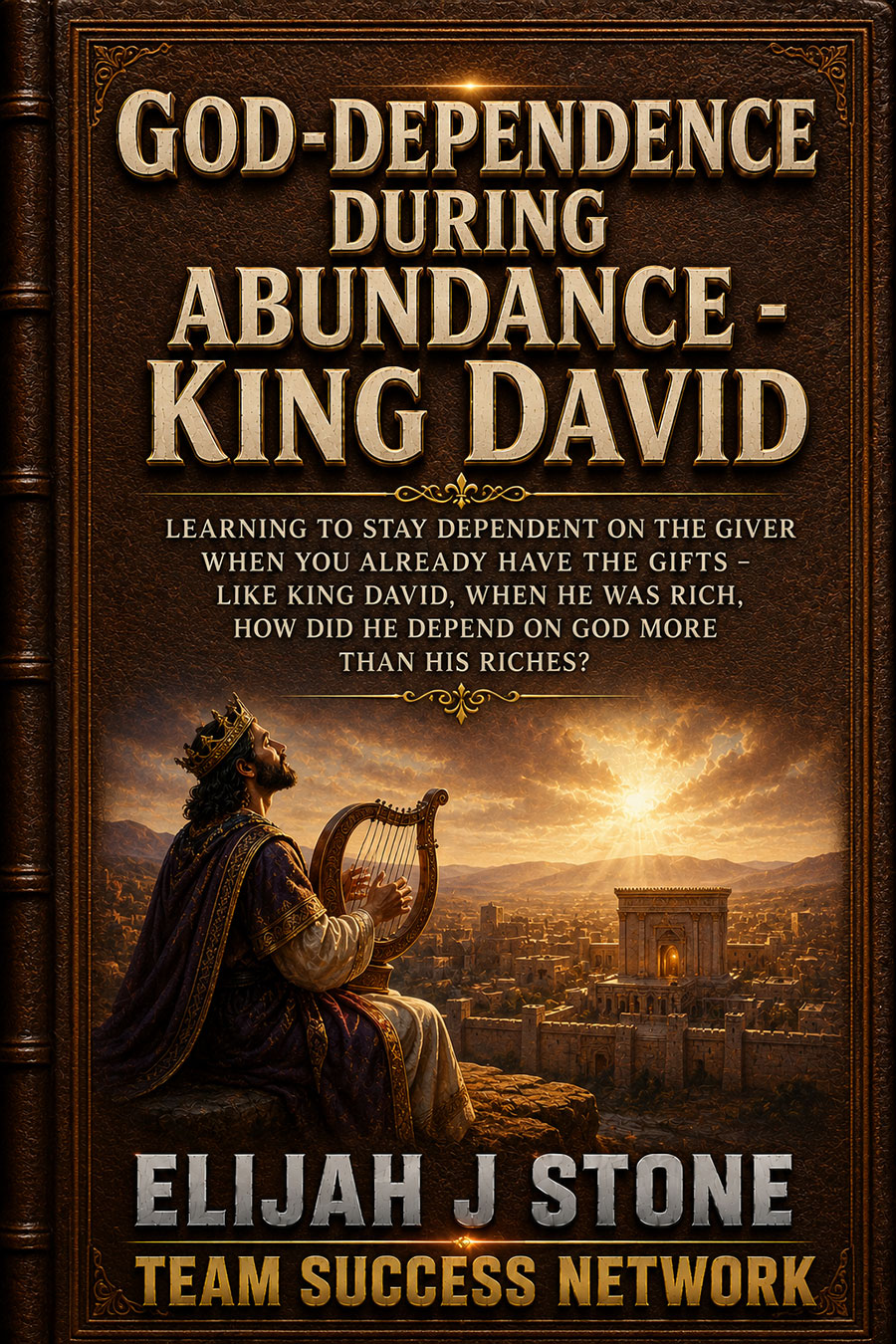
Book 90: God-Dependence During Abundance - King David

God-Dependence
During Abundance - King David
Learning to Stay Dependent on the Giver When You Already Have the Gifts - Like King David, When He Was Rich, How Did He Depend On God More Than His Riches?
By Mr. Elijah J Stone
and the Team Success Network
Table
of Contents
Chapter 1 – The Hidden Test of Prosperity............................................ 1
Chapter 2 – Remembering the Shepherd in the Palace.......................... 1
Chapter 3 – When Blessing Becomes a Battlefield................................. 1
The God-Dependent Life of David
Chapter 4 – God-Dependent – The Secret of Daily Inquiry..................... 1
Chapter 5 – God-Dependent – Worship Before War.............................. 1
Chapter 6 – God-Dependent – Giving God Credit for Every Victory........ 1
Chapter 7 – God-Dependent – Repentance After Counting the Army..... 1
Chapter 8 – God-Dependent – Generosity as Proof of Trust................... 1
Chapter 9 – God-Dependent – Praising in Every Season........................ 1
Chapter 10 – God-Dependent – Refusing to Manipulate Power............. 1
Chapter 11 – God-Dependent – Surrounding Himself with Prophetic Voices 1
Chapter 12 – God-Dependent – Building Altars, Not Monuments.......... 1
Chapter 13 – God-Dependent – Handling Correction with Humility....... 1
Chapter 14 – God-Dependent – When Comfort Can Corrupt................. 1
Chapter 15 – God-Dependent – Fighting Complacency in Success.......... 1
Chapter 16 – God-Dependent – The Balance Between Blessing and Brokenness 1
Chapter 17 – God-Dependent – Leaving a Legacy of Faith, Not Fortune.. 1
Chapter 18 – God-Dependent – Staying Childlike in a King’s World........ 1
Chapter 19 – The Danger of Wealth Without Worship........................... 1
Chapter 20 – Returning to the Source of All Success............................. 1

Chapter 1 – The Hidden Test of Prosperity
Learning to Stay Dependent When Everything
Looks Secure
Why Blessing Can Be a Bigger Test Than
Struggle
The Real
Test Begins After The Breakthrough
Prosperity
is not the end of testing—it’s the beginning of a deeper one. When you have
what you once prayed for, the challenge shifts from asking to honoring.
Many people believe the real test is in poverty, when they have nothing. But
the greater test comes when God trusts you with plenty.
King David
learned this firsthand. He went from shepherd boy to king, from caves to
castles, from surviving off scraps to sitting at royal banquets. Yet his
greatest battles weren’t fought with giants or armies—they were fought in the
quiet moments of his own heart. Wealth brought comfort, and comfort tempted
complacency.
“When you
have eaten and are satisfied, praise the Lord your God for the good land he has
given you. But be careful that you do not forget the Lord your God.” (Deuteronomy 8:10–11)
This is
the test prosperity introduces—forgetfulness. Not of facts, but of dependence.
You stop asking, stop listening, stop leaning. The heart that once cried for
help can easily begin to trust in the help it received.
When
Blessing Becomes A Blindfold
Success
can subtly blind us to our need for grace. Comfort creates the illusion of
control. You start to think, I worked hard for this. I built this. The
language of dependence fades into the language of achievement. That’s why
prosperity is a dangerous gift—it amplifies whatever is already in your heart.
For David,
the danger came not from enemies outside his palace but from self-sufficiency
inside it. His victories made him respected, admired, and powerful. Yet power
without prayer becomes pride. And pride is the slow leak that drains
dependence.
It’s easy
to assume that material stability equals spiritual safety. But Scripture warns
otherwise. “Those who trust in their riches will fall, but the righteous
will thrive like a green leaf.” (Proverbs 11:28) Prosperity isn’t
protection—it’s a platform that reveals what you trust most.
If God
blesses you and you stop needing Him, that blessing has failed its purpose. The
goal of abundance is not independence; it’s intimacy through stewardship.
Prosperity is meant to display God’s generosity, not replace it.
The Subtle
Voice Of Independence
Prosperity
speaks softly. It doesn’t shout rebellion—it whispers comfort. It says, You’re
safe now. You can relax spiritually. But the moment you believe that, you
drift from your Source.
David
could have relied on wealth, horses, or armies. Yet he continually declared, “Some
trust in chariots and some in horses, but we trust in the name of the Lord our
God.” (Psalm 20:7) His secret was not just that he prayed when he
lacked—it’s that he prayed when he had everything.
The same
God who teaches us dependence in scarcity wants to be our focus in abundance.
The test of prosperity asks: Will you still kneel when you no longer need to
beg?
We fail
this test not by rebellion but by routine. Our prayers shorten. Our worship
becomes casual. Our gratitude turns into entitlement. Independence grows
quietly until God becomes optional instead of essential.
The Gift
That Tests Your Grip
Every
blessing God gives is both a provision and a probe. It reveals whether you love
the gift more than the Giver. David’s heart stayed humble because he held
blessings loosely. He saw his position as stewardship, not ownership. He
understood that all power is borrowed, and all success temporary.
“Yours,
Lord, is the greatness and the power and the glory and the majesty and the
splendor, for everything in heaven and earth is yours.” (1 Chronicles 29:11)
This
declaration wasn’t poetic—it was a spiritual posture. David made sure his
wealth never outgrew his worship. He didn’t cling to gold; he offered it. He
didn’t hoard possessions; he prepared them for God’s house. Prosperity didn’t
harden him because gratitude softened him first.
When God
blesses you, He’s not rewarding independence—He’s entrusting influence. He’s
seeing if the hand that receives can also release. The tighter you grip what
you have, the quicker your joy fades. But the moment you release it back to
Him, peace returns.
Humility
In The Midst Of Increase
Humility
is not thinking less of yourself—it’s thinking of yourself less. David’s
humility didn’t disappear in royalty. His crown didn’t replace his conscience.
Even as a king, he still danced like a shepherd before the Lord. That’s the
secret of staying dependent: never stop being small before God.
When
humility leaves, pride enters silently. Pride doesn’t always boast—it often
forgets. It forgets who gave you breath, who opened doors, who provided
strength. Prosperity amplifies that forgetfulness unless you consciously choose
remembrance.
David
stayed grounded by remembering. Every Psalm of thanksgiving was a reminder of
where God found him—alone, unseen, and unqualified. His humility grew not from
poverty but from perspective. He never forgot that everything he ruled once
belonged to Another.
The higher
God lifts you, the deeper your humility must grow. The taller the tree, the
deeper the roots. Prosperity demands humility like oxygen. Without it, your
success becomes your suffocation.
Gratitude
Keeps The Soul Awake
Gratitude
is how you keep your soul from falling asleep in luxury. David practiced
gratitude as a lifestyle, not a reaction. His worship wasn’t situational—it was
habitual. He praised God not because he was desperate, but because he was
devoted.
“Praise
the Lord, my soul, and forget not all his benefits.” (Psalm 103:2) Gratitude fights spiritual
amnesia. It keeps your blessings from becoming background noise. When your
heart stays thankful, dependence remains alive.
We lose
gratitude when we focus on possession instead of purpose. Gratitude reminds us
that wealth is a witness of God’s goodness. It’s not just provision—it’s proof
of His partnership. Every resource you hold is a reminder of a relationship you
must keep.
The moment
you stop thanking God, you start taking His blessings for granted. Gratitude
isn’t a feeling; it’s a discipline that keeps your priorities in order and your
worship pure.
When
Prosperity Reveals The Heart
Prosperity
doesn’t corrupt—it exposes. It reveals what has been dormant. In the same way
that pressure shows character in struggle, abundance shows character in ease.
David’s heart was revealed through how he handled honor.
He didn’t
lose intimacy with God because he was rich; he lost it only when he forgot to
depend. Every believer must face this reality: your heart’s loyalty isn’t
proven by how you suffer, but by how you handle success.
God tests
the heart not to condemn, but to confirm. He wants to ensure that your
foundation is built on Him, not on what He gives. Prosperity without dependence
is like a palace built on sand—beautiful for a season, but doomed when storms
return.
If you let
abundance anchor your faith instead of God’s presence, your joy will rise and
fall with circumstances. But when your dependence is anchored in Him, you’ll
remain steady in every season.
How To
Stay Dependent In Seasons Of Plenty
Dependence
in abundance looks different than dependence in lack. It’s quieter but equally
intentional. David modeled it through several consistent habits:
• Prayer
Before Decisions – He inquired of the Lord before making moves, even when
he could have relied on experience.
• Generosity Without Fear – He gave freely, proving that riches didn’t
own him.
• Repentance Without Delay – When pride entered, he turned quickly.
• Praise Without Prompt – He worshiped out of love, not need.
• Remembrance Without Pride – He recalled God’s goodness daily to stay
grounded.
These
aren’t religious rituals—they’re relational habits. They’re how you build
spiritual muscle to handle the weight of blessing. Prosperity without these
rhythms will eventually erode dependence.
True
maturity isn’t just thanking God for blessing—it’s staying near Him after
receiving it. Blessings should deepen intimacy, not distance it. Prosperity
isn’t a pass from dependence—it’s a call to strengthen it.
Stewardship
Over Ownership
Stewardship
is the mindset that keeps prosperity holy. It’s the awareness that nothing
truly belongs to you—it’s all on loan. David knew that his authority, wealth,
and influence were tools for God’s purposes. Ownership says, “This is mine.”
Stewardship says, “This is God’s.”
When
ownership rules, fear follows. You begin to protect and preserve. But when
stewardship rules, peace follows—you’re simply managing what already belongs to
Him.
Stewardship
keeps joy alive in prosperity. It lets you celebrate blessings without being
controlled by them. When you see yourself as a manager, not a master, every
resource becomes an opportunity for worship.
Your
finances, your influence, your home—none of them define you. They’re all
entrusted spaces where your love for God can be displayed. Stewardship is how
dependence remains visible in prosperity.
The
Blessing That Leads Back To Worship
Every gift
from God carries an invitation—to return. To turn the blessing into
thanksgiving. To make the miracle into a moment of worship. David modeled this
beautifully. When he saw the favor of God increase, he didn’t build walls—he
built altars.
His
instinct wasn’t to keep more, but to give more. The more he received, the more
he worshiped. That is what true prosperity looks like: wealth that increases
worship, not worry.
God’s
desire is not to withhold riches but to ensure they never replace relationship.
Prosperity becomes dangerous only when it becomes central. David’s example
teaches us that the safest place for wealth is under the shadow of worship.
As long as
your blessings lead you back to praise, they’ll never lead you away from God.
Key Truth
Prosperity
is not proof of independence—it’s a test of stewardship. God’s goal is not to
deprive but to develop. He wants to see whether increase produces worship or
worry, humility or pride. The wealthiest heart is the one that still kneels.
The true
mark of maturity is not what you can handle in lack, but what you can carry in
abundance without losing dependence.
Summary
David’s
life reveals that prosperity refines the heart more than poverty ever could.
Wealth exposes motives, comfort tests humility, and abundance reveals the
strength of gratitude. When success arrives, the heart must remain small before
God.
To pass
the hidden test of prosperity, you must remember the Source of every blessing,
live as a steward not an owner, and let gratitude keep your soul awake.
Prosperity was never meant to replace dependence—it was designed to reveal it.
Stay
dependent. Stay grateful. Let every good thing point back to the Giver. That is
how blessing remains holy.

Chapter 2 – Remembering the Shepherd in the
Palace
How to Stay Grounded When God Elevates You
Why Gratitude for Humble Beginnings Protects
the Heart in Success
The Power
Of Remembering Where You Came From
Promotion
reveals more than skill—it exposes the soul. Many long to be lifted, but few
know how to stay humble once they are. When God raised David from the fields to
the throne, his circumstances changed overnight, but his heart remained the
same. He never forgot where grace first found him.
David’s
greatness was not in his crown but in his consciousness of mercy. His humility
didn’t come from poverty; it came from perspective. He remembered that before
the palace, there were pastures. Before a scepter, there was a sling. Before he
ruled men, he served sheep.
“He chose
David his servant and took him from the sheep pens; from tending the sheep he
brought him to be the shepherd of his people Jacob, of Israel his inheritance.” (Psalm 78:70–71)
That verse
is more than history—it’s testimony. God elevated a man who never stopped
acknowledging the grace that lifted him. David’s heart remained shepherd-sized,
even when his responsibilities became king-sized.
Promotion
Without Perspective Leads To Pride
When
success arrives, it can cloud memory. People forget the prayers that once built
their faith. They forget the days when they depended on daily bread. Yet
forgetting the pasture is the first step toward pride. The moment we believe
elevation came by effort alone, we start to drift from dependence.
David’s
strength was his memory. He didn’t romanticize the struggle, but he refused to
erase it. The wilderness taught him what no palace could: how to hear God’s
voice in the quiet and how to trust His timing when nothing seemed to move.
Those lessons became anchors when abundance threatened to make him forget.
“Do not
despise these small beginnings, for the Lord rejoices to see the work begin.” (Zechariah 4:10)
Success
without remembrance is spiritual amnesia. The person who forgets where they
came from will eventually forget Who brought them there. Promotion without
perspective is dangerous because it convinces us we deserve what grace
provided.
Humility
Is Remembering Grace, Not Failure
Remembering
humble beginnings doesn’t mean glorifying hardship—it means honoring grace.
It’s not about reliving pain but recognizing purpose. David didn’t replay his
past out of regret; he remembered it out of reverence. His gratitude
transformed his history into worship.
We often
want to leave the past behind, but reflection keeps the soul grounded. When you
recall what God has done, your heart stays soft. You no longer measure yourself
by your achievements but by His mercy.
“By the
grace of God I am what I am, and his grace to me was not without effect.” (1 Corinthians 15:10)
Gratitude
is humility in motion. It keeps you aware that every success is borrowed breath
and every opportunity is undeserved favor. Remembering grace protects you from
the illusion of greatness.
David’s
memory was his mirror—it reminded him that even a king without grace is just
dust in royal garments. The more he remembered mercy, the more he worshiped.
The more he worshiped, the more his success stayed sanctified.
The Field
Trains What The Palace Tests
The
pasture was God’s classroom. Before David ever faced Goliath or led armies, he
learned to lead sheep. Those quiet years shaped his dependence, discipline, and
discernment. What he learned in obscurity sustained him in prominence.
When
success comes too soon, pride takes root where patience should have grown. God
often delays promotion to prepare the heart for it. The same fields that seem
beneath you may be the very ground God uses to mature you.
“Humble
yourselves, therefore, under God’s mighty hand, that he may lift you up in due
time.” (1 Peter
5:6)
If you
skip the field, the palace will expose you. David’s strength in leadership came
from lessons learned in solitude. He knew how to wait on God because he
practiced patience in hidden seasons. He knew how to shepherd people because he
had tended sheep. The palace only multiplied what the pasture planted.
When you
remember the field, you carry its humility into every future room. That memory
becomes protection against the pride that success can bring.
Why
Remembering Builds Worship
Worship
flows from remembrance. David’s songs often began with memory—he recounted
God’s faithfulness through every season. His psalms were not written from
theory but from testimony. Memory fueled melody.
“I will
remember the deeds of the Lord; yes, I will remember your miracles of long
ago.” (Psalm
77:11)
Each
remembrance became a reminder that his story was authored by grace. He didn’t
sing to celebrate self; he sang to honor the Source. This is why his worship
carried such power—it was rooted in remembrance.
When you
forget your history with God, your worship loses authenticity. But when you
remember how far He’s brought you, your praise gains depth. Worship built on
remembrance doesn’t depend on mood or environment—it flows from revelation.
David
remembered what it was like to fight lions alone, to sleep under stars instead
of roofs, to be forgotten by men yet chosen by God. Those memories became
sacred fuel for lifelong adoration. The deeper your remembrance, the stronger
your worship.
Gratitude
Keeps You Human
Success
has a way of making people unreachable. When you rise, the world applauds, but
applause can deafen you to Heaven’s voice. Gratitude keeps your heart human—it
reminds you that you’re not the source.
David’s
humility kept him relatable even as king. He remained approachable,
compassionate, and conscious of others. Remembering the field helped him govern
the palace with empathy. He knew what struggle felt like, and that memory made
him merciful.
Gratitude
bridges the gap between what you were and who you’ve become. It allows success
to serve rather than separate. When David looked at the poor, he didn’t see
strangers—he saw himself. He remembered what it meant to depend on daily
provision. That memory protected him from arrogance and preserved his
compassion.
True
greatness doesn’t forget weakness—it ministers from it. Gratitude keeps
influence humble and authority kind. The most dangerous success is the one that
erases your humanity. Gratitude guards against that by keeping you anchored in
grace.
The Enemy
Of Remembrance Is Pride
Pride
thrives on forgetfulness. It convinces you that you earned what only God gave.
It turns the miracle of mercy into a memory of merit. Pride has one mission—to
disconnect you from your dependence on God.
When David
forgot momentarily—when he numbered his army or took Bathsheba—trouble
followed. Those moments didn’t define him, but they revealed the cost of
forgetting. Pride blinded him to grace, but repentance restored remembrance.
“Pride
goes before destruction, a haughty spirit before a fall.” (Proverbs 16:18)
Remembering
keeps pride powerless. Every time you recall the pit God pulled you from, pride
loses ground. Pride demands self-praise; remembrance redirects it to God.
That’s why
gratitude and humility must walk together. They’re your spiritual defense
against deception. Pride cannot survive where worship is alive. The more you
remember the Shepherd, the safer your palace becomes.
Reflection
That Produces Wisdom
David’s
reflection was not self-pity—it was self-awareness. He understood that
reflection without revelation leads to regret, but reflection with gratitude
produces wisdom. Looking back is not about reliving mistakes but learning from
mercy.
When you
pause to remember what God has done, you begin to see His patterns. You see how
every delay, denial, and difficulty was shaping your dependence. The field
wasn’t punishment—it was preparation.
Reflection
builds discernment. It teaches you how to steward the next season with grace.
David used reflection to measure his heart continually. His memories kept him
honest before God and humble before men.
Wise
believers don’t live in the past, but they never erase it. Reflection becomes
their reminder that every new season must honor the old lessons. Remembering
the Shepherd keeps the king accountable to Heaven.
How To
Stay Grounded In Greatness
David’s
example teaches practical ways to remain humble while promoted:
• Celebrate
God’s Faithfulness Often – Keep a rhythm of thanksgiving through prayer and
worship.
• Acknowledge The Source Publicly – Tell your story often; give God
glory before others.
• Serve Where You Don’t Have To – Never outgrow servanthood; humility is
sustained by service.
• Mentor Others With Compassion – Use your experience to lift others,
not to elevate yourself.
• Repent Quickly When Pride Appears – Catch it early and return to
gratitude.
These
practices keep success safe. They remind you that growth is not measured by
status but by surrender. Greatness without grace collapses under its own
weight. Remembering your roots is not insecurity—it’s insulation. It guards
your heart while God enlarges your territory.
The
Strength Of Those Who Remember
David’s
legacy endured because his remembrance produced resilience. When kings forgot
God, kingdoms crumbled. When David remembered God, strength returned.
Remembrance builds spiritual continuity—it connects past provision to present
praise.
“The Lord
is my shepherd, I lack nothing.” (Psalm 23:1)
That
declaration came from memory. The same Shepherd who guided him through fields
was guiding him through the palace. That realization gave David peace in
prosperity and courage in conflict. He knew his identity wasn’t defined by
crown or comfort—it was anchored in covenant.
Those who
remember become unshakable. Their joy doesn’t depend on circumstances because
their confidence comes from consistency—God’s faithfulness never changes.
Memory becomes the root of endurance.
If you can
remember where God met you, you can withstand any place He leads you. The
Shepherd never leaves the one He promotes; He simply changes the scenery to
test the stability of your gratitude.
Key Truth
Promotion
is not a sign that dependence has ended—it’s proof that dependence must deepen.
The same grace that lifts you must sustain you. Forgetting the pasture invites
pride; remembering it preserves purity.
Every
throne built on gratitude remains stable. Every success rooted in remembrance
becomes worship. The palace is safest in the hands of those who still think
like shepherds.
Summary
David’s
rise from pasture to palace teaches that remembrance is more than memory—it’s
maturity. Success without gratitude breeds arrogance, but gratitude keeps
greatness grounded. The field that once felt small becomes sacred when it
teaches humility that outlasts promotion.
To
remember the Shepherd in the palace is to honor the journey that shaped your
faith. Look back to stay humble, look forward to stay fruitful, and look up to
stay dependent. The higher God lifts you, the more deeply you must remember who
carried you there. Every promotion is a reminder that grace still sits on the
throne.

Chapter 3 – When Blessing Becomes a
Battlefield
How Success Creates New Spiritual Challenges
Why the Seasons of Ease Require the Deepest
Vigilance
The Battle
Changes, But It Never Ends
Many think
the fight is over once the breakthrough comes. You’ve prayed, waited, endured,
and finally, God blesses you with what you asked for. But blessing doesn’t end
warfare—it changes it. The enemy doesn’t disappear when success arrives; he
simply adjusts his strategy.
When David
moved from the wilderness to the throne, his environment changed, but his need
for discernment didn’t. The spears of Saul were replaced by the subtler weapons
of comfort, pride, and distraction. The tests that once came through hardship
now came through ease.
“Be alert
and of sober mind. Your enemy the devil prowls around like a roaring lion
looking for someone to devour.” (1 Peter 5:8)
The devil
rarely attacks the blessed through poverty—he attacks through prosperity. He
whispers lies like, “You’ve made it now,” or “You deserve to relax
spiritually.” But the moment you stop watching and praying, success becomes
a setup. The greater the blessing, the greater the need for vigilance.
The Subtle
Shift From Gratitude To Entitlement
When
blessings multiply, it’s easy to move from gratitude to entitlement. The heart
slowly transitions from “Thank You, God,” to “I earned this.”
That shift happens quietly, often unnoticed. Comfort replaces conviction. Ease
replaces dependence.
David
faced this battle daily. He had every reason to feel secure: power, wealth,
respect, and victories. Yet his heart still needed guarding. His blessing could
easily have become a breeding ground for arrogance if he didn’t stay centered
in worship.
“When
pride comes, then comes disgrace, but with humility comes wisdom.” (Proverbs 11:2)
Entitlement
blinds. It convinces you that what once felt like grace is now your right. But
the truth is, nothing we have is independent of God’s mercy. Every good thing
remains on loan from Heaven.
To stay
humble in blessing, you must keep gratitude louder than achievement. You must
remember the Giver more than the gift. The antidote to entitlement is continual
thanksgiving.
Success
Doesn’t Protect You From Temptation
It’s
possible to be spiritually vulnerable while appearing outwardly successful.
David learned this painfully. His fall with Bathsheba didn’t happen because he
was weak—it happened because he was comfortable. He stayed home when kings went
to war, and comfort became the breeding ground for compromise.
The same
principle applies today. When your schedule slows, when your income stabilizes,
when your influence grows—that’s when your soul must remain alert. The enemy
strikes hardest when you stop expecting battle.
“So, if
you think you are standing firm, be careful that you don’t fall!” (1 Corinthians 10:12)
Temptation
doesn’t stop when promotion begins. It merely disguises itself. The very
blessings meant to bring joy can become distractions if the heart loses focus.
Prosperity exposes character—it doesn’t replace it.
When you
reach a place where you no longer need to pray, you’re in greater danger
than when you struggled. Blessing should bring peace, not passivity. The only
safe posture for a blessed believer is one of continual dependence.
The Hidden
Dangers Of Ease
Ease is
deceptive. It looks like rest but can quickly become regression. The human
heart wasn’t designed to live without dependence on God. When comfort removes
the sense of need, it also removes the sensitivity to His presence.
David’s
comfort created a vacuum. He had everything a man could want—yet temptation
entered through boredom. When passion for purpose fades, pleasure fills the
void. The battlefield shifts from external enemies to internal appetites.
“Above all
else, guard your heart, for everything you do flows from it.” (Proverbs 4:23)**
The heart becomes the new battleground in prosperity. Guarding it means
refusing to let comfort dull your awareness of God’s voice.
Blessing
is never the problem—it’s unguarded contentment that becomes the trap. When
life is peaceful, double your prayer. When resources abound, deepen your
worship. Ease is safest only when it drives you closer to God.
How
Celebration Can Invite Defeat
David
celebrated his victories publicly, but he always followed them with worship
privately. That rhythm protected him. He knew that celebration without humility
invites downfall. When success comes, the flesh wants applause; the spirit
needs surrender.
Every
celebration carries a crossroads: you can exalt self or exalt God. If you
forget the Source of victory, pride quietly takes over. The joy of blessing can
dull discernment if gratitude isn’t active.
“Not to
us, Lord, not to us but to your name be the glory, because of your love and
faithfulness.” (Psalm
115:1)**
Celebration
without humility becomes intoxication. It blinds you to your dependence and
numbs you to correction. That’s why David often turned victories into songs of
worship—he redirected praise to Heaven.
If you
want your blessings to remain safe, learn to turn every applause into an altar.
Let celebration become adoration. That’s how joy stays pure and victory stays
holy.
The Enemy
Of Dependence Is Self-Sufficiency
Self-sufficiency
is the silent killer of intimacy with God. It doesn’t feel sinful—it feels
mature. You start to believe your experience is enough, your wisdom is
sufficient, your success is secure. That’s when spiritual decline begins.
David’s
downfall during the census (2 Samuel 24) was rooted in this very deception. He
began to trust numbers more than the God who gave them. He shifted from faith
to statistics. His dependence subtly changed from divine to human calculation.
“Trust in
the Lord with all your heart and lean not on your own understanding.” (Proverbs 3:5)**
Every
believer faces this temptation when they gain knowledge or success. We begin to
lean on what we know instead of Who we know. The solution isn’t ignorance—it’s
intimacy. Dependence is choosing relationship over reason when reason feels
easier.
Self-sufficiency
turns prayer into a formality; dependence keeps prayer as a lifeline. The key
to remaining victorious in blessing is remembering that success doesn’t make
God unnecessary—it makes Him more essential.
When
Blessing Becomes A Test Of Trust
Every
blessing God gives comes with a question: Can I trust you with this? The
test of blessing is not about stewardship of money or possessions—it’s about
stewardship of the heart.
David’s
wealth, influence, and authority weren’t rewards—they were responsibilities.
Each demanded deeper intimacy and greater surrender. God wasn’t impressed by
David’s success; He was interested in his dependence.
“The Lord
searches every heart and understands every desire and every thought.” (1 Chronicles 28:9)**
The
battlefield of blessing is subtle—it’s fought in motives, not motions. Will you
still seek God when success seems certain? Will you still give when abundance
feels comfortable? Will you still obey when comfort invites compromise?
The test
of trust isn’t how you handle loss—it’s how you handle gain. Blessing is meant
to magnify obedience, not minimize it. When you treat prosperity as sacred, you
disarm pride and keep your blessing pure.
The
Spiritual Discipline Of Vigilance
Vigilance
is a spiritual discipline—staying awake when comfort tempts you to sleep. David
practiced vigilance through worship, prayer, and reflection. Even in seasons of
ease, he stayed aware that blessing required guarding.
“Watch and
pray so that you will not fall into temptation. The spirit is willing, but the
flesh is weak.” (Matthew
26:41)**
The
greater the abundance, the easier it becomes to lower spiritual defenses. But
vigilance is how you honor God’s trust. You protect the sacred by refusing to
let routine replace reverence.
When life
feels easy, stay sharp. The mind must stay renewed, the hands generous, and the
heart repentant. Dependence requires constant recalibration—returning daily to
God’s perspective.
The
blessed believer who stays watchful will not lose focus. They understand that
blessing requires as much discipline as drought. Ease is a stewardship
assignment, not an escape from devotion.
How To
Guard Dependence In Abundance
Practical
habits help believers maintain dependence when life is abundant:
• Pray
First, Decide Second – Keep God first in every choice, even when you’re
confident.
• Stay Generous – Giving keeps greed from growing and centers the heart
on others.
• Repent Regularly – Confession cleanses the soul from subtle pride.
• Worship Without Prompt – Worship must remain a habit, not a response.
• Seek Accountability – Allow trusted voices to speak correction when
success clouds judgment.
These
disciplines don’t earn favor—they preserve it. They remind you that prosperity
isn’t protection from spiritual warfare; it’s an invitation to deeper maturity.
Dependence
requires structure. The same way soldiers train in peace to prepare for war,
believers must strengthen their spirit in ease to withstand temptation.
Blessing doesn’t excuse discipline—it demands it.
The Sacred
Stewardship Of Abundance
Blessing
is not ownership; it’s stewardship under scrutiny. God gives abundance to
measure whether the heart still bows. Every possession is an opportunity to
display trust.
David’s
generosity toward building the temple showed that he viewed wealth as worship.
His stewardship reflected his intimacy. He gave because he remembered that
everything he had was borrowed.
“Now, our
God, we give you thanks, and praise your glorious name. But who am I, and who
are my people, that we should be able to give as generously as this? Everything
comes from you, and we have given you only what comes from your hand.” (1 Chronicles 29:13–14)**
Abundance
is holy ground. When you treat your prosperity as sacred, it becomes a
testimony. When you treat it as yours, it becomes a temptation. The way you
handle what God gives determines whether you’ll be trusted with more.
Every
season of blessing is an invitation to return to gratitude, generosity, and
grace. Prosperity is safest in hands that tremble with awe.
When
Blessing Builds Worship Instead Of Walls
Some use
blessing to isolate themselves. Others use it to worship. David chose the
latter. His blessings became platforms of praise, not prisons of pride. His
victories led him to sing louder, not live quieter.
Blessing
that isolates you has become an idol. But blessing that drives you to worship
has fulfilled its purpose. When prosperity builds walls around you, you lose
perspective. When it builds altars before you, you gain revelation.
Worship
keeps wealth in its rightful place. It dethrones self and enthrones God. When
you use your success to glorify Him, the blessing multiplies instead of decays.
Let every
victory lead you to deeper surrender. Turn every breakthrough into
thanksgiving. Prosperity that leads you to worship becomes eternal; prosperity
that leads you to pride becomes temporary.
The Reward
Of Dependence In Success
David’s
legacy wasn’t built on endless victories—it was built on enduring humility. He
stumbled, but he always returned. The man after God’s heart wasn’t perfect; he
was persistent in dependence.
When you
remain dependent in blessing, you become a conduit, not a container. God can
trust you with increase because your heart remains anchored. Prosperity then
becomes purpose—fuel for Kingdom work, not a trophy of self.
“Blessed
is the one who trusts in the Lord, whose confidence is in him.” (Jeremiah 17:7)**
Dependence
turns blessing into ministry. Your success becomes testimony. Your prosperity
becomes partnership. God doesn’t bless you to impress others—He blesses you to
express His heart to others.
The reward
of dependence is not more stuff—it’s more presence. The more you rely on Him,
the more you carry His peace, even amid plenty.
Key Truth
Blessing
is not a shield from warfare—it’s a shift in it. Prosperity exposes what
pressure once concealed. The enemy doesn’t retreat when you’re blessed; he
refocuses. The heart that stays dependent in success is the heart that cannot
be conquered.
When
blessing becomes a battlefield, fight differently—through gratitude, humility,
and worship. Victory in abundance comes from vigilance in dependence.
Summary
David’s
journey proves that blessing is both gift and test. Success introduces new
battles—ones fought not with enemies but with ego. The same faith that
sustained you in lack must sustain you in abundance.
When
blessing dulls discernment, pride gains ground. But when blessing deepens
gratitude, God gains glory. The key to lasting victory is vigilance. Stay
dependent in ease as you were in adversity.
Blessing
was never meant to end your battles; it was meant to refine them. Keep praying.
Keep worshiping. Keep remembering Who made you blessed. The battlefield of
prosperity is won by hearts that still bow.

Chapter 4 – God-Dependent – The Secret of
Daily Inquiry
How Asking God First Keeps Life Safe, Strong,
and Aligned
Why Dependence Is Proven by Consistency, Not
Crisis
The Power
Of Asking God First
David’s
greatest victories were not the result of strategy—they were the fruit of
inquiry. He didn’t rely on intuition or experience. He developed the sacred
habit of asking God first. This simple rhythm of conversation was his unseen
strength, the anchor beneath every triumph.
Many know
how to pray when desperate but few know how to ask when comfortable. David did
both. Whether facing giants or governing nations, he treated divine
consultation as his first step, not his last resort. His heart was not just
trained for war—it was trained for listening.
“David
inquired of the Lord, ‘Shall I go and attack these Philistines?’ The Lord
answered him, ‘Go, attack the Philistines and save Keilah.’” (1 Samuel 23:2)
That
single phrase—David inquired of the Lord—appears repeatedly in
Scripture. It was his way of saying, “God, I won’t move without You.” His
success was not built on his brilliance but on his submission.
True
Wisdom Flows From Relationship
Wisdom is
not primarily intelligence—it’s intimacy. David’s insights came from proximity,
not pride. He understood that revelation flows to those who remain connected.
Every time he inquired of God, he received direction that human reasoning could
never supply.
“Call to
me and I will answer you and tell you great and unsearchable things you do not
know.” (Jeremiah
33:3)**
Inquiring
daily is the difference between reaction and revelation. Reaction happens when
you respond to circumstances; revelation happens when you respond to God. David
didn’t guess—he listened. His humility gave Heaven room to speak.
The closer
you walk with God, the clearer decisions become. Not because life gets simpler,
but because His voice becomes familiar. Daily inquiry transforms confusion into
confidence because direction is no longer your burden—it’s His.
Dependence
Is A Discipline, Not A Feeling
Dependence
doesn’t always feel spiritual. Sometimes it looks like slowing down when
everyone else rushes. It means waiting for a whisper instead of chasing
opportunity. David made inquiry his discipline, not his emotion. He didn’t pray
only when inspired—he prayed because he was dependent.
The
problem today is not that believers don’t love God; it’s that they often leave
Him out of the process. Many pray for outcomes but plan without permission.
David refused to separate devotion from decision. He didn’t assume success—he
asked for it.
“Trust in
the Lord with all your heart and lean not on your own understanding; in all
your ways submit to him, and he will make your paths straight.” (Proverbs 3:5–6)**
Discipline
sustains dependence when emotion fades. Asking daily builds spiritual muscle
memory. It keeps the heart in posture even when life gets busy. Inquiry isn’t a
delay—it’s divine protection in disguise.
How Daily
Inquiry Protects The Heart
Every
inquiry invites correction before consequence. When you stop asking, you start
drifting. David’s safety wasn’t in his soldiers—it was in his sensitivity. God
often warned him of hidden traps before they appeared.
Inquiry is
Heaven’s early warning system. It exposes pride before it hardens. It redirects
paths before mistakes multiply. Each time David asked, God adjusted his steps
to match divine timing. His life became proof that obedience is the shortest
route to safety.
“Whether
you turn to the right or to the left, your ears will hear a voice behind you,
saying, ‘This is the way; walk in it.’” (Isaiah 30:21)**
Many
calamities come not from rebellion but from neglect. We assume what God once
said still applies today. But daily inquiry ensures freshness—it keeps the
relationship current. What protected you yesterday may not guide you tomorrow.
Asking daily keeps you aligned.
Dependence
isn’t fragile—it’s vigilant. Those who keep listening keep learning, and those
who keep learning stay safe.
When
Success Makes Inquiry Harder
Prosperity
complicates prayer. When resources are abundant and influence expands, the
temptation to rely on self intensifies. David faced this often. Surrounded by
advisors, prophets, and generals, he could easily have substituted counsel for
communion. But he didn’t. He still inquired of the Lord.
It takes
humility to keep seeking God when you have access to everything else.
Dependence in success is rarer than dependence in struggle. Blessing tests
whether the habit of inquiry is rooted in need or in love.
David’s
consistency proved it was the latter. He asked not because he was weak, but
because he was wise. True maturity isn’t growing beyond the need to ask—it’s
deepening the desire to ask.
When life
becomes comfortable, double your inquiry. The greater your influence, the more
dangerous independence becomes. The throne is safer when prayer still leads it.
When God’s
Silence Tests Your Patience
Sometimes,
the hardest part of inquiry is waiting. God doesn’t always answer immediately
because He’s training your dependence. Waiting reveals whether you seek His
voice or just His validation.
David
often had to wait for clarity. Yet in waiting, he learned intimacy. The silence
refined his motives and strengthened his discernment. When God delayed, David
didn’t force decisions—he worshiped instead.
“I wait
for the Lord, my whole being waits, and in his word I put my hope.” (Psalm 130:5)**
Waiting
doesn’t mean inaction—it means alignment. When you learn to trust God’s timing,
you avoid traps that rushers fall into. The impatient often build what God
never intended, only to watch it collapse. The inquirer builds with confidence,
because his foundation is revelation.
Daily
inquiry teaches patience, and patience preserves destiny. Waiting becomes holy
when it’s rooted in dependence.
The Danger
Of Acting Without Asking
Every time
David inquired of the Lord, he found victory. The one time he didn’t, disaster
struck. When the Ark of the Covenant was being moved, David failed to ask for
divine instruction. He relied on good intentions instead of divine directions,
and tragedy followed.
Uzzah’s
death was a sobering reminder: doing something for God is not the same as doing
it with God. David’s mistake wasn’t rebellion—it was presumption. He
learned that obedience begins with inquiry, not assumption.
“There is
a way that appears to be right, but in the end it leads to death.” (Proverbs 14:12)**
Acting
without asking is the birthplace of error. It turns inspiration into
impulsiveness. The heart that stops asking eventually starts guessing, and
guessing always ends in grief.
David
corrected his mistake by returning to prayer and study. Once he followed God’s
specific instructions, the Ark was restored safely. Inquiry turns regret into
revelation.
The Rhythm
Of Daily Dependence
Daily
inquiry must become rhythm, not ritual. Ritual prays because it’s time; rhythm
prays because it’s relationship. David’s inquiries were conversations, not
checklists. He didn’t treat prayer like a transaction but like a trust.
Every day
he reset his focus through communion. He made room for God’s wisdom before
making room for his plans. That rhythm is how peace replaced pressure. When you
live by inquiry, you never face decisions alone.
• Morning
Inquiry – Begin the day asking, “Lord, what’s on Your heart today?”
• Midday Alignment – Pause briefly to realign when distractions creep
in.
• Evening Reflection – Review the day with gratitude and correction
where needed.
This
rhythm keeps dependence active. It turns your entire schedule into sacred
space. Inquiry becomes the thread that weaves divine partnership through every
moment.
The closer
you live to His voice, the fewer regrets your day will hold.
How
Inquiry Builds Intimacy
Asking God
questions is not just about getting answers—it’s about getting closer. Every
inquiry reveals His personality. Each response teaches His ways. When you
inquire daily, you’re not just managing your life—you’re deepening your
friendship.
David
called God his Shepherd, his Rock, his Deliverer, his Friend. These weren’t
theological titles; they were relational discoveries. Each title came from a
moment of dependence.
“The Lord
confides in those who fear him; he makes his covenant known to them.” (Psalm 25:14)**
Intimacy
grows when conversation becomes continual. Asking God questions invites
dialogue; obedience maintains it. When your dependence becomes consistent, your
discernment sharpens. The more you talk with Him, the faster you recognize His
whisper.
Inquiry
transforms faith from religion into relationship. The heart that inquires daily
never drifts far from His presence.
What
Happens When You Ask Daily
Daily
inquiry produces spiritual stability. When you seek God before moving, you gain
three priceless gifts:
- Clarity – Confusion loses power because
direction comes from above, not emotion.
- Confidence – You move boldly because you’re led,
not guessing.
- Covering – God’s guidance shields you from unseen
danger.
David
never lost a battle that began with inquiry. The habit became his shield. God
honored his consistency by granting favor, strategy, and strength.
When you
make asking God your instinct, life’s pace no longer controls your peace. You
become anchored in awareness that He is near. Inquiry doesn’t remove
challenges—it removes uncertainty.
Every
believer who learns this rhythm walks in supernatural composure. Storms may
rage, but decisions stay steady because dependence directs every move.
From
Inquiry To Instruction
Inquiry is
the doorway; instruction is the reward. God doesn’t reveal His will to satisfy
curiosity—He reveals it to invite obedience. The purpose of asking is acting.
When David inquired, he obeyed swiftly. His reverence turned revelation into
results.
Some ask
but never act, treating God’s direction as advice. But inquiry demands
surrender. It’s saying, “I’ll do whatever You say, no matter the cost.” That
posture attracts favor.
“Teach me
your way, Lord, that I may rely on your faithfulness; give me an undivided
heart, that I may fear your name.” (Psalm 86:11)**
Every
inquiry should end in yieldedness. God’s wisdom transforms only when it’s
applied. When you act on divine instruction, blessing follows naturally.
Dependence proves itself through obedience.
Inquiry
without obedience is curiosity; inquiry with obedience is covenant. David lived
the latter, and that’s why his leadership carried Heaven’s authority.
Keeping
Inquiry Fresh In A Busy World
In our
modern pace, the noise is louder than ever. Constant information, endless
distraction, and busyness make daily inquiry feel impossible. Yet this is the
generation that needs it most.
David’s
world was filled with demands—armies to lead, people to govern, crises to
solve—yet he always made space for God’s counsel. He knew one moment of divine
instruction could save months of human effort.
Dependence
must become non-negotiable, not optional. You don’t need hours of silence to
inquire—you just need moments of sincerity. The Spirit speaks in stillness, not
volume.
When you
invite God into your decisions, you’re choosing wisdom over weariness. Daily
inquiry transforms leadership, business, parenting, and even creativity. It
invites Heaven’s blueprint into human activity.
When the
world rushes, slow down to listen. The quiet moment you spend asking may
redirect your entire destiny.
How To
Develop The Habit Of Inquiry
You can
cultivate this lifestyle through intentional practice:
• Schedule
Time With God – Set daily appointments as faithfully as you keep meetings.
• Ask Specific Questions – Be clear about what you’re seeking; God
honors precision.
• Write What You Hear – Record impressions or Scriptures that come
during prayer.
• Wait Before Acting – Give space for confirmation before moving.
• Thank God For Every Answer – Gratitude increases sensitivity for
future direction.
Over time,
these habits rewire your reflexes. Asking God first becomes instinct. You stop
reacting to life and start partnering with Heaven. Inquiry evolves from effort
into enjoyment.
Dependence
matures when the heart delights in direction rather than resists it. Daily
asking becomes a joy, not a duty.
The Reward
Of A Listening Life
David’s
dependence gave him more than victories—it gave him friendship with God. His
life proves that guidance is not the highest reward of inquiry—closeness is.
God shared His secrets with a man who kept asking.
The
greatest privilege of dependence is not getting answers but gaining awareness
of His presence. Once you live this way, you’ll never want to move without Him
again.
Inquiry
builds intimacy, and intimacy builds inheritance. Those who listen daily live
securely because they walk in step with divine rhythm. The voice of God becomes
their compass and comfort.
Your
reward for asking daily is more than direction—it’s the assurance that you’re
never alone in any decision again.
Key Truth
Dependence
is proven in inquiry. The strength of your relationship with God is measured
not by how loudly you worship, but by how quickly you ask. Inquiry is not a
pause—it’s a posture.
The life
that begins every day with “Lord, what do You say?” will never walk in
confusion. Asking first is the purest evidence of trust.
Summary
David’s
life shows that consistent inquiry transforms chaos into clarity. The secret of
his success wasn’t strength or skill—it was submission. He refused to rely on
intellect when he could rely on intimacy.
Blessing
remains safe only under divine direction. Inquiry keeps prosperity from pride
and progress from presumption. The heart that asks daily lives under constant
protection.
Make
inquiry your rhythm, not your rescue. Keep asking, keep listening, keep
obeying. The secret to staying dependent is simple—never stop asking God first.

Chapter 5 – God-Dependent – Worship Before War
How Worship Aligns the Heart Before Every
Battle
Why Praise Is the Posture of Power
The Secret
Power Of Starting With Worship
Before
David ever fought with his sword, he fought with his song. Worship wasn’t what
he did after victory—it was what made victory possible. Before every
battle, he aligned his heart with Heaven. He knew that success without
surrender would become pride, and that every fight required God’s favor before
it required his effort.
David’s
dependence was not a weakness; it was his weapon. His psalms often began in
fear but ended in faith. He discovered that worship before war reorders the
soul—it silences anxiety, sharpens focus, and invites God to lead the charge.
“Let God
arise, let his enemies be scattered; let those who hate him flee before him.” (Psalm 68:1)
Worship
was never optional for David—it was strategic. It reminded him that his
strength was borrowed, his victories were shared, and his life was a stage for
God’s glory. He didn’t just sing because he felt victorious; he sang to become
victorious.
Why
Worship Must Come Before Strategy
Many plan
before praying, but David prayed before planning. He understood that worship
wasn’t a distraction from action—it was divine preparation. Worship realigned
his motives, ensuring that every battle began in obedience, not ambition.
Success
can tempt us to trust methods over the Master. But when you worship first, you
remember that every plan must be submitted to the Lord’s direction. Strategy
without surrender leads to stress; worship before strategy leads to success
that glorifies God.
“The horse
is made ready for the day of battle, but victory rests with the Lord.” (Proverbs 21:31)**
David
didn’t worship to avoid responsibility—he worshiped to carry it rightly. His
songs became blueprints for battle. They weren’t just melodies; they were maps
that pointed him back to dependence. The greater the opposition, the louder his
praise became.
Before the
sword ever struck, the song set the atmosphere. Worship was his way of saying,
“God, I’m not going unless You go with me.”
How
Worship Realigns Perspective
Worship is
more than music—it’s alignment. It restores perspective when fear or pride try
to distort it. David’s psalms reveal a man constantly re-centering his heart on
the Source of power. In worship, he remembered that God was his Defender, not
his decoration.
“The Lord
is my strength and my shield; my heart trusts in him, and he helps me.” (Psalm 28:7)**
When life
becomes chaotic, worship brings order. When emotion clouds judgment, worship
brings clarity. It shifts your gaze from the size of the battle to the
greatness of God. The same circumstances remain, but your confidence
transforms.
Without
worship, even small problems look overwhelming. With worship, even great
battles look conquerable. Worship doesn’t change your situation—it changes your
sight. That’s why David sang before the sword left its sheath. His perspective
determined his posture, and his posture determined his victory.
Worship
magnifies God, not the problem. It reminds the soul who’s really in command.
Worship
Turns Fear Into Faith
David’s
instinct in crisis was to sing. When fear rose, he responded with praise. His
worship became warfare in sound. He knew that fear feeds on silence, but faith
feeds on song.
“When I am
afraid, I put my trust in you. In God, whose word I praise—in God I trust and
am not afraid.” (Psalm
56:3–4)**
Every time
he worshiped, fear lost its authority. The melody of faith replaced the echo of
worry. Praise broke the power of panic because it shifted the conversation—from
inner anxiety to outward adoration.
Worship
doesn’t deny fear—it disarms it. David didn’t wait for courage to come; he
created it through worship. His psalms show a heart that learned to transform
trembling into trust by lifting his voice instead of his weapons first.
For
believers today, worship remains the same spiritual exchange: fear leaves when
faith sings. When you begin with worship, you stop fighting alone. You begin to
move in partnership with God instead of panic within yourself.
The
Exchange That Happens In Worship
Worship is
not performance—it’s exchange. It’s where you give your weakness and receive
His strength. It’s where you surrender control and gain courage. Every song
David sang before battle became a spiritual transaction between his humanity
and God’s divinity.
“He gives
strength to the weary and increases the power of the weak.” (Isaiah 40:29)**
When you
worship first, your perspective shifts from “I must” to “He will.”
That exchange transforms worry into peace and pressure into power. Worship
before war is not just a habit; it’s a handoff. You hand the outcome back to
God and let Him fight for you.
David
understood this principle so deeply that even when his men doubted him, he
worshiped anyway. He didn’t need approval to praise. He knew the only way to
win lasting victory was to keep his spirit surrendered.
Worship
allows Heaven to intervene in earthly conflicts. It invites the supernatural
into the natural. That’s why the strongest warriors are always the deepest
worshipers.
How
Worship Guards Motives In Battle
The danger
of success is pride, and the danger of pride is misplaced glory. David’s habit
of worship before war purified his motives. It reminded him that victory
belonged to God, not to him.
When
worship precedes action, it becomes a filter for intention. You can’t exalt
self while exalting God at the same time. Worship kills ego before ego kills
effectiveness.
“Not to
us, Lord, not to us but to your name be the glory, because of your love and
faithfulness.” (Psalm
115:1)**
Many begin
battles with right causes but wrong motives. They fight for recognition instead
of righteousness. Worship resets the heart. It ensures that every fight is
fought from submission, not self-importance.
Before
David ever commanded armies, he commanded his own spirit. His worship before
battle was an act of accountability. It kept pride out of his leadership and
kept God at the center of his purpose.
When your
motives stay pure, your victories stay holy.
The Rhythm
Of Worship In Every Season
David
didn’t worship occasionally—he worshiped continually. His dependence wasn’t
seasonal; it was steady. Whether in caves, courts, or conquest, his song never
stopped. That consistency built a rhythm that kept him spiritually alive.
“I will
bless the Lord at all times; his praise shall continually be in my mouth.” (Psalm 34:1)**
Worship in
every season is the true mark of dependence. It proves that your love for God
isn’t based on comfort or crisis—it’s based on covenant. David didn’t need
circumstances to dictate his praise; his relationship with God defined it.
In moments
of peace, worship preserved humility. In moments of war, it produced courage.
In moments of loss, it birthed restoration. Every stage of his life was carried
by the same rhythm: praise before pressure, worship before warfare.
A believer
who worships in all seasons remains unshaken. Circumstances may shift, but
dependence remains constant.
How
Worship Releases Divine Strategy
Worship
doesn’t just prepare the heart—it invites divine instruction. Many of David’s
battle strategies came through worshipful communion. When he worshiped, he
didn’t just feel inspired—he received direction.
“After
consulting the people, Jehoshaphat appointed men to sing to the Lord and to
praise him for the splendor of his holiness… As they began to sing and praise,
the Lord set ambushes against the men of Ammon and Moab and Mount Seir who were
invading Judah, and they were defeated.” (2 Chronicles 20:21–22)**
Though
this story speaks of King Jehoshaphat, it mirrors David’s pattern. Praise
invited divine participation. When worship came first, God moved before human
effort did. Heaven responds where honor rises.
Worship is
strategic—it creates spiritual atmosphere for revelation. The Spirit speaks
clearly when the heart is softened by praise. The more you worship, the less
you strive. You stop forcing outcomes and start flowing with divine timing.
When you
honor God before the fight, you receive wisdom during it. Worship opens your
ears before it opens your path.
When
Worship Wins Without Weapons
There were
times David didn’t even have to fight—his worship won for him. God’s presence
became his defense. When Saul pursued him, David’s refuge wasn’t in his
soldiers but in songs. Worship turned hiding places into holy spaces.
Worship is
warfare of a higher kind. It defeats enemies without hostility, through
surrender instead of struggle. When the enemy expects panic, you release
praise—and Heaven responds.
“You are
my hiding place; you will protect me from trouble and surround me with songs of
deliverance.” (Psalm
32:7)**
Worship
surrounds you with divine presence, creating an atmosphere where fear cannot
dwell. It’s not escapism—it’s empowerment. Every melody sung in faith becomes a
shield of peace.
When David
worshiped, he wasn’t ignoring his problems—he was inviting God to dominate
them. Worship lifts you above the battlefield, giving you Heaven’s view of
earthly problems.
Victory
that comes from worship lasts longer than victory won by force.
Practical
Ways To Worship Before War
Living a
lifestyle of worship before war requires intentionality. You can cultivate this
rhythm daily through:
• Morning
Praise – Begin your day exalting God before confronting challenges.
• Scripture-Focused Songs – Sing verses of truth to train your mind for
faith.
• Spontaneous Gratitude – Pause throughout the day to thank God before
making decisions.
• Corporate Worship – Surround yourself with voices that remind you of
Heaven’s power.
• Pre-Battle Praise – Before any task, meeting, or conflict—lift a quick
prayer of honor.
These
habits shift your focus from stress to surrender. Worship creates an
environment where Heaven’s peace rules over human fear.
David’s
success wasn’t his alone—it was shared with the One who guided him. When you
make worship your first reaction, victory becomes the natural outcome.
Dependence
through worship is the safest foundation for any endeavor.
When
Worship Restores Lost Strength
Even when
David failed, he returned through worship. After his sin with Bathsheba, he
didn’t rebuild his image—he rebuilt his altar. He wrote songs of repentance
that still heal hearts today. Worship became the path to restoration.
“Create in
me a pure heart, O God, and renew a steadfast spirit within me.” (Psalm 51:10)**
That
prayer wasn’t just apology—it was adoration. He knew worship wasn’t only for
celebration; it was also for correction. True worship acknowledges that
dependence doesn’t disappear after failure—it deepens.
When
strength fades and guilt lingers, worship revives what shame tries to kill. It
reminds you that God’s mercy is stronger than your mistakes.
Every time
David worshiped, he reconnected with his purpose. His throne was preserved not
by his perfection but by his posture. Worship before war is not only
preparation—it’s restoration when battles within the soul arise.
How
Worship Turns Victory Into Witness
The end of
every battle wasn’t silence for David—it was song. He didn’t just celebrate
privately; he made his victories public testimonies of God’s power. Worship
before war created worship after war. Every triumph became an opportunity to
glorify the One who delivered him.
“I will
give thanks to you, Lord, with all my heart; I will tell of all your wonderful
deeds.” (Psalm
9:1)**
When you
win through worship, you’re compelled to testify. Success becomes story.
Testimony becomes worship again. This cycle keeps dependence alive—it turns
each victory into another altar of gratitude.
The
believer who worships before and after battle becomes a living reminder that
God still fights for His people. Every story of deliverance points others to
the same dependence that secured your breakthrough.
When your
victories become praise, pride has no place to grow.
Key Truth
Worship
before war is not emotion—it’s alignment. It’s how you prepare your spirit
before you engage the world. Worship reminds you that battles are not won by
effort but by presence.
Every
fight begins and ends at the altar. Dependence deepens where worship leads.
Summary
David’s
life teaches that worship before war is the rhythm of victory. Praise prepares
perspective, purifies motives, and positions you under God’s power. The same
song that invited strength before battle sustained humility after it.
When life
offers comfort or conflict, start with worship. It tunes the heart to Heaven’s
frequency, making every step guided, guarded, and graced. Those who sing before
they swing never lose the war—they simply let God fight it through them.
Dependence
isn’t displayed in weakness but in worship. Lift your song before you lift your
sword, and you’ll discover that the greatest victories are won on your knees.

Chapter 6 – God-Dependent – Giving God Credit
for Every Victory
How Gratitude Guards the Heart from Pride
Why All Glory Belongs to the Giver, Not the
Receiver
The Secret
Of Staying Grounded After Victory
True
success reveals character. What we do after the win often matters more
than what we did to achieve it. David’s heart remained pure not because he
never failed, but because he never forgot the Source. He refused to steal God’s
glory.
Every
triumph became testimony, not trophy. David’s instinct after victory was
worship, not celebration of self. He understood that when you take credit for
what Heaven did, you endanger the very favor that made it possible. Gratitude
was his greatest safeguard.
“Yours,
Lord, is the greatness and the power and the glory and the majesty and the
splendor, for everything in heaven and earth is yours.” (1 Chronicles 29:11)**
David’s
secret wasn’t skill—it was surrender. Every achievement became an altar, and
every applause became an offering. He made sure the nation knew: This
victory belongs to God. That awareness kept his soul from being seduced by
success.
When
Praise Becomes A Trap
Praise
from people can be intoxicating. Compliments feel good, affirmation feels
deserved—but unchecked, they become dangerous. Pride grows in the soil of
applause. That’s why David learned to redirect every shout of “David has slain
his tens of thousands” back to God.
When the
people sang his praises, he didn’t argue—but he didn’t absorb them either. He
lifted them upward. David knew the difference between being celebrated and
being exalted. Being celebrated is encouragement; being exalted is idolatry.
Only one of those honors God.
“Let the
one who boasts boast in the Lord.” (1 Corinthians 1:31)**
Every
heart that learns to deflect human praise toward Heaven becomes immune to
pride. When you train yourself to give God the credit, you disarm the enemy’s
favorite temptation—to make success about self.
The key to
long-term peace is short-term humility. Gratitude keeps your victories safe
from corruption.
Why Giving
Credit Deepens Dependence
Acknowledging
God after victory doesn’t just honor Him—it transforms you. Each time David
credited God, his dependence deepened. Gratitude reminded him that partnership,
not pride, produced every success. He never saw God as a resource to exploit,
but as a relationship to cherish.
Dependence
grows in the soil of recognition. When you admit that you couldn’t have done it
alone, humility takes root and pride dies quietly. Gratitude keeps your eyes
lifted and your heart aligned.
“Every
good and perfect gift is from above, coming down from the Father of the
heavenly lights.” (James
1:17)**
David’s
understanding of this truth allowed him to enjoy success without being enslaved
by it. He didn’t fear losing blessings because he knew who owned them. When God
receives the glory, you receive the grace to handle the next assignment well.
Dependence
is the awareness that success doesn’t start or end with you—it flows through
you.
The
Anatomy Of A Humble Heart
Humility
isn’t thinking less of yourself—it’s thinking of yourself less. David modeled
this beautifully. Whether facing giants or leading armies, he never saw himself
as the source of victory. He called himself God’s servant, not Israel’s
hero.
“The Lord
is my strength and my shield; my heart trusts in him, and he helps me.” (Psalm 28:7)**
That verse
wasn’t written in theory—it was David’s lived reality. His courage came from
confidence in God, not in personal capacity. This humility preserved his peace,
even when his reputation soared.
When
humility rules the heart, success cannot corrupt it. The ego loses its grip
because identity is no longer tied to outcomes. David’s peace was the byproduct
of perspective: he knew victories are temporary, but worship is eternal.
Humility
keeps your soul light when the world wants to weigh it down with applause.
How
Gratitude Protects Prosperity
Gratitude
is more than manners—it’s protection. It guards wealth, influence, and peace
from spiritual decay. The moment you stop thanking God, you start taking His
blessings for granted. Gratitude keeps ownership clear: He is the Giver; we are
the stewards.
“Praise
the Lord, my soul, and forget not all his benefits.” (Psalm 103:2)**
For David,
gratitude wasn’t a reaction; it was a rhythm. He thanked God in public and in
private. His psalms overflow with remembrance because he refused to let memory
fade into entitlement.
When you
constantly recall what God has done, pride has no space to live. The enemy
wants you to believe success came from your effort; gratitude reminds you it
came from His empowerment.
The more
you thank God, the more you invite Him to do again what He did before.
Gratitude multiplies grace. When you give Him credit for victories, you qualify
for more of them.
The
Pattern Of Praise After Victory
David had
a pattern—celebrate the win, then immediately worship. He didn’t separate the
two. His celebrations were acts of devotion. When the Ark was returned to
Jerusalem, he danced before the Lord with all his might.
That
moment wasn’t for public display; it was private passion made visible. David
understood that when God moves, human dignity is irrelevant. The same man who
commanded armies could still dance like a child before his King.
“I will
become even more undignified than this, and I will be humiliated in my own
eyes.” (2 Samuel
6:22)**
That kind
of humility offends pride but delights Heaven. When you worship after victory,
you declare to the world that your heart belongs to God, not to the applause of
men.
The
measure of your humility is found in how quickly you thank God when others
thank you. Worship must always outrun recognition.
Success
Without Worship Becomes Dangerous
Not every
victory is safe. Success that forgets its Source becomes poison. David saw this
truth in Saul’s downfall. Saul started humble but ended proud. He took credit
for obedience that wasn’t his and lost the anointing that sustained him.
David
learned from Saul’s mistakes. He knew that the presence of favor didn’t mean
the absence of accountability. Every time he triumphed, he turned praise into
prayer. That habit kept him from Saul’s fate.
“The Lord
detests all the proud of heart. Be sure of this: They will not go unpunished.” (Proverbs 16:5)**
Success
without worship becomes idolatry in disguise. It makes you trust your ability
instead of God’s anointing. The danger isn’t in being blessed—it’s in believing
you blessed yourself.
The only
safe success is surrendered success. Worship keeps prosperity pure by keeping
perspective right.
Why God
Shares His Glory With No One
Scripture
makes it clear—God alone deserves glory. He delights in partnership but never
in competition. He will share His blessings, His promises, and His power, but
not His praise.
David
respected that boundary. His reverence ensured longevity. While others fell
because of pride, David’s legacy endured because he lived to magnify the Lord.
“I am the
Lord; that is my name! I will not yield my glory to another or my praise to
idols.” (Isaiah
42:8)**
Giving God
credit isn’t optional; it’s obedience. It’s recognition that divine partnership
means divine ownership. Everything we build, accomplish, or experience exists
under His authorship.
God honors
those who honor Him. Every time you turn recognition into reverence, you
strengthen Heaven’s trust in you. He can pour out more when He knows you won’t
steal His glory.
How To
Redirect Praise Properly
Redirecting
praise doesn’t mean rejecting appreciation—it means redelivering it. When
others commend you, you can honor their kindness without absorbing the credit.
David modeled this gracious balance.
Here are
practical ways to handle praise rightly:
• Receive,
Then Redirect – Thank people sincerely but point upward: “God has been good
to me.”
• Turn Compliments Into Worship – Quietly thank God for the opportunity
and strength He provided.
• Stay Conscious Of Grace – Remind yourself that favor, not effort,
produced the fruit.
• Deflect Comparison – When people elevate you, elevate God instead.
• Guard Inner Dialogue – Pride grows in secret thoughts, not just public
words.
These
practices keep the heart safe from subtle ego. Redirecting praise becomes an
act of worship—acknowledging that you’re a vessel, not the source.
The humble
don’t deny success; they define it correctly.
Public
Honor, Private Reverence
David’s
public victories made him a national hero, but his private worship made him a
man after God’s heart. The contrast between outer acclaim and inner humility
reveals spiritual maturity.
He didn’t
crave attention—he carried assignment. Whether facing lions in obscurity or
armies in the spotlight, his heart posture stayed consistent. He lived before
an audience of One.
Public
honor can be a blessing or a burden depending on what you do with it. If it
drives you to worship, it refines you. If it drives you to pride, it ruins you.
David’s
peace came from private reverence. When applause faded, his praise continued.
The one who glorifies God in public remains grounded in private because worship
replaces the weight of expectation with the ease of dependence.
When You
Give God Credit, You Invite More Glory
There’s a
divine paradox—those who give God glory share in it. The more you exalt Him,
the more He elevates you. God resists the proud but gives grace to the humble.
David experienced this repeatedly: every time he bowed lower, God lifted him
higher.
“Humble
yourselves before the Lord, and he will lift you up.” (James 4:10)**
Promotion
from Heaven is not earned; it’s entrusted. God can only promote those who won’t
forget Him after the increase. When you give Him credit for small victories, He
can trust you with larger ones.
Every
miracle magnified becomes a seed for more. Gratitude multiplies grace because
humility attracts Heaven. When recognition flows upward, revelation flows
downward.
The key to
sustained favor is simple—keep the glory cycle unbroken: God gives, you thank,
He gives again.
How To
Make Every Victory An Altar
David’s
instinct to worship after victory can become ours. We can turn each success—big
or small—into an altar of praise.
• Stop
And Acknowledge – Take a moment after every achievement to give thanks
before celebrating.
• Speak It Out Loud – Say, “Lord, You did this. Thank You.” Let
gratitude fill the air before pride fills the mind.
• Write It Down – Record victories in a gratitude journal to remind your
future self of God’s faithfulness.
• Share It Publicly – Use testimonies to glorify God and inspire others,
not to elevate yourself.
• Offer Something Back – Give, serve, or sow a seed in honor of the
breakthrough.
Turning
victories into altars keeps dependence alive. You remember that every success
is a story of grace, not just grit. The more you practice this rhythm, the more
peace fills your success.
Worship
before, during, and after battle—this is the lifestyle of those God can trust
with influence.
The
Blessing Of Living Unimpressed With Yourself
David’s
humility made him untouchable by pride. He was confident in God but unimpressed
with himself. He knew that without divine presence, his achievements meant
nothing. That kind of attitude protects joy because it removes the pressure to
prove anything.
Being
unimpressed with self is not false modesty—it’s spiritual sanity. You stop
competing for glory and start resting in grace. When your satisfaction comes
from pleasing God, the opinions of others lose their control.
This
humility doesn’t diminish excellence—it purifies it. You can pursue greatness
without seeking glory. You can lead boldly without losing dependence.
David’s
confidence came from covenant, not capability. His heart said, “God chose
me, so I will choose to honor Him.” The same posture keeps every believer
free from the traps of comparison and pride.
How Giving
Glory Keeps The Presence Close
God’s
presence lingers where gratitude lives. David’s worship attracted God because
it always pointed back to Him. He didn’t use God’s presence as a tool for
fame—he treated it as the goal of life.
When you
give God credit, you make room for Him to remain. The Holy Spirit is drawn to
humility like fire to oxygen. Pride repels Him; praise invites Him.
David’s
greatest fear wasn’t losing battles—it was losing presence. He prayed, “Do
not cast me from your presence or take your Holy Spirit from me.” That
prayer reveals a heart that valued relationship over results.
Those who
give God glory experience more of His nearness because they continually
acknowledge His hand. Gratitude keeps the presence tangible. Worship keeps
success spiritual.
The more
you glorify Him, the more aware you become that every breath is grace.
Key Truth
Gratitude
is protection; glory is preservation. Every victory credited to God becomes a
seed for greater grace. Pride steals peace; praise sustains it.
The safest
place to stand after success is on your knees. When you give God glory, you
keep your soul grounded and your success sanctified.
Summary
David’s
life teaches that giving God credit is not optional—it’s essential. Success
becomes sustainable only when gratitude becomes automatic. Every achievement
should echo, “To God be the glory.”
When you
make thanksgiving your reflex, you live in continual favor. Pride has no room
to grow where worship is constant.
Every time
you win, worship. Every time you advance, acknowledge. Every time you’re
applauded, redirect. The heart that gives God glory never falls from it.
The path
to greater victory is paved with gratitude. Keep giving God credit, and you’ll
never lose what only grace could give.

Chapter 7 – God-Dependent – Repentance After
Counting the Army
How Returning Quickly Restores Dependence
Why Repentance Is the Reset That Protects
Prosperity
When
Counting Becomes Distrusting
There
comes a moment in every believer’s life when success tempts the heart to
measure strength instead of surrender. That’s what happened to David when he
decided to count his army. What seemed like strategy was, in truth, a symptom
of pride. He wanted reassurance that victory could be calculated. But God had
never told him to count—He had told him to trust.
David’s
census was not about preparation; it was about dependence. It revealed a shift
from “God is my defender” to “Look what I’ve built.” The danger
wasn’t in numbers—it was in motivation. When you start measuring what God meant
you to marvel at, pride is already whispering.
“So the
king said to Joab and the army commanders with him, ‘Go throughout the tribes
of Israel and enroll the fighting men, so that I may know how many there are.’
But Joab replied, ‘May the Lord your God multiply the troops a hundred times
over, and may the eyes of my lord the king see it. But why does my lord the
king want to do such a thing?’” (2 Samuel 24:2–3)**
Even Joab,
not known for spiritual sensitivity, recognized the danger. David’s action was
not rebellion—it was reliance misplaced. He had begun to trust what could be
seen instead of Who had always been unseen yet faithful.
The Subtle
Drift From Faith To Formula
The
tragedy of self-reliance is that it often hides beneath wisdom. Counting the
army sounded logical. After all, every nation needed records, strategy, and
organization. But what begins as stewardship can easily slide into
self-security.
David’s
drift shows how success can distort sensitivity. The same man who once relied
on God against Goliath now sought comfort in statistics. When you’ve
experienced victory after victory, faith can quietly give way to formula. You
start believing that what worked yesterday guarantees tomorrow.
“Cursed is
the one who trusts in man, who draws strength from mere flesh and whose heart
turns away from the Lord.” (Jeremiah
17:5)**
David’s
sin wasn’t the counting—it was the confidence behind the counting. When
he numbered his soldiers, he was numbering security outside of God. Faith had
been replaced by familiarity. Dependence had been substituted with data.
It’s a
warning for every believer: the more capable you become, the easier it is to
forget that capability still depends on Christ.
Conviction—The
Gift That Saves The Heart
The beauty
of David’s story is not that he was flawless but that he was sensitive. When
conviction came, he didn’t defend himself—he repented. The same heart that
drifted into pride quickly returned to dependence. That is what made him a man
after God’s own heart.
“David was
conscience-stricken after he had counted the fighting men, and he said to the
Lord, ‘I have sinned greatly in what I have done. Now, Lord, I beg you, take
away the guilt of your servant. I have done a very foolish thing.’” (2 Samuel 24:10)**
Conviction
is not condemnation—it’s divine kindness. God exposes the heart to heal it, not
humiliate it. David’s response was immediate and honest. He didn’t minimize or
rationalize; he confessed. Pride delays repentance, but humility runs toward
it.
Conviction
is the Holy Spirit’s way of preserving relationship. Without it, success would
destroy us quietly. But when the heart still feels conviction, it’s proof that
dependence is not dead—it’s just being reawakened.
The
Difference Between Counting And Trusting
Counting
focuses on capacity; trusting focuses on covenant. David’s mistake teaches us
that numbers without the presence of God are meaningless. You can have an army
and still lose the battle if God isn’t leading it.
When the
census was complete, David felt no peace. The data didn’t comfort him—it
condemned him. That’s the fruit of misplaced faith. Whenever we rely on human
metrics for divine outcomes, anxiety replaces assurance.
“Unless
the Lord builds the house, the builders labor in vain.” (Psalm 127:1)**
True
confidence doesn’t come from preparation—it comes from presence. David’s trust
had shifted, and the peace of God lifted with it. The lesson is timeless:
numbers may tell you what you have, but only God can tell you what you can
handle.
Faith
counts on God’s faithfulness, not on man’s ability. Dependence means resting in
what cannot be measured.
Repentance
Restores Relationship
When David
fell, he didn’t hide. He ran back to God. His repentance reopened the door that
pride had closed. Repentance is not merely saying sorry—it’s returning home.
It’s the act of surrender that repairs intimacy faster than any performance
ever could.
“The
sacrifices of God are a broken spirit; a broken and contrite heart you, God,
will not despise.” (Psalm
51:17)**
David
understood that brokenness was not weakness—it was worship. His repentance
turned punishment into purpose. When he chose humility, God chose mercy.
Repentance
doesn’t erase consequences, but it does restore connection. It transforms
discipline into dialogue. God could trust David again because David’s heart had
realigned with His.
Dependence
always follows repentance. You can’t be dependent while defending your pride.
Only when the soul bows low can grace flow freely again.
Pride
Disguised As Wisdom
David’s
census didn’t look sinful—it looked smart. That’s the danger of pride: it often
masquerades as prudence. The same temptation visits every modern believer. We
say, “I’m just being wise,” when in reality, we’re trying to regain
control.
God is not
against planning; He’s against replacing His guidance with self-reliance. The
moment you begin trusting your systems more than His Spirit, you’ve stepped
into David’s error.
“There is
a way that appears to be right, but in the end it leads to death.” (Proverbs 14:12)**
Pride
never announces itself. It whispers through logic and hides in success. It
justifies independence by calling it preparation. But when you start planning
without prayer, counting without consulting, or leading without listening,
you’re already drifting.
David’s
humility to admit he was wrong protected him from destruction. Pride may
deceive for a while, but repentance exposes the lie and restores the truth.
How God
Turns Consequence Into Cleansing
God
allowed a plague as consequence for David’s pride, yet even in that discipline,
mercy prevailed. What began as punishment became purification. God wasn’t
trying to destroy David—He was teaching him dependence again.
“So the
Lord sent a plague on Israel from that morning until the end of the time
designated, and seventy thousand of the people from Dan to Beersheba died.” (2 Samuel 24:15)**
Though the
loss was severe, God stopped the destruction at David’s intercession. David’s
repentance invited divine restraint. Even judgment bowed to humility. That’s
the power of returning quickly—the moment you yield, Heaven intervenes.
Repentance
doesn’t just cleanse sin; it reestablishes trust. It reminds God that your
heart is still pliable, still tender, still teachable.
When David
built an altar to the Lord after the plague, it symbolized restoration. Out of
discipline came devotion. Out of sorrow came surrender.
The Altar
Of Restoration
David’s
repentance ended not with regret but with an altar. He purchased the threshing
floor of Araunah to offer burnt offerings to the Lord—a place that would later
become the site of Solomon’s Temple.
“But the
king replied to Araunah, ‘No, I insist on paying you for it. I will not
sacrifice to the Lord my God burnt offerings that cost me nothing.’” (2 Samuel 24:24)**
That one
sentence reveals David’s renewed heart. His repentance wasn’t cheap—it was
costly. True repentance always costs something: pride, comfort, or control.
David refused to offer God a convenient apology. He wanted his repentance to
have weight.
Dependence
is expensive because it requires surrender of self. But what David gave, God
multiplied. His altar became the foundation of future worship for generations.
The place of failure became a place of eternal glory.
Every act
of repentance carries potential for legacy when it’s real.
Repentance
Is A Rhythm, Not A Rescue Plan
David
didn’t view repentance as an emergency exit; he treated it as an everyday
rhythm. He understood that constant surrender kept pride powerless. Repentance
wasn’t weakness—it was maintenance for the soul.
“Search
me, God, and know my heart; test me and know my anxious thoughts. See if there
is any offensive way in me, and lead me in the way everlasting.” (Psalm 139:23–24)**
That
prayer shows a man who invited correction before collapse. Dependence is
preserved through continual honesty. You can’t walk closely with God and hide
from self-examination.
Repentance
should be as normal as breathing for a believer. The heart that repents quickly
stays soft. The soul that avoids repentance slowly hardens until pride feels
like wisdom again.
Daily
repentance keeps success sanctified. It ensures that prosperity never becomes a
replacement for presence.
How
Repentance Rebuilds Sensitivity
The first
thing pride dulls is hearing. The last thing repentance restores is
sensitivity. David’s ability to feel conviction was a sign that God’s presence
still mattered to him.
When
repentance flows easily, discernment flows freely. When you repent slowly,
discernment fades quietly. That’s why David never resisted correction from
prophets like Nathan or Gad. He welcomed it.
“Let a
righteous man strike me—that is a kindness; let him rebuke me—that is oil on my
head.” (Psalm
141:5)**
That
attitude preserved his destiny. Sensitive hearts stay safe because they invite
pruning instead of punishment. Repentance sharpens spiritual ears, keeping the
believer tuned to divine frequency.
Those who
stay tender before God never drift far from His voice. Every time you repent,
you clean the windows of perception to see clearly again.
Why Quick
Repentance Protects Destiny
The speed
of repentance often determines the safety of destiny. David didn’t wait weeks
or months—he responded immediately. Delay gives pride time to defend itself.
The longer you justify, the deeper deception grows.
When the
Holy Spirit convicts, respond fast. Quick repentance closes the gap between
error and restoration. Slow repentance widens it until regret replaces
revelation.
David’s
greatness wasn’t his perfection; it was his reflex. He fell, but he fell
forward—into mercy.
“If we
confess our sins, he is faithful and just and will forgive us our sins and
purify us from all unrighteousness.” (1 John 1:9)**
God
doesn’t demand perfection—He desires responsiveness. He can redirect an honest
heart faster than He can use a proud one. Repentance keeps your future
protected because it keeps your pride in check.
When
Wealth Requires More Watchfulness
The census
didn’t happen when David was struggling—it happened when he was successful.
Prosperity always tests purity. The more blessed you become, the more easily
you can drift into independence.
Dependence
must deepen as wealth increases. Every new level of blessing demands new layers
of humility. Without them, gratitude fades, and self-confidence grows.
David’s
error warns us: blessings without boundaries become burdens. The solution isn’t
fear—it’s repentance.
“Command
those who are rich in this present world not to be arrogant nor to put their
hope in wealth, which is so uncertain, but to put their hope in God.” (1 Timothy 6:17)**
David
learned that prosperity is safest in hands that stay lifted. Every believer
entrusted with abundance must maintain a repentant posture. It’s how success
stays under divine supervision.
Repentance
protects what prosperity tempts.
The Mercy
That Follows Repentance
After
David repented, God responded with mercy. The plague stopped, and peace
returned. That mercy was not earned—it was released. Repentance doesn’t
purchase forgiveness; it positions the heart to receive it.
David’s
restoration shows that God delights in repentance more than in perfection. His
compassion rushes to meet humility.
“As far as
the east is from the west, so far has he removed our transgressions from us.” (Psalm 103:12)**
Mercy is
the melody that follows repentance. God’s correction never ends in rejection—it
ends in restoration. Even when David’s choices hurt a nation, God’s grace still
built an altar from the ruins.
No matter
how far you’ve drifted, repentance rebuilds faster than rebellion destroys.
Dependence begins again the moment you return.
What
Repentance Teaches About God’s Character
David’s
story doesn’t just expose human weakness—it reveals divine patience. God could
have abandoned him, but He didn’t. He used the failure to teach faithfulness.
That’s how grace transforms even discipline into discipleship.
Repentance
isn’t about punishment—it’s about partnership. God walks with the repentant. He
takes the hand of those willing to bow their hearts.
Through
repentance, David discovered something deeper than forgiveness—he discovered
friendship. He saw that God’s mercy wasn’t fragile; it was relentless.
Dependence
grows when you realize that God never withdraws love, even in correction. His
rebuke is proof of relationship, not rejection.
When you
see discipline as love, repentance becomes worship.
Practical
Steps To Maintain A Repentant Lifestyle
To live
like David—humble, sensitive, and dependent—you can practice these rhythms:
• Daily
Heart Check – Ask the Holy Spirit to search for pride or self-reliance.
• Immediate Confession – Admit wrong the moment conviction comes; don’t
delay.
• Public Humility – When your actions affect others, own it openly.
• Continual Gratitude – Thank God daily for mercy that keeps you
standing.
• Regular Fasting – Use fasting to quiet self-will and keep dependence
sharp.
Repentance
is not seasonal; it’s sustainable. It’s the rhythm that keeps the heart tender
in a hard world. Every time you return, you realign with God’s grace and
rebuild your sense of awe.
A
repentant lifestyle doesn’t mean living condemned—it means living connected.
The Beauty
Of A Soft Heart
David’s
greatest wealth wasn’t gold—it was softness of heart. His ability to cry, to
admit, to worship again, kept him spiritually rich. He valued sensitivity more
than success.
When your
heart stays soft, correction feels like love, and repentance feels like peace.
A hard heart breaks under correction; a soft heart bends and grows.
That’s why
God said of David, “I have found a man after My own heart.” His
greatness wasn’t political or military—it was relational. He mirrored the
humility of Heaven.
Soft
hearts stay safe because they never stop depending. When you weep easily,
repent quickly, and worship freely, you remain moldable. That is the true
wealth of a believer—tenderness that keeps you near God no matter how high He
lifts you.
Key Truth
Repentance
isn’t shame—it’s safety. It’s how the prosperous remain pure and how the
powerful stay humble. Pride counts numbers; humility counts on God.
Dependence
grows deeper every time you return quickly. The soft heart is the strong heart
because it knows where to kneel.
Summary
David’s
decision to count the army revealed how easy it is for success to distort
dependence. But his swift repentance showed that humility can restore what
pride risks. The moment he bowed, mercy returned, and intimacy was renewed.
For every
believer blessed with abundance, repentance is the rhythm that keeps wealth
from becoming worship. The secret of safety is surrender.
When you
fail, return quickly. When pride rises, bow deeply. When numbers tempt,
remember the Name that gave them value. Repentance is how the dependent stay
divine. Every heart that stays soft stays safe in God’s hands.

Chapter 8 – God-Dependent – Generosity as
Proof of Trust
How Giving Reveals the Depth of Your
Dependence
Why True Prosperity Is Proven by Open Hands,
Not Full Accounts
The Proof
Of Dependence Is Generosity
David’s
wealth was immense. He had palaces, soldiers, gold, and influence beyond
imagination. Yet the truest sign of his greatness wasn’t how much he had—it
was how easily he gave. When he contributed toward the building of God’s
temple, he didn’t calculate the loss; he celebrated the privilege.
Generosity
was not an event for David—it was a lifestyle. His giving was more than
generosity—it was theology in action. Each offering declared, “My trust is
still in God, not in gold.”
“But who
am I, and who are my people, that we should be able to give as generously as
this? Everything comes from you, and we have given you only what comes from
your hand.” (1
Chronicles 29:14)**
David saw
giving not as subtraction, but as stewardship. He believed everything he owned
was on loan from Heaven. His open hand proved that his heart remained open too.
The true test of prosperity is not in gaining but in giving—because only
dependence makes generosity possible.
When
Abundance Demands Surrender
We often
assume that more wealth means more freedom, but for the heart, abundance can be
dangerous. The richer a person becomes, the more temptation grows to trust in
the resource instead of the Source. David overcame that danger by continually
offering his riches back to God.
Generosity
was his shield against self-sufficiency. It protected him from the illusion
that wealth could replace worship. Each time he gave, he reminded himself: “I
still depend on You.”
“Command
those who are rich in this present world not to be arrogant nor to put their
hope in wealth, which is so uncertain, but to put their hope in God, who richly
provides us with everything for our enjoyment.” (1 Timothy 6:17)**
Wealth is
a test of worship. Abundance without surrender breeds arrogance. But when
prosperity meets generosity, blessing becomes beautiful. Dependence deepens
when you release what others cling to.
David
understood that abundance is safest in surrendered hands. The more he gave, the
more God trusted him with.
Giving
Reveals Who Really Rules Your Heart
Money is
not evil, but it is powerful. It can either serve God’s purposes or sabotage
them. That’s why Scripture says, “Where your treasure is, there your heart
will be also.” (Matthew 6:21)**
David’s
treasure was vast, but his heart was pure. He didn’t measure his worth by
possessions but by obedience. When he poured gold, silver, and precious stones
into the temple treasury, he was saying something spiritual: “God, You’re
still the King, even when I’m blessed.”
Generosity
reveals ownership. When you give freely, you declare that God—not money—is your
master. You dethrone fear, dethrone pride, and enthrone trust.
The heart
that clings cannot worship freely. The heart that gives cannot fall easily.
That’s why generosity isn’t about finances—it’s about faith. Every time you
give, you demonstrate what kingdom you belong to.
The Joy Of
Offering, Not Obligation
David
didn’t give out of pressure; he gave out of pleasure. His generosity wasn’t
forced—it flowed. When he gathered Israel to give toward God’s house, his words
were filled with joy, not duty.
“The
people rejoiced at the willing response of their leaders, for they had given
freely and wholeheartedly to the Lord. David the king also rejoiced greatly.” (1 Chronicles 29:9)**
Giving
with joy transforms generosity from transaction into worship. When you give
willingly, your heart mirrors God’s nature. He is the ultimate Giver, and every
act of generosity draws you closer to His likeness.
God
doesn’t need your resources—He desires your release. He blesses what you
surrender, not what you store. Joyful giving reveals a soul that has found
freedom from greed and fear.
David’s
laughter while giving was not foolish—it was faith-filled. He had learned that
joy multiplies every offering and makes even costly sacrifices light to carry.
How Giving
Destroys Fear
Fear and
faith cannot live in the same wallet. Every act of generosity weakens fear’s
hold. Greed says, “If I give, I’ll lose.” Faith says, “If I give, God
will multiply.” David’s giving was fearless because his confidence was in
the Provider, not the provision.
“Give, and
it will be given to you. A good measure, pressed down, shaken together and
running over, will be poured into your lap.” (Luke 6:38)**
Generosity
is not financial recklessness—it’s spiritual warfare. It defeats the lie that
you must hoard to feel safe. Fear counts what it keeps; faith counts what it
gives.
When you
hold tightly to what God gave you, you limit His flow. But when you release it,
you invite miracles. Generosity is Heaven’s way of teaching you that God’s
supply never runs out.
David
proved this by giving extravagantly and still having peace. Trust removes the
fear of lack because it knows that divine hands refill faster than human ones
can release.
Stewardship:
Managing What Belongs To God
David
never claimed ownership of his wealth. He understood that everything was
borrowed. He was a steward, not a sovereign. That mindset made giving natural.
Stewardship
means you handle what isn’t yours as if it were sacred. It changes your posture
from “I have to give” to “I get to give.”
“Now it is
required that those who have been given a trust must prove faithful.” (1 Corinthians 4:2)**
Stewardship
is not about amount—it’s about attitude. You can give millions and still lack
surrender, or give little and overflow with dependence. God measures motive,
not money.
David’s
wealth was vast, but his stewardship was greater. He saw himself as a
distributor of divine blessing. Every time he gave, he honored God’s ownership
and affirmed his role as a trusted manager of Heaven’s resources.
That’s
what makes generosity proof of dependence—it acknowledges that God is the true
Provider and Owner.
The Danger
Of Holding Too Tightly
When God
blesses abundantly, the temptation is to hold tightly—to protect, preserve, and
plan without prayer. But what you clutch in fear eventually controls you.
David’s
freedom came from open hands. He never let wealth define his worship. He knew
that gold loses its shine when it outshines God.
“Whoever
loves money never has enough; whoever loves wealth is never satisfied with
their income.”
(Ecclesiastes 5:10)**
Greed
creates anxiety; generosity creates peace. The hand that hoards grows heavy;
the hand that gives stays light. Holding tightly makes you a prisoner of what
you own.
God never
designed wealth to trap—it was meant to travel. Blessings are rivers, not
reservoirs. When they stop flowing through you, they start stagnating in you.
Generosity
keeps your spirit fresh because it keeps Heaven’s current moving through your
life.
How Giving
Builds Eternal Legacy
David’s
giving didn’t just build a building—it built a legacy. His generosity toward
the temple inspired a nation and set a standard for generations. The gold he
offered became walls for worship; the silver he donated became vessels for
sacrifice.
Generosity
builds beyond the giver. When you sow into God’s purposes, your influence
outlives you.
“A good
person leaves an inheritance for their children’s children, but a sinner’s
wealth is stored up for the righteous.” (Proverbs 13:22)**
David’s
legacy wasn’t the throne—it was the temple. The place where others met God
existed because he chose generosity over greed. His giving outlived his crown.
Every time
you give to advance God’s kingdom—whether finances, time, or energy—you build
something eternal. You turn temporary wealth into timeless worship. The legacy
of generosity is not what you leave behind; it’s who you lift up along the way.
Generosity
Is Worship In Action
For David,
giving wasn’t separate from worship—it was worship. He understood that
offerings without love were empty, but giving with adoration was sacred. His
giving wasn’t about funding a project; it was about honoring a Presence.
“Honor the
Lord with your wealth, with the firstfruits of all your crops; then your barns
will be filled to overflowing.” (Proverbs 3:9–10)**
Worship is
incomplete if it doesn’t touch what you value. When David gave, he was
expressing affection, not obligation. Worshiping with wealth sanctifies
success—it turns profit into praise.
Generosity
purifies ambition because it teaches the soul to love God more than gain. Every
time you give, you are bowing before the truth that He owns everything.
When you
start giving as worship, you stop worrying about loss. You realize that your
seed never leaves your life—it just changes form and location.
Giving As
A Declaration Of Faith
Every act
of giving is a declaration of faith. It says, “I believe God will refill
what I release.” Faithless hearts hold back because they measure by sight.
Faith-filled hearts give because they measure by promise.
David
didn’t wait for confirmation before giving. He gave in confidence. His faith
turned generosity into a weapon against worry.
“Bring the
whole tithe into the storehouse, that there may be food in my house. Test me in
this,” says the Lord Almighty, “and see if I will not throw open the floodgates
of heaven and pour out so much blessing that there will not be room enough to
store it.” (Malachi
3:10)**
Giving
tests trust. God invites you to prove His faithfulness by practicing
generosity. The more you release, the more He reveals His sufficiency.
Faith-driven
giving doesn’t come from surplus; it comes from surrender. You don’t wait until
you have more—you give because you already have enough.
The
Spiritual Reward Of Generosity
God never
forgets generosity. Every act of giving becomes spiritual currency in Heaven.
David’s offerings didn’t just fund worship—they attracted divine favor. God
loves cheerful givers because their giving mirrors His heart.
“Good will
come to those who are generous and lend freely, who conduct their affairs with
justice.” (Psalm
112:5)**
Generosity
doesn’t just bless others—it transforms the giver. It stretches faith, heals
greed, and releases joy. When you give, you participate in God’s own nature.
David’s
heart remained peaceful because his giving kept him aligned with divine flow.
Prosperity becomes a burden when it’s hoarded, but a blessing when it’s shared.
God
promises to remember and reward every act of generosity. The return may not
always be financial—it may come as wisdom, protection, or supernatural
favor—but it will always exceed the seed.
How To
Practice God-Dependent Generosity
Living
generously is not about wealth level—it’s about willingness level. You can
cultivate a lifestyle of giving that strengthens dependence and glorifies God.
Here are
practical ways to grow in generosity:
• Give
First, Not Last – Make giving your starting point, not what’s left over.
• Give Joyfully – Let gratitude, not guilt, motivate your giving.
• Give Secretly – Seek God’s approval, not public recognition.
• Give Consistently – Develop rhythm; small faithful acts multiply over
time.
• Give Prayerfully – Ask God where and when to sow for maximum impact.
Generosity
becomes natural when you trust God’s nature. He never asks you to give without
intending to replenish. When giving becomes instinct, dependence becomes
lifestyle.
The open
hand always finds itself refilled.
Why
Generosity Keeps Pride Powerless
Nothing
humbles the soul like giving. Each act of generosity dethrones pride. It
reminds you that you’re a channel, not a container. Pride hoards; humility
hands over.
David’s
humility shone brightest when he gave away what others would have guarded. His
giving wasn’t to impress but to express. It was his way of saying, “I have,
because He gave.”
When you
give generously, you remind your heart that you’re not the source. You make
room for the miracle of multiplication. Pride tries to say, “I built this.”
Generosity says, “God blessed this.”
The
open-handed believer remains grounded because giving continually recalibrates
the heart toward Heaven. It breaks the illusion of ownership and restores the
joy of stewardship.
The Chain
Reaction Of Generosity
One
generous heart inspires another. David’s giving ignited a movement among the
people of Israel. When the king gave, the nation followed. Generosity is
contagious because it reflects divine design—God’s love always multiplies.
“They gave
toward the work on the temple of God five thousand talents and ten thousand
darics of gold, ten thousand talents of silver, eighteen thousand talents of
bronze and a hundred thousand talents of iron.” (1 Chronicles 29:7)**
The
generosity of one man fueled the worship of a nation. That’s the power of
leadership through giving. Influence is never proven by control but by
contribution.
Every
believer carries the same potential. When your giving becomes example, your
life becomes invitation. You show others that trust in God is safe, that
abundance is meant to circulate, and that dependence is not weakness but
wisdom.
Generosity
doesn’t just meet needs—it multiplies faith.
When
Giving Becomes Gratitude
Generosity
and gratitude are twin virtues. You can’t sustain one without the other.
Grateful people give; giving people stay grateful.
David’s
giving flowed from remembrance. He never forgot where God found him—tending
sheep, forgotten by men but chosen by Heaven. Every offering was a thank-you
note written in gold.
“I will
sacrifice a freewill offering to you; I will praise your name, Lord, for it is
good.” (Psalm
54:6)**
Generosity
is gratitude made visible. It’s how you turn thanksgiving into tangible
worship. The more you remember grace, the freer you give.
Ingratitude
grips tightly because it forgets the Giver. Gratitude releases freely because
it remembers. When your heart stays thankful, your hands stay open.
Gratitude
fuels generosity, and generosity keeps gratitude alive—it’s a holy cycle of
dependence.
Key Truth
Generosity
is not losing—it’s aligning. Every time you give, you declare that God is still
your Source. True wealth is not measured by what you hold but by what you
release.
Dependence
turns prosperity into purpose. When blessings flow through you, they never stop
flowing to you.
Summary
David’s
generosity revealed that dependence and abundance can coexist beautifully. He
gave not because he was rich but because he was reliant. His open hand proved
his open heart.
God-Dependent
generosity is the truest form of trust. It transforms possessions into praise
and wealth into worship. Every time you give, you build altars of gratitude
that keep pride powerless.
The secret
to sustained blessing is surrender. Keep your heart thankful, your hand open,
and your trust anchored in the Giver, not the gift. When you live like that,
every resource becomes revelation—proof that God is your Source, forever
faithful and endlessly generous.

Chapter 9 – God-Dependent – Praising in Every
Season
How Constant Praise Keeps the Heart Anchored
in God
Why Worship Is the Bridge Between Plenty and
Peace
The
Stability Of A Praising Heart
David’s
life was a journey of extremes—lonely caves and royal courts, betrayal and
blessing, warfare and worship. Yet through every valley and victory, one thing
never changed: his praise. He praised when pursued, and he praised when
promoted. His circumstances shifted constantly, but his song remained steady.
That’s the
power of dependence—it keeps your praise consistent when life isn’t. David’s
worship wasn’t conditional; it was covenantal. He didn’t praise because he felt
victorious—he praised because he knew Who was faithful.
“I will
extol the Lord at all times; his praise will always be on my lips.” (Psalm 34:1)**
That
declaration wasn’t poetic—it was prophetic. David was training his spirit to
worship regardless of what he saw. Praise steadies the soul when life spins. It
reminds you that God’s worthiness isn’t affected by worldly weather.
When your
praise survives every season, your peace does too.
When
Comfort Tests Gratitude
Prosperity
carries a silent danger. When life is good, the heart can grow dull. Comfort
whispers, “You’re fine on your own.” Gratitude fades as convenience
rises. David never let that happen. Even when he sat on the throne surrounded
by gold and honor, he continued to lift songs to Heaven.
Praise was
his guardrail—it kept success from seducing his soul. He had learned that
gratitude must be louder than luxury.
“Praise
the Lord, my soul, and forget not all his benefits—who forgives all your sins
and heals all your diseases.” (Psalm
103:2–3)**
David
understood that comfort can kill dependence faster than hardship. That’s why he
cultivated praise as a daily discipline. He praised to remember. He praised to
stay humble. He praised to protect his heart from pride.
For those
walking in blessing, this is vital: don’t let prosperity quiet your praise.
Increase your worship when everything goes right, and you’ll stay close to the
One who made it right.
When Pain
Produces Pure Worship
The
sweetest songs often come from the hardest nights. David’s psalms weren’t
written in comfort—they were forged in conflict. From the darkness of the cave
to the heartbreak of betrayal, he used worship as his weapon and therapy.
He poured
out his heart not to complain but to connect. When life hurt most, he turned
sorrow into song.
“Why, my
soul, are you downcast? Why so disturbed within me? Put your hope in God, for I
will yet praise him, my Savior and my God.” (Psalm 42:5)**
This was
David’s secret: he didn’t wait for deliverance to worship—he worshiped into
deliverance. Praise became the pathway out of pain.
In moments
of grief or confusion, praising God doesn’t deny emotion—it directs it. It
reminds the soul that even when we don’t understand His hand, we can still
trust His heart. Pain-filled praise is the purest kind—it comes not from
comfort but from conviction.
When you
can praise God through tears, you prove your dependence is deeper than
circumstance.
Praise Is
The Weapon Of The Dependent
Praise is
not just expression—it’s warfare. It shifts atmospheres, silences anxiety, and
defeats discouragement. When David faced enemies, he didn’t only use a sword;
he used a song. Worship invites Heaven’s armies to fight alongside you.
“From the
lips of children and infants you, Lord, have called forth your praise to
silence the enemy and the avenger.” (Psalm 8:2)**
Praise
confuses the enemy because it signals trust in the middle of trouble. When you
praise instead of panic, you prove that your dependence hasn’t been broken by
difficulty.
The
devil’s goal is to steal your song. He knows that if he can quiet your praise,
he can cloud your perspective. That’s why praise is a weapon—it keeps your
focus fixed on truth when feelings fade.
A praising
heart is an unshakable heart. When you lift your voice, you remind darkness
that it no longer dictates your demeanor.
How Praise
Keeps Pride Powerless
Praise
dethrones self. It lifts the gaze from achievement to adoration. Every time
David praised, he was making a declaration: “I am not the source.”
When you
exalt God, pride loses its oxygen. Gratitude starves arrogance. The act of
worship re-centers you in humility.
“Not to
us, Lord, not to us but to your name be the glory, because of your love and
faithfulness.” (Psalm
115:1)**
In
prosperity, praise protects. In success, it sanctifies. It reminds the heart
that every victory, opportunity, and blessing originated from God’s generosity,
not personal greatness.
Pride
says, “Look what I did.” Praise says, “Look what He’s done.” One
builds self; the other builds intimacy. The higher God lifts you, the louder
your praise should rise.
David’s
greatness remained safe because his gratitude remained strong. His praise was
not decoration—it was defense.
The Rhythm
Of Daily Praise
David’s
dependence on God expressed itself through rhythm. Praise wasn’t a rare
occurrence—it was woven into his daily routine. Morning and night, in joy and
in sorrow, he made worship a lifestyle.
“Seven
times a day I praise you for your righteous laws.” (Psalm 119:164)**
This
consistency trained his soul for stability. No matter what the day
brought—criticism, loss, celebration—his spirit remained anchored in adoration.
Praise recalibrated him.
You can
cultivate the same rhythm. Begin your day with gratitude before you reach for
goals. End your day with worship before you drift to sleep. Praise turns
routine into relationship.
When
praise becomes habit, dependence becomes reflex. You stop reacting to pressure
and start responding with presence. The rhythm of daily worship keeps your soul
attuned to the reality of God’s faithfulness.
Why
Gratitude Is Spiritual Oxygen
Gratitude
is how the heart breathes in the presence of God. When it’s missing, the soul
suffocates under entitlement and anxiety. Praise fills the atmosphere with
spiritual oxygen, reviving joy and perspective.
David
understood this connection. That’s why his psalms overflow with thanksgiving.
He thanked God for mercy, provision, guidance, forgiveness, and every moment in
between.
“Enter his
gates with thanksgiving and his courts with praise; give thanks to him and
praise his name.” (Psalm
100:4)**
Thankfulness
is the gateway to intimacy. When you stop giving thanks, you stop entering.
Gratitude is not polite manners—it’s holy maintenance. It keeps the connection
alive between Creator and creation.
When
gratitude becomes your default, you can’t stay discouraged for long. You’ll see
God’s fingerprints in every detail.
To the
dependent heart, thankfulness isn’t seasonal—it’s constant.
Praising
When You Don’t Feel Like It
There will
be seasons when praise feels hard. The words don’t come easily. The heart feels
numb. The mind feels distracted. David knew this pain well. Yet he also knew
that praise was medicine, not just music.
When
feelings fade, obedience takes over. Praise becomes a choice—a deliberate act
of faith.
“I will
sacrifice a thank offering to you and call on the name of the Lord.” (Psalm 116:17)**
Sacrificial
praise means you worship even when you don’t understand. You lift your hands
not because life feels good, but because God still is. In those moments, praise
becomes prophetic—it declares victory before it’s visible.
Every time
you choose to praise through pain, you prove that your dependence isn’t
circumstantial—it’s covenantal.
The secret
of strength is learned in such moments. Those who praise when they least feel
like it discover joy that the world cannot steal.
When
Praise Turns Seasons Into Stepping Stones
Life comes
in seasons—some bright, some heavy. But when you live a life of praise, each
season becomes sacred. Praise transforms valleys into classrooms and
mountaintops into altars.
David’s
psalms show this pattern clearly. The same man who cried, “How long, O
Lord?” later sang, “You have turned my mourning into dancing.” His
praise didn’t skip seasons—it carried him through them.
“You
turned my wailing into dancing; you removed my sackcloth and clothed me with
joy.” (Psalm
30:11)**
Praise
redeems time. What looked wasted becomes worshiped over. What looked final
becomes fruitful. Seasons no longer define you—they refine you.
When you
praise through every phase, you stop fearing change. The seasons may shift, but
the Source never does. Praise builds the bridge that carries you safely across
every transition.
How Praise
Strengthens Dependence
Dependence
deepens when praise becomes constant. The more you thank God, the more aware
you become of your need for Him. Gratitude opens your eyes to grace you once
took for granted.
David’s
songs weren’t written from a throne of self-sufficiency but from a posture of
continual awareness. Each verse said, “I’m still dependent.”
“The Lord
is my shepherd, I lack nothing.” (Psalm 23:1)**
That line
isn’t about abundance—it’s about alignment. When your heart stays full of
praise, you realize you already have what you need: His presence.
Dependence
is not weakness—it’s wisdom. And praise is the language of that wisdom. It
declares that everything good in your life is borrowed from His goodness. The
more you acknowledge Him, the more clearly you see Him.
Praise
keeps your soul humble enough to keep receiving.
Practical
Habits For Praising In Every Season
Building a
lifestyle of praise takes intentionality. David developed spiritual habits that
kept his worship consistent. You can do the same.
Here are
ways to cultivate constancy in praise:
• Start
Your Day With Praise – Before checking messages, acknowledge God’s mercy
and thank Him for a new morning.
• Speak Gratitude Often – Express thankfulness aloud throughout the
day—it retrains your focus.
• Use Scripture As Song – Turn verses into personal declarations of
worship.
• Praise In Problems – When anxiety rises, interrupt it with praise.
Replace panic with proclamation.
• End Each Day With Thanksgiving – Reflect on God’s goodness before
rest; it resets your heart for tomorrow.
These
practices keep dependence tangible. Praise is not meant for Sunday
mornings—it’s meant for everyday moments. When worship becomes reflex,
stability becomes reality.
The Reward
Of Constant Praise
When
praise becomes your posture, peace becomes your portion. God inhabits the
praises of His people. That means His presence fills the space that gratitude
creates.
“Yet you
are enthroned as the Holy One; you are the one Israel praises.” (Psalm 22:3)**
David
didn’t wait for the temple to experience God’s glory—he carried it through
worship. Praise invited presence, and presence brought protection.
The reward
of constant praise is not just emotional joy—it’s spiritual resilience. You
stop being swayed by circumstances because you’re anchored in consistency.
Those who
live in praise never live in panic. They walk with a sense of divine nearness
that no wealth or status can replace.
Dependence
through praise is the secret to enduring peace.
When
Worship Becomes Testimony
David’s
praise wasn’t private—it was public. His songs became Scripture, and his
gratitude became global. Every generation now sings the words of a man who
refused to let circumstance dictate worship.
“I will
give thanks to you, Lord, among the nations; I will sing of you among the
peoples.” (Psalm
57:9)**
Praise
multiplies when shared. Your gratitude can become someone else’s encouragement.
When others see you worship through hardship, they learn what dependence looks
like.
Every song
of praise is a seed of testimony. It tells the world that God is faithful even
when life isn’t easy. Worship becomes evangelism when it’s consistent.
David’s
life still preaches this truth: praise that endures through every season
changes generations. Your song might do the same.
How Praise
Prepares You For The Next Season
Every
season prepares you for another. Praise is the bridge that ensures you
transition well. Gratitude for the last season guards you against pride in the
next.
David
didn’t know that his psalms would prepare Solomon for kingship. But his worship
trained the next generation to live with the same dependence. Praise multiplies
beyond moments—it becomes legacy.
“One
generation commends your works to another; they tell of your mighty acts.” (Psalm 145:4)**
When you
live a lifestyle of worship, you leave behind a trail of gratitude for others
to follow. Your praise becomes blueprint.
Dependence
doesn’t just sustain you—it shapes those who watch you. Every time you choose
gratitude over grumbling, someone else learns faith through your example.
Praise
today prepares faith tomorrow.
Key Truth
Praise is
not emotion—it’s alignment. It’s how the dependent stay centered when seasons
change. Worship keeps your heart low enough for grace to flow and high enough
to see Heaven’s perspective.
Every
season has a song. Find yours, and sing it boldly.
Summary
David’s
example shows that praise is the great equalizer of life. It steadies the heart
in hardship and sanctifies the soul in success. Worship transforms every
circumstance into an opportunity to depend deeper.
When
comfort tempts you to forget, praise reminds you to remember. When struggle
tempts you to fear, praise reminds you to trust. Gratitude is the bridge
between what you see and what God is still doing.
To live
God-dependent is to live praise-driven. Let every breath be thanksgiving, every
victory a song, and every trial a testimony. Praise in every season—and you’ll
find that dependence never fades, because the Giver remains constant through
them all.

Chapter 10 – God-Dependent – Refusing to
Manipulate Power
How True Strength Waits for God’s Timing
Why Restraint Is the Real Proof of Dependence
Power Is
the Final Test of Trust
Power
exposes character. It reveals what’s hidden in the heart when no one can tell
you “no.” For many, the greatest temptation isn’t weakness—it’s strength. The
moment you gain influence, the question becomes: Will you still wait on God,
or will you move yourself forward?
David had
the authority to act long before he had the permission to. Twice, he had the
chance to take Saul’s life—the very man hunting him. Every earthly voice said, “This
is your moment.” But David’s heart whispered, “Not without God.”
“But David
said to Saul, ‘May the Lord judge between you and me, and may the Lord avenge
the wrongs you have done to me, but my hand will not touch you.’” (1 Samuel 24:12)**
That
moment defined his kingship more than any battle ever could. He refused to
manipulate power. He waited for God to lift him.
True
dependence isn’t shown when you have nothing—it’s proven when you could do
something but choose restraint instead.
When
Opportunity Isn’t Obedience
Not every
open door is divine. Sometimes opportunity arrives as a test, not a gift. Saul
sleeping in the cave wasn’t God handing David the throne—it was God checking
David’s heart. Would he seize control or submit to providence?
In that
silence, David learned that timing matters as much as calling. The wrong time
can ruin the right promise.
“Wait for
the Lord; be strong and take heart and wait for the Lord.” (Psalm 27:14)**
Dependence
requires discipline. It means saying no to shortcuts that look spiritual but
lack surrender. Power becomes manipulation when you use it to push God’s plan
faster than He intends.
David knew
he was anointed to be king, but he refused to crown himself. That’s humility in
motion—trusting that what God starts, only God should finish.
The
Difference Between Authority And Ambition
Authority
is given; ambition is grabbed. David never chased power—he was chosen for it.
His confidence rested not in his charisma but in his calling. Ambition screams,
“I deserve it now.” Dependence whispers, “I’ll wait until God says
it’s time.”
“Do not
lift your horn against heaven; do not speak so defiantly.” (Psalm 75:5)**
Ambition
without submission is rebellion in disguise. It tries to achieve in human
strength what only grace can produce. David understood that every crown not
received from God will eventually crush the head that wears it.
He waited
patiently for years between anointing and appointing. That waiting didn’t
weaken him—it purified him. Waiting tests motives; it strips self-reliance and
strengthens spiritual maturity.
Those who
rush promotion without preparation will always struggle to sustain it.
Power
Without Purity Becomes Poison
Unchecked
power corrupts. But power surrendered to God becomes purpose. David’s restraint
while being hunted by Saul proved that he could be trusted with authority
later. His humility under pressure became his qualification for the throne.
“Do not be
overcome by evil, but overcome evil with good.” (Romans 12:21)**
When David
spared Saul, he wasn’t being passive—he was being prophetic. He declared
through his actions that no one can steal what God has reserved. Killing Saul
might have made David king sooner, but it would have made him smaller in
spirit.
Power
unpurified becomes poison. Every time we try to control outcomes, we
contaminate calling. David chose purity over promotion because he understood
that manipulation ruins miracles.
The way
you handle power reveals whether you worship God or position.
The Wisdom
Of Waiting
Waiting on
God is not weakness—it’s worship. It’s declaring that His timeline is wiser
than your urgency. David’s years in hiding were not wasted time; they were
training time. God was building the character that the crown would later
require.
“Be still
before the Lord and wait patiently for him; do not fret when people succeed in
their ways.” (Psalm
37:7)**
The world
rewards speed, but Heaven rewards surrender. Impatience turns progress into
pride. David’s waiting showed that trust isn’t measured by passivity but by
peace—the ability to rest when you could rush.
Waiting
refines perspective. It teaches that the goal isn’t arrival but alignment. When
your timing matches God’s timing, promotion comes without regret.
David
didn’t wait for power; he waited with God. That’s the essence of
dependence—choosing His pace over personal plans.
Restraint
Reveals Reverence
The reason
David refused to harm Saul was simple—he revered God’s anointing, even on
someone who opposed him. He saw through Saul’s failures and still honored God’s
choice. Reverence protected him from retaliation.
“The Lord
forbid that I should do such a thing to my master, the Lord’s anointed, or lay
my hand on him; for he is the anointed of the Lord.” (1 Samuel 24:6)**
That kind
of restraint comes only from dependence. David wasn’t trying to impress Saul—he
was trying to honor God. He understood that vengeance belongs to the Lord, not
to ambition.
Reverence
is the secret strength of the humble. It sees authority as sacred, even when
flawed. When you fear God rightly, you stop fighting for position and start
trusting His providence.
Dependence
keeps you soft when power tempts you to harden.
The
Pressure To Prove Yourself
Every
leader faces moments when silence looks like weakness. David’s men pressured
him, saying, “This is your chance! Strike now!” But David knew better.
The urge to prove yourself is one of pride’s most subtle traps.
“Trust in
the Lord with all your heart and lean not on your own understanding.” (Proverbs 3:5)**
Dependence
doesn’t need to defend itself. When you truly believe God is in control, you
don’t have to force people to see your worth. David’s restraint wasn’t
cowardice—it was confidence. He didn’t need to prove anything because God had
already promised everything.
You never
need to manipulate what’s already yours by covenant. The moment you start
forcing outcomes, you reveal that faith has turned into fear.
Patience
is the language of trust. Those who wait on God never need to explain
themselves—He does it for them.
Manipulation
Is The Counterfeit Of Miracles
Manipulation
is humanity’s attempt to replicate divine results without divine dependence.
It’s when you try to create what only obedience can receive. Saul was the
master manipulator; David was the master of waiting. That’s why one lost the
kingdom while the other gained it.
“Does the
Lord delight in burnt offerings and sacrifices as much as in obeying the Lord?
To obey is better than sacrifice.” (1 Samuel 15:22)**
Manipulation
always masks insecurity. It’s what we do when we no longer trust God’s timing.
It says, “If He’s taking too long, I’ll make it happen myself.”
But David
learned that premature promotion produces permanent problems. Every time you
take matters into your own hands, you step outside God’s covering.
Dependence
looks weak to the world but wise to Heaven. Miracles happen when surrender
replaces strategy.
The
Strength Hidden In Silence
Sometimes
the strongest thing you can do is nothing. David’s silence in the cave shouted
louder than any sword could. He let God speak through his restraint.
“When he
had finished speaking to Saul, David said, ‘See, my father, look at this piece
of your robe in my hand! I cut off the corner of your robe but did not kill
you.’” (1 Samuel
24:11)**
Silence is
not inaction—it’s intention. It shows that your trust isn’t in outcome but in
oversight. When you refuse to retaliate, you let Heaven defend you.
Power
without peace is fragile. But the one who can wait without panic carries true
strength.
David’s
silence taught Israel that dependence isn’t passive; it’s prophetic. It
announces that God’s justice is better than man’s agenda.
How
Dependence Protects From Corruption
Dependence
guards purity in power. When your heart stays surrendered, authority remains
safe. Many lose their way not because they lack anointing, but because they
stop submitting.
“Humble
yourselves, therefore, under God’s mighty hand, that he may lift you up in due
time.” (1 Peter
5:6)**
David’s
humility kept corruption from creeping in. Even as king, he continually sought
God’s counsel, reminding himself that power didn’t exempt him from
accountability.
When you
stop depending on God, power begins to depend on pride. That’s when decisions
turn dangerous. The moment you forget who gave you authority, you start using
it for yourself.
Dependence
keeps your heart anchored in humility. It ensures that success never becomes
self-serving.
When God
Promotes, No Man Can Prevent
After
years of waiting, the day finally came—Saul fell in battle, and David was
crowned king. But notice this: David didn’t force that moment. God orchestrated
it. When God promotes, no man can stop it, and no manipulation is required.
“So all
the elders of Israel came to the king at Hebron, and they anointed David king
over Israel.” (2 Samuel
5:3)**
David’s
story proves that patience doesn’t delay destiny—it protects it. Every season
of waiting prepared him for the weight of the crown.
When you
let God promote you, peace comes with position. But when you push your way up,
anxiety follows.
Dependence
trusts God’s process, even when it’s slow. Because every divine delay carries
unseen development.
Leadership
As Stewardship
David
viewed leadership as stewardship, not entitlement. His kingship wasn’t about
control—it was about care. He saw himself as a shepherd even when wearing a
crown.
“And David
shepherded them with integrity of heart; with skillful hands he led them.” (Psalm 78:72)**
That verse
captures the essence of godly power: integrity before influence. David didn’t
use his authority to serve ego but to serve people. Dependence kept his
leadership gentle, yet firm.
When you
realize power is for service, not self, you stop manipulating outcomes to
protect position.
Every
believer who leads—whether in family, business, or ministry—must remember that
authority is borrowed. Handle it like David did: with humility, reverence, and
gratitude.
The
Temptation Of Self-Promotion
Self-promotion
is subtle pride. It craves visibility more than validation from Heaven. David’s
dependence saved him from that trap.
He didn’t
post his anointing for attention—he proved it through obedience. His value was
already established in secret with God.
“When you
are invited, take the lowest place… For all those who exalt themselves will be
humbled, and those who humble themselves will be exalted.” (Luke 14:10–11)**
Promotion
from God requires preparation in private. David’s years in obscurity refined
his motives. He learned that waiting quietly is not hiding—it’s honoring.
Self-promotion
builds platforms that collapse; divine promotion builds foundations that last.
How To
Guard Your Heart When You Gain Influence
Dependence
isn’t automatic—it must be guarded. Influence brings both opportunity and
temptation. Here are spiritual practices that keep power from corrupting
purpose:
• Stay
Prayerful – Ask God before acting, even when you have the authority to
decide.
• Stay Accountable – Surround yourself with voices who speak truth, not
flattery.
• Stay Generous – Giving keeps greed from growing.
• Stay Teachable – Wisdom flows to the humble, not the proud.
• Stay Worshipful – Praise before decisions keeps perspective clear.
These
habits protect purity in promotion. The higher God lifts you, the deeper your
dependence must go.
Leadership
without dependence is dangerous; leadership with it becomes divine.
When
Waiting Feels Unfair
Waiting is
hardest when others move faster. Saul still reigned while David hid. Others
celebrated while he suffered. Yet David never complained—he communed. He
believed that every delay was preparation disguised as denial.
“The Lord
will fight for you; you need only to be still.” (Exodus 14:14)**
When
waiting feels unfair, remind yourself that God’s clock is not slow—it’s
strategic. What feels like a pause is often protection.
If David
had forced his promotion early, he would’ve inherited Saul’s insecurity instead
of God’s peace. Dependence transforms waiting from frustration into formation.
When you
feel overlooked, keep worshiping. When doors close, keep trusting. Your
patience will preach louder than your progress ever could.
Dependence
Is Greater Than Dominion
David
eventually ruled nations, commanded armies, and oversaw wealth beyond
measure—but his true greatness was his dependence. Dominion without dependence
is destruction waiting to happen.
“Apart
from me you can do nothing.” (John
15:5)**
The more
authority you carry, the more humility you need. God doesn’t just test the
weak—He tests the strong. Every promotion is a new proving ground for
surrender.
David’s
success never outgrew his need for God. He still prayed, worshiped, and
inquired of the Lord before every major move.
Dependence
isn’t lost at the top—it’s needed most there. The moment you stop depending,
your power begins to decay.
How God
Rewards Restraint
David’s
patience didn’t go unnoticed. God honored him by establishing his throne
forever through the covenant that birthed the Messiah. His restraint unlocked
reward.
“Your
house and your kingdom will endure forever before me; your throne will be
established forever.” (2 Samuel
7:16)**
God always
rewards those who refuse manipulation and wait for His hand. The same patience
that protected David’s calling preserved his lineage.
Dependence
has eternal impact. Every time you yield control, you’re sowing faith that will
bless generations after you.
Waiting
may feel costly, but the reward lasts forever.
Key Truth
Power
handled without prayer becomes pride. But power surrendered in patience becomes
purpose. True strength is not in taking what’s available but in trusting what’s
appointed.
Dependence
refuses manipulation because it values God’s approval more than man’s applause.
Summary
David’s
story teaches that prosperity’s sharpest test is power. When ability meets
ambition, the heart must choose dependence. David proved his trust not by
seizing opportunity, but by surrendering it. His restraint revealed reverence,
and his patience preserved promise.
In every
life, moments come when manipulation looks faster than faith. But rushing leads
to ruin, and waiting leads to wisdom.
Dependence
is the art of trusting divine timing. Let God promote you, position you, and
protect you. When power is held in humility, success remains safe—and your
crown will never outweigh your character.
Chapter 11 – God-Dependent – Surrounding
Himself with Prophetic Voices
How Humility Keeps the Heart Open to
Correction
Why Accountability Is the Guardian of
Dependence
The Power
Of Teachable Leadership
True
greatness is not measured by how many follow you, but by how well you can still
listen. David’s reign was filled with wisdom and power, yet his humility was
what made him extraordinary. He understood that success without counsel leads
to self-deception. Even as king, he surrounded himself with prophetic voices
like Nathan and Gad—men unafraid to speak truth even when it stung.
David
didn’t just tolerate correction; he invited it. His teachability became his
protection. The throne may have elevated him, but humility kept him human. That
willingness to listen revealed that his trust wasn’t in his own insight but in
God’s wisdom through others.
“Plans
fail for lack of counsel, but with many advisers they succeed.” (Proverbs 15:22)**
Every
believer, no matter how mature or blessed, needs people who can speak truth in
love. Dependence means accepting that you don’t see everything clearly. God
surrounds the humble with voices that refine them and protect them from hidden
pride.
Prophetic
Voices: Heaven’s Guardrails On Earth
Prophetic
voices are not there to control you—they’re there to keep you aligned. They
function as Heaven’s guardrails, ensuring you stay on the narrow path of
obedience when prosperity tempts independence. David’s relationship with Nathan
and Gad shows that every blessing requires boundaries.
“Surely
the Sovereign Lord does nothing without revealing his plan to his servants the
prophets.” (Amos
3:7)**
When God
blesses you, He often sends a voice before He sends a warning. Prophetic voices
remind you that success doesn’t cancel submission. They carry Heaven’s tone
when your heart risks tuning out divine direction.
David’s
openness to correction preserved his purpose. The same anointing that placed
him on the throne could have destroyed him if pride went unchecked. Listening
became his act of dependence—proof that authority doesn’t equal autonomy.
The Nathan
Moment: Mercy Through Confrontation
Perhaps
the most defining test of David’s humility came when Nathan confronted him
after his sin with Bathsheba. The prophet didn’t flatter the king—he delivered
a parable that pierced through denial. David could have silenced Nathan, but
instead, he fell to his knees in repentance.
“Then
Nathan said to David, ‘You are the man!’ … Then David said to Nathan, ‘I have
sinned against the Lord.’” (2 Samuel
12:7,13)**
That
moment revealed the difference between Saul and David. Saul justified; David
repented. Saul blamed; David bowed. The prophetic rebuke wasn’t rejection—it
was rescue. God’s voice, through Nathan, brought David back from deception to
dependence.
When you
allow correction to become restoration, you protect your destiny from
destruction. Prophetic voices aren’t interruptions—they’re interventions. Every
time you listen to godly correction, you strengthen your foundation in
humility.
How
Success Makes Us Deaf
Prosperity
has a strange way of dulling sensitivity. When blessings multiply, it’s easy to
assume you’ve mastered life. Pride whispers, “You’ve outgrown advice.”
That’s when independence begins to replace intimacy.
David’s
secret was that he never stopped needing guidance. Even when he commanded
armies and managed kingdoms, he remained reachable. He knew that hearing God
often required hearing through people.
“The way
of fools seems right to them, but the wise listen to advice.” (Proverbs 12:15)**
Many
leaders lose their way not because of ignorance, but because of isolation. When
no one can tell you the truth, you’re already in danger. David surrounded
himself with men who loved him enough to correct him.
Success is
safest when it stays surrounded. Dependence thrives in community, not
isolation. God never designed you to hear perfectly alone.
Correction
As Confirmation Of Sonship
Correction
isn’t punishment—it’s proof of love. God disciplines those He delights in. When
He sends prophetic voices, He’s confirming your belonging, not condemning your
behavior.
“My son,
do not despise the Lord’s discipline, and do not resent his rebuke, because the
Lord disciplines those he loves.” (Proverbs 3:11–12)**
David
didn’t view correction as an attack on his authority; he saw it as affirmation
of relationship. When Nathan spoke, David recognized Heaven’s heart behind the
words. He didn’t argue—he adjusted.
Maturity
isn’t avoiding mistakes; it’s responding rightly to correction. Every time you
embrace discipline, you deepen dependence. God doesn’t correct to shame you; He
corrects to shape you.
Those who
resist correction remain shallow. Those who receive it rise higher.
The Role
Of Prophetic Friendship
David’s
prophetic relationships weren’t transactional—they were relational. Nathan and
Gad weren’t distant advisors; they were trusted friends who carried spiritual
authority. Prophetic friendship is a gift from God—a blend of love and truth
that keeps destiny on course.
“Faithful
are the wounds of a friend; but the kisses of an enemy are deceitful.” (Proverbs 27:6)**
Nathan’s
words may have wounded David’s pride, but they healed his purpose. Prophetic
friendship is not about comfort—it’s about calling. True friends don’t flatter
your feelings; they fight for your future.
David’s
openness to such friendship revealed emotional maturity. He didn’t isolate
himself in authority; he invited honesty into his circle. When God gives you
prophetic friends, treasure them. They see what pride hides.
Dependence
grows stronger when you walk with people who help you see from Heaven’s
perspective.
When
Silence Becomes Dangerous
The most
dangerous moment for any leader is when people stop telling the truth. Silence
isn’t peace—it’s peril. Saul surrounded himself with flatterers; David
surrounded himself with prophets. That one decision determined their destinies.
“Where
there is no revelation, people cast off restraint.” (Proverbs 29:18)**
Silence is
not always the absence of sound—it’s often the absence of correction. When
those around you stop speaking truth, you begin to drift. God sends prophetic
voices to restore divine alignment before damage becomes destruction.
David’s
humility kept him in the conversation with Heaven. Saul’s pride ended it. The
difference wasn’t anointing—it was accountability.
Dependence
doesn’t fear confrontation; it invites it. When God stops speaking through
others, it’s not because He’s pleased—it’s because you’ve stopped listening.
Teachability:
The True Mark Of Maturity
David’s
greatness wasn’t in his victories—it was in his teachability. He remained a
student even as a king. Teachability is humility in action—it’s proof that you
value revelation more than reputation.
“Show me
your ways, Lord, teach me your paths. Guide me in your truth and teach me.” (Psalm 25:4–5)**
The moment
you stop learning, your leadership begins to decay. Wisdom flows only to the
listening heart. David prayed for guidance constantly because he knew
dependence wasn’t automatic—it was intentional.
Teachability
attracts the favor of God. It’s what turns correction into growth and rebuke
into revelation. A teachable person never stops rising because they never stop
receiving.
Dependence
is teachability sustained over time.
The
Discipline Of Listening
Listening
is not passive—it’s spiritual warfare. It takes humility to pause and receive
counsel before acting. In David’s life, prophetic instruction often determined
victory or defeat. Before battles, he inquired of the Lord, and many times that
word came through a prophet.
“David
inquired of the Lord, and he answered him: ‘Go, for I will surely deliver the
Philistines into your hands.’” (1 Samuel
23:4)**
Listening
is how you keep direction sacred. Acting without listening turns blessing into
burden. The more influence you carry, the more essential it is to slow down and
seek divine input.
Dependence
doesn’t rush ahead; it waits for instruction. Listening honors God by
acknowledging, “I can’t see what You see.”
Every
moment of pause before decision-making is an act of worship.
How
Prophetic Voices Protect Prosperity
Prophetic
voices do more than correct—they preserve. They guard the heart when blessing
blinds the eyes. Prosperity amplifies influence but also multiplies risk.
That’s why David’s openness to counsel kept his success sustainable.
“Without
counsel purposes are disappointed: but in the multitude of counsellors they are
established.” (Proverbs
15:22)**
Correction
prevents collapse. The same success that can build your platform can also bury
your soul if unguarded. God sends people who see danger before you do.
Listening to them is not weakness—it’s wisdom.
Every
great move of God in Scripture was sustained by prophetic alignment. Moses had
Aaron; Paul had Barnabas; David had Nathan.
When God
blesses you, stay covered by counsel. Prosperity protected by prophecy becomes
permanence.
When
Correction Brings Clarity
Correction
doesn’t just reveal sin—it restores vision. When Nathan confronted David, the
prophet’s words didn’t destroy him; they redirected him. After repentance came
revelation—Psalm 51, one of the most beautiful cries of restoration ever
written.
“Create in
me a pure heart, O God, and renew a steadfast spirit within me.” (Psalm 51:10)**
David’s
clarity returned because he humbled himself under truth. The moment he
listened, peace was restored. Correction clears confusion because truth always
brings light.
Dependence
requires constant recalibration. God uses correction not to embarrass you, but
to refine your discernment. When your heart stays sensitive, direction stays
clear.
Listening
to prophetic truth doesn’t limit you—it liberates you.
How To
Recognize God-Sent Voices
Not every
voice is prophetic, and not every critique is correction. David’s relationship
with Nathan shows discernment. He didn’t listen to just anyone—he listened to
those with godly fruit and divine credibility.
Here are
signs of a God-sent prophetic voice:
• They
Speak From Scripture – Their words align with God’s truth, not personal
opinion.
• They Love You Enough To Confront You – They prioritize your calling
over your comfort.
• They Point You To God, Not Themselves – True prophetic voices lead you
closer to Him.
• They Operate In Humility – Their counsel carries peace, not pride.
• Their Words Bear Fruit Over Time – What they say produces
righteousness, not rebellion.
Surround
yourself with such voices, and you’ll remain grounded even when greatness
grows. God-sent counsel keeps you dependent, not dominated.
How Pride
Silences Prophecy
The moment
pride enters, perception leaves. Pride convinces you that you hear God better
than anyone else. It shuts out wisdom and isolates destiny. Saul’s downfall
began when he stopped listening to Samuel.
“But
Samuel replied: ‘Because you have rejected the word of the Lord, he has
rejected you as king.’” (1 Samuel
15:23)**
Ignoring
prophetic correction isn’t independence—it’s idolatry. It makes self the
authority instead of God. Pride silences prophecy by replacing submission with
self-confidence.
David
avoided Saul’s fate by remaining broken before God. Even after failure, he
still heard His voice because his heart stayed soft. Dependence is sustained by
humility, and humility keeps Heaven speaking.
When
Wealth Requires Wise Voices
The richer
David became, the more counsel he needed. Prosperity multiplies complexity.
Every decision affects more people, more resources, and more nations. That’s
why he kept prophets close—to interpret Heaven’s will in earthly matters.
“For lack
of guidance a nation falls, but victory is won through many advisers.” (Proverbs 11:14)**
Wealth
without wisdom leads to wandering. Influence without instruction leads to
instability. Prophetic voices keep prosperity from becoming a trap.
When you
have much to manage, you need more than logic—you need revelation. That’s the
secret of sustainable success: divine insight through trusted voices.
Dependence
doesn’t shrink with status—it expands with responsibility.
Building A
Circle Of Truth
David’s
kingdom wasn’t built on yes-men but on truth-bearers. He intentionally placed
godly counsel around him because he understood that divine wisdom flows through
community.
Building a
circle of truth means surrounding yourself with people who fear God more than
they fear you. It means inviting feedback, not flattery.
“Let the
righteous smite me; it shall be a kindness: and let him reprove me; it shall be
an excellent oil.” (Psalm
141:5)**
When you
have people who love God more than your approval, your destiny is safe. Truth
spoken in love keeps kings humble and servants strong.
Your
circle determines your ceiling. Stay surrounded by people who tell you what you
need to hear, not just what you want to hear. That is how
dependence matures.
The
Protection Of Prophetic Accountability
Accountability
doesn’t restrict—it preserves. David’s prophetic accountability ensured that
his spiritual alignment remained steady through prosperity. Even when his
emotions were high, those around him reminded him of God’s standards.
Accountability
is how Heaven governs leadership. It’s not legalism—it’s love in structure.
When people can speak truth to power, the powerful stay pure.
“Carry
each other’s burdens, and in this way you will fulfill the law of Christ.” (Galatians 6:2)**
Prophetic
accountability is not control—it’s covering. When you remain covered, you
remain calm. When correction feels heavy, remember—it’s lighter than the weight
of regret.
Dependence
invites others to help you stay close to God. That’s wisdom, not weakness.
Key Truth
Listening
is not losing control—it’s gaining protection. Prophetic voices are God’s mercy
in human form. Every rebuke that brings repentance also brings restoration.
Dependence
is proven not by how much you know, but by how well you can still be taught.
Summary
David’s
greatness came not only from his victories but from his vulnerability. He
surrounded himself with prophetic voices that could challenge, correct, and
comfort him. Even as king, he remained a student of truth.
Dependence
grows in the soil of accountability. Prophetic voices are Heaven’s safety nets,
keeping you from pride and preserving purpose. They remind the prosperous that
no one outgrows the need for correction.
As
blessings increase, keep your ears open and your heart humble. Invite counsel,
embrace truth, and honor those God sends to speak it. When you stay surrounded
by prophetic wisdom, you remain protected by divine dependence—and that’s how
kings keep their crowns clean before God.
Chapter 12 – God-Dependent – Building Altars,
Not Monuments
How Gratitude Turns Success Into Worship
Why Dependence Uses Every Victory To Glorify
God, Not Self
The
Difference Between Altars And Monuments
David was
a builder—but not of self-promotion. Where others built monuments to their
greatness, David built altars to God’s goodness. His victories didn’t end in
celebration of self—they ended in worship. Each triumph became a testimony of
divine help.
Monuments
glorify man; altars glorify God. One says, “Look what I did.” The other
says, “Look what He did.” David understood this difference deeply. He
refused to let success become self-centered.
“David
built an altar to the Lord there and sacrificed burnt offerings and fellowship
offerings. Then the Lord answered his prayer in behalf of the land.” (2 Samuel 24:25)**
That altar
wasn’t about fame—it was about faithfulness. David knew that every blessing
must be reconnected to its Source. Altars remind you that dependence doesn’t
end with deliverance—it deepens after it.
The
Temptation To Build Monuments
Success
whispers a dangerous lie: “You deserve the glory.” It tempts the heart
to make memories about self instead of moments with God. David resisted that
temptation by choosing worship over self-promotion.
He saw
what happened to kings who built monuments to their pride. Saul raised a
monument to himself after victory (1 Samuel 15:12), but it led to his downfall.
Monuments capture ego; altars cultivate gratitude.
“Do not
let your left hand know what your right hand is doing, so that your giving may
be in secret. Then your Father, who sees what is done in secret, will reward
you.” (Matthew
6:3–4)**
Monuments
announce what you’ve done; altars express who God is. Pride always seeks
visibility; humility seeks remembrance. Every time David built an altar, he
publicly declared, “God did this, not me.”
Dependence
expresses itself through deflection—redirecting credit from self to Sovereign.
Altars As
Memorials Of Mercy
In
Scripture, altars were not just for sacrifice—they were for remembrance. They
marked moments when God intervened, forgave, or delivered. David’s altars
carried stories of mercy, not merit.
Each stone
represented a chapter of grace. The shepherd who became king never forgot the
fields where dependence began.
“Give
thanks to the Lord, for he is good; his love endures forever.” (Psalm 107:1)**
Every
altar David built became a memorial of mercy—a physical declaration that he was
not self-made but God-sustained. Altars told his story truthfully: “I’m
standing because of grace.”
Building
altars keeps gratitude visible. They remind you where help came from and where
honor belongs. Dependence turns every success into thanksgiving.
When
Blessings Become Dangerous
Blessings,
when left undedicated, become dangerous. They start as gifts and end as gods.
David avoided that trap by dedicating every success back to God. Whether spoils
of war or personal victory, he offered them in worship.
“King
David dedicated these articles to the Lord, as he had done with the silver and
gold from all the nations he had subdued.” (2 Samuel 8:11)**
Dedication
sanctifies success. It keeps blessings holy by connecting them to the heart of
their Giver. The moment you treat a gift as your own, it begins to possess you.
Dependence
protects you by making gratitude automatic. David didn’t celebrate ownership—he
celebrated stewardship. His victories became offerings, not ornaments.
The altar
was his accountability system. It reminded him that everything he achieved was
borrowed grace.
The Heart
Posture Behind Every Altar
David’s
altars weren’t about ritual—they were about relationship. His worship was not
obligation; it was overflow. Gratitude was the posture that kept pride
powerless.
“I will
praise you, Lord my God, with all my heart; I will glorify your name forever.” (Psalm 86:12)**
When
success grows, humility must grow faster. Gratitude isn’t a reaction—it’s a
rhythm. David didn’t wait for hard times to worship. His praise flowed in every
season because his dependence never ended.
Every
altar reflected this truth: “I am still the shepherd, even in the palace.”
Humility
is not thinking less of yourself—it’s thinking of yourself less. When your
heart remains thankful, God remains central.
Monuments
Feed Pride; Altars Feed Presence
Pride
builds monuments because it wants to be remembered. Humility builds altars
because it wants God to be encountered.
David knew
that presence mattered more than prestige. A monument says, “Remember me.”
An altar says, “Meet Him.”
“Unless
the Lord builds the house, the builders labor in vain.” (Psalm 127:1)**
Presence
sustains what pride can’t. The more David built altars, the stronger his
awareness of God became. Every sacrifice kept his success sanctified.
When you
build altars instead of monuments, you trade admiration for anointing. People
might forget your name, but Heaven will never forget your worship. Dependence
ensures that every accomplishment points upward, not inward.
How
Gratitude Redirects Glory
Pride
tries to redirect glory to self, but gratitude returns it to God. David
mastered this exchange. After every victory, he wrote psalms of thanksgiving.
His gratitude turned moments of achievement into movements of worship.
“The Lord
lives! Praise be to my Rock! Exalted be God my Savior!” (Psalm 18:46)**
David’s
praise became public theology—teaching a generation how to handle success.
Gratitude is how you transfer credit. It’s the spiritual act of giving back
what isn’t yours to keep.
Every time
you thank God out loud, you dethrone self silently. Gratitude shifts focus from
your performance to His provision.
Dependence
flourishes in gratitude because it refuses to take ownership of glory.
When
Success Demands Surrender
The true
test of dependence is not in suffering—it’s in success. Anyone can cry out in
crisis, but only the humble bow in blessing. David didn’t let prosperity dilute
his devotion.
When God
increased his influence, David increased his surrender.
“Then King
David went in and sat before the Lord, and he said: ‘Who am I, Sovereign Lord,
and what is my family, that you have brought me this far?’” (2 Samuel 7:18)**
That verse
captures his heart—awestruck, not arrogant. Dependence made him aware that
success was stewardship, not self-creation.
Surrender
keeps success safe. When you lay every accomplishment on the altar, you prevent
pride from claiming ownership. That’s how David’s victories remained holy—they
always pointed back to Heaven.
The
Symbolism Of The Altar Today
For
believers today, an altar may not be made of stone—but the principle remains
the same. It’s any place where we return credit to God. It’s the quiet prayer
after promotion, the tithe after increase, the worship after breakthrough.
“In all
your ways acknowledge him, and he will make your paths straight.” (Proverbs 3:6)**
Altars are
built in the secret moments of recognition—when your heart whispers, “God
did this.” Dependence transforms success into worship by acknowledging the
unseen Hand that made it possible.
Modern
monuments look like social posts, trophies, or titles—but the altar still looks
like surrender. Gratitude remains the eternal language of dependence.
The
Dangers Of Spiritual Amnesia
When you
forget the Source, you start worshiping the story. Spiritual amnesia replaces
remembrance with self-reliance. David guarded his memory by marking his
moments. Each altar was a reminder not to forget who sustained him.
“Praise
the Lord, my soul, and forget not all his benefits.” (Psalm 103:2)**
Forgetfulness
is the first step toward pride. Gratitude is the first step back to grace.
Dependence is built on memory—rehearsing what God has done until it becomes
impossible to think it was you.
Every
altar David built kept him anchored in remembrance. When you remember, you
remain dependent. When you forget, you drift toward pride.
Memory is
the soil where humility grows.
The Altar
Of Obedience
Not all
altars are built in joy. Some are built in surrender—when obedience costs you
something. David learned that real worship is sacrifice.
When he
bought Araunah’s threshing floor, he refused a free offering. He insisted on
paying full price because he understood that cheap worship dishonors a costly
God.
“But the
king replied to Araunah, ‘No, I insist on paying you for it. I will not
sacrifice to the Lord my God burnt offerings that cost me nothing.’” (2 Samuel 24:24)**
That altar
stopped a plague and restored peace. Dependence values obedience over
convenience. When you give God something costly, you acknowledge His worth.
True
altars are built with tears, not applause. They remind you that dependence
isn’t always comfortable—but it’s always worth it.
The Danger
Of Self-Glorification
Self-glorification
is the slowest form of idolatry. It doesn’t look like rebellion—it looks like
recognition gone wrong. When blessings start feeding ego, destruction follows
quietly.
“Pride
goes before destruction, a haughty spirit before a fall.” (Proverbs 16:18)**
Every time
David built an altar, he disarmed pride before it grew. He refused to let his
success become a statue. Instead of engraving his name in stone, he engraved
God’s faithfulness in history.
The same
temptation faces every believer—turning testimonies into trophies. But
dependence resists the urge to immortalize self. It glorifies God instead.
When you
give Him the credit, you give yourself peace. The weight of glory only fits
divine shoulders.
How
Worship Purifies Ambition
David
wasn’t against ambition—he was against arrogance. His ambition was sanctified
because it was rooted in worship. He wanted to build God’s house, not his
empire.
“I had it
in my heart to build a house of rest for the ark of the covenant of the Lord.” (1 Chronicles 28:2)**
That
desire was pure—it came from devotion, not ego. Worship purifies ambition by
aligning dreams with divine purpose. Dependence doesn’t kill vision—it cleanses
it.
David’s
dream to build the temple became his son Solomon’s assignment, but even that
didn’t discourage him. He gave generously toward it, proving that dependence
values obedience more than recognition.
When you
live to build altars, not monuments, your dreams outlast your lifetime.
How To
Build Altars In Modern Life
Here are
practical ways to live out this principle today:
• Celebrate
With Worship, Not Boasting – Turn achievements into praise moments.
• Dedicate Every Gain To God – Make dedication part of your gratitude
ritual.
• Give Generously From Increase – Transform income into impact.
• Record God’s Faithfulness – Keep a gratitude journal as your modern
altar.
• Speak Glory Publicly, Stay Humble Privately – Let your testimony exalt
Him, not you.
Each act
of surrender builds an invisible altar that keeps your heart aligned. The more
you build altars, the less room pride has to settle in.
Dependence
grows stronger when worship becomes your reflex response to success.
Turning
Recognition Into Reverence
People
will notice your success. The question is: where will you point them? David
always redirected praise to God. Recognition can become a trap unless it turns
into reverence.
“Not to
us, Lord, not to us but to your name be the glory, because of your love and
faithfulness.” (Psalm
115:1)**
When
recognition arrives, remember it’s meant to reflect, not retain, glory. Shine
it upward. Use influence as invitation—so others see God, not greatness.
Dependence
ensures that human praise becomes divine worship. You become a mirror that
reflects His light, not a monument that blocks it.
Legacy:
Altars Outlast Monuments
Monuments
crumble. Altars endure. The structures of pride fade, but the fruits of worship
remain eternal.
David’s
altars outlived his throne. The legacy of his worship became the foundation of
Israel’s spiritual history. His psalms still build altars in hearts today.
“One
generation commends your works to another; they tell of your mighty acts.” (Psalm 145:4)**
When you
build altars, you leave behind patterns of praise. You inspire others to
worship through their own victories. Dependence becomes contagious when
gratitude becomes visible.
Legacy is
not about leaving your name—it’s about leaving His presence in the story.
The Weight
Of Glory
David
understood something profound: the glory that belongs to God becomes heavy on
human shoulders. That’s why he never tried to carry it. He gave it back through
gratitude.
“Ascribe
to the Lord the glory due his name; worship the Lord in the splendor of his
holiness.” (Psalm
29:2)**
When you
take credit, you take on a burden that crushes peace. But when you give credit,
you invite rest. Glory belongs to God because only He can handle its weight.
Dependence
isn’t about insecurity—it’s about spiritual safety. The altar is where glory
returns home.
Key Truth
Altars
preserve gratitude; monuments preserve ego. One builds intimacy, the other
builds image. Dependence chooses the altar because it values relationship over
recognition.
Every
victory is a chance to give glory back. The more you surrender credit, the more
God sustains success.
Summary
David’s
greatness was not in his wealth or wisdom, but in his worship. He knew that
every victory demanded an altar, not a monument. His humility redirected glory
to God, and his gratitude protected his heart from pride.
Dependence
means dedicating every success to the One who made it possible. It’s how
blessings stay holy and victories stay safe.
In your
own life, let gratitude be your building material and worship your design. When
your achievements become altars, God becomes visible through your story. You’ll
discover that success without surrender is hollow—but surrender turns success
into something eternal.
Build
altars, not monuments. Let your life declare, “To God be the glory—forever
and always.”

Chapter 13 – God-Dependent – Handling
Correction with Humility
How True Strength Is Shown in Submission, Not
Resistance
Why Dependence Welcomes Conviction as
Protection
The Test
Of True Humility
Few
moments reveal the depth of humility like correction. When Nathan stood before
David with a message of confrontation, Heaven waited to see how the king would
respond. David could have silenced the prophet, justified his actions, or
hidden behind his authority—but he didn’t. He bowed. He wept. He confessed.
That choice changed his destiny forever.
Correction
is the mirror that reveals whether your heart is still soft. David’s
willingness to face truth showed that his dependence on God was greater than
his attachment to reputation. He chose purity over position and truth over
comfort.
“Then
Nathan said to David, ‘You are the man!’ … Then David said to Nathan, ‘I have
sinned against the Lord.’” (2 Samuel
12:7,13)**
That
response separates the proud from the humble. Dependence isn’t proven when life
is easy—it’s revealed when truth hurts. Only a heart submitted to God can
survive correction and come out cleaner.
Correction
Is A Gift, Not A Threat
To the
proud, correction feels like attack. To the humble, it feels like mercy. David
understood that rebuke from God was proof of relationship, not rejection.
“My son,
do not despise the Lord’s discipline, and do not resent his rebuke, because the
Lord disciplines those he loves, as a father the son he delights in.” (Proverbs 3:11–12)**
When God
sends correction, He’s not trying to destroy you—He’s trying to preserve you.
Correction keeps your destiny from drifting. It realigns your steps before
consequences deepen.
David’s
tears were not shame—they were healing. His brokenness became the birthplace of
restoration. Correction reveals God’s kindness because He cares enough to
confront. Dependence grows when you realize discipline is divine protection.
The Danger
Of Success Without Correction
Prosperity
makes correction harder to receive. When people praise you constantly, truth
sounds like insult. The higher God elevates you, the more intentional you must
be about staying correctable.
David
never outgrew the need for prophetic voices. Even as king, he stayed
accountable. That’s why he survived what destroyed others.
“Pride
goes before destruction, a haughty spirit before a fall.” (Proverbs 16:18)**
When
success silences correction, destruction follows quickly. Saul lost his throne
because he rejected rebuke. David kept his crown because he received it.
Correction
is the safeguard of kings and the salvation of leaders. Prosperity without
humility is peril; abundance without accountability is a trap. Dependence means
letting others—and God—speak into your blind spots before pride blinds you
completely.
Nathan:
The Voice Of God’s Mercy
Nathan’s
confrontation wasn’t an act of judgment—it was an act of mercy. God sent truth
before tragedy. Nathan’s story about the rich man stealing a poor man’s lamb
pierced David’s heart with divine conviction.
“You are
the man!” Those
words weren’t meant to humiliate but to heal.
God uses
people to restore what pride tries to hide. When David heard the truth, he
didn’t run—he repented. He didn’t resist—he received. That’s what made him a
man after God’s own heart.
Dependence
means trusting that even painful truth is for your protection. Nathan’s courage
and David’s humility created the perfect environment for grace to flow.
Never
despise the Nathans in your life—they are proof that God hasn’t given up on
you.
Repentance
Restores Relationship
Correction
without repentance leads to rebellion. But when conviction meets humility,
renewal begins. David didn’t just admit sin; he mourned over it. His sorrow
wasn’t over consequences—it was over separation from God’s presence.
“Create in
me a pure heart, O God, and renew a steadfast spirit within me. Do not cast me
from your presence or take your Holy Spirit from me.” (Psalm 51:10–11)**
That cry
reveals true repentance—not “I’m sorry,” but “Change me.” David’s humility
reopened the channel of intimacy that sin had clogged.
Correction
doesn’t end the story—it restarts it. Dependence means allowing God to rebuild
your heart after He breaks your pride. Every confession cleans the soul and
restores communion with the Creator.
When you
humble yourself under correction, you make room for restoration.
The Pride
That Resists Correction
Pride
disguises itself as wisdom. It says, “I know better.” It turns every
rebuke into offense and every confrontation into conflict. Pride refuses
correction because it equates being wrong with being weak.
Saul’s
story is the tragedy of unteachability. When Samuel rebuked him, Saul blamed
others. When God corrected him, he made excuses. He valued image over
integrity. That’s why his leadership crumbled.
“Whoever
remains stiff-necked after many rebukes will suddenly be destroyed—without
remedy.” (Proverbs
29:1)**
Dependence
doesn’t mean you’ll never make mistakes—it means you’ll never stop admitting
them. Humility keeps the heart flexible, while pride hardens it until it
breaks.
The longer
you delay correction, the deeper the deception grows. But the moment you humble
yourself, truth sets you free.
Humility:
The Highway To Healing
David’s
tears were not weakness—they were wisdom. The world glorifies image management,
but Heaven honors honesty. Humility is the only soil where healing can grow.
“Humble
yourselves before the Lord, and he will lift you up.” (James 4:10)**
Every act
of humility invites divine lifting. God resists the proud but gives grace to
the humble. David’s repentance didn’t lower his dignity—it elevated his
destiny.
Humility
turns rebuke into revelation. When your posture is low, you can see what pride
keeps hidden. Correction becomes conversation rather than condemnation.
Dependence
and humility are twins—they always walk together. The lower you bow, the higher
God can raise you.
Correction
Keeps Authority Clean
David’s
response to correction proved that authority is safest in surrendered hands.
Leadership without humility becomes manipulation. Authority without correction
becomes abuse.
When
you’re in power, humility protects you from self-deception. It keeps your
decisions pure and your motives honest. David remained a trustworthy king
because he was a teachable servant first.
“The fear
of the Lord is the beginning of wisdom, and humility comes before honor.” (Proverbs 15:33)**
Correction
doesn’t remove authority—it refines it. The leader who cannot be corrected is
already corrupting his calling.
Dependence
ensures that you lead from grace, not from ego. True leaders weep before they
wound. They repent before they rule.
David’s
strength was not in his crown but in his ability to kneel.
Correction
Deepens Dependence
Every time
God corrects you, He’s inviting you to trust Him more deeply. Correction
reaffirms that your destiny is worth guarding. Dependence grows stronger when
you allow truth to realign your perspective.
David’s
humility under correction kept him from repeating the same mistake twice. He
learned to lean, not to lead alone.
“Teach me
your way, Lord, that I may rely on your faithfulness; give me an undivided
heart, that I may fear your name.” (Psalm 86:11)**
Correction
reveals where dependence has weakened. It exposes areas where pride has taken
root. When you embrace it, God plants wisdom in the same soil.
Each
confrontation with truth is an opportunity for transformation. Dependence turns
rebuke into refinement.
How To
Respond When God Corrects You
Correction
hurts, but how you handle it determines whether it heals or hardens you.
David’s response gives a blueprint for the dependent believer:
- Listen Before Defending – Let the Holy Spirit speak before your
pride does.
- Confess Quickly – Don’t delay repentance; delay deepens
damage.
- Repent Deeply – Go beyond words—ask God to change your
desires.
- Submit To Restoration – Let God’s process rebuild what sin
broke.
- Learn From It – Allow correction to shape future
obedience.
“Those
whom I love I rebuke and discipline. So be earnest and repent.” (Revelation 3:19)**
Dependence
means trusting that God’s discipline is a sign of favor, not failure. He
corrects to complete, not to condemn.
When
Correction Comes Through People
God often
speaks through people before He speaks through pain. Nathan was God’s voice to
David, and his courage saved a kingdom.
Sometimes
correction arrives through pastors, mentors, or friends who love you enough to
tell the truth. Don’t resist it—receive it.
“Let a
righteous man strike me—that is a kindness; let him rebuke me—that is oil on my
head.” (Psalm
141:5)**
Correction
feels like discomfort, but it carries anointing. When someone corrects you with
love, it’s a sign that Heaven is still invested in your growth.
Dependence
means valuing divine voices more than personal validation. The ones who
confront you care about your calling.
Turning
Conviction Into Worship
David
didn’t let guilt paralyze him—he turned it into praise. His repentance birthed
one of the most beautiful worship psalms in Scripture.
“Restore
to me the joy of your salvation and grant me a willing spirit, to sustain me.” (Psalm 51:12)**
Conviction
isn’t meant to crush—it’s meant to cleanse. When correction meets worship,
guilt transforms into gratitude.
David’s
humility made his repentance a song, not a scar. He worshiped through
correction, proving that brokenness can still be beautiful when surrendered to
God.
Dependence
sees correction not as the end, but as the beginning of a deeper relationship.
Every rebuke is a reminder that grace is still available.
Correction
Separates Performers From Worshipers
Performers
hide sin; worshipers confess it. Pride maintains appearances; humility pursues
authenticity. David’s confession before God was public because his worship was
real.
“Then I
acknowledged my sin to you and did not cover up my iniquity. I said, ‘I will
confess my transgressions to the Lord.’ And you forgave the guilt of my sin.” (Psalm 32:5)**
Dependence
doesn’t fear exposure because it trusts God’s mercy. When you bring sin into
the light, shame loses power. Correction separates those who live for applause
from those who live for presence.
David
didn’t care about saving face—he cared about saving fellowship. His heart ached
for God more than for image. That’s how dependence protects integrity even when
reputation shakes.
The
Blessing Hidden In Correction
Correction
may hurt in the moment, but it heals for a lifetime. God never exposes to
embarrass—He exposes to elevate.
“No
discipline seems pleasant at the time, but painful. Later on, however, it
produces a harvest of righteousness and peace for those who have been trained
by it.” (Hebrews
12:11)**
David’s
correction produced a deeper wisdom, a softer heart, and a legacy of grace. His
story proves that even failure can serve your future if handled with humility.
Dependence
learns to thank God for correction. Without it, we would keep walking toward
destruction unaware.
When you
see discipline as destiny’s safeguard, gratitude replaces shame. Correction
becomes blessing when you recognize its purpose.
How
Correction Builds Character
Correction
strips pride, shapes perspective, and strengthens conscience. It builds
character faster than comfort ever could. Every confrontation with truth
chisels you into Christ’s likeness.
“Blessed
is the one whom God corrects; so do not despise the discipline of the
Almighty.” (Job
5:17)**
David’s
corrected heart became his most powerful ministry tool. His story still teaches
us that repentance is the doorway to renewal.
Character
isn’t built in perfection but in correction. Dependence doesn’t seek to be
flawless—it seeks to be faithful. God isn’t looking for unbreakable people;
He’s looking for bendable ones.
A humble
heart can be molded, but a proud one must be broken.
The
Strength Of Staying Teachable
Teachable
people never stop growing. David stayed teachable even after decades of
leadership. His prayer was constant: “Teach me Your ways, Lord.”
“Guide me
in your truth and teach me, for you are God my Savior, and my hope is in you
all day long.” (Psalm
25:5)**
Teachable
hearts remain safe because they remain small in their own eyes. Pride graduates
from learning; humility keeps enrolling. Dependence is lifelong education in
God’s character.
Every time
you submit to correction, Heaven enrolls you in another level of wisdom.
David’s teachability made him timeless—his lessons still disciple kings today.
Teachable
hearts make history because they never stop being students of grace.
Correction
As A Form Of Revival
Correction
doesn’t just fix behavior—it revives passion. When God cleanses your heart, He
also rekindles your fire. David’s repentance led to worship that changed
nations.
“Then I
will teach transgressors your ways, so that sinners will turn back to you.” (Psalm 51:13)**
His
restored heart became contagious. Correction turned personal renewal into
public revival. When God corrects you, He’s preparing you to help others.
Dependence
transforms discipline into ministry. The same area where you were corrected can
become the area you now carry authority to restore others.
Revival
begins in the corrected heart.
Key Truth
Correction
is not rejection—it’s redirection. Every rebuke is a rescue mission from
Heaven. Dependence welcomes truth because it values purity more than pride.
The humble
heart remains teachable; the proud heart remains trapped.
Summary
David’s
response to Nathan’s correction revealed the essence of dependence. He didn’t
defend his actions—he repented. His humility turned judgment into mercy and sin
into a song. Correction became the bridge that carried him back into intimacy
with God.
Dependence
means staying open to truth no matter how high you rise. Prosperity doesn’t
replace accountability. Every correction is an invitation to closeness.
When God
corrects, bow quickly. When truth confronts, weep willingly. The sooner you
surrender, the sooner you’re restored.
Those who
handle correction with humility never lose their way, because their hearts
remain soft enough for God to shape. And that softness—more than power, more
than wealth—is the true strength of a God-dependent life.

Chapter 14 – God-Dependent – When Comfort Can
Corrupt
How Ease Can Quietly Erode Dependence
Why Prosperity Requires More Discipline, Not
Less
The Hidden
Danger Of Ease
Comfort
feels safe—but it’s one of the most dangerous seasons for the soul. When
David’s wars ended and peace filled his kingdom, something subtle shifted. He
stopped going to battle. He stayed home while others fought. That moment of
ease became the setting for one of his greatest downfalls.
“In the
spring, at the time when kings go off to war, David sent Joab out with the
king’s men… But David remained in Jerusalem.” (2 Samuel 11:1)**
The drift
didn’t begin with sin; it began with comfort. He stopped doing what once kept
him close to God. Comfort can soften conviction until compromise feels natural.
Ease can be more lethal than adversity because it numbs awareness of
dependence.
David
learned the hard way that the absence of struggle can create the presence of
temptation.
Comfort
Without Conviction
Comfort is
not evil—it’s neutral. But without conviction, it becomes corruption.
Prosperity tests your priorities differently than poverty. When life gets easy,
dependence becomes optional, and prayer becomes rare.
“Be
careful that you do not forget the Lord your God, failing to observe his
commands… Otherwise, when you eat and are satisfied, when you build fine houses
and settle down… your heart will become proud and you will forget the Lord your
God.”
(Deuteronomy 8:11–14)**
That
warning describes the danger perfectly. Blessings are safe only when anchored
by awareness. The human heart drifts quickly toward self-sufficiency when
comfort increases.
David’s
mistake wasn’t luxury—it was losing focus. Comfort whispered, “You’ve earned
rest,” but that rest became idleness. Without conviction, comfort makes
worship lazy and discipline dull.
Dependence
is how we turn ease into gratitude rather than arrogance.
When
Stillness Becomes Stagnation
God calls
us to rest, not to spiritual sleep. Rest restores; stagnation weakens. David’s
moment on the rooftop wasn’t rest—it was drift. His body was relaxed, but his
spirit was unguarded.
“The
moment you stop guarding your heart, the enemy starts planning your fall.”
Stillness
without purpose invites temptation. When you stop moving in obedience, you
start drifting in disobedience. Comfort turns into compromise when you forget
why you were blessed in the first place.
David’s
rooftop view became a battlefield for his soul. The same comfort that brought
peace became the soil for temptation. Ease must always be balanced with focus.
Dependence
keeps you spiritually awake even when everything else seems calm.
Gratitude:
The Guardrail Of Prosperity
Gratitude
is the discipline that keeps comfort from corrupting. Every blessing needs a
reminder of its Source. David’s greatest seasons were marked by thankfulness,
not entitlement.
“Give
thanks to the Lord, for he is good; his love endures forever.” (Psalm 136:1)**
When
gratitude fades, greed grows. The heart that forgets to thank God soon feels
entitled to His gifts. Comfort without worship produces arrogance. But
gratitude keeps the soul grounded—it turns every possession back into praise.
David’s
psalms overflow with thanksgiving because he knew the danger of forgetting.
Gratitude renews dependence daily. It reminds the heart that every luxury is
still on loan from Heaven.
Without
gratitude, comfort becomes corrosion. With it, comfort becomes communion.
Discipline
In Times Of Ease
Discipline
isn’t just for the difficult seasons—it’s for the comfortable ones. When
there’s no crisis pushing you to pray, you must push yourself. David thrived
spiritually when he sought God voluntarily, not reactively.
“Early in
the morning I cry to you; for I have put my trust in your word.” (Psalm 119:147)**
Spiritual
discipline is the act of staying hungry when you’re full. It’s the conscious
choice to seek God when everything seems fine. That’s how you keep peace from
turning into passivity.
Ease must
be stewarded with intentionality. Pray even when there’s nothing wrong. Give
even when there’s no need. Serve even when no one’s watching.
Dependence
is sustained through consistency, not crisis. The quiet days reveal whether God
is your habit or just your help.
How
Prosperity Tests The Heart
Poverty
tests your faith, but prosperity tests your loyalty. When you have everything,
do you still choose God first? David’s comfort season asked that question—and
for a moment, he failed it.
“I said in
my prosperity, ‘I shall never be moved.’” (Psalm 30:6)**
That verse
reveals a subtle danger: confidence can turn into complacency. The illusion of
stability replaces the awareness of dependence. Success becomes security, and
security becomes idolatry.
God allows
comfort to test the depth of your devotion. Will you still pray with tears when
the bank account is full? Will you still serve when recognition is abundant?
Dependence
isn’t proven in need—it’s proven in plenty. The way you handle success reveals
who you truly trust.
When Peace
Hides Pride
Peace is a
beautiful gift—but it can also hide pride. When everything is calm, you begin
to think you earned the calm. David’s pride grew silently under the canopy of
comfort.
“His heart
was lifted up; therefore, the Lord his God delivered him into the hand of his
enemies.” (2
Chronicles 32:25)**
God
resists pride because pride resists dependence. When peace becomes
self-produced in your mind, you forget that it was God who fought unseen
battles to keep it.
Comfort
can quietly convince you that you’re capable. Humility remembers that every
calm sea is sustained by God’s hand.
The peace
that hides pride must be interrupted by praise. Worship keeps you aware that
the throne of your heart belongs to Him alone.
The Slow
Drift From Devotion
Drifting
rarely begins dramatically—it’s a slow fade. One skipped prayer, one neglected
act of gratitude, one self-made plan without asking God. Soon, dependence feels
unnecessary.
David’s
rooftop season didn’t begin with rebellion—it began with routine without
relationship.
“You have
persevered and have endured hardships for my name… Yet I hold this against you:
You have forsaken the love you had at first.” (Revelation 2:3–4)**
That’s
what comfort does—it replaces fire with familiarity. It makes passion optional.
Dependence fades not through denial but through distraction.
The only
remedy is daily renewal. Remind your heart why you love Him. Stir the embers of
gratitude before apathy hardens them. Dependence must be practiced like
devotion—it dies without attention.
Comfort
Creates A False Security
The
greatest illusion of comfort is control. You begin to believe that peace means
protection, forgetting that both come from God. David’s kingdom looked secure,
but one wrong glance proved otherwise.
“Some
trust in chariots and some in horses, but we trust in the name of the Lord our
God.” (Psalm
20:7)**
Comfort
tempts you to trust in systems instead of the Spirit. You start counting
savings instead of blessings, relying on strategy instead of surrender.
But no
amount of comfort can replace the covering of God’s presence. Dependence is the
only true security. When your confidence stays rooted in Him, you’re safe even
in abundance.
Comfort
without God is counterfeit peace—it feels stable but isn’t sacred.
Ease Must
Be Managed Like A Gift
God gives
comfort as a reward, but He expects stewardship in return. Ease is not an
excuse for laziness—it’s an assignment to cultivate gratitude.
“From
everyone who has been given much, much will be demanded.” (Luke 12:48)**
When God
gives you rest, use it to build others, not to indulge yourself. When He
blesses you with resources, use them to serve, not to stagnate.
David’s
generosity during prosperity redeemed what comfort tried to corrupt. He gave
freely toward the temple, proving that dependence had not died in him.
Every
blessing is a test: will it feed self or fuel service? Dependence answers, “All
is Yours, Lord.”
Comfort
Can Distract Purpose
Comfort
doesn’t just tempt—it distracts. When you’re surrounded by blessings, it’s easy
to forget the mission. David’s purpose as king was to lead and protect, but
comfort dulled his vigilance.
“Where
there is no vision, the people perish.” (Proverbs 29:18)**
Vision
fades when luxury becomes louder than calling. Comfort whispers, “You’ve
arrived.” But purpose keeps saying, “There’s more to do.”
Dependence
means staying aware of assignment even when applause surrounds you. The moment
you forget the “why,” you drift from the “Who.”
Comfort
can’t fulfill you because you were designed for calling, not complacency.
When
Blessings Replace The Blesser
David’s
greatest danger wasn’t Goliath—it was forgetfulness. Blessings began to replace
the Blesser in his focus. When the gift becomes the goal, worship becomes
misdirected.
“They
exchanged the truth about God for a lie, and worshiped and served created
things rather than the Creator.” (Romans 1:25)**
The heart
easily transfers affection from God to gain. That’s why dependence must be
renewed daily. Blessings are meant to magnify gratitude, not multiply
distraction.
David’s
repentance after his moral failure restored his alignment. He rediscovered that
satisfaction doesn’t come from having everything—it comes from needing God.
Dependence
re-centers affection where it belongs—on the Giver, not the gift.
How To
Stay Dependent In Seasons Of Comfort
Here are
five practical disciplines that keep comfort from becoming corruption:
- Practice Daily Gratitude – Start each day by thanking God for
specific blessings.
- Maintain Spiritual Habits – Pray, worship, and read even when life
is smooth.
- Give Generously – Break self-focus by blessing others.
- Seek Accountability – Surround yourself with voices that
keep you sharp.
- Serve Faithfully – Stay connected to purpose through acts
of love.
“Be on
your guard; stand firm in the faith; be courageous; be strong.” (1 Corinthians 16:13)**
Comfort
isn’t the enemy—it’s the test. Discipline transforms luxury into loyalty. When
you steward comfort well, God can trust you with more.
When
Dependence Looks Like Discipline
Dependence
isn’t always emotional—it’s practical. It looks like choosing prayer over
passivity, fasting over feasting, and obedience over opinion. David’s
relationship with God thrived when his discipline matched his devotion.
“Blessed
are those who hunger and thirst for righteousness, for they will be filled.” (Matthew 5:6)**
Dependence
in comfort means staying hungry for righteousness even when you’re full of
blessings. It’s refusing to let ease replace effort.
Spiritual
maturity is measured not by how you pray under pressure but by how you pursue
God under peace.
Discipline
keeps the heart dependent when the body feels comfortable.
When God
Interrupts Your Ease
Sometimes
God disrupts comfort to protect your calling. He stirs restlessness to prevent
stagnation. When your ease starts dulling your spirit, He allows small
frustrations to wake your dependence.
“Before I
was afflicted I went astray, but now I obey your word.” (Psalm 119:67)**
God loves
you too much to let comfort corrupt your character. His interruptions are
invitations back to intimacy.
When
blessings become distractions, He shakes the nest—not to harm you, but to help
you fly again.
Dependence
often deepens through divine discomfort. Don’t resist it—revere it.
Renewing
Hunger In Peaceful Seasons
Spiritual
hunger is not automatic—it must be cultivated. David’s best songs were born not
just in battle but also in stillness, when he chose to pursue God
intentionally.
“As the
deer pants for streams of water, so my soul pants for you, my God.” (Psalm 42:1)**
That kind
of longing must be maintained, not manufactured. Hunger keeps comfort holy. It
prevents peace from turning into pride.
Dependence
thrives when you remain desperate for God even when nothing seems wrong. Every
day of abundance is another chance to say, “I still need You.”
Hunger is
how the wealthy stay humble and the blessed stay broken before God.
When Ease
Tests Integrity
Integrity
isn’t proven in crisis—it’s proven in comfort. Anyone can cry out to God in
desperation, but dependence is displayed when nothing forces you to.
“The
integrity of the upright guides them, but the unfaithful are destroyed by their
duplicity.” (Proverbs
11:3)**
David’s
lapse in integrity came when no one was watching. Ease lowered his guard, and
compromise followed. But his repentance restored integrity through humility.
Comfort
tempts you to relax your moral standards. Dependence reminds you to maintain
them.
When you
live aware that ease is still a test, you’ll protect your purity even in
prosperity.
How
Worship Reclaims Dependence
The moment
David repented, his worship returned. Worship reawakens dependence by shifting
focus from self to Savior.
“I will
extol the Lord at all times; his praise will always be on my lips.” (Psalm 34:1)**
Worship
breaks the hypnosis of comfort. It pulls your heart out of complacency and into
communion. David’s songs after failure were not performances—they were proof
that grace had reached him again.
Dependence
is renewed every time you lift your voice in gratitude. Worship transforms
comfort into covenant—reminding you that peace without presence is still
poverty.
The Danger
Of Forgetting Dependence
David’s
story warns us: no amount of success can replace intimacy with God. Comfort
must always be carried carefully.
“When you
have eaten and are satisfied, praise the Lord your God for the good land he has
given you.”
(Deuteronomy 8:10)**
God
doesn’t mind blessing you—He minds losing you to the blessing. Dependence means
staying near the Source even when life feels sufficient.
When you
forget your dependence, you lose direction. When you remember it, every comfort
becomes a catalyst for worship.
Don’t let
ease become erosion. Let every blessing remind you of the Blesser.
Key Truth
Comfort
isn’t the problem—complacency is. Ease becomes corruption only when gratitude
fades and discipline disappears. Dependence transforms luxury into loyalty and
peace into purpose.
Stay awake
in your blessings; stay worshipful in your success. The safest comfort is the
one carried with humility.
Summary
David’s
story reveals that comfort can be more dangerous than conflict. Ease without
gratitude leads to drift. But dependence turns peace into praise and prosperity
into partnership with God.
Every
believer must learn to manage comfort like stewardship, not ownership.
Gratitude keeps blessings clean, and discipline keeps the heart awake.
True
maturity is staying hungry for God when you no longer need anything
else. Prosperity was never meant to replace dependence—it was meant to amplify
it.
If you
stay grateful, disciplined, and teachable, comfort will never corrupt you—it
will glorify God through you. Because the truly rich are not those who have
everything, but those who never stop needing Him.

Chapter 15 – God-Dependent – Fighting
Complacency in Success
How Victory Can Quietly Invite Vulnerability
Why Dependence Must Stay Active Even After
Achievement
When
Success Breeds Stillness
David’s
greatest danger didn’t come from Goliath—it came from comfort. After years of
warfare, victory, and expansion, the season arrived when kings were meant to go
to battle. Yet David stayed home. His sword rested, his armor collected dust,
and his purpose went idle. That moment of inactivity opened the door to
temptation.
“In the
spring, at the time when kings go off to war, David sent Joab out with the
king’s men… But David remained in Jerusalem.” (2 Samuel 11:1)**
Complacency
always begins quietly. It doesn’t announce itself as rebellion—it simply
whispers, “You’ve earned a break.” But when the heart stops pursuing
God, it starts drifting from Him. David’s mistake wasn’t his success; it was
thinking success meant the battle was over.
Dependence
demands engagement. The moment you stop fighting for faith, you start falling
from focus.
The
Deception Of “Enough”
Success
has a strange way of convincing the soul that it can coast. David believed he
had achieved enough. He had conquered nations, established peace, and built
wealth. But the mission of intimacy with God never ends.
“Not that
I have already obtained all this, or have already arrived at my goal, but I
press on to take hold of that for which Christ Jesus took hold of me.” (Philippians 3:12)**
The same
principle applied to David: the pursuit wasn’t over just because the pressure
was gone. Complacency begins the moment pursuit ends.
Dependence
keeps you pressing even in prosperity. It says, “God, I still need You as
much now as when I had nothing.” The spiritually mature understand that the
finish line of faith isn’t success—it’s surrender.
When
“enough” becomes your goal, stagnation becomes your reality.
When
Idleness Becomes the Enemy
The
rooftop scene wasn’t about lust—it was about idleness. The absence of mission
made space for misdirection. When David stayed home, he had no battle to fight
externally, so the battle moved internally.
“A man who
is idle invites destruction through desire.”
The enemy
rarely tempts busy believers; he tempts bored ones. When you stop serving,
seeking, or stretching your faith, your spirit becomes unguarded. David’s fall
began not with rebellion, but with relaxation.
Complacency
is subtle—it replaces devotion with distraction. But dependence stays engaged.
It finds new battles to fight, new people to bless, and new ground to claim for
God.
When your
hands are occupied with purpose, temptation finds no grip.
Complacency
Feeds Pride
At the
root of complacency is the quiet belief that you no longer need God’s help.
David had fought so many battles that victory felt automatic. Success made him
confident—but not careful.
“When I
felt secure, I said, ‘I will never be shaken.’ But when you hid your face, I
was dismayed.” (Psalm
30:6–7)**
That’s the
deception of success: it replaces vigilance with vanity. Pride grows when
dependence fades. The same victories that once built humility can begin to
build ego.
David
learned that self-assurance is not faith—it’s forgetfulness. The key to
longevity is staying desperate even when you’re full. Dependence doesn’t relax;
it reveres.
When pride
whispers, “You’ve made it,” dependence answers, “I still need Him.”
The Slow
Drift From Passion
Passion
fades faster in peace than in persecution. When pressure lifts, priorities
loosen. David’s passion for God was strongest in caves, not palaces. Success
gave him stability, but it also tested his sincerity.
“Restore
to me the joy of your salvation and grant me a willing spirit, to sustain me.” (Psalm 51:12)**
That
prayer came after failure—but it reveals the problem that preceded it: joy
faded before sin appeared. The moment passion cools, temptation warms.
Complacency
doesn’t destroy overnight; it erodes little by little. Prayer becomes optional.
Worship becomes mechanical. Vision becomes maintenance instead of movement.
Dependence
reignites passion through daily pursuit. It refuses to let comfort replace
calling.
The Danger
Of Disengaged Leadership
David’s
absence from battle didn’t just affect him—it affected his army. When leaders
disengage, those under their care lose covering. Spiritual complacency in one
person can ripple through an entire generation.
“Woe to
the shepherds who destroy and scatter the sheep of my pasture!” declares the
Lord. (Jeremiah
23:1)**
God
expects those in influence to remain vigilant. When you stop leading
spiritually, others stumble emotionally. Dependence keeps your leadership alive
through prayer, humility, and service.
David
learned that absence at the top creates vulnerability at the bottom. The people
followed his example, and his compromise cost them peace.
The battle
for your heart is never private—it always affects someone else.
Success
Without Stewardship
Success is
never the end goal; stewardship is. David mistook his achievements for arrival.
He thought peace meant pause, but in God’s Kingdom, peace means preparation.
“To whom
much is given, much will be required.” (Luke 12:48)**
Complacency
mishandles blessing. It assumes that yesterday’s obedience secures tomorrow’s
safety. But dependence knows that every victory must be maintained through
humility.
Stewardship
is the act of fighting for what God already gave you. It’s protecting peace
through prayer and guarding success through surrender.
David’s
rooftop moment could have been avoided if he had remembered that blessing
demands just as much diligence as battle.
When
Routine Replaces Relationship
Routine is
useful, but when it replaces relationship, you lose the heartbeat of faith.
David’s walk with God once overflowed with intimacy—songs, tears, and unbroken
communion. But routine worship can become ritual without revelation.
“You have
forsaken the love you had at first.” (Revelation 2:4)**
Complacency
thrives in routine because it looks holy but lacks hunger. Dependence keeps
worship alive by remembering Who it’s for, not just how it’s done.
When your
habits become hollow, your heart begins to harden. David’s greatest songs came
not from comfort but from closeness. When worship becomes work, you know
dependence is fading.
Keep your
relationship raw, real, and reliant. Don’t let structure replace surrender.
The
Seduction Of Safety
Safety
feels spiritual—but sometimes it’s selfish. David’s decision to stay behind was
rooted in safety, not strategy. He forgot that God’s protection was always
found in obedience, not avoidance.
“Whoever
tries to save their life will lose it, but whoever loses their life for me will
find it.” (Matthew
16:25)**
Complacency
seeks comfort over calling. It hides behind self-preservation instead of
stepping into purpose. Dependence moves even when risk remains because it
trusts the One who calls, not the outcome.
David’s
comfort led to captivity. Safety without surrender is a trap disguised as
wisdom.
True
dependence is courageous obedience, not cautious delay.
When
Victory Feels Final
One of the
greatest lies of success is that the mission is complete. David’s victories had
built a reputation of greatness, but God wasn’t finished shaping his character.
Every new level requires new dependence.
“He who
began a good work in you will carry it on to completion until the day of Christ
Jesus.”
(Philippians 1:6)**
Completion
belongs to God, not to comfort. David mistook the end of conflict for the end
of calling. But God’s work in the heart doesn’t stop just because external
battles end.
Complacency
declares, “I’ve arrived.” Dependence says, “I’m still becoming.”
The
journey with God has no plateau. There’s always more to know, more to
surrender, and more to become.
How To
Recognize Complacency
Complacency
often hides under good excuses. It sounds like wisdom but smells like
weariness. Here are signs dependence is being replaced by drift:
• You
Pray Less, Because Life Feels Stable
• You Serve Less, Because You Think You’ve Done Enough
• You Read Less, Because You Assume You Already Know
• You Give Less, Because Blessing Feels Like Ownership
• You Repent Less, Because You Don’t Feel Convicted
“Wake up!
Strengthen what remains and is about to die.” (Revelation 3:2)**
Complacency
kills without conflict—it suffocates with comfort. Dependence revives by
choosing diligence over delay, passion over passivity, and growth over ease.
Awareness
is the first act of awakening.
The Role
Of Accountability
David’s
fall teaches that isolation fuels complacency. He sent Joab to war but sent no
one to watch over him. When you remove accountability, temptation becomes
opportunity.
“Two are
better than one… If either of them falls down, one can help the other up.” (Ecclesiastes 4:9–10)**
Accountability
is the friend of dependence. It keeps you alert when you’d rather relax. It’s
God’s way of guarding your blind spots through trusted voices.
Complacency
hates accountability because pride loves privacy. But those who stay covered
stay clean.
When you
surround yourself with truth-tellers, you starve complacency and strengthen
humility.
Serving As
A Shield
One of the
simplest ways to fight complacency is to stay serving. David’s servants were in
the field while he was in the palace—and that difference changed everything.
Service keeps your spirit sharp.
“Whoever
refreshes others will be refreshed.” (Proverbs 11:25)**
When you
stop serving, you stop growing. When you stop giving, you start grasping.
Dependence stays alive in motion—it thrives when you keep pouring out what God
has poured in.
Serving
others keeps your focus outward and your heart humble. The safest believer is
the one too busy blessing others to entertain idleness.
Stay on
the battlefield of purpose, even in prosperity.
When
Comfort Becomes A Competitor
David’s
rooftop temptation wasn’t just moral—it was spiritual competition. Comfort
competed with calling. Ease competed with obedience.
“You
cannot serve both God and money.” (Matthew 6:24)**
Anything
that competes with dependence becomes corruption. Comfort isn’t sin, but when
it becomes your substitute for God’s presence, it weakens your discernment.
David’s
peace wasn’t wrong—but his passivity was. God allows seasons of ease, but not
to erase engagement. Every blessing must bow to the purpose it was given for.
Dependence
keeps comfort in its place: under obedience, not over it.
Dependence
As Daily Warfare
Dependence
is not passive—it’s warfare. Every day you stay surrendered, you’re fighting
the pull of complacency.
“Fight the
good fight of faith. Take hold of the eternal life to which you were called.” (1 Timothy 6:12)**
Faith is a
fight against forgetfulness. It’s resisting the urge to relax spiritually while
life feels stable. Dependence prays, worships, and serves as if battle never
ends—because spiritual warfare never does.
David
learned that victory yesterday doesn’t guarantee vigilance today. The enemy
doesn’t retreat after your success—he waits for your stillness.
Every act
of prayer is a strike against complacency. Every word of gratitude is a sword
against pride.
Rekindling
Zeal After Success
When you
lose zeal, don’t settle—stir it. David’s repentance restored not only
forgiveness but fire. After failure, his songs regained their spark.
“My heart
is steadfast, O God, my heart is steadfast; I will sing and make music.” (Psalm 57:7)**
God
doesn’t just forgive complacency—He reignites passion. Dependence invites Him
to breathe again on what drift dulled.
Ask Him to
restore your first love, to reignite joy in service, and to make success serve
purpose again. The same Spirit that sustained David through battle can sustain
you through blessing.
The fire
that dependence kindles will burn longer than the thrill of success ever could.
How To
Stay Engaged Spiritually
Here are
seven practices that keep the fire of dependence alive in every season:
- Keep A Daily Devotional Habit – Stay rooted in the Word even when life
is easy.
- Keep A Prayer Rhythm – Schedule prayer before problems force
it.
- Celebrate, Then Consecrate – Dedicate every success back to God.
- Serve In Secret – Keep humility strong through hidden
acts of obedience.
- Give Generously – Let generosity keep greed from
settling in.
- Invite Accountability – Don’t walk alone.
- Worship Before You Work – Let praise be your preparation, not
your reward.
“Never be
lacking in zeal, but keep your spiritual fervor, serving the Lord.” (Romans 12:11)**
Dependence
thrives when discipline becomes delight.
The Reward
Of Staying Vigilant
Those who
remain watchful in success enjoy peace without pollution. They can celebrate
without compromise and rest without regression.
“Blessed
is that servant whom the master finds doing so when he comes.” (Matthew 24:46)**
David’s
later life proved that vigilance after failure brings restoration. His humility
became his legacy.
Dependence
doesn’t prevent comfort—it purifies it. When you fight complacency, peace
remains pure because purpose remains present.
The
vigilant believer is both restful and ready—enjoying blessings without being
enslaved by them.
When God
Rekindles The Warrior Spirit
God didn’t
reject David after his failure—He restored his warrior heart. The man who once
hid in shame returned to praise with renewed purpose.
“He trains
my hands for battle; my arms can bend a bow of bronze.” (Psalm 18:34)**
Dependence
made him strong again. When you repent of complacency, God reignites courage.
He trains your hands once more for spiritual battle.
Your best
warfare happens not when you fight out of fear but when you fight from faith.
Dependence doesn’t retire after success—it rejoices in fresh assignments.
The same
God who gave you peace will give you purpose again—if you stay ready.
Key Truth
Complacency
is not rest—it’s retreat. Dependence refuses to retire from pursuit. Success is
safest when the heart stays in battle mode.
The enemy
cannot tempt what remains engaged. Stay spiritually active, even in abundance.
Summary
David’s
fall wasn’t sudden—it was the slow result of success without vigilance. Comfort
convinced him the fight was over, but complacency is a thief that enters
quietly.
Dependence
fights back by staying engaged—through worship, service, accountability, and
continual gratitude. It keeps faith alive by treating every victory as training
for the next.
The
greatest threat to a blessed believer isn’t adversity—it’s apathy. But when you
remain dependent, every season of success becomes another opportunity for
surrender.
Stay on
the battlefield of faith. Keep your hands lifted, your heart humble, and your
spirit awake. For the safest place for the victorious is not the throne—it’s
still on their knees before the King.
Chapter 16 – God-Dependent – The Balance
Between Blessing and Brokenness
How God Uses Both Joy and Pain to Keep the
Heart Dependent
Why True Maturity Learns to Embrace Every
Season as Sacred
The Divine
Design of Dual Seasons
David’s
life was not defined by a single kind of season—it was a blend of extremes. He
experienced both palaces and caves, triumphs and tears, applause and
accusation. One day he was celebrated as Israel’s champion; another day he was
hunted as an outlaw. Yet through it all, he remained dependent on God.
“The Lord
gave and the Lord has taken away; may the name of the Lord be praised.” (Job 1:21)**
This
verse, though from Job, captures the same truth David lived: that both blessing
and brokenness come through the same sovereign hands. The same God who anoints
also prunes. The same love that promotes also humbles.
Dependence
is not built in balance—it’s built in surrender. David’s heart stayed steady
because his trust didn’t depend on the season but on the Shepherd who led him
through each one.
Blessing
expanded his influence, but brokenness deepened his intimacy. Both worked
together to shape his soul into something God could use.
Blessing
Without Brokenness Becomes Dangerous
Blessing
reveals God’s favor, but without humility, it becomes fuel for pride. David’s
success in battle, his wealth, and his throne were divine gifts, but even
divine gifts can distort perspective when the heart forgets dependence.
“When I
felt secure, I said, ‘I will never be shaken.’ But when you hid your face, I
was dismayed.” (Psalm
30:6–7)**
Success
convinced David that he was untouchable, and comfort numbed his awareness of
grace. It was only when brokenness returned that his perspective was restored.
Blessing
alone can create the illusion of self-sufficiency. Brokenness reminds us that
every crown still rests under the cross. God allows both to keep our hearts
aligned with truth.
Dependence
means enjoying prosperity without losing perspective—and enduring pain without
losing praise.
Brokenness
Without Blessing Leads to Despair
While
blessing can puff up, brokenness can wear down. Left unchecked, sorrow can make
the heart cynical. That’s why God never leaves His people in despair. David’s
life was marked by many tears, but none were wasted.
“The Lord
is close to the brokenhearted and saves those who are crushed in spirit.” (Psalm 34:18)**
Brokenness
refines, not ruins. It reminds you that God’s presence is not limited to
success. When David wept over the death of his son, when he mourned betrayal,
and when he repented of sin, God met him there—not in punishment, but in
partnership.
Dependence
grows in broken places because that’s where we stop pretending we’re strong.
Brokenness is the place where God’s strength becomes visible again.
The
absence of comfort is never the absence of care.
The Holy
Tension That Keeps the Heart Humble
David
lived in a sacred rhythm of victory and vulnerability. This divine balance was
not punishment—it was preservation. God knew that continual blessing could
destroy the same man it once promoted.
“Before I
was afflicted I went astray, but now I obey your word.” (Psalm 119:67)**
Affliction
has a way of resetting priorities. It humbles where success hardens. David’s
tears washed away pride, preparing him to carry the next level of blessing
without arrogance.
God’s goal
is not to keep you comfortable—it’s to keep you usable. Dependence cannot
thrive without humility, and humility is maintained through both favor and
fire.
Blessing
and brokenness are not enemies—they are teammates.
How
Blessing Tests Dependence
Blessing
tests the heart differently than hardship. When you have nothing, dependence is
natural. When you have everything, dependence must be intentional. David’s
throne tested him more than Goliath’s sword ever did.
“Command
those who are rich in this present world not to be arrogant nor to put their
hope in wealth… but to put their hope in God.” (1 Timothy 6:17)**
Blessing
whispers independence. It suggests you’ve “arrived.” But David learned that no
amount of success could replace his need for God’s voice.
Dependence
is not proven in lack—it’s proven in abundance. Staying desperate in prosperity
is the secret to sustaining favor. The higher you rise, the deeper you must
bow.
Blessing
is safest in the hands of the broken.
How
Brokenness Builds Depth
David’s
psalms of pain are among the most powerful prayers in Scripture. Through
heartbreak, he discovered that brokenness brings clarity. Pain stripped away
pretense and left only genuine worship.
“My
sacrifice, O God, is a broken spirit; a broken and contrite heart you, God,
will not despise.” (Psalm
51:17)**
Brokenness
becomes the place where pride dies and grace lives. It exposes what success hid
and invites transformation.
David’s
heart didn’t grow hard from pain—it grew holy through it. Every loss became a
lesson, every wound a window for God’s light.
Dependence
flourishes in the soil of surrender. Brokenness is not a setback—it’s sacred
ground where God rebuilds what pride once ruined.
Why God
Alternates Our Seasons
God
alternates seasons to develop character. Constant blessing breeds entitlement;
constant suffering breeds despair. The balance between the two builds endurance
and empathy.
“There is
a time for everything, and a season for every activity under the heavens.” (Ecclesiastes 3:1)**
David’s
seasons were perfectly timed: victory when his courage needed strengthening,
brokenness when his pride needed softening.
The
alternation wasn’t random—it was redemptive. Blessing matured his leadership;
brokenness matured his love.
When life
feels unpredictable, remember: God isn’t punishing you; He’s perfecting you.
The switching of seasons is Heaven’s strategy to make dependence permanent.
When
Blessing and Brokenness Work Together
The beauty
of David’s story is not one season over another—it’s the harmony between both.
His throne and his tears were equally sacred.
“We are
hard pressed on every side, but not crushed… struck down, but not destroyed.” (2 Corinthians 4:8–9)**
Blessing
showed the glory of God’s favor; brokenness showed the power of His grace. One
revealed what God could give; the other revealed what God could restore.
David’s
dependence became unshakeable because he learned to worship in both. He didn’t
let blessing make him proud or brokenness make him bitter. He remained aware
that both came from a loving Father.
Balance
isn’t avoiding extremes—it’s trusting God in both.
The
Purpose of Divine Pruning
Pruning
feels painful, but it’s purposeful. God removes what no longer bears fruit so
that dependence can deepen.
“Every
branch that does bear fruit he prunes so that it will be even more fruitful.” (John 15:2)**
David’s
pruning seasons were not punishment—they were preparation. Every time pride
sprouted, brokenness cut it back. Every time complacency appeared, trial
reawakened prayer.
God prunes
not because you’re failing, but because you’re fruitful. Dependence grows
strongest when you surrender to the process rather than resist it.
The
gardener’s knife is never cruel—it’s creative.
Blessing
Expands Territory, Brokenness Expands Trust
When David
conquered enemies, his kingdom grew. But when he endured loss, his faith grew.
God used both outcomes to expand different kinds of capacity.
“Enlarge
my heart, that I may run the way of your commandments.” (Psalm 119:32)**
Blessing
expands your reach; brokenness expands your reliance. Blessing makes you
visible; brokenness makes you usable.
David’s
greatest impact didn’t come from his throne but from his psalms—written in
nights of pain. That’s the paradox of dependence: your most fruitful seasons
may come from your most fragile ones.
Every
victory increases influence; every wound increases wisdom. Both are tools in
God’s hand.
How To
Respond To Blessing
Blessing
must always be met with worship, not pride. David handled success best when he
redirected glory back to God.
“Yours,
Lord, is the greatness and the power and the glory and the majesty and the
splendor… Everything comes from you.” (1 Chronicles 29:11,14)**
Blessing
becomes safe when you remember its Source. Gratitude protects the heart from
arrogance. Dependence means using prosperity as a platform for praise, not
pride.
Celebrate
what God gives, but never forget Who gave it. The moment you claim ownership,
you forfeit intimacy.
When
blessings arrive, bow deeper. The more God trusts you with, the more He expects
humility to grow.
How To
Respond To Brokenness
Brokenness
must always be met with surrender, not despair. David didn’t just mourn—he
prayed. His grief became worship, his failures became songs of grace.
“Hear my
cry, O God; attend unto my prayer. From the end of the earth will I cry unto
you, when my heart is overwhelmed.” (Psalm 61:1–2)**
Dependence
transforms pain into praise by viewing it through purpose. Instead of asking
“Why me?” David asked, “What are You forming in me?”
Every tear
became an offering. Every wound became wisdom.
When
brokenness meets belief, it becomes breakthrough. God doesn’t waste pain; He
weaves it into purpose.
The
Maturity That Balance Produces
Spiritual
maturity isn’t perfection—it’s perspective. David matured because he learned to
interpret every circumstance through dependence.
“I have
learned to be content whatever the circumstances.” (Philippians 4:11)**
He didn’t
let success inflate him or suffering define him. His stability came from
surrender, not circumstance. That’s what maturity looks like—knowing that God’s
goodness doesn’t change, even when your situation does.
Dependence
produces consistency of character, not comfort of condition. David could praise
in the cave as easily as in the palace because both were classrooms of trust.
Maturity
is balance rooted in faith.
The
Blessing of Broken Worship
Some of
David’s deepest worship came after his darkest moments. Psalm 51 was born from
repentance; Psalm 34 from pain; Psalm 63 from wilderness exile. Broken worship
carries a fragrance that untouched hearts can’t produce.
“Those who
sow with tears will reap with songs of joy.” (Psalm 126:5)**
Brokenness
gives worship depth. It replaces performance with presence. When tears mix with
praise, Heaven listens differently.
Dependence
turns failure into fragrance. The same heart that sinned became the heart God
called “after His own.” That’s what broken worship does—it redeems what pride
ruined.
Your
worship after loss speaks louder than your praise after victory.
Blessing
Without Depth Is Shallow
The
tragedy of unchecked blessing is spiritual superficiality. Without depth,
success becomes decoration instead of devotion. David’s wisdom came not from
prosperity but from pain sanctified through prayer.
“Teach me
your way, Lord, that I may rely on your faithfulness; give me an undivided
heart.” (Psalm
86:11)**
Blessing
may fill your hands, but brokenness fills your heart. Depth comes from
wrestling, not resting. Dependence doesn’t ask for fewer storms—it asks for
stronger roots.
David’s
psalms show a man who wasn’t afraid to feel, fail, and be formed. His intimacy
with God was born in the soil of struggle.
Blessing
made him grateful, but brokenness made him grounded.
Why God
Trusts the Broken
God
entrusts greater responsibility to those who have been through pain because
they know how to handle power without pride. Brokenness qualifies you to carry
blessing safely.
“Humble
yourselves, therefore, under God’s mighty hand, that he may lift you up in due
time.” (1 Peter
5:6)**
David’s
crown came after years of cave dwelling. The man who had been crushed by trial
could now be trusted with triumph. Dependence was forged in hardship so that
success wouldn’t destroy him later.
Brokenness
removes arrogance and replaces it with empathy. Those who’ve been through pain
handle people with grace.
Dependence
is God’s safety system for the blessed.
How To
Stay Balanced Spiritually
Here are
practical ways to remain steady between blessing and brokenness:
- Keep Gratitude Constant – Thank God in both gain and loss.
- Stay in the Word – Let Scripture define your reality, not
circumstance.
- Pray Without Pause – Don’t wait for pain to start talking
to God.
- Give in Blessing, Serve in Sorrow – Let both seasons shape generosity.
- Remember the Source – Everything good or refining still
comes from Him.
“Rejoice
always, pray continually, give thanks in all circumstances.” (1 Thessalonians 5:16–18)**
Dependence
thrives when gratitude and trust become habits, not reactions.
Learning
to Thank God for Both
David
didn’t only thank God for victory; he thanked Him for the lessons within loss.
That’s the pinnacle of spiritual maturity—praising God for what He allowed, not
just what He gave.
“It was
good for me to be afflicted so that I might learn your decrees.” (Psalm 119:71)**
When you
can thank God for both sunshine and rain, you’ve learned true dependence. Every
event becomes evidence of divine orchestration.
Gratitude
in pain reveals faith beyond feelings. It proves that trust is no longer
circumstantial—it’s relational.
Dependence
celebrates God’s goodness regardless of the weather.
When
Brokenness Births Blessing
God often
hides blessings inside of battles. David’s greatest revelations came after his
hardest failures. The psalmist who once cried, “Why are you downcast, O my
soul?” later sang, “I will bless the Lord at all times.”
“Weeping
may stay for the night, but rejoicing comes in the morning.” (Psalm 30:5)**
Morning
always comes for those who stay surrendered. Dependence doesn’t deny pain—it
endures it until redemption appears.
Brokenness
births blessing when surrender stays steadfast. The night of tears becomes the
seedbed of testimonies.
Every scar
in David’s story became a symbol of God’s sustaining grace.
How
Dependence Unites Both Worlds
Dependence
is the bridge between blessing and brokenness. It allows both to coexist
without conflict. Blessing fuels gratitude; brokenness fuels growth. Together
they produce intimacy.
“My flesh
and my heart may fail, but God is the strength of my heart and my portion
forever.” (Psalm
73:26)**
Dependence
keeps your eyes on the Giver, not the gifts or the griefs. It transforms life
into a continuous conversation with God—thankful in victory, trusting in pain.
David’s
story teaches that favor and fire are not opposites—they are complementary
forces shaping divine character.
When you
walk with God, every season is useful.
Key Truth
Blessing
reveals God’s favor; brokenness reveals His faithfulness. You need both to know
Him fully. Dependence doesn’t choose comfort over correction—it embraces both
with gratitude.
The same
hand that blesses also breaks—but both moves are love.
Summary
David’s
journey shows that balance is not avoiding extremes but embracing every
experience as God’s tool. Blessing without brokenness would have made him
proud; brokenness without blessing would have left him hopeless. Together, they
made him holy.
Dependence
is the secret that holds both seasons together. It lets you rejoice in
prosperity without arrogance and endure pain without despair.
The heart
trained by both sunshine and storm becomes unshakable. It no longer prays,
“God, change my season,” but, “God, change my heart within it.”
True
dependence thanks Him for both the crown and the cross—because both lead you
closer to the King.
Chapter 17 – God-Dependent – Leaving a Legacy
of Faith, Not Fortune
How True Greatness Is Measured by What You
Give, Not What You Gather
Why Dependence Thinks Generationally, Not
Materially
When
David’s Focus Shifted From Building to Blessing
As David
neared the end of his life, his ambitions changed. The man who once conquered
giants and ruled kingdoms began thinking beyond his reign. His heart turned
from conquest to consecration. He wanted his final act to glorify God, not
himself.
“With all
my resources I have provided for the temple of my God—gold for the gold work,
silver for the silver, bronze for the bronze… In my devotion to the temple of
my God I now give my personal treasures of gold and silver.” (1 Chronicles 29:2–3)**
David
realized that his calling was not to build a bigger palace, but to prepare a
house for God’s presence. His dependence matured into legacy-minded faith. He
knew that fortune fades, but faith multiplies.
Dependence
transforms ambition into stewardship. When your heart belongs to God, your
resources become tools, not trophies.
True
Legacy Is Spiritual, Not Financial
David
could have left behind mountains of wealth, monuments of stone, and records of
power—but he chose instead to leave faith. His name endures not because of his
riches, but because of his righteousness.
“I know,
my God, that you test the heart and are pleased with integrity… and now I have
seen with joy how willingly your people who are here have given to you.” (1 Chronicles 29:17)**
Legacy is
not measured in currency; it’s measured in character. The richest inheritance
you can give is a heart devoted to God.
David’s
generosity set a standard for his nation. His giving wasn’t random—it was
worship. Dependence turns every resource into an offering, proving that God is
still the Source of your strength.
A
faith-filled legacy outlives fortunes because it reproduces obedience in
others.
When
Generosity Becomes Worship
David’s
giving was not a transaction—it was a declaration. He wasn’t trying to impress
God but to express gratitude. His wealth became his worship language.
“Yours,
Lord, is the greatness and the power and the glory and the majesty and the
splendor… Wealth and honor come from you; you are the ruler of all things.” (1 Chronicles 29:11–12)**
True
worship happens when giving costs something personal. David didn’t just give
from surplus; he gave from devotion. He saw wealth as a way to serve, not
secure.
Dependence
treats generosity as partnership with Heaven. Every gift given in faith becomes
eternal currency—invested where moth and rust can’t destroy.
Worship
without generosity is incomplete; generosity without dependence is
unsustainable.
The Danger
of Fortune Without Faith
Fortune
without faith is fleeting. David had seen men rise and fall by wealth’s
deceitful power. He understood that riches alone can’t produce righteousness.
“Whoever
trusts in his riches will fall, but the righteous will thrive like a green
leaf.” (Proverbs
11:28)**
Wealth
becomes dangerous when it shifts trust from God to possessions. David learned
dependence through both abundance and adversity. His strength came from
understanding that gold can build temples, but only God can dwell in them.
When
wealth replaces worship, corruption begins. But when worship governs wealth,
the kingdom advances.
David’s
story teaches that the only safe hands for riches are those already lifted in
surrender.
Dependence
Thinks Generationally
Dependence
never ends with you—it always looks forward. David’s heart was fixed on
preparing Solomon for the work ahead. He gathered materials, trained leaders,
and prayed for his son’s wisdom.
“My son
Solomon, acknowledge the God of your father, and serve him with wholehearted
devotion and with a willing mind.” (1 Chronicles 28:9)**
David knew
that real legacy was not in what he left behind, but in who he raised up. He
didn’t just hand over wealth—he handed over worship.
Dependence
doesn’t die with one generation; it multiplies through many. When you teach
others to depend on God, your influence outlives your lifetime.
True
success is succession—passing on faith, not just funds.
The
Eternal Return of Faithful Investment
Every act
of dependence has eternal yield. David’s contributions to the temple became the
spiritual center of Israel for centuries. Long after his death, his faith kept
inspiring worship.
“The
memory of the righteous will be a blessing.” (Proverbs 10:7)**
Financial
legacy fades, but spiritual legacy compounds. Every prayer you pray, every soul
you influence, and every seed you sow in faith continues producing fruit long
after you’re gone.
David
didn’t live to see the temple completed, but his preparation made it possible.
That’s the power of a dependent heart—it works for eternity, not applause.
Faithful
giving doesn’t die; it multiplies. God deposits eternal reward in every act of
obedience.
How
Dependence Redefines Success
In the
world’s eyes, success means accumulation. In Heaven’s eyes, it means
contribution. David succeeded not because of what he built, but because of what
he gave away.
“Better is
a little with the fear of the Lord than great wealth with turmoil.” (Proverbs 15:16)**
Dependence
changes your definition of prosperity. It’s not how much you own, but how much
you’ve surrendered. The more dependent you are, the freer you become.
David’s
palace would one day crumble, but his songs would echo through eternity. His
success was not architectural—it was spiritual.
When God
measures success, He looks for stewardship, not status.
Preparing
the Next Generation
David’s
final mission was to equip the next generation to carry God’s presence further.
He poured wisdom and wealth into Solomon so that the temple could glorify God
beyond his own reign.
“Be strong
and do the work. Do not be afraid or discouraged, for the Lord God, my God, is
with you.” (1
Chronicles 28:20)**
Dependence
never retires—it reproduces. David’s mentoring of Solomon reflected his faith
in God’s continuity. He wasn’t building an empire; he was empowering a future.
Legacy-minded
believers don’t compete with the next generation—they complete them. They plant
seeds of faith that others will water.
Every time
you invest in someone’s spiritual growth, you extend the reach of your own
obedience.
The
Humility Behind Legacy
David’s
humility defined the end of his journey. When God told him that he wouldn’t
build the temple, he didn’t complain—he contributed.
“You are
not to build a house for my Name, because you are a warrior and have shed
blood.” (1
Chronicles 28:3)**
That
moment revealed a heart free from ego. David didn’t need credit; he wanted
completion. Dependence accepts God’s “no” as direction, not rejection.
True
humility serves God’s plan even when it’s not the spotlight role. David gave
Solomon everything needed to succeed because dependence always values purpose
over personal recognition.
Legacy
without humility becomes manipulation; legacy with humility becomes
multiplication.
When
Wealth Becomes a Weapon for Worship
David used
his fortune as a tool for faith. His giving to the temple wasn’t charity—it was
warfare against greed. Every act of generosity dethroned self and exalted God.
“The earth
is the Lord’s, and everything in it, the world, and all who live in it.” (Psalm 24:1)**
Dependence
sees wealth not as ownership but as opportunity. God doesn’t bless to inflate
ego; He blesses to extend impact.
Every
offering you make weakens the hold of materialism and strengthens your trust in
God. The more you give, the more Heaven governs your heart.
David’s
riches weren’t idols—they were instruments of worship.
Teaching
Others to Trust God
David
didn’t just demonstrate dependence privately; he modeled it publicly. When he
gave, the people followed. His obedience became their inspiration.
“Then the
leaders of families, the officers of the tribes of Israel, the commanders of
thousands and commanders of hundreds… gave willingly.” (1 Chronicles 29:6)**
Dependence
is contagious. When others see your trust in God, it invites them into freedom
from fear.
David’s
leadership created a culture of faithfulness. He didn’t command generosity—he
inspired it.
Your life
teaches more about dependence than your words ever can. Every decision made in
faith gives others permission to believe again.
When God
Entrusts You With Abundance
Abundance
is both blessing and test. David handled prosperity with reverence. He saw it
not as privilege but as responsibility.
“Riches
and honor come from you, and you are the ruler of all things.” (1 Chronicles 29:12)**
Dependence
doesn’t apologize for blessing—it manages it. It recognizes that abundance is
meant for assignment.
David knew
that if God could trust him with much, it was because his heart stayed
surrendered. Prosperity is safe only in the hands of the dependent.
When you
hold blessings loosely, Heaven releases more freely. God multiplies through
those who don’t cling to what they carry.
How
Dependence Transcends Death
David’s
physical life ended, but his faith didn’t. His psalms still shape worship
thousands of years later. His generosity still speaks through Scripture.
“The
righteous will be remembered forever.” (Psalm 112:6)**
Dependence
leaves fingerprints on eternity. Every obedient act becomes immortal in God’s
memory. David’s story proves that death cannot end the influence of a
surrendered life.
Your faith
becomes your biography in Heaven. The things you give for God never die—they
become part of His ongoing work on Earth.
Dependence
ensures that what you start in faith continues through generations.
Legacy
Versus Inheritance
There’s a
difference between inheritance and legacy. Inheritance is what you leave to
people; legacy is what you leave in people. David left Solomon
resources, but he also left him revelation.
“Be strong
and courageous, and do the work.” (1 Chronicles 28:20)**
Inheritance
fades; legacy fuels. Dependence focuses not on making people rich, but on
making them ready.
When you
invest truth, values, and faith in others, you give them something wealth can’t
replace. Legacy outlasts currency because it’s written on hearts, not balance
sheets.
David’s
life reminds us that influence is the real inheritance of the godly.
What You
Build Isn’t What You Leave
David
dreamed of building a temple, but God let Solomon finish it. Yet, David’s
fingerprints were on every stone. That’s the paradox of dependence—you may not
see the completion of what you start, but your obedience becomes the foundation
others stand on.
“Unless
the Lord builds the house, the builders labor in vain.” (Psalm 127:1)**
Legacy
isn’t about completion; it’s about contribution. The success of the next
generation depends on your faithfulness in this one.
Dependence
doesn’t demand credit; it delivers continuity. When you build for God, your
reward isn’t recognition—it’s revelation that you partnered with something
eternal.
How to
Build a Legacy That Lasts
David’s
pattern gives us practical wisdom for leaving a faith-based legacy:
- Dedicate Your Resources – Offer everything to God first.
- Develop the Next Generation – Mentor, teach, and empower others.
- Demonstrate Faithfulness – Let consistency prove your dependence.
- Deflect the Glory – Always point credit back to God.
- Decide Eternally – Make choices that matter in Heaven,
not just Earth.
“Store up
for yourselves treasures in heaven… For where your treasure is, there your
heart will be also.” (Matthew
6:20–21)**
Dependence
sees every resource as a seed for eternity. Legacy is built not by hoarding,
but by planting.
When
Giving Becomes a Prophecy
David’s
giving didn’t just fund a building—it foretold a future. The temple Solomon
built became the dwelling place of God’s glory, a foreshadowing of Christ, the
ultimate Temple.
“I will
establish the throne of his kingdom forever.” (2 Samuel 7:13)**
David’s
generosity became prophetic. His actions on Earth aligned with Heaven’s eternal
plan. That’s what dependent giving does—it echoes beyond time.
Your
generosity today can write tomorrow’s testimonies. When you give under God’s
direction, you partner with His redemptive timeline.
Dependence
turns obedience into legacy and giving into prophecy.
Faith That
Outlives Fortune
David’s
name appears over a thousand times in Scripture, not because he was rich, but
because he was reliant. His wealth didn’t define him—his worship did.
“After
David had served God’s purpose in his own generation, he fell asleep.” (Acts 13:36)**
That verse
captures the essence of legacy: serving God’s purpose in your time so others
can serve Him in theirs. Fortune fades, but faith reproduces.
Dependence
ensures that what you start in devotion continues in generations of worshipers.
When you
live to serve God’s purpose, you die full, not empty.
The
Ultimate Example of Dependence
David’s
faith pointed toward a greater King—Jesus Christ, who left Heaven’s riches to
redeem humanity. His legacy wasn’t wealth but salvation.
“Though he
was rich, yet for your sake he became poor, so that you through his poverty
might become rich.” (2
Corinthians 8:9)**
That’s the
divine pattern of dependence: releasing to increase, losing to gain, giving to
grow.
When you
model your life after Christ’s generosity, you leave behind eternal fruit.
Legacy becomes worship when your life mirrors the Giver Himself.
Every
surrendered believer becomes a continuation of that story—God using earthly
vessels to build heavenly value.
Key Truth
Legacy is
not what you keep; it’s what you release. Dependence transforms wealth into
worship and inheritance into influence.
The only
treasures worth leaving are the ones that lead others back to God.
Summary
David’s
final act of faith wasn’t conquering nations but consecrating his wealth to
God’s house. His story teaches that the measure of greatness is not fortune
gained, but faith given.
Dependence
redefines success—it turns prosperity into purpose and legacy into love. Every
resource becomes a bridge for others to encounter God.
Your
calling is not just to accumulate but to activate—to use what you have for what
Heaven is doing. When your life points others to Him, your influence never
ends.
Leave
faith, not fortune. Build altars, not monuments. And when your final day comes,
let Heaven say what was once said of David: “He served God’s purpose in his
generation.” That’s the legacy of a truly God-dependent life.

Chapter 18 – God-Dependent – Staying Childlike
in a King’s World
How Innocence Protects Intimacy Even Amid
Influence
Why True Maturity Keeps Its Wonder Before God
Dancing
Before the Lord
When David
danced before the Lord, he didn’t do it for approval—he did it out of
adoration. The same shepherd who sang under the stars still danced in the
palace. The crown didn’t harden him; it only gave him a bigger platform to
praise.
“Wearing a
linen ephod, David was dancing before the Lord with all his might.” (2 Samuel 6:14)**
That
moment wasn’t about performance—it was purity. While others watched the ark
with protocol, David watched God with passion. He didn’t care about opinions
because his eyes were on the One who delivered him.
Dependence
looks foolish to the proud but beautiful to the Father. David’s joy was
unfiltered because his heart was unguarded. That’s what it means to be
childlike in a king’s world—to lead with freedom and love with abandon.
Real faith
doesn’t need applause; it just needs access to God.
The
Freedom That Flows From Humility
David’s
childlike spirit didn’t come from immaturity—it came from humility. He knew
that everything he had was grace, not greatness.
“Who am I,
Sovereign Lord, and what is my family, that you have brought me this far?” (2 Samuel 7:18)**
Humility
keeps joy alive. It reminds the heart that position doesn’t equal permission to
grow proud. The higher God lifts you, the lower your heart should bow.
Childlike
faith is the antidote to pride. It sees life as a gift, not an achievement.
When David danced, he wasn’t displaying status—he was demonstrating surrender.
Dependence
requires humility because humility keeps the relationship simple. When you stay
small before God, you stay safe before man.
When
Reverence Meets Rejoicing
The world
teaches reverence as solemn silence. But for David, reverence was dancing
without restraint. He understood that joy and awe could coexist.
“Serve the
Lord with fear and celebrate His rule with trembling.” (Psalm 2:11)**
This is
the mystery of mature faith: you can bow low in worship and still leap high in
joy. Reverence doesn’t cancel rejoicing—it fuels it.
David
didn’t separate holiness from happiness. His worship was wild but pure,
passionate yet respectful. That balance only comes from dependence—when you
know you are loved and chosen, you stop performing and start celebrating.
Childlike
hearts make holy noise.
Freedom
Offends the Flesh
Not
everyone celebrated David’s freedom. When Michal, his wife, saw him dancing,
she despised him. She valued dignity over devotion, image over intimacy.
“When she
saw King David leaping and dancing before the Lord, she despised him in her
heart.” (2 Samuel
6:16)**
Freedom
will always offend the flesh—especially religious flesh. Dependence expresses
what pride suppresses. The unashamed heart exposes the unyielded one.
Michal’s
criticism revealed fear of man; David’s dance revealed fear of God. He didn’t
worship for her approval, and he didn’t apologize for his passion.
“I will
become even more undignified than this, and I will be humiliated in my own
eyes.” (2 Samuel
6:22)**
That’s the
sound of a heart truly free—one that values presence over perception.
The Secret
of Staying Young Before God
Spiritual
maturity doesn’t mean emotional stiffness. David’s joy made him youthful in
spirit even as his responsibilities grew heavier.
“Those who
look to him are radiant; their faces are never covered with shame.” (Psalm 34:5)**
Dependence
keeps your spirit alive because it stays curious and trusting. Childlike faith
doesn’t analyze everything—it enjoys God’s nearness.
David
could have become hardened by leadership, but his songs kept him soft. He
stayed young because he stayed yielded.
The soul
that laughs in worship never ages in bitterness. Staying childlike before God
is how you keep your heart from growing old before your time.
When
Dignity Becomes a Disguise
Dignity
has its place in the palace—but not before the Presence. When reverence becomes
restraint, it stops being worship.
David
didn’t let his royal robes restrict his praise. He took them off to dance in a
linen ephod—a simple garment of a priest.
“David
took off his royal robe and danced before the Lord.” (Paraphrase of 2 Samuel 6:14–20)**
Dependence
strips away pretension. It refuses to let titles hide tenderness. True
worshippers don’t protect their image; they protect their intimacy.
Dignity
without dependence becomes disguise—hiding the vulnerability God desires. The
Father doesn’t want professionals; He wants children.
Recovering
the Simplicity of Faith
Adulthood
trains us to control outcomes. Childhood trusts without fear. David never lost
that. He still believed God could do anything.
“The Lord
is my shepherd; I lack nothing.” (Psalm 23:1)**
That verse
wasn’t poetry—it was perspective. It came from a heart that remembered the
pasture even in the palace. Dependence means never forgetting who your Shepherd
is.
Simplicity
doesn’t mean ignorance—it means intimacy. It means returning to that place
where you don’t overthink God’s love; you just receive it.
Faith
matures not by sophistication, but by surrender. The more you grow in God, the
simpler trust becomes.
The
Childlike Heart Versus the Cynical Heart
Every
believer must guard against cynicism—the slow hardening of the soul that comes
from disappointment or pride. The childlike heart stays open; the cynical heart
stays guarded.
“See to it
that no one misses the grace of God and that no bitter root grows up to cause
trouble.” (Hebrews
12:15)**
Cynicism
robs joy. It disguises itself as wisdom but kills wonder. David had every
reason to grow cynical—betrayal, loss, failure—but he refused. He kept singing,
kept trusting, kept believing.
Dependence
keeps you innocent in a corrupt world. It lets you see God’s goodness even in
grief. A childlike heart isn’t naïve—it’s nourished by hope.
When you
stop expecting good things from God, you’ve already grown old in spirit.
How
Laughter Strengthens Faith
David’s
worship wasn’t only singing—it was laughter too. Joy is strength for the soul.
“The joy
of the Lord is your strength.” (Nehemiah
8:10)**
Dependence
celebrates because it knows that the battle belongs to God. Laughter in prayer
is not irreverence; it’s revelation that victory is secure.
David
laughed in the face of adversity because he trusted the outcome. Childlike joy
confuses the enemy—it declares, “I may not see it yet, but I already believe
it.”
When faith
matures without losing laughter, it becomes unstoppable.
The Power
of Playful Faith
David’s
childlike spirit made him spontaneous with God. He wrote songs in caves, danced
in the streets, and wept in worship. Dependence gives faith flexibility—it
keeps you alive to the moment.
“I will
praise you as long as I live, and in your name I will lift up my hands.” (Psalm 63:4)**
Playful
faith doesn’t mean careless faith—it means fearless faith. It means loving God
so freely that nothing feels forced.
David’s
freedom flowed from friendship. He wasn’t afraid to express emotion before God.
That’s why his heart stayed soft even when his life was hard.
Childlike
trust turns every encounter into celebration.
Worship
That Costs Reputation
David
risked reputation to remain real. He wasn’t afraid of looking foolish for God.
The fear of man dies in the presence of pure dependence.
“Fear of
man will prove to be a snare, but whoever trusts in the Lord is kept safe.” (Proverbs 29:25)**
Every
believer faces this test—will you protect your image or your intimacy? David
chose intimacy. He knew that worship can’t be both safe and sincere.
Dependence
means giving God your full affection even when it makes others uncomfortable.
Real worship breaks protocol. It says, “I’m not here to impress—I’m here to
adore.”
If you
never look foolish in faith, you may not be trusting enough.
Why God
Loves Childlike Worship
God
delights in unfiltered worship because it mirrors Heaven. Children trust
without hesitation and love without agenda.
“Truly I
tell you, unless you change and become like little children, you will never
enter the kingdom of heaven.” (Matthew
18:3)**
Childlike
worship is honest. It doesn’t hide tears or temper emotions. It runs toward God
with full heart and empty hands.
David’s
authenticity touched God’s heart more than his achievements. Dependence
restores that same innocence in us—it teaches us to come as we are, not as we
wish we were.
Childlike
hearts experience Heaven on Earth because they never outgrow awe.
How
Success Tempts the Soul to Grow Up Too Soon
The more
success you have, the harder it becomes to stay simple. Power demands polish.
Influence pressures image. But David’s dependence kept him unpolished before
God.
“I am like
an olive tree flourishing in the house of God; I trust in God’s unfailing love
forever and ever.” (Psalm
52:8)**
He never
let responsibility replace relationship. He could rule nations and still sing
like a shepherd boy.
Dependence
teaches that authority and affection must coexist. When power grows, praise
must grow louder.
The moment
you think you’re too important to kneel, you’ve stopped being useful to Heaven.
Keeping
the Wonder Alive
Wonder is
the breath of worship. Without it, faith becomes function. David kept wonder
alive by remembering God’s works.
“I will
remember the deeds of the Lord; yes, I will remember your miracles of long
ago.” (Psalm
77:11)**
Remembering
restores wonder. Gratitude revives awe. Dependence keeps you fascinated by
grace, amazed by mercy, and surprised by love.
Every
sunrise reminded David of God’s faithfulness. Every song reminded him of God’s
friendship. He never let routine rob revelation.
A
childlike heart always finds new reasons to say “Wow.”
How
Dependence Keeps Worship Authentic
Dependence
protects authenticity because it removes the need for performance. David’s
worship wasn’t rehearsed—it was real.
“You
desired faithfulness even in the womb; you taught me wisdom in that secret
place.” (Psalm
51:6)**
Authentic
worship flows from awareness, not appearance. It’s born from gratitude, not
guilt.
David
didn’t worship to earn approval; he worshiped because he already had it. That’s
what keeps it pure.
Dependence
means you don’t come to God as a performer but as a child who simply enjoys His
presence.
The Joy of
Being Fully Known
Childlike
hearts have no pretense—they live unmasked before God. David could be honest
about his failures because he trusted God’s love.
“Search
me, God, and know my heart; test me and know my anxious thoughts.” (Psalm 139:23)**
Dependence
frees you from hiding. You can be both king and child, strong and soft,
anointed and honest.
David’s
vulnerability wasn’t weakness—it was worship. God can only heal what you’re
willing to reveal.
When you
stay transparent, intimacy deepens. The safest place to be unguarded is in the
presence of your Father.
When
Childlike Faith Becomes Contagious
David’s
freedom inspired a nation. His joy spread through Israel like fire. People
followed his example and learned to celebrate before God.
“Then all
Israel rejoiced with great joy.” (1 Chronicles 15:25–28)**
Childlike
dependence is contagious—it gives others permission to love God loudly. When
leaders stay humble and joyful, entire communities rediscover praise.
David
didn’t have to command worship; his authenticity compelled it.
Your
freedom can set others free. Every time you worship unashamed, you remind
others that God deserves their whole heart, not half of it.
Protecting
the Inner Child in the Presence
The world
hardens hearts through disappointment, betrayal, and pressure. Dependence keeps
the inner child alive—the part of you that still believes anything is possible
with God.
“With man
this is impossible, but with God all things are possible.” (Matthew 19:26)**
To stay
childlike, you must guard joy, nurture trust, and choose wonder over worry.
David’s
secret was not denial of reality but devotion to a greater one. He saw God as
bigger than every battle, closer than every problem, kinder than every
correction.
Protect
that innocence; it’s the birthplace of miracles.
The
Childlike King
David’s
leadership flowed from his intimacy. He ruled like a king but loved like a
child. That’s the paradox of spiritual maturity: the more God promotes you, the
more childlike you must become.
“He will
shepherd his people with integrity of heart; with skillful hands he will lead
them.” (Psalm
78:72)**
Integrity
of heart comes from simplicity of faith. David’s strength was never in strategy
but in surrender.
Dependence
lets you lead without losing tenderness. Kingship without childlikeness becomes
control; leadership with dependence becomes love.
When you
stay small before God, He can trust you with greatness before people.
Key Truth
Childlike
faith is not immaturity—it’s intimacy. Dependence keeps the heart unguarded,
unashamed, and unafraid to love God publicly.
True
royalty dances before the King without caring who watches.
Summary
David’s
story reveals that spiritual maturity is not growing out of childlike
wonder—it’s learning to protect it. He ruled a kingdom but remained a
worshipper. He wore a crown but carried a child’s heart.
Dependence
made him free from the fear of man and full of the joy of Heaven. His dance
before the ark wasn’t rebellion—it was revelation that God delights in the
undignified heart.
To stay
childlike in a king’s world is to stay surrendered in success. It’s to let
wonder outlast weariness and intimacy outshine image.
Keep your
laughter. Keep your dance. Keep your heart simple. Because in the end, the most
powerful person in the palace is still the one who knows how to play before
their Father.

Chapter 19 – The Danger of Wealth Without
Worship
How Prosperity Without Presence Leads to
Spiritual Poverty
Why Worship Must Remain the Heartbeat of Every
Blessing
Wealth
Without Worship Is Deceptive
Wealth
without worship looks full but lives empty. It glitters on the outside while
hollow within. The danger isn’t in having abundance—it’s in letting abundance
have you.
“What good
will it be for someone to gain the whole world, yet forfeit their soul?” (Matthew 16:26)**
Prosperity
was never meant to replace presence. When David rose to wealth, he didn’t let
riches redefine his joy. His heart remained tethered to God through worship.
His psalms weren’t written in poverty alone—they were sung in prosperity too.
Wealth
tests the heart more quietly than pain does. When everything is available,
gratitude must become intentional. Worship keeps the soul honest, reminding it
that success is stewardship, not sovereignty.
Without
worship, wealth becomes a thief—stealing dependence, dulling discernment, and
drying out the spirit.
The Subtle
Poison of Possession
Possession
slowly poisons the heart when gratitude fades. The more we own, the more we
risk forgetting Who owns us.
“You may
say to yourself, ‘My power and the strength of my hands have produced this
wealth for me.’ But remember the Lord your God, for it is he who gives you the
ability to produce wealth.”
(Deuteronomy 8:17-18)**
That
warning isn’t ancient—it’s alive. Every generation repeats the same mistake:
loving gifts more than the Giver.
David
stayed free because he never saw wealth as entitlement. Every victory offering
went to God; every treasure gathered was for His temple. He refused to believe
his own success story.
Dependence
dies when worship disappears. The moment you stop bowing, your blessings begin
ruling.
How
Worship Guards the Heart
Worship is
not music—it’s posture. It’s how the soul stays aligned with Heaven.
“Ascribe
to the Lord the glory due his name; bring an offering and come before him;
worship the Lord in the splendor of his holiness.” (1 Chronicles 16:29)**
Worship
keeps the heart soft. It purifies motives. It resets focus. When you lift your
hands, you lift the weight of pride off your spirit.
David used
worship as spiritual maintenance. Before making decisions, he sang. Before
going to battle, he prayed. Before enjoying blessings, he bowed.
Worship
keeps you aware that everything you touch belongs to God. Without that
awareness, pride takes root—and pride always grows in silence where worship
once lived.
The
Illusion of Self-Sufficiency
Wealth
whispers a lie: “You don’t need God as much anymore.” That’s why
dependence must grow stronger as prosperity increases.
“When I
felt secure, I said, ‘I will never be shaken.’ But when you hid your face, I
was dismayed.” (Psalm
30:6-7)**
David
experienced this deception firsthand. Security made him forgetfulness-prone,
and God withdrew momentarily to remind him of his Source.
Wealth
gives the illusion of control—but control is counterfeit peace. Only worship
produces true rest, because it surrenders control back to God.
Without
worship, self-sufficiency becomes your new savior—and it cannot save you.
The Rich
Who Forgot God
Scripture
is full of contrasts between those who worshiped and those who wandered. Saul
gained power but lost presence. Solomon gained wealth but lost wisdom. The
kings who stopped worshiping fell not from poverty but from pride.
“They
worshiped their idols, which became a snare to them.” (Psalm 106:36)**
David’s
life stands as the opposite story. His worship preserved him through
prosperity. He could enjoy blessing without becoming bound by it.
Every
generation faces the same fork in the road: worship or wander. Only one path
keeps the heart alive.
The Empty
Crown
An
unworshipful king is a lonely man. Without communion, even a crown feels heavy.
Wealth cannot fill what only presence satisfies.
“Better a
little with the fear of the Lord than great wealth with turmoil.” (Proverbs 15:16)**
David
understood that riches without reverence are ruin. His joy came not from
possession but from proximity to God.
He wore
gold but bowed on dirt. That posture preserved purity.
Dependence
demands humility even in luxury. The greater your platform, the greater your
need for prayer. Without it, power turns to poison.
When
Worship Becomes Routine
The danger
isn’t just losing worship—it’s reducing it to ritual. Routine without
revelation is religion, not relationship.
David’s
worship stayed alive because it was personal. His psalms weren’t scripted; they
were spontaneous. He worshiped with tears, with laughter, with repentance, with
awe.
“I will
bless the Lord at all times; his praise will always be on my lips.” (Psalm 34:1)**
That’s not
routine—that’s rhythm. It’s the heartbeat of dependence.
When
worship becomes mechanical, it loses meaning. The key is sincerity—bringing
your real heart, not just your words.
Authentic
worship keeps prosperity pure.
The Loss
of Gratitude
Gratitude
is worship’s twin. When gratitude dies, greed takes its place.
“Give
thanks to the Lord, for he is good; his love endures forever.” (Psalm 136:1)**
Thankfulness
keeps wealth from warping the soul. David never stopped saying “thank You,”
even when his table overflowed. That’s why God called him a man after His own
heart—because abundance never silenced his gratitude.
Gratitude
transforms gold into glory. It turns possessions into praise.
If you can
thank God as easily in surplus as in scarcity, you’ve mastered the secret of
contentment.
When
Blessing Becomes Burden
Blessing
becomes burden the moment it replaces the Blesser. Prosperity without presence
is a weight the soul cannot carry.
“Do not
wear yourself out to get rich; do not trust your own cleverness.” (Proverbs 23:4)**
Wealth
wasn’t designed to sustain identity. When your worth is tied to what you own,
your peace will fluctuate with the market.
David’s
value came from God’s voice, not his vault. That’s why loss didn’t destroy
him—worship did what wealth couldn’t: it stabilized him.
Without
worship, blessing crushes rather than comforts.
Reclaiming
Worship in the Midst of Wealth
If success
has numbed your sensitivity to God, the antidote is worship. Not more work, not
more giving—just genuine communion.
“Come, let
us bow down in worship, let us kneel before the Lord our Maker.” (Psalm 95:6)**
Bowing
breaks the spell of independence. It reawakens awe.
David made
worship his default, not his reaction. He didn’t wait for crisis to seek God;
he lived there.
Reclaim
worship by re-prioritizing presence. Set aside moments of stillness, of
gratitude, of song. The soul refills when the mouth rejoices.
Worship as
the Wealth Test
Worship is
the only test wealth cannot fake. You can mimic generosity, philanthropy, or
success—but you can’t counterfeit adoration.
“Where
your treasure is, there your heart will be also.” (Matthew 6:21)**
When
wealth is under God’s rule, worship flows freely. When it’s not, worship feels
forced.
David’s
giving proved his freedom. He could part with treasure easily because his
treasure wasn’t earthly. Worship detoxifies the heart from materialism.
If you
want to know who rules your life, follow your praise.
The Idol
of Control
Wealth
tempts you to believe you’re in control. But dependence thrives only where
surrender remains.
“Trust in
the Lord with all your heart and lean not on your own understanding.” (Proverbs 3:5)**
Control is
the counterfeit of faith. It feels powerful but produces pressure. Worship
releases that pressure—it reminds the soul that God runs the universe, not you.
David
faced armies, betrayals, and abundance, yet he stayed calm because he knew Who
was in control.
Dependence
doesn’t demand outcomes—it delights in obedience.
Why God
Resists the Proud
Pride
grows easily in prosperity because success disguises it as confidence. Worship
uproots pride before it poisons destiny.
“God
opposes the proud but shows favor to the humble.” (James 4:6)**
David
stayed humble because worship kept him low. Every bow before God protected him
from arrogance before men.
Pride
cannot breathe in the atmosphere of praise. When you lift your hands, you
dethrone yourself.
That’s why
worship is warfare—it breaks the spirit of pride and restores purity of heart.
When
Wealth Silences Compassion
Another
danger of wealth without worship is loss of empathy. Comfort can make you
forget pain.
“Defend
the weak and the fatherless; uphold the cause of the poor and the oppressed.” (Psalm 82:3)**
David used
his prosperity to provide, not to isolate. His worship made him merciful. He
remembered the pasture and cared for those still in it.
Worship
connects abundance to assignment. It reminds you that you’re blessed to bless.
Without
worship, compassion dies, and wealth becomes a wall instead of a well.
The Temple
That Wealth Could Not Build
Ironically,
David’s wealth could not build the temple—his worship did. God allowed Solomon
to complete it, but David’s songs prepared the atmosphere.
“I will
not enter my house or go to my bed… till I find a place for the Lord.” (Psalm 132:3-5)**
Wealth
funds structures; worship fills them with presence. David understood that gold
could buy materials, but only devotion could draw glory.
Every
generation must learn the same truth: money builds buildings, but worship
builds altars.
If your
wealth doesn’t lead to worship, it will lead to waste.
The
Restoration of True Prosperity
True
prosperity isn’t the increase of possessions—it’s the increase of peace.
“The
blessing of the Lord brings wealth, without painful toil for it.” (Proverbs 10:22)**
God’s
blessing adds rest, not restlessness. Worship realigns success with serenity.
David’s
richest moments weren’t on the throne—they were in prayer. He discovered that
joy didn’t come from ruling men but from communing with God.
When
worship returns to wealth, contentment returns to the soul.
Practical
Steps to Keep Worship Alive in Prosperity
- Start Every Day With Gratitude – Thank God before you touch your phone
or finances.
- Turn Every Success Into a Song – Celebrate victories with praise, not
pride.
- Dedicate Every Resource to God – Treat money as mission fuel, not
personal proof.
- Guard Against Comparison – Worship kills competition; comparison
kills joy.
- Keep Serving the Poor – Giving keeps the soul grounded.
“Freely
you have received; freely give.” (Matthew 10:8)**
When
worship governs wealth, generosity becomes instinctive, not forced.
The Joy
That Money Can’t Manufacture
Worship
produces joy that wealth can’t mimic. David’s greatest treasure was God
Himself.
“You make
known to me the path of life; you will fill me with joy in your presence.” (Psalm 16:11)**
Joy in God
outlasts every promotion, paycheck, and possession. Worship unlocks that joy by
placing affection where it belongs.
Dependence
delights in God even when the vault is full. It proves that joy doesn’t need
circumstance—it needs connection.
Wealth
fades, but worship flourishes.
The Cure
for Spiritual Drought
When
success dries out your soul, worship becomes your rain.
“He turns
deserts into pools of water, and the parched ground into flowing springs.” (Psalm 107:35)**
God
restores joy where gratitude returns. If wealth has dulled your wonder, start
singing again. Sing until the heart softens. Pray until peace returns. Give
until greed breaks.
David’s
refreshment came not from possessions but from presence. Dependence means
letting worship water every dry place in your life.
When
Giving Becomes Worship Again
Generosity
restores the link between wealth and worship. Every time you give, you declare
that God is still your Source.
“Honor the
Lord with your wealth, with the firstfruits of all your crops.” (Proverbs 3:9)**
David gave
extravagantly because he trusted completely. His giving was gratitude in
action.
Worship
isn’t complete until it costs something. Dependence is demonstrated when you
can release without reluctance.
Wealth
becomes holy when it’s handed back to Heaven.
Key Truth
Wealth
without worship is prosperity without purpose. Dependence keeps possessions
from becoming prisons. Worship is the key that turns fortune into faithfulness.
Blessing
is safest when it still bows.
Summary
David’s
story reminds us that riches are not the enemy—forgetfulness is. The heart that
worships stays free; the heart that hoards becomes bound.
When
wealth grows, worship must grow louder. When success expands, surrender must
deepen.
Without
worship, prosperity becomes pressure. With worship, prosperity becomes praise.
The danger
of wealth without worship is not losing money—it’s losing meaning. Stay humble.
Stay thankful. Stay dependent.
Because in
the end, the richest person isn’t the one who owns the most—it’s the one who
still bows the deepest.

Chapter 20 – Returning to the Source of All
Success
How Every Victory Finds Its Meaning Only in
the Presence of God
Why Dependence Is the Final Destination of
Every Blessed Life
The Circle
of Dependence
Every
divine journey begins and ends at the same place—dependence. David started in
the pasture leaning on God, and he finished in the palace doing the same.
Though his surroundings changed, his Source never did.
“The Lord
is my shepherd; I lack nothing.” (Psalm 23:1)**
Those
words were not just a song—they were a summary of his life. Every triumph,
every victory, every crown rested on one foundation: God’s faithfulness.
Returning
to the Source is not regression; it’s restoration. It’s realizing that the
higher success lifts you, the more you must kneel.
David’s
last recorded words weren’t about strategy or wealth but about worship: “The
Spirit of the Lord spoke through me; His word was on my tongue.” (2 Samuel
23:2)**
He knew
that true greatness doesn’t end in applause—it ends in adoration.
Why God Is
the Beginning and the End of Prosperity
The first
breath of faith and the final breath of wisdom say the same thing: “It was
all God.”
“I am the
Alpha and the Omega, the First and the Last, the Beginning and the End.” (Revelation 22:13)**
David
understood this reality intimately. His life began with a sling and ended with
a song. He was still the same boy in the eyes of Heaven—still dependent, still
grateful, still small before a great God.
When God
prospers you, it’s not to make you independent—it’s to make your dependence
more visible. Every blessing is an invitation to remember the Source.
Success is
not a signal to stop seeking; it’s a reminder to keep surrendering.
The Final
Words of a Dependent King
As David’s
reign neared its close, he reflected on a life of divine partnership.
“The
Spirit of the Lord spoke through me; His word was on my tongue.” (2 Samuel 23:2)**
Even at
the height of authority, David never took credit. His closing words carried no
mention of achievements or architecture—only of intimacy.
He didn’t
boast in battles won, songs written, or thrones held. He glorified the God who
sustained him through them all. That’s how dependence matures—from needing
God’s help to desiring His heart.
David’s
story teaches that success isn’t validated by wealth, but by worship that still
flows after the work is done.
Stewardship
Over Ownership
Returning
to the Source means remembering that nothing you have belongs to you. You are a
steward, not an owner.
“The earth
is the Lord’s, and everything in it, the world, and all who live in it.” (Psalm 24:1)**
David
modeled this truth perfectly. He gave freely to build God’s temple because he
knew all of it came from Heaven’s hand. Ownership breeds pride; stewardship
breeds peace.
The
dependent heart doesn’t cling to blessings—it carries them carefully, knowing
they are borrowed.
Every
possession, every success, and every opportunity are invitations to prove
faithfulness, not self-importance.
The Test
of Completion
The end of
a season often tests dependence more than its beginning. When goals are met and
victories secured, pride whispers, “You did it.” But humility replies, “He
did it through me.”
“Unless
the Lord builds the house, the builders labor in vain.” (Psalm 127:1)**
David
lived by that truth. He didn’t let success rewrite authorship. Every triumph
was traced back to God’s enabling grace.
Completion
reveals character. Many can begin with dependence; few finish with it.
Dependence
must outlast duty. It’s the anchor that holds when applause fades and life
slows.
Returning
to the Source means giving glory where it always belonged.
Gratitude
at the End of Gain
Gratitude
is the sound of a soul that remembers.
“Give
thanks to the Lord, for he is good; his love endures forever.” (Psalm 107:1)**
David’s
thankfulness didn’t diminish with age—it deepened. He saw that every blessing
was a bridge, every challenge a classroom, every victory a verse in God’s
larger song.
Gratitude
protects the heart from spiritual amnesia. Without it, success becomes sterile.
Dependence
breathes through thanksgiving. When you remember Who made the way, you remain
safe in abundance.
Gratitude
transforms prosperity from possession into praise.
When Favor
Demands Faithfulness
The
greater the favor, the greater the responsibility to stay faithful. God doesn’t
bless to inflate the ego; He blesses to elevate His purpose.
“Now
therefore, our God, we give you thanks, and praise your glorious name.” (1 Chronicles 29:13)**
David knew
this intimately. He didn’t view favor as entitlement but as evidence of trust.
His heart remained pliable even when his influence expanded.
Favor
without faithfulness turns into folly.
Dependence
ensures that success serves Heaven’s agenda, not human ambition.
Faithfulness
is not proven in lack; it’s proven in how you handle plenty.
Worship as
the Final Response
The purest
response to success is not pride—it’s worship. When you realize that every open
door, every opportunity, and every victory came from God, worship becomes
natural.
“Praise be
to you, Lord, the God of our father Israel, from everlasting to everlasting.” (1 Chronicles 29:10)**
David’s
final public act was worship. In front of the nation, he exalted God for the
privilege of giving. He didn’t praise himself—he praised the One who empowered
him to finish well.
Dependence
always ends in worship. The more God gives, the more the dependent heart gives
back.
Every
blessing becomes a melody; every miracle becomes a moment to bow.
The Danger
of Forgetting
The
greater the success, the easier it is to forget. Forgetfulness is the silent
killer of dependence.
“Beware
that you do not forget the Lord your God by failing to keep His commands.” (Deuteronomy 8:11)**
David kept
his memory sharp by keeping his worship sincere. His songs of remembrance
preserved his awareness of grace.
The surest
sign of drift is silence in gratitude. Forgetting who provided leads to living
as if you provided yourself.
Dependence
is sustained through continual remembrance—acknowledging God daily, publicly,
and personally.
Never let
blessing dull your memory of the Source.
The Return
of Reverence
As David
looked back on his life, reverence filled his reflection.
“Yours,
Lord, is the greatness and the power and the glory and the majesty and the
splendor.” (1
Chronicles 29:11)**
He saw
that everything pointed back to God. Reverence reclaims perspective. It reminds
us that human success is temporary, but divine glory is eternal.
Dependence
grows through reverence—it’s the posture that turns gratitude into devotion.
Reverence
transforms success from something achieved to something received.
When
Blessings Bow Back to the Blesser
When a
life truly returns to the Source, even its blessings begin to bow. Every
accomplishment becomes an altar. Every success bends to serve the One who gave
it.
“Everything
comes from you, and we have given you only what comes from your hand.” (1 Chronicles 29:14)**
David
understood that God’s grace was the origin of every good thing. His wealth,
wisdom, and victories were all reflections of divine generosity.
Dependence
turns success into surrender. It’s when you realize: “I’m not the reason I’m
here; I’m the result of His faithfulness.”
Blessings
are safest when they’ve learned how to bow.
The Final
Rest of the Dependent Soul
At the end
of striving comes rest—not the rest of exhaustion, but of completion.
“Now my
God, may your eyes be open and your ears attentive to the prayers offered in
this place.” (2
Chronicles 6:40)**
David
longed for God’s dwelling to remain among His people. His rest came not from
his palace, but from God’s presence remaining near.
Dependence
doesn’t retire; it rests. It trusts that God will continue the work long after
your hands release it.
The
dependent soul finds peace in knowing that stewardship doesn’t end when seasons
do—it continues through those who inherit your obedience.
The
Generational Ripple of Dependence
Dependence
multiplies through legacy. David’s life became a template for generations after
him.
“Because
David did what was right in the eyes of the Lord and had not failed to keep any
of the Lord’s commands.” (1 Kings
15:5)**
His
devotion outlived his days. God honored his dependence by extending his lineage
through Christ Himself—the Son of David, born through his surrender.
When you
return to the Source, your obedience echoes into eternity.
Dependence
plants seeds that generations harvest.
Every
prayer of surrender becomes a promise fulfilled in those who follow.
The
Humility of Completion
David’s
humility was greatest at the end. He didn’t try to extend his throne or
preserve his name; he prepared others to continue God’s work.
“Be strong
and do the work. Do not be afraid or discouraged, for the Lord God, my God, is
with you.” (1
Chronicles 28:20)**
He
understood that humility is the final proof of dependence. Those who truly
trust God don’t cling to control—they release it with peace.
Completion
is not retirement from purpose; it’s release into God’s permanence.
When you
finish with humility, Heaven continues your story.
When
Success Leads to Surrender
Success
was never meant to end in self-congratulation but in deeper consecration.
“Commit
your way to the Lord; trust in him and he will do this.” (Psalm 37:5)**
Dependence
doesn’t discard ambition; it redeems it. It transforms striving into
stewardship and turns goals into gratitude.
When
success leads you back to surrender, it becomes sacred. David’s life wasn’t
defined by what he gained, but by what he gave back.
Returning
to the Source means holding success with open hands, ready to release it when
He calls.
The
Eternal Source of Strength
David’s
dependence wasn’t just emotional—it was spiritual strength.
“The Lord
is my strength and my shield; my heart trusts in him, and he helps me.” (Psalm 28:7)**
Dependence
doesn’t weaken you; it empowers you. It channels divine strength into human
limitation.
Every time
David bowed, he became stronger. Every time he sang, he regained focus. Every
time he trusted, he triumphed.
Returning
to the Source means returning to strength—not your own, but His.
When God
is your Source, you never run out.
How to
Return to the Source
If success
has distracted your soul, the path back is simple but sacred:
- Remember – Reflect on every blessing and recall
Who gave it.
- Repent – Turn from pride and acknowledge God’s
role in your journey.
- Rejoice – Celebrate His faithfulness more than
your achievements.
- Release – Surrender control, credit, and
outcomes.
- Rest – Let His sufficiency replace your
striving.
“Be still,
and know that I am God.” (Psalm
46:10)**
Dependence
is not weakness—it’s wisdom. Returning to the Source re-centers your entire
life on the One who never fails.
When
Prayer Becomes the Final Song
As David
aged, his prayers became simpler, sweeter, and more dependent.
“Hear my
prayer, Lord; listen to my cry for help. Do not be deaf to my weeping.” (Psalm 39:12)**
He didn’t
ask for more victories—he asked for continued presence. Dependence refines
desire until all you want is Him.
That’s the
secret to finishing well: the closer you walk with God, the less you need
anything else.
Prayer
becomes the bridge between what you’ve done and what He will continue.
Your story
ends in surrender, not silence.
The
Unchanging Source
God
doesn’t change when your circumstances do. The same hand that blessed the
shepherd guided the king.
“I the
Lord do not change; therefore you are not consumed.” (Malachi 3:6)**
Dependence
means staying consistent with a consistent God. Success shifts, but the Source
remains steady.
When life
feels uncertain, remember: your stability doesn’t come from your results but
from your relationship.
Returning
to the Source is not a moment—it’s a lifestyle.
Why
Dependence Is Eternal
Dependence
doesn’t end in Heaven; it’s perfected there. Worship continues forever because
dependence never dies.
“Holy,
holy, holy is the Lord God Almighty, who was, and is, and is to come.” (Revelation 4:8)**
David’s
song became Heaven’s song—a melody of eternal trust. His dependence didn’t
expire at death; it entered eternity as worship.
The more
dependent you are now, the more natural Heaven will feel.
Dependence
isn’t temporary—it’s eternal alignment with the Source of all life.
Key Truth
All
success originates from the same Source—and it’s meant to return there.
Dependence transforms endings into new beginnings.
The throne
fades, the riches fade, but the relationship remains.
The goal
of every blessing is to lead you back to the Blesser.
Summary
David’s
final lesson is the simplest and the strongest: everything begins and ends with
God. The true measure of success is not how much you gained but how much you
gave back to Him.
Returning
to the Source doesn’t mean losing your blessings—it means surrendering them
into hands more capable than yours.
Dependence
brings peace, rest, and perspective. It turns achievement into adoration and
success into service.
The
shepherd who became a king ended his life the same way he began it—singing to
his Source.
And so
must we.
When all
is said and done, may the world remember not our wealth, but our worship. For
that is the legacy of every truly God-dependent heart.