
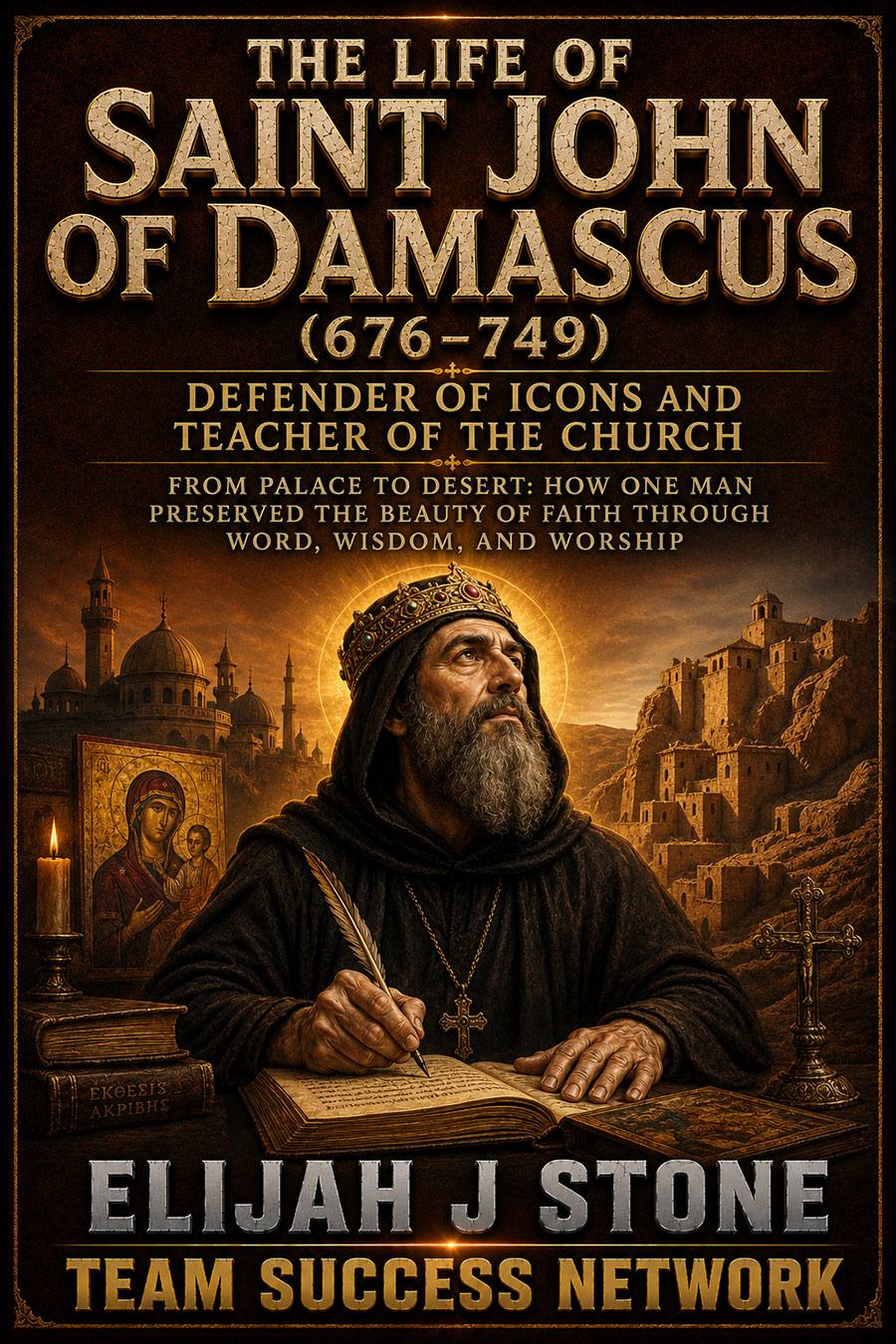
Book 95: Saint John of Damascus (676 - 749) Defender of Icons

The Whole Life of Saint John of Damascus (676–749): Defender of Icons and Teacher of the Church – Before & During
From Palace to
Desert: How One Man Preserved the Beauty of Faith Through Word, Wisdom, and
Worship
By Mr.
Elijah J Stone
and the Team Success Network
Table
of Contents
Part 1 – The World That
Formed Him
Chapter 1 – Born in
Damascus Under Two Worlds
Chapter 2 – A Christian
Household in a Muslim Empire
Chapter 3 – The Heritage
of the Mansur Family
Chapter 4 – The Young
Scholar and His Teacher Cosmas
Chapter 5 – Early Signs of
Wisdom and Wonder
Part 2 – The Scholar of
Damascus
Chapter 6 – Serving the
Caliphate with Integrity
Chapter 7 – Learning the
Languages of Power
Chapter 8 – A Mind Trained
in Greek and Arabic Thought
Chapter 9 – Balancing
Faith in a Foreign Court
Chapter 10 – The Awakening
of a Deeper Calling
Part 3 – The Turning
Point of Surrender
Chapter 11 – Leaving the
Palace Behind
Chapter 12 – The Journey
to the Monastery of Saint Sabbas
Chapter 13 – Trials of
Silence and Obedience
Chapter 14 – The Formation
of a Monk and Priest
Chapter 15 – The Desert
Becomes His Teacher
Part 4 – The Defender
of Icons
Chapter 16 – The Rise of
the Iconoclast Controversy
Chapter 17 – The Three
Apologies Against the Image-Breakers
Chapter 18 – The Miracle
of the Severed and Restored Hand
Chapter 19 – Writing Truth
from the Desert
Chapter 20 – The Theology
of the Visible God
Part 5 – The Teacher of
the Church
Chapter 21 – The Fount of
Knowledge
Chapter 22 – On the
Orthodox Faith: Doctrine Made Clear
Chapter 23 – Hymns of
Light and Resurrection
Chapter 24 – Teaching the
World Through Worship
Chapter 25 – The Voice
Called “Chrysorrhoas” – The Golden Stream
Part 6 – The Legacy of
a Saint
Chapter 26 – Peace in the
Midst of Conflict
Chapter 27 – Influence on
the Seventh Ecumenical Council
Chapter 28 – Death at
Saint Sabbas Monastery
Chapter 29 – The
Continuing Echo of His Words
Chapter 30 – The Eternal
Triumph of Truth and Beauty
Part 1 – The World That Formed Him
John of
Damascus was born into a world where faith and empire collided. Growing up in
Damascus under Muslim rule, he learned early how to live faithfully in a
culture that did not share his beliefs. His family, educated and respected,
showed him that truth can thrive even under pressure. The harmony they modeled
between faith, learning, and service shaped the foundation of his entire life.
From his
earliest years, he loved wisdom. Taught by the monk Cosmas, he grew to see that
knowledge and humility must walk hand in hand. His home became a sanctuary of
prayer and study, where ideas and devotion intertwined naturally. The seeds of
holiness were already visible in his curiosity about creation and the God who
designed it.
The young
John found wonder in everything around him—the stars, music, language, and
philosophy. To him, beauty revealed the fingerprints of God. This fascination
prepared him to defend sacred beauty later in life when others would call it
idolatry. His faith was not a product of fear but of awe.
Before he
ever became a theologian or monk, John was a soul shaped by the world’s
contrasts—faith and reason, empire and eternity, knowledge and worship—all
blending into one divine calling.

Chapter 1
– Born in Damascus Under Two Worlds
Where Faith Met Empire
How a Child of Two Civilizations Became the Bridge of Christian Wisdom
Introduction
– A Saint of Harmony and Light
Saint John
of Damascus is remembered as one of the most luminous voices in the history of
the Church—a theologian, poet, and defender of beauty. Born around 676 AD, he
lived where faith and empire met: in Damascus, the heart of the Muslim
Caliphate and a city still echoing with Christian devotion. His words continue
to resonate through centuries because they were forged at the intersection of
truth and grace.
He once
wrote, “The whole earth is a living icon of the face of God.” That
single statement summarizes his vision: that creation itself reveals divine
love, and that every person, every place, and even every hardship can become a
reflection of God’s presence. His life would prove this truth—not through
conflict, but through wisdom that turned division into revelation.
The City
of Two Worlds
Damascus
was no ordinary city. It was ancient even in John’s day, filled with Roman
columns, Christian churches, and bustling markets that drew traders from every
direction. Yet under new Muslim rule, it had become the seat of a rising
empire. Christianity still shaped its culture, but Islam now shaped its
governance. The air carried both the echo of church bells and the call to
prayer.
In this
vibrant mix of faiths and philosophies, young John grew up surrounded by
difference—but never divided by it. He learned to speak the languages of both
faith and reason, hearing the debates of priests and the poetry of scholars.
His mind opened wide to the world, but his heart remained anchored in Christ.
Key Truth: You can live among many voices without
losing the sound of truth.
The world John inherited taught him how to listen without surrendering his
soul. This early harmony between conviction and compassion became his lifelong
mark of holiness.
The Family
of Faith and Honor
John was
born into the noble Mansur family, a Christian household respected by Muslim
rulers for its loyalty and skill. His father, Sergius Mansur, served as a
financial administrator for the Caliph and used his position to protect the
city’s Christian community. Their home became a refuge where faith met
fairness, and where the love of God quietly influenced the affairs of men.
His family
was wealthy, but their wealth served a purpose. They funded churches, supported
the poor, and maintained open doors for travelers and monks. In a city of
shifting powers, the Mansurs stood firm as an example of how a believer can
live with honor even in foreign systems.
John later
wrote, “The possession of all knowledge without love is the loss of all.”
His family lived this principle. They taught him that true greatness was not
measured by position but by compassion—and that service, not status, was the
mark of divine wisdom.
A Teacher
Sent by Providence
One of the
most beautiful stories from John’s youth tells how God sent him a teacher
through mercy. His father once ransomed a Christian monk named Cosmas, who had
been captured by invading soldiers. Instead of sending him away, Sergius
invited the monk to stay and educate his sons. Thus began one of the most
fruitful mentorships in Church history.
Under
Cosmas’ guidance, John studied Scripture, philosophy, mathematics, and music.
He learned to see God not only in the written Word but in the order of the
universe. The monk taught him humility and purity of heart—virtues that would
later shape his theology.
Key Truth: True wisdom is not in knowing everything,
but in knowing where knowledge leads—to worship.
Cosmas often reminded him that every subject, from science to song, was a
doorway into understanding God’s design. This foundation prepared John to
defend the harmony of creation when others would later try to divide the
material from the spiritual.
Growing
Amid Contrasts
As John
matured, he saw how faith and culture could both illuminate and distort truth.
He watched Christians adapt to Muslim rule while holding to the gospel, and he
observed how new ideas could challenge old traditions. Yet instead of fear, he
felt fascination. The variety of beliefs around him became a mirror in which he
saw more clearly the distinct beauty of Christ.
He learned
early that holiness is not retreat—it is engagement without compromise. The
young scholar attended lessons in logic and language, walked through mosques
and churches, and spoke with people of all backgrounds. These experiences gave
him a calm, measured understanding of the human heart—something that would
later define his writing and debate style.
He would
one day write, “What God is in His essence and nature, no man has ever yet
discovered. But what He is in His love toward us, this we know.” In a world
filled with religious competition, that humility stood out. It kept his
theology grounded in awe rather than pride.
Seeds of a
Defender
The child
who listened in Damascus would one day speak for the whole Church. Even then,
signs of his destiny were visible. His questions ran deep, his answers careful.
He sought to understand not just what people believed, but why.
Beneath his learning was compassion—a desire for peace grounded in truth.
His
education connected him with the writings of the early Church Fathers—Basil,
Gregory, and Chrysostom. Their harmony of intellect and holiness resonated with
him. He believed that beauty and reason, when joined, could guard faith better
than violence ever could.
Key Truth: Truth defended with humility becomes
stronger than truth defended with force.
Years later, this conviction would fuel his defense of icons when emperors
tried to erase them. But before he became a public defender, God was still
preparing him in private—teaching him that the voice of faith must first be
purified by silence.
The Early
Vision of Beauty
Even as a
child, John loved music and art. He often watched artists decorate the walls of
churches with frescoes of Christ and the saints. He noticed how light and color
seemed to lift the heart toward Heaven. This early fascination planted the seed
of his later theology of beauty—the idea that visible things can point to
invisible truths.
To him,
the face of Christ in an icon was not mere paint; it was a reflection of the
Word made flesh. His heart thrilled at the thought that God could be both seen
and worshiped in Spirit. This revelation became the foundation of his later
defense of icons.
He wrote, “I
do not worship matter, but I worship the Creator of matter, who became matter
for my sake.” Those words, born of deep contemplation, summed up his entire
worldview. Beauty was not an enemy of holiness—it was its messenger.
The Young
Scholar’s Wisdom
By the
time John reached adulthood, he was already known for his learning and grace.
He could quote philosophers and Scripture alike, blending insight with
reverence. His speech was gentle but firm, filled with the same calm authority
that would one day make his writings timeless.
Those
around him sensed that his destiny reached beyond politics or philosophy. There
was something luminous about his presence, a peace that seemed to come from
another world. He saw life not as a competition of faiths, but as an invitation
to truth that unites rather than divides.
He once
wrote, “The sea may be vast, but it reflects the same light from above.”
That was how he viewed humanity—diverse yet capable of reflecting the same
divine radiance. His early years in Damascus taught him that God’s light shines
even in unexpected places.
Summary
Saint John
of Damascus was born into a world of contrast and complexity. His youth in a
city where two civilizations met became the divine training ground for his
mission. Through the faith of his family, the mentorship of Cosmas, and the
grace of divine wisdom, he learned to live between worlds without losing the
truth.
His story
begins not with conflict, but with clarity—a life rooted in harmony. The faith
that formed him in childhood would one day defend the beauty of worship for
generations to come.
Key Truth: When truth is born in peace, it grows
strong enough to stand through every storm.

Chapter 2
– A Christian Household in a Muslim Empire
Faith Without Fear
How a Family’s Integrity Preserved Light in a
Divided World
A Home Of
Steadfast Peace
John of
Damascus grew up in a home that shone with quiet holiness amid political
tension. His family, the Mansurs, lived faithfully under the rule of the Muslim
Caliphate, serving honorably in positions of public trust. While other
Christians struggled with resentment or fear, his father, Mansur, became a
model of wisdom—firm in faith, fair in judgment, and gracious in speech. Their
home became a place where God’s light was never dimmed by the surrounding
culture.
The Caliph
respected the Mansur family because their service was pure. Mansur managed
finances for the empire with the same integrity he used to lead his household.
He did not use power to build walls but to build bridges of peace. From him,
young John learned that loyalty to Christ does not mean hostility to others—it
means excellence in whatever task God assigns.
Key Truth: Holiness is not escape—it’s influence.
The faith of John’s family was not hidden from the world. It was seen in their
honesty, their humility, and their unfailing kindness toward all. This example
would anchor John’s soul in later years, when the Church would face the storms
of division and doubt.
Faith In
Public Life
Every day,
Damascus reminded believers that they were living in a new era. The city
bustled with trade and innovation, but the political power had shifted. Islamic
law governed the streets, while Christian communities maintained their faith
quietly within their own quarters. It was a world of boundaries and bridges,
where words had to be chosen wisely.
John
watched his father navigate this complex world with grace. Mansur never denied
his Christian identity, yet he never sought conflict either. He understood that
God had placed him in government not to retreat from influence, but to model
integrity. By treating Muslims and Christians alike with dignity, he lived out
the teaching, “Let your light shine before others, that they may see your
good deeds and glorify your Father in heaven” (Matthew 5:16).
At home,
he often told his son, “Serve men as though you were serving God.” This became
a living rule for John’s character. He learned that real witness is not loud;
it’s consistent. When trust is built through honesty, faith becomes its own
testimony.
The
Spiritual Rhythm Of Home
Inside the
Mansur household, faith was more than words—it was rhythm. Each morning began
with prayer, Scripture reading, and thanksgiving. The family gathered before
icons of Christ and the Virgin Mary, lifting their hearts to Heaven before the
day began. In the evening, hymns filled the courtyard like fragrance. Their
home became a miniature church where holiness was not performed but lived.
John’s
mother, a woman of deep compassion, taught him tenderness of heart. She often
reminded him that “Knowledge without love is a sword without a handle.”
She embodied this truth through simple acts—feeding the hungry, comforting
widows, and teaching her children to give freely. Her love softened the
intellect of her son, grounding his brilliance in mercy.
Key Truth: The strongest theology grows in the soil
of humility.
While his father formed his sense of justice, his mother shaped his sense of
grace. Together, they gave him the balance that would later define his entire
life: a mind of reason, a heart of compassion, and a spirit anchored in peace.
Wisdom
Learned Through Example
John’s
education began long before books and scrolls—it began with observation. He saw
his father refuse bribes even when doing so risked favor with rulers. He
noticed how his parents spoke kindly even of those who opposed them. These
small, consistent examples became his unspoken curriculum of holiness.
Mansur
often told him, “If you would preach the truth, live it first.” John
absorbed this wisdom deeply. He learned that credibility is the soul of
ministry; truth loses its power when the life behind it is corrupted.
Integrity, he discovered, is the bridge between belief and influence.
The
family’s reputation reached beyond religious boundaries. Muslims admired them
for their honesty; Christians looked to them for protection. They were
peacemakers in a divided city, proving that faith and diplomacy could walk hand
in hand. The example of his father gave John the courage to one day speak truth
to emperors without fear of man.
Challenges
Of Faith Under Foreign Rule
To be a
Christian under Islamic authority required discernment. While Christians were
allowed to worship freely, they were considered second-class citizens, paying
special taxes and often facing social limitation. Yet the Mansurs chose
gratitude over grievance. They refused to live in complaint and instead saw
their situation as divine placement.
Young John
observed that freedom of heart matters more than freedom of circumstance. His
father’s joy never depended on favor from rulers—it flowed from fellowship with
God. Their household did not wait for better conditions to live faithfully;
they shone precisely because conditions were difficult.
Key Truth: Faithfulness under pressure is the purest
kind of strength.
The lessons John learned here would guide him later when he faced persecution
for defending icons. Having watched his father stand with grace under tension,
he knew how to serve truth without bitterness.
Education
In Faith And Understanding
The Mansur
home was filled with conversation and learning. Scrolls of Scripture lay beside
works of philosophy. Guests often included priests, poets, and merchants—all
sharing ideas late into the evening. This culture of discussion gave John an
early respect for the power of reason guided by faith.
His father
encouraged him to study mathematics and music alongside theology, believing
that all wisdom ultimately leads to God. John saw that truth is not confined to
one field—it permeates everything that is honest, beautiful, and good. The
family believed that to understand creation is to honor the Creator.
He later
wrote, “The knowledge of things is not evil, but its misuse.” That
single line captures his balance—embracing knowledge while keeping it submitted
to divine purpose. The harmony between intellect and devotion, born in his
childhood home, became the foundation for his later defense of theology and
sacred art.
The Legacy
Of A Living Example
As John
grew older, he realized how rare his upbringing had been. Many believers around
him lived in fear or compromise, yet his family lived in steadfast faith and
visible joy. Their strength was not political influence, but purity of heart.
They proved that holiness could flourish anywhere God is honored.
When John
later withdrew to the monastery, he carried the memory of his home like a
sacred fire. It burned quietly within him, guiding his decisions and giving his
theology warmth. He would one day defend the visible expressions of faith
because he had first seen faith made visible in the lives of his parents.
Key Truth: Before you can defend truth publicly, you
must live it privately.
That lesson became the cornerstone of his courage. His calm under persecution
was born from years of watching his father serve faithfully and his mother love
unconditionally.
Summary
The
household of the Mansur family stood as a lighthouse in Damascus—a place where
faith and duty worked together for God’s glory. In a world divided by religion
and empire, their integrity made the gospel visible without words. Through
their example, young John learned that faith is not preserved by isolation but
by influence grounded in righteousness.
Their home
taught him that knowledge serves love, that authority must protect, and that
holiness thrives under humility. These lessons became the spiritual
architecture of his soul—the framework that would sustain him through trials,
controversies, and miracles alike.
Key Truth: A faithful home builds saints long before
the world ever sees them.

Chapter 3
– The Heritage of the Mansur Family
A Legacy Of Honor And Faith
How Generations Of Righteousness Prepared A
Saint For His Calling
A Family
Known For Integrity
Long
before the birth of John of Damascus, the Mansur family name already carried
the fragrance of honor. For generations, they had served the city of Damascus
with wisdom, fairness, and compassion. Their word was trusted, their counsel
respected, and their influence extended across both Christian and Muslim
communities. They were not only known for competence—but for conscience.
Their
reputation was built not on wealth alone, but on righteousness. The Caliphs
valued their loyalty; the Church treasured their devotion. They were the kind
of family whose presence brought peace, whose leadership inspired unity. In
their home, honesty was not optional—it was the atmosphere itself.
Key Truth: A family that walks in integrity becomes a
living testimony of God’s character.
John inherited this reputation as both blessing and burden. The world expected
excellence from a Mansur—and Heaven expected holiness. He would one day carry
that name beyond the city gates, turning its legacy of service into a legacy of
sanctity.
Faith That
Shaped Generations
The
strength of the Mansur heritage was not political—it was spiritual. They were
deeply rooted in the Christian faith, keeping the teachings of Christ alive
even when surrounded by a foreign religion. Their home stood as a quiet
fortress of devotion, where Scripture was studied and the sacraments honored.
Their wealth funded churches, fed the poor, and sustained monasteries in the
surrounding deserts.
From an
early age, John saw generosity practiced as a sacred duty. His family believed
that blessings were not possessions to hoard but resources to steward. Mansur
often reminded his children, “The hand that gives becomes the hand that God
fills.” That simple truth would later echo in John’s writings about divine
grace.
Faith was
the foundation of their influence. While others used power for advantage, the
Mansurs used theirs for mercy. They understood that authority, rightly used,
reveals the heart of God. Their way of living preached the gospel without
words—compassion doing what argument could not.
Service As
A Form Of Worship
John grew
up watching his father serve the Caliph with the same diligence he showed in
serving the Church. To Mansur, work was not separate from faith—it was an
extension of it. Every decision was made with prayer, every transaction with
fairness. He believed that to serve others honestly was to worship God
faithfully.
This
balance between the sacred and the secular formed the core of John’s character.
He learned that holiness does not retreat from responsibility; it transforms
it. The table of his home became his first altar of obedience, where excellence
and humility learned to dwell side by side.
Key Truth: True leadership is born when duty becomes
devotion.
That philosophy defined not just one man, but an entire lineage. When John
later abandoned his position to live in poverty, it wasn’t rejection of his
heritage—it was its fulfillment. He carried forward the same principle, only on
a higher plane: service now directed entirely toward the Kingdom of God.
Harmony
Between Faith And Intellect
The Mansur
family valued both wisdom and worship. Their home was filled with scrolls of
theology and philosophy alike. They did not fear knowledge; they redeemed it.
In their world, reason was not an enemy of faith but its servant. Young John
was encouraged to question, explore, and understand—always returning to the
conviction that all truth flows from God.
His father
believed that ignorance weakens the Church as much as arrogance does. So he
trained his sons not only in Scripture but in languages, logic, and science.
This combination of intellect and spirituality created a mind capable of
bridging worlds. When John later engaged in theological defense, his clarity of
thought came from a lifetime of disciplined learning grounded in reverence.
He would
one day write, “The whole earth is full of the glory of God, and nothing
that exists is outside His wisdom.” That sentence reflected the family
atmosphere that raised him—a world where every field of study revealed the
fingerprints of Heaven.
A Noble
Heritage With Holy Purpose
To belong
to the Mansur family was both privilege and responsibility. Nobility was not
defined by luxury, but by example. They were nobles of the spirit, not of
pride. Their influence reached far beyond the palace walls because their
kindness touched both rulers and beggars.
John’s
grandfather had once defended Christian families from unjust taxes; his father
negotiated peace during political unrest. They understood that their influence
was a loan from God, not a right. Such a heritage instilled in John a deep
sense of duty—to use his voice and mind not for ambition, but for
righteousness.
Key Truth: The true measure of greatness is how much
good survives after you are gone.
Every generation of the Mansurs added another stone to that legacy. When John
later took up the pen to defend the Church, he was not starting a new story but
continuing an old one—the story of faithfulness passed from father to son.
Strength
Through Stability
In a world
of shifting empires and fragile alliances, the Mansurs stood as a pillar of
stability. Their faith anchored them while others were swept by fear or
compromise. They practiced what Scripture calls “the peaceable wisdom that
comes from above.”
John
witnessed this peace at home daily. When neighbors argued, his father mediated.
When disputes arose between Muslim and Christian officials, Mansur’s fairness
earned trust from both sides. He became a living example of Proverbs 11:3: “The
integrity of the upright guides them.”
This
climate of stability gave John the confidence to one day stand firm against
powerful opponents. He had seen that truth does not need to shout—it simply
needs to stand. The patience and calm of his household became the foundation
for his later courage.
Faithfulness
That Outlasted Power
Empires
rise and fall, but character endures. The wealth and influence of the Mansurs
would one day fade, but their spiritual legacy would not. John carried it
forward not through possessions, but through purity. When he eventually chose
the monastic life, he was not abandoning privilege; he was transforming it into
offering.
He later
wrote, “Riches are not evil, but their misuse is.” Those words echoed
the values of his upbringing—stewardship over ownership, humility over pride.
He understood that material blessings are holy only when surrendered back to
God. The simplicity of the monastery would mirror the simplicity of faith he had
first seen at home.
Key Truth: The legacy of holiness is never inherited
by name—it is chosen by heart.
John chose it fully. By living the same virtues that had guided his
ancestors—honesty, compassion, and courage—he ensured that the light of the
Mansur family would never go out.
Summary
The
heritage of the Mansur family was more than reputation—it was revelation. Their
example showed that holiness and honor can coexist in public life, that faith
can guide intellect, and that true influence flows from integrity. John’s early
years among them formed his understanding that God’s presence fills both palace
and prayer chamber alike.
From their
example, he learned that leadership means service, knowledge means
responsibility, and faith means endurance. The character they modeled became
the compass of his entire life. In their household, he saw not religion in
theory but righteousness in motion—and that living witness prepared him to
stand for truth when the whole world wavered.
Key Truth: A family rooted in faith does not just
shape a child—it shapes history.

Chapter 4
– The Young Scholar and His Teacher Cosmas
A Friendship Formed By Providence
How a Captive Monk Became the Mentor Who
Shaped a Saint
A Meeting
Arranged By God
In the
story of Saint John of Damascus, few moments were as providential as the day
his father met the monk named Cosmas. Captured during a military raid and
brought to Damascus as a slave, Cosmas seemed destined for obscurity. Yet the
elder Mansur saw something sacred in his eyes—a peace that came from Heaven
rather than circumstance. Moved with compassion, he purchased the monk’s
freedom and invited him not to serve the household but to teach within it.
It was a
decision that would change the course of Christian history. The man who had
lost everything would now shape one of the greatest minds the Church would ever
know. Cosmas, seasoned by suffering and purified by prayer, became the vessel
through which God would pour wisdom into the next generation.
Key Truth: Sometimes God hides His greatest teachers
in the garments of the broken.
John would later recall his teacher with awe and affection, saying that through
Cosmas he learned “how to think rightly of God and of man.” Their meeting was
no accident—it was divine appointment disguised as mercy.
The Humble
Teacher From The Desert
Cosmas
came from a monastic background, where silence, fasting, and prayer were daily
bread. The life of courtly luxury in Damascus was foreign to him, yet he
adapted not out of comfort but out of obedience. His humility was his crown. He
entered the Mansur home quietly, carrying no wealth but the treasure of divine
wisdom.
He brought
with him the simplicity of the desert—the clarity that comes when a man has
nothing left but faith. The children quickly noticed that he prayed more than
he spoke, and when he did speak, every word carried weight. His calmness
softened hearts, his gentleness commanded attention.
John’s
father recognized the spiritual value of such a presence. He asked Cosmas to
instruct his sons not only in Scripture but in all forms of learning. Thus
began an education that fused intellect with holiness—a combination that would
one day define Saint John himself.
Key Truth: Holiness teaches more deeply than
knowledge ever can.
Before John understood theology, he saw it lived. In Cosmas, learning had
become prayer, and prayer had become wisdom.
Learning
The Language Of Creation
Under
Cosmas’ mentorship, John’s education reached a rare excellence. He studied
Scripture first, for it was the foundation of all truth. Then came philosophy,
logic, grammar, mathematics, music, and astronomy. Each subject became a
doorway into wonder. Where others saw numbers, John saw divine order; where
others studied sound, he heard the echo of creation’s praise.
Cosmas
never allowed knowledge to become vanity. He constantly reminded his student
that learning without humility is blindness wearing spectacles. He taught John
to begin and end every study with prayer, for the goal was not to master the
world but to worship its Maker through understanding.
John later
wrote, “The mind that seeks God in all things will find Him in all.”
That principle became his compass. To him, even the laws of geometry or the
movement of the stars were testimonies of divine wisdom. Under Cosmas, study
became worship, and curiosity became reverence.
Key Truth: All truth, rightly seen, points back to
its Source—God Himself.
This harmony between intellect and devotion would later make John’s theology
both beautiful and unshakable.
Wisdom Of
The Heart
Cosmas did
not limit his lessons to intellect; he trained John’s heart just as carefully.
He taught that patience is a greater proof of wisdom than eloquence, and that
compassion is the crown of every scholar. When conflicts arose among servants,
Cosmas was always the first to reconcile them, often quoting, “Blessed are
the peacemakers, for they shall be called sons of God.”
He showed
John that the worth of knowledge is measured by the peace it brings. The monk’s
life was a living sermon—contentment without possessions, serenity without
power. Through him, John learned that holiness has its own fragrance: humility.
He would
one day write, “The man who loves humility is never far from God.” Those
words were born from observation. John had seen humility personified in his
teacher’s every gesture. What philosophy explained, Cosmas embodied. His
influence turned John’s brilliance into virtue, and his curiosity into worship.
The Sacred
Bond Between Teacher And Student
Over time,
the bond between the young scholar and his mentor deepened into something
sacred. Their relationship transcended the boundaries of classroom and
household—it became a fellowship of souls united in pursuit of truth. Cosmas
saw in John not only a student, but a seed of destiny. John saw in Cosmas the
mirror of Christ’s gentleness.
They often
walked together through the gardens of Damascus, discussing the mysteries of
faith under the starlit sky. Cosmas taught through creation as much as through
Scripture, pointing upward and saying, “The heavens declare the glory of
God.” For John, these moments were more than lessons—they were revelations.
Key Truth: A true mentor does not fill the mind; he
awakens the spirit.
Through this friendship, John learned that spiritual formation happens not in
lectures but in lives shared. He was being shaped not just by information, but
by imitation.
From
Captivity To Divine Appointment
What began
as an act of compassion had become a masterpiece of divine orchestration. The
captive monk had become the liberator of a young soul destined to defend the
faith. In teaching John, Cosmas was unknowingly teaching the future defender of
icons, the composer of hymns, and the theologian who would bridge centuries.
The irony
was holy: the one who had been enslaved by men became the instrument God used
to free minds from ignorance. This reversal reflected the gospel itself—God
turning brokenness into blessing, loss into legacy.
John never
forgot this. Even in his later years as a monk, he spoke of Cosmas with
gratitude and awe. He regarded him not merely as a teacher, but as the proof
that God can use the humble to confound the wise.
He once
wrote, “The Lord delights to lift the lowly and to make wisdom dwell in
simplicity.” Those words were his way of honoring the man who had lived
that truth before him.
The Fruits
Of Holy Education
By the
time John reached adulthood, the effects of Cosmas’ mentorship were
unmistakable. He possessed a mind sharpened by study, a heart purified by love,
and a soul anchored in prayer. His brilliance was evident, but it never carried
pride. He walked with quiet authority—the kind that comes from knowing both
Scripture and the God of Scripture.
His
writings, hymns, and later theological works would all bear the imprint of this
early formation. Every argument he made, every hymn he wrote, carried the
spirit of his teacher’s discipline: humility in thought, reverence in
knowledge, and peace in expression. The monk who had entered his home in chains
had left behind the chains of ignorance, replaced by a lineage of divine
wisdom.
Key Truth: The greatest education produces not
prideful minds but peaceful hearts.
Through Cosmas, John learned how to think deeply, love purely, and serve
faithfully—lessons that would one day sustain him in the deserts of repentance
and the debates of empires.
Summary
The
meeting of Saint John and Cosmas stands as a testament to the providence of
God. A once-captive monk became the spiritual architect of one of
Christianity’s greatest theologians. Through this mentorship, John learned that
knowledge is not an end but a means to worship, and that the truest wisdom
flows from humility and love.
Their
relationship transformed both teacher and student into instruments of divine
grace. Cosmas poured out his experience; John received it and multiplied it
through a lifetime of faithfulness. What began as mercy toward a stranger
became the spark that illuminated centuries of Christian thought.
Key Truth: When God joins a humble teacher to a
willing heart, the world is never the same.

Chapter 5
– Early Signs of Wisdom and Wonder
A Mind Awakened by Awe
How the Curiosity of a Child Became the Vision
of a Saint
The Spark
Of Divine Curiosity
From his
earliest years, John of Damascus showed a depth of thought that set him apart.
While other children played without care, he stood in the courtyards of
Damascus gazing at the stars, asking questions that startled his elders. He
wanted to know why the heavens moved with such precision, why colors shone
differently at dawn and dusk, and why music could stir tears of joy and
longing. To him, every detail of creation was a message written by the hand of
God.
His
curiosity was not idle; it was worship disguised as wonder. Each time he
discovered something new, he marveled at how perfectly wisdom and beauty worked
together. Where others saw routine, John saw revelation. He believed that God
was hidden in plain sight—speaking through light, sound, pattern, and harmony.
Key Truth: The first step toward wisdom is learning
to be amazed by God again.
That awe would one day grow into a theology of beauty—the belief that
everything truly beautiful leads the heart toward its Creator. Long before he
held a pen, John’s soul was already writing hymns to the glory of God through
the language of wonder.
The Mind
Of A Seeker
As John
grew, his questions became deeper. He was never content to memorize; he wanted
to understand. When his teachers explained Scripture, he did not merely
listen—he probed the meaning beneath the words. When he read the Psalms, he did
not stop at poetry; he asked why beauty could heal the soul. His search for
truth was as natural as breathing.
He often
said, “The human mind is made to seek God as iron is drawn to the magnet.”
That conviction became the heartbeat of his study. To him, ignorance was not
humility—it was neglect. He saw knowledge as one of the ways to glorify the
Creator, provided the heart remained pure.
His
mentor, Cosmas, recognized this hunger and guided it gently. He taught John
that the goal of study was not to impress others, but to grow closer to the
truth that gives life. The young scholar learned early that curiosity without
prayer produces pride, but curiosity joined with reverence produces revelation.
Key Truth: When the heart stays humble, every
question becomes an act of worship.
In this union of intellect and devotion, the seeds of sainthood began to take
root.
Beauty As
A Window To God
One of the
earliest signs of John’s spiritual maturity was his fascination with beauty. He
would stop to watch craftsmen carve intricate designs into marble or to listen
as a harpist played in the courtyard. Where others enjoyed art as
entertainment, he felt it awaken something eternal inside him. He sensed that
beauty was not man’s invention—it was God’s language.
When he
saw light streaming through the stained glass of a church, he whispered to
himself, “If this beauty is but a shadow, what must Heaven’s glory be?” The
harmony of sight and sound, form and color, became to him a living parable of
divine order. In these experiences, the theology of his future writings was
already being born.
He would
one day write, “I do not worship matter, but the Creator of matter, who
became matter for my sake.” This profound statement, which would defend the
holy icons years later, began here—in the wonder of a boy who saw God’s
reflection in every created thing.
Key Truth: Beauty is not decoration—it is revelation.
For John, the loveliness of the world was the whisper of the Word made flesh.
A
Character Formed By Calm Strength
People who
met the young John often remarked on his unusual peace. He carried a calmness
that drew others near. Though gifted with great intellect, he never displayed
arrogance. When others debated loudly, he listened quietly; when others sought
to win arguments, he sought to win understanding. This gentleness gave weight
to his wisdom.
His
composure came from the harmony between knowledge and prayer. He had learned
from both his parents and his teacher that learning without love breeds pride.
The patience he saw in Cosmas, and the kindness he witnessed in his father,
merged into his own quiet strength. He became a young man whose intelligence
was softened by grace.
John later
wrote, “Let your knowledge be clothed in mercy, and your wisdom in
humility.” That sentence reflected his very life. He carried truth like a
lamp—not to expose others, but to guide them. It was this spirit of calm
confidence that made others seek his counsel, even before he reached adulthood.
Key Truth: Wisdom without humility loses its
fragrance; knowledge without love loses its light.
From his youth, John embodied both—the fragrance and the light of godly
understanding.
The
Scholar Who Heard God Everywhere
John’s
studies extended beyond the classroom. He listened for God’s voice in
everything—wind, rhythm, silence, and song. He often walked alone through the
gardens near his home, meditating on how creation praised its Maker. Birds sang
without vanity, rivers flowed without ambition, and stars obeyed their
appointed courses without pride. In their obedience, he saw beauty; in their
beauty, he saw truth.
This habit
of meditation gave birth to one of his lifelong convictions: that theology
begins not with argument, but with listening. The world, to John, was a great
cathedral filled with living psalms. The more he studied the structure of the
world, the more convinced he became that reason and worship were meant to walk
together.
Key Truth: Creation is the first book of theology;
only those who read it with reverence will understand it.
It was this ability to see God everywhere that later allowed him to defend the
visible symbols of faith—the icons, hymns, and sacraments that others tried to
destroy. His wonder prepared his theology long before persecution prepared his
courage.
Seeds Of
His Future Calling
As John
approached adulthood, people began to recognize in him something more than
intelligence. There was a quiet authority in his words, a maturity that came
from deep reflection. When he spoke of God, it felt as though Heaven itself
leaned closer. His teachers predicted that he would one day serve both the
Church and the world in ways they could not yet imagine.
His
combination of intellect and purity made him rare. He did not study for gain or
praise; he studied because he loved truth. He understood that the search for
wisdom is not a competition—it is a pilgrimage. The path he was walking, though
he did not yet know it, was leading him to defend the mysteries of faith
against kings and emperors.
He would
later write, “The man who knows God truly will not fear the judgment of
men.” That courage was already forming in him through small acts of
obedience—faithful study, humble service, and unshakable wonder.
Key Truth: The person who loves truth more than
comfort becomes unbreakable.
Long before John faced opposition, he had already conquered the greatest enemy
of all—complacency.
The Wonder
That Never Faded
Even as
John matured into a scholar and later a monk, the sense of awe he carried as a
child never left him. It became the secret source of his joy and the foundation
of his theology. The same heart that once looked at the stars in wonder would
later look at the icons of Christ and see divine mystery. He learned that the
God who created galaxies also humbled Himself to dwell in human form.
This
continuity of wonder preserved his purity in a world full of cynicism. While
others grew weary of mystery, he grew deeper into it. His life was proof that
childlike wonder is not meant to fade with age—it is meant to mature into
worship.
Key Truth: The saints never lose their sense of
wonder—they just learn to express it in holiness.
The young boy who once marveled at creation would one day defend it as the
canvas of God’s glory. His wonder became his wisdom, his curiosity became his
calling, and his heart became a sanctuary of praise.
Summary
The early
life of John of Damascus reveals the rare harmony of intellect and humility,
study and prayer, curiosity and reverence. His love for creation’s beauty
prepared him to see holiness in all things. Every question he asked, every
truth he learned, deepened his worship rather than his pride.
Through
the example of his family and the mentorship of Cosmas, his soul became a
living reflection of divine order—calm, thoughtful, and full of light. He
learned that beauty reveals God, that wisdom serves love, and that wonder is
the beginning of faith.
Key Truth: Those who see God’s glory in creation are
destined to reveal His glory in their generation.
Part 2 –
The Scholar of Damascus
In his
youth, John rose to prominence as a scholar and administrator in the court of
the Caliphate. His intelligence and character made him invaluable in government
service. Yet even in a Muslim-led empire, he remained a faithful Christian,
living with integrity that earned respect from rulers and common people alike.
His wisdom shone brightest not in argument but in honesty.
He
mastered languages and philosophy, studying both Greek logic and Arabic poetry.
This rare education gave him the ability to understand and converse across
cultures. Rather than dividing himself between faith and intellect, he united
them—showing that truth in any form ultimately points to God.
Success
did not blind him to eternity. Though surrounded by wealth and influence, his
soul began to thirst for something higher. The more he studied the wisdom of
men, the more he longed for the presence of God. A quiet restlessness began
stirring in him—a divine invitation toward simplicity and surrender.
The palace
had taught him leadership, but the Spirit was teaching him detachment. His
heart was awakening to the realization that knowledge without holiness is
incomplete. This longing would soon lead him from the splendor of Damascus to
the silence of the desert.

Chapter 6
– Serving the Caliphate with Integrity
Faithfulness in the Halls of Power
How a Young Christian Learned to Serve God
Without Compromise
A
Christian In The Court Of The Caliph
When John
of Damascus entered government service, he stepped into a world defined by
power, prestige, and politics. The Umayyad Caliphate stretched across
continents, ruling with both brilliance and complexity. Damascus, its capital,
was the beating heart of the empire—a city alive with scholars, traders, and
soldiers. For a young Christian to rise within such a system was rare, but
John’s reputation for wisdom and honesty made him a natural choice.
Following
in his father’s footsteps, he accepted a position of responsibility within the
financial administration. Yet unlike others who sought advancement, John sought
to serve. He believed that integrity could be a witness just as powerful as
preaching. Every task, every calculation, every decision became an offering to
God.
Key Truth: True faith shines brightest where
compromise is easiest.
While others maneuvered for favor, John carried himself with calm dignity. His
loyalty was not to political gain but to divine truth, and even those who did
not share his beliefs could not help but respect his unwavering character.
Faith In
Action, Not In Name
Working
for the Caliphate required discernment. The empire valued competence above
creed, but the environment was full of temptation—power, money, and influence
could easily corrupt. Yet John walked through it all untouched. He refused
bribes, avoided flattery, and treated everyone—rich or poor, Muslim or
Christian—with the same fairness. His reputation became his defense; even his
critics could not find fault in him.
His faith
was not something he advertised—it was something he embodied. The peace of
Christ in his demeanor spoke louder than any sermon. He worked diligently,
prayed privately, and lived so consistently that both Muslims and Christians
trusted him to resolve disputes.
He once
wrote, “He who does what is good for God’s sake has already preached Christ
with his life.” Those words summarized his approach to service. For John,
holiness was not limited to monasteries or pulpits; it could be lived in the
counting room, the courtroom, or the palace itself.
Key Truth: The world may not listen to your faith,
but it will always watch your integrity.
By choosing righteousness over recognition, John proved that spiritual
excellence can thrive even in secular authority.
Integrity
That Stood The Test
The
political world of Damascus was as dangerous as it was dazzling. Intrigue
filled the corridors of power, and alliances shifted with the wind. Yet John
never allowed fear or flattery to determine his path. He lived by one
standard—the will of God.
His
honesty soon became legendary. When others falsified records for personal
advantage, John refused. When others bent truth to please rulers, John stood
silent rather than sin. His refusal to compromise cost him opportunities, but
it gained him something far greater—the trust of the Caliph himself.
The Caliph
once said of him, “This man serves truth even when truth serves no man.” That
respect gave John remarkable freedom to act with integrity. It also became his
training ground for what would come later, when emperors would demand not money
but faith itself.
Key Truth: The integrity built in private battles
prepares you for public trials.
Every decision in those years shaped him into the kind of man who could later
withstand pressure not just from men, but from empires.
Faithfulness
Over Favor
While John
worked among powerful men, he never forgot the simplicity of his upbringing.
The humility taught by his mentor, Cosmas, and the righteousness modeled by his
father remained the anchors of his heart. Success never swelled his pride.
Instead, it deepened his gratitude. He often spent evenings reading Scripture
by lamplight, praying quietly for wisdom to remain pure amid ambition.
He lived
the verse, “The fear of the Lord is the beginning of wisdom” (Proverbs
9:10). His wisdom was not cunning but discernment—knowing when to speak, when
to be silent, and when to stand alone. That discernment saved him many times
from political traps.
Colleagues
admired his calm spirit. Even when insulted for his faith, he responded with
gentleness. When faced with injustice, he corrected it firmly but without
vengeance. His peace disarmed hostility. His excellence silenced prejudice.
Key Truth: Faithfulness is not proved by what we
gain, but by what we refuse to compromise.
John’s work became a sermon in motion—a quiet testimony that holiness can
inhabit the marketplace as fully as the monastery.
A Bridge
Between Two Worlds
Because of
his dual education in Greek and Arabic thought, John could move easily between
cultures. He became a bridge between Christian and Muslim leaders, translating
ideas, resolving misunderstandings, and promoting mutual respect. While others
argued, he listened. While others distrusted, he sought understanding.
This
bridge-building role reflected his divine calling before he ever realized it.
Just as he would later defend icons as bridges between the seen and unseen,
here he defended people as bridges between nations and faiths. He believed
peace was not weakness, but the strength of those who trust God’s justice more
than man’s power.
He once
said, “Peace is the clothing of virtue.” To John, this peace did not
mean silence about truth—it meant speaking truth without hatred. His fairness
won the admiration of Muslims and the affection of Christians, uniting them in
respect even when their beliefs differed.
Key Truth: God places His servants in divided places
to build bridges, not walls.
Through John, the city of Damascus glimpsed the kind of unity possible when
love governs leadership.
Lessons
From Leadership
Years of
service under the Caliphate gave John lessons that no monastery could teach. He
learned the value of discipline, the necessity of order, and the wisdom of
patience. Managing resources taught him stewardship. Working with diverse
people taught him empathy. Making decisions under scrutiny taught him courage.
He
realized that faith is not proven by comfort but by consistency. Every ledger
balanced with honesty, every conflict resolved with mercy, every word spoken
with restraint—these were acts of obedience as holy as prayer. His office
became his altar; his integrity, his incense.
Key Truth: If you can stay holy in the palace, you
can stay holy anywhere.
This period of his life would later give him credibility among both nobles and
monks. He had seen the world and remained uncorrupted. That experience gave
authority to his later teachings about humility, obedience, and purity of
heart.
Preparation
For A Greater Call
Though
John served the Caliph with excellence, a quiet stirring began in his heart. He
sensed that his years in government were not the destination but preparation.
The administrative skills he was gaining would one day serve the Church. The
discipline he practiced in the palace would sustain him in the monastery.
He began
to understand that every season of faithfulness prepares the soul for a deeper
surrender. The palace was his classroom, but the desert would be his
graduation. God was using the order of earthly service to prepare him for the
order of divine calling.
He later
wrote, “The man who serves faithfully in small things will be found worthy
of great things.” The truth of that statement was already being written in
his life. His quiet service in the empire became the proving ground of his
sainthood.
Key Truth: Every assignment from God is training for
a higher one.
Through obedience in worldly work, John was being shaped into a vessel fit for
holy purpose.
Summary
John of
Damascus’ time serving the Caliphate proved that holiness and humility can
thrive even in the heart of political power. He lived with integrity where
compromise was common, and his honesty turned even rulers into admirers. He
bridged faiths without betraying truth, and he learned that real influence
flows from righteousness, not ambition.
His
example teaches that God can be glorified anywhere—a palace, an office, or a
monastery—when a heart stays true. Through his faithful service, John
demonstrated that the believer’s duty is not to escape the world, but to
sanctify it through integrity.
Key Truth: When truth governs your heart, every place
becomes holy ground.

Chapter 7
– Learning the Languages of Power
The Scholar Who Listened Before He Spoke
How Understanding Many Tongues Prepared John
To Speak For All Truth
The Gift
Of Many Languages
John of
Damascus was not only a man of faith—he was a man of intellect shaped by
language itself. His education under Cosmas and within the halls of Damascus
had given him a rare mastery of tongues. He spoke Greek, Arabic, and Syriac
with equal fluency, and could move between dialects and idioms as gracefully as
a poet. In a time when most men spoke only within the borders of their birth,
John spoke across civilizations.
Each
language opened a new window into the mind of a people. Greek gave him access
to philosophy and the Church Fathers; Arabic to science, poetry, and politics;
Syriac to ancient Christian traditions rooted in Semitic faith. This gift made
him not just a translator of words, but a translator of worlds.
Key Truth: Every language carries a reflection of
God’s wisdom, waiting to be heard by those humble enough to listen.
John’s ability to listen, absorb, and speak with understanding became the
foundation of his future ministry. Where others saw barriers, he saw bridges.
Language
As The Door To The Heart
John soon
realized that language is not only a tool of speech but a window into the soul.
The way a people express beauty, justice, or love reveals what they believe
about God. By learning languages, he was not merely collecting vocabulary—he
was learning compassion.
He
discovered that to truly understand others, one must first listen to their
heart before correcting their words. This posture of humility made him
respected among scholars of every faith. Muslim poets, Jewish thinkers, and
Christian priests alike found in him a man who valued understanding more than
debate.
He would
later write, “The one who knows how to listen learns more than the one who
speaks without pause.” This became his principle for both dialogue and
theology. He learned to hear truth even in unexpected voices, recognizing that
the image of God shines faintly in every culture and conscience.
Key Truth: Listening is not weakness—it is the wisdom
that precedes revelation.
Through patient listening, John learned the art of peace, proving that the love
of truth begins with respect for people.
Bridging
Civilizations Through Understanding
Damascus
in John’s day was the meeting point of empires and faiths. Greek rationalism,
Syriac Christianity, and Arabic poetry all mingled in its streets. Philosophers
discussed Aristotle beside theologians quoting the Gospels. In this crucible of
ideas, John’s linguistic fluency allowed him to move freely and learn from all.
He often
attended gatherings where Muslim scholars debated the nature of the soul or
where Christian priests discussed divine mysteries. He did not fear exposure to
differing ideas because his faith was rooted in understanding, not insecurity.
He believed that truth has nothing to fear from dialogue.
Key Truth: Truth stands firm in every language
because it was spoken first by God.
Through this conviction, John became a living bridge between communities that
distrusted one another. His life demonstrated that faith is strongest when it
engages the world with confidence, not when it hides from it in fear.
The Power
Of Words And The Wisdom Of Silence
John’s
study of languages taught him something even greater—the discipline of words.
To speak in multiple tongues is to understand the weight of each one. He
learned that careless speech could build or destroy entire worlds. His command
of words gave him influence, but his reverence for silence gave him wisdom.
When
others used eloquence to boast, he used it to bless. When others wielded
rhetoric to manipulate, he used it to reveal truth. He understood that the
tongue is both sword and seed: what it cuts can heal, and what it plants can
grow for generations.
He once
wrote, “Let every word be seasoned with grace, for words build ladders to
Heaven or walls against it.” Those who heard him speak felt that every
sentence carried the calm weight of eternity. His words healed divisions and
elevated understanding wherever he went.
Key Truth: Speech without holiness loses power;
silence without purpose loses meaning.
John mastered both—the word that teaches, and the silence that listens.
The
Universal Longing For Truth
Through
his study of cultures and tongues, John discovered a profound truth: though
languages differ, the human heart longs for the same things—truth, peace, and
eternity. He saw that beneath arguments and creeds lies a universal thirst for
God. This realization filled him not with pride but with compassion.
He began
to see that every person he met, no matter their background, was a seeker in
disguise. The poet seeking beauty was seeking God’s reflection; the philosopher
searching for reason was reaching for divine order; the mystic yearning for
peace was longing for the Spirit of truth.
Key Truth: Every honest search for truth is a step
toward the same Light.
This understanding shaped John’s theology. It taught him to value both
revelation and reason—to see God not only in Scripture, but also in the sincere
hearts of those who sought Him unknowingly.
Faith And
Reason In Harmony
John’s
linguistic studies gave him access to both Greek philosophy and Arabic thought.
He saw the beauty of logic and the strength of reason, but he also knew their
limits. He believed that faith and reason were not enemies—they were companions
on the same path.
Where
philosophy ended, revelation began. He often explained to others that logic can
lead one to the threshold of truth, but only faith opens the door. His writings
later reflected this balance, combining the precision of Aristotle with the
passion of Scripture. This harmony of intellect and spirit made him one of the
most persuasive voices of his age.
He once
said, “Reason is the servant of faith, not its master.” That line
captured his lifelong conviction. He used reason to defend the mysteries of
God, not to dissect them. Through him, the Church learned that clear thinking
and deep belief can dwell peacefully in the same soul.
Key Truth: The mind finds rest only when it kneels
before the mystery it cannot explain.
In that humility, John’s brilliance became light, not pride.
The
Preparation For His Future Defense
Unknowingly,
John’s years of studying language and philosophy were preparing him for a
divine mission. The words he learned in youth would one day become the tools
God used to defend truth under persecution. His ability to understand the logic
of opponents made his arguments irrefutable. His compassion for humanity made
his theology relatable.
He would
later use these very languages to write his defenses of holy images—explaining
in Greek to theologians, reasoning in Arabic with scholars, and praying in
Syriac with monks. His education became his weapon, his humility its balance,
and his love for truth its aim.
Key Truth: God equips His servants long before He
reveals their mission.
Through years of quiet study, John was being trained to stand as a bridge
between worlds, speaking words that would echo across centuries.
Summary
Saint John
of Damascus mastered the languages of power not for fame, but for faith. He
learned to see language as more than speech—it was connection, compassion, and
creation. His study of Greek, Arabic, and Syriac opened not just his mind, but
his heart to the diverse reflections of God’s image across cultures.
Through
listening, he became wise; through speaking, he became a light. He showed that
the way to defend truth is not through argument alone, but through
understanding. His voice became one that united reason and revelation,
intellect and intimacy with God.
Key Truth: Those who learn to listen to many voices
are prepared to speak with Heaven’s authority.

Chapter 8
– A Mind Trained in Greek and Arabic Thought
The Harmony of Reason and Revelation
How John United the Wisdom of Nations in the
Worship of One God
An
Education Beyond His Age
Saint John
of Damascus possessed one of the most extraordinary minds of his century. His
education was not confined to the theology of the Church—it spanned the full
breadth of human knowledge. Under the guidance of his mentor Cosmas, he studied
mathematics, music, geometry, astronomy, logic, and philosophy. He read the
Greek classics—Plato’s dialogues and Aristotle’s logic—until their structure of
thought became second nature to him. But he also immersed himself in Arabic
poetry and Islamic writings, learning the patterns of thought shaping the new
world around him.
This dual
training gave him a panoramic vision. In his mind, Greek reason met Semitic
spirituality and found friendship rather than conflict. While others saw
philosophy as a rival to revelation, John saw it as its servant. His mind
became like a garden where diverse flowers bloomed in perfect symmetry—each
discipline reflecting a different facet of divine wisdom.
Key Truth: When every kind of knowledge bows before
God, the mind becomes a temple of truth.
John’s education prepared him not to escape the world, but to redeem it—showing
that every stream of thought ultimately flows back to the same Source.
Greek
Reason Meets Holy Faith
From the
Greeks, John learned the beauty of order. He saw how mathematics revealed
proportion, how music reflected harmony, and how logic uncovered the structure
of truth. Yet he also recognized that reason alone could not satisfy the soul.
For him, philosophy was not an end but a means—a lamp to guide faith, not a sun
to replace it.
He admired
Aristotle’s precision and Plato’s yearning for the ideal, but he found their
fulfillment in Christ, the Logos made flesh. He once wrote, “Philosophy is a
mirror that reflects truth dimly until the light of God shines upon it.”
Through that light, he transformed secular knowledge into sacred understanding.
Key Truth: Reason without revelation leads to pride;
revelation without reason leads to confusion.
John’s genius was to unite both—reason purified by faith, and faith
strengthened by reason. This harmony became the foundation for centuries of
Christian theology to come.
The Gift
Of Arabic Insight
Living
under Islamic rule gave John a rare opportunity. Arabic culture in Damascus was
flourishing with poetry, mathematics, and the early forms of scientific
inquiry. The Muslims had inherited much from the Greeks and were building upon
it with vigor. Rather than reject this intellectual world, John learned from it
with humility and discernment.
He read
Arabic verse to understand its rhythm and meaning. He studied the way Muslim
thinkers described the unity of God, noting both the beauty and the limitation
of their understanding. He did not argue to win; he learned to understand. This
exposure sharpened his ability to communicate Christian truth clearly in a
world where monotheism was being redefined.
He later
observed, “Truth is not threatened by inquiry; it is revealed through it.”
His engagement with Arabic thought taught him the value of clarity and
precision—skills that would make his later theological works unmatched in depth
and accuracy.
Key Truth: Wisdom grows when humility allows truth to
speak in many languages.
Through his studies, John’s mind became both cosmopolitan and consecrated—a
reflection of unity in diversity.
Logic As
Worship
John’s
love for logic was not academic vanity—it was devotion. He believed that God,
who made the universe orderly, could be known through orderly thought. When he
solved a philosophical question, he did it as an act of worship. Each
conclusion, each proof, was a small echo of the eternal reason that upholds
creation.
He would
often say, “The order of the mind mirrors the order of the heavens.” To
him, the practice of reasoning was sacred because it imitated the divine
intellect. The study of philosophy became prayer for the mind, just as the
psalms were prayer for the heart.
Key Truth: When knowledge becomes worship, study
becomes sanctified.
John showed that intellectual life need not lead away from God. When guided by
humility, thought becomes an instrument of praise—revealing the mind of the
Creator in every mystery it touches.
Humility
As The Crown Of Knowledge
Despite
his vast learning, John remained profoundly humble. He understood that the
wisest man is not the one who knows most, but the one who knows his limits. His
philosophy was not a ladder to boast upon, but a staircase that led downward
into reverence. The more he learned, the more he felt awe.
He taught
that mystery is not ignorance—it is the place where knowledge meets its
boundary and bows. This humility protected him from pride, the downfall of so
many thinkers. He believed that reason is a light, but that faith is the sun.
One guides the steps; the other reveals the destination.
He once
wrote, “To know where to stop is the beginning of wisdom.” That
statement became the heartbeat of his theology. It was why his works could
explain deep truths without arrogance and defend divine mysteries without
presumption.
Key Truth: The greatest minds are those that kneel
before greater mysteries.
John’s intellect was bright because his spirit was bowed. His learning did not
exalt him—it sanctified him.
The
Harmony Of Faith And Science
In an era
when philosophy and religion often clashed, John’s approach was revolutionary.
He saw no contradiction between studying the heavens and worshiping the God who
made them. Astronomy revealed divine order; music revealed divine beauty;
geometry revealed divine precision. For him, the natural sciences were not
threats to faith but confirmations of it.
He taught
that studying creation is a way of honoring the Creator. The problem, he said,
is not knowledge itself but the heart that forgets its purpose. When knowledge
is separated from love, it becomes arrogance. But when it is joined with
worship, it becomes wisdom.
He later
summarized this balance beautifully: “To study the world rightly is to read
a book written by the hand of God.” His view anticipated centuries of
Christian thinkers who would see science as a form of devotion, not defiance.
Key Truth: Every discovery in creation should deepen
our devotion to its Creator.
John’s voice still echoes today, calling believers to think deeply without
losing their awe of God.
The
Synthesis Of All Wisdom
John’s
mastery of both Greek and Arabic thought gave him a rare ability to synthesize
truths from different worlds. He built bridges between philosophy and theology,
reason and faith, East and West. His writings, especially The Fountain of
Knowledge, gathered centuries of Christian wisdom and arranged it with the
clarity of Greek logic and the precision of Arabic scholarship.
He became
the Church’s great harmonizer—a man who could unite minds as well as hearts.
His work proved that divine truth can speak through every culture when
interpreted through reverence and understanding. In a time of division, his
mind modeled unity.
Key Truth: The highest wisdom gathers light from
every lamp but bows only to the Sun.
By joining intellect and devotion, John gave the Church a timeless model of how
to think without losing wonder, and how to reason without losing reverence.
Summary
Saint John
of Damascus was more than a theologian—he was a sanctified scholar. His
education in Greek and Arabic thought made him a bridge between civilizations
and a beacon for the Church. He proved that faith and intellect, revelation and
reason, are not rivals but reflections of the same divine truth.
Through
humility, he turned philosophy into praise and logic into worship. His example
reminds us that knowledge without love is empty, but knowledge offered to God
becomes light for generations. In his hands, wisdom itself became an act of
adoration.
Key Truth: When the mind worships as deeply as the
heart, truth becomes radiant.
Chapter 9
– Balancing Faith in a Foreign Court
Grace in the Midst of Power
How John Served With Conviction Without
Compromise
Faith
Among The Powerful
To live as
a Christian within an Islamic court required courage, humility, and divine
wisdom. John of Damascus understood this challenge intimately. Surrounded by
scholars, judges, and rulers who did not share his beliefs, he carried his
faith quietly but firmly. He did not boast about his Christianity, nor did he
hide it. His life itself became his confession of faith—a steady light glowing
in a place of shifting shadows.
The
Umayyad Caliphate was vast and powerful, filled with men of ambition and
intellect. Many served only for gain or favor, but John served with purpose. He
saw his work not as a political opportunity but as a divine assignment. He once
said, “Wherever God places you, serve as if Heaven is watching.” These
words guided his heart amid the complex demands of court life.
Key Truth: Faithfulness is not proven by where you
stand but by how you stand there.
Through daily choices of integrity, John transformed a seat of politics into a
sanctuary of righteousness.
Integrity
Under Pressure
In the
palace halls of Damascus, temptation came cloaked in diplomacy. There were
times when compromise would have made John’s life easier—times when silence
would have won favor or deceit would have secured promotion. Yet he chose
neither. His honesty, though inconvenient, earned respect even from those who
disagreed with him.
Officials
observed how he handled delicate matters—never slandering, never scheming. When
asked to endorse policies that violated justice or faith, he found ways to
speak truth without rebellion. His courage was calm, his convictions quiet. He
showed that firmness and gentleness can coexist.
He once
wrote, “It is better to offend with truth than to please with lies, for God
rewards faithfulness, not flattery.” That principle became his compass.
Through it, he proved that holiness does not retreat from the world; it redeems
it through integrity.
Key Truth: The strength of faith is revealed not in
what it shouts but in what it refuses to surrender.
John’s quiet endurance became his greatest sermon.
Wisdom
That Disarmed Suspicion
Being a
Christian official under Muslim rule placed John in constant scrutiny. Every
word he spoke could be misinterpreted, every action questioned. Yet, through
prayer and discernment, he learned to navigate this tension with supernatural
wisdom. His ability to read hearts and handle situations calmly made him
invaluable to the Caliph and respected by all.
He
practiced the advice of Proverbs 15:1—“A gentle answer turns away wrath.”
When disagreements arose between faith communities, John’s composure often
diffused hostility before it could ignite. He became a peacemaker without
compromising his beliefs. To his peers, he was the embodiment of grace under
pressure.
His calm
presence made him a trusted counselor. Muslims admired his integrity,
Christians drew courage from his example, and both found in him an uncommon
balance of conviction and compassion.
Key Truth: Wisdom is not the ability to outthink
others—it is the grace to outlove them while standing in truth.
Through this wisdom, John’s life preached reconciliation in a divided world.
In The
World But Not Of It
John’s
years in the court taught him a truth that many still struggle to grasp:
believers are not called to escape the world but to transform it through
example. He lived in luxury but was not ruled by it. He worked among
unbelievers but was not shaped by them. He participated in governance without
becoming a slave to politics.
He often
prayed, “Lord, let me serve without pride and shine without noise.” That
prayer defined his daily walk. His faith did not isolate him—it influenced. His
restraint made his witness powerful. He became proof that a Christian can move
in worldly systems without losing heavenly identity.
Key Truth: Holiness is not separation from people—it
is separation from sin while serving people with love.
By living this truth, John demonstrated that godly influence is not withdrawn;
it is woven into daily faithfulness.
Humility
In Power
Though he
held a respected position, John remained humble. Power did not harden his
heart; it refined his service. He remembered the teachings of Christ—that
greatness in the Kingdom comes through servanthood. He treated subordinates
with kindness, and even those who mocked his faith with patience. His
leadership was marked by quiet strength.
He was
known to say, “A man who cannot govern himself is not fit to govern others.”
He lived by that principle, ruling his temper, words, and actions with
discipline. This self-control gave his faith credibility. People trusted him
because he was consistent—gentle when praised, steadfast when opposed.
His
humility disarmed envy and dissolved rivalry. He taught by example that
authority is not about dominance but about stewardship.
Key Truth: Humility turns influence into ministry.
In the palace, John’s demeanor preached more sermons than his words ever could.
Testing Of
Faith Through Conflict
Not every
day in the Caliph’s service was peaceful. There were moments of accusation and
jealousy. Some envied his influence; others questioned his loyalty because of
his religion. Yet even when falsely accused, John never retaliated. He believed
that truth defends itself in time.
He
remembered Christ’s command: “Love your enemies and pray for those who
persecute you.” And he did. His forgiveness turned enemies into allies and
suspicion into admiration. His faith was not shaken by insult—it was
strengthened by endurance. Each trial became preparation for the greater
battles that awaited him when theological controversies would later shake the
empire.
Key Truth: The fire that tests faith also purifies
it.
Through every trial, John’s devotion became more refined, like gold purified by
flame.
Gentleness
And Courage United
John
embodied Christ’s command to be “wise as serpents and innocent as doves.” He
balanced prudence with purity, strategy with sincerity. When others expected
anger, he responded with patience. When they expected fear, he answered with
peace. His composure became a weapon stronger than argument.
This
balance between courage and compassion would later define his theological
writings. He knew that truth must be defended boldly—but also delivered gently.
He would one day write, “The sword of truth cuts deepest when wielded by
love.” Those who read his works could sense that his words came not from
theory but from a life that had lived this balance daily.
Key Truth: True courage is not loud—it is love that
will not retreat.
Through both grace and grit, John learned how to stand firm without becoming
hard.
A Life Of
Holy Influence
As the
years passed, John’s example transformed the atmosphere of the court itself. He
proved that excellence and righteousness could coexist. Colleagues who once
mocked his faith began to respect it. Even the Caliph, though not a believer,
valued the peace that John’s presence brought.
His life
revealed that holiness is not confined to cloisters or deserts; it can flourish
in boardrooms, offices, and palaces—anywhere a heart remains surrendered.
John’s faith did not weaken under pressure; it grew stronger because of it. The
world tested him, and Heaven approved him.
Key Truth: Wherever God places you, His light can
shine through you if your heart stays pure.
In a foreign court, John found his mission—not to conquer, but to reveal Christ
through character.
Summary
Balancing
faith in the foreign court of the Caliphate required John of Damascus to embody
both wisdom and holiness. Through integrity, humility, and unwavering
conviction, he showed that God’s people can thrive even in secular systems. His
gentleness disarmed opposition, and his steadfastness inspired trust.
He lived
what he later taught—that truth and love must walk hand in hand, and that
believers are called not to escape the world but to illuminate it. His service
proved that divine grace can dwell even in the halls of worldly power.
Key Truth: The believer’s greatest witness is not
escape from difficulty, but faithfulness within it.
Chapter 10
– The Awakening of a Deeper Calling
When Success Could No Longer Satisfy
How John’s Heart Turned From Earthly Greatness
To Heavenly Purpose
The Quiet
Ache Beneath Success
John of
Damascus had achieved everything a man of his time could desire. He was
respected by rulers, admired by scholars, and trusted by both Christians and
Muslims alike. His intellect was celebrated, his career secure, and his
influence unquestioned. Yet within the corridors of comfort and honor, a
strange silence began to echo in his heart—a longing that no achievement could
silence.
The palace
glittered, but its gold grew dull in his eyes. The applause of men began to
sound like distant thunder fading into emptiness. He felt what Solomon once
described: “Meaningless, meaningless—all is meaningless under the sun.”
Though John had found wisdom and honor, he sensed they were not ends in
themselves. They were signposts pointing beyond.
Key Truth: When the soul outgrows its surroundings,
it is not failure—it is calling.
In those restless nights of reflection, John began to realize that the world’s
highest throne could never equal the peace of kneeling before God.
The
Whisper Of The Spirit
It began
as a gentle stirring—a longing for silence, prayer, and solitude. While others
sought his counsel, John sought God’s presence. Each day he grew more aware of
a quiet voice in his spirit, inviting him to let go. That inner whisper spoke
not of loss, but of liberation. The Lord was calling him to trade influence for
intimacy, comfort for consecration.
He often
walked alone in the gardens near the palace, meditating on the psalms he had
memorized as a boy. The words, “Be still, and know that I am God,” took
on new meaning. Stillness was no longer an option—it was obedience.
He would
later write, “The soul that has tasted divine peace can no longer live by
earthly bread.” The more he prayed, the more the palace seemed like a
gilded cage. His longing for God’s presence grew stronger than the pull of
position or praise.
Key Truth: The first sign of divine calling is not
noise—it is holy restlessness.
That restlessness became the sacred wind pushing John toward his next chapter
of destiny.
A Conflict
Of Loyalties
The
decision to leave his position was not easy. His family, friends, and
colleagues could not understand why such a successful man would consider
abandoning it all. They saw a future bishop, a political leader, perhaps even a
saint in society—but John saw only a servant called into silence.
Many urged
him to stay. “You can do more good here,” they argued. “The Church needs voices
in high places.” But John knew that obedience matters more than opportunity. He
felt that God was not asking him to do more, but to be more—to
trade activity for authenticity.
Key Truth: Sometimes God’s greatest promotions look
like demotions to the world.
John’s inner conviction outweighed every argument. The same Spirit who had
taught him wisdom was now teaching him surrender. He understood that
faithfulness sometimes means walking away, not to quit the mission, but to find
its deeper form.
Preparation
Revealed As Purpose
As he
reflected on his past, John began to see that every experience—education,
service, and study—had been divine preparation. His years in administration
taught him discipline and order. His training in philosophy sharpened his
understanding of truth. His time in the court refined his character under
pressure. All of it had been groundwork for something greater: the defense of
the faith through prayer and pen.
He
realized that his intellect had served the truth, but now his soul yearned for
communion with the Truth Himself. Every book he had studied suddenly pointed to
one Author. Every debate he had won seemed meaningless beside the quiet beauty
of adoration.
He wrote, “Knowledge
of God is not learned in words, but received in silence.” That revelation
sealed his decision. His education was complete; now began his transformation.
Key Truth: Preparation ends where purpose begins—at
the point of surrender.
John’s surrender was not retreat—it was revelation. He was not abandoning the
world; he was preparing to love it from the place of prayer.
Leaving
The Palace Behind
The day
John left the palace, there were no trumpets or farewells. He departed quietly,
as a man following an unseen Guide. He exchanged fine robes for a simple cloak
and the company of nobles for the companionship of monks. His steps were
steady, though his heart was heavy. Behind him stood everything he had
achieved; before him, everything he had been made for.
When he
arrived at the Monastery of Saint Sabbas, the desert air felt like truth
itself—harsh, honest, and pure. There were no politics, no applause, no
distractions—only the rhythm of prayer and the sound of wind across the hills.
The silence that once frightened him became his friend.
He prayed,
“O Lord, take away from me the noise of praise, that I may hear the whisper
of Your will.” That prayer became his anthem. In losing the world, he found
the Kingdom.
Key Truth: When you leave behind what glitters, you
begin to find what glows.
John had stepped out of the court, but into his true calling—the lifelong
service of God through contemplation and truth.
The Dawn
Of Transformation
John’s
awakening was not sudden like a thunderclap—it was gradual, like dawn spreading
across the horizon. The transition from palace to monastery felt like exhaling
after years of holding his breath. The simplicity of desert life stripped away
what the world had built around him, revealing the man God had built within
him.
In the
stillness, he rediscovered the God he had known as a child—the God of peace,
beauty, and holiness. He found that joy no longer depended on position, but on
presence. Each day began with prayer, and each night ended in gratitude. The
silence that had once seemed empty now felt full—full of the voice of God.
Key Truth: Transformation begins when admiration of
truth becomes surrender to it.
The rest of his life would flow from this one turning point—the moment he chose
not success, but sanctity.
The
World’s Loss, Heaven’s Gain
News of
John’s departure spread quickly. Some pitied him; others mocked him. But within
the walls of Saint Sabbas, he found peace the world could not understand. What
seemed like loss to society became gain for eternity. His writings from that
period began to reflect a deeper radiance—thought refined by love, intellect
fused with worship.
He would
later compose hymns that still echo through the Church, each one infused with
the serenity of a soul finally home. The palace had trained his mind; the
desert was now training his heart. And from that sacred place, he would one day
rise to defend the faith with words that would outlast empires.
Key Truth: When the world loses a servant of
ambition, Heaven gains a soldier of truth.
John’s new life was not the end of his influence—it was the sanctification of
it.
Summary
Saint John
of Damascus’s awakening was not a rejection of the world, but a redirection
toward Heaven. His restlessness became revelation; his success became
surrender. Through prayer and discernment, he discovered that every achievement
without intimacy with God is incomplete.
He left
the palace not in defeat, but in obedience—trading the comfort of wealth for
the riches of divine presence. In silence, he found his voice. In solitude, he
found communion. His story reminds every believer that God’s greatest callings
often come quietly, and that peace begins the moment we answer.
Key Truth: The deepest calling of life is not to do
great things for God, but to belong wholly to Him.
Part 3 –
The Turning Point of Surrender
When John
finally renounced his position, he stepped into one of history’s greatest acts
of faith. Leaving behind honor and riches, he entered the Monastery of Saint
Sabbas, choosing poverty over privilege. There he learned obedience, silence,
and service—the spiritual disciplines that purify the soul. What seemed like
loss became transformation.
The quiet
of monastic life refined him. Each act of humility—cleaning floors, carrying
water, praying in the night—became a form of worship. Through discipline, he
discovered the joy of belonging fully to God. In the silence that once felt
empty, he found a voice clearer than any human praise.
Over time,
he was ordained a priest, serving his brothers and the poor with wisdom and
love. The great scholar had become a shepherd. His knowledge was no longer for
debate but for devotion. His heart, once restless, now found rest in prayer.
The desert
had stripped away everything false. What remained was a man completely
surrendered, whose strength was gentleness and whose intellect bowed before
mystery. The hidden years at Saint Sabbas prepared him for the moment when his
pen would become the voice of the Church.

Chapter 11
– Leaving the Palace Behind
The Freedom of Letting Go
How John Exchanged Earthly Greatness for
Eternal Glory
The Cost
of Obedience
The day
John of Damascus decided to leave the palace was one of quiet rebellion—not
against the Caliph or his empire, but against the illusion that comfort equals
purpose. He had served faithfully, ruled wisely, and walked honorably among
men. Yet beneath the golden ceilings of power, his soul yearned for the
heavens. The luxury that once seemed a blessing now felt like a burden. The
weight of privilege pressed heavier on his heart than any chain could.
He knew
the truth spoken by Christ: “You cannot serve both God and Mammon.” The
tension between calling and comfort had reached its breaking point. To remain
would mean disobedience; to leave would mean surrender. The world called it
loss, but Heaven called it liberation.
Key Truth: When God calls you higher, He often asks
you to release what others cling to.
John’s choice was not reckless—it was righteous. His obedience began where his
attachments ended.
The Moment
Of Departure
There was
no grand ceremony, no public farewell. One morning, as dawn broke over
Damascus, John simply rose, prayed, and walked away. He resigned from his
position, distributed his wealth among the poor, and left the palace quietly,
carrying nothing but his faith. The marble floors that had echoed with power
now echoed with absence.
To his
peers, his departure seemed absurd—a waste of potential, a step backward. To
John, it was freedom. He was not running from the world but walking toward the
Kingdom. He had tasted success and found it hollow; now he longed for holiness.
He once
wrote, “The man who leaves all for God loses nothing, for in losing the
world, he gains the One who made it.” That sentence captured the peace in
his heart as he stepped through the gates for the last time.
Key Truth: What the world calls loss, Heaven calls
gain.
In that quiet exodus, John crossed the invisible line between admiration of God
and full surrender to Him.
From
Marble To Dust
The road
from palace to desert was more than a journey—it was a transformation. Behind
him stood polished walls, fine robes, and the applause of men. Before him
stretched barren hills, coarse garments, and the solitude of prayer. Yet he
walked without hesitation.
As he left
the city behind, he reflected on Christ’s words: “Foxes have holes and birds
have nests, but the Son of Man has no place to lay His head.” To follow
such a Master meant trading luxury for simplicity, recognition for humility.
And John found it sweet.
The
desert, to him, was not desolation but preparation. Every step away from the
palace was a step toward purity. The silence of the wilderness washed the noise
of power from his soul. What had once been filled with the voices of men was
now filled with the whispers of God.
Key Truth: Holiness begins where comfort ends.
In the harsh simplicity of the desert, John discovered riches that gold could
never buy—peace, purity, and presence.
The Joy Of
Surrender
John’s
renunciation was not sorrowful—it was radiant. He did not leave in bitterness
but in gratitude. His heart overflowed with joy at the thought of belonging
wholly to God. He had spent his life mastering philosophy and administration,
but now he was ready to master something far greater—silence, prayer, and love.
Friends
who heard of his decision could not understand. “How can a man of your learning
waste himself in the wilderness?” they asked. But John smiled and replied, “To
waste myself on God is to be truly spent for the only purpose that matters.”
He would
later write, “To give up all things for Christ is to receive all things in
Christ.” That truth was no longer theory—it was testimony. His joy was not
in what he left behind but in what he was running toward.
Key Truth: Surrender is not giving up; it is giving
over—trusting God with everything you release.
John’s joy became contagious, inspiring others to seek the freedom that only
obedience can bring.
The Desert
As Sanctuary
When John
arrived at the Monastery of Saint Sabbas near Jerusalem, he felt as though he
had entered another world. Gone were the sounds of politics and persuasion; in
their place, the chants of monks rose like incense into the desert air. The
monastery stood like a beacon of quiet holiness amid the rugged hills—a place
where souls learned to listen again.
The desert
stripped him of titles, possessions, and pride. But in that stripping, he found
strength. Each day was simple: prayer, study, work, rest. The rhythms of
humility replaced the routines of hierarchy. He was no longer “the great John
of Damascus.” He was now “Brother John,” a servant among servants.
He once
reflected, “The desert teaches the soul to need nothing but God.” That
truth became his daily reality. His former mastery of words now yielded to the
mastery of silence.
Key Truth: Solitude is not emptiness—it is fullness
discovered in the absence of distraction.
The wilderness that once seemed lonely became the garden of his intimacy with
God.
A New Kind
Of Power
In the
quiet of monastic life, John found a power far stronger than politics—the power
of holiness. He realized that influence gained through humility lasts longer
than authority gained through ambition. The prayers of one righteous man could
shape empires more deeply than the decrees of kings.
His hands,
once used to sign royal documents, now folded in intercession for the world he
had left behind. His voice, once heard in the palace, now rose in hymns that
would echo through centuries of Christian worship. The strength he had once
drawn from intellect now flowed from intimacy.
Key Truth: True power is not control—it is communion
with God.
The man who had guided the affairs of an empire was now being guided by Heaven
itself. In losing command over men, he gained fellowship with angels.
The Peace
Of Obedience
Time in
the monastery deepened what obedience had begun. John’s soul, once burdened by
responsibility, now rested in divine simplicity. He found joy in the smallest
acts—sweeping the floor, serving food, praying through the night. He discovered
that peace is not found in position but in surrender.
Every day
felt like a new beginning. He no longer measured success by influence or
achievement but by love and faithfulness. The same sharp mind that had once
analyzed politics now contemplated the mysteries of God with reverent wonder.
His wisdom became worship.
He wrote, “Peace
does not come from having less to do, but from doing only what God asks.”
That sentence became the essence of his monastic philosophy—a guide for all who
would later follow his example.
Key Truth: Obedience may cost you your comfort, but
it will give you your crown.
Through his surrender, John found the peace he had been seeking his entire
life.
Summary
John of
Damascus left the palace not out of failure but fulfillment. He had mastered
the wisdom of the world, but now he sought the wisdom of Heaven. By giving away
wealth, position, and fame, he received joy, peace, and purity. What others saw
as loss, God used as transformation.
He
exchanged marble for sand, influence for solitude, and comfort for communion.
In the wilderness, he discovered that the greatest riches are not stored in
vaults but in hearts surrendered to God. The man who once led nations became a
servant of eternity.
Key Truth: The moment you let go of the world is the
moment Heaven takes hold of you.

Chapter 12
– The Journey to the Monastery of Saint Sabbas
From Comfort to Consecration
How John Learned That True Greatness Begins in
Obedience
The Desert
of Testing
The
journey from Damascus to the desert near Jerusalem was more than a change of
scenery—it was a pilgrimage of the soul. The road twisted through rugged
terrain, where silence pressed upon the heart like a weight. The wilderness was
dry, vast, and unyielding, a place that exposed what comfort hides. Every
traveler who entered it met himself face to face, stripped of distractions and
pretenses.
For John
of Damascus, this journey marked the death of one life and the birth of
another. He had left behind the noise of power for the stillness of purpose. As
he approached the Monastery of Saint Sabbas, the air felt different—charged
with holiness and simplicity. The wind that carried dust through the canyons
seemed to whisper ancient prayers.
He knew
that God had led him here, to this sacred solitude, where the spirit is refined
by silence and humility. The desert’s emptiness would soon become his
classroom.
Key Truth: The wilderness does not destroy the
faithful—it purifies them.
Through every scorching day and cold night, John’s heart grew lighter, as if
shedding one layer of the world at a time.
Arrival At
The Monastery
When John
arrived at the gates of Saint Sabbas, he was not greeted with ceremony. There
were no honors, no recognition of his past. The monks received him as they did
any other seeker—with love, but without privilege. He was no longer “John the
statesman” or “John the scholar.” He was simply a man longing to know God.
The
monastery stood like a fortress carved into the desert cliffs, weathered by
time and prayer. It was home to men who had turned their backs on the world to
face eternity. Their discipline was strict, their lives ordered around the
rhythm of worship. To John, it was both foreign and familiar—the order appealed
to his disciplined mind, but the silence demanded something deeper: surrender.
He bowed
low before the abbot and said, “I come not to be known, but to be changed.”
Those words became his vow.
Key Truth: Holiness begins when titles end.
At Saint Sabbas, greatness meant obedience, and wisdom meant silence. John had
entered a new kingdom—one ruled not by power, but by peace.
The
Humbling Of A Scholar
As a
novice, John was given no special treatment. His education meant nothing here;
his intellect, his status, even his eloquence were of no use in the kitchen or
the courtyard. The first tasks assigned to him were menial: sweeping the
floors, cleaning the lamps, drawing water from the well.
At first,
his body protested the labor. His hands, once used for writing and diplomacy,
blistered under the weight of buckets and brooms. But his spirit rejoiced. Each
act of humility became an offering of love. He remembered Christ washing His
disciples’ feet and whispered to himself, “No task is small when done for a
great King.”
The abbot
often reminded the brothers, “He who cannot obey cannot truly love.” Those
words cut deep into John’s pride. Slowly, he began to understand that obedience
is not slavery—it is freedom from self.
Key Truth: Humility is not thinking less of
yourself—it is thinking of yourself less.
Through obedience, the great mind of John of Damascus began to find its true
Master.
Learning
Through Silence
Life at
Saint Sabbas revolved around stillness. Words were few, prayers were long, and
silence filled every space like sacred air. For a man once surrounded by
constant discussion, this quiet was both painful and healing. In silence, the
soul no longer hides behind intellect—it must face God directly.
At first,
John struggled. His thoughts raced, his mind searched for familiar noise. But
as days turned into weeks, the silence began to speak. It was in that stillness
that he heard God most clearly—not through arguments or ideas, but through
peace.
He wrote
later, “Silence is the language of Heaven; all else is translation.”
That truth became the foundation of his spiritual life. The same intellect that
once mastered philosophy now bowed before mystery.
Key Truth: When words end, worship begins.
The desert had succeeded where wisdom could not—it had quieted his heart enough
for God’s voice to be heard.
The
Stripping Of The Soul
The desert
has a way of revealing what truly governs the heart. Away from comfort, every
illusion falls. John soon discovered that holiness grows best in the soil of
humility. The rough simplicity of monastic life exposed his weaknesses, but it
also healed them.
There were
no luxuries, no possessions—only prayer, fasting, and work. Meals were simple,
clothing coarse, and sleep brief. Yet in this simplicity, he felt more alive
than ever. Each day stripped him of another layer of pride. The man who had
once advised kings now learned to take correction from brothers half his age.
He often
repeated the words, “Better to be rebuked in truth than praised in vanity.”
Every rebuke became a blessing, every hardship a mirror of grace. His
transformation was quiet but complete—the last traces of his former life
dissolved into devotion.
Key Truth: The desert removes what is false until
only truth remains.
What the palace had refined in intellect, the desert now perfected in spirit.
The
Kingdom Without Walls
As John’s
days turned into years, he came to see the monastery not as confinement but as
liberation. It was a kingdom without walls, where every act of service was an
act of worship. Here, no one ruled but Christ, and the only currency was love.
John began
to experience a joy unknown to those chasing greatness—the joy of hidden
faithfulness. No one applauded his prayers, yet Heaven listened. No one praised
his obedience, yet God smiled. The anonymity that would terrify the ambitious
became his peace.
He
realized that his new kingdom was not of this world. It did not need wealth or
armies. It was ruled by humility, guarded by obedience, and nourished by divine
love. He later wrote, “The greatest throne is the heart where Christ
reigns.”
Key Truth: The kingdom of God is not built by hands,
but by hearts surrendered in silence.
In serving unnoticed, John found the only recognition that mattered—the
approval of Heaven.
Preparation
For The Mission Ahead
Every day
at Saint Sabbas became training for John’s future calling. God was refining his
soul as carefully as a craftsman shapes gold in fire. Through labor, he learned
endurance. Through silence, he learned wisdom. Through prayer, he learned
power.
He did not
know it yet, but this hidden season was preparing him for one of history’s
great spiritual battles—the defense of sacred icons and the purity of faith.
The humility he learned sweeping floors would give him courage to stand before
emperors. The obedience he practiced in private would make his words unshakable
in public.
He later
wrote, “He who conquers himself conquers the world.” And John had done
just that. In mastering his own heart, he became unconquerable.
Key Truth: God trains His greatest warriors in hidden
places.
The monastery had become his forge, shaping the saint the world would one day
see.
Summary
John’s
journey to the Monastery of Saint Sabbas was not an escape—it was an encounter.
The desert stripped away the noise of ambition and left only the melody of
grace. Through silence, humility, and obedience, the brilliant scholar became a
humble servant.
He learned
that true wisdom is not in knowing much, but in loving much. The man who had
once guided kingdoms now let himself be guided by the Spirit. His hidden years
at Saint Sabbas prepared him for a public witness that would shape the future
of faith.
Key Truth: Before God uses a man publicly, He refines
him privately.
Chapter 13
– Trials of Silence and Obedience
The Hidden Fire of Formation
How God Strengthened John’s Voice by First
Teaching Him to Be Silent
The
Command That Tested The Heart
When John
of Damascus entered the monastery, he expected prayer, labor, and humility—but
not silence. His superior, discerning the depth of John’s intellect and the
traces of his former fame, gave him an order that pierced deeper than any
rebuke: he was to remain completely silent. No teaching. No writing. No debate.
The brilliant mind that had shaped policies and philosophies was to be quiet as
stone.
To the
world, this would have been humiliation. To John, it was confusion—but not
rebellion. He bowed low before the abbot and simply said, “As you command,
Father.” His obedience was immediate, though his understanding would come
slowly. The monk who once spoke in courts and councils was now forbidden to use
the gift that defined him.
Key Truth: The greatest test of faith is not
persecution from without, but submission from within.
What God was preparing in John could not be formed through applause, only
through stillness.
The
Discipline Of Silence
The days
that followed were filled with quiet labor. While others sang in the chapel or
read aloud in study, John swept floors, washed dishes, fetched water, and
tended the lamps. He rose before dawn and retired after dark, saying little and
expecting nothing. His mind, trained for argument and reasoning, now found
itself imprisoned in silence.
At first,
his thoughts rebelled. “Why hide what God has given?” he asked in
prayer. “Why bury a lamp that could give light?” Yet as the weeks
passed, a deeper understanding began to dawn. The abbot was not punishing
him—he was pruning him. The silence was not suppression but sanctification.
John began
to see that the discipline of silence is not the absence of speech but the
presence of God. His restless thoughts slowed, and his heart found peace. Each
quiet day became a prayer, each humble task a liturgy of obedience.
Key Truth: Before God trusts you to speak for Him, He
teaches you to listen to Him.
In the soundless chambers of his heart, John began to hear Heaven’s voice more
clearly than ever before.
The Fire
Of Hiddenness
Obedience
often feels like burial. To those who once knew John as a scholar, his silence
looked like the death of his purpose. But God buries seeds, not to destroy
them, but to multiply them. In the soil of obscurity, John’s spirit took root.
The
silence became a furnace that burned away pride and purified faith. He no
longer sought recognition; he sought only the presence of God. Each unnoticed
act became worship. Each moment of restraint became strength. He discovered
that the will of God is not always revealed in explanation but in endurance.
He would
later write, “The one who obeys his spiritual father obeys God Himself, and
he who resists obedience resists grace.” Through those words, we glimpse
the fruit of his trial. What once felt like loss had become divine gain.
Key Truth: Hidden obedience produces visible power.
The man who once shaped empires was now being shaped by Heaven—silently,
completely, and perfectly.
When God
Silences A Voice
There are
seasons when God deliberately silences His servants, not as punishment but as
preparation. The same God who closed Zechariah’s lips before John the Baptist’s
birth now closed John of Damascus’s mouth before his ministry’s rebirth.
In those
years of silence, John learned the language of Heaven—listening. He began to
recognize that obedience is more eloquent than speech. Every act of submission
became a sentence of faith written on his soul. The silence that once felt
suffocating began to sing with unseen glory.
He later
wrote, “Words are empty when they do not rise from obedience.” That
realization transformed his understanding of ministry. He learned that divine
authority does not come from knowledge or eloquence but from surrender.
Key Truth: The voice God silences, He later
strengthens.
The silence that once restrained him was now reshaping him for eternal purpose.
The
Healing That Comes Through Stillness
In the
quiet of Saint Sabbas, John discovered something he had never known in all his
years of study—inner peace. The mind that once wrestled with ideas now rested
in the simplicity of God’s love. The silence healed him from the noise of
ambition and the burden of brilliance.
He found
joy in repetition: the rhythm of prayer, the daily work, the unchanging
discipline. It was in monotony that he met mystery. What others called boredom,
he called blessing. He learned that God often hides His deepest lessons in the
ordinary.
He
reflected later, “In stillness the heart becomes a mirror of Heaven.”
His soul, once filled with complexity, was now clear enough to reflect divine
simplicity. The quiet was no longer his enemy—it was his sanctuary.
Key Truth: Stillness is not emptiness; it is space
for God to fill.
Through that stillness, John’s inner world was restored to harmony with
Heaven’s rhythm.
Obedience
As Worship
Over time,
John realized that obedience was not a lesser path—it was the highest act of
worship. In the world, obedience is weakness; in the Kingdom, it is strength.
Every time he obeyed without question, he built an altar in his heart where his
will was laid down.
He learned
that to obey is to love, and to love is to trust. The same humility that made
Christ wash His disciples’ feet now flowed through him in small, quiet deeds.
His obedience turned labor into liturgy and silence into song.
He would
later teach others, “The obedient man is greater than the one who fasts or
prays without submission.” That wisdom, born of experience, became one of
his greatest legacies.
Key Truth: Obedience transforms duty into devotion.
Through his quiet surrender, John found a closeness to God that no intellect
could achieve.
The Moment
Of Release
After
years of faithful silence, the abbot finally called John and said, “The Lord
has tested your obedience and found it pure. Now speak, and let your words be
prayer.” It was a sacred moment—the lifting of a divine restraint. When John
began to write again, the ink that flowed from his pen carried the weight of
Heaven.
His words
no longer came from intellect alone but from intimacy with God. The silence had
seasoned his voice with grace, patience, and power. What he had once lost
through obedience, he now regained through anointing.
He later
wrote, “When the soul has learned silence before men, God grants it speech
before angels.” And indeed, his writings would echo through centuries,
shaping theology and worship for generations.
Key Truth: Obedience multiplies what pride
diminishes.
Because he submitted in stillness, his words gained eternal strength. Heaven’s
authority now rested on every phrase he spoke.
The Saint
Formed In Silence
By the end
of his silent years, John of Damascus was no longer the same man who had
entered the monastery. His brilliance remained, but it was now tempered by
holiness. His words were fewer, but their weight was greater. The fire of
silence had melted the iron of pride into the gold of humility.
He had
learned that true authority is not earned through recognition but through
refinement. His silence had taught him to see God in every command, every
rebuke, every still moment. Through surrender, he had been transformed from a
servant of intellect into a servant of grace.
Key Truth: God trains His strongest voices in the
school of silence.
The voice once restrained by obedience would now resound through history,
proclaiming truth not from pride, but from purity.
Summary
Saint
John’s trial of silence and obedience was not punishment—it was perfection. The
monastery’s command that silenced his lips opened his heart. Through hidden
labor and quiet surrender, he discovered the strength that comes from
stillness.
When he
finally spoke again, his words carried the fragrance of Heaven because they had
been purified by obedience. His silence turned knowledge into wisdom and
intellect into intimacy. God had taken his greatest gift, buried it in
humility, and raised it in power.
Key Truth: Before God gives a man a voice for
nations, He first gives him silence for Himself.
Chapter 14
– The Formation of a Monk and Priest
From Servant to Shepherd
How Obedience Prepared John to Carry the Heart
of a Priest
The
Ripening of Wisdom
Years
passed quietly in the desert monastery of Saint Sabbas. What began as a season
of silence had matured into a life of peace and depth. John of Damascus was no
longer the nobleman who once walked palace halls; he had become a man whose
very presence breathed humility and prayer. The other monks, once his teachers,
now sought his counsel. The transformation was undeniable. The fire of
discipline had burned away all pride, leaving behind a heart refined by grace.
The abbot
watched him closely over the years and saw a man wholly yielded to God—faithful
in prayer, gentle with others, and pure in motive. When the time came, the
abbot discerned that the Spirit had finished His hidden work. John was to be
ordained a priest. It was not a reward for endurance or intellect but the
natural fruit of holiness. His priesthood would not lift him above others; it
would root him even deeper in service.
Key Truth: Promotion in God’s Kingdom is not
elevation but deepening.
John’s ordination marked the beginning of a new chapter—not of honor, but of
greater humility and love.
Ordained
For Service, Not Status
The day of
John’s ordination was solemn, not grand. The chapel was small, the congregation
few, but Heaven was near. The abbot laid hands on him and prayed that the
Spirit who once filled the apostles would now rest upon this humble monk. Tears
filled John’s eyes—not of pride, but of gratitude. He felt the weight of holy
responsibility settle upon his soul like a sacred mantle.
He
whispered in his heart, “Lord, make me a vessel, not a voice. Let every word
I speak carry Your mercy, not mine.” From that moment, his service became a
living prayer. He did not seek to lead with authority but with love. The same
obedience that once kept him silent now gave his words divine weight.
He wrote, “The
priest is a bridge between Heaven and earth; his task is not to be seen but to
let grace pass through him.” This was the spirit in which John carried his
ministry.
Key Truth: True priesthood is not power over others
but compassion for them.
To serve as a priest was, for John, not a new position—it was a continuation of
surrender.
The Gentle
Shepherd
As priest,
John’s days became filled with acts of quiet mercy. He celebrated the Divine
Liturgy with profound reverence, each word of the prayers stirring with love
and awe. His sermons were not fiery or dramatic—they were tender, full of light
and clarity. Monks and pilgrims who heard him wept softly, for his voice
carried something more than intellect: it carried anointing.
When he
preached, he spoke from the stillness he had learned in silence. He did not
argue doctrines to prove himself right; he revealed truth to bring others
peace. The same mind that once debated philosophers now spoke simply of
forgiveness, repentance, and love. His hearers said it felt as though God
Himself were speaking through the calm rhythm of his words.
He once
said, “A sermon is not measured by the eloquence of speech, but by the tears
it brings to the repentant heart.” That was the heart of his priestly
service.
Key Truth: The shepherd’s greatest sermon is his
example.
John’s life, more than his words, became a homily of grace to all who met him.
The Prayer
That Never Slept
John’s
priesthood was marked by prayer more than preaching. He often spent long nights
in the chapel, kneeling before the icon of Christ, whispering intercessions for
the world. When others slept, he prayed. When others rested, he wrote hymns of
adoration.
His heart
burned for the mercy of God, and his pen became an extension of that flame. He
wrote, “He who has tasted the sweetness of prayer cannot be satisfied by the
sweetness of words.” And so, while others rested their minds, John lifted
his in worship. The silence of Saint Sabbas would often be broken by the sound
of his voice chanting softly in the night.
Key Truth: Prayer is not preparation for ministry—it
is ministry itself.
Through those vigils, John’s spirit grew radiant. His face often glowed with a
quiet joy, the reflection of a soul that had spent hours gazing upon God.
The Monk
Who Became a Poet of Heaven
The same
intellect that once crafted arguments now wove hymns. John’s writings took on
new life—not as debates but as doxologies. He began composing songs that
captured the beauty of divine mercy and the mystery of resurrection. His words
turned theology into worship.
The monks
would often wake to find John still writing by candlelight, his parchment wet
with tears. His hymns were born not from study but from communion. They carried
the fragrance of prayer, the rhythm of faith, and the melody of love.
He wrote, “Let
every word of praise rise like incense, for to sing is to breathe Heaven.”
These hymns would one day fill churches across the world, teaching believers to
rejoice in God’s victory over death.
Key Truth: When intellect kneels before God, reason
becomes worship.
Through his hymns, John revealed that theology and adoration were never meant
to be separate—they are one breath of the same Spirit.
The
Harmony Of Mind And Heart
John’s
priestly life became the perfect harmony of intellect and devotion. His
reasoning remained sharp, but it was now softened by compassion. His wisdom was
no longer the echo of philosophy but the song of grace. The once-political
thinker had become a spiritual poet; the statesman had become a saint.
He
discovered that knowledge without love is hollow, but love with knowledge
becomes radiant truth. The more he studied Scripture and the writings of the
Fathers, the more he saw that all theology is ultimately about union with God.
Every doctrine pointed toward intimacy; every truth led to worship.
He wrote, “Right
thinking leads to right loving, and right loving leads to right worship.”
For John, theology was not argument—it was adoration shaped by understanding.
Key Truth: The truest knowledge of God is found not
in study, but in surrender.
John’s faith had become whole—his mind and heart moving together in the rhythm
of divine grace.
The Priest
As Father
The other
monks began to call John abba, “father.” Not because of his age, but
because of his gentleness. He carried the burdens of others as though they were
his own. He listened more than he spoke and corrected only with compassion.
When young
monks struggled with doubt, he would walk with them in silence until their
hearts calmed. When they sinned, he offered forgiveness, reminding them that
mercy is stronger than failure. He embodied Christ’s words: “The good
shepherd lays down his life for the sheep.”
Through
priesthood, John discovered his ultimate calling—not to teach truth alone, but
to reveal love incarnate. His leadership was not a throne, but a towel. He led
not by command, but by care.
Key Truth: Spiritual authority flows through
humility, not hierarchy.
The shepherd’s crook in John’s hand was invisible—but its reach extended far
beyond the monastery walls.
A Life
Poured Out For God
By the
time years had passed, John’s priesthood had become the center of life at Saint
Sabbas. The monks saw in him a living image of Christ—a man emptied of himself
and filled with divine love. Every act, from preparing the Eucharist to tending
the sick, carried the same quiet reverence.
His
writings spread beyond the monastery, touching hearts across lands and
generations. Yet he never sought fame; he sought only faithfulness. In his
hidden service, God magnified his influence.
He once
prayed, “Lord, let my words fade, but let Your mercy remain.” That
prayer was answered. His humility became his legacy, and his priesthood his
crown.
Key Truth: The life most hidden from men is often the
life most seen by Heaven.
Through John’s surrender, the world gained a voice of truth and beauty that
would echo for centuries.
Summary
Saint
John’s formation as a monk and priest completed the transformation that began
in the palace. Obedience shaped him, silence refined him, and priesthood
revealed him. In service, he found joy; in prayer, he found purpose; in
humility, he found power.
His life
became the model of harmony between intellect and love—between thought and
worship, faith and reason. The scholar had become a shepherd; the
administrator, an intercessor; the man of words, a man of prayer.
Key Truth: When a heart is fully given to God, every
gift becomes a vessel of His glory.
Chapter 15
– The Desert Becomes His Teacher
The Classroom of Silence
How the Wilderness Revealed the Voice of God
to John of Damascus
The Voice
Within the Stillness
In the
vast expanse of the Judean desert, Saint John of Damascus entered his greatest
classroom—the one without walls, teachers, or books. The sand stretched
endlessly before him, the sky opened like Scripture, and the silence spoke
louder than any sermon. Every day the wind carried lessons, and every night the
stars whispered truth.
At first,
the emptiness felt overwhelming. The absence of noise revealed how loud the
heart can be when left alone with God. But as days turned into months, John
began to hear something deeper—an inner stillness where the divine voice
echoed. What the intellect could not teach, silence did. The desert was no
longer void; it was filled with presence.
He would
later write, “When speech ceases, the heart begins to understand what Heaven
has always been saying.” In the quiet, he realized that creation itself is
God’s first and most enduring language.
Key Truth: The silence of the desert is not empty—it
is filled with the sound of God’s love.
The more John listened, the more he learned, and the more he learned, the
quieter he became.
Creation
Becomes Scripture
For John,
every part of the desert became a verse in the Book of God. The rising sun was
the resurrection; the falling dusk, the mystery of rest. The mountains stood
like ancient prophets—silent, steadfast, declaring faith without words. The
stars became reminders of divine order, each fixed light testifying to the
precision and beauty of Heaven’s design.
As he
walked through the barren paths, he found life hidden in the smallest
details—an olive tree clinging to dry soil, a stream carving its way through
rock, a bird soaring effortlessly against the wind. Each sight preached
endurance, faith, and dependence on divine sustenance.
He later
said, “The visible world is a mirror of the invisible; he who contemplates
creation with purity sees the Creator within it.” That revelation changed
the way he saw everything. Theology was no longer confined to parchment; it was
written across the face of the earth.
Key Truth: Creation is not decoration—it is
revelation.
John learned that to study God rightly, one must first learn to adore Him
through what He has made.
When
Knowledge Meets Presence
In the
silence, John’s brilliant intellect found its true companion—God’s presence.
Study, once a mental pursuit, now became a form of prayer. He no longer
analyzed truth; he encountered it. The Scriptures, which he had memorized as a
scholar, came alive in him as a saint.
Each time
he opened the Psalms, they seemed to echo across the valleys. When he read, “The
heavens declare the glory of God,” he looked up and saw it unfold before
his eyes. Knowledge without presence, he realized, is lifeless; but knowledge
illuminated by prayer becomes revelation.
He wrote, “To
know God is not to understand His essence but to share His presence.” This
insight became the foundation for his later writings on worship and icons. To
him, all beauty pointed to the Source of beauty—God Himself.
Key Truth: Wisdom without intimacy is noise, but
wisdom with prayer becomes light.
The desert had turned his theology from theory into encounter.
Lessons
From the Barren Places
The desert
taught John lessons no book could contain. It taught endurance through heat and
hunger, patience through repetition, and trust through lack. There were no
comforts, no distractions, and no applause—only God and the soul.
At times,
loneliness pressed upon him like a weight, yet he found that isolation became
invitation. When stripped of every comfort, the heart becomes free to love
without condition. The barrenness revealed the abundance of divine grace.
He
reflected later, “The man who is full of himself finds the desert empty, but
the man emptied of himself finds the desert full of God.” This paradox
became his peace. The less he saw of himself, the more he saw of God’s glory
shining everywhere.
Key Truth: God often teaches His deepest truths where
the world sees nothing to learn.
The desert became both his crucible and his crown—breaking him down only to
build him up in faith.
The
Theology of Beauty
One of the
most profound revelations John received in the wilderness was about beauty
itself. Watching the sun set over the cliffs, or light shimmer across the sand,
he began to understand why God delights in creation’s splendor. Beauty, he
realized, is not a distraction from truth—it is the expression of it.
Every
color, sound, and form reflected something divine. The glow of dawn spoke of
resurrection; the calm of evening, of rest in God. The order of nature mirrored
the order of Heaven. These insights would later shape his defense of sacred
icons. If creation reveals the invisible God through visible form, then art,
too, can glorify Him when it points to His truth.
He wrote, “I
do not worship matter, but the Creator of matter who became matter for my
sake.” That statement would one day stand as a pillar in his argument for
holy images.
Key Truth: When the heart sees beauty through God,
beauty becomes prayer.
In the desert’s stillness, John learned to see God not only in words but in
wonder.
The Desert
As Mirror Of The Soul
The longer
John lived in solitude, the more he saw the desert as a reflection of the human
heart—vast, empty, yet capable of bearing fruit when touched by God’s rain. He
realized that the soul, like the wilderness, must be cleared of weeds and
stones before it can bloom.
There were
days when the wind howled and storms swept through the valleys, yet he found
peace even then. “So is the life of the believer,” he thought. “At times
fierce, but always shaped by the Master’s hand.” The harshness of the land
became his teacher in endurance, and its silence his mentor in patience.
He wrote, “The
heart that endures dryness will one day overflow with grace.” This truth
sustained him during times when God felt distant. He knew that silence was not
abandonment—it was preparation.
Key Truth: Every wilderness has a hidden spring
waiting for the faithful to find it.
Through endurance, John’s spirit grew fertile with revelation.
The
Solitude Of Vision
In those
quiet years, John began to experience visions of divine clarity—not mystical in
spectacle but profound in understanding. The simplicity of life sharpened his
perception of eternal things. He began to see that every truth, every beauty,
every act of love in the world was a reflection of the eternal Word made flesh.
He would
later reflect, “The invisible God makes Himself visible through His works,
that we might love what we see and ascend to what we cannot see.” This
insight became the bridge between creation and incarnation, between worship and
art.
In seeing
God everywhere, John ceased to seek Him nowhere else. The desert no longer
isolated him—it connected him to all creation in a deeper unity.
Key Truth: Solitude reveals that God was never
absent—only unnoticed.
Through his vision, John’s soul became radiant, full of light and comprehension
that words could barely contain.
The
Prophet Formed In Solitude
By the
time John’s training in the desert was complete, he was no longer merely a
monk—he was a prophet of divine beauty. The wilderness had stripped him of
pride, refined his faith, and revealed the harmony between creation and
Creator. He emerged not as one who escaped the world but as one ready to redeem
its vision of God.
The same
desert that had once seemed barren was now a temple overflowing with
revelation. Every grain of sand had become a teacher, every dawn a sermon,
every silence a song.
Key Truth: Those who learn from silence speak with
eternal authority.
The desert had done its perfect work. John walked out not with the power of
words, but with the weight of truth. From that solitude would soon come a
defender of icons, a voice for beauty, and a heart that saw God everywhere He
could be found.
Summary
The Judean
desert became John’s greatest teacher. Its silence purified his soul; its
vastness opened his mind; its beauty revealed the heart of God. In the
stillness, he learned that theology is not merely thought—it is worship born of
encounter.
The barren
became blessed, and the quiet became choir. From the depths of solitude, John
emerged radiant with revelation, ready to defend the truth that God’s glory can
be seen in both creation and sacred image.
Key Truth: When the desert becomes your teacher, you
carry Heaven’s wisdom wherever you go.
Part 4 –
The Defender of Icons
When
Emperor Leo III began destroying icons, claiming they led to idolatry, John
rose as the lone voice of truth from the desert. His writings defended the
sacred image, teaching that since God became visible in Christ, it is holy to
depict Him. He argued that icons were not idols but witnesses to the
Incarnation—the visible proof of divine love entering creation.
His
courage inspired believers across the empire. Though the emperor sought to
silence him, John’s words traveled farther than armies. Through logic,
Scripture, and humility, he restored balance between beauty and worship. His
defense was not rebellion but reverence.
Legend
tells that when his hand was cut off unjustly, God miraculously healed it,
confirming his divine mission. The “Three-Handed” icon became a symbol of faith
that cannot be severed. Through suffering, John’s testimony grew stronger—his
obedience was his authority.
From the
stillness of his monastery, he wrote truths that shaped centuries. He taught
that creation, when purified by faith, reflects its Creator. Through his
defense of icons, he preserved not just art, but the revelation that God’s
glory shines through matter, color, and form.

Chapter 16
– The Rise of the Iconoclast Controversy
When Beauty Was Put On Trial
How John of Damascus Defended the Visible
Truth of an Invisible God
A Storm
Across the Empire
Far away
from the quiet peace of the desert, a storm was gathering over the Byzantine
Empire. The throne of Constantinople was now occupied by Emperor Leo III, a man
of ambition and zeal who believed he was cleansing the Church of impurity. He
looked upon the holy icons—those painted images of Christ, the Virgin Mary, and
the saints—and saw danger. To him, they were idols, threats to true worship.
In 726 AD,
he issued his decree: all icons were to be destroyed. What began as reform soon
became ruin. Sacred art was torn from walls, burned in public squares, and
shattered under hammers. The faces of saints that had inspired generations of
prayer were scraped from the very walls of God’s houses.
Many
Christians were horrified, yet terrified to resist. Soldiers patrolled the
streets; priests who protested were silenced, imprisoned, or worse. The once
radiant beauty of Christian worship—its colors, candles, and icons—was replaced
by cold, empty walls. The faith that once sang through images now trembled in
fear.
Key Truth: When truth is silenced, beauty becomes its
first casualty.
The Church that had once reflected Heaven’s glory was now shrouded in sorrow.
The Pain
Of A Watching Heart
From his
monastery in the Judean desert, John of Damascus heard the news with grief and
disbelief. Though he lived under Muslim rule and beyond the emperor’s reach,
his heart belonged to the same Church now suffering. The letters and reports
that reached him told of destruction so deep it pierced his spirit.
He had
spent years learning to see God’s glory in all things—in creation, in prayer,
and in sacred art. To see that glory trampled under the banner of “purity”
broke his heart. The issue was not mere aesthetics; it was theology. The
destruction of icons was, in truth, a denial of the Incarnation itself.
He prayed
with anguish: “Lord, they do not understand. They destroy what points to
You, thinking they defend You.” The desert that had once given him peace
now echoed with his sorrow. The same silence that had been his sanctuary became
his burden, pressing him to speak.
Key Truth: Righteous silence ends where truth is
threatened.
John knew that obedience to God sometimes means breaking human silence.
The
Meaning Of The Icons
For
centuries, Christians had painted icons not to worship them, but to venerate
what they represented. The image of Christ was not adored as paint and wood,
but as a window through which the faithful beheld the reality of His presence.
Icons were visual prayers, silent sermons in color and form.
To the
illiterate and the poor, they were the Gospel made visible—the Word made flesh
drawn with light. When believers kissed an icon, they were not worshiping the
object but honoring the Person behind it. Just as one kisses a loved one’s
photograph, not out of love for paper but for the person it portrays, so
Christians honored Christ through His image.
John wrote
later, “I do not worship matter, but I worship the Creator of matter, who
became matter for my sake.” In those words, he captured the entire argument
for icons. They were not idols; they were testimonies. To reject them was to
reject the reality that God Himself had entered the material world through
Christ.
Key Truth: The Incarnation sanctified
creation—therefore beauty can now reveal God.
Destroying icons was not defending God’s glory; it was denying that He had ever
shown His face.
The
Theology Of The Visible God
John’s
conviction ran deeper than sentiment—it was grounded in Scripture and the
mystery of the Incarnation. Before Christ, God was invisible. “No one has seen
God at any time,” Scripture says. But in Jesus, the invisible became visible,
the Word became flesh, and the eternal entered time.
If God
Himself chose to be seen, John reasoned, then representing Him through art was
not blasphemy—it was worship. The icon was not a substitute for God but a
celebration that He could now be known in human form. To erase that image was
to erase the truth of Emmanuel—“God with us.”
He wrote
boldly, “When the Invisible One becomes visible in the flesh, you may then
draw His likeness.” Those words became the cornerstone of his defense. They
were both logical and luminous, rooted in reverence for the Incarnation itself.
Key Truth: What God reveals, we may revere.
To destroy the image of Christ was, to John, to strike at the very heart of the
Gospel.
A Voice
From The Desert
Though
distant from the empire’s capital, John’s writings traveled farther than armies
could march. From his small cell at Saint Sabbas, he began composing letters
and treatises that would shake the Christian world. With clarity and courage,
he argued that icons were not idols but instruments of worship, aids for
devotion, and witnesses to truth.
He never
attacked the emperor personally; he attacked the lie that confused devotion
with idolatry. His tone was firm yet full of grace—an educated man speaking
from the heart of a mystic. His words carried both Scripture and serenity. He
quoted Moses, the prophets, the apostles, and the early Church Fathers, weaving
together a tapestry of wisdom that made error impossible to defend.
He wrote, “If
you destroy the image of Christ, you destroy His visible manifestation. If you
forbid His image, you forbid His humanity.” Through such arguments, John
gave courage to believers everywhere who feared to speak.
Key Truth: One voice rooted in truth can outlast an
empire built on fear.
From the solitude of his monastery, John became the conscience of the Christian
world.
Beauty
Under Attack
The
emperor’s campaign intensified. Churches were raided, relics burned, and icons
shattered. Families hid sacred images behind walls or buried them in the
ground. The sound of breaking wood echoed through the empire like the breaking
of hearts. Yet John’s writings began to spread quietly among believers, giving
them hope.
His words
reminded them that God’s glory could not be erased with hammers. Even if the
walls were bare, the truth remained alive in their hearts. His theology of
beauty became their banner: that what is seen can lead the soul to the unseen;
that the visible can reveal the invisible; that matter itself can carry grace
because Christ once took on matter to save us.
He wrote
again, “The honor paid to the image passes to its prototype.” In that
one sentence, he gave the Church a shield against false accusation and fear.
Key Truth: Destroying beauty does not destroy truth;
it only reveals who fears it.
John’s words began to rebuild what swords had torn down—faith in the goodness
of creation itself.
The Battle
For The Heart Of Worship
What John
defended was not art—it was incarnation. He saw clearly that the iconoclast
movement threatened to make Christianity abstract, removing from it the
tangible love of a God who enters human experience. Without icons, faith risked
becoming invisible again—a return to distance instead of intimacy.
To John,
this was more than a cultural battle; it was a spiritual war for the heart of
worship. Would believers see God as distant and untouchable, or near and
knowable? Would Christianity remain flesh and spirit, or retreat into fear of
the physical world God Himself had blessed?
His answer
was firm: “Christ sanctified the visible world by His presence; therefore,
let the visible remind us of His glory.” In that conviction, he stood
unshaken, even as others fell silent.
Key Truth: The Incarnation is the bridge between
Heaven’s truth and Earth’s beauty.
John’s defense was not rebellion against the emperor—it was loyalty to the
truth of God made flesh.
Summary
The
Iconoclast Controversy was more than a clash over art—it was a crisis of faith.
In an age when beauty was declared dangerous, John of Damascus stood as a
defender of both truth and wonder. From the desert, he reminded the world that
to see Christ’s image is to remember His humanity, and to honor the saints is
to celebrate His victory in them.
He proved
that matter can glorify God because God Himself entered matter to redeem it.
His courage preserved not only the icons on the walls but the image of Christ
in every believer’s heart.
Key Truth: When beauty is defended for God’s sake,
truth shines brighter than ever before.
Chapter 17
– The Three Apologies Against the Image-Breakers
The Voice of the Silent Church
How John of Damascus Defended Heaven’s Beauty
Through Earthly Words
The Birth
Of A Bold Defense
When word
spread that holy icons were being destroyed across the Byzantine Empire, John
of Damascus knew he could not remain silent. His heart burned with conviction,
and his mind, sharpened by years of prayer and study, became the instrument of
divine truth. From the solitude of Saint Sabbas Monastery, he took up his pen
and wrote three great works that would echo through the centuries—The
Apologies Against Those Who Attack the Holy Images.
These
writings were not apologies in the modern sense of regret but in the ancient
sense of defense—a reasoned explanation of truth. They were composed
with the clarity of a scholar, the tenderness of a priest, and the courage of a
prophet. John wrote not for argument’s sake but for the preservation of faith
itself. He sought to calm confusion, not inflame conflict.
He opened
his first treatise with a tone of both grief and love, declaring, “I speak
not to condemn, but to correct. Let no man despise the works of God, for
through them He has revealed His love to the world.”
Key Truth: When the Church loses her voice, God often
raises one from the wilderness.
John’s words would become that voice—a cry of truth that silenced centuries of
fear.
The
Foundation In Scripture
John began
his defense not with philosophy but with the Word of God. He reminded his
readers that Scripture itself contained examples of holy images commanded by
God. The Ark of the Covenant was adorned with golden cherubim. The temple walls
were carved with palm trees and angels. God, who forbade idolatry, also
instructed beauty that revealed His glory.
He wrote, “When
you read that God forbade the making of idols, understand that He condemned
false gods, not sacred images that remind us of His works.” With this
simple distinction, he untangled centuries of confusion. The issue was not making
images but misusing them. Worship belonged to God alone, but honor could
rightly be shown to those who reflected His holiness.
John
argued that God Himself used matter to communicate grace: wood for Noah’s Ark,
stone for the tablets, and the human body in the Incarnation. Every element of
creation had become a potential vessel of divine revelation.
Key Truth: If God chose to reveal Himself through
creation, then creation can reveal Him still.
John’s defense was not innovation—it was restoration of what the Church had
always known.
The
Incarnation As The Cornerstone
At the
heart of John’s argument stood the Incarnation—the mystery of God made flesh.
Before Christ, it was indeed forbidden to make an image of the invisible God.
But once God took on human form, visibility became holy. The eternal Word
entered matter, sanctifying it forever.
He wrote
with conviction, “In former times, God, who is without form or body, could
never be depicted. But now that He has appeared in the flesh and lived among
men, I can make an image of what I have seen of God.” Those words became
the core of Christian theology about sacred art.
To destroy
Christ’s image, John argued, was to deny that He had truly taken flesh. To
forbid painting His face was to forget that He had walked among us, been seen,
touched, and crucified. The icon, then, was not a decoration but a
declaration—the visual proclamation that “The Word became flesh and dwelt
among us.”
Key Truth: Every icon of Christ is a testimony that
God came close enough to be seen.
For John, the defense of images was nothing less than the defense of the Gospel
itself.
Reason And
Reverence Combined
What made
John’s Apologies extraordinary was not only their logic but their love.
He did not write as a political rebel but as a spiritual father. His tone was
patient, reasoning with clarity rather than rage. He invited, not attacked; he
persuaded, not condemned.
His
writings flowed with the same grace that filled his prayers. He knew that truth
is not defended through anger but through beauty, and beauty is most persuasive
when it reveals the heart of God. He explained that icons were not obstacles to
faith but aids to it—visual reminders that lift the heart toward Heaven.
He said, “The
image is to the eye what the word is to the ear. Both proclaim the same truth.”
In one line, he united art and preaching, showing that both served the same
purpose: to make God known.
Key Truth: Truth without love hardens; love without
truth misleads. John offered both, perfectly joined.
His reasoning was so balanced that even opponents had to respect his wisdom.
The First
Apology – Clarifying Confusion
In the
first of his three treatises, John focused on correcting misunderstanding. He
distinguished between worship (latreia), which belongs only to God, and
veneration (proskynesis), which may be shown to holy persons or their
images. This difference, simple yet profound, preserved both reverence and
orthodoxy.
He wrote, “I
do not worship the image, but the one whom the image represents. Honor shown to
the image passes to its prototype.” Through this teaching, he dismantled
the charge of idolatry. To venerate a saint’s icon was no more idolatrous than
to honor a king’s seal. Both were symbols pointing beyond themselves.
This first
work restored peace to countless believers who had been accused or shamed for
their devotion. It showed that true worship begins in the heart, not in the
medium of expression.
Key Truth: Proper distinction brings spiritual
freedom.
By defining the difference between honor and worship, John protected both faith
and beauty from distortion.
The Second
Apology – The Incarnation And Matter
John’s
second treatise deepened the argument, centering on the Incarnation’s
sanctification of the material world. If God had entered matter to save
humanity, how could matter now be despised? To reject sacred art was to insult
the very act of redemption.
He wrote
passionately, “Matter is the friend of God, for through it my salvation
came. By matter I have been saved—the wood of the Cross, the ink of the
Scriptures, the bread and wine of Communion.” These words became a
theological anthem for centuries to come.
The idea
that grace could dwell in material form was revolutionary to those who feared
idolatry. But to John, it was the essence of the Christian mystery—that Heaven
and Earth had met in Christ and were never to be separated again.
Key Truth: What God has touched cannot be treated as
unholy.
John’s second Apology turned theology into wonder, teaching that every
physical thing can point toward divine love.
The Third
Apology – The Triumph Of Beauty
In his
final Apology, John addressed the spiritual purpose of beauty. He wrote
that God, who created all things in harmony, desires that His Church reflect
that same order. The colors of icons, the gold of their halos, and the light of
candles were not vanity but worship. They reminded the soul that Heaven is
radiant with divine light.
He
declared, “If beauty moves you to tears, give glory to the One who made
beauty. For beauty is not the rival of holiness—it is its reflection.”
Through this, John redeemed aesthetics as sacred theology. To behold an icon
was not to adore pigment but to encounter presence.
His
writings closed not with pride but with prayer, offering his defense as service
to the God of truth and light.
Key Truth: Beauty is the language of Heaven
translated for human hearts.
Through the three Apologies, John showed that worship and wonder belong
together.
A Voice
That Could Not Be Silenced
Though
emperors tried to crush the movement for icons, John’s words outlasted their
decrees. His treatises spread across monasteries and cities, copied by faithful
hands and read in secret gatherings. He became the conscience of the Church
during its silence, the poet of divine reason in an age of fear.
His
defense reminded the world that to love beauty rightly is to love God deeply.
Through his writings, believers found courage to keep painting, praying, and
preserving what was sacred. He turned persecution into poetry, controversy into
communion.
Key Truth: When truth is written in love, it becomes
eternal.
John’s three Apologies were not just arguments—they were acts of worship
written with ink and tears.
Summary
Saint
John’s Three Apologies Against the Image-Breakers remain one of the
greatest defenses of faith in Christian history. They united Scripture, logic,
and devotion into a single masterpiece of truth. His voice rose above emperors
and armies to remind the world that God had made Himself visible, and therefore,
the visible could glorify Him.
Through
these writings, beauty was restored to its rightful place—not as vanity, but as
revelation. Icons would once again shine on the walls of churches, and
believers would see in them the face of love incarnate.
Key Truth: When John defended the image of Christ, he
defended the truth that God’s beauty will never be broken.

Chapter 18
– The Miracle of the Severed and Restored Hand
Heaven Defends Its Defenders
How God Restored the Hand That Wrote for His
Glory
A Plot of
Deception and Jealousy
As the
voice of John of Damascus spread throughout the Christian world, his courage
stirred both admiration and envy. His writings, copied in secret and read by
priests across the empire, strengthened the faithful and enraged his enemies.
Emperor Leo III, unable to silence John through argument, turned to deception.
He forged a letter in John’s name, addressed to the Caliph of Damascus,
accusing him of plotting betrayal. The letter was false, but convincing—a web
of deceit woven by political fear.
When the
forged letter reached the Caliph, his heart filled with fury. To him, treason
was worse than death, and the accusation seemed undeniable. Without trial or
mercy, he ordered that John’s right hand—the very hand that had penned his
fiery defenses of the faith—be cut off in punishment. It was meant as both
justice and humiliation, a cruel attempt to silence the defender of beauty once
and for all.
Key Truth: When darkness cannot defeat truth, it
seeks to discredit the messenger.
Yet even through injustice, Heaven was preparing a miracle that would turn
shame into glory.
The Hand
of the Writer Falls
The
sentence was carried out without hesitation. Soldiers entered the monastery
courtyard, bringing with them the weight of imperial anger. John stood calmly,
neither pleading nor resisting. His eyes were not fixed on the executioner but
on Heaven.
With a
single stroke, the hand that had shaped words of eternal truth was severed.
Blood fell upon the stones like ink spilled from the pages of his life. The
pain was fierce, but his silence was deeper. The monks, horrified, carried him
to his cell, where he lay pale and trembling, his right arm wrapped in cloth.
To human
eyes, this was the end. The voice of the Church’s defender had been silenced,
his instrument of writing destroyed. But John believed differently. He
whispered, “If this hand wrote for God, then it belongs to Him to restore.”
Key Truth: What is offered to God cannot be taken by
man.
The same obedience that once accepted silence now accepted suffering. The hand
that had served emperors would soon serve eternity.
The Night
of Desperate Prayer
That
night, John refused despair. With his remaining strength, he asked to be
carried to the chapel. Before the icon of the Virgin Mary—his Mother and
intercessor—he knelt in agony. His severed hand, wrapped in linen, lay beside
him on the floor like an offering.
Through
tears, he prayed: “O Mother of God, you know why I suffer. It is not for
crime or deceit, but for the defense of your Son. If it be your will, restore
my hand—not for my sake, but that I may continue to write the truth for His
glory.”
Hours
passed in silence. His pain was sharp, but his faith sharper still. He laid his
wound against the icon and fell asleep in exhaustion, his tears staining the
floor beneath him.
Key Truth: Faith is not proven in comfort but in
surrender.
He had nothing left but trust—and that was enough for Heaven to act.
The
Miracle of Restoration
Before
dawn, the monastery was filled with a quiet light. When John awoke, the ache in
his arm had vanished. Looking down, he gasped—his hand was whole again. Flesh
and bone, skin and sinew, perfectly restored as if the wound had never been. A
faint scar circled his wrist like a seal of divine mercy.
The monks,
awakened by his cry of wonder, rushed into the chapel. They stood speechless,
tears streaming down their faces. What no human hand could mend, Heaven had
healed. John raised his hand toward the icon and whispered, “Let this hand
write only what glorifies God.”
He
immediately composed a hymn of thanksgiving to the Mother of God, honoring her
as the intercessor who turns sorrow into song. In gratitude, he fashioned a
small silver model of his hand and placed it upon the icon. From that day
forward, the image became known as the Three-Handed Theotokos—two
painted hands of the Virgin, and one silver hand offered in devotion.
Key Truth: When man seeks to silence God’s servant,
God Himself speaks through miracles.
The hand meant for punishment became a witness of divine power.
The
Meaning Behind the Miracle
Whether
understood as history or symbol, the miracle carried profound truth. It
revealed that God honors those who defend His glory. The restoration of John’s
hand was not merely physical—it was theological. The very hand that wrote
against the destruction of sacred images was restored by the intercession of
the one most often depicted in them. The Mother of God had vindicated the
defender of her Son.
John saw
in this miracle a divine confirmation that beauty, art, and matter could indeed
bear the touch of Heaven. The same God who became flesh had now healed flesh.
Grace flowed through the material world just as it had through the Incarnation.
He wrote
later, “The God who took matter into His own nature now works wonders
through it, proving that creation itself is not the enemy but the servant of
salvation.”
This insight would strengthen his defense of icons even more, giving it a
miraculous seal of authenticity.
Key Truth: God often confirms truth through the same
means the world despises.
The restored hand became a living sermon that beauty, matter, and faith are
forever united in Christ.
The Hand
That Served the King of Kings
After the
miracle, John’s reputation spread quickly across the Christian world. Pilgrims
came to see the holy icon, and his restored hand became a sign of hope for all
who suffered for the truth. Even those who had doubted him now called him The
Golden Tongue of Orthodoxy. His writings, once condemned, were now
cherished as inspired works of divine wisdom.
The hand
that once wrote for emperors now wrote only for the King of Kings. It penned
hymns of praise, letters of teaching, and meditations that still echo in the
Church today. With every word, John remembered the price of obedience and the
reward of faith.
He later
said, “The hand that was cut for truth will never again write for pride.”
It was as if the wound itself had become a vow—to use every gift only for God’s
glory.
Key Truth: When God restores what was lost, He also
redeems how it will be used.
John’s restored hand became an instrument of eternal influence, writing truth
that would outlive empires.
A Sign For
The Faithful
The
miracle of John’s restored hand was more than a story—it was a message. To the
faithful who faced persecution, it declared that no earthly power can silence
divine truth. To those who doubted the sanctity of beauty, it proved that God
works even through what is seen and touched.
The Three-Handed
Icon became a symbol of Heaven’s partnership with Earth—a sign that God
defends His defenders. It traveled across generations, carried by believers who
faced their own battles for faith. Each time someone looked upon it, they
remembered that obedience and courage never go unrewarded.
John’s
story became a song of victory written not in triumphal tone, but in humble
gratitude. The miracle taught that God does not always remove suffering—but He
redeems it so completely that even wounds become wonders.
Key Truth: The miracle was not merely that the hand
was restored, but that the heart behind it remained pure.
In that purity, John’s mission gained unshakable power.
Summary
The legend
of Saint John’s severed and restored hand stands as one of the most beautiful
testimonies of divine justice in history. What began as treachery ended in
triumph. The hand that was cut for truth was healed by truth itself.
Through
his tears and prayers before the Mother of God, John received not only healing
but heavenly confirmation of his calling. The silver hand he offered to the
icon became a symbol of thanksgiving that still shines across centuries.
Chapter 19
– Writing Truth from the Desert
The Pen That Outshone the Sword
How John of Damascus Changed the World Without
Leaving His Cell
The Desert
Becomes His Pulpit
In the
sunlit stillness of Saint Sabbas Monastery, far from the noise of politics and
the clash of armies, John of Damascus found his true pulpit. The stone walls
around him were not a cage—they were a cathedral. Here, without power, wealth,
or title, he spoke more loudly than kings. His parchment became his platform,
and his quill, dipped in prayer, became a sword of light.
He no
longer served an earthly empire, yet his words reached emperors. Messengers
carried his writings across deserts and seas; pilgrims copied them by hand,
preserving them like treasure. The monastery, though hidden, became a fountain
of truth that flowed through the entire Christian world.
He once
wrote, “He who prays truly speaks to God, and he who writes truly speaks for
Him.” And so he did—writing as one who knew the weight of every word and
the holiness of every truth. His quiet desk in the desert became the throne
from which Heaven taught the Church anew.
Key Truth: When a life is surrendered to God, even
silence becomes a sermon.
John’s hidden years became history’s loudest witness.
The Tone
of a Healed Heart
What made
John’s writings so powerful was not only their logic but their spirit. He wrote
not with bitterness toward his enemies, but with compassion for their
confusion. He did not attack; he illuminated. He believed that falsehood is
best defeated not by force but by light.
His tone
carried both strength and gentleness—a rare harmony born of prayer. The same
man who had suffered injustice and exile now wrote with patience and peace. The
miracle of his healed hand was also the miracle of his healed heart. He refused
to use his words as weapons of pride; they were tools of restoration.
He said, “Error
cannot be conquered by anger but only by the clarity of truth.” His every
sentence was a fusion of intellect and reverence, shaped not in haste but in
worship. He often wrote through the night, candles flickering over parchment,
as if Heaven itself dictated each line.
Key Truth: Truth written without love may win
arguments, but truth written with love wins hearts.
Through humility, his words carried the fragrance of Christ Himself.
The Reach
of His Writings
From his
solitary cell, John’s writings began to travel like ripples through water.
Monks, merchants, and missionaries carried copies of his treatises to distant
lands. They reached Alexandria, Antioch, Constantinople, and even Rome. Each
copy was like a seed planted in hearts weary from conflict and confusion.
In every
city, believers who had been silenced by fear found courage again. They read
his Apologies and saw that reason and revelation could coexist. They
heard his voice reminding them that beauty and holiness were not opposites but
allies. Many bishops, inspired by his conviction, began to defend icons
publicly once more. His words united those who had been scattered by
persecution.
He became
known throughout the Church as The Golden Voice of Orthodoxy. The irony
was divine—a man who had once taken a vow of silence now spoke more powerfully
through ink than any preacher could through speech.
Key Truth: God does not need great platforms—only
willing hearts.
John’s writings proved that truth can travel where the body cannot.
The
Structure of Truth
John’s
mind, trained in both philosophy and Scripture, organized faith into clarity.
He understood that confusion breeds fear, and fear breeds error. So he gave the
Church structure—faith explained, doctrine refined, and mystery made
understandable.
His
greatest theological work, The Fountain of Knowledge, became the first
systematic summary of Christian theology ever written. Divided into three
parts—philosophy, heresies, and the true faith—it offered believers a map
through the vast landscape of belief. In it, he combined the precision of
reason with the warmth of devotion.
He wrote, “The
mind is a servant of truth, not its master.” In those words, he revealed
his method: intellect bowed before mystery. His reason did not replace faith—it
deepened it. His writings made theology not a cold system but a living
testimony of love.
Key Truth: When reason kneels before God, it becomes
revelation’s companion, not its rival.
Through intellect made humble, John gave the Church both wisdom and wonder.
The Power
of Peaceful Conviction
Unlike the
fiery reformers or the militant bishops of his age, John’s power came from
peace. He did not argue to win; he reasoned to heal. His goal was restoration,
not victory. Those who read him could feel that his authority came not from his
education but from his communion with God.
He wrote
as one who had seen truth, not just studied it. His words carried the calm
certainty of a man whose heart had been purified in silence. While others
fought with swords or decrees, he fought with patience, precision, and prayer.
He said, “The
man who speaks truth from the heart fears neither king nor council.” His
fearlessness came from obedience, his authority from humility. He reminded the
Church that spiritual strength does not come from loudness, but from alignment
with God’s Spirit.
Key Truth: The calmest hearts often carry the
strongest voices.
Through his quiet firmness, John turned theological chaos into clarity.
The
Desert’s Influence on Civilization
Though
John never left the desert again, his influence reached into the heart of
civilization. Emperors read his works. Councils quoted him. Artists found in
his theology the freedom to paint again. The icon, once outlawed, began to
reappear—not as ornament, but as theology in color.
His
defense of matter as a vessel of grace reshaped Christian worship forever.
Churches filled once more with light and beauty. Hymns he wrote became part of
the liturgy, echoing through sanctuaries even today. Through him, the desert
blossomed like Eden—a place once barren now overflowing with spiritual fruit.
He taught
the world that holiness is not withdrawal from creation but participation in
its redemption. The same desert that stripped him of comfort gave him
revelation for generations.
Key Truth: When God sends a voice into the
wilderness, the wilderness becomes a garden.
John’s solitude birthed renewal for the entire Church.
The Fruit
of Hidden Faithfulness
The longer
John lived, the more his writings grew in depth and reach. He never sought fame
or recognition; he sought only faithfulness. Yet because he served quietly, God
made his influence eternal. His words continued to speak long after his lips
fell silent.
You could
say that his ink became immortal. The truths he recorded—about the Incarnation,
beauty, worship, and grace—became cornerstones for centuries of theology. His
legacy proved that faithfulness in obscurity is more powerful than brilliance
in pride.
He
reflected, “He who labors in secret for God builds what no time can
destroy.” Those who read his life understood that greatness in the Kingdom
is measured not by visibility but by surrender.
Key Truth: Hidden obedience bears visible fruit.
Through anonymity, John reached immortality. Through stillness, he changed
history.
The Pen
That Outlasted the Empire
By the
time of his old age, John’s name was known across continents. Yet in his own
heart, he remained a monk—a servant, a writer, a worshiper. The empire that had
once condemned him began to quote him. The Church that had suffered division
began to unite around his clarity.
He never
saw the full effect of his words, but Heaven did. His writings prepared the way
for the restoration of icons and the healing of faith across generations. His
pen, moved by the Spirit, outlasted emperors, armies, and centuries.
Key Truth: A life lived in truth never ends—it
multiplies.
John of Damascus showed that a single soul, wholly yielded to God, can rewrite
the story of nations.
Summary
From the
quiet halls of Saint Sabbas, Saint John of Damascus wrote truth that reshaped
the Church. His quill became his pulpit; his silence became his sermon. With
calm reason and burning devotion, he restored confidence to a world that had
lost its sense of beauty.
He proved
that you don’t need power to have influence—only purity of purpose. Through one
faithful man, the desert became a center of renewal, and ink became the weapon
of light.
Key Truth: When God anoints a writer, the desert
becomes a doorway for truth to reach the world.

Chapter 20
– The Theology of the Visible God
The Glory That Can Be Seen
How John of Damascus Revealed the Mystery of
God Made Visible
The
Revelation That Changed Everything
At the
very center of John of Damascus’s life and teaching burned one radiant truth: God
became visible. For him, this was not a poetic phrase—it was the foundation
of all Christian theology. The invisible, eternal Creator had stepped into time
and taken on human flesh. The infinite became finite, not by limitation but by
love.
In Jesus
Christ, God allowed Himself to be seen, touched, and known. The Word that spoke
creation into being now had a face, hands, and eyes filled with mercy. To John,
this was the defining miracle of existence—the eternal entering the visible. It
transformed how the faithful were to see the world, the body, and even beauty
itself.
He wrote, “The
God who is beyond all being became visible in the flesh for our salvation.
Therefore, I depict what I have seen of God.” These words crystallized
centuries of faith into one luminous insight.
Key Truth: The Incarnation is not only about
redemption—it is about revelation.
In Christ, God showed Himself not only to forgive humanity but to make Himself
known through matter.
The Holy
Logic of the Icon
John’s
theology of the visible God made icons not merely permissible, but profoundly
necessary. If God had chosen to reveal Himself in visible form, then
representing Him in art was not idolatry—it was obedience. The Incarnation
sanctified visibility.
He taught
that an icon is not worshiped, but venerated—honored for the divine truth it
reflects. Just as a letter leads us to the one who wrote it, so an icon leads
us to the One whom it portrays. The icon is not the goal; it is the gateway. It
invites the soul to move from sight to faith, from color to communion.
He wrote, “When
I kiss the image of Christ, I do not adore the wood or the paint; I honor the
One who became visible for my sake.” To John, this was not sentiment but
sound theology—the image participates in the reality it represents, just as the
written Word points to the living Word.
Key Truth: Icons are windows, not walls—they open the
soul to Heaven’s light.
Through them, believers encounter the mercy of the Savior and the memory of the
saints who mirror His love.
Matter
Becomes a Messenger
In an age
when many feared the material world as a distraction or danger to holiness,
John offered a revolutionary perspective: creation itself is sacred. God does
not despise matter; He made it, entered it, and now works through it.
Every atom
bears the fingerprint of the Creator. The same hands that formed the stars also
shaped human flesh and later bore the nails of the Cross. For John, this meant
that the physical and spiritual were not enemies but allies in revealing divine
grace.
He wrote, “I
honor all matter, for through it my salvation came—the wood of the Cross, the
ink of the Scriptures, the bread and wine of the Eucharist.” Through this
insight, he sanctified the entire visible world as a theater of divine
revelation.
The
ordinary became extraordinary under his gaze. To look at creation rightly was
to worship its Maker. To paint the image of Christ was to proclaim that God
Himself had once walked among dust and light.
Key Truth: Matter is not the obstacle of grace—it is
its instrument.
In every tangible thing, the Creator leaves traces of His invisible glory.
Beauty as
a Form of Truth
John’s
theology of the visible God forever changed how the Church understood beauty.
For him, beauty was not vanity or distraction—it was theology in color. It was
the visible sermon of divine truth expressed through light, form, and harmony.
When
believers entered a church adorned with icons, mosaics, and candles, they were
not stepping into art—they were stepping into revelation. The beauty of the
sanctuary was meant to mirror the beauty of Heaven. Every golden halo, every
painted eye of a saint, every gentle curve of the Virgin’s face preached
silently: God is near.
John
wrote, “Through beauty, the soul ascends from what is seen to what is
unseen. The colors teach the heart as the Scriptures teach the mind.” In
this, he joined theology with artistry, proving that truth need not always be
spoken—it can be shown.
Key Truth: Beauty is the language God uses when words
fall short.
Through beauty, the invisible becomes touchable, and faith becomes sight.
The
Incarnation and the Redemption of the Body
For John,
the visible God not only justified art but redeemed the body itself. Christ’s
incarnation declared that the body was not a prison for the soul, but a vessel
of divine presence. The same flesh that sinned in Adam was glorified in Jesus.
Redemption was not escape from the material—it was its transformation.
When John
defended the icon, he was defending the dignity of embodiment. To paint the
face of Christ was to confess that God Himself had a human face. To portray the
saints was to affirm that divine grace can dwell fully in human life. The
visible and invisible were no longer divided—they were reconciled.
He wrote, “I
have seen the image of God in the face of man, for the Word became man to
restore that image.” This was the heart of his theology: every redeemed
person reflects the beauty of the One who made them.
Key Truth: The Incarnation teaches that holiness is
not escape from humanity, but the perfection of it.
Through the face of Christ, all creation was invited to behold its own renewal.
The Icon
as Encounter
John
taught that to stand before an icon is not to study art but to enter encounter.
The gaze of Christ in an icon is not merely painted—it is alive with divine
presence. The eyes that look upon the believer are the same eyes that once wept
over Jerusalem and shone in resurrection light.
When a
believer venerates an icon, it becomes a meeting place between time and
eternity, between earth and Heaven. The physical act of bowing or kissing the
image is not superstition—it is participation. It is the body expressing what
the heart already knows: God is near, and love is visible.
He wrote, “The
honor given to the image passes to the prototype; the reverence is not stopped
by the picture, but ascends to God Himself.” The icon thus becomes a
bridge—a sacred threshold through which the soul remembers that it was made for
union with divine beauty.
Key Truth: An icon is not a memory—it is a moment of
meeting.
Through the visible, the believer communes with the eternal.
The
Theology That Redeemed the World
John’s
defense of icons was never merely intellectual—it was incarnational. He saw in
every sacred image the affirmation of God’s dwelling among His people. His
theology of the visible God became a revelation of how Heaven and Earth were
meant to exist: intertwined, not opposed.
His
writings taught generations to see God not as distant but as delightfully
near—in the face of Christ, in the sacraments, in the beauty of creation, and
in the quiet love of ordinary life. The world was no longer divided between
sacred and secular; all of it belonged to the One who had walked upon its soil.
He wrote, “The
image of Christ is the gospel written not with ink, but with light.” And
through that light, the Church learned to worship with eyes open—to see
holiness shimmering through everything that God has made.
Key Truth: When God became visible, the world itself
became His icon.
Through Christ, every sunrise, every act of love, every human face became a
reflection of His glory.
Summary
Saint John
of Damascus gave the Church a vision that continues to transform faith: that
the visible world, far from being profane, is charged with divine purpose.
Because God became flesh, beauty can reveal truth, and matter can bear grace.
His
theology of the visible God made the Incarnation the foundation of Christian
art, worship, and wonder. He showed that what is seen rightly can lead the
heart to what is unseen. Through his words, believers learned to encounter God
not only in Heaven above, but in the world around them.
Key Truth: When God took on visibility, He made all
creation a mirror of His glory—and every act of beauty a doorway into His
heart.
Part 5 –
The Teacher of the Church
John’s
writings reached far beyond his lifetime. His monumental work, The Fount of
Knowledge, gathered centuries of Christian wisdom into one system of
thought. It united faith and philosophy, reason and revelation, proving that
theology could be both orderly and alive. His clarity became the foundation for
generations of believers seeking truth.
He was not
content to write about doctrine alone—he also turned theology into song. His
hymns, especially the Easter Canon, taught that music can carry divine truth
into the heart. Through melody, he made resurrection joy an experience, not
just an idea.
John saw
worship as the greatest form of teaching. Every icon, chant, and prayer was a
living sermon about God’s nature. He reminded believers that theology is not
just learned—it is lived and sung. His vision made worship both beautiful and
instructive, uniting heaven and earth in harmony.
Because of
this, he was called “Chrysorrhoas,” the Golden Stream. His words flowed with
wisdom, purity, and peace. He showed that truth expressed through love becomes
radiant, that beauty rooted in holiness never fades. His voice became the
bridge between thought and adoration.

Chapter 21
– The Fount of Knowledge
The Stream That Carried Wisdom Through the
Ages
How John of Damascus United Faith and Reason
into One Living River of Truth
The Birth
of a Masterwork
As the
years of contemplation deepened and the controversies faded, Saint John of
Damascus turned his attention to a new kind of work—one not born from crisis,
but from completion. He had defended icons, clarified doctrine, and healed
divisions. Now, guided by the Spirit, he sought to preserve the entire
structure of Christian knowledge for generations to come. The result was his
greatest literary monument: The Fount of Knowledge.
This
masterpiece became a river into which the wisdom of centuries flowed. It
gathered theology, philosophy, and spiritual reflection into one coherent
vision of faith. It was not written to display brilliance, but to guide souls
toward understanding. John saw truth as a living spring—eternal, pure, and
inexhaustible—and his task was to direct the Church to its source.
He wrote, “As
from a fountain flow streams of water to refresh the earth, so from divine
knowledge flow streams of truth to refresh the soul.” Through this image,
he named the work that would outlast empires and enlighten hearts for over a
thousand years.
Key Truth: When wisdom is written in humility, it
becomes a river that never runs dry.
Through this book, John became not just a defender of faith, but its architect.
The
Threefold Structure of Wisdom
The Fount
of Knowledge was not a
single treatise but a trilogy of truth—three parts woven together like gold
threads in a single garment. Each section had its own purpose, yet all flowed
from the same divine source.
The first
part, Philosophical Chapters, explained logic and the nature of
knowledge. John began not with Scripture, but with understanding—showing that
the human mind, when rightly ordered, is a servant of truth. He taught that
reason and faith are not enemies, but allies in seeking God. Philosophy, in his
view, was not worldly arrogance but spiritual discipline—a way of training the
mind to discern what is real from what is false.
The second
part, Concerning Heresies, served as a map of error. John catalogued
every false teaching that had ever troubled the Church, exposing its flaws with
calm precision. Yet he never mocked or condemned—he corrected with gentleness,
offering clarity instead of scorn. His goal was restoration, not humiliation.
The third
and final part, On the Orthodox Faith, was the crown jewel. Here John
gathered the doctrines of the apostles, prophets, and Church Fathers into a
single, unified explanation of what Christians believe. It was theology made
luminous—ordered like the heavens, beautiful like a hymn.
Key Truth: Truth is not a collection of ideas—it is
harmony among mind, heart, and Spirit.
John’s trilogy reflected that harmony perfectly.
Faith and
Reason in Perfect Balance
What made The
Fount of Knowledge revolutionary was its balance. John refused to divide
what God had joined together—reason and revelation. He understood that the
human mind is a gift, not a rival, to divine truth. Faith gives reason its
purpose; reason gives faith its clarity.
He wrote, “Faith
is the eye of the soul, but reason is the lens that brings vision into focus.”
In that single line, he summarized the entire relationship between intellect
and belief. He knew that without understanding, faith becomes fragile, and
without faith, knowledge becomes hollow.
Through
philosophy, John taught believers how to think rightly about God without
reducing Him to human logic. He showed that questions are not threats to
faith—they are bridges to deeper understanding when pursued with humility. His
writing trained both scholars and worshipers to see truth as a living dialogue
between Creator and creature.
Key Truth: Faith seeks understanding, and
understanding deepens faith.
Through John’s lens, the light of divine wisdom became accessible to all who
hungered for truth.
Exposing
Falsehood with Grace
The middle
section of The Fount of Knowledge—Concerning Heresies—was John’s
map of spiritual discernment. He understood that every age produces its own
distortions of truth, and the Church must know how to identify them without
losing love.
Rather
than attack those in error, John sought to heal their misunderstandings. He
catalogued over one hundred heresies with fairness and accuracy, carefully
distinguishing where they deviated from the apostolic faith. His tone was that
of a physician, not a judge. He exposed lies not to humiliate the mistaken, but
to rescue them from confusion.
He wrote, “Error
is not to be hated but healed; for falsehood is a wound that truth alone can
bind.” In those words, the heart of the good shepherd shone through. He
understood that correction must never destroy—it must restore.
Key Truth: Truth without grace hardens the heart, but
grace without truth blinds the soul.
In John, the two walked hand in hand, producing theology that both enlightened
and embraced.
On the
Orthodox Faith – The Crown of His Work
The third
part of John’s trilogy, On the Orthodox Faith, became one of the most
influential works in all of Christian history. It was the first systematic
summary of theology ever written—a foundation upon which later generations
would build.
In its
pages, John explained everything from the Trinity and creation to angels,
humanity, sin, salvation, and the sacraments. But he did so with clarity that
was not cold, and depth that was not distant. His words read not like
arguments, but like worship. Each doctrine flowed naturally into praise.
He
described God’s nature not with speculation but with awe: “God is beyond all
knowing, yet He makes Himself known through love. He is invisible in essence,
yet visible in His works.” Every sentence balanced mystery and meaning,
intellect and intimacy.
Through
this final section, John gave the Church not only theology but spiritual
stability. He organized centuries of truth into a framework that would protect
faith through future generations of change and challenge.
Key Truth: Theology is not the study of ideas about
God—it is the adoration of the God of truth.
John’s work made doctrine a doorway to devotion.
The Bridge
Between Generations
The Fount
of Knowledge became
the golden bridge linking the wisdom of the early Church Fathers with the
thinkers who would come after. Without it, much of the theology of Basil,
Gregory, and Athanasius might have faded into obscurity. With it, the entire
heritage of the ancient Church flowed into the medieval and modern worlds.
His
synthesis allowed Christians to see the unity between philosophy and
revelation, East and West, intellect and faith. Centuries later, Thomas Aquinas
would quote John with reverence, calling him “the last of the Fathers and the
first of the theologians.” His influence stretched far beyond his monastery,
shaping theology, philosophy, and even art.
He once
reflected, “Wisdom is not bound by time, for truth belongs to eternity.”
Indeed, his work proved it. Each new generation found in his words the same
living clarity—a voice that transcended centuries because it was rooted in
eternity.
Key Truth: When a man writes in step with Heaven,
time becomes his student.
Through John, the stream of knowledge became a river that flowed through all
ages.
The
Harmony of Head and Heart
What made
John of Damascus unique was not merely his intellect—it was his harmony. His
heart and mind flowed together like twin currents of gold. He could explain
divine mysteries without losing wonder, and describe truth with precision
without draining it of beauty.
He refused
to separate theology from worship. To him, study was prayer, and writing was
liturgy. Every truth he explained became a hymn of gratitude to the God who
revealed it. He taught that knowledge without devotion becomes pride, and
devotion without knowledge becomes superstition. The two must walk together if
faith is to remain whole.
He wrote, “To
know God truly is to love Him endlessly.” That sentence became the
heartbeat of his legacy.
Key Truth: True theology is not cold knowledge—it is
burning love shaped into words.
Through this harmony, John became not just a teacher of the Church but a lover
of truth itself.
Summary
The Fount
of Knowledge stands as
John’s enduring masterpiece—a cathedral of wisdom built in words. It gathered
the light of the past and directed it toward the future. In it, reason and
revelation met, heresy was healed, and faith was made beautiful again.
Through
this work, John of Damascus became the Church’s first systematic theologian—a
bridge between contemplation and clarity, philosophy and prayer. He showed that
faith is not blind; it sees deeper than reason alone.
Key Truth: When truth and love flow together, they
become a fountain that refreshes the whole world—and John of Damascus became
its spring.

Chapter 22
– On the Orthodox Faith: Doctrine Made Clear
Truth Made Beautiful
How John of Damascus Gave the Church Its
Clearest Vision of God
The Final
Jewel of His Life’s Work
In the
final and most luminous section of The Fount of Knowledge, Saint John of
Damascus reached the summit of his teaching. It was titled On the Orthodox
Faith, and it gathered into one radiant harmony everything the Church
believed—from the mystery of the Trinity to the hope of salvation. It was
theology distilled into light, where doctrine became not only understood but
adored.
John did
not write for scholars alone. His goal was clarity without compromise, depth
without distance. He believed that truth must be both profound and plain—that
even the simplest believer should be able to behold the wonder of God without
confusion. With humility and precision, he gave Christianity a voice that both
reason and reverence could recognize.
He wrote, “Theology
does not begin with words, but with worship.” That single sentence became
the heartbeat of his method. His book was not an argument—it was an act of
praise, guiding minds upward to the God who reveals Himself to the humble.
Key Truth: The highest theology is worship, and the
clearest truth is love.
In John’s hands, doctrine became doxology—truth turned into song.
The
Mystery of the Trinity
John began
his great synthesis with the highest mystery of all—the Trinity. He explained
that God is one in essence but three in persons: Father, Son, and Holy Spirit.
This truth, he said, cannot be invented by reason but only received through
revelation. Yet, once received, it makes sense of all existence.
He wrote, “The
Father is unbegotten, the Son begotten, and the Holy Spirit proceeds—yet the
nature is one, the divinity undivided.” In these few words, he captured
centuries of contemplation. He described not formulas, but relationships—love
flowing eternally within God Himself.
John
warned that speculation beyond revelation leads to confusion. Instead of trying
to dissect mystery, he taught believers to adore it. To know God rightly, he
said, one must approach not with curiosity but with purity of heart. Only in
the silence of worship can the mind perceive what the tongue cannot fully
express.
Key Truth: The Trinity is not a puzzle to be solved
but a love to be entered.
Through this mystery, John revealed that God Himself is eternal
communion—perfect unity in perfect diversity.
Creation
and the Order of the World
From the
contemplation of God’s being, John moved to the wonder of God’s works.
Creation, he taught, was not an accident or necessity, but an outpouring of
divine love. The same triune God who exists in eternal joy chose to share His
goodness by bringing forth all things from nothing.
He wrote, “All
that exists came to be by the Word and in the Spirit, for God spoke, and it
was.” This simple statement carried profound meaning. The world was not
made by chance or chaos, but through wisdom and purpose. The laws of nature
reflected the logic of the Creator, and the beauty of creation reflected His
glory.
John
emphasized that everything God made is good, but that creation finds its
fullness only when it glorifies its Maker. Humanity, being made in God’s image,
stands as the bridge between visible and invisible worlds. In the harmony of
creation, John saw a mirror of the harmony within God Himself.
Key Truth: Creation is love made visible; the world
is God’s hymn sung in matter and light.
To study the world rightly, one must look through it, not merely at it.
The Fall
and the Gift of Redemption
No account
of faith could ignore the tragedy of humanity’s fall. John described it not
merely as disobedience but as broken communion. Humanity, he wrote, was created
for fellowship with God, but through pride, it turned inward. That inward turn
darkened the image of God within the soul, leading to corruption and death.
Yet, even
in the fall, love remained stronger than loss. God did not abandon His creation
but entered it. John’s treatment of redemption is tender and triumphant: “The
Word became what we are, that we might become what He is.” In the
Incarnation, the divine reached down without ceasing to be divine, and humanity
was lifted up without ceasing to be human.
Through
Christ, every aspect of human life—birth, work, suffering, and even death—was
transformed into a path toward God. The cross became not a symbol of defeat but
the bridge of restoration. In His resurrection, John saw the rebirth of all
creation, the dawn of eternal hope.
Key Truth: Salvation is not escape from the world—it
is the world remade in Christ.
Through this revelation, the curse of death became the doorway of life.
The
Sacraments and the Sanctification of Matter
From the
Incarnation, John turned naturally to the sacraments—the visible signs of
invisible grace. If God could take on flesh, then matter itself could become
holy. Bread, wine, oil, and water—all of creation’s simplest gifts—became
vessels through which Heaven touched Earth.
He wrote, “God,
who fashioned all things, uses the things of creation to give grace to His
creatures.” The Eucharist, he said, is not mere symbol but true
participation in the Body and Blood of Christ. Baptism cleanses not only the
body but the soul. Chrismation seals the believer with the fire of the Spirit.
Through these mysteries, God continues His Incarnation in the life of the
Church.
John’s
view of the sacraments revealed his deep consistency: the same theology that
defended icons as sanctified matter also affirmed that creation itself is the
channel of divine life. His teaching erased the false divide between spirit and
flesh, reminding believers that God works through both.
Key Truth: Grace does not destroy the material—it
fills it with glory.
In John’s theology, every touch of creation could become a touch of God.
Doctrine
as Worship
What made On
the Orthodox Faith timeless was not merely its content, but its tone. It
was written not as an academic manual but as a prayer. Every paragraph breathed
reverence. Every doctrine became a song. John did not simply inform the Church;
he invited it to adore.
He wrote, “Knowledge
of God is born from love of God.” To him, theology was a relationship, not
a theory. He taught that right belief flows from right worship—orthodoxy and
orthopraxy united as one. His clarity was never cold; his explanations glowed
with devotion.
Readers
throughout the centuries have found in his words not only instruction but
inspiration. His work became the foundation for councils, schools, and saints
who sought to keep faith pure and hearts aflame. Through his synthesis,
Christianity learned to speak with one voice—to think, pray, and live in
harmony.
Key Truth: Doctrine that does not lead to worship is
only words; true doctrine sings.
John’s theology still calls the Church to adore before it argues.
A Teacher
for Every Generation
Long after
his passing, On the Orthodox Faith continued to shape the heart of
Christianity. It bridged East and West, uniting minds that would otherwise have
divided. Councils quoted it, theologians copied it, and saints lived it. It
became the foundation of systematic theology—the model for clarity and balance
that all others would follow.
In his
final years, John never sought to be remembered as a genius, only as a servant
of truth. But history crowned him as both—a saint whose words still instruct,
inspire, and ignite. His writings remind the Church that theology is not only
for scholars but for every soul that seeks to love God more deeply.
He wrote, “Right
faith is the soul’s light; without it, the heart walks in shadow.” Through
his words, that light continues to shine.
Key Truth: The wisdom of the saints outlives empires
because it flows from eternity.
In John’s teaching, faith found both its foundation and its song.
Summary
On the
Orthodox Faith was John
of Damascus’s final gift to the world—a river of doctrine that flowed clear and
strong through the centuries. It taught that theology is not speculation but
revelation, not argument but adoration.
Through
this masterpiece, the Church received a vision of truth that was both beautiful
and whole. It revealed a God who can be known, not by curiosity, but by
communion.
Key Truth: When truth becomes clear, worship becomes
complete—and in Saint John’s words, the world learned once again to see God in
the light of love.

Chapter 23
– Hymns of Light and Resurrection
The Song That Outlived the Centuries
How John of Damascus Taught the World to Sing
Its Faith
The Poet
of the Resurrection
Though
history remembers Saint John of Damascus as a theologian and defender of truth,
his soul was that of a poet. His love for God overflowed into hymns so radiant
that they outlasted empires. His theology was not only written in books but
woven into melodies that still echo through the halls of worship.
Among his
many works, one stands above them all—the Paschal Canon, the hymn of
Easter morning that begins with triumphant simplicity: “Christ is risen from
the dead, trampling down death by death, and upon those in the tombs bestowing
life.” These words, sung for more than a thousand years, remain the anthem
of victory for the Christian world.
John did
not merely write music; he captured eternity in sound. His hymns were theology
set to rhythm, revelation wrapped in melody. Through them, believers learned
that resurrection is not only a doctrine to believe—it is a song to live by.
He wrote, “If
words fail to reach the heart, let them be sung, for music lifts the soul to
where speech cannot.” And through that vision, he gave the Church a voice
that continues to proclaim life over death.
Key Truth: Where truth is sung, it becomes eternal.
John’s music made theology audible—faith that could be felt.
The
Paschal Canon – The Hymn of Victory
The Paschal
Canon was more than poetry; it was a symphony of resurrection. Written for
the great feast of Easter, it expressed the unspeakable joy of Christ’s triumph
over the grave. Its opening words became the heartbeat of Christian
celebration: “Christ is risen from the dead!”
Each verse
unfolded like the dawn, moving from sorrow to light, from tomb to triumph. It
proclaimed that death had been defeated not by force, but by love. Through
these verses, John taught that the resurrection was not just a past event—it
was a present power. Every believer, through Christ, shared in that victory.
He wrote, “Yesterday
I was buried with Thee, O Christ; today I rise with Thee, the New Adam.” In
that poetic confession, the ancient story of redemption became a personal
resurrection. The Paschal Canon turned theology into worship, and worship into
joy.
When the
faithful sang his hymn, they were not recalling history—they were entering
mystery. The resurrection became not only remembered but experienced, as if the
tomb were empty all over again.
Key Truth: Resurrection is not only proclaimed; it
must be sung into the soul.
Through John’s hymn, the world still hears the echo of that first Easter
morning.
Theology
That Sings
For John,
theology that remained silent was incomplete. Truth, he believed, must be sung
to be fully understood. Music, in his mind, was not a human invention but a
divine echo—the sound of creation praising its Creator.
He wrote, “Let
all creation sing, for every voice born of God was made for praise.” This
conviction shaped his life and art. His hymns were not entertainment; they were
instruments of revelation. Through melody, he carried truth deeper than logic
could go.
John
understood that rhythm stirs memory, and melody moves the soul. The Church of
his day was filled with chants, yet he refined them with theological depth. His
words carried Scripture; his harmonies carried emotion. The result was worship
that engaged both intellect and heart—a union of mind and mystery.
His hymns
taught the people of God not only what to believe but how to rejoice in it. He
gave the Church a language that could be sung by every generation, crossing
barriers of time, culture, and tongue.
Key Truth: When truth is sung with love, it becomes a
living sermon.
John’s theology was not confined to parchment—it danced in the voices of the
faithful.
Beauty as
Revelation
John’s
music flowed from the same conviction that shaped his defense of icons: beauty
reveals God. Just as images make the invisible visible, so music makes the
ineffable audible. For him, beauty was not decoration—it was revelation.
He wrote, “In
beauty we see the trace of the divine; in harmony we hear His peace.” These
were not metaphors—they were theology. Every note, every chord, every rising
phrase was a reflection of divine order and grace. In song, he saw the
fingerprints of the Creator.
His hymns
wove together Scripture and creation, light and sound, mind and spirit. Each
composition invited the worshiper to experience truth with wonder. In this way,
music became a bridge between heaven and earth—a sacrament of sound through
which the heart could ascend to God.
Key Truth: Beauty is the language of Heaven; every
hymn is a translation of love.
Through sacred song, John let believers touch eternity for a moment.
The Hymns
of Every Season
Though the
Paschal Canon is his most famous work, John composed hymns for nearly every
feast of the Church. His poetry marked the rhythm of holy time—Advent,
Nativity, Epiphany, Pentecost, and the feasts of saints and martyrs. Each
celebration had its melody, each season its song.
He often
wrote for funerals, transforming grief into faith. His Funeral Hymns
begin, “What earthly sweetness remains unmixed with grief?”—a question
that becomes hope as the song progresses: “Yet in Thee, O Christ, the
faithful find eternal rest.” In those lines, the sorrow of mortality melts
into the melody of resurrection.
These
hymns became woven into the life of the Eastern Church. Monks sang them in
candlelit chapels; pilgrims echoed them on mountain paths; choirs carried them
into cathedrals of gold. Through his music, John gave generations a voice for
every emotion—joy, repentance, awe, and eternal hope.
Key Truth: Sacred music is not seasonal—it is the
heartbeat of faith.
John’s songs carried believers through both festival and funeral with the same
light of Christ.
Music That
Preaches
John’s
hymns were more than art—they were sermons that could be remembered. In an age
when few could read, melody became the teacher of truth. Through his lyrics,
entire doctrines found their way into hearts and homes.
He wrote, “A
song sung with understanding is a confession of faith.” For John, this was
the purpose of every hymn—to form the believer, not just move them. He used
music to teach theology gently, to place truth upon the lips of the people.
When the
Church sang of Christ’s resurrection, they were also proclaiming the
Incarnation, redemption, and the defeat of sin. When they sang of the Virgin,
they were confessing the mystery of grace. When they sang of the Cross, they
were preaching the gospel without needing words of debate.
Key Truth: Music teaches where words are forgotten.
Through his hymns, John trained generations to carry theology in their hearts
long after the final Amen.
The
Eternal Echo of Praise
Centuries
have passed since John of Damascus sang in the desert monastery of Saint
Sabbas, yet his voice has never faded. His hymns are still sung at every
Pascha, every feast, every funeral. The same melodies that rose from stone
chapels under desert stars now fill cathedrals and monasteries around the
world.
Through
his sacred music, John gave the Church not only words to believe but songs to
live by. His theology of light and resurrection became melody—an eternal echo
of hope. He transformed faith into harmony and doctrine into praise.
He once
said, “When I sing, I see the dawn of the new creation.” That vision
still shines through every note of his music. Each time believers lift their
voices in his hymns, the resurrection is proclaimed anew.
Key Truth: A saint’s song never dies—it becomes the
breath of the Church.
Through John’s hymns, the risen Christ continues to be heard in every
generation.
Summary
John of
Damascus taught that truth must be sung as well as spoken. His hymns
transformed theology into beauty and doctrine into joy. Through his Paschal
Canon and countless sacred songs, he gave the Church a living legacy of worship
that still glows with resurrection light.
His voice
reminds us that faith without music is incomplete, for the gospel itself is a
song of victory.
Key Truth: Every time “Christ is risen” is sung, John
of Damascus still sings with the Church—teaching the world that love’s final
word is life.

Chapter 24
– Teaching the World Through Worship
The School of the Soul
How John of Damascus Revealed Worship as the
Highest Form of Learning
Worship as
Revelation
Saint John
of Damascus grasped a truth that still astonishes the world: worship is not
only expression—it is revelation. He believed that when the Church gathers to
pray, sing, and venerate, something far greater than emotion takes place.
Heaven opens, and humanity learns directly from God.
To John,
every element of worship—word, song, gesture, incense, and image—was a divine
textbook. The believer does not merely attend worship but enters a living
classroom where God Himself is the Teacher. Every icon is a sermon in color;
every hymn, a proclamation of truth; every prayer, a lesson in love.
He wrote, “What
the Scriptures declare with words, the icons proclaim in form, and the hymns
sing into the heart.” This vision transformed how generations understood
faith. Worship was not an escape from theology; it was its living heartbeat.
Key Truth: Worship is not what follows learning—it is
how learning begins.
In John’s theology, every act of adoration becomes a doorway to understanding.
The
Liturgy – The School of the Soul
John
called the Church’s liturgy the true “school of the soul.” He saw that while
sermons teach the mind, liturgy trains the heart. Through beauty and
repetition, truth becomes engraved in the memory like music etched in stone.
Each
gesture of worship, he said, carries meaning: the sign of the cross confesses
the Trinity; the lighting of candles proclaims Christ as the Light of the
world; the rising incense teaches that prayer ascends to Heaven. Nothing in the
liturgy is empty. Everything forms, molds, and instructs.
He wrote, “We
are shaped by what we adore. To worship rightly is to be remade in the image of
the One we behold.” That sentence became the cornerstone of his theology of
worship. He believed that the liturgy is not a ritual to observe but a
transformation to experience.
When
believers stand before the altar, they stand before truth itself. They do not
merely repeat prayers—they participate in revelation.
Key Truth: Liturgy is not performance but
participation—it trains the heart in divine reality.
Through worship, the soul becomes fluent in the language of Heaven.
Beauty
That Forms the Heart
John’s
insight into worship rested on one central conviction: beauty is formative.
What we see, hear, and touch shapes what we believe. Thus, beauty in worship is
not luxury—it is necessity.
He wrote, “The
soul is drawn by beauty more swiftly than by reason. What is fair in form
awakens the heart to what is true in spirit.” He understood that humans are
not only thinkers but lovers. The path to God runs not only through the
intellect but through wonder.
That is
why John defended icons, hymns, and sacred art—not for aesthetic pleasure, but
for spiritual formation. When the eyes gaze upon a holy image, the mind
remembers the story it represents, and the heart learns reverence. When the
ears hear sacred chant, the truth of God settles deeper than logic. Through
beauty, the believer encounters both knowledge and transformation.
For John,
beauty was not an ornament to faith but a vehicle of truth. It made the
invisible visible and the distant near.
Key Truth: Beauty teaches where words cannot—it opens
the heart to the presence of God.
Through sacred beauty, John showed that theology can be felt as well as
understood.
Repetition
as Formation
John saw
repetition not as dullness but as divine rhythm. The recurring prayers, chants,
and gestures of worship were, in his eyes, the method by which God trains the
soul. Every repetition is remembrance; every remembrance deepens
transformation.
He wrote, “We
become what we repeat. In worship, the soul is tuned to eternity.” Just as
a musician practices scales until melody flows effortlessly, so the believer
repeats the language of worship until love becomes natural.
In the
daily cycle of prayer, fasting, feasting, and singing, the heart learns to live
in rhythm with grace. The words that once felt external begin to take root
within, shaping thought, speech, and behavior. Worship, repeated rightly,
becomes habit; habit becomes holiness.
John saw
that spiritual formation is not accomplished by bursts of emotion but by steady
participation. Every service, every psalm, every sign of the cross chisels away
self-centeredness and carves the likeness of Christ.
Key Truth: Repetition in worship is rehearsal for
eternity.
Through liturgy, the believer’s heart learns the language of Heaven one prayer
at a time.
The Union
of Theology and Devotion
For John,
the separation of theology from worship was unthinkable. He taught that right
belief (orthodoxy) and right worship (orthopraxy) are one and the
same stream. You cannot know God without adoring Him, nor adore Him without
knowing who He is.
He wrote, “To
believe is to bow; to bow is to confess.” Theology divorced from devotion
becomes dry philosophy, and worship without truth becomes emotional drift.
John’s genius was to reunite what the Church had begun to separate—healing the
mind through song and sanctifying the intellect through prayer.
His vision
produced balance. Every time the Church sang his hymns or prayed his liturgy,
doctrine entered the heart without losing its depth. Worship became the living
classroom of faith, where believers not only heard truth but felt it, spoke it,
and carried it into life.
Key Truth: Worship and theology are two wings of the
same dove—truth must both think and sing.
Through John’s teaching, Christianity found its rhythm again: mind illuminated
by melody, and love guided by wisdom.
What We
Adore, We Become
John’s
conviction can be summed up in one profound phrase: “What we adore, we
become.” He saw that worship is transformative—it shapes the worshiper into
the image of what is adored. The idols of the world deform the heart; the
worship of God restores it.
He taught
that when believers behold the face of Christ in prayer, they are not simply
expressing love—they are being changed by it. The more they contemplate His
beauty, the more their souls reflect His likeness. In that sense, every act of
worship is an act of becoming.
He wrote, “The
eyes lifted in prayer begin to shine with what they behold.” This was not
poetry—it was spiritual fact. Worship is the furnace where love burns away
pride and purifies desire. The more one adores, the more one becomes radiant
with the glory of the One adored.
Key Truth: Worship is not only what we give to God—it
is what God uses to remake us.
Through adoration, we are restored to the image from which we fell.
The Living
Rhythm of Heaven
John’s
understanding of worship reached its highest expression in his vision of the
Church as a reflection of Heaven itself. Every prayer, every hymn, every bow,
and every burst of incense participates in the eternal liturgy already
unfolding before God’s throne.
He wrote, “When
we worship on earth, we join the angels who never cease to sing in heaven.”
For him, liturgy was not imitation—it was participation. The earthly Church
does not copy the heavenly—it communes with it. In that sacred harmony, time
and eternity meet.
This
understanding transformed the meaning of every service. To gather in worship
was to step into Heaven’s rhythm. To sing was to echo the cherubim. To kneel
was to join the saints. Worship became the bridge uniting earth and glory.
Key Truth: True worship is Heaven breaking into time.
Through John’s vision, every believer realized that liturgy is not merely
remembered—it is lived.
Summary
Saint John
of Damascus revealed that worship is not performance but transformation. It is
the Church’s highest education—the place where beauty teaches, repetition
forms, and adoration sanctifies. Every hymn and every prayer is a divine lesson
written in sound and sight.
He taught
the world that theology must be sung, not just studied; that what we adore, we
become; and that in worship, the human soul learns the rhythm of eternity.
Key Truth: When the Church worships with depth, the
world sees truth with clarity—for every act of worship is Heaven teaching earth
to love.
Chapter 25
– The Voice Called “Chrysorrhoas” – The Golden Stream
The River of Divine Wisdom
How John of Damascus Turned Truth Into Living
Beauty
The Name
of Honor
In the
twilight of his life, Saint John of Damascus was given a title that captured
the essence of his gift: “Chrysorrhoas,” meaning “the Golden Stream.”
The name was borrowed from a river that flowed through Damascus—clear, shining,
and life-giving. But in John’s case, the golden stream was not water—it was
words. His speech flowed with purity, gentleness, and grace, carrying truth to
every corner of the Church.
His
writings, sermons, and hymns sparkled with light. They were never loud or
harsh, yet they carried a quiet authority that could not be resisted. His words
did not crush opponents; they converted hearts. Like sunlight reflected on
water, his wisdom reached both the simple and the scholarly with equal
brilliance.
He wrote, “Let
the mouth speak what the heart has seen of God, and let the tongue become the
river of His praise.” Through that principle, his life became a fountain of
holy eloquence. The name “Chrysorrhoas” was not flattery—it was truth.
Key Truth: When truth flows from love, it shines like
gold.
John’s words became a river of divine light that never ran dry.
Words That
Carried Grace
What made
John’s voice golden was not its cleverness but its purity. He spoke and wrote
as one who had first been purified by silence, obedience, and suffering. Out of
that inner sanctification came words that bore the fragrance of Heaven.
He often
said that words without grace are empty noise, but truth spoken in love becomes
eternal. For him, language was not a tool of control but a vessel of communion.
Every sentence was shaped by prayer, every phrase bathed in humility. His
eloquence was not artifice—it was worship.
He wrote, “If
speech does not heal, it is unworthy of the Gospel.” Through this
conviction, he transformed theology into comfort and argument into peace. Even
those who opposed his ideas could not deny the serenity of his tone. His
writings carried authority not because of power, but because of purity.
Key Truth: Grace gives truth its music.
John’s words sang, not shouted; they built, not broke.
Humility
Behind the Brilliance
Unlike
many thinkers of his age, John never sought recognition. His brilliance was
hidden in humility. He understood that wisdom divorced from meekness becomes
pride, and eloquence without love becomes vanity.
He wrote, “Let
no man boast of words, for even the wind can make sound; but let him boast of
mercy, for that is the voice of God.” In those few lines, he revealed his
own heart. The man whose writings shaped empires preferred anonymity before
Heaven’s throne.
His
humility gave his words credibility. People trusted his teaching because they
sensed no agenda—only devotion. He was not trying to win debates or impress
scholars; he was trying to help souls find rest in truth. The absence of pride
made his intellect shine even brighter, for his knowledge was transparent, not
self-serving.
Those who
visited Saint Sabbas Monastery described him as a man of luminous peace. His
presence was quiet but magnetic, like still water reflecting light. To meet him
was to feel both gentleness and gravity—proof that divine wisdom and human
kindness can coexist perfectly.
Key Truth: Humility is the echo that gives wisdom its
depth.
John’s silence spoke louder than the pride of a thousand tongues.
The Stream
That Nourished the Church
John’s
influence reached far beyond the stone walls of his monastery. Students, monks,
and bishops copied his manuscripts by hand, carrying them across the empire.
Each scroll became a seed of light planted in new soil.
In an age
before printing presses, every copy was an act of devotion. Scribes wrote his
words slowly, reverently, knowing they were preserving more than thought—they
were preserving revelation. Through their labor, his wisdom spread from
Palestine to Constantinople, from Greece to Rome.
Those who
read him found stability in confusion, clarity in debate, and beauty in belief.
His writings became the gold standard of theological precision for centuries to
come. Councils cited him; preachers quoted him; poets echoed him. He had become
the voice of balance in a world torn by extremes.
He once
said, “Let the wise man’s speech be a lamp—clear, steady, and kind.” And
so his voice became exactly that—a steady flame guiding the Church through the
storms of history.
Key Truth: Truth spoken with peace travels farther
than force.
Through his words, John’s wisdom flowed across continents and centuries like a
golden river.
Harmony of
Mind and Heart
John’s
genius lay not merely in his intellect but in his harmony. He united thought
and emotion, philosophy and faith, intellect and compassion. His theology was
neither dry nor sentimental; it was balanced, whole, and alive.
He wrote, “The
heart must think, and the mind must feel; for only then can man resemble his
Maker.” In that sentence, he captured his entire philosophy. The human
person was not divided between mind and soul but integrated in worship and
truth.
When
people read his works, they felt peace even while learning about complex
doctrines. His words did not demand agreement—they invited contemplation.
Through his calm tone, readers sensed the presence of the same Spirit who had
inspired him.
He
believed that truth must never be wielded as a weapon but offered as a gift.
Theology, in his view, should heal wounds, not create them. His ability to
combine precision with compassion made him both scholar and shepherd,
philosopher and poet.
Key Truth: Wisdom that flows from love becomes
healing.
John’s theology mended hearts while enlightening minds.
The Golden
Legacy
“Chrysorrhoas”
was more than a title—it was a prophecy fulfilled. Like the golden river that
gave life to Damascus, the golden stream of John’s teaching has continued to
flow through every generation. His words became the foundation of the Church’s
theology, the melody of her hymns, and the reason behind her reverence for
beauty.
Even now,
his writings are studied by theologians, sung by choirs, and prayed by monks
who trace their lineage back to his desert cell. The clarity of his faith has
outlived the empires that once silenced him. His eloquence still irrigates the
fields of Christian thought, making them bloom with new insight and devotion.
He wrote, “What
is spoken in love endures longer than marble, for stone weathers but mercy
shines forever.” Indeed, his legacy proves that truth spoken with
tenderness becomes timeless.
Key Truth: The words of love never die—they echo in
eternity.
Through John’s voice, the golden stream of God’s wisdom continues to flow
through history.
The River
of Light
As his
life neared its end, John no longer cared for recognition or debate. His joy
was in the sound of worship, the beauty of icons, and the peace of prayer. He
had become the embodiment of his own theology—a man whose words and spirit were
one.
When
younger monks asked him the secret of his wisdom, he replied simply, “Listen
long to God, and speak little to men. Then your words will shine like rivers in
sunlight.” In that humility, he revealed the secret of divine eloquence:
intimacy with God.
Through
the silence of the desert, he became the Church’s unending song. Through his
writings, he taught that speech purified by love becomes a vessel of divine
presence.
“Chrysorrhoas”
was not a man who made noise in history—he made harmony. His voice continues to
teach that holiness is not only in miracles or martyrdom, but in the quiet,
steady flow of grace through a faithful heart.
Key Truth: A golden stream never rushes—it flows with
peace and power alike.
John’s words still run through time, carrying Heaven’s light into human hearts.
Summary
Saint John
of Damascus earned the name “Chrysorrhoas,” the Golden Stream, because his
words flowed like divine light—pure, steady, and full of love. His brilliance
was matched by humility; his intellect softened by grace. He turned theology
into harmony and writing into worship.
Through
him, the Church learned that truth without love is noise, but truth spoken in
love becomes gold. His legacy remains the golden river of faith, beauty, and
wisdom still nourishing the world.
Key Truth: When the heart overflows with God, the
voice becomes a golden stream—and its song never ends.
Part 6 –
The Legacy of a Saint
In his
later years, John embodied peace amid division. While empires fought and
ideologies clashed, he remained still—a man anchored in eternal truth. His
serenity became a silent sermon to all who knew him, a reminder that holiness
conquers not through argument but through love.
After his
passing, his writings guided the Church’s greatest council on icons. The Second
Council of Nicaea affirmed his teaching, declaring that to honor the image of
Christ is to honor Christ Himself. His legacy triumphed beyond his lifetime,
transforming theology, worship, and art forever.
Even in
death, his influence lived on. The hymns he composed continued to rise in
worship, and his theology nourished minds for generations. The monastery that
once sheltered him became a beacon of light to the world. Through him, faith
became not just belief but beauty incarnate.
Today, his
life stands as proof that truth and beauty belong together. He revealed that to
love God deeply is to see Him everywhere—in prayer, in people, and even in art.
His journey from palace to monastery shows that surrender to God’s will turns
human wisdom into eternal light.
Chapter 26
– Peace in the Midst of Conflict
The Stillness That Defeated the Storm
How John of Damascus Became a Peacemaker in a
Divided World
The Calm
Within the Chaos
The world
in which Saint John of Damascus lived was anything but peaceful. Empires
clashed, rulers changed, and theological arguments tore through the Church like
fire through dry grass. Cities trembled under the weight of both war and pride.
Yet in the midst of it all stood a man whose heart remained unmoved—serene,
steady, and secure.
John’s
peace did not come from favorable circumstances; it came from an unshakable
center. His anchor was not in politics or popularity, but in the eternal
presence of God. He had learned that true peace is not the absence of storms—it
is the stillness that endures within them.
He wrote, “The
heart that abides in God is a sea without waves.” That sentence captured
his entire life. While the world around him roared, his spirit remained calm,
reflecting Heaven’s light like a quiet mirror.
Key Truth: Peace is not found in calm surroundings
but in a heart that rests in God.
John’s serenity proved that even in times of division, the soul can remain
whole.
Peace Born
of Prayer
John’s
calmness was not natural temperament—it was cultivated communion. He prayed
constantly, not as routine, but as relationship. In the desert monastery, his
hours of silence became the foundation of strength that no argument could
shake.
He once
said, “The man who prays stands before every storm already at peace.” To
him, prayer was not escape from reality—it was entry into the deeper reality of
God’s kingdom. From that place of communion, he could speak truth without
agitation, correct error without pride, and confront conflict without fear.
His
contemporaries often marveled that he could be so gentle in an age of such
aggression. But John knew that peace is a weapon more powerful than wrath. He
believed that only the still heart can carry the full weight of divine truth.
Anger, even when righteous, clouds vision. Peace, born of prayer, sees clearly.
Key Truth: Prayer is the birthplace of peace, and
peace is the power that disarms conflict.
Through prayer, John learned to defend truth without wounding love.
Truth
Defended in Peace
John’s
world was full of controversy. The iconoclast crisis divided believers;
political rulers imposed doctrines by force; even bishops turned to hostility
instead of humility. But John refused to let anger define his defense of truth.
He wrote, “Truth
defended in fury loses its light; truth spoken in peace reveals its source.”
He understood that when believers fight like enemies, even for good causes,
they wound the witness of the Gospel. To him, the manner of truth-telling
mattered as much as the message.
When he
wrote his treatises on holy images, his tone remained calm and compassionate.
He explained, reasoned, and exhorted, but never condemned. His peace gave his
arguments credibility; his restraint gave them power. Those who read him could
sense the difference—his aim was not to win but to heal.
John
proved that peace is not weakness. It is spiritual strength under control.
Anger reacts; peace responds. Fury shouts; peace speaks with authority.
Key Truth: Peace is the power that gives truth its
dignity.
Through stillness, John’s words became irresistible rivers of wisdom.
The Heart
That Cannot Be Shaken
In every
season of trial, John anchored his soul in one reality: God’s sovereignty never
changes. Whether under Islamic rule or Church persecution, he trusted that
Heaven’s order remained intact. That conviction made him unshakable.
He wrote, “He
who sees the hand of God in all things cannot be troubled by anything.”
Those words revealed the secret of his strength. He believed that no empire
could overthrow the rule of Christ, no council could rewrite eternal truth, and
no persecution could silence love.
His peace
was not denial—it was discernment. He could see the larger picture when others
panicked. The world’s noise became background music to the melody of divine
providence. He lived out the truth of Isaiah’s promise: “You will keep him
in perfect peace whose mind is stayed on You.”
Because
John’s mind was stayed on God, his spirit could not be moved. Even when falsely
accused or ignored, he never retaliated. His stillness disarmed those who
sought to provoke him.
Key Truth: The soul anchored in eternity cannot be
disturbed by time.
John’s peace became his invincible fortress.
The Power
of a Peacemaker
John did
not merely enjoy peace; he created it. His presence reconciled rivals, softened
hard hearts, and turned heated discussions into moments of grace. He embodied
the Beatitude, “Blessed are the peacemakers, for they shall be called sons
of God.”
He wrote, “He
who brings peace where there is conflict reveals the nature of God.” And
indeed, through him, others began to see that peace is not passive—it is
creative. It builds bridges where pride builds walls. It listens before it
argues, blesses before it blames, and prays before it protests.
When
fellow monks quarreled, John would quietly intervene—not by commanding, but by
reminding them of love. His gentle words often dissolved anger faster than any
rebuke. He taught that the Spirit of God never enters where strife rules. For
him, peace was not the result of avoidance—it was the fruit of active love.
Key Truth: Peacemakers are not those who flee from
conflict, but those who bring Heaven into it.
John carried reconciliation wherever he went because he carried Christ within.
Holiness
in the Storm
Holiness,
John believed, is tested not in calm seasons but in storms. It is easy to be
gentle when unchallenged, but true virtue shines when pressure comes. His life
proved that peace and holiness are inseparable—the presence of one guarantees
the other.
He wrote, “A
man’s holiness is measured by his peace in adversity.” By that measure,
John was a giant. The controversies of his age did not make him bitter; they
made him better. The injustices he endured did not harden him; they purified
him.
Even in
the face of betrayal and slander, he refused to strike back. Instead, he prayed
for his accusers. He modeled the peace of Christ on the cross—silent, merciful,
and strong. Through that example, he showed the Church that peace is not
passivity but participation in God’s power.
Key Truth: Holiness is peace that refuses to break,
even when the world does.
John’s serenity in turmoil became the most convincing sermon of his life.
A Legacy
of Stillness
Centuries
later, John’s legacy remains a fountain of peace. His writings are read not
only for their theology but for the spirit that breathes through them. They
calm anxious minds and guide restless hearts toward trust. His voice, once
lifted in a world of chaos, still whispers, “Be still, and know that He is
God.”
The world
has changed, but conflict has not vanished. Nations still war; believers still
argue. Yet John’s example offers a remedy that time cannot weaken: anchor your
soul in God, and the storm will not own you.
He wrote, “The
heart that has made peace with God makes peace with all creation.” In that
single truth, he summarized his entire life. Peace with God births peace with
men.
Key Truth: The greatest miracle is not walking on
water—it is standing still in the storm.
Through divine stillness, John taught the world that stability is the fruit of
surrender.
Summary
Saint John
of Damascus lived in a world torn by war and division, yet his heart remained
anchored in divine peace. His calm was not weakness but power—born of prayer,
rooted in truth, and expressed in love. He proved that peace is both the sign
and the strength of holiness.
Through
him, the Church learned that truth defended in peace reveals God’s nature more
than truth defended in rage. His legacy endures as a golden calm amid centuries
of noise.
Key Truth: When the world trembles, the soul that
rests in God becomes its quiet witness—shining proof that Heaven’s peace can
rule even on earth.

Chapter 27
– Influence on the Seventh Ecumenical Council
The Triumph of Truth and Beauty
How the Voice of One Monk Restored the Vision
of the Whole Church
The Silent
Teacher Speaks Through Time
Saint John
of Damascus had already gone to his rest when his words rose again to defend
the faith. Decades after his death, the Church faced its greatest crisis over
beauty—the battle between the iconoclasts, who destroyed images, and the
faithful, who venerated them. What began as argument became persecution, and
what started as reform became rebellion against the mystery of the Incarnation
itself.
It was in
this storm that John’s voice returned—not through his presence, but through his
writings. The very pages penned in solitude at Saint Sabbas became the guiding
light for bishops, priests, and believers who refused to abandon the visible
witness of God’s love. His work, once whispered in the desert, now thundered in
the council halls of the empire.
He had
written, “I do not worship matter, but the Creator of matter, who became
matter for my sake.” That line, copied and carried from monastery to
monastery, became the heart of the Church’s defense. Through it, the humble
monk who once stood alone became the silent teacher of an entire generation.
Key Truth: A voice spoken in obedience can echo
through centuries.
John’s pen accomplished what armies could not—it united the Church in truth.
The
Gathering at Nicaea
In 787 AD,
the bishops of the Christian world assembled in the ancient city of Nicaea for
what would become the Seventh Ecumenical Council, the Second Council of
Nicaea. The empire was weary of division. Emperor Constantine VI and his
mother, Empress Irene, desired peace in the Church—but only truth could bring
it.
From every
corner of Christendom, bishops gathered carrying scrolls, memories, and
prayers. The issue before them was not merely art—it was theology itself. Could
images of Christ and the saints be honored without idolatry? Was the visible a
threat to faith, or a revelation of it?
In the
midst of debate, John’s writings were read aloud. His logic, born in the
desert, became the compass of the council. His words untangled confusion with
clarity, rooted every argument in Scripture, and revealed that the veneration
of icons was not innovation but continuity—the natural fruit of the
Incarnation.
He had
taught that since God became visible in Jesus Christ, the representation of His
face was not a violation but a proclamation of faith. The bishops recognized in
his writings the voice of sound doctrine.
Key Truth: When the Church listens to her saints,
Heaven speaks again.
Through John’s theology, reason bowed before revelation, and unity began to
bloom.
John’s
Theology as the Foundation
The
council’s conclusions echoed John of Damascus almost word for word. He had laid
the foundation long before the assembly met. His Apologies Against Those Who
Attack the Holy Images became their blueprint for truth.
He had
written:
“The honor paid to the image passes to the prototype, and he who venerates
an icon venerates the person represented in it.”
This
statement, preserved by faithful scribes, became one of the central
affirmations of the council. It clarified that worship belongs to God alone,
but honor can rightly be shown to those who reflect His holiness. The bishops
declared that icons are not idols—they are windows through which the faithful
glimpse eternity.
John’s
reasoning protected the mystery of the Incarnation. Without icons, the Church
would risk denying the reality that God took on visible flesh. His theology
joined Heaven and Earth, Spirit and matter, Creator and creation, in one
seamless vision of divine love.
The
council’s decree declared: “We keep unchanged all the traditions of the
Church, whether written or unwritten, one of which is the making of
representational images.” Those words carried the echo of John’s soul.
Key Truth: Right doctrine preserves right worship;
right worship protects right belief.
Through John’s insight, the visible and invisible were reconciled forever.
The
Restoration of Icons
The
decision was made: iconoclasm was condemned, and the veneration of icons
restored. Churches once stripped bare of beauty began to blossom again with
light and color. The faithful wept as they brought out hidden icons, kissing
them with tears of gratitude.
In
monasteries and cities alike, painters returned to their art, not as craftsmen
alone but as theologians in color. The Church’s walls became the gospel made
visible. The faces of Christ and His saints once more looked upon the
worshipers, reminding them that Heaven had drawn near.
John’s
teaching had triumphed—not through rebellion, but through revelation. His quiet
insistence that beauty and truth belong together had turned the tide of
history. The man who had once been branded a heretic now became the champion of
orthodoxy. His words had preserved not just art, but the very heart of
Christian worship.
Key Truth: When truth is restored, beauty returns
with it.
Through John’s faith, the Church rediscovered the glory of the visible God.
The
Shining Star of Orthodoxy
At the
council, many bishops spoke of John with reverence and gratitude. They called
him “the shining star of Orthodoxy,” a light that had risen from the
desert to illumine the world. Though he was no longer alive, his spirit filled
the assembly as if he stood among them.
His name
was honored not for victory’s sake, but for faithfulness. He had lived as a
servant, written as a disciple, and spoken as a lover of truth. His work had
not been born in the courts of emperors but in the quiet of prayer. And yet it
was his peace, not their politics, that healed the Church.
The
bishops recognized that his theology was more than theory—it was revelation
lived through humility. His defense of icons had preserved not only images but
the mystery of the Incarnation itself: that the invisible God had made Himself
visible, touchable, and near.
Key Truth: Humility outlasts empire, and the prayers
of the hidden often shape history.
Through one monk’s obedience, the Church found her voice again.
A Victory
of Love Over Fear
The
triumph of the Seventh Ecumenical Council was not the victory of intellect over
ignorance—it was the victory of love over fear. Iconoclasm had sprung from
anxiety: the fear that honoring images might dishonor God. John’s teaching cast
out that fear with perfect love.
He showed
that devotion to the incarnate Christ does not diminish reverence—it deepens
it. The same God who took on flesh invites His creation to bear His reflection.
Fear destroys; love restores. His theology turned suspicion into worship and
argument into adoration.
It was
fitting that the Church’s final ecumenical council would echo John’s central
truth: that beauty and holiness belong together. The same love that carved the
Cross now paints the face of the Redeemer. The same Spirit that inspired
Scripture breathes through sacred art.
Key Truth: Where love reigns, truth shines—and fear
fades into light.
John’s theology transformed controversy into communion.
The Fruit
of Faithfulness
The story
of the Seventh Ecumenical Council stands as living proof that one life
surrendered to God can shape generations. John did not live to see his
vindication; he did not fight to be remembered. Yet his peace outlasted
persecution, and his words guided the Church long after his death.
The
restoration of icons became more than a correction—it was a renewal of the
Church’s soul. Through John’s wisdom, theology found beauty again, and beauty
found its voice in theology.
He wrote, “Truth
is victorious not by force but by endurance.” His endurance became his
monument, his legacy the peace that followed his struggle. The golden stream of
his thought continued to nourish the faithful like a river flowing from
eternity into time.
Key Truth: Obedience may seem small, but when offered
to God, it becomes eternal.
Through one man’s faith, the world regained the face of divine love.
Summary
At the
Seventh Ecumenical Council, the Church found its voice in the words of Saint
John of Damascus. His theology of the Incarnation and the holiness of beauty
became the foundation for the restoration of icons. What he wrote in solitude
became the anthem of unity, ending generations of division.
He proved
that peace is stronger than persecution, and truth defended in love cannot die.
Through him, the Church learned that holiness is not silence before tyranny,
but stillness before God.
Key Truth: When one faithful soul stands firm in
truth, even centuries later, the whole Church stands with him—and Heaven
rejoices in the triumph of love.

Chapter 28
– Death at Saint Sabbas Monastery
The Peaceful Passing of a Holy Life
How the Golden Stream Returned to the Source
The Final
Season of Stillness
After
decades of writing, teaching, and worship, Saint John of Damascus entered the
final season of his earthly pilgrimage. The monastery that had once received
him as a fiery young monk now sheltered him as a gentle elder. The same stone
walls that had echoed his hymns for years became witnesses to his last prayers.
He had
nowhere else to go and nothing more to prove. The battles had been fought, the
truth defended, the songs written, the peace won. What remained was
love—simple, steady, and complete. He spent his days in quiet rhythm: prayer
before dawn, counsel to the younger brothers in the morning, and writing in the
soft glow of afternoon light. His pen, though slow, still flowed like the
golden stream for which he was named.
He once
wrote, “Blessed is the man who grows silent before death, for his words have
all become prayer.” That silence now filled his life. Every breath became
intercession, every glance became gratitude. The world outside the monastery
continued its noise, but within Saint Sabbas, a holy calm rested over the aged
saint.
Key Truth: A life spent in truth always ends in
peace.
John’s final season was not retreat—it was ripened fulfillment.
A Light in
His Final Years
Those who
knew John in his old age testified that he carried an inner brightness. His
hair had turned white, yet his eyes shone with a youthful joy. His face, marked
by years of fasting and prayer, radiated a peace that words could not describe.
Visitors
who came seeking counsel often found themselves weeping—not from sadness, but
from the quiet holiness they felt in his presence. He never spoke to impress;
he spoke to bless. His words were few but filled with grace, like sunlight
through a narrow window.
He would
often remind the monks, “Do not fear the end, for it is the beginning
unveiled.” To him, death was not defeat but homecoming. He had spent his
life beholding the beauty of God in icons and creation; now he longed to behold
that beauty face to face.
The
brothers said that even his laughter had become a kind of prayer. It was light,
gentle, and healing. To be near him was to feel heaven’s peace spill quietly
into the room.
Key Truth: The soul that has found God’s peace
becomes a living sanctuary for others.
In his final years, John became more than a teacher—he became a presence.
The Fading
of Strength and the Deepening of Spirit
Age
eventually brought frailty to John’s body, but not to his spirit. The hands
that had written so much now trembled; the voice that had filled churches grew
softer. Yet, even as his strength waned, his heart grew stronger.
He once
told a young monk, “When the body weakens, the soul learns to fly.” And
indeed, his spirit seemed freer than ever. Each physical limitation became an
invitation to draw nearer to God. He no longer prayed for healing—only for
holiness. His infirmities became companions that reminded him daily of his
dependence on grace.
He spent
his final nights in the small chapel of the monastery, seated before an icon of
Christ Pantocrator. The flicker of candlelight danced upon his face as he
whispered psalms. “Lord,” he would pray, “let my last breath be praise.”
The monks
often found him lost in contemplation, eyes fixed on the icon as if already
conversing with the One it depicted. The peace around him was palpable. It was
as if time itself had slowed to match the rhythm of his heart.
Key Truth: When the body fades, the spirit finds its
truest strength.
John’s frailty became the doorway through which eternity began to shine.
The
Passing of the Golden Stream
The hour
of his departure came quietly, like the setting of a sun that leaves the world
bathed in gentle light. It was said that the air around Saint Sabbas Monastery
grew unusually still that morning. The brothers gathered at his side, praying
the psalms he had so often sung.
John’s
eyes were closed, his breathing slow but peaceful. Those nearest to him later
recalled that he smiled faintly as he whispered his final words: “Into Your
hands, O Lord, I commend my spirit.” With that breath, the golden stream
returned to its source.
There was
no struggle, no fear—only rest. The man who had written so much about the
beauty of the visible God now beheld that beauty without veil. His death was
not departure, but arrival; not an ending, but a reunion with the One he had
loved all his life.
As the
monks began to chant the Easter hymn—“Christ is risen from the dead,
trampling down death by death”—their tears mingled with joy. They knew that
the author of those very words was now singing them in the presence of the
risen Christ.
Key Truth: To die in peace is to awaken in glory.
The saint who taught the world how to see God now saw Him face to face.
The Burial
and the Legacy
John’s
body was laid to rest within the monastery, among the stones that had long
borne witness to his prayers. The monks prepared him with reverence, wrapping
him in simple cloth and placing his hands across his chest—the same hands that
had written hymns, prayers, and theology that would outlast empires.
The
funeral procession was filled with quiet awe. As they carried him to his
resting place, they sang the hymns he had composed, their voices echoing
through the desert canyons. There was grief, but it was the kind that blooms
into gratitude.
His tomb
soon became a place of pilgrimage. Travelers came from distant lands to kneel
before the resting place of the man who had defended beauty and lived peace.
Many said they felt a strange stillness there—a sense that his presence
lingered, not as ghostly memory, but as a living peace that continued to bless.
He had
written, “The one who departs in love is never truly absent.” Indeed,
his voice, though stilled on earth, continued to sing in the prayers of the
Church.
Key Truth: The saint’s death is never silence—it is
the continuation of his song.
Through his rest, John’s life of worship found its eternal refrain.
The Saint
as an Icon
In death,
John became what he had spent his life defending—an icon. His body returned to
dust, but his witness became living light. He had shown the world that holiness
is not an abstract ideal but a visible reality, written in flesh and lived in
love.
His peace
became a mirror of Christ’s peace. His humility became the proof of his wisdom.
His death revealed what his theology had always proclaimed—that those who
behold the face of God in faith will one day share His glory in truth.
Centuries
later, when pilgrims visit his tomb or chant his hymns, they encounter more
than memory—they encounter grace. For every soul who reads his writings, every
choir that sings his Paschal hymns, and every believer who venerates the icons
he defended, John of Damascus still speaks.
He wrote, “When
I am gone, let my words lead others to love.” They did. They still do.
Key Truth: A life that reveals God becomes an icon of
His love.
In death, John’s faith became image—visible, radiant, eternal.
Summary
Saint John
of Damascus ended his life as he had lived it—in peace. At the Monastery of
Saint Sabbas, surrounded by prayer and light, he surrendered his spirit to the
God he had served with mind and heart. His final breath was worship, his tomb a
testimony, his legacy a river of truth that still flows.
Through
him, the Church learned that holiness is not loud but luminous; that the
greatest victory is quiet faithfulness; and that death is not loss but
fulfillment.
Key Truth: The saint who taught the world to see God
in beauty now lives forever in that beauty—the golden stream flowing into the
ocean of divine light.

Chapter 29
– The Continuing Echo of His Words
The Voice That Never Fell Silent
How John of Damascus Still Shapes Faith,
Beauty, and Understanding Today
The Voice
That Outlived the Centuries
Centuries
have rolled by since Saint John of Damascus last held a quill, yet his words
continue to breathe. His voice—gentle, clear, and golden—still moves through
the corridors of time like a melody that refuses to fade. The world that once
doubted him now honors him. The Church that once trembled in conflict now sings
his hymns with gratitude.
In every
age, his writings have found new readers, his hymns new singers, and his truths
new defenders. The Fount of Knowledge, his theological masterpiece,
remains a cornerstone for both the Eastern Orthodox and Roman Catholic
traditions. Scholars still open its pages to find a balance rarely seen: the
intellect of a philosopher fused with the devotion of a saint.
He wrote, “Truth
does not age; it shines brighter as shadows lengthen.” That statement
captures why his voice still endures. His words were not bound to his century;
they were bound to eternity. The same Spirit that inspired him continues to
echo through his writings, guiding those who seek to love God with both heart
and mind.
Key Truth: The words of a saint never die, for they
carry the breath of the eternal Word.
Through John’s pen, truth continues to speak across generations.
Faith and
Reason in Harmony
John’s
legacy bridges a divide that still challenges humanity—the tension between
faith and reason. In an age where many separate the spiritual from the
intellectual, he stands as proof that the two are meant to dance, not duel.
He had
written, “Reason is the servant of faith, and faith the light of reason.”
To him, the mind was not a threat to belief but its companion. God gave
intellect not to replace revelation but to recognize it. His life was living
evidence that holiness and intelligence can flourish together.
Today,
when universities debate theology and science as though they were rivals,
John’s wisdom still offers balance. He shows that faith without understanding
can become superstition, while understanding without faith becomes arrogance.
The harmony between them is worship—thought offered in love.
Artists
and scholars alike draw from his vision. Theologians admire his precision;
poets admire his reverence; musicians feel the rhythm of his hymns in their own
craft. Every field that seeks beauty or truth owes something to the man who saw
both as expressions of God.
Key Truth: Faith thinks, and reason prays.
John’s example restores unity to what pride has divided.
The Beauty
That Speaks
Perhaps
John’s most enduring contribution is his defense of beauty. To him, the visible
and the invisible were never enemies. He taught that beauty in creation and art
is a reflection of divine order—an echo of Heaven made tangible.
He wrote, “Beauty
is the form of truth seen through the eyes of love.” In that single line,
he redeemed art from suspicion and restored it to sanctity. His theology of
icons transformed how generations would understand worship. An icon, he said,
is not merely an image—it is a window to eternity, a silent sermon of color and
light.
Today, his
vision still inspires painters, sculptors, architects, and hymnographers. Every
church adorned with sacred imagery, every icon kissed in prayer, every hymn
sung with reverence continues his work. He proved that when beauty serves
truth, it becomes a form of theology—one that reaches hearts reason cannot
touch.
In an age
of distraction, his vision calls believers back to wonder. To see beauty
rightly is to see God rightly, for every created thing is a reminder of the
Creator’s presence.
Key Truth: When truth takes form, beauty becomes
worship.
Through John’s insight, the Church continues to adore God with eyes as well as
hearts.
A Bridge
Between Worlds
John lived
between civilizations—Greek and Arab, Christian and Muslim, East and West. That
experience gave him a gift the world still needs: the ability to speak across
boundaries without losing conviction. His writings show that clarity and
charity can coexist, that faithfulness to truth does not require hostility.
He once
wrote, “To understand another’s belief is not to weaken your own—it is to
strengthen your love.” His spirit of dialogue, rare in his time, remains
prophetic in ours. In an age of division between religions and cultures, John’s
life demonstrates how respect can flow from rootedness, not compromise.
He met
differences with discernment, not disdain. He listened before he answered. That
humility transformed disagreement into opportunity for peace. His approach
remains a model for interfaith understanding today—showing that love without
truth is empty, but truth without love is cold.
Key Truth: Real conviction never fears conversation;
it refines it.
Through John’s example, the world learns that dialogue grounded in faith brings
light, not confusion.
The Church
That Still Sings His Song
Every
year, in monasteries and cathedrals, John’s hymns rise once more. His Paschal
Canon, sung on Easter morning, has become the heartbeat of resurrection
joy: “Christ is risen from the dead, trampling down death by death.”
Those words, carried through centuries, unite millions of voices across
languages and lands.
Through
music, his theology became immortal. Every verse carries the simplicity of
faith and the depth of revelation. His hymns are not relics of the past—they
are living rivers that still refresh weary souls.
Even now,
when the Church chants his words, it joins in the same praise that once filled
the caves of Saint Sabbas. His melody of resurrection continues to echo through
the ages, proving that worship is stronger than time.
He wrote, “What
the mind cannot explain, the heart may sing.” And so, the Church still
sings what he saw: a world redeemed by beauty, sustained by peace, and
illuminated by love.
Key Truth: Every true song of worship carries the
sound of saints who sang before us.
John’s hymn remains the melody of faith made eternal.
The
Relevance of His Vision Today
The modern
world, with its noise and confusion, often forgets what John never did—that
peace comes from order, and order from truth. His writings remind humanity that
all wisdom flows from divine reality, and all art from divine inspiration.
When faith
becomes shallow or intellect arrogant, his words restore balance. When beauty
is divorced from holiness, his theology calls it home. When cultures clash in
misunderstanding, his gentleness shows the path to peace.
John’s
influence is not locked in monasteries or history books. It lives in every
Christian who studies with reverence, creates with devotion, or prays with
understanding. He continues to teach that the truest wisdom is worship and the
truest worship is love.
Key Truth: The saint who loved truth still teaches
the world to love beautifully.
Through him, knowledge has a soul, and devotion has depth.
The
Everlasting Echo
Saint John
of Damascus left behind no empire, no monument, no wealth—but he left something
far greater: harmony. His harmony between intellect and faith, beauty and
truth, conviction and compassion still sings through the centuries.
Every time
a theologian seeks clarity, an artist paints with reverence, or a believer
kneels before an icon, his voice is there—whispering peace. The echo of his
words reminds the world that truth and love, mind and heart, are not rivals but
reflections of the same divine light.
He once
wrote, “Let every word be a flame of love and every silence a temple of
peace.” That echo remains.
Key Truth: The saint’s voice fades from ears but
never from eternity.
Through his enduring echo, Saint John of Damascus still teaches the world to
see, think, and love in the light of God.
Summary
The legacy
of Saint John of Damascus continues to inspire the Church and the world. His
writings unite faith and reason, his hymns turn theology into song, and his
compassion bridges divides. His echo calls every generation back to beauty,
truth, and peace—the harmony of Heaven lived on earth.
Key Truth: The voice of Saint John still resounds—not
from his lips, but from the hearts of all who see God’s beauty and adore Him in
truth.
Chapter 30
– The Eternal Triumph of Truth and Beauty
The Song That Never Ends
How the Life of Saint John of Damascus
Revealed the Glory of God in All Things
The Living
Harmony of Heaven and Earth
The life
of Saint John of Damascus shines as one of the clearest reflections of divine
harmony ever seen on earth. He lived at the meeting point of reason and
revelation, where thought bowed before mystery and beauty became a language of
truth. In him, intellect was not separated from devotion—it was consumed by it.
He taught the Church that to think of God rightly is to adore Him deeply.
John once
wrote, “The knowledge of God is not in words but in wonder.” That
conviction defined his entire existence. Whether writing theology, composing
hymns, or defending icons, he revealed that every true form of knowledge leads
to worship. His mind was a cathedral of light where reason and reverence sang
together.
He proved
that holiness is not the absence of thought, and thought is not the absence of
holiness. The saint’s genius was not his intellect alone but his ability to let
truth and beauty dance without conflict. What began as a defense of doctrine
became a vision of creation itself—holy, radiant, and redeemed.
Key Truth: When reason worships and worship reasons,
Heaven and earth meet.
Through John, faith found its full harmony again.
The
Incarnation as the Heart of All Beauty
At the
center of John’s vision stood the mystery that changed the universe: the
Incarnation. God became visible in Jesus Christ, and by doing so, sanctified
matter itself. This was the cornerstone of all his teaching, the heartbeat of
his theology, the soul of his art.
He
declared, “I worship the Creator of matter, who for my sake became matter
and dwelt among us.” That truth overturned the fears of the iconoclasts,
who saw the physical world as a danger to faith. To John, creation was not a
distraction—it was revelation. The face of Christ proved forever that God is
not distant from His creation but dwelling within it.
By
defending icons, John defended the mystery of redemption itself. He understood
that to erase beauty was to erase the testimony of the Incarnation. The painted
face of the Savior is not an idol—it is a confession that the Word became
flesh. In every stroke of sacred art, the Church proclaims: God has entered His
creation, and His glory fills it.
Key Truth: The visible world became holy when the
invisible God took form within it.
In every icon, John saw the face of divine love made tangible.
The
Purpose of Beauty
John
taught that beauty is not luxury—it is language. It speaks when words fail, it
heals where doctrine alone cannot, and it leads hearts toward the truth that
logic only points to. Beauty, for him, was not opposed to truth but its most
radiant garment.
He wrote, “Beauty
is the splendor of truth shining through creation.” These words still guide
the Church’s understanding of art and worship. To destroy beauty out of fear is
to silence one of God’s voices. To embrace it with reverence is to participate
in His divine creativity.
For John,
every song, every image, every color used in worship was a form of theology.
The golden glow of icons, the rhythm of liturgy, and the fragrance of incense
were not decorations—they were sacraments of meaning. Each one reminded the
soul that heaven and earth were no longer strangers.
He
revealed that beauty’s true purpose is to awaken love. When the soul encounters
the beautiful, it does not stop at admiration—it rises into adoration. In that
ascent, humanity remembers its origin and destiny: to mirror the beauty of the
Creator Himself.
Key Truth: Beauty is not entertainment; it is
invitation.
Through beauty, the soul hears God calling it home.
The Legacy
That Outshines Time
Though the
centuries have turned, the legacy of Saint John of Damascus burns brighter than
ever. His defense of icons restored the Church’s confidence in the holiness of
creation. His theology became the bridge between the early Fathers and the
future of Christian thought. His hymns continue to teach worshippers how to
sing truth into being.
He did not
build monuments or seek fame; his monument was meaning itself. Every scholar
who unites reason and faith stands in his shadow. Every artist who paints with
reverence carries his spirit. Every believer who kneels before an icon
participates in his victory.
In his own
words, “God became visible, that we might become radiant.” That sentence
summarizes his entire life. He lived and died to show that the purpose of
revelation is transformation—to make humanity luminous with divine beauty.
Even
today, his influence ripples through both East and West. In seminaries, his Fount
of Knowledge still instructs; in cathedrals, his hymns still echo; in
icons, his theology still gleams. His message remains the same: to love truth
is to love beauty, and to love both is to love God.
Key Truth: The life that unites truth and beauty
leaves a light no darkness can dim.
John’s radiance did not end with his life—it multiplied through every
generation that followed.
The
Triumph of Love Over Fear
John’s
greatest victory was not intellectual but spiritual. He overcame fear—the fear
of error, the fear of matter, the fear of beauty itself. He showed that perfect
love casts out fear, and that in the presence of divine love, all creation
becomes holy.
Where
others saw danger in the visible, he saw redemption. Where others saw
separation between spirit and matter, he saw union. His theology healed the
Church’s divided heart. In a world that still trembles between skepticism and
superstition, John’s balance remains prophetic.
He did not
fight for art; he fought for awe. He did not argue for images; he argued for
incarnation. The Church he helped shape learned again to gaze upon the world
with holy eyes—to see in its order, color, and form the fingerprints of its
Maker.
Key Truth: Fear hides God’s presence; love reveals
it.
Through John’s courage, faith regained its vision of glory.
The Church
That Still Reflects His Light
Today, the
light of Saint John of Damascus glows wherever faith meets beauty. Every candle
flickering before an icon carries his spirit. Every choir that sings of
resurrection echoes his voice. Every mind that studies the mysteries of God
with humility follows in his footsteps.
He did not
seek to be remembered, yet the world cannot forget him. His words, once written
in a desert monastery, now flow through every corner of Christian civilization.
They remind us that truth is not a weapon but a flame; beauty is not vanity but
revelation; and worship is not performance but participation in divine love.
John’s
life ended in peace, but his mission continues in every act of reverent
creativity. The same Spirit that moved his pen still moves hearts to see God’s
glory shining through all things.
Key Truth: The saints do not die; their light becomes
part of the world’s dawn.
Through John, the sunrise of truth and beauty will never set.
The
Eternal Triumph
In the
end, the story of Saint John of Damascus is not about argument but adoration.
It is the story of one man who allowed truth to sing and beauty to speak until
both became one language of love. His life revealed that theology and art are
not separate callings but two voices in the same song of praise.
He proved
that when truth is loved and beauty is sanctified, God Himself becomes visible
through them. The eternal triumph of truth and beauty is the triumph of God’s
own self-revelation—the radiant unity of Word and glory.
John’s
witness calls the world to look again with pure eyes—to see the sacred in the
ordinary, the divine in the created, the infinite in the visible. Through him,
the Church learned to adore with mind and heart together.
Key Truth: When truth reveals beauty, and beauty
reflects truth, God is seen.
That is the eternal triumph of Saint John of Damascus—a song that will never
end, a light that will never fade, and a glory that forever proclaims: God
became visible, that we might become radiant.