
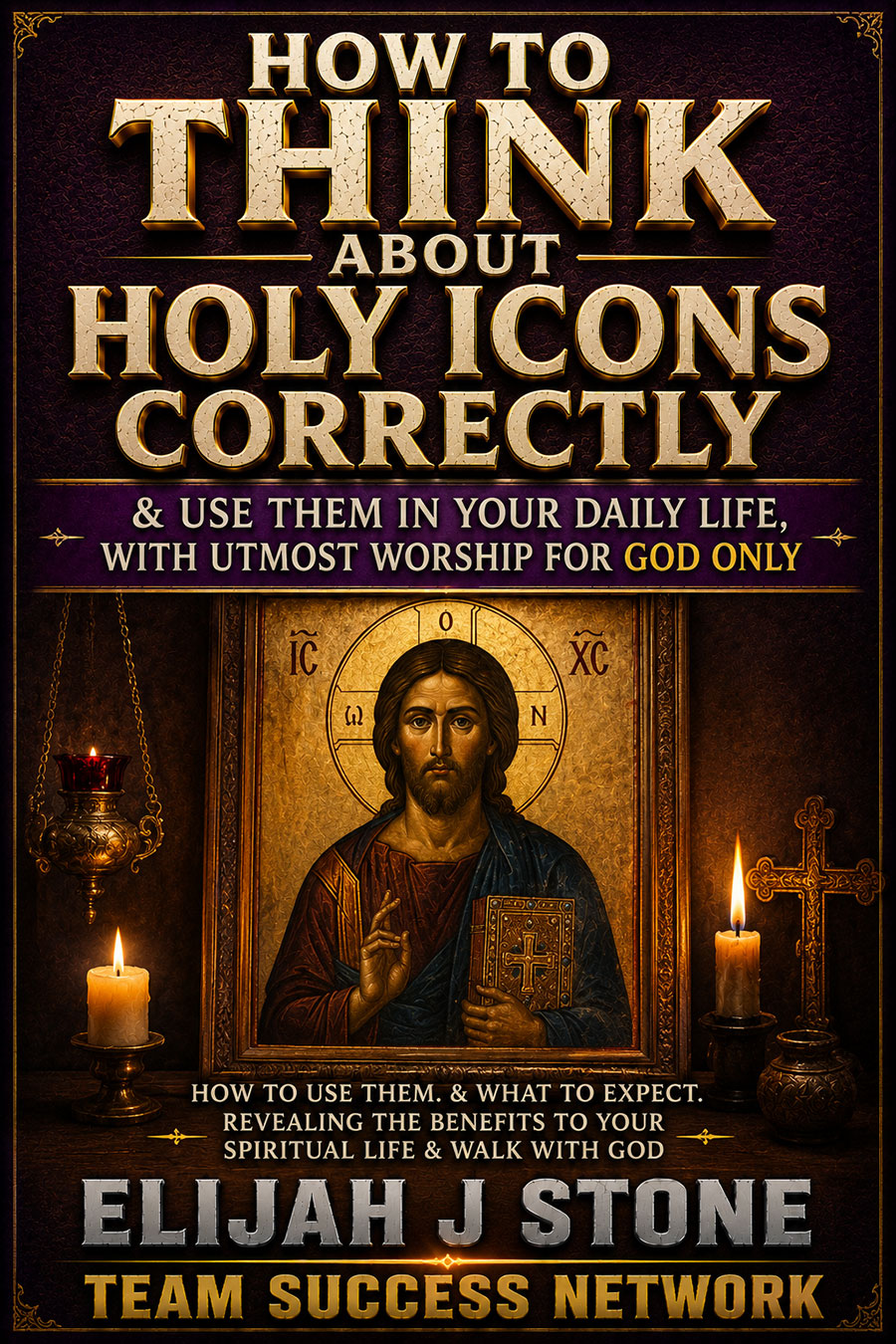
Book 96: How To Think About Holy Icons Correctly

How To Think About Holy Icons Correctly & Use Them In Your Daily Life, With Utmost Worship For God ONLY
How To Use Them.
& What To Expect. Revealing The Benefits To Your Spiritual Life & Walk
With God
By Mr. Elijah J Stone
and the Team Success Network
Table
of Contents
Part 1 – Foundations of
Holy Icons
Chapter 1 – The
Incarnation: God Made Visible
Chapter 2 – Why Icons
Exist: The Theology of Seeing
Chapter 3 – Saint John of
Damascus: Defender of the Holy Image
Chapter 4 – The Apologies:
Answering Those Who Attack Icons
Chapter 5 – The Difference
Between Worship and Veneration
Part 2 – Understanding
the Spiritual Purpose
Chapter 6 – Icons as
Windows to Heaven
Chapter 7 – The Presence
Behind the Paint
Chapter 9 – The Power of
the Gaze: Meeting Christ Through the Image
Chapter 10 – The Icon and
the Word: Scripture in Color
Part 3 – Right Use and
Daily Practice
Chapter 11 – Preparing a
Prayer Corner in Your Home
Chapter 12 – How to Pray
Before an Icon
Chapter 13 – Reverence,
Posture, and Heart Alignment
Chapter 14 – Using Icons
in Family and Community Worship
Chapter 15 – The Spiritual
Effects You Can Expect
Part 4 – Guarding True
Worship
Chapter 16 – Avoiding
Idolatry: Keeping the Focus on God Alone
Chapter 17 – Discernment
and Purity in Icon Use
Chapter 18 – When Icons
Become a Means of Repentance
Chapter 19 – Icons,
Miracles, and Divine Encounters
Chapter 20 – Becoming a
Living Icon of Christ
Part 5 – Holy Beauty:
The Triumph of Truth Through Saint John of Damascus
Chapter 21 – On the Divine
Images: Three Apologies — Apology 1 of 3
Chapter 22 – On the Divine
Images: Three Apologies — Apology 2 of 3
Chapter 23 – On the Divine
Images: Three Apologies — Apology 3 of 3
Chapter 24 – On the Divine
Images: Three Apologies — The Written Sermons – After The Three Apologies
Part 1 – Foundations of Holy Icons
The
beginning of understanding holy icons starts with seeing the Incarnation as the
key. When God became man, He made Himself visible, sanctifying all matter. This
truth allows believers to honor sacred images not as idols but as testimonies
that the invisible God entered creation. Every brushstroke on an icon proclaims
that Christ took on real flesh and remains present among His people.
Icons are
theology in color. They teach that what is seen can lead to faith when the
heart is pure. Through them, believers learn that God uses the senses to draw
the soul upward toward divine truth. Sight becomes an act of worship, as the
eyes behold reminders of eternal reality.
The early
defenders of icons, like Saint John of Damascus, preserved this truth with
courage and clarity. They understood that to reject holy images was to forget
the mystery of the Word made flesh. Their teaching grounded the Church in
reverent understanding, uniting beauty and faith.
Foundations
matter because they guard the heart from error. True icon veneration begins in
sound theology and sincere love. When believers grasp that icons exist to
reveal God’s glory, they discover how to see with both reverence and wonder.

Chapter 1
– The Incarnation: God Made Visible
How God’s Becoming Man Made Holy Icons
Possible
Understanding How the Invisible Entered the
Visible World
God Made
Himself Seen
Before
Christ came, no one could see God and live. He was beyond sight, beyond touch,
and beyond any physical representation. Yet in the fullness of time, the
unseeable God chose to reveal Himself through His Son, Jesus Christ. “The Word
became flesh and made his dwelling among us. We have seen his glory, the glory
of the one and only Son, who came from the Father, full of grace and truth”
(John 1:14).
The
Incarnation changed everything. The moment God took on human nature, He
sanctified all matter. No longer was the physical world separate from the
spiritual—He entered it, walked in it, and blessed it. His image could now be
represented truthfully because He had made Himself visible.
The holy
icon exists because of this miracle. It is not man’s attempt to reach God; it
is God’s invitation to be known. Every icon is a confession that the invisible
became visible, that the Creator walked among His creation, and that His glory
shines through the material world He made.
Why The
Incarnation Changes Everything
The
Incarnation means God did not stay distant. He stepped into time and space so
we could see Him, touch Him, and follow Him. “He is the image of the invisible
God, the firstborn over all creation” (Colossians 1:15). In Jesus, the unseen
Father revealed His face.
That truth
gives icons their sacred foundation. They exist not to replace God but to
proclaim that God has entered human life. The paint, the wood, and the light
within an icon speak silently: God was here. Every brushstroke tells a
theological truth—that creation itself can now become a vessel of divine glory.
When the
believer gazes upon an icon of Christ, they are not imagining a myth. They are
remembering a real event. The Son of God lived, breathed, suffered, and rose in
human form. Through this, the whole world became capable of reflecting divine
presence.
Matter
Redeemed And Made Holy
The
Incarnation transforms how believers see the physical world. What once seemed
ordinary—bread, water, oil, or light—can now serve as instruments of grace. The
same principle applies to icons. The materials are not holy by themselves, but
they become holy when they participate in God’s purpose.
“Through
him all things were made; without him nothing was made that has been made”
(John 1:3). Everything God made carries the imprint of His design. When that
creation is offered back to Him, it becomes a channel of His presence. The
artist’s hand, guided by faith, paints not for fame but for worship.
Icons
remind us that redemption touches every layer of reality. Just as the body can
become a temple of the Holy Spirit, the visible world can become a vessel of
divine glory. Looking upon an icon is not an escape from the world—it’s a
revelation that God has already filled it with His light.
The True
Purpose Of The Icon
A true
icon is not a decoration—it is a declaration. It proclaims that Christ has
conquered distance between Heaven and Earth. “For God, who said, ‘Let light
shine out of darkness,’ made his light shine in our hearts to give us the light
of the knowledge of God’s glory displayed in the face of Christ” (2 Corinthians
4:6). The face of Christ in an icon is not fantasy—it is testimony.
The
believer who stands before an icon of Jesus is reminded that God’s gaze meets
their own. His eyes are not of paint alone—they reflect eternal compassion.
Through that gaze, prayer becomes encounter, and worship becomes personal. The
icon calls to the soul, saying, Behold, God is near.
This truth
separates Christian art from ordinary imagery. An icon is not created to
capture emotion but to communicate revelation. Its beauty does not exist for
admiration but for transformation. It draws the eyes to holiness, training the
heart to recognize divine presence in all things.
Incarnation
As The Foundation Of True Worship
Without
the Incarnation, all attempts to depict God would be false. But because Christ
took on flesh, He opened a way for worship that engages both spirit and senses.
“No one has ever seen God, but the one and only Son, who is himself God and is
in closest relationship with the Father, has made him known” (John 1:18). The
God whom no one could see has now made Himself known.
This means
believers can worship with eyes and hearts together. The icon becomes a meeting
place between Heaven and Earth, spirit and body, eternity and time. It teaches
that to love God is to love His creation rightly. It does not pull us away from
matter—it redeems our perception of it.
Worship,
then, becomes holistic. The believer prays not only with words but with sight,
posture, and reverence. Every act of devotion becomes a continuation of the
Incarnation—God revealed, man responding.
Seeing
Christ In The Icon
To look
upon the face of Christ in an icon is to remember that He truly lived among us.
His eyes are steady, His expression peaceful, His light eternal. Through that
stillness, the believer learns to find rest for the soul. “Come to me, all you
who are weary and burdened, and I will give you rest” (Matthew 11:28).
An icon
does not move or speak, yet it preaches. It reminds you that the One who once
walked dusty roads now reigns in glory. His presence is as near as your
heartbeat, and His mercy is endless. The icon trains the mind to stay centered
on Him, teaching you to see every moment through the light of His incarnation.
Over time,
this vision transforms the inner life. Prayer before an icon shapes humility
and awe. It is not about emotion but recognition—that the same Christ who came
once in flesh now comes again in spirit to those who behold Him with faith.
Key Truth
The icon
exists because God became visible. The Incarnation sanctified the material
world, making sight itself a path to holiness. Every true icon declares that
Jesus Christ—fully God and fully man—revealed the Father to humanity. To look
upon Him rightly is to worship the invisible God who entered creation for
love’s sake.
Summary
The
mystery of the Incarnation stands at the heart of all sacred imagery. God, once
unseen, revealed Himself in Christ, allowing believers to honor His image
without fear. The icon is not a human idea; it is a divine invitation to see
and remember.
When you
stand before a holy icon, you are not gazing at paint—you are beholding a
confession: God became man, and He is still with us. Every glance toward
that truth strengthens faith, sanctifies vision, and awakens the soul to the
wonder of a God who made Himself visible so that we might know Him forever.

Chapter 2
– Why Icons Exist: The Theology of Seeing
How God Uses Sight to Reveal His Glory
Understanding How Holy Vision Leads to Deeper
Worship
God
Redeems The Eyes
Faith
begins with hearing, but God did not stop there—He redeemed seeing, too. The
same God who said, “Let there be light,” designed the eyes to behold truth, not
temptation. When sight is purified, it becomes a channel of revelation.
“Blessed are the pure in heart, for they will see God” (Matthew 5:8).
Holy icons
exist to restore the purpose of vision. They remind the believer that seeing
can become believing when guided by love and truth. The eyes are not enemies of
the spirit—they are instruments of worship when focused on what is holy. Every
glance upon an icon can become prayer, every moment of stillness an invitation
to encounter divine beauty.
In a world
that fills the eyes with distraction, the icon retrains vision to seek Heaven.
It calls you to pause, to see rightly, to perceive beyond what is seen. God
redeems not only the heart but also the gaze, teaching believers to behold His
glory with purity.
The Eyes
As Instruments Of Faith
The
theology of seeing begins with this truth: what God created, He can sanctify.
The eyes that once led Eve astray can now lead the believer home. “The
unfolding of your words gives light; it gives understanding to the simple”
(Psalm 119:130). Through light—spiritual and physical—God still reveals
Himself.
Icons
transform ordinary seeing into holy attention. They are not mere pictures; they
are encounters. The eyes rest on form and color, but the heart perceives divine
truth. Through their beauty, believers are reminded that God speaks not only
through words but through creation itself.
This is
why icons matter. They teach that everything visible has potential to reveal
the invisible. The sky, the light, the face of another—all can become reminders
of God’s handiwork. When the heart learns to see through grace, every glance
becomes an opportunity for worship.
The Word
Revealed In Form And Color
Scripture
is the Word of God written; the icon is the Word of God portrayed. Both
proclaim the same message: Christ revealed, known, and adored. “In the
beginning was the Word, and the Word was with God, and the Word was God” (John
1:1). The icon, like the Bible, tells His story—but through color, composition,
and light.
Every
element within an icon is intentional. Gold represents eternity; blue
symbolizes divine mystery; red expresses sacrificial love. Stillness within the
image speaks of peace—the unshakable calm of Heaven. Each line and hue whispers
the Gospel in visual form, making theology visible to the eyes and accessible
to the heart.
When a
believer stands before an icon, the message of Scripture becomes tangible. The
colors, gestures, and symbols teach silently what words cannot say. It is not
artistic emotion but sacred revelation. Through the beauty of the icon, truth
becomes incarnate once again.
Beauty
That Teaches The Soul
Beauty is
not vanity—it is truth made visible. God designed beauty to awaken love and
draw the heart toward Himself. “One thing I ask from the Lord, this only do I
seek: that I may dwell in the house of the Lord all the days of my life, to
gaze on the beauty of the Lord and to seek him in his temple” (Psalm 27:4).
Icons
carry this same spiritual purpose. They educate the soul through beauty,
inviting believers to rise above distraction and find peace in divine order.
Their harmony and proportion reflect the balance of Heaven. Their silence
teaches patience, and their light teaches hope.
In prayer
before an icon, you do not stare—you behold. The act of seeing becomes
contemplation. Over time, this discipline trains the heart to recognize God’s
presence not only in sacred art but in all creation.
How Holy
Sight Reforms The Heart
Seeing
through faith reshapes the inner life. What enters through the eyes shapes the
imagination, and what fills the imagination forms the heart. That is why icons
are so vital—they cleanse vision from impurity. “Turn my eyes away from
worthless things; preserve my life according to your word” (Psalm 119:37).
In an age
flooded with empty and sensual images, the holy icon restores sacred focus. It
reminds the believer that the eyes were never meant for vanity, lust, or
distraction—they were made to perceive glory. Every gaze upon a holy image is
an act of spiritual healing, replacing chaos with order and confusion with
calm.
When the
believer learns to see as God sees, judgment turns into compassion and pride
melts into gratitude. Holy vision softens the soul and strengthens love. It
opens a way for prayer that includes not only words but sight sanctified by
grace.
The Eyes
As A Path To Holiness
True sight
is not just physical—it is spiritual understanding. The eyes of faith see more
than the natural world; they perceive God’s invisible presence. “For since the
creation of the world God’s invisible qualities—his eternal power and divine
nature—have been clearly seen, being understood from what has been made”
(Romans 1:20).
Icons
teach believers to look at creation with reverence. The mountains, rivers, and
stars become living parables. The face of every person becomes a reflection of
divine image. When the eyes are purified, the whole world becomes a cathedral
of beauty.
This is
why the practice of gazing upon icons transforms life outside prayer as well.
It cultivates a spirit of gratitude, training the believer to see Christ
everywhere. Vision becomes vocation—to find God in all things and to reflect
His light back into the world.
Seeing As
Worship
To see
rightly is to worship rightly. Icons exist to bring clarity to vision—to
replace confusion with revelation. When the eyes look upon holiness, the soul
learns its proper posture: adoration. “Fixing our eyes on Jesus, the pioneer
and perfecter of faith” (Hebrews 12:2). Through focus, faith grows strong.
In that
gaze, something sacred happens. The believer no longer strives to grasp God
intellectually but beholds Him relationally. The act of seeing becomes
participation in the divine mystery. Every glance toward Christ’s image becomes
a silent “Amen” to His presence.
Icons
therefore teach that worship involves the whole person—heart, mind, and sight
together. Faith does not reject the senses; it redeems them. What God has made,
He sanctifies. The eyes that once wandered now behold His glory.
Key Truth
Icons
exist to train the eyes of faith. God redeems human sight so that believers may
see Him through creation and worship Him through beauty. Every holy image is a
sermon in color, teaching that the visible can reveal the invisible. Seeing
through faith is not imagination—it is revelation made visible through love.
Summary
The
theology of seeing reveals why icons matter so deeply. They are not decorations
but declarations that sight itself can become worship. God uses form, color,
and light to communicate His truth, just as He uses words in Scripture.
Through
holy icons, the believer learns to see as Heaven sees—to perceive beauty
without vanity and holiness without pride. When vision is purified, life
becomes radiant with divine meaning. To see rightly is to live rightly, and to
look upon a holy icon is to begin beholding the face of God in all things.

Chapter 3
– Saint John of Damascus: Defender of the Holy Image
How One Man’s Faith Preserved the Beauty of
True Worship
Understanding Why Truth and Beauty Can Never
Be Separated in God’s Design
A Voice In
A Time Of Turmoil
In the
eighth century, confusion filled the Church. Many believers began destroying
icons, fearing they violated God’s command to “make no graven image.” In their
zeal, they forgot the mystery of the Incarnation—God made visible in Christ. It
was during this storm that Saint John of Damascus rose as a clear voice of
truth and courage.
Living as
a monk near Jerusalem, John dedicated his life to prayer, study, and writing.
Yet when sacred art was threatened, he could not remain silent. He knew that
destroying icons meant erasing reminders of God’s presence among His people.
“For God, who said, ‘Let light shine out of darkness,’ made his light shine in
our hearts” (2 Corinthians 4:6). That light, John believed, shines even through
created things.
He became
known as the Defender of the Holy Image—a title earned not through power
or position but through conviction and clarity. His defense would preserve the
Church’s understanding of how matter itself could declare the glory of God.
Doctrine
Over Emotion
John’s
arguments were not based on passion but on principle. He rooted his defense in
Scripture, tradition, and the logic of divine truth. God Himself, he explained,
made an image when He created humanity in His likeness. “Then God said, ‘Let us
make mankind in our image, in our likeness’” (Genesis 1:26). The act of forming
humanity as His image revealed that God is not against representation—He is the
origin of it.
When
Christ took on flesh, the invisible God became visible. To portray His
humanity, therefore, was not rebellion but reverence. For John, rejecting icons
was equivalent to denying that Jesus truly came in the flesh. He wrote, “I do
not worship matter; I worship the Creator of matter who became matter for my
sake.” That statement became one of the clearest summaries of incarnational
theology in history.
By
defending holy images, John was defending the truth that God uses the physical
world to communicate His love. Bread becomes body, water becomes cleansing, and
paint becomes prayer. Matter, when offered to God, becomes grace in visible
form.
The
Courage To Stand Alone
It takes
courage to defend beauty when others misunderstand it. John of Damascus faced
heavy opposition. Those who sought to destroy icons accused him of idolatry and
rebellion. Yet he refused to compromise. He saw that this battle was not about
art—it was about truth. “Be on your guard; stand firm in the faith; be
courageous; be strong” (1 Corinthians 16:13).
From his
monastery, John wrote three powerful Apologies—reasoned defenses that
explained why icons were essential to the Christian faith. He reminded
believers that before Christ came, God forbade images because He had no visible
form. But once the Word became flesh, the rule changed. The Creator allowed Himself
to be seen, touched, and remembered through the senses.
His
writings spread across the Christian world, strengthening believers who were
afraid to speak. Though he lived far from the centers of power, his voice
reached the heart of the Church. His words became a shield for truth—and a
sword against misunderstanding.
Faith And
Reason In Harmony
John’s
greatest gift to the Church was showing that faith and reason can live in
harmony. He taught that beauty is not a threat to truth but a companion to it.
Logic and love, art and doctrine, can stand side by side when God is at the
center. “For since the creation of the world God’s invisible qualities—his
eternal power and divine nature—have been clearly seen, being understood from
what has been made” (Romans 1:20).
This
insight restored confidence to believers who had begun to fear the material
world. John reminded them that the problem was not matter—it was misuse. When
creation is offered to God, it becomes revelation. When it is worshiped for its
own sake, it becomes idolatry. The difference lies in direction: worship flows
upward to God, not downward to the object.
Through
John’s writings, Christians learned to see the world again as holy ground. The
sun, the stars, and even the painted face of Christ became reminders that the
Creator still speaks through His creation.
Matter As
A Channel Of Grace
John of
Damascus taught that creation is not an obstacle to holiness—it is its
instrument. God, who formed the earth from dust, still uses dust to display His
glory. Just as Jesus used clay to heal the blind man, so God continues to use
physical things to bring spiritual revelation.
“Through
him all things were made; without him nothing was made that has been made”
(John 1:3). This truth anchored John’s reasoning. Since all things were made
through Christ, all things can serve Christ when dedicated to His purpose.
Paint, wood, and gold—when used to honor God—become vessels of divine beauty.
For those
who prayed before icons, John explained that the honor shown to the image
passes to the One represented. The believer bows not to the paint but to the
Presence. Every gesture of veneration is an act of faith in the reality of the
Incarnation. The invisible became visible, and therefore, matter became sacred.
The
Humility Of God Revealed Through Beauty
What John
defended most deeply was not art—it was humility. God humbled Himself to dwell
in flesh, to be seen, touched, and even wounded. The icon testifies to that
humility. It proclaims that the Creator of the universe does not despise the
material but redeems it. “Your attitude should be the same as that of Christ
Jesus… being made in human likeness” (Philippians 2:5–7).
By
painting Christ, believers confess His nearness. By venerating His image, they
celebrate His mercy. Beauty becomes a doorway to gratitude. The icon does not
elevate matter above spirit—it reveals how spirit sanctifies matter.
Saint
John’s theology transforms perception. What once appeared ordinary becomes
radiant with meaning. Every candle’s flame, every beam of light on an icon’s
face, reminds the soul that divine glory can dwell in human form. The world is
not forsaken—it is redeemed.
The Legacy
That Endures
Centuries
have passed, yet the voice of Saint John of Damascus still echoes in the
Church. His defense of holy images shaped Christian thought for generations,
influencing councils, theologians, and artists alike. Through him, the Church
learned that the Gospel is not only preached in words but painted in color.
For those
new to his story, his courage still inspires. He proved that defending truth
sometimes means standing alone. His conviction was not rebellion but
obedience—to the God who became visible. By his writings, the Church regained
confidence to celebrate the union of beauty and truth.
Today,
every time a believer lights a candle before an icon or lifts their eyes to the
face of Christ, they stand in the legacy of this faithful monk. His life
continues to remind the world that holiness can shine through matter and that
God’s light still reflects in human creativity.
Key Truth
Saint John
of Damascus proved that beauty and truth belong together. To honor the icon is
to honor the God who became visible for our salvation. Matter, when offered to
God, becomes a vessel of grace, not an idol. The image of Christ proclaims the
humility of God, who took on flesh so that love could be seen and adored.
Summary
Saint John
of Damascus stood as a bridge between theology and art, showing that faith and
beauty flow from the same source—God Himself. He defended icons not as relics
of tradition but as witnesses to the Incarnation. Through his reasoning, the
Church rediscovered how creation reveals its Creator.
His legacy
endures as a call to pure worship and holy imagination. The believer who gazes
upon a sacred image joins that same confession: God became man, and through
Him, all things are made holy. Every true icon is a testimony to that
wonder—and every act of veneration, a reminder that the unseen God has chosen
to be seen.

Chapter 4
– The Apologies: Answering Those Who Attack Icons
How Saint John’s Writings Became a Shield for
Holy Beauty
Understanding How Reason and Revelation
Defended the Image of Christ
A Time Of
Conflict And Confusion
In the
eighth century, the Church was shaken by a storm that threatened its
understanding of worship and truth. This era, known as the Iconoclast
Controversy, saw believers turning against icons, destroying them in fear
that they violated God’s commandment against graven images. The
misunderstanding was born of zeal but lacked discernment. In their effort to
protect purity, they forgot that the Word had become flesh—and the invisible
God had revealed His face.
Amid this
spiritual crisis rose Saint John of Damascus, the same faithful monk whose
writings would restore clarity and peace to the Church. From his monastery near
Jerusalem, he composed a series of writings called The Apologies—defenses
of holy images grounded in Scripture, theology, and logic. “For the Lord is
righteous, he loves justice; the upright will see his face” (Psalm 11:7). John
understood that to see the face of Christ rightly was an act of faith, not
idolatry.
His
Apologies did not attack his opponents but enlightened them. They were written
not in anger but in love, offering truth where fear had blinded vision. They
became the shield that protected beauty from destruction and preserved the
Church’s confidence in God’s use of creation.
Scripture
As His Foundation
John’s
defense of icons was not built on opinion but on the unshakable ground of
Scripture. He pointed to the Old Testament, where God Himself commanded images
to be made—not for worship, but for holy remembrance. “Make two cherubim out of
hammered gold at the ends of the cover” (Exodus 25:18). The cherubim above the
Ark of the Covenant were visible symbols of invisible realities. They were not
idols but instruments that pointed to divine presence.
He also
recalled how God instructed Moses to make the bronze serpent in the wilderness,
through which those bitten by snakes could look and live. “So Moses made a
bronze snake and put it up on a pole. Then when anyone was bitten by a snake
and looked at the bronze snake, they lived” (Numbers 21:9). The power was not
in the image itself but in the God who commanded it.
Through
these examples, John showed that God did not reject imagery but directed it
toward redemption. The prohibition against idols applied to false gods—not to
the true God revealed through His creation. His argument was simple yet
profound: what God once used to symbolize His presence, He now fulfills through
the image of His Son.
From
Symbols To Revelation
Before the
coming of Christ, the Old Testament gave believers symbols and shadows of
divine truth. The cherubim, the altar, the lampstands—all were glimpses of
glory yet to come. But in the Incarnation, the shadow became substance, and the
promise became presence. “The Son is the radiance of God’s glory and the exact
representation of his being” (Hebrews 1:3).
In The
Apologies, John explained that because God has now revealed Himself visibly
in Jesus Christ, believers can rightly portray Him. The invisible has become
visible, the Word has taken form, and holiness can now be reflected in the
physical world. The Incarnation changed everything about how humanity sees God.
Icons,
therefore, are not inventions of art but responses to revelation. They declare
that salvation was not an idea but an event that entered time and space. To
forbid the image of Christ after the Incarnation would be to deny the truth
that He became man. Every icon, then, is a visual proclamation of the Gospel—a
testimony that “the Word became flesh and dwelt among us” (John 1:14).
Faith That
Thinks Clearly
John of
Damascus taught that faith is not blind—it is enlightened by truth. The
Christian does not close his eyes to reason but allows reason to serve
revelation. The Apologies were written to show that intelligence and
holiness belong together. When guided by the Spirit, logic becomes a servant of
love.
He wrote
with calm authority, distinguishing between worship (latria), given to
God alone, and veneration (dulia), given to what represents Him. This
careful reasoning rescued the Church from confusion. It proved that holy
images, when used rightly, are not barriers but bridges—visible aids that lift
the heart toward the unseen God.
John’s
clarity invites believers to think deeply about devotion. The true danger lies
not in the image but in the heart that forgets its purpose. When the heart
loves God first, everything that reflects His glory becomes sanctified. When
the heart turns inward or becomes proud, even prayer can become self-serving.
In
defending icons, John was teaching something larger: that the human mind and
spirit were both created to participate in truth. Faith, at its best, is not a
retreat from thinking—it is thinking redeemed.
God’s
House And Holy Beauty
The Apologies
also remind believers that beauty belongs in the house of God. John pointed out
that from the beginning, the Lord desired beauty in His dwelling. The
Tabernacle and the Temple were adorned with gold, fine linen, and artistic
designs. “He has filled them with skill to do all kinds of work as engravers,
designers, embroiderers… all of them skilled workers and designers” (Exodus
35:35). God Himself inspired artistry for His glory.
John
argued that if God once commanded beauty in His sanctuary, He has not changed
His mind now that His people are redeemed. Beauty, when offered in humility,
reflects divine order. To remove sacred images from the church would not purify
worship—it would impoverish it. Holy art exists not to distract the soul but to
awaken it.
Through
this, John re-taught the Church the theology of creation: that matter, sound,
and color are gifts meant to glorify God. When sanctified by faith, they become
vessels of grace. The same Spirit who inspired prophets to speak also inspires
artists to reveal truth through form and color.
Grace And
Truth United
The
brilliance of Saint John’s Apologies lies in how they unite grace and
truth. He did not defend icons merely with words—he revealed the heart of God’s
intention for creation. The same divine wisdom that formed the universe now
forms beauty within the Church. His defense was both theological and pastoral,
logical and loving.
Through
his writings, believers learned that holiness does not fear the visible world.
God entered it, redeemed it, and continues to speak through it. The painted
face of Christ does not compete with Scripture—it confirms it. The two work
together: the Word in text and the Word in image, both revealing the same
Savior.
John’s
reasoning also teaches believers how to defend their faith in every
generation—with gentleness, patience, and conviction. The Church’s strength
lies not in argument alone but in grace-filled truth spoken with clarity.
Enduring
Wisdom For The Church
Even
centuries later, the wisdom of Saint John’s Apologies continues to guide
believers who seek balance between reverence and understanding. His writings
remind the Church that the problem was never with the image itself—it was with
hearts that forgot the Creator behind it. Once hearts are rightly ordered, the
image becomes a pathway to prayer.
“The
heavens declare the glory of God; the skies proclaim the work of his hands”
(Psalm 19:1). If creation can proclaim God’s glory, how much more can art
inspired by His Spirit? Every true icon continues that declaration. It points
beyond itself, beyond color and light, to the living God who chose to dwell
among His people.
In every
age, believers must defend beauty from misunderstanding and truth from
distortion. Like John, they must do so not in pride but in peace—confident that
God’s glory will always outshine confusion. His Apologies remain a
living call to worship God with the whole heart, mind, and imagination.
Key Truth
The Apologies
of Saint John of Damascus prove that holy images do not violate God’s
command—they fulfill it through Christ. When the invisible became visible, God
sanctified sight itself. The same Lord who filled His Temple with beauty now
fills the hearts of His people with grace. Reason and revelation, joined
together, defend the truth that creation can declare the glory of its Creator.
Summary
Saint John
of Damascus wrote The Apologies to answer fear with faith and confusion
with clarity. His reasoned defense of icons preserved the Church’s vision of
holy beauty and showed that faith can think as well as worship. Scripture,
history, and logic stood on his side, testifying that God works through the
visible world He made.
His
writings remain a model for every believer who must stand for truth in a world
that misunderstands it. Through his words, the Church learned again that beauty
and holiness walk hand in hand—and that when hearts stay pure, every holy image
becomes a bridge to prayer, not a barrier to God.

Chapter 5
– The Difference Between Worship and Veneration
How Right Understanding Keeps the Heart Pure
in Devotion
Learning to Honor God Through What Reflects
His Glory
Why This
Distinction Matters
One of the
greatest sources of confusion in the use of holy icons comes from
misunderstanding the difference between worship and veneration. Many accuse the
faithful of idolatry, assuming that bowing before an image means adoring the
object itself. But this confusion disappears when the truth is made clear.
Worship and veneration are not the same—they serve different purposes in the
life of faith.
Worship,
called latria, belongs only to God—the Creator, Redeemer, and
Sanctifier. It is the adoration of His being, the offering of one’s entire
heart and soul in surrender. Veneration, called dulia, is the honor
shown to those who reflect His holiness—His saints, His angels, and the sacred
symbols that remind us of His work. The difference is not subtle; it is
foundational. “You shall worship the Lord your God and serve him only” (Matthew
4:10).
Understanding
this difference protects believers from both pride and fear. It prevents
idolatry by keeping worship focused on God alone and prevents spiritual
coldness by preserving the beauty of honor and gratitude. The two—worship and
veneration—are not enemies but companions, leading the soul toward deeper
reverence.
How
Worship Differs From Honor
True
worship is the highest expression of love toward God. It involves the whole
person—heart, mind, and will—adoring His majesty and mercy. Worship belongs
only to the divine nature; it cannot be shared or divided. Every prayer of
praise, every song of surrender, is an act of latria, given exclusively
to the Almighty.
Honor,
however, is something different. It recognizes the grace of God reflected in
His servants. When a believer honors a saint, they are not glorifying the
person for their own sake but glorifying God for what He has done through them.
“Give honor to whom honor is due” (Romans 13:7). Just as one may honor a
teacher without confusing them with the source of all truth, so one may
venerate a saint without confusing them with the Author of holiness.
This
distinction is what allows Christians to live a balanced and joyful faith.
Worship exalts the Giver; veneration appreciates His gifts. When the two are
rightly ordered, the heart stays humble, gratitude flows freely, and love
remains pure.
Why We Bow
Before An Icon
When a
believer bows before an icon, they are not worshiping paint or wood—they are
expressing love toward the divine reality the image represents. It is like
bowing before the portrait of a king—not for the canvas, but for the person
portrayed. The gesture is a physical act of respect, acknowledging the
spiritual truth that God’s presence is near.
“Honor the
Lord with your wealth, with the firstfruits of all your crops” (Proverbs 3:9).
If even our possessions can be offered in honor to God, how much more can our
gestures of reverence express devotion? Bowing, kissing, or lighting a candle
before an icon is not adoration—it is acknowledgment. It says, “Thank You,
Lord, for what You have done in this life, and for showing Your glory through
it.”
This kind
of veneration trains the heart to love rightly. It teaches the believer that
affection for what is holy always leads upward—to the Creator, not away from
Him. The icon, in this sense, becomes a mirror of Heaven: through it, we
remember that holiness is not far from us but dwelling among us through grace.
The Danger
Of Misunderstanding
Throughout
history, misunderstanding this truth has led to unnecessary division. Those who
destroyed icons in fear of idolatry often forgot that the Church had already
distinguished between false worship and holy honor. Their zeal, though sincere,
missed the beauty of what God sanctifies. They sought to protect truth but
ended up wounding it.
Scripture
itself gives examples of rightful veneration. The Israelites bowed before the
Ark of the Covenant, which represented God’s presence (Joshua 7:6). They
honored the tablets of the Law and the sacred vessels of the Temple. None of
these acts were idolatry because the honor shown to them passed directly to
God. “Let them make me a sanctuary, that I may dwell among them” (Exodus 25:8).
God did not forbid reverence—He instructed how to express it properly.
The same
principle applies to icons. When we honor them rightly, we honor the God who
dwells in His saints. When we misuse them, we fall into superstition. The
distinction is not external—it lies in the heart’s direction.
Icons As
Teachers Of Right Love
Icons are
silent teachers of balance and humility. They show believers how to love God
without neglecting His works. To venerate a saint’s image is to celebrate what
grace has accomplished in human flesh. It is a testimony that holiness is
possible and that divine light can shine through ordinary people.
“The path
of the righteous is like the morning sun, shining ever brighter till the full
light of day” (Proverbs 4:18). Every icon of a saint is a reflection of that
light. It reminds us that sanctity is not distant—it is the destiny of every
redeemed soul. The believer who honors a saint honors the God who made that
saint radiant.
Icons also
shape emotion. They move the heart from admiration to imitation. Seeing the
gentle eyes of Christ or the compassionate face of His mother stirs the will to
live more like them. This is not idol worship—it is discipleship in color and
light.
Veneration
As An Act Of Thanksgiving
Every act
of veneration is ultimately gratitude. When we kiss the cross or bow before an
icon, we are saying, “Thank You, God, for revealing Your glory through Your
creation.” This gratitude keeps pride far from the heart and turns reverence
into worship’s companion.
“Give
thanks in all circumstances; for this is God’s will for you in Christ Jesus” (1
Thessalonians 5:18). Veneration fulfills that command in a visible way. It
acknowledges that the saints are evidence of God’s mercy and that every holy
image points back to His redeeming love.
Veneration
also guards against forgetfulness. It helps believers remember that holiness is
real and attainable. When we honor the image of a saint, we are reminded that
the same Spirit who empowered them lives in us. Gratitude turns icons into
living sermons of hope.
How Right
Honor Strengthens Faith
A heart
that understands this distinction walks in freedom. Worship remains undivided,
and veneration becomes a source of inspiration. Fear of error gives way to joy
in truth. The believer no longer sees reverence as superstition but as harmony
between body and spirit.
Right
honor strengthens faith because it teaches humility. When we venerate, we
acknowledge dependence—on God’s grace, on the witness of the saints, and on the
community of faith that has gone before us. Veneration connects us to history,
reminding us that we are part of something eternal.
This is
why the Church, through centuries of prayer and teaching, has upheld both
worship and veneration as necessary. Worship anchors us in God; veneration
draws us into communion with His glory reflected in others. When both are
practiced rightly, they create a beautiful balance of awe and affection.
Key Truth
Worship
belongs to God alone, but honor belongs to all that reflects His holiness. To
venerate is not to adore—it is to thank God for His work in His saints and in
creation. The heart that knows the difference worships without fear and honors
without confusion. Right understanding purifies devotion and turns every
gesture of reverence into an offering of love.
Summary
The
difference between worship and veneration is the key to pure faith. Worship
adores the Creator; veneration honors what reveals His grace. When believers
bow before an icon, their hearts are lifted toward Heaven, not earth. The
gesture becomes gratitude, not idolatry.
Saint John
of Damascus preserved this truth so that generations would remember: to honor
what is holy is to glorify the One who made it so. Icons, saints, and sacred
symbols are not ends in themselves—they are reminders that all creation sings
of its Maker. When this truth is understood, the believer learns to love
rightly, worship purely, and walk humbly before God.
Part 2 –
Understanding the Spiritual Purpose
Holy icons
invite the believer to experience prayer with the eyes as well as the heart.
They open windows to Heaven, making the invisible Kingdom tangible. Gazing upon
them, the soul senses peace, awe, and a nearness to God that transcends words.
Icons are not mere art—they are instruments of transformation, designed to
awaken awareness of divine presence.
Each icon
reflects God’s truth through light, color, and form. The faces of Christ and
the saints teach humility, stillness, and faith. They quiet the restless mind,
guiding prayer into silence where the Holy Spirit speaks gently. Through these
sacred images, believers learn that seeing can become believing when vision is
purified by love.
Icons
train the heart to worship without distraction. Their unchanging peace
contrasts the noise of the world, calling the believer back to simplicity. They
awaken repentance, tenderness, and gratitude in those who approach with
reverence.
Ultimately,
icons exist to remind the faithful that Heaven is near. They are glimpses of
eternity placed within reach. Every holy image whispers the same truth: God is
with us, and His beauty still shines through creation.

Chapter 6
– Icons as Windows to Heaven
How Holy Images Open the Soul to the Eternal
Learning to See Through the Eyes of Faith, Not
Just the Eyes of Flesh
The
Meaning Of The Window
Holy icons
have long been called “windows to Heaven.” The phrase is not poetic
exaggeration—it describes their true spiritual purpose. Icons open a space
between worlds, allowing the believer to perceive divine reality through
earthly form. They do not merely hang on walls; they hang between time and
eternity. “For now we see only a reflection as in a mirror; then we shall see
face to face” (1 Corinthians 13:12).
When one
stands before a sacred icon, the noise of the world fades. Attention narrows,
distractions fall away, and the soul becomes aware that Heaven is near. The
icon is not a fantasy—it is a threshold. Through it, faith begins to glimpse
eternity while still standing on earth.
This is
why icons cannot be treated as art pieces alone. They are prayers in color,
theology in form, and worship made visible. Every true icon invites the heart
to look through it, not at it—to pass beyond the material into the mystery of
God’s presence.
The Icon
As A Place Of Encounter
To the one
who prays, an icon is not a picture—it is a meeting. The believer does not
stare at the image as an observer but enters into communion through faith. “The
eyes of the Lord are on the righteous, and his ears are attentive to their cry”
(Psalm 34:15). That gaze of divine attention is reflected in every authentic
icon of Christ.
When you
stand before the face of Christ in an icon, you are not looking at history—you
are standing before a living presence. His gaze meets yours in silence, and the
encounter changes the atmosphere of the soul. Words become unnecessary. The
icon teaches the art of stillness—the sacred stillness where God speaks through
peace rather than sound.
This
encounter is not imagination; it is recognition. It awakens awareness that God
is truly here, that the saints are alive in His glory, and that prayer is never
one-sided. Through the icon, Heaven bends low, and the believer stands
taller—not in pride, but in communion.
Heaven
Surrounding The Believer
Many
people imagine Heaven as far away, but icons correct that misconception. They
remind us that Heaven is not distant—it is present, permeating creation like
light through glass. “Surely the Lord is in this place, and I was not aware of
it” (Genesis 28:16). Icons awaken that awareness. They whisper to the heart: Heaven
is all around you; open your eyes to see.
Each time
you gaze upon a holy image, you are reminded that life is lived in the presence
of God. The saints in the icons are not gone—they are alive, joined with us in
the great cloud of witnesses. Their faces, radiant and calm, testify that
holiness is possible and that the human story continues in eternity.
For a new
believer, this realization brings both comfort and awe. It transforms prayer
from a lonely cry into a shared communion. Icons become companions, helping you
remember that you are never praying alone—Heaven prays with you, and the Church
on earth joins the worship of Heaven above.
Icons As
Visual Prayer
An icon is
prayer made visible. Just as the Psalms are prayers in poetry, icons are
prayers in paint. They are wordless songs of worship that lift the eyes and
heart together. “Let the beauty of the Lord our God be upon us” (Psalm 90:17).
Through this beauty, the believer finds stillness and focus in a distracted
world.
When you
look upon an icon, you are not meant to analyze it; you are meant to enter into
its silence. The eyes lift toward Christ, and the heart follows. This lifting
of attention becomes contemplation—an upward motion of the soul that mirrors
prayer itself. The icon helps transform vision into devotion and sight into
surrender.
In time,
the believer begins to understand that to look rightly is to pray rightly.
Every glance upon a holy image becomes an act of worship. The heart says
silently, “Lord, I see You,” and in that acknowledgment, Heaven answers, “And I
see you too.”
The Union
Of Heaven And Earth
Icons
reveal that the material and spiritual worlds are not enemies—they are partners
in redemption. God sanctified matter through the Incarnation, making it capable
of bearing His glory. “The earth is filled with the glory of the Lord”
(Habakkuk 2:14). Through icons, believers see that truth made visible.
When
paint, gold, and wood are offered to God, they cease to be ordinary. They
become carriers of divine presence. This is not superstition—it is sacramental
vision. The icon teaches that everything touched by grace becomes holy. The
physical and the spiritual are joined, just as Heaven and Earth are united in
Christ.
Looking
through the “window” of an icon, you glimpse this mystery. The saints who once
walked the earth now stand in eternal light, and through their icons, that same
light shines back upon you. In this way, icons are not barriers—they are
bridges that unite both realms in a single act of worship.
The Beauty
Of Holiness
The beauty
of icons is not ornamental—it is revelatory. The radiance of gold, the serenity
of faces, and the harmony of form all proclaim one truth: God is beautiful, and
His holiness is radiant. “Worship the Lord in the beauty of holiness” (Psalm
96:9). Beauty becomes theology—it teaches, inspires, and converts.
When you
gaze upon an icon, beauty becomes a doorway to truth. The calm stillness of the
figures is intentional—it reflects the peace of Heaven. Their eyes do not stare
outward but inward, inviting you to contemplation. Their proportions follow
divine order, symbolizing the perfection of redeemed creation.
In this
way, icons train the senses to recognize holiness. They teach you to find
beauty not in glamour or passion but in purity and peace. Every brushstroke
proclaims that the ultimate beauty is not found in the world’s chaos but in the
still light of God’s presence.
The Call
To Long For Heaven
Every icon
awakens longing. It reminds the believer that this world is not the final home,
but the doorway to the Kingdom. Icons do not make you escape reality—they
deepen it, revealing that eternity is already pressing in on time. “But our
citizenship is in heaven. And we eagerly await a Savior from there, the Lord
Jesus Christ” (Philippians 3:20).
The more
you pray before icons, the more your heart begins to look forward, not
backward. You start to live as a pilgrim—walking toward the light you glimpse
through that sacred window. Icons teach endurance and hope. They anchor the
soul in what is eternal while teaching the body to live faithfully in what is
temporary.
Heaven is
not only a destination; it is a relationship. The icon brings that reality
near. Through it, God says, “Behold, I am with you always.” Each encounter
becomes an anticipation of the eternal vision promised to the pure in heart—the
vision that will one day be face to face.
Key Truth
Icons are
windows to Heaven—places where the eternal touches the temporal. Through them,
the believer learns that Heaven is not far but near, that matter can reflect
spirit, and that beauty itself can become prayer. The icon reveals that God’s
light is not distant—it already shines through creation, inviting all to behold
and believe.
Summary
Icons as
windows to Heaven reveal the unity of all things in Christ. They open the eyes
of faith to perceive what natural sight cannot see: a world filled with divine
presence. Through them, prayer becomes vision, and vision becomes worship.
The
believer who stands before an icon stands before a window of eternity,
glimpsing the Kingdom that already surrounds us. In that sacred stillness, the
heart learns peace, and the soul begins to long for its true home. Every glance
through this holy window whispers the same truth—Heaven is open, and God is
near.

Chapter 7
– The Presence Behind the Paint
How God’s Nearness Dwells Within Holy Things
Learning to See the Reality That Shines Beyond
the Surface
The
Mystery Within The Image
The true
power of an icon does not rest in its paint or its wood, but in the sacred
presence it represents. The icon is more than a visual object—it is a vessel, a
meeting place between Heaven and Earth. Through its stillness and beauty,
something invisible becomes tangible. “For where two or three gather in my
name, there am I with them” (Matthew 18:20). That promise is fulfilled even
here—in silence, color, and light.
Every icon
is sanctified for holy use. It is not common or casual; it is blessed, prayed
over, and offered to God. Once dedicated, it ceases to belong merely to the
artist—it belongs to Heaven. Its material form becomes a doorway for divine
reality. The believer who prays before it steps into that mystery, not to
worship the image, but to meet the living Presence beyond it.
In this
way, icons become reminders that God truly inhabits His creation. The same God
who filled the burning bush with fire without consuming it can fill wood and
paint with glory without changing their nature. Through the icon, we learn that
holiness is not bound by distance—it can dwell anywhere God is invited.
The
Difference Between Object And Presence
To
understand icons rightly, one must distinguish between what is seen and what is
revealed. The wood and pigment are physical, but the presence they signify is
spiritual. The power does not come from the object—it comes from the God it
represents. “God is spirit, and his worshipers must worship in the Spirit and
in truth” (John 4:24).
The
faithful do not bow before matter; they bow before the divine reality shining
through it. The image becomes a window through which the soul beholds the
eternal. When a believer kneels before an icon of Christ, they are not praying
to paint—they are praying to the One whose face the paint portrays.
This
understanding protects the heart from superstition. Icons are not magical
charms that guarantee blessing by mere possession. Their meaning is relational,
not mechanical. They come alive through faith, not through ritual alone. When
approached with reverence, they become channels of grace—places where God’s
love touches human frailty.
The
material is simply the means; the Spirit is the source. The believer’s faith
transforms the moment into communion, and the icon becomes a living encounter
rather than a lifeless image.
Faith
Gives The Icon Life
Without
faith, an icon is just paint and wood; with faith, it becomes a meeting point
of Heaven and Earth. The power of an icon depends not on its design but on the
heart of the one who prays. “According to your faith let it be done to you”
(Matthew 9:29). This truth applies as much to icons as it does to every act of
worship.
For
beginners, this realization brings great peace. You do not have to feel
something supernatural for God to be present. The holiness of an icon is not
measured by emotion but by trust. Even in silence, even in stillness, God is
near. The Person represented—the Lord, His Mother, or His saints—hears every
prayer offered before their likeness.
Through
this, faith becomes sight. What was once invisible begins to be perceived
inwardly. The believer learns to recognize God’s nearness not through noise or
spectacle, but through calm assurance. The icon becomes a quiet companion in
prayer, reflecting back the presence of the One who listens.
Icons do
not replace faith—they refine it. They train the soul to believe not by seeing,
but by seeing through.
When
Heaven Meets Earth
Every time
a believer stands before a holy icon, a sacred exchange takes place. Earth
offers its materials—wood, pigment, and gold—and Heaven fills them with grace.
The divine touches the created, and both are transformed by the encounter. “The
Word became flesh and made his dwelling among us” (John 1:14). What happened
once in Bethlehem continues in every consecrated thing.
The icon
thus becomes a small Bethlehem—a place where God dwells visibly among His
people. It is not divine in essence, but it participates in divine purpose.
Through it, the believer remembers that God chooses to reveal Himself through
humble things.
When you
pray before an icon, you step into that mystery. Heaven leans close; the unseen
draws near. What was once ordinary space becomes sacred ground. The same
presence that filled the Temple, the same Spirit that descended at Pentecost,
fills the moment with quiet holiness.
To look
upon an icon is to acknowledge that God still enters creation. He is not
confined to Heaven above but manifests His glory through the works of His hands
and the faith of His people.
The World
As A Vessel Of Grace
The
presence behind the paint changes how believers see everything around them. If
God can fill an icon with His presence, then He can fill all creation with His
glory. “The earth is the Lord’s, and everything in it” (Psalm 24:1). Nothing is
too small or ordinary for divine use.
Every
created thing has potential to become a vessel of grace when consecrated to
God’s purpose. Bread and wine become sacraments; water becomes cleansing; oil
becomes healing. Likewise, color and wood become icons. Creation itself becomes
a hymn—every material thing echoing the truth that God is near.
This
vision restores wonder. The believer begins to see the world not as mundane but
as radiant with divine possibility. Mountains become altars, rivers become
baptisms, and even silence becomes prayer. The icon is simply the most visible
example of what God can do when the natural is offered to the supernatural.
To
perceive this rightly requires humility. Only a quiet, trusting heart can
recognize the sacred in the simple.
Recognizing
The Presence Of God
The
presence behind the paint reveals itself to those who seek with sincerity. When
prayer is genuine, when the heart is pure, the Holy Spirit often makes His
nearness known—not through spectacle, but through peace. “Be still, and know
that I am God” (Psalm 46:10). Stillness is the door through which His presence
enters.
Some
believers feel warmth, others tears, and some only deep calm. These are not
emotional rewards—they are signs of grace. The same Spirit who filled the
prophets and apostles now fills the room of the one who prays. It is not the
paint that moves the heart, but the Presence that responds to faith.
Over time,
this awareness deepens. Prayer before icons no longer feels like talking to
God but with Him. The believer’s soul learns to rest in His company,
confident that Heaven is near. Each moment before an icon becomes an echo of
eternity—a small participation in the unending worship of the saints.
The icon,
then, is not merely something to look at but something to look through. Beyond
the image stands the living God, waiting to meet those who come in faith.
Key Truth
The true
power of an icon lies not in its materials but in the divine reality it
reveals. Blessed and set apart, it becomes a meeting point where God’s presence
touches human faith. The believer who prays with a humble heart will always
find more than art—they will find encounter. Through faith, paint becomes
prayer, and wood becomes witness to the nearness of the Holy Spirit.
Summary
The
presence behind the paint reminds us that God works through tangible means to
reach the heart. Icons are not magic; they are sanctified instruments of grace.
Their purpose is to help the believer perceive divine reality through earthly
symbols.
When
approached with faith, the icon becomes a place of communion—a quiet Bethlehem
where Heaven and Earth meet. It reveals that everything created can become holy
when offered to God. In its stillness, the icon whispers truth: the same God
who once took on flesh still chooses to dwell among His people, filling
ordinary things with extraordinary presence.

Chapter 8
– How Icons Teach the Heart to Pray
How
Stillness Becomes the Language of the Soul
Learning
to Commune With God Through Silence, Beauty, and Focus
The Silent
Teacher Of Prayer
Holy icons
are silent teachers of prayer. They do not speak, yet they communicate deeply.
Their stillness trains the restless soul to quiet itself before God. “Be still
before the Lord and wait patiently for him” (Psalm 37:7). In a noisy world, the
icon becomes a sanctuary of silence—a visible reminder that true prayer begins
not with words, but with stillness.
When
believers sit before the image of Christ, they are invited to stop striving.
The eyes of the Savior, calm and compassionate, draw the heart into awareness
of His presence. There is no rush, no pressure to say everything perfectly. The
icon’s unchanging peace slowly reshapes the atmosphere of the soul.
Icons
teach by example. Their silence is not emptiness—it is invitation. The believer
who gazes upon them learns the first lesson of prayer: that God is not
impressed by eloquence but drawn by honesty. The icon waits patiently, as God
does, until the soul becomes quiet enough to listen.
From
Distraction To Focus
Distraction
is one of the greatest enemies of prayer. The mind wanders, the emotions
fluctuate, and the spirit grows weary. But when the believer fixes their eyes
on a holy icon, the mind finds an anchor. The sacred image becomes a steady
point of focus that gathers the scattered thoughts into one direction—toward
God.
“I keep my
eyes always on the Lord. With him at my right hand, I will not be shaken”
(Psalm 16:8). This verse captures what the icon helps believers do—to look
steadily toward the Lord until peace replaces chaos.
Icons do
not demand—they invite. The face of Christ, serene and strong, gazes back
without judgment. It draws the attention away from confusion and back toward
divine presence. In that gaze, the believer’s inner life begins to align. The
rhythm of breathing slows. The mind settles. The heart becomes still.
Over time,
prayer before icons teaches the discipline of attention. The believer learns
not to escape distraction by force, but to surrender it gently—to let the holy
image pull every thought heavenward, like a compass pointing to true north.
Prayer As
Beholding
Icons
reveal that prayer is more about beholding than performing. It is less about
saying the right words and more about being present before God. “One thing I
ask from the Lord, this only do I seek: that I may dwell in the house of the
Lord all the days of my life, to gaze on the beauty of the Lord” (Psalm 27:4).
The word gaze is the secret of contemplative prayer.
For those
new to this way of prayer, icons provide a tangible focus. Instead of wrestling
to think about God, you simply behold Him. The eyes rest upon divine beauty
while the heart opens in quiet love.
This kind
of prayer doesn’t depend on mood or emotion. It flows from the awareness that
God is already present. You don’t have to bring Him closer; you only have to
turn your attention toward Him. The icon becomes a mirror of that truth—a
visible assurance that the invisible God can indeed be met here and now.
As this
awareness grows, words begin to fall away. The believer discovers the joy of
being with God without needing to speak. Silence becomes worship, and the heart
itself becomes a temple.
The Peace
Of Slow Prayer
Icons
teach believers to pray slowly. Their unhurried form and gentle colors invite
peace, not passion. In their presence, time seems to soften. There is no
rush—only rhythm, like breathing in God’s grace and breathing out the world’s
noise. “In repentance and rest is your salvation, in quietness and trust is
your strength” (Isaiah 30:15).
This
slowness is not laziness—it is reverence. Each moment before the icon is an
opportunity to remember that prayer is relationship, not ritual. The believer
learns to pause between phrases, to listen between thoughts, and to let
gratitude rise naturally.
The beauty
of the icon reinforces this posture. Every curve and color expresses harmony
and calm. The composition itself becomes a visual sermon about prayer—steady,
balanced, and full of light. As you gaze, your soul begins to imitate that same
peace.
Over time,
prayer before icons becomes rhythmic and restful. It anchors the heart in God’s
presence and fills even brief moments of devotion with quiet depth. Through
this, the believer learns that prayer is not about saying much but about
being much with God.
Learning
To Pray With The Whole Being
Icons draw
prayer out of the head and into the whole person. Sight, breath, and posture
begin to participate in worship. The believer stands or bows, crosses
themselves, and breathes slowly—all physical expressions of inner surrender.
“Let everything that has breath praise the Lord” (Psalm 150:6). Even the body
becomes an instrument of prayer.
When you
pray before an icon, your sight becomes spiritual. The eyes no longer see only
shapes and color—they perceive holiness. Your breathing slows, becoming a
steady rhythm of communion. Even your stillness speaks. The icon’s quiet energy
begins to shape your own, guiding you toward deeper awareness.
This
embodied prayer teaches that faith is not merely intellectual. It is
relational, sensory, and holistic. God meets the believer not just in thought
but in every part of their being. Icons become the classroom where this
integration is learned—where the physical and spiritual come together in
harmony before the Creator.
As this
practice matures, prayer ceases to feel mechanical. It becomes natural—like
breathing, like resting in sunlight.
Becoming
What You Behold
The most
profound lesson icons teach about prayer is transformation. The more you look
upon Christ, the more you become like Him. “And we all, who with unveiled faces
contemplate the Lord’s glory, are being transformed into his image with
ever-increasing glory” (2 Corinthians 3:18). The icon, therefore, does not only
invite prayer—it produces likeness.
When the
believer gazes upon the face of Christ, that gaze begins to work inwardly. The
peace in His eyes becomes the peace in your heart. His humility begins to shape
your attitude. His compassion becomes your response to others. The more you
behold Him, the more His image is restored within you.
This
transformation is gentle, not forced. It happens through presence, not
performance. Prayer before an icon gradually reshapes the soul until the
believer themselves becomes an icon—an image of divine love reflected in human
form.
Eventually,
prayer no longer feels separate from life. Every act, every word, every moment
becomes a continuation of that silent communion. The believer becomes a living
icon—transparent to God’s light, reflecting His peace into the world.
Key Truth
Icons
teach prayer by leading the soul into stillness. They transform seeing into
worship and silence into conversation with God. The believer who gazes upon
Christ learns to pray not with anxiety, but with awe. Through the icon’s quiet
presence, prayer moves from the lips to the heart, and from effort to union.
Summary
Icons are
teachers of prayer that never speak yet always instruct. They lead believers
from distraction to focus, from speaking to listening, from restlessness to
peace. In their silent beauty, the soul learns to commune with God through
simplicity and love.
As the
believer gazes upon the face of Christ, prayer becomes more than words—it
becomes transformation. The one who beholds begins to resemble what they
behold. Through holy icons, the restless heart learns its truest rhythm: to
rest, to adore, and to become a living reflection of the God it loves.

Chapter 9
– The Power of the Gaze: Meeting Christ Through the Image
How the Eyes of Christ Awaken the Heart to His
Presence
Learning to See, and Be Seen, Through the Gaze
of Love
The
Meeting Of Eyes And Spirit
The human
gaze carries deep power—it expresses love, attention, and presence. A look can
comfort, correct, or heal. When we meet someone’s eyes, we recognize that we
are seen and known. In a holy icon, this mystery takes on divine meaning. The
gaze of Christ becomes a living meeting place between Heaven and Earth.
When a
believer looks into the painted eyes of Christ, something sacred occurs. Faith
recognizes that this is not just color on wood but a representation of living
Presence. “The eyes of the Lord are on the righteous, and his ears are
attentive to their cry” (Psalm 34:15). That awareness turns looking into
communion.
Prayer
before the icon thus becomes mutual. The believer gazes upon Christ—and Christ,
through that image, gazes back. This exchange transforms prayer from monologue
to encounter. The eyes of the Savior remind the soul: You are not forgotten,
not unseen. I know you, and I love you.
The
Ancient Practice Of Holy Looking
To those
unfamiliar with icons, this may seem mysterious. Yet this way of prayer—holy
looking—is ancient. The early Christians understood that to gaze upon Christ’s
image was not imagination but faith perceiving reality through sanctified
sight. “Fixing our eyes on Jesus, the pioneer and perfecter of faith” (Hebrews
12:2).
In the
stillness of that gaze, the believer enters a sacred conversation without
words. The silence is not emptiness—it is full of divine attention. The heart
begins to understand that prayer does not always require speech. Sometimes, to
look is to love.
This kind
of contemplation teaches the soul to see differently. Instead of striving to
reach God through effort, the believer learns to rest in His nearness. The eyes
of Christ draw the heart beyond form and color into awareness of His living
Spirit. In that moment, the line between art and reality fades, and only
presence remains.
What
begins as outward attention becomes inward awakening. The believer realizes
that true prayer is not about trying to find God but about letting God find
you.
Seeing And
Being Seen
Looking
into the eyes of Christ changes everything. His gaze pierces through masks,
pride, and pretense, yet it never wounds—it heals. “You have searched me, Lord,
and you know me” (Psalm 139:1). To be seen by Christ is to be fully known and
yet fully loved.
The icon
helps make this knowing tangible. The eyes of Jesus, calm and steady,
communicate both truth and mercy. They see not only what you are but what you
are meant to become. This realization can move the soul to tears—not out of
fear, but from love that feels itself understood.
Many
believers have experienced this as quiet conviction followed by peace. In that
gaze, sin loses its disguise. The heart recognizes its need for grace but also
feels safe to receive it. The icon becomes like a mirror—revealing who we are
and reflecting who we are called to be.
In this
way, the gaze of Christ purifies. It melts pride, softens hardness, and
restores dignity. What the world judges, Christ redeems. What the soul hides,
Christ gently exposes so He can heal it.
The Gaze
That Transforms
The power
of Christ’s gaze lies not in condemnation but in transformation. When He looks
at you, He sees both your wounds and your worth. His look carries no anger—only
mercy and invitation. “Neither do I condemn you,” He said to the woman caught
in sin. “Go now and leave your life of sin” (John 8:11). That same gaze now
shines from every true icon.
To meet
His eyes is to stand in the light that both reveals and restores. The more the
believer returns to this gaze in prayer, the more their heart begins to change.
Fear dissolves. Shame fades. Hope awakens. The believer learns that the God who
sees is also the God who loves beyond measure.
Icons, in
this sense, do not only depict Christ—they extend His ministry. Just as His
eyes once met the eyes of Peter after his denial, His gaze now meets ours,
calling us to repentance and renewal. Each encounter becomes an invitation: Do
not hide. Come, and be made whole.
Over time,
the believer discovers that this exchange shapes their entire vision of life.
They begin to see others through the same compassionate eyes that once looked
upon them.
Prayer As
Relationship
The gaze
of Christ turns prayer into relationship. No longer is God distant or
abstract—He is present, personal, and attentive. When you look into His eyes,
prayer ceases to be performance and becomes communion. “The Lord make his face
shine on you and be gracious to you” (Numbers 6:25). His shining face is the
sign of His favor, His closeness, and His love.
Icons help
restore this relational dimension of prayer. They remind the believer that God
is not an idea to analyze but a Person to behold. Through this gaze, the soul
rediscovers intimacy. Silence becomes filled with presence. Stillness becomes
surrender.
In time,
this awareness carries into daily life. The believer begins to pray not only
before icons but through them—seeing every face as a reflection of God’s image,
every encounter as an opportunity to love. The presence once found in the icon
now radiates outward, turning life itself into prayer.
This is
the hidden miracle of holy vision: once you have met Christ’s eyes, you cannot
look at the world the same way again.
The
Healing Of The Heart
When a
believer prays before the image of Christ, they often sense an invisible
exchange taking place. The pain within the heart rises toward the One whose
eyes never look away. “He heals the brokenhearted and binds up their wounds”
(Psalm 147:3). In His gaze, grief finds comfort and guilt finds forgiveness.
Tears that
come in prayer before an icon are not a sign of despair—they are a sacrament of
release. They mark the moment when the soul surrenders its defenses and allows
divine tenderness to enter. Icons become instruments of healing precisely
because they make God’s compassion visible.
The longer
one remains in that gaze, the deeper the healing becomes. What once was hidden
comes into the light. What was hardened becomes soft again. The believer feels
no demand to perform—only a call to rest in love. The gaze of Christ restores
innocence by replacing self-condemnation with divine acceptance.
Prayer
before His image becomes a return home—a rediscovery of the God who looks upon
His children with joy, not judgment.
Beholding
And Becoming
To gaze
upon Christ is to be changed by Him. The more we look at His image, the more
our hearts reflect His likeness. “But we all, with unveiled face, beholding as
in a mirror the glory of the Lord, are being transformed into the same image
from glory to glory” (2 Corinthians 3:18). The gaze becomes grace in motion.
The
believer who meets Christ’s eyes in prayer begins to carry that same light into
the world. They look upon others with gentleness instead of criticism, with
patience instead of pride. Prayer no longer ends when they leave the icon—it
continues in every glance of compassion they offer to another soul.
Through
this transformation, the icon fulfills its deepest purpose: it shapes the one
who beholds it into an icon themselves—a living reflection of Christ’s love.
The gaze that once healed the heart now shines through it, turning the
believer’s life into a window of divine mercy.
Key Truth
The gaze
of Christ in the holy icon is not paint—it is presence. His eyes meet ours with
truth that heals, mercy that transforms, and love that never turns away.
Through that gaze, prayer becomes encounter, and encounter becomes
transformation. The one who looks upon Him learns what it means to be truly
seen, truly known, and truly loved.
Summary
Icons
reveal the sacred mystery of the gaze—the meeting of human eyes with divine
love. To look into the image of Christ is to enter communion, where silence
speaks and presence heals. His eyes see beyond sin to the soul’s beauty,
inviting transformation through mercy, not fear.
Over time,
the believer discovers that this gaze is not confined to the icon but lives
within them. It becomes their new way of seeing the world—with compassion,
clarity, and peace. In every true icon, Christ still looks upon His people, and
through that gaze, He continues to teach hearts how to love.
Chapter 10
– The Icon and the Word: Scripture in Color
How God’s Story Is Told Through Light, Line,
and Living Symbol
Seeing the Bible Come Alive Through Sacred
Imagery
Two
Languages, One Revelation
Icons and
Scripture speak the same divine language. The Bible proclaims God’s truth
through words; icons proclaim that same truth through color and light. They are
not rivals but partners in revelation—two ways of expressing one message: Christ
revealed. “The Word became flesh and made his dwelling among us. We have
seen his glory” (John 1:14).
Every
sacred image draws from the Word. The icon of Christ’s birth reflects the
Gospel of Luke; the Baptism icon preaches the Jordan miracle; the Crucifixion
icon embodies Calvary; and the Resurrection icon bursts with Easter victory.
These are not artistic inventions but visual sermons—painted theology rooted in
Scripture itself.
The icon
and the Word exist together because the same God who spoke truth through
prophets also spoke truth through beauty. Both are revelations of the same
glory. The Bible is the Word written; the icon is the Word shown. Each confirms
the other, creating a harmony that nourishes the mind and moves the heart.
The Bible
Seen With The Eyes
For the
beginner, this truth changes how Scripture is experienced. The icon becomes a
visual commentary, helping the believer read with greater understanding. Just
as hearing the Word builds faith, seeing it deepens memory and meditation.
“Faith comes from hearing the message, and the message is heard through the
word about Christ” (Romans 10:17). When that same message is made visible, the
heart perceives it in new ways.
Consider
the icon of the Annunciation. Gabriel’s gesture echoes the divine command, “You
will conceive and give birth to a son” (Luke 1:31). Mary’s humble posture
reflects her words, “Let it be to me according to your word” (Luke 1:38). The
icon captures both dialogue and obedience in a single moment of stillness. The
believer who contemplates it is not merely looking at art—they are meditating
on Scripture with their eyes.
Every
symbol in an icon serves the same purpose: to translate divine truth into form.
Gold backgrounds reflect the eternal light of Heaven; blue garments reveal
divinity; red garments represent love and sacrifice. These visual cues teach
theology to the heart, often without a single spoken word.
The Icon
As A Visual Gospel
Icons have
been called “the Gospel in color” because they preach silently but powerfully.
The icon of the Nativity tells of God’s humility: the Creator entering
creation. The icon of the Transfiguration reveals His divine glory: light
brighter than the sun. The icon of the Crucifixion proclaims love’s victory
through suffering. And the icon of the Resurrection declares triumph over death
with radiant peace.
Each scene
mirrors Scripture in design and meaning. “Your word is a lamp for my feet, a
light on my path” (Psalm 119:105). In icons, that light is literally painted
into the image. The figures glow from within because they reflect the uncreated
light of God—the same light that shines through the words of Scripture.
These holy
images are not imaginative recreations but faithful representations guided by
revelation. Iconographers follow strict patterns based on biblical truth,
ensuring that every gesture, every detail serves the Word. Nothing in an icon
is accidental; everything exists to point the soul back to Christ.
Through
them, the believer encounters the same message proclaimed by the apostles: that
Jesus is Lord, the Savior, and the Light of the world.
Reading
With The Eyes Of The Heart
Icons
train the believer to read Scripture not only with intellect but with
affection. The image, like the Word, must be read slowly, with reverence. The
eyes trace lines, colors, and symbols as the heart absorbs their meaning. “Open
my eyes that I may see wonderful things in your law” (Psalm 119:18).
As the
eyes linger, the story unfolds. In the Baptism icon, the water flows downward
while Christ stands upright—showing victory over chaos. The Holy Spirit
descends as a dove, just as the Gospels describe. John the Baptist bows,
declaring the Lamb of God. Every element corresponds to a verse, yet together
they create one vision—a revelation of divine love breaking into the world.
In this
way, icons turn Scripture study into contemplation. They slow the pace of the
mind, inviting the heart to dwell on each truth. The believer no longer rushes
through chapters or verses but sits with the scene, allowing the Holy Spirit to
teach through sight as well as sound.
This is
what it means to “meditate on His law day and night” (Psalm 1:2)—to let the
Word, whether written or painted, dwell richly in the soul.
The
Stillness That Reveals Truth
The
stillness of an icon mirrors the peace of Scripture’s message. There is no
motion or chaos in its design, only order, proportion, and harmony. This
reflects the nature of God Himself—unchanging, calm, and full of light. “You
will keep in perfect peace those whose minds are steadfast, because they trust
in you” (Isaiah 26:3).
When
believers meditate before an icon, they learn to read the Bible in that same
stillness. The stories no longer feel distant or historical—they become
encounters with living truth. The figures in the icons do not shout; they
invite. Their gestures, faces, and silence all draw the soul into
contemplation.
Even the
absence of shadow carries meaning. Icons are lit not from an external source
but from within, symbolizing divine illumination. This interior light teaches
the believer that the Word of God, too, shines from within. Scripture and icon
alike reveal that holiness is radiant, steady, and eternal.
Imagination
Sanctified By Truth
Icons
sanctify the imagination. They guard the believer from forming false mental
images by offering faithful ones rooted in revelation. This is especially
important for beginners in prayer, who may struggle to keep their thoughts
centered. Icons guide vision without replacing faith—they discipline the
imagination to serve truth.
“For God,
who said, ‘Let light shine out of darkness,’ made his light shine in our hearts
to give us the light of the knowledge of God’s glory displayed in the face of
Christ” (2 Corinthians 4:6). The face of Christ in an icon fulfills that
verse—it becomes a visible reflection of divine glory.
By
meditating on this sacred light, the believer’s imagination becomes purified.
Seeing no longer leads to distraction but to adoration. The mind that once
wandered finds focus; the heart that once feared finds peace. The Word of God
and the icon of God together restore vision to its holy purpose—to see,
remember, and love.
Scripture
Made Visible, Faith Made Tangible
Icons do
not replace the Bible; they reinforce it. They make the invisible visible, the
abstract tangible. The stories of faith come alive not through spectacle but
through stillness. A believer who studies the Gospels and prays before icons
will find both experiences merging—the written and the visual forming one
testimony of truth.
When
Scripture is read with eyes shaped by icons, it becomes more vivid. The
believer imagines the tenderness in Christ’s face, the light of His
Resurrection, and the mercy in His gaze. Likewise, when an icon is viewed
through the memory of Scripture, its meaning deepens. Word and image together
form a seamless garment of revelation.
Through
this union, the believer begins to live the story—not just read or see it.
Faith ceases to be theory and becomes vision. The Gospel moves from page and
panel into the heart, transforming prayer into participation.
Key Truth
Icons and
Scripture are two expressions of the same revelation. What the Bible declares
in word, the icon declares in color. Together they proclaim that the Word
became flesh, that light entered darkness, and that truth became visible. The
icon is Scripture for the eyes—stillness made sacred, faith made visible, and
the Gospel preached in beauty.
Summary
The icon
and the Word are companions in revelation. Scripture gives language to the
truth; the icon gives it form. Both flow from the same Source and lead to the
same Savior.
When
believers read the Bible and pray before holy images, they engage both hearing
and seeing—two gateways to faith. The Word teaches; the icon reminds. One
speaks, the other shows. And together, they declare the same eternal message:
Christ, the living Word, still shines in every heart that looks upon His glory.
Part 3 –
Right Use and Daily Practice
Integrating
icons into daily life turns faith into a living rhythm. A simple prayer corner
in the home becomes a meeting place between the believer and God. When one
prays before the face of Christ or the Virgin Mary, the ordinary space becomes
sanctified ground. The presence of holy images calls the soul to prayer, even
in silence.
Using
icons rightly begins with reverence. Lighting a candle, making the sign of the
Cross, or bowing are outward acts that train the inward heart. These gestures
keep worship sincere and humble, ensuring that love for God remains at the
center of devotion.
In
families and communities, icons unite hearts in shared faith. They remind all
who gather that the Church is one body—on Earth and in Heaven. Children who
grow up seeing and honoring icons learn to view prayer not as duty but as joy.
Over time,
daily veneration produces fruit. The believer becomes more peaceful, patient,
and aware of God’s nearness. The home filled with icons becomes a school of the
heart, teaching that holiness belongs in every moment of life.

Chapter 11
– Preparing a Prayer Corner in Your Home
How to Create a Sacred Space That Welcomes
God’s Presence Daily
Turning Ordinary Space Into a Sanctuary of
Peace and Prayer
Why Every
Home Needs a Holy Place
A home
becomes a true dwelling place of peace when prayer fills it. The prayer
corner—sometimes called the “icon corner”—is more than decoration. It is a
declaration: this house belongs to God. “As for me and my household, we
will serve the Lord” (Joshua 24:15).
Creating a
prayer corner establishes a sacred rhythm in daily life. It offers a space
where hearts can rest, minds can focus, and faith can breathe. It does not
require grandeur or cost—it requires reverence. A few holy images, a candle,
and a humble heart are enough to transform an ordinary wall into a meeting
place with Heaven.
The prayer
corner is where the invisible becomes visible. It stands as a quiet testimony
that God is welcome here. When you pass by it, even briefly, the icons seem to
whisper an invitation: Stop. Remember. Pray. Over time, this small space
shapes the atmosphere of the entire home, filling it with spiritual warmth and
peace.
The
Simplicity Of Sacred Design
The beauty
of a prayer corner lies in its simplicity. It is not about impressing others—it
is about inviting God. The corner need not be elaborate or ornate; it must
simply be sincere. “For where your treasure is, there your heart will be also”
(Matthew 6:21).
A beginner
can start with a small shelf, a table, or even a section of a wall. Upon it,
place a few icons—Christ at the center, the Virgin Mary beside Him, and perhaps
a patron saint or feast day image. Add a cross if you have one, and a candle or
small oil lamp to symbolize the light of Christ.
If
possible, keep a Bible or prayer book nearby. These elements together create a
visual harmony that directs the heart toward worship. The icons are not art for
admiration but symbols for encounter. Their purpose is to make your home a
place where Heaven feels near.
As you
prepare this space, pray simply: “Lord, bless this home and all who pray within
it.” That prayer alone consecrates the room and sets it apart as holy ground.
Creating
Atmosphere Through Reverence
Holiness
does not depend on size—it depends on awareness. The way you treat your prayer
corner reveals how much you value God’s presence. When you light the candle,
bow your head, and make the sign of the Cross, you are reminding yourself that
prayer is sacred work. “Be still, and know that I am God” (Psalm 46:10).
Clean the
area often, just as you would the altar of your heart. Keep it simple,
uncluttered, and peaceful. The fewer distractions there are, the more easily
the soul can focus. Soft lighting helps create a sense of stillness. Even a
small flame can symbolize the Spirit’s living fire, teaching reverence through
its quiet glow.
Avoid
treating the corner as decoration. It is not for display—it is for devotion.
The purpose is not to impress guests but to invite communion. A pure and
intentional atmosphere turns even a small space into a sanctuary.
When you
kneel or stand here, time slows down. The world’s noise fades, and you begin to
hear eternity’s gentle whisper: I am with you.
Making
Prayer A Family Habit
The prayer
corner blesses not only individuals but entire families. It becomes a gathering
point where love and faith unite. “For where two or three gather in my name,
there am I with them” (Matthew 18:20).
Start
simple. Morning and evening prayers are a beautiful rhythm to build. In the
morning, stand before the icons to thank God for a new day. In the evening,
gather as a family to give thanks for His protection and to seek His peace for
the night.
Parents
can teach children to cross themselves before the icon, to kiss the cross or
image reverently, and to say a short prayer: “Lord Jesus Christ, have mercy on
me.” These small habits plant seeds of holiness that grow with time.
Families
who pray together before their icons create memories rooted in faith. The
corner becomes a silent witness to generations of devotion—a living altar of
love. It reminds everyone in the household that prayer is not confined to
church but is woven into daily life.
A Place
For Guidance And Gratitude
The prayer
corner also becomes a space for reflection. When decisions weigh heavily or
when gratitude overflows, it provides a quiet refuge to bring both to God. The
believer stands before the icon of Christ, perhaps lights a candle, and
whispers a simple prayer: “Lord, guide me.”
In moments
of joy, it becomes a place of thanksgiving: “Bless the Lord, O my soul, and
forget not all his benefits” (Psalm 103:2). In times of sorrow, it becomes a
refuge for tears. The presence of holy images reminds the soul that Heaven
listens and understands.
You can
also place a small notebook nearby—a prayer journal. Write down the names of
those you intercede for or blessings you’ve received. This act turns memory
into thanksgiving and requests into faith. Over time, the corner becomes filled
not just with light but with testimony—proof that God hears and answers prayer.
The icons
seem to watch with silent compassion, reminding you that you are never praying
alone. The saints, the angels, and the faithful across ages are joined with you
in the great chorus of worship.
Transforming
The Home Into A Temple
As this
practice continues, something subtle yet powerful begins to happen: the peace
from that small corner spreads throughout the house. “My people will live in
peaceful dwelling places, in secure homes, in undisturbed places of rest”
(Isaiah 32:18). The prayer corner becomes the heart of the home, beating with
quiet devotion that sanctifies every room.
Meals
shared nearby feel more thankful. Conversations become gentler. The very air
seems lighter. This is not superstition—it is sanctification through rhythm.
When prayer dwells in a home, God dwells in that home.
In this
way, the prayer corner turns the household into a domestic church. It joins the
rhythms of daily life with the worship of Heaven. Whether small or large,
ornate or simple, it becomes a constant reminder that the Creator is near,
blessing every breath and every moment.
Through
this, the believer learns a beautiful truth: worship is not confined to sacred
buildings—it can dwell within sacred hearts and homes.
Joining
The Great Tradition Of Faith
When you
create a prayer corner, you join a centuries-old tradition. From the earliest
Christians to modern believers, homes have always held small sanctuaries—spaces
for prayer, candles, and holy icons. These humble altars carried the faith
through persecution, exile, and generations of hope.
To kneel
before your icons today is to kneel beside them all. You join a lineage of
prayer that stretches from ancient monasteries to modern families. You
participate in the same faith that comforted the saints and inspired the
martyrs. The flame of your candle burns in the same light that once illuminated
catacombs and chapels.
This
awareness gives dignity to even the smallest act of devotion. Lighting a candle
or whispering a prayer in your home becomes an act of unity with the entire
Body of Christ. You stand in continuity with those who, across time and
nations, have made their homes altars of love.
Your home
becomes a link in that chain of faith, a dwelling where Heaven once again finds
welcome on earth.
Key Truth
A prayer
corner transforms a home into holy ground. It is not about decoration but
devotion—not about beauty for display, but beauty for worship. Every candle
lit, every prayer whispered, declares: God lives here. Through this
small sanctuary, Heaven and Earth meet, and daily life becomes an act of
praise.
Summary
Preparing
a prayer corner is one of the simplest and most powerful ways to bring faith
into daily life. It invites God’s presence into your home and gives your heart
a place to rest. The icons, the cross, and the candle all serve as reminders
that worship is not confined to church—it continues wherever love and reverence
dwell.
When you
stand before your icons in prayer, you join the family of faith across
generations. You learn to see your home not as separate from God’s house, but
as part of it. Through that sacred corner, peace enters, prayer grows, and your
home becomes what it was always meant to be—a temple where God is loved,
honored, and adored.

Chapter 12
– How to Pray Before an Icon
How to Enter the Presence of God With
Simplicity and Sincerity
Learning to Turn Seeing Into Worship and
Silence Into Communion
Beginning
With Reverence
Praying
before an icon is not about ritual perfection—it is about relationship. The
holy image is not a charm or object of superstition but a window that opens the
heart to divine presence. True prayer begins not with words, but with
awareness. “Be still, and know that I am God” (Psalm 46:10).
Begin by
quieting your heart. Let the noise of the day fade and your breathing slow.
Stand before the icon, make the sign of the Cross, and recognize that you are
stepping into sacred space. The image before you is not merely paint and
wood—it is a visual reminder of the One who loves you beyond measure.
Look
gently upon the face of Christ, the Virgin Mary, or the saint depicted. Do not
rush. Simply allow your soul to settle into the stillness of His gaze. Prayer
begins when presence replaces performance. In that awareness, the heart opens
and heaven feels near.
This is
not about achieving mystical experience—it is about faithfulness and focus.
Even in silence, you are seen, known, and loved.
Praying
With Simplicity
When words
do come, let them be simple and sincere. Long speeches are not needed; the Lord
already knows your heart. “When you pray, do not keep on babbling like pagans,
for they think they will be heard because of their many words” (Matthew 6:7).
Speak plainly, as one friend to another.
For those
new to prayer before icons, short invocations help anchor attention. Say
quietly, “Lord Jesus Christ, have mercy on me,” or “Holy God, be with me.”
These phrases are not formulas—they are breaths of the soul. They gather the
heart’s attention and direct it toward God.
You can
also express gratitude: “Thank You, Lord, for Your mercy.” Or confession:
“Forgive me, Lord, for my impatience today.” Or love: “I adore You, my Savior.”
Whatever you say, say it truthfully. Prayer is not about eloquence; it is about
honesty.
As you
speak, let your eyes remain softly focused on the icon. Allow your gaze to
rest, not stare. The purpose of the image is not to capture attention but to
calm it—to bring wandering thoughts home to God.
When
Distraction Comes
Distraction
is part of every prayer life. The mind drifts, the body fidgets, the heart
grows restless. When this happens, do not become discouraged. Simply return
your attention to the image before you. Look again into the eyes of Christ. Let
that gaze remind you that prayer is not about your ability to concentrate—it is
about your willingness to stay.
“The Lord
looks down from heaven on all mankind to see if there are any who understand,
any who seek God” (Psalm 14:2). When you turn your eyes back to Him, that
simple act of seeking becomes a prayer itself.
If your
thoughts wander, acknowledge them gently and bring them back without judgment.
The icon serves as an anchor for your awareness, holding you steady when
spiritual currents pull you away. Over time, distractions will lose their
power, replaced by a growing sense of calm presence.
Do not
measure prayer by emotion or outcome. The goal is not to feel something but to
be faithful. Every return to His face, every quiet moment of attention, is an
act of love.
Letting
Stillness Become Communion
As the
practice deepens, words often become fewer. The believer begins to discover the
quiet joy of simply being before God. The icon teaches that prayer is not
always speaking—it is listening with the heart. “My soul waits for the Lord
more than watchmen wait for the morning” (Psalm 130:6).
This
waiting is not passive. It is attentive stillness—a readiness to receive. The
longer you remain before the icon, the more you sense that you are being prayed
for, even as you pray. The presence represented in the image begins to fill the
room with peace. You feel known, accepted, and embraced by the Holy One who
looks back at you with unchanging love.
This is
how prayer matures from conversation into communion. The believer no longer
needs constant words because the relationship has become deeper than speech.
The gaze of Christ says everything: “I am with you always, to the very end of
the age” (Matthew 28:20).
At this
level of stillness, prayer transforms from duty into delight. The silence
becomes full—not empty—alive with awareness that God is near.
The Role
Of The Body In Prayer
Icons
teach not only how to focus the mind but how to engage the body in worship.
Stand or kneel with respect, as one would before a king—but with the warmth of
a child before a loving Father. Let your posture reflect your reverence. “Come,
let us bow down in worship, let us kneel before the Lord our Maker” (Psalm
95:6).
You may
cross yourself, bow, or touch your forehead to the ground—gestures of humility
that align body and spirit. Physical movements help the soul remain anchored in
presence. They remind us that worship involves the whole person, not just
thoughts or emotions.
You can
also light a candle before you begin, symbolizing Christ as the Light of the
World. The gentle flame serves as a visual prayer, burning silently even after
words cease. Each element—the posture, the light, the gaze—becomes part of one
seamless act of devotion.
Through
this, the believer learns that prayer is not just spoken but lived. Every
movement becomes a confession: You are holy, Lord, and I am Yours.
Growing In
Personal Relationship
Prayer
before an icon is deeply personal. It is not meant to be mechanical or distant.
Over time, the believer learns to speak with God as with a beloved friend. “The
Lord would speak to Moses face to face, as one speaks to a friend” (Exodus
33:11). That same intimacy is possible for every Christian through the presence
of the Holy Spirit.
At first,
your prayers may feel awkward or formal. But as you continue, they will grow
more natural. You may find yourself pausing longer, speaking less, and feeling
more. The awareness of Christ’s gaze softens the heart. The words you do speak
come not from effort but from affection.
Eventually,
you realize that prayer before an icon is not about mastering technique but
cultivating relationship. The image is not the goal—it is the doorway. It helps
you meet God face-to-face in spirit and truth. Through this, prayer ceases to
be something you do and becomes something you are.
This
transformation is subtle yet profound. Your prayers become quieter, your heart
humbler, and your love more constant.
When
Prayer Becomes Presence
With
practice, the prayer corner and the icon become places of encounter you long to
return to. You begin to feel drawn not by duty but by desire—to see His face,
to rest in His peace. “You will seek me and find me when you seek me with all
your heart” (Jeremiah 29:13).
At this
stage, prayer is no longer about getting results but about receiving
relationship. The believer becomes aware that even silence is filled with
communion. The eyes of Christ seem to follow you—not in judgment, but in love.
His presence becomes part of your day, His peace a rhythm in your breathing.
Eventually,
you realize that you carry the prayer with you. The same awareness that began
before the icon continues in your heart at work, in conversation, and in rest.
The face you once gazed upon now shines within you. You become an icon of the
encounter—a reflection of the One who loves you endlessly.
Key Truth
To pray
before an icon is to stand before God with honesty and peace. It is not about
formulas or feelings but about faithfulness. The icon helps you focus your
heart, quiet your mind, and remember that you are seen, known, and loved.
Through simplicity and sincerity, prayer becomes presence, and presence becomes
communion.
Summary
Prayer
before an icon teaches that worship is relationship, not ritual. It begins with
stillness, deepens through honesty, and ends in peace. The image serves as a
mirror of divine love, helping the believer encounter God not through
imagination, but through faith.
When the
heart learns to rest before the icon, distractions fade and awareness grows.
Every glance becomes prayer, every silence becomes worship. Over time, the
believer’s soul reflects what it beholds—the peace, humility, and compassion of
Christ Himself.
Chapter 13
– Reverence, Posture, and Heart Alignment
How the Body and Spirit Unite in Worship
Letting Every Movement Reflect the Love and
Humility of the Heart
Worship
With The Whole Being
God
designed both body and spirit to worship together. Faith is not merely a
thought—it is a lived expression that involves every part of who we are.
Bowing, crossing oneself, kneeling, and lighting candles are not empty motions;
they are the language of the body speaking faith. “Therefore, honor God with
your bodies” (1 Corinthians 6:20).
When
posture and prayer unite, worship becomes whole. The outward gesture reflects
the inward devotion, helping the soul stay focused on the divine presence. This
is why Christians through the centuries have prayed not only with words but
with movement—with their eyes lifted, knees bent, and hands crossed.
Physical
expressions of reverence remind the believer that prayer is sacred. Each bow
says, You are holy, Lord. Each sign of the Cross whispers, I belong
to You. The alignment of body and soul turns prayer into a living act of
love—one that engages every sense in communion with God.
The
Meaning Of Reverence
Reverence
is not about performance—it is about presence. It is the awareness that you are
standing before the Holy One who made Heaven and Earth. “The fear of the Lord
is the beginning of wisdom” (Proverbs 9:10). In Scripture, this “fear” means
awe and deep respect, not terror. Reverence begins when the heart acknowledges
that God is near and worthy of all honor.
For those
new to physical expressions of worship, gestures may feel formal or unfamiliar
at first. But they are not meant to impress—they are meant to align. The body
naturally expresses what the heart feels. When the soul is reverent, the body
bows. When the heart is grateful, the hands rise.
Standing
upright during prayer shows respect for God’s majesty; bowing or kneeling
expresses surrender to His will. These movements help the believer remain
attentive, not distracted, reminding both mind and body: I am in sacred
space. Reverence trains the soul to recognize holiness in every breath and
every gesture.
Over time,
such awareness transforms prayer from routine into relationship. You begin to
move not out of habit but out of love.
The Sign
Of The Cross: Confession In Motion
Among the
most ancient gestures of Christian devotion is the sign of the Cross. It is a
prayer in itself—a visible confession of faith. “May I never boast except in
the cross of our Lord Jesus Christ” (Galatians 6:14). When the hand traces the
shape of the Cross, the believer proclaims: Christ is my salvation, my
protector, and my life.
Each
motion carries meaning. The forehead represents the mind—may it be sanctified
by divine truth. The heart represents love—may it be purified by grace. The
shoulders represent strength—may it be guided by faith and perseverance. The
entire gesture unites thought, emotion, and action under the lordship of
Christ.
This
movement is not superstition; it is symbol. It reminds the soul that the Cross
covers every part of life—our thoughts, our feelings, our labors. Making the
sign of the Cross before prayer consecrates the moment. Making it after prayer
seals that blessing with gratitude.
In times
of temptation or fear, the Cross becomes a weapon of light—a simple yet
powerful reminder that you belong to the One who conquered death. Through this
sacred gesture, the believer carries the mark of faith both upon the body and
within the heart.
The
Posture Of Prayer
How we
position our body in prayer often shapes how our heart responds. The early
Church taught that posture expresses theology—what we believe about God and
ourselves before Him. “Come, let us bow down in worship, let us kneel before
the Lord our Maker” (Psalm 95:6).
Standing
in prayer reflects dignity and alertness—it acknowledges that you stand before
a King. Kneeling expresses humility and repentance—it confesses that you are
dependent on His mercy. Sitting quietly during meditation symbolizes rest in
His presence—it shows that you trust His care. Each posture speaks a wordless
truth about the relationship between Creator and creation.
Even small
gestures—like folding hands or lowering the head—help focus attention. They are
not rigid requirements but aids to concentration. The goal is not uniformity
but sincerity. What matters is that posture and heart move together.
Over time,
this unity trains the believer to live prayerfully even outside the prayer
corner. The body learns to reflect grace naturally—through gentle speech, kind
eyes, and humble presence.
Lighting
Candles And Bowing Before The Icon
Lighting a
candle before an icon is another act of embodied prayer. It symbolizes Christ
as the Light of the world and the believer’s desire to shine with His
brightness. “The light shines in the darkness, and the darkness has not
overcome it” (John 1:5). Each flame is a prayer rising upward, a visible sign
that faith still burns within.
When you
light a candle, you are offering something tangible to God—a small sacrifice of
time and attention that says, Lord, may my life burn with love for You.
The flickering flame becomes both symbol and sermon: it reminds you that prayer
must be alive, not cold or mechanical.
Likewise,
bowing before an icon expresses reverence and gratitude. The bow is not
directed at the wood or paint but at the divine reality represented. It is a
physical acknowledgment that you stand in holy company—before Christ, His
saints, and the angels.
These
gestures are not for others to see but for your heart to remember. They ground
the spirit when words fail. Each movement teaches humility, and each bow
becomes a quiet declaration: You are God, and I am Yours.
Humility
In Movement, Peace In Stillness
Physical
reverence is not meant to impress God—it is meant to align us with Him. Our
gestures train humility into our posture, just as prayer trains humility into
the heart. Over time, this discipline produces peace. “Take my yoke upon you
and learn from me, for I am gentle and humble in heart” (Matthew 11:29).
When body
and spirit move together in harmony, prayer becomes natural. The mind stops
wandering because the body participates. The act of bowing teaches surrender.
The act of kneeling teaches dependence. The act of standing teaches courage.
Through this rhythm, worship becomes a living conversation between Creator and
creation.
Even
silence becomes worship when it is filled with awareness. The believer stands
still before the icon, breathing slowly, aware of every heartbeat as praise.
This is reverence perfected—when nothing needs to be said because the whole
being speaks.
The more
you practice this kind of prayer, the more you carry its peace into everyday
life. Your posture, your tone, your movements begin to mirror the serenity of
Christ Himself.
The
Alignment Of Heart And Body
True
reverence is alignment—when what you do outwardly matches what you feel
inwardly. The opposite of reverence is not irreverence but distraction. When
the body prays while the heart drifts, or the heart prays while the body
slouches, something feels divided. God invites both to move together in
harmony. “Love the Lord your God with all your heart and with all your soul and
with all your strength” (Deuteronomy 6:5).
That
“strength” includes the physical self—the body that kneels, breathes, and
stands before His presence. When the outer form reflects the inner devotion,
prayer deepens. The believer begins to sense a flow between spirit and flesh,
heaven and earth, heart and gesture.
In that
unity, prayer ceases to feel forced. Every motion becomes meaningful. Every
still moment becomes sacred. The body learns to speak the same language as the
soul: Holy, Holy, Holy is the Lord God Almighty.
Key Truth
Reverence
is harmony between posture and heart. When the body bows, the soul follows;
when the heart surrenders, the body reflects it. True worship engages every
part of who we are—mind, spirit, and flesh. Through simple gestures of humility
and love, the believer learns to honor God not only in words but in every
movement and breath.
Summary
Worship is
not confined to thought or sound—it is embodied truth. Bowing, crossing
oneself, lighting candles, and kneeling are ancient expressions of reverence
that unite body and soul in prayer. Each movement is a sermon without words,
reminding the heart that it stands before the living God.
Reverence
trains awareness. Posture teaches humility. Together, they transform prayer
from mere recitation into real encounter. When body and spirit align, even
silence becomes worship—and every breath becomes a confession of love to the
One who is worthy of all devotion.
Chapter 14
– Using Icons in Family and Community Worship
How Holy Images Unite Hearts in Shared Prayer
Building Love, Reverence, and Faith Through
the Presence of the Sacred
The Icon
As The Center Of Family Faith
Icons hold
a quiet power to gather hearts together. When placed in the center of family
life, they remind everyone that the home belongs to God. The family that prays
before an icon does not simply share a belief—they share a Presence. “For where
two or three gather in my name, there am I with them” (Matthew 18:20).
The icon
becomes the family’s visual altar, drawing each member into awareness that
Christ is the unseen guest in every moment. Morning or evening, a simple prayer
before the image of Christ transforms routine into worship. Meals begin with
gratitude, days end with peace, and life itself begins to feel connected to
Heaven.
A home
with icons is a home with a heart turned upward. The images become companions
in the rhythm of daily life—reminding the busy, comforting the weary, and
inspiring the faithful to see each other through divine light. The home ceases
to be just a dwelling—it becomes a small church where love and reverence dwell
side by side.
Through
this sacred habit, ordinary walls become witnesses of extraordinary grace.
Teaching
Faith Through Practice
For
families, icons provide one of the simplest and most profound ways to teach
faith. Children learn not only by hearing but by seeing and doing. When they
light a candle, bow before the icon, or whisper a short prayer, they are
learning to connect heaven and earth through tangible acts of love. “Train up a
child in the way he should go, and when he is old he will not depart from it”
(Proverbs 22:6).
Parents
can begin gently—lighting a candle together before the image of Christ or the
Theotokos (Mary, the Mother of God). The child learns to bow, cross themselves,
and speak from the heart. The focus is not on perfection but participation.
Every gesture becomes a seed planted in the soul—a memory of reverence that
will guide them for life.
As these
habits take root, the children begin to associate prayer with peace. The sight
of the flickering flame, the soft glow of the icon, and the loving presence of
their family create an atmosphere where faith feels alive. The home itself
becomes a classroom of holiness.
Icons are
visual sermons for young and old alike. They teach without speaking, showing
that God’s beauty can dwell among us in form, color, and light.
Gathering
The Family Around The Icon
Family
prayer before an icon brings a unity that no discussion or lecture can create.
When a family stands together in silence before the face of Christ, all
differences lose their weight. Pride softens, resentment fades, and hearts
realign toward love. “How good and pleasant it is when God’s people live
together in unity!” (Psalm 133:1).
To begin,
choose a regular time—perhaps morning or evening—when the family can pause
together. A short psalm, a prayer of thanksgiving, or even a moment of silence
before the icons will fill the home with peace. The goal is consistency, not
length. A few sincere minutes every day can shape the atmosphere for years to
come.
During
these times, family members can take turns offering prayers. One may thank God
for blessings; another may intercede for friends or needs. Children can pray
simple phrases like, “Lord Jesus, bless our home.” Each prayer, no matter how
brief, becomes part of a shared symphony of faith.
Over time,
this practice weaves spiritual unity into the fabric of family life. The home
becomes a refuge of love, forgiveness, and holy awareness—a sanctuary where
everyone feels both safe and seen by God.
The Icon
In The Life Of The Church
Icons are
not only for homes—they belong to the life of the whole community. In the
church, icons surround the faithful like a great cloud of witnesses. “We are
surrounded by such a great cloud of witnesses” (Hebrews 12:1). The saints
depicted are not distant; they are present, interceding, rejoicing, and
reminding believers that they are part of something far greater than
themselves.
In
community worship, icons serve as gathering points for the eyes and hearts of
the people. They focus attention not on human personalities but on divine
presence. Whether in a grand cathedral or a humble parish hall, the icons
silently preach the same truth: Christ is the center.
When
believers bow or kiss an icon together, it is not mere tradition—it is shared
reverence. The act unites every person in the same posture of humility. No one
stands higher; no one prays alone. The community becomes one body, joined in
love and repentance before the same Lord.
Icons make
this unity visible. They remind worshipers that the Church is one—spanning
time, nations, and generations, both on earth and in Heaven.
Shared
Veneration And Its Fruit
When
families and communities venerate icons together, a transformation begins. The
act of shared reverence shapes attitudes, softens hearts, and cultivates
patience. Each prayer before the icon becomes a moment of mutual surrender—a
reminder that love is the true offering God desires.
“The aim
of our charge is love that issues from a pure heart and a good conscience and a
sincere faith” (1 Timothy 1:5). That kind of love grows when believers fix
their gaze on the same holy image. Looking together toward Christ, they learn
to see each other through His mercy.
The saints
painted around the Savior remind everyone that holiness is not individual
achievement but shared grace. They surround the faithful like friends cheering
from Heaven, encouraging each person to run the race well. In this communion,
barriers fall and unity deepens.
The icon,
then, becomes a silent teacher of humility. It levels pride, calls forth
compassion, and turns every act of worship into an act of reconciliation.
Icons And
Forgiveness Within Families
When a
family prays before icons, something remarkable often happens—the same Spirit
that unites also heals. The shared silence before the face of Christ exposes
what words often hide: hurt, distance, or misunderstanding. The icon becomes a
gentle witness to truth.
As eyes
meet the eyes of Christ, the heart begins to soften. His gaze calls each family
member to humility and forgiveness. “Bear with each other and forgive one
another if any of you has a grievance against someone. Forgive as the Lord
forgave you” (Colossians 3:13).
It becomes
difficult to remain angry when standing together before the Prince of Peace.
The physical act of lighting a candle or making the sign of the Cross becomes a
small but powerful surrender of ego. Grace fills the space where tension once
lived.
Over time,
family prayer before icons becomes a safeguard against division. It restores
communication not just with God, but with one another. The family learns that
to live in unity is itself an act of worship.
Community
Worship: Heaven Reflected On Earth
When a
congregation gathers around icons, the church becomes a reflection of Heaven.
Every face turned toward Christ mirrors the harmony of the saints. Every candle
lit becomes a symbol of one shared faith.
In this
setting, the diversity of people—young and old, rich and poor—becomes beauty,
not burden. All stand equal before the same Lord. The icons remind the
community that the Church is not built on personal charisma but on the enduring
presence of God. The holy images draw eyes upward, away from human concerns,
into divine reality.
Through
processions, feasts, and prayer vigils, icons unite believers in visible
worship. They make the unseen Church tangible. In the glow of candlelight and
the fragrance of incense, time itself feels suspended, and eternity becomes
near.
This unity
is not sentimental—it is sacramental. It reveals that the same Christ who once
walked among His disciples now walks among His people still.
Key Truth
Icons
unite families and communities by turning attention from self toward the
Savior. They gather hearts around divine presence, teaching humility,
forgiveness, and shared reverence. The home that prays before icons becomes a
small church; the community that venerates them together becomes a living image
of Heaven’s harmony.
Summary
When
families and communities pray before icons, faith becomes tangible. The sacred
images focus attention, quiet division, and fill both home and church with
peace. Parents teach children reverence through practice, while communities
rediscover the beauty of unity in worship.
Icons do
not divide generations or traditions—they bridge them. They remind all who gaze
upon them that holiness is not an individual pursuit but a shared journey. In
every family prayer and every community gathering, the icon stands as a silent
invitation: Come together in love, for Christ is in your midst.
Chapter 15
– The Spiritual Effects You Can Expect
How Holy Icons Quiet the Mind and Transform
the Heart
Becoming a Living Reflection of God’s Presence
Through Steady Devotion
Transformation
Through Holy Presence
When used
rightly, holy icons reshape the heart in ways that words can barely describe.
Their purpose is not to entertain the senses but to sanctify them—to train the
eyes, mind, and spirit to see as Heaven sees. “And we all, who with unveiled
faces contemplate the Lord’s glory, are being transformed into his image with
ever-increasing glory” (2 Corinthians 3:18).
The
presence of icons fills the believer’s surroundings with quiet holiness. Their
stillness invites inward peace, their beauty awakens reverence, and their light
reminds the soul that it is surrounded by Heaven’s witnesses. Over time, prayer
before icons begins to refine the soul itself—calming the restless, humbling
the proud, and tenderizing the heart.
This
transformation is gradual, like dawn spreading across the sky. You may not
notice it immediately, but the inner landscape of the heart begins to change.
Distraction gives way to focus. Anxiety gives way to calm. Self-importance
yields to gratitude. The holy image works not by magic, but by continual
exposure to divine presence.
In time,
the believer who gazes upon Christ’s face begins to reflect His peace. The one
who venerates holiness learns to live it.
Quietness
Of Mind And Heart
One of the
first effects of praying before icons is a growing quietness of mind. In the
beginning, thoughts may rush and emotions may swirl, but the sacred image
slowly trains attention to rest. “You will keep in perfect peace those whose
minds are steadfast, because they trust in you” (Isaiah 26:3).
As the
eyes settle on Christ’s gaze, the noise of the world loses its pull. The icon
becomes an anchor in the storm of distraction. Its silence teaches the mind to
stop striving. Even without words, its presence whispers peace.
This
quietness is not emptiness—it is focus. It frees the believer from the tyranny
of endless thought, creating space for awareness of God. Over time, the mind
becomes accustomed to stillness, and prayer flows more naturally. The believer
begins to sense that peace is not something to achieve but something to
receive.
The
stillness of icons retrains attention in a world that constantly fragments it.
It heals the soul’s scattered focus, restoring unity between thought, feeling,
and faith. The believer learns to live with an inner calm that remains steady
even amid life’s chaos.
Tenderness
Of Soul And Awareness Of God
Another
profound effect of praying before icons is tenderness—a deep sensitivity of
soul toward God and others. The same light that exposes sin also reveals mercy.
“The sacrifices of God are a broken spirit; a broken and contrite heart you,
God, will not despise” (Psalm 51:17).
As
believers spend time before Christ’s image, their hearts begin to soften. Tears
may come—not of despair, but of repentance mingled with love. The face of Jesus
reflected in the icon becomes a mirror of truth and compassion. You see both
your weakness and His forgiveness at once.
This dual
awareness—your smallness and His greatness—produces humility, not shame. It
draws the heart nearer to the One who already knows and loves you completely.
The believer who experiences this tenderness becomes more gentle toward others
as well. Harshness fades. Patience grows. The soul learns to treat others with
the same mercy it has received.
Over time,
that tenderness becomes the quiet mark of holiness—strength wrapped in
compassion, conviction balanced with love.
The Growth
Of True Reverence
Icons also
cultivate reverence, a sacred awareness of God’s nearness in everyday life.
When you begin each day with prayer before the holy images, even ordinary
moments feel sanctified. “Holy, holy, holy is the Lord Almighty; the whole
earth is full of his glory” (Isaiah 6:3).
This
awareness transforms how you speak, think, and act. Words become more careful,
gestures more humble, decisions more prayerful. The believer learns to carry
the peace of the prayer corner into every conversation and task.
Reverence
is not stiffness or fear—it is awe rooted in love. It is the realization that
God is present in all places and that every moment can be holy ground. Icons
teach this lesson wordlessly. Their silent eyes remind the believer that Heaven
is watching not with suspicion but with love.
As this
reverence matures, the believer no longer separates prayer from life. Work,
rest, relationships—all become extensions of worship. The icon teaches that the
sacred is not elsewhere; it is here, when seen with the eyes of the heart.
Increased
Sensitivity To Sin And Desire For Holiness
The more a
believer prays before holy icons, the more sensitive the conscience becomes.
Sin that once seemed small now feels heavy. Not because of guilt, but because
the heart begins to see its true impact—it clouds communion with God. “Create
in me a pure heart, O God, and renew a steadfast spirit within me” (Psalm
51:10).
This
awareness does not lead to despair but to freedom. Seeing the face of Christ
daily trains the soul to long for purity. The believer begins to hunger for
holiness the way the body hungers for air. Little by little, selfishness
loosens its grip. Habits of distraction and pride lose their hold.
Repentance
becomes less about remorse and more about relationship—a daily return to the
One whose love never changes. The icon stands as a gentle call: Come back,
My child. Each gaze upon the holy image becomes a renewal of that call.
Through
this process, holiness stops feeling distant. It becomes a natural byproduct of
love—the fruit of living continually before the face of God.
The Fruit
Of Joy And Peace
One of the
most beautiful results of venerating icons is an abiding sense of joy. This joy
is not loud or fleeting—it is quiet and steady, like the glow of a candle in
the dark. “You make known to me the path of life; you will fill me with joy in
your presence” (Psalm 16:11).
As prayer
deepens, joy begins to flow not from circumstances but from communion. The
believer discovers that to be near God is enough. The world’s anxieties fade
when compared with the radiance of divine peace.
Icons
continually reflect this truth. The faces of the saints, serene and luminous,
remind the believer that joy and suffering coexist in holiness. The peace in
their expressions is not denial of hardship—it is victory over it.
Over time,
the believer who prays before icons begins to carry that same peace. It becomes
visible in their eyes, tone, and presence. They radiate calm without effort
because their heart lives in continual remembrance of divine love.
Such peace
does not mean life becomes easy; it means life becomes illuminated.
Becoming A
Living Icon
Perhaps
the greatest spiritual effect of all is that the believer becomes what they
behold. Gazing upon holy icons trains the soul to mirror the divine image. The
stillness of Christ becomes your stillness. His compassion becomes your
compassion. His patience becomes your patience. “Whoever claims to live in him
must live as Jesus did” (1 John 2:6).
Through
faithful prayer, the believer begins to live as a “living icon”—a visible
reflection of invisible grace. Others begin to notice something different—a
gentleness in speech, a calmness in adversity, a light in the eyes. This is not
pretense or piety—it is transformation.
To live as
an icon means to let God’s presence shine through your humanity. It means that
your very being becomes a message of hope, a reminder to others that Heaven is
real and near.
The more
you pray before icons, the more you realize that they were never meant to end
with wood and paint—they were meant to continue in you.
Key Truth
Icons do
not simply decorate the believer’s environment—they reshape the believer’s
soul. Through prayer, stillness, and devotion, they train the heart to love,
the mind to focus, and the spirit to rest. The one who prays before them
faithfully becomes what they behold—a living icon of peace, purity, and divine
love.
Summary
The
spiritual effects of venerating icons are quiet but profound. Peace replaces
anxiety, reverence replaces distraction, and tenderness replaces hardness of
heart. The icon becomes both mirror and guide—reflecting divine mercy and
shaping the believer into its likeness.
Over time,
the one who prays before holy images learns to live as one—calm, luminous, and
full of grace. The icon’s stillness becomes their stillness, its light becomes
their light. Thus, the visible image of Christ gives birth to an invisible
transformation: the believer themselves becoming a reflection of God’s living
presence in the world.
Part 4 –
Guarding True Worship
Holy icons
must always lead the heart toward God, never away from Him. Worship belongs to
God alone, and icons are merely bridges that help the soul draw near. When used
rightly, they protect faith from cold abstraction by making God’s presence
tangible. When used wrongly, they risk becoming idols of sentiment. The
difference lies in the heart’s direction.
True
discernment keeps devotion pure. Icons should never replace Scripture or prayer
but should enrich both. When approached with humility, they reveal Christ; when
approached carelessly, they lose meaning. The believer must constantly return
to sincerity and simplicity in worship.
Icons can
stir repentance, as the eyes of Christ or His saints reveal truth to the soul.
They may even become instruments through which God performs miracles, reminding
believers that grace still touches the visible world. Such experiences deepen
reverence and gratitude.
The
ultimate goal is transformation. As believers gaze upon Christ, they begin to
reflect His image within themselves. The true icon is not on wood or canvas but
in the heart that radiates love, purity, and humility. Worship guarded by truth
leads to likeness with God Himself.

Chapter 16
– Avoiding Idolatry: Keeping the Focus on God Alone
How to Use Holy Icons Without Losing Sight of
the Holy One
Letting Every Image Point Beyond Itself to the
Living God
The
Purpose Of Holy Icons
Holy icons
are sacred tools, never substitutes for God Himself. They exist to lift the
heart upward, not to anchor it in created things. Every image, every color,
every symbol is designed to point beyond itself to divine reality. “You shall
have no other gods before me” (Exodus 20:3).
When
believers honor an icon, they do not worship paint or wood—they honor the God
whose grace shines through it. The image is like a window, transparent to
heavenly light. It draws the soul to contemplation, reminding the mind that the
unseen has become visible through Christ’s incarnation.
Trouble
arises only when the heart forgets this purpose and clings to the image as
though it possessed power of its own. That forgetfulness transforms reverence
into superstition. True worship belongs only to God—Father, Son, and Holy
Spirit—and every gesture of devotion toward an icon must end in His glory.
Icons are
not the destination; they are the path. Their beauty is not an end but a
means—a reflection of the One who is Beauty itself. When the believer remembers
this, reverence remains pure and idolatry is avoided.
The Window
And The Light
A holy
icon is to faith what a window is to light. The window allows radiance to pass
through, but it is not the light itself. If a person becomes fixated on the
glass, they miss the sun. Likewise, if attention rests only on the icon, the
worshiper risks losing sight of the God it reveals.
“The true
light that gives light to everyone was coming into the world” (John 1:9). The
purpose of the icon is to help the eyes of the soul perceive that light. It
does not replace divine illumination—it helps the heart receive it.
This
understanding brings freedom and balance. When you gaze at an icon, your
attention should move through it, not stop at it. The colors, lines, and
stillness exist to focus your love, not to capture it. The saint depicted does
not demand your affection; they direct it heavenward.
In this
way, the icon teaches humility. It reminds you that all holiness comes from God
alone. The saints are honored not because they are gods, but because they
reveal what God’s grace can accomplish in human lives.
The moment
an icon becomes more important than the Presence it points to, the light grows
dim. But when used rightly, the icon becomes transparent—letting Heaven’s light
fill the soul.
The
Posture Of The Heart
To avoid
idolatry, one must continually examine the posture of the heart. “Examine
yourselves to see whether you are in the faith” (2 Corinthians 13:5). The heart
is where true worship begins and where false worship can easily take root.
Before
every prayer, remind yourself of why you bow, why you light a candle, why you
cross yourself before the icon. These actions are not to earn God’s favor—they
are responses to His presence. Their meaning lies not in repetition but in
relationship.
Ask
yourself often: Am I loving the Creator or merely His creation? The
answer to that question determines the purity of your worship. If the heart
clings to beauty without perceiving the Giver of beauty, it begins to drift
toward idolatry. But when the heart uses beauty as a bridge to behold the
Divine, it fulfills its purpose.
This kind
of discernment does not lead to fear but to maturity. It trains the believer to
worship with both awe and understanding. Icons then serve not as distractions
but as reminders—gentle teachers that keep the gaze of faith centered on God
alone.
A rightly
ordered heart transforms even the simplest act of veneration into a confession
of love, not superstition.
Understanding
True Worship
True
worship is the offering of the whole person to God—mind, heart, body, and
spirit. “God is spirit, and his worshipers must worship in the Spirit and in
truth” (John 4:24). The essence of worship is inward sincerity expressed
through outward reverence.
Icons play
a role in this process, but they are never the object of it. They help the
believer focus, much like Scripture helps direct thought or music helps express
praise. But neither the book, nor the melody, nor the icon is the goal. God
alone is.
Worship
becomes idolatrous when anything other than God receives ultimate
devotion—whether it be an image, a ritual, or even an emotion. When believers
fixate on the experience of worship instead of the One being worshiped, they
lose the heart of faith.
The
solution is not to abandon physical expressions of devotion but to purify them.
The bow, the kiss, the candle—all are holy when they express love toward the
Lord. But they must remain signs, not sources. The moment you believe the act
itself brings blessing apart from God’s will, reverence slips into ritualism.
Keeping
focus on God alone ensures that every gesture becomes worship in spirit and
truth—not empty formality, but living faith.
Icons As
Bridges, Not Barriers
When
approached rightly, icons lead deeper into communion, not away from it. They
are not walls that separate the divine from the human—they are bridges that
connect them. “Through him we both have access to the Father by one Spirit”
(Ephesians 2:18).
The icon’s
true value lies in its ability to make invisible grace visible. It serves as a
reminder that God entered creation and continues to meet His people through
material means. In this way, icons protect against idolatry rather than cause
it—they testify that the Incarnation sanctified matter itself.
The
believer who venerates icons properly does not mistake the bridge for the
destination. Instead, they cross over it again and again, finding renewed
awareness of divine presence. Each prayer before the icon becomes a journey
from sight to faith, from form to spirit, from symbol to reality.
When your
eyes rest on the face of Christ, let your heart speak directly to Him, not to
the paint or image. The holiness of the icon lies in what it reveals, not what
it is. Through that awareness, your worship remains pure and your devotion
genuine.
Guarding
The Mind Against Superstition
Superstition
is faith misplaced. It believes that power lies in the object rather than in
the God who sanctifies it. To guard against this, believers must hold their
faith firmly in the Giver, not the gift. “Every good and perfect gift is from
above, coming down from the Father of the heavenly lights” (James 1:17).
Lighting a
candle before an icon does not make grace happen—it symbolizes openness
to grace already given. Kissing the icon does not invoke magic—it expresses
love for the One depicted. These acts hold meaning only because of faith, not
apart from it.
If ever
the mind begins to rely on ritual more than on relationship, return immediately
to the heart of prayer: Lord, You alone are holy. This confession keeps
worship alive and truthful.
The saints
themselves would never accept worship; they direct all glory to God. They
rejoice when veneration given through their image results in deeper communion
with Christ. Proper understanding transforms icons from potential idols into
instruments of revelation.
Superstition
closes the heart in fear; true faith opens it in love.
Living In
The Light Of Right Devotion
When
believers keep their focus on God alone, icons become radiant pathways to His
presence. They inspire awe, humility, and gratitude. Their beauty reminds the
soul that holiness is both transcendent and near.
Over time,
proper use of icons cultivates maturity in worship. You begin to sense that
every sacred object points to a greater reality. The cross, the chalice, the
altar—all find meaning only in the living God who fills them with grace.
This
awareness keeps faith alive and dynamic. It prevents stagnation and protects
against the lifeless repetition that drains devotion of joy. The believer
learns to love the symbols for what they signify—not as possessions, but as
invitations to encounter.
As this
understanding deepens, the icon becomes what it was always meant to be: a
mirror reflecting Heaven’s light, guiding the soul toward pure adoration.
Key Truth
Icons are
holy windows that point beyond themselves to God. They are not ends, but
means—tools of remembrance, not objects of power. True worship belongs to God
alone, and every reverent act must return to His glory. When the heart stays
focused on the Creator, the image becomes a bridge of grace rather than a
stumbling block of idolatry.
Summary
Avoiding
idolatry means keeping the heart rightly ordered—loving the Giver above all His
gifts. Icons, when used properly, lead the believer into deeper intimacy with
God. They invite contemplation, not fixation; adoration, not attachment.
The danger
is never in the image itself, but in forgetting the One it represents. By
keeping eyes and heart fixed on the Lord, every holy image fulfills its
purpose—to reveal, remind, and renew. Thus, the faithful worshiper learns that
all beauty, all reverence, and all devotion find their rightful end in God
alone.

Chapter 17
– Discernment and Purity in Icon Use
How to Keep Your Heart Aligned While Using
Holy Images in Prayer
Letting Sincerity, Humility, and
Self-Awareness Guard the Gift of Devotion
The Need
For Spiritual Discernment
Every act
of devotion requires discernment, especially when it involves sacred symbols
like icons. Holy images invite reverence, but reverence must be guided by
awareness. Discernment means learning to distinguish between true worship that
flows from love and false devotion that flows from habit or pride. “Test
everything; hold fast what is good” (1 Thessalonians 5:21).
Icons are
holy, but holiness cannot dwell in a distracted or self-centered heart. A
person may kneel, light candles, and bow beautifully—and yet be far from God if
the heart is cold or proud. True icon veneration begins not with the hands but
with the heart. It is inward purity, not outward form, that determines whether
an act is sacred or shallow.
For those
who desire to grow in grace, discernment is the safeguard that keeps devotion
from decaying into routine. It teaches the believer to ask before every prayer:
Why am I here? Whom am I loving? When that question is answered
honestly, the icon becomes a channel of grace. When it is forgotten, the icon
becomes a lifeless decoration.
Discernment
is what keeps reverence alive and holiness pure.
Self-Awareness
Before Prayer
For
beginners, discernment starts with self-awareness. Before approaching an icon,
pause to quiet your thoughts. Take a deep breath. Acknowledge that you are
about to meet the living God. “The Lord looks at the heart” (1 Samuel 16:7).
Ask
yourself gently: Am I seeking His face, or merely performing a duty? It
is not wrong to come tired or distracted, but honesty transforms even weakness
into worship. God would rather receive an imperfect prayer offered in truth
than a perfect ritual performed without love.
When the
believer begins with reflection, the heart becomes aligned with intention. The
gestures that follow—crossing oneself, bowing, lighting a candle—become outward
signs of an inward sincerity. Discernment sanctifies preparation.
If the
mind is restless, say a short prayer: “Lord, purify my heart. Let this time be
Yours.” These simple words open the soul to grace and cleanse the motive before
the prayer even begins. The icon then becomes a mirror of truth rather than an
escape from it.
Without
discernment, routine replaces relationship. With it, every act becomes living
communion.
Purity Of
Intention
Purity of
intention is the soul of all true devotion. The beauty of sacred art loses
meaning if the life behind it is unrepentant. “Blessed are the pure in heart,
for they will see God” (Matthew 5:8). Purity does not mean perfection—it means
honesty, humility, and a willingness to change.
Approach
the icon not to feel spiritual, but to be sanctified. Come not to impress
others, but to encounter God. The difference is subtle but powerful. One
posture feeds the ego; the other feeds the soul.
A pure
heart uses the icon as a path toward transformation. Each time the believer
stands before it, they confess silently: I am not yet like You, Lord, but I
want to be. That longing pleases God more than eloquent prayers or dramatic
emotion.
Purity
also means letting go of self-centered prayers. Instead of asking for comfort
alone, the believer learns to ask for cleansing. The icon becomes a reminder
that holiness begins within and radiates outward. Through repentance,
thanksgiving, and love, the heart becomes transparent—able to see Christ
clearly through the sacred image.
Moral
Integrity And Holy Living
Icons call
not only for devotion but for integrity. They cannot coexist with hypocrisy.
The one who kisses an icon with unrepentant sin on their lips dishonors the
image they venerate. “Who may ascend the mountain of the Lord? The one who has
clean hands and a pure heart” (Psalm 24:3–4).
Purity in
icon use therefore involves the whole life. The beauty of the image must be
matched by the beauty of obedience. Reverence at the prayer corner must
overflow into kindness at the dinner table, honesty at work, and humility in
conversation.
When the
believer strives for moral consistency, the icon becomes radiant with meaning.
Its holiness no longer condemns—it invites. The light shining from Christ’s
eyes becomes a source of strength, not shame. The believer learns that prayer
without repentance is like light without warmth—it reveals but does not renew.
Through
confession, forgiveness, and continual surrender, the soul becomes fit to stand
before sacred images. The icon then serves as both reminder and mirror—showing
not only who God is, but who we are called to become.
Guarding
Against Pride In Devotion
One of the
subtlest temptations in spiritual life is pride in piety. A person may begin
praying sincerely but end up admiring their own devotion more than the God they
are meant to adore. Discernment helps detect this creeping danger. “When you
have done everything you were told to do, you should say, ‘We are unworthy
servants; we have only done our duty’” (Luke 17:10).
Icons are
meant to humble the heart, not inflate it. Their beauty reflects divine glory,
not human achievement. When prayer becomes self-focused—when the believer
begins to think, I am devout, I am holy, I know the truth—the icon’s
light fades. The gaze once filled with mercy becomes, in perception, merely
paint.
The cure
is humility. True reverence never draws attention to itself. It bows quietly,
prays simply, and loves deeply. The humble soul remembers that the saints
depicted in the icons were sinners saved by grace. Their holiness was not
earned—it was received.
If you
ever sense spiritual pride rising, return immediately to simplicity. Kneel,
confess your dependence, and thank God for the gift of His mercy. Pride feeds
idolatry, but humility restores purity.
Discernment
In Emotion And Experience
Icons
often awaken strong emotion—tears, joy, awe—but discernment is needed even
here. Not every feeling is spiritual, and not every silence is empty. Emotional
responses can be beautiful, yet they must never replace the substance of faith.
“The heart is deceitful above all things” (Jeremiah 17:9).
Discernment
helps you separate the movement of grace from the fluctuation of mood. Ask
yourself, Is this feeling drawing me toward humility and peace, or toward
self-focus and pride? True encounters with God produce repentance and
gratitude, not spiritual vanity.
If emotion
comes, welcome it gently; if it does not, remain faithful. The value of prayer
is not measured by how much you feel but by how much you love. Icons are
constant reminders that God’s presence is not dependent on your emotions but on
His faithfulness.
Through
this maturity, the believer learns to rest in consistency rather than chase
experiences. The soul becomes stable, rooted in reverence rather than reaction.
Discernment
As The Path To Clarity
As
discernment grows, vision clears. The believer begins to see Christ not only in
the icon but through it—in Scripture, in others, and in daily life.
“Your word is a lamp for my feet, a light on my path” (Psalm 119:105). The icon
becomes a lamp too, shining truth into every corner of the soul.
This inner
clarity teaches that holiness begins within and radiates outward. It exposes
impurity not to condemn but to heal. The more the heart is purified, the more
the believer perceives divine beauty in all things.
Discernment
transforms icon veneration from mere ritual into spiritual maturity. It teaches
moderation, attentiveness, and depth. The believer learns that purity does not
come from the frequency of devotion but from the sincerity of it.
Icons,
then, become lifelong teachers—calling the believer back to simplicity whenever
the spirit grows complicated. They whisper a timeless truth: holiness begins
not in perfection of action, but in purity of heart.
Key Truth
Discernment
and purity protect the sacred use of icons. They keep worship alive, humble,
and authentic. When the believer approaches holy images with sincerity,
repentance, and awareness, every prayer becomes a meeting with God. The purer
the heart, the clearer the vision of Christ—and the icon fulfills its true
purpose: to lead the soul from form into faith, from ritual into relationship.
Summary
Spiritual
discernment is the guardian of holy devotion. It keeps the believer’s focus on
love rather than habit, on humility rather than pride. Purity of heart
sanctifies every gesture before the icon, ensuring that it remains a vessel of
grace rather than a shell of ritual.
As the
believer matures, discernment deepens. Prayer becomes more honest, repentance
more natural, and love more real. The icon no longer feels distant—it becomes
transparent, a window to divine presence. Through purity and awareness, the
faithful learn that the truest icon of all is a heart fully surrendered to God.
Chapter 18
– When Icons Become a Means of Repentance
How Holy Images Awaken the Conscience and Heal
the Heart
Encountering Divine Mercy Face to Face Through
Sacred Vision
The Icon
As A Mirror Of The Soul
There
comes a moment in every believer’s life when prayer before an icon becomes more
than reverence—it becomes revelation. When you stand before the image of Christ
crucified or gaze upon the sorrowful compassion of the Virgin Mary, your
conscience begins to stir. The still eyes looking back at you seem to see
everything—every failure, every wound, every longing for redemption. “God’s
kindness is intended to lead you to repentance” (Romans 2:4).
In that
gaze, sin is not ignored but illuminated. The believer begins to realize that
sin has cost more than they ever imagined—but that mercy has gone further
still. This awakening is not condemnation; it is invitation. The icon becomes a
mirror where repentance and grace meet face to face.
Before
such holiness, pretense falls away. The soul stands naked and seen, yet loved
beyond measure. The silence around the icon becomes a sacred conversation
between a sinner and the Savior who never stops loving. In that holy stillness,
the heart begins to turn.
Repentance,
then, is not forced—it is drawn forth by beauty. The holy image makes visible
both the pain of sin and the promise of mercy.
When Tears
Become Prayer
For those
new to this experience, tears before an icon may come unexpectedly. They are
not signs of weakness but of grace at work. “Those who sow with tears will reap
with songs of joy” (Psalm 126:5). The eyes of Christ, painted in peace yet
filled with compassion, awaken something deep within—the remembrance of love
lost and now found again.
The
believer may not even understand the emotion at first. The tears that fall are
both sorrow and relief—sorrow for sin, relief at being seen and forgiven. Icons
do not scold; they heal. The gaze of Christ does not shame; it restores. The
Virgin Mary’s tender face reminds the soul that God’s mercy has a mother’s
heart—gentle, patient, and steadfast.
In those
moments, the believer begins to understand that repentance is not a transaction
but a transformation. The heart that weeps before the icon is being cleansed by
divine presence. The tears are like holy water washing away layers of pride and
hardness.
Such
moments cannot be manufactured. They are gifts—holy encounters where Heaven
touches the heart and the soul finally breathes again.
From Fear
To Love
Repentance,
when touched by divine beauty, changes its tone. It ceases to be driven by fear
of punishment and becomes compelled by love. “There is no fear in love. But
perfect love drives out fear” (1 John 4:18). The believer no longer confesses
out of guilt but out of gratitude. The Cross ceases to feel like a verdict and
becomes a rescue.
Standing
before the image of Christ crucified, one realizes: This is what love looks
like. The wounds, the thorns, the pierced hands—each detail becomes a
revelation of mercy, not wrath. The heart’s response is no longer, “I am
afraid,” but, “I am loved too deeply to stay the same.”
Icons make
this transition tangible. They turn repentance into a dialogue, not a
performance. You are not confessing to an image—you are speaking to the living
Christ whose image you behold. His silence is not distance but listening. His
gaze is not judgment but invitation.
In that
sacred exchange, repentance is reborn. It becomes love-driven, not law-driven.
The believer learns that turning back to God is not about punishment avoided—it
is about love rediscovered.
The Icon
As A Confessional Of The Heart
The icon
becomes, in a sense, a silent confessional. You stand before it, and without
words, your soul begins to speak. “Search me, God, and know my heart; test me
and know my anxious thoughts” (Psalm 139:23). There is no need for elaborate
speech—the truth flows out naturally.
In that
light, excuses lose their power. The presence of Christ in the icon makes
honesty easy because love is safe. You realize that you cannot hide anything,
and yet, you do not need to. Everything you fear to confess is already known,
and still, the gaze of mercy does not waver.
Many
believers have experienced that in the stillness before icons, forgotten sins
rise gently to memory—not to accuse, but to heal. The Spirit uses the sacred
image to uncover what has been buried. The confession that follows is not
forced but inspired. The believer feels the Spirit whispering, Let it go.
Give it to Me.
After such
moments, forgiveness feels tangible. Peace does not have to be imagined; it is
felt, quiet and steady, like sunlight after a storm. The icon becomes the
doorway through which the believer steps into reconciliation with God.
Repentance
That Leads To Freedom
True
repentance does not leave the believer burdened—it sets them free. “If the Son
sets you free, you will be free indeed” (John 8:36). Icons, when used rightly,
guide the heart toward that freedom. The image of the Savior becomes a reminder
that every sin confessed is a chain broken.
The
believer who prays before an icon learns that guilt is not meant to be carried;
it is meant to be surrendered. The gaze of Christ does not trap you in
regret—it calls you forward into restoration. Each prayer becomes a release, a
movement from darkness into light.
This
freedom grows quietly. Worry begins to fade. The conscience feels lighter. The
believer who once feared God’s judgment now desires His presence. The same icon
that once provoked tears now brings peace. The journey from conviction to
comfort reveals the full spectrum of grace.
Through
such prayer, the believer learns a vital truth: repentance is not a single
event but a lifestyle of returning. Icons become companions in this rhythm—a
visible reminder that mercy is always waiting, that love always welcomes home.
Healing
Through Holy Beauty
Beauty has
always been one of God’s most powerful teachers. Icons, crafted with prayer and
reverence, embody that beauty in visual form. They heal the heart not through
argument but through awe. “The Lord your God is gracious and compassionate. He
will not turn his face from you if you return to him” (2 Chronicles 30:9).
The eyes,
the colors, the light—all serve to lift the spirit toward hope. They speak
without words: You are loved. You are redeemable. You are invited back.
The believer who contemplates an icon of Christ Pantocrator (the Almighty) sees
power wrapped in peace, majesty wrapped in mercy.
Even the
imperfections of the believer are redeemed in that vision. The icon does not
ignore sin—it transfigures it by grace. The sinner who repents becomes part of
the same beauty that once convicted them. The heart once hardened by pride
becomes soft and radiant with humility.
In this
way, icons become more than art—they become agents of healing. Their beauty
does not flatter; it purifies. They awaken repentance not through fear but
through wonder.
The Fruit
Of Love-Driven Repentance
Repentance
born from love bears lasting fruit. The believer who has encountered Christ
through icons begins to live differently. Pride weakens, gratitude deepens, and
compassion expands. “His kindness leads you to repentance” (Romans 2:4). That
kindness, once experienced, cannot be forgotten.
The more
you pray before holy images, the more your heart learns to stay tender.
Harshness toward others diminishes because you have looked into mercy and found
your own reflection forgiven. The icon’s light begins to live within you.
This
transformation is not emotional—it is spiritual. It expresses itself in gentler
speech, quicker forgiveness, and deeper peace. The believer who repents through
beauty begins to carry that same beauty into the world. They become a living
icon—transparent to divine mercy, radiant with grace.
Repentance
ceases to feel heavy and begins to feel holy. It becomes an act of returning to
joy.
Key Truth
Icons can
awaken repentance not through fear but through love. Before their holy silence,
the conscience stirs, tears fall, and hearts soften. The gaze of Christ reveals
both sin and mercy, drawing the believer into honest confession and lasting
peace. Repentance through icons is not self-punishment—it is divine invitation,
where beauty becomes the doorway to redemption.
Summary
When icons
become a means of repentance, prayer turns into encounter. The believer gazes
upon Christ’s face and discovers not condemnation, but compassion. Tears flow
as grace begins its gentle work, cleansing pride and renewing faith.
Through
this sacred process, repentance transforms from dread to desire. The believer
leaves prayer not bowed in guilt but lifted in freedom. The icon, once a mirror
of conviction, becomes a window of restoration—proof that God’s mercy is not
distant but personal, tender, and ever-present to the heart that returns to
Him.
Chapter 19
– Icons, Miracles, and Divine Encounters
How God’s Power Reveals His Presence Through
Holy Images
Understanding the Wonders That Point to His
Glory, Not to Themselves
God
Working Through Holy Images
Throughout
history, God has chosen to work through the visible to reveal the invisible. He
has used prophets’ staffs, Moses’ bronze serpent, Elijah’s mantle, and the
shadow of Peter to manifest His power. Likewise, there have been times when
miracles have occurred through icons—healings, tears flowing from painted eyes,
or inexplicable blessings that defy natural explanation. “With man this is
impossible, but with God all things are possible” (Matthew 19:26).
Yet the
power never belongs to the icon itself. It flows entirely from God, who chooses
humble materials as vessels of His grace. Icons do not possess divine energy on
their own—they transmit it only when and how God wills. Their role is not to
amaze but to awaken faith.
Miracles
through icons serve one central purpose: to remind the Church that the Lord is
near. Heaven and Earth are not divided realms but intertwined by grace. Every
healing or sign calls the believer to deeper awe—not in the object, but in the
God who acts through it.
Icons that
radiate miracles become like burning bushes—ordinary in form, yet filled with
divine fire that does not consume but transforms.
Awe And
Balance In Miraculous Testimonies
For
newcomers, hearing stories of miraculous icons can stir both amazement and
skepticism. Discernment is vital. While the Church honors true miracles, it
also warns against chasing them. “A wicked and adulterous generation asks for a
sign,” Jesus said, “but none will be given it except the sign of Jonah”
(Matthew 12:39). The goal of faith is not to seek spectacles but to seek the
Savior.
When
miracles do occur, they are not proofs to satisfy doubt but invitations to
adore. The believer should approach these stories with awe balanced by
humility. Awe recognizes that God’s power is limitless; humility remembers that
we cannot control or predict how He will act.
The
Church’s saints and theologians have long emphasized that miraculous icons are
not magical. Their wonder lies not in breaking natural laws but in revealing
divine mercy. God, in His kindness, bends the ordinary to touch the
extraordinary. He uses paint, wood, and light to whisper His love in tangible
form.
To focus
solely on the phenomenon is to miss the message. Miracles are not trophies for
display—they are testimonies of faith meant to draw hearts closer to God.
Why God
Chooses The Material World
Some
wonder why God would use physical objects at all to show His power. The answer
lies in the Incarnation. When “the Word became flesh” (John 1:14), matter was
forever sanctified. God entered creation, not to discard it, but to redeem and
glorify it. Through Christ, even the simplest elements of the world—bread,
water, oil, wood—can become conduits of divine grace.
Icons
continue this mystery of incarnation. They affirm that God’s presence is not
confined to Heaven but fills His creation. Just as Jesus touched the blind
man’s eyes with clay and healed him, so God may use an icon to touch and heal
the soul.
When
miracles occur through icons, they are reminders of this truth: God delights to
work through what is humble. The material becomes spiritual, the ordinary
becomes holy, and the visible becomes a doorway to the invisible.
This is
not superstition; it is sacramental reality. Creation is not a barrier to
grace—it is the canvas through which grace is painted.
The
Purpose Of Miracles: Conversion, Not Curiosity
Every true
miracle carries a message: Turn your heart back to God. “These are
written that you may believe that Jesus is the Messiah, the Son of God, and
that by believing you may have life in his name” (John 20:31). Miracles are
never meant to be entertainment or proof—they are calls to repentance and
renewal.
When icons
manifest divine power, gratitude should follow, not fascination. The believer’s
response must be worship, not wonder-seeking. To gaze upon a miraculous icon
and remain unchanged is to miss the miracle’s purpose entirely.
Those who
experience such moments often describe an overwhelming sense of peace, light,
or love—a reminder that the greatest miracle is not physical healing but the
conversion of the heart. The sick may be healed or may not, but every encounter
with divine grace heals the soul that believes.
The goal,
therefore, is not to collect stories of marvels but to allow those stories to
deepen devotion. Every miracle is an echo of the Gospel, a fresh reminder that
Christ still walks among His people and that His mercy is still active in the
world.
Recognizing
True Encounters From False Fascination
Discernment
protects believers from confusion. Not every claim of a miraculous icon is
genuine. Some may be misunderstandings; others may even be counterfeit. The
Church carefully investigates such reports, seeking evidence of holiness rather
than sensationalism.
True
miracles bear spiritual fruit. They lead to repentance, humility, and charity.
False fascination, by contrast, leads to pride, division, or self-promotion.
Jesus warned, “By their fruit you will recognize them” (Matthew 7:16). The
fruit of a genuine encounter with divine grace is always love.
When an
icon truly manifests the power of God, it unites hearts and strengthens faith.
It inspires reverence and silence, not noise and spectacle. It glorifies God,
not human reputation. Believers who witness such moments often describe feeling
small, not superior—humbled by holiness rather than proud of privilege.
This
humility is the surest sign that the miracle is real. God does not perform
wonders to entertain the world but to awaken worship within it.
Heaven And
Earth Intertwined
Icons that
display divine grace remind the Church that Heaven is not distant. Every
miracle is proof that the veil between worlds is thin. “Surely the Lord is in
this place, and I was not aware of it” (Genesis 28:16). Through these sacred
events, believers glimpse what has always been true—that God is closer than we
imagine.
Miraculous
icons teach that faith is not an escape from the world but a transfiguration of
it. The ordinary becomes luminous when seen through the eyes of grace. The
believer learns to recognize God’s presence not only in churches and icons but
in people, creation, and daily life.
The one
who venerates a miraculous icon with faith learns to see everything as a
potential meeting place with God. Every sunrise, every act of kindness, every
answered prayer becomes another “divine encounter,” reminding us that the
Creator still speaks through creation.
Through
these revelations, Heaven and Earth no longer feel separated—they feel like two
sides of the same mystery, joined in the love of God.
Living
Response To Miraculous Grace
The
believer who witnesses or hears of miracles through icons is called not to
boast but to believe. Gratitude must be the first response: Thank You, Lord,
for showing that You still act among Your people. Humility must be the
second: I am unworthy, yet You have drawn near.
Such
encounters are meant to deepen holiness. The one who has experienced divine
touch through an icon should live differently—speaking with more gentleness,
giving with more generosity, and praying with greater faith. “Freely you have
received; freely give” (Matthew 10:8).
The
purpose of witnessing grace is not to possess it but to reflect it. The miracle
continues whenever the believer shares the mercy they have received. In this
way, the external sign of divine power becomes an internal reality of divine
love.
Ultimately,
every miracle through an icon is an extension of the same truth proclaimed in
the Gospel: God is still Emmanuel—God with us.
Key Truth
Icons that
manifest divine power remind the faithful that God still acts personally in the
world. Their miracles are not about magic but about mercy. The power belongs to
God alone, who chooses humble materials to reveal His love. Each true wonder is
an invitation to deeper faith, gratitude, and repentance—a reminder that the
living God is truly among His people.
Summary
Miracles
through icons are not about objects—they are about the presence of God breaking
into creation. They inspire awe, not obsession; faith, not fascination. The
goal is never to chase wonders but to glorify the One who works them.
When
believers witness such grace, they are called to humility, gratitude, and
renewed holiness. The icon becomes a signpost pointing to divine love—a visible
declaration that Heaven still touches Earth. Through these sacred encounters,
God continues to remind His children that He is near, merciful, and endlessly
active in the hearts of those who believe.

Chapter 20
– Becoming a Living Icon of Christ
How Every Believer Reflects the Image of the
Invisible God
Letting Your Life Shine as a Visible
Expression of Invisible Grace
You Were
Created To Reflect Christ
The
journey of understanding icons leads to a single, transforming truth—you were
made to become one. The ultimate purpose of venerating holy images is not just
admiration but imitation. Every believer is called to reflect the image of
Christ, not merely in outward form but in inward reality. “We all, who with
unveiled faces contemplate the Lord’s glory, are being transformed into his
image with ever-increasing glory” (2 Corinthians 3:18).
The
physical icon reveals what the spiritual life must become—a visible
manifestation of invisible grace. When others look upon your life, they should
glimpse something of the compassion, purity, and holiness of God. You were
created in His image, redeemed by His blood, and filled with His Spirit so that
His likeness might shine through you.
This is
not a metaphor but a calling. You are meant to become what you behold. The same
God who allows His glory to rest on painted wood desires to rest His glory upon
your heart. As the icon reveals Christ through color and light, your life is
meant to reveal Him through character and love.
Becoming a
living icon of Christ is the fulfillment of true faith—the moment when prayer
becomes transformation.
From
Veneration To Transformation
For
beginners, this truth changes everything about prayer before icons. It reveals
that the purpose of contemplation is not to remain before an image but to carry
its message into daily life. As you gaze upon Christ in an icon, His likeness
is gradually being imprinted upon your soul. “Christ in you, the hope of glory”
(Colossians 1:27).
Icons
train the eyes of the heart to see rightly. Each time you stand before one, you
are reminded not only of who He is but who you are called to become. The
reverence you show outwardly must take root inwardly. The same humility that
bows before His image must begin to govern your thoughts, speech, and actions.
In this
sense, every moment of veneration becomes a moment of transformation. The peace
you feel before the icon must flow into the way you treat others. The awe you
sense in prayer must overflow into patience, forgiveness, and gentleness. The
more you gaze upon Christ, the more His gaze shapes you from within.
The icon
on the wall prepares the heart to become an icon in the world.
Imitating
The Character Of Christ
To be a
living icon is to live as Christ lived—to forgive as He forgave, to serve as He
served, to love as He loved. “Whoever claims to live in him must live as Jesus
did” (1 John 2:6). The Gospel is not merely a message to be believed but a life
to be lived.
Icons show
this truth in color. The calmness of Christ’s eyes teaches peace under
pressure. The open hand of blessing reminds you to be generous. The serene
posture of the saints teaches patience in trial. Every holy image is a visual
sermon about the life of holiness you are called to embody.
This
transformation is practical, not abstract. It happens in small, unseen acts of
kindness—in choosing humility over pride, forgiveness over bitterness,
compassion over criticism. The believer who lives this way becomes a reflection
of divine light in a dark world.
When the
inner life matches the outward faith, the soul becomes luminous. The believer
becomes a sermon the world can see—a living, breathing icon of grace.
The Union
Of Outward Reverence And Inward Reality
The outer
gestures of faith—crossing yourself, bowing, lighting candles—find their
meaning only when matched by inward sincerity. Without inner transformation,
even the holiest forms become hollow. Jesus warned, “These people honor me with
their lips, but their hearts are far from me” (Matthew 15:8).
True
worship unites the two—the visible and the invisible, the physical and the
spiritual. When your hands lift in prayer, your heart must rise with them. When
your lips speak praise, your life must echo that same devotion. The believer
who lives this way embodies what icons represent: harmony between the seen and
unseen worlds.
Every act
of love becomes a kind of veneration. Every word spoken with grace becomes a
small hymn of praise. Every humble deed becomes a brushstroke in the living
portrait of Christ being painted in you by the Holy Spirit.
When
reverence becomes reality, the believer no longer just looks at icons—they become
one.
Transfiguring
The World Through Love
To become
a living icon of Christ is not to escape the world but to transfigure it. Jesus
prayed, “As you sent me into the world, I have sent them into the world” (John
17:18). The believer’s task is not withdrawal but witness—to bring Heaven’s
light into the places where darkness hides.
Each time
you act with compassion, you reveal the image of God to others. Each time you
forgive, you restore beauty where sin has broken it. Every gesture of mercy
becomes a small miracle—a reminder that God still works through human hearts.
Icons
teach that holiness is not separation but sanctification. Just as paint and
wood are set apart for sacred use, your time, talents, and relationships are
meant to become instruments of divine love. Through kindness, patience, and
integrity, your life becomes a vessel of glory in the midst of ordinary days.
When
others look upon you and feel peace, when they sense humility and truth, they
have seen a glimpse of Christ. This is the quiet power of sanctified living—the
light that transforms without words.
The Church
As A Gallery Of Living Icons
The
communion of believers is meant to be a gallery of living icons—a fellowship of
souls reflecting the light of Christ together. “You are the light of the world.
A town built on a hill cannot be hidden” (Matthew 5:14). Each life, uniquely
shaped and colored by grace, contributes to the beauty of the whole.
In this
gallery, the saints are not distant figures but companions. Their lives
encourage us to press on, reminding us that holiness is attainable through
grace. You are part of that same lineage—the continuation of their radiance in
your own generation.
When the
Church lives in unity, forgiveness, and joy, it becomes the truest icon of
Christ on Earth. Its members—each one a small light—combine to illuminate the
world. The harmony of believers becomes a reflection of the harmony of Heaven.
To live as
a living icon, therefore, is not a solitary journey but a shared calling.
Together, the faithful reveal what God looks like when love takes flesh.
Carrying
Heaven Into Everyday Life
The one
who learns to see Christ in the icon eventually learns to see Him in every
person. “Whatever you did for one of the least of these brothers and sisters of
mine, you did for me” (Matthew 25:40). The boundaries between sacred and
ordinary dissolve when love governs perception.
You begin
to see divine beauty in faces once ignored, holiness in moments once
overlooked. The presence of God fills not just your prayer corner but your
workplace, your family, your city. Every act of compassion becomes a prayer;
every conversation a chance to reveal His grace.
Living
this way does not mean perfection—it means participation. It means letting
Christ’s light shine through your imperfections, trusting that His strength is
made perfect in weakness. When others encounter that light in you, they meet
not your virtue but His mercy reflected.
The final
goal of icon veneration is not admiration but incarnation—Christ formed in you,
living through you, shining from you.
Key Truth
You were
created to become a living icon of Christ. The same God who shines through
painted images desires to shine through your life. As you gaze upon Him in
prayer, His likeness is formed within you. Holiness is not distant—it is
visible wherever love reigns. The believer’s calling is to become what they
behold: a living reflection of the light of Heaven.
Summary
To become
a living icon of Christ is the fulfillment of every act of worship and prayer.
The believer who venerates rightly learns to reflect what they adore. Through
humility, compassion, and purity, the soul becomes a mirror of divine grace.
This
transformation does not remove you from the world—it redeems the world through
you. When your life radiates peace, forgiveness, and love, you become both
worshiper and witness, carrying the light of Heaven into the everyday. In this
way, the story of the icon reaches its completion—not on the wall of a church,
but in the heart of every believer who becomes a living image of the living
God.
Part 5 –
Holy Beauty: The Triumph of Truth Through Saint John of Damascus
The final
part of this journey celebrates the victory of divine truth through the life
and witness of Saint John of Damascus. When the Church was torn by fear and
misunderstanding, he stood firm as a voice of clarity and faith. His writings,
known as The Three Apologies, defended not just images but the
Incarnation itself—the mystery of God made visible in Christ. Through his
steadfast reasoning and unshakable devotion, beauty was restored to its
rightful place as a language of worship.
John’s
work reminds believers that theology is never abstract—it is lived through
obedience and love. He proved that truth does not need to shout; it only needs
to shine. His arguments silenced error not through anger, but through peace
rooted in revelation. The very world that once rejected beauty learned again to
see God’s glory reflected in matter.
The Written
Sermons that followed his Apologies transformed defense into worship. They
showed that theology must always lead to adoration. Through John’s voice, the
Church was invited to move from controversy to contemplation, from defending
beauty to living within it.
His
miraculous healing crowned this testimony with divine approval. The hand once
severed for writing truth was restored through the intercession of the Mother
of God—an act proving that Heaven confirms what faith confesses. In this
triumph of holy beauty, we see the harmony of truth, grace, and glory made
visible through the life of one faithful servant.

Chapter 21
– On the Divine Images: Three Apologies — Apology 1 of 3
Defending the Holy Images: The Reason Faith
Can See
How Saint John of Damascus Began His Defense
of the Visible Faith
The
Courage To Defend the Visible
In the
eighth century, when icons were being destroyed by their own brethren, Saint
John of Damascus stood as a voice of reason and revelation. His first Apology
Against Those Who Attack the Holy Images was not written from comfort but
from conviction. He risked exile and slander because truth, once seen, could
not be denied. “We cannot but speak about what we have seen and heard” (Acts
4:20).
John’s
defense began with one unshakable belief: that since God became visible in
Christ, His image could be represented with reverence. The Incarnation changed
everything. The invisible God took on flesh, and in doing so, sanctified the
material world. To destroy His image was, in John’s eyes, to deny the reality
of His coming.
He wrote
not to win debate but to restore faith’s sight. In a world torn between fear of
idolatry and hunger for holiness, his words brought clarity. Matter was not the
enemy—sin was. Creation, when used rightly, became a vessel of divine grace.
The first Apology would become a cornerstone of Christian understanding:
a declaration that to see rightly is to believe deeply.
Through
this bold beginning, John set the stage for a theology that honored both spirit
and form, showing that the eye, too, could become an instrument of worship.
The Word
Made Visible
At the
heart of John’s first Apology lies a profound truth: the Word became
visible. “The Word became flesh and made his dwelling among us” (John
1:14). Before the Incarnation, the divine could not be pictured because it had
not yet been revealed in bodily form. But when Christ took on human nature, He
gave humanity permission to see the unseen.
John
argued that the commandment against idols was given in a world before Christ.
Israel was forbidden to make images because God had not yet revealed Himself in
visible form. But now, he wrote, the prohibition had been fulfilled and
transformed. The invisible had taken shape; the unapproachable had drawn near.
He
proclaimed, “I do not depict the invisible God, but I depict God made visible
in the flesh.” That one sentence became the rallying cry for every defender of
sacred art thereafter. The icon was not an idol but a testimony—a confession
that God truly entered history.
Through
this argument, John united theology and beauty. Every brushstroke on an icon
became a proclamation of the Gospel. Every gaze upon it became a silent sermon.
The divine image no longer divided the Church—it illuminated it.
The
Theology Of Matter
Saint
John’s wisdom went deeper still. He saw that God not only created matter but
also worked through it. The waters of baptism, the oil of anointing, the bread
and wine of communion—all were material elements bearing spiritual power. Why
then, he asked, should images of Christ and His saints be any different?
His
reasoning was simple and profound: God uses the tangible to reveal the
eternal. Just as Christ healed with clay, blessed with touch, and saved
through the wood of the Cross, so too He could sanctify images made by human
hands. “For everything God created is good,” wrote Paul, “and nothing is to be
rejected if it is received with thanksgiving” (1 Timothy 4:4).
John’s
theology of matter refuted the false divide between physical and spiritual. To
despise matter, he said, was to insult the Creator who made it. The same hands
that formed clay into man could also form wood and paint into windows of grace.
The first Apology
therefore became a manifesto of restoration. It redeemed creation from
suspicion and placed it back into the service of divine glory. The material
world was no longer a hindrance—it was a bridge.
Against
Fear Of Idolatry
The
iconoclasts of John’s time were driven by fear—fear of violating God’s law,
fear of human weakness, fear of misplaced devotion. But John taught that fear
cannot sustain faith. Only love can. He reminded the Church that the problem
was never the image but the heart that misunderstood it.
He
explained that the difference between idolatry and veneration lies in purpose.
The idol is worshiped as god; the icon is honored for God. One
replaces the Creator; the other reveals Him. “You shall not make for yourself
an image,” God said in Exodus, because Israel had no true image of Him yet. But
once Christ came, the invisible gained a face.
Saint
John’s logic was both theological and pastoral. He called believers to
maturity—to worship with discernment, not superstition. He did not deny that
images could be misused; he simply refused to let fear erase beauty. “Do not
destroy the things of God’s grace because of the mistakes of men,” he urged.
In this
way, he freed the Church from spiritual anxiety. The Apology taught that
love must interpret law and that true worship depends on the heart’s intention,
not the hand’s action.
The Power
Of Holy Memory
John’s Apology
also spoke to the importance of remembrance. Icons, he said, are not objects of
curiosity but instruments of memory. They remind believers of God’s works and
His saints’ examples. “Remember those earlier days after you had received the
light,” says Hebrews 10:32. Through images, the Church remembered continually.
An icon of
Christ recalled His Incarnation. An icon of the Theotokos reminded the faithful
of her “Yes.” An icon of the martyrs recalled courage under trial. These images
became silent teachers, keeping alive what Scripture proclaimed.
John
understood the frailty of human memory. Words fade, emotions fluctuate, but the
visual endures. In a world where few could read, icons became the Scriptures of
the eyes. They preached in color what the apostles preached in word.
Thus, the Apology
defended not only art but education, not only devotion but discipleship. To
destroy an icon, John argued, was to erase a page of living faith. To preserve
it was to honor the memory of God’s mercy in every generation.
The Icon
As Theology In Color
Through
his first Apology, Saint John gave the Church one of its most beautiful
insights: that theology could be painted. Just as Scripture is the Word
written, the icon is the Word revealed through color and form. “The heavens
declare the glory of God; the skies proclaim the work of his hands” (Psalm
19:1). So too, he believed, should sacred art declare that same glory.
An icon is
not mere art—it is prayer in pigment, silence in motion. The painter is not an
artist alone but a theologian of light. Every proportion, every hue, every
gesture speaks doctrine: Christ’s nimbus of gold for divinity, blue for the
mystery of incarnation, red for sacrificial love. The icon is not a decoration
but a revelation—a window through which eternity touches time.
John’s
words transformed how the Church saw art forever. He proved that beauty could
be truth’s companion, not its rival. Faith no longer had to choose between
intellect and image, between Scripture and sight. The two, properly united,
became a harmony of worship.
Legacy Of
The First Apology
The first Apology
of Saint John of Damascus stands as one of the most courageous theological
defenses in Christian history. It did not merely preserve wood and paint—it
preserved the understanding of the Incarnation itself. Without it, the Church
might have turned inward, fearing creation instead of blessing it.
Through
John’s words, believers learned to see again—to behold matter as a vessel of
mystery and to recognize that God’s glory shines through what He has made. His
writings became the foundation for the Seventh Ecumenical Council (787 A.D.),
which restored the veneration of icons to the Church.
The
courage of one monk in the desert became the light of a thousand sanctuaries.
His defense still speaks today in every candle-lit chapel, every whispered
prayer before the face of Christ, every act of beauty offered in faith.
Key Truth
The first Apology
of Saint John of Damascus teaches that the visible world is not opposed to
faith—it is redeemed by it. Because God became visible, His image may be
honored. Icons are not idols; they are witnesses of the Word made flesh. The
eye that looks with love becomes an instrument of worship, seeing God’s glory
reflected in creation.
Summary
Saint
John’s first Apology stands as a landmark of courage and clarity. He
defended the right to see God’s image because God Himself made it possible
through Christ. His theology united heaven and earth, spirit and matter,
worship and beauty.
Through
his teaching, the faithful learned that to venerate rightly is to love
rightly—to honor creation as a reflection of its Creator. The first Apology
still calls believers to this vision: to look upon the world with holy eyes,
seeing in all things the light of the Word made visible.

Chapter 22
– On the Divine Images: Three Apologies — Apology 2 of 3
The Reason for Holy Images: Faith Expressed
Through Sight
How Saint John of Damascus Deepened His
Defense of Sacred Beauty
Faith That
Sees Clearly
The second
Apology Against Those Who Attack the Holy Images continues the vision
Saint John of Damascus began in the first. Having established that God may
rightly be portrayed because He became visible in Christ, John now turns to why
this truth matters for the believer’s faith. The second treatise is less about
permission and more about purpose—it asks not merely can we have images,
but why must we have them?
John’s
answer was simple yet revolutionary: because the senses, too, belong to God.
Humanity was created to worship with the whole person—mind, heart, and body
alike. “My heart says of you, ‘Seek his face!’ Your face, Lord, I will seek”
(Psalm 27:8). If the eyes were made by God, then they, too, are meant to
glorify Him.
Through
the second Apology, John moves from defense to devotion. He teaches that
the holy image is not a concession to weakness but a gift to strengthen faith.
Just as Scripture reaches the ear, the icon reaches the eye; both convey the
same message—the Word made visible.
The one
who prays before an icon, therefore, is not practicing superstition but
participating in revelation.
The Eye As
a Gate of Faith
In this
treatise, John elevates the act of seeing to a spiritual discipline. The eyes,
he said, can become instruments of sin—or instruments of sanctification. “The
lamp of the body is the eye,” Jesus said. “If your eyes are healthy, your whole
body will be full of light” (Matthew 6:22). Through this, John argues that what
we behold shapes what we become.
When the
eyes dwell on impurity, the soul is darkened. But when the eyes are turned
toward the holy, the inner life is enlightened. Icons serve this sacred
function. They train the eyes to recognize divine truth, to gaze upon love
rather than vanity, to find beauty that lifts the heart rather than enslaves
it.
For the
early Christians, this was crucial. Many were illiterate; the written Word
could not reach them, but the visual Gospel could. The icon became the Bible of
the poor, the classroom of the humble, the sanctuary of the silent.
John’s
insight went deeper still. He saw that the Incarnation itself was God’s way of
sanctifying the human gaze. When Christ appeared, the invisible became visible,
not to feed curiosity but to heal perception. Every true icon continues that
healing, teaching the eyes to see not as the world sees, but as Heaven does.
Symbols
That Speak Truth
In the
second Apology, John explains that God Himself has always used symbols
to reveal His truth. The Ark of the Covenant, the bronze serpent, the cherubim
on the mercy seat—all were divinely commanded images. “Make two cherubim out of
hammered gold,” the Lord said to Moses (Exodus 25:18). These were not idols but
instruments of worship, sanctified by purpose and obedience.
Likewise,
John reasoned, the Christian icon is a continuation of that sacred pattern.
Just as the Old Testament pointed forward to Christ through types and shadows,
the icon points backward to Him in remembrance. The material becomes a signpost
of the eternal.
He wrote
that the difference between holy images and idols lies in intention. An idol
claims divinity for itself; an icon proclaims divinity beyond itself. The one
deceives, the other declares. The idol says, “Look at me.” The icon says, “Look
through me.”
Through
this reasoning, John’s Apology disarmed critics who accused icons of
violating the Second Commandment. He showed that the commandment forbade
worship of false gods, not remembrance of the true God. When the believer
kneels before an icon of Christ, they do not worship wood and color—they
worship the Word who became flesh for their salvation.
In this
way, John restored symbols to their rightful role: not distractions from truth
but reflections of it.
Icons As
Visible Theology
John
called icons “books for the illiterate,” but they are more than
illustrations—they are theology in form. Just as the written Word conveys truth
through language, the icon conveys truth through light, shape, and gesture.
Every detail preaches. “Faith comes by hearing,” Paul said (Romans 10:17), but
John added that faith is confirmed by seeing.
He
explained that the mind learns through the senses. What we hear, we remember
briefly; what we see, we carry deeply. An icon captures the mysteries of faith
not to reduce them but to reveal them. The calm expression of Christ
communicates peace; the posture of the saints shows humility; the colors of
gold and blue whisper of eternity and grace.
Icons,
then, become silent teachers. They train not only memory but virtue. To
contemplate an icon of the Crucifixion is to be schooled in compassion. To gaze
upon the Transfiguration is to learn glory through humility. To see the
Theotokos holding the Child is to learn what it means to treasure the Word of
God in the heart.
For John,
art and doctrine were not rivals but partners. He insisted that the same Spirit
who inspired Scripture also inspires sacred art. The two are different
languages of the same revelation—one written, one visible, both divine in
origin and purpose.
The
Discipline of Holy Vision
In his
second Apology, Saint John also warned believers that the gift of sight
must be disciplined. Icons should never become ornaments of pride or objects of
sentimentality. They are not meant to entertain but to sanctify. “Set your
minds on things above, not on earthly things” (Colossians 3:2).
He called
the faithful to purity of perception—to approach icons not with curiosity but
with reverence. To stare without prayer, he said, is to miss their meaning.
True contemplation happens when the gaze becomes worship.
This
discipline of sight extends beyond the prayer corner. John taught that learning
to look rightly at an icon trains the believer to look rightly at the world.
The same respect given to the image of Christ on the wall should be shown to
the image of Christ in every person. If matter can bear grace, then so can
humanity.
This
teaching revolutionized Christian ethics. It turned reverence for holy art into
compassion for human life. The believer who venerates an icon of Christ must
also honor His image in the poor, the suffering, and the stranger. In this way,
icons become moral teachers as well as spiritual ones—reminding us that
holiness must be lived, not just looked at.
Faith
Expressed Through Beauty
Beauty,
John wrote, is one of God’s languages. It attracts the soul without coercion.
“One thing I ask from the Lord… to gaze on the beauty of the Lord and to seek
him in his temple” (Psalm 27:4). The icon embodies this desire—it is the
meeting of devotion and delight, where the heart learns that holiness is
beautiful.
John
refused to separate faith from beauty because both come from the same Source.
The ugliness of sin distorts vision; the beauty of grace restores it. A Church
stripped of beauty, he warned, forgets how to rejoice. The holy image is not
luxury—it is liturgy. Its beauty is not vanity but vocabulary, the way Heaven
speaks through color and form.
By
defending beauty, John defended joy. He insisted that worship should awaken
awe, that the senses should be allies of faith, not enemies of it. Every icon,
therefore, is a testimony that God’s glory can dwell among the ordinary and
make it radiant.
The
Enduring Message of the Second Apology
Through
his second Apology, Saint John of Damascus gave the Church a deeper
theology of perception. He taught that faith must engage all the senses, that
beauty belongs to holiness, and that sight, when purified, becomes prayer.
His
writings silenced fear and replaced suspicion with wonder. No longer was the
visible world a threat to faith; it became its ally. The believer could now
lift their eyes without guilt, knowing that creation itself was a choir of
praise.
From this
treatise, Christian art drew its courage. Painters, sculptors, and architects
began to see their craft not as mere expression but as worship. Cathedrals rose
like stone icons; mosaics shimmered with divine light. Each work whispered
John’s conviction: that the God who became visible still chooses to reveal
Himself through beauty.
Key Truth
The second
Apology of Saint John of Damascus teaches that faith is not blind—it is
illuminated. The senses were created to share in worship, and beauty was
designed to reveal truth. Icons are not diversions from the divine but
directions toward it. Through holy images, the believer learns to see with
purity, to love what is holy, and to glorify God through the gift of sight.
Summary
Saint
John’s second Apology transforms the defense of icons into a theology of
vision. He reveals that seeing can be believing when guided by the Spirit. The
eye, sanctified by grace, becomes a pathway of prayer.
Through
this teaching, the faithful learn to view the world not as a distraction but as
revelation. Every icon becomes a teacher, every act of beauty a hymn. The
believer who learns to look with holy eyes begins to reflect divine light in
every aspect of life—living proof that God still reveals Himself through what
is seen.
Chapter 23
– On the Divine Images: Three Apologies — Apology 3 of 3
The Triumph of Truth and the Restoration of
Holy Vision
How Saint John of Damascus Completed His
Defense of God’s Presence Through the Visible World
Faith
Vindicated Through Revelation
The third Apology
Against Those Who Attack the Holy Images stands as Saint John of Damascus’
final and most passionate defense of divine art. In the first, he proved that
images could exist without sin; in the second, he showed why they should exist
to teach faith through sight. In this third, he declared the triumph of
revelation—that God’s glory is not confined to spirit but shines through
creation itself.
Here
John’s tone rises from reasoning to proclamation. The Church had been torn
apart by fear and misunderstanding; he wrote as one bringing medicine to a
wounded body. “The Word of God became man and dwelt among us,” he insisted
again, “and through that dwelling, all things were sanctified.” To despise what
God had redeemed was to insult His grace.
John’s
third Apology closes the circle of vision and worship. He explains that
icons exist not simply as reminders but as evidence—living proof that the
Creator still chooses to dwell among His creatures. What the pagans sought in
idols, Christians find in truth: not gods made by human hands, but the God who
took human form.
Faith, for
John, was never blind—it was illuminated. The icon became that illumination
incarnate.
The Light
That Cannot Be Silenced
By the
time John composed his third Apology, the controversy over icons had
grown violent. Churches were stripped of sacred art; faithful believers were
punished for keeping images in their homes. John responded not with anger but
with light. “The light shines in the darkness, and the darkness has not
overcome it” (John 1:5).
He
reminded his readers that the destruction of holy images did not protect God’s
honor—it dishonored His work. To erase the face of Christ from His people’s
sight was to blind the Church to its own redemption. The iconoclasts thought
they were defending holiness, but in truth, they were denying the Incarnation.
John’s
words carry the rhythm of prophecy: “I worship not matter, but the Creator of
matter, who for my sake became material, and deigned to dwell in matter, and
through matter worked my salvation.” With this statement, he sealed the
theology of icons for all generations.
The
material world, John proclaimed, is not the enemy of the soul—it is the stage
of redemption. The same hands that formed clay into Adam now form wood and
color into signs of grace. The same breath that gave life to man gives meaning
to all that reflects divine glory.
In the
third Apology, matter and spirit are finally reconciled under one light:
Christ, the visible God.
Icons As
Revelation of the Kingdom
Saint John
goes further still—he teaches that icons are not only aids to faith but
revelations of the Kingdom. They are glimpses of what eternity looks like when
reflected through time. “The whole earth is filled with His glory” (Isaiah
6:3).
In his
third treatise, John explains that the saints in icons are not distant heroes
but living participants in God’s presence. Their images remind believers that
holiness is possible and ongoing. Each icon becomes a meeting point between
Heaven and Earth, a visible testimony that the Kingdom of God has already
begun.
He
describes the icon as “a door to the mystery.” When the believer gazes upon it
with reverence, something of Heaven passes through. The wood and paint do not
imprison divinity—they transmit it. The same Spirit who overshadowed Mary and
made the Word flesh still overshadows the Church, making divine presence known
through visible signs.
In this
way, John’s final Apology becomes a hymn of restoration. He does not
argue for art; he proclaims resurrection. Through the icon, the believer sees
what sin once obscured: a world alive with glory.
The
Communion of Vision
One of the
most beautiful themes in the third Apology is communion—the unity
between God, His saints, and His people through shared sight. “Since we are
surrounded by such a great cloud of witnesses,” writes Hebrews 12:1, “let us
run with perseverance the race marked out for us.”
For John,
the saints are not simply remembered—they are present. Their icons are not
portraits but participation. When the faithful look upon their images, they do
not communicate with ghosts but with glorified souls who still worship the same
Lord. The Church on earth and the Church in Heaven share one continuous gaze
upon the face of God.
This truth
redefines worship. The veneration of icons is not an isolated act but a
communal one. Every bow, every kiss, every candle lit before an image joins the
prayers of angels and martyrs. The believer standing before the icon of Christ
does not stand alone—he stands amid the great chorus of eternity.
The icon,
then, becomes the meeting ground of communion. Through it, the visible and
invisible unite, the temporal and eternal touch, and faith becomes fellowship.
Silencing
the Enemies of Beauty
In this
third defense, Saint John of Damascus confronts not only theological arguments
but spiritual blindness. He addresses those who mock sacred art as weakness or
superstition. To them, he responds with the wisdom of Scripture and the
boldness of truth. “Show me your faith without deeds,” says James 2:18, “and I
will show you my faith by my deeds.” Likewise, John declares: Show me your
invisible faith, and I will show you mine made visible through reverence,
light, and love.
He reminds
the skeptics that even God commanded beauty. The Tabernacle, the Temple, the
priestly garments—all were adorned with gold, jewels, and embroidered cherubim.
God did not fear beauty; He consecrated it. To reject beauty, John argues, is
to reject one of the languages of Heaven.
He speaks
with compassion but firmness: “Those who reject icons do not understand what
they destroy. They tear down not walls of wood but the memory of redemption.”
His words strike at the core of iconoclasm—not as an artistic debate, but as a
spiritual wound. When the visible reminder of grace is torn away, the faith of
the simple and the humble suffers most.
John ends
this confrontation not with triumphalism but with prayer. He prays for those
who attack holy images, asking God to open their eyes. For if they could see
the light within the icon, they would cease to fear it.
The
Restoration of Holy Sight
The final
sections of the third Apology read like a prophecy fulfilled. John
envisions a time when the Church will once again be filled with light—when
icons will return to the walls, and the faithful will lift their eyes without
fear.
This
prophecy would indeed come true decades later at the Seventh Ecumenical Council
in 787, when the veneration of icons was officially restored to the Church. The
council’s declarations echoed John’s own words almost verbatim: that “the honor
paid to the image passes to its prototype,” and that “whoever venerates an
image venerates the person depicted in it.”
Through
his final defense, John had written not only theology but history. His faith
endured beyond his lifetime, shaping the worship of generations. The Church he
defended now stands adorned with the very images his enemies sought to destroy.
The eyes of the faithful are once again filled with holy light.
In that
restoration, the victory of his words was complete.
Key Truth
The third Apology
of Saint John of Damascus proclaims that the visible world is the stage of
divine revelation. Icons are not luxuries of devotion but necessities of
vision—they remind humanity that God is truly present. Through matter, He
manifests mercy; through beauty, He reveals truth. The eye that looks with
faith sees eternity breaking through time.
Summary
In his
third and final Apology, Saint John of Damascus brings his defense to
completion. He unites theology, art, and worship into one radiant truth: that
the God who became visible in Christ continues to reveal Himself through His
creation.
The
believer who venerates holy images is not bound to objects but freed by vision.
The icon becomes both mirror and window—reflecting the soul’s redemption and
opening the heart to Heaven. Through John’s words, the Church recovered its
sight, and with it, the courage to adore beauty again.
The Apologies
end not in argument but in light—declaring that the face of Christ, once seen
and loved, will never again be erased from the world.
Chapter 24
– On the Divine Images: Three Apologies — The Written Sermons – After The Three
Apologies
The Voice of Devotion After the Defense of
Truth
How Saint John of Damascus Turned Doctrine
Into Worship and Theology Into Praise
From
Defense To Devotion
After
completing his Three Apologies Against Those Who Attack the Holy Images,
Saint John of Damascus turned from argument to adoration. The storm of
controversy had passed, and his heart, freed from battle, overflowed with
worship. It is in this spirit that he wrote his Sermons After the Apologies—sacred
writings that transform theology into prayer, logic into love.
Where the Apologies
defended the right to see God’s glory through images, the Sermons
invited believers to experience that glory with their hearts. John’s tone
changes from the steady reasoning of a theologian to the tender exaltation of a
monk who has beheld divine beauty and cannot remain silent. “My soul glorifies
the Lord,” he writes in the opening lines, echoing the Virgin Mary’s Magnificat
(Luke 1:46).
These
sermons were not academic essays; they were acts of worship in words. They
reveal what happens when truth takes root in the soul—when the one who once
argued for beauty begins to live within it. The written sermons that follow the
Three Apologies stand as a continuation of his defense, now expressed in
thanksgiving rather than contention.
For John,
the victory of truth was not the end of his mission—it was the beginning of
unbroken praise.
The Theme
Of The Incarnate Word
The heart
of Saint John’s post-Apology sermons is the same truth that animated his
defense: the Word became flesh. Yet now he writes not as a defender but
as a worshiper. The intellectual foundation gives way to adoration; his
theology breathes.
He
proclaims that because God took on human form, the material world has become a
temple. “Heaven came down to earth,” John writes, “and earth is lifted into
Heaven.” Every act of creation, every image, every sacrament becomes a
revelation of divine tenderness. His words resound with awe, not argument—his
tone is no longer the courtroom but the choir.
In one of
his most famous Sermons on the Dormition of the Theotokos, John pours
out reverence for Mary, the Mother of God, who made the mystery of the
Incarnation possible. He describes her as “the living ark of the covenant,”
“the paradise of the second Adam,” and “the bridge by which Heaven descended to
earth.” Through her obedience, the invisible became visible, and thus every
holy image is rooted in her “yes” to God.
This theme
carries the essence of his earlier works but now reaches its fulfillment. The
Word made flesh has not only been defended—it is adored.
The Beauty
Of Holy Obedience
In these
later sermons, Saint John of Damascus turns often to the subject of obedience,
which he calls “the beauty of the soul.” Having defended the outer forms of
worship, he now calls believers to live the inner reality those forms express.
“It is not enough,” he writes, “to paint the saints on walls; we must also
paint their likeness in our hearts.”
For John,
obedience is the invisible icon—the image of Christ formed within the believer
through humility and love. It is not submission born of fear but surrender born
of faith. Just as an icon painter submits to the pattern handed down through
tradition, so the Christian soul must submit to the pattern of holiness
revealed in Christ.
This
obedience, he teaches, restores order to creation. When humanity lives in
harmony with God, the world itself becomes luminous again. In this sense, his
sermons extend his theology of matter: just as paint and wood can bear the
divine, so can the human will when surrendered to grace.
Through
obedience, the believer becomes a living sermon—just as the saint becomes a
living icon.
The
Sermons As Sacred Poetry
What
distinguishes John’s post-Apology writings is their beauty. His sermons
rise into poetry, rich with metaphor and music. They echo with the rhythm of
chant, often written to be recited in liturgical celebration. His words are
filled with light—he calls the Virgin Mary “the dawn of unsetting day,” the
saints “the flowers of Paradise,” and the cross “the tree that blossoms with
life.”
This
beauty was deliberate. John understood that truth must be expressed not only
through doctrine but through delight. He believed that beauty carries power to
sanctify the imagination, to lift the soul beyond distraction into
contemplation. “The mind,” he wrote, “is drawn by beauty as iron is drawn by a
magnet.”
In this
sense, his sermons complete what his Apologies began. The arguments had
defended the place of sacred images in theology; now beauty itself becomes the
theology. His words do what the icons do—they make the invisible visible. They
invite not analysis but worship.
The
sermons are not the continuation of controversy—they are its healing.
The Voice
Of Peace After The Storm
After
decades of turmoil, exile, and theological battle, the voice of Saint John of
Damascus in these sermons is strikingly peaceful. He no longer writes to
persuade but to praise. His tone reflects the stillness of victory—not the
triumph of argument, but the quiet assurance of divine truth standing unshaken.
“Peace I
leave with you; my peace I give you,” Christ said (John 14:27). John’s final
writings embody that promise. They are soaked in tranquility—the peace that
follows faith’s endurance. Having defended beauty with words, he now rests in
the beauty of worship.
He often
compares the soul to a lamp before an icon—burning not in frenzy but in
faithful stillness. That still flame, he says, is what true faith looks like
when fully matured. “The fire that defends truth,” he writes, “must become the
light that adores it.”
His
sermons, therefore, are more than teaching; they are testimony. They show how a
man once known for his intellectual courage became known for his contemplative
peace. His final works are not about winning but about resting—in love, in
beauty, in God.
The
Spiritual Legacy Of The Sermons
The Sermons
After the Apologies occupy a sacred place in Christian heritage. They
reveal that theology and worship are not enemies but companions. Doctrine
protects worship; worship fulfills doctrine. Through these sermons, Saint John
of Damascus handed the Church not just a defense of truth but a vision of
sanctified life.
The themes
that fill these homilies—incarnation, humility, obedience, divine beauty—would
shape centuries of Orthodox hymnography. Later generations of monks and
theologians would call him “The Sweet-Tongued,” not for eloquence alone, but
because his words carried the sweetness of Heaven’s light.
Even his
reflections on death and resurrection bear this fragrance. He writes that the
Christian should not fear death, for Christ has transformed the grave into a
doorway of glory. “Death is not the end,” he says, “but the beginning of
unbroken vision.” The icon of Christ in glory, which once defended sight, now
becomes the believer’s destiny—to see Him as He is.
Thus, the
sermons after the Three Apologies are not an appendix—they are the
fulfillment. They move the reader from reason to reverence, from the study of
faith to the experience of it.
Doctrine
Blossoming Into Worship
In the
end, Saint John of Damascus’ life and writings form a seamless tapestry:
defense leads to devotion, intellect gives way to adoration, and truth blossoms
into beauty. His Apologies taught believers that God can be seen; his Sermons
teach them what to do once they see Him—worship.
Through
his voice, we learn that the ultimate goal of theology is not argument but awe.
The knowledge of God must lead to the love of God. As John writes, “When
knowledge ripens, it becomes song.” His sermons are that song—the final melody
of a life spent gazing at divine light.
In every
sense, his journey mirrors the path of every believer: first learning to see,
then learning to love what is seen. The mind defends, but the heart adores.
The final
word of Saint John’s legacy is therefore not “defend” but “worship.” For the
man who once stood alone to protect the holy images now invites all the
faithful to join him in the eternal liturgy—the worship of the God who became
visible for love of mankind.
Key Truth
The Written
Sermons After the Three Apologies reveal the completion of Saint John of
Damascus’ vision: that the defense of truth must lead to the worship of Truth
Himself. Theology becomes doxology; doctrine becomes praise. The one who
defended the right to see God now invites all to behold Him in beauty,
humility, and love.
Summary
After the Three
Apologies, Saint John of Damascus laid down the armor of debate and lifted
the instrument of worship. His Written Sermons transform theology into
poetry and faith into song. They teach that truth defended must also be adored,
and that beauty once vindicated must now be celebrated.
These
final writings mark the saint’s transition from champion to contemplative, from
scholar to seer. Through them, the Church learned that the purpose of sight is
not victory but vision—the vision of the God who made Himself visible so that
humanity might live forever in His light.
Chapter 25
– Conclusion – The Holy Icon & The Miracle of His Hand Being Healed – Saint
John of Damascus
The Triumph of Faith Through the Healing Power
of Holy Icons
How God Glorified His Servant and Confirmed
the Truth of Sacred Images
The Wound
of Injustice
The life
of Saint John of Damascus reached its most miraculous moment through suffering.
After years of writing in defense of holy icons, his faith was put to the test
not through words, but through pain. Enemies sought to silence him. The emperor
of Constantinople, Leo III—an iconoclast ruler—resented John’s influence from
afar and conspired to destroy his reputation.
False
letters were forged in his name, accusing him of treason. Though John was a
monk serving in peace at the Monastery of Saint Sabbas near Jerusalem, the
forged message was sent to the Caliph of Damascus, under whose protection he
lived. Deceived by the lie, the Caliph ordered John’s right hand—the very hand
that had written the Apologies in Defense of Holy Images—to be cut off
publicly.
This cruel
act was meant as punishment, but in Heaven’s eyes, it became preparation for a
miracle. What man meant for shame, God transformed into glory. The very hand
used to defend the truth of icons would soon become the sign by which that
truth was vindicated before all.
The story
that follows is one of divine justice, faith unshaken, and the mysterious power
of the holy image that bears the face of Christ.
The Prayer
Before the Holy Icon
Bleeding
and in agony, Saint John’s severed hand was returned to him by the Caliph’s
order—a gesture of mockery more than mercy. He was told to keep it as a
reminder of his “betrayal.” But John, though weak in body, was strong in
spirit. He took the lifeless hand and carried it to his cell in the monastery,
where he fell before an icon of the Most Holy Theotokos—the Mother of God whom
he had loved and defended in his writings.
Before her
image, he prayed through tears. “O Blessed Lady,” he cried, “you know, O Mother
of God, how falsely I have been accused. You know that I have done no harm, but
only sought to glorify your Son. You know that for His name’s sake, my hand has
been cut off. Therefore, look upon my affliction and restore my hand, that I
may once again lift it in service to God and in defense of His truth.”
He placed
the severed hand upon the wrist and pressed it against the icon. Then, overcome
with exhaustion, he fell into deep sleep.
What
happened next was Heaven’s answer to his years of faith.
The
Miracle of the Healing Hand
In the
stillness of night, the Virgin Mary appeared to Saint John in a vision radiant
with light. Her voice was gentle but filled with divine authority: “Your hand
is restored. Continue to write for the glory of my Son and for the defense of
the truth. Through your words, the Church will find healing.”
When John
awoke, he found the prophecy fulfilled. His hand was completely restored—flesh
and bone joined perfectly, leaving only a thin scar around the wrist as
testimony to the miracle. The impossible had become visible.
The monks
who came to his cell saw the hand whole and trembled at the sight. The news
spread quickly through the monastery and beyond. The Caliph, hearing of the
miracle, realized that he had wronged a holy man. Moved with fear and
reverence, he publicly repented and begged John to remain in his service. But
John refused. He renounced all earthly privilege and withdrew entirely to a
life of prayer and writing.
This event
became one of the most significant miracles in the history of the Church,
confirming both the sanctity of Saint John and the divine approval of his
defense of holy images. Through an icon, the defender of icons was healed.
The
miracle was not merely physical—it was theological. It declared that God works
through the material world He created, that the grace once embodied in Christ
still flows through what bears His likeness. The icon became, once again, a
window through which Heaven touched the earth.
The Third
Hand and the Icon of the Theotokos
In
gratitude for his healing, Saint John of Damascus crafted a small silver
replica of his restored hand and attached it to the icon before which he had
prayed. This was his offering of thanksgiving—an everlasting testimony of God’s
mercy and the intercession of the Mother of God.
From that
day forward, the icon was known as “The Three-Handed Theotokos” (Tricheirousa).
It remained in the Monastery of Saint Sabbas for centuries, venerated as a
miraculous image through which countless believers later found healing and
comfort. Today, the original icon is preserved in the Hilandar Monastery on
Mount Athos, continuing to inspire the faithful who come before it.
This third
hand—added not by miracle but by gratitude—became a symbol of divine-human
cooperation. It spoke of a mystery John had always preached: that matter, when
offered to God, becomes a vessel of grace. Just as the wood of the Cross became
the instrument of salvation, so a painted board became the means through which
God revealed His glory.
In this
simple act of devotion, Saint John turned his suffering into thanksgiving, his
loss into testimony, his defense into worship. His life itself became a living
icon—a visible reflection of divine truth manifested through humility and
faith.
Theological
Meaning of the Miracle
The
healing of Saint John’s hand carries layers of meaning that reveal the heart of
his theology. It is more than an act of mercy—it is a revelation. The miracle
affirms that God does not disdain the material world but sanctifies it. Just as
Christ used mud to heal the blind man’s eyes (John 9:6) and water to cleanse
the baptized, so He used the image of His own Mother to heal His servant.
Through
this event, God confirmed the very message John had defended in writing: that
matter can be a conduit of grace when united to divine purpose. The holy image
is not to be worshiped as divine, but through it, divine grace can act upon
those who believe.
It is also
a lesson about suffering. The same hand that wrote in defense of truth was
wounded for it—and healed by the truth itself. This mystery mirrors the Gospel:
Christ’s hands were pierced for humanity, yet from those wounds came healing
for the world. Saint John’s miracle echoes that divine pattern—suffering
transfigured into redemption, weakness transformed into strength.
Thus, his
healing stands not only as a personal miracle but as a living parable of the
Incarnation. The invisible God works through visible means. The eternal Word
uses created things to reveal His uncreated glory.
The Legacy
of the Healed Hand
From that
day, Saint John of Damascus continued to write with renewed fervor. His
restored hand became the instrument of some of the most profound theological
and poetic works in Christian history. He composed hymns that are still sung in
the Orthodox Church today, including the triumphant Canon of Pascha and Hymns
of the Resurrection, where he celebrated the victory of light over
darkness, of life over death.
The scar
on his wrist remained visible for the rest of his life—a permanent reminder of
both suffering and grace. To those who saw it, he would say, “This scar is my
sermon; it tells the story of God’s mercy written on flesh.”
His legacy
spread across generations. Artists, theologians, and believers continued to
draw courage from his faith and his writings. The Three-Handed Icon
became one of the most beloved in Christendom, reminding all that miracles are
not the exception but the continuation of the divine presence in the world.
Through
his life and healing, Saint John proved that true theology is never detached
from life. The truths we defend must be the truths we live—and sometimes, the
truths we suffer for.
The Glory
Belongs to God Alone
In the
end, Saint John’s miracle is not the glorification of man but of God. His
restored hand did not exist to exalt the saint but to confirm the Word he
served. “Not to us, O Lord, not to us, but to Your name be the glory” (Psalm
115:1).
Through
this miracle, the Church learned that the purpose of icons is not admiration
but adoration—not to focus the gaze on art, but to lift it to Heaven. The icon
of the Theotokos that healed John remains a symbol of God’s closeness and the
truth of the Incarnation: that the eternal now dwells among us, that grace
still touches flesh, and that beauty remains a vessel of divine love.
Saint
John’s restored hand wrote again, but its message was no longer merely
defense—it was worship. His final testimony was written not in ink alone, but
in the healed flesh of faith.
Key Truth
The
miracle of Saint John’s healed hand reveals the ultimate purpose of holy
icons—to glorify God through the visible world. When approached with faith,
they become vessels through which Heaven touches earth. The hand that once
defended the icons became itself an icon of divine power, proving that God
works wonders through what He sanctifies.
Summary
The story
of Saint John of Damascus’ healing stands as a radiant conclusion to his life
and teaching. The hand that was unjustly severed was miraculously restored
before an icon of the Mother of God, proving that the Lord honors those who
honor Him. From this miracle came a testimony that outlived the man himself—a
visible sign that the truth he defended was not theory but power.
Through
his suffering and healing, Saint John showed the world how holy icons can
glorify God directly. They are not relics of superstition but revelations of
mercy. In their light, faith sees the face of God; in their presence, miracles
still unfold. And through the healed hand of His servant, God declared once and
for all: what is offered to Him in faith will never be lost, but transformed
into glory.